
 The objectivity of intersubjectivity: objective social knowledge within and around organizations
Abstract
For many in organizational sociology, subjectivity is intrinsically arbitrary and relativistic, precluding the very possibility of objective social knowledge. However, organizational behavior and structure hinge on intersubjectivity. This theoretical essay is a critical synthesis of pertinent literature that inquires whether and how it is possible to develop an objective approach to intersubjectivity. Such an approach is achieved by combining the intersubjectivity and social relations necessary for the organization. Intersubjectivity and social relations are built upon human biological needs and the human neurological constitution and functionalities. They are observed in organizational actions and cultural results. Necessary social relations and culture evolve in a Lamarckian way, seeking effectiveness. Thus, an objective knowledge of organizational phenomena within and around organizations becomes possible. One key consequence is the need for and possibility of an objective interpretation of organizational phenomena. There remains an unaddressed residue of subjectivity that does not affect intersubjectivity and can be objectively investigated through cognitive science and neuroscience.
Keywords:
Necessary social relations; Necessary organizational action; Scientific epistemology; Objective interpretation
Resumo
Para muitos na sociologia organizacional, a subjetividade é intrinsecamente arbitrária e relativista, impedindo a possibilidade do conhecimento social objetivo. Porém, o comportamento e a estrutura organizacional dependem da intersubjetividade. Esse ensaio teórico visa uma síntese crítica da literatura pertinente e indaga se e como é possível uma abordagem objetiva da intersubjetividade. Esse tratamento é alcançado pela combinação de intersubjetividade com relações sociais necessárias à organização. Intersubjetividade e relações sociais se constroem sobre as necessidades e funcionalidades biológicas e constituição neurológica humanas e são observadas na ação organizacional e nos seus resultados culturais. Relações sociais necessárias e cultura evoluem de forma lamarckiana visando efetividade. Assim, é possível um conhecimento objetivo dos fenômenos organizacionais dentro e à volta das organizacionais. Uma consequência crucial é a necessidade e possibilidade de uma interpretação objetiva dos fenômenos organizacionais. Permanece um resíduo da subjetividade que não afeta a intersubjetividade e pode ser objetivamente investigado através da neurociência e da ciência cognitiva.
Palavras-chave:
Relações sociais necessárias; Ação organizacional necessária; Epistemologia científica; Interpretação objetiva
Resumen
Para muchos expertos en sociología organizacional, la subjetividad es intrínsecamente arbitraria y relativista, lo que impide la posibilidad de conocimiento social objetivo. No obstante, el comportamiento y la estructura organizacional dependen de la intersubjetividad. Este ensayo teórico se propone realizar una síntesis crítica de la literatura pertinente e indaga si y cómo es posible un abordaje objetivo de la intersubjetividad. Tal abordaje se logra mediante la combinación de la intersubjetividad con las relaciones necesarias para la organización. La intersubjetividad y las relaciones sociales se construyen sobre las necesidades y las funcionalidades biológicas y la constitución neurológica humanas y se observan en la acción organizacional y en sus resultados culturales. Las relaciones sociales necesarias y la cultura evolucionan de forma lamarckiana con vistas a la efectividad. Así, es posible un conocimiento objetivo de los fenómenos organizacionales dentro y alrededor a las organizaciones. Una consecuencia crucial es la necesidad y posibilidad de una interpretación objetiva de los fenómenos organizacionales. Permanece un residuo de subjetividad que no afecta la intersubjetividad y puede ser objetivamente investigado mediante la neurociencia y la ciencia cognitiva.
Palabras clave:
Relaciones sociales necesarias; Acción organizacional necesaria; Epistemología científica; Interpretación objetiva
INTRODUCTION
Problem and objective
For many, human subjectivity represents an unbridgeable difference between natural and social sciences. Subjectivity would preclude the existence of social structures and the objective study of society. For Burrell and Morgan (2005), to accept or to deny the reality of social structures is a paradigmatic feature of organizational sociology, thus irreconcilably divided by subjectivist and objectivist conceptions of social science.
Burrell and Morgan (2005) recognized that destructive criticism among paradigms is easy but dismissed it as unfruitful for research. For further development, they adopted the perspective of internal constructive critique and comparative reflection.
Contrastingly, the aim here is a scientifically based philosophical and critical synthesis. Philosophy of science is here taken as a rational (Russell, 1945) and pragmatic (Peirce, 2008) speculation on philosophical problems originating in human practice (Marx & Engels, 1977) and science (Popper, 2002). Therefore, this essay’s guiding questions are whether and how, in the study of organizations, it is possible to objectively approach human subjectivity.
Method and the structure of the text
The literature relevant to this essay is potentially gigantic. Therefore, the adopted approach refers to known authors’ synthesizing works for the informed layperson, trusting their ability to bring the core pertinent ideas emerging from the scientific literature. Together they bring pertinent theories and evidence and quote the myriad evolutive, cognitive, artificial intelligence, and neurological pertinent works.
As Darwinian evolution lords over the biological, Lamarckian evolution is characteristic of the social world. Figure 1 shows the evolution from a human nature grounded in anthropology and ethology, leading to a Lamarckian socio-cultural development. “Culture itself is constituted by physical objects and enduring patterns of relationships in human praxis […] [that] constitute the subject matter of social sciences” (Goddard, 1973). Enduring patterns constitute necessary social relations (NSR) and lend objectivity to intersubjectivity. In its turn, objective intersubjectivity results in the objective knowledge of organizations. Each level is grounded on the one below, but emerges from it in a contingent and specific way, and has its own typical features and processes. This is analogous to the way a tree is rooted in soil but also has its nature linked to its own processes and constraints, not just to the soil below.

THE LAMARCKIAN SOCIOCULTURAL EVOLUTION
Human biological and social nature
The first step in the construction of objectivity is to understand the biological roots of human sociocultural nature. From our animal nature come our bodies and brains. Almost all human biological and neurological characteristics are found in mammals and primates (Bennett, 2023). With brains came the humans’ cognitive and emotional capabilities and social orientation (Lieberman, 2013).
Many animals are social. Large mammals cooperate for hunting, hygiene (picking lice), pack protection, etc. Animals have hierarchy too. Even bacteria come together for defense and cooperation in scarcity (Damásio, 2018).
Aristotle placed humans among the social animals. So do ethology (Lorenz, Pavlov, Humphrey, Dunbar, among others) and sociobiology (Edmond Wilson and others).
The main human distinction is our language capability, with no known parallel among animals (Berger & Luckmann, 1979). From language comes reason. Despite some controversy, the scientific consensus points to an imperfect rationality. Limited by ideologies (Marx, 1818-1883). By the unconscious mind (Freud, 1856-1939). By the biases of perception (Gestalt Psychology). By the limitations of cognitive processing (Simon, 1979).
In social science, by consensus, man is a social animal, which cooperates and enters conflicts to satisfy their needs, with language and bounded rationality, and constrained autonomy of action (Marx, 1977; Parsons, 1968).
There may be disagreement on details. A religious person would perhaps add a spiritual soul, but would not renounce the other attributes above.
Social behaviors
Alone, biology does not fully explain human behavior. Neither do social factors. However, together they strongly constrain thought and behavior.
Biology concerns the body’s physical needs: Requirements of energy, water, food, rest, excretion, reproduction, etc. Also, there are the body’s systems, like the nervous system. Brains provide homeostatic regulation (Damásio, 2018; Solms, 2021) and direction to and control over external action.
In mammals, there are brain subsystems dedicated to social interaction as well (Bennett, 2023; Churchmann, 2013; Damásio, 2018; Dunbar, 1992, 1993). Churchman (2013), for example, attests to our social side, showing the brain bases of human morality, our sense of duty to one another, aggression, and sex. Lieberman (2013) tells us how “our brains are wired to be connected”. There is little controversy about the brain’s social networks existence, even if the underlying system configuration is still a research subject.
To explain different behaviors, varying weights are due to biological and socio-cultural factors. Wilson (1995) emphasizes the biological foundation of family, for instance. There are family groups among mammals. Their biological purpose is species reproduction and survival. Among humans, there seems to be a strong genetic inclination toward family life. Yet, while families have a typical form among animals, human families vary enormously, from nuclear to extended. There are polygamy, monogamy, polyamorous unions, and gay partnerships. There are patriarchal and matriarchal, as well as extended families. There are unmarried people. There are celibate monks and nuns. There are adopted children, stepmothers, and stepfathers. Berger and Luckmann (1979) stress the enormous diversity of sexual behavior. It seems clear that family and sexual behavior transcend mere reproduction and species survival. Even Wilson (1995) accepts that human family behavior cannot be reduced to biology.
Food is another significant biological example. Every species must eat. Humans are omnivorous and show an endless cultural variation and complexity in eating. Food is socially collected, or cultivated, and then prepared and tendered with a large and growing assortment of norms, rituals, equipment, etc. Pickaxes, plows, tractors, stables, farms, fertilizers, genetically altered seeds, stoves, tableware, seasoning, diversity of preparation, table rituals, weight loss diets, infrastructure, institutions, etc., even fasting, (Flandrin & Montanari, 1998) arise from socio-cultural processes, irreducible to feeding.
The essential point is that there is an enormous cultural conditioning of social behavior related to basic human needs or impulses (aggression, feeding, sex, etc.), even reverting biological drives.
What about non-basic needs and behaviors? Altruism, religion, war […] Wilson (1995) argues for a remote biological influence, admitting even greater variation coming from social factors. Even more relevant, Wilson (1995) says nothing about non-basic social often organized behaviors like language, economy, markets and institutions, politics, war, and many others.
The Lamarckian sociocultural dynamic
Society undergoes continuous, massive, asynchronous, aperiodic, and phased change in its basic elements: language, division of labor, hierarchy, material products, moral values, knowledge, institutions, even the very notion of rationality (Costa, 1994), etc. Such social elements become increasingly differentiated and complex and are regularly reproduced. This whole socio-cultural dynamic preserves acquired and successful (fittest) practices (Wilson, 1995). It is Lamarckian.
Language is a prime example of Lamarckian sociocultural dynamic (Everett, 2017). Today, more than 7000 spoken languages survive. A lot less than in the past (Everett, 2017). This enormous flexibility and variability cannot be genetically encoded (Bennett, 2023). Nobody is born speaking.
For Bennett (2023), current scientific evidence and thinking suggest babies acquire their mother language with uniquely pre-language instinctive behaviors. This “learning curriculum” consists of, first, “proto conversations” of babies babbling with their mothers, long before they speak any word; second, “joint attention to objects,” starting at nine months old; and third, an instinctive, endless inclination to ask questions. This “hardwired learning curriculum […] repurposes older mentalizing neocortical areas into language areas” (Bennett, 2023, pp. 317-322). There are no brain networks solely dedicated to language (Everett, 2017). Just a genetic inclination to engage in conversation, joint attention, and asking questions. All the vast rest is cultural (Bennett, 2023).
Oral language led to writing and recording, vastly amplifying the transmission and impact of culture, language, and rationality. Just compare the original writings of early Sumerians, restricted to pictorial representations of concrete nouns (Jean, 1992), with current writing systems. All current writing sophistication comes from behavioral flexibility and cultural accumulation.
Against any persisting doubt, take chocolate, created by the Aztecs. Today it is a global consumer item. Gone are the Aztecs. Chocolate remains, with a global reach and a social complexity and sophistication of production, preparation, and consumption that would astonish its inventors. Clearly, there is no comparison between modern cuisine and hunter-gatherers’ feeding habits, or even with any ancient civilization (Flandrin & Montanari, 1998).
Herculano-Houzel (2016) even argues that cooking allowed the human brain to grow to its present exceptional size. Cooking allows one to get much more energy out of food, essential to the ravenous human brain and very big neocortex, an essential feature for our large social groups and language evolution (Dunbar, 1993).
Ditto for tool making and use. Both affected the musculoskeletal configuration and dexterity of early hominids. They may have had a learning program for stone tools, like the language one, perhaps based on joint attention to objects, imitation, and some proto-language (Bennett, 2023). Human evolution has surely been heavily affected by cultural inventions (Condemi & Savatier, 2019), sharply distinguishing us from other animals.
As further illustration, take the social maintenance and restoration of health. Past human tribes and clans likely had rudimentary healthcare. Civilization brought better health care possibilities. There is evidence of trepanations among Pharaonic Egyptians and Sumerians. Since the Renaissance, enormous progress has been made (Damásio, 2018; Simmons, 2004). While illness is a biological state and health care is an ancient cultural trait, a social system for health care is a recent and currently huge phenomenon.
Nowadays, it is impossible to deny the centrality of society’s socio-cultural evolution. In many areas, one can even speak of cultural progress and accumulation that transcends civilizations in science, technology, everyday practices, industry and commerce, infrastructure, division of labor, institutions, etc. Many languages share a cultural heritage of all sorts of sophisticated concepts.
Without parallel among animals, markets and the economy are clearly a core social aspect of human life, and today supply our material and spiritual needs. Sociology reveals the institutional core of daily life beyond economic activities (Durkheim, 1895; Giddens, 1993; Parsons, 1968).
Although controversial, one can even argue for the moral progress of humanity. Social condemnation of the arbitrary murder of fellow citizens is an early example. The end of socially legitimate slavery is another striking and recent example of moral evolution. Common and legal until recently, now it is illegal all over the planet. The Universal Declaration of Human Rights, polemical as it still is, can also be seen as moral progress.
The human capacity to transmit, reproduce, and extend our culture is observable and consensual. This socio-cultural dynamics is clearly Lamarckian and leads to the increasing cultural and social complexity that underpins human survival and expansion. It is not reducible to biology. Language, industry, markets, technology, science, cooking, medicine, etc. are social phenomena. Abundant evidence of this dynamic has been provided by archeology, anthropology, history, economy, and sociology etc.
The Lamarckian social dynamics promote metastable patterns of effective behavior in society. Such patterns are particularly stable when based in NSR and explain the long-lived (not permanent) regularity of human behavior and social structures. Organizations - “systems of cooperation” - are just the more coordinated among metastable patterns!
NECESSARY SOCIAL RELATIONS (NSR) AND MANAGEMENT
Voluntary and necessary social relations and mutual demands
“Contrary to the physical world laws, which are not affected by their own operation, social structures and relations do not exist independently of the activities that carry them out” (Mingers, 2000, p. 1263).
Without actions, social relations may remain latent. The employee does not lose his job when his shift ends. The employment relationship continues and generates obligations. The employee must return regularly and perform the contracted work, and the employer must pay his due. Even if the employee is fired, some mutual obligations remain.
Some social relationships are voluntary. Even so, they may generate necessary obligations. For example, membership in a club may be a free choice. However, payments are due. Even when a social relationship ends, some obligations remain. For instance, due severance debts, respect to third-party patents, or child maintenance after a divorce.
Other social relationships are necessary. Nobody escapes them. For example, those derived from basic needs, such as feeding or procreation. Marx and Engels (1977) were among the first to suggest that human socio-biology promotes the division of labor and imposes NSR of production and exchange. Through cooperation, such relations enable results impossible for individuals (Giddens, 1993).
Under the social division of labor, income and personal livelihood come from jobs, property, or business, which means through social relations with employers, customers, or sponsors. For Smith (1979) and Marx (1980), each person lives amidst a tangle of economic relations of exchange and production, command and subordination, cooperation and conflict. This network within and around organizations and people defines the results expected and demanded by others in exchange for their collaboration. It is based on contemporary technology and requires technical and command positions and roles, implicitly defined in social relations (Berger & Luckmann, 1979). To the contractor corresponds the contracted. To the boss, the subordinate. To the capitalists, the workers. Priests and their flock. Rulers and citizens. Suppliers and buyers. Interdependent work by different operators.
The NSR also divides society into groups or classes with distinct roles. It is Berger and Luckmann’s (1979) institutionalization of roles. Such division generates systematic stable conflicts of interest among the groups embodying distinct roles. As Marx (1976, p. 17) emphasized, “Men make their own history, but they do not make it arbitrarily, under conditions chosen by them, but under conditions directly determined or inherited from the past.”
The NSR are at the basis of social structures and are objective because the involved agents have institutionalized roles therein. Roles from which they cannot escape without structural change. Even if the individual has some freedom, he cannot live in society without submitting to the demands of the social positions he occupies. The reason is simple: his income and livelihood depend on his compliance, so he takes positions, disputes them, and wins by well playing the required roles. If he does not, he loses his position. One becomes unemployed; cannot find work, if self-employed; or goes bankrupt, if one is a businessperson. The person is discarded, and others occupy her position! Continuous competition helps ensure roles permanence as a social structure.
In all exchange social relations, there are always polar roles. Demands are immanent in such social relations and accepted voluntarily, because the participant fulfills his agreed role and obligations in exchange for the agreed rewards: wages, fees, profits, goods, services, even favors. Each participant seeks to ensure that others do fulfill their dues and sometimes want to increase its own reward. Unfulfillment leads to retaliation, even to breaking up the relationship, in which case each part will need another counterpart.
There is always conflict and reciprocal demands in the reproduction of NSR. Thus arises a system of conflicts immanent to organizations’ activities - “systems of cooperation.” This lends objectivity to the activities and intentions of all involved parties, which end up sharing the deep, inescapable, objective meaning of NSR (Nascimento, 2022).
Necessary social relations, hierarchy, and organizations
There is hierarchy among mammals - the alpha male or female (Churchland, 2013). Unsurprisingly, hierarchy reappears to facilitate cooperation and regulate conflict among humans, especially in the coordination and control of complex sequences of action requiring significant resources.
Mobilizing and engaging human resources and suppliers constitutes a vast network of necessary exchange social relations within and around organizations. Such relations impose roles and behaviors closely demanded, monitored, and controlled by participants.
Crucially, participants demand resources as compensation for their contributions. Most organized action needs other resources too. Organizations need results for these resources and may dissolve in severe crises of results, as when a defeated army flees as a disorderly mob. The same people are there, but the organization is gone due to a lack of results, which dissolves the will to participate and the power of the hierarchy. Thus, to ensure enough results is the key operational constraint of any organization. Hence, enough results is a vital, always present, subordinate organizational purpose. Since circumstances and expectations change, hierarchy is also necessary for the regulation of distribution conflicts among stakeholders. In addition, to deliver the required resources, owners seek to ensure sufficient return, thus often demanding hierarchical control over the organization.
Other NSR inside the organization comes from the technical processes generated by the horizontal and functional division of labor.
The pattern of NSR and its sustaining activities represents the very social structure of an organization. Individuals can leave the organization or be replaced. On the edge, all people can be replaced without the organization perishing.
Cooperatives, foundations, and other kinds of organizations are not capitalist enterprises, but they too need resources, division of labor, and hierarchy. Armies, police, social organizations, religious orders, and state institutions, all have hierarchy and institute NSR.
Challenging NSR generates negative, sometimes lethal, social reactions. The employee may disobey his boss, but he risks losing his salary and job. The slave was forced to obey his master. If he tries to escape, he is persecuted, captured, punished, or even killed. Likewise, the criminal prisoner is incarcerated against his will. Criminal activity is institutionally persecuted and punished. Even managers commands are ignored and may be fired when they violate their organizational roles. Despite some room for voluntary action within these social roles, people do not escape participating in the division of labor and social relations that define such roles.
NSR imply regularity of behavior. Regularity is not certainty, however. Only tendency, inclination, orientation of specific action under specific conditions (Giddens, 1993). Such regularity has the character of soft laws (Horgan & Tienson, 1996), economists ceteris paribus laws, or (Holland et al., 1989) default hierarchies.
As society goes through sociocultural evolution, ever more sophisticated forms of cooperation and conflict are developed and institutionalized. Specifically, organized cooperation generates NSR, and conflict helps to generate new practices and preserve hierarchy and asymmetrical relations.
Intersubjectivity, organization, and management
Continuous, ordered, effective, and efficient cooperation is key to an organization, which may be initially defined as “a system of cooperation […]” (Barnard, 1942).
March and Simon (1958, p. 4) stress the significance of organizations as structural components of modern society. “Organizations are assemblages of interacting human beings […] the largest […] in our society that have anything resembling a central coordinative system. […] a sociological unit comparable in significance to the individual organism in biology.”
Barnard (1942, p. 82) suggests that “an organization comes into being when (1) there are persons able to communicate with each other, (2) who are willing to contribute action, (3) to accomplish a common purpose.”
Effective and efficient cooperation requires vertical, horizontal, and functional division of labor. One is thus forced to accept NSR of exchange and production for resources acquisition and distribution to stakeholders. An organization only survives by paying its contributors with the results of effective cooperative action in its “domain of operations” (Thompson, 2006) - revenues and donations. The stakeholders’ cooperation hangs on systematically paying the employees wages, executive compensation, dividends, interest rates, supply and service payments, favors, etc.
NSR requires shared meanings. Objective intersubjectivity is at the heart of effective and efficient cooperation, as in communication, practice consistency, organizational perception, attention and memory, organizational thinking, business intelligence, organization identity, customers understanding, stakeholders understanding, division of labor, goal setting, monitoring, planning, action control, etc.
Cooperation generates conflicts of interest about the division of the efforts, the distribution of the results of cooperation, and other exchange conditions (price or barter rates, quality, etc.). So, an organization may be better defined as a system of cooperation and conflict. Here, the subjectivist must recognize conflicts of interest.
Cooperation is also a powerful means to deal with competition and conflicts. To get better decision-making and implementation, through arbitration, negotiations, and bargains, leaders manage the “system of cooperation” to persuade laggards and recalcitrant stakeholders, to elide, mitigate, or compensate for conflicts’ adverse consequences and to succeed against foes and competitors. Fast information integration, decision-making, and command action are key social processes to deal with conflict, especially destructive conflict. Charisma, coercion, and persuasion also play a role in successful conflict resolution. Thus, objective intersubjectivity is essential for conflict and competition very existence and resolution. At some level, there must be agreement on the identity of the subject or object of dispute (Nascimento, 2008, 2022).
Common purpose, co-operation, coordination, conflict resolution, managing, and leadership are grounded in NSR and demand intersubjectively shared, therefore objective, intentions and meanings.
THE ORGANIZATIONAL OBJECTIVITY OF INTERSUBJECTIVITY
For Burrell and Morgan (2005, p. 4), the ontology of social phenomena is either realist or nominalist.
The realist would recognize the existence of a social world of tangible and relatively stable social structures - the prevailing social order. At birth, the individual would already find such structures in place, institutionalized, ruling her life, independent of her consciousness. For the realist, the social structure is as objective as the natural world. Among the realists, Burrell and Morgan (2005) included symbolic interactionism, Weberians, Marxists, social action theory, and positivism.
In contrast, the nominalist does not see real structures in society. She centers her understanding on people’s beliefs. For her, these beliefs are just convenient labels for understanding, justifying, and negotiating the outside world. People are free to do and think whatever they want. Nothing constrains thought or behavior. Social structures would be nothing more than a fragile reflection of the way individuals think. In this nominalist field, Burrell and Morgan (2005) included existentialism, individualistic anarchism, critical theory, phenomenology, hermeneutics, and phenomenological sociology.
However, the nominalist, or subjectivist, cannot escape accepting language and intersubjectivity. He cannot deny the reality of socially shared meanings. Otherwise, how else would he postulate social life or give it shared concepts and labels?
In the social sciences, much progress has been made in the objective treatment of subjectivity through the recognition of the objectivity of intersubjectivity (Berger & Luckmann, 1979; Giddens, 1993; Marx & Engels, 1977; Marx, 1980; Popper, 1978; Vico, 1999; Weber, 1999). Objectivity as viewed here is the child of direct and shared observation of action manifesting NSR and its results. It is closely related to intersubjectivity in shared action and grounded in everyday life.
The subjectivist’s own biological reality is felt in oneself, undeniable. Observation of others and their activities shows similar bodies and needs. To satisfy needs and desires, human beings need to act and cooperate. Thus, one must accept the reality of cooperative action as the means for effective action and its cultural results, such as language, currency, science, technology, cuisine, music, literature, moral values, institutions, etc., all phenomena directly observable among human beings (Giddens, 1993). Hence, a shared world and intersubjectivity.
At the very least, whoever assumes intersubjectivity must also assume its observable objectivity in cooperative and competitive action and its results. Indeed, for realists, precisely in the ensuing NSR lies the origin of objective social structures. The novelty of the above argument is to show that acceptance of intersubjectivity compels acceptance of the ensuing social division of labor and hence social structures.
Thus, once intersubjectivity is accepted, nominalists and realists may converge on an objective notion of social processes that generate social structures. They converge because shared ideas and meanings are intersubjectively concerned with inescapable and institutionalized NSR and their constituting actions.
An ontological synthesis is thus born and absorbs the strengths of realists and nominalists and their reciprocal criticisms.
OBJECTIVE KNOWLEDGE WITHIN AND AROUND ORGANIZATIONS
Only individuals have ideas and knowledge. However, individuals construct and receive most of their ideas from social exchanges, even before they learn to speak. Thus, most, if not all, an individual’s ideas have origin and support in NSR.
Humans know about society because it is made and discussed by, for, and among them (Vico, 1999). Marx (1976) added that their thinking is fraught with ideology.
Marx and Weber had differing points of view concerning the role of ideology in large-scale social structures. Unsurprisingly, the dominant ideology source and maintenance in society as a whole became a strong contention between Marxists and Interpretative Sociologists.
However, this paper synthesis does not concern social structures at the society level, only as observed at the organizational level. Organizations have cognitive processes, involving their stakeholders intersubjectively sharing and conflicting on ideas and knowledge. Here, there is no need to deal with the dominant ideology polemic. Inside and around organizations, the interrelation between shared ideas and effective practices in social relations is evident in an everyday setting. At the level of organizations, an objective knowledge of social reality is possible because there are NSR in and around organizations, crucial to their survival and success, and such relations support the objective shared meanings, or intersubjectivity. Organizational knowledge is a result of an interacting community connected by NSR. Even conflicting ideologies can be observed and managed at the organizational level.
Practical knowledge at the organizational level
Knowledge is more than abstract ideas. Objective knowledge about organizations can be practical or scientific (Giddens, 1993). Practical knowledge is directly applied by agents in social action. It concerns shared meanings that explain and are effective and efficient in practice, systematically reinforcing successful social behavior.
Intersubjectivity lends objectivity to practical knowledge. When faced with a statement about practice, each interlocutor can assess its validity directly or indirectly by their own means. Given a procedure, she can repeat it and check the expected results. Failing, she may amend it or conclude it is irretrievably flawed. Intersubjectivity and action are enough to guarantee the objectivity of the procedure. Independently, everyone will be able to check if and how it works. If one cannot personally verify the procedure, she may look for various authoritative sources and judge for herself the relative merits of their arguments and evidence. The same is true for any received knowledge.
Likewise, intersubjectivity is essential to cooperation. NSR strongly constrains ideas to socially defined, institutionalized, and objective meanings, supplying effective communication. For example, nobody alone establishes the value of currency. Only market transactions define the value of currency. Idem for the meanings of words. Only social interaction with shared meanings about the relevant situations allows successful communication and action. Anyone can speak nonsensical babble. Effective communication and action require shared meanings in context.
Organizational roles also require the objectivity of intersubjectivity. People in organizations must have a mutual understanding of their roles and obligations, because others expect and strongly demand their compliance with their position’s socially expected behaviors. And they cannot escape these expected behaviors because they come out of NSR. Even when disagreeing and unwilling to comply, individuals know and deliver what is expected in their roles.
Even conflict requires some meaningful agreement about the disputed object or subject.
Practical knowledge has its roots in effectiveness and efficiency. The need for resources in organizations further constrains practice interpretation and leads to the institutionalization of associated knowledge and meanings. The residue of interpretation outside the shared intended goals and meanings has little bearing on cooperative work. Moreover, practice serves as a basis for and is often improved, modified, or even substituted by scientific knowledge.
Organizational scientific knowledge
To examine the epistemological assumptions of sociological and organizational scientific theories, Burrell and Morgan (2005) created a dimension with two ends. At one end, positivists “seek to explain and predict what happens in the social world by searching for regularities and causal relationships between its constituent elements. “They firmly reject subjective phenomena as constituent elements. Anti-positivists, the other end, “[…] maintain that one can only ‘understand’ by occupying the frame of reference of the participant in action [...] social science is seen as being essentially a subjective rather than an objective enterprise” (Burrell & Morgan, p. 5). Both ends are problematic.
The first blow against positivists was denying Durkheim’s (1858-1817) suggestion that social facts are things. Marx and Weber (Weber, 2004) agree that social phenomena manifest themselves in social relations and social action processes. Today, most, if not all, social scientists are processual and relational and see a dynamic intersubjectivity, the second blow to positivism, in social phenomena.
The critique by Popper (1989, 2002) and Quine (2002) demolished the logical positivists’ verification principle. For them, operational definitions do not exhaust the meaning of key entities not directly observable in physics, such as the electron, neutrino, or magnetic field. There is always a theoretical core in any concept (Quine, 2002). The full meaning of the concept only appears by its integration into a semantic network that, via deductive operations, generates testable predictions (Churchland, 1988).
There remained Popper (1989) and his logical doctrine that the scientific hypothesis could be tested and falsified, though never proven. Feyerabend (1980) and others retorted that logical falsification differs from empirical refutation. One failed critical experiment is not enough. Only an accumulation of negative evidence would disprove a hypothesis or theory. This leads to the same logical induction problem that Popper tried to circumvent. Nevertheless, the failed critical experiment remains a powerful tool of scientific practice. Even more, whenever triangulation repeats its results with differing methodologies, settings, and support theories.
In technological practice, by contrast, even falsified models are accepted in explanation, prediction, planning, and engineering design. Practice only requires a good enough approximation. Newtonian mechanics, for example, despite being falsified by relativity and quantum mechanics, is still used today in spacecraft design. Well-understood and controllable limitations allow the use of a falsified model even in the construction of a scientific experiment. For example, using Newton’s mechanics in the design and building of particle accelerators or telescopes does not invalidate relativistic and even quantum experiments and observations.
All indications are that an analogous situation prevails in the social sciences because of unforeseeable conditions and the unpredictability of human behavior. Contrary to physical sciences, there are no hard laws in social science (laws without exception). In economics, it is common to formulate causal generalizations with the application of the ceteris paribus clause (everything else remaining equal). Marx emphasizes that in each social totality (capitalism, feudalism, etc.) there are specific laws, which change along with it. Cognitive psychology does not have such hard laws either. Horgan and Tienson (1996), for example, stress the existence of soft laws, valid generalizations that can be suspended by unforeseen circumstances. Holland et al. (1989) present a similar conception for induction, which they call default hierarchies.
The good news is that, just like hard laws, soft laws can figure in logical explanations (Horgan & Tienson, 1996). The difference lies in their predictions’ limited degree of generality. Events can deviate widely from predictions if there are unforeseen intervening factors. Still, there is the possibility of intervention in social processes, to resume the initially predicted directions, just as one can correct a spaceship’s trajectory when it deviates from its planned route.
In addition, social phenomena are always multicausal, statistical, and complex because they may be the result of multiple sthocastic iterating and interacting processes. A social science model never explains the whole variance of such a phenomenon. There always remains a relevant, unexplained, sometimes large, error. This impairs predictability, an additional setback for positivists.
An important subtlety, derived from the non-linear mathematics of dynamical systems, is the demonstration that explanation does not entail predictability (Ruelle, 1993; Stewart, 1997). With large numbers of successive iterations, fully causal nonlinear processes can amplify minor differences in initial conditions, creating divergent and unpredictable trajectories. In meteorology, for example, a good explanatory model does not result in good long-term weather forecasts. This entails the continuous collection of empirical data and forecasts updating. For example, to broadcast previously unforeseen dangerous weather conditions.
Finally, positivist epistemology encounters another social challenge in indeterminacy. Agents can act and react in unforeseen ways. When they abandon their social science script and violate expectations, agents generate Merton (1934) famous unforeseen and unpredictable consequences. Apart from everyday exceptions, such violations can even bring about historical changes, totally at odds with previous social science models. Such indeterminacy can have random causes, be the result of deterministic chaos, or even be based on unknowable factors, a core of irreducible unpredictability that Nascimento (2006) called epistemological free will.
As Kant (1963, as cited in Stevenson & Haberman, 2004, p. 173) stressed: in practice, there is no escape from making decisions about what to do. Churchland (2013), in this supported by Dehaene (2014), Damasio (2011, Ch. 11) and others, suggests a conception of freewill compatible with determinism. It is offline, reflected deliberation based on conscious control of immediate impulses, conscious training of unconscious processes, reflection on problems and solution alternatives, and careful planning of future action alternatives for choice. Human social life clearly defies simplistic determinism.
Although biology and NSR heavily condition individual behavior, they do not fully determine a person’s behavior. There is always a residue of individual freedom (Nascimento, 2006; Packard & Clark, 2020). This relative independency of a person’s thinking from one’s social setting and dominant ideas is particularly important as a source of endless variation in the Lamarckian sociocultural dynamic that drives much social and cultural innovation as well as social unrest. It is also the source of new scientific and pragmatic knowledge of social phenomena.
Contrary to biological evolution, micro social change is often intentional - particularly in organizations. Of course, intended changes may be followed by unintended consequences (Merton, 1934) that, large enough, may defy or even reverse the original intent. This risk grows with meso-scale and becomes very large with intended macro-social change.
At the far subjective end of Burrell and Morgan (2005) scale, solipsists can be ignored because they disbelieve the existence of the world and others. No social science for them. Next come the anti-positivists. Emphasizing subjective experience, they are forced into a relativistic conception, ignoring the social side of science (Popper, 1978), the objectivity of intersubjectivity.
To some extent, subjectivity can reign supreme in the mind of the passive observer. Even here, however, there is the limit of directly felt bodily states: sleep, hunger, pain, cold, fever, loss of body balance, etc. More crucial, no one can always be passive. Willingly or not, people must engage in social life to either cooperate or take part in conflicts. Social action presupposes others and constitutes social science’s subject matter. Language is a cultural product, intersubjectively constructed in shared practice, as Wittgenstein (1975) emphasized in his concept of language-games. To be effective in practice, language requires shared meanings to refer to biology, physics, and even psychology. Shared meanings are required for NSR, which anchors them in the real world.
Even opponents need shared concepts in mutual aggression! Argentinian, British, and other observers all agree that the Malvinas, as referred to by Argentinians, is the same physical archipelago called the Falklands by the British. There is much political disagreement between the British and Argentinians about these islands, but no one disputes their geography. Otherwise, a war for their possession would be impossible! Which, by the way, well illustrates how the mere agreement on meanings, in this case geographic, is insufficient to suppress conflict.
Resulting from Lamarckian sociocultural evolution, almost everything in modern societies is a cultural product, including organized co-operation and conflict, both based on observable institutionalized goals, on reciprocal exchanges, and on ordered processes. Daily, each of us experiences roles in NSR and uses shared objective meanings. How can one seriously talk about social science without examining the implications of these objective results of intersubjectivity in social action? The anti-positivists overlook the objective consequences of intersubjectivity, material as well as socio-relational.
Organizational phenomena can be objectively approached as processes in systems of social interactions and iterations that generate objective meanings (Nascimento, 2022). Excluding analytical purposes, such practical social interactions and iterations cannot be unfolded into independent individual actions, as Weberian methodological individualism wanted, precisely because they form interconnected sets, with mutually monitored and controlled action: employer, employee; buyer, seller; boss, subordinate; etc. If one fails to comply, the other retaliates. As Goddard (1973) well stated, behind cultural phenomena, there are systems of interactions which constitute the very subject matter of social scientific inquiry.
Social actions are objective and observable in social relations. Individual thought, shared via language, has social relations as subject matter. Even if each interlocutor or scientist has a broader meaning in mind, there is always an objective shared core that creates the very reason for social interaction. Without it, interaction simply does not happen. These intersubjectively shared meanings refer to the necessary and institutionalized social relations and cultural products themselves. They are objective as well.
CONCLUSION
The answer to the first research question posed initially is yes, it is possible to objectively approach human subjectivity in the study of organizations. The text shows how (Figure 1), answering the second question.
It is possible to overcome Burrell and Morgan (2005) radical dichotomy between objectivists and subjectivists by remembering that both need intersubjectivity in their view of society. But intersubjectivity is objective because agents must participate in NSR and, therefore, share objective meanings.
Objectivists must abandon the idea that a social fact is a thing. Even social structures result from long-duration social processes of partially autonomous agents acting in NSR. This, in practice and research, forces the objectivist and the subjectivist to accept:
-
. a realist ontology of social actions, relations, processes, cultural products, and organizational structures and roles,
-
. and an objective epistemology of conceptual models for them, or objective knowledge of organizations.
However, this view requires an original approach, an objective conception of interpretation in management based on the objectivity of intersubjectivity, necessary social practice and relations, objective shared meanings, and cultural products. Objective interpretation, however, is a topic for further research and other articles, for instance (Nascimento, 2022).
Intersubjectivity presupposes subjectivity. Would there be a residue of human subjectivity never explainable by science? Maybe. Cartesian dualism does not seem scientifically tenable anymore (Damásio, 1995). It seems subjectivity may be objectively and directly studied, as suggested by modern biology, neurology, and cognitive science. However, substantiating this view requires a foray into these sciences, a task for other pieces (Nascimento, 2021, 2022).
Even if real, would this residue proscribe objectivity and force a subjective interpretation of meanings in organized action? This is another question, analytically and pragmatically separable from the preceding one, and converging with the discussion about free will. For this author, there may be such a residue, serving as a foundation of free will, and affecting social science via unintended consequences, and yet leaving social structures and organizations standing as real ontology, because of NSR constraints and processes. Again, this requires further studies. One avenue for further scientific progress on free will may be through neuroscience (Mitchell, 2023).
REFERENCES
- Bennett, M. S. (2023). A brief history of intelligence: evolution, AI, and the five breakthroughs that made our brains HarperCollins.
- Berger, P., & Luckmann, T. (1979). A construção social da realidade (4a ed.). Vozes.
- Burrell, G., & Morgan, G. (2005). Sociological paradigms and organisational analysis Ashgate Publishing Limited.
- Churchland, P. M. (1988). Matéria e consciência - Uma introdução contemporânea à filosofia da mente Ed. UNESP.
- Churchland, P. S. (2013). Touching a nerve - The self as brain Norton & Company.
- Condemi, S., & Savatier, F. (2019). As últimas notícias do Sapiens: uma revolução nas nossas origens Vestígio.
- Costa, N. C. A. da. (1994). Ensaio sobre os fundamentos da lógica (2nd ed.). Hucitec.
- Dehaene, S. (2014). Consciousness and the Brain: Deciphering How the Brain Codes Our Thoughts Penguin Books.
- Damásio, A. (1995). Descartes’ error: Emotion, reason, and the human brain HarpPeren.
- Damásio, A. (2018). The Strange order of things: Life, feeling, and the making of cultures Pantheon Books.
- Dunbar, R. I. M. (1992). Neocortex size as a constraint on group size in primates. Journal of Human Evolution, 22(6), 469-493.
- Dunbar, R. I. M. (1993). Co-evolution of neocortex size, group size and language in humans. Behavioral and Brain Sciences, 16(4), 681-735.
- Everett, D. L. (2017). How language began: The story of humanity’s greatest invention Profile Books.
- Feyerabend, P. K. (1980). Contra o método (3a ed.). F. Alves.
- Flandrin, J. L., & Montanari, M. (1998). História da alimentação (L. V. Machado & G. J. F. Teixeira, Trads.). Estação Liberdade.
- Giddens, A. (1993). New rules of sociological methods (2a ed.). Stanford University Press.
- Goddard, D. (1973). Max Weber and the objectivity of social science. History and Theory, 12(1), 1-22.
- Herculano-Houzel, S. (2016). The human advantage: A new understanding of how our brain became remarkable MIT Press.
- Holland, J. H., Holyoak, K. J., Nisbett, R. E., & Thagard, P. R. (1989). Induction: Processes of inference, learning, and discovery MIT Press.
- Horgan, T., & Tienson, J. (1996). Connectionism and the philosophy of psychology MIT Press.
- Jean, G. (1992). Writing: the story of alphabets and scripts H. N. Abrams.
- Lieberman, M. D. (2013). Social: Why our brains are wired to connect Crown.
- Kant, I. (1963). On history Bobbs-Merrill.
- March, J. G., & Simon, H. A. (1958). Organizations Wiley.
- Marx, K. (1976). O 18 de brumário de Luís Bonaparte (M. F. M. Simões, Trad.). Estampa.
- Marx, K. (1980). O Capital: Crítica da economia política (5a ed., R. Sant’Anna, Trad). Civilização Brasileira.
- Marx, K., & Engels, F. (1977). A ideologia alemã [I - Feurbach] (C. Bruni & M. A. Nogueira, Trad.). Grijalbo.
- Merton, R. K. (1936). Unanticipated consequences of purposive social action. American Sociological Research, 1(6), 894-904.
- Mingers, J. (2000). The contribution of critical realism as an underpinning philosophy for OR/OM and systems. Journal of the Operational Research Society, 51(11), 1256-1270.
- Mitchell, K. J. (2023). Free will: How evolution gave us free will Princeton University Press.
- Nascimento, P. T. S. (2006). O livre arbítrio epistemológico na administração. Organizações & Sociedade, 13(38), 31-44.
- Nascimento, P. T. S. (2008). O sentido objetivo da prática administrativa. Cadernos EBAPE.BR, 6(1), 1-17.
- Nascimento, P. T. S. (2021, outubro). A neurociência objetiva da subjetividade e a administração estratégica. Anais do 45ª Encontro da Associação Nacional de Pós-Graduação e Pesquisa em Administração, Maringá, PR, Brasil.
- Nascimento, P. T. S. (2022). Objective meaning fixation: organizational cognitive processes under uncertainty and conflict. Cadernos EBAPE.BR, 20(5), 608-623.
- Packard, M. D., & Clark, B. B. (2020). On the mitigability of uncertainty and the choice between predictive and nonpredictive strategy. Academy of Management Review, 45(4), 766-786.
- Parsons, T. (1968). The Structure of Social Action: A study of social theory with special reference to a group of European writers Free Press.
- Peirce, C. S. (2008). Ilustrações da lógica da ciência Ideias & Letras.
- Popper, K. R. (1978). Lógica das Ciências Sociais Biblioteca Tempo Universitário.
- Popper, K. R. (1989). A Lógica da Pesquisa Científica Cultrix.
- Popper, K. R. (2002). Conjectures and Refutations - The Growth Of Scientific Knowledge Routledge. (Original work published 1963).
- Quine, W. V. (2002). Two Dogmas of Empiricism. In Y. Balashov & A. Rosenberg (Eds.). Philosophy of Science: Contemporary Readings(pp. 155-169). Routledge.
- Ruelle, D. (1993). Acaso e caos (R. L. Ferreira, Trad.). Ed. UNESP.
- Simmons, J. G. (2004). Médicos & descobridores: Vidas que criaram a medicina de hoje Record.
- Simon, H. A. (1979). Rational decision-making in business organizations. The American Economic Review, 69(4), 493-513.
- Smith, A. (1979). Investigação sobre a natureza e as causas da riqueza das Nações Abril Cultural. (Coleção Os Economistas).
- Solms, M. (2021). The hidden springs. A journey to the source of consciousness W. W. Norton & Company.
- Stevenson, L. F., & Haberman, D. L. (2004). Ten theories of human nature Oxford University Press.
- Stewart, I. (1997). Does God play dice: The mathematics of chaos (2a ed.). Penguin Books.
- Thompson, J. D. (2006). Organizations in action: The social science bases of Administrative Theory Transaction Publishers.
- Vico, G. (1999). A ciência nova (M. Lucchesi, Trad.). Record.
- Weber, M. (1999). A “objetividade” do conhecimento nas ciências sociais. In G. Cohn. (Org.). Max Weber: Sociologia(pp. 79-127). Ática.
- Weber, M. (2004). Economia e sociedade: volume 1: fundamentos da sociologia compreensiva (4a ed.). Ed. UnB.
- Wilson, E. (1995). On human nature Penguin Books.
- Wittgenstein, L. (1975). Tractatus Logico-Philosophicus: English Translation Routledge.
-
DATA AVAILABILITY
It is an essay. There is no data to be shared.
-
REVIEWERS
Daniel Pinheiro (Universidade do Estado de Santa Catarina, Florianópolis / SC - Brazil). ORCID: https://orcid.org/0000-0002-7731-8178
-
REVIEWERS
One of the reviewers did not authorize the disclosure of their identity.
-
PEER REVIEW REPORT
The peer review report is available at this URL: https://periodicos.fgv.br/rap/article/view/94673
-
7
[Original version]
Edited by
-
EDITOR-IN-CHIEF
Hélio Arthur Reis Irigaray (Fundação Getulio Vargas, Rio de Janeiro / RJ - Brazil). ORCID: https://orcid.org/0000-0001-9580-7859
-
ASSOCIATE EDITOR
Fabricio Stocker (Fundação Getulio Vargas, Rio de Janeiro / RJ - Brazil). ORCID: https://orcid.org/0000-0001-6340-9127
It is an essay. There is no data to be shared.

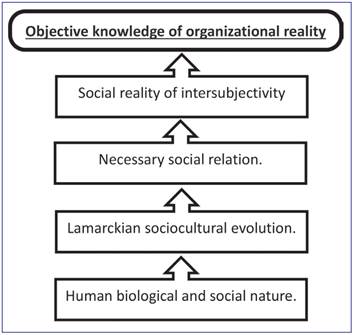 Source: Elaborated by the author.