
 TV Globo: Today is a new day, a new time has begun...
Abstract
Through the trajectory of TV Globo — the country’s leading broadcaster and Latin America’s largest content producer — this case examines Brazil’s media and entertainment industry. It traces the company’s evolution from 1965 to 2019, articulating the formation of its historical leadership, its accumulated strategic commitments, and the period since 2010, when shifts in market dynamics, technology, and audience behavior imposed new challenges that redefined competition, advertising, and content distribution and affected the company's financial performance. The reader takes on the role of Jorge Nóbrega, president of Grupo Globo in 2019, responsible for leading the digital transformation of the network and the conglomerate’s other business units. The case is recommended for postgraduate specialization programs, professional master’s and doctoral degrees, and executive education programs in Business Administration and Accounting, particularly in the areas of business strategy, digital transformation, and corporate finance. Its focus rests on strategic analysis within contexts of digital transition and organizational and economic-financial reconfiguration, exploring how legacy firms seek to balance efficiency and innovation while adapting their structures, processes, culture, and capabilities to sustain competitive advantage in dynamic environments.
Keywords:
TV Globo; strategic commitment (lock-in; lock-out; lags; and inertia); digital transformation; dynamic capabilities; economic-financial reconfiguration
Resumo
A partir da trajetória da TV Globo, principal emissora e maior produtora de conteúdo da América Latina, este caso examina a indústria de mídia e entretenimento no Brasil. O texto apresenta a evolução da empresa de 1965 a 2019, articulando a formação de sua liderança histórica, seus compromissos estratégicos acumulados e o período em que as transformações de mercado, tecnológicas e de comportamento da audiência - especialmente a partir de 2010 - impuseram novos desafios que redefiniram a concorrência, a publicidade, a distribuição de conteúdo e afetaram o desempenho financeiro da empresa. O leitor assume o papel de Jorge Nóbrega, presidente do Grupo Globo em 2019, responsável por conduzir a transformação digital da emissora e das demais unidades de negócio do conglomerado. O caso é recomendado para cursos de pós-graduação lato sensu, mestrados e doutorados profissionais, e programas de educação executiva em Administração e Contabilidade, especialmente nas áreas de estratégia empresarial, transformação digital e finanças corporativas. Seu foco está na análise estratégica em contextos de transição digital e reconfiguração organizacional e econômico-financeira, explorando como empresas com forte legado buscam equilibrar eficiência e inovação na adaptação de suas estruturas, processos, cultura e capacidades para sustentar vantagem competitiva em ambientes dinâmicos.
Palavras-chave:
TV Globo; compromisso estratégico (lock-in; lock-out; defasagens e inércia); transformação digital; capacidades dinâmicas; reconfiguração econômico-financeira
Resumen
A partir de la trayectoria de TV Globo, la principal cadena televisiva y mayor productora de contenidos de América Latina, este caso examina la industria de medios y entretenimiento en Brasil. El texto describe la evolución de la empresa desde 1965 hasta 2019, articulando la formación de su liderazgo histórico, sus compromisos estratégicos acumulados y el periodo en que las transformaciones del mercado, tecnológicas y del comportamiento de la audiencia - especialmente a partir de 2010 - impusieron nuevos desafíos que redefinieron la competencia, la publicidad, la distribución de contenidos y afectaron el desempeño financiero de la empresa. El lector asume el rol de Jorge Nóbrega, presidente del Grupo Globo en 2019, encargado de conducir la transformación digital de la emisora y de las demás unidades de negocio del conglomerado. El caso está recomendado para cursos de especialización de posgrado (lato sensu), maestrías y doctorados profesionales, y programas de educación ejecutiva en Administración y Contabilidad, especialmente en las áreas de estrategia empresarial, transformación digital y finanzas corporativas. Su enfoque se centra en el análisis estratégico de contextos de transición digital y reconfiguración organizacional y económico-financiera, explorando cómo las empresas con un fuerte legado buscan equilibrar eficiencia e innovación al adaptar sus estructuras, procesos, cultura y capacidades para mantener una ventaja competitiva en entornos dinámicos.
Palabras clave:
TV Globo; compromiso estratégico (lock-in; lock-out; desfases e inercia); transformación digital; capacidades dinámicas; reconfiguración económico-financiera
INTRODUCTION
Who killed Odete Roitman? (Braga, 1988)
Jornal Nacional is starting! (TV Globo, 1969)
It’s four, it’s four! Brazil are four-time world soccer champions (Bueno, 1994)
These expressions crossed generations. For decades they were echoed in family conversations, among groups of friends, and along workplace corridors, reflecting Globo’s daily presence in Brazilian life. More than just a source of entertainment or information, the broadcaster shaped habits, produced collective memories, and became a cultural, economic, and strategic reference in the Media and Entertainment (M&E) industry.
One need only recall recent moments, such as the final episode of the remake of Vale Tudo (2025); the images of destruction of the buildings housing Brazil’s three branches of Government (2023); or the Copa Libertadores final between South American soccer teams, Flamengo and River Plate (2019), which was decided in the closing minutes. All were broadcast by Globo, which had led national audience ratings since the 1970s, when 85% of its revenue “came from the roughly 60 minutes of advertising aired during the time slot occupied by telenovelas and the evening newscast” (Rodrigues, 2024, p. 281).
By 2019, Globo had consolidated its position as the largest content producer in Latin America, with a presence in more than 190 countries and multiplatform programming ‒ free-to-air television, streaming, and digital devices ‒ broadcast in HD and 4K HDR. At the time, the company had approximately 12,000 employees and 120 affiliate stations covering 98.6% of Brazil’s national territory (Grupo Globo, 2019).
Yet the path to this position had been far from linear. From the difficulties of the 1960s, through its dominance in the 1970s and 1980s, to the later challenges of the transition to the digital environment, Globo’s trajectory had been marked by continuous adaptation and innovation.
As technology advanced, the game became more dynamic. The internet, social networks, and digital platforms redefined the consumption of media and entertainment, access to content, and the allocation of advertising budgets. Estimates indicated that, between 2020 and 2024, investments in online advertising would grow by 85%, while offline media would increase by only 23% (Deloitte, 2021). In this new competitive environment, companies such as Facebook, Netflix, YouTube, and others began to set the rules of the game, displacing television from the central position it had occupied for half a century.
Faced with this scenario, the Marinho family decided to rethink the group’s strategy. Roberto Irineu, the founder’s son, stepped back from his management role and appointed Jorge Nóbrega as chief executive officer, the first person from outside the family to hold the position. His announcement was direct: “Jorge will be responsible for the results of all the Group’s businesses and for implementing the transformation process already underway” (Memória Globo, 2021a).
It is 2019, and the dilemma is laid on the table awaiting answers to questions such as the following. What kind of transformation should be led ‒ and in which direction? Should Globo accelerate its digital transformation by way of Globoplay and data? Should it defend its leadership position of free-to-air television, whether integrated with streaming or not? Or should it prioritize monetization through licensing? The strategic and financial implications would be profound.
If you were Jorge Nóbrega, what would you do?
1965: Era uma vez... (ONCE UPON A TIME...)
The Marinho family, owner of the newspaper O Globo and Radio Globo, decided to expand into television in 1957, when Roberto Marinho received a concession from the Brazilian government to operate a TV channel. In 1962, a financing and technical cooperation agreement was signed with the American conglomerate Time-Life and, on April 26, 1965, TV Globo, Channel 4 in Rio de Janeiro (RJ), was launched (Clark & Priolli, 2015). With its pinwheel-shaped logo (Figure 1), modern facilities, and state-of-the-art equipment, the broadcaster began operations competing with TV Tupi‒RJ, which had been launched in 1951, TV Rio, launched in 1955, and TV Excelsior-RJ, launched in 1963.
At the time, competition among broadcasters was local, as the idea of a national broadcasting network had not yet been implemented. Globo’s early programming was almost entirely live, but also included American series and films that were suggested by Time-Life. TV Rio, in turn, invested in shows and comedy programs hosted by Chacrinha and Chico Anysio, while TV Tupi stood out for its telenovelas and children’s programs, such as Beto Rockfeller (1968) and Sítio do Picapau Amarelo, broadcast between 1952 and 1963 (Clark & Priolli, 2015; Wallach, 2011). TV Excelsior, for its part, innovated with studio-audience shows, sports programming, an organized program schedule, and a small network linking São Paulo and Rio de Janeiro (Moya, 2004; Ricco & Vannucci, 2017a). In this environment, competition among broadcasters for artists and professionals was intense and, at times, surprising. In 1963, for example, TV Excelsior hired 45 professionals from TV Rio in less than 24 hours (Oliveira, 2011).

Brazilian television operated with limited in-house production. Programs were financed and produced by advertisers, and channels functioned largely as commercial showcases. Advertising breaks had no standardized duration and could extend for seemingly endless minutes (Ricco & Vannucci, 2017a). In its early years, Globo faced serious financial difficulties, accumulating monthly losses of US$250,000; with 700 employees, it often delayed salary payments (Borgerth, 2003). Time-Life regularly sent representatives to Brazil to assess the operation, but they had little understanding of the local context, which generated friction with Roberto Marinho. At that point, Globo ranked fourth and last in audience ratings in Rio de Janeiro.
1966-1971: Plunct, Plact, Zuuum
Faced with TV Globo’s poor results, the Time-Life group sent executive Joe Wallach, who arrived in Brazil in August 1965 to assess the situation. Wallach (2011) identified weaknesses in budget control and a high rate of employee absenteeism. As he analyzed the Brazilian market, he monitored competitors, studied audience reports, and grew closer to Roberto Marinho. He also found that the studios, although new, were unsuitable for entertainment productions because they had been designed for news programming, following the American model (Oliveira, 2011).
Aware that Marinho had acquired TV Paulista, Channel 5, in 1964 with the aim of establishing a future Globo operation in São Paulo, Wallach visited the station and recognized the city’s importance to Brazil’s gross domestic product (GDP) and to the advertising market. However, he also noticed that Globo had no local representation there (Clark & Priolli, 2015). In São Paulo, he met Roberto Montoro and his assistant Walter Clark (Figure 2), both then working at TV Rio, and convinced them to join the broadcaster. Montoro took over commercial management in São Paulo, while Clark became responsible for advertising sales and programming in Rio de Janeiro, under the general direction of Rubens Amaral ‒ a position Clark himself would soon assume (Wallach, 2011).

Walter Clark, known as television’s “boy wonder”, transformed Globo into a content producer, and broke with the previous model in which programs were financed and produced by advertisers (Borgerth, 2003). Upon arriving in December 1965, he identified operational inefficiencies and introduced the concept of “segundagem”, pricing advertisements according to airtime in seconds (Borelli & Priolli, 2000; Ricco & Vannucci, 2017a; Wallach, 2011).
Clark also repositioned the broadcaster’s focus toward lower-income audiences, prioritizing studio-audience programs and entertainment shows, a strategy that would later give way to the Globo Quality Standard (Clark & Priolli, 2015). He recognized telenovelas as highly profitable products and hired Glória Magadan, a writer with an exclusive contract (Oliveira, 2011). In the beginning, and despite their unusual storylines for the Brazilian audience, such as Eu Compro Esta Mulher (1966) and O Sheik de Agadir (1967) that were marked by melodramatic, swashbuckling action, and romantically fantastical plots often set in distant places, telenovelas quickly became the broadcaster’s main attraction (Memória Globo, 2021c).
Together with Wallach, Clark reduced the workforce, introduced Célia Biar as a film presenter, and encouraged the creation of Globo’s own television newscast, Jornal Nacional (1969). Drawing on the strength of the O Globo newspaper and Radio Globo, Clark integrated these media outlets into the strategy for promoting television scheduling, and strengthened the broadcaster’s presence in viewers’ daily lives (Clark & Priolli, 2015).
Clark structured a regular programming schedule, allowing viewers to know exactly when to watch their favorite programs, which reinforced the relationship of trust with the audience (Borelli & Priolli, 2000; Ricco & Vannucci, 2017a). Meanwhile, Embratel, Brazil’s state-owned telecommunications company that was created in 1965, developed the telecommunications infrastructure that made nationwide network broadcasting possible, something that had been a long-standing conviction of Clark and Boni, who had been frustrated in their previous jobs, and supported Globo’s expansion across Brazil, as illustrated in Figure 3 (Oliveira, 2011; Rodrigues, 2024).

Finally, in January 1966, Clark’s coordination of flood coverage in Rio de Janeiro helped build an emotional bond and a relationship of trust between the broadcaster, the city, and its residents (Wallach, 2011). He also created the “sandwich” programming strategy (Figure 4), placing Jornal Nacional between telenovelas, a formula that secured the loyalty of millions of viewers (Borelli & Priolli, 2000).

In 1976, approximately 85% of the broadcaster’s revenue came from 60 minutes of advertising aired during telenovelas and newscast time slots (Rodrigues, 2024). In 1978, while the entertainment sector as a whole saw its average return on equity grow by 31.6%, Globo’s rate increased by 51.7%. By the end of 1979, the company’s total revenue was estimated to have already exceeded Cr$1 billion per month (IstoÉ, 1980). And, in 1981, Globo accounted for 75% of all investments in television advertising (Figure 5), a figure that would decline by 5 percentage points by 1994, but still represent 57% of the total television advertising market (Borelli & Priolli, 2000; Globo, 1996).

Alongside the growth in the number of television sets in Brazil (Figure 6), TV Globo became part of Brazilian families’ daily routines in the years that followed, with telenovelas and Jornal Nacional becoming audience phenomena. The executive team had planned to achieve national leadership in five years - by 1972 - but reached that goal in only three, in 1970, thus consolidating the beginning of a trajectory marked by discipline, innovation, and excellence (Oliveira, 2015).

1972-1989: A Indomada (the untamed)
While Clark conceived the programs and defined their time slots, José Bonifácio de Oliveira Sobrinho, known as “Boni” (see Figure 2), gave them shape in production. Like Clark, before joining Globo Boni had accumulated experience in advertising, radio, and television (Oliveira, 2011). His hallmark was seriousness, creativity, and rigor (Figure 7).
From the moment he arrived in 1967 at Clark’s invitation, Boni demanded better infrastructure and modern equipment. Over time, he also took on responsibility for programming strategy. For Boni, there was no middle ground: everything was either “perfect or crap.” He argued that details were as important as the whole (Borgerth, 2003). Initially hired as director of programming and production, he became superintendent, and expanded his responsibilities to engineering, journalism, and communications. After Clark left in 1977 and Wallach in 1980, Boni was promoted to become vice-president of operations, a position he held until 1997, during which time he led the broadcaster’s technological transformation (Oliveira, 2011).

While Clark was revitalizing Globo in Rio de Janeiro, Boni took charge of the operation in São Paulo. Unlike the Rio unit, the São Paulo operation was precarious, in a market dominated by Record (1953) and Excelsior (1960), with Tupi (1950) also competing for space (see Figure 10).
The executive team had already identified that São Paulo had a robust advertising market but lacked high-quality television content. Another challenge was the obsolete transmitter on Pico do Jaraguá, which would only be replaced in 2007 by a new facility on Avenida Paulista (Oliveira, 2011).
A crucial factor in Globo’s success, especially in telenovelas, was the creation of soundtracks. In 1969, the broadcaster created Sistema Globo de Gravações Audiovisuais Ltda. (SIGLA), responsible for managing this service in partnership with Som Livre. The first soundtrack, for O Cafona (1971), launched a series of successes that enriched the program schedule and deepened the audience’s connection with the characters (Grupo Globo História, 2022).
In addition to Clark and Boni, other professionals joined Globo and left their mark on the company’s trajectory. Daniel Filho revolutionized the telenovela production model by introducing technical innovations (Figure 8), and was also responsible for landmark specials, musicals, and comedy programs (Oliveira, 2011). German designer Hans Donner created the broadcaster’s visual identity, including the logo that was adopted from 1975 onward (see Figure 1), as well as iconic visual openings such as those for Fantástico and Globeleza (Ricco & Vannucci, 2017b). In journalism, Armando Nogueira and Alice-Maria structured Jornal Nacional (Oliveira, 2011). In drama production, Janete Clair and Dias Gomes ‒ also a couple in their personal lives ‒ were responsible for creating telenovelas. In engineering, Adilson Pontes Malta led the technical solutions, while João Carlos Magaldi worked in communications and Homero Icaza Sánchez directed audience research. This logic would become one of the broadcaster’s defining traits: bringing together some of the best professionals in the market in areas that were decisive for its growth and consolidation.

The arrival of color television in 1972 made visible the standard that Globo had been consolidating since the formation of its executive team. Many attribute the creation of the Globo Quality Standard (GQS) to Boni; according to him, however, it was the result of a collective effort to achieve excellence and an intolerance of repeated mistakes. Borelli and Priolli (2000, p. 79) define it as an “articulation between a production standard, technology, and a specific proposal, capable of creating a personality in programming that, at a given moment, is accepted as the best by producers and receivers.”
In practice, the GQS consisted of a set of technical, creative, and organizational routines that structured the broadcaster’s production processes and supported its ability to produce content in an industrial, regular, predictable, and consistent manner. This standard enabled Globo to respond in a balanced way to its viewers’ diverse needs ‒ entertainment, information, emotion, fantasy, and aesthetics ‒ while also expressing the company’s organizational culture. This interpretation appears in the broadcaster’s institutional material based on a critical analysis by Artur da Távola (Rede Globo, 1984).
Built on three interdependent pillars ‒ qualified professionals, a robust infrastructure, and a culture of excellence ‒ the GQS generated a widely recognized reputation in the national market, attracted audiences and enabled strategic partnerships, thereby consolidating itself as one of Globo’s main competitive advantages (Leão Féres & Pereira, 2025).
This capability became evident in the number of telenovelas produced during the 1980s (Figure 9), as well as in the audiences they attracted. In 1985, in the city of São Paulo, prime time began with 56 rating points for A Gata Comeu, rose to 63 with Ti-ti-ti, and reached 74 audience rating points1 with Roque Santeiro (Borelli & Priolli, 2000).

Between the 1970s and 1980s, Globo consolidated its hegemony by acquiring new equipment, adopting modern production processes, using a strategic programming schedule, professionally selling advertising breaks, employing the use of videotape, and undertaking systematic audience research. These advances positioned the broadcaster as a national benchmark, with audiovisual productions comparable to those of Hollywood, thus ensuring audience growth and a sustainable competitive advantage (Figures 10 and 11).

Broadcasters’ share of recalled television audience (%) | Greater Rio de Janeiro | 1960-1984
During this period, major telenovelas were produced, including Irmãos Coragem (1970), Selva de Pedra (1972), O Bem-Amado (1973), Gabriela and Pecado Capital (1975), Escrava Isaura (1976), O Astro (1977), Dancin’ Days (1978), Guerra dos Sexos (1983), Vale Tudo (1988), and Tieta (1989), many of which were sold internationally.
In addition to telenovelas, many iconic programs were launched across different genres. In comedy, these included Chico City (1973), starring Chico Anysio; Faça Humor Não Faça Guerra (1970) and Viva o Gordo (1981), both starring Jô Soares; and Os Trapalhões (1977). In entertainment, Globo launched the television variety magazine, Fantástico (1973), the sports program, Esporte Espetacular (1973), the musical special, Roberto Carlos Especial (1974), and Vale a Pena Ver de Novo (1980), which was dedicated to the reruns of telenovelas. In children’s programming, the broadcaster launched Xou da Xuxa (1986). Finally, in journalism, the broadcaster launched Jornal Hoje (1971), Globo Repórter (1973), Globo Rural (1980), and the local newscasts, SPTV and RJTV (1983).

By 1977, Globo was already producing 75% of its own programs (Borelli & Priolli, 2000). Their quality was recognized in 1979, when the broadcaster was awarded the title of the world’s best television station at Salute-79 by the National Academy of Television Arts and Sciences in the United States (Herz, 1987).
1990-1999: Fera Ferida (wounded beast)
Throughout the 1970s and 1980s, TV Globo consolidated its position as the leader of Brazilian television, when it achieved a prime-time audience share of more than 90%, due both to the quality of its programs and to its “sandwich” programming strategy (Bolaño, 2004; Borelli & Priolli, 2000). One indication of the power of this formula was an unusual episode involving Cid Moreira - one of the anchors of Jornal Nacional - in a shopping mall in Rio de Janeiro. A woman approached him and asked whether he was Sérgio Chapelin - his co-anchor on the newscast. She then made a curious request: “Could you perhaps read the news faster? In that way, the telenovela would start sooner” (Rodrigues, 2024).
From the 1990s onward, however, Globo began to face fiercer competition at prime time, a slot previously dominated almost exclusively by its telenovelas. Manchete, launched in 1983, broke this dominance with Pantanal (1990), which stood out because of its use of natural settings and regional themes, and was the first telenovela produced by another broadcaster to surpass Globo in audience ratings (Borelli & Priolli, 2000). SBT ‒ launched in 1981, although operating since 1976 as TVS in Rio de Janeiro ‒ also competed for audience share with popular attractions such as Aqui Agora (1991) and Programa do Ratinho (1998), which relied on a more sensationalist and popular style, while Record, after being acquired by Edir Macedo in 1989, began to structure a programming schedule similar to Globo’s.

Share of national audience held by the main Brazilian networks from 7 a.m. to midnight (%) | 1990-1999
In parallel, broadcasters also diversified their programming. SBT invested in productions for teenagers and families, such as Carrossel (1991), Marimar (1996), Programa Livre (1991), and Chiquititas (1997). TV Cultura stood out with Castelo Rá-Tim-Bum (1994), while Band gained space through its coverage of various sports, an effort that had begun in the 1980s.
In addition, the number of television sets almost doubled between 1994 and 1998, going from 31 million to 59 million (see Figure 6). As a result, part of the audience began to migrate to other channels (Borelli & Priolli, 2000; Rodrigues, 2024). Despite these changes, Globo maintained its leadership, although with a partial loss of audience share (Figure 12).
Internally, the broadcaster underwent an important transition: Boni’s departure made way for Marluce Dias, who was appointed director general in 1998 (see Figure 17). Her management was marked by organizational reengineering aimed at reducing costs and increasing profitability, while encouraging greater employee commitment to results. Between 1991 and 1997, while she was the executive superintendent, the broadcaster’s revenue tripled and profits increased, thus ensuring solidity in the face of competitive pressure (Brittos, 2000).
During this period, the remote control, videocassette recorders, video games and pay television, also gained in popularity, which diversified the role of the television set and fragmented public attention. According to Borelli and Priolli (2000), in the early 1990s, access to television sets with remote controls began to expand among lower-income segments. Between 1993 and 1996, the share of television sets sold with them increased from 31% to 53%. This movement favored the emergence of a new audience profile: the zapper, a viewer who constantly switched between channels, whether because of an aversion to commercials or because of behavioral traits such as compulsiveness, curiosity, dissatisfaction, and a continuous search for visual stimuli. Sales of videocassette recorders, which totaled 494,000 units in 1989, reached 1.2 million in 1994 and 2.4 million in 1997. In 1989, the number of video game consoles in Brazil rose from 130,000 to 400,000 units and, by 1993 had reached 4.5 million. Finally, pay television subscriptions increased from 250,000 in 1993 to 1 million in 1995 and reached 2.5 million subscribers in 1997.
Even so, the broadcaster once again delivered landmark productions such as Rainha da Sucata and Barriga de Aluguel (1990), Vamp (1991), Mulheres de Areia (1993), A Viagem (1994), O Rei do Gado (1996), Por Amor and A Indomada (1997), and Terra Nostra (1999). Globo also maintained its pace of innovation. It launched the first interactive program on Brazilian television, Você Decide (1992), in which the audience chose the ending of the stories in real time. In 1995, after nearly 10 years between conception and execution and at an estimated cost of US$350 million, the broadcaster inaugurated the Jacarepaguá Project (Projac) ‒ Figure 13 ‒ which centralized a production structure that, during the 1980s, had been spread across 40 different locations, and consolidated one of the largest television production complexes in the world (Borelli & Priolli, 2000; Ricco & Vannucci, 2017b).

2000-2014: CAMBALACHO (TRICKERY)
At the turn of the new millennium, in response to the audience fragmentation that had begun in the 1990s, TV Globo resorted to a classic strategy in the industry: attracting talent from competing broadcasters (Figure 14). Between 1999 and 2000, Globo hired Ana Maria Braga from Record, Luciano Huck from Band, and Serginho Groisman and Jô Soares from SBT. The move weakened its rivals and generated iconic programs, such as Mais Você, Caldeirão do Huck, Altas Horas, and Programa do Jô, some of which would figure among the longest-running programs in Brazilian television.

In the early 2000s, the broadcaster invested in reality shows such as No Limite, Big Brother Brasil, Hipertensão, and Fama (Figure 15). Of these, only Big Brother Brasil prevailed, becoming a phenomenon with 26 editions to date. During the 2000s, the internet ‒ introduced in Brazil in 1988 ‒ grew rapidly, and competed for an audience that had once been captive to television.


At the end of 2009, Globo recorded revenue of R$7 billion, equivalent to 73.5% of the total free-to-air television advertising revenue (Jimenez, 2010). Between 2002 and 2012, Octávio Florisbal (Figure 17) led the broadcaster, guiding it through the internet boom and the first wave of digital convergence in the M&E industry. His strategic vision prioritized Globo’s online expansion (Table 1), the modernization of production, and the exploration of new formats such as reality shows. It also reinforced the connection with younger audiences and the diversification of content. His management stood out because of its focus on people, strategy, and innovation, thereby promoting integration between teams and proximity to professionals. This philosophy guided company’s strategic planning, with clear goals shared across areas and between directors (Rosa, 2024).

The following years would be marked by changes in programming, the departure of major names, and the celebration of long-running programs such as Jornal Hoje, Globo Repórter, and Esporte Espetacular, which would reach their 40th anniversaries.
In 2012, the telenovela Avenida Brasil, became a cultural and commercial phenomenon. Broadcast to approximately 46 million daily viewers, with a 65% audience share, it mobilized the country to such an extent that the government warned of a possible blackout during the final episode. With advertisers paying up to US$400,000 for 30 seconds and total revenue estimated at R$2 billion, this telenovela exceeded its US$45 million production cost by almost 20 times, thus consolidating its standing as the most profitable telenovela in the history of Brazilian television (Antunes, 2012).
2015-2019: VALE TUDO - Você, Como, Quando e Onde quiser... (ANYTHING GOES - ANY WAY, ANY TIME, ANYWHERE...)
On November 3, 2015, Globo launched its streaming service, Globoplay, which initially allowed users to watch programs from the previous day (G1, 2015). The initiative represented another step in the broadcaster’s digital expansion (Table 1). By 2016, the app had already recorded more than 10 million downloads, thus consolidating itself as one of Brazil’s leading digital platforms.
Between 2013 and 2019, director general Carlos Henrique Schroder (Figure 17) played a decisive role in Globo’s restructuring. He promoted discussion groups, encouraged creativity, and stimulated communication across areas. With the support of writers, directors, and producers, he anticipated decisions about products and formats that integrated entertainment and technology. Under his leadership, the broadcaster consolidated Globoplay’s position and began the transition toward a new business model that would become known as mediatech (Memória Globo, 2021e).
At the same time, Netflix, then with 6 million subscribers in Brazil, commissioned a study showing that Brazilians watched streaming mainly at lunchtime and at 9 p.m. ‒ a peak-audience time slot. In 2018, the service had 10 million subscribers in the country (Figure 18) and began competing with Amazon Prime Video, Fox+, YouTube, HBO Go, and Watch ESPN. During the same period, pay television lost approximately 550,000 customers, while Netflix advanced rapidly (Braga, 2019).

In 2017, YouTube published a report based on 5,450 interviews with members of Brazil’s A, B, and C socioeconomic classes. The report showed that audience levels were comparable to those of radio and that content consumption was concentrated in music, food, gaming, fashion, beauty, and soccer (Table 2), patterns that helped consolidate the platform as a new center of attention in digital media (Ciriaco, 2017).
Globo also continued to play an important role in both live content and fiction. In 2016, it broadcast the impeachment of President Dilma Rousseff, which reinforced its journalistic strength. The following year, the telenovela A Força do Querer, restored the prestige of prime time TV when it received 50 rating points for its final episode, generated nearly 600,000 mentions on Twitter, and prompted more than 50,000 Google searches for actor Jonathan Azevedo (Bittencourt, 2017).
According to its 2018 financial statements, the broadcaster reduced its operating cash generation by 38% ‒ from R$2.3 billion to R$1.4 billion ‒ due to heavy investments in Globoplay, both in content and technology. Despite its late entry into streaming, the Group planned to invest at the same pace for a decade, thereby prioritizing Globoplay over its other business units (Sá, 2019).
In 2019, Globoplay began offering live programming, both nationally and regionally depending on availability, and on-demand content via two models:
-
Free users: excerpts from programs.
-
Premium users: the full catalog, including original and international productions.
The subscription price rose from R$12.90 in 2015 to R$19.90 in 2019. The platform was available on iOS, Android, Smart TVs (LG, Samsung, Sony, Philips, Panasonic), and Chromecast. “Grupo Globo’s vision is that in the medium term the streaming area will be as important for revenue as TV Globo and Globosat,” said João Mesquita, president of Globoplay (Jankavski, 2019, p. 34).
Jornal Nacional celebrated its 50th anniversary in 2019, when it was still ranked among the broadcaster’s most expensive programs for commercial placement (Table 3). In that same year, Globo signed an agreement with the state-owned China Media Group for cooperation in film, television, sports, entertainment, and 4K, 8K, and 5G technologies (Sá, 2019). It also inaugurated Recording Module 4, an investment of more than R$200 million, with three new studios covering 26,000 m² and equipped with state-of-the-art technology for the development of entertainment content ‒ with a special focus on telenovelas ‒ thus underlining Globo Studios’ position as having the largest audiovisual complex in Latin America (G1, 2019).
At the same time, technological advances accelerated the transformation of audiences. Digital television replaced analog broadcasting, series surpassed films in popularity, and Generation Z grew up immersed in mobile devices and social networks (Figure 19).

In 2019, 71% of Brazilian households had internet access ‒ a figure that at first glance suggested a broad and democratic connectivity. Figure 20, however, reveals a much more complex reality.

According to Calicchio et al. (2019), this access predominantly used 3G/4G networks, with 90% via smartphone, and concentrated among people aged 16 to 24 (25%) and 25 to 34 (28%), which drove the consumption of video on demand (Figure 21).

In this new environment, services such as iFood, Spotify, Uber, WhatsApp, and video streaming platforms became symbols of digital culture. Netflix was already recording revenue higher than that of SBT in the Brazilian market in 2018, signaling a shift in the competitive center of gravity (Calicchio et al., 2019; Ribeiro, 2019) and contributing to higher audiences for “other channels” (see Figure 16).

Ownership and use of smart TVs increased (Figure 22), but average time spent watching linear TV also grew (Figure 23), varying between 36 and 39 minutes before viewers changed channels, indicating audience loyalty (Kantar Ibope Media, 2023). A striking example was the Copa Libertadores [soccer] final between Flamengo and River Plate, which recorded 33 rating points and a 54% share on Globo, reaching more than 6 million viewers (Bittencourt, 2021).

On the other hand, the average daily time dedicated to television differs significantly across Brazilian regions, as shown in Figure 24.

Viewing habits also vary by generation. While Generation X still preferred cable or satellite television, Millennials and Generation Z were migrating to online platforms and multiple devices, such as smartphones, tablets, and smart TVs (Figure 25).

2020-2035: SENHORA DO DESTINO (THE LADY OF DESTINY)
Between 2000 and 2006, TV Globo reached its highest levels in recent history, with a reach of 90% and a share above 50% in São Paulo. From 2007 onward, however, a structural decline began: share fell from 50.1 points in 2004 to 31 points in 2015, reach dropped from 90% to 70% in 2014, and average daily audience declined from 21.7 points in 2004 to a period low of 13.5 points in 2014. A slight recovery between 2016 and 2017 did not reverse the trend, however, and its share closed at 32.5% and reach at 72% in 2019. Globo still remained the leader, but with systematically lower numbers than a decade earlier, signaling that its stable leadership position had been eroded in a fragmented and unpredictable digital environment (Castro, 2023).
This shift can be attributed, at least in part, to five structural changes in the competitive environment. First, free-to-air television broadcasters improved the quality of their transmissions and diversified their programming. Second, internet access transformed consumption habits and formats, with two in every three Brazilians connected and 90% accessing the internet via a smartphone, with online time increasing to nine hours per day (Calicchio et al., 2019). Third, global-scale “competitors” emerged, such as Netflix, Amazon Prime Video, Disney+, and YouTube, offering on-demand content and giving users greater control. Fourth, social networks and apps became alternative centers of attention, with Facebook and WhatsApp each exceeding 120 million users in Brazil alone (Calicchio et al., 2019). Fifth, advertising budgets migrated online. From 2015 onward, digital investments grew, while spending on free-to-air television declined (Deloitte, 2021). Projections indicated that, between 2020 and 2024, online advertising would continue to expand, in contrast with the slower pace of offline media (Figure 26).

Distribution of advertising expenditure by media vehicle (%) | Brazil | 2015, 2019 and 2020
These changes altered the historical balance between scale, audience, and profitability, forcing TV Globo to redefine its value proposition and business model. This new competitive landscape affected the Globo Group as a whole, prompting it to seek new forms of monetization and intensify its use of data and technology to sustain its relevance.
In 2018, the Globo Group embarked on a ten-year strategic transition (2018-2028), with an interim monitoring phase beginning in 2023.2 In this context, Jorge Nóbrega became the first executive from outside the family to serve as president, charged with balancing continuity and reinvention.
It is worth remembering that TV Globo will celebrate its 70th anniversary in 2035. What that future will look like depends, to a large extent, on the decisions being made now. The dilemma was clear: How could Globo reconfigure its historical portfolio in the face of digital competition while preserving its competitive advantage?
The new management team needed to decide whether to: accelerate digital transformation through Globoplay and data-driven initiatives; defend Globo’s leadership in live free-to-air television, integrated with streaming and digital channels; maintain free-to-air television as a model independent of digital media; prioritize monetization through licensing; or combine these strategies into a hybrid model. If you were Jorge Nóbrega, what would you do?
ACKNOWLEDGMENTS
The authors thank the anonymous reviewers and the entire editorial team for their valuable contributions, careful reviews, and dedicated support throughout the process. They also express their gratitude to Adalto Barbaceia for serving as the bridge that brought them together and made this collaboration possible. The first author extends special thanks to Adriana Takahashi, David Wong, Giancarlo Pereira, Julia Benavides, Kenyth Freitas, Luciana Ferreira, Miriam Pereira, Paulo Francoti, Pedro Cortonesi, Thomaz Martins, and Wagner Barreira for their attentive readings, generous critiques, and valuable suggestions during the development of the initial versions of this work, whose development began in 2018. He also acknowledges Juliana Bonomi for her strategic encouragement, which was decisive for the submission and redirection of this manuscript.
References
-
Andrade, V. (2019, 9 de julho). Quanto custa anunciar na Globo? Comercial no JN vale mais de R$ 1,3 mi Notícias da TV/UOL. https://noticiasdatv.uol.com.br/noticia/televisao/quanto-custa-anunciar-na-globo-comercial-no-jn-vale-mais-de-r-13-mi-27923
» https://noticiasdatv.uol.com.br/noticia/televisao/quanto-custa-anunciar-na-globo-comercial-no-jn-vale-mais-de-r-13-mi-27923 -
Antoniutti, C. L. (2019). Globoplay: um estudo sobre a plataforma de video on demand da Rede Globo. PAULUS: Revista de Comunicação da FAPCOM, 3(6), 105-119. https://revista.fapcom.edu.br/index.php/revista-paulus/article/view/119
» https://revista.fapcom.edu.br/index.php/revista-paulus/article/view/119 -
Antunes, A. (2012, 19 de outubro). Brazilian telenovela ‘Avenida Brasil’ makes billions by mirroring its viewers’ lives Forbes. https://www.forbes.com/sites/andersonantunes/2012/10/19/brazilian-telenovela-makes-billions-by-mirroring-its-viewers-lives/
» https://www.forbes.com/sites/andersonantunes/2012/10/19/brazilian-telenovela-makes-billions-by-mirroring-its-viewers-lives/ -
Becker, V., Gambaro, D., & Souza, G. L., Filho. (2015). O impacto das mídias digitais na televisão brasileira: queda da audiência e aumento do faturamento. Palabra Clave, 18(2), 341-373. https://doi.org/10.5294/pacla.2015.18.2.3
» https://doi.org/10.5294/pacla.2015.18.2.3 -
Bittencourt, C. (2017, 24 de outubro). Último capítulo de ‘A força do querer’ marca 49 pontos no Rio Extra. https://extra.globo.com/tv-e-lazer/telinha/ultimo-capitulo-de-forca-do-querer-marca-49-pontos-no-rio-21982369.html
» https://extra.globo.com/tv-e-lazer/telinha/ultimo-capitulo-de-forca-do-querer-marca-49-pontos-no-rio-21982369.html -
Bittencourt, C. (2021, 3 de fevereiro). Final de Libertadores de 2019, na Globo, é maior que a exibida no SBT Extra. https://extra.globo.com/tv-e-lazer/telinha/final-de-libertadores-de-2019-na-globo-maior-que-exibida-no-sbt-24866911.html
» https://extra.globo.com/tv-e-lazer/telinha/final-de-libertadores-de-2019-na-globo-maior-que-exibida-no-sbt-24866911.html - Bolaño, C. R. S. (2004). Mercado brasileiro de televisão EDUC.
- Bolaño, C. R. S., & Brittos, V. C. (2007). A televisão brasileira na era digital: Exclusão, esfera pública e movimentos estruturantes Paulus.
- Borelli, S. H. S., & Priolli, G. (2000). A deusa ferida: por que a Rede Globo não é mais a campeã de audiência Summus.
- Borgerth, L. E. (2003). Quem e como fizemos a TV Globo Girafa.
- Braga, G. (1988). Vale tudo Telenovela. TV Globo.
-
Braga, L. (2019, 29 de fevereiro). TV por assinatura perdeu quase 550 mil assinantes em 2018, segundo Anatel Tecnoblog. https://tecnoblog.net/noticias/anatel-dados-tv-paga-2018/
» https://tecnoblog.net/noticias/anatel-dados-tv-paga-2018/ -
Brittos, V. C. (2000). As Organizações Globo e a reordenação das comunicações. Intercom - Revista Brasileira de Ciências da Comunicação, 23(1), 57-76. https://revistas.intercom.org.br/index.php/revistaintercom/pt_BR/article/view/2005
» https://revistas.intercom.org.br/index.php/revistaintercom/pt_BR/article/view/2005 - Bueno, G. (1994, 17 de julho). Narração da final da Copa do Mundo de 1994 Transmissão esportiva. TV Globo.
-
Calicchio, N., Dias, Y., Lombardi, J., Mansur, M., Fleury, M., Carneiro, A., Berbel, J., Barbosa, G., Coutinho, A., Dare, C., Craddock, C., Sertorio, C., Boaretto, F., Carvalho, F., Broide, J., & Galache, J. (2019). Brazil digital report McKinsey & Company. https://www.mckinsey.com/br/~/media/mckinsey/locations/south%20america/brazil/our%20insights/brazil%20digital%20report/brazil-digital-report-1st-edition_portuguese-vajustado.pdf
» https://www.mckinsey.com/br/~/media/mckinsey/locations/south%20america/brazil/our%20insights/brazil%20digital%20report/brazil-digital-report-1st-edition_portuguese-vajustado.pdf -
Castro, D. (2015, 26 de abril). TV era feita por ‘loucos’ quando a Globo foi criada, lembra Boni Notícias da TV/UOL. https://noticiasdatv.uol.com.br/noticia/televisao/tv-era-feita-por-loucos-quando-a-globo-foi-criada-lembra-boni-7575
» https://noticiasdatv.uol.com.br/noticia/televisao/tv-era-feita-por-loucos-quando-a-globo-foi-criada-lembra-boni-7575 -
Castro, D. (2017, 5 de setembro). Consumo de TV explode, e Globo e Record têm melhor ano desde 2011 Notícias da TV/UOL. https://noticiasdatv.uol.com.br/noticia/televisao/consumo-de-tv-explode-e-globo-e-record-tem-melhor-ano-desde-2011--16660
» https://noticiasdatv.uol.com.br/noticia/televisao/consumo-de-tv-explode-e-globo-e-record-tem-melhor-ano-desde-2011--16660 -
Castro, D. (2023, 26 de abril). Demissões e prejuízo: Globo chega aos 58 anos a caminho do desastre? Notícias da TV/UOL. https://noticiasdatv.uol.com.br/noticia/daniel-castro/demissoes-e-prejuizo-globo-chega-aos-58-anos-a-caminho-do-desastre-101441
» https://noticiasdatv.uol.com.br/noticia/daniel-castro/demissoes-e-prejuizo-globo-chega-aos-58-anos-a-caminho-do-desastre-101441 - Centro de Estudos de Opinião Pública. (2008). IBOPE - Série histórica: Televisão anos 1950 e 1960. Opinião Pública, 14(2), 515-545.
-
Ciriaco, D. (2017, 25 de julho). YouTube é acessado por 95% da população online brasileira, mostra relatório Tecmundo. https://www.tecmundo.com.br/internet/119776-youtube-insights-brasil.html
» https://www.tecmundo.com.br/internet/119776-youtube-insights-brasil.html -
Cirino, F. (2024, 14 de agosto). Octávio Florisbal morre aos 84 anos e deixa marcante legado na Globo Ofuxico. https://ofuxico.com.br/morte/octavio-florisbal-morre-aos-84-anos-e-deixa-marcante-legado-na-globo/
» https://ofuxico.com.br/morte/octavio-florisbal-morre-aos-84-anos-e-deixa-marcante-legado-na-globo/ - Clark, W., & Priolli, G. (2015). O campeão de audiência: uma autobiografia Summus.
- Daniel, J. C., Filho. (2001). O circo eletrônico: Fazendo TV no Brasil. Zahar.
-
Deloitte. (2021). O valor da publicidade no Brasil: o impacto do setor nos negócios, na economia e na sociedade https://www.abap.com.br/wp-content/uploads/2021/09/deloittevalorpublicidadeptdigital.pdf
» https://www.abap.com.br/wp-content/uploads/2021/09/deloittevalorpublicidadeptdigital.pdf -
Estrelando. (2023, 9 de outubro). Relembre a carreira de Luciano Huck antes e depois da Globo!https://www.estrelando.com.br/foto/2023/10/09/luciano-huck-relembra-seu-primeiro-programa- meu-figurino-calca-de-couro-compare-a-carreira-do- apresentador -antes-e-depois-da-globo-179896/foto-7
» https://www.estrelando.com.br/foto/2023/10/09/luciano-huck-relembra-seu-primeiro-programa- meu-figurino-calca-de-couro-compare-a-carreira-do- apresentador -antes-e-depois-da-globo-179896/foto-7 - Globo. (1996). Rede Globo 30 anos: Uma história ilustrada
-
G1. (2015, 26 de outubro). Globoplay é lançado; conheça nova plataforma digital de vídeos da Globo https://g1.globo.com/tecnologia/noticia/2015/10/globoplay-nova-plataforma-digital-de-videos-da-globo-e-lancado.html
» https://g1.globo.com/tecnologia/noticia/2015/10/globoplay-nova-plataforma-digital-de-videos-da-globo-e-lancado.html -
G1. (2019, 8 de agosto). Globo inaugura o MG4, conjunto de 3 novos estúdios que amplia o maior complexo de produção de conteúdo da América Latina https://g1.globo.com/rj/rio-de-janeiro/noticia/2019/08/08/globo-inaugura-o-mg4-conjunto-de-3-novos-estudios-que-amplia-o-maior-complexo-de-producao-de-conteudo-da-america-latina.ghtml
» https://g1.globo.com/rj/rio-de-janeiro/noticia/2019/08/08/globo-inaugura-o-mg4-conjunto-de-3-novos-estudios-que-amplia-o-maior-complexo-de-producao-de-conteudo-da-america-latina.ghtml - Grupo Globo. (2019). Release institucional Globo.
-
Grupo Globo História. (2022, 10 de março). Outras empresas https://historia.globo.com/memoria-roberto-marinho/empresas/noticia/outras-empresas.ghtml
» https://historia.globo.com/memoria-roberto-marinho/empresas/noticia/outras-empresas.ghtml -
Grupo Globo História. (2025, 30 de junho). TV Globo https://historia.globo.com/memoria-roberto-marinho/empresas/noticia/tv-globo.ghtml
» https://historia.globo.com/memoria-roberto-marinho/empresas/noticia/tv-globo.ghtml -
Gshow. (2014, 4 de outubro). Relembre 14 looks da Ana Maria nesses 15 anos de Mais Você https://gshow.globo.com/programas/mais-voce/So-na-web/noticia/2014/10/relembre-14-looks-da-ana-maria-nesses-15-anos-de-mais-voce.html
» https://gshow.globo.com/programas/mais-voce/So-na-web/noticia/2014/10/relembre-14-looks-da-ana-maria-nesses-15-anos-de-mais-voce.html - Herz, D. (1987). A história secreta da Rede Globo Tchê!.
-
Hopewell, J. (2016, 23 de fevereiro). Brazilian giant Globo reveals first results, strategies of new VOD service GloboPlay (exclusive) Variety. https://variety.com/2016/tv/global/globo -vod-globo-play-1201712749/
» https://variety.com/2016/tv/global/globo -vod-globo-play-1201712749/ -
Interactive Advertising Bureau Brasil. (2021). Guia de vídeo digital, streaming e TV conectada https://iabbrasil.com.br/wp-content/uploads/2021/06/IAB-BRASIL_GUIA-DE-VIDEO-DIGITAL-STREAMING-E-CTV_V6.pdf
» https://iabbrasil.com.br/wp-content/uploads/2021/06/IAB-BRASIL_GUIA-DE-VIDEO-DIGITAL-STREAMING-E-CTV_V6.pdf -
Internet Movie Database. (s. d.). Jô Soares in Viva o Gordo (1981) Fotografia. https://www.imdb.com/pt/name/nm0811666/mediaviewer/rm699215616/
» https://www.imdb.com/pt/name/nm0811666/mediaviewer/rm699215616/ - IstoÉ. (1980, 16 de janeiro). A nova TV brasileira (edição nº 188).
-
Jankavski, A. (2019). Estão todos contra a Netflix. Isso é bom para o consumidor? Exame. https://exame.com/revista-exame/todos-contra-a-netflix/
» https://exame.com/revista-exame/todos-contra-a-netflix/ -
Jimenez, K. (2010, 25 de março). Globo fatura R$ 7 bilhões em 2009 Estadão. https://www.estadao.com.br/cultura/globo-fatura-r-7-bilhoes-em-2009/
» https://www.estadao.com.br/cultura/globo-fatura-r-7-bilhoes-em-2009/ -
Kantar Ibope Media. (2020). Inside TV: Experiência, influência e as novas dimensões do vídeo https://kantaribopemedia.com/wp-content/uploads/2020/03/Kantar-IBOPE-Media_Inside-TV_2020.pdf
» https://kantaribopemedia.com/wp-content/uploads/2020/03/Kantar-IBOPE-Media_Inside-TV_2020.pdf -
Kantar Ibope Media. (2023). Inside video: Vídeo, estado de evolução https://kantaribopemedia.com/wp-content/uploads/2023/03/Kantar-IBOPE-Media_Inside-Video-2023.pdf
» https://kantaribopemedia.com/wp-content/uploads/2023/03/Kantar-IBOPE-Media_Inside-Video-2023.pdf -
Leão Féres, W., & Pereira, G. da S. R. (2025). Globoplay: Você decide!. Cadernos EBAPE.BR, 23(5), e2025-0007. https://doi.org/10.1590/1679-395120250007
» https://doi.org/10.1590/1679-395120250007 - Mattos, S. (2010). História da televisão brasileira: Uma visão econômica, social e política. Vozes.
-
Meio & Mensagem. (2025, 18 de dezembro). Quanto irá valer o ponto de audiência em 2026?https://www.meioemensagem.com.br/midia/quanto-ira-valer-o-ponto-de-audiencia-em-2026
» https://www.meioemensagem.com.br/midia/quanto-ira-valer-o-ponto-de-audiencia-em-2026 -
Memória Brasil. (2021, 29 de outubro). Joe Wallach https://memoriaglobo.globo.com/perfil/joe-wallach/noticia/joe-wallach.ghtml
» https://memoriaglobo.globo.com/perfil/joe-wallach/noticia/joe-wallach.ghtml -
Memória Globo. (2021a, 28 de outubro). Jorge Nóbrega https://memoriaglobo.globo.com/perfil/jorge-nobrega/noticia/jorge-nobrega.ghtml
» https://memoriaglobo.globo.com/perfil/jorge-nobrega/noticia/jorge-nobrega.ghtml -
Memória Globo. (2021b, 29 de outubro). Glória Magadan Globo. https://memoriaglobo.globo.com/perfil/gloria-magadan/noticia/gloria-magadan.ghtml
» https://memoriaglobo.globo.com/perfil/gloria-magadan/noticia/gloria-magadan.ghtml -
Memória Globo. (2021c, 29 de outubro). Atentados de 11 de setembro https://memoriaglobo.globo.com/jornalismo/coberturas/atentados-de-11-de-setembro/noticia/atentados-de-11-de-setembro-1.ghtml
» https://memoriaglobo.globo.com/jornalismo/coberturas/atentados-de-11-de-setembro/noticia/atentados-de-11-de-setembro-1.ghtml -
Memória Globo. (2021d, 29 de outubro). Marluce Dias https://memoriaglobo.globo.com/perfil/marluce-dias/noticia/marluce-dias.ghtml
» https://memoriaglobo.globo.com/perfil/marluce-dias/noticia/marluce-dias.ghtml -
Memória Globo. (2021e, 29 de outubro). Carlos Henrique Schroder https://memoriaglobo.globo.com/perfil/carlos-henrique-schroder/noticia/carlos-henrique-schroder.ghtml
» https://memoriaglobo.globo.com/perfil/carlos-henrique-schroder/noticia/carlos-henrique-schroder.ghtml -
Memória Globo. (2022, 12 de janeiro). Copa do Mundo de 2002 https://memoriaglobo.globo.com/jornalismo/jornalismo-e-telejornais/jornal-nacional /reportagens-e-entrevistas/noticia/copa-do-mundo-de-2002.ghtml
» https://memoriaglobo.globo.com/jornalismo/jornalismo-e-telejornais/jornal-nacional /reportagens-e-entrevistas/noticia/copa-do-mundo-de-2002.ghtml - Moya, A. (2004). Glória in Excelsior: ascensão, apogeu e queda do maior sucesso da televisão brasileira Imprensa Oficial do Estado.
- Oliveira, J. B., Sobrinho. (2011). O livro do Boni. Casa da Palavra.
-
Oliveira, J. B., Sobrinho. (2015, 25 de abril). José Bonifácio de Oliveira Sobrinho: minha namorada era a televisão Época. https://epoca.globo.com/vida/noticia/2015/04/jose-bonifacio-de-oliveira-sobrinho-minha-namorada-era-televisao.html
» https://epoca.globo.com/vida/noticia/2015/04/jose-bonifacio-de-oliveira-sobrinho-minha-namorada-era-televisao.html -
Padilha, A. (2021, 26 de abril). No Limite: relembre a dinâmica e as regras do reality de sobrevivência GQ. https://gq.globo.com/Cultura/noticia/2021/04/no-limite-dinamica-regras-reality.html
» https://gq.globo.com/Cultura/noticia/2021/04/no-limite-dinamica-regras-reality.html -
Purepeople. (s. d.). Serginho Groisman apresentou o “Programa Livre” entre 1991 e 1999 https://www.purepeople.com.br/midia/serginho-groisman-apresentou-o_m278730
» https://www.purepeople.com.br/midia/serginho-groisman-apresentou-o_m278730 - Rede Globo. (1984). 15 anos de história
-
Ribeiro, G. F. (2019, 15 de maio). A fila andou: a tecnologia causou uma revolução nos serviços; agora, é a hora das empresas provarem a que vieram UOL. https://www.uol.com.br/tilt/reportagens-especiais/uber-netflix-spotify-e-mais-a-tecnologia-revolucionou-os-servicos/
» https://www.uol.com.br/tilt/reportagens-especiais/uber-netflix-spotify-e-mais-a-tecnologia-revolucionou-os-servicos/ - Ricco, F., & Vannucci, J. A. (2017a). Biografia da televisão brasileira (Vol. 1). Matrix.
- Ricco, F., & Vannucci, J. A. (2017b). Biografia da televisão brasileira (Vol. 2). Matrix.
- Rodrigues, E. (2024). A Globo: hegemonia: 1965-1984 Autêntica.
-
Rosa, J. L. (2024, 15 de agosto). Morre Octávio Florisbal, que dirigiu a Globo por 10 anos Valor Econômico. https://valor.globo.com/empresas/noticia/2024/08/15/morre-octavio-florisbal-que-dirigiu-a-globo-por-10-anos-sembarreira.ghtml
» https://valor.globo.com/empresas/noticia/2024/08/15/morre-octavio-florisbal-que-dirigiu-a-globo-por-10-anos-sembarreira.ghtml -
Sá, N. (2019, 14 de novembro). Globo assina com gigante chinesa para coprodução e tecnologia 5G Folha de S.Paulo. https://www1.folha.uol.com.br/colunas/nelsondesa/2019/11/globo-assina-com-gigante-chinesa-para-coproducao-e-tecnologia-5g.shtml
» https://www1.folha.uol.com.br/colunas/nelsondesa/2019/11/globo-assina-com-gigante-chinesa-para-coproducao-e-tecnologia-5g.shtml -
Silva, L. E. P. de C. e. (1982). Estratégia empresarial e estrutura organizacional nas emissoras de TV brasileiras: 1950-1982 Dissertação de mestrado. Fundação Getulio Vargas. https://repositorio.fgv.br/items/285ed374-a046-4be2-b56d-5f2fd7fd7415/full
» https://repositorio.fgv.br/items/285ed374-a046-4be2-b56d-5f2fd7fd7415/full - TV Globo (Produtora). (1969-presente). Jornal Nacional Telejornal.
- Wallach, J. (2011). Meu capítulo na TV Globo Topbooks.
-
Wikipedia contributors. (2019, 9 de janeiro). Ficheiro: Walter Clark (1971).jpg Wikipédia, a enciclopédia livre. https://pt.wikipedia.org/wiki/Ficheiro:Walter_Clark_(1971).jpg
» https://pt.wikipedia.org/wiki/Ficheiro:Walter_Clark_(1971).jpg -
Wikipedia contributors. (s. d.-a). Big Brother Brasil 1 Wikipédia, a enciclopédia livre. https://pt.wikipedia.org/wiki/Big_Brother_Brasil_1
» https://pt.wikipedia.org/wiki/Big_Brother_Brasil_1 -
Wikipedia contributors. (s. d.-b). Fama (programa de televisão) Wikipédia, a enciclopédia livre. https://pt.wikipedia.org/wiki/Fama_%28programa_de_televis%C3%A3o%29
» https://pt.wikipedia.org/wiki/Fama_%28programa_de_televis%C3%A3o%29 -
Wikipedia contributors. (s. d.-c). Hipertensão (reality show) Wikipédia, a enciclopédia livre. https://pt.wikipedia.org/wiki/Hipertens%C3%A3o_%28reality_show%29
» https://pt.wikipedia.org/wiki/Hipertens%C3%A3o_%28reality_show%29

 Source: Grupo Globo História (
 Source: Elaborated by the authors based on Memória Brasil (
 Source: IstoÉ (1980).
 Source: Elaborated by the authors based on
  Note: The share of advertising expenditure allocated to television that was recorded in 1984 remained the highest until 2008 (
 Source: Elaborated by the authors based on
  Source:
  Source: Elaborated by the authors based on
  Source: Elaborated by the authors based on
 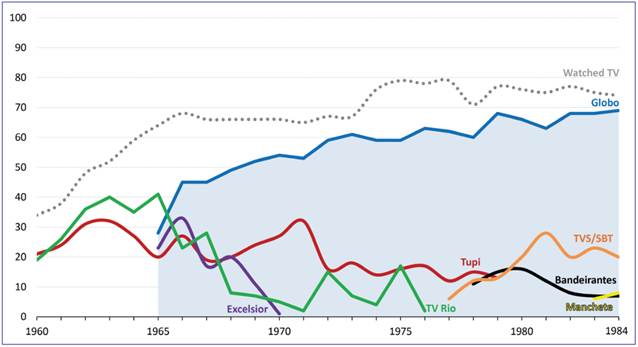 Note: The 1969 data come from Centro de Estudos de Opinião Pública (CESOP, 2008), and were obtained using a methodology different from the Marplan studies, although they are numerically equivalent to that produced by interpolation. The 1975 value for Tupi was estimated by linear interpolation. The values for 1983 and 1984 were obtained by a visual reading of
  Note: The value for Excelsior in 1960 was estimated by backward extrapolation. The 1966 data come from CESOP (2008), obtained using a methodology different from the Marplan studies, and were prioritized over interpolation because they better capture the historical reality of that year. The values for 1983 and 1984 were obtained through visual reading of
  Note: The values for 1990-1992 and for “Other channels” in 1998 were estimated using simple linear regression applied to each broadcaster’s known data. Globo and Record in 1992 were also calibrated based on Graph 27 in
 Source: Elaborated by the authors based on gshow (
 Source: Elaborated by the authors based on
  Note: Average daily household audience in IBOPE rating points, from 7 a.m. to midnight, in Greater São Paulo. Each point corresponds to approximately 1% of households in the panel that have a television. “Other channels” includes pay television, regional broadcasters, and, from 2011 onward, streaming measurable by IBOPE. Data for 2018-2019 for SBT, Record, Band, and Other Channels are trend-based estimates from the series. Because the data sources differ between 2013 and 2014, the values are not directly comparable between the two periods.Source: Elaborated by the authors based on
  Source: Elaborated by the authors based on Memória Globo (
 Source:
  Source: Interactive Advertising Bureau Brasil (
 Source: Deloitte (
 Source: Interactive Advertising Bureau Brasil (
 Source: Kantar Ibope Media (
 Source: Deloitte (
 Source: Kantar Ibope Media (2020).
 Source: Interactive Advertising Bureau Brasil (2021).
 Source: Adapted from Deloitte (