Incorporation of waste black tourmaline-rich from the extraction of Alto Serra Branca pegmatite for the production of porcelain stoneware
Abstract
The reuse of mining wastes in ceramic production represents an important strategy for reducing environmental impacts while adding value to industrial by-products. Although black tourmaline has been explored in other ceramic and functional applications, its potential use in porcelain stoneware remains unexplored. In this context, the present study investigates the feasibility of incorporating black tourmaline-rich waste (WOS) as a partial substitute for feldspar in porcelain stoneware formulations, contributing to the sustainable management of mining residues. The waste was processed, characterized, and incorporated at levels ranging from 0 to 5 wt%, and the ceramic bodies were fired at 1150, 1175, and 1250ºC. Physical-mechanical properties, including linear shrinkage, water absorption, apparent porosity, flexural strength, and apparent density, were evaluated, complemented by SEM and XRD analyses. The results demonstrated that the waste is suitable as a ceramic raw material, with bodies containing higher waste contents fired at 1250ºC exhibiting properties compatible with the requirements of ISO 13006:2018, ISO 10545-3:2014, and ISO 10545-4:2014 for porcelain stoneware. These findings highlight the potential of black tourmaline-rich waste as an alternative raw material for high value-added ceramic applications and reinforce the role of traditional ceramics in advancing sustainable and circular production practices.
Keywords:
Porcelain Stoneware; Waste; Black Tourmaline; Ceramic materials; Sustainability
INTRODUCTION
Mining activity supplies essential raw materials for a wide range of industrial sectors and constitutes one of the fundamental pillars of global socioeconomic development1. However, the expansion of this activity over recent decades has been accompanied by a significant intensification of environmental impacts, including the generation of large volumes of solid waste, soil degradation, and contamination of water bodies by heavy metals and suspended particles2), (3), (4. The exploitation of granitic pegmatites, particularly within the Borborema Pegmatite Province (BPP) in northeastern Brazil, is predominantly carried out under artisanal or semi-industrial small-scale mining regimes5), (6. Under these conditions, environmental challenges become more pronounced due to the high selectivity of the extraction process, which generates substantial amounts of waste that are frequently disposed of improperly, reinforcing the need for strategies focused on the sustainable reuse of these materials7), (8.
Extraction activities in the municipality of Pedra Lavrada (PB) represent an important economic activity; however, they have also resulted in significant environmental and social impacts due to the accumulation of mining wastes and the predominantly rudimentary extraction practices adopted in the region. Previous studies have reported severe environmental degradation, including land cover alteration, vegetation loss, dust emissions, and risks to human health associated with unmanaged mining residues9), (10. In this context, the development of technological routes capable of incorporating these wastes into industrial processes represents a strategic solution to mitigate environmental liabilities while maintaining socioeconomic benefits. By proposing the reuse of black tourmaline-rich mining waste as a raw material for high value-added ceramic products, this study contributes to transforming an environmental burden into an economically viable resource, aligning exploitation activities with sustainable development principles and circular economy strategies, as advocated in regional environmental and socioeconomic assessments11.
In recent decades, the reuse of mining waste has advanced considerably, with recent studies demonstrating the potential of various mineral wastes to produce ceramic bricks12, concrete aggregates13), (14, pavement components15, and, notably, as alternative raw materials for the ceramic industry. In this latter context, the incorporation of extraction wastes16 and ore beneficiation by-products17 as feldspar substitutes, as well as kaolin and scheelite wastes18, has been investigated in different formulations to produce tiles, roofing, and floor coverings. Due to the mineralogical diversity associated with granitic pegmatites, the wastes generated during their extraction exhibit variable chemical and physical compositions, creating opportunities for their reuse in several industrial sectors19. Among the minerals present in these wastes, black tourmaline stands out, as it is abundantly discarded during the mining of pegmatites in the BPP aimed at the extraction of industrial and gemological minerals (Fig. 1).

Sample of residual material rich in black tourmalines within a quartz and feldspar matrix from the Alto Serra Branca pegmatite.
Although black tourmaline has been applied in the manufacture of functional ceramic materials, such as piezoelectric ceramics, electronic components, and, more recently, water purification filters and fuel activation systems20, its application in porcelain stoneware, a high value-added ceramic product, has not yet been reported in the literature. In this context, the present study explores the feasibility of incorporating tourmaline-rich waste into porcelain stoneware formulations as a partial substitute for feldspar, aiming to contribute to the valorization of mineral waste within high value-added ceramic production chains. This approach also aligns with current efforts to reduce environmental impacts and improve resource efficiency in ceramic manufacturing21), (22. Given the increasing demand for environmentally responsible production processes, the search for alternative materials that contribute to cost reduction and mitigate the impacts associated with raw material extraction becomes essential, fostering the development of products made with alternative inputs that demonstrate technical performance compatible with industrial requirements23), (24.
Therefore, this study aims to assess the technical feasibility of incorporating small-scale mining waste rich in black tourmaline (WOS) as a partial replacement for feldspar (0-5 wt.%) in porcelain stoneware manufactured through conventional processing routes, including dry milling, wet homogenization, uniaxial pressing, and sintering at different temperatures. The feasibility of this substitution is evaluated based on technological parameters (water absorption, apparent porosity, apparent density, linear shrinkage, and flexural strength). Additionally, the crystalline phase stability (mullite-quartz, assessed by XRD) and the microstructural morphology of the resulting ceramic bodies are examined using scanning electron microscopy.
MATERIALS AND METHODS
The formulations of sustainable ceramic used in this study were composed of the following raw materials: plastic clay (ballclay), quartz, and feldspar supplied by Armil Mineração do Nordeste (Parelhas-RN, Brazil), and kaolin from Rocha Minérios (Juazeirinho-PB, Brazil). The black tourmaline-rich waste (schorl), referred to as WOS, was obtained from the extraction of a granitic pegmatite called Alto Serra Branca. The WOS was provided by the Pedra Lavrada Miners’ Cooperative (COOMIPEL, Pedra Lavrada-PB, Brazil).
Chemical composition of the raw materials was obtained by X-ray fluorescence (Shimadzu, model EDX 720), and the mineralogical phases were identified by X-ray diffraction (XRD) using a diffractometer (Shimadzu, model XRD6000) with Cu-Kα (40kV/30mA), 0.02º step, and 2θ angle range of 5º-60º. The particle size distribution of the WOS was determined by laser diffraction (Cilas, model 1064 LD) post comminuted, and the thermal behavior was evaluated by Thermogravimetric Analysis and Derivative Thermogravimetry Analysis (TGA, DTGA) (Shimadzu, model TA 60H), with a heating rate of 12.5ºC/min and under a compressed air atmosphere.
In all cases, the investigated compositions were prepared using 23 wt.% plastic clay, 27 wt.% kaolin, 30-35 wt.% feldspar, and 15 wt.% quartz, representing a conventional porcelain composition widely adopted in industrial practice. Variable amounts of WOS were incorporated as a partial substitute for feldspar, the main fluxing agent, due to its chemical compatibility with the residue. The WOS content was limited to a maximum of 5 wt.% to control the incorporation of iron oxide, which, although contributing to the fusion and formation of the liquid phase, can excessively reduce the viscosity of the molten mass and lead to pyroplastic deformation, dimensional instability, and undesirable color changes at higher contents. The compositions and nomenclature of the ceramic formulations are summarized in Table I.25), (26), (27
The entire volume of WOS was first subjected to comminution by crushing and dry milling, followed by sieving through an ABNT No. 200 mesh (75 µm). The resulting material was then homogenized with the raw materials in a ball mill operating at 450 rpm for 60 min, using alumina grinding media (α-Al2O3 spheres) with diameters of 12, 16, and 21 mm. After homogenization, the formulations were moistened to obtain a water content of 7%. The mixtures were subsequently uniaxially pre-pressed in a Servitech CT-335 press using a rectangular mold (50 mm × 20 mm × 5 mm) under a pressure of 13.5 MPa for 10 s, followed by final pressing at 50 MPa for 20 s. The green ceramic bodies were dried in an oven at 110ºC for 24 h and subsequently sintered in a kiln (Flyever Equipamentos, model Controlador FE 50 RP) at 1150ºC, 1175ºC, and 1250ºC. All sintering cycles were conducted using a controlled heating rate of 30ºC/min up to the target temperature, followed by a dwell time of 10 min at the maximum temperature. Cooling proceeded naturally by means of the kiln’s thermal inertia until room temperature (approximately 24ºC).
For each formulation (F1-F5), the physical-mechanical properties of ten test specimens (n=10) were determined. The evaluated properties included water absorption, apparent porosity, and apparent density, measured according to the Archimedes method (ISO 10545-3:2014)28, as well as linear shrinkage and three-point flexural strength. The flexural strength tests were performed using a universal testing machine (Shimadzu, Autograph AG-X, 50 kN) equipped with a 5 kN load cell. A support span of 40.4 mm and a crosshead displacement rate of 0.5 mm·min-1 were adopted. The data obtained for all physical-mechanical properties were statistically analyzed by calculating the arithmetic mean and the sample standard deviation29), (30. The results are reported as mean ± standard deviation, and the error bars in the figures represent ±1 standard deviation. In addition, 95% confidence intervals were estimated using Student’s t-distribution (α=0.05; df=9) to assess the reliability of the measurements.
After the mechanical strength tests, the fractured specimens were sectioned to fit the sample holder, mounted on aluminum stubs using conductive carbon tape, and gold-coated for 3 min to enable microstructural analysis of the fracture surfaces by scanning electron microscopy (SEM; Tescan, Vega 4). The mineralogical phases formed after sintering were investigated by powder X-ray diffraction (XRD), under the conditions described in Section 2.1. For the specimens sintered at 1250ºC.
RESULTS AND DISCUSSIONS
The conventional raw materials exhibited high SiO2 and Al2 O3 contents, typical of clay-based ceramic formulations and responsible for the formation of refractory silica-alumina phases during firing31. Additionally, the presence of 11.03 wt.% K2O and 2.84 wt.% Na2O indicates a significant contribution from alkali feldspars, which act as fluxing oxides in aluminosilicate ceramic systems, reducing the vitrification temperature and facilitating densification32. The WOS also showed a high combined content of SiO2 (56.15 wt.%) and Al2O3 (27.30 wt.%), associated with the presence of quartz, mica and black tourmaline (Fig. 2). Tourmaline-group minerals have a complex borosilicate structure composed of rings of six silicate tetrahedra [Si6O18] linked to octahedral sites that accommodate Al3+, Mg2+and Fe2+/Fe3+cations33. This structural complexity explains the significant Fe2O3 content (10.42 wt.%), which is also responsible for its black coloration34. As shown in Table II.

Black tourmaline (schorl) may incorporate boron and, occasionally, lithium within its crystalline structure; however, their concentrations are generally very low. In this study, chemical characterization was carried out by X-ray fluorescence (XRF), with emphasis on the determination of major oxides, which predominantly govern the technological behavior of porcelain tiles. It is well established that XRF has inherent limitations in the detection and quantification of light elements such as B and Li, owing to their low characteristic X-ray energies and significant absorption effects. Consequently, these elements are not reported in the chemical composition. Nevertheless, within the scope of evaluating tourmaline-rich waste for ceramic applications, the absence of quantitative data for B and Li does not compromise the validity of the conclusions, as the material performance is primarily controlled by the major oxide composition35), (36), (37.
Although feldspars are known to contain minor amounts of Na2O, typically in the range of 2-3 wt.% (35), (36, sodium was not detected in the ceramic bodies within the analytical detection limit of the X-ray fluorescence analysis. Concentrations below approximately 3 wt.% may fall below the method sensitivity and/or be grouped under the category “other oxides.” Consequently, the K2O content of approximately 4 wt.% measured in the formulations can be predominantly attributed to the potassium feldspar used in this study37.
The mineral phases identified in the conventional raw materials are consistent with those typically employed in ceramic tile compositions38. Quartz (JCPDS 85-1053), kaolinite (JCPDS 78-2110), and potassium (JCPDS 84-1455) and sodium (albite) feldspars (JCPDS 72-1245) were detected, in agreement with16. The diffractogram of the WOS confirmed black tourmaline (JCPDS 86-1572) as the predominant crystalline phase, along with quartz (JCPDS 85-1053), albite (JCPDS 72-1245), and muscovite (JCPDS 83-1808), consistent with previous studies on pegmatite-derived wastes39), (40), (41), (42), (43), (44.
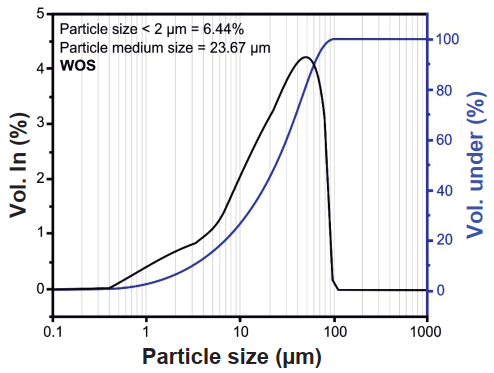
The particle-size distribution of WOS obtained by dry comminution, shown in Figure 3, is unimodal and broad, with characteristic diameters of D10=3.12 µm, D50=23.67 µm, D90=61.44 µm, and SPAN [(D90-D10)/D50]=2.54. The presence of particles with a wide particle-size distribution (Fig. 3) enables a configuration in which fine particles favor early-stage sintering by promoting the formation of the liquid phase, while coarser particles maintain structural packing during densification45), (46. Furthermore, the heterogeneity of the particles, as indicated by the SPAN value, is similar to that of other mineral wastes and falls within the typical industrial limits adopted for materials used in pressed ceramics47), (48.

Table III contains the values of the chemical composition of the ceramic formulations incorporated with WOS. The SiO2 (67.20-66.31 wt.%) and Al2O3 (27.82-27.29 wt.%) contents remained stable across all compositions, indicating that WOS addition did not significantly alter the silica-alumina framework of the formulations. The predominance of SiO2 and Al2O3 favors mullite (3Al2O3·2SiO2) crystallization during firing, a key phase in porcelain stoneware responsible for thermal and mechanical resistance49. The presence of fluxing oxides, primarily K2O (3.69-4.36 wt.%) from feldspars and, to a lesser extent, MgO and CaO from WOS, contributes to liquid-phase formation, facilitating vitrification and densification50), (51. Although WOS contains a relatively high Fe2O3 content (10.42 wt.%), its effective contribution to the final formulations is below 0.7 wt.%, minimizing any undesirable influence on the final color of the fired ceramic bodies. Higher Fe2O3 levels may lead to grayish or brownish tones in porcelain bodies52; however, this effect was controlled in the present formulations due to the low waste addition.
Figures 4a and 4b show the TGA and DTGA curves of the ceramic formulations (F1-F5) with varying WOS contents. All compositions exhibited similar thermal behavior, with total mass loss between 4.83% and 5.38%, a typical range for kaolinitic ceramic formulations. Two primary mass loss stages were identified: the first below 200ºC, attributed to the elimination of adsorbed and weakly bound surface water; and the second between 450-650ºC, associated with dehydroxylation of kaolinite and transformation into metakaolinite53), (54. Formulation F5 (5 wt% WOS) presented a slightly higher initial mass loss (~2%) compared to the other compositions. This behavior is consistent with the greater incorporation of WOS (Table II), whose mineralogical composition includes Fe2O3 and MgO bearing phases (Table III) that increase defect density and surface reactivity, favoring moisture adsorption and early release during heating4. Additionally, tourmaline-group minerals possess structural hydroxyl groups, which contribute to low-temperature mass loss between 100-250ºC33. Overall, the thermal profiles indicate that WOS incorporation does not introduce deleterious mass loss events, suggesting thermal stability of the formulations before vitrification.

Figure 5 presents the physical parameters of linear shrinkage (LS), apparent density (AD), water absorption (WA), and apparent porosity (AP) after sintering at 1150, 1175, and 1250ºC. LS increased progressively with temperature for all formulations, which is characteristic of densification induced by viscous flow during sintering. Compositions F3 and F4 (2-3 wt.% WOS) showed greater linear shrinkage, indicating enhanced densification due to higher availability of fluxing oxides from WOS (Fe2O3+K2O+MgO+CaO=5.35 wt.% in F3; 5.14 wt.% in F4). This increase in liquid-phase content promotes better particle rearrangement and pore elimination39), (55.

Physical properties of ceramic bodies with and without incorporation of WOS, after sintering at 1150ºC, 1175ºC, and 1250ºC.
Apparent density values (Figure 5b) increased with the rise in sintering temperature from 1150ºC to 1250ºC, reaching the highest values for formulations F3 and F4, which contained the largest number of fluxes, favoring the formation of a greater quantity of liquid phase. The other formulations exhibited similar behavior, indicating that the temperature increase promoted progressive densification of the ceramic bodies39), (55. Conversely, water absorption and apparent porosity values (Figures 5c and 5d) decreased with increasing sintering temperature, a result consistent with the direct relationship between liquid phase formation, densification, and porosity elimination56.
The incorporation of WOS contributed to the reduction of water absorption and apparent porosity. Regardless of the sintering temperature, the ceramic bodies of formulations F3 and F4 displayed lower values compared to the other formulations, corroborating the densification results observed (Figure 5b). These findings indicate that WOS has the potential to partially substitute feldspar in the formulation for porcelain stoneware production39. Water absorption is a critical parameter for the classification of ceramic tiles. According to ISO 13006:201857, products are classified as semi-stoneware when WA values range between 3.0% and 6.0%, as stoneware when 0.5%<WA<3.0%, and as porcelain when WA≤0.5%. Therefore, samples containing WOS and sintered at 1175ºC exhibited WA values suitable for application as semi-stoneware, whereas those sintered at 1250ºC demonstrated potential for use as porcelain stoneware55.
As shown in Figure 6, the modulus of rupture (MR) increased with sintering temperature for all formulations, reflecting the progressive densification and vitrification of the ceramic bodies. The reference formulation without WOS (F1) exhibited a significant increase in MR, from 31 MPa at 1150ºC to 42 MPa at 1250ºC, which is associated with enhanced liquid-phase formation and mullite crystallization above ~980ºC39), (51. Notably, the incorporation of WOS did not compromise mechanical performance; on the contrary, formulations F3 and F4 (2-3 wt.% WOS) displayed higher flexural strength than the reference composition, particularly at 1250ºC, indicating that controlled additions of WOS can positively contribute to the microstructural consolidation of the ceramic.

Flexural rupture strength of ceramic bodies with and without WOS, after sintering at 1150ºC, 1175ºC, and 1250ºC.
This effect is attributed to the presence of Fe- and Mg-bearing phases in the waste (Table III), which can locally intensify the sintering process by modifying liquid-phase viscosity and promoting grain rearrangement55. However, excessive addition of WOS (F5, 5 wt.%) resulted in reduced MR, suggesting the presence of refractory inclusions acting as stress concentrators and hindering densification40), (58. According to ISO 13006:2018 and ISO 10545-4:201457), (59, samples F3 and F4 sintered at 1250ºC indicate their potential suitability for use as porcelain stoneware55. In addition, samples F2, F3, and F4, sintered at 1175ºC, still have potential for semi-stoneware, while F2 sintered at 1250ºC has potential for stoneware, all by ISO 10545-3:201428.
Figure 7 illustrates the X-ray diffraction (XRD) patterns of the ceramic bodies sintered at 1250ºC. It is observed that, for all samples, the mullite (JCPDS 79-1454) and quartz (JCPDS 85-1053) phases were formed60. Regarding the ceramic bodies, the patterns exhibit almost identical peaks, indicating that increasing the WOS content up to 5% did not cause significant changes in the mineralogical profile of the samples. The mechanical strength of the material increases with increasing proportion of mullite, which is directly associated with high sintering temperatures61.

XRD patterns of the test specimens of the formulations: F1, F2, F3, F4, and F5, after sintering at 1250º
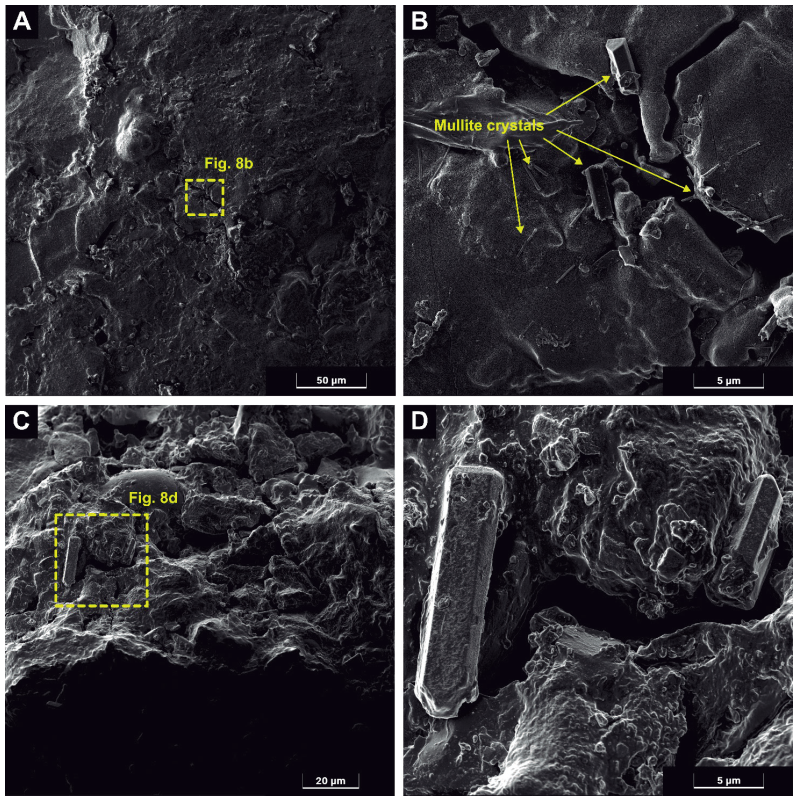
Figure 8 shows the morphology of the fracture surface (Fig. 8a and 8b) and the cross-section (Fig. 8c and 8d) of the F5 ceramic bodies, sintered at 1250ºC, obtained by SEM. It can be observed that the surface is dense and vitrified, with small and isolated pores. The microstructure is characterized by needle-shaped mullite crystals of different sizes, immersed in an abundant amount of glassy phase. The development of mullite, forming a network of intertwined needles, contributes to increasing the strength of the material. The mullite needles are formed from the dissolution and crystallization of the aluminosilicate present in the liquid phase, in which aluminum ions react with silicon ions from the amorphous phase (rich in SiO2), promoting the growth of these crystals39.

SEM images of the fracture surface (a and b) and the cross-section (c and d) of the ceramic test specimens of F5, sintered at 1250ºC.
CONCLUSIONS
The black tourmaline-rich waste (WOS) was processed, characterized, and evaluated as a partial substitute for feldspar in different ceramic formulations. Within the investigated incorporation range (0-5 wt.%) and firing temperatures of 1150, 1175, and 1250ºC, the addition of WOS, combined with increasing sintering temperature, demonstrated good chemical and mineralogical compatibility with the proposed formulations. The ceramic bodies maintained low water absorption and apparent porosity while showing increased apparent density and flexural strength. The most favorable combination of densification and mechanical performance was observed for compositions containing 2-3 wt.% WOS (F3 and F4) fired at 1250ºC, reaching a maximum flexural strength of 40.87 MPa. X-ray diffraction analyses confirmed mullite as the dominant crystalline phase at 1250ºC, accompanied by residual quartz. Scanning electron microscopy revealed a vitrified matrix reinforced by interlocked mullite needles. In terms of classification, ceramic bodies containing 3-5 wt.% WOS (F3 and F4) fired at 1250ºC, which exhibited flexural strength values above 35 MPa and water absorption below 0.5%, demonstrated performance consistent with porcelain stoneware, and can be classified as Group BIa according to ISO 13006:2018.
Low-to-moderate WOS additions (2-3 wt.%) positively contributed to microstructural consolidation and mechanical strength, whereas the highest waste content (5 wt.%) reduced mechanical performance. Nevertheless, the incorporation of up to 5 wt.% WOS did not disrupt the mullite-quartz phase equilibrium at 1250ºC, confirming the chemical compatibility of the waste with the proposed ceramic system. From an industrial perspective, partial replacement of feldspar by controlled WOS additions (2-3 wt.%) can be implemented without altering existing powder-processing routes (dry milling, uniaxial pressing, and rapid firing). The reduction in porosity and achievement of flexural strength values ≥ 35 MPa in F3 and F4 at 1250ºC confirm the technical feasibility of WOS as an alternative raw material for porcelain stoneware formulations.
This work clearly addresses a gap in the literature regarding the application of black tourmaline-rich materials in porcelain stoneware, since previous studies have been restricted to other ceramic products and functional applications. By systematically demonstrating the chemical, mineralogical, and technological compatibility of black tourmaline-rich waste as a partial substitute for feldspar in a conventional porcelain tile body, the present study provides robust experimental evidence supporting its feasibility for high value-added ceramic production. The results confirm that this waste can meet the strict performance requirements of porcelain stoneware while contributing to the valorization of by-products from small-scale mining. Moreover, its incorporation reduces dependence on non-renewable raw materials, minimizes waste disposal, and mitigates environmental impacts associated with mineral extraction. In this context, the study establishes a technically sound and environmentally relevant pathway for integrating black tourmaline-rich waste into industrial porcelain tile production, reinforcing the role of traditional ceramics as an effective platform for innovation, sustainability, and circular economy strategies.
DATA AVAILABILITY
The data that support the findings of this study are available from the corresponding author, upon reasonable request.
REFERENCES
-
1 Igogo, T., Awuah-Offei, K., Newman, A., Lowder, T., & Engel-Cox, J. (2021). Integrating renewable energy into mining operations: Opportunities, challenges, and enabling approaches. Applied Energy, 300, 117375. https://doi.org/https://doi.org/10.1016/j.apenergy.2021.117375
» https://doi.org/https://doi.org/10.1016/j.apenergy.2021.117375 -
2 Mekonnen, B., Haddis, A., & Zeine, W. (2020). Assessment of the Effect of Solid Waste Dump Site on Surrounding Soil and River Water Quality in Tepi Town, Southwest Ethiopia. Journal of Environmental and Public Health, 2020(1), 5157046. https://doi.org/https://doi.org/10.1155/2020/5157046
» https://doi.org/https://doi.org/10.1155/2020/5157046 -
3 Shengo, L. M. (2021). Review of Practices in the Managements of Mineral Wastes: The Case of Waste Rocks and Mine Tailings. Water, Air, & Soil Pollution, 232(7), 273. https://doi.org/10.1007/s11270-021-05198-w
» https://doi.org/10.1007/s11270-021-05198-w -
4 Wang, P., Sun, Z., Hu, Y., & Cheng, H. (2019). Leaching of heavy metals from abandoned mine tailings brought by precipitation and the associated environmental impact. Science of The Total Environment, 695, 133893. https://doi.org/https://doi.org/10.1016/j.scitotenv.2019.133893
» https://doi.org/https://doi.org/10.1016/j.scitotenv.2019.133893 -
5 Soares, D. R. (2016). Aspectos técnicos da lavra do pegmatito “alto” feio, pedra lavrada, paraíba. Holos, 1(SE-artigos), 404-412. https://doi.org/10.15628/holos.2016.3248
» https://doi.org/10.15628/holos.2016.3248 -
6 Vasters, J., & Schütte, P. (2023). Country profiles of artisanal and small-scale ECRM mine production and processing developments. https://doi.org/10.25928/mar3-v778
» https://doi.org/10.25928/mar3-v778 -
7 Bansah, K. J., Acquah, P. J., & Boafo, A. (2024). Land, water, and forest degradation in artisanal and small-scale mining: Implications for environmental sustainability and community wellbeing. Resources Policy, 90, 104795. https://doi.org/10.1016/j.resourpol.2024.104795
» https://doi.org/10.1016/j.resourpol.2024.104795 -
8 Kulkarni, N. P. (2021). Mineral and Mining Wastes: A Burgeoning Problem with a Need for Sustainable Restitution BT - Innovations in Sustainable Mining: Balancing Environment, Ecology and Economy (K. Randive, S. Pingle, & A. Agnihotri (eds.); pp. 219-231). Springer International Publishing. https://doi.org/10.1007/978-3-030-73796-2_13
» https://doi.org/10.1007/978-3-030-73796-2_13 - 9 Arruda Filho NT, Menezes RR, Neves GA, Oliveira TH, Teódulo JMR, Santana LNL. Impactos ambientais causados pela atividade mineradora em Pedra Lavrada-PB. Rev Bras Geogr Fís. 2017; 10(1): 176-193.
- 10 Silva JAL, Damasceno J, Reinaldo LRL, Filho MFG, Macedo DRG, Pereira TMS. Avaliação dos impactos socioambientais advindos da extração mineral em áreas próximas aos centros urbanos: estudo de caso no município de Pedra Lavrada-PB. Rev Espacios. 2017; 38(9): 32.
- 11 Souza YG, Cobel JLP, Silva JB. A mineração e suas consequências no município de Pedra Lavrada-PB: uma perspectiva da legislação ambiental. Rev Regne. 2019; 5(Número Especial): 23-34.
-
12 Benahsina A, Taha Y, Bouachera R, Elomari M, Bennouna MA. Manufacture and characterization of fired bricks from gold mine waste rocks. Minerals. 2021; 11(7): 695. doi: 10.3390/min11070695.
» https://doi.org/10.3390/min11070695 -
13 Arruda, T. D., Costa, F. P., Diniz, R. C., Rodrigues, A. M., Menezes, R. R., & Neves, G. D. (2023). Statistical Design of Eco-Friendly Mortar Mixtures Containing Scheelite Tailings and Quartzite Sand: Evaluation of Resistance to Alkali-Aggregate Reaction. In Sustainability (Vol. 15, Issue 15). https://doi.org/10.3390/su151511544
» https://doi.org/10.3390/su151511544 -
14 El Machi, A., El Berdai, Y., Mabroum, S., Safhi, A. E., Taha, Y., Benzaazoua, M., & Hakkou, R. (2024). Recycling of Mine Wastes in the Concrete Industry: A Review. In Buildings (Vol. 14, Issue 6). https://doi.org/10.3390/buildings14061508
» https://doi.org/10.3390/buildings14061508 -
15 Friber, M. A., Guimarães, A. C., Martins, C. A., & Soares, J. S. (2023). Study of the Mining Waste in the Production of Calcined Aggregate for Use in Pavement. In Minerals (Vol. 13, Issue 12). https://doi.org/10.3390/min13121543
» https://doi.org/10.3390/min13121543 -
16 Ferreira JF, Costa FPd, Borborema LFD, Arimateia RRd, Leite RS, Apolinário RC, Pinto HC, Rodrigues AM, Neves GdA, Menezes RR. Incorporation of Bentonite Mining Waste in Ceramic Formulations for the Manufacturing of Porcelain Stoneware. Sustainability. 2022; 14(23): 15973. https://doi.org/10.3390/su142315973
» https://doi.org/10.3390/su142315973 -
17 Izak, P., Delihowski, J., Mastalska-Popławska, J., & Stempkowska, A. (2025). Utilisation of Mining Waste for Production of Ceramic Tiles. In Applied Sciences (Vol. 15, Issue 7). https://doi.org/10.3390/app15073957
» https://doi.org/10.3390/app15073957 -
18 Almeida, E. P., Carreiro, M. E. A., Rodrigues, A. M., Ferreira, H. S., Santana, L. N. L., Menezes, R. R., & Neves, G. A. (2021). A new eco-friendly mass formulation based on industrial mining residues for the manufacture of ceramic tiles. Ceramics International, 47(8), 11340-11348. https://doi.org/https://doi.org/10.1016/j.ceramint.2020.12.260
» https://doi.org/https://doi.org/10.1016/j.ceramint.2020.12.260 -
19 Hudson-Edwards, K. A. (2024). Geochemistry and mineralogy of wastes from lithium-bearing granite-pegmatite mining: resource potential and environmental risks. Frontiers in Geochemistry, 2. https://www.frontiersin.org/journals/geochemistry/articles/10.3389/fgeoc.2024.137899
» https://www.frontiersin.org/journals/geochemistry/articles/10.3389/fgeoc.2024.137899 -
20 Jie liu, Gao, Z., Liang, J., Zhang, H., & Meng, J. (2021). Strengthening mechanism of far-infrared radiation of tourmaline in iron-tailing ceramics. Ceramics International, 47(18), 25214-25220. https://doi.org/https://doi.org/10.1016/j.ceramint.2021.01.278
» https://doi.org/https://doi.org/10.1016/j.ceramint.2021.01.278 -
21 Haleem, A., Javaid, M., Singh, R. P., Suman, R., & Qadri, M. A. (2023). A pervasive study on Green Manufacturing towards attaining sustainability. Green Technologies and Sustainability, 1(2), 100018. https://doi.org/https://doi.org/10.1016/j.grets.2023.100018
» https://doi.org/https://doi.org/10.1016/j.grets.2023.100018 -
22 Yu, H., Zahidi, I., Chow, M. F., Liang, D., & Madsen, D. Ø. (2024). Reimagining resources policy: Synergizing mining waste utilization for sustainable construction practices. Journal of Cleaner Production, 464, 142795. https://doi.org/https://doi.org/10.1016/j.jclepro.2024.142795
» https://doi.org/https://doi.org/10.1016/j.jclepro.2024.142795 -
23 Gairola, S. U., Khanduri, A. K., & Bhuvaneswari, V. (2025). Sustainable mining: reducing waste and enhancing resource efficiency. Discover Civil Engineering, 2(1), 75. https://doi.org/10.1007/s44290-025-00233-9
» https://doi.org/10.1007/s44290-025-00233-9 -
24 Tazmeen, T., & Mir, F. Q. (2024). Sustainability through materials: A review of green options in construction. Results in Surfaces and Interfaces, 14, 100206. https://doi.org/https://doi.org/10.1016/j.rsurfi.2024.100206
» https://doi.org/https://doi.org/10.1016/j.rsurfi.2024.100206 - 25 Sánchez, E, García-Ten, J, Sanz, V, Moreno, A. Porcelain tile: almost 30 years of steady scientific-technological evolution. Ceram Int. 2010; 36(3): 831-845.
- 26 Andreola, F, Barbieri, L, Lancellotti, I, Leonelli, C, Manfredini, T. Recycling of industrial wastes in ceramic manufacturing: state of the art and glass case studies. Ceram Int. 2016; 42(12): 13333-13344.
- 27 Vieira, CMF, Monteiro, SN. Incorporation of solid wastes in red ceramics: an updated review. Matéria (Rio J). 2009; 14(3): 881-905.
- 28 ISO. ISO 10545-3:2014 - Ceramic tiles - Part 3: Determination of water absorption, apparent porosity, apparent relative density and bulk density. Geneva: International Organization for Standardization, 2014.
-
29 ASTM International. ASTM E122-17(2022) - Standard Practice for Calculating Sample Size to Estimate, With Specified Precision, the Average for a Characteristic of a Lot or Process. West Conshohocken (PA): ASTM International; 2022. Available from: https://www.astm.org/e0122-17r22
» https://www.astm.org/e0122-17r22 - 30 Montgomery, DC, Runger, GC. Applied statistics and probability for engineers. 7th ed. Hoboken (NJ): John Wiley & Sons; 2020.
-
31 Romero, M., Padilla, I., Contreras, M., & López-Delgado, A. (2021). Mullite-Based Ceramics from Mining Waste: A Review. In Minerals (Vol. 11, Issue 3). https://doi.org/10.3390/min11030332
» https://doi.org/10.3390/min11030332 -
32 Li, X., Zhi, L., Shi, W., Kong, L., Bai, J., Yu, J., Reinmöller, M., Guhl, S., Meyer, B., & Li, W. (2020). Effect of K2O/Na2O on fusion behavior of coal ash with high silicon and aluminum level. Fuel, 265, 116964. https://doi.org/10.1016/j.fuel.2019.116964
» https://doi.org/10.1016/j.fuel.2019.116964 -
33 Bosi, F. (2018). Tourmaline crystal chemistry. American Mineralogist, 103(2), 298-306. https://doi.org/10.2138/am-2018-6289
» https://doi.org/10.2138/am-2018-6289 -
34 Pasetti, L., Fornasini, L., Mantovani, L., Andò, S., Raneri, S., Palleschi, V., & Bersani, D. (2024). Study of Mg-Fe content in tourmalines from the dravite-schorl series by Raman spectroscopy. Journal of Raman Spectroscopy, 55(2), 276-286. https://doi.org/https://doi.org/10.1002/jrs.6645
» https://doi.org/https://doi.org/10.1002/jrs.6645 - 35 Deer WA, Howie RA, Zussman J. An introduction to the rock-forming minerals. 3rd ed. London: Mineralogical Society of Great Britain and Ireland; 2013.
-
36 Snyder RL. X-ray diffraction. In: Jenkins R, Snyder RL, editors. Introduction to X-ray powder diffractometry. New York: Wiley-Interscience; 1999. p. 1-103. doi: 10.1002/9783527613748.ch1.
» https://doi.org/10.1002/9783527613748.ch1 - 37 Beckhoff B, Kanngießer B, Langhoff N, Wedell R, Wolff H, editors. Handbook of practical X-ray fluorescence analysis. Berlin: Springer; 2006.
-
38 Tomalino, M. U. (2021). Mineralogy and Properties of Raw Materials and Crystalline Phases of Ceramics and Glass-Ceramics BT - Ceramics, Glass and Glass-Ceramics: From Early Manufacturing Steps Towards Modern Frontiers (F. Baino, M. Tomalino, & D. Tulyaganov (eds.); pp. 47-73). Springer International Publishing. https://doi.org/10.1007/978-3-030-85776-9_2
» https://doi.org/10.1007/978-3-030-85776-9_2 -
39 Almeida EP, Carreiro MEA, Rodrigues AM, Ferreira HS, Santana LNL, Menezes RR, Neves GA. A new eco-friendly mass formulation based on industrial mining wastes for the manufacture of ceramic tiles. Ceramics International. 2021; 47(8): 11340-11348. doi: 10.1016/j.ceramint.2020.12.260.
» https://doi.org/10.1016/j.ceramint.2020.12.260 -
40 Wang F, Zhang X, Liang J, Fang B, Zhang H, Zhang Y, Zhang H. Phase transformation and microstructural evolution of black tourmaline mineral powders during heating and cooling processes. Ceramics International. 2018; 44(11): 13253-13258. doi: 10.1016/j.ceramint.2018.04.154.
» https://doi.org/10.1016/j.ceramint.2018.04.154 -
41 Santos RC, Silva TR, Neves GA, Macedo RS, Menezes RR, Santana LNL. Interação entre características de argilas e parâmetros de processamento sobre propriedades tecnológicas de corpos cerâmicos (Interaction between clays characteristics and processing parameters on technological properties of ceramic bodies). Cerâmica. 2017; 63(366): 361-368. doi: 10.1590/0366-69132017633672126.
» https://doi.org/10.1590/0366-69132017633672126 -
42 Peng J, Guo R, Shi X, Zhang P, Qiu F, Li W, Wei C, Miao S. Highly efficient and recyclable conversion of CO2 using supported metal-free ionic liquids on ball clay. Appl Clay Sci. 2022; 228: 106645. doi: 10.1016/j.clay.2022.106645.
» https://doi.org/10.1016/j.clay.2022.106645 -
43 Rouabhia F, Nemamcha A, Moumeni H. Elaboration and characterization of mullite-anorthite-albite porous ceramics prepared from Algerian kaolin. Cerâmica. 2018; 64(369): 253-260. doi: 10.1590/0366-69132018643692297.16.
» https://doi.org/10.1590/0366-69132018643692297.16 - 44 Riella, H. G.; Franjndlich, E. U. de C.; Durazzo, M. Caracterização e utilização de fundentes em massas cerâmicas. Cerâmica Industrial, v. 7, n. 3, 2002.
-
45 Dondi M, Raimondo M, Zanelli C, et al. Clays and bodies for ceramic tiles: Reappraisal and technological classification. Applied Clay Science. 2014; 96: 4. doi: 10.1016/j.clay.2014.01.013.
» https://doi.org/10.1016/j.clay.2014.01.013 -
46 Zanelli C, Conte S, Molinari C, Soldati R, Dondi M. Waste recycling in ceramic tiles: a technological outlook. Resources, Conservation and Recycling. 2021; 168: 105289. doi: 10.1016/j.resconrec.2020.105289.
» https://doi.org/10.1016/j.resconrec.2020.105289 - 47 Torres P, Fernandes HR, Agathopoulos S, Tulyaganov DU, Ferreira JMF. Incorporation of granite cutting sludge in industrial porcelain tile formulations. J Eur Ceram Soc. 2004; 24(10-11): 3177-3185.
-
48 Menezes RR, Ferreira HS, Neves GA, Lira HL, Ferreira HC. Rheological properties of kaolin suspensions obtained in different dispersions conditions. Cerâmica. 2005; 51(317): 35-41. doi: 10.1590/S0366-69132005000100006.
» https://doi.org/10.1590/S0366-69132005000100006 -
49 Lima RMF, Silva AGP, Menezes RR. Mullite formation in porcelain stoneware: influence of firing temperature and raw material composition. Cerâmica. 2022; 68(385): 75-82. doi: 10.1590/0366-691320226838530075.
» https://doi.org/10.1590/0366-691320226838530075 -
50 He, L., Huang, N., Lu, D., Sheng, P., & Zou, W. (2023). A Study on the Effects of Liquid Phase Formation Temperature and the Content of Sintering Aids on the Sintering of Silicon Nitride Ceramics. In Crystals (Vol. 13, Issue 7). https://doi.org/10.3390/cryst13071099
» https://doi.org/10.3390/cryst13071099 -
51 Goltsman, B. M., & Yatsenko, E. A. (2024). Modern fluxing materials and analysis of their impact on silicate structures: A review. Open Ceramics, 17, 100540. https://doi.org/https://doi.org/10.1016/j.oceram.2024.100540
» https://doi.org/https://doi.org/10.1016/j.oceram.2024.100540 -
52 Zhong, J., Xue, J., & Huang, Y. (2021). Effects of Fe2O3 on crystallisation and properties of R2O-CaO-MgO-Al2O3-SiO2-Fe2O3 glass ceramics. Advances in Applied Ceramics, 120(3), 164-168. https://doi.org/10.1080/17436753.2021.1911583
» https://doi.org/10.1080/17436753.2021.1911583 - 53 Murray HH. Applied clay mineralogy: occurrences, processing and application of kaolins, bentonites, palygorskite-sepiolite, and common clays. 1st ed. Amsterdam: Elsevier; 2007. 188p. (Developments in Clay Science; vol. 2).
- 54 Souza Santos P. Ciência e tecnologia de argilas. Vol. 1: Matéria-prima, processamento e propriedades. 2ª ed. São Paulo: Edgard Blücher; 1992. 408p.
-
55 Molinari C, Sima A, Zanelli C, Cavina M, Guarini G, Conte S, Albonetti S, Sánchez E, Canas E, Dondi M. Wastes from beneficiation of granite in porcelain stoneware: Effects on technological properties. Open Ceramics. 2024; 19: 100651. doi: 10.1016/j.oceram.2024.100651.
» https://doi.org/10.1016/j.oceram.2024.100651 -
56 Lopez-Perales JF, Sanchez-Rodriguez R, Suarez-Suarez DD, Rodríguez EA. Fired electrical porcelain scrap (chamotte waste) recycling and reuse as an alternative raw material for sustainable porcelain stoneware production. Journal of Cleaner Production. 2024; 434: 140385. doi: 10.1016/j.jclepro.2023.140385.
» https://doi.org/10.1016/j.jclepro.2023.140385 - 57 ISO. ISO 13006:2018 - Ceramic tiles - Definitions, classification, characteristics and marking. Geneva: International Organization for Standardization, 2018.
-
58 Almeida EP, Brito IP, Ferreira HC, Lira HL, Santana LNL, Neves GA. Cordierite obtained from compositions containing kaolin waste, talc and magnesium oxide. Ceramics International. 2018; 44(2): 1719-1725. doi: 10.1016/j.ceramint.2017.10.102.
» https://doi.org/10.1016/j.ceramint.2017.10.102 - 59 ISO. ISO 10545-4:2019 - Ceramic tiles - Part 4: Determination of modulus of rupture and breaking strength. Geneva: International Organization for Standardization, 2019.
-
60 Dong L, Zhang C, Chen Y, Cao L, Li J, Luo L. Acicular porous mullite from diatom frustules. Materials Letters. 2016; 171: 108-111. doi: 10.1016/j.matlet.2016.02.023.
» https://doi.org/10.1016/j.matlet.2016.02.023 -
61 Silva MRC, Malacarne CS, Longhi MA, Kirchheim AP. Valorization of kaolin mining waste from the Amazon region (Brazil) for the low-carbon cement production. Case Studies in Construction Materials. 2021; 15: e00756. doi: 10.1016/j.cscm.2021.e00756.
» https://doi.org/10.1016/j.cscm.2021.e00756 -
62 Carty WM, Senapati U. Porcelain - raw materials, processing, phase evolution, and mechanical behavior. J Am Ceram Soc. 1998; 81(1): 3-20. doi: 10.1111/j.1151-2916.1998.tb02290.x.
» https://doi.org/10.1111/j.1151-2916.1998.tb02290.x -
63 Lee SK, Kim YJ, Moon HS. Phase transformation sequence from kaolinite to mullite investigated by an energy-filtering TEM. J Am Ceram Soc. 1999; 82(10): 2841-2848. doi: 10.1111/j.1151-2916.1999.tb02165.x.
» https://doi.org/10.1111/j.1151-2916.1999.tb02165.x -
64 Martín-Márquez J, Rincón JM, Romero M. Mullite development on firing in porcelain stoneware bodies. J Eur Ceram Soc. 2010; 30(7): 1599-1607. doi: 10.1016/j.jeurceramsoc.2010.01.002.
» https://doi.org/10.1016/j.jeurceramsoc.2010.01.002