Latin American representation in critical care research: insights from a global bibliometric study (2018 – 2022)
INTRODUCTION
Global scientific production in medicine remains markedly unequal, with research activity heavily concentrated in the Global North (United States, Canada, European Union, Japan, and Australia), regardless of population size or global health needs.(1,2) Critical care medicine mirrors this pattern, as most studies originate from wealthy nations, while contributions from the Global South remain limited.(3,4) In Latin America, the region's scientific output in health and biomedical sciences has increased over recent years; however, persistent structural and economic barriers continue to limit visibility and impact.(5) To date, no comprehensive data is describing intensive care research produced in Latin America. This study aims to depict 5 years of critical care publications from the region.
METHODS
This work represents a secondary analysis derived from a previous bibliometric investigation that examined original research articles involving adult critically ill patients published between 2018 and 2022 in the ten critical care journals (Table 1) with the highest impact factors,(3) as determined by Clarivate™ Analytics. We categorized all manuscripts by the country of the corresponding author's affiliation.
We described each study according to predefined characteristics, including publication year, design (observational or randomized controlled trial), thematic area, number of centers, open-access status, number of countries involved, and citation counts obtained from OpenAlex.(6)
RESULTS
Of the 4,982 original studies identified, 141 (2.8%) originated from Latin America. Among these, 117 (83.0%) were observational studies and 24 (17.0%) randomized controlled trials. Research was conducted across nine countries: Brazil, Colombia, Argentina, Chile, Mexico, Peru, Uruguay, Ecuador, and Costa Rica. Brazil accounted for most publications (n = 90; 63.8%). Sixty studies (42.6%) were multicenter, and twelve (8.5%) were multinational, including six with countries outside the region. The most frequent research themes were sepsis/infection (n = 29; 20.6%) and mechanical ventilation/respiratory (n = 21, 14.9%). Over one-third reported no funding (n = 53; 37.6%), while 52 (36.9%) received public funding. More than one-third (n = 55; 39.0%) were not open access (Figure 1). The median sample size was 183 (interquartile range [IQR] 73 - 809). We found a median of 21 citations per article, ranging from 3 to 484, with an h-index of 37.
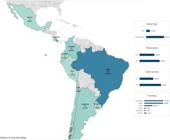
Characteristics and geographical distribution of critical care publications originating from Latin America (2018 - 2022).
DISCUSSION
Latin America contributed fewer than 3% of global intensive care publications, reflecting persistent asymmetry in scientific production between regions of differing income levels. Despite representing 8% of the world's population and 6% of global Gross Domestic Product (GDP),(7) the region's output remains constrained by limited funding, infrastructural challenges, and language barriers.(5,8) consistent with global patterns of underrepresentation of the "Global South".(1,2,4)
Brazil accounted for nearly two-thirds of all Latin American publications, underscoring its leadership but also revealing intraregional imbalance, as the country represents about 32% of the region's population and 30% of its GDP, highlighting the disproportion between scientific output and its demographic and economic weight. The predominance of observational studies and limited multinational collaborations may indicate restricted access to funding and networks, consistent with prior findings on the structural fragility of regional research systems.(9) Similar disparities were observed across a bibliometric analysis of publication output of South American countries, where investments in research and development and the number of researchers are not necessarily associated with greater research visibility or citation impact.(10)
Our study has some limitations. First, selecting only ten high-impact journals excludes regional or non-English publications, potentially underestimating total output. Second, defining origin by the corresponding author may overlook participation in multinational collaborations. Furthermore, using absolute publication counts, rather than metrics adjusted for population or ICU beds, might not fully reflect relative research productivity.
Although Latin America has shown encouraging growth in biomedical publications in recent years,(5) its scientific visibility in critical care remains disproportionately low compared with its disease burden and clinical capacity. Addressing this inequity requires targeted investment, regional collaboration, and increased inclusion of Latin American researchers in international networks and editorial boards. Strengthening research capacity and fostering equitable partnerships are crucial steps toward enhancing representation and ensuring that global intensive care research accurately reflects the realities of diverse healthcare systems.
-
Take-home message
Latin America accounted for fewer than 3% of global critical care publications, underscoring a severe underrepresentation disproportionate to the region's population and disease burden. By detailing the predominance of observational studies and restricted funding, this work highlights the need for targeted global investment and equitable partnerships to strengthen regional scientific visibility.
-
Publisher's note
Availability of data and materials
After publication the data will be available on demand to authors.
REFERENCES
- 1 Woods WA, Watson M, Ranaweera S, Tajuria G, Sumathipala A. Under-representation of low and middle income countries (LMIC) in the research literature: ethical issues arising from a survey of five leading medical journals: have the trends changed? Glob Public Health. 2023;18(1):2229890.
- 2 Yegros-Yegros A, van de Klippe W, Abad-Garcia MF, Rafols I. Exploring why global health needs are unmet by research efforts: the potential influences of geography, industry and publication incentives. Health Res Policy Syst. 2020;18(1):47.
- 3 Daltro-Oliveira R, Quintairos A, Santos LI, Amado F, Salluh JI, Nassar AP Jr. Global disparities in scientific publications: a 5-year analysis of 10 critical care journals. Crit Care Resusc. 2025;27(4):100137.
- 4 Daltro-Oliveira R, Quintairos A, Santos LI, Salluh JI, Nassar AP Jr. Examining inequality in scientific production: a focus on critical care publications and global economic disparities. Intensive Care Med. 2024;50(9):1538-40.
- 5 Fabiani MA, Pardo K, Argüello A, et al. Where does Hispanic Latin America stand in biomedical and life sciences? A bibliometric analysis of research output. Public Health Pract (Oxf). 2024;5:100412.
-
6 OpenAlex [Internet]. 2025 [cited 2025 Oct 29]. Available from: https://openalex.org
» https://openalex.org -
7 The World Bank Group. World Bank Open Data. [cited 2025 Mar 22]. Available from: https://data.worldbank.org/
» https://data.worldbank.org/ - 8 Gonzalez-Dambrauskas S, Salluh JI, Machado FR, Rotta AT. Science over language: a plea to consider language bias in scientific publishing. Crit Care Sci. 2024;36:e20240084en.
- 9 Huete-Perez JA, Salvatierra N. Assessing biomedical research capacities in selected countries of Latin America: challenges, opportunities, and recommendations. Front Res Metr Anal. 2025;10:1594303.
- 10 Narayan A, Chogtu B, Janodia M, Radhakrishnan R, Venkata SK. A bibliometric analysis of publication output in selected South American countries. F1000 Res. 2023;12:1239.
Edited by
-
Responsible editor:
Pedro Henrique Rigotti Soares https://orcid.org/0000-0003-1504-2396