 Preliminary greenhouse screening of eight grapevine rootstock cultivars under progressive water-table depletion and SSR diversity
Abstract
Selecting grapevine rootstocks that are tolerant to drought has become crucial for the sustainability of viticulture. This study evaluated the quantitative and molecular genetic variability of eight rootstocks subjected to progressive water depletion while cultured in a greenhouse. Several plant mass traits were analyzed, and six SSR markers were used to assess molecular diversity. While heritability for leaf traits varied, stem diameter exhibited a distinct pattern where genotypic differentiation and heritability estimates increased significantly under severe water deficit, ensuring reliable selection accuracy. Additionally, our BLUP analysis indicated that clones IAC 313 Tropical, IAC 766 Campinas, and Paulsen 1103 performed best by the end of the stress period. The SSR analysis grouped the genotypes together while revealing a high genetic diversity among all the rootstocks (He > 0.70). We concluded that late-stage stem diameter was a reliable but indirect selection criterion for drought tolerance.
Keywords:
Microsatellites; Vitis spp.; breeding; rootstock
INTRODUCTION
Viticulture is one of the most significant agricultural activities worldwide (Zhang et al. 2009, OIV 2024). The use of rootstocks in viticulture has been fundamental since the 19th century, mainly due to phylloxera infestations in Vitis vinifera L. cultivars. Therefore, a range of rootstocks were developed by crossing different Vitis species, especially American strains resistant to this pest (Blank et al. 2022, Chen et al. 2024). In addition to conferring resistance to pests and diseases, the use and breeding of rootstocks have played a crucial role in overcoming various abiotic stresses, such as water deficits and excessive soil salinity, as well as influencing the quality of the grapes and consequently the wine produced (Prinsi et al. 2021, Blank et al. 2022, Rius-Garcia et al. 2025). Genotypes such as ‘Paulsen 1103’ and ‘Ruggeri 140’ stand out for their root system adaptations, conferring a greater tolerance to water scarcity (Ferlito et al. 2020). Traveling south, in tropical viticulture, rootstocks from the 'IAC' series, such as IAC 572 'Jales' and IAC 766 'Campinas', have also shown remarkable adaptation to abiotic stresses. Studies have evidenced their tolerance to salinity and salt-induced water stress, where they maintain photosynthetic activity and growth even under high osmotic pressure (Viana et al. 2001, Silva et al. 2024). The search for alternatives that promote crop resilience is intensifying due to the current climate change causing worsening droughts. In this context, the development and use of rootstocks tolerant to water deficits is emerging as a fundamental strategy (Delrot et al. 2020). In addition, these rootstocks also increase general industry sustainability by reducing the water required by the vines, lessening the dependence on irrigation, and favoring the rational use of water resources (Medrano et al. 2018).
The proper choice of rootstocks represents one of the main challenges in viticulture, as different genotypes have distinct capacities for adaptation to environmental conditions, especially under water scarcity. Given the increasing importance of drought tolerance for the sustainability of viticultural production, the present research aimed to evaluate eight rootstock genotypes, with the goal of selecting drought-tolerant materials.
MATERIAL AND METHODS
Experiment and plant material
The experiment was conducted at the Department of Plant Protection (lat 22° 50' 48" S, long 48° 26' 06" W and alt 817 m asl) within the São Paulo State University, College of Agriculture (FCA/Unesp). The eight grapevine rootstock cultivars evaluated (Table 1) were selected based on their field history (unpublished data, IAC) and observations made under water depletion. The rootstock cuttings were obtained from the Advanced Division of Research and Development of Fruits of the Agronomic Institute (IAC).
The eight grapevine rootstocks used and their parentals. Agronomic Institute (IAC), SP, Brazil
The cuttings used for planting were approximately 30 cm long, with 4 buds. A basal cut was made near a bud, and an apical, beveled cut was made 1 cm above the last bud on the cutting. The cuttings were rooted in 1.7-liter plastic pots containing Carolina Soil® substrate, irrigated by micro-sprinklers, and fertilized to develop the root system. The cuttings were planted on August 10, 2023, and remained in the rooting beds until October 11, 2023. Two shoots were maintained, one at the base of the cutting and one at its apex (shoots 1 and 2, respectively), while developing the rootstock. The experiment began when rootstock shoots 1 and 2 had average lengths of 33 and 41 cm and 9 and 11 leaves, respectively.
Characterization of the experiment and water depletion imposition
The plastic pots with the rootstock cultivars were placed in the greenhouse between November and December 2024, on foam blocks housed in six 50-liter Arqplast brand plastic boxes (organizer type), 57 cm in length, 41 cm in width, and 35 cm in height. Faucets were installed 5 cm from the base of each box to adjust the water level, along with phenolic foam blocks (Aquaflora®) measuring 41 cm in length, 30 cm in width, and 23 cm in height. The cuttings remained in these plastic boxes from October 11 to December 10, 2023, at internal temperatures ranging from 18 to 30 °C and relative air humidity from 74 to 86%. 6 cm circular openings at the base of the plastic pots contained a nylon mesh that allowed contact between the seedlings' root system and the foam blocks to allow water absorption through capillarity, as according to the methodology proposed by Marchin et al. (2020).
The eight genotypes were used in a randomized complete block experimental design, totaling 6 blocks (boxes) with one plant per plot. To simulate stress conditions resulting from water scarcity, the water available was gradually reduced. Initially, the plants were subjected to a 21 cm water level for a period of 10 days to acclimatize the plants (no stress). After this period, the water level was reduced to 12 cm (minimum stress) for 15 days before the water level was further reduced to 4 cm for 20 days (high water stress) and finally returned to 21 cm to observe the post-stress recovery of the genotypes, totaling seven measurements.
Evaluated traits and genetic correlation analysis
During the experiment, two shoots were maintained on each rootstock, while any further shoots were removed frequently. Thus, at the end of the experiment, 68 days after transplanting the rootstocks into the foam blocks, the leaf and stem length from the two shoots was evaluated, named 1 and 2 for the median and apex locations, respectively.
Estimation of the variation components and genetic parameters
The following mixed model was used to capture the genetic variances between the clones (), residues (), and phenotypes ():
Where is the i-th individual of the j-th clone within the k-th block, X is the incidence matrix for the random effects, is the vector of random effects for the j-th genotype, and is the experimental error. The genetic parameters were then estimated for each measured trait with the estimated variance components. Additionally, the average broad sense heritability () and the accuracy () among the genotypes were estimated, where is the genetic variance among the genotypes, and is the phenotypic variance.
Molecular analysis
The DNA extraction was performed according to the protocol of Doyle and Doyle (1987), and its quality and concentration were evaluated by agarose gel electrophoresis and spectrophotometry using a NanoDrop. Ten microsatellite loci developed by Merdinoglu et al. (2005) were tested; of these, three could not be amplified (VVIq52, VVIv37, and VMC1b11) using an M13-tailed PCR. The products of the remaining seven loci were amplified and submitted to genotyping using an ABI 3500 Genetic Analyzer sequencer and analyzed using the GeneMapper 5.0 software.
The data was imported and formatted as a genind object using the "adegenet" package (Jombart 2008) in R 4.3.3 (R Core Team 2024). Genetic diversity parameters, such as the observed heterozygosity (Ho), expected heterozygosity (He), and fixation index (F), were calculated from this genind object's summary. A Hardy-Weinberg equilibrium test was conducted using the “pegas” package in R (Paradis 2010), with 10,000 bootstrap replicates to increase its statistical robustness.
Genetic distance between genotypes
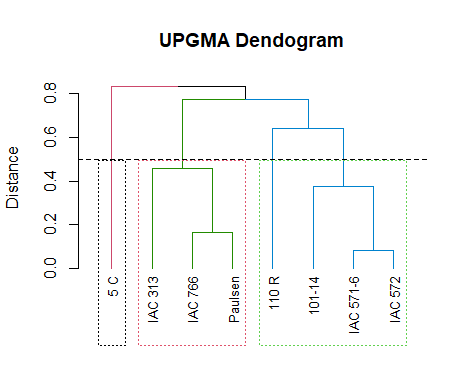
To evaluate the genetic dissimilarity among the tested rootstock cultivars, genetic distances were calculated using the prevosti.dist function in the "poppr" package (Kamvar 2014). Hierarchical clustering was then performed using the "average" method (UPGMA) with this dissimilarity matrix. The resulting dendrogram was visualized and plotted using the "dendextend" package in R (Galili 2015).
RESULTS AND DISCUSSION
Genetic parameters
There was substantial variation within the vegetative components and leaf traits (Leaf_1 and Leaf_2) of the eight grapevine genotypes used as rootstocks (Table 2). Therefore, there is plenty of exploitable genetic variability for breeding purposes using these genetic, phenotypic, and residual variances. In general, the phenotypic variance () exceeded the genetic variance () for all evaluated traits, highlighting considerable environmental influence. Nevertheless, the magnitude of was relatively high for several components, particularly for Sprout_2, suggesting a greater potential for direct selection. The mean values (μ) of Sprout_2 ranged from 68.02 to 78.20, while Leaf_1 and Leaf_2 presented lower averages, ranging from 10.39 to 12.48. This contrast indicates that sprout length is not only more expressive but also more variable, reinforcing its relevance as an indicator of vegetative vigor.
Heritability (H²) estimates varied widely among traits and genotypes. For Sprout_2, H² values ranged from 0.30 to 0.56, characterizing a moderate to high H² and suggesting a greater selection efficiency. In contrast, Leaf_1 and Leaf_2 generally exhibited a low to moderate H², indicating more environmental influence on leaf length. For stem diameter (SD), the H² variation was high, ranging from 0.07 to 0.90 between SD_1 and SD_2. Additionally, a distinct behavior for SD was noted: as the water depletion intensified, genotypic differentiation increased, resulting in higher H² estimates, as shown with the 5th measurement.
Selection accuracy (acc) closely followed the H² pattern, with higher values recorded for SD_2 (up to 0.95) and lower values for Leaf_1 in some genotypes. According to Resende (2016), accuracy values above 0.70 reflect a high reliability for predicting genetic values, reinforcing the suitability of SD_2 as a robust selection criterion in grapevine breeding programs. These findings are consistent with previous studies reporting that traits associated with vegetative growth tend to exhibit a stronger genetic influence than those related to leaf structures, especially under more varied field conditions (Leão et al. 2018).
In this experiment, the morphometric data indirectly measured the plants’ water status and stress. As cell expansion is the most sensitive to water deficit (Taiz et al. 2024), reductions in stem, leaf, and shoot dimensions confirmed turgor limitation. Moreover, cumulative growth serves to better select drought-tolerant genotypes compared to point-based physiological data (Blum 2011).
From an agronomic perspective, selecting rootstocks with an increased sprout length may enhance the vigor of the grafted plants, contributing to improved establishment and future productivity, due to the high H2 observed here. Additionally, the genetic diversity detected provides a valuable basis for selecting genotypes better adapted to diverse edaphoclimatic conditions. These results emphasize the importance of evaluating genetic parameters at early selection stages, as they increase breeding efficiency and reduce the time required to develop superior cultivars or rootstocks, as highlighted by Cavalcante et al. (2021).
This pattern has also been described in perennial crops, such as grapevines, where epigenetic plasticity mechanisms and environmentally induced gene expression can lead to the differential activation of tolerance genes over time (Fortes and Gallusci 2017). Thus, traits evaluated at later growth stages prove to be more reliable indicators for the selection of drought-tolerant genotypes, corroborating previous studies that highlight the importance of long-term physiological resilience (Herrera et al. 2022).
The BLUP predicted value analysis revealed dynamic changes in the rankings of the genotypes throughout the experiment. Comparing the BLUPs before and after water depletion helps to identify more resilient cultivars, as they maintain their performance even under water deficit conditions. While the genotypes IAC 572 Jales, IAC 766 Campinas, and 110 R initially performed better under water scarcity, IAC 313 Tropical, IAC 766 Campinas, and Paulsen 1103 performed better overall (Figure 1). Another critical aspect is the cultivars' recovery following water depletion. It was observed that genotypes IAC 101-14 and 5C not only exhibited negative BLUP estimates throughout all evaluations, but they also failed to recover after water restoration (7th evaluation). For these genotypes, the severity of the water deficit caused these genotypes to permanently wilt, irreversibly compromising their physiological functions and hindering recovery even after rehydration (Taiz et al. 2024). Consequently, their status worsened further relative to the other genotypes during this phase.

Molecular analysis
Initially, ten microsatellite loci developed by Merdinoglu et al. (2005) were evaluated for their amplification efficiency and informative potential for the analyzed genotypes (Ramos et al. 2025). However, three of these loci (VVIq52, VVIv37, and VMC1b11) amplified inconsistently, presenting issues such as missing bands or unstable patterns even after adjusting the conditions of the PCR (magnesium concentration, annealing temperature, and number of cycles). Consequently, these markers were excluded. Additionally, among the remaining loci, one (VVLN73) exhibited a monomorphic profile, meaning it did not show allelic variation among the analyzed genotypes and was also removed from the diversity analysis. Therefore, the final molecular characterization relied on six polymorphic loci.
The expected heterozygosity (He) was high for most loci, particularly VVLP31 (0.84) and VMCF3 (0.82), indicating a high level of genetic diversity among the evaluated genotypes. Meanwhile, the observed heterozygosity values (Ho) ranged from 0.50 (VVLP60) to 1.00 (VVLB01) (Table 3). Three loci (VMCF3, VVLP31, and VVLP60) also showed significant deviations from the Hardy-Weinberg equilibrium, suggesting a possible occurrence of selection effects, non-random crosses, or genetic structures in the studied population. This result was expected, since the analyzed genotypes are cultivars from breeding programs. Here, it is common to find genetic imbalances due to a narrow genetic base and low accumulated recombination throughout domestication and artificial selection (Barnaud et al. 2006). The fixation index (F) was positive in three loci, e.g., VVLP60 (F = 0.37), indicating greater homozygosity, thus representing regions that are conserved across all tested materials. The other loci gave a negative F value, as in VVLH54 (F = −0.62) and VVLB01 (F = −0.32), indicating an excess of heterozygotes.
Genetic distance between cultivars
The cultivars were subdivided into three distinct groups based on the genetic dissimilarity analysis among the genotypes, with genotype 5C being the most distant (Figure 2). The other four genotypes (110R, 101-14, IAC 571-6 Jundiaí, and IAC 572 Jales) had a high similarity due to their ancestry. Both 110R and 101-14 have V. rupestris as a common ancestor, while both IAC 572 Jales and IAC 571-6 Jundiaí have V. caribeae as a common ancestor.

The shared ancestry of the high-performing genotypes (IAC 313 Tropical, IAC 766 Campinas, and Paulsen 1103) also explains their SSR marker grouping and high BLUP values. Paulsen 1103 is derived from a cross between V. berlandieri × V. rupestris, a combination widely recognized to endow drought tolerance mechanisms in the resulting plants (Riaz et al. 2019). IAC 766 Campinas and IAC 313 Tropical also originate from wild species frequently associated with stress tolerance characteristics, notably from the tropical species V. cinerea but also from V. riparia and V. rupestris (Riaz et al. 2019).
Conversely, the genetic isolation and inferior drought performance of the 5C cultivar align with its ancestry. Its paternal lineage, V. riparia, evolved in riparian habitats and lacks physiological adaptations required to sustain turgor under severe water depletion (Padgett-Johnson et al. 2003). Thus, the SSR-based grouping effectively separated genotypes based on their functional adaptive strategies rather than just taxonomic distance.
In conclusion, the integration of quantitative and molecular data in this study highlights the potential of rootstocks IAC 313 Tropical, IAC 766 Campinas, and Paulsen 1103 for use in viticulture under drought conditions. The consistency between phenotypic performance and molecular grouping reinforces the reliability of this selection. However, to fully validate drought tolerance, further work should include soil-based pot trials incorporating physiological measurements, such as water potential (Ψw) and gas exchange, finally followed by field validation. Ultimately, these findings provide a basis for the development of robust selection indices, considering temporal stability and ancestry, contributing to the sustainability of viticulture in water-limited environments.
ACKNOWLEDGEMENTS
Evandro V. Tambarussi and Marco Antonio Tecchio are supported by the CNPq research fellowship grants no. 303789/2022-0 and 304258/2024-5, respectively.
Data Availability
The datasets generated and/or analyzed during the current research are available from the corresponding author upon reasonable request.
REFERENCES
- Barnaud A, Lacombe T, Doligez A2006 Linkage disequilibrium in cultivated grapevine, Vitis vinifera LTheoretical and Applied Genetics 112:708-716
- Blank M, Samer S, Stoll M2022 Grapevine rootstock genotypes influences berry and wine phenolic composition (Vitis vinifera L. cv. Pinot noir)OENO One 56:133-144
- Blum A2011 Plant breeding for water-limited environments. Springer, New York, 255p.
- Cavalcante NR, Silva WC, Santos CEM, Silva JK, Viana AP2021 Genetic control and early selection in full-sib families of guava (Psidium guajava L.)Euphytica 217:1-13
- Chen Y, Fei Y, Howell K, Chen D, Clingeleffer P, Zhang P2024 Rootstocks for grapevines now and into the future: selection of rootstocks based on drought tolerance, soil nutrient availability, and soil pHAustralian Journal of Grape and Wine Research 2024:6704238
- Delrot S, Grimplet J, Carbonell-Bejerano P, Schwandner A, Bert PF, Bavaresco L, Costa LD, Gaspero GD, Duchêne E, Hausmann L, Malnoy M, Morgante M, Ollat N, Pecile M, Vezzulli S2020 Genetic and genomic approaches for adaptation of grapevine to climate change. In Khurana SMP, Roy B and Khurana P (eds) Genomic designing of climate-smart fruit crops. Springer, Cham, p. 157-270
- Doyle JJ, Doyle JL1987 A rapid DNA isolation procedure for small quantities of fresh leaf tissuePhytochemical Bulletin 19:11-15
- Ferlito F, Distefano G, Gentile A, Allegra M, Lakso AN, Nicolosi E2020 Scion-rootstock interactions influence the growth and behaviour of the grapevine root system in a heavy clay soilAustralian Journal of Grape and Wine Research 26:68-78
- Fortes AM, Gallusci P2017 Plant stress responses and phenotypic plasticity in the epigenomics era: perspectives on the grapevine scenario, a model for perennial crop plantsFrontiers in Plant Science 8:82
- Galili T2015 dendextend: an R package for visualizing, adjusting and comparing trees of hierarchical clusteringBioinformatics 31:3718-3720
- Herrera JC, Calderan A, Gambetta GA, Peterlunger E, Forneck A, Sivilotti P, Cochard H, Hochberg U2022 Stomatal responses in grapevine become increasingly more tolerant to low water potentials throughout the growing seasonPlant Journal 109:804-815
- Jombart T2008 adegenet: an R package for the multivariate analysis of genetic markersBioinformatics 24:1403-1405
- Kamvar ZN, Tabima JF, Grünwald NJ2014 Poppr: An R package for genetic analysis of populations with clonal, partially clonal, and/or sexual reproductionPeer Journal 2:e281
- Leão PCS, Nunes BTG, Souza EMC2018 Repeatability coefficients and genetic gains in table grape progenies for the Brazilian semi-arid regionScientia Agricola 75:387-392
- Marchin RM, Ossola A, Leishman MR, Ellsworth DS2020 A simple method for simulating drought effects on plantsFrontiers in Plant Science 10:1372
- Medrano H, Tortosa I, Montes E, Pou A, Balda P, Bota J, Escalona JM2018 Genetic improvement of grapevine (Vitis vinifera L.) water use efficiency: variability among varieties and clones. In Prasad MNV (ed) Water scarcity and sustainable agriculture in semiarid environment. Academic Press, London, p. 377-401
- Merdinoglu D, Butterlin G, Bevilacqua L, Chiquet V, Adam-Blondon AF, Decroocq S2005 Development and characterization of a large set of microsatellite markers in grapevine (Vitis vinifera L.) suitable for multiplex PCRMolecular Breeding 15:349-366
-
OIV2024 State of the world vine and wine sector in 2024. Available at: <Available at: https://www.oiv.int/sites/default/files/2025-04/OIV-State_of_the_World_Vine-and-Wine-Sector-in-2024.pdf >. Accessed on July 19, 2025.
» https://www.oiv.int/sites/default/files/2025-04/OIV-State_of_the_World_Vine-and-Wine-Sector-in-2024.pdf - Padgett-Johnson M, Williams LE, Walker MA2003 Vine water relations, gas exchange, and vegetative growth of seventeen Vitis species grown under irrigated and nonirrigated conditions in CaliforniaJournal of the American Society for Horticultural Science 128:269-276
- Paradis E2010 pegas: an R package for population genetics with an integrated-modular approachBioinformatics 26:419-420
- Prinsi B, Simeoni F, Galbiati M, Meggio A, Tonelli C, Scienza A, Espen L2021 Grapevine rootstocks differently affect physiological and molecular responses of the scion under water deficit conditionAgronomy 11:289
-
R Core Team2024 R: A language and environment for statistical computing. R Foundation for Statistical Computing, Vienna. Available at <Available at https://www.R-project.org/ >. Accessed on June 02, 2025.
» https://www.R-project.org/ - Ramos AR, Zanotto MD, Souza YBD, Tambarussi EV, Homczinski I, Nunes MPBA2025 Genetic profiling system optimization for Ricinus communis L. using microsatellite markersCrop Breeding and Applied Biotechnology 25:e510125211
- Resende MDV2016 Genética biométrica e estatística no melhoramento de plantas perenes. Embrapa, Brasília, 975p.
- Riaz S, Pap D, Uretsky J, Laucou V, Boursiquot J-M, Kocsis L, Walker MA2019 Genetic diversity and parentage analysis of grape rootstocksTheoretical and Applied Genetics 132:1847-1860
- Rius-Garcia X, Videgain-Marco M, Casanova-Gascón J, Acuña-Rello L, Martín-Ramos P2025 Physiological response to salinity in novel M-series grapevine rootstocks: a comparison with commercial standardsAgronomy 15:473
- Silva AG, Felinto Filho EF, Ulisses C, Musser RS, Costa CSR, Chaves ARM, Leão PCS2024 Grapevine rootstocks under water deficit: biomass, biochemical, and gas exchange attributesRevista Caatinga 37:e11870
- Taiz L, Zeiger E, Møller IM, Murphy A2024 Balanço hídrico nas plantas. In Taiz L, Zeiger E, Møller IM and Murphy A (eds) Fisiologia e desenvolvimento vegetal. Artmed, Porto Alegre, p. 169-189.
- Viana AP, Bruckner CH, Martinez HEP, Huaman CAM2001 Physiological characteristics of grapevine rootstocks in saline solutionScientia Agricola 58:139-143
- Zhang J, Hausmann L, Eibach R, Welter LJ, Töpfer R, Zyprian EM2009 A framework map from grapevine V3125 (Vitis vinifera “Schiava grossa” × “Riesling”) × rootstock cultivar “Börner” (Vitis riparia × Vitis cinerea) to localize genetic determinants of phylloxera root resistanceTheoretical and Applied Genetics 119:1039-1051