 Occupational therapy in Basic Education in Brazil: a panoramic overview and some of its voices
Abstract
Guided by dialectical and historical materialism, we present research that focused on understanding the professional field of occupational therapy in education in Brazil. Following the study’s methodological path, the text provides an initial overview that addresses the relationship between this field and Brazilian Basic Education, as well as our understanding of the specific professional practice of occupational therapists hired by the education sector, both public and private, to work in schools across the country. The data were obtained through: (1) an online form distributed nationwide with the support of professional networks and entities representing the category; and (2) interviews with occupational therapists from the education sector. This professional field has mainly been taking shape since the 2000s, assuming porous contours and a broad but not very dense scope, with an irregular conceptual framework and dispersion regarding the references that inform these practices. These practices, in turn, arise from a certain spontaneity, combined with the incorporation of what is familiar from a theoretical-methodological standpoint, and, to some extent, are subject to what external actors to the field believe the role of these professionals should be. Often, the motivation for hiring occupational therapists stems from knowledge of their work in rehabilitation institutions, either in clinical practice or in rehabilitative practice within special education institutions. Considering this, we propose that the horizon to be pursued is one of possibilities for occupational therapists’ actions aimed at a quality, public, diverse, radically inclusive, and thus democratic formal basic education, equipping everyone with the necessary tools for well-being.
Keywords:
Occupational Therapy; Professional Practice; Schools; Education
Resumo
À luz da dialética materialista-histórica, apresentamos uma pesquisa que se debruçou sobre a apreensão do campo profissional da terapia ocupacional na educação no Brasil. Seguindo o caminho metodológico do estudo, o texto traz um panorama inicial que se refere à relação dessa área com a Educação Básica brasileira e à nossa apreensão sobre a prática profissional específica de terapeutas ocupacionais contratadas pelo setor da educação, público e privado, para atuarem em escolas do país. Os dados foram obtidos por meio de: (1) formulário on-line distribuído nacionalmente com o apoio da rede profissional e de entidades representativas da categoria; e (2) entrevistas com terapeutas ocupacionais do setor da educação. Esse campo profissional vem se delineando principalmente desde os anos 2000, assumindo contornos porosos e um dimensionamento amplo, porém pouco denso, com um corpo conceitual irregular e dispersão quanto aos referenciais que informam essas práticas. Práticas que, por sua vez, decorrem de certo espontaneísmo, somado à incorporação do que é familiar, do ponto de vista teórico-metodológico, e, de certa forma, sujeitas ao que atores externos à área acreditam ser o papel dessas profissionais. Comumente, a motivação para a contratação de terapeutas ocupacionais advém do conhecimento de sua atuação em instituições de reabilitação, na forma da atuação clínica, ou na prática reabilitativa em instituições de educação especial. Diante disso, propomos que o horizonte a ser buscado seja o das possibilidades de ações de terapeutas ocupacionais direcionadas para uma educação formal básica de qualidade, pública, diversa, radicalmente inclusiva e, portanto, democrática, dotando a todos das ferramentas necessárias para o bem viver.
Palavras-chave:
Terapia Ocupacional; Exercício Profissional; Escolas; Educação
Introduction
Guided by the dialectical and historical materialism (Gramsci, 1999; Frigotto, 2000), this article presents the professional field of Brazilian occupational therapy in education, based on a study that was part of the doctoral dissertation “Occupational Therapy in Education: Contours and Outlines of the Professional Field” (Souza, 2021). In seeking to answer the question, “What are occupational therapists doing in schools in Brazil?”, we produced an overview of the relationship between occupational therapy and Basic Education in the country (the first stage of our empirical fieldwork) and explored the specific professional practices of occupational therapists employed by the public and private education sectors to work in schools nationwide (the second stage), integrating what we define as the subfield of occupational therapy in education.
To build this overview, we developed a questionnaire to be answered on-line using Google Forms. This instrument included closed, objective, and open-ended questions aimed at occupational therapists who were or had been professionally working in schools for at least three months, considering this duration as the minimum reasonable time for professionals to become familiar with the dynamics of the services and provide accurate information about them.
By disseminating the form through our professional network and via 13 of the 18 regional offices of the COFFITO-CREFITOs system, which agreed to support the study’s promotion among affiliated professionals, we reached 90 participants, who between July 2019 and August 2020 completed the questionnaire after registering their informed consent1 . For a participant’s response to be included, they had to be an occupational therapist currently working or having worked professionally in school(s) or in the education sector, regardless of the nature of that professional action. As a result, 74 responses were considered for the study.
For the second stage, scheduled to begin in March 2020, the initial intention was to select occupational therapists directly involved in the education sector and working in it for at least three months based on the information gathered in the first stage of the study. We planned to conduct at least four in-person interviews, accompanied by observations of their everyday practice, and, as much as possible, organize focus groups to delve deeper into the issues raised in the initial conversation. Because of the COVID-19 pandemic, we had to resize our plans to fit within the necessary restriction measures. As a result, we proposed conducting a greater number of on-line interviews, inviting the 20 occupational therapists who met the established profile and had responded to the initial stage’s form, of which 15 accepted our invitation.
Given the situation at the time, and considering the exclusion of the observation stage, we were also interested in interviewing occupational therapists who had worked in the education sector in the past for at least three months, as the first stage of the study highlighted a certain impermanence within the category, particularly in positions related to the public education sector and in vacancies resulting from public tenders.
Using the aforementioned framework, along with others (Bittar, 2012; Bittar & Bittar, 2012; Ferreira Junior & Bittar, 2006, 2008; Freitag, 2005; Lopes & Borba, 2022; Lopes et al., 2021; Manacorda, 2010; Nosella, 2008; Nosella et al., 2007; Saviani, 2014, 2018), we achieved a macro-social understanding of the social question for the formation of the problems historically inherited by Brazilian education. Through this, we developed comprehensive analyses of what we encountered in our empirical research. This was because we aimed to identify points of convergence and/or divergence between the demands of education in Brazil and the actions of occupational therapy directed toward Brazilian schools, given our proposal: to discuss the contribution made or not, possible or not. Thus, we looked at the educational reality in Brazil; we reflected generally on the concept of “inclusion” in education (Souza et al., 2021) – believing this to be the main link that allowed occupational therapists to cross the boundary between health/rehabilitation and education, or the social field and education, integrating into this sector and developing a school-based practice in various countries, including Brazil.
In this process, we defined that the propositions of occupational therapy in education should contribute to what we agree as the horizon to be pursued: a mass school system that responds with quality to both collective and individual demands, while also being concerned with an education that promotes the intellectual and cultural autonomy of subjects. This, in our view, is the role of occupational therapy in education in Brazil.
It is, therefore, an education that is realized as a social policy, reverberating as a technical action that considers the impacts of the social question on education, which, as is known, institutionalizes the inequality of opportunities, configuring the main ethical problem of today – the over-concentration of wealth and the excessive increase in poverty (Freitag, 2005; Nosella, 2008; Lopes et al., 2021).
Stage 1 – Overview of the Field of Occupational Therapy in the Education Sector in Brazil
Systematization of the professional field in Brazil
The study that gave rise to this article allowed us, already in its first stage, to assert something unprecedented, perhaps anticipated but not yet determined: there is a professional field of occupational therapy in the education sector in Brazil that assumes specific contours and outlines.
Before delving deeper into this point, we emphasize that, when mentioning “occupational therapy in the education sector,” we recognize that this term refers to professional practice within the scope of formal education—with professionals working in or relating to different levels, from Early Childhood Education to Higher Education (Cardoso & Matsukura, 2012; Fonseca et al., 2018; Nogueira & Oliver, 2018; Pereira et al., 2021; Lopes & Borba, 2022)—and non-formal education (Lopes et al., 2008, 2013; Malfitano & Lopes, 2004).
Concerning our specific focus, the gathered information demonstrated that the professional field of occupational therapy, specifically in Basic Education, has been taking shape since approximately the 2000s, and it is composed of professionals who arrive at schools through different means, including: working independently, providing home care and attending to individual needs of patients in their schools; clinics offering services to schools; professionals from the health, social assistance, or socio-legal sectors developing professional actions in schools; practices in schools/in the education sector through teaching occupational therapy; direct employment with schools or with municipal or state education departments; and, additionally, those who do not fit into any of these profiles, such as those temporarily hired with specific work hours to support, on a transitional basis, the implementation of various projects in education through advisory or consultancy roles.
Within the broader field, we define a professional subfield of occupational therapy with particular contours, referring to the creation of permanent positions for occupational therapists in the education sector, involving the direct hiring of the category to work in schools and in educational policies. The subfield integrates the field but refers to a rather specific and particular professional practice.
Occupational therapists in Brazilian basic education: an overview
This professional field is predominantly composed of white women, averaging between 30 and 39 years old. The occupational therapists informing this research have been developing actions in or in relation to schools (borrowing the words of Pan et al., 2022) for no longer than 20 years, with most working continuously. Therefore, despite literature occasionally indicating the presence of this professional practice since the 1970s, as for example in Rocha (2007), the empirically obtained data allow us to conclude at this point that education seems to have become a demand for occupational therapists more recently in Brazil, primarily around the early 2000s, when the first publications on the theme also began to emerge in the realm of scientific knowledge production in the country (Pereira et al., 2021). This finding is surprising, as it aligns with the average duration of professional engagement observed, for instance, in Primary Health Care (APS) in the study by Silva (2020), an established field of practice among occupational therapists, and in the Unified Social Assistance System (SUAS), as demonstrated by Oliveira’s (2020) study, which has had professional regulation in the sector since 2011.
The overview portrays a scenario composed of a group of professionals who graduated from private or public Higher Education Institutions (HEIs) and have a high level of education, with the majority having completed or being enrolled in postgraduate programs. These include specializations (often more than one), master’s degrees, and, to a lesser extent, doctoral degrees2 .
Given the information regarding the professionals’ specializations, we encountered a significant variety of courses, which show little repetition and are confined to the field of health3 . It becomes clear, therefore, the realm through which occupational therapists in education navigate and engage in dialogue in Brazil – a pattern that also appears in the findings related to master’s (both academic and professional) and doctoral degrees.
This contrasts with the results found by Silva (2020), who reported a high rate of postgraduate specialization specifically for PHC, demonstrating positive impacts of this characteristic on the contours of professional action in that sector.
Regarding the type of institution where occupational therapists conducted their professional work, both public and private institutions were recorded, including nonprofit organizations, with some cases where the occupational therapist operates in both sectors.
As for the weekly working hours, the 30-hour limit established (Brasil, 1994) was respected; however, we also found cases where there was no consistency, as the education sector allows for specific engagements, such as service provision to families or even public schools by self-employed professionals.
Regarding compensation, the hourly rates varied widely, ranging from BRL 6.90 to BRL 250.00 per hour, though the majority earned up to BRL 100.00 per hour worked, with the highest concentration in the BRL 80.00 to BRL 100.00 range – a finding that is surprising, considering the average hourly wage for occupational therapists at the time was between BRL 18.84 and BRL 22.01 in Brazil (Salário, 2024).
Outlines of a field shaped by rehabilitation sciences and special education
Research has revealed the strong presence of teamwork among professionals from different fields in the daily professional life of occupational therapists in education (Fonseca et al., 2018), as well as in services within the social sector, such as the facilities of SUAS (Oliveira, 2020) and in health services such as the APS (Silva, 2020).
In this broader view of the various pathways through which occupational therapists have entered the education sector, professional practice appears to take shape in a similar manner, that is, through working with multidisciplinary teams, typically including psychologists, educators and/or licensed teachers, speech therapists, social workers, psycho-pedagogists, physical therapists, and school administrators. However, there is little collaboration with teachers of specialized educational services (AEE) and other professionals supporting students who are the target population of special education (PAEE), such as therapeutic companions, caregivers, Brazilian sign language (Libras) interpreters, and Braille proofreaders. This is a surprising finding, considering that it is common among occupational therapists working in education to assert that their practice is historically shaped by the processes of including PAEE students in regular schools.
In fact, the information gathered in the research supports our assertion that occupational-therapeutic actions in schools primarily benefit children, either directly or indirectly (and very seldom adolescents and young people), with “neuropsychodevelopmental”4 issues, which have been the main focus of occupational therapy in education. Their actions are directed similarly, reaching teachers, administrators, parents and/or legal guardians, pedagogical teams, and, more broadly, students. Considering that individuals with disabilities are a primary concern for occupational therapists working in schools, the limited reference to direct actions with professionals who engage with this population daily may reflect a certain focus on interventions aimed at the individual labeled as “having a problem.” This topic has been discussed in relation to actions in the health and social fields, where the individualized approach is associated with the historical affiliation of occupational therapy with rehabilitation sciences and clinical care in the traditional contexts in which the profession has operated (Barros et al., 2002; Malfitano, 2016). Such an approach and affiliation do not adequately meet the demands of policies with territorial and community-based proposals and/or those that seek to move beyond health (Silva, 2020; Oliveira, 2020), posing the risk of a medicalizing action5 (Moysés & Collares, 2013).
In this context, the resources that occupational therapists most frequently use in their direct or occasional interactions with schools include a wide range of tools, techniques, and strategies, which they describe with significant and, we might say, concerning heterogeneity. This suggests that it is important to understand the meanings behind this diversity, as what we observe is a near-total lack of consensus on how these resources are named. Therefore, it would be misleading to say, “In education, occupational therapists primarily use the following resources...” because the information obtained does not allow us to make such a claim.
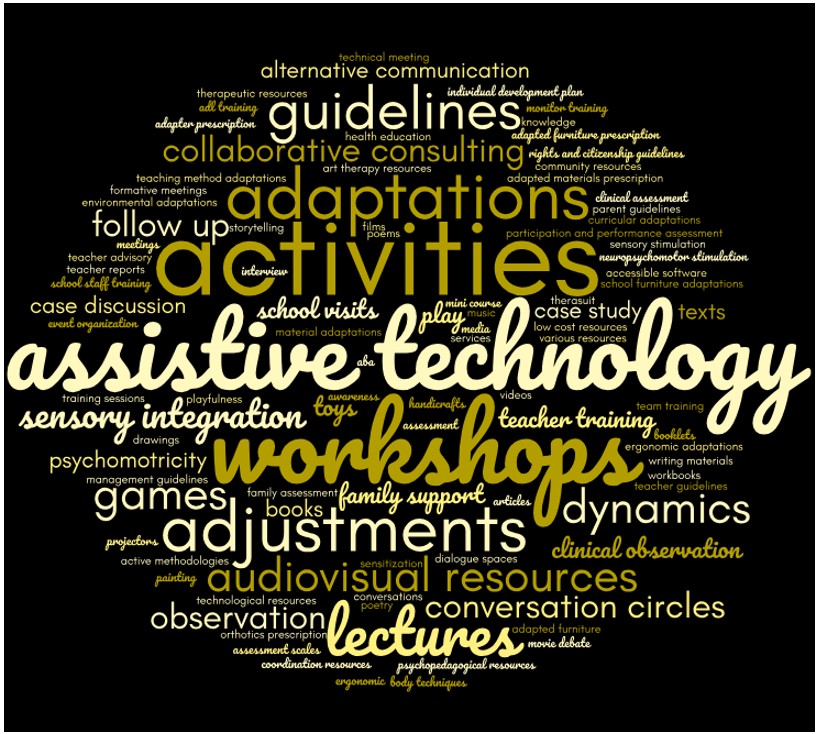
However, it is worth noting that some relatively recurring mentions included: “adaptations” (environmental, curricular, materials, ergonomic, in teaching methodology, and/or school furniture); “adjustments” (environmental, learning process resources, postural, in activities); “activities” (crafts, artistic, conversational, expressive, recreational, manual, psycho-pedagogical, socio-cultural, gross and fine motor, visuomotor, and/or sensory coordination); “workshops” (activity, recreational, “socio-occupational,” “thematic”); and “assistive technology,” which aligns with the landscape of national publications in the area (Pereira, 2018). Their actions are directed similarly, reaching teachers, administrators, parents and/or guardians, pedagogical teams, and, more broadly, students.
Foundations for defining the current contours of this professional field
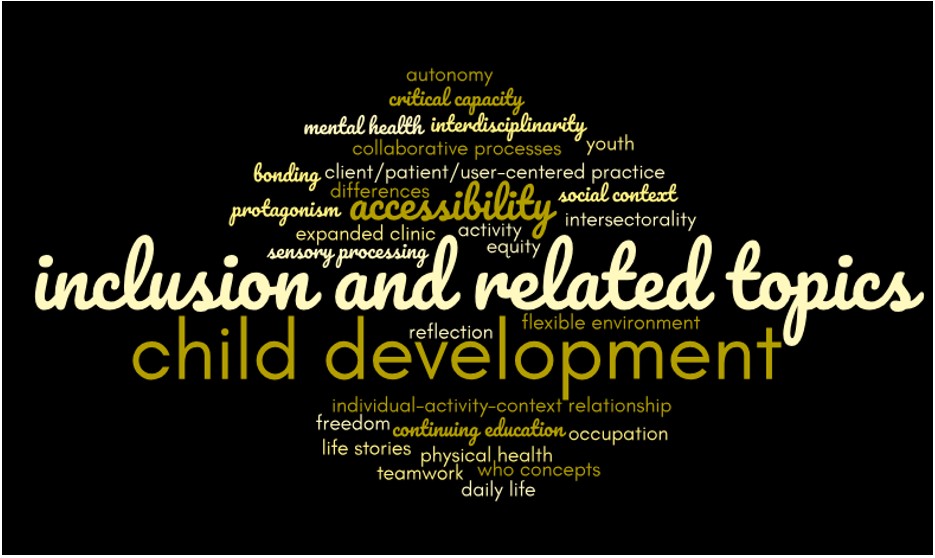
Up to this point, we can visualize a map of this professional field with porous contours, quite broad, seemingly not very dense, but which indeed exists in Brazil, even if still in its early stages. It appears to have begun establishing itself as a trend in the field during the first decades of the 21st century. Its lack of consolidation becomes more evident when we examine which concepts and references occupational therapists identify as essential for this work. In this regard, there is also a significant variety of responses (Figure 1).

Concepts and/or terms considered essential for the work of occupational therapists in the school context.
Silva (2020, p. 100) encountered a similar scenario in APS, warning that this conceptual dispersion “[…] could hinder the development and documentation of practices and highlights the need for dialogue within this specific field of knowledge [in occupational therapy] to enhance understanding of APS practice.” Similarly, Oliveira (2020) found a diverse understanding of the theoretical frameworks informing the practice of occupational therapists at SUAS, very close to what we observed in our research. This author noted a “[…] generic and heterogeneous approach to how the professional category has named the practices being developed” (Oliveira, 2020, p. 205) and, for her, this would result in a weakness in defining “what is intended and what is being done.”
Considering this, we grouped the references by type and organized the data in Table1, allowing a clearer view of both what we aim to express and the content of the responses obtained.
Indications of theoretical-methodological frameworks used by occupational therapists in professional practice in schools.
In the first group, for example, we can say that something that repeats itself more often, although still to a limited extent, are the sensory integration and psychomotricity approaches. The former is also more frequent in foreign theoretical works on occupational therapy and education (Pereira, 2018). As noted in Souza (2014), the body of work on sensory integration has long offered proposals to address sensory issues that negatively affect students’ school performance, as well as tools and resources for teachers.
Despite the apparent conceptual dispersion, a more comprehensive analysis reveals that the following theoretical frameworks tend to predominate: special education and its primary target populations, developmental psychology and its interface with education, as well as subjects linked to the realm of physical rehabilitation and those encompassed by the prefix “neuro,” which focus on functionality.
As for the foundations, the notion of inclusion within the terms of special education, along with related notions and concepts, has emerged as the main guiding principle in the field. However, we also observe, consistent with what we have presented here, the relatively frequent presence of concepts referring to the developmental perspective for children, as well as those more directly associated with the theoretical and practical realm of occupational therapy. These include “activity,” “autonomy,” “everyday life,” “occupational performance,” “occupational development,” “education as occupation,” “occupation,” “client/patient/user-centered practice,” “sensory processing,” “individual-activity-context relationship,” and “bond.”
The information gathered regarding the references and concepts that occupational therapists consider essential in their work in and related to schools does not sufficiently support us in identifying those that characterize or outline the foundations of professionals’ work in Basic Education. However, they allow us to affirm that there is an apparent affinity with certain fields of knowledge, as described.
Despite the significant conceptual, referential, and resource-related dispersion, and beyond seeking to understand its meanings, we have looked for complementary information that could provide some direction regarding what is generating this characteristic in the field.
Among occupational therapists, there is a predominant perception that undergraduate education does not sufficiently provide the necessary requirements for working in schools. A significant group asserts that professional education either prepares them very inadequately or does not prepare them at all for this professional practice.
Given that professional practice in occupational therapy is partly aimed at contributing to addressing social demands institutionalized by the State, primarily through social policies (Bezerra et al., 2021), it is noteworthy that professionals from various subfields so emphatically report that undergraduate education does not provide the necessary support for professional practice, whether in education, social assistance (Oliveira, 2020), or even in health, in the case of APS (Silva, 2020).
Stage 2 – Voices of Occupational Therapists in the Education Sector
What are occupational therapists doing in schools in Brazil?
Starting from the data obtained in the first stage of the empirical study, we selected occupational therapists who were professionally linked directly to the education sector, in public or private Basic Education institutions, aiming to understand this specific professional practice and produce a more detailed description of this professional subarea. To this end, we interviewed 15 occupational therapists, most of whom were from states in the Southeast region, where there seems to be a higher concentration of professionals directly connected to this sector. We also had two representatives from the Northeast and one from the South regions of the country. Regarding the length of service, 10 of them belonged to the group “currently linked” (five) or “formerly linked” (five) to the public education sector, while the other five were linked to the private education sector.
The analytical reading of this material sought to provide a general picture of this subarea, despite certain singularities, aiming to answer the different dimensions of “What are occupational therapists doing in schools?” – What? How? With whom? Since when? Where? With which theoretical frameworks? With which resources?
Outlines of occupational therapy practice in the education sector
Contextualizing how, we find it important to state that entry into this sector seems to occur mainly through two pathways. The first is a personal or professional connection with education. This includes individuals who already had a relationship (family or professional) with education and were interested in it before entering occupational therapy, and/or those who worked in or identified with special education during their undergraduate studies or at the beginning of their professional careers. The second pathway, more common in the public sector, involves therapists being assigned to positions in the education sector through public service exams. Many therapists reported that the job postings did not specify which sector or service the position would be for – a common practice even today. Several therapists mentioned having initially been interested in the subfield of mental health, with the expectation that the positions would be in Psychosocial Care Centers (CAPS). When they unexpectedly found themselves working in education, some, particularly those pioneering the services, tried to build their practices based on prior experiences in Associations of Parents and Friends of Children with Deficiency (APAEs) or private practice. Others sought out existing knowledge or legal documents about occupational therapy in education or related topics.
Especially for those who had other occupational therapists on their teams or in the same service, or who were taking over positions previously held by professionals in the field, there was support in building their practices or, in some cases, a pre-established path. Only two interviewees reported seeking specific education that would provide them with the necessary tools for their initial work in schools.
Several recurring points were marked cross-sectionally throughout the participants’ reports. The first and most evident was the consensus that the professional role, regardless of the path taken by the interviewees, was primarily aimed at addressing social demands related to school inclusion, especially, though not exclusively, those within the scope of special education. We can say that the principle of inclusion strongly guides the entry of occupational therapists into the education sector, particularly in relation to children with disabilities and/or “neuropsychodevelopmental” issues, echoing expressions found both nationally and internationally in the academic sphere (Borba et al., 2020; Pereira et al., 2021). This alignment was especially evident among those who had a prior interest in the field of education, reflecting an affinity with working with children – a trend also noted in the aforementioned body of knowledge.
In the public education sector, services are established locally, with no nationally organized policy to guide this type of support service for inclusion, structured in a specific way, or to define the composition of teams that include occupational therapists. The country has not yet succeeded in implementing a nationally organized – centralized – education system (Saviani, 2018). Consequently, and given the lack of a pre-existing organization and systematization of this occupational therapy subarea, with unified and well-defined guidelines as part of a broader system, there appears to be a movement toward the question, “How can my interests and previous experiences inform the practice I need to build and/or develop in education?”
Among public sector participants, there was a recurrent alignment with mental health, with many initially expecting to enter the field through public contests. However, from what was observed, the experiences and knowledge gained from special education and pediatric rehabilitation were recognized by professionals as valuable for supporting this shift, while mental health contributions did not seem, except in rare cases, to have been as integrated into school practice.
In the United States of America (U.S.A.), mental health lost significant professional influence when occupational therapists began working in schools in the 1970s (Chandler, 2013). The book on “best practices in school-based occupational therapy” in this country (Clark & Chandler, 2013) noted the expansion of the field from disabilities to child mental health issues, such as ASD and ADHD (Borba et al., 2021), which we also observed in the Brazilian context. Despite this, the approaches adopted in schools there are drawn from the rehabilitation sciences (a trend also assimilated here) and are driven by an evidence-based practice model that, in turn, defines the notion of “best practices” and what should or should not be funded.
In the private sector, the motivation for occupational therapists to enter the field often stems from personal connections, but there was also a connection to the legal demand that private schools provide necessary support for the inclusion of students with disabilities, mandated by the Brazilian Inclusion Law (Brasil, 2015).
We observed that everyday practice results from a certain spontaneity, combined with the incorporation of familiar theoretical-methodological frameworks (previous experiences and affinities) and, to some extent, is shaped by what actors outside the field believe to be the role of these professionals in these services. Often, in both the public and private sectors, the motivation to hire occupational therapists stems from knowledge of the profession’s work, particularly in rehabilitation institutions, whether through clinical practice or rehabilitative work in special education institutions.
A concern that stood out among the interviewees, and that was voiced critically, was the notion of “clinical” or “exclusively clinical” work in the school setting. This discourse is significant in the narratives of the professionals—since this is not a new debate in occupational therapy—particularly in the effort to separate from health-focused work – a struggle seen especially in the historical formation of social occupational therapy, as well-developed by Oliveira (2020).
Nevertheless, particularly in the private sector, some connection is established between clinical care and schools, with occupational therapists sometimes being hired by the school or leaving it to meet a demand for clinical care generated by the school setting itself.
Thus, a particular perspective of work emerges that seeks to move beyond traditional clinical practice in schools but, in doing so, has adopted the idea of expanding clinical practice. This reflects the influence of the health field, specifically rehabilitation, through which actions for education in occupational therapy are also proposed. As we will see, this approach poses challenges in defining the professional specificity required to complement the different sectors, as observed in the fields studied by Silva (2020) and Oliveira (2020).
With whom do occupational therapists work in schools?
In the context of working in schools, in many cases, occupational therapists integrate themselves or establish partnerships with teams composed of professionals from different fields, the most frequent being social workers (only in the public sector), psychologists, and speech therapists. Occasionally, teams also include other professionals who provide support to PAEE (students who are the target population of special education), reflecting what is observed across the broader occupational therapy field, as presented earlier.
The characteristic of working within multidisciplinary teams is common in the broader field of education, especially for those whose work has a central focus on territorial and community-based practices (Silva, 2020; Oliveira, 2020).
Despite the traditional presence of psychology and, more recently, social work in schools, and the absence of a national education system that prescribes the composition of teams with professionals from different areas, it is unclear whether the field of education recognizes these and other professionals (e.g., speech therapists, occupational therapists) as “education professionals,” alongside educators and licensed teachers.
In the participants’ accounts, the work processes often blended together, making it difficult to distinguish what was the responsibility of the team and what was specific to the occupational therapists. These processes revealed some commonalities among the interviewees regarding the professional reasoning that guides the way services are provided. One of the most recurring aspects was the flow by which students in schools access these services and professionals. Typically, students are referred to the teams by teachers, often through structured documents provided by the services to formalize the requests.
This represents a fundamental difference compared to what Silva (2020) and Oliveira (2020) found in the context of the APS or SUAS, where specific referrals to occupational therapists are uncommon. In schools, teachers observe a problem or difficulty in a student and request evaluation and support from the teams. Some places have more or less structured procedures, such as a guiding document from the service that instructs teachers on which professionals to refer students to, depending on the situation.
We sought to understand when, from the school’s perspective, occupational therapists are the professionals to be requested. The most common issues cited were problems with motor coordination, although some also mentioned developmental delays or disorders, autism spectrum disorder (ASD), learning difficulties, disabilities, sensory processing disorders, etc. In one case, the therapist’s role was characterized more by expertise in assistive technologies and adaptations than by addressing specific issues.
In general, schools tend to perceive occupational therapy as addressing rehabilitation demands, especially those related to motor issues, though not exclusively. This aligns, in part, with what has been revealed by theoretical research in the field (Pereira et al., 2021; Borba et al., 2020). However, during the interviews, the therapists expressed a critical tone regarding these understandings. Many reported employing various strategies to broaden the schools’ view of how they, as occupational therapists, could contribute. Their presence in classrooms and schools seemed to play a central role in expanding this understanding, as they conducted active searches in loco, diversifying the profiles of students who fell within their scope of practice and care.
It is important to note that the concern about the school’s reductive understanding of the role of occupational therapy is also present in publications that helped outline the historical pathways of occupational therapy in schools in the U.S.A. (Souza et al., 2020). However, this concern did not seem to have had the necessary strength to prevent what later became a dominant aspect of knowledge production on occupational therapy and schools in that country – the large proportion of research dedicated to motor coordination and handwriting (Borba et al., 2020).
For the participating professionals, the specificity of occupational therapy in education is not defined by the target population and their issues but rather by the characteristics of professional practice and certain skills that they feel this field, and only this field, possesses. Their narratives even reflected the recognition of this specificity by their colleagues on the team.
I think this perspective on the context and the activity is important. For example, psychology [...], the partners I’ve had [...] tended to focus a lot on providing guidance [...], all the speech therapists I worked with in the field of education were [...] very technical [...]. More prescriptive! [...] I believe the occupational therapy perspective was very much focused on everyday life! It was very much about the context, like, okay, the speech therapist is going to prescribe something, but how do I make it work within the school? In this specific school? For these students? So how do I introduce Libras in a village school? (13th interviewee, SIC).
Reports like these align directly with the studies by Silva (2020) and Oliveira (2020), in which occupational therapists attribute their specificity to two main elements: activities and everyday life, in the interaction between the two. This concerns how much the individuals they follow up are accessing or benefiting from their rights. In our study, this right is education.
When we recognize this, we can infer that, rather than being defined by the target population, occupational therapy in Basic Education focuses on any and every student who is struggling to engage in the broad range of activities that compose the school day. This is crucial for their holistic educational experience and ensures they have full access to personal, social, and cultural development, preparation for citizenship, and qualifications for employment through schooling (Brasil, 1988, 1996), and we would also add that it equips them with the tools necessary for well-being.
However, when we try to understand which populations are effectively the target of occupational therapy interventions in schools, the analysis becomes more complex, and the reports become somewhat unclear. Once again, it becomes increasingly difficult to discern what is the responsibility of the team as a whole and what falls specifically under the role of the occupational therapist. We observe that there are primarily two major groups that are defined as targets for professional intervention in schools: the first group comprises students with diagnoses (medically reported – “laudados”) – those with clinical diagnoses or disabilities. It is worth noting that not every student with a medical diagnosis necessarily receives services or occupational therapy intervention. In practice, the general criterion is whether the student is “functioning” well in school, be it in terms of motor, relational, behavioral, or social functioning.
However, there was not always consensus on defining the target population, as illustrated by the case of this team, which, despite being part of the special education division of the Municipal Department of Education, had ongoing debates on this topic:
That’s an ongoing discussion within that team. And we always feel the lack of a clear directive, we’ve always felt that way [...]. One time I told them: ‘I think our target population should be the school itself.’ There’s a lot of debate about whether the target population is special education students, but then that excludes children with ADHD, psychological issues, or those socially vulnerable (5th professional interviewed, SIC).
Where does the work take place?
As introduced earlier, in both the public and private sectors, the professional insertion of occupational therapists in schools and the education sector has occurred primarily because of the growing debates surrounding inclusive education. This trend focuses on the inclusion of students with or without disabilities who experience difficulties and require some form of “specialized” attention within regular schools. The assumption is largely based on special educational needs, though viewed through a somewhat broader lens (Souza et al., 2021). Inclusive education services and programs have apparently been created, either from scratch or by expanding pre-existing school support services.
Regarding the institutional place, both physical and symbolic, occupied by occupational therapists and/or the teams they integrate, particularly in the public sector, there was often a designated workspace, separate from school buildings. It was noticeable that these teams occupied what could be described as a “prestigious” place, enjoying a certain status, as expressed in some accounts. This status was evident both in terms of physical infrastructure and access to material resources.
This relative abundance contrasts with what we know about the reality of Brazilian public schools, where physical infrastructure, equipment, working conditions, teacher salaries, pedagogies, curricula, and assessment outcomes are often precarious (Saviani, 2018). Interestingly, this abundance also contrasts with the challenges occupational therapists face in accessing materials and resources for their professional practice in other subfields, as revealed by Silva (2020) and Oliveira (2020) in the APS and SUAS.
Concerning the physical and symbolic institutional space in the private sector, professionals reported being hired as part of the school team, working either exclusively in one school or providing services as outsourced professionals across multiple schools. We observed differences in the characteristics of their daily professional routines. Some professionals said they primarily worked at the institutional headquarters and visited schools periodically, while others reported spending almost all their time within the schools.
As we have seen, the professionals felt relatively free to determine how their routines should be structured. However, various other factors influenced this structure, such as the pre-established work dynamics of the service as a whole, especially since many joined teams that had already been in place for some time, and the number of schools under each interviewee’s “responsibility.”
Those who spent most of their time in the schools described their work as dynamic and mobile, without the structured routine of scheduled appointments, which occurred only occasionally. In the unique case of one interviewee working in a program of the State Department of Education, the itinerant nature of the work took on greater proportions, involving travel between municipalities, as well as between schools within each education department’s jurisdiction. This included schools of various types, not only urban ones but also in remote regions of the state.
What guiding question defines occupational-therapeutic intervention?
Considering what we have outlined about occupational therapy not being defined by the target population but by elements that fall within its professional scope (activities and everyday life), there is an implicit question at the start of each occupational-therapeutic process in schools: “Why is this student (who is accessing the service individually) unable to receive or benefit from education?”
The professional process has, therefore, been shaped not only for occupational therapists but also for the functioning of these inclusion support services as a whole and for the overall workflow of these teams. This process follows a logic heavily influenced by biomedical rationality (even when we speak of expanding clinical practice). It leads to an intervention that implicitly states: “This student is not receiving or benefiting from education because they have motor, relational, behavioral, and/or social problems.” Thus, the occupational-therapeutic intervention focuses on these aspects, both in terms of the activities needed in the school day and the application of activities aimed at developing the necessary skills or resolving observed functional problems.
In doing so, the broader context is seemingly overlooked. The question of why the school systematically excludes certain social groups, including people with disabilities or those with global developmental disorders, is not asked. We argue that this should be the driving question at the start of the professional process, one that activates the entire team, which was created specifically to support school inclusion.
What resources do occupational therapists use to conduct their actions in schools?
Thus far, we have learned that occupational therapy work in the education sector operates through a framework for interpreting reality, which we define as what professionals have called “the occupational therapy perspective.” This perspective directs attention to analyzing the student in interaction with the various factors inherent to the context in which they are immersed and (attempting to) participate in everyday life. In Oliveira’s (2020) research, occupational therapists also employed this same terminology to describe the specificity of the profession in social assistance. This researcher noted that this might reflect the generalist nature of initial occupational therapy education and the development of interventions that are close to and sensitive to the needs of individuals, collectives, and populations. On the other hand, she emphasized
[...] the importance of outlining work processes in technical forms and discourses to avoid interpretations that reduce the role of the occupational therapist to personal traits or actions without consistent theoretical and practical foundations [...]. (Oliveira, 2020, p. 206).
According to this author, these inconsistencies stem from “a lexical and knowledge gap in properly defining the specificities of technical-professional work in occupational therapy” (Lima, 2004; Morais & Malfitano, 2016). In Souza et al. (2020), we observe that, historically, American occupational therapists have been concerned about which language would be most appropriate to form the lexical framework to describe their work in education, aiming for the consolidation of this field in that country. However, there were limitations in the propositions that sought merely to translate the traditional language of clinical practice to be better assimilated by the education sector. On this matter, we propose that this language should express something derived from a consistent theoretical and methodological body, which, consequently, manifests in praxis.
Figure 2 presents the main resources and tools used in this professional field and the proportion and centrality with which they appeared in the first stage of the study.
Resources, tools, and technologies that occupational therapists utilize in their work in schools.
The specific professional actions of occupational therapists seem to align with the broader panorama of the field, as they are characterized by a mastery of materials and tools, along with knowledge of various activities and resources and their uses for specific purposes, which agree with the objectives that they and/or their teams have for the students in focus.
It appears that these professionals and their teams play an active role in facilitating a network of care, involving a range of actors, such as families and teachers, in their work processes.
From the accounts of the more specific professional processes of occupational therapists, classroom observation emerges as a distinctive feature of their professional work in education. In this regard, classroom presence does not seem to be common practice among professionals from other areas who are part of these teams. This is one of the primary strategies for occupational therapists, both in the public and private sectors, focusing on evaluating students with difficulties and identifying new demands – those that schools do not recognize or understand as issues for occupational therapists but that the therapists realize they can contribute to, a process we refer to as “active search.”
Additionally, we have learned that some therapists work with individual and/or group sessions. However, what seems to be a general practice is the strategy of individualized follow-ups. It is important to differentiate between individual sessions, which take place outside school hours in the therapists’ offices, and individualized follow-ups, which often involve not only the student but also other members of the school community. There is coordination among all these actors, based on the needs of a student experiencing difficulties (typically related to their classroom experiences).
There are classes that show difficulties in accepting children who have some kind of visible disability, so we work with the entire class, not just the student or the teacher [...] we conduct acceptance workshops with them [...] (12th interviewee, SIC).
Here is a good example demonstrating that the student’s needs were related to the negative attitudes of people in their environment (classmates, teachers, etc.), which led to action proposals involving this group in the form of workshops to raise awareness about the issue. It becomes clear that the critique is aimed at work that is exclusively focused on individual or group outpatient care sessions in the education sector, as the broader argument supports individualized follow-ups. We note that the tendency toward more “individualizing” propositions is prominent in the literature discussing occupational therapy and schools (Pereira et al., 2021; Borba et al., 2020, 2021; Borba, 2022).
Thus, the teachers of these students are involved in the follow-up process, receiving a wide range of guidance related to the occupational therapists’ expertise, which the therapists believe can help address the difficulties the teachers are experiencing with the referred students in the classroom. It is also important to note that the families of these students are involved at various levels: from everyday interactions resulting from the occupational therapists’ presence in the school, to more formal conversations, and the provision of diverse guidance. In addition to classroom teachers and families, some interviewees reported offering guidance to other members of the school community:
We provide guidance to the teachers who supervise the playground or the playground aides, and we also guide the doorman when the problem lies there as well [...] (4th interviewee, SIC).
Although individual follow-ups play a more prominent role in the daily work in schools, some professionals reported actions that are not only directed at referred or actively identified needs but also involve teacher training on topics that tend to represent more common general demands. Additionally, there are other efforts, such as work conducted in the classroom:
We notice that some bullying issues are happening in certain classrooms, and we set up specific projects for them [...] (3rd interviewee, SIC).
As well as outside the classroom:
[When the pandemic hit,] we were developing a project to set up an entire room, create a relaxing environment, and also leave it open for students to choose topics for us to discuss. So, it would have been three times a week [...] (14th interviewee, SIC).
Or with the parents:
We set up some thematic workshops that address what intellectual disability is, workshops about the autism spectrum to explain the characteristics, the prognosis of having the diagnosis, and what needs to be done... (1st interviewee, SIC).
And in partnership with colleagues from other areas of the same team:
We [occupational therapist and speech therapist] did several projects together, providing support to families and teachers. She would run voice workshops, and I would participate as well... It was really great! (10th interviewee, SIC).
And in the specific case of the occupational therapy company, they provide training, education, and screening for school support professionals for the schools:
My company offers a training course for school support professionals (PAE), which is the term used by law [...]. [...] and we handle the selection [of candidates for this position] and provide [the course] not only to the schools we work with but also to other schools at no cost... (4th interviewee, SIC).
The strategies used by occupational therapists working in the education sector involve, to varying degrees, individual or group sessions, individualized follow-ups—which include guidance for teachers, daily interactions with those responsible for the student, interviews, and guidance for families (and when they refer to “families,” they specifically mean the nuclear family, particularly parents or guardians)—as well as teacher and/or school staff training. Additionally, there are activity workshops, which is how we can classify the classroom-based actions reported by some professionals:
There’s a group of about three, at most four children in the little room, and I set it up so we can work on activities addressing learning difficulties or emotional challenges, or some specific issue that these children have that can be worked on together (7th interviewee, SIC).
Within the set of strategies, they use for their work in schools, the professionals mentioned various resources. The use of activities, one of the key aspects that, according to them, defines what only occupational therapists do within these teams of professionals, is the most frequently mentioned.
Conclusion
Considering what has been previously presented, it can be affirmed that there is an emerging field of occupational therapy in Basic Education in Brazil, which has primarily been taking shape since the 2000s. Occupational therapists enter the education sector through work in various services within sectoral policies. A greater presence is observed in the Southeast (particularly in the state of São Paulo) and the Northeast regions, with this professional field being relatively spread across the states, predominantly focused on children with “neuropsychodevelopmental” issues. The field is porous, with broad dimensions but low density, characterized by an irregular conceptual framework and a dispersion of theoretical references informing these professional practices. It is a specific professional subarea, referring to the direct hiring of occupational therapists to work in this sector, both in formal and non-formal education.
In the school setting, institutional flows previously established by inclusion support services—where occupational therapists are integrated—the team’s work process, the scale of work demand, and the school’s understanding of their professional roles are factors that shape the subarea of occupational therapy within Basic Education.
When identifying problems that require individualized and regular clinical intervention, occupational therapists in education face the limitations of school-based work and refer the student for rehabilitation services, offered privately and under the responsibility of the family. This boundary is less defined in the public sector, where individualized clinical care and outpatient services are often provided within the education service itself.
In both the public and private sectors, professional actions involve traveling between schools or classrooms to conduct evaluations and interventions with the student or related individuals—especially teachers—and providing out-of-class services to the student, either individually or in groups organized according to the shared needs of their members.
This subarea is significantly guided by the principle of inclusion in the context of special education. In the public sector, it remains within a nationally disjointed field, integrating randomly into local education policies. As a result, there is an apparent margin of freedom for professionals to build practices they believe are most consistent with their role as occupational therapists in this setting. The interviewees expressed criticism of the format of their work, actively seeking to expand dialogue with schools about possible contributions. However, they largely remain focused on populations with issues related to rehabilitation. They advocate for extending demands beyond motor coordination rather than expanding them beyond the health scope, which, in general, is not much different in the private sector.
The specificity of occupational therapists’ work directly linked to schools lies in their mastery of activities and their interaction with the everyday lives of mostly children, with the primary strategy being individual follow-up, closely aligned with a functional perspective. They employ various tools, resources, and technologies. As part of professional teams, they focus on establishing a network of care for the populations that access these services, creating referrals and intersectoral dialogues centered on individuals.
It is possible that it is through the increasingly prevalent discourse about the weakening of the Basic Education teaching profession that occupational therapists and professionals from various fields, often referred to as “specialists,” are arriving in schools. On this topic, Nóvoa (1999) highlights the “extraordinary” development of the university field of pedagogy and/or the sciences of education in the decades preceding his publication. According to him:
In large part, this scientific-educational community is fueled by teachers and legitimizes itself through reflection on them. [...] The professionalization of teachers depends on the ability to construct pedagogical knowledge that is not purely instrumental. Therefore, it is natural that the key moments of producing a scientific discourse in education are also key moments for the professional affirmation of teachers. However, these moments also contain the seeds of a devaluation of the profession, as they lead to the “delegitimization” of teachers as knowledge producers and invest new groups of specialists who assume the role of “scientific authorities” in the educational field (Nóvoa, 1999, p. 15).
According to Nóvoa (1999, p. 20), the “re-foundation of the school” as a space for individual formation and democratic citizenship can take many paths, but all of them necessarily go through the teachers. Renowned researchers in the field of education have pointed out the significant precariousness of teaching work in Basic Education as one of the legacies left by centuries of neglect of Brazilian education (Saviani, 2014, 2018; Bittar & Bittar, 2012).
One thing that becomes evident in the interviews is how occupational therapists are aware of this fragility, particularly regarding the physical, structural, and material conditions for teaching, as well as the inadequacies in teacher education. We observe a discourse that expresses solidarity with the first aspect, while justifying their presence in the education sector due to the second. In other words, occupational therapists are being called upon to contribute to this sector for demands that seem to stem from the intersection of precarious working conditions and insufficient teacher education.
Thus, the social and political pressures that led to the mandatory inclusion of PAEE (students with special educational needs) in schools, coupled with the growing medicalization of the education sector, have highlighted the perceived need for support for “supposedly unprepared” teachers to address certain student needs. It is professionals from the rehabilitation field who are believed to have the know-how that schools need to guarantee the social right to education for certain groups.
The State, at a local level, has been providing support for school inclusion while deviating from the provision of better general working conditions for teachers. “Specialists” are being called in to join the ranks of professionals in the education sector, often subjected to precarious situations, though distinct from those faced by teachers. Despite the supposedly better infrastructure for professional practice, these teams face daunting workloads and contend with a lack of clear guidelines for these services. Moreover, occupational therapists struggle with the lack of recognition or subordination regarding what they believe to be their potential for action in these spaces. Thus, the fragility is revealed.
In summary, the problem is being addressed in a fragmented manner, and the response is limited to individualized actions targeting specific groups, more palliative than transformative, as the micro- and macro-structural problems that lead to the educational challenges inherited from previous centuries in Brazil persist.
We propose, then, that the horizon to be pursued is one of possibilities for occupational therapy actions directed toward a quality, public, diverse, and democratic formal Basic Education that fosters the full development of the person, prepares individuals for citizenship, and equips everyone with the necessary tools for well-being.
Considering this scenario, we can affirm that sharing the data and analyses derived from this study provides us with the foundation to reflect more comprehensively on the contributions already made by occupational therapists in this sector. There is still a long road ahead—one that must be traveled critically and seriously—so that, as a professional category, we can actively collaborate toward an education that aspires to be radically inclusive.
-
1
We emphasize that the study was authorized by the Institutional Review Board (IRB) of the Universidade Federal de São Carlos, under the Ethical Approval Submission Certificate - CAAE No. 10873019.6.0000.5504, which contemplated the ethical procedures for the two stages of our empirical field. Supported by Resolution No. 510 of 2016 of the National Health Council (Brasil, 2016), the registration of free, informed and voluntary consent was carried out through online certification by the participant at the time of accessing the form (stage 1), and through audio recording of the consent process at the beginning of each interview (stage 2).
-
2
We note, however, that some of the research participants are/were faculty members at HEIs, and furthermore, that the educational background described refers to the participant's profile at the time of responding to the questionnaire, not necessarily during their practice in the education sector.
-
3
For example: epidemiology, geriatrics, gerontology, neonatology, neuropediatrics, public and community health, child and adolescent health, family health, public health, mental health, mental health with an emphasis on social inclusion, psychosocial care, psychology, and psychiatry.
-
4
A term coined by us in Souza (2021) to refer to the entire group composed of individuals with disabilities, Cerebral Palsy, Autism Spectrum Disorder, Neuropsychomotor Developmental Delay, Down Syndrome, Global Developmental Disorders, emotional issues, sensory alterations, learning difficulties, Oppositional Defiant Disorder, and/or Special Educational Needs.
-
5
This refers to the understanding that transforms human behaviors considered “deviant” into diagnoses, syndromes, and disorders, medicalizing individuals or offering individualizing treatments and solutions focused on the subjects and their families (Nakamura et al., 2008; Signor, 2013; Moysés & Collares, 2013; Signor et al., 2017). It is a historical construction that has permeated all human relations and shaped a world guided by biomedical rationality and its incorporation into various social systems, through its internalization in how individuals constitute themselves and the world (Rose, 2007).
-
How to cite: Souza, J. R. B., Borba, P. L. O., & Lopes, R. E. (2024). Occupational therapy in Basic Education in Brazil: a panoramic overview and some of its voices. Cadernos Brasileiros de Terapia Ocupacional, 32(spe), e3798. https://doi.org/10.1590/2526-8910.ctoAO392437982
-
Funding Source
National Council for Scientific and Technological Development (CNPq) – Processes No. 311017/2016-9 and No. 434490/2018-0; Coordination for the Improvement of Higher Education Personnel (CAPES) – Processes No. 23112.000576/2019-23 and No. 88881.361541/2019-01.
References
- Barros, D. D., Ghirardi, M. I. G., & Lopes, R. R. (2002). Terapia ocupacional social. Revista de Terapia Ocupacional da Universidade de São Paulo, 13(3), 95-103.
- Bezerra, W. C., Pereira, B. P., & Braga, I. F. (2021). Estado e sociedade civil em Gramsci: notas para discutir a institucionalização das demandas sociais no capitalismo e a dimensão social da terapia ocupacional. Cadernos Brasileiros de Terapia Ocupacional, 29, e2048.
- Bittar, M. (2012). A educação brasileira no século XX: um balanço crítico. In A. Ferreira Junior, C. R. M. Hayashi & J. C. Lombardi (Eds.), A educação brasileira no século XX e as perspectivas para o século XXI (pp. 79-106). Campinas: Alínea.
- Bittar, M., & Bittar, M. (2012). História da Educação no Brasil: a escola pública no processo de democratização da sociedade. Acta Scientiarum Education, 34(2), 157-168.
- Borba, P. L. O., Pereira, B. P., Souza, J. R. B., & Lopes, R. E. (2020). Occupational therapy research in schools: a mapping review. Occupational Therapy International, 2020, 891978.
- Borba, P. L. O., Pan, L. C., Farias, M. N., Souza, J. R. B., & Lopes, R. E. (2021). “Best practices of occupational therapy in schools”: a critical review and contributions for occupational therapists in the education sector. Cadernos Brasileiros de Terapia Ocupacional, 29, e2136.
- Borba, P. L. O. (Coord.). (2022). Terapia(s) ocupacional(is) e educação: por uma inclusão radical na América Latina (Projeto de Pesquisa. Universal CNPq - Chamada CNPq/MCTI/FNDCT Nº 18/2021). Brasília: CNPq.
- Brasil. (1988, 5 de outubro). Constituição da República Federativa do Brasil de 1988. Diário Oficial [da] República Federativa do Brasil, Brasília.
- Brasil. (1994, 1 de março). Lei nº 8.856, de 1º de março de 1994. Fixa a Jornada de Trabalho dos Profissionais Fisioterapeuta e Terapeuta Ocupacional. Diário Oficial [da] República Federativa do Brasil, Brasília, seção 1, p. 1481.
- Brasil. Ministério da Educação. (1996). Lei de Diretrizes e Bases da Educação Nacional. Diário Oficial [da] República Federativa do Brasil, Brasília.
- Brasil. (2015, 7 de julho). Lei nº 13.146, de 6 de julho de 2015. Lei Brasileira de Inclusão. Diário Oficial [da] República Federativa do Brasil, Brasília.
- Brasil. (2016, 7 de abril). Resolução nº 510, de 7 de abril de 2016. Diário Oficial [da] República Federativa do Brasil, Brasília, seção 1, p. 44-46.
- Cardoso, P. T., & Matsukura, T. S. (2012). Práticas e perspectivas da terapia ocupacional na inclusão escolar. Revista de Terapia Ocupacional da USP, 23(1), 7-15.
- Chandler, B. E. (2013). History of occupational therapy in the schools. In G. F. Clark & B. E. Chandler (Eds.), Best practices for occupational therapy in schools (pp. 3-14). Bethesda: AOTA Press.
- Clark, G. F., & Chandler, B. E. (Eds.). (2013). Best practices for occupational therapy in schools Bethesda: AOTA Press.
- Ferreira Junior, A., & Bittar, M. (2006). A ditadura militar e a proletarização dos professores. Educação & Sociedade, 27(97), 1159-1179.
- Ferreira Junior, A., & Bittar, M. (2008). Educação e ideologia tecnocrática na ditadura militar. Cadernos CEDES, 28(76), 333-355.
- Fonseca, S. P., Sant’Anna, M. M. M., Cardoso, P. T., & Tedesco, S. A. (2018). Detalhamento e reflexões sobre a terapia ocupacional no processo de inclusão escolar. Cadernos Brasileiros de Terapia Ocupacional, 26(2), 381-397.
- Freitag, B. (2005). Escola, estado & sociedade São Paulo: Centauro.
- Frigotto, G. (2000). O enfoque da dialética materialista histórica na pesquisa educacional. In I. Fazenda (Ed.), Metodologia da pesquisa educacional (6ª ed., pp. 69-90). São Paulo: Cortez.
- Gramsci, A. (1999). Introdução ao estudo da filosofia (Cadernos do Cárcere, Vol. 1). Rio de Janeiro: Civilização Brasileira.
- Lima, E. M. F. A. (2004). A análise e a construção do olhar do terapeuta ocupacional. Revista de Terapia Ocupacional da Universidade de São Paulo, 15(2), 42-48.
- Lopes, R. E., & Borba, P. L. O. (Eds.). (2022). Terapia ocupacional, educação e juventudes: conhecendo práticas e reconhecendo saberes. São Carlos: EdUFSCar.
- Lopes, R. E., Borba, P. L. O., & Monzeli, G. A. (2013). Expressão livre de jovens por meio do Fanzine: recurso para a terapia ocupacional social. Educação & Sociedade, 22(3), 937-948.
- Lopes, R. E., Silva, C. R., & Borba, P. L. O. (2021). School and youth: contributions of social occupational therapy. In R. E. Lopes & A. P. S. Malfitano (Eds.), Social occupational therapy: theoretical and practical designs Philadelphia: Elsevier.
- Lopes, R. E., Adorno, R., Malfitano, A. P. S., Takeiti, B. A., Silva, C. R., & Borba, P. L. O. (2008). Juventude pobre, violência e cidadania. Saúde e Sociedade, 17(3), 63-76.
- Malfitano, A. P. S., & Lopes, R. E. (2004). Apontamentos de campo acerca de uma experiência de educação não-formal com crianças e adolescentes em situação de rua. Série-Estudos - Periódico do Programa de Pós-graduação em Educação da UCDB, (17), 29-42.
- Malfitano, A. P. S. (2016). Contexto social e atuação social: generalizações e especificidades na terapia ocupacional. In R. E. Lopes & A. P. S. Malfitano (Eds.), Terapia ocupacional social: desenhos teóricos e contornos práticos (pp. 117-133). São Carlos: EdUFSCar.
- Manacorda, M. A. (2010). História da educação: da antiguidade aos nossos dias (13ª ed.). São Paulo: Cortez.
- Morais, A. C., & Malfitano, A. P. S. (2016). O terapeuta ocupacional como executor de medidas socioeducativas em meio aberto: discursos na construção de uma prática. Cadernos Brasileiros de Terapia Ocupacional, 24(3), 531-542.
- Moysés, M. A. A., & Collares, C. S. L. (2013). Controle e medicalização da infância. Desidades, 1(1), 11-21.
- Nakamura, M. S., Lima, V. A. A., Tada, I. N. C., & Junqueira, M. H. R. (2008). Desvendando a queixa escolar: um estudo no Serviço de Psicologia da Universidade Federal de Rondônia. Psicologia Escolar e Educacional, 12(2), 423-429.
- Nogueira, L. F. Z., & Oliver, F. C. (2018). Núcleos de acessibilidade em instituições federais brasileiras e as contribuições de terapeutas ocupacionais para a inclusão de pessoas com deficiência no ensino superior. Cadernos Brasileiros de Terapia Ocupacional, 26(4), 859-882.
- Nosella, P. (2008). Ética e pesquisa. Educação & Sociedade, 29(102), 255-273.
- Nosella, P., Lombardi, J. C., & Saviani, D. (2007). Mario Alighiero Manacorda: aos educadores brasileiros Campinas: Histerdbr-FE/UNICAMP.
- Nóvoa, A. (1999). Os professores na virada do milênio: do excesso dos discursos à pobreza das práticas. Educação e Pesquisa, 25(1), 11-20.
- Oliveira, M. L. (2020). Qual é a “SUAS”? A terapia ocupacional e o Sistema Único de Assistência Social (Tese de doutorado). Universidade Federal de São Carlos, São Carlos.
- Pan, L. C., Borba, P. L. O., & Lopes, R. E. (2022). Recursos e metodologias para o trabalho de terapeutas ocupacionais na e em relação com a escola pública. In R. E. Lopes & P. L. O. Borba (Eds.), Terapia ocupacional, educação e juventudes (pp. 97-126). São Carlos: EdUFScar.
- Pereira, B. P. (2018). Terapia ocupacional e educação: as proposições de terapeutas ocupacionais na e para a escola (Tese de doutorado). Universidade Federal de São Carlos, São Carlos.
- Pereira, B. P., Borba, P. L. O., & Lopes, R. E. (2021). Terapia ocupacional e educação: as proposições de terapeutas ocupacionais na e para a escola no Brasil. Cadernos Brasileiros de Terapia Ocupacional, 29, e2072.
- Rocha, E. F. A. (2007). Terapia ocupacional e as ações na educação: aprofundando interfaces. Revista de Terapia Ocupacional da Universidade de São Paulo, 18(3), 122-127.
-
Rose, N. (2007). Beyond medicalization. Lancet, 369(9562), 700-702. http://dx.doi.org/10.1016/S0140-6736(07)60319-5.
» https://doi.org/10.1016/S0140-6736(07)60319-5 -
Salário. (2024). Terapeuta ocupacional: piso salarial 2024, o que faz, salário terapia ocupacional. Recuperado em 9 de março de 2024, de https://www.salario.com.br/profissao/terapeuta-ocupacional-cbo-223905/
» https://www.salario.com.br/profissao/terapeuta-ocupacional-cbo-223905/ - Saviani, D. (2014). O legado educacional do “Longo Século XX” brasileiro. In D. Saviani, J. S. Almeida, R. F. Souza & V. T. Valdemarin (Eds.), O legado educacional do século XX no Brasil (3ª ed., pp. 11-54). Campinas: Autores Associados.
- Saviani, D. (2018). Sistema Nacional de Educação e Plano Nacional de Educação (2ª ed.). Campinas: Autores Associados.
- Signor, R. C. F. (2013). O sentido do diagnóstico de transtorno de déficit de atenção e hiperatividade para a constituição do sujeito/aprendiz (Dissertação de mestrado). Universidade Federal de Santa Catarina, Florianópolis.
- Signor, R. C. F., Berberian, A. P., & Santana, A. P. (2017). A medicalização da educação: implicações para a constituição do sujeito/aprendiz. Educação e Pesquisa, 43(3), 743-763.
- Silva, R. A. S. (2020). A prática de terapeutas ocupacionais na atenção primária à saúde no Brasil (Tese de doutorado). Universidade Federal de São Carlos, São Carlos.
- Souza, J. R. B. (2014). Formação continuada de professores: Transtorno do Processamento Sensorial e as consequências para o desempenho escolar (Dissertação de mestrado). Universidade Federal de São Carlos, São Carlos.
- Souza, J. R. B. (2021). Terapia ocupacional na educação: composição e delineamentos do campo profissional (Tese de doutorado). Universidade Federal de São Carlos, São Carlos.
- Souza, J. R. B., Borba, P. L. O., & Lopes, R. E. (2020). Caminhos históricos da regulamentação dos school-based occupational therapists nos Estados Unidos da América. Cadernos Brasileiros de Terapia Ocupacional, 28(2), 467-484.
- Souza, J. R. B., Borba, P. L. O., Pan, L. C., & Lopes, R. E. (2021). “Inclusion” and “democracy” in education: an exploration of concepts and ideas for occupational therapists. World Federation of Occupational Therapists Bulletin, 77(2), 107-113.
Edited by
-
Section editor
Profa. Dra. Stéphany Conceição Correia Alves Guedes Reis

 Source: Prepared by the authors.
 Source: Prepared by the authors.