 In vitro screening of the ethanolic extract of Spondias purpurea L. leaves on ruminal fermentation
Abstract
Nutritional strategies that optimize the use of forage resources have received attention, including practices that favor ruminal degradability and microbial activity. Natural additives rich in phytochemicals have been shown to modulate the microbiota and fermentative processes, representing promising alternatives in ruminant nutrition. This study aimed to evaluate the effects of the ethanolic extract of Spondias purpurea L. leaves on in vitro ruminal fermentation. The research used a completely randomized design with three treatments: control, monensin, and plant extract. Gas production kinetics, dry matter degradability, and pH values were evaluated at different incubation times. The extract contains alkaloids, flavonoids, tannins, saponins, and terpenes, suggesting potential for modulating the ruminal microbiota. The results show that the extract increases gas production and dry matter degradability. A reduction in microbial colonization time and maintenance of pH within the appropriate range for fermentation were observed. Although the fermentation growth rate is lower than in the control, the cumulative gas production is higher with the extract, indicating greater fermentation. Monensin, in turn, reduces the fermentation rate and gas volume. It is concluded that the Spondias purpurea L. extract modulates ruminal fermentation in vitro, representing a promising alternative. It is recommended to evaluate different concentrations and their effects on short-chain fatty acids, methane production, ammoniacal nitrogen, and the degradability of fiber and non-fibrous carbohydrates, as well as conducting in vivo experiments.
Keywords:
natural additives; microbial metabolism; ruminal modulation; ruminants.
Resumo
Estratégias nutricionais que otimizam o uso de recursos forrageiros têm recebido destaque, incluindo práticas que favorecem a degradabilidade ruminal e a atividade microbiana. Aditivos naturais ricos em fitoquímicos demonstram ser capazes de modular a microbiota e os processos fermentativos, configurando alternativas promissoras na nutrição de ruminantes. O estudo teve por objetivo avaliar os efeitos do extrato etanólico das folhas de Spondias purpurea L. sobre a fermentação ruminal in vitro. A pesquisa utiliza delineamento inteiramente casualizado com três tratamentos: controle, monensina e extrato vegetal. A cinética de produção de gás, a degradabilidade da matéria seca e os valores de pH são avaliados em diferentes tempos de incubação. O extrato apresenta alcaloides, flavonoides, taninos, saponinas e terpenos, sugerindo potencial modulador da microbiota ruminal. Os resultados evidenciam que o extrato aumenta a produção de gases e a degradabilidade da matéria seca. Observa redução no tempo de colonização microbiana e manutenção do pH dentro da faixa adequada para fermentação. Embora a taxa de crescimento da fermentação seja inferior à do controle, a produção acumulada de gás é maior com o extrato, indicando uma maior fermentação. A monensina, por sua vez, reduz a taxa de fermentação e o volume de gases. Concluise que o extrato de Spondias purpurea L. modula a fermentação ruminal in vitro, representando uma alternativa promissora. Recomenda-se avaliar diferentes concentrações e os seus efeitos sobre ácidos graxos de cadeia curta, produção de metano, nitrogênio amoniacal e degradabilidade da fibra e dos carboidratos não fibrosos, bem como a condução de experimentos in vivo.
Palavras-chave:
aditivos naturais; metabolismo microbiano; modulação ruminal; ruminantes.
1. Introduction
Ruminants play a strategic role in global food security and sustainability of agricultural systems due to their ability to convert plant biomass into animal protein of high biological value (1). In addition, these animals efficiently utilize resources often considered waste or agro-industrial byproducts, promoting their valorization as products such as meat and milk (2). Although forages form the basis of ruminant diets, many forage resources present important limitations, mainly because of pronounced seasonal variation in nutritional composition and biomass production. These factors compromise animal performance and feeding efficiency. During periods of reduced forage quality, lower concentrations of soluble carbohydrates, limited availability of nitrogenous compounds, and increased lignin content are commonly observed, conditions that restrict substrate degradation and impair ruminal fermentation (3).
Consequently, diets characterized by low nutritional quality increase methane production in the rumen, resulting in substantial losses of metabolizable energy and nutrients that could otherwise support animal productivity (4). Enhanced methanogenesis is primarily associated with greater hydrogen release during degradation of fibrous fraction, which serves as a substrate for methanogenic archaea. Moreover, this fermentative pattern favors acetate production at the expense of propionate, reducing hydrogen sequestration and further intensifying methane emissions (5).
The use of feed additives, particularly ionophore antibiotics, has proven effective in improving energy efficiency, reducing excessive protein degradation, and stabilizing ruminal pH (6). However, prolonged, and indiscriminate use of these compounds has contributed to development of antimicrobial resistance, raising public health concerns (7) and leading to their prohibition as feed additives in the European Union (8). In this context, nutritional strategies that enhance efficient use of widely available forage resources with inherent nutritional limitations have become increasingly important. Among these strategies, proper grazing management stands out for maximizing forage quality and reducing losses associated with senescence (9). Additional approaches include practices that improve ruminal digestibility, such as harvesting forages at earlier vegetative stages, adjusting supply of physically effective fiber (10), and providing protein-energy supplementation, which stimulates intake, microbial activity, and fiber degradation (11). Furthermore, inclusion of alternative ingredients, particularly natural additives, represents a strategy aimed at modulating ruminal microbiota and fermentative pathways (12). Plants rich in phytochemicals and their extracts have emerged as promising alternatives to conventional additives, offering a more sustainable approach consistent with current ruminant nutrition strategies (13).
S. purpurea L., popularly known as seriguela, is a species native to Central America and widely distributed throughout northeastern Brazil. Traditionally used in folk medicine, this plant exhibits antimicrobial, antioxidant, antidiarrheal, and gastroprotective properties (14). Studies involving other species of the genus S indicate that animal responses vary according to plant part used and inclusion level. Qualitative phytochemical screening of S. mombin leaves revealed presence of bioactive compounds such as tannins, flavonoids, saponins, alkaloids, and phenolic compounds (15).
Residues from S. tuberosa pulp have been associated with increased fiber intake and rumination time, although reductions in dry matter digestibility were reported (16). Inclusion levels equal to or greater than 50 % of S. mombin associated with cassava flour increased intake and weight gain in sheep without impairing digestibility (17). Despite these findings, studies evaluating S. purpurea L. and its application in ruminant nutrition remain limited.
Therefore, this study aimed to investigate effects of ethanolic extract from S. purpurea L. leaves on gas production kinetics, dry matter degradability, and ruminal pH under in vitro ruminal fermentation conditions.
2. Material and methods
The experiment was conducted at the Animal Nutrition Laboratory of the State University of Southwest Bahia (UESB), Vitória da Conquista campus, Bahia, Brazil. All experimental procedures were approved by the Ethics Committee on the Use of Animals of the State University of Southwest Bahia (CEUA-UESB) under protocol no. 245/2024.
Leaves of seriguela (S. purpurea L.) were collected, taxonomically identified, and deposited in the herbarium of State University of Southwest Bahia. Immediately after harvesting, the plant material was transported to the laboratory, dried in a forced-air oven at approximately 40 °C, and subsequently macerated using a pestle to obtain the dried plant material used for extraction.
For extract preparation, a 100-g sample of dried leaves was exhaustively extracted with ethanol (99.9 %) in successive 72-h cycles. After each extraction cycle, the material was filtered through filter paper, and the solvent was removed under reduced pressure using a rotary evaporator. The concentrated extract was then subjected to qualitative phytochemical screening to detect alkaloids, flavonoids, tannins, saponins, and terpenoids, following established methodologies (18,19).
Alkaloids were identified using the Dragendorff test. Briefly, 2 ml of ethanolic extract and 0.2 ml of diluted hydrochloric acid were placed in a test tube, followed by addition of 1 ml of Dragendorff’s reagent. Formation of a brownish-orange precipitate indicated presence of alkaloids. Flavonoids were detected by adding a few drops of concentrated hydrochloric acid to a small volume of the extract solution; immediate development of a red coloration confirmed their presence. Tannins were identified using the ferric chloride test. The extract (0.5 g) was dissolved in 5-10 ml of distilled water and filtered, after which a few drops of 5 % ferric chloride solution were added. Formation of a dark green precipitate indicated presence of tannins. Saponins were detected by diluting 1 ml of the extract in 20 ml of distilled water and shaking the solution in a graduated cylinder for 15 min. Formation of a stable foam layer of approximately 1 cm indicated presence of saponins. Terpenoids were detected using the Salkowski test, in which 5 ml of extract was mixed with 2 ml of chloroform, followed by careful addition of 3 ml of concentrated sulfuric acid to form a separate layer. Development of a reddish-brown coloration at the interface indicated a positive result for terpenoids (18,19,).
The ingredients used to formulate the incubated diet included Tifton 85 hay, ground corn, and soybean meal. All ingredients were ground in a Wiley-type knife mill fitted with a 1.0-mm sieve. Chemical composition of feedstuffs and the experimental diet is presented in Table 1. Dry matter (DM), crude protein (CP), mineral matter (MM), ether extract (EE), acid detergent fiber (ADF), and hemicellulose (HEM) contents were determined according to AOAC procedures (20). Neutral detergent fiber (NDF) was determined following the methodology described by Mertens et al. (21). Total carbohydrates (TC) were estimated using the equation proposed by Sniffen et al. (22): TC = 100 - (%CP + %EE + %MM), and non-fibrous carbohydrates (NFC) were calculated according to Van Soest et al. (23): NFC = 100 - (%CP + %EE + %MM + %NDF).
Ruminal fluid used as the inoculum for gas production assays was obtained from two rumencannulated Holstein crossbred cows (650 ± 50 kg live weight). Animals had free access to water and were fed, for 15 days before the experiment, a diet based on elephant grass supplemented daily with a concentrate composed of ground corn, soybean meal, and a mineral supplement.
Ruminal fluid was collected from different rumen compartments, filtered through gauze, and stored in prewarmed thermos bottles at 39 °C before transport to the laboratory. Fluid collected from both donor animals was pooled in equal proportions and continuously flushed with CO₂ to maintain anaerobic conditions.
The incubation medium was prepared according to Theodorou et al. (24). The medium consisted of 500 ml of distilled water, 200 ml of buffer solution, 200 ml of macromineral solution, 60 ml of reducing agent, and 0.1 ml of micromineral solution, with resazurin included as a redox indicator in the reducing solution. The mixture was gently stirred and saturated with CO₂ until a pH of 6.8-6.9 was achieved, indicated by a pink coloration.
Ingredients of the experimental diet were ground to a particle size of 1 mm and weighed separately into nylon bags (5 × 10 cm) with a pore size of 50 µm, at a rate of 1 g of substrate per bag. Bags were placed in 160-ml glass flasks. A completely randomized design (CRD) was adopted with three treatments: ethanolic extract of S. purpurea L., sodium monensin included at 5 µM (25), and a control without additives. Because the extract exhibited high viscosity, it was diluted in dimethyl sulfoxide (DMSO). Each flask received 87 ml of incubation medium, 3 ml of pure DMSO for the control and monensin treatments, or 3 ml of S. purpurea L. ethanolic extract diluted to 8 % in DMSO, resulting in a final volume of 90 ml per flask.
In the laboratory, flasks were inoculated using a buffer medium to ruminal fluid ratio of 9:1 (v: v), corresponding to 10 ml of ruminal fluid per flask. Flasks were flushed with CO₂, sealed with expandable rubber stoppers, and contained the substrate before inoculation. After inoculum injection, the needle was maintained in the stopper for a few seconds to release excess gas and ensure zero internal pressure. Flasks were then gently shaken and incubated in a forced-air oven at 39 °C, marking time zero. Treatments were conducted in triplicate. Additionally, three flasks containing only ruminal fluid and incubation medium were included as blanks.
Gas production kinetics were evaluated using the semi-automated gas production technique described by Maurício et al. (26) and modified by Menezes et al. (27). Headspace pressure was measured using a pressure transducer (Type T443A, Bailey and Mackey, England) connected to a digital pressure indicator. Measurements were taken by inserting a 21G × 1″ (0.80 × 25 mm) needle through the flask stopper. Pressure readings, expressed in pounds per square inch (psi), were recorded during the fermentation period at 2, 4, 6, 8, 10, 12, 16, 20, 24, 48, and 72 h of incubation.
Pressure data were converted to gas volume using the equation proposed by Figueiredo et al. (28), adjusted for local altitude:
Wherein: “V” is the volume (ml) and “p” is the gas pressure in fermentation flasks (psi).
Kinetics of cumulative gas production were evaluated using the Gompertz model:
Wherein: Y = cumulative gas production (ml/g); A= maximum gas production (ml); B= lag time before onset of exponential gas production (h); K= specific gas production rate (ml/h) at time (h) (29).
At the end of each predetermined fermentation period (2, 6, 12, 24, 48, and 72 h), flasks were removed from the incubator, and medium pH was immediately measured. Apparent dry matter degradability of the substrate was determined by removing nylon bags (27) at the same incubation times. After removal, flasks were immediately refrigerated to halt microbial activity. Nylon bags were then washed under running water, dried for 12 h in a forced-air oven at 55 °C, followed by an additional 2 h at 105 °C, and subsequently weighed. Dry matter degradability was calculated as the difference between bag weight containing the sample before incubation and weight after incubation.
Model parameters were estimated using SAS statistical software (30) through the nonlinear regression procedure (PROC NLIN). Data were subjected to analysis of variance (ANOVA) using the general linear model procedure (PROC GLM) of SAS. Treatment means were compared using Tukey’s test at a 5 % significance level.
3. Results and discussion
The crude extract obtained from purple mombin leaves (S. purpurea L.) contained alkaloids, flavonoids, tannins, saponins, and terpenes, as identified in the present study. Similar findings were reported by Marisco et al. (31), who evaluated different solvents for extraction of bioactive compounds from S. purpurea L. leaves. Those authors observed that the ethanolic extract exhibited greater phytochemical diversity than extracts obtained using chloroform, chloroform-methanol, and ethyl acetate, in which some compounds were absent.
Similar bioactive profiles reported in extracts from other plant species highlight the critical role of extraction methods in shaping final chemical composition. Oliveira et al. (32) analyzed an aqueous extract of Moringa oleifera leaves and identified saponins, flavonoids, tannins, alkaloids, and total phenols. Similarly, Baihaqi et al. (33) reported that aqueous extracts of Carica pubescens seeds contained tannins, flavonoids, alkaloids, saponins, and steroids, besides demonstrating wide distribution of these compounds across diverse plant species.
Efficiency of bioactive compound extraction is influenced by several factors, including solvent polarity, particle size, temperature, extraction time, and extraction technique (34). These variables affect not only yield but also diversity of phytochemicals recovered. Such compounds play essential roles in plant defense and exhibit diverse biological activities that can directly affect microbial populations (35).
Chemical complexity of plant extracts, characterized by presence of multiple bioactive compounds, highlights their potential as sources of functional molecules (36). These compounds may interact with ruminal microorganisms, altering metabolic pathways and influencing efficiency of nutrient utilization in ruminant animals.
Table 2 presents parameter estimates of the Gompertz model for in vitro gas production, including maximum gas production potential (A), colonization time (B), and specific gas production rate (K) after 72 h of incubation.
Maximum gas production potential (A) differed significantly among treatments (p < 0.0001). The extract treatment showed a higher value (161.26 mL g⁻1 DM) than both monensin (126.76 mL g⁻1 DM) and the control (126.59 mL g⁻1 DM). The enhanced response observed with the extract may be associated with presence of alkaloids, flavonoids, tannins, saponins, and terpenes identified in the crude extract of S. purpurea L. leaves.
Monensin maintained a gas production potential similar to that of the control, indicating inhibition of fermentative activity. Russell and Strobel (37) described the ability of monensin to inhibit hydrogen-producing Gram-positive bacteria, thereby reducing gas accumulation without impairing digestion. Plant-derived metabolites can selectively modulate ruminal microbiota, favoring fermentative efficiency (38). The use of plant extracts may increase total gas production through enhanced fermentation or reduce gas output, particularly methane, via modulation of methanogenic microorganisms (39,40).
In the rumen, alkaloids exhibit activity against specific microbial groups, reducing populations of methanogenic protozoa and archaea and directly influencing fermentative processes. Lower availability of hydrogen for methanogenesis redirects metabolic flux toward propionate production, a more energetically efficient volatile fatty acid, thereby reducing methane emissions (41).
Flavonoids exert antimicrobial activity through multiple mechanisms, including disruption of the cytoplasmic membrane, inhibition of nucleic acid synthesis and energy metabolism, and interference with cell wall integrity (42, 43). These compounds interact with nucleophilic sites in peptidoglycan, rendering Gram-positive bacteria more susceptible because of the higher proportion of this component in their cell walls (44). As a result, flavonoids reduce populations of Gram-positive bacteria while favoring propionate-producing Gram-negative bacteria, thereby promoting beneficial shifts in ruminal fermentation (45, 46).
Tannins can modulate the ruminal ecosystem by reducing populations of protozoa and methanogenic archaea, contributing to lower ammonia and methane production and a reduced acetate-to-propionate ratio (47). Their antimicrobial activity occurs through several mechanisms, including inhibition of bacterial and fungal enzymes, formation of complexes with enzyme substrates, and interaction with cell membranes, leading to metabolic disruption (48).
Suppression of cellulolytic bacteria reduces fiber degradation and acetate formation, thereby decreasing hydrogen availability for methanogenesis (49, 50). In addition, tannins exhibit affinity for structural carbohydrates due to their phenolic hydroxyl groups, forming complexes that limit substrate accessibility to microbial fermentation (51). These compounds also form stable complexes with dietary proteins in the rumen, increasing the fraction of protein that escapes ruminal degradation and becomes available for intestinal digestion (52).
Saponins act in the rumen by forming complexes with sterols in protozoal cell membranes, increasing membrane permeability, and leading to cell rupture and lysis. This process, known as defaunation, refers to reduction or elimination of the ruminal protozoan population. However, defaunation effects may be transient, as saponins can be metabolized by ruminal microorganisms into sapogenins, which are biologically inactive (53).
Reduction of ruminal protozoa enhances bacterial protein synthesis and slows down ruminal protein turnover, resulting in greater flow of bacterial nitrogen to the duodenum. This reduction also influences methane production, as many methanogenic archaea exist in symbiotic association with protozoa and rely on hydrogen released during protozoal metabolism to sustain methanogenesis. Consequently, defaunation reduces hydrogen availability, limiting methanogenic activity (54).
Essential oils consist primarily of isoprene derivatives, including monoterpenes and sesquiterpenes, as well as low-molecular-weight aromatic compounds (55). Terpenoids comprise monoterpenes (C10), sesquiterpenes (C15), and, to a lesser extent, diterpenes (C20) (56,57). Their bioactive constituents destabilize membranes of protozoa and Gram-positive bacteria through mechanisms similar to those of ionophores (58). Owing to their hydrophobic nature, terpenoid cyclic hydrocarbons accumulate within bacterial lipid bilayers, disrupting membrane integrity and increasing permeability. This disruption promotes ion translocation and collapse of ionic gradients, increasing cellular energy expenditure and potentially leading to cell death when metabolism is redirected to restore ionic balance (59).
A primary mechanism involves inhibition of bacterial adhesion to feed particles, which reduces amino acid deamination and ruminal ammoniacal nitrogen (N-NH₃) production. Associated reductions in ruminal pH further modify the fermentative profile, as more acidic conditions suppress fibrolytic bacteria and favor amylolytic populations, resulting in increased propionate production (60).
Colonization lag time (B) also differed among treatments (P = 0.0325). Monensin (3.43 h) and the plant extract (3.81 h) reduced colonization time relative to the control (4.12 h), corresponding to reductions of 16.74 % and 7.52 %, respectively. These results indicate that both additives accelerated onset of fermentation. According to Oliveira et al. (61), colonization time reflects the interval between microbial adhesion to feed particles and initiation of effective substrate degradation, constituting a key determinant of microbial growth dynamics. Thus, shorter colonization time indicates more rapid microbial attachment and earlier access to fermentable substrates by overcoming structural barriers of the feed matrix (62).
Specific gas production rate (K), which reflects fermentation intensity after the initial phase, differed significantly among treatments (P < 0.0001). The control exhibited the highest rate (0.076 h⁻1), followed by the plant extract (0.067 h⁻1), whereas monensin showed the lowest rate (0.061 h⁻1). These results suggest that although monensin accelerated onset of fermentation (lag time = 3.43 h), it subsequently moderated fermentative activity, leading to reduced gas production over time.
Despite exhibiting the longest colonization time (4.12 h), the control treatment showed more rapid and intense fermentation. Extended colonization may reflect lower selective pressure on microbial populations, allowing establishment of more diverse communities before peak fermentation (63). The plant extract produced an intermediate response, characterized by reduced colonization time (3.81 h) and moderate growth rate, suggesting selective effects of its bioactive compounds on ruminal microorganisms.
Cumulative gas production increased over time in all treatments (Figure 1), with the extract showing the highest total gas volume after 72 h of incubation. Elevated gas production likely reflects increased organic matter digestibility, given the strong correlation between gas volume and degradability of incubated substrates (64).

Cumulative gas production (ml) over 72 h of in vitro fermentation for extract, monensin, and control treatments.
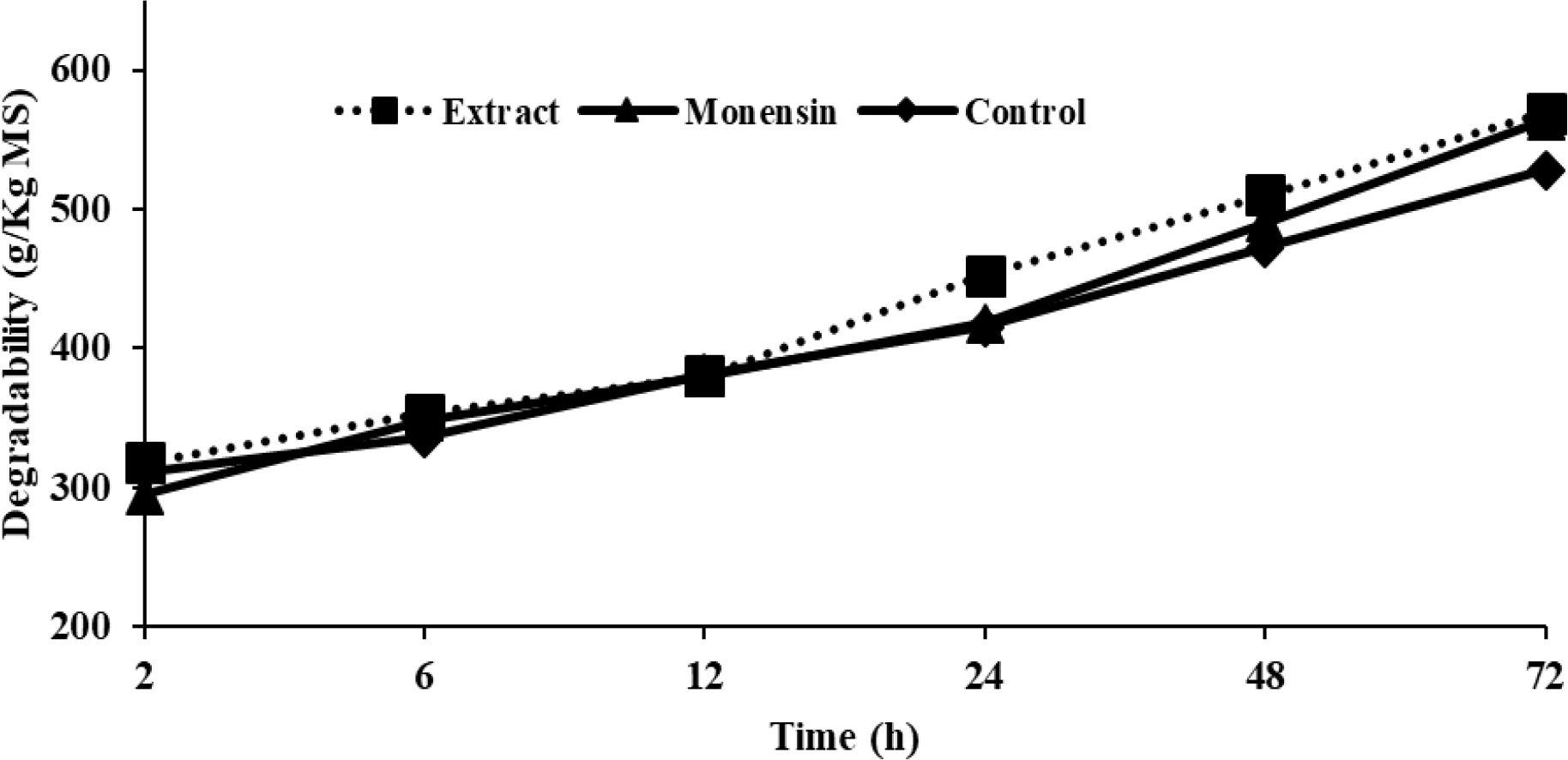
In contrast, monensin significantly reduced gas production, indicating greater regulation of microbial activity, which likely limited cumulative gas production over time. The control treatment exhibited intermediate values, reflecting baseline fermentation of the substrate in the absence of additives. As shown in Table 3, no significant differences in dry matter (DM) degradability were observed among treatments at incubation times of 2 h (P = 0.3115), 6 h (P = 0.5091), 12 h (P = 0.9470), and 48 h (P = 0.4576). At 24 h (P = 0.0239), the extract treatment showed greater DM degradability (452.75 g kg⁻1 DM) than both the control (415.41 g kg⁻1 DM) and monensin (418.30 g kg⁻1 DM). At 72 h (P = 0.0402), DM degradability with the extract (569.31 g kg⁻1 DM) did not differ from monensin (563.83 g kg⁻1 DM) but remained higher than that of the control (528.39 g kg⁻1 DM).
Apparent dry matter degradability (g kg⁻1 DM) over incubation time for control, extract, and monensin treatments.
Results indicate that the extract significantly influenced ruminal fermentation and dry matter (DM) degradability, exhibiting a distinct response compared with monensin and the control. Increased gas production was accompanied by greater DM degradability, particularly at 24 and 72 h of incubation (Figure 2). This response suggests that the effect of the extract persisted throughout the fermentation period. Alvarado-Ramírez et al. (65) reported that enhanced gas production may be associated with greater availability of fermentable substrates promoted by plant extracts.

Dry matter degradability (g kg⁻1 DM) throughout fermentation time (72 h) for control, extract, and monensin treatments.
In vitro DM degradability increased linearly over incubation time in all treatments. Lack of differences among treatments at early incubation times (2, 6, and 12 h) indicates that effects of additives became more evident during the medium and long term of fermentation.
Diets or substrates with greater fermentative potential may reduce time required for degradability, as increased availability of readily fermentable compounds favors early microbial colonization and accelerates DM degradation rates. Mertens (67) emphasized that feed fermentability and microbial colonization rate directly determine ruminal fermentation dynamics. Higher initial production of volatile fatty acids in rapidly fermentable substrates intensifies ruminal degradation during early incubation stages (68). However, despite faster initial fermentation, total degradability ultimately depends on maintenance of ruminal pH, as excessively acidic conditions impair fibrolytic bacterial activity and can limit degradation of the fibrous fraction over time.
Abd’Quadri-Abojukoroum et al. (68) evaluated ethanolic leaf extracts over 48 h of incubation and reported that lemon (Citrus limon) extract exhibited the highest gas production (140 mL g⁻1 DM) and dry matter degradability (385 g kg⁻1 DM), values that did not differ from the control (104 mL g⁻1 DM and 382 g kg⁻1 DM). In contrast, monensin markedly reduced gas production and degradability (66 mL g⁻1 DM and 327 g kg⁻1 DM).
In the present study, treatments did not affect ruminal pH; however, incubation time significantly influenced mean values, which ranged from 6.59 to 7.06 (Table 4). Maintenance of pH within this range is essential for sustaining efficient ruminal fermentation and microbial activity. Absence of treatment effects indicates that neither the plant extract nor monensin disrupted ruminal environmental balance, representing a favorable condition for nutrient digestibility.
Progressive pH reduction over incubation may indicate intensification of microbial fermentation, increasing production of short-chain fatty acids (SCFAs) (69, 70). Baihaqi et al. (33) reported pH values from 6.81 to 6.86 during in vitro incubation with aqueous Carica pubescens extract, with no significant changes observed even at extract concentrations up to 5 %. Similarly, Abd’Quadri-Abojukoroum et al. (68) observed that pH remained within the normal range of 6.0 to 7.0 after 16 and 48 h of incubation using Themeda triandra hay and 22 ethanolic plant extracts.
Neutral detergent fiber (NDF) content of the experimental diet in the present study may have contributed to maintenance of pH over time. Hassan et al. (71) emphasized that dietary fiber plays a key role in modulating the ruminal environment and stabilizing pH in the rumen. In vivo, physically effective fiber stimulates chewing activity and salivary secretion, enhancing ruminal pH buffering capacity. In contrast, in vitro systems lack salivary input and rely on buffer solutions to partially simulate saliva function. Consequently, pH stability under in vitro conditions depends primarily on buffer composition, substrate fermentation rate, and gradual accumulation of SCFAs.
Although mean pH decreased across all treatments, a more pronounced decline was observed in the extract treatment, particularly at later incubation times. This response is consistent with cumulative gas production and dry matter degradability results, indicating greater fermentative activity in the presence of the extract. Despite this trend, pH values remained within the optimal range for ruminal fermentation throughout the incubation period (Figure 3).

Ruminal pH values over the fermentation period (72 hours) for control, extract, and monensin treatments.
In contrast, the monensin treatment exhibited smaller pH variation over time, likely reflecting its modulatory effect on ruminal microbiota. This monensin response has been described by Thomas (72), who highlighted its ability to reduce organic acid production by specific microbial populations, thereby stabilizing the ruminal environment. Monensin acts by disrupting ion transport in Gram-positive bacteria, reducing lactic acid production, and promoting propionate formation (73).
Unlike monensin, plant extracts influence ruminal pH through multiple mechanisms. Previous studies indicate that inclusion of plant extracts can increase pH by reducing lactic acid and short-chain fatty acid (SCFA) concentrations, contributing to a more stable ruminal environment. In the case of cinnamon extract, which is rich in phenols, tannins, and flavonoids, increased acetateto-propionate ratio, and higher gas and SCFA production have been reported, resulting in greater pH variation during incubation (74).
Overall, these findings suggest that both monensin and plant extracts can modulate ruminal fermentation without compromising pH stability. However, fermentative profiles differed among treatments, indicating distinct modes of action. These interpretations should be considered preliminary and warrant further investigation.
4. Conclusion
The ethanolic extract of S. purpurea L. modulated ruminal fermentation under in vitro conditions, increasing gas production and dry matter degradability. In addition, the extract reduced microbial colonization lag time while maintaining pH within an appropriate range for ruminal fermentation. These preliminary findings indicate potential of this extract as a natural modulator of ruminal fermentation. Further studies should quantify bioactive compounds and evaluate different inclusion levels, with emphasis on effects on short-chain fatty acid profiles, methane production, ammoniacal nitrogen, fiber and non-fibrous carbohydrate degradability, as well as validation using in vivo experiments.
Generative AI use statement
During preparation of this manuscript, the authors used ResearchRabbit and SciSpace to assist in identifying and organizing relevant scientific literature. All content was subsequently reviewed by the authors, who assume full responsibility for the manuscript.
Data availability statement
Data will be provided upon request to the corresponding author.
References
-
1 Krause DO, Denman SE, Mackie RI, Morrison M, Rae AL, Attwood GT, Mcsweeney CS. Opportunities to improve fiber degradation in the rumen: microbiology, ecology, and genomics. FEMS Microbiol Rev. 2003;27(5):663-693. Available from: https://doi.org/10.1016/S0168-6445(03)00072-X
» https://doi.org/10.1016/S0168-6445(03)00072-X -
2 Mahesh MS, Mohini M. Crop residues for sustainable livestock production. Adv Dairy Res. 2014;2:e108. Available from: https://doi.org/10.4172/2329-888X.1000e108
» https://doi.org/10.4172/2329-888X.1000e108 -
3 Ulfina G, Lemma F, Tekalign T, Amanuel B. Rumen manipulation: one of the promising strategies to improve livestock productivity - review. Dairy Vet Sci J. 2019;9(2):555758. Available from: https://doi.org/10.19080/JDVS.2019.09.555758
» https://doi.org/10.19080/JDVS.2019.09.555758 -
4 Suriyapha C, Pongsub S, Sommai S, Wongtangtong E, Chuenwarin W, Phaikaeo L, Saetiew K, Rattanasuwan P. In vitro fermentation characteristics, microbial changes and gas production of microencapsulated phytonutrient pellets at varying dietary crude protein levels. Sci Rep. 2025;15:11214. Available from: https://doi.org/10.1038/s41598-02595748-7
» https://doi.org/10.1038/s41598-02595748-7 -
5 Ungerfeld EM. Metabolic hydrogen flows in rumen fermentation: principles and possibilities of interventions. Front Microbiol. 2020;11:589. Available from: doi: https://doi.org/10.3389/fmicb.2020.00589
» https://doi.org/10.3389/fmicb.2020.00589 - 6 Bergen WG, Bates DB. Ionophores: their effect on production efficiency and mode of action. J Anim Sci. 1984;58(6):1465-1483.
- 7 Saraiva MMS, Lim K, Do Monte DFM, Givisiez PEN, Alves LBR, De Freitas Neto OC, et al. Antimicrobial resistance in the globalized food chain: a One Health perspective applied to the poultry industry. Braz J Microbiol. 2022.
- 8 Martin C, Morgavi D, Doreau M. Methane mitigation in ruminants: from microbe to the farm scale. Animal. 2010;4(3):351-365.
- 9 Hodgson J. Grazing management: science into practice. Longman; 1990.
- 10 Van Soest PJ. Nutritional ecology of the ruminant. 2nd ed. Cornell University Press; 1994.
- 11 Franco GL, Barros LF, Rocha MST, Medeiros LQ, D’Oliveira MC, Diogo JMS, Ramos AKB. Suplementação proteicoenergética sobre o consumo voluntário e parâmetros ruminais em novilhos. Rev Bras Saúde Prod An. 2010;11(2):371385
-
12 Jamarun N, Pazla R, Zain M, Arief A. Comparison of in vitro digestibility and rumen fluid characteristics between the tithonia (Tithonia diversifolia) with elephant grass (Pennisetum purpureum). IOP Conf Ser Earth Environ Sci. 2019;287:012019. Available from: https://doi.org/10.1088/1755-1315/287/1/012019
» https://doi.org/10.1088/1755-1315/287/1/012019 -
13 Ahmed E, Fukuma N, Hanada M, Nishida T. The efficacy of plant-based bioactives supplementation to different proportion of concentrate diets on methane production and rumen fermentation characteristics in vitro Animals. 2021;11:1029. Available from: https://doi.org/10.3390/ani11041029
» https://doi.org/10.3390/ani11041029 - 14 Engels C, Gräter D, Esquivel P, Jiménez VM, Gänzle MG, Schieber A. Characterization of phenolic compounds in jocote (S. purpurea L.) peels by ultra-high-performance liquid chromatography/electrospray ionization mass spectrometry. Food Res Int. 2012.
- 15 Njoku PC, Akumefula MI. Phytochemical and nutrient evaluation of S mombin leaves. Pakistan J Nutr. 2007;6(8):613615.
-
16 Mazza PHS, Jaeger SMPL, Silva FL, Lima AGVO, Hora DC, Barbosa AM, Andrade EA, Silva Júnior JM, Bezerra LR, Oliveira RL. Effects of dietary inclusion of dry umbu fruit pulp residue (S. tuberosa Arr. Cam) on intake, ingestive behaviour, digestibility, nitrogen balance and ruminal pH in sheep. J Anim Feed Sci. 2022;31(1):55-64. Available from: https://doi.org/10.22358/jafs/146396/2022
» https://doi.org/10.22358/jafs/146396/2022 - 17 Eniolorunda OO, Awojobi HA, Ettu RO, Agunbiade JA, Oyekunle MA. Effect of S mombin on intake and digestibility in West African Dwarf sheep fed graded levels of whole cassava root meal-based diets. Assiut J Agric Sci. 2015;46(6):27- 34.
- 18 Harborne J. Phytochemical methods: a guide to modern techniques of plant analysis. 2nd ed. London: Chapman and Hall; 1984.
- 19 Raaman N. Phytochemical techniques. New Delhi: New India; 2006.
- 20 Association of Official Analytical Chemists - AOAC. Official methods of analysis. 18th ed. Gaithersburg: AOAC; 2007.
-
21 Mertens DR. Gravimetric determination of amylase-treated neutral detergent fiber in feeds with refluxing in beakers or crucibles: collaborative study. J AOAC Int. 2002;85:1217-1240. Available from: https://doi.org/10.1093/jaoac/85.6.1217
» https://doi.org/10.1093/jaoac/85.6.1217 - 22 Sniffen CJ, O’Connor JD, Van Soest PJ, et al. A net carbohydrate and protein system for evaluating cattle diets. II. Carbohydrate and protein availability. J Anim Sci. 1992;70:3562-3577.
- 23 Van Soest PJ, Robertson JB, Lewis BA. Methods for dietary fiber, neutral detergent fiber, and nonstarch polysaccharides in relation to animal nutrition. J Dairy Sci. 1991;74:3583-3597.
- 24 Theodorou MK, et al. A simple gas production method using a pressure transducer to determine fermentation kinetics of ruminant feeds. Anim Feed Sci Technol. 1994;48:185-197.
-
25 De Jesus Pereira TC, Pereira MLA, Moreira JV, et al. Effects of alkaloid extracts of mesquite pod on the products of in vitro rumen fermentation. Environ Sci Pollut Res. 2017;24:4301-4311. Available from: https://doi.org/10.1007/s11356016-7761-3
» https://doi.org/10.1007/s11356016-7761-3 - 26 Maurício RM, et al. A semi-automated in vitro gas production technique for ruminant feedstuff evaluation. Anim Feed Sci Technol. 1999;79:321-330.
-
27 Menezes DR, Costa RG, Araújo GGL, et al. Cinética ruminal de dietas contendo farelo de mamona destoxificado. Arq Bras Med Vet Zootec. 2015;67(2):636-641. https://doi.org/10.1590/1678-7040
» https://doi.org/10.1590/1678-7040 - 28 Figueiredo MP, et al. Determinação da relação entre a pressão e volume através da fermentação da raiz de mandioca tratada com uréia, feno de tifton 85 e silagem de milho para instalação da técnica in vitro de produção de gases. In: Reunião Anual da Sociedade Brasileira de Zootecnia; 2003; Santa Maria, RS. Anais. Santa Maria: Sociedade Brasileira de Zootecnia; 2003.
- 29 Laird AK. Dynamics of relative growth. Growth. 1965;29:249-263.
- 30 SAS Institute Inc. User’s guide, version 9.2. Cary, NC: SAS Institute Inc.; 2001.
-
31 Marisco G, Santos RX, Aguiar R, Brendel M, Pungartnik C. Antifungal potential of terpenes from S. purpurea L. leaf extract against Moniliophthora perniciosa that causes witches broom disease of Theobroma cacao. Int J Complement Altern Med. 2017;7(1):00215. Available from: https://doi.org/10.15406/ijcam.2017.07.00215
» https://doi.org/10.15406/ijcam.2017.07.00215 -
32 Oliveira IST, Fernandes T, Santos ARD, González Aquino C, Vega Britez GD, Vargas Junior FM. Phytochemical composition and effects of aqueous extracts from Moringa oleifera leaves on in vitro ruminal fermentation parameters. Ruminants. 2025;5(1):4. Available from: https://doi.org/10.3390/ruminants5010004
» https://doi.org/10.3390/ruminants5010004 -
33 Baihaqi ZA, Widiyono I, Angeles AA, Suwignyo B, Nurcahyo W. Anthelmintic activity of Carica pubescens aqueous seed extract and its effects on rumen fermentation and methane reduction in Indonesian thin-tailed sheep: An in vitro study. Veterinary World. 2023;16(7):1421-1428. Available from: https://doi.org/10.14202/vetworld.2023.1421-1428
» https://doi.org/10.14202/vetworld.2023.1421-1428 -
34 Madanahall Ramesh M, Shankar NS, Venkatappa AH. Driving/critical factors considered during extraction to obtain bioactive enriched extracts. Pharmacognosy Reviews. 2024;18(35):68-81. Available from: https://doi.org/10.5530/phrev.2024.18.7
» https://doi.org/10.5530/phrev.2024.18.7 -
35 Yelugudari B, Mesram N, Karnati PT. 9-Hexadecenoic acid rich HPLC fraction of Pithecellobium dulce methanolic seed extract exhibits potential anti-inflammatory activity by inhibiting IL-8, IL-6, and PGE2: phytochemical characterization, in-vitro and in-vivo evaluation. Journal of Research in Pharmacy. 2023;27(5):1733-1750. Available from: https://doi.org/10.29228/jrp.458
» https://doi.org/10.29228/jrp.458 -
36 Ali MAMM. Phytochemical screening and antibacterial activity of Pulicaria crispa aerial parts extract. Asian Journal of Basic Science & Research. 2020;2(2):9-14. Available from: https://doi.org/10.38177/AJBSR.2020.2202
» https://doi.org/10.38177/AJBSR.2020.2202 -
37 Russell JB, Strobel HJ. Effect of ionophores on ruminal fermentation. Applied and Environmental Microbiology. 1989;55(1):1-6. Available from: https://doi.org/10.1128/aem.55.1.1-6.1989
» https://doi.org/10.1128/aem.55.1.1-6.1989 -
38 Patra AK, Saxena J. A new perspective on the use of plant secondary metabolites to inhibit methanogenesis in the rumen. Phytochemistry. 2010;71(11-12):1198-1222. Available from: https://doi.org/10.1016/j.phytochem.2010.05.010
» https://doi.org/10.1016/j.phytochem.2010.05.010 -
39 Kholif AE, Anele UY, Patra AK, Varadyova Z. Editorial: The use of phytogenic feed additives to enhance productivity and health in ruminants. Frontiers in Veterinary Science. 2021;8:685262. Available from: https://doi.org/10.3389/fvets.2021.685262
» https://doi.org/10.3389/fvets.2021.685262 -
40 Choi Y, Lee Y, Lee SJ, Kim HS, Eom JS, Jo SU, Lee SS. Dose-response effects of Poncirus trifoliata extract on in vitro ruminal methane production, fermentation, and microbial abundance. Italian Journal of Animal Science. 2022;21(1):595604. Available from: https://doi.org/10.1080/1828051X.2022.2034540
» https://doi.org/10.1080/1828051X.2022.2034540 -
41 Santos ET, Pereira MLA, Silva CFPG, Souza-Neta LC, Geris R, Martins D, Santana AEG, Barbosa LCA, Silva HGO, Freitas GC, Figueiredo MP, Oliveira FF, Batista R. Antibacterial activity of the alkaloid-enriched extract from Prosopis juliflora pods and its influence on in vitro ruminal digestion. Int. J. Mol. Sci. 2013;14(4):8496-8516. Available from: https://doi.org/10.3390/ijms14048496
» https://doi.org/10.3390/ijms14048496 - 42 Cushnie TPT, Lamb AJ. Recent advances in understanding the antibacterial properties of flavonoids. Int J Antimicrob Agents. 2011;38:99-107.
- 43 Xie Y, Yang W, Tang F, Chen X, Ren L. Antibacterial activities of flavonoids: structure-activity relationship and mechanism. Curr Med Chem. 2015;22:132-149.
- 44 Babii C, Mihalache G, Bahrin LG, Neagu A, Birsa LM, Gostin I, Mihai CT, Sa L, Stefan M. A novel synthetic flavonoid with potent antibacterial properties: in vitro activity and proposed mode of action. PLoS One. 2018;13:1-15.
- 45 Oskoueian E, Abdullah N, Oskoueian A. Effects of flavonoids on rumen fermentation activity, methane production, and microbial population. Biomed Res Int. 2013;1-8.
- 46 Seradj AR, Abecia L, Crespo J, Villalba D, Fondevila M, Balcells J. The effect of Bioflavex® and its pure flavonoid components on in vitro fermentation parameters and methane production in rumen fluid from steers given highconcentrate diets. Anim Feed Sci Technol. 2014;197:85-91.
- 47 Cieslak A, Zmora P, Pers-Kamczyc E, et al. Effects of tannins source (Vaccinium vitis-idaea L.) on rumen microbial fermentation in vivo Anim Feed Sci Technol. 2012;176:102-106.
-
48 Scalbert A. Antimicrobial properties of tannins. Phytochemistry. 1991;30(12):3875-3883. Available from: https://doi.org/10.1016/0031-9422(91)83426-L
» https://doi.org/10.1016/0031-9422(91)83426-L - 49 Patra AK, Saxena J. The effect and mode of action of saponins on microbial population and fermentation in the rumen and ruminant production. Nutr Res Rev. 2009;22:204-219.
-
50 Bodas R, Prieto N, García-González R, et al. Manipulation of rumen fermentation and methane production with plant secondary metabolites. Anim Feed Sci Technol. https://doi.org/10.1016/j.anifeedsci.2012.07.010
» https://doi.org/10.1016/j.anifeedsci.2012.07.010 - 51 Patra AK, Saxena J. Exploitation of dietary tannins to improve rumen metabolism and ruminant nutrition. J Sci Food Agric. PMID: 20815041.
-
52 Mueller-Harvey I. Unravelling the conundrum of tannins in animal nutrition and health. J Sci Food Agric. 2006;86:2010-2037. https://doi.org/10.1002/jsfa.2577Digita
» https://doi.org/10.1002/jsfa.2577Digita -
53 Ramos-Morales E, de la Fuente G, Duval S, et al. Antiprotozoal effect of saponins in the rumen can be enhanced by chemical modifications in their structure. Front Microbiol. 2017;8:1-13. https://doi.org/10.3389/fmicb.2017.00399
» https://doi.org/10.3389/fmicb.2017.00399 -
54 Jayanegara A, Wina E, Takahashi J. Meta-analysis on methane mitigating properties of saponin-rich sources in the rumen: influence of addition levels and plant sources. Asian-Australas J Anim Sci. 2014;27:1426-1435. https://doi.org/10.5713/ajas.2014.14086
» https://doi.org/10.5713/ajas.2014.14086 -
55 Cobellis G, Marinucci MT, Yu Z. Critical evaluation of essential oils as rumen modifiers in ruminant nutrition: a review. Sci Total Environ. 2016;545-546:556-568. https://doi.org/10.1016/j.scitotenv.2015.12.103
» https://doi.org/10.1016/j.scitotenv.2015.12.103 -
56 Benchaar C, Chaves AV, Fraser GR, et al. Effects of essential oils and their components on in vitro rumen microbial fermentation. Can J Anim Sci. 2007;87:413-419. https://doi.org/10.4141/CJAS07012
» https://doi.org/10.4141/CJAS07012 -
57 Calsamiglia S, Busquet M, Cardozo PW, et al. Essential oils as modifiers of rumen microbial fermentation. J Anim Sci. 2007;90:2580-2595. https://doi.org/10.3168/jds.2006-644
» https://doi.org/10.3168/jds.2006-644 -
58 Castillejos L, Calsamiglia S, Ferret A. Effect of essential oil active compounds on rumen microbial fermentation and nutrient flow in in vitro systems. J Dairy Sci. 2006;89(7):2649-2658. Available from: https://doi.org/10.3168/jds.S00220302(06)72341-4
» https://doi.org/10.3168/jds.S00220302(06)72341-4 -
59 Chao SC, Young DG, Oberg CJ. Screening for inhibitory activity of essential oils on selected bacteria, fungi and viruses. J Essent Oil Res. 2000;12:639-649. https://doi.org/10.1080/10412905.2000.9712177
» https://doi.org/10.1080/10412905.2000.9712177 -
60 Wallace RJ, McEwan NR, McIntosh FM, et al. Natural products as manipulators of rumen fermentation. AsianAustralas J Anim Sci. 2002;15:1458-1468. https://doi.org/10.5713/ajas.2002.1458
» https://doi.org/10.5713/ajas.2002.1458 - 61 Oliveira JS, Zanine ADM, Santos EM. Diversidade microbiana no ecossitema ruminal. Revista Electrónica de Veterinaria. 2007;8(6):1-12
- 62 Valadares Filho SC, Pina DS. Fermentação ruminal. In: Berchielli TT, Pires AV, Oliveira SG, editores. Nutrição de ruminantes. 2. ed. Jaboticabal: Funep; 2011. p. 151-176.
-
63 Xie X, Wang JK, Liu JX, et al. Temporal microbial colonization on different forages is driven by the rumen environmental conditions. Animal Microbiome. 2025;7:46. Available from: https://doi.org/10.1186/s42523-025-00407-x
» https://doi.org/10.1186/s42523-025-00407-x - 64 Menke KH, Steingass H. Estimation of the energetic feed value obtained from chemical analysis and in vitro gas production using rumen fluid. Animal Research and Development. 1988;28:7-55.
-
65 Alvarado-Ramírez ER, Maggiolino A, Elghandour MMMY, Rivas-Jacobo MA, Ballesteros-Rodea G, Palo PD, Salem AZM. Impact of co-ensiling of maize with Moringa oleifera on the production of greenhouse gases and the characteristics of fermentation in ruminants. Animals. 2023;13(764). Available from: https://doi.org/10.3390/ani13040764
» https://doi.org/10.3390/ani13040764 -
66 Mertens, DR. Rate and extent of digestion. Journal of Dairy Science. 1993;76(12):323-333. Available from: https://doi.org/10.3168/jds.S0022-0302(93)77730-9
» https://doi.org/10.3168/jds.S0022-0302(93)77730-9 - 67 Owens, FN, Goetsch AL. Digesta passage and microbial protein synthesis. In: Milligan LP, Grovum WL, Dobson A, eds. Control of Digestion and Metabolism in Ruminants. Englewood Cliffs, NJ: Prentice-Hall; 1986. p. 196-226.
-
68 Abd’Quadri-Abojukoro AN, Nsahlai IV. Evaluating the effects of some selected medicinal plant extracts on feed degradability, microbial protein yield, and total gas production in vitro Animals. 2023;13(702). Available from: https://doi.org/10.3390/ani13040702
» https://doi.org/10.3390/ani13040702 -
69 Wei X, Ouyang K, Long T, Liu Z, Li Y, Qiu Q. Dynamic variations in rumen fermentation characteristics and bacterial community composition during in vitro fermentation. Fermentation. 2022;8(6):276. Available from: https://doi.org/10.3390/fermentation8060276
» https://doi.org/10.3390/fermentation8060276 -
70 Zhang M, Liang G, Zhang X, Lu X, Li S, Wang X, Yang W, Yuan Y, Jiao P. The gas production, ruminal fermentation parameters, and microbiota in response to Clostridium butyricum supplementation on in vitro varying with media pH levels. Frontiers in Microbiology. 2022;13:960623. Available from: https://doi.org/10.3389/fmicb.2022.960623
» https://doi.org/10.3389/fmicb.2022.960623 -
71 Hassan F, Arshad MA, Ebeid HM, Rehman MS, Khan MS, Shahid S, Yang C. Phytogenic additives can modulate rumen microbiome to mediate fermentation kinetics and methanogenesis through exploiting diet-microbe interaction. Frontiers in Veterinary Science. 2020;7:575801. Available from: https://doi.org/10.3389/fvets.2020.575801
» https://doi.org/10.3389/fvets.2020.575801 - 72 Thomas EE. Field responses to the feeding of Rumensin®. Elanco Animal Health. 2006.
-
73 Chalupa W, Corbett W, Brethour JR. Effects of monensin and amichloral on rumen fermentation. Journal of Animal Science. 1980;51(1):170-179. Available from: https://doi.org/10.2527/jas1980.511170x
» https://doi.org/10.2527/jas1980.511170x -
74 Ahmed MG, Al-Sagheer AA, El-Zarkouny SZ, et al. Potential of selected plant extracts to control severe subacute ruminal acidosis in vitro as compared with monensin. BMC Veterinary Research. 2022;18:356. Available from: https://doi.org/10.1186/s12917-022-03457-4
» https://doi.org/10.1186/s12917-022-03457-4
Edited by
-
Editor:
Rondineli P. Barbero