 Perceptions of research integrity and open science practices: a survey of Brazilian dental researchers
Abstract
The objective of this study was to evaluate Brazilian dental researchers’ perceptions of research integrity and open science practices, as well as their perceptions of the way researchers are evaluated for promotion, hiring, and receiving grants. In a self-administered online survey, the respondents were presented with 3 questions on researcher evaluation in Brazil. Additionally, for 25 academic activities or characteristics, researchers rated their perceived importance for a) career advancement, b) science advancement, c) personal satisfaction, and d) social impact. The questionnaire was sent to a total of 2,179 dental researchers working in graduate programs in dentistry in Brazil. Multilevel regressions were performed to statistically confirm the differences between the predefined subgroups. Three hundred and fifty-five (16%) researchers completed the survey. Most respondents (96.1%) considered the current evaluation system to be flawed and indicated the need for improvement. Non-traditional activities were considered more important than traditional ones for science advancement (p < 0.01), and social impact (p < 0.01), whereas traditional activities were perceived to be more important only for career advancement (p < 0.01). Although Brazilian dental researchers recognize the value of open science and research integrity practices for science advancement and impact on society, they perceive that the current evaluation system emphasizes traditional activities, such as publishing many papers in well-recognized journals as criteria for advancing their careers.
Dentistry; Research Personnel; Attitude
Introduction
Knowledge accumulation and its subsequent dissemination is a fundamental goal of research. Ideally, scientific research should be conducted with a rigorous design and a complete and transparent report of its findings. Such research outputs benefit the scientific community and the broader society.1 There are established mechanisms to help researchers ensure transparency in methods, results, and inference.2 However, the inclusion of these methods as criteria for hiring and promotion policies of academic institutions still needs to be improved. Similarly, funders are slow in shifting their evaluation criteria for grant distribution based on transparency, openness, and societal impact. To date, empirical evidence shows no widespread adoption of open science and research integrity practices.1,3-7
The traditional evaluation of researchers, still widely used, typically focuses on the number of publications, associated journal impact factors (JIF), and other citation metrics, rather than on responsible research practices that reflect quality, potential social impact, and relevance.3,8,9 Researchers who aspire an academic career react by focusing on outputs that facilitate their academic progress. This scenario has resulted in the so-called “publish or perish” paradigm: a practice in which the quantity of publications is the most important criterion closely followed by citation metrics. This might negatively influence the quality of research and is likely to compromise its integrity, transparency, reproducibility, and relevance.1,3,10,11
In Brazil, the assessment of researchers, graduate programs, and universities in biomedical sciences reflects the traditional evaluation paradigm described above. The volume of published papers and the associated JIFs play the primary role in the decision to hire a professor, to receive research funding, and to be recognized in the Research Productivity Tiers levels by the national research council (www.gov.br/cnpq). The evaluation of higher education and graduate programs by the Brazilian regulatory agency (https://www.gov.br/capes) is based on a quantitative metric called Qualis to assess the journals and publications, but has recently developed a more qualitative and multi-dimensional approach to evaluate graduate programs12. However, the new system has yet to be tested and implemented.
With the recent growing interest in meta-research (research on research itself), several initiatives have emerged to modify the way researchers are evaluated11 and to bring more integrity and transparency to research evaluation,1,10 such as the San Francisco Declaration on Research Assessment (DORA) in 2012. DORA is a worldwide initiative that advocates for change in the way scholars and institutions are assessed13. The Universidade de São Paulo (USP), Universidade de Campinas (Unicamp), and 37 other Brazilian journals and institutions have signed DORA. The Leiden Manifesto, launched in 2015,14 has a similar focus. In 2020, the Hong Kong Principles (HKP) were formulated. The HKP consists of five principles that focus on the use of a research integrity lens to promote more informed and open science criteria in the assessment of researchers.1 These initiatives aim to change the research assessment system by eliminating poor practices and proposing other indicators for career progression other than research output and journal impact factor.1,13,14 For these changes to take place, the collective efforts of funders, publishers/journals, regulators and research institutions are essential.15-17 Besides that, monitoring researchers’ actions and the results of the implemented changes may serve as examples for others.10
Although many universities and researchers have changed various assessment components to increase the integrity and quality of research practices, it is still unclear how researchers value integrity and open science and how this affects how science is developed and executed.18 In addition, very little is known about how South American researchers perceive research integrity and open science practices. Brazil ranks second in the world for publications in dentistry,19 and investigating the perceptions about science practices and the value of such a large community can provide important knowledge and an opportunity to propose actions to promote research integrity.
Therefore, this study aims to assess the perceptions of dentistry researchers in Brazil about research integrity and open science practices, as well as their perceptions of how researchers are evaluated for promotion, hiring, and receiving grants.
Methods
This cross-sectional study was completed using an online self-administered survey hosted on REDCap (REDCap – Research Electronic Data Capture, Vanderbilt, Nashville, Tennessee, USA, www.projectREDCap.org/). The Survey Reporting Guideline (SURGE) was used as a reporting guideline.20 The Research Ethics Committee of the UFPel School of Dentistry approved the study protocol (52679821.2.0000.5318).
Data availability
The study protocol (complete methods), research tools, analysis plan, codes used in statistical analysis and results, informed consent form (ICF), as well as the complete anonymized data set are available without restrictions on the Open Science Framework platform (OSF) project folder (https://osf.io/nyjw7/). To ensure confidentiality and anonymity, the detailed description of the state of the country in which the respondent lived was removed, leaving only the respondent’s country region.
Questionnaire
After a comprehensive literature search, conducted by J.C. (https://osf.io/hjtwn), only one potentially suitable but not validated questionnaire was identified21. This questionnaire was adapted to the Brazilian scenario based on the indicators suggested in the DORA Assessment,13 the Leiden manifesto,14 and the HKP.1 The final survey included 37 questions in three sections.
The entire questionnaire with introduction, informed consent form, questions, and explanation of the concepts is available on the OSF (https://osf.io/ubqxk). In brief, the questionnaire consisted of: Part 1: demographic questions; Part 2: 3 questions on researcher evaluation in Brazil; and Part 3: 25 academic activities or characteristics for which respondents were asked to rate the perceived impact on (I) career advancement, (II) science advancement, (III) personal satisfaction, and (IV) social impact.
The survey was piloted with 134 early career researchers from the Universidade Federal de Pelotas (UFPel), Brazil, who were not part of the final sample, to assess its comprehensibility in generating answers about the research objectives. Respondents were asked (for each question) to answer whether the question was clear and were instructed to make suggestions for improvement if judged necessary. The questions that were judged to lack clarity and understanding were edited until the authors reached a consensus. The total time needed to answer the questionnaire was about 10 minutes. Before answering the questionnaire, all pilot respondents had to read and sign the same informed consent form used in the study reported here. The pilot results were presented in a congress and can be found in the abstract book (https://osf.io/r7f49).
Population, recruitment, and sample size estimation
The target population were established researchers that were active in post-graduate dental education and professors from any of the 100 Brazilian graduate programs in dentistry. To be included, the researcher had to be categorized as “permanent professor” or “collaborator” in the national graduate program evaluation system. In the Brazilian system, these are the professors who are officially enrolled in the graduate programs, teach classes, conduct research projects, and supervise master’s and PhD candidates.22 These are usually tenured positions at the level of full or associate professor.
The list of the researchers that were invited to complete the survey was retrieved from the national database (https://dadosabertos.capes.gov.br/dataset/ 2017-a-2020-docentes-da-pos-graduacao-stricto-sensu-no-brasil), and consisted of 2,179 dentistry professors registered in the Brazilian national system. Visiting professors or external participants in the graduate programs were excluded.
Given a target population of 2,179 researchers, it was estimated that 327 respondents would be necessary to detect a prevalence of 50% with a 95% confidence interval of 45%–55% (https://www.openepi.com).
Survey delivery
Email addresses of all researchers were obtained from the graduate programs or manually obtained online from the graduate program website or found in published articles for which the participant was the corresponding author. All researchers were contacted via email, invited to participate, and received the link for the online questionnaire. Additionally, the graduate programs were contacted and asked to forward the invitation to all researchers in their dental faculty. Reminders were sent weekly for 12 weeks (from September 2022 to November 2022). This study was administered and distributed from the REDCap platform (REDCap – Research Electronic Data Capture, Vanderbilt, Nashville, USA, www.projectREDCap.org/). The email with the questionnaire link was sent to each researcher from an institutional email account created specifically for this study (ristudybr@ufpel.edu.br). Before answering the questionnaire, all respondents had to read and sign the informed consent form (ICF). Only those who accepted the terms were taken to the first part of the questionnaire and were able answer the questions.
Data analysis
Descriptive analysis was used to summarize the results of all three questionnaire parts.
To help interpret the results in Part 3, the 25 activities were split into traditional and non-traditional activities. The nomenclature and characterization of activities into traditional and non-traditional were based on previous studies.10,23 The non-traditional activities were divided into four groups: activities related to research integrity, open science, research climate, and social oriented activities (Table 1).
Research activities and characteristics according to the Traditional and Non-traditional categories, including sub-division into 4 groups.
For statistical analysis, the responses of the Likert scale were numerically transformed as follows: detrimental = 1, unfavorable = 2, irrelevant = 3, important = 4, essential = 5. The Cronbach alpha test was applied to each group (traditional, nontraditional, research integrity, Open Science, research climate, and socially oriented), and an alpha coefficient above 0.80 was considered to confirm a high relationship between the activities in each group.
The mean score of each group of activities was calculated and expressed in charts to enable visual comparison. A multilevel regression model was applied to calculate possible differences between traditional and non-traditional activities for each domain (on advancing career; on advancing science; on personal satisfaction; on social impact), and the estimated ‘effects’ and the ‘95% confidence intervals’ were reported. In this part, the ‘effects’ were the difference for each domain calculated by subtracting the average score for traditional activities from the average score for non-traditional activities (this can also be called the difference in means). For the second part, in which the non-traditional activities were separated into 4 groups, again a multilevel regression model was applied, but now to evaluate possible differences between the 4 domains in each group of activities. The estimated ‘effects’ and the 95% confidence intervals were also reported, but here the ‘effect’ was the result of subtracting the mean scores from the comparison of each domain within each of the 5 groups (traditional, research integrity, open science, research climate, social-oriented). The multilevel regressions were not planned in the preregistered study protocol. They were introduced after data collection to investigate whether confounding factors could (partly) explain group differences. Additional exploratory analyses were performed to verify if there were differences in answers between respondents from public and private institutions; participants who completed their PhD less than 5 years ago and those who completed it 5 years ago or more; and between participants who had participated in a course addressing the topic and those who had not. Multilevel regression was again used with these 3 variables in the model to correct for each other. These additional analyses were also not planned in the protocol, but came up after data collection. A confidence interval of 95% and a significance level of α = 0.05 were used for all quantitative analyses. All analyses were conducted using the RStudio statistical software (RStudio, RStudio Inc., Boston, USA).
Results
The pilot study, which included 134 early career researchers, indicated that most respondents found the questionnaire comprehensible and easy to complete. Questions that were initially unclear were revised until the authors reached a consensus on their clarity. On average, respondents took about 10 minutes to complete the questionnaire. For Part 3 of the questionnaire, it was decided, based on the pilot study, to categorize the 25 academic activities into two groups (traditional and non-traditional) for a clearer analysis when applied to the main sample.
Of the 2,179 researchers invited to participate, 528 (24%) completed part of the survey. However, only 355 (16%) respondents completed the entire survey and were included in the data analysis. There were 177 females (49.9%), 175 males (49.3%), and three respondents who classified themselves as non-binary (0.8%). Most of the respondents were from public institutions (n = 272; 76.6%) and 76 (21.4%) were from private institutions. Seven respondents (2.0%) were from community (private non-profit) institutions. The country region most represented by respondents was the Southeast (n = 170; 48.2%), followed by the South (n = 88; 24.9%), Northeast (n = 61; 17.3%), Midwest (n = 22; 6.2%), and North (n = 12; 3.4%).
Working experience at the current institution was reported to be more than 10 years for 212 respondents (59.7%), between 5 and 10 years for 78 (22.0%), and less than 5 years for 65 (18.3%) respondents. Undergraduate training had taken place at public institutions for 281 (79.2%), private institutions for 66 (18.6%), and community institutions for 8 (2.3%) respondents. For the doctoral degree training, these numbers were 338 (95.5%), 15 (4.2%), and 1 (0.3%), respectively. The time since receiving their PhD degree was more than 10 years for 240 (67.6%) respondents, between 5 to 10 years 79 (22.3%), and less than 5 years 36 (10.1%). Most respondents (227; 63.9%) declared they had never attended a course addressing open science and research integrity practices.
Regarding the respondents’ perceptions on the current researcher assessment system, most respondents (96.1%) considered it to be flawed and indicated the need for improvement (Table 3). The prevalences from the 3 questions on respondents’ perceptions of the current researchers’ evaluation system in Brazil are shown in Tables 2 and 3.
Prevalence (frequencies) of respondents’ perceptions for question 3 of part 2 - What is your view on the researchers’ current evaluation model for hiring processes and distribution of inputs?
Prevalence (frequencies) of respondent perceptions for the first 2 questions of part 2 - Question 1: how much do you think the researchers’ current evaluation system contributes to good practices in science; Question 2: how much do you think the current system of evaluation of researchers contributes to the production of science that delivers value to society (1 - no contribution, 5 - contribute a lot).
For Part 3, Cronbach’s alpha coefficient was high for all groups of activities (Traditional: 0.86; Non-traditional: 0.94; Research integrity: 0.81; Open Science: 0.84; Research climate: 0.85; Social Oriented: 0.91) confirming the strong association between perceptions of the activities within each group. The entire results for Cronbach’s alpha calculations can be found on the OSF (https://osf.io/n8qd3).
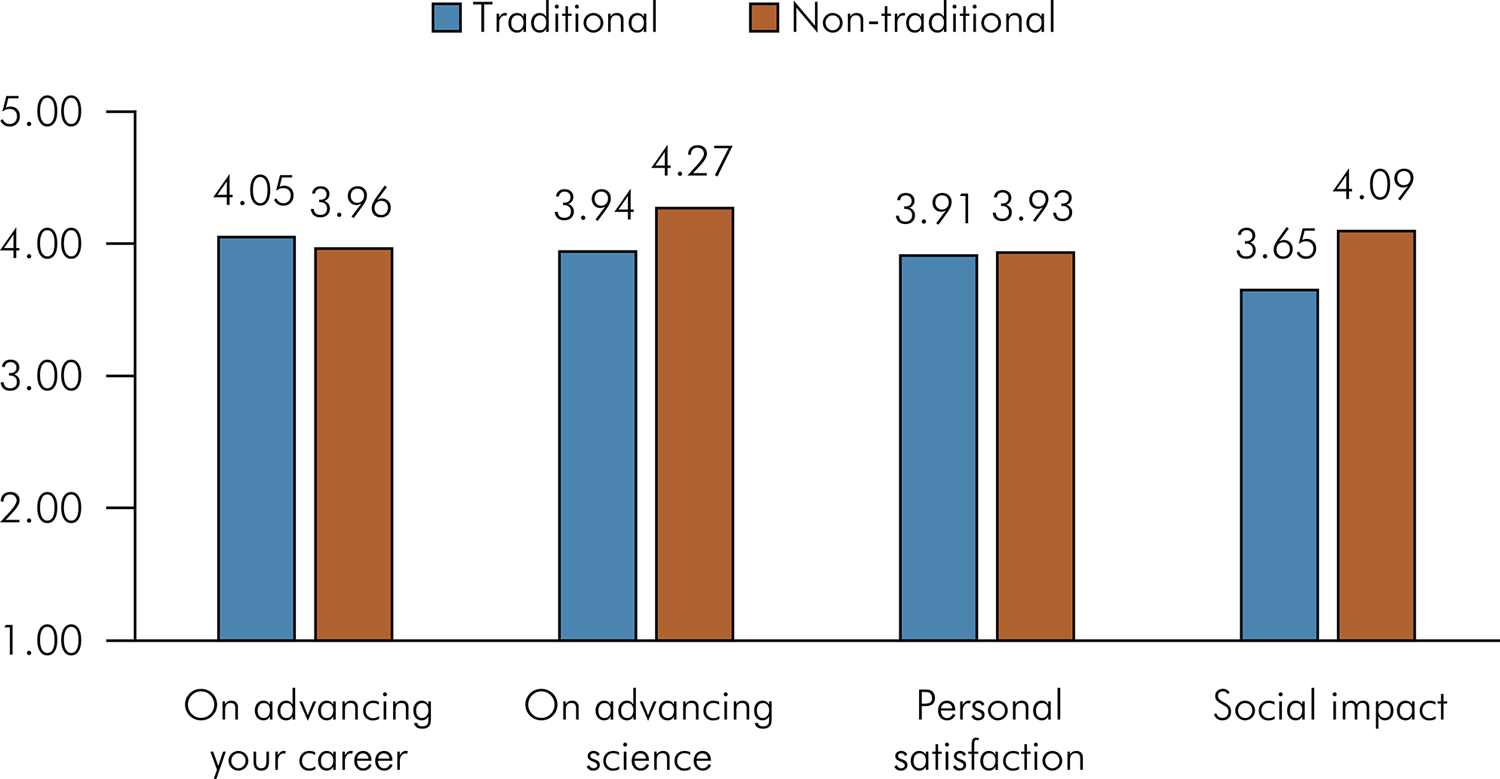
Non-traditional activities were considered more important than traditional ones for science advancement (effect: -0.33; 95%CI: -0.36; -0.30) and social impact (effect: -0.45; 95%CI: 4.05;4.13), whereas traditional activities were more important only for careers advancement (effect: 0.09; 95%CI: 0.06;0.12). Personal satisfaction was not significantly different between categories (effect: 0.02; 95%CI: -0.06;0.01). These results are represented in Figure 1.

Comparison of traditional and non-traditional activities across the four domains: career advancement (p < 0.01), science advancement (p < 0.01), personal satisfaction (p = 145), and social impact (p < 0.01), with lower scores indicating more detrimental effects (Likert scale: 1- detrimental, 2 - unfavorable, 3 - irrelevant, 4 - important, 5 - essential).
Non-traditional activities were separated into four groups (research integrity, open science, research climate, and social oriented) and evaluated according to the domains (advancing career; advancing science; personal satisfaction; social impact). The multilevel regression results showed that the activities in “research integrity” (effect: -0.43; 95%CI: -0.50;-0.36), “open science” (effect: -0.47; 95%CI: -0.53; -0.40), and “research climate” (effect: -0.27; 95%CI: -0.34; -0.20) were more important for science advancement than for career advancement. However, the “traditional” group was regarded as having a critical impact on career advancement (effect: 0.11; 95%CI: 0.05; 0.16). The group of “socially oriented activities” was shown to be more critical for social impact than career advancement (effect: 0.18; 95%CI: -0.22;-0.13) and personal satisfaction (effect: 0.10; 95%CI: -0.15; -0.06). “Socially oriented activities” were not perceived to influence science advancement (effect: -0.03; 95%CI: -0.08; 0.01). These results are illustrated in Figure 2.

Comparison of the four domains (career advancement, science advancement, personal satisfaction, and social impact) in each group of activities: traditional, research integrity, open science, research climate, and social-oriented. (Likert scale: 1- detrimental, 2 - unfavorable, 3 - irrelevant, 4 - important, 5 - essential).
The main results of the additional exploratory analysis showed a statistical difference only for course participation, showing that respondents who had never taken a course on the topic identified less differences between traditional and non-traditional activities for scientific advancement (effect: -0.14; 95%CI: -0.230; -0.058) and for social impact (effect: 0.14; 95%CI: -0.233; -0.061) than respondents who had taken a course. These results indicate that participants who had training in the topic were more aware of the differences between traditional and non-traditional activities for scientific advancement and social impact.
The tables with the means and frequencies, all analysis results for each domain of all groups of activities, as well as the additional exploratory analysis can be found on the OSF (https://osf.io/rbwf7).
Discussion
To our knowledge, this is the first study to assess the perceptions of dental researchers in Brazil and one of the first to do so internationally. Our findings have the potential to influence discussions about researcher evaluation systems and may promote a shift towards a more open and accountable research culture within the Brazilian and international dental community. By addressing the “publish or perish” paradigm, this study underscores the potential for improving the quality of dental research in Brazil and promoting a more robust and impactful scientific community. Given Brazil’s prominent position in global dental research publications, understanding these perceptions is crucial for establishing policy and evaluation criteria that are better aligned with responsible research practices.
This study used a survey to address the perception of established Brazilian dental researchers about the current evaluation system as well as their perceptions about research integrity and open science practices. Nearly a quarter of survey participants responded to part of the survey (n = 528; 24%); 325 (16%) participants completed the entire survey. Our study provides evidence of Brazilian researchers’ perspectives about their own practices and how those are perceived to be related to their careers and the advancement of science. In this context, respondents generally perceived the current evaluation system to be based solely on journal metrics and that the evaluation could be improved. They also recognize that traditional activities such as publishing several papers in high IF journals are currently more valuable for career advancement than practices that favor science advancement. The advancement of science that entails impact and social value has been associated with promotion of research transparency, openness, collaboration, and rigorousness.1,13,24 Our results partly support this idea, because the respondents indeed associated the “non-traditional” practices, which include activities focused on integrity, open science practices, social value and research climate, as important to science advancement. Research integrity revolves around the rigorous conduct of research, while the central emphasis of open science is predominantly on transparency and accountability,25 as well as the wide dissemination of research. Nevertheless, the concepts are closely related, as many open science practices are responsible research practices, making research more accountable, thereby promoting research integrity and exposing deviations from it.26
Regarding the participants’ perceptions of the current researcher assessment system, only a few answered that ‘the process covers all requirements and must be maintained’ (1.1%). This suggests that there may be an excellent opportunity to improve the evaluation system in the Brazilian context, following global trends. Respondents showed genuine concerns about the current assessment system when asked whether the current evaluation contributes to good practices in science or to added value to society. Therefore, the respondents acknowledged the relationship between how science is produced and delivered and the advancement of positive social outcomes. This finding also shows that, to some extent, respondents recognize that the current evaluation system is inadequate, but also know that their careers is driven by it. As already suggested in the literature, it is essential to promote new evaluation systems to increase the value of research practices.1,10,13,14
Comparing traditional and non-traditional activities within the 25 routine academic activities, respondents pointed out that traditional activities are more critical to their career advancement. For science advancement and social impact, non-traditional activities were considered more critical than traditional activities. These findings corroborate a study that surveyed Belgian researchers, showing that indicators such as openness, transparency, quality, and innovation (labelled as non-traditional activities) were rated as very important for science advancement. In that study, the non-traditional activities were also considered unimportant regarding the researcher’s career advancement. On the other hand, indicators related to prestige and competition, such as publishing more papers than other researchers, publishing in high-impact journals, being cited, and having a solid network of prestigious researchers (categorized as traditional in our study), were often described as necessary for career advancement, but irrelevant and in some cases detrimental to science advancement.21 In line with this, in a qualitative study, researchers and stakeholders, including research integrity officers, assert that current research evaluations prioritize results at the expense of critical processes vital for research quality and integrity. Factors currently considered essential to success were often viewed as detrimental to research culture and integrity.27 Two other qualitative studies with early career researchers showed that they want to adopt open science practices but feel hampered by the lack of incentives in terms of career opportunities, emphasizing that science evaluation processes should take greater account of the adoption of such practices.28,29
When the non-traditional activities were split into four groups (research integrity, open science, research climate, and social oriented), the answers pointed to the importance of those activities in promoting the advancement of science and increasing the social relevance of research. Results of the traditional group of activities were referred to as more important to career advancement and less critical to social impact. These answers showed that respondents perceived that traditional activities are not necessarily related to science advancement and social impact and that our instrument could capture their impressions. A possible additional conclusion from these findings would be: if these activities are more critical to science advancement and societal impact, why not use them to evaluate researchers and, in turn, encourage researchers to conduct research with more transparency, integrity, and reproducibility?
This sample was mostly of researchers with more than 10 years of research experience, meaning that they were probably ‘born and raised’ in the current metric-based evaluation system. It is noticeable that those researchers understand, in general, that this system is inadequate and does not benefit society much. Senior researchers can change their careers to emphasize non-traditional practices, and are responsible for mentoring the new generation of researchers. Future initiatives to improve research integrity practices and increase transparency should be aimed also at early career researchers. In this context, future generations may receive better training and change the ‘publish or perish’ paradigm, since the lack of training towards such practices is one of the main barriers reported by early career researchers to adopt them.28,29 The current practices and perceptions of early-career researchers should be further explored in future studies.
Our findings should be interpreted with caution due to some limitations. Firstly, only one field was chosen (dentistry), with a 16% response rate. The results may suffer from selective response and cannot be extrapolated to the entire Brazilian research context. Although low response rates are to be expected in online surveys, those with more affinity for the topic were more likely to participate in the study (selection bias). Secondly, although the questionnaire was piloted, it has not been formally validated. Another issue is that the control for respondent duplication may not have been effective since the questionnaire was sent using an institutional email. The only way to fully control this would be to use RedCAP itself to send the emails, but in this case, most emails would have ended up in the spam folder making recruitment more difficult. To mitigate this, a warning in the reminder emails not to respond again if the researcher had already responded was added. Finally, the interpretation of concepts may vary depending on the respondent’s backgrounds and point of view. This can complicate the interpretation of respondents’ perceptions.
Conclusions
In conclusion, while Brazilian dental researchers perceive which research activities are more closely aligned with science advancement and the generation of science with social impact, they emphasize that their activities on the most traditional practices based on the number of publications and journal impact metrics are more important for their career. Therefore, as long as the evaluation system puts researchers under the pressure of the “publish or perish” paradigm, the room for increasing quality and reducing waste in dental research is limited.
References
-
1 Moher D, Bouter L, Kleinert S, Glasziou P, Sham MH, Barbour V, et al. The Hong Kong Principles for assessing researchers: fostering research integrity. PLoS Biol. 2020 Jul;18(7):e3000737. https://doi.org/10.1371/journal.pbio.3000737
» https://doi.org/10.1371/journal.pbio.3000737 -
2 Goodman SN, Fanelli D, Ioannidis JP. What does research reproducibility mean? Sci Transl Med. 2016 Jun;8(341):341ps12. https://doi.org/10.1126/scitranslmed.aaf5027
» https://doi.org/10.1126/scitranslmed.aaf5027 -
3 Niles MT, Schimanski LA, McKiernan EC, Alperin JP. Why we publish where we do: faculty publishing values and their relationship to review, promotion and tenure expectations. PLoS One. 2020 Mar;15(3):e0228914. https://doi.org/10.1371/journal.pone.0228914
» https://doi.org/10.1371/journal.pone.0228914 -
4 Schimanski LA, Alperin JP. The evaluation of scholarship in academic promotion and tenure processes: Past, present, and future. F1000 Res. 2018 Oct;7:1605. https://doi.org/10.12688/f1000research.16493.1
» https://doi.org/10.12688/f1000research.16493.1 -
5 Fanelli D. How many scientists fabricate and falsify research? A systematic review and meta-analysis of survey data. PLoS One. 2009 May;4(5):e5738. https://doi.org/10.1371/journal.pone.0005738
» https://doi.org/10.1371/journal.pone.0005738 -
6 Xie Y, Wang K, Kong Y. Prevalence of research misconduct and questionable research practices: a systematic review and meta-analysis. Sci Eng Ethics. 2021 Jun;27(4):41. https://doi.org/10.1007/s11948-021-00314-9
» https://doi.org/10.1007/s11948-021-00314-9 -
7 Sofi-Mahmudi A, Raittio E, Uribe SE, Khademioore S, Zeraatkar D, Mbuagbaw L, et al. Research transparency in 59 fields of medical and health sciences: a meta-research study. medRxiv. 2024 2024:2024.04.08.24305416. https://doi.org/10.1101/2024.04.08.24305416
» https://doi.org/10.1101/2024.04.08.24305416 -
8 Koroshetz WJ, Behrman S, Brame CJ, Branchaw JL, Brown EN, Clark EA, et al. Framework for advancing rigorous research. eLife. 2020 Mar;9:e55915. https://doi.org/10.7554/eLife.55915
» https://doi.org/10.7554/eLife.55915 -
9 Cobey KD, Haustein S, Brehaut J, Dirnagl U, Franzen DL, Hemkens LG, et al. Community consensus on core open science practices to monitor in biomedicine. PLoS Biol. 2023 Jan;21(1):e3001949. https://doi.org/10.1371/journal.pbio.3001949
» https://doi.org/10.1371/journal.pbio.3001949 -
10 Moher D, Naudet F, Cristea IA, Miedema F, Ioannidis JP, Goodman SN. Assessing scientists for hiring, promotion, and tenure. PLoS Biol. 2018 Mar;16(3):e2004089. https://doi.org/10.1371/journal.pbio.2004089
» https://doi.org/10.1371/journal.pbio.2004089 - 11 Aubert Bonn N, Bouter L. Research assessments should recognize responsible research practices. narrative review of a lively debate and promising developments. In: Valdés, E., Lecaros, J.A. (eds.). Handbook of bioethical decisions. Springer, Cham; 2023. (Collaborative bioethics, v. 3).
-
12 Coordenação de Aperfeiçoamento de Pessoal de Nível Superior. Avaliação multidimensional de programas de pós-graduação. Brasília, DF: Ministério da Educação; 2019 [cited 2022 Mar 11]. (Relatório técnico DAV). Available from: https://www.gov.br/capes/pt-br/centrais-de-conteudo/23072020-dav-multi-pdf
» https://www.gov.br/capes/pt-br/centrais-de-conteudo/23072020-dav-multi-pdf -
13 Declaration on Research Assessment. San Francisco: DORA; 2012 [cited 2020 Mar 25]. Available from: http://www.ascb.org/dora/
» http://www.ascb.org/dora/ -
14 Hicks D, Wouters P, Waltman L, de Rijcke S, Rafols I. Bibliometrics: the Leiden Manifesto for research metrics. Nature. 2015 Apr;520(7548):429-31. https://doi.org/10.1038/520429a
» https://doi.org/10.1038/520429a -
15 Bouter L. What research institutions can do to foster research integrity. Sci Eng Ethics. 2020 Aug;26(4):2363-9. https://doi.org/10.1007/s11948-020-00178-5
» https://doi.org/10.1007/s11948-020-00178-5 -
16 Mejlgaard N, Bouter LM, Gaskell G, Kavouras P, Allum N, Bendtsen AK, et al. Research integrity: nine ways to move from talk to walk. Nature. 2020 Oct;586(7829):358-60. https://doi.org/10.1038/d41586-020-02847-8
» https://doi.org/10.1038/d41586-020-02847-8 -
17 Malicki M, Aalbersberg IJ, Bouter L, Mulligan A, Ter Riet G. Transparency in conducting and reporting research: a survey of authors, reviewers, and editors across scholarly disciplines PLoS One. 2023 Mar;18(3):e0270054. https://doi.org/10.1371/journal.pone.0270054
» https://doi.org/10.1371/journal.pone.0270054 -
18 Sørensen MP, Ravn T, Marušic A, Elizondo AR, Kavouras P, Tijdink JK, et al. Strengthening research integrity: which topic areas should organisations focus on? Humanit Soc Sci Commun. 2021;8(198):198. https://doi.org/10.1057/s41599-021-00874-y
» https://doi.org/10.1057/s41599-021-00874-y -
19 Yahya Asiri F, Kruger E, Tennant M. Global dental publications in PubMed Databases between 2009 and 2019: a bibliometric analysis. Molecules. 2020 Oct;25(20):4747. https://doi.org/10.3390/molecules25204747
» https://doi.org/10.3390/molecules25204747 - 20 Grimshaw J. Surge: the Survey Reporting GuideliE. In: Moher D, Altman DG, Schulz KF, Simera I, Wagner E, eds. Guidelines for reporting health research: a user's manual. John Wiley & Sons, 2014. Chapter 20.
-
21 Aubert Bonn N, Pinxten W. Advancing science or advancing careers? Researchers' opinions on success indicators. PLoS One. 2021 Feb;16(2):e0243664. https://doi.org/10.1371/journal.pone.0243664
» https://doi.org/10.1371/journal.pone.0243664 - 22 Ministério da Educação (BR). Portaria Nº 81, de 3 de junho de 2016. Define as categorias de docentes que compõem os Programas de Pós-Graduação(PPG's) stricto sensu. Diário Oficial União, 2016 June 6.
-
23 Rice DB, Raffoul H, Ioannidis JP, Moher D. Academic criteria for promotion and tenure in biomedical sciences faculties: cross sectional analysis of international sample of universities. BMJ. 2020 Jun;369:2081. https://doi.org/10.1136/bmj.m2081
» https://doi.org/10.1136/bmj.m2081 -
24 The Netherlands. Recognition and rewards: room for everyone's talent - towards a new balance in the recognition and rewards of academic; 2020 [cited 2023 Nov 3]. Available from: https://recognitionrewards.nl/
» https://recognitionrewards.nl/ -
25 Bouter L. Why research integrity matters and how it can be improved. Account Res. 2023 Mar:1-10. https://doi.org/10.1080/08989621.2023.2189010
» https://doi.org/10.1080/08989621.2023.2189010 -
26 Haven T, Gopalakrishna G, Tijdink J, van der Schot D, Bouter L. Promoting trust in research and researchers: how open science and research integrity are intertwined. BMC Res Notes. 2022 Sep;15(1):302. https://doi.org/10.1186/s13104-022-06169-y
» https://doi.org/10.1186/s13104-022-06169-y -
27 Aubert Bonn N, Pinxten W. Rethinking success, integrity, and culture in research (part 1) - a multi-actor qualitative study on success in science. Res Integr Peer Rev. 2021 Jan;6(1):1. https://doi.org/10.1186/s41073-020-00104-0
» https://doi.org/10.1186/s41073-020-00104-0 -
28 Zecevic K, Houghton C, Noone C, Lee H, Matvienko-Sikar K, Toomey E. Exploring factors that influence the practice of open science by early career health researchers: a mixed methods study. HRB Open Res. 2021 Jan;3:56. https://doi.org/10.12688/hrbopenres.13119.2
» https://doi.org/10.12688/hrbopenres.13119.2 -
29 Toribio-Flórez D, Anneser L, Oliveira-Lopes FN, Pallandt M, Tunn I, Windel H. Where do early career researchers stand on open science practices? A survey within the Max Planck Society. Front Res Metr Anal. 2021 Jan;5:586992. https://doi.org/10.3389/frma.2020.586992
» https://doi.org/10.3389/frma.2020.586992