 Self-perceived oral health among Brazilian university students: a cross-sectional study
Abstract
This cross-sectional study aimed to analyze the self-perceived oral health of young university students at the Federal University of Juiz de Fora and identify the associated factors. Data were collected in 2021 using a self-administered questionnaire containing questions on students’ sociodemographic variables and oral health. Binary logistic regression was applied in the multivariate analysis using the SPSS (Statistical Package for the Social Sciences) software (version 20.0) for Windows. The final analysis included 1,316 students aged 17–24 years. The prevalence of negative self-perception of oral health was 14.1% (95%CI: 12.2–16.0). The following variables were associated with negative self-perception of oral health: single marital status (OR = 0.34; 95%CI: 0.12–0.98), monthly family income of up to three minimum wages (OR = 2.02; 95%CI: 1.32–3.09), non-regular use of dental services (OR = 2.29; 95%CI: 1.48–3.53), dissatisfaction with the last service (OR = 1.97; 95%CI: 1.23–3.16), fear of dental treatment (OR = 1.56; 95%CI: 1.06–2.29), dissatisfaction with the appearance of teeth and mouth (OR = 5.27; 95%CI: 3.37–8.22), and perceived need for dental treatment (OR = 6.94; 95%CI:3.14–15.33). In conclusion, most young university students had a positive self-perception of oral health. However, factors related to socioeconomic profile, access to oral health services, and satisfaction with one's appearance were found to increase the likelihood of having a negative self-perception of oral health.
Keywords:
Self Concept; Oral Health
Introduction
Self-perception of oral health is a subjective indicator of morbidity and mortality that has multidimensional influences such as clinical and psychosocial issues.1,2 It encompasses an individual's subjective view of their social, functional, and psychological well-being associated with their oral health.3,4 Furthermore, it is associated with an individual's quality of life.5
Therefore, knowledge of this indicator and its associated conditions is crucial for the planning and implementation of public actions and policies in oral health to recognize the subjectivity involved in the health-disease process and address individual factors associated with quality of life.6
Considering this, several studies have been conducted with the objective of identifying the characteristics of the Brazilian population in relation to self-perception of oral health and its associated factors. Variables such as income, gender, race, age, tooth aesthetics, evaluation of the last visit, perceived need for dental treatment, reason for the last visit, non-health course, dental fear, family income, lower parental education, and use of public health services were associated with a negative self-perception of oral health in several studies among the Brazilian population, including different age groups.6-14 However, few studies have been conducted specifically with the college students, which has unique characteristics owing to their stage of life and particular socioeconomic and demographic profiles.15 Oral health and dental aesthetics impact psychological well-being of individuals. Facial characteristics and appearance are particularly relevant for adolescents and young adults. Therefore, it affects their self-perception, self-esteem, and quality of life,16 including their mental health.17 Thus, a negative self-perception of oral health becomes a barrier to social inclusion.18 Additionally, this population has characteristics associated with a higher probability of inadequate oral health and negative self-perception of oral health, such as accessing dental services out of necessity instead of prevention,19 deficient oral health knowledge,20 and consumption of cariogenic foods and beverages.10 Another study emphasized that the search for healthcare services was associated with students’ income, with higher income implying greater access to healthcare services.15
Therefore, the present study aimed to explore the self-perception of oral health among undergraduate students at the Federal University of Juiz de Fora (UFJF) and identify the associated socioeconomic, demographic, and oral health-related factors to determine the vulnerabilities related to this subjective indicator in this population.
Methods
Study design and participants
This cross-sectional census study included university students aged between 17 and 24 years from various face-to-face undergraduate courses at the Federal University of Juiz de Fora (UFJF) in 2021. It is a public institution for higher education headquartered in Juiz de Fora and an advanced field in Governador Valadares (MG). In 2021, 16,068 students were enrolled.
The study population included young university students enrolled in face-to-face undergraduate courses and aged between 17 and 24 years. The age group was selected based on the World Health Organization's (WHO) age classification of young individuals.21 Individuals who did not respond to the research questionnaire sent via e-mail despite three attempts (once a month) to contact them were considered sample loss. The Human Research Ethics Committee of the Federal University of Juiz de Fora (UFJF) approved this study (opinion number: 4,617,665).
Data collection
The present study used data from a previous study. Cunha and Leite have described the formulation of the questionnaire in the digital format and the process of data collection.19 The questionnaire was created on Google Forms and sent via e-mail to all enrolled students, requiring their informed consent to access the free questionnaire.
A pilot study was conducted to analyze the potential difficulties in interpreting the questionnaire by the students. It included a group of 23 university students who answered the questions and provided critical feedback, suggestions, or possible doubts about them, thereby allowing authors to make necessary modifications.
The self-administered questionnaire was divided into three blocks and included questions related to socioeconomic and demographic characteristics, their undergraduate course, and the use of dental services and oral health conditions.
Variables
The dependent variable investigated in this study was self-perception of oral health, a categorical variable inquired through the question "How would you describe the health of your teeth and mouth?" The answer was dichotomized between positive (excellent, very good, and good) and negative (fair and poor) based on several previous studies.9,11,12,22
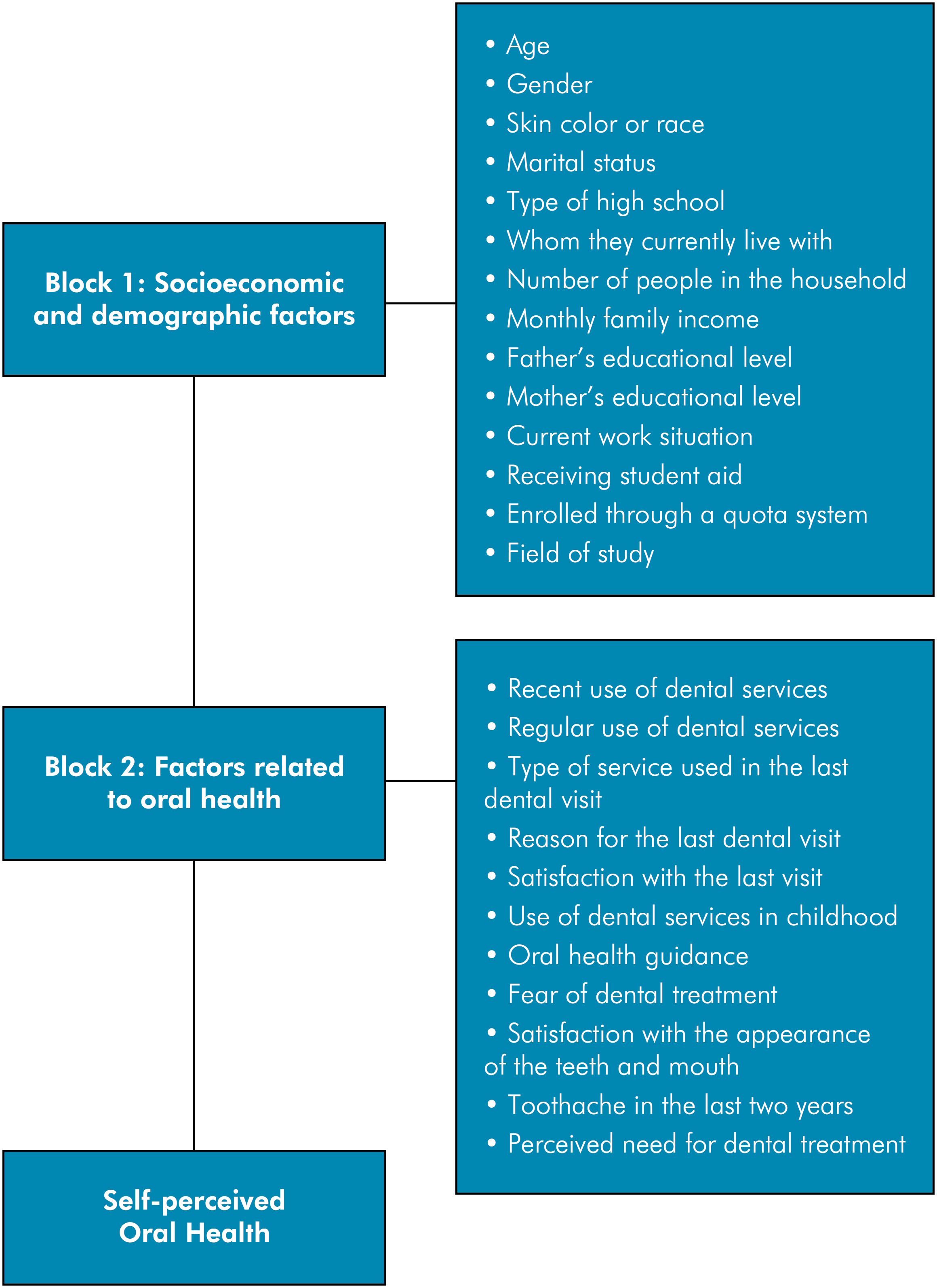
The independent variables were selected based on previous studies 6,8,9,14,16,22-24 and grouped into two blocks: socioeconomic and demographic factors (Block 1) and factors associated with oral health (Block 2), as shown in Figure.

Theoretical model for analyzing the association of independent variables with self-perceived oral health by blocks.
Figure describes the formats in which the independent variables were collected and the categories for statistical analysis. Notably, the variable "current work situation" was relative to the undergraduate student and the variable "oral health guidance" was based on whether students received information about oral health during their life (Chat 1).
Data analysis
The SPSS (Statistical Package for the Social Sciences) version 20.0 for Windows was used for data analysis. First, descriptive analyses were performed using absolute and relative frequencies. The association between dependent and independent variables was determined using bivariate analyses and logistic regression to estimate the crude and adjusted ORs, adhering to the 95% confidence interval. The independent variables associated with a p-value of ≤ 0.05 were included in the multiple models, and the variables with a p-value of < 0.05 were included in the final model.
Results
Of the 16,068 students enrolled in 2021, 1,876 students responded to the questionnaire, corresponding to a response rate of 11.7%. Of these, 1,316 undergraduates met the inclusion criteria and comprised the final sample. According to data from the local academic record, these undergraduates had sociodemographic characteristics similar to those of freshmen at the institution. Regarding their socioeconomic and demographic profiles, there was a predominance of cisgender females aged between 20 and 24 years, self-declared white, single, coming from public schools, living with family members, sharing a household with three or four people, and having a family income of up to three minimum wages. Additionally, 75.4% were unemployed, 20.7% received student aid, 48.6% entered through quotas, and 62.6% studied subjects other than biological sciences or health.
Regarding the variables associated with oral health, it was observed that most students sought dental care recently (in the last two years), did not use dental services regularly, and used the private health system in the last visit, mostly out of necessity. Furthermore, it was highlighted that 43.5% were dissatisfied with the appearance of their teeth and mouth, 49.3% had a toothache in the last 2 years, and 63.8% perceived the need for dental treatment.
Considering the dependent variable in this study, self-perception of oral health, 14.1% (95%CI: 12.2–16.0) had a negative self-perception of their oral health. Table 1 presents the frequency distributions of the independent variables divided into blocks according to the outcome investigated.
Participants’ socioeconomic, demographic, and oral health-related variables distributed according to self-perceived oral health.
The variables of block 1, including gender, self-declared color, marital status, type of high school attended, monthly family income, paternal schooling, maternal schooling, receipt of student aid, admission by quotas, and knowledge area of the course, were associated with self-perception of oral health in the crude analysis. Considering block 2, all variables were associated with the outcome. After block-adjusted analysis, the following variables remained significant: gender, marital status, monthly family income, knowledge area of the course, regular use of dental services, type of service used in the last dental visit, satisfaction with the last appointment, fear of dental treatment, satisfaction with the appearance of teeth and mouth, toothache in the last two years, and perceived need for dental treatment.
In the final model, the following variables were associated with negative self-perception of oral health: single marital status, low monthly family income, irregular use of dental services, dissatisfaction with the last visit, fear of dental treatment, dissatisfaction with the appearance of their teeth and mouth, and perceived need for dental treatment. Tables 2 and 3 show the crude, block-adjusted ORs, and final model for negative self-perceived oral health.
Association between self-perceived oral health and socioeconomic, demographic, and oral health-related variables.
Final model of variables associated with self-perceived oral health among university students.
Discussion
Oral health conditions and self-perception are influenced by social determinants of health.25,26 Therefore, it is essential to understand these factors to ensure equity and reduce inequalities in provision of oral healthcare.27
In the present study, the prevalence of negative self-perception of oral health was 14.1%. It was associated with the following variables: single marital status, low monthly family income, irregular use of dental services, dissatisfaction with the last appointment, fear of dental treatment, dissatisfaction with the appearance of teeth and mouth, and perceived need for dental treatment. The present study results were consistent with the scientific literature that indicates a predominance of positive self-perception in this age group. Data from the National Oral Health Survey (PNS) identified a higher prevalence of negative self-perception in individuals aged 15–19 years and 18 years or older, with an important regional disparity between the North/Northeast and South/Southeast regions, with the latter having a lower prevalence.6,24,28 It is essential to emphasize that although these studies involved the age group included in the present study, they did not focus on the young university population and partially involved them or included them in a broader age group. Thus, they may overestimate or underestimate the results. They may ignore the social context of the university since individuals who have access to universities may represent, even today, a portion of the socioeconomically privileged population despite affirmative action policies that have increased access to universities.11,29
Additionally, analyses involving the university population highlighted a predominance of positive self-perception of oral health, despite the prevalence of negative self-perception being higher than that identified in this study.11,22 However, these studies included a wider age range, which may explain the difference in findings, as the prevalence of positive self-perception was higher among younger people.30
The socioeconomic variables that were associated with self-perceived oral health following adjustments in analysis were marital status and monthly family income. Regarding marital status, single status was associated with a lower frequency of negative self-perception of oral health. This variable was not identified in studies involving the young population but was associated with older adults in another study.13 Doctors seem to be more concerned with the appearance of patients’ teeth and oral health and seek to maintain self-care. These factors directly influence the self-esteem and social lives of these individuals, as identified by several authors.16, 31, 32 Regarding monthly family income, the present study identified that individuals with an income of up to three minimum wages were 102% more likely to have a negative outcome than individuals with higher income. This finding was consistent with a previous study.22 Other contextual or individual variables related to economic issues that have been associated with negative self-perception of oral health in previous studies include lower per capita income, lower social class, or lower socioeconomic status.23,30 Access to dental goods and services and oral health education is probably a major differential in the population with greater purchasing power. Individuals with a high income have easier access to oral health goods and services8,33 and oral health information.34 Subsequently, they are more likely to ensure self-care and satisfaction with the appearance of their teeth and mouth, a variable that was strongly associated with self-perceived oral health in the present study.
Considering the factors associated with oral health, the following variables were associated with the outcome after the adjusted analysis: regular use of dental services, satisfaction with the last visit, fear of dental treatment, satisfaction with the appearance of teeth and mouth, and perceived need for dental treatment. Irregular use of dental services was associated with a higher frequency of negative self-perception. This result is similar to that described by Escheverria,12 who found that the regular use of dental services was associated with a greater chance of having a positive self-perception of oral health. The regular use of these services helps in the maintenance of oral health and early diagnosis of health conditions, becoming a predictor of satisfactory oral health. Previous research involving university population has identified that they used dental services when needed instead of on a regular basis.19 This highlights the need to pay attention to the mechanisms that increase the access of these individuals to oral health services. These mechanisms may involve the development of public policies for prevention and health promotion focused on achieving the interests of this population and including them in oral healthcare programs.
Consistent with the results of a study conducted using data from the 2019 National Health Survey (PNS) involving 60,202 adults aged 18 years and above,9 satisfaction with the last visit was also associated with a lower frequency of negative self-perception of oral health in the present study. Gonçalves35 identified that dissatisfaction with a service was strongly associated with the non-resolution of users’ needs. A lack of resolution gives users the perception that their oral health remains problematic. Situations such as lack of instructions about oral healthcare, insufficient consultation time, lack of important medical records, non-attendance in the afternoon shift by the Oral Health Team (OHT), time incompatible with users’ needs, and not looking for the user in case of treatment drop out were associated with greater dissatisfaction with care in Basic Health Units.36 These data highlight the need for primary care professionals to improve access and care for users.
Reportedly, fear was associated with a greater chance of negative self-perception of oral health. The prevalence of fear of dental care was 23.6%, similar to that of a previous study involving university students.11 Fear leads people to postpone dental appointments for as long as possible and seek care only in cases of extreme distress. Thus, it becomes a barrier to the regular use of services, thereby aggravating health problems and affecting subjective conditions.37
Another variable that was associated with the outcome was satisfaction with the appearance of teeth and mouth. In this study, dissatisfaction with the appearance of teeth and mouth was related to a 4-fold increase in the likelihood of having a negative self-perception of oral health. Militi16 indicated the influence of dental appearance and conditions related to facial features and physiognomy on the self-perception of oral health among young adults. Other studies have demonstrated the association between self-perception of oral health, perception of self-esteem, and quality of life in this population, providing evidence for the influence of these variables on emotional well-being and social relationships.16,17,31,32 These results emphasize the importance of dental appearance in the judgment of individuals regarding their oral health. Furthermore, considering the impact of these issues on their lives, it highlights the need to consider aesthetic concerns in the procedures and services offered by the healthcare system.38
The perceived need for dental treatment was also strongly associated with negative self-perception of oral health. Probably, individuals who realize that they need dental treatment believe that their oral health is unsatisfactory. This problem occurs when users do not develop the capacity to perceive their needs due to a lack of knowledge and/or access to oral health education. Some studies have shown an association between a lack of access to oral health information, failure to self-perceive problems, and the search for access to oral health services.39,40 This variable was also associated with the self-perception of oral health by Rebouças.7
Regarding socioeconomic and demographic factors, other studies have indicated that male gender, non-white skin color, non-health areas of knowledge, lower parental education, and older age are associated with a higher probability of negative self-perception of oral health.6,14,22,24 However, the present study did not find a statistically significant association between these variables and the outcome. Age may not have been associated with the self-perception of oral health in this study because of the small variability among the categories analyzed. Additionally, unlike previous studies that included wider age group, the present study only evaluated the young population. Based on previous studies, the reasons for the last dental visit and the type of health service were also associated with self-perception of oral health.9, 23
These results indicate that self-perception of oral health is influenced by factors that are directly or indirectly associated with access to dental goods and services, whether due to income, regular use, satisfaction with the services, or fear that prevents them from accessing them. Additionally, it is influenced by issues involving appearance. Furthermore, marital status may be a variable that indirectly affects this concern.
This study had limitations. Since it was a cross-sectional study, it was not possible to determine a cause-and-effect relationship. Additionally, the questionnaire used for data collection depended on self-reported information, which does not guarantee the veracity of the facts. Furthermore, the motivation to participate in the study may influence the results, since the sample may be composed of individuals who place more importance on oral health.
This study contributes to the identification of factors that can influence negative self-perception of oral health, considering the scarcity of research on this indicator focusing on the university population despite its important influence on individuals’ lives. University students are a population with a specific socioeconomic, demographic, cultural, psychological, and oral health profile considering their age and the social context in which they live, which are especially influenced by situations that harm social inclusion and self-esteem. However, this population is still neglected in oral healthcare programs in the country.
Conclusions
This study identified a 14.1% prevalence of negative self-perception among university students. The socioeconomic variables associated with negative self-perception of oral health were single marital status and family income of up to three minimum wages, while factors associated with oral health were non-regular use of dental services, dissatisfaction with the last dental visit, fear of dental treatment, dissatisfaction with the appearance of teeth and mouth, and perceived need for treatment.
References
-
1 Corchuelo-Ojeda J, González Pérez GJ, Casas-Arcila A. Factors associated with self-perception in oral health of pregnant women. Health Educ Behav. 2022 Jun;49(3):516-24.https://doi.org/10.1177/10901981211038903
» https://doi.org/10.1177/10901981211038903 -
2 Bergmann VF, Cadermatori MG, Corrêa MB, Demarco FF, Goettems ML, Shqair AQ. Autopercepção de saúde bucal, cárie dentária e dor: o papel do medo dentário subjacente a essa associação. Int J Paediatr Dent. 2018;28(3):319-25.https://doi.org/10.1111/ipd.12359
» https://doi.org/10.1111/ipd.12359 -
3 Araújo MV, Barroso RF, Emmi DT, Gomes KM, Pinheiro HH. Autopercepção de saúde bucal por idosos marajoaras. Rev Digit Acad Para Odontol. 2018;2(1):9-22. https://doi.org/10.1590/S1413-81232011000800017
» https://doi.org/10.1590/S1413-81232011000800017 -
4 Fahin A, Mahmood R, Haider I, Luqman M, Ikhlaq I, Mahmood T, et al. Association between clinical oral health status and perceived oral health in different age groups. Peer J. 2022;10:14152. https://doi.org/10.7717/peerj.14152
» https://doi.org/10.7717/peerj.14152 -
5 Firmino RT, Martins CC, Faria LS, Martins Paiva S, Granville-Garcia AF, Fraiz FC, et al. Association of oral health literacy with oral health behaviors, perception, knowledge, and dental treatment related outcomes: a systematic review and meta-analysis. J Public Health Dent. 2018 Jun;78(3):231-45. https://doi.org/10.1111/jphd.12266
» https://doi.org/10.1111/jphd.12266 - 6 Cárdenas-Bahena A, Falcón-Flores JA, García-Zámano IE, Montes-Salmerón RE, Reza-Bravo GG, Sánchez-García S, et al. Autopercepción de la salud oral en adultos mayores de la Ciudad de México. Rev Med Inst Mex Seguro Soc. 2018;56(1):54-63.
-
7 Silva JV, Oliveira AG. Individual and contextual factors associated to the self-perception of oral health in Brazilian adults. Rev Saude Publica. 2018 Apr;52:29. https://doi.org/10.11606/S1518-8787.2018052000361
» https://doi.org/10.11606/S1518-8787.2018052000361 -
8 Rebouças AG, Cavalli AM, Zanin L, Ambrosano GM, Flório FM. Factors associated with Brazilian adolescents’ satisfaction with oral health. Community Dent Health. 2018 May;35(2):95-101. https://doi.org/10.1922/CDH_4165Gama07
» https://doi.org/10.1922/CDH_4165Gama07 -
9 Carreiro DL, Souza JG, Coutinho WL, Haikal DS, Martins AM. Acesso aos serviços odontológicos e fatores associados: estudo populacional domiciliar. Cien Saude Colet. 2019 Mar;24(3):1021-32. https://doi.org/10.1590/1413-81232018243.04272017
» https://doi.org/10.1590/1413-81232018243.04272017 -
10 Bordin D, Fadel CB, Moimaz SA, Santos CB, Garbin CA, Saliba NA. Characterization of the self-perception of oral health in the Brazilian adult population. Cien Saude Colet. 2020 Sep;25(9):3647-56. https://doi.org/10.1590/1413-81232020259.29612018
» https://doi.org/10.1590/1413-81232020259.29612018 -
11 Albuquerque RM, Cavalcanti LR, Panjwani CM, Sarmento-Omena AR, Santos RG, Sena MS. Autopercepção, hábitos e impacto da saúde bucal na qualidade de vida dos estudantes de um Instituto Federal do Nordeste. Diversitas J. 2019;4(2):600-11. https://doi.org/10.17648/diversitas-journal-v4i2.765
» https://doi.org/10.17648/diversitas-journal-v4i2.765 -
12 Azevedo MS, Cadermatori MG, Correa MB, Costa VP, Demarco FF, Dias VD, et al. Medo odontológico e saúde bucal: avaliação transversal do ciclo do medo entre universitários brasileiros. Rev Fac Odontol (Univ Passo Fundo). 2021;62(2):43-54. https://doi.org/10.22456/2177-0018.110685
» https://doi.org/10.22456/2177-0018.110685 -
13 Echeverria MS, Silva AE, Agostini BA, Schuch HS, Demarco FF. Regular use of dental services among university students in southern Brazil. Rev Saude Publica. 2020;54:85. https://doi.org/10.11606/s1518-8787.2020054001935
» https://doi.org/10.11606/s1518-8787.2020054001935 -
14 Rosendo RA. Saúde bucal e impacto na qualidade de vida em idosos. RSC online. 2017;6(1):89-102. https://doi.org/10.1590/S1413-81232011000800031
» https://doi.org/10.1590/S1413-81232011000800031 -
15 Farias DR, Brito Junior RB, Oliveira AM, Zanin L, Flório FM. Higher education students from health and non-health subject areas: aspects of oral health. RGO. 2021;69:e2021014. https://doi.org/10.1590/1981-86372021001420190135
» https://doi.org/10.1590/1981-86372021001420190135 - 16 Andifes, Fonaprace. V Pesquisa do perfil socioeconômico e cultural dos graduandos das IFES-2018. Brasília, DF; 2019.
-
17 Militi A, Sicari F, Portelli M, Merlo EM, Terranova A, Frisone F, et al. Psychological and social effects of oral health and dental aesthetic in adolescence and early adulthood: an observational study. Int J Environ Res Public Health. 2021 Aug;18(17):9022. https://doi.org/10.3390/ijerph18179022
» https://doi.org/10.3390/ijerph18179022 -
18 Zhang Z, Tian Y, Zhong F, Li C, Dong S, Huang Y, et al. Association between oral health-related quality of life and depressive symptoms in Chinese college students: Fitness Improvement Tactics in Youths (FITYou) project. Health Qual Life Outcomes. 2019;17(1):96. https://doi.org/10.1186/s12955-019-1163-4
» https://doi.org/10.1186/s12955-019-1163-4 -
19 Baiju RM, Peter E, Varghese NO, Sivaram R. Oral health and quality of life: current concepts. J Clin Diagn Res. 2017 Jun;11(6):ZE21-6. https://doi.org/10.7860/JCDR/2017/25866.10110
» https://doi.org/10.7860/JCDR/2017/25866.10110 -
20 Cunha RO, Leite IC. Factors associated with recent and regular non-use of dental services by students from a university in southeastern Brazil: a cross-sectional study. BMC Oral Health. 2022 Dec;22(1):612. https://doi.org/10.1186/s12903-022-02648-7
» https://doi.org/10.1186/s12903-022-02648-7 -
21 Barnabé LE, Macedo A, Macena MC, Oliveira-Júnior JK, Rodriguez RQ, Santos ML. O valor atribuído à saúde bucal: um estudo com acadêmicos iniciantes de quatro cursos de graduação. Arch Health Investig. 2017;6(3):106-109. https://doi.org/10.1590/1981-86372021001420190135
» https://doi.org/10.1590/1981-86372021001420190135 - 22 Fundação Nacional de Saúde. Diretrizes de educação em saúde visando à promoção da saúde: documento base - documento I. Brasília, DF: Fundação Nacional de Saúde; 2007.
-
23 Henzel LT, Silveira MC, Karam SA, Schuch HS, Cadermatori MG, Corrêa MB, et al. Iniquidades socioeconômicas na saúde bucal de estudantes universitários do sul do Brasil. Rev Fac Odontol (Univ Passo Fundo). 2021;62(1):33-43. https://doi.org/10.22456/2177-0018.109536
» https://doi.org/10.22456/2177-0018.109536 -
24 Silva Junior MF, Sousa MD, Batista MJ. Reducing social inequalities in the oral health of an adult population. Braz Oral Res. 2020 Jan;33:e102. https://doi.org/10.1590/1807-3107bor-2019.vol33.0102
» https://doi.org/10.1590/1807-3107bor-2019.vol33.0102 -
25 Corassa RB, Silva CJP, Paula JS, Aquino EC, Sardinha LMV, Alves PAB. Condições de saúde bucal autorrelatadas entre adultos brasileiros: resultados das Pesquisas Nacionais de Saúde de 2013 e 2019. Epidemiol Serv Saude. 2022;31(1):2021383. https://doi.org/10.1590/ss2237-9622202200014.especial
» https://doi.org/10.1590/ss2237-9622202200014.especial -
26 Abreu MH, Cruz AJ, Borges-Oliveira AC, Martins RC, Mattos FF. Perspectives on social and environmental determinants of oral health. Int J Environ Res Public Health. 2021 Dec;18(24):13429. https://doi.org/10.3390/ijerph182413429
» https://doi.org/10.3390/ijerph182413429 -
27 Esposti CD, Santos-Neto ET, Oliveira AE, Travassos C, Pinheiro RS. [Adequacy of prenatal dental care: social and geographical inequalities in a metropolitan region of Brazil]. Cien Saude Colet. 2021 Sep;26(9):4129-44. Portuguese. https://doi.org/10.1590/1413-81232021269.10542020
» https://doi.org/10.1590/1413-81232021269.10542020 -
28 Azevedo MB, Pinto RD, Abreu MH, Lucas SD. Factors associated with the needs of specialised dental treatment among adults aged 35-44 years old in the state of Minas Gerais, Brazil: a multilevel cross-sectional study. Cien Saude Colet. 2020 Jul;25(7):2783-92. https://doi.org/10.1590/1413-81232020257.29852018
» https://doi.org/10.1590/1413-81232020257.29852018 - 29 Ministério da Saúde (BR). Secretaria de Atenção à Saúde. Secretaria de Vigilância em Saúde. Pesquisa Nacional de Saúde Bucal: resultados principais. Brasília, DF: Ministério da Saúde; 2012.
-
30 Gonçalves FG, Ramos MP. Sucesso no campo escolar: condicionantes para entrada na universidade no Brasil. Educ Soc. 2019;40:e0188393. https://doi.org/10.1590/es0101-7330201918839330
» https://doi.org/10.1590/es0101-7330201918839330 -
31 Alade O, Ajoloko E, Dedeke A, Uti O, Sofola O. Self-reported halitosis and oral health related quality of life in adolescent students from a suburban community in Nigeria. Afr Health Sci. 2020 Dec;20(4):2044-9. https://doi.org/10.4314/ahs.v20i4.62
» https://doi.org/10.4314/ahs.v20i4.62 -
32 Grecu AG, Balazsi R, Dudea D, Mesaroş AŞ, Strîmbu M, Dumitraşcu DL. Oral health related quality of life and self-esteem in a general population. Med Pharm Rep. 2019 Dec;92(3 Suppl No 3):S65-72. https://doi.org/10.15386/mpr-1520
» https://doi.org/10.15386/mpr-1520 -
33 Reda SF, Reda SM, Schwendicke F, Thomson WM. Desigualdade na Utilização de Serviços Odontológicos: Uma Revisão Sistemática e Meta-análise. Am J Public Health. 2018;108(2):e1-7. https://doi.org/10.2105/AJPH.2017.304180
» https://doi.org/10.2105/AJPH.2017.304180 -
34 Roberto LL, Noronha DD, Souza TO, Miranda EJ, Martins AM, Paula AM, et al. [Lack of access to information on oral health problems among adults: an approach based on the theoretical model for literacy in health]. Cien Saude Colet. 2018 Mar;23(3):823-35. Portuguese. https://doi.org/10.1590/1413-81232018233.25472015
» https://doi.org/10.1590/1413-81232018233.25472015 -
35 Gonçalves KF, Menegazzo GR, Hilgert JB, Hugo FN, Giordani JM, Fatores contextuais e individuais associados à insatisfação com a assistência odontológica no Brasil. Cien Saude Colet. 2021;26 suppl 2:3715-24. https://doi.org/10.1590/1413-81232021269.2.04162020
» https://doi.org/10.1590/1413-81232021269.2.04162020 -
36 Pires HF, Limao NP, Protasio AP, Valença AM. Fatores associados à satisfação dos usuários com a atenção à saúde bucal na Paraíba, 2014. Saúde Debate. 2020;44(125):451-64. https://doi.org/10.1590/0103-1104202012513
» https://doi.org/10.1590/0103-1104202012513 -
37 Silveira ER, Cademartori MG, Schuch HS, Armfield JM, Demarco FF. Prevalência estimada de medo dentário em adultos: uma revisão sistemática e meta-análise. Rev Odontol. 2021;108:103632. https://doi.org/10.1101/2020.11.30.20241216
» https://doi.org/10.1101/2020.11.30.20241216 -
38 Ribeiro RC, Lima FG, Bighetti TI. Estética dentária na Atenção Básica em Saúde. Rev Fac Odontol (Univ Passo Fundo). 2018;23(3):333-8. https://doi.org/10.5335/rfo.v23i3.8491
» https://doi.org/10.5335/rfo.v23i3.8491 -
39 Oliveira Júnior AJ, Mialhe FL. Letramento em saúde bucal e variáveis associadas a autopercepção de saúde bucal em adultos e idosos usuários da atenção básica: um estudo exploratório. Cad Saude Colet. 2022;30(2):1-10. https://doi.org/10.1590/1414-462x202230020132
» https://doi.org/10.1590/1414-462x202230020132 -
40 Romano F, Perotto S, Bianco L, Parducci F, Mariani GM, Aimetti M. Self-perception of periodontal health and associated factors: A cross-sectional population-based study. Int J Environ Res Public Health. 2020 Apr;17(8):2758. https://doi.org/10.3390/ijerph17082758
» https://doi.org/10.3390/ijerph17082758