
 Articulations among Computational Thinking, Mathematical Modeling, and Meaningful Learning
Abstract
Given the relevance of a theoretical-methodological foundation for pedagogical practices, there are studies in Mathematical Modeling in Mathematics Education that address its interaction with the Theory of Meaningful Learning, as well as others that have investigated the approximation between Mathematical Modeling and Computational Thinking. However, the explicit articulation among the three still lacks analysis. In this essay, we focus on answering how Computational Thinking, Mathematical Modeling, and Meaningful Learning can be articulated, clarifying the three themes and advancing their understanding by representing them through conceptual maps that highlight their relationships. We emphasize the need for a refined understanding of the aspects of the Theory of Meaningful Learning to achieve learning objectives, since such learning is not inherent to Computational Thinking nor to Mathematical Modeling itself, but may be facilitated through the articulation among all these elements.
Keywords:
Computational Thinking; Mathematics Education; Teaching Methodologies; Meaningful Learning Theory; Mathematical Modeling
Resumo
Dada a pertinência de um aporte teórico-metodológico às práticas pedagógicas, há pesquisas em Modelagem Matemática na Educação Matemática sobre sua interação com a Teoria da Aprendizagem Significativa, e outras que investigaram a aproximação entre Modelagem Matemática e Pensamento Computacional. No entanto, a articulação explícita entre os três ainda carece de análise. Neste ensaio, focamos em responder de que forma podem se articular o Pensamento Computacional, a Modelagem Matemática e a Aprendizagem Significativa, esclarecendo os três temas e avançando na sua compreensão, registrando-a por meio de mapas conceituais evidenciando suas relações. Destaca-se a necessidade do fino entendimento dos aspectos da Teoria da Aprendizagem Significativa para alcançar os objetivos de aprendizagem, não sendo essa aprendizagem inerente ao Pensamento Computacional e nem à Modelagem Matemática em si, mas podendo ser facilitada pela articulação entre todos esses elementos.
Palavras-chave:
Pensamento Computacional; Educação Matemática; Metodologias de Ensino; Teoria da Aprendizagem Significativa; Modelagem Matemática
1 Introduction
The teaching of the so-called Computational Thinking (CT) skills has generated debate, with persistent questions about how to implement it in Education, which has led us to reflect on the topic. In this process, based on a systematic review study reported in (Kaminski, 2023), we identified a gap regarding the theoretical and methodological foundations for this implementation. Furthermore, in our academic trajectory, and also grounded in the data from the aforementioned review, we reflected on possible weaknesses in introducing CT into Education, highlighting concerns about the lack of articulation between the teaching of its so-called skills1 and other areas of knowledge. Despite the large number of studies on CT, this articulation is still little explored, and there is limited clarity regarding possible ways to develop it (Kaminski, 2023). In Brazil, these issues have gained prominence since the publication of Opinion No. 2/2022 (Brazil, 2022a, p. 17) and the approval of Resolution No. 1/2022 (Brazil, 2022b), which establish the guidelines for the inclusion of Computing in Basic Education, including the teaching of CT, in a “gradual and incremental” manner, starting on November 1, 2023.
Thus, in this theoretical essay, we reflect on why CT should be brought closer to Mathematics Education (ME), considering its specificities, and how Mathematical Modeling (MM) in Mathematics Education, in interaction with the Theory of Meaningful Learning (TML), can be configured as a viable theoretical-methodological framework to support the articulation between practices that promote the development of CT and ME. This is possible because such practices enable, during pedagogical activities, situations that require the mobilization of both CT skills and mathematical knowledge, in a contextualized and interdisciplinary manner. The conjectures presented are based on theoretical reflections on CT, MM, TML, and their possible interrelations, through which we seek to answer: How can Computational Thinking, Mathematical Modeling in Mathematics Education, and Meaningful Learning be articulated?
To present the findings, the article is organized as follows: Section 2 presents theoretical aspects related to the investigation, divided into subsections in which we discuss the approximations between the studied elements in pairs (analytical dyads), and finally, a triadic analysis in which we aim to highlight the relationships among the three elements. In the final section, we present the concluding remarks and research perspectives.
2 Assumptions for the approximation between CT and ME
Before presenting the main aspects of TML, MM, and CT and reflecting on their possible relationships, it is pertinent to consider the meanings of bringing CT closer to ME and the assumptions adopted, which are the objectives of this section. This reflection begins with discussions about the approximation of CT with Education as a whole and then moves into ME, which is grounded not only in the epistemological bases of Mathematics but also considers the foundations of the field of Education (Burak; Klüber, 2016, p. 35).
Since 2006, when research on CT in the school context gained prominence following the studies of Wing (2006), many publications have highlighted this approximation as necessary for students’ education today. This is justified by the undeniable presence of digital culture in our society, which raises the demand for schools to incorporate into teaching and learning processes themes related to cyberspace and cyberculture.
In this process, philosophical assumptions directly influence how this approximation is carried out, since, as highlighted by Silva (2020), classroom practices are always influenced by philosophical assumptions about how knowledge occurs and about the object of knowledge. Furthermore, the psychological and pedagogical conceptions adopted regarding learning and the social function of the school also influence these practices (Kaminski, Klüber, Boscarioli, 2021). Thus, it is the educator’s role to answer questions about what and why to teach certain knowledge and then define strategies that lead to achieving the objectives (Silva, 2020).
Given this, we reflect on the topic by adopting a critical perspective of knowledge, under which reflection is fundamental, and by considering knowledge as the result of the relationship between rationality and human historicity (Bombassaro, 1992). These assumptions lead us to adopt Education from a historical-cultural perspective and within a critical-social framework. From this perspective, bringing digital culture into the school goes far beyond using Digital Technologies (DT) as tools to support the teacher or contributing to students’ digital literacy. It involves treating them as part of historically produced knowledge that students must critically understand and, through this culture, internalize and produce knowledge.
Bringing CT into the school context is consistent with the assumptions of an Education that considers the analytical appropriation of human historical-cultural development as the basis for a critical and emancipatory education. In addition to enabling students to understand the processes involved in the functioning of the digital world around them, contributing to the development of a critical view of the use of DT, CT, as defined by Wing (2006), is based on the development of skills grounded in the principles of Computer Science that can be used as a strategy for problem-solving, both within and beyond the field of Computing.
Regarding what these skills are, a systematic review reported in (Kaminski, 2023) shows that, despite variations in understanding among authors who investigate the topic in education, four skills are predominantly mentioned as related to the development of CT, forming a consensus in the literature: decomposition, abstraction, pattern recognition, and algorithms.
Decomposition refers to dividing a problem into smaller parts, making the solution more manageable, since the parts can be solved separately, without losing sight of the fact that combining the solutions of the parts results in solving the overall problem. Abstraction is related to filtering data, ignoring unnecessary elements, and focusing attention on those relevant to solving the problem. Pattern recognition involves identifying and analyzing similar problems that have already been solved, aiming to replicate or adapt solutions in different situations or problems. Algorithms involve developing clear and ordered instructions aimed at solving the problem (Brackmann, 2017).
Although we recognize the importance of introducing CT into Education, neither research nor guiding documents, such as the aforementioned Opinion and Resolution that establish the guidelines for Computing in Basic Education (Brazil, 2022a, 2022b), clearly explain how this can occur. When we question how, we are referring not only to the resources used but, in a broader sense, to approaches that are theoretically and methodologically grounded in coherence with the adopted philosophical, psychological, and pedagogical assumptions.
As indicated by Kaminski (2023), there are various ways in which CT has been implemented in schools, most of which occur through courses or workshops. Among initiatives that attempt to include it as part of the curriculum, most do so through specific subjects involving the teaching of Computing, while initiatives that attempt to treat it in an interdisciplinary manner are rare.
Our reflections, based on the historical analysis presented in Kaminski, Klüber, and Boscarioli (2021) and on Wing’s (2006) own definition of CT, led us to agree with Valente (2016) that introducing CT into Education in an interdisciplinary way is the most desirable approach. This does not mean that interdisciplinarity guarantees the assumptions we adopt, but rather that it is one of the elements to be considered when adopting these assumptions. Nor do we mean that approaches that address CT in isolation do not contribute to its development to some extent, but that, given our assumptions about Education, what makes sense is to approach it in articulation with other areas of knowledge.
In our understanding, CT in Education involves teaching thinking skills (decomposition, abstraction, pattern recognition, and algorithms), understood as cognitive processes based on principles used in Computing, which mobilize reasoning and metacognition, contributing to learning and problem-solving in various areas of knowledge. This teaching should be based on didactic-pedagogical actions that enable and require the mobilization of these skills.
Like Navarro and Sousa (2023), we do not consider CT as isolated knowledge. Rather, we understand it as related knowledge, part of the reality in which we are embedded, in which DT are included, and which can contribute to learning and the development of other areas. Thus, we consider the interdisciplinary approach to CT as the most coherent and see possibilities for its approximation with any other curricular component, in a contextualized way with the problems related to each area. Seeking this articulation between CT and other areas of knowledge, we focus on reflecting on the approximation between CT and ME, as this is our field of investigation.
Being concerned with the teaching and learning of Mathematics, Mathematics Education (ME), according to Higginson (1980) and Burak and Klüber (2008), must obviously consider Mathematics as its fundamental basis. However, beyond this, it must also take into account other areas, such as Philosophy, Psychology, Sociology, Anthropology, and the Mother Tongue. From these reflections, these authors consider that, from this perspective of ME, it is possible to “consider that Mathematics is conditioned by Education” (Burak; Klüber, 2016, p. 35) and, therefore, it incorporates contributions from this field in addition to the foundations of Mathematics itself.
Thus, the same reasons already presented that justify bringing CT closer to Education as a whole—namely, aspects related to contemporary digital culture—also support its insertion into ME. Furthermore, ME is “a process embedded within the dynamics of social and historical processes” (Navarro; Sousa, 2023, p. 22), which currently include the digital universe. In this sense, digital culture can be considered a social practice with which Mathematics interacts, and this interaction may contribute both to understanding the digital world and to learning Mathematics considering a context external to it.
In addition to considering the general aspects of the approximation between CT and ME, which are related to its connection with Education, it is pertinent to reflect on the contributions of this association to each area, analyzing their specificities, so that the teacher can “create pedagogical situations that foster the development of computational thinking in the classroom” (Navarro; Sousa, 2023, p. 18), especially in articulation with the knowledge of the curricular component being taught. In this regard, Navarro and Sousa (2023, p. 21) sought to identify the “possible conceptual nexuses that contribute to the development of Computational Thinking in the context of Mathematics Education.”
For these authors, the concept of CT is an important external nexus; however, it is necessary to consider the internal nexuses (knowledge from the field that serve as a basis for the development of CT) within ME, in order to use it in the interpretation and solution of problems. After analysis, they identified three conceptual nexuses that are part of mathematical knowledge and that “allow one to infer the movement of computational thinking” (Navarro; Sousa, 2023, p. 84).
The first nexus is Problem Solving, which, according to the authors, involves the use of mathematical concepts, logical reasoning, techniques and skills, as well as reading and interpretation, the search for information and relevant concepts, planning, and the development of strategies. It is noteworthy that problem solving encompasses a series of cognitive operations that may involve algorithmic and algebraic language, such as analysis, interpretation, generalization, abstraction, hypothesis formulation, and data synthesis. The authors argue — and we agree — that problem solving contributes to prompting students to “interpret, analyze, question, explore, investigate, decompose, reflect, observe regularities, and produce syntheses leading to the creation of solutions and/or strategies” (Navarro; Sousa, 2023, p. 90), being related both to the production of mathematical knowledge and to CT. It is worth emphasizing that problem solving, as a conceptual nexus, does not refer to a specific trend in ME, but rather to the broader sense of solving problems.
The second nexus refers to Algebraic Thinking, which, due to its characteristic of seeking regularities among elements and making use of algorithms, rules, symbols, pattern identification, and different languages with the aim of generalization, can be connected to CT. Algorithmic Thinking is the third nexus presented by the authors, conceived by them as a logical and methodical procedure, organized into steps, aimed at solving problems or tasks, and which can be considered a form of mathematical reasoning (Navarro; Sousa, 2023).
Thus, in the teaching process, when these three conceptual nexuses are addressed, the possibility emerges of articulating the development of CT with the development of mathematical knowledge. In this way, in the context of ME, CT “serves the function of helping students produce mathematical knowledge (algebraic and algorithmic thinking), develop investigative and problem-solving abilities,” as well as expanding their reading of the world (Navarro; Sousa, 2023, p. 108). Therefore, the goal is for students to develop CT in order to use it in “everyday situations to understand data, interpret information, create patterns and regularities, re-signify knowledge, and solve problems” (Navarro; Sousa, 2023, p. 108).
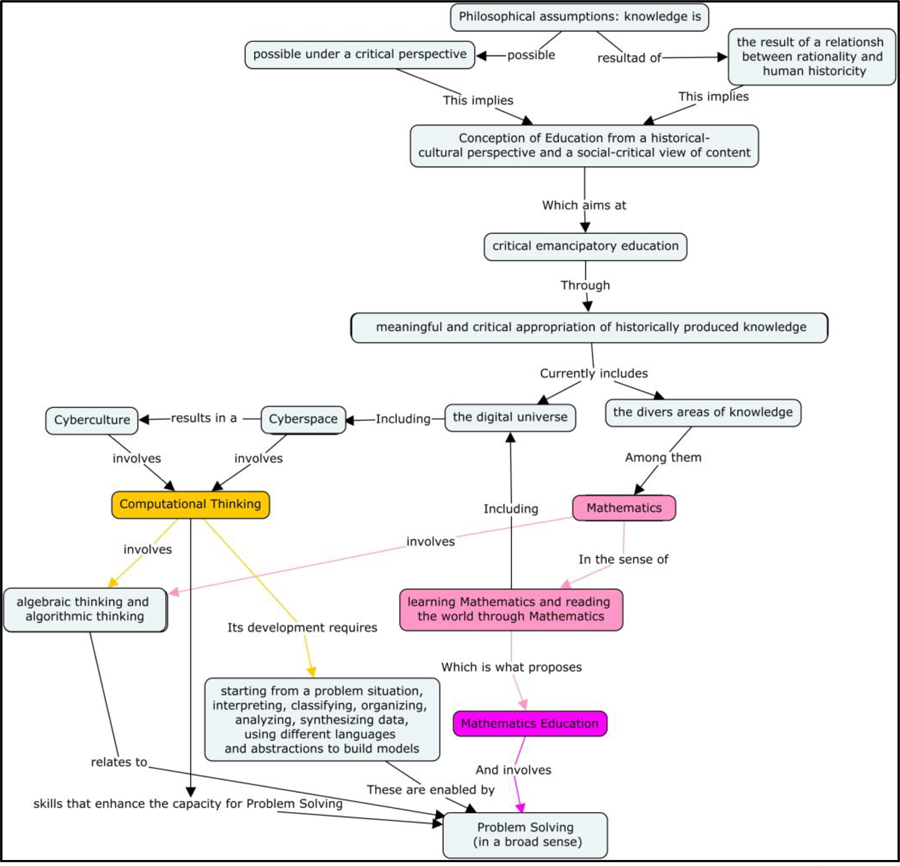
In this sense, CT can contribute to ME in a more specific and internal way, since its so-called skills enhance mathematical thinking, especially in problem solving. At the same time, ME has the potential to mobilize the development of skills related to CT both within the context of Mathematics itself and beyond it. Based on these reflections, in Figure 1, we present the relationships between the CT–ME dyad grounded in the philosophical and educational assumptions we have adopted.
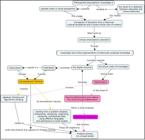
Although, based on these reflections, we see the point in inserting PC within the context of EM, and considering the data on related aspects presented, we agree with Navarro and Sousa (2023) on the need for teachers to intentionally organize and develop practices that enable this articulation between PC and EM, and it is from this point that we shed light on possible contributions. Thus, in Section 2.1, we will disagree on how MM can be configured as a methodology that enables this connection.
2.1 Assumptions for the approximation between CT and ME through MM
Prior to development, the organization of pedagogical practice intentionally designed to promote this connection between CT and ME is necessary, and for this purpose, adopting a methodology consistent with the expected objectives is not irrelevant. Thus, we consider it meaningful to choose a methodology based on problem-solving, as it aligns with the ideas already presented regarding the conceptual nexuses for CT in ME. However, since CT is often defined as a form of problem-solving, it is worth asking: what is the point of, when proposing an educational practice aimed at its development, thinking about a problem-solving methodology? Would it not, by itself, be sufficient to meet this requirement?
To answer this question, it is initially important to highlight, as stated by Burak (2010, p. 17), that “according to Freudenthal, a methodology presupposes premises, and premises originate in philosophy.” Thus, the choice of a methodology reveals the conceptions of world, human being, knowledge, and education that are assumed, in addition to guiding and organizing pedagogical work in the chosen direction, making it a necessary action in pedagogical practice.
Even though CT may be used by teachers during the development of some of their professional activities, it does not constitute a methodology for organizing pedagogical work in the sense discussed above, thus requiring the adoption of one to guide the proposed practices aimed at its development within the classroom context. Furthermore, it is important to recall that, within the context of ME, problem-solving aims to “stimulate the development of mathematical thinking” (Navarro; Sousa, 2023, p. 86).
Therefore, problem-solving within ME aims to contribute to the formation of mathematical knowledge, going beyond the so-called CT skills, although these may enhance one’s ability to solve problems, as they contribute to interpretation processes, metacognition, and the development of reasoning. Thus, adopting a problem-solving methodology for working with CT in ME is not merely adding elements to the process, but rather seeking ways to intentionally and systematically enable both the development of CT skills and mathematical knowledge, in which one can contribute to the other in a dialectical process of knowledge construction, grounded in broader educational objectives aligned with the adopted philosophical assumptions.
However, there are various methodologies based on problem-solving that can support the development of CT skills alongside the learning of mathematical knowledge. In ME, some examples include Problem Solving, Mathematical Modeling, and Ethnomathematics. Project-Based Learning is also related to problem-solving. According to Biembengut (2014, p. 217), these four approaches make it possible to stimulate knowledge and guide students in the process of understanding the environment in which they live. Given this, we reflect on which of these methodologies can best support the development of CT in ME.
In an effort to identify common points among the four, Biembengut (2014) highlights specific characteristics of each, noting that MM, when compared to Problem Solving and Project-Based Learning, is characterized by the “formulation of a model (mathematical or not) and the expression of results” (Biembengut, 2014, p. 212). Furthermore, in Problem Solving, situations are generally proposed to improve knowledge or content that students have already studied, whereas MM considers developing content through and from the proposed situation. In relation to Ethnomathematics, “solving the problem based on the model” becomes a distinctive feature of MM, since although the development of an explanatory model about a mathematical practice is often part of the process in Ethnomathematics, solving it is not always necessary (Biembengut, 2014, p. 213). Moreover, in this trend of Mathematics Education, the proposal is to “know and value the practices of a person or group in their activities” (Biembengut, 2014, p. 215), whereas in MM, the teaching of curricular content arising from the model is expected.
From these considerations, we recognize the potential of each of these approaches to support problem-solving practices that foster the development of CT in articulation with ME. However, we identify in the specificities of MM an even greater potential to strengthen this articulation, namely the construction of models, their possible generalization, and the development of mathematical content arising from the problem.
However, MM can be defined and implemented in the classroom in different ways, depending on the objectives of its use (Barbosa, 2001, p. 3). Klüber and Burak (2008) present different conceptions of MM and argue that the conception adopted by the teacher reveals underlying ways of understanding teaching and Mathematics. Among the different conceptions of MM, such as those of Barbosa (2001), Almeida, Silva, and Vertuan (2012), Vecchia (2012), among others, the conception proposed by Burak and Aragão (2012) stands out to us for aligning with our assumptions.
Burak and Aragão (2012) consider that when the decision to teach through MM is based on reflection on philosophical premises that justify why to teach Mathematics and specifically why to do so through MM, considering the type of individual one aims to educate, MM can be assumed as a “teaching methodology” (p. 85), with the “status of a methodology meaning the study of paths” (p. 87). We understand that adopting MM from philosophical assumptions, as these authors propose, goes beyond adopting it as a method, since a method refers to a “set of rational procedures, based on rules” (Japiassú; Marcondes, 2001, p. 130) expected to be followed step by step. Methodology, in turn, involves the “investigation of the methods used in different sciences, their foundations and validity, and their relationship with scientific theories” (Japiassú; Marcondes, 2001, p. 130).
Within this perspective of MM as a methodology, rather than following a predefined sequence of steps, it is expected that the teacher will become a teacher with MM as a methodology, incorporating and integrating it into their ways of conducting practice, based on reflections grounded in their philosophical assumptions. According to Burak and Aragão (2012, p. 87), this reflection is not irrelevant when one seeks “consistency in theoretical foundations and coherence in actions and procedures,” and within this understanding:
Mathematical Modeling consists of a set of procedures whose objective is to construct a parallel to attempt to explain, mathematically, phenomena present in human daily life, helping individuals to make predictions and decisions, and which is based on two premises: (1) the interest of the group of people involved; (2) data are collected where the interest of the group of people involved lies (Burak; Aragão, 2012, p. 88).
The first premise is grounded in Psychology, which highlights the influence of interest on individuals’ actions, and based on it, the authors propose the following stages of Modeling:
1) selection of the theme; 2) exploratory research; 3) identification of the problem(s); 4) problem solving and development of content within the context of the theme; 5) critical analysis of the solution(s) (Burak; Aragão, 2012, p. 89).
The second premise is based on methods “of an anthropological, phenomenological, ethnographic nature, and all those characterized as a form of ‘participant observation’” (Burak; Aragão, 2012, p. 88). The authors emphasize that these stages are flexible and may undergo changes throughout the process.
Like Burak and Aragão (2012), we conceive MM as a methodology, grounded in philosophical assumptions that underpin the development of its practices in the classroom, and we share the same assumptions regarding students’ education and Mathematics Education. In this conception, the idea of a model is present, but it goes beyond mathematical models, and can be understood as representations such as “a grocery list, the floor plan of a house, among others” (Burak; Aragão, 2012, p. 97). From this perspective, the model may include programming code, as already proposed by Vecchia (2012).
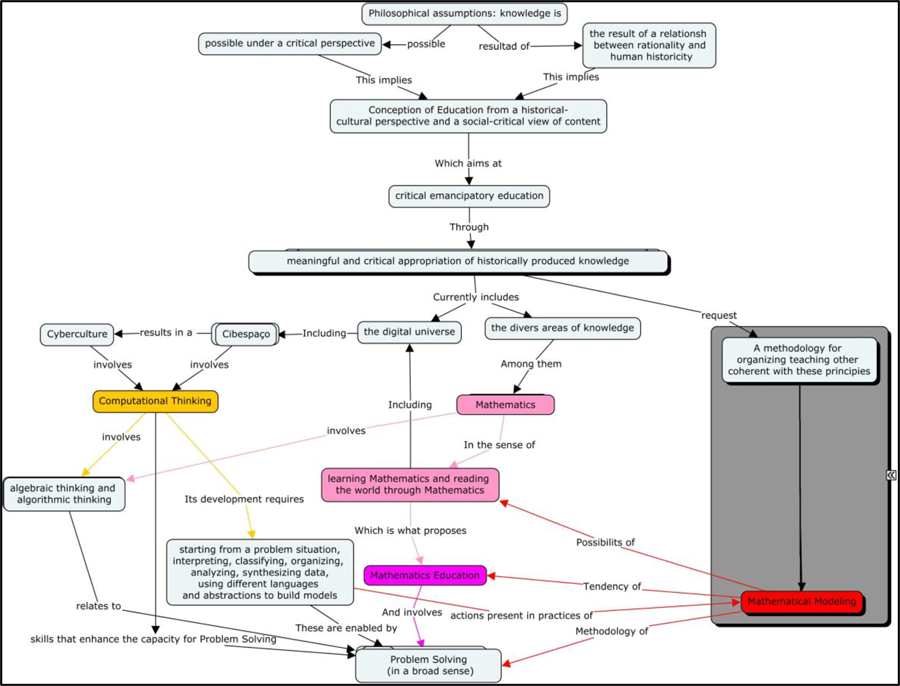
From the above, we understand that MM, in the perspective proposed by Burak and Aragão (2012), can be adopted as a methodology to guide pedagogical practices consistent with the assumptions adopted, enabling both the development of mathematical knowledge and the so-called CT skills. Figure 2 illustrates the same relationships presented in Figure 1, expanding them to make explicit the relationships with MM in the adopted conception. The added component is highlighted by the large gray node.
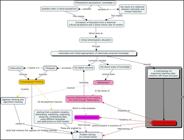
In addition to methodology, the psychological dimension of ME raises the need to consider a theory that supports teaching and learning processes, in order to guide teaching practice from its planning to its assessment. Thus, in Section 2.2, we discuss TML as a theoretical framework to support MM practices and to articulate CT and ME.
2.2 Assumptions for the approximation between CT and ME through MM in interaction with the principles of TML
Understanding how the learning process occurs and which variables influence it is relevant for the organization and conduct of teaching. Learning theories contribute to teaching practice by shedding light on these aspects, thereby increasing the likelihood of achieving the established learning objectives. As one of the authors who contributed to this field, David Ausubel clearly establishes the direct relationship between understanding how students learn (learning theory) and knowing how to conduct the process in order to help them learn more effectively (teaching theory) (Ausubel, 1968 apud Aragão, 1976).
In this conception, teaching means giving a deliberate direction to the learning process. This direction is based on guidelines suggested by principles that constitute a theory of learning implemented in the classroom. It is therefore possible to state that the discovery of more efficient teaching methods will inherently depend on and be related to the learning theory adopted (Aragão, 1976, p. 1).
For the author, by considering psychological principles regarding how cognitive development occurs with a focus on their application in the school context, TML, proposed by David Ausubel, not only helps to understand how learning takes place, but also to identify ways to facilitate it. By recognizing this distinctive feature and potential of TML, we set out to investigate its relationship with CT, envisioning that it can serve as a foundation for guiding MM practices, as a methodology, since we understand that together they can support both the facilitation of mathematical learning and the development of the so-called CT skills. The relationships between TML and MM have already been investigated by Burak and Aragão (2012), and our intention here is to expand these relationships to also include CT. In order to visualize the intended relationships, it is pertinent to present some principles of TML, summarized in Table 1. Given its complexity, the intention is not to summarize the theory, but to situate the reader with respect to some of its principles, with which we identify relationships with the so-called CT skills and MM.
All types of Meaningful Learning result from the interaction between specifically relevant prior knowledge, called subsumers, and new information. This interaction may occur in three different ways, which likewise involve cognitive processes that converge with the skills associated with CT, as shown in Table 3.
– Forms of interaction between prior knowledge and new information for the occurrence of any type of Meaningful Learning
Mechanical and meaningful learning form a continuum, with mechanical learning being initially unavoidable. Meaningful learning occurs when new knowledge interacts with subsumers, which may originate from mechanical learning or from concrete experiences. As schooling progresses, these subsumers are expected to become more elaborate, facilitating new meaningful learning. According to Kochhann and Moraes (2014), the objective of teaching is to mediate meaningful learning, which is evidenced when the student is able to transfer knowledge to new situations. For Ausubel, there are three types of Meaningful Learning, summarized in Table 2.
Based on these reflections, it is possible to conclude that developing, in school, practices that promote the development of the so-called CT skills may contribute to students acquiring abilities that facilitate Meaningful Learning of any knowledge, given that these skills converge with the occurrence of Meaningful Learning. At the same time, Meaningful Learning creates the need for students to mobilize the skills associated with CT.
Other authors have sought to complement and refine TML. Johnson-Laird’s studies on mental models shed light on how people internally represent the external world through mental constructions. For this author, these models are one of the ways we represent the world, initially captured through perception, imagination, and language. They include images and propositions, which are also mental representations (Moreira, 2018). Mental models are constructed from basic principles organized in a structured way to represent reality; they are finite and are “computable, that is, they must be able to be described in the form of effective procedures that can be executed by a machine” (Moreira, 2018, p. 197). From the characteristics of mental models presented by the author, we observe a relationship between their construction and Abstraction and Algorithmic Thinking, which, according to Brackmann (2017), is characterized by the organization of procedures in a structured way. Promoting the development of the so-called CT skills may be a means of contributing to the construction of mental models, which may facilitate the occurrence of Meaningful Learning.
Moreira (2011) emphasizes that TML values teaching through questions rather than the presentation of ready-made answers, as well as the diversity of strategies that place the student at the center of the process. Among the resources, this author highlights the potential of digital technologies to contribute to facilitating Meaningful Learning. These characteristics are among the contributions the author brought to TML, which, when incorporated into the classical principles of the theory, configure what Moreira (2011) called the Critical Meaningful Learning Theory (CMLT).
In this regard, MM can be considered a coherent methodology, as already investigated by Burak and Aragão (2012), since it advocates autonomy, freedom to formulate conjectures, and the student’s role as an active seeker of knowledge. Thus, MM practice becomes a fertile ground for questioning and for the construction of knowledge based on the search for answers that are not provided by the teacher but are built throughout the process through interaction among students, study materials, knowledge itself, and the teacher as mediator, thereby facilitating Meaningful Learning. When referring to the teacher as a mediator, we are not speaking merely of someone who organizes space or activities, but of a teacher who provokes, raises questions, promotes the negotiation of meanings, and, from this, mediates their understanding within the context of the subject matter.
Semantic awareness, the ability to assign meaning to words—which also requires Abstraction—is another facilitator of Meaningful Learning according to Moreira (2011). Thus, when negotiating meanings, it is important to recognize that these meanings also include personal meanings, since “meanings are in people, not in words” (Moreira, 2011, p. 174). This understanding should lead the teacher to foster the negotiation of meanings until the student shows evidence of having internalized the intended meaning within the context of the subject matter.
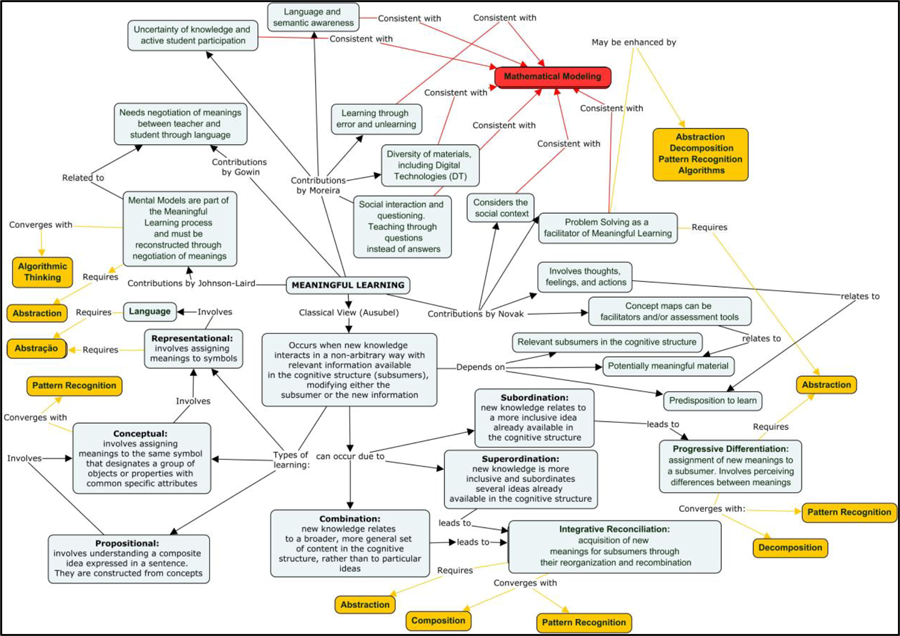
Having presented the principles of TML with which we identify relationships with our object of investigation, from its classical to its contemporary perspective, in Figure 3 we present a synthesis of these principles and the relationships among them, the so-called CT skills, and MM in Mathematics Education.
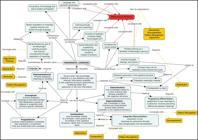
Based on the above, we observe that the so-called CT skills may constitute an additional element for facilitating Meaningful Learning of any knowledge, since they are related to the different types of Meaningful Learning (representational, conceptual, and propositional) and converge with the processes that support them (subordination, superordination, and combination).
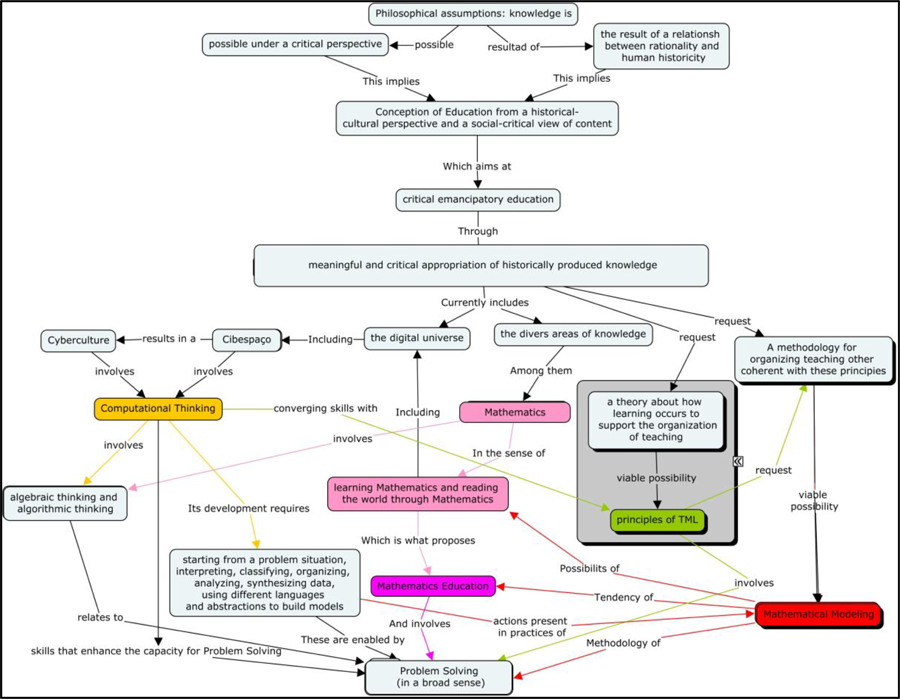
In turn, considering the need to organize teaching in a way that enables the negotiation of meanings, learning through error, the use of different instructional materials, and teaching through questions rather than answers, problem solving through Mathematical Modeling emerges as a methodology consistent with the principles of TML, which, as discussed in previous sections, also promotes the development of the so-called CT skills alongside the learning of Mathematics within the field of Mathematics Education. In Figure 4, we make these relationships explicit within the triad TML, MM, and CT.
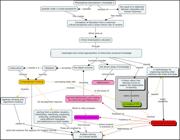
For the composition of Figure 4, we started from Figure 2 and added the principles of TML, whose relationships with CT and MM were detailed in Figure 3. The large gray node highlights the added element, thus resulting in a representation that makes explicit the relationships among all the components studied.
3 Final Considerations
Based on the entire analytical effort undertaken, it was possible to advance the understanding of the reasons for the inclusion of CT in ME, showing that these reasons include, but go beyond, those that justify its inclusion in Education as a whole. In ME, they encompass the enhancement of problem-solving ability and the learning of Mathematics in a context external to it, including the interpretation of the world through Mathematics. In ME, CT can contribute by enhancing students’ skills in problem solving. At the same time, ME, through problem solving, has the potential to generate situations that mobilize and require skills related to CT. In addition, it was possible to clarify aspects that answer our guiding question: how can Computational Thinking, Mathematical Modeling in Mathematics Education, and Meaningful Learning be articulated?
MM, as a methodology that encompasses problem solving, in interaction with the assumptions of TML, proved to be a fertile ground for conducting pedagogical practices with the potential to facilitate the development of the so-called CT skills and, at the same time, the Meaningful Learning of Mathematics, in such a way that one contributes to the other in a dialectical process. Moreover, the very construction of Meaningful Learning, according to the principles of the theory, converges with the so-called CT skills. For example, representational, conceptual, and propositional learning involve, in their development, the so-called CT skills, as do the processes through which they may occur (subordination, superordination, and combination).
Thus, it is possible to infer that pedagogical practices that adopt MM as a methodology in interaction with the principles of TML have the potential to mobilize the development of the so-called CT skills, which in turn may contribute to facilitating the Meaningful Learning of Mathematics in the context of Mathematics Education, in a bidirectional and dialectical process.
Therefore, this article contributes by presenting a way of understanding the role of CT in the context of Mathematics Education: as an additional facilitator of Meaningful Learning, which can be invoked through Modeling practices developed in interaction with the assumptions of TML, and which, while being activated in these processes, enables students to progressively refine these skills. Thus, dialectically, CT is developed through MM from the perspective of TML, and its development may serve as another facilitator of Meaningful Learning. Pedagogical practices within this perspective have been developed and are partially reported in Kaminski (2023).
References
- ABBAGNANO, N. Dicionário de filosofia 2. ed. Tradução de Alfredo Bosi. São Paulo: Martins Fontes, 1998.
- ALMEIDA, L. W.; SILVA, K. P.; VERTUAN, R. E. Modelagem Matemática na Educação Básica São Paulo: Contexto, 2012.
- ARAGÃO, R. M. R. Teoria da Aprendizagem Significativa de David P. Ausubel: sistematização dos aspectos teóricos fundamentais. 1976. 109 f. Tese (Doutorado em Ciências - Educação) - Universidade Estadual de Campinas, Campinas, 1976.
- AUSUBEL, D. P. Aquisição e Retenção de Conhecimentos: uma perspectiva cognitiva. Tradução de Ligia Teopisto. Lisboa: Paralelo, 2003.
- AUSUBEL, D. P.; NOVAK, J. D.; HANESIAN, H. Psicologia Educacional Tradução de Eva Nick. Rio de Janeiro: Interamericana, 1980.
-
BARBOSA, J. C. Modelagem na Educação Matemática: contribuições para o debate teórico. In: REUNIÃO ANUAL DA ANPED, 24., 2001, Caxambu. Anais ... Caxambu: Anped, 2001. p. 1-30. Disponível em: https://www.ufrgs.br/espmat/disciplinas/funcoes_modelagem/modulo_I/modelagem_barbosa.pdf Acesso em: 16 mar. 2026.
» https://www.ufrgs.br/espmat/disciplinas/funcoes_modelagem/modulo_I/modelagem_barbosa.pdf -
BIEMBENGUT, M. S. Modelagem Matemática & Resolução de Problemas, Projetos e Etnomatemática: pontos confluentes. Alexandria Revista de Educação em Ciência e Tecnologia, Florianópolis, v. 7, n. 2, p. 197-219, nov. 2014. Disponível em: https://biblat.unam.mx/hevila/AlexandriaFlorianopolis/2014/vol7/no2/9.pdf Acesso em: 16 mar. 2026.
» https://biblat.unam.mx/hevila/AlexandriaFlorianopolis/2014/vol7/no2/9.pdf - BOMBASSARO, L. C. As Fronteiras da Epistemologia: Como se produz o conhecimento. Rio de Janeiro: Vozes, 1992.
-
BRACKMANN, C. P. Desenvolvimento do Pensamento Computacional através de Atividades Desplugadas na Educação Básica. 2017. 226 f. Tese (Doutorado em Informática na Educação) - Centro Interdisciplinar de Novas Tecnologias na Educação, Universidade Federal do Rio Grande do Sul, Porto Alegre, 2017. Disponível em: https://www.researchgate.net/publication/322684630_DESENVOLVIMENTO_DO_PENSAMENTO_COMPUTACIONAL_ATRAVES_DE_ATIVIDADES_DESPLUGADAS_NA_EDUCACAO_BASICA#read Acesso em: 9 fev. 2026.
» https://www.researchgate.net/publication/322684630_DESENVOLVIMENTO_DO_PENSAMENTO_COMPUTACIONAL_ATRAVES_DE_ATIVIDADES_DESPLUGADAS_NA_EDUCACAO_BASICA#read -
BRASIL. Parecer CNE/CEB n.º 2, de 17 de fevereiro de 2022. Dispõe sobre as Normas da Computação na Educação Básica - Complemento à Base Nacional Comum Curricular (BNCC). Brasília: MEC, 2022a. Disponível em: https://portal.mec.gov.br/index.php?option=com_docman&view=download&alias=235511-pceb002-22&category_slug=fevereiro-2022-pdf&Itemid=30192Acesso em: 9 fev. 2026.
» https://portal.mec.gov.br/index.php?option=com_docman&view=download&alias=235511-pceb002-22&category_slug=fevereiro-2022-pdf&Itemid=30192 -
BRASIL. Resolução CNE/CEB n.º 1, de 4 de outubro de 2022. Normas sobre a Computação na Educação Básica - Complemento à BNCC. Brasília: MEC, 2022b. Disponível em: https://portal.mec.gov.br/index.php?option=com_docman&view=download&alias=241671-rceb001-22&category_slug=outubro-2022-pdf&Itemid=30192 Acesso em: 9 fev. 2026.
» https://portal.mec.gov.br/index.php?option=com_docman&view=download&alias=241671-rceb001-22&category_slug=outubro-2022-pdf&Itemid=30192 -
BURAK, D. Modelagem Matemática sob um olhar de Educação Matemática e suas implicações para a construção do conhecimento matemático em sala de aula. Revista de Modelagem na Educação Matemática, Blumenau, v. 1, n. 1, p. 10-27. 2010. Disponível em: https://proxy.furb.br/ojs/index.php/modelagem/article/view/2012/1360 Acesso em: 7 jan. 2025.
» https://proxy.furb.br/ojs/index.php/modelagem/article/view/2012/1360 - BURAK, D.; ARAGÃO, R. M. R. A Modelagem Matemática e as relações com a Aprendizagem Significativa Curitiba: CRV, 2012.
-
BURAK, D.; KLÜBER, T. E. Educação Matemática: contribuições para a compreensão da sua natureza. Acta Scientiae, Canoas, v. 10, n. 2, p. 93-106, 2008. Disponível em: http://funes.uniandes.edu.co/27890/1/Burak2008Educacao.pdf Acesso em: 07 jan. 2025.
» http://funes.uniandes.edu.co/27890/1/Burak2008Educacao.pdf -
BURAK, D.; KLUBER, T. E. Considerações Sobre a Modelagem Matemática em uma Perspectiva de Educação Matemática. Margens, Abaetetuba, v. 7, n. 8, p. 33-50, mai. 2016. DOI: http://dx.doi.org/10.18542/rmi.v7i8.2745 Disponível em: https://periodicos.ufpa.br/index.php/revistamargens/article/view/2745 Acesso em: 9 fev. 2026.
» http://dx.doi.org/10.18542/rmi.v7i8.2745» https://periodicos.ufpa.br/index.php/revistamargens/article/view/2745 -
CAÑAS, J. A.; HILL, G.; CARFF, R.; SURI, N.; LOTT, J.; GÓMEZ, G.; ESKRIDGE, T.; ARROYO, M.; CARVAJAL, R. CmapTools: Um ambiente de modelagem e compartilhamento de conhecimento. In: INTERNATIONAL CONFERENCE ON CONCEPT MAPPING, 1. , 2004, Pamplona. Anais... Pamplona: Universidad Publica de Navarra, 2004. p. 25-133. Disponível em: https://cmc.ihmc.us/Papers/cmc2004-283.pdf Acesso em 9 fev. 2026.
» https://cmc.ihmc.us/Papers/cmc2004-283.pdf -
HIGGINSON, W. On the Foundations of Mathematics Education. For The Learning of Mathematics, Montreal, v. 1, n. 2, p. 3-7, nov. 1980. Disponível em: https://www.jstor.org/stable/40247706#metadata_info_tab_contents Acesso em: 7 jan. 2025.
» https://www.jstor.org/stable/40247706#metadata_info_tab_contents - JAPIASSÚ, H.; MARCONDES, D. Dicionário Básico De Filosofia. 3. ed. Rio de Janeiro: Jorge Zahar Editor, 2001.
- KAMINSKI, M. R. O Pensamento Computacional no Âmbito da Modelagem Matemática na Perspectiva da Aprendizagem Significativa. 2023. 245 f. Tese (Doutorado em Educação em Ciências e Educação Matemática) - Universidade Estadual do Oeste do Paraná, Cascavel 2023.
-
KAMINSKI, M. R.; KLÜBER, T. E.; BOSCARIOLI, C. Pensamento Computacional na Educação Básica: Reflexões a partir do Histórico da Informática na Educação Brasileira. Revista Brasileira de Informática na Educação, v. 29, p. 604-633, 2021. DOI: 10.5753/rbie.2021.29.0.604. Disponível em: https://journals-sol.sbc.org.br/index.php/rbie/article/view/2970 Acesso em: 17 mar. 2026.
» https://doi.org/10.5753/rbie.2021.29.0.604» https://journals-sol.sbc.org.br/index.php/rbie/article/view/2970 - KOCHHANN, A.; MORAES, Â. C. Aprendizagem Significativa na Perspectiva de David Ausubel. Anápolis: UEG, 2014.
-
KLÜBER, T. E.; BURAK, D. Concepções de modelagem matemática: contribuições teóricas. Educação Matemática Pesquisa, São Paulo, v. 10, n. 1, p. 17-34, jan. 2008. Disponível em: https://revistas.pucsp.br/index.php/emp/article/view/1642 Acesso em: 7 jan. 2025.
» https://revistas.pucsp.br/index.php/emp/article/view/1642 - MOREIRA, M. A.; MASINI, E. F. S. Aprendizagem Significativa: a teoria de David Ausubel. São Paulo: Centauro, 2001.
- MOREIRA, M. A. A Teoria da Aprendizagem Significativa segundo Ausubel. In: MASINI, E. F. S.; MOREIRA, M. A. Aprendizagem Significativa: condições para ocorrência e lacunas que levam a comprometimentos. São Paulo: Vetor, 2008. p. 15-44.
- MOREIRA, M. A. Aprendizagem Significativa: a teoria e textos complementares. São Paulo: Livraria da Física, 2011.
- MOREIRA, M. A. Teorias de Aprendizagem. 2. ed. São Paulo: E.P.U, 2018.
- NAVARRO, E. R.; SOUSA, M. C. Qual o conceito de Pensamento Computacional para a Educação Matemática? São Paulo: Dialética, 2023.
- SILVA, J. J. da. Filosofia da Matemática e Filosofia da Educação Matemática. In: BICUDO, M. A. V. (org.). Pesquisa em Educação Matemática: concepções e perspectivas. São Paulo: Unesp, 2020. p. 28-44.
-
VALENTE, J. A. Integração do Pensamento Computacional no Currículo da Educação Básica: Diferentes Estratégias Usadas e Questões de Formação de Professores e Avaliação do Aluno. Revista e-Curriculum, São Paulo, v. 14 n. 3, p. 864-897, 2016. Disponível em: https://revistas.pucsp.br/index.php/curriculum/article/view/29051 Acesso em: 7 jan. 2025.
» https://revistas.pucsp.br/index.php/curriculum/article/view/29051 -
VECCHIA, R. D. A Modelagem Matemática e a Realidade do Mundo Cibernético. 2012. 275 f. Tese (Doutorado em Educação Matemática) - Universidade Estadual Paulista, Rio Claro, 2012. Disponível em: https://repositorio.unesp.br/server/api/core/bitstreams/71c34da1-6fdb-4e5b-ab42-8206bca1ffed/content Acesso em: 7 jan. 2025.
» https://repositorio.unesp.br/server/api/core/bitstreams/71c34da1-6fdb-4e5b-ab42-8206bca1ffed/content -
WING, J. Computational Thinking. Communications of the ACM, New York, v. 49, n. 3, p. 33-35, mar. 2006. Disponível em: https://www.cs.cmu.edu/~15110-s13/Wing06-ct.pdf Acesso em: 7 jan. 2025.
» https://www.cs.cmu.edu/~15110-s13/Wing06-ct.pdf
-
Data Availability:
The data generated or analyzed during this study are included in the published article.
-
1
In this article, the use of the expression “so-called CT skills” or “skills associated with CT,” instead of “Computational Thinking skills,” which is commonly used in the literature, is justified by the understanding that such skills are necessary for Computational Thinking, but are not exclusive to it. This understanding directly influences how CT is addressed in the school context. This discussion was problematized and systematized in (Kaminski, 2023), allowing this article to focus on the theoretical connections among CT, MM, and TML.
-
2
All figures were created using CmapTools software, developed by the Institute for Human and Machine Cognition (IHMC), where Joseph Novak, the creator of Concept Maps, worked as a researcher. The software was developed to facilitate the creation of Concept Maps considering the principles proposed by the author (Cañas et al., 2004). Available for free at: https://cmap.ihmc.us/cmaptools/.
-
Editor-in-Chief:
Prof. Dr. Roger Miarka
-
Associate Editor:
Prof. Dr. Vicenç Font
The data generated or analyzed during this study are included in the published article.

 Source:
  Source:
  Source:
  Source: