 One for all and all for one: two mixed-species shoaling of stream fish
Abstract
Shoaling can provide a number of advantages for individual fish, enhancing foraging efficiency and reducing predation risk. We investigated the role of multiple characid species shoaling (Compsura heterura and Serrapinnus piaba) in order to recognize social behavior, foraging strategy, and diet composition in one semiarid stream from northeast Brazil. The study was done by field observations (ad libitum). The most frequent social behavioral (Arranged Mixed-species school - 38.46%) was represented by mixed-species schools structured with large-sized individuals of C. heterura using the school periphery and small individuals of both species using the center of the school. Shoals with lower individuals inhabiting shallow locals and pools presented higher frequency of this behavior. Although foraging behavior did not vary significantly between the two species, each characin species explored distinct food resources, indicating that diet segregation can act as a strategy to both species foraging in the same shoal. These results suggest that C. heterura and S. piaba have mechanisms to facilitate their coexistence in structured mixed-species schools, minimizing the costs of living in groups.
Keywords
coexistence; animal aggregations; feeding habits; schooling behavior; stream-dwelling fish
Resumo
Cardumes podem oferecer diversas vantagens para os peixes, como aumento na eficiência do forrageio e redução do risco de predação. Neste estudo, nós investigamos o papel de cardumes mistos de caracídeos (Compsura heterura e Serrapinnus piaba) com o objetivo de reconhecer diferentes tipos de comportamento, suas estratégias alimentares e composição da dieta em um riacho do semiárido brasileiro, na região nordeste do Brasil. Nossas análises foram realizadas através de observações em campo. O comportamento social mais frequente foi representado por cardumes estruturados e organizados pelas duas espécies (38,46%) com indivíduos maiores de C. heterura utilizando a periferia do cardume e indivíduos menores de ambas as espécies utilizando a porção central do cardume. Esse comportamento foi observado com maior frequência em cardumes menores que estavam ocupando habitats mais rasos e de águas paradas. Apesar do comportamento alimentar não apresentar diferenças entre as duas espécies, o conteúdo estomacal revelou que cada espécie explorou diferentes recursos tróficos, indicando que uma segregação na dieta pode atuar como estratégia de forrageio dentro do mesmo cardume. Assim, nossos resultados sugerem que C. heterura e S. piaba possuem mecanismos que facilitam sua coexistência dentro de cardumes mistos e estruturados, minimizando os custos de viver em grupo.
Palavras-chave
coexistência; segregações animais; estratégias alimentares; cardumes mistos; caracídeos
Introduction
Grouping behavior is largely observed in different animal taxa and an important behavior for the maintenance of many species (Krause & Ruxton 2002). About half of all fish species live in groups at some period in their life cycle, probably because of the significant benefits gained with the interactions, such as, social information transmission among individuals, reduction of predation risk, and increased predators’ detection (Pitcher 1983, Shaw 1978).
Shoals and schools are typical grouping behaviors used by various fish species (Pitcher 1983) and differ because of the high organized and synchronized movement shown by schooling fishes and the non-synchronous loosely organized movement shown by shoaling ones (Pitcher 1983, Carvalho et al. 2007). Shoaling and schooling are mediated by biological traits (e.g. aggregative tendency of a group or tendency to polarize) operating in different ways, and through different effects (Delcourt & Poncin 2012). For example, dilution and confusion effects play different roles in the reduction of predation risks both in shoaling and schooling species (Pitcher & Parrish 1993, Bumann et al. 1997), showing different mechanisms for the same function. Here, we considered shoals as cohesive slightly or highly structured groups and schools as highly structured groups with synchronized movements (Gautrais et al. 2008, Delcourt & Poncin 2012).
Shoaling and schooling are collective movements that are part of a continuum, from random orientated to a polarized behavior, with many intermediate ones, such as swarms (Delcourt & Poncin 2012). These aggregations provide a number of general benefits to individuals, such as a reduction of individual predation risk (Landeau & Terborgh 1986), and increased foraging opportunities (Ranta et al. 1994), but it also provides some costs such as competition for food (Ward et al. 2002). It is generally believed that shoal members benefit most when the shoal is phenotypically homogeneous (Krause 1993). Nonetheless, it has been shown that mixed-species aggregations do occur when advantages accrue to individuals (Allan & Pitcher 1986).
Although mixed-species aggregations provide individual benefits (Romey 1995, Marras & Domenici 2013), many studies have shown that individuals living in groups can face challenges to competition for food (Pavlov & Kasumyan 2000, Ward et al. 2002). To overcome these challenges, individuals use to evaluate roles of both predation risk and food competition (Mathis & Chivers 2003), performing group choice decisions concerning a risk-balancing trade-off between deciding to stay, go off alone or join other fish (for a review, see Krause & Ruxton 2002, Pitcher & Parrish 1993).
Responding to these challenges, spatial position within the group can influence individual performance on feeding efficiency and predation avoidance (Bednekoff 2003, Morrell & Romey 2008). Individual shoal members can respond to each other’s behavior affecting the emergence and maintenance of social roles within groups (Jolles et al. 2014). Shoaling fishes may present individual differences in behavior (Marras & Domenici 2013) with few individuals acting as leaders, and many as followers (Jolles et al. 2014). The position of each individual in a shoal may be more or less advantageous in terms of predation risk and foraging efficiency (Krause et al. 1992, Killen et al. 2012, Ajemian et al. 2016).
Fishes of the family Characidae are endemic to the Neotropical region (Melo et al. 2022) and the most abundant species living in Brazilian small streams (Buckup 2021). Nonetheless, information on the coexistence of these species in mixed-species aggregations is scarce (e.g. Suzuki & Orsi 2008) with only the studies of Sazima (1980) and Godoy (1975) being known so far. In this study, we use mixed-species shoals composed by the characids Compsura heterura Eigenmann, 1915 and Serrapinnus piaba Lütken, 1875, as a model to test the mechanisms of co-occurrence by two ecological similar species at the same shoal. For this, we test the effects of shoal size (number of individuals), habitat variables (water flow and stream depth) and diet on social and feeding behavior in order to discuss the benefits and costs of living in groups. This information can add important knowledge about the interactions of multispecies shoaling and the strategies on coexistence of species that are phenotypically and behaviorally similar.
Material and Methods
1. Study area
Shoaling behavior was observed in one transect (95 m length) in the Curu stream (3°49’10.9” S 39°19’57.2” W), into the Curu Basin located at Ceará State, in the Brazilian semi-arid region (Figure 1). This is a seventh-order stream when considering the entire catchment and a fourth-order stretch at the study site (Silva et al., 2018). This site is located in Municipality of Pentecoste and surrounded by savannah vegetation and characterized by pools and runs (riffles were absent) with abundant aquatic macrophytes.

Study area with sampling site at Curu stream, Municipality of Pentecoste, Ceará State, Northeast of Brazil.
The studied species Compsura heterura and Serrapinnus piaba are very abundant characids in the semi-arid zone in Northeast of Brazil (Teixeira et al. 2017) and are among the most widely distributed species in the study area (Curu stream system - Manna et al. 2019). Three potential predators (Hoplias aff. malabaricus, Crenicichla menezesi, and Cichlasoma orientale) occur in the study area (Manna et al. 2019). These species have different predator behavior with Hoplias aff. malabaricus as ambush predator and C. menezesi and C. orientale as chase predation (Sabino & Zuanon 1997, Winemiller 1989, Sazima 1986).
2. Data sampling
Behavior survey was performed along dry season in November 2011 at daylight, following the ad libitum (sensuLehner 1996) and focal animal protocols (Altmann 1974) through snorkeling sessions. The type of behavior presented by each group of fish was recorded, following Sabino (1999). Due to the morphological similarities of the two characids species, the diver (LRM) conducted 10 hours of preliminary observation in order to guarantee the correct identification of individuals. After that, the two species were identified underwater based on minor morphological differences (e.g. body height) and swimming performance (Figure 2). Additionally, individuals from both species were collected and identified by specialists. Voucher specimens were deposited in the ichthyological collection of the Fish Systematics and Morphology Laboratory at the Federal University of Paraíba (UFPB 7075, UFPB 7077).

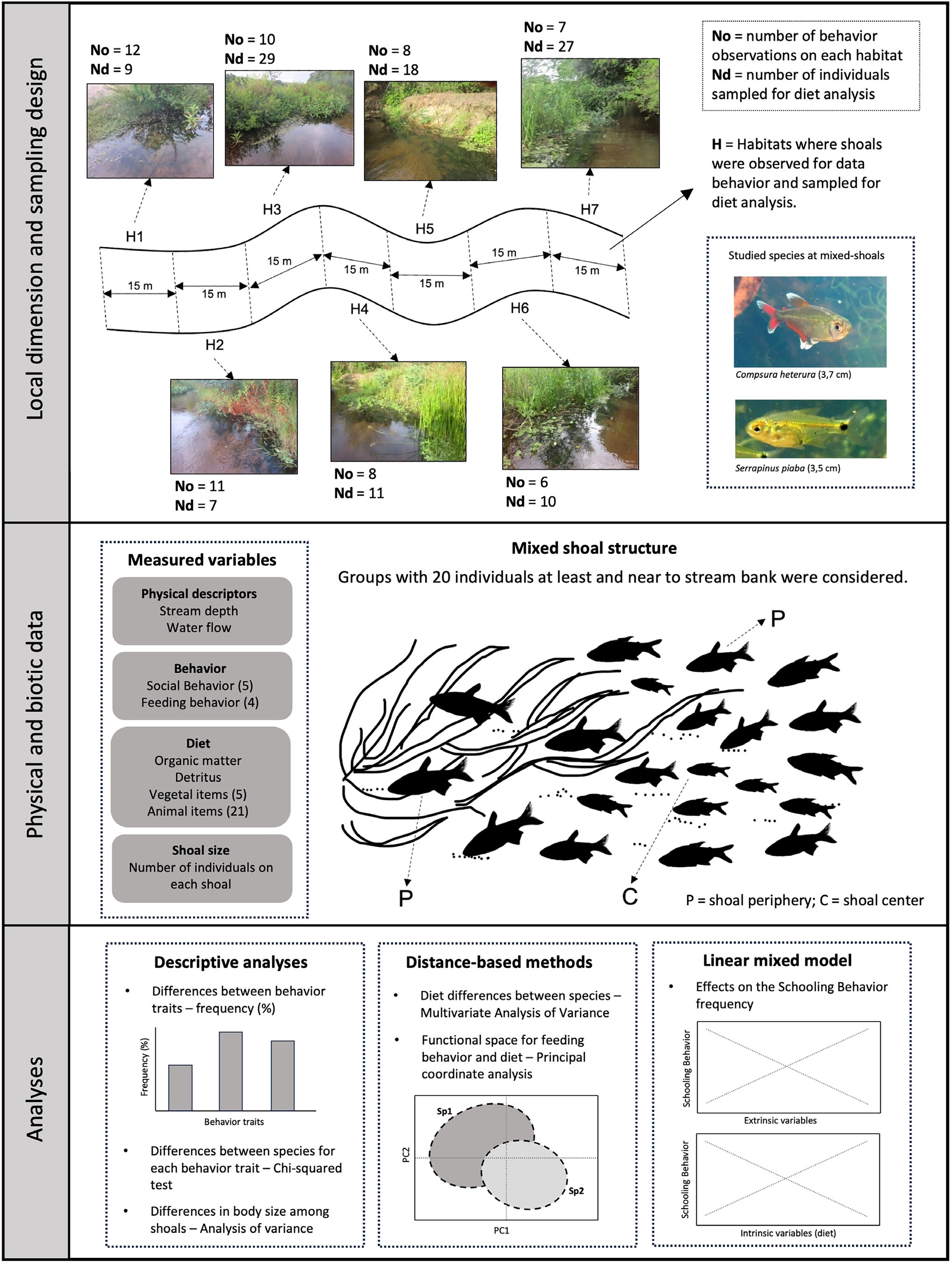
Methodological workflow to investigate social and feeding behavior in a mixed-species shoals at Curu stream, Municipality of Pentecoste, Ceará State, Northeast of Brazil.
The sampling transect was divided into seven sectors of 15 m each (Figure 2) based on type of habitats where shoals were located, totaling seven different observed shoals. The sampled transect presented clear and warm water with temperature around 30 °C facilitating underwater sampling methods. Habitat variables (stream depth and water velocity) were measured on each sector. Stream depth was measured using a measuring tape (in cm) considering the distance from water surface to stream bottom and water velocity was measured with a fluxometer probe (in m/s).
Diving sessions were conducted throughout the sampling transect and the behavior was recorded every time a subject appeared in the visual field of the diver. All data were collected by the same diver (LRM) to avoid observer bias. At the beginning of each diving session, the diver stood still for 10 min downstream of the site, so that the fish became used to the observer. Only fishes that appeared to be undisturbed by the observer’s presence were recorded. During the observation, the diver stayed in a fixed position and distant at least one (1) meter from the fishes. Each type of behavior was recorded using frequency method (presence/absence) and tabulated in one waterproof board during each diving session. A total of 31 h of active underwater observation was registered with several sessions of 30 min each, totaling 62 observations with 30 min of interval between sessions.
Behavior was grouped in two different categories: social and feeding (Table 1). Social behavior was classified into five categories: (i) disarranged mixed-species shoal - DS; (ii) arranged mixed-species school - AS; (iii) presence of predators - PP; (iv) predator attack - PA; and (v) reorganization - RE. Feeding behavior was classified into four categories: (i) foraging on the bottom - FB; (ii) foraging in the middle of the water column - FMI; (iii) foraging on the surface - FS; and (iv) foraging in the macrophytes - FMA. These behavior categories were defined after 10 h of previous underwater sessions based on different behaviors displayed by the entire shoal. Number of individuals on each shoal was also registered to determine shoal size.
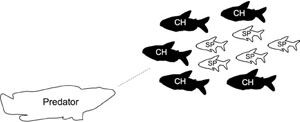
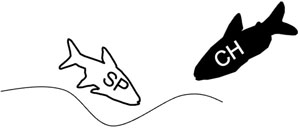
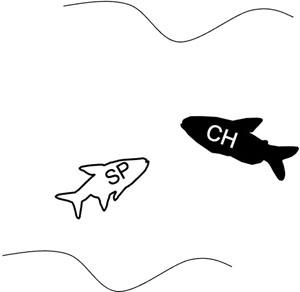
Categories of behavior traits for Compsura heterura and Serrapinnus piaba in Curu stream, Northeast of Brazil with respective codes, descriptions, and schematic representation. CH = Compsura heterura; SP = Serrapinnus piaba.
After behavior observations, 57 individuals of S. piaba and 54 individuals of C. heterura were sampled for diet analysis using seine nets (3.5 × 2.5 m, mesh size 5 mm) along the seven observed habitat sectors (Figure 2). In each sector, the nets were passed twice during daylight. Each captured fish was euthanized using a 30 mL of a 10% Eugenol solution in 970 mL of water and then fixed in 10% formalin. Individuals were measured (Standard Length, cm), stomach contents were preserved in 70% ethanol, and food items were identified under a stereomicroscope to the lowest feasible taxonomic level according to the literature (Bicudo & Bicudo 1970, Mugnai et al 2010, Triplehorn & Johnson 2005). Stomach content analysis was performed following numerical and volumetric methods since both techniques are useful to represent the contribution of each food item on diet (Hyslop 1980). Based on these techniques, we accessed the relative importance of each food item through the alimentary index (AIi) proposed by Kawakami & Vazzoler (1980) and adapted by Hahn et al. (1997), following the equation 1. The AIi was used to describe the diet of two studied species.
Equation 1: Alimentary Index (AIi), where i = 1, 2, … n, food items; Fi = frequency of occurrence of a given food item; Vi = volume of a given food item.
According to the collecting curves (Figure S1) we detected that the cumulative frequency of items composing species diet was stabilized, in three items, at 36 and 25 individuals for Compsura heterura and Serrapinus piaba, respectively. The two items observed beyond 50 stomachs of S. piaba were accidental or rare food items (i.e. scale and Acarina).
3. Data analysis
As a descriptive analysis, the frequency of each behavioral category was calculated considering presence and absence of each behavior during all observation sessions. Differences among behavior traits frequency displayed by shoals were descriptively verified without statistical tests. Analysis of Variance (ANOVA) was applied to test the differences in average body size among shoals.
The relative volume of food items in the diet was used to calculate Bray-Curtis distance between two species. We built two multidimensional spaces summarizing differences in feeding behavior (or diet) between two species, using Principal Coordinates Analysis (PCoA) computed on Bray-Curtis distance matrices. Next, diet differences between species were tested with a permutational multivariate analysis of variance (PERMANOVA), with 999 permutations, using dissimilarities among species in its distance matrix to verify if the two characin species of all observed shoals fed on different food items. Additionally, Schoener’s D index was applied to test the diet niche overlap between species (Schoener 1970). We also tested if the proportion of each feeding behavior was the same for the two species, for this we used the chi-squared test for 2 × 2 contingency tables (Zar 1999), one for each behavior category. Finally, PCoA plots were elaborated to illustrate feeding and diet functional spaces.
Linear Mixed Models (LMMs) were used to test specifically the influence of extrinsic variables (shoal size, water flow, and stream depth) and diet (aquatic insects, algae, and ostracods) on the Schooling Behavior (Arranged Mixed-species School, Table 1) frequency. Food items with higher values of IAi were selected for this analysis and the relative volume of food items was applied. Two models were tested, including all possible combinations of explanatory variables, for the response variable (Arranged Mixed-species School). In the first model, Shoal Size, Water Flow, and Stream Depth were selected as fixed effect variables while in the second model, were Aquatic Insects, Algae and Ostracods. In both models, Shoal Identity was selected as random effect variable. The model with the lowest value of the Akaike’s Information Criterion (AIC) was considered the best fit, and then, the others were ranked according to differences calculated between AICs (ΔAIC). In order to determine the relative significance of models, the Normalized Akaike’ Weight (Wi) was calculated (Johnson & Omland 2004). ANOVA was used to test the significance of the best-fitted model.
All statistical analyses were performed in the R statistical and programming environment (R 3.3.1., R Development Core Team 2016) using “vegan” (Dixon 2003), “ade4” (Dray & Dufour 2007), “lme4” (Bates et al. 2015) and “car” (Fox & Weisberg 2019) packages.
Results
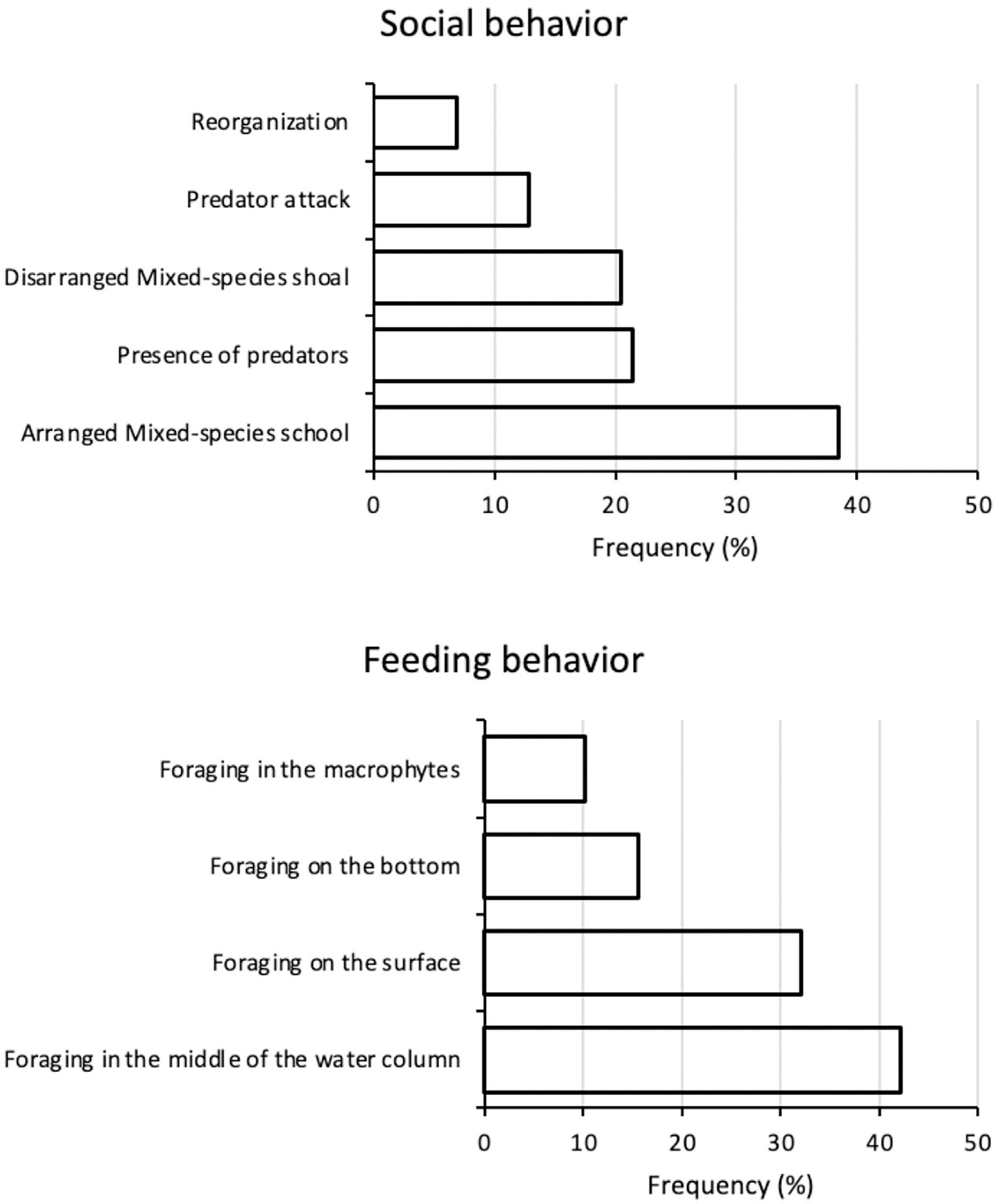
Stream depth in the study site varied from 15 to 97 cm (mean = 55.51 cm, SD = 15.64) and water velocity from 0.0 m/s and 0.46 m/s (mean = 0.12 m/s, SD = 0.11). We found differences between behavior categories with AS (arranged mixed-species school) as the most frequent social behavior (38.46%) and FMI (foraging in the middle of the water column) as the most observed feeding behavior (42.19%) (Figure 3). In all cases that shoals presented the arrangement in mixed-species schools, larger individuals of C. heterura were located in the periphery of the shoal and smaller individuals of both species in the middle zone (see mixed shoal structure in Figure 2). Three different fish predators (Hoplias aff. malabaricus, Crenicichla menezesi, and Cichlasoma orientale) were frequently observed at least 30 cm next to the shoals in the total observation sessions (25 occasions, 21.37%) (Figure 3). On 15 of these occasions, the predators attacked the shoal causing the formation to fall into disarray. In more than half of these attacks (53.3%), the larger individuals of C. heterura returned first to their original positions followed by the smaller ones of both species (see the schematic representation of RE - reorganization in Table 1). There was no significant variation in body size among shoals (ANOVA test, F = 1.10; p = 0.29) revealing that the mean body size from each group of individuals was similar among shoals (Table S1).

Mean values of behavioral traits frequency displayed by studied mixed-shoals in Curu stream, Municipality of Pentecoste, Ceará State, Northeast of Brazil.
Feeding behavior did not vary significantly between the two species (Chi-squared: p > 0.1; Table S2) with FMI (foraging in the middle of water column) and FS (foraging on the surface) as the primary behaviors presented by both species (Figure 3). However, stomach content analysis revealed that diet was different between species (PERMANOVA: d.f. = 111, F = 3.7019, p = 0.001; Table 2) with C. heterura presenting preference for aquatic insects (AIi = 96.66) and S. piaba consuming algae (AIi = 54.30), aquatic insects (AIi = 30.02) and ostracods (AIi = 15.04) (see Table S3 for details). PCoA analyses revealed higher functional space overlap between species for feeding behavior when compared to diet (Figure 4, Tables S4–S5), confirming that the two characin species fed on similar portions of the water column but consuming different food items (Schoener’ D index = 0.34).
Results of the Multivariate Analysis of Variance (PERMANOVA) for diet differences between Compsura heterura and Serrapinnus piaba from all mixed-species shoals in Curu stream, Municipality of Pentecoste, Ceará State, Northeast of Brazil.
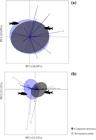
Principal coordinate analysis (PCoA) using data from feeding behavior (a) and diet (b) for both species. Data spaces for Compsura heterura are represented by gray color and for Serrapinnus piaba by blue color.
Considering extrinsic variables data, the best-fitted LMM models for Schooling Behavior had as fixed effect variables Shoal Size and Flow, and Shoal Identity as random fixed effect variable ((Schooling Behavior ~ Shoal Size+(1|Shoal Identity), and ~ Flow+(1|Shoal Identity)) (Table 3) revealing that variation in schooling behavior was explained by shoal size and water flow. Considering diet, the best-fitted LMM model for Schooling Behavior had Ostracod and Algae as fixed effect variables and Shoal Identity as random fixed effect variable ((Schooling Behavior ~ OST+(1|Shoal Identity), and ~ ALG+(1|Shoal Identity)) (Table 3). Shoals with lower numbers of individuals were related to higher frequencies of schooling behavior (Arranged mixed-species school) (Table 3). Values of water flow and stream depth revealed that shoals inhabiting shallow locals with higher water flow were the shoals that displayed schooling behavior with high frequency (Table 4).
Results of the LMMs analysis for the response variable, Schooling Behavior, and predictive variables: shoal size, flow, and depth (extrinsic variables); and aquatic insects (IA), algae (ALG) and ostracods (OST) (food items) (AIC = Akaike’s Information Criterion; Wim = Akaike’s weight).
Schooling behavior (Arranged Mixed-species school) displayed by each shoal and your respective number of individuals, values of water flow and stream depth in habitats that mixed-species studied shoals were observed at Curu river, Ceará, Brazil. Schooling behavior is represented by number of events that this behavior was registered.
Discussion
The mixed-species shoals presented a consistent pattern of organization, with larger individuals of C. heterura located in the periphery and smaller individuals of both species located in the center of the group. The mean body size on each shoal was not different among shoals, revealing that this pattern of body size was similar among studied shoals. Arranged mixed-species schools was the most frequent social behavior and could be associated with anti-predator and feeding behavior (Hoare et al. 2000, Hemelrijk & Kunz 2004). Groups of individuals are able to detect predators more efficiently than lone ones (Magurran et al. 1985), and shoaling can reduce the per-capita predation risk (Landeau & Terborgh 1986). In our study, larger bodied individuals were located in the shoal periphery. Depending on predator size, this can be an effective behavior to reduce predation because larger bodied prey restricts the efficiency of predators (Nilsson & Brönmark 2000, Scharf et al. 2000).
Shoaling behavior incorporates strategies ensuring that individuals remain in close proximity and aligned with one another (Grünbaum 1998). The shoals observed in the present study were formed by individuals of two different characid species. Schooling behavior is beneficial for both species because it increases the efficiency of predator detection and avoidance (Parrish et al. 2002, Vital & Martins 2013). Predator detection is more accurate with increasing group size and not with individual ability, and detection by a single individual equates to detection by the entire shoal (Ward et al. 2011). Predators are also efficiently avoided because of increased evasive behavior (Kelley & Magurran 2003). Here, evasive behavior has been characterized by rapid movements of larger individuals placed in the front of aggregation, triggering evasive behavior by the smaller individuals placed backwards. This behavior is accomplished by efficient collective evasion of fish individuals (Zheng et al. 2005). The efficiency of evasive behavior can be facilitated by visual cues of more experienced individuals that act as ‘demonstrators’ and transfers their successful antipredator behavior to other individuals of the same group (i.e., small individuals) (Kelley et al. 2003). In the current study, the large-bodied individuals act as demonstrators, while the small-bodied ones act as learners, improving their own antipredator response by following the evasive behavior of larger and more experienced individuals.
Specifically for schooling behavior observed in different shoals, our results suggest that shoals with lower numbers of individuals in each shoal displayed this behavior with higher frequency. Larger schools detect predators sooner when compared to smaller schools (Magurran et al. 1985) and feeding success of individuals improves with group size (Ranta & Kaitala 1991). However, living in larger groups can allow many costs for individuals of the same group, such as competition for food (Killen et al. 2012). The two studied species consumed different food items, especially in relation to ostracods. Thus, these data suggest that trophic segregation between two species balanced the costs of intragroup potential competition (Sazima 1980, Ward et al. 2006). Moreover, stream depth and water flow were also important factors to determine the structure of fish groups in our study, revealing that physical parameters can influence behavior displayed by fish.
Characids are highly active and forage in groups (Sazima 1980). Although C. heterura and S. piaba foraged together forming a mixed-species shoal, the composition of their diets was different. Algae is commonly the main food item for S. piaba and C. heterura (Dias & Fialho 2009) but here, C. heterura fed mostly on immature aquatic insects, revealing trophic segregation between studied species. Foraging in groups can provide facilitation on the successful of feeding attempts by individuals (Schrandt & Powers 2015). However, feeding in a group also carries a cost. For example, food competition increases with enlargement of group size and cohesion (Krause & Ruxton 2002, Gimeno et al. 2016). In mixed-species groups, differences on trophic niche can be related to prey size class and time of capture (Olson et al. 2014, Alatorre-Ramirez et al. 2017).
In conclusion, despite the similarity on social and feeding behavior, the studied characids are segregating in prey choice, which can facilitate their coexistence in the same shoals, minimizing the costs of living in groups. Such findings suggest that the two characid species may increase feeding success and reduce predation through schooling behavior in mixed-species aggregations. Understanding the mechanisms of grouping behavior is important to clarify the co-occurrence of species with similar ecological requirements and reinforce the need for future studies evaluating fish behavior with an evolutionary perspective.
Supplementary Material
The following online material is available for this article:
Table S1
Table S2
Table S3
Table S4
Table S5
Figure S1
Acknowledgments
The present study is part of the Ph.D fellowship of the first author (CAPES/BEX0152/14-5). LRM was granted by FAPERJ/E-26/203.911/2022; and RM was granted by FAPERJ/CNE/E-26-203.193/2015, CNPq/Pq1D-301.621/2013-6 and Prociência/UERJ. This study is in strict accordance and recommendations of the Ethical committee of UERJ (CEUA/012/2013). All the sampling complied with current Brazilian laws, and IBAMA SISBIO through special license 1916854 issued to RM. We thank the administrators of the Vale do Curu Experimental Farm, the Federal University of Ceará (UFC) for logistic support during fieldwork, and the PPGEE/UERJ for funding field trips. We also thank three anonymous reviewers for their comments that helped us to improve our manuscript.
Data Availability
The datasets generated during the current study are available at https://doi.org/10.5061/dryad.gtht76hws.
References
-
AJEMIAN, M.J., KENWORTHY, M.D., SÁNCHEZ-LIZASO, J.L., & CEBRIAN, J. 2016. Aggregation dynamics and foraging behaviour of striped red mullet Mullus surmuletus in the western Mediterranean Sea. J. Fish Biol. 88(5): 2051–2059. https://doi.org/10.1111/jfb.12932.
» https://doi.org/10.1111/jfb.12932 -
ALATORRE-RAMIREZ, V.G., GALVAN-MAGARIA, F., TORRES-ROJAS, Y.E., & OLSON, R.J. 2017. Trophic segregation of mixed schools of yellow fin tuna (Thunnus albacares) and skipjack tuna (Katsuwonus pelamis) caught in the eastern tropical Pacific Ocean. Fish. Bull. 115(2): 252–269. https://doi.org/10.7755/FB.115.2.11.
» https://doi.org/10.7755/FB.115.2.11 -
ALLAN, J.R., & PITCHER, T.J. 1986. Species segregation during predator evasion in cyprinid fish shoals. Fresh. Biol. 16(5): 653–659. https://doi.org/10.1111/j.1365-2427.1986.tb01007.x.
» https://doi.org/10.1111/j.1365-2427.1986.tb01007.x -
ALTMANN, J. 1974. Observational study of behavior: sampling methods. Behaviour 49(3-4): 227–266. https://doi.org/10.1163/156853974X00534.
» https://doi.org/10.1163/156853974X00534 - BATES, D., MAECHLER, M., BOLKER, B., WALKER, S., CHRISTENSEN, R.H.B., SINGMANN, H., DAI, B., SCHEIPL, F., GROTHENDIECK, G., GREEN, P., FOX, J., BAUER, A., KRIVITSKY, P.N., TANAKA, E., & BOLKER, M.B. 2015. Package ‘lme4’. Convergence 12(1): 2.
-
BEDNEKOFF, P.A. 2003. A revival for group living. TREE 18(6): 274. https://doi.org/10.1016/S0169-5347(03)00031-4.
» https://doi.org/10.1016/S0169-5347(03)00031-4 - BICUDO, C. E. M., & BICUDO, R. M. T. 1970. Algas de águas continentais brasileiras: Chave ilustrada para identificação de gêneros. São Paulo, Brazil: FBDEC.
-
BUCKUP, P.A. 2021. Taxonomia e filogenia de peixes de riachos brasileiros. Oecol. Aust. 25(2): 230–230. https://doi.org/10.4257/oeco.2021.2502.01.
» https://doi.org/10.4257/oeco.2021.2502.01 -
BUMANN, D., KRAUSE, J., & RUBENSTEIN, D. 1997. Mortality risk of spatial positions in animal groups: the danger of being in the front. Behaviour 134(13-14): 1063–1076. https://doi.org/10.1163/156853997X00403.
» https://doi.org/10.1163/156853997X00403 -
CARVALHO, C.D.D., CORNETA, C.M., & UIEDA, V.S. 2007. Schooling behavior of Mugil curema (Perciformes: Mugilidae) in an estuary in southeastern Brazil. Neotrop. Ichthyol. 5: 81–83. https://doi.org/10.1590/S1679-62252007000100012.
» https://doi.org/10.1590/S1679-62252007000100012 -
DELCOURT, J., & PONCIN, P. 2012. Shoals and schools: back to the heuristic definitions and quantitative references. Fish Biol. Fish. 22: 595–619. https://doi.org/10.1007/s11160-012-9260-z.
» https://doi.org/10.1007/s11160-012-9260-z -
DIAS, T.S., & FIALHO, C.B. 2009. Feeding biology of four sympatric Cheirodontinae species (Characiformes, Characidae) from Ceará Mirim River, Rio Grande do Norte, Brazil. Iheringia Ser. Zool. 99: 242–248. https://doi.org/10.1590/S0073-47212009000300003.
» https://doi.org/10.1590/S0073-47212009000300003 -
DIXON, P. 2003. VEGAN, a package of R functions for community ecology. J. Veg. Sci. 14(6): 927–930. https://doi.org/10.1111/j.1654-1103.2003.tb02228.x.
» https://doi.org/10.1111/j.1654-1103.2003.tb02228.x -
DRAY, S., & DUFOUR, A.B. 2007. The ade4 package: implementing the duality diagram for ecologists. J. Stat. Softw. 22: 1–20. https://doi.org/10.18637/jss.v022.i04.
» https://doi.org/10.18637/jss.v022.i04 - FOX, J., & WEISBERG, S. 2019. Using car functions in other functions. CRAN R.
-
GAUTRAIS, J., JOST, C., & THERAULAZ, G. 2008. Key behavioural factors in a self-organised fish school model. Ann. Zool. Fenn. 45(5): 415–428. https://doi.org/10.5735/086.045.0505.
» https://doi.org/10.5735/086.045.0505 -
GIMENO, E., QUERA, V., BELTRAN, F.S., & DOLADO, R. 2016. Differences in shoaling behavior in two species of freshwater fish (Danio rerio and Hyphessobrycon herbertaxelrodi). J. Comp. Psychol. 130(4): 358. https://doi.org/10.1037/com0000041.
» https://doi.org/10.1037/com0000041 - GODOY, M.P. 1975. Peixes do Brasil - subordem Characoidei, Bacia do rio Mogi-Guassú. Piracicaba, Editora Franciscana.
-
GRÜNBAUM, D. 1998. Schooling as a strategy for taxis in a noisy environment. Evol. Ecol. 12: 503–522. https://doi.org/10.1023/A:1006574607845.
» https://doi.org/10.1023/A:1006574607845 -
HAHN, N.S., ALMEIDA, V.L.L.D., & LUZ, K.D.G.D. 1997. Feeding and diel cycle of feeding of Hoplosternum littorale (Hancock) (Siluriformes, Callichthyidae) in the lagoons Guaraná and Patos of the upper Paraná river, Brazil. Ver. Bras. Zool. 14: 57–64. https://doi.org/10.1590/S0101-81751997000100005.
» https://doi.org/10.1590/S0101-81751997000100005 -
HEMELRIJK, C.K., & KUNZ, H. 2004. Density distribution and size sorting in fish schools: an individual-based model. Behav. Ecol. 16(1): 178–187. https://doi.org/10.1093/beheco/arh149.
» https://doi.org/10.1093/beheco/arh149 -
HOARE, D.J., KRAUSE, J., PEUHKURI, N., & GODIN, J.G. 2000. Body size and shoaling in fish. J. Fish Biol. 57(6): 1351–1366. https://doi.org/10.1111/j.1095-8649.2000.tb02217.x.
» https://doi.org/10.1111/j.1095-8649.2000.tb02217.x -
HYSLOP, E. J. 1980. Stomach contents analysis—a review of methods and their application. J. Fish Biol. 17(4): 411–429. https://doi.org/10.1111/j.1095-8649.1980.tb02775.x.
» https://doi.org/10.1111/j.1095-8649.1980.tb02775.x -
JOLLES, J.W., FLEETWOOD-WILSON, A., NAKAYAMA, S., STUMPE, M.C., JOHNSTONE, R.A., & MANICA, A. 2014. The role of previous social experience on risk-taking and leadership in three-spined sticklebacks. Behav. Ecol. 25(6): 1395–1401. https://doi.org/10.1093/beheco/aru146.
» https://doi.org/10.1093/beheco/aru146 -
JOHNSON, J.B., & OMLAND, K.S. 2004. Model selection in ecology and evolution. TREE 19(2): 101–108. https://doi.org/10.1016/j.tree.2003.10.013.
» https://doi.org/10.1016/j.tree.2003.10.013 -
KAWAKAMI, E., & VAZZOLER, G. 1980. Método gráfico e estimativa de índice alimentar aplicado no estudo de alimentação de peixes. Bol. Inst. Oceanogr. 29: 205–207. https://doi.org/10.1590/S0373-55241980000200043.
» https://doi.org/10.1590/S0373-55241980000200043 -
KELLEY, J. L., & MAGURRAN, A. E. 2003. Learned predator recognition and antipredator responses in fishes. JFF 4(3): 216–226. https://doi.org/10.1046/j.1467-2979.2003.00126.x.
» https://doi.org/10.1046/j.1467-2979.2003.00126.x -
KELLEY, J.L., EVANS, J.P., RAMNARINE, I.W., & MAGURRAN, A.E. 2003. Back to school: can antipredator behaviour in guppies be enhanced through social learning?. Anim. Behav. 65(4): 655–662. https://doi.org/10.1006/anbe.2003.2076.
» https://doi.org/10.1006/anbe.2003.2076 -
KILLEN, S.S., MARRAS, S., STEFFENSEN, J.F., & MCKENZIE, D.J. 2012. Aerobic capacity influences the spatial position of individuals within fish schools. Proc. Roy. Soc. London, Ser. B, Biol. Sci. 279(1727): 357–364. https://doi.org/10.1098/rspb.2011.1006.
» https://doi.org/10.1098/rspb.2011.1006 -
KRAUSE, J. 1993. The relationship between foraging and shoal position in a mixed shoal of roach (Rutilus rutilus) and chub (Leuciscus cephalus): a field study. Oecologia 93: 356–359. https://doi.org/10.1007/BF00317878
» https://doi.org/10.1007/BF00317878 - KRAUSE, J., & RUXTON, G.D. 2002. Living in groups. New York, Oxford University Press.
-
KRAUSE, J., BUMANN, D., & TODT, D. 1992. Relationship between the position preference and nutritional state of individuals in schools of juvenile roach (Rutilus rutilus). Behav. Ecol. Sociobiol. 30: 177–180. https://doi.org/10.1007/BF00166700.
» https://doi.org/10.1007/BF00166700 -
LANDEAU, L., & TERBORGH, J. 1986. Oddity and the ‘confusion effect’ in predation. Anim. Behav. 34(5): 1372–1380. https://doi.org/10.1016/S0003-3472(86)80208-1.
» https://doi.org/10.1016/S0003-3472(86)80208-1 - LEHNER, P.N. 1996. Handbook of Ethological Methods. UK, Cambridge University Press.
-
MAGURRAN, A.E., OULTON, W.J., & PITCHER, T.J. 1985. Vigilant behaviour and shoal size in minnows. Z. Tierpsychol. 67(1–4): 167–178. https://doi.org/10.1111/j.1439-0310.1985.tb01386.x.
» https://doi.org/10.1111/j.1439-0310.1985.tb01386.x -
MANNA, L. R., VILLÉGER, S., REZENDE, C. F., & MAZZONI, R. 2019. High intraspecific variability in morphology and diet in tropical stream fish communities. Ecol. Freshw. Fish 28(1): 41–52. https://doi.org/10.1111/eff.12425.
» https://doi.org/10.1111/eff.12425 -
MARRAS, S., & DOMENICI, P. 2013. Schooling fish under attack are not all equal: some lead, others follow. PLoS One 8(6): e65784. https://doi.org/10.1371/journal.pone.0065784.
» https://doi.org/10.1371/journal.pone.0065784 -
MATHIS, A., & CHIVERS, D.P. 2003. Overriding the oddity effect in mixed-species aggregations: group choice by armored and nonarmored prey. Behav. Ecol. 14(3): 334–339. https://doi.org/10.1093/jcr/ucv048.
» https://doi.org/10.1093/jcr/ucv048 -
MELO, B.F., SIDLAUSKAS, B.L., NEAR, T.J., ROXO, F.F., GHEZELAYAGH, A., OCHOA, L.E., STIASSNY, M.L.J., ARROYAVE, J., CHANG, J., FAIRCLOTH, B.C., MACGUIGAN, D.J., HARRINGTON, R.C., BENINE, R.C., BURNS, M.D., HOEKZEMA, K., SANCHES, N.C., MALDONADO-OCAMPO, J.A., CASTRO, R.M.C., FORESTI, F., ALFARO, M.E., & OLIVEIRA, C. 2022. Accelerated diversification explains the exceptional species richness of tropical characoid fishes. Syst. Biol. 71(1): 78–92. https://doi.org/10.1093/sysbio/syab040.
» https://doi.org/10.1093/sysbio/syab040 -
MORRELL, L. J., & ROMEY, W. L. 2008. Optimal individual positions within animal groups. Behav. Ecol. 19(4): 909–919. https://doi.org/10.1093/beheco/arn050.
» https://doi.org/10.1093/beheco/arn050 - MUGNAI, R., NESSIMIAN, J. L., & BAPTISTA, D. F. 2010. Manual de identificação de macroinvertebrados aquáticos do Estado do Rio de Janeiro. Rio de Janeiro, Brazil: Technical Books Editora.
-
NILSSON, P.A., & BRÖNMARK, C. 2000. Prey vulnerability to a gape-size limited predator: behavioural and morphological impacts on northern pike piscivory. Oikos 88(3): 539–546. https://doi.org/10.1034/j.1600-0706.2000.880310.x.
» https://doi.org/10.1034/j.1600-0706.2000.880310.x -
OLSON, R.J., DUFFY, L.M., KUHNERT, P.M., GALVÁN-MAGAÑA, F., BOCANEGRA-CASTILLO, N., & ALATORRE-RAMÍREZ, V. 2014. Decadal diet shift in yellowfin tuna Thunnus albacares suggests broad-scale food web changes in the eastern tropical Pacific Ocean. Mar. Ecol. Prog. Ser. 497: 157–178. https://doi.org/10.3354/meps10609.
» https://doi.org/10.3354/meps10609 -
PARRISH, J.K., VISCIDO, S.V., & GRUNBAUM, D. 2002. Self-organized fish schools: an examination of emergent properties. Biol. Bull. 202(3): 296–305. https://doi.org/10.2307/1543482.
» https://doi.org/10.2307/1543482 - PAVLOV, D.S., & KASUMYAN, A.O. 2000. Patterns and mechanisms of schooling behavior in fish: a review. J. Ichthyol. 40(2): S163.
-
PITCHER, T.J. 1983. Heuristic definitions of fish shoaling behaviour. Anim. Behav. 31(2): 611–613. https://doi.org/10.1016/S0003-3472(83)80087-6.
» https://doi.org/10.1016/S0003-3472(83)80087-6 - PITCHER, T.J. & PARRISH, J.K. 1993. Functions of shoaling behaviour in teleosts. In The behaviour of teleost fishes (T.J. Pitcher, ed). Croom Helm, London, p. 364–439.
- R Core Team. 2016. R: A language and environment for statistical computing. R Foundation for Statistical Computing, Vienna, Austria.
-
RANTA, E., PEUHKURI, N., & LAURILA, A. 1994. A theoretical exploration of antipredatory and foraging factors promoting phenotype-assorted fish schools. Ecoscience 1(2): 99–106. https://doi.org/10.1080/11956860.1994.11682233.
» https://doi.org/10.1080/11956860.1994.11682233 -
RANTA, E., & KAITALA, V. 1991. School size affects individual feeding success in three-spined sticklebacks (Gastevosteus aculeatus L.). J. Fish Biol. 39(5): 733–737. https://doi.org/10.1111/j.1095-8649.1991.tb04402.x.
» https://doi.org/10.1111/j.1095-8649.1991.tb04402.x -
ROMEY, W.L. 1995. Position preferences within groups: do whirligigs select positions which balance feeding opportunities with predator avoidance?. Behav. Ecol. Sociobiol. 37: 195–200. https://doi.org/10.1007/BF00176717.
» https://doi.org/10.1007/BF00176717 - SABINO, J. & ZUANON, J. 1997. A stream fish assemblage in Central Amazonia: distribution, activity patterns and feeding behavior. Ichthyol. Explor. Freshw. 8(3): 201–210.
- SABINO, J. 1999. Comportamento de peixes em riachos: métodos de estudos para uma abordagem naturalística. Oecol. Brasil. 6(1): 6.
-
SAZIMA, I. 1980. Behavior of Two Brazilian Species of Parodontid Fishes, Apareiodon piracicabae and A. ibitiensis. Copeia 1980(1): 166–169. https://doi.org/10.2307/1444157.
» https://doi.org/10.2307/1444157 -
SAZIMA, I. 1986. Similarities in feeding behaviour between some marine and freshwater fishes in two tropical communities. J. Fish Biol. 29(1): 53–65. https://doi.org/10.1111/j.1095-8649.1986.tb04926.x.
» https://doi.org/10.1111/j.1095-8649.1986.tb04926.x -
SCHARF, F.S., JUANES, F., & ROUNTREE, R.A. 2000. Predator size-prey size relationships of marine fish predators: interspecific variation and effects of ontogeny and body size on trophic-niche breadth. Mar. Ecol. Prog. Ser. 208: 229–248. https://doi.org/10.3354/meps208229.
» https://doi.org/10.3354/meps208229 -
SCHOENER, T.W. 1970. Nonsynchronous spatial overlap of lizards in patchy habitats. Ecology 51(3): 408–418. https://doi.org/10.2307/1935376.
» https://doi.org/10.2307/1935376 -
SCHRANDT, M.N., & POWERS, S.P. 2015. Facilitation and dominance in a schooling predator: foraging behavior of Florida pompano, Trachinotus carolinus Plos one 10(6): e0130095. https://doi.org/10.1371/journal.pone.0130095.
» https://doi.org/10.1371/journal.pone.0130095 - SHAW, E. 1978. Schooling fishes: the school, a truly egalitarian form of organization in which all members of the group are alike in influence, offers substantial benefits to its participants. Am. Sci. 66(2): 166–175.
- SILVA, A.G.R., SENA, M.G.T., LEDO, E.R., LOPES, F.B., & ANDRADE, E.M. 2018. Caracterização morfométrica da bacia hidrográfica do rio Curu, Ceará, Brasil. In Bacias hidrográficas e análises de seus parâmetros quantitativos (LN Barbosa et al., eds). EDUER, Mossoró – RN, p. 95–107.
-
SUZUKI, F.M., & ORSI, M.L. 2008. Schooling behavior of Astyanax altiparanae (Teleostei: Characidae) in the Congonhas River, Parana, Brazil. Rev. Brasil. Zool. 25: 566–569. https://doi.org/10.1590/S0101-81752008000300026.
» https://doi.org/10.1590/S0101-81752008000300026 -
TEIXEIRA, F.K., RAMOS, T.P.A., PAIVA, R.E.C.D., TÁVORA, M.A., LIMA, S.M.Q., & REZENDE, C.F. 2017. Ichthyofauna of Mundaú river basin, Ceará state, northeastern Brazil. Biota Neotrop. 17: e20160174. https://doi.org/10.1590/1676-0611-BN-2016-0174.
» https://doi.org/10.1590/1676-0611-BN-2016-0174 - TRIPLEHORN, C. A., & JOHNSON, N. F. 2005. Borror and Delong’s introduction to the study of insects. Ohio: Publisher Thomson Brooks/Cole.
-
VITAL, C., & MARTINS, E.P. 2013. Socially-central zebrafish influence group behavior more than those on the social periphery. PloS one 8(1): e55503. https://doi.org/10.1371/journal.pone.0055503.
» https://doi.org/10.1371/journal.pone.0055503 -
WARD, A.J., AXFORD, S., & KRAUSE, J. 2002. Mixed-species shoaling in fish: the sensory mechanisms and costs of shoal choice. Behav. Ecol. Sociobiol. 52: 182–187. https://doi.org/10.1007/s00265-002-0505-z.
» https://doi.org/10.1007/s00265-002-0505-z -
WARD, A.J., WEBSTER, M.M., & HART, P.J. 2006. Intraspecific food competition in fishes. JFF 7(4): 231–261. https://doi.org/10.1111/j.1467-2979.2006.00224.x.
» https://doi.org/10.1111/j.1467-2979.2006.00224.x -
WARD, A.J., HERBERT-READ, J.E., SUMPTER, D.J., & KRAUSE, J. 2011. Fast and accurate decisions through collective vigilance in fish shoals. PNAS 108(6): 2312–2315. https://doi.org/10.1073/pnas.1007102108.
» https://doi.org/10.1073/pnas.1007102108 -
WINEMILLER, K.O. 1989. Ontogenetic diet shifts and resource partitioning among piscivorous fishes in the Venezuelan ilanos. Environ. Biol. Fishes 26: 177–199. https://doi.org/10.1007/BF00004815.
» https://doi.org/10.1007/BF00004815 - ZAR, J. 1999. Biostatistical analysis, NJ: Prentice Hall, Upper Saddle River.
-
ZHENG, M., KASHIMORI, Y., HOSHINO, O., FUJITA, K., & KAMBARA, T. 2005. Behavior pattern (innate action) of individuals in fish schools generating efficient collective evasion from predation. J. Theor. Biol. 235(2): 153–167. https://doi.org/10.1016/j.jtbi.2004.12.025.
» https://doi.org/10.1016/j.jtbi.2004.12.025