 Taxonomic synopsis of Euphorbiaceae in the threatened upland forests "Brejos de Altitude" in the Brazilian semi-arid region
Abstract
The analysis of herbarium collections and field surveys revealed the occurrence of 14 genera and 38 species of Euphorbiaceae in the threatened flora of the Brejos de Altitude of the Pajeú region, a semi-arid area of Pernambuco. Crotonoideae was the most representative subfamily, with Croton (10 spp.), Euphorbia (8 spp.), Dalechampia (3 spp.) and Acalypha (3 spp.) being the genera with the highest number of species. Twelve species are considered endemic to Brazil, five of which are exclusive to the Caatinga domain. The relatively high number of Euphorbiaceae species in the areas studied and the fact that some species are exclusively related to Brejos de Altitude vegetation highlight the need to preserve these forests and to create Conservation Units in these environments. An identification key, photographic plates and comments on the geographical distribution and diagnostic characteristics of the species are presented here. In addition, the presence of Euphorbia ophthalmica in Pernambuco is confirmed, and the typification of Cnidoscolus halteris is clarified and is illustrated.
Keywords
Biodiversity; Caatinga, Flora; Humid enclaves; Malpighiales
Resumo
A análise de coleções herborizadas e estudos de campo revelaram a ocorrência de 14 gêneros e 38 espécies de Euphorbiaceae na flora ameaçada dos Brejos de Altitude da região do Pajeú, uma área semiárida de Pernambuco. Crotonoideae foi a subfamília mais representativa, Croton (10 spp.), Euphorbia (8 spp.), Dalechampia (3 spp.) e Acalypha (3 spp.) sendo os gêneros com maior número de espécies. Doze espécies são consideradas endêmicas do Brasil, cinco das quais exclusivas do domínio Caatinga. O número relativamente elevado de espécies de Euphorbiaceae nas áreas estudadas, e o fato de algumas espécies estarem exclusivamente relacionadas aos Brejos de Altitude ressaltam a necessidade de preservação dessas florestas, e para a criação de Unidades de Conservação nesses ambientes. Aqui é apresentada uma chave de identificação, pranchas fotográficas e comentários sobre a distribuição geográfica e caracteres diagnósticos das espécies. Além disso, é confirmada a presença de Euphorbia ophthalmica em Pernambuco, esclarecida a tipificação e apresentada uma ilustração de Cnidoscolus halteris.
Palavras-chave
Biodiversidade; Caatinga; Flora; Enclaves úmidos; Malpighiales
Introduction
Euphorbiaceae Juss. (ca. 250 genera and more than 6300 species, Wurdack et al. 2005) is considered one of the most speciesrich families of Eudicots, being located in the Rosid clade, Fabid subclade, order Malpighiales (Wurdack & Davis, 2009; APG IV 2016). Phylogenetic studies based on molecular data indicated four major lineages for Euphorbiaceae represented by the subfamilies Acalyphoideae Beilschm., Crotonoideae Burmeist, Euphorbioideae L. and Cheiolosoideae Pax (APG II 2003, APG III 2009, Wurdack et al. 2005, Tokuoka 2007, Wurdack and Davis 2009). The most recent change in the family concept was the segregation of Pera Mutis and related genera, which were accommodated in the reestablished Peraceae Klotzsch (Wurdack and Davis 2009; APG IV 2016). The family has a global distribution – except in the polar regions – with a higher concentration of species in the tropics and than in temperate regions (Webster 2014). Euphorbiaceae stand out due to their great morphological, taxonomic and biochemical diversity (medicinal and toxicological properties) and forms of use, both industrially and by local communities in different parts of the world (Rizk, 1987; Salatino et al. 2007; Mwine & Van Damme 2011; Mavundza et al. 2022; Suryanarayanan & Azevedo, 2023; Nogueira et al. 2024; Sánchez-Hoyos et al. 2024), especially in the semi-arid region of Brazil (Tokarnia et al. 1997; Lucena et al. 2008; Crepaldi et al. 2015; Araújo et al. 2018, Costa et al. 2018).
Morphologically, Euphorbiaceae have a diverse habit, ranging from small prostrate herbs to large trees. They also include climbers, lianas, and can sometimes be succulents with a cactiform appearance. The species are generally monoecious, rare dioecious, have laticifers and different types of trichomes. The leaves can be alternate, opposite or whorled, unlobed or lobed, but are rarely compound. The inflorescences are terminal or axillary, generally cymose, spiciform thyrses, capitate glomeruli or even pseudanthial, including the cyathium in all species of the giant genus Euphorbia (ca. 2300 species (Webster, 2014). Flowers always unisexual, stamens of 1 to 400, superior ovary, generally 3-carpelar, 3-locular, uniovulate. Fruit is often schizocarpic, autochoric (rarely bacaceous or drupaceous), with loculicidal and/or septicidal dehiscence, and the seeds may be carunculated or arylate (Webster 2014; Silva et al. 2020b).
In Brazil, Euphorbiaceae is among the 10 most species-rich plant families with around 1,000 species and 68 genera, more than 60% of the species and four genera being endemic to Brazil (Silva et al. 2020b). The Northeast of Brazil is home to almost 380 species and 48 genera and around 230 species occur in the Caatinga (Silva et al. 2020a). Various taxonomic treatments of genera, e.g. (Külkamp et al. 2020, Melo & Sales 2008, Silva et al. 2009, 2010, Carneiro-Torres 2011, Carneiro-Torres et al. 2017, Pereira-Silva et al. 2020, Santos & Sales 2010, Santos et al. 2019) were recently developed in Northeast Brazil. However, local taxonomic studies that deal with Euphorbiaceae as a whole in areas of the Caatinga domain in the Northeast are still relatively rare and generally comprise floristic lists (e.g., Alves, 1998; Lucena & Alves, 2010), the taxonomic treatments in local floras being scarce (Carneiro-Torres et al. 2002; Lucena et al. 2009; Sátiro and Roque 2008; Oliveira, 2013; Hurbath et al. 2016).
New species, e.g. Gymnanthes boticario Esser, M.F.A. Lucena & M. Alves (Esser et al. 2010), Brasiliocroton muricatus Riina & Cordeiro (Riina et al. 2014), Gradyana franciscana S.M. Athiê-Souza, A.L. Melo & M.F. Sales (Athiê-Souza et al. 2015), Dalechampia erythrostyla R.A. Pereira-Silva & A.L. Melo (Pereira-Silva et al. 2016), Croton suassunae Y. Rossine & A.L. Melo (Rossine et al. 2020), Ditaxis grazielae Külkamp (Külkamp et al. 2020), Jatropha longibracteata A.S. Moreira & Carn.-Torres and J. paganucci A.S. Moreira & Carn.-Torres (Carneiro-Torres et al. 2020) and even a new genus (Gradyana Athiê-Souza, A. L. Melo & M. F. Sales, Athiê-Souza et al. 2015) have been announced in the literature in recent years, which reinforces the need for new studies in the Northeast and demonstrates that the diversity of Euphorbiaceae may still be underestimated in that region. Therefore, studies on the local flora need to be produced to gain greater knowledge about the geographic distribution, morphological variations, records of new occurrences, their endemism status and these should also include a survey of possible threatened species.
Brejos de Altitude are forests on uplands located in the semiarid region of Northeast Brazil, which are considered to be humid enclaves of the lowland Atlantic Forest (Andrade-Lima 1982; Medeiros & Cestaro, 2019). The Brejos de Altitude are located on mountains and plateaus at altitudes above 600 m above sea level in places which at lower altitude have shrubby dry vegetation (caatinga). The Brejos de Altitude, compared to the caatinga, have milder temperatures, water is available in greater quantities and their soils are rich in organic matter, developed as predominantly evergreen or sub-deciduous arboreal formations. Fragments of upland forests serve as refuges for fauna and flora, which show high species richness and numerous endemisms (Barbosa et al. 2022). On the other hand, the Brejos de Altitude are increasingly reduced in size due to human pressures (agriculture, livestock, real estate speculation, etc.) that promote the fragmentation of habitats and loss of biodiversity (Silva et al. 2017). There are just over 2,600 km2 of Brejo de Altitude areas remaining in NE Brazil and only 0.16% are protected in Conservation Units (Tabarelli & Santos, 2004). Thus, the present study set out to prepare a synopsis of Euphorbiaceae in fragments of “Brejos de Altitude” located in the municipalities of Santa Cruz da Baixa Verde and Triunfo in the semi-arid region of the state of Pernambuco and this includes an identification key, comments on differentiation, the geographic distribution and habitat of the species, photographs of these taxa in addition to which it clarifies the typification of Cnidoscolus halteris.
Material and Methods
1. Study area
The municipalities of Santa Cruz da Baixa Verde and Triunfo (Fig. 1) are located in the Pajeú region, in the sertão of Pernambuco, between the coordinates 7° 50’ 16” S and 38° 06’ 07” W and 7° 48’ 40’’ S and 38° 8’ 43’’ W, and are characterized by the presence of vegetation known locally as Brejo de Altitude, especially in the highest areas. These environments have the temperature and climate of a humid or sub-humid tropical forest and flora with characteristics of both the Atlantic Forest and the caatinga. They have an annual temperature of 23-27ºC with variations of 5-10ºC, precipitation between 639-1230 mm, an altitude that can vary between 774-1,034 m, and an average annual relative humidity of 50% (MDA 2011). The period of greatest rainfall in both municipalities occurs between January and June (APAC, 2024).

Hypsometric map of the municipalities of Santa Cruz da Baixa Verde and Triunfo located in the Pajeú region, state of Pernambuco. 1. Cachoeira do Pinga, 850 m alt. (7°51’05,43” S e 48°02’31,87” W); 2. Mata do Brejinho, 1,020 m alt. (7°51’59,47” S e 38°07’48,43” W); 3. Mata do Carro Quebrado, 620 m alt. (7°52’29,34” S e 38°06’10,97” W); 4. Mata no entorno do SESC, 1,050 m alt. (7°50’17,99” S e 38°06’37,67” W); 5. Pico do Papagaio, 1,130 m alt. (7°49’13,47” S e 38°03’28,70” W); 6. Serra da Madeira, 920 m alt., (7°51’49,40” S e 38°10’31,88” W); 7. Sítio Laje, 1,050 m alt. (7°50’39,79” S e 38°04’59,12” W); 8. Sítio Retiro, 1070 m alt. (7°50’42,96” S e 38°04’59,12” W); 9. Sítio Coroas, 1,070 m alt. (7°51’07,94” S e 38°08’24,05” W).
2. Taxonomic treatment, geographic distribution, flowering and fruiting data
The flora survey was carried out mainly based on the analysis of material previously deposited between 2008 and 2020 in the collection of the Herbário do Semiárido do Brasil (HESBRA) of the Unidade Acadêmica de Serra Talhada belonging to the Universidade Federal Rural de Pernambuco and from material collected in the field, according to the methodology of Mori et al. (1989), in nine fragments of Brejos de Altitude (Table 1), Figs. 2-3. Additionally, the herbaria of Pernambuco (HST, HVASF, IPA, PEUFR) were visited and images of Euphorbiaceae specimens collected in the study areas available on Species Link (https://specieslink.net) and the Reflora Virtual Herbarium (https://reflora.jbrj.gov.br/reflora), with exsiccates belonging to herbaria (ALCB, BHCB, NY, JPB, UEC) mentioned among the materials examined. Herbarium acronyms are those according to Thiers et al. 2024 (continuously updated). To identify genera and species, specialized bibliographies were consulted mainly, such as reviews and taxonomic treatments, as well as protologs and images of collection types, available on virtual herbarium websites.
Endemism status and registration locations of Euphorbiaceae species in the Brejos de Altitude of the Pajeú region, in the semi-arid region of Pernambuco, Brazil. 1. Cachoeira do Pinga; 2. Mata do Brejinho; 3. Mata do Carro Quebrado; 4. Mata no entorno do SESC; 5. Pico do Papagaio; 6. Serra da Madeira; 7. Sítio Laje; 8. Sítio Retiro; 9. Sítio Coroas. Endemisms: NE - Not endemic to Brazil; EB - Endemic to Brazil; EC - Endemic from Brazil, exclusive from Caatinga.
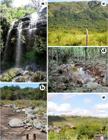
Landscaps of Brejos de Altitude from Pernambuco-Brazil. a. Cachoeira do Pinga (Triunfo). b. Mata do Brejinho (Triunfo). c & d. Mata do Carro Quebrado (Santa Cruz da Baixa Verde). e. Mata do Sesc.

Landscaps of Brejos de Altitude from Pernambuco-Brazil. a. Pico do Papaguaio. b e c. Serra da Madeira. d. Sítio Laje (Triunfo). e. Sítio Retiro. f. Sítio Coroas (Triunfo).
Comments on the general geographic distribution of the species were based on the literature and data from Flora e Funga do Brasil 2020 (Silva et al. 2020b), except for Cnidoscolus which were verified in Oliveira (2019) and Oliveira et al. (2021). The occurrence of the species in the study area was verified through field observations during collections and by analyzing the labels on the specimens, where the flowering and fruiting periods were also verified.
Results
Fourteen genera and 38 species of Euphorbiaceae were recorded in the Brejos de Altitude of Santa Cruz da Baixa Verde and Triunfo (Table 1). Crotonoideae was the subfamily with the largest number of taxa (16 species and 5 genera), followed by Acalyphoideae (12 species and 6 genera) and Euphorbioideae (10 species and 3 genera). The genera with the greatest representation in number of species were Croton L. (10 spp.), Euphorbia L. (8 spp.), Dalechampia L. (3 spp.) and Acalypha (3 spp.). Argythamnia P. Browne, Bia Klotzsch, Jatropha L., Manihot Mill., Microstachys A. Juss. and Sapium Jacq. presented one species each. Twelve species are recognized as occurring exclusively in Brazil and of these, five are endemic to the Caatinga domain (Table 1).
Regarding the phenological data extracted from the exsiccates of Euphorbiaceae occurring in the Brejos de Altitude of Santa Cruz da Baixa Verde and Triunfo, most of the species have a strong tendency to present flowers co-mingled with fruit. It can also be seen that most of the species were collected when flowering or fruiting during the rainy season, especially between January and July, with the number of fertile exsiccates decreasing from August to December (Fig. 4).

Phenological data extracted from Euphorbiaceae exsiccates collected in Brejos de Altitude of Santa Cruz da Baixa Verde and Triunfo, semiarid region of Pernambuco.
Key to the identification of Euphorbiaceae species in the Brejos de Altitude of the semi-arid region of Pajeú, Pernambuco, Brazil
-
1. Flowers in cyathium........................................................................2
-
2. Cyathium always with one marginal gland, without appendages......................................................................28. Euphorbia heterophylla
-
2’. Cyathium with 2–5 glands, appendages 2–5.................................3
-
3. Leaves alternate; bracts well developed (7–10 × 5–9 cm long), alternately imbricated; cyathium hidden among the bracts; seeds prismatic............................................................................................4
-
4. Woody plant at the base; sessile or subsessile leaves (petiole up to 1 cm long)……………..............…........27. Euphorbia heterodoxa
-
4’. Completely herbaceous plant; leaves petiolate (petiole equal to or longer than 3 cm long)...............................26. Euphorbia comosa
-
3’. Leaves opposite; bracts little developed (1.5–2.0 × 0.7–1.0 cm long), opposite, never imbricated; cyathium evident; seeds ellipsoid..........................................................................................5
-
5. Appendages of the cyathium glands strongly unequal in size, margin undulate…………………......................25. Euphorbia adenoptera
-
5’. Appendages of the cyathium glands approximately equal in size, margin entire or absent....................................................................6
-
6. Cyathium in glomeruliform dichasium (more than 15 densely gathered cyathia…..........................................................................7
-
7. Erect or decumbent plant; non-dichotomous branching; axillary or terminal glomeruliform dichasium on the same branch...............................................................................29. Euphorbia hirta
-
7’. Prostrate plant; dichotomous branching; glomeruliform dichasium only terminal.......................................31. Euphorbia ophthalmica
-
6’. Solitary cyathium, in pairs or in loosely arranged dichasium (less than 10 cyathia)...............................................................................8
-
8. Erect or ascending plants; green or reddish branches; foliaceous bracts; well-developed white cyathium appendages; straight fruit pedicels; glabrous capsules...................30. Euphorbia hyssopifolia
-
8’. Prostrate plants; dark green to vinaceous branches; absent bracts; poorly developed pink or vinaceous cyathium appendages; curved fruit pedicels (facing downwards); capsules with trichomes on the dehiscence lines of the valve.......................32. Euphorbia prostrata
-
1’. Solitary flowers or in inflorescences of other types...............................9
-
9. Plants with malpighiaceous trichomes; flowers in fascicles or solitary..................................................4. Argythamnia desertorum
-
9’. Plants with simple, stellate, lepidote, glandular, urticating or other trichomes, never malpighiaceous; flowers in pseudantial, thyrse, glomerulus or dichasium inflorescences........................................10
-
10. Twining vines................................................................................11
-
11. Leaves entire; flowers solitary or in thyrses.................................12
-
12. Inflorescences bifurcated.....................................9. Bia lessertiana
-
12’. Inflorescences non-bifurcated........................................................13
-
13. Stipules lanceolate; pistillate flower pedicel > 5 mm long......................................................................................38. Tragia volubilis
-
13’. Stipules triangular or deltoid; pistillate flower pedicel up to 1 mm long........................................................37. Tragia cearensis
-
11’. Leaves lobed; flowers in pseudanthium.....................................14
-
14. Stipules with nectary glands; lanceolate bracteal stipules..................................................................24. Dalechampia scandens
-
14’. Stipules without nectary glands; linear or deltoid bracteal stipules.......................................................................................15
-
15. Peduncle of pseudanthim up to 1 cm long; involucral bract with papilliform glands; stigmas slightly lobed..........................................................................................22. Dalechampia brasiliensis
-
15’. Peduncle of pseudanthium longer than 2 cm; involucral bract without glands; stigmas peltate-discoid...23. Dalechampia pernambucensis
-
10’. Herbs, subshrubs, shrubs or trees................................................16
-
16. Inflorescence dichasial.................................................................17
-
17. Flowers dichlamideous; calyx green or reddish green; petals yellow, yellow with red or red spots; fruit ribbed ....33. Jatropha mollissima
-
17’. Flowers monochlamideous; calyx green, purplish-green, greenish-white or white; petals absent; fruit without ribs.........................18
-
18. Plant glabrous or with simple trichomes; perianth green or purplish-green; acropetiolar glands absent; staminate flower with lobed interstaminal nectary; all filaments free...34. Manihot carthagenensis
-
18’. Plant with stinging trichomes; perianth greenish-white or white; acropetiolar glands present, papillose; staminate flower with entire extra-staminal nectary; inner stamen filaments united at the base or all filaments united in a column..............................................19
-
19. Leaf blade margin toothed; outer whorl filaments free and inner slightly united………………………….....11. Cnidoscolus infestus
-
19’. Leaf blade margin entire; filaments of both whorls in a halteriform column....................................................10. Cnidoscolus halteris
-
16’. Inflorescence in thyrse or glomerulus........................................20
-
20. Inflorescences always unisexual; pistillate flowers forming glomerulous inflorescence...........................................................21
-
21. Dioecious shrub; leaf blade with nectaries on the abaxial side..................................................................8. Bernardia tamanduana
-
21’. Herb or monoecious subshrub; leaf blade without nectaries..........................................................................7. Bernardia sidoides
-
20’. Inflorescences bissexual, rarely unisexual, pistillate flowers in the lower portion or throughout the thyrses or, rarely, solitary…......22
-
22. Leaves 3–5-palmate....................................................................23
-
23. Simple trichomes on petiole, abaxial side of leaf blade and outer side of sepals of pistillate flower; sepals of pistillate flowers ca. 8–10 mm long....................................................5. Astraea gracilis
-
23’. Stellate-porrect trichomes on petiole, abaxial side of the leaf blade and outer side of sepals of the pistillate flower; sepals of pistillate flowers up to 5 mm long...........................6. Astraea surinamensis
-
22’. Leaves unlobed............................................................................24
-
24. Leaf blade with 2–4 flat nectaries on the abaxial side and 2–4 marginal nectaries; solitary pistillate flowers on axis near staminate inflorescence; fruit with two cornicles on each carpidium…….............................…...35. Microstachys corniculata
-
24’. Leaf blade without nectaries on the abaxial side or, if present, never flat, rarely 2–5 marginal nectaries (only in Sapium argutum); pistillate flowers solitary or numerous on the underside of the floral axis or all along the floral axis; fruit without cornicles...............25
-
25. Plant glabrous; abundant white latex; petiole with a pair of nectaries near the apex; seeds with red aril.....................36. Sapium argutum
-
25’. Plant indumented; latex absent, scarce or of other colors; no nectaries on the petiole; seeds without aril..................................26
-
26. Plants usually with simple or interspersed simple and branched trichomes......................................................................................27
-
27. Plants decumbent; branches with roots at the nodes......................................................................................3. Acalypha radicans
-
27’ Plants erect; branches without roots at the nodes.......................28
-
28. Axillary inflorescences without allomorphic flowers.................................................................................1. Acalypha brasiliensis
-
28’. Terminal inflorescences with allomorphic flowers.....................................................................2. Acalypha multicaulis
-
26’. Plants with branched trichomes (stellate or lepidote)................29
-
29. Leaves with glands at the junction of the petiole and leaf blade......30
-
30. Subshrubs; green branches, woody only at the base of the stem..... 31
-
31. Margin of leaf blade entire to slightly serrate; soft stellate trichomes on young branches; sepals of pistillate flowers equal, white.........................................................................17. Croton pulegiodorus
-
31’. Margin of leaf blade always serrate; stellate-porrect and pungent trichomes on young branches; sepals of pistillate flowers unequal, green....................................................................14. Croton hirtus
-
30’. Shrubs; woody branches, brownish or grayish from the base to near the apex..............................................................................32
-
32. Stipules glandular; leaf blade margin with sessile glands; style multifid...........................................16. Croton laceratoglandulosus
-
32’. Stipules eglandular; eglandular leaf blade margin; style bifid................................................................18. Croton sertanejus
-
29’. Leaves eglandular.......................................................................33
-
33. Leaf blade with serrate margins; inflorescences with discontinuity between the pistillate and staminate cymules.................................................................................21. Croton urticifolius
-
33’. Leaf blade with entire margins; continuous inflorescences......34
-
34. Sepals of pistillate flower strongly unequal in size, three being larger and two obsolete..............................................20. Croton triqueter
-
34’. Sepals of pistillate flower of the same size................................35
-
35. Pistillate flower sepals not reduplicated; bifid style; columella with 3 prominent lobes..................................13. Croton heliotropiifolius
-
35’. Pistillate flower sepals reduplicated; multifidus style; columella without prominent lobes.................................................................36
-
36. Plant with silvery to rusty indumentum; leaf blade lanceolate to elliptical; calyx lobes of pistillate flowers elliptical to obovate..............................................................19. Croton tricolor
-
36’. Plant with whitish, rare yellowish indumentum; leaf blade ovate, ovate-lanceolate to cordiform; calyx lobes of pistillate flowers ovate to broad-ovate.....................................................................37
-
37. Plant with stellate indument; leaf blade cordiform; ovary with dense stellate trichomes; style free or united at the base in a short column (less than 1 mm long), patent; rugose seeds.......................................................................15. Croton jacobinensis
-
37’. Plant with rotated-lepidote to stellate-lepidote indumentum; leaf blade ovate to ovate-lanceolate; ovary with sparse lepidote trichomes; style united in a column (ca. 2 mm long); smooth seeds......................................................................12 Croton blanchetianus
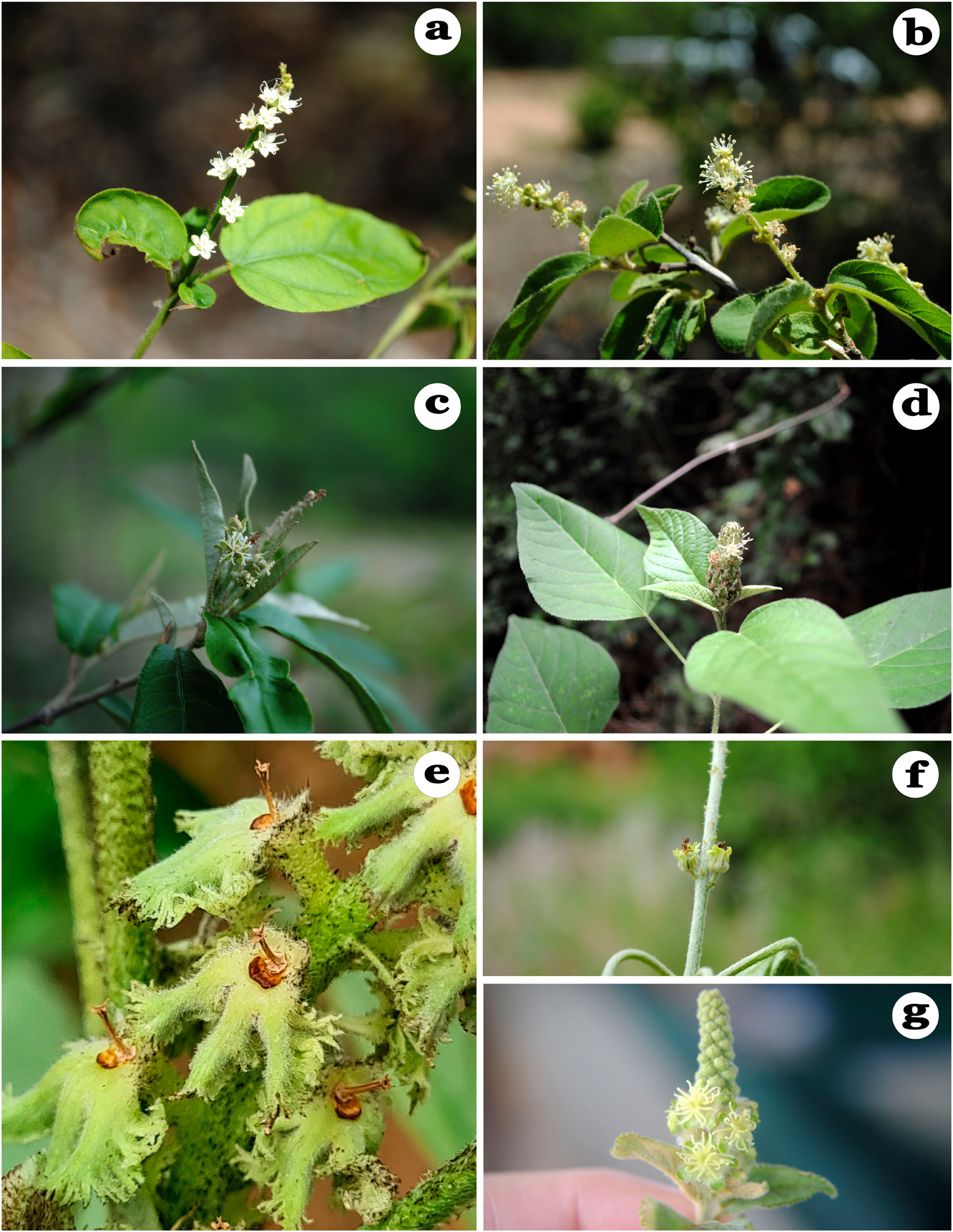
1. Acalypha brasiliensis Müll. Arg., Linnaea 34: 37. 1865. Fig. 5A-B
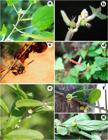
Acalypha brasiliensis Müll. Arg. (Photo: A. Laurênio) a. Inflorescence. b. Fruits. Acalyha multicaulis Müll. Arg. (Photo: A. Laurênio) c. Flowering branch. Acalypha radicans Müll. Arg. (Photo: A. Laurênio) d. Flowering branch. Argythamnia desertorum Müll. Arg. (Photo: A. Laurênio) e. Staminate flower. f. Pistillate flower. g. Fruit.
Shrub (1.0–1.4 m tall) monoecious, non-lateescent, leaf blade entire, serrate, covered with simple and stellate interspersed trichomes, inflorescence thyrses axillary, bisexual, tiny staminate flowers (up to 2–3 mm long), styles multifidus, filiform. It differs from the other Acalypha species in the study area due to its shrubby habit (vs. erect subshrub up to 0.8 m or decumbent in other species), the leaf blade with indumentum (vs. glabrous) and the axillary thyrses (vs. terminal) and bisexual (vs. staminate, isolated pistillate flowers).
Distribution, ecology, and phenology: Species occurring in Argentina and Brazil (Cardiel et al. 2018). In the latter country, it is distributed in the Amazon, Atlantic Forest, Caatinga and Cerrado domains, occurring in different vegetation formations from humid forests to deciduous forests such as the caatinga sensu stricto and the cerrado sensu lato and on rocky outcrops (Souza et al. 2024). In the Northeast of Brazil, it was found in Bahia and Ceará (Souza et al. 2024), but is now mentioned here for the first time for Pernambuco. In the study area, it is found mainly in the underforest of forests, in shaded places, in clayey soils rich in litter and in rocky soils. Flowering and fruiting during the rainy season, from January to July.
Material examined: BRAZIL, Pernambuco: Santa Cruz da Baixa Verde, Olho d’Água, Serra da Madeira, 7°51’45,30 S, 38°10’31” W, 24.I.2013, fl., A.B. Farias 1 (HESBRA); Santa Cruz da Baixa Verde, Olho d’Água, Serra da Madeira, 7°51’44” S, 38°10’31” W, 17.I.2013, fl., S.S. Matos et al. 54 (HESBRA); Santa Cruz da Baixa Verde, Olho d’Água, Serra da Madeira, 7°51’44” S, 38°10’31” W, 17.I.2013, fl., S. S. Matos et al. 58 (HESBRA); Santa Cruz da Baixa Verde, Olho d’Água, Serra da Madeira, 7°51’44” S, 38°10’31” W, 26.IV.2013, fl., fr., S.S. Matos 134 (HESBRA); Triunfo, Brejinho, 7°51’51” S, 38°07’48” W, 15.VI.2013, fl., fr., S.S. Matos & A. Laurênio 193b (HESBRA); Triunfo, Brejinho, 7°51’51” S, 38°07’48” W, 15.VI.2013, fl., fr., S.S. Matos & A. Laurênio 200 (HESBRA); Triunfo, Carro Quebrado, Mata do Carro Quebrado, 7°52’36,30” S, 38°6’18,4” W, 15.V.2011, fl., T. Lopes-Silva et al. 6 (HESBRA); Triunfo, Mata do Brejinho, 14.VI.2013, fl., fr., A. Laurênio 3719 (HESBRA); Triunfo, Mata do Brejinho, 3.III.2017, fl., fr., A. Laurênio 3808b (HESBRA); Triunfo, Mata do Brejinho, 3.III.2017, fl., fr., A. Laurênio 3809b (HESBRA); Triunfo, Mata do Brejinho, 07°51’51” S, 38°07’48” W, 10.VII.2024, fl., G.A. Lima et al. 219 (HESBRA); Triunfo, Mata do Brejinho, 07°51’51” S, 38°07’48” W, 10.VII.2024, fl., G.A. Lima et al. 226 (HESBRA); Triunfo, Olho d’Água, 27.III.1995, fl., A.M. Miranda 2234 (HST); Triunfo, Sítio Retiro, 21.III.2018, fl., B. Leal et al. 55 (HESBRA).
Illustrations: Sousa et al. (2017).
2. Acalypha multicaulis Müll. Arg., Linnaea 34: 53.1865. Fig. 5C
Erect subshrub (ca. 0.6–0.8 m high), monoecious, serrate leaf blade, glabrous on both sides, axillary thyrse, bisexual. It is similar to A. radicans in that both share the glabrous leaf blade on both sides, the terminal inflorescences and the triangular staminate bracts, but the latter has a decumbent habit, the nodes are radicant and the ovary is puberulent.
Distribution, ecology and phenology: This species is endemic to Brazil (Cardiel et al. 2018). Found in the Northeast region (Bahia, Pernambuco) and Southeast region (Minas Gerais) of the country, in the Caatinga and Cerrado domains in ombrophilous forest vegetation (Souza et al. 2024). It was found in the municipality of Triunfo, growing on rocky outcrops at altitudes around or above 1000 m. It possibly reproduces throughout the rainy season, with flowers in February, March, July, August and May and with fruit in November, February and August.
Material examined: BRAZIL. PERNAMBUCO: Triunfo, gravel road to SESC, 30.VIII.2014, fl., fr., L. Maciel-Júnior & A. Laurênio 212b (HESBRA); Triunfo, near SESC, 15.XI.2014, fl., fr., A. Laurênio 3102 (HESBRA); Triunfo, Lagoa Nova, 10.III.1995, fl., A.M. Miranda & M.F.O. Pires 2128 (ALCB, HST); Triunfo, Sítio Laje, 6.II.2020, fl., fr., B. Leal & A. Laurênio 88 (HESBRA); Triunfo, Sítio Laje, 6.II.2020, fl., fr., B. Leal & A. Laurênio 94 (HESBRA); Triunfo, Sítio Laje, 6.II.2020, fl., fr., B. Leal & A. Laurênio 95 (HESBRA); Triunfo, Sítio Santa Rita, near the Pico do Papagaio, 15.VII.2010, fl., A.P. Fontana et al. 6981 (HESBRA, HVASF); Triunfo, location not recorded, 6.II.2020, fl., fr., B. Leal & A. Laurênio 99 (HESBRA); Triunfo, Sítio Retiro, 21.III.2018, fl., fr., B. Leal et al. 52 (HESBRA).
3. Acalypha radicans Müll. Arg., Linnaea 34: 39.1865. Fig. 5D
Decumbent subshrub, monoecious, non-latescent, lower nodes often rooting, serrate leaf blade, staminate inflorescence in terminal thyrse, pistillate flowers usually isolated and puberulent ovary. It resembles Acalypha multicaulis, from which it differs in aspects presented in the comments on the latter species.
Distribution, ecology and phenology: This South American species is found in Argentina, Bolivia, Brazil, Paraguay and Uruguay (Cardiel et al. 2013; Cardiel and Muñoz 2015). In Brazil, its occurrence has been confirmed in the Northeast, Southeast and South, such occurrences being in the Caatinga, Cerrado, Atlantic and Pampa domains. It has been recorded in humid and dry forests such as the Caatinga sensu stricto and the Cerrado, as well as in anthropogenic areas (Souza et al. 2024). In the study area, it was found in shady places in the understory of the Brejos de Altitude, at altitudes above 900 m, in clayey soils, rich in leaf litter and rocks. It also differs from A. pruriens in the environment in which it occurs, since the latter species was observed in sunny places, on rocky outcrops. It possibly reproduces throughout the rainy season, with flowers observed in February, March, May and July, and fruit in March and May.
Material examined: BRAZIL. PERNAMBUCO: Triunfo, on the road to the Pico do Papagaio, 18.V.2015, fl., fr., A. Laurênio et al. 3738 (HESBRA); Triunfo, Mata do Brejinho, 07°51’51” S, 38°07’48” W, 10.VII.2024, fl., A. Laurênio et al. 4264 (HESBRA); Triunfo, Sítio Coroas, 12.II.2019, fl., J.G.S. Alves 114 (HESBRA); Triunfo, Sítio Retiro, 21.III.2018, fl., fr., B. Leal et al. 50 (HESBRA); Triunfo, Sítio Retiro, 21.III.2018, fl., fr., B. Leal et al. 51 (HESBRA); Triunfo, Sítio Retiro, 21.III.2018, fl., fr., B. Leal 54 (HESBRA).
4. Argythamnia desertorum Müll. Arg. in Mart., Fl. Bras. 11(2): 310, 1874. Fig. 5E-G
Small shrub (1–2 m high), monoecious, non-latescent, discolored leaves, slightly serrate, underside of the leaf blade with long dense malpiguiaceous trichomes, cauline inflorescences and reduced to small fascicles or the flowers are isolated. This set of characteristics distinguishes it from the other Euphorbiaceae species in the study area.
Distribution, ecology and phenology: Species endemic to the Caatinga, occurring in almost all states of the Northeast and in Minas Gerais. It is associated with Caatinga vegetation sensu stricto (Külkamp & Ornelas, 2024). It is not easily found in the study area, being observed in only one stretch of high-altitude Brejo in an area shaded by large trees (20-30 m high), growing in clayey soils, rich in litter and rocky outcrops, at altitudes between 600 and 700 m. Flowering in March and December, fruiting during the rainy season, between March and July.
Material examined: BRAZIL, Pernambuco: Triunfo, Canaã, Carro Quebrado, 5.III.2011, fr., J.K. Lima-Silva & A. Laurênio 22 (HESBRA); Triunfo, Canaã, Carro Quebrado, 4.VII.2011, fr., V.N. Souza 28 (HESBRA).
Additional material examined: BRAZIL, Pernambuco: Serra Talhada, Parque Estadual Mata da Pimenteira, 12.III.2012, fl., fr., R. Melo & S.S. Matos 57 (HESBRA); Serra Talhada, 14.XII.2010, fl., R.S. Cordeiro 176 (HESBRA); Serra Talhada, Parque Estadual Mata da Pimenteira, 12.III.2012, fl., fr., R. Melo &. S. S. Matos 51 (HESBRA).
5. Astraea gracilis (Müll. Arg.) O. L. M. Silva & Cordeiro, Phytotaxa 317(4): 299. 2017. Fig. 6A-C

Astraea gracilis (Müll. Arg.) O. L. M. Silva & Cordeiro. (Photo: A. Laurênio). a. Habit. b. Pistillate flowers. c. Fruit. Astraea surinamensis (Miq.) O.L.M. Silva & Cordeiro. (Photo: J.C.R. Mendes). d. Flowering branch. Bernardia sidoides (Klotzsch) Müll. Arg. (Photo: A. Laurênio) e. Habit. Bernardia tamanduana (Baill.) Müll. Arg. (Photo: A. Laurênio) f. Flowering branch. g. Fruiting branch.
Erect subshrub (0.3–0.6 m tall), monoecious, colorless latex, young branches with simple to stellate indumentum, 3-lobed, eglandular leaf blade, thyrses inflorescence, continuous, pistillate flower sepals of up to 10 mm in length (15 mm in the fruit) and glabrous fruit. It can be differentiated from the congener A. surinamensis (Miq.) O.L.M. Silva & Cordeiro by young branches with simple to short stellate, up to 1 mm long. (vs. stellate-porrect indumentum, greater than 2 mm long in A. surinamensis), sepals of the pistillate flower up to 10 (-15 in the fruit, mm long), vs. less than 5(-8 in the fruit) mm length. and glabrous fruit (vs. with simple trichomes).
Distribution, ecology and phenology: Species exclusive to South America (Silva et al. 2020a). In Brazil, it occurs in the Center-West, Northeast and Southeast, being associated with different formations, from deciduous, semi-deciduous to rainforest, and vegetation on rocky outcrops in the Atlantic Forest, Caatinga, Cerrado and Pantanal domains (Silva & Cordeiro, 2024). In the study area it can be considered rare, being observed only in a fragment of Brejos de Altitude, growing inside the forest in a shaded location, in clayey soil rich in litter. It is an annual plant that quickly flowers and bears fruit during the rainy season, while the cotyledons have not yet fallen, and then disappears during the dry season. It was found flowering and fruiting in June.
Material examined: BRAZIL, Pernambuco: Triunfo, Brejinho, 7°51’51” S, 3°, 07’48” W, 15.VI.2013, fl., fr., S.S. Matos & A. Laurênio 237 (HESBRA).
Additional material examined: BRAZIL. PERNAMBUCO: Serra Talhada, Parque Estadual Mata da Pimenteira, 15.IV.2014, fl., fr., S.S. Matos et al. 525 (HESBRA).
Illustrations: Silva (2018); Silva et al. (2020).
6. Astraea surinamensis (Miq.) O.L.M. Silva & Cordeiro, Phytotaxa 404(4): 133, 2019. Fig. 6D
Erect subshrub (0.3–1 m tall), monoecious, colorless latex, branches with stellate-porrect trichomes, long (2-3 mm long), 3–5-lobed, eglandular leaf blade, fruit with simple trichomes. The distinctive characteristics between A. surinamensis and A. gracilis were presented in the comments on the latter species.
Distribution, ecology and phenology: Astraea surinamensis has a wide distribution in the Neotropical region. It was introduced into and spread in the Old World (Silva et al. 2020a). It is recorded in almost all of Brazil, except in the South region, occurring in all phytogeographic domains. It is found mainly in anthropogenic areas and rocky outcrops (Silva & Cordeiro, 2024). In the study area, it occurs in open, sunny areas, on the edges of forests, often as an invader of abandoned fields, crops and sidewalks, in clayey or sandy-clayey soils, sometimes in rock crevices. Flowers and bears fruit during the rainy season, between April and July.
Material examined: BRAZIL, Pernambuco: Santa Cruz da Baixa Verde, Olho d’Água, Serra da Maderia, 25.VII.2013, fl., fr., S.S. Matos 258 (HESBRA); Santa Cruz da Baixa Verde, Sítio Santo Antônio, 7°51’47,1” S, 38°10’30,1” W, 18.IV.2017, fl., Y. Rossine et al. 30 (HESBRA); Santa Cruz da Baixa Verde, Sítio Santo Antônio, 7°51’47,1” S, 38°10’30,1” W, 18.IV.2017, fl., Y. Rossine et al. 28 (HESBRA); Santa Cruz da Baixa Verde, Sítio Santo Antônio, 7°51’47,1” S, 38°10’30,1” W, 18.IV.2017, fl., fr., Y. Rossine et al. 29 (HESBRA); Triunfo, Pico do Papagaio, 18.V.2015, fl., fr., A. Laurênio 3759b (HESBRA); Triunfo, Sítio Laje, 18.IV.2017, fl., fr., Y. Rossine et al. 31 (HESBRA); Triunfo, Sítio Laje, 18.IV.2017, fl., fr., Y. Rossine et al. 32 (HESBRA); Triunfo, Sítio Laje, 18.IV.2017, fl., fr., Y. Rossine et al. 34 (HESBRA).
Illustrations: Silva (2018); Silva et al. (2020).
7. Bernardia sidoides (Klotzsch) Müll. Arg., Linnaea 34: 177. 1865. Fig. 6E
Erect herb to subshrub (ca. 0.08–70 cm tall), monoecious, non-latent, linear stipules, leaves densely distributed at the apex of the branches, entire leaf blade with serrate margin, without glands, indument of simple trichomes, inflorescences of both the terminal sexes. It is easily distinguished from Bernardia tamanduana, a congener also found in the study area, as the latter is a shrub (1–1.3 m tall), dioecious, with leaves distributed along the branches, leaf blade with flat basilaminar glands, glabrescent on both sides, axillary staminate and terminal pistillate inflorescences.
Distribution, ecology and phenology: Species distributed in Mexico, Central America, Brazil and Venezuela (Maldonado 2002). In Brazil, it is distributed mainly in the Caatinga domain but can also be found in the Cerrado in Mato Grosso (Carrión 2024). In the study area, it generally occurs in open and sunny areas, in clayey soils or in cracks in flagstones, and even in anthropogenic areas. It is an annual species that disappears in the dry season. Flowers and bears fruit in April and May, the rainy season.
Material examined: BRAZIL. PERNAMBUCO: Triunfo, Brejinho, 7°51’51” S, 38°07’48” W, 3.V.2013, fl., fr., S. S. Matos & D.R.M. Caldas 157 (HESBRA); Triunfo, Brejinho, 7°51’51” S, 38°07’48” W, 15.IV.2013, fl., fr., S. S. Matos & A. Laurênio 224 (HESBRA); Triunfo, Sítio Laje, 18.IV.2017, fl., fr., B. Leal et al. 26 (HESBRA); Triunfo, Sítio Laje, 18.IV.2017, fl., fr., B. Leal et al. 27 (HESBRA); Triunfo, Sítio Laje, 18.IV.2017, fl., fr., B. Leal et al. 28 (HESBRA); Triunfo, Sítio Laje, 18.IV.2017, fl., fr., B. Leal et al. 29 (HESBRA); Triunfo, Sítio Laje, 18.IV.2017, fl., fr., B. Leal et al. 30 (HESBRA); Triunfo, Sítio Laje, 18.IV.2017, fl., fr., B. Leal et al. 32 (HESBRA).
Illustrations: Santos et al. (2019).
8. Bernardia tamanduana (Baill.) Müll. Arg., Prodr. 15 (2): 920. 1866. Fig. 6F-G
Small shrub (1–1.3 m tall), dioecious, non-lateescent, entire leaf blade, serrate margin, with 10-12 flat basilaminar glands, axillary staminate and terminal pistillate inflorescences. See comment on B. medoides for distinction between these two species.
Distribution, ecology and phenology: Species endemic to Brazil, occurring in the Atlantic Forest and Caatinga domains in different vegetation formations, from seasonal forests to the Caatinga sensu stricto (Cárrion, 2020). It can be considered a rare species in the Brejo de Altitude of Santa Cruz da Baixa Verde and Triunfo, being observed in a few better-preserved fragments of the forest. It grows in clayey soils, rich in litter and rock fragments. It was observed flowering in February, May and December and fruiting in February.
Material examined: BRAZIL, Pernambuco: Triunfo, Brejinho, 4.II.2013, fl., fr., S.S. Matos et al. 81 (HESBRA); Triunfo, Lagoa Nova, 7.XII.1991, fl., E. Ferraz & F.A.R. Santos 39 (IPA, PEUFR).
Additional material examined: BRAZIL. PERNAMBUCO: Carnaíba, Serra da Matinha, 28.III.2017, fl., fr., B. Leal et al. 13 (HESBRA); Carnaíba, Serra da Matinha, 28.III.2017, fl., fr., B. Leal et al. 14 (HESBRA). Carnaíba, Serra da Matinha, 7°43’10” S, 37°45’37” W, 31.V.2024, fl., J.V. Alves-Souza 78 (HESBRA); Carnaíba, Serra da Matinha, 7°43’10” S, 37°45’37” W, 31.V.2024, fl., J.V. Alves-Souza 81 (HESBRA).
Illustrations: Santos et al. (2019).
9. Bia lessertiana Baill., Étude Euphorb. 502. 1858. Fig. 7A
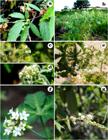
Bia lessertiana Baill. (Photo: W. Cordeiro) a. Habit. Cnidoscolus halteris Fern.- Casas. b. Habit. c. Staminate flower. d. Pistillate flower. Cnidoscolus infestus Pax & K. Hoffm. in Engl. (Photo: A. Laurênio). e. Staminate flower. f. Pistillate flower. Croton blanchetianus Baill. (Photo: A. Laurênio). g. Inflorescence.
Monoecious vine, stinging trichomes on the vegetative parts and fruit, entire alternate leaves, leaf blade with serrate margin, bifurcated thyrses. In the study area, it is vegetatively similar to Tragia species as it shares the habit and the presence of stinging trichomes, but B. lessertiana is distinguished from Tragia cearensis and T. volubilis by its bifurcated inflorescence (vs. inflorescence with a single axis in Tragia species), interstaminal disc (vs. staminal disc absent) and 8–20 stamens (vs. 3–5).
Distribution, ecology and phenology: It is distributed from the Guianas to the Northeast of Brazil. In Brazil, it is found in the North and Northeast, in the Amazon, Atlantic Forest and Cerrado domains, occurring in vegetation of cerrado lato sensu, terra firma forest and rainforest (Cordeiro et al. 2020). It can be considered a rare species in the study area, being observed in shaded places or in clearings within some fragments. It is found in clayey soils, rich in litter and rock fragments.
Material examined: BRAZIL. PERNAMBUCO: Triunfo, Sítio Retiro, 21.III.2018, fl., B. Leal et al. 53 (HESBRA); Triunfo, on the border of the municipalities of Triunfo-Princesa Isabel, the property of Sr. Manoel Barbosa, V.C. Lima & F. Gallindo 131 (IPA).
Additional material examined: BRAZIL. PERNAMBUCO. Inajá, 19.VIII.1980, fl., fr., V.C. Lima et al. 50 (IPA); Paudalho, Usina Mussurepe, mata do Engenho Itaboraí, 26.III.1952, fl., D. Andrade-Lima 52-1015 (IPA); São Lourenço da Mata, Refúgio da Vida Silvestre Mata do Toró, XII.2016, fl., A.M. Silva 46 (IPA); Vicência, Engenho Jundiá, 30.VII.1968, fl., D. Andrade-Lima 68-5405 (IPA).
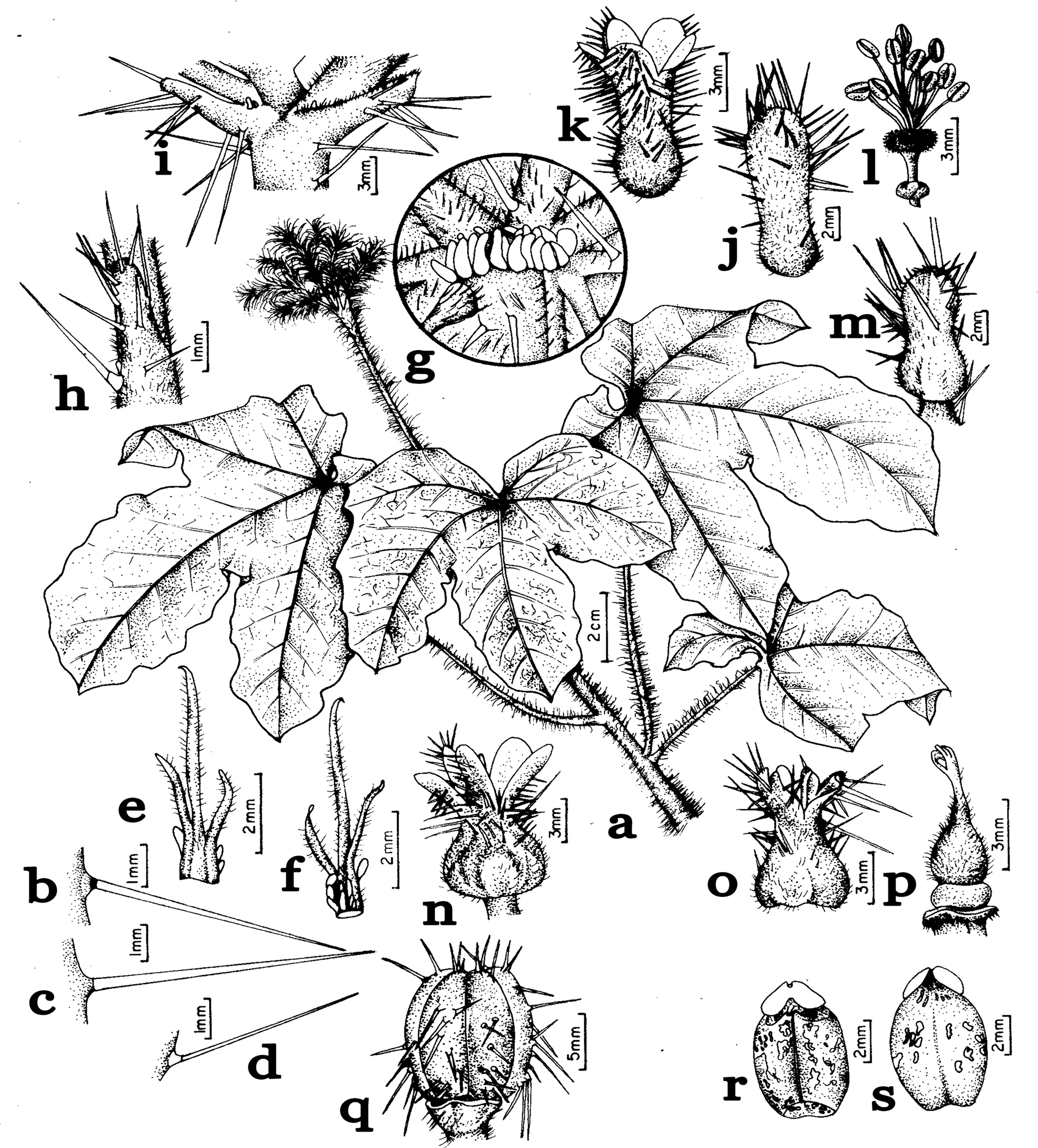
10. Cnidoscolus halteris Fern.- Casas., Fontqueria 55(7): 34. 2001. Fig. 7B-D & 8

Cnidoscolus halteris Fern.- Casas. a. Flowering branch (A. Laurênio 1627 et al.); b. Aciculiform urticating trichome on the branch (A. Laurênio 1108 et al.); c. Aciculiform urticating trichome on the petiole (A. eaurênio 1216 et al.); d. Aciculiform urticating trichome on the fruit (A. Laurenio 1215 et al.); e. External face of the stipule; f. Inner face of the stipule (Andrade 129 et al.); g. Petiolar glands (Laurênio 1217 et al.); h. Bracts in lateral view; i. Bract in frontal view (A. Laurênio 1627 et al.); j. Staminate bud (A. Laurênio 1065 et al.). k. Staminate flower (Andrade 129 et al.); l. Androecium (A. Laurênio 1065 et al.); m. Pistillate bud. n. Pistillate flower; o. Pistillate flower perianth detached; p. Gynoecium (Andrade 129 et al.); q. Fruit (A. Laurênio 1216 et al.); r. Seed, ventral face; s. Seed, dorsal face (A. Laurênio 1628 et al.).
Succulent shrub (0.8–1.2 m high), monoecious, abundant white latex, dense urticating trichomes on the branches, leaves, perianth and fruit; alternate leaves 3–5-lobed, margin of the leaf blade toothed, papilliform glands at the junction of the petiole and the leaf blade, dichasial inflorescence, pistillate flowers at the bifurcation and staminate at the terminal axes, monoclamid, white or cream perianth. As with most other species of Cnidoscolus sect. Jussieuia (Houst.) Pax, C. halteris differs from C. neglectus, which also occurs in the areas studied, due to floral characteristics, since the vegetative aspects are less informative. Even so, the leaves of C. halteris are more often 3-lobed (vs. 5-, rarely 7-, lobed in C. neglectus) and are crasser with entire or slightly toothed margins and more densely covered with urticating trichomes (vs. chartaceous leaves with toothed margins, lax urticating trichomes). In both species, the perianth of the staminate and pistillate flowers are tubular, but in C. halteris the tube of the staminate flower is abruptly widened at the base (vs. straight tube or slightly and gradually widened in C. infestus). However, the most distinctive characteristic between the two species is found in the androecium, namely the 10 filaments of C. halteris are all united in a crass column with a tuft of trichomes at the apex, while in C. neglectus only the 5 filaments of the inner whorl are slightly united at the base, while the 5 filaments of the outer whorl are entirely free.
Distribution, ecology and phenology: Endemic to Brazil, found in the states of Paraíba and Pernambuco (Oliveira 2019). In these states, C. halteris seems to be related to the Brejo de Altitude, being found mainly in open environments, often growing in rock crevices around these forests. In the original description (Fernandez Casas 2001) of C. halteris, it is mentioned that the species is also recorded for Bahia, being referred (as the only paratype) to the collection Grupo Pedra do Cavalo 25, originating from the Bananeiras Dam, in the municipality of Cachoeira, in that state, from the NY herbarium. However, when analyzing the image of this specimen, as well as isoparatypes from the ALCB and HUEFS herbaria, it was verified that it was C. marcgravii Pohl. Thus, the presence of C. halteris in Bahia can still be considered doubtful. Although these species have a certain similarity in their vegetative morphology, they are very different when it comes to their flowers. Cnidoscolus marcgravii - see Melo & Sales 2008, p. 821, for an illustration of this species, as C. urens (L.) Arthur population 1- has the perianth tube of the staminate flowers narrow at the base (vs. are evidently enlarged at the base in C. halteris) the pistillate flowers have almost entirely free segments, united by less than 1mm long (vs. tubular, urceolate pistillate perianth), filaments slightly united at the base in a 2.2 mm long column, densely villous (vs. filaments united in a 6–7 mm long column, glabrous with a tuft of trichomes only at the apex). In the study area, it is found in open areas, growing in clay soils with many rock fragments. It was found flowering and fruiting in February, March and April.
Material examined: BRAZIL. PERNAMBUCO: Santa Cruz da Baixa Verde, Sítio Santo Antônio, 07º51’47,1” S, 38º10’30,1” W, 18.IV.2017, fl., fr., Y. Rossine et al. 27 (HESBRA); Triunfo, around the group of schools, 7°51’17” S, 38°08’24” W, 29.IV.2015, fl., fr., C.C. Oliveira & A.L. Melo 263 (BHCB); Triunfo, near Brejinho, 15.III.2014, fl., fr., S.S. Matos et al. 430 (HESBRA); Triunfo, Sítio Santo Antônio, 12.II.2019, fl, fr., R. L. Sousa & A. Laurênio 10 (HESBRA).
Additional material examined: BRAZIL. PARAÍBA: Cabaceiras, Sítio Bravo, 11 km S of Boa Vista, 18.II.1992, fl., V.L. Nascimento & C.F. Martins 42 (JPB); PERNAMBUCO: Brejo da Madre de Deus, Fazenda Bituri, 5.1995, fl., fr., F. Villarouco et al. 85 (PEUFR!, isotype; NY!, holotype); Santa Cruz do Capibaribe, dirt road, km 16, 8.II.1993, fl., S.I. Silva 49 (PEUFR); Brejo da Madre de Deus, on the way out to Jataúba, 9.II.1993, fr., S.I. Silva 52 (PEUFR).
11. Cnidoscolus infestus Pax & K. Hoffm. in Engl., Pflanzenr. IV. 147 XVI (Heft 85): 193 Fig. 7E-F.
Succulent shrub (0.4–2.0 m high), monoecious, abundant white latex, generally lax urticating trichomes on the branches, leaves, perianth and fruit; leaves alternate 5(-7)-lobed, margin of the leaf blade toothed, papilliform glands at the junction of the petiole and the leaf blade, dichasial inflorescence, pistillate flowers at the forks and staminate at the terminal axes, monoclamid, perianth white or cream. It resembles C. halteris, with which it shares most of its vegetative characteristics, and is distinguished by a set of characteristics mentioned as being among the characteristics of the previous species.
Distribution, ecology and phenology: This species is endemic to Brazil and is found in Bahia, Ceará, Minas Gerais, Paraíba and Pernambuco (Fernandez Casas and Domínguez 2005), in open deciduous vegetation formations such as the caatinga sensu stricto to the Atlantic Rainforest and can often be found on rocky outcrops. In the study area, it is found mainly on the edges of forests, often in the crevices of large cliffs. It possibly reproduces all year round, with flowering recorded in February, March, July, August, October and November and fruiting in February, July and November.
Material examined: BRAZIL. PERNAMBUCO: Santa Cruz da Baixa Verde, fl. fr., 16.VII.1998, Laurênio et al. 1106 (PEUFR); Triunfo, 16.VII.1998, fl. fr., Laurênio et al. 1110 (PEUFR); Triunfo, the road to Santa Cruz, Fazenda Bom Jesus, 26.II.1986, fl., fr., V.C. Lima & F. Gallindo 72 (IPA); Triunfo, the road near SESC, 22.X.2016, fl., Y. Rossine & A. Laurênio 9 (HESBRA); Triunfo, Mata do Brejinho, 16.XI.2012, fl., A. Laurênio 3301 (HESBRA); Triunfo, Sítio Laje, 6.II.2010, fl., B. Leal & A. Laurênio 90 (HESBRA); Triunfo, Sítio Retiro, 21.III.2018, fl., Y. Rossine & A. Laurênio 81 (HESBRA); Triunfo, Sítio Santa Rita, near the Pico do Papagaio, 15.VII.2010, fl., fr., J.A. Siqueira Filho 2370 (HVASF); Triunfo, Timbaúba, 16.XI.1998, fr., A.M. Miranda 3054 (HST).
Additional material examined: BRAZIL. Pernambuco: Bezerros, 4.X.1983, fl., F. Gallindo et al. s.n. (IPA 42335); Brejo da Madre de Deus, 11.VI.1998, fl. fr., A. Laurênio et al. 1071 (PEUFR); Buíque, 12.IV.1997, fr., A. Laurênio et al. 461 (PEUFR); Cabrobó, 22.V.1984, fl. fr., O. A. Salgado et al. 382 (IPA); Camaragibe, 14.VI.1998, fl. fr., A. Laurênio & M.F.A. Lucena 1076 (PEUFR); Camutanga, 29.X.1998, fl., A. Laurênio et al. 1538 (PEUFR); Caruaru, 19.IV.1997, fl. fr., A. Laurênio et al. 484 (PEUFR); Custódia, 2.IV.1989, fl., E.L. Araújo s.n. (IPA 52179); Iati, 28.V.1997, fl. fr., A. Laurênio et al. 519 (PEUFR); Ibimirim, 27.I.1997, fl. fr., M. J. N. Rodal & L. M. Nascimento 714 (PEUFR); Limoeiro, 12.V.1998, fl. fr., A. Laurênio & M. F. A. Lucena 1050 (PEUFR); Mirandiba, 17.VII.1998, fl., A. Laurênio et al. 1118 (PEUFR); Parnamirim, 11.XII.1997, fl. fr., A. M. Miranda et al. 2899 (HST); Pesqueira, 30.VII.1998, fl. fr., A. Laurênio et al. 1162 (PEUFR); Petrolina, 25.XI.1983, fl., G. Fotius 3613 (IPA); Recife, 2.V.1997, fl. fr., A. Laurênio 505 (PEUFR); Sanharó, 30.VII.1998, fl. fr., A. Laurênio et al. 1161 (PEUFR); São Caetano, 11.I.1982, fl., F. Gallindo s.n. et al. (IPA 32069); Serra Talhada, fl. fr., 30.V.1997, A. Laurênio et al. 539 (PEUFR); Serra Talhada, on top of a serra before reaching UAST, 25.V.2009, fl., E. A. Silva-Filho et al. 1 (HESBRA); Taquaritinga do Norte, 18.IV.1997, fl. fr., A. Laurênio et al. 469 (PEUFR); Venturosa, 1998, fl., K. Costa 26 (PEUFR); Vertentes, 18.IV.1997, fr., A. Laurênio et al. 466 (PEUFR).
Illustrations: Melo & Sales (2008), as Cnidoscolus loefgrenii (Pax & K. Hoffm.) Pax & K. Hoffm.
12. Croton blanchetianus Baill., Adansonia 4: 301. 1864. Fig. 7G
Shrub (1.5–3 m tall) monoecious, stellate-rotate to stellate-lepidote trichomes (see Gomes et al. 2018 for MEV images of the trichomes of this species), whitish or yellowish on all vegetative parts, on the calyx and on the fruit, leaves alternate, entire, leaf blade with entire margins, eglandular, stipules lanceolate to auriculate, inflorescences continuous thyrses, calyx of pistillate flowers valvar-reduplicate, styles multifid. It resembles C. jacobinensis among the species from the Brejo de Altitude studied, with which it shares the size of the leaves and the general appearance of the inflorescence. However, C. jacobinensis has only stellate trichomes - free lateral rays (vs. stellate-rotate to stellate-lepidote trichomes - lateral rays with a certain degree of union in C. blanchetianus), cordiform leaf blade (vs. ovate to ovate-lanceolate), free or united styles in short column, less than 1 mm long, (vs. styles united in a column, ca. 2 mm long, erect) and rough seeds (vs. smooth).
Distribution, ecology and phenology: This species is endemic to the Caatinga domain and is found in the north of Minas Gerais and in almost all (except Maranhão) the states of Northeastern Brazil. It is found in different features of the caatinga, in anthropogenic areas and on the edges of Brejo de Altitude (Rossine et al. 2023). In the study area, it is only found on the edges of some lower (around 700-800 m altitude) and drier Brejo de Altitude fragments, sometimes growing on rocky outcrops. Flowering and fruiting between February and July.
Material examined: BRAZIL, Pernambuco: Santa Cruz da Baixa Verde, Olho d’água, Serra da Madeira, 21.II.2013, fl., fr., C.M.P.G. Souza 1 (HESBRA); Santa Cruz da Baixa Verde, Olho d’Água, Serra da Madeira, 7°51’44” S, 38°10’31” W, 25.VII.2013, fl., fr. A.M.R.F. Jardim et al. 2 (HESBRA); Santa Cruz da Baixa Verde, Olho d’Água, Serra da Madeira, 05.IV.2014, fr., C. Pessoa 157 (HESBRA); Santa Cruz da Baixa Verde, Serra da Madeira, 8°26’57,6” S, 37°27’3,7” W, 13.IV.2017, fr., Y. Rossine et al. 20 (HESBRA).
Illustrations: Silva et al. (2009, 2010); Rossine et al. (2023).
13. Croton heliotropiifolius Kunth, Nov. Gen. Sp. (quarto ed.) 2: 83. 1817. Fig. 9B-C

Croton heliotropiifolius Kunth. (Photo: A. Laurênio). a. Habit. b. Staminate flower. c. Pistillate flower. Croton hirtus L’Hér. (Photo: A. Laurênio). d. Habit. Croton jacobinensis Baill. (Photo: A. Laurênio). e. Flowering branch. Croton laceratoglandulosus Caruzo & Cordeiro. (Photo: A. Laurênio). f. Flowering branch.
Shrub (0.7–1.5 m tall), stellate indumentum on all vegetative and reproductive parts, sessile globose nectaries (1 pair), inconspicuous, near the base of the central vein, elliptical to ovate leaf blade, entire margins, continuous thyrse inflorescence, bifid stylets, ovate to elliptical fruit and columella with three prominent apexes. It morphologically resembles C. sertanejus, with which it shares the general appearance of the leaves and inflorescence, the stellate indumentum and the bifid styles. However, C. sertanejus has monopodial branching (vs. dichasial in C. heliotropiifolius), 4-6 nectaries at the base of the leaf blade (vs. base of leaf blade without nectaries) and globose fruit (vs. oblong).
Distribution, ecology and phenology: This species is widespread in Tropical America. In Brazil, it occurs throughout the Northeast, in Goiás and the Federal District in the Midwest, and in Minas Gerais in the Southeast. It is mainly associated with Caatinga sensu stricto, but also in more humid environments such as rainforests and Brejo de Altitude (Caruzo et al. 2020). In the study area, it is seen in open places, degraded vegetation, abandoned crops, clearings, on the edge of fragments of forest and in shrub formations and in regenerating Brejo de Altitude, in clay, sandy-clay or stony soils, sometimes growing in rock crevices. It seems to reproduce all year round, with flowering recorded in January, February, March, April, May, July, October, November and December and it bears fruit in March, April, July, August and October.
Material examined: BRAZIL. PERNAMBUCO: Santa Cruz da Baixa Verde, Olho d’Água, Serra da Madeira, 7°51’44” S, 38°10’31” W, 17.I.2013, fl., S.S. Matos et al. 52 (HESBRA); Santa Cruz da Baixa Verde, Olho d’Água, Serra da Madeira, 24.I.2013, fl., J.M.N. Santos et al. 1 (HESBRA); Serra da Madeira, Olho d’Água, Serra da Madeira, 21.II.2013, fl., M.J.F.B.L. Silva 1 (HESBRA); Santa Cruz da Baixa Verde, Olho d’água, Serra da Madeira, 7°51’44” S, 38°10’31” W, 23.III.2013, fl., S.S. Matos et al. 109 (HESBRA); Santa Cruz da Baixa Verde, Olho d’água, Serra da Madeira, 7°51’44” S, 38°10’31” W, 26.IV.2013, fl., fr., S.S. Matos 131 (HESBRA); Santa Cruz da Baixa Verde, Olho d’água, Serra da Madeira, 7°51’44” S, 38°10’31” W, 08.VIII.2013, fr., T.C. Xavier 3 (HESBRA); Santa Cruz da Baixa Verde, Olho d’Água, Serra da Madeira, 24.I.2013, fl., L.M. Maciel-Júnior 2 (HESBRA); Santa Cruz da Baixa Verde, Olho d’Água, Serra da Madeira, fl., 21.II.2013, M.S.S. Ferraz et al. 1 (HESBRA); Santa Cruz da Baixa Verde, Olho d’Água, Serra da Madeira, 21.II.2013, fl., M.T.L. Silva 3 (HESBRA); Santa Cruz da Baixa Verde, Olho d’Água, Serra da Madeira, 21.II.2013, fl., S.M.V.L. Cavalcanti et al. 1 (HESBRA); Santa Cruz da Baixa Verde, Serra da Madeira, 23.I.2014, fl., G.B. Izidório 2 (HESBRA); Santa Cruz da Baixa Verde, Serra da Madeira, 23.I.2014, fl., E. Santos-Silva 2 (HESBRA); Santa Cruz da Baixa Verde, Sítio Santo Antônio, 18.IV.2017, fl., fr., Y. Rossine et al. 25 (HESBRA); Triunfo, near SESC, 27.X.2016, fl., fr., B. Leal & A. Laurênio 8 (HESBRA); Triunfo, the wood beside SESC, 5.XII.2019, fl., M.F. Silva 1 (HESBRA); Triunfo, near SESC, 7°50’26,76” S, 38°06’22,21 W, 20.X.2016, fl., J.H.V.P.S. Silva 1 (HESBRA); Triunfo, near SESC, 17.VII.2014, fl., fr., L.S.J. Silva et al. 10 (HESBRA); Triunfo, Sítio Laje, 6.II.2020, fl., fr., B. Leal & A. Laurênio 89 (HESBRA); Triunfo, Sítio Retiro, 21.III.2018, fl., fr., Y. Rossine & A. Laurênio 78 (HESBRA); Triunfo, Cachoeira do Pinga, 21.III.2018, fl., fr., Y. Rossine et al. 83 (HESBRA); Triunfo, Pico do Papagaio, 18.VI.1999, fl., F.V. Silva 60 (ASE, HST); Triunfo, Sítio Olho d’Água, 25.III.1993, fl., E. Ferraz 240 (IPA, PEUFR); Triunfo, Timbaúba, 16.XI.1998, fl., A.M. Miranda 3053 (HST); Triunfo, near SESC, 7°50’26,76” S, 38°06’22,21 W, 20.X.2016, fl., L.L.S. Pádua 2 (HESBRA).
Illustrations: Silva et al. (2009, 2010).
14. Croton hirtus L’Hér., Stirp., Nov. 17, pl. 9. 1785. Fig. 9D
Erect subshrub (0.1–0.7 m tall), monoecious, with stellate-porrect trichomes on all vegetative and reproductive parts (with a central ray much larger than the lateral ones, dense and pungent in the young part of the branches), alternate leaves, entire, linear stipules, glandular, leaf blade with serrate margins, one pair of long-stipitate acropeciolar glands, inflorescence in continuous thyrse, sepals of pistillate flowers not reduplicated, unequal in size, three larger and two smaller, styles bifid, free, fruit entirely green. The pungent trichomes of C. hirtus can irritate the skin and cause mild itching.
Distribution, ecology and phenology: This species has a wide Neotropical distribution, from Mexico to Argentina (Van Ee et al., 2011). It is widespread in Brazil, occurring in all regions, except for the extreme south and the Western part of the North, where it is not recorded. It is found in a variety of vegetation types, from the driest such as the Caatinga, semi-deciduous formations to Ombrophilous Forests (Caruzo et al. 2024). In the areas studied, Croton hirtus can be found mainly on the edges of fragments of the Brejos de Altitude, generally being associated with anthropized environments, near plantations and clearings, mainly on clay soils. It seems to have reproductive structures only during the rainy season, with flowering recorded in February, March, April and August and fruiting in February, March, April, June and August.
Material examined: BRAZIL. PERNAMBUCO: Santa Cruz da Baixa Verde, Olho d’água, Serra da Madeira, 7°51’44” S, 38°10’31” W, 03.VIII.2013, fl., fr., L.M. Maciel-Júnior 3 (HESBRA); Santa Cruz da Baixa Verde, Serra da Madeira, 7°51’44” S, 38°10’31” W, 08.III.2013, fl., B.M.B. Alvino 6 (HESBRA); Santa Cruz da Baixa Verde, Olho d’água, Serra da Madeira, 7°51’44” S, 38°10’31” W, 26.IV.2013, fl., fr., S.S. Matos 128 (HESBRA); Santa Cruz da Baixa Verde, Serra da Madeira, 8°26’57,6” S, 13.IV.2017, 37°27’3,7” W, fl., Y. Rossine et al. 22 (HESBRA); Santa Cruz da Baixa Verde, Serra da Madeira, 8°26’57,6” S, 37°27’3,7” W, 18.IV.2017, fl., fr., Y. Rossine et al. 35 (HESBRA); Santa Cruz da Baixa Verde, Serra da Madeira, 8°26’57,6” S, 37°27’3,7” W, 18.IV.2017, fl., fr., Y. Rossine et al. 36 (HESBRA); Triunfo, Brejinho, 15.VI.2013, fr., S.S. Matos 209 (HESBRA); Triunfo, Lagoa Nova, 27.III.1995, fl., fr., A.M. Miranda et al. 2248 (HST); Triunfo, Sítio Laje, 6.II.2020, B. Leal & A. Laurênio 87 (HESBRA).
Illustrations: Silva et al. (2009, 2010).
15. Croton jacobinensis Baill., Andansonia 4: 302. 1864. Fig. 9E
Shrub (2.0–3.5 m tall) monoecious, whitish stellate trichomes on vegetative and reproductive parts, leaves alternate, entire, leaf blade with entire margins, eglandular, stipules auriculate, inflorescences in continuous thyrses, calyx of pistillate flowers valvar-reduplicate, styles multifid. It can be confused with C. blanchetianus, whose distinctive morphological details were presented in the comments on that species.
Distribution, ecology and phenology: This species is endemic to the Caatinga domain and has been recorded in most of the Northeastern states and in Minas Gerais (Caruzo et al. 2024). In this domain, it occurs in more humid and elevated environments (such as the Brejo de Altitude, in anthropized areas and in transitional areas between the Caatinga vegetation and the Atlantic Rainforest, mainly in clayey soils (Carneiro-Torres 2009, Rossine et al. 2023). In the study area, it is found on the margins and in clearings of the Brejo de Altitude, on reddish clay soils rich in rock fragments. It flowers and bears fruit in March and April.
Material examined: BRAZIL. Pernambuco: Triunfo, Brejinho, 7°51’51” S, 38°07’48” W, 15.VI.2013, fr., S.S. Matos & A. Laurênio 182 (HESBRA); Triunfo, near the Mata de Brejinho, 15.III.2014, fl., fr., S.S. Matos et al. 403 (HESBRA).
Additional material examined: BRAZIL. Pernambuco: Carpina, 10.VIII.1998, fl., M.F.A. Lucena et al. 606 (PEUFR); Carpina, Experimental Station of the IPA, XI.2008, fl., I.B. Neta 153 (PEUFR); Itambé, Experimental Station, 9.III.1953, fl., D. Andrade-Lima 53-1660 (IPA); Lagoa do Carro, Region of Campo Alegre, 9.V.2018, fl., S.G. Rezende & A.G. Justo 6263 (BHCB); São Lourenço da Mata, Ecological Station of Tapacurá, 2.XII.1977, I. Pontual 1308 (PEUFR); swTimbaúba, Cruangi, 5.III.1998, fl., M.F.A. Lucena et al. 409 (PEUFR).
Illustrations: Silva et al. (2010); Rossine et al. (2023).
16. Croton laceratoglandulosus Caruzo & Cordeiro, Bot. J. Linn. Soc. 158: 493. 2008. Fig. 9F
Shrub (1.5–2.5 m tall), monoecious, few branched, with stellate indumentum on vegetative and reproductive parts, filiform to deeply lacerated stipules with glands on the margins, cordiform leaf blade, entire leaf blade margin ciliated with nectaries, inflorescences in continuous thyrses, valvar sepals of the pistillate flowers slightly unequal in size and glandular margins, ovary with stellate trichomes and multifid styles united in a column for more than half of their length. The cordiform leaves, stipules, leaf blade margin and glandular bracts make it an easily recognizable species in the study area.
Distribution, ecology and phenology: A species with a disjunct distribution between Brazil and Bolivia (Cordeiro et al. 2008). In Brazil, it occurs in the Caatinga domain in the states of Bahia, Ceará, Minas Gerais, Pernambuco, and in Piauí in Caatinga sensu stricto, Brejo de Altitude and in Ombrophilous Forest (Caruzo et al. 2024). It can be considered a rare species in the study area, being found only in the interior of one of the fragments of the Atlantic Forest, forming a small population in the understory in shady places and clay-stony soils. It flowers and bears fruit from January to March.
Material examined: BRAZIL. Pernambuco: Triunfo, Mata do Carro Quebrado, 05.III.2011, fl., fr., J.K. Lima-Silva 51 (HESBRA); Triunfo, Canaã, Carro Quebrado, 13.I.2013, fl., fr., A. Laurênio 3144 (HESBRA).
Additional material examined: BRAZIL. Pernambuco: Salgueiro, BR-116, going towards Penaforte, 5.VI.2009, fr., J.G. Carvalho-Sobrinho 2048 (HVASF); Serrita, Barra do Cedro, 21.I.2013, fl., A.C.P. Oliveira 2191 (HVASF); Solidão, Conglomerado do Inventário Florestal Nacional, 8.V.2017, fr., I.S. Nascimetno 432 (IPA).
Illustrations: Caruzo et al. 2007; Silva et al. (2010).
17. Croton pulegiodorus Baill., Adansonia 4: 361. 1864. Fig. 10A
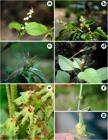
Croton pulegiodorus Baill. (Photo: A. Laurênio). a. Flowering branch. Croton sertanejus Sodré & M.J. Silva. (Photo: A. Laurênio). b. Flowering branch. Croton tricolor Klotzsch ex Baill. (Photo: A. Laurênio). c. Flowering branch. Croton triqueter Lam. (Photo: A. Laurênio). d. Flowering branch. e. sepals. e. sepals of chalice after fruit fall. Croton urticifolius Lam. (Photo: A. Laurênio). f. Staminate flowers. g. Pistillate flowers.
Monoecious subshrub (0.3–0.6 m high), stellate-porrect indumentum on vegetative and reproductive parts, alternate to pseudoverticillate leaves, with a pair of acropeciolar nectaries, leaf blade margins entire to sparsely serrate, inflorescences in continuous thyrse, pistillate flower with imbricate, white sepals, bifid styles, fruits globose to ovoid. The phyllotaxis, the long-stipitate acropeciolar nectaries and the white sepals (before pollination) on the pistillate flowers differentiate this from the other Croton species in the study area. In the field, the macerated leaves of C. pulegiodorus exude a strong odor similar to that of ‘mastruz’ (Dysphania ambrosioides (L.) Mosyakin & Clemants (Amaranthaceae).
Distribution, ecology and phenology: Species recognized as endemic to Brazil, occurring mainly in the Northeast region and in Minas Gerais in the Caatinga domain and also in the cerrado of the state of Goiás (Caruzo et al. 2024). In the Brejo de Altitude of Santa Cruz da Ba1ixa Verde and Triunfo, it is seen mainly in shaded places associated with arboreal vegetation, also occurring on rocky outcrops. It appears to have reproductive structures throughout the year, being recorded flowering from October to July and bearing fruit from November to April.
Material examined: BRAZIL. Pernambuco: Santa Cruz da Baixa Verde, Olho d’água, Serra da Madeira, 7°51’44” S, 38°10’31” W, 26.IV.2013, fl., fr., S.S. Matos 130 (HESBRA); Santa Cruz da Baixa Verde, Olho d’água, Serra da Madeira, 7°51’44” S, 38°10’31” W, 17.I.2013, fl., S.S. Matos et al. 56 (HESBRA); Santa Cruz da Baixa Verde, Olho d’água, Serra da Madeira, 7°51’44” S, 38°10’31” W, 17.I.2013, fl., S.S. Matos et al. 49 (HESBRA); Santa Cruz da Baixa Verde, Olho d’água, Serra da Madeira, 7°51’44” S, 38°10’31” W, 23.III.2013, fl., fr., S.S. Matos et al. 104 (HESBRA); Triunfo, Mata do Brejinho, 16.XI.2013, fl., A. Laurênio 3297 (HESBRA); Triunfo, near SESC, 17.VII.2014, fl., R.T. Rurtiodrigues et al. 6 (HESBRA); Triunfo, the road to SESC 27.X.2016, fl., Y. Rossine & A. Laurênio 11 (HESBRA); Triunfo, Mata do Carro Quebrado, 12.VI.2011, fl., A. Laurênio 3315 (HESBRA); Triunfo, Sítio Retiro, 21.III.2018, fl., Y. Rossine & A. Laurênio 82 (HESBRA); Triunfo, location not recorded, 6.II.2020, fl., fr., B. Leal et al. 101 (HESBRA).
18. Croton sertanejus Sodré & M.J. Silva, Eur. J. Taxon. 839: 16–24, f. 1–2. 2022. Fig. 10B.
Shrub (1.5–3 m tall) monoecious, stellate indumentum on vegetative and reproductive parts, entire leaf blade with 4-6 nectaries at the base, inflorescence in continuous thyrse, bifid styles, globose fruit and columella with three prominent apexes. Among the species in the study area, it resembles and is sometimes confused in the herborized material with another species (Croton heliotropiifolius) from the same section (Croton sect. Adenophylli Griseb.), which are differentiated by characteristics mentioned in the comments on the latter species.
Distribution, ecology and phenology: This species is endemic to the Caatinga, occurring in different physiognomies of the vegetation of the same name in the states of Bahia, Ceará, Paraíba, Pernambuco, Piauí and Sergipe in the Northeast and in Minas Gerais in the Southeast of Brazil (Sodré & Silva 2022). It was observed here in a lower altitude fragment of forest (ca. 700-900 m altitude), forming part of the woody component within the forests, sometimes forming large numbers of tillers, on predominantly clay soils with large rocky blocks and fragmented rocks.
Material examined: BRAZIL, Pernambuco: Santa Cruz da Baixa Verde, Olho d’água, Serra da Madeira, 26.IV.2013, fl., S.S. Matos et al. 148 (HESBRA).
Additional material examined: BRAZIL. Pernambuco: Serra Talhada, Parque Estadual Mata da Pimenteira, 21.III.2014, fr., E.P. Viturino & A.P.S. Gomes 1 (HESBRA); Serra Talhada, Serra Branca, 18.XI.2010, fl., R.S. Cordeiro 160 (HESBRA); Serra Talhada, Serra Branca, 12.I.2011, fl., R.S Cordeiro & A. Laurênio 206 (HESBRA). Serra Tahada, Experimental Station of IPA - Lauro Bezerra. Pimenteira, 07.VII.2010, fl., T.G.C. Menezes 99 (PEUFR).
Illustrations: Silva et al. (2010, as C. rhamnifolioides); Sodré & Silva (2022).
19. Croton tricolor Klotzsch ex Baill., Adansonia 4: 291. 1864. Fig. 10C
Shrub (2.0–3.5 m tall) monoecious, predominantly lepidote trichomes (see Gomes et al. 2018 for images of the trichomes of this species), silvery to rusty on the young branches, stipules, abaxial side of the leaf blade, inflorescence and fruit, leaves alternate, entire, eglandular, stipules lanceolate to auriculate, inflorescences in continuous thyrses, calyx of pistillate flowers valvar-reduplicate, stylets multifid, fruits ovoid to subspheroid. Its silvery to rusty lepidote indumentum, the eglandular leaves and the multifid styles differentiate this from the other Croton species in the study area. It belongs to the same section as C. blanchetianus and C. jacobinensis (Croton sect. Lasiogyne, van Ee et al. 2011, Rossine et al. 2023), from which it can be easily distinguished because of the predominantly silver to rusty indumentum of lepidote trichomes (sometimes interspersed with stellate-lepidote to dentate-lepidote trichomes) (vs. indumentum of stellate-rotate to stellate-lepidote trichomes, whitish, rarely yellowish, in C. blanchetianus and indumentum of stellate-lepidote trichomes, whitish, rarely yellowish, in C. jacobinensis). Croton blanchetianus and indumentum of stellate trichomes, whitish, in C. jacobinensis), because of the lanceolate to elliptical leaf blade (vs. ovate to ovate-lanceolate leaf blade in C. blanchetianus and cordiform in C. jacobinensis) and because of the elliptical to obovate calyx lobes of the pistillate flowers (vs. ovate to broad-ovate lobes in the other two species).
Distribution, ecology and phenology: Croton tricolor occurs disjunctly in Brazil, Colombia and Venezuela (Gomes 2006, Luján et al. 2015). In Brazil, it is found mainly in the Northeast, and in Minas Gerais in the Caatinga domain (mainly in upland forests), extending to transitional Caatinga-Cerrado areas and in the Atlantic Forest of the Southeast, Minas Gerais and Espírito Santo (Rossine et al. 2023). In the study area, it can be found in open areas such as clearings and on the edges of trails, as well as in the as in the understory, more arboreal and closed areas. It only seems to reproduce during the rainy season, being recorded flowering from January to July and bearing fruit from March to July.
Material examined: BRAZIL. Pernambuco: Santa Cruz da Baixa Verde, Olho d’água, Serra da Madeira, 7°51’45,30” S, 38°10’31” W, 21.II.2013, fl., M.J.F.B. Silva 2 (HESBRA); Santa Cruz da Baixa Verde, Olho d’Água, Serra da Madeira, 7°51’44” S, 38°10’31” W, 17.I.2013, fl., S.S. Matos et al. 64 (HESBRA); Santa Cruz da Baixa Verde, Olho d’Água, Serra da Madeira, 7°51’45,30” S, 38°10’31” W, 21.II.2013, fl., D.S. Eugênio et al. 1 (HESBRA); Santa Cruz da Baixa Verde, Olho d’Água, Serra da Madeira, 7°51’44” S, 38°10’31” W, 25.VII.2013, fl., fr., F.T. Gomes et al. 1 (HESBRA); Santa Cruz da Baixa Verde, Olho d’Água, Serra da Madeira, 7°51’45,30” S, 38°10’31” W, 24.I.2013, fl., M.G. Souza 2 (HESBRA); Santa Cruz da Baixa Verde, Olho d’Água, Serra da Madeira, 7°51’44” S, 38°10’31” W, 26.IV.2013, fl., S.S. Matos 146 (HESBRA); Santa Cruz da Baixa Verde, Serra da Madeira, 8°26’57,6” S, 37°27’3,7” W, 13.IV.2017, fl., fr., Y. Rossine et al. 23 (HESBRA); Santa Cruz da Baixa Verde, Serra da Madeira, 13.IV.2017, fl., Y. Rossine et al. 21 (HESBRA); Santa Cruz da Baixa Verde, Sítio Santo Antônio, 18.IV.2017, fl., fr., Y. Rossine et al. 26 (HESBRA); Triunfo, Mata do Brejinho, 14.VI.2013, fl., fr., A. Laurênio 3275 (HESBRA); Triunfo, Sítio Retiro, 21.III.2018, fl., fr., Y. Rossine et al. 76 (HESBRA); Triunfo, Sítio Retiro, 21.III.2018, fl., fr., Y. Rossine et al. 77 (HESBRA); Triunfo, Sítio Lagoa Nova, 28.II.1992, fl., E. Ferraz 115 (IPA); Triunfo, location unknown, 15.V.1971, fl., E.P. Heringer 929 (PEUFR).
Illustrations: Silva et al. (2010); Rossine et al. (2023).
20. Croton triqueter Lam., Encycl. 2: 214, 1786. Fig. 10D-E
Shrub (0.8–1.5 m tall) monoecious, stellate trichomes, whitish, yellowish on the vegetative parts and calyx of the pistillate flowers, sometimes black on the young branches, inflorescence and calyx of the pistillate flowers; alternate leaves, cordiform leaf blade, eglandular, slightly serrated margins, congested inflorescence, pistillate sepals unequal in size (3 large ones and two inconspicuous). This species can be easily identified by the presence of blackish trichomes (not always present), but mainly by the congested inflorescence, sepals of the pistillate flowers of markedly different sizes, three larger ones with lacerated margins and two smaller, inconspicuous, triangular ones.
Distribution, ecology, and phenology: This species has a South American distribution, occurring in Argentina, Bolivia, Brazil and Paraguay (Caruzo & Cordeiro 2007). In Brazil, it is distributed in the extra-Amazon region, in almost all the states of the Northeast (not recorded for Piauí yet), in all of the Southeast and South and in Mato Grosso do Sul, in the Midwest. It occurs in different vegetation formations, from the drier caatinga, where it is widely distributed, to the more humid rainforests and Ombrophilous forests. In the study area, it was observed in a clearing and an area of degraded vegetation at an altitude of 600-1000 m, on clayey soils, rich in litter and fragmented rocks.
Material examined: BRAZIL. Pernambuco: Triunfo, on the outskirts of Águas Parque, 7°50’05,14” S, 38°06’00,40” W, 4.VII.2024 (fl., fr.), A. Laurênio & D.G. Laurênio-Melo 4250 (HESBRA).
Additional material examined: BRAZIL. Pernambuco: Buenos Aires, 15.V.1999, fl., M.F.A. Lucena & M.I.B. Loiola 733 (PEUFR); Vitória de Santo Antão, Engenho Pombal, 3.III.1998, fl., A. Laurênio 1307 (PEUFR).
Illustration: Silva et al. (2010).
21. Croton urticifolius Lam., Encycl. 2: 219. 1786. Fig. 10 F-G
Shrub (1–2 m tall) monoecious, stellate indumentum, alternate to pseudoverticillate leaves, glandular fimbriate stipules, 2–4 acropeciolar nectaries, leaf blade ovate to cordiform, eglandular, serrate margins, glandular, inflorescence in continuous thyrse, often with 3 or 4 axes coming from the same point, styles multifid. This set of characteristics makes it easy to identify in the study area. In the field, the flowers exude an unpleasant smell and are visited by flies.
Distribution, ecology and phenology: The general geographic distribution of C. urticifolius is controversial, it is known that it is not endemic to Brazil, as stated by Caruzo et al. (2024), but the reference used by some articles published with Croton (Silva et al. 2010 a, Oliveira et al. 2023) mentions a course completion monograph as a reference (Lucena 2001, unpublished data) which mentions that the species occurs in Bolivia, Brazil, Guyana and Venezuela. Other studies state that the species is endemic to Brazil (Hurbath et al. 2016) or do not mention its general distribution (Silva et al. 2010 b). The latter two articles use Carneiro-Torres et al. (2009) as a reference. Analyzing collections from Species Link (www.specieslink.net), one can see images of at least one collection from Santa Cruz in Bolivia (no collector, n. 25671, UEC 53101) which is clearly of C. urticifolius. In POWO (2024), the species’ distribution is for Bolivia and Brazil. In Brazil, it is widely distributed in the Northeast (except Maranhão) and Southeast (except São Paulo) regions of Brazil, occurring in arboreal caatinga, deciduous forest and restinga (coastal forest) (Caruzo et al. 2024). In the study area, it is found on the edges and inside fragments of forest, often growing on rocky outcrops and compacted clay soils. It was observed flowering from January to February and bearing fruit between February and April, in June and in October.
Material examined: BRAZIL. Pernambuco: Santa Cruz da Baixa Verde, Olho d’água, Serra da Madeira, 7°51’44” S, 38°10’31” W, 17.I.2013, fl., S.S. Matos et al. 77 (HESBRA); Santa Cruz da Baixa Verde, Olho d’Água, Serra da Madeira, 7°51’45,30” S, 38°10’31” W, 24.I.2013, fl., S.L. Almeida 1 (HESBRA); Santa Cruz da Baixa Verde, Olho d’água, Serra da Madeira, 7°51’44” S, 38°10’31” W, 26.IV.2013, fl., fr., S.S. Matos 111 (HESBRA); Santa Cruz da Baixa Verde, Serra da Madeira, 13.IV.2017, fl., Y. Rossine et al. 23 (HESBRA); Santa Cruz da Baixa Verde, Sítio Santo Antônio, 7°51’47,1” S, 38°10’30,1 W, 18.IV.2017, fl., fr., Y. Rossine et al. 24 (HESBRA); Santa Cruz da Baixa Verde, Olho d’água, Serra da Madeira, 7°51’44” S, 38°10’31” W, 26.IV.2013, fl., fr., S.S. Matos 112 (HESBRA); Triunfo, Brejinho, 0°7’51’51” S, 38°07’48” W, 15.VI.2013, fr., S. S. Matos 191b (HESBRA); Triunfo, estrada de São João, near SESC, 27.X.2016, fr., E.L. Nunes 2 (HESBRA); Triunfo, Mata do Brejinho, 7°51’51” S, 38°07’48” W, 4.II.2013, fl., S.S. Matos et al. 102 (HESBRA); Triunfo, near Mata do Brejinho, 15.III.2014, fl., S.S. Matos et al. 401 (HESBRA); Triunfo, Sítio Laje, 6.II.2020, fl., fr., B. Leal & A. Laurênio 91 (HESBRA); Triunfo, Sítio Retiro, 21.III.2018, fl., fr., Y. Rossine & A. Laurênio. 79 (HESBRA); Triunfo, Sítio Retiro, 21.III.2018, fl., Y. Rossine & A. Laurênio 80 (HESBRA).
Illustrations: Silva et al. (2009, 2010).
22. Dalechampia brasiliensis Lam., Encycl. 2: 258. 1786. Fig. 11A
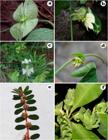
Dalechampia brasiliensis Lam. (Photo: R.A. Pereira-Silva). a. Pseudanthium. Dalechampia pernambucensis Baill. (Photo: A. Laurênio). b. Pseudanthium. c. Bracteal stipule deltoid. Dalechampia scandens L. (Photo: A. Laurênio). d. Pseudanthium. Euphorbia adenoptera Bertol. (Photo: A. Laurênio). e. Habit. Euphorbia comosa Vell. (Photo: A. Laurênio). f. Cyathium.
The Dalechampia species in the study area are very similar in general appearance, with all four belonging to D. sect. Dalechampia (Pereira-Silva et al. 2019). They are monoecious twining vinee with stinging trichomes on the branches, leaves and calyx of the pistillate flowers, 3-lobed leaves, pseudantial, bisexual, axillary inflorescence with two involucral, three-lobed bracts, staminate flowers in pleiocasium and pistillate flowers in cymules, lamellate resin glands located near the staminate pleiocasium. Dalechampia brasiliensis differs from the other species in all its characteristics: involucral bracts without papilliform glandular trichomes, linear bracteal stipules and a slightly lobed stigma.
Distribution, ecology and phenology: This species is endemic to Brazil and occurs in the extra-Amazon region in the Northeast, Southeast and Center-West in different vegetation types (Pereira-Silva 2019; Pereira-Silva et al. 2020). It is found both inland and on the edges of the Brejos de Altitude on clayey soils, sometimes growing in rocky areas, at altitudes of 600 to 1200 m. It flowers and bears fruit from February to June.
Material examined: BRAZIL. Pernambuco: Triunfo, sítio Laje, 6.II.2020, fl., B. Leal & A. Laurênio 97 (HESBRA); Triunfo, Mata do Brejinho, 14.VI.2013, fl., A. Laurênio 3279 (HESBRA).
Illustrations: Pereira-Silva et al. (2020 a, b).
23. Dalechampia pernambucensis Baill., Adansonia 5: 311. 1865. Fig. 11B-C
Easily differentiated from the other Dalechampia species studied from the upland forests because of its deltoid bracteal stipules, involucral bracts, often white (vs. green in the other species) with stipitate glandular trichomes and peltate stigma.
Distribution, ecology and phenology: The species occurs in Bolivia and Brazil (Pereira-Silva 2019). In the latter country, it is found in the extra-Amazonian portion, in the Northeast and Southeast regions in the Amazon, Atlantic and Caatinga domains (Pereira-Silva, 2020). In the study area, it was found on the edges of forest fragments, on clay soil rich in rocky outcrops, at approximately 700 to 1100 m above sea level. It flowers in February, March, April, July and August and bears fruit in the same months, with the exception of July.
Material examined: BRAZIL. PERNAMBUCO: Santa Cruz da Baixa Verde, Olho d’Água, Serra da Madeira, 7°51’44” S, 38°10’31” W, 25.VIII.2013, fl., fr., G.N.A. Júnior et al. 2 (HESBRA); Santa Cruz da Baixa Verde. Olho d’Água, Serra da Madeira, 7°51’44” S, 38°10’31” W, 21.II.2013, fl., A. Laurênio 4007 (HESBRA); Santa Cruz da Baixa Verde, Olho d’Água, Serra da Madeira, 7°51’44” S, 38°10’31” W, 26.IV.2013, fl, fr., S.S. Matos 152 (HESBRA); Santa Cruz da Baixa Verde, Serra da Madeira, 18.IV.2017, fr., B. Leal et al. 21 (HESBRA); Triunfo, Cachoeira do Pinga, 21.III.2018, fl., fr., B. Leal et al. 58 (HESBRA); Triunfo, on the way to Cachoeira do Pinga, 21.III.2018, fl., B. Leal et al. 46 (HESBRA); Triunfo, Lagoa Nova, 7.VI.1997, fl., A.M. Miranda et al. 2695 (HST); Triunfo, Sítio Laje, 6.II.2020, fl., fr., B. Leal & A. Laurênio 97 (HESBRA); Triunfo, location unknown, 27.VII.1996, fl., A.M. Miranda et al. 2452 (HST); Triunfo, location unknown, 10.III.1995, fl., A.M. Miranda 2118 (HST).
Illustrations: Pereira-Silva et al. (2020 a, b).
24. Dalechampia scandens L., Sp. Pl. 105: 219. 1753. Fig. 11D
This species is known because it has simple 3-lobed leaves, with stipules associated with nectary glands, 3-lobed involucral bracts with lanceolate bracteal stipules, crateriform stigma.
Distribution, ecology and phenology: A widely distributed species, from Mexico and Central America to Brazil and Paraguay in South America. In Brazil, only the Southern region has not been recorded as having it. It often occurs in open, sunny vegetation (Pereira-Silva 2019). In the study area, it is found on the edges of upland forests fragments and degraded areas, abandoned plantations, in clay soils and on rocky outcrops. It flowers in January, February, March, August and November and bears fruit in February, August and November.
Material examined: BRAZIL. PERNAMBUCO: Santa Cruz da Baixa Verde, Olho d’água, Serra da Madeira, 7°51’44” S, 38°10’31” W, 08.VIII.2013, fl., fr., A. Laurênio 3265 (HESBRA); Triunfo, Mata do Brejinho, 16.XI.2013, fl., fr., A. Laurênio 3285 (HESBRA); Triunfo, Mata do Brejinho, 16.XI.2013, fl., fr., A. Laurênio 3305 (HESBRA); Triunfo, Sítio Laje, 6.II.2020, fl., B. Leal & A. Laurênio 86 (HESBRA); Triunfo, Sítio Laje, 6.II.2020, fl., B. Leal & A. Laurênio 92 (HESBRA); Triunfo, Sítio Laje, 6.II.2020, fl., B. Leal & A. Laurênio 93 (HESBRA); Triunfo, Sítio Laje, 6.II.2020, fl., fr., B. Leal & A. Laurênio 96 (HESBRA); Triunfo, unknown location, 10.III.1995, fl., A.M. Miranda 2144 (HST); Triunfo, unknown location, 16.VI.1999, fl., F.V. Silva & A.M. Miranda 15 (HST).
Illustrations: Pereira-Silva et al. (2020 a, b).
25. Euphorbia adenoptera Bertol., Misc. Bot. 3: 20. 1844. Fig. 11E
Prostrate herb, white latex, opposite leaves, serrate margin, 4-5 cyathium glands with petaloid, asymmetrical appendages. This set of characteristics distinguishes E. adenoptera from other species in the study area.
Distribution, ecology and phenology: Widely distributed in the Neotropics, Mexico, Central America (including the Antilles) and South America (from Venezuela to Argentina) (Carneiro-Torres et al. 2017). In Brazil, it is found in the North, Northeast, Midwest and Southeast regions, in the Caatinga, Cerrado and Atlantic domains, growing in the Atlantic Forest, Brejo de Altitude, Caatinga and in anthropized areas (Silva et al. 2024). In the study area, it grows in degraded areas in compacted clay soils and gaps in the sidewalk, but it can also be seen in better preserved environments associated with rocky outcrops. It flowers and bears fruit in February, April, May and October.
Material examined: BRAZIL. Pernambuco: Triunfo, Brejinho, 7°51’51” S, 38°07’48” W, 15.IV.2013, fl., fr., S.S. Matos & A. Laurênio 186 (HESBRA); Triunfo, Mata do Brejinho, 25.IV.2016, fl., fr., A. Laurênio 3774 (HESBRA); Triunfo, Pico do Papagaio, 18.V.2015, fl., fr., A. Laurênio et al. 3754 (HESBRA); Triunfo, Sítio Laje, 6.X.2015, fl,, fr., J.A. Góis1 (HESBRA); Triunfo, síto Laje, 6.II.2020, fl., fr., C. Nogueira 48 (HESBRA).
Additional material examined: BRAZIL. Pernambuco: Serra Talhada, near Ramalhete, 11.I.2014, fl., fr., W. Cordeiro et al. 724 (HESBRA); Serra Talhada, Academic Unit of Serra Talhada, near the Pé de Serra restaurant, 27.V.2008, fl., fr., A. Laurênio 3002 (HESBRA); Serra Talhada, facing the UAST campus, 06.VI.2008, fl., fr., R.S. Cordeiro et al. 9 (HESBRA); Serra Talhada, facing the UAST campus, 30.V.2008, fl., fr., R.S. Cordeiro et al. 4 (HESBRA); Serra Talhada, UAST campus, 4.IV.2020, fl., fr., C. Nogueira et al. 41 (HESBRA); Serra Talhada, Area covered by the Mata da Pimenteira State Park, top of Serra Talhada, trail to Pedra do Urubu, 7.VI.2024, fl., fr., E.K. Menezes-Silva et al. 32 (HESBRA); Serra Talhada, Area covered by the Mata da Pimenteira State Park, top of Serra Talhada, F.S.S. Souza et al. 15 (HESBRA).
26. Euphorbia comosa Vell., Fl. Flumin. 5: 202, pl. 15. 1825. Fig. 11F
Erect subshrub (ca. 0.3–0.5 tall), succulent, white latex, entire alternate leaves, entire margin, cyathium arranged in terminal monochasium covered by imbricated bracts, green bracts, cyathium with 4–5 subreniform glands, prismatic seeds with circular caruncles. These morphological characteristics are common to E. heterodoxa Müll. Arg. However, E. comosa has a developed petiole between 7–30 mm long, 2 staminate flowers per cymule and laterally apiculate appendages. E. heterodoxa has a subsessile leaf with a 0.5-1 mm long petiole, 3–4 staminate flowers per cymule and non-apiculate appendages.
Distribution, ecology and phenology: It is only found in South America, in Brazil, Colombia and Venezuela (Carneiro-Torres et al. 2017). It occurs in most of Brazil, in the phytogeographic domains of the Amazon, Atlantic Forest, Caatinga and Cerrado. It can be found in the Anthropic Area, Campo Limpo and Carrasco (Silva et al. 2024). In the study area, it occurs mainly in anthropogenic areas and on the edges of fragments of forests, usually on compact clay, sandy clay and sandy soils, sometimes on rocky outcrops. It flowers and bears fruit between March and August.
Material examined: BRAZIL, Pernambuco: Santa Cruz da Baixa Verde, Olho d’Água, Serra da Madeira, 7°51’44” S, 38°10’31” W, 26.IV.2013, fl., S.S. Matos 142 (HESBRA); idem, 03.VIII.2013, fl., fr., L. Maciel-Júnior 8 (HESBRA); Santa Cruz da Baixa Verde, Olho d’Água, Serra da Madeira, 7°51’44” S, 38°10’31” W, 8.VIII.2013, fl., fr., Y.A.P. Albuquerque 5; Triunfo, Brejinho, 7°51’51” S, 38°07’48” W, 15.VI.2013, fl., S.S. Matos & A. Laurênio 207 (HESBRA); Santa Cruz da Baixa Verde, Sítio Santo Antônio, 18.IV.2017, fl.,fr., B. Leal et al. 23 (HESBRA); Santa Cruz da Baixa Verde, Sítio Santo Antônio, 18.IV.2017, fl.,fr., B. Leal et al. 24 (HESBRA); Triunfo, Carro Quebrado, 17.VI.1999, fl., fr., A.M. Miranda & F.V. Silva 3519 (HST); Triunfo, Lagoa Nova, 10.III.1995, fl., A.M. Miranda & M.F.O. Pires 2132 (HST); Triunfo, Pico do Papagaio, 16.III.2010, fr., A.P. Fontana et al. 6535 (HVASF); Triunfo, Sítio Santa Rita, near the Pico do Papagaio, 15.VII.2010, fl., J.A. Siqueira-Filho & A.P. Fontana 2369 (HVASF); Triunfo, próximo ao SESC, 28.III.2015, fl., E.H. Sá-Júnior 60 (HESBRA).
Illustration: Carneiro-Torres et al. (2017).
27. Euphorbia heterodoxa Müll. Arg., Fl. Bras. 11(2): 701. 1874. Fig. 12A-C

Euphorbia heterodoxa Müll. Arg. (Photo: A. Laurênio). a. Habit. b. Imbricated bracts protecting the cyathium. c. Cyathium. Euphorbia heterophylla L. (Photo: A. Laurênio). d. Fruiting branch. Euphorbia hirta L. (Photo: A. Laurênio). e. Cyathium glomerulus. Euphorbia hyssopifolia L. (Photo: A. Laurênio). f. Habit. g. Inflorescence.
Erect subshrub (ca. 0.3–1.0 m tall), succulent, white latex, entire alternate leaves, short-petiolate (petiole 0.5–1 mm long) or sessile, margin of leaf blade entire, cyathium arranged in terminal monochasium covered by imbricate bracts, green bracts, appendages of the cyathium subreniform, prismatic seeds with circular caruncle. It resembles and is often confused with E. comosa, and the distinctive characteristics between the two are discussed in the comments on the latter species.
Distribution, ecology and phenology: Endemic to Brazil, with a confirmed occurrence in the Northeast region, in the states of Alagoas, Bahia, Paraíba, Pernambuco and Sergipe, occurring only in the Caatinga phytogeographic domain, in rupestrian grassland vegetation and is associated with Carrasco rocky outcrops (Silva et al. 2024). It is found in the municipality of Triunfo in areas with a high altitude of between 700-1200 m, always in rupicolous formations, growing in the cracks in the rocks. Its flowers in February, May, July, August and October.
Material examined: BRAZIL. Pernambuco: Triunfo, the road to SESC, 27.X.2016, fl., Y. Rossine & A. Laurênio 8 (HESBRA); Triunfo, Pico do Papagaio, 18.V.2015, fl., fr., A. Laurênio et al. 3759 (HESBRA); Triunfo, Pico do Papagaio, 16.III.2010, fr., A.P. Fontana 6535 (HVASF); Triunfo, near SESC, 28.III.2015, fr., E.H. Sá-Júnior 61 (HESBRA); Triunfo, Sítio Laje, 8.VIII.2017, fl., J.I.S. Lima 29 (HESBRA); Triunfo, Sítio Laje, 6.II.2020, fl., fr., C. Nogueira et al. 45 (HESBRA); Triunfo, Sítio Laje, 6.II.2020, fl., C. Nogueira et al. 46 (HESBRA); Triunfo, Sítio Santa Rita, near Pico do Papagaio, 15.VII.2010, fl., J.A. Siqueira Filho 2369 (HVASF).
Illustration: Carneiro-Torres et al. (2017).
28. Euphorbia heterophylla L., Sp. Pl. 1: 453. 1753. Fig. 12D
Erect subshrub (ca. 0.1–1.0 m tall), succulent, white latex, entire alternate leaves, very variable leaf blade shape, from elliptical, obovate to pandurate, entire margin, cyathium with only one gland, no appendix. These characteristics of the cyathium are not found in any other species in the study area, which therefore makes it easy to identify E. heterophylla.
Distribution, ecology and phenology: Widely distributed in the tropical and subtropical regions of the globe (POWO, 2024). In Brazil, it occurs in all regions, in the Amazon and Caatinga domains, in anthropogenic areas (Silva et al. 2024). In Santa Cruz da Baixa Verde and Triunfo, it can be seen both on the edges of forest fragments and in rupicolous formations, as well as in cultivated areas and urban environments, growing in vacant lots and the cracks in sidewalks. It is found in different types of soil and at altitudes ranging from 600 to 1200 m in the study area. It flowers and bears fruit from March to August.
Material examined: BRAZIL. Pernambuco: Santa Cruz da Baixa Verde, Sítio Santo Antônio, 18.IV.2017, fl., fr., B. Leal & A. Laurênio 22 (HESBRA); Triunfo, Brejinho, 7°51’51” S, 38°07’48” W, 15.VI.2013, fl., fr., S.S. Matos & A. Laurênio 197 (HESBRA); Triunfo, Pico do Papagaio, 18.V.2015, fr., A. Laurênio et al. 3756 (HESBRA); Triunfo, Pico do Papagaio, 18.V.2015, fr., A. Laurênio et al. 3757 (HESBRA); Triunfo, the outskirts of the town, 16.VI.1999, fl., fr., A.M. Miranda & F.V. Silva 3510 (HST); Triunfo, Lagoa Nova, 10.III.1995, fr., A.M. Miranda & M.F.O. Pires 2123 (HST); Triunfo, Lagoa Nova, 10.III.1995, fl., A.M. Miranda & M.F.O. Pires 2131 (HST); Triunfo, Lagoa do Mariano, 30.IV.1996, fr., A.M. Miranda et al. 2372 (HST); Triunfo, near SESC, 7°50’26,76” S, 38°06’22,21” W, 3.VIII.2017, fl., fr., T. A. Silva 1 (HESBRA).
Illustration: Carneiro-Torres et al. (2017).
29. Euphorbia hirta L., Sp. Pl. 1: 454. 1753. Fig. 12E
Erect or decumbent herb (0.2–0.4 m tall), opposite, unlobed leaves, serrate margin, densely arranged cyathium glomerulus. It resembles E. ophtalmica in terms of the general shape of the leaves and the arrangement of the cyathium, but they differ in that the latter species has a prostrate habit and cyathium glomerulus concentrated only at the terminal nodes of the branches (vs. cyathium glomeruli at terminal and non-terminal nodes in E. hirta).
Distribution, ecology and phenology: It has an extensive distribution in the tropical and subtropical regions of the globe (POWO, 2024). In Brazil, it is distributed in all phytogeographic domains, occurring widely in anthropized areas (Silva et al. 2024). It occurs on the edges of Brejos de Altitude, in clayey and stony soils and in urban areas, in gaps in streets and sidewalks and as an invader of various crops. It was collected when flowering and bearing fruit in April.
Material examined: BRAZIL. Pernambuco: Triunfo, Mata do Brejinho, 25.IV.2016, fl., fr., A. Laurênio 3775 (HESBRA). Triunfo, near SESC, 27.X.2016, fl., fr. B. Leal & A. Laurênio 11 (HESBRA).
Illustration: Carneiro-Torres et al. (2017).
Additional material examined: BRAZIL. Pernambuco: Afrânio, BR 407, leaving the town of Afrânio, a township of Caboclo, 28.VII.2012, fl., R.F. Duarte 36 (HVASF); Petrolina, Núcleo 2, Projeto Senador Nilo Coelho, 24.XII.2022, fl., E. O. Guimarães 2 (HVASF); Serra Talhada, Coverage area of the Mata da Pimenteira State Park, top of Serra Talhada, 17.V.2023, fl., F.S.S. Souza et al. 16 (HESBRA); Serra Talhada, UAST Campus, there are 200 m of classroom buildings, base of Serra Talhada, 21.V.2010, fl., G.P. Silva 92 (HESBRA); Serra Talhada, UAST campus, there are 200 m of classroom buildings, base of Serra Talhada, 22.III.2010, fl., G. P. Silva & A. Laurênio 39 (HESBRA); Serra Talhada, Mata da Pimenteira State Park, Lagoa Pimenteira II, 29.IX.2011, W. Cordeiro & S. S. Matos 91; Sertânia, east axis of the Project of Integration of the São Francisco River (PISF), 17.VII.2013, fl., J.R. Fabricante 180 (HVASF).
Illustration: Carneiro-Torres et al. (2017).
30. Euphorbia hyssopifolia L., Syst. Nat. (ed. 10) 2: 1048. 1759. Fig. 12F-G
Erect or decumbent herb (0.01–0.8 m tall), leaves opposite, entire, margin entire or slightly serrate, cyathium loosely arranged, in pairs or in small dichasium. It can be distinguished from the other species in the study area because it has foliaceous bracts, cyathium in axillary dichasium at the ends of the branches, with 4-5 glands, each with a white or pink petaloid appendage.
Distribution, ecology and phenology: This species is found in tropical and subtropical regions of the world (POWO, 2024). In Brazil, it has a wide distribution and has been recorded in all regions and phytogeographic domains, in anthropogenic areas (Silva et al. 2024). In the study area, it is found mainly in open and rupicolous areas, on the edges of fragments of forest, occasionally in clearings, on rocky outcrops and in sandy and clayey soils. It is also an invader of sidewalks and vacant lots in urban areas and of various crops in rural areas. It seems to flower all year round, with blooms recorded in February, April, May, June and October and bears fruit in February, May, June and October.
Material examined: BRAZIL. Pernambuco: Santa Cruz da Baixa Verde, Olho d’Água, Serra da Madeira, 26.IV.2013, fl., S.S. Matos 142 (HESBRA); Triunfo, outskirts of the town, 16.VI.1999, fl., fr., A.M. Miranda & F.V. Silva 3511 (HST); Triunfo, Pico do Papagaio, 18.V.2015, fl., fr., A. Laurênio et al. 3754 (HESBRA); Triunfo, near SESC, 27.X.2016, fl., fr., B. Leal & A. Laurênio 10 (HESBRA); Triunfo, Sítio Laje, 6.II.2020, fl., fr., C. Nogueira et al. 43 (HESBRA); Triunfo, Sítio Laje, 6.II.2020, fl., fr., C. Nogueira et al. 44 (HESBRA).
Illustration: Carneiro-Torres et al. (2017).
31. Euphorbia ophthalmica Pers., Syn. Pl. 2(1): 13. 1807. Fig. 13A

Euphorbia ophthalmica Pers. (Photo: A. Laurênio). a. Habit. Euphorbia prostrata Aiton. (Photo: A. Laurênio). b. Fruit. c. Pistillate flower. Jatropha mollissima (Pohl) Baill. (Photo: A. Laurênio). d. Staminate flowers. e. Pistillate flowers. f. Fruit.
Prostrate herb (branches ca. 0.08–0.1 m tall), opposite leaves entire, serrate margin, ciathium in glomerular arrangement. Easily confused with E. hirta, from which it differs in aspects presented in the comments on the latter species.
Distribution, ecology and phenology: It is distributed from North America to South America (POWO, 2024). In Brazil, E. ophthalmica has confirmed records for the Midwest, Southeast and South regions (Silva et al. 2024). According to Silva et al. (2024), it may occur in other regions and states of the country, thus confirming its presence in the Northeast. It is not as widely distributed as E. hirta in the study area, being seen only on the edges of some forests and in anthropogenic areas, on bare, clayey and compacted soil. It flowers and bears fruit in April and July.
Material examined: BRAZIL. Pernambuco: Triunfo, Mata do Brejinho, 25.IV.2016, fl., fr., A. Laurênio 3782 (HESBRA); Triunfo, wood near SESC, 7°50’26,76” S, 38°06’22,21” W, 5.VII.2018, fl., fr., A. Andrade 9 (HESBRA); Triunfo, in the area surrounding the SESC hotel, 17.VII.2014, fl., fr., R.F. Jardim 1 (HESBRA).
32. Euphorbia prostrata Aiton., Hort. Kew. 2: 139. 1789. Fig. 13B-C
Prostrate herb (branches ca. 0.05–0.15 m tall), opposite leaves entire, margin of the leaf blade partially serrate, cyathium solitary or in pairs. Euphorbia prostrata has a cyathium involucre with trichomes restricted to the apical portion, while on the ovary and fruit, the trichomes are arranged along the dehiscence lines of the valves. The species may have a vinaceous coloration on the branches and petioles, and greyish-green leaves, helping to identify it among other species in the genus.
Distribution, ecology and phenology: This species is widely distributed in tropical and subtropical regions of the globe (POWO 2024). It may occur throughout Brazil as a species of anthropogenic areas (Silva et al. 2020b). It occurs on the edges of the upland forests , growing in beaten clay soil and in sidewalk cracks, at altitudes of 400-1200 m. It flowers and bears fruit in April, August and October.
Material examined: BRAZIL. Pernambuco: Triunfo, Mata do Brejinho, 25.IV.2016, fl., fr., A. Laurênio et al. 3773 (HESBRA); idem, Sítio Laje, 08.VIII.2017, fl., fr., J.I.S. Lima 36 (HESBRA); Triunfo, Sìtio Laje, 6.X.2015, fl., fr., T.L. Ramalho 1 (HESBRA).
Illustration: Carneiro-Torres et al. (2017).
33. Jatropha mollissima (Pohl) Baill. Adansonia 4: 268. 1864. Fig. 13D-F
Shrub (2–4 m tall), alternate leaves, lobed, serrate margin, dichasial inflorescence, dichlamid flowers, yellow or red corolla. It is easily identified by its shrubby size, abundant translucent latex, simple indumentum, lobed leaf blade with serrated margins, compound dicentric inflorescence, fimbriate-glandular stipules and bracts, diclamide staminate and pistillate flowers and fruit with prominences at the septum junction.
Distribution, ecology and phenology: It occurs in Brazil, Bolivia and Venezuela (Dehgan, 2012). In Brazil, it is recorded in all the states of the Northeast, Minas Gerais (Southeast), the Midwest and the North (Tocantins), in the Caatinga, Cerrado and Amazon domains, occurring in caatinga and cerrado vegetation and in anthropized areas. In the study area, it is found occasionally, being observed on the edges of forest fragments in clay soils or on rocky outcrops.
Material examined: BRAZIL. Pernambuco: Triunfo, Sítio Coroas, 7°51’06” S, 38°08’27” W, 24.V.2023, fl., fr., A. Laurênio & A.L.A. Lima 4196 (HESBRA).
Additional material examined: BRAZIL. Pernambuco: Serra Talhada, Experimental Station of IPA - Lauro Bezerra, Pimenteira, 07.VII.2010, fl., T.G.C. Menezes 91 (HESBRA); Serra Branca, 09.VII.2010, fr., R.S. Cordeiro 134 (HESBRA); Parque Estadual Mata da Pimenteira State Park, 10.IV.2014, fl., C. Pessoa 179 (HESBRA); Mata da Pimenteira State Park, 29.III.2012, fr., R.B. Souza et al. 2 (HESBRA); Mata da Pimenteira State Park, 12.III.2012, fl., fr., R. Melo & S. S. Matos 52 (HESBRA); Serra Branca, 23.IX.2010, fl., R. S. Cordeiro & G. M. S. Souza 145 (HESBRA).
Illustration: Sátiro & Roque (2008).
34. Manihot carthagenensis (Jacq.) Müll. Arg., Prodr. 15(2): 1073. 1866. Fig. 14A-C

Manihot carthagenensis (Jacq.) Müll. Arg. (Photo: A. Lima). a. Staminate flowers. b. Pistillate flowers. c. fruit with prominences at the septum junction. Microstachys corniculata (Vahl) Griseb. d. Inflorescence. Sapium argutum (Müll.Arg.) Huber. (Photo: A. Laurênio). e. Inflorescence. Tragia cearensis Pax & Hoffm. in Engl (Photo: A. Laurênio). f. Flowering and fruiting branch. Tragia volubilis L. (Photo: W. Cordeiro). g. Flowering branch.
Shrub or tree 1–5 m tall, colorless (hyaline) to whitish latex, 3–5-lobed, glabrescent leaves, simple trichomes, no nectaries, dichacial inflorescences, monochlamydeous flowers, interstaminal nectar disc, not ribbed capsules. This set of characteristics allows easy identification of the species in the study area.
Distribution, ecology and phenology: It occurs in Brazil, Caribbean, Venezuela and Colombia (POWO, 2024). In Brazil, it occurs in the North (Amazonas, Pará), Southeast (Minas Gerais), Northeast (Alagoas, Bahia, Maranhão, Paraíba, Pernambuco, Piauí, Rio Grande do Norte, Sergipe) regions in the Amazon, Caatinga and Cerrado domains, growing in caatinga vegetation (stricto sensu), semideciduous seasonal forest and Ombrophilous forest (Martins et al. 2024). It is frequently found on rocky outcrops in the internal areas of forest fragments. However, it can be part of the woody component of vegetation in drier Brejo de Altitude, generally located at lower altitudes. It flowers in January, March and bears fruit in March and April.
Material examined: BRAZIL. Pernambuco: Santa Cruz da Baixa Verde, Olho d’Água, Serra da Madeira, 7°51’45,30” S, 38°10’31” W, 24.I.2013, fl., R.L. Almeida 2 (HESBRA); Triunfo, Cachoeira do Pinga, 21.III.2018, fl., fr., Y. Rossine et al. 73 (HESBRA); Triunfo, Cachoeira do Pinga, 21.III.2018, fl., Y. Rossine et al. 84 (HESBRA); Triunfo, near the Mata do Brejinho, 15.III.2014, fl., fr., S.S. Matos et al. 409 (HESBRA); Triunfo, Pico do Papagaio, 16.III.2010, fr., A.P. Fontana 6537 (HVASF); Triunfo, Sítio Lagoa Nova, 19.IV.1992, fr., E. Ferraz 141 (IPA, PEUFR); Triunfo, Sítio Retiro, 21.III.2018, fl., Y. Rossine & A. Laurênio 75 (HESBRA).
35. Microstachys corniculata (Vahl) Griseb., Fl. Brit. W. I. 49. 1864. Fig. 13D
Herb or subshrub 10–80 cm tall, with little latex, simple trichomes, simple leaves with slightly serrated margins, nectaries on the underside (flat) and on the margins of the leaf blade, exclusively staminate inflorescence with a spiciform thyrses, pistillate flowers isolated on branches close to the staminate inflorescence, fruit with about 12 cornicles, carunculate seeds. Due to these characteristics, it is easily recognizable and cannot be confused with any other species in the study area.
Distribution, ecology and phenology: Species with Neotropical distribution, from Mexico to Argentina (including the Antilles). In Brazil, it occurs in all regions and phytogeographic domains in different non-forest vegetation types – caatinga, cerrado, rocky fields and restingas (Cordeiro et al. 2024). In the study area, the species is observed on the edges of forest fragments, often in sandy-clayey soils and on rocky outcrops. It flowers and bears fruit in February and May.
Material examined: BRAZIL. Pernambuco: Triunfo, the road to Pico do Papagaio, 18.V.2015, fl., fr., A. Laurênio 3744 (HESBRA); Triunfo, Sítio Laje, 6.II.2020, fl., fr., C. Nogueira 48 (HESBRA).
Additional material examined: BRAZIL. Pernambuco: Floresta, Transposition Project of the São Francisco, Lote 09, Reservatório Areias, 14.III.2011, fl., fr., M. Oliveira 10931 (HVASF); Serra Talhada, Top of Serra Talhada, 25.IV.2017, fl., fr., B. Leal et al. 42 (HESBRA); Serra Talhada, top of Serra Talhada, near the antennae, 02.VI.2016, fl., V.L.C. Pereira 8 (HESBRA); Tapera, IV.1927, fl., fr., D. Bento Pickel 1263 (IPA).
Illustrations: Santos & Sales (2009).
36. Sapium argutum (Müll.Arg.) Huber, Bull. Herb. Boissier, sér. 2, 6: 439, f. 31. 1760. Fig. 13E
Tree ca. 2–8 m tall with abundant white latex, glabrous, simple leaves with nectaries at the apex of the petiole (conical) and in the teeth of the leaf blade margin, thyrses-spiform inflorescence with nectaries at the outer base of the bracteoles, seeds with red aril. These characteristics distinguish it from all others found in the study area.
Distribution, ecology and phenology: Sapium argutum occurs in Bolivia, Brazil, French Guiana and Suriname (Kruijt 1996, Esser 2014). In Brazil, the species is found in the Northeast (Alagoas, Bahia, Ceará, Paraíba, Pernambuco and Piauí), North (Pará and Tocantins) and Southeast (Minas Gerais) (Cordeiro et al. 2018). In the study area, it was observed inside the forest fragments as a woody component of the tree community where it reaches about 7 or 8 m high, but it is also seen as a small tree (2–4 m high) growing between cracks in large rocky outcrops. It flowers and bears fruit from November to April.
Material examined: BRAZIL. Pernambuco: Santa Cruz da Baixa Verde, Olho d’Água, Serra da Madeira, 7°51’45,30” S, 38°10’31” W, 24.I.2013, fl., H.S.D. Vasco 1 (HESBRA); Santa Cruz da Baixa Verde, Olho d’Água, Serra da Madeira, 7°51’45,30” S, 38°10’31” W, 21.II.2013, fr., C.M.P.G. Souza 3 (HESBRA); Santa Cruz da Baixa Verde, Olho d’Água, Serra da Madeira, 7°51’45,30” S, 38°10’31” W, 24.I.2013, fl., P.C. Almeida 2 (HESBRA); Santa Cruz da Baixa Verde, Santa Cruz da Baixa Verde, Olho d’Água, Serra da Madeira, 7°51’44” S, 38°10’31” W, 4.IV.2014, fr., C. Pessoa 158 (HESBRA); Santa Cruz da Baixa Verde, Olho d’Água, Serra da Madeira, 7°51’44” S, 38°10’31” W, 17.I.2013, fl., S.S. Matos et al. 72 (HESBRA); Santa Cruz da Baixa Verde, Santa Cruz da Baixa Verde, Olho d’Água, Serra da Madeira, 7°51’44” S, 38°10’31” W, 26.IV.2013, fr., S.S. Matos 150 (HESBRA); Triunfo, estrada para Santa Cruz, Fazenda Bom Jesus, 26.II.1986, fr., F. Gallindo & V.C. Lima 95 (IPA); Triunfo, Mata do Brejinho, 25.IV.2016, fl., fr., A. Laurênio 3781; Triunfo, near SESC, 7°50’26,76” S, 38°06’22,21” W, 20.X.2016, fl., G.A.C. Silva 1 (HESBRA); Triunfo, Sítio Lagoa Nova, 17.I.1992, fl., E. Ferraz 65 (IPA, PEUFR); Triunfo, Sítio Lagoa Nova, 4.XI.1992, fl., E. Ferraz 221 (IPA); Triunfo, Sítio Laje, 15.XI.2014, fl., A. Laurênio 3101 (HESBRA); Triunfo, Sítio Laje, 6.X.2015, fl., fr., Y. Rossine 3 (HESBRA); Triunfo, Sítio Laje, 6.II.2020, fl., fr., C. Nogueira 42 (HESBRA); Triunfo, Sítio Laje, 6.II.2020, fl., fr., C. Nogueira 49 (HESBRA); Triunfo, Sítio Laje, 6.II.2020, fl., fr., C. Nogueira 50 (HESBRA); Triunfo, Timbaúba, 16.XI.1998, fl., A.M. Miranda 3052 (HST).
Illustrations: Santos & Sales (2009); Cordeiro et al. (2018).
37. Tragia cearensis Pax & K. Hoffm. in Engl., Pflanzenr. IV. 147 XVI I (Heft 85): 186. 1924. Fig. 13F
Climbing vine with stinging and glandular trichomes, simple, toothed leaves, flowers in unbranched thyrses. It resembles Tragia volubilis with which it shares the general appearance, but is distinguished by its long-stipated glandular trichomes located at the base of the leaves and apex of the petioles (vs. absent in T. volubilis) and by the shorter pedicel length (0.2 mm long, vs. 1.6–6.0 mm long) of the pistillate flower.
Distribution, ecology and phenology: Species found in Brazil and Guyana (Cordeiro et al. 2020). In Brazil, it is restricted to the Northeast region, being found in the caatinga and Brejo de Altitude vegetation (Santos et al. 2019; Cordeiro et al. 2021). In the study area, it is found on the edges and in the understory of forest fragments. It flowers and bears fruit in July.
Material examined: BRAZIL. Pernambuco: Santa Cruz da Baixa Verde, Olho d’Água, Serra da Madeira, 25.VII.2013, fl., fr., S.S. Matos 261 (HESBRA).
Additional material examined: BRAZIL. Pernambuco: Acadmic Unit of Serra Talhada, near the Pé de Serra restaurant, 27.V.2008, fl., fr., A. Laurênio 3001 (HESBRA); Serra Talhada, facing the UAST campus, 06.VI.2008, fl., fr., A. Laurênio et al. 3008 (HESBRA); Serra Talhada, Serra Branca, 13.07.2011, fl., A. Laurênio et al. 3217 (HESBRA); Serra Talhada, upward slope of Serra Talhada behind UAST, 07.V.2013, fl., A. Laurênio et al. 3705; Serra Talhada, Coverage area of the Mata da Pimenteira State Park, top of Serra Talhada, trail to Pedra do Urubu, 7°57’13” S, 38°19’09” W, 7.VI.2024, fl., fr., E.K. Menezes-Silva et al. 29 (HESBRA).
Illustrations: Santos et al. (2019), Cordeiro (2021).
38. Tragia volubilis L., Sp. Pl. 2: 980. 1753. Fig. 13G
Climbing vine with stinging trichomes, simple, serrated leaves, flowers in unbranched thyrses. It resembles Tragia cearensis with which it shares the general appearance but is distinguished by the characteristics presented in the commentary on the last species.
Distribution, ecology and phenology: It is distributed in the Neotropical region, from the United States to Mexico, and in Africa, where it appears to be introduced (Romero & Sanguinetti 1989). It has been recorded throughout Brazil, except in Amapá, Pará and Roraima, occurring in different types of vegetation (Secco et al. 2024), especially on the edges of forest fragments (including Brejos de Altitude) and also in anthropic areas and rocky outcrops (Cordeiro et al. 2021). In the study area, it is rarely observed, in understory rich in rock fragments. It flowers in February, March and April and bears fruit in February.
Material examined: BRAZIL. Pernambuco: Triunfo, mata near SESC, 17.VII.2014, fl., R.T. Rodrigues et al. 1 (HESBRA); Triunfo, mata near SESC, 7°50’26,76” S, 38°06’22,21” W, 3.VIII.2017, fl., L.A.S. Barreto 1 (HESBRA); Triunfo, near Mata de Brejinho, 15.III.2014, fl., S.S. Matos et al. 418 (HESBRA); Triunfo, locaion unknown, 6.II.2020, fl., fr., B. Leal et al. 100 (HESBRA).
Illustrations: Santos et al. (2019), Cordeiro (2021).
Discussion
Bernardia tamanduana and Bia lessertiana are distributed Pernambuco, especially in Brejos de Altitude and in the Atlantic Forest. Cnidoscolus halteris Fern.-Casas is found only in Pernambuco and Paraiba and is mainly related to rocky outcrops on the edges of Brejos de Altitude. Euphorbia heterodoxa Müll. Arg. is also associated with rocky outcrops often related to these forests. In Pernambuco, all these species mentioned above are distributed in a few areas and need to have their conservation status assessed in the State so that local public authorities can take protective measures for these and other species that are in the same situation. Although the present study deals exclusively with Euphorbiaceae, these data highlight the importance of preserving the Brejos de Altitude, especially the fragments that are in the “Sertão” of the State of Pernambuco, which are surrounded by hyperxerophilic Caatinga and represent refuges with milder temperatures for the fauna and flora and protect water sources, especially springs. Along with the Serra Negra Biological Reserve (Rebio Serra Negra) located between the municipalities of Floresta, Inajá and Tacaratu, the Brejos de Altitude of Santa Cruz da Baixa Verde and Triunfo are some of the westernmost fragments of this formation in the Northeast but they are not yet protected by conservation units.
In recent decades, several generalist floristic surveys have been carried out in different Brejos de Altitude in the Northeast finding in Northeast between four and 20 species and between two and 12 genera of Euphorbiaceae in these studies. (Ferraz et al. 1998, Rodal & Nascimento 2002, Lourenço & Barbosa 2003, Agra et al. 2004, Barbosa et al. 2004, Rodal & Sales 2007, Cardoso et al. 2009, Lima et al. 2009, Araújo et al. 2011, Machado et al. 2012, Nascimento et al. 2012). The richness of taxa found in the present work (14 genera and 38 species) may reveal that taxonomic treatments are more attentive in determining species and genera as they are developed by specialists. On the other hand, it may suggest that these formations of more inland Brejos de Altitude present a greater number of Euphorbiaceae taxa due to the environment itself, which is less humid than other Brejos de Altitude located closer to the Atlantic Forest. Euphorbiaceae is a taxon from dry formations and one of the most species-rich families in surveys in caatinga sensu stricto (Fernandes & Queiroz, 2008). Among the surveys above, some that presented the largest number of species were carried out in Pico do Jabre (19 spp., Agra et al. 2004) and in Rebio Serra Negra (12 spp., Rodal & Nascimento 2002), both located in the semi-arid region where hyperxerophilic caatinga predominates in the surrounding area. Other areas of the Caatinga domain presented relatively high numbers of Euphorbiaceae because they are territorially comprehensive and are floristic-vegetation complexes with different formations involved, as can be seen in the studies by Athiê-Souza et al. (2019) in the Vale do Catimbau National Park, located in the municipalities of Buíque, Ibimirim, Sertânia and Tupanatinga (Pernambuco), with 12 genera and 39 species, and by Hurbarth et al. (2016) in Serra Geral, municipality of Licínio de Almeida (Bahia), with 13 genera and 48 species.
The study by Ferraz et al. (1998) was the unique floristic survey carried out in Santa Cruz da Baixa Verde and Triunfo, bringing seven species of Euphorbiaceae, most with incomplete or outdated identification. However, using the collector number, it was possible to retrieve the exsiccates in the IPA and PEUFR Herbaria and make a new determination, recognizing Bernardia tamanduana (E. Ferraz 39), Croton heliotropiifolius Kunth (E. Ferraz 240), C. tricolor Klotzsch ex Baill. (E. Ferraz 115), Jatropha mollissima (Pohl) Baill. (E. Ferraz 230), Manihot carthagenensis (Jacq.) Müll. Arg. (E. Ferraz 141) and Sapium argutum (Müll. Arg.) Huber (E. Ferraz 65). The E. Ferraz 205 collection currently refers to a Phyllanthaceae. Thus, it was an addition of 35 species to the knowledge of the Euphorbiaceae flora in the Brejos de Altitude studied.
Regarding the distribution of species in the Brejos de Altitude studied, it was found that some are part of the woody component of these formations, especially those fragments that have a drier aspect, such as Croton sertanejus, Jatropha mollissima, Manihot carthagenensis and Sapium argutum and can also be found in open areas, especially on large rocky outcrops. On the other hand, Acalypha brasiliensis, A. radicans, Argythamnia desertum, Astraea digitata, Bernardia tamanduana, Bia lessertiana, Croton pulegiodorus, C. tricolor, Tragia cearensis and T. volubilis are small shrubs, subshrubs or vines observed in the understories of forests. Acalypha pruriens, Euphorbia heterodoxa and Cnidoscolus halteris were only observed associated with rocky outcrops. The other species are widely distributed mainly in open and sunny areas, often degraded, sometimes as ruderals or invaders of crops and sidewalks.
Some species are rare in the areas studied, such as Bernardia tamanduana, Bia lessertiana, Cnidoscolus halteris and Croton triqueter, which were found in two in one or two localities, forming small populations.
According to Silva et al. (2024), Euphorbia ophtalmica has been recorded in the Center-West, Southeast and South of Brazil and has possible occurrences in the North and Northeast, and the present study confirms the presence of the species in the Northeast for the first time.
In addition, Pereira-Silva et al. (2020 a, b) mention Dalechampia stipulacea for Pernambuco, municipality of Triunfo, citing the specimens D. Andrade-Lima s.n. and A.M. Miranda et al. 2695 as examined. However, after reanalyzing the collections, it was concluded that it was D. pernambucensis.
Acknowledgments
We are grateful to Coordenação de Aperfeiçoamento de Pessoal de Nível Superior (CAPES) for the master’s scholarship granted to Brígida Alves Leal and for providing the grant 88887.805619/2023-00 of PDPG-POSDOC for R. A. Pereira-Silva; to Fundação de Amparo a Ciência e Tecnologia do Estado de Pernambuco (FACEPE), for the Scientific Initiation Scholarships granted to Camila Mariana Nogueira (BIC-1512-2.03/20, BIC-1566-2.03/19), Wanderson José Gondim (BIC-1026-2.03/23, BIC-0887-2.03/22) and the master’s scholarship (IBPG-0727-2.01/24). We would also like to thank Frank Silva for the illustration of Cnidoscolus halteris and the curators of the herbaria for providing the exsiccates.
Data Availability
URL of the dataset: https://doi.org/10.48331/scielodata.14FKCY.
References
- AGRA, M.F., BARBOSA, M.R. de V., STEVENS, W.D. 2004. Preliminary Floristic Survey of the Pico do Jabre, Paraíba, Brazil. In: PORTO, K.C., CABRAL, J.P., TABARELLI, M. (Eds.). of Pernambuco and Paraíba: natural history, ecology and conservation. Brasília-DF: Ministry of the Environment, p. 123–137.
-
APAC, 2024. https://www.apac.pe.gov.br/ (last access on 09/08/2024).
» https://www.apac.pe.gov.br/ - APG (Angiosperm Phylogeny Group) II. 2003. An update of the Angiosperm Phylogeny Group classification for the orders and families of flowering plants: APG II. Bot. J. Botanical Journal of the Linnean Society. 141, p. 399–436.
- APG IV. 2016. An update of the Angiosperm Phylogeny Group classification for the orders and families of flowering plants: APG IV. Botanical Journal of the Linnean Society, (181), p. 1–20.
- ALVES, M.V. 1998. Checklist das espécies de Euphorbiaceae Juss. ocorrentes no semi-árido pernambucano, Brasil. Acta Botanica Brasilica, 12, (3): 485–495.
- ANDRADE-LIMA, D. Present-day forest refuges in Northeastern Brazil. In: Prance, G.T. (Org.). Biological diversification in the tropics. New York: Columbia University Press, 1982. p. 247–251.
-
ARAÚJO F.S., COSTA, R.C., LIMA J.R., VASCONCELOS, S.F., GIRÃO, L.C. 2011. Floristics and life-forms along a topographic gradient, central-western Ceará, Brazil. Rodriguésia, 62(2):341–366. https://doi.org/10.1590/2175-7860201162210.
» https://doi.org/10.1590/2175-7860201162210 - ARAÚJO JÚNIOR, G.N., SOUZA, M.S., SIMÕES, V.J.L.P., GOMES, F.T., JARDIM, A.M.R.F., LEITE, M.L.M.V., TEIXEIRA, V.I., SILVA, T.G.F. 2018. Espécies da família Euphorbiaceae na alimentação animal. PUBVET 12(8): 1–8.
- ATHIÊ-SOUZA, S.M., Melo, A.L., Silva, M.J., Oliveira, L.S.D., Sales, M.F. 2015. Gradyana (Euphorbiaceae): a new genus from northeastern Brazil. Systematic Botany, 40,(2): p. 527–533.
- ATHIÊ-SOUZA, S.M.; MELO, J.I.M.; SILVA, L.P.; SANTOS, L.L., SANTOS, J.S.; OLIVEIRA, L.S.D.; SALES, M.F. 2019. Flora fanerogâmica do Parque Nacional do Catimbau, Pernambuco, Brasil. Biota Neotropica, 19(1), e20180622.
- BARBOSA, M.A., PRAZERES, J.F.S., MALOSSO, E. 2022. A higher altitude enclave of humid forest in the semi-arid of Brazil holds a diversity of conidial fungi on leaf-litter. Acta Botanica Brasilica, 36: e20220031.
- BARBOSA, M.R.V., AGRA, M.F., SAMPAIO, E.V.S.B., CUNHA, J.P., ANDRADE, L.A. DIVERSIDADE FLORÍSTICA DA MATA DE PAU FERRO, AREIA, PARAÍBA. In: PORTO, K.C., CABRAL, J.P.,TABARELLI, M. (Eds.). Altitude swamps of Pernambuco and Paraíba: natural history, ecology and conservation. Brasília-DF: Ministry of the Environment, p. 111–121.
- CARDIEL, J.M., NEE, M., RODRÍGUEZ, P.M. 2013. Synopsis of Acalypha L. (Euphorbiaceae) of Peru and Bolivia, with description of a new species. In Anales del Jardín Botánico de Madrid. Vol. 70, No. 2, pp. 152–177.
- CARDIEL, J.M., MUÑOZ-RODRÍGUEZ, P. 2015. Synopsis of Acalypha (Euphorbiaceae) of Argentina, Paraguay, and Uruguay. Annals of the Missouri Botanical Garden, 101(2): 384–405.
- CARDIEL J.M., MONTERO-MUÑOZ, I, SANCHO-GARCÍA, I. 2018. Three new species of Acalypha (Euphorbiaceae, Acalyphoideae) from Argentina, Bolivia, Brazil, and Paraguay. Phytotaxa 356(2):158–166.
-
CARDOSO, D.B.O.S., FRANÇA, F., NOVAIS, J.S., FERREIRA, M.H.S., SANTOS, R.M., CARNEIRO, V.M.S., GONÇALVES, J.M. 2009. Composição florística e análise fitogeográfica de uma floresta semidecídua na Bahia, Brasil. Rodriguésia, 60(4), 1055–1076. https://doi.org/10.1590/2175-7860200960416.
» https://doi.org/10.1590/2175-7860200960416 - CARNEIRO-TORRES, D.S. 2009. Diversidade de Croton L. (Euphorbiaceae) no bioma Caatinga. Doctoral Thesis. Universidade Estadual de Feira de Santana. Feira de Santana, Bahia, Brasil.
- CARNEIRO-TORRES, D.S., CORDEIRO, INÊS., FRANÇA, F. 2002. A família Euphorbiaceae na flora de inselbergs da região de Milagres, Bahia, Brasil. Boletim de Botânica da Universidade de São Paulo, p. 31–47.
- CARNEIRO-TORRES, D.S., CORDEIRO, I., GIULIETTI, A.M., BERRY, P.B., RIINA, R. 2011. Three new species of Croton (Euphorbiaceae ss) from the Brazilian Caatinga. Brittonia, 63 (1): 122–132.
- CARNEIRO-TORRES, D.S, SILVA, O.L.M., CORDEIRO, I. 2017. Flora da Bahia: Euphorbia (Euphorbiaceae). Sitientibus série Ciências Biológicas, v. 17.
- CARNEIRO-TORRES, D.S. 2020. Two new species of Jatropha (Euphorbiaceae) from limestone outcrops in Brazilian seasonally dry tropical forests. Phytotaxa, 451(1): 073–082.
- CARUZO, M.B.R. & CORDEIRO, I. 2007. Sinopse da tribo Crotoneae Dumort. (Euphorbiaceae s.s.) no Estado de São Paulo, Brasil. Hoehnea, 34(4):571–585.
-
CARUZO, M.B.R., SECCO, R.S., MEDEIROS, D., RIINA, R., TORRES, D.S.C., SANTOS, R.F.D.; PEREIRA, A.P.N.; ROSSINE, Y., LIMA, L.R., MUNIZ FILHO, E., VALDUGA, E. Croton in Flora e Funga do Brasil. Jardim Botânico do Rio de Janeiro. Available at: https://floradobrasil.jbrj.gov.br/FB17517 (last access on 24/05/2024).
» https://floradobrasil.jbrj.gov.br/FB17517 -
CARRIÓN, J.F. 2024. Bernardia in Flora e Funga do Brasil. Jardim Botânico do Rio de Janeiro. Available at: https://floradobrasil.jbrj.gov.br/FB17468 (last access on 22/05/2024).
» https://floradobrasil.jbrj.gov.br/FB17468 - CORDEIRO, W.P.F.S. 2021. Revisão taxonômica de Tragia sect. Tragia s.l. (Plukenetieae, Euphorbiaceae) no Brasil. Doctoral thesis. Universidade Federal Rural de Pernambuco: Recife, 202 p.
- CORDEIRO, W.P.F.S., MELO, A.L., ATHIÊ-SOUZA, S.M., ESSER, H.-J., SALES, M.F. 2018. Reinstatement of Sapium sceleratum (Euphorbiaceae), an endemic species from Northeast Brazil, and new circumscription of Sapium argutum Phytotaxa, 348 (1): 23–31.
- CORDEIRO, W.P.F., ATHIÊ-SOUZA, S.M., BURIL, M.T., MELO, A. L., SALES, M.F. 2021. Chicomendes (Euphorbiaceae, Tragiinae): a new Amazonian genus segregated from Tragia Plant Systematics and Evolution, 307(4):1–15.
- CORDEIRO, W.P.F.S., ATHIÊ-SOUZA, S.M., TORRES, A.M., MELO, A.L. SALES, A.L. 2020. A new record for Guyana reveals the disjunct distribution of Tragia cearensis Pax & K. Hoffm.(Euphorbiaceae). Check List, 16(6):1603-1608.
-
CORDEIRO, I., PSCHEIDT, A.C., ESSER, H.-J. 2020. Microstachys in Flora do Brasil 2020. Jardim Botânico do Rio de Janeiro. Available at: http://floradobrasil.jbrj.gov.br/reflora/floradobrasil/FB25544 (last access on 01/08/2021).
» http://floradobrasil.jbrj.gov.br/reflora/floradobrasil/FB25544 -
CORDEIRO, W.P.F.S., SECCO, R.S., MELO, A.L., GAMA, B.R.A., LEAL, B.A., SILVA, D.F., OLIVEIRA, J.C.P.; MENDES, J.C.R., SALES, M.F., BIGIO, N.C., PEREIRA-SILVA, R.A., ATHIÊ-SOUZA, S.M. 2024. Bia in Flora e Funga do Brasil. Jardim Botânico do Rio de Janeiro. Available at: https://floradobrasil.jbrj.gov.br/FB54271 (last access on 2/05/2024).
» https://floradobrasil.jbrj.gov.br/FB54271 - COSTA, E.C.; ALMEIDA, J.R.G.S.; SIQUEIRA FILHO, J.A.; ARAÚJO, E.C.C. 2018. Perfil fitoquímico, atividade antioxidante e fotoprotetora de extratos de Jatropha mutabilis (Euphorbiaceae). Revista Brasileira de Plantas Medicinais 20: 314–321.
- CREPALDI, C.G., CAMPOS, J.L.A., ALBUQUERQUE, U.P., SALES, M.F. 2016. Richness and ethnobotany of the family Euphorbiaceae in a tropical semiarid landscape of Northeastern Brazil. South African Journal of Botany, 102: 157–165.
- DEHGAN, B. 2012. Jatropha (Euphorbiaceae). Flora Neotropica, 110: 1–274.
- ESSER, H.J., LUCENA, M.F.A., ALVES, M. 2010. A new species of Gymnanthes (Euphorbiaceae) from northeastern Brazil. Willdenowia, 40(2):345–349.
- FERNÁNDEZ CASAS, F.J. 2001. Cnidoscolorum notulae (Euphorbiaceæ), 1-5. Fontqueria 55: 33–38.
- FERRAZ, E.M.N.; RODAL, M.J.N.; SAMPAIO, E.V.S.B.; PEREIRA, R.C.A. 1998. Composição florística em trechos de vegetação de caatinga e brejo de altitude na região do Vale do Pajeú, Pernambuco. Revista Brasileira de Botânica. p 7–15p.
-
FLORA DO BRASIL 2020 em construção. Jardim Botânico do Rio de Janeiro. Available at: http://floradobrasil.jbrj.gov.br/reflora/listaBrasil/PrincipalUC/PrincipalUC.do#CondicaoTaxonCP (last access on 15/11/2018).
» http://floradobrasil.jbrj.gov.br/reflora/listaBrasil/PrincipalUC/PrincipalUC.do#CondicaoTaxonCP - GOMES, A.P.S. 2006. Revisão das espécies sul-americanas de Croton L. subgen. Croton sect. Argyroglossum Baill. (Crotonoideae - Euphorbiaceae). Doctoral thesis. Universidade Federal Rural de Pernambuco, 156 pp.
- GOMES, A.P.S., MELO, A.L., BEZERRA, Y.R.L., ATHIÊ-SOUZA, S.M., LOIOLA, M.I.B., SALES, M.F. 2018. Tricomas foliares em sete espécies de Croton sect. Lasiogyne (Klotzsch) Baill. ocorrentes no Brasil (Euphorbiaceae). Revista Nordestina de Biologia, 26(1): 151–160.
- HURBATH, F., TORRES, D.S.C., ROQUE, N. 2016. Euphorbiaceae na Serra Geral de Licínio de Almeida, Bahia, Brasil1. Rodriguésia, 67: 489–531.
- KÜLKAMP, J., IGANCI, J.R.V., CORDEIRO, I., BAUMGRATZ, J.F.A. 2020. Ditaxis (Euphorbiaceae) from the Brazilian Caatinga, including a new species. Phytotaxa, 455 (2):152–160.
-
KÜLKAMP, J., ORNELAS, M. M. Argythamnia in Flora e Funga do Brasil. Jardim Botânico do Rio de Janeiro. Available at: https://floradobrasil.jbrj.gov.br/FB54173 (last access on 19/05/2024).
» https://floradobrasil.jbrj.gov.br/FB54173 - LUCENA, M.F.A., AMORIM, BRUNO B.S., ALVES, M. 2009. Sinopse das espécies de Euphorbiaceae sl do Parque Nacional Serra de Itabaiana, Sergipe, Brasil. Revista Caatinga, 22(4): 214–224.
- LUCENA, M.F.A., ALVES, M. 2010. Notas taxonômicas para Euphorbiaceae sl do Nordeste do Brasil. Hoehnea, 37(1):71–85.
- LUCENA, R.F.P., NASCIMENTO, V.T., ARAÚJO, E.L.. ALBUQUERQUE, U.P. 2008. LOCAL Uses of Native Plants in an Area of Caatinga Vegetation (Pernambuco, NE Brazil). Ethnobotany Research & Applications 6: 3–13.
- LUJÁN, M., LEÓN, Y., RIINA, R. 2015. Synopsis of Croton (Euphobiaceae) in the Andes of Mérida, Venezuela. Caldasia, 37(1):73–90.
- MACHADO, W., PRATA, A.P., MELLO, A. 2012. Floristic composition in areas of Caatinga and Brejo de Altitude in Sergipe state, Brazil. CheckList, 8, 1089. file:///C:/Users/Rafaela/Downloads/20141.pdf
- MALDONADO, A.A.C. 2002. Revisión taxonómica de las especies mexicanas del género Bernardia Houst. ex Mill. (Euphorbiaceae-Bernardieae). Unpublished Master’s Thesis. Universidad Nacional Autónoma de México, Mexico, 189 p.
-
MARTINS, M.L.L., ORLANDINI, P., MENDOZA F., J.M., SILVEIRA, T.C. 2020. Manihot in Flora do Brasil 2020. Jardim Botânico do Rio de Janeiro. Available at: http://floradobrasil.jbrj.gov.br/reflora/floradobrasil/FB29288 (last access on 01/08/2024).
» http://floradobrasil.jbrj.gov.br/reflora/floradobrasil/FB29288 - MAVUNDZA, E.J.; STREET, R., BAIJNATH, H. 2022. A review of the ethnomedicinal, pharmacology, cytotoxicity and phytochemistry of the genus Euphorbia in southern Africa. South African Journal of Botany, 144: 403–418.
- MEDEIROS, J.F., CESTARO, L.A. 2019. As diferentes abordagens utilizadas para definir Brejos de Altitude, áreas de exceção do nordeste brasileiro. Sociedade e Território, 31(2), 97–119.
- MELO, A.L., SALES, M.F. 2008. The genus Cnidoscolus Pohl (Crotonoideae - Euphorbiaceae) in the Pernambuco State, Brazil. Acta Botanica Brasilica, 22(3): 806–827.
- MDA- Ministério do Desenvolvimento Agrário. 2011. Plano Territorial de Desenvolvimento Rural Sustentável do Sertão do Pajeú. p. 18–50.
- MORI, S.A., SILVA, L.A.M., LISBOA, G., CORADIN, L. 1989. Manual de Manejo de Herbário Fanerogâmico. 2a ed. Centro de Pesquisas do Cacau. Ilhéus.
- MWINE, J.T.; VAN DAMME, P. 2011. Why do Euphorbiaceae tick as medicinal plants? A review of Euphorbiaceae family and its medicinal features. Journal of Medicinal Plants Research 5(5):652–662.
- NASCIMENTO, L.M., RODAL, M.J.N., SILVA, A.G. 2012. Florística de uma floresta estacional no Planalto da Borborema, nordeste do Brasil. Rodriguésia, 63(2):429–440.
-
NOGUEIRA, M.; FAVA, W.S.; CORREIA, J.B.; ARAÚJO, R.V.; MARTINS, R.C.; SANTOS, A.B.C., MAGALHÃES FILHO, F.J.C. & COSTA, R.B. 2024. Medicinal Species of The Genus Croton (Euphorbiaceae): a Worldwide View on the Dynamics and Evolution of Scientific Production. Revista ee Gestão Social e Ambiental, 18(4), e04476. https://doi.org/10.24857/rgsa.v18n4-006.
» https://doi.org/10.24857/rgsa.v18n4-006 - OLIVEIRA, D.G. 2013. A família Euphorbiaceae Juss. em um fragmento de Caatinga em Sergipe. Scientia Plena, 9(4):1–7.
- OLIVEIRA, C.C. 2019. Revisão taxonômica das espécies de Cnidoscolus Pohl (Euphorbiaceae-Crotonoideae) ocorrentes no Brasil. Doctoral thesis. Universidade de Brasília, Brasília, 225 pp.
- OLIVEIRA, C.C., MELO, A.L.; SILVA, M.J. 2021. Synopsis of Cnidoscolus (Euphorbiaceae) in midwestern Brazil, including taxonomic updates, a new species, and a reestablishment of C. neglectus. Phytotaxa, 500(3):179–200.
- PEREIRA-SILVA, R.A. 2019. Filogenia e taxonomia de Dalechampia com ênfase em Dalechampia sect. Dalechampia (Webster & Armbruster). Doctoral thesis. Universidade Federal Rural de Pernambuco, 338 pp.
- PEREIRA-SILVA, R.A, ATHIÊ-SOUZA, S.M., SECCO, R., MELO, A.L., SALES, M.F. 2016. Dalechampia erythrostyla (Euphorbiaceae), a new species from Northeastern Brazil. Systematic Botany, 41(4):989–995.
- PEREIRA-SILVA, R.A., ATHIÊ-SOUZA, S., SECCO, R., MELO, A.L, SALES, M. 2020a. Dalechampia (Acalyphoideae, Euphorbiaceae) em Pernambuco (Brasil). Rodriguésia, 71. e03912017.
- PEREIRA-SILVA, R. A., GAMA, B.R.A., ATHIÊ-SOUZA, S. M., MELO, A. L., SALES, M.F. 2020b. Dalechampia (Euphorbiaceae, Acalyphoideae): synopsis of species from Northeast, Brazil. Biota Neotropica 20(2): e20190805.
-
POWO (2024). “Plants of the World Online”. Facilitated by the Royal Botanic Gardens, Kew. Available at: http://www.plantsoftheworldonline.org/ (last access on 27/06/2024).
» http://www.plantsoftheworldonline.org/ - RIINA, R., CARNEIRO-TORRES, D.S., PEIRSON, J. A., BERRY, P. E., CORDEIRO, I. 2014. Further support for the Crotoneae phylogeny: A new species of Brasiliocroton (Euphorbiaceae) based on morphological, geographical, and molecular evidence. Systematic Botany, 39(1) 227–234.
- RIZK, A.-F.M. 1987. The chemical constituents and economic plants of the Euphorbiaceae. Botanical Journal of the Linnean Sociely, 94:293–326.
- RODAL, M.J.N., NASCIMENTO, L.M. 2002. Levantamento florístico da floresta serrana da Reserva Biológica de Serra Negra, microrregião de Itaparica, Pernambuco, Brasil. Acta botanica Brasilica, 16 (4):481–500.
- RODAL, M.J.N., SALES, M.F. 2007. Composição da flora vascular em um remanescente de floresta montana no semi-árido do nordeste do Brasil. Hoehnea, 34(4):433–446.
- ROSSINE, Y., GOMES, A.P.S., MELO, A.L., ATHIÊ-SOUZA, S.M., SALES, M.F. 2020. Croton suassunae (Euphorbiaceae): A new dioecious species from Northeastern Brazil. Systematic Botany, 45(2):249–253.
- ROSSINE, Y., MELO, A.L., ATHIÊ-SOUZA, S.M., SALES, M.F. 2023. Understanding the “Marmeleiros”: a taxonomic treatment of Croton sect. Lasiogyne (Euphorbiaceae) in Brazil. Phytotaxa, 584 (4):219–250.
- SALATINO, A., SALATINO, M.L.F.; NEGRI, G. 2007. Traditional uses, Chemistry and Pharmacology of Croton species (Euphorbiaceae). J. Braz. Chem. Soc. 18(1): 11–33.
- SALES, M.F., MAYO, S.J., RODAL, M.J.N. 1998. Plantas vasculares das Florestas Serranas de Pernambuco: um Checklist da Flora Ameaçada dos Brejos de Altitude, Pernambuco, Brasil. Universidade Federal Rural de Pernambuco. Recife, Imprensa Universitária, 130 pp.
- SÁNCHEZ-HOYOS, F., SÁNCHEZ-HOYOS, J., MORENO-DÍAZ, W., URTECHO, E.Z., BAZAEZ, P.R., KOGAN, M.J., GÓMEZ-ESTRADA, H. 2024. Biological activity of the Euphorbiaceae and Moraceae families of medicinal plants present in the Northern Coast of Colombia: worldwide overview and their therapeutic potential. Brazilian Journal of Development, 10(6): 1–21.
- SANTOS, M.O., CORDEIRO, W.P.F.S., SALES, M.F., SANTOS-SILVA, J. 2019. The genera Bernardia Houst. ex Mill. and Tragia L. (Euphorbiaceae, Acalyphoideae) in Northeastern Brazil. Biota Neotropica, v. 19, n. 3, e20180592.
- SANTOS, V.J., SALES, M.F. 2009. The tribe Hippomaneae A. Juss. ex Spach. (Euphorbiaceae Juss.) in Pernambuco State, Brazil. Acta Botanica Brasilica, 23(4):976–990.
- SÁTIRO, L.N. ROQUE, N. 2008. A família Euphorbiaceae nas caatingas arenosas do médio rio São Francisco, BA, Brasil. Acta Botanica Brasilica, 22(1):99–118.
-
SECCO, R.S.; CORDEIRO, W.P.F.S.; BIGIO, N.C.; PEREIRA-SILVA, R.A.; MELO, A.L.; GAMA, B.R.A.; ATHIÊ-SOUZA, S.M.; OLIVEIRA, J.C.P.; MENDES, J.C.R.; LEAL, B.A.; SILVA, D.F.; SALES, M.F. Tragia in Flora e Funga do Brasil. Jardim Botânico do Rio de Janeiro. Available at: https://floradobrasil.jbrj.gov.br/FB17691 (last access on 14/09/2024).
» https://floradobrasil.jbrj.gov.br/FB17691 - SILVA, J.S., SALES, M.F., CARNEIRO-TORRES, D.S. 2009. O gênero Croton (Euphorbiaceae) na microrregião do vale do Ipanema, Pernambuco, Brasil. Rodriguésia, 60(4):879–901.
- SILVA, J.S., SALES, M.F., GOMES, A.P.S., CARNEIRO-TORRES, D.S. 2010. Sinopse das espécies de Croton L.(Euphorbiaceae) no estado de Pernambuco, Brasil. Acta Botanica Brasilica, 24(2):441–453.
- SILVA, O.L.M. 2018. Revisão taxonômica, filogenia e biogeografia de Astraea Klotzsch (Euphorbiaceae). Doctoral thesis. Instituto de Botânica da Secretaria do Estado do Meio Ambiente, 252 p.
-
SILVA, O.L.M., CARNEIRO-TORRES, D.S., CORDEIRO, I. 2020. Flora of Bahia: Astraea (Euphorbiaceae). Sitientibus série Ciências Biológicas, 20: 1-9. https://doi.org/10.13102/scb527.
» https://doi.org/10.13102/scb527 -
SILVA, O.L.M., SECCO, R.S., CORDEIRO, I., CARUZO, M.B.R., KÜLKAMP, J., FARIAS, S.Q., ORLANDINI, P., MEDEIROS, D., MARTINS, M.L.L., SILVEIRA, T.C. 2020b. Euphorbiaceae in Flora do Brasil 2020. Jardim Botânico do Rio de Janeiro. Available at: http://floradobrasil.jbrj.gov.br/reflora/floradobrasil/FB113 (last access on 10/09/2024).
» http://floradobrasil.jbrj.gov.br/reflora/floradobrasil/FB113 -
SILVA, J.M.C., LEAL, I.R., TABARELLI, M. 2017. Caatinga, the Largest Tropical Dry Forest Region in South America. 487 p. https://doi. org/10.1007/978-3-319-68339-3.
» https://doi.org/10.1007/978-3-319-68339-3 -
SILVA, O.L.M., CORDEIRO, I. 2024. Astraea in Flora e Funga do Brasil. Jardim Botânico do Rio de Janeiro. Available at: https://floradobrasil.jbrj.gov.br/FB606057 (last access on 20/05/24).
» https://floradobrasil.jbrj.gov.br/FB606057 -
SILVA, O.L.M., TORRES, D.S.C., HURBATH, F., CORDEIRO, I., RIINA, R. 2024. Euphorbia in Flora e Funga do Brasil. Jardim Botânico do Rio de Janeiro. Available at: https://floradobrasil.jbrj.gov.br/FB36062 (last access on 20/05/24).
» https://floradobrasil.jbrj.gov.br/FB36062 - SODRÉ, R.C., SILVA, M.J. 2022. Croton sertanejus, a new species from Seasonally Dry Tropical Forest in Brazil, and redescription of C echioides (Euphorbiaceae). European Journal of Taxonomy, 839:14–38.
- SOUSA, A.A.C., CORDEIRO, I., CARDIEL, J.M., CARUZO, M.B.R. 2017. Sinopse do gênero Acalypha L. (Euphorbiaceae) no Estado de São Paulo, Brasil. Hoehnea 44(3): 336–348.
-
SOUSA, A.A.C., SILVA, O.L.M., CORDEIRO, I., CARUZO, M.B.R. 2024. Acalypha in Flora e Funga do Brasil. Jardim Botânico do Rio de Janeiro. Available at: https://floradobrasil.jbrj.gov.br/FB17440 (last access on 20/05/24).
» https://floradobrasil.jbrj.gov.br/FB17440 -
SURYANARAYANAN, T.S., AZEVEDO, J.L. From forest to plantation: a brief history of the rubber tree. Indian Journal of History of Science, https://doi.org/10.1007/s43539-023-00071-7.
» https://doi.org/10.1007/s43539-023-00071-7 - TABARELLI, M. & SANTOS, A.M.M. 2004. Uma breve descrição sobre a história natural dos Brejos Nordestinos. In Brejos de Altitude em Pernambuco e Paraíba, História Natural, Ecologia e Conservação (K.C. Porto, J.J.P. Cabral & M. Tabarelli, eds.). Ministério do Meio Ambiente, Brasília, (série Biodiversidade, n. 9), p.17–24.
-
THIERS, B. 2024. [continuously updated] Index Herbarium. A global directory of herbaria and associated staff. New York Botanical Garden’s Virtual Herbarium. Available at: http:sweetgum.nybg.org/ih/ (last access on: 05 jun. 2024).
» http:sweetgum.nybg.org/ih/ - TOKARNIA, C.H., CHAGAS, B.R.D., CHAGAS, A.D.D., & SILVA, H.K.D. 1997. Anemia hemolítica causada por Ditaxis desertorum (Euphorbiaceae) em bovinos. Pesquisa Veterinária Brasileira, 17: 112–116.
- TOKUOKA, T. 2007. Molecular phylogenetic analysis of Euphorbiaceae sensu stricto based on plastid and nuclear DNA sequences and ovule and seed. Journal of Plant Research, 120: 511–522.
- VAN, E.E., RINNA, R., BERRY, P.E. (2011). A revised infrageneric classification and molecular phylogeny of new World Croton (Euphorbiaceae). Taxon, 60(3):791–823.
- WEBSTER, G.L. 1994. Synopsis of the genera and suprageneric taxa of Euphorbiaceae. Annals of Missouri Botanical Garden, 81(1):3–144.
- WEBSTER, G.L. 1994. Classification of the Euphorbiaceae. Annals of Missouri Botanical Garden, p. 3–32.
- WEBSTER, G.L. 2007. Taxonomic and nomenclatural changes in American Euphorbiaceae sensu lato. Contributions from the University of Michigan Herbarium, 25: 235–239.
- WEBSTER, G.L. 2014. Euphorbiaceae. In: Flowering plants. Eudicots. Springer, Berlin, Heidelberg, 81:51–216.
- WURDACK, K.J., HOFFMANN, P., CHASE, M.W. 2005. Molecular phylogenetic analysis of uniovulate Euphorbiaceae (Euphorbiaceae sensu stricto) using plastid rbcL and trnL-F DNA sequences. American Journal of Botany, 8(92):1397–1420.
- WURDACK, K.J., DAVIS, C.C. 2009. Malpighiales phylogenetics: gaining ground on one of the most recalcitrant clades in the angiosperm tree of life. American Journal of Botany, 96(8):1551–1570.