 New records of Tabanidae (Diptera) in an ecotone zone between the Cerrado and the Amazon Forest and an updated list of species of Tocantins, Brazil
Abstract
Tabanidae is a family of the order Diptera composed of insects popularly known as horse flies. Compared to the current knowledge about other insects, tabanids can be considered a well-studied group in Brazil, however, little is known about the Tabanidae fauna in the Tocantins state, since only 44 species had been recorded for the state, which is not a very significant number among the 488 species recorded for the country. Thereby, we aimed to enlarge the knowledge of tabanids present in the state by identifying the specimens collected over the last decade in an important transition area between the Cerrado and Amazon domains. We accounted 302 specimens distributed in three subfamilies (Pangoniinae, Chrysopsinae, and Tabaninae), four tribes (Scionini, Chrysopsini, Diachlorini, and Tabanini), 12 genera, 29 species, and two varieties. Of these, only eight species and the two varieties had been recorded in the Tocantins state, numbering 21 new records for the state. Thus, we updated the records of Tabanidae for the Tocantins state for 65 known species.
Keywords
Horse flies; taxonomy; inventory; biodiversity
Resumo
Tabanidae é uma família da ordem Diptera composta por insetos popularmente conhecidos como mutucas. Quando comparado ao conhecimento sobre os demais insetos, os tabanídeos podem ser considerados um grupo bem estudado no Brasil, entretanto pouco se conhece sobre a fauna de Tabanidae do Tocantins, sendo que até então, apenas 44 espécies haviam sido registradas para o estado, um número pouco significativo, já que são registradas 488 espécies para o País. Desse modo, o presente trabalho visou ampliar o conhecimento acerca dos tabanídeos do estado através da identificação dos espécimes coletados ao longo da última década em uma importante área de transição entre os domínios Cerrado e Amazônia. Foram estudados 302 espécimes, distribuídos em três subfamílias (Pangoniinae, Chrysopsinae e Tabaninae), quatro tribos (Scionini, Chrysopsini, Diachlorini e Tabanini), 12 gêneros, 29 espécies e duas variedades. Apenas oito espécies e as duas variedades haviam sido previamente registradas para o Tocantins, totalizando 21 novos registros para o estado. Com isso, os registros de Tabanidae para o Tocantins são atualizados para 65 espécies.
Palavras-chave
Mutucas; taxonomia; inventário; biodiversidade
Introduction
Tabanidae is a family of the order Diptera composed of insects popularly known as horse flies. There are 4,659 known species belonging to 170 genera in the world (Evenhuis & Pape 2021). The Neotropical region holds 1,205 known species (Henriques et al. 2012) and Brazil has 488 species recorded belonging to 44 genera (Krolow & Henriques 2022).
Historically, the main knowledge gaps about Brazilian tabanids refer to the Northeast region and areas of Cerrado in the North and Central-West regions of Brazil (Krolow & Henriques 2017). Even though Tabanidae is a well-known and relatively well-studied group in Brazil, surveys or works with fauna listing are still rare or outdated. However, some new efforts have been implemented and over the past three decades, some regions have been better explored or reviewed, namely: Amazon (Rafael et al. 1991, Gorayeb 1995, Henriques & Rafael 1999, Gorayeb 1999, Gorayeb 2000), Pampa (Krolow et al. 2007, Krüger & Krolow 2015), Atlantic Forest (Bassi et al. 2000, Guimarães et al. 2016), Pantanal (Barros & Gorayeb 1996, Barros 2001, Barros et al. 2003, Krolow & Henriques 2017, Koller et al. 2019). These studies are important to fill some distribution gaps and increase taxonomic catalogs that gather information on the diversity and distribution of species.
The state of Tocantins, located in the North of Brazil, is markedly influenced by the two largest Brazilian biomes – the Amazon Forest and Cerrado (Haidar et al. 2013) and little is known about the fauna of tabanids in the region. So far, only one taxonomic survey had been carried out in the state restricted to an area of Cerrado in the district of Taquaruçu, in the city of Palmas (Lima et al. 2015). The aforementioned survey involved the collection of 34 species, including nine that had been recorded for the state, 21 other species, and one variety that accounted for new records for the state, resulting in a total of 44 species for the Tocantins.
Ecotonal areas are known for sheltering a large diversity of species and are important to understanding evolutionary and ecological processes, representing a priority for biodiversity conservation (Smith et al. 2001, Kark & Rensburg 2006). For such a purpose, these areas must be thoroughly studied to catalog their biodiversity.
Thereby, our goal was to survey which Tabanidae species are present in a Cerrado/Amazon transition area and update the state records of Tabanidae.
Material and Methods
1. Specimens collection, deposit and image acquisition
The material was collected at the Research Center of Canguçu (CPC – abbreviation in Portuguese) (coordinates: 9°58'42.47"S, 50°02'16.54"W), located in the city of Pium, in the southwest of the state of Tocantins, between the National Park of Araguaia and the State Park of Cantão. The CPC is inserted in a transition (ecotone) region between the Cerrado and Amazon domains (Figure 1). The collections were performed by the team of the Laboratory of Entomology of the Federal University of Tocantins (UFT) in 2012, 2015, 2016, 2017, and 2019, using four types of traps: lighted sheet, Malaise model Gressitt & Gressitt, Malaise model Townes and NZI trap. Additionally, some specimens were collected manually. For specimens collected in 2013 the collection method is not indicated on the labels. The specimens were first fixed in ethanol 70% and then mounted on pins. Most of the tabanids are well conserved, while others lose some of their peculiar colors, are deformed or are partially hairless after being subjected to ethanol. The material is deposited in the Entomology Collection of the UFT (CEUFT), Campus of Porto Nacional. The images were obtained from a stereomicroscope Leica M165C with an attached camera. The photos were edited, and the boards were assembled on the Adobe Photoshop software version CC 2021.
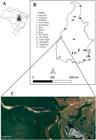
Previous records of Tabanidae and site of collection. A – States of Brazil with Tocantins highlighted in gray; B – State of Tocantins with indications of previous records (municipalities) of Tabanidae and the sampling site of the present work (Pium). The municipality of Dianópolis was called Duro, as mentioned in Table 1.; C – Satellite image (Google Earth™) showing the location of the CPC Headquarters and its surroundings.
2. Checklist elaboration
The list is arranged in alphabetical order into their respective subfamilies and tribes. Each species is assigned with information on the examined material and its distribution. The records of species distribution were checked and presented according to Coscarón & Papavero (2009), countries and states of occurrence are listed in north/south order, from left to right. Additionally, Henriques & Gorayeb (1993) and Henriques (1997) were also consulted, as well as studies published since 2009 (Krolow & Henriques 2010, Krolow et al. 2012, Lima et al. 2015, Guimarães et al. 2016, Krolow & Henriques 2017, Henriques & Krolow 2019, Carmo & Henriques 2019). The information on the sampling sites of the CPC is indicated here, in Material & Methods, therefore, it is not reproduced in the list.
Results
We accounted for 302 specimens distributed in three subfamilies (Chrysopsinae, Pangoniinae, and Tabaninae), four tribes (Chrysopsini, Scionini, Diachlorini, and Tabanini), 12 genera, 29 species, and two varieties. Out of the 29 species collected, 21 are new records for the state of Tocantins, resulting in a total of 65 species for the state (Table 1) distributed in 14 localities (Figure 1). Only eight species, Chlorotabanus inanis (Fabricius, 1787), Diachlorus bicinctus (Fabricius, 1805), Leucotabanus exaestuans (Linnaeus, 1758), Tabanus cicur Fairchild, 1942, T. importunus Wiedemann, 1828, T. mucronatus Fairchild, 1961, T. occidentalis Linnaeus 1758, T. palpalis Brèthes, 1910, and the two varieties had been formally recorded for the state (Henriques & Gorayeb 1993, Henriques 1997, Lima et al. 2015).
Checklist of the Tabanidae species in the Centro de Pesquisas Canguçu
*New records for Tocantins state Subfamily Chrysopsinae Tribe Chrysopsini
*Chrysops formosus Kröber, 1926
Material examined: 11-14.ix.2015, Armadilha Malaise, Krolow, T.K. & Equipe leg. (2♀).

A – Chrysops formosus ♀; B – Chrysops cf. formosus ♀; C – Chrysops variegatus ♀; D – Fidena mattogrossensis ♀; E – Chlorotabanus inanis ♀; F – Chlorotabanus inanis ♂; G – Chlorotabanus leucochlorus ♂; H – Cryptotylus unicolor ♀; I – Diachlorus bicinctus ♀; J – Diachlorus bimaculatus ♀; K – Diachlorus curvipes ♀; L – Diachlorus falsifuscistigma ♀; M – Diachlorus fuscistigma ♀; N – Diachlorus immaculatus ♀; O – Dichelacera fuscinervis ♀. Scale bar = 2 mm.
Distribution: Venezuela, Trinidad, French Guiana, Brazil (Roraima, Amapá, Amazonas, Pará, Maranhão, Acre, Rondônia, Tocantins, Bahia).
Chrysopscf.formosus Kröber, 1926
Figure 2B
Material examined: 11-14.ix.2015, Armadilha Malaise, Krolow, T.K. & Equipe leg. (6♀); idem, 30.vi-02.vii.2016, Malaise (1♀).
Comments: The specimens were identified as C. cf. formosus because they present a difference in coloration on the first abdominal tergite, lateral margin with a light brown spot, which is persistent throughout the series examined.
*Chrysops variegatus (De Geer), 1776
Figure 2C
Material examined: 10-13.xii.2015, Malaise Townes, Krolow, T.K. & Equipe leg. (1♀); idem, 07-10.iii.2016 (1♀).
Distribution: West Indies, Southern Mexico to Argentina (Misiones).
Subfamily Pangoniinae
Tribe Scionini
*Fidena mattogrossensis (Lutz), 1912
Figure 2D
Material examined: 01-02.xi.2016, Lençol iluminado, Krolow, T.K. & Equipe leg. (1♀).
Distribution: Guyana, Surinam, Brazil (Amazonas, Rondônia, Mato Grosso, Tocantins).
Subfamily Tabaninae
Tribe Diachlorini
Chlorotabanus inanis (Fabricius), 1787
Figure 2E-F
Material examined: 01-02.xi.2016, Lençol iluminado, Krolow, T.K. & Equipe leg. (3♀, 2♀); idem, 30.iii.2017, 18:00-22:00h, Alvim, B.G.C. leg. (2♀); idem, 10-13.xii.2015, 18:00-06:00h, Krolow, T.K. & Equipe leg. (19♀, 10♀); idem, 13-18.v.2016, 18:00-22:00h, Krolow, T.K. & Valadares, A.C. leg. (4♀); idem, 11-14.ix.2015, 18:00-06:00h, Krolow, T.K. & Equipe leg. (2♀); idem, 30-01.vii.2016 (1♀); idem, 18.i.2017 (3♀); idem, 07-10.iii.2016 (2♀).
Distribution: Southern Mexico to Peru and Brazil (until Paraná).
*Chlorotabanus leucochlorus Fairchild, 1961
Figure 2G
Material examined: 01-02.xi.2016, Lençol iluminado, Krolow, T.K. & Equipe leg. (1♀).
Distribution: Eastern Colombia, Venezuela, Guyana, Surinam, French Guiana, eastern Peru, Brazil (Roraima, Amapá, Amazonas, Pará, Maranhão, Rondônia, Tocantins).
*Cryptotylus unicolor (Wiedemann), 1828
Figure 2H
Material examined: 11-14.ix.2015, Lençol iluminado, 18:00-06:00h, Krolow, T.K. & Equipe leg. (1♀); idem, 07-10.iii.2016 (1♀); idem, 30.vi- 02.vii.2016, Malaise (1♀); idem, ix?.xi.2016 (1♀).
Distribution: Panama to Brazil (until Mato Grosso do Sul and Espírito Santo), Paraguay, Argentina (Chaco).
Diachlorus bicinctus (Fabricius), 1805
Figure 2I
Material examined: 14-18.v.2016, Malaise Gressitt & Gressitt, Krolow, T.K. & Valadares, A.C. leg. (2♀); idem, 10-13.xii.2015, Krolow, T.K. & Equipe leg. (2♀); idem, 10-13.xii.2015, Malaise Townes (1♀); idem, 02.xi.2016-30.ii.2017, Coleta Manual, Sulene leg. (2♀); idem, ix?.xi.2016, Krolow, T.K. & Equipe leg. (1♀); idem, 26.x.2019, Malaise, Oliveira, J.W. & Equipe. leg. (1♀).
Distribution: Venezuela, Trinidad, Surinam, eastern Peru, Brazil (Roraima, Amapá, Amazonas, Pará, Maranhão, Rondônia, Mato Grosso, Tocantins), eastern Bolivia.
*Diachlorus bimaculatus (Wiedemann), 1828
Figure 2J
Material examined: 01-02.xi.2016, Lençol iluminado, Krolow, T.K. & Equipe leg. (1♀); idem, ix?.xi.2016 (1♀).
Distribution: eastern Ecuador, eastern Peru, Brazil (Acre, Rondônia, Mato Grosso, Tocantins, Paraíba, Mato Grosso do Sul, Minas Gerais, São Paulo), eastern Bolivia, Paraguay, Argentina (Corrientes).
*Diachlorus curvipes (Fabricius), 1805
Figure 2K
Material examined: 01-03.xi.2016, Malaise, Krolow, T.K. & Equipe leg. (1♀); idem, 10-13.xii.2015, Malaise Townes (3♀), idem, 01-03.xi.2016, Malaise Gressitt Gressitt (1♀); idem, 07-10.iii.2016, Malaise Townes (1♀); idem, ix?.xi.2016 (1♀); idem, 01.xi.2019, Lençol iluminado (1♀).
Distribution: Costa Rica to eastern Bolivia, Venezuela, Trinidad, Surinam, French Guiana, Brazil (Roraima, Amapá, Amazonas, Pará, Maranhão, Paraíba, Acre, Rondônia, Mato Grosso, Tocantins, Bahia, ?Minas Gerais).
*Diachlorus falsifuscistigma Henriques & Rafael, 1999
Figure 2L
Material examined: 14-18.v.2016, Malaise Gressitt & Gressitt, Krolow, T.K. & Valadares, A.C. leg. (10♀); idem, 07-10.iii.2016, Malaise Townes, Krolow, T.K. & Equipe leg. (1♀); idem, 10-13.xii.2015, Malaise Gressitt & Gressitt (3♀); idem, 10-13.xii.2015, Malaise Townes (9♀); idem, 02.xi.2016-30.ii.2017, Coleta manual, Sulene leg. (4♀); idem, 01-03.xi.2016, Malaise, Krolow, T.K. & Equipe leg. (5♀); idem, ix?.xi.2016 (3♀); idem, 01.xi.2019, Lençol iluminado, Krolow, T.K. & Equipe leg. (1♀); idem, 26.x.2019, Malaise, Oliveira, J.W. & Equipe leg. (4♀).
Distribution: Brazil (Amazonas, Pará, Tocantins).
*Diachlorus fuscistigma Lutz, 1913
Figure 2M
Material examined: 10-13.xii.2015, Malaise Townes, Krolow, T.K. & Equipe leg. (4♀); idem, 14-18.v.2016, Krolow, T.K. & Valadares, A.C. leg. (1♀); idem, 13-18.v.2016, Lençol iluminado, 18:00-22:00h (1♀); idem, 03.v.2019, Malaise, Oliveira Junior, W. leg. (1♀).
Distribution: eastern Colombia, Surinam, French Guiana, eastern Peru, Brazil (Roraima, Amapá, Amazonas, Pará, Maranhão, Acre, Rondônia, Tocantins, Mato Grosso do Sul, Bahia), eastern Bolivia.
*Diachlorus immaculatus (Wiedemann), 1828
Figure 2N
Material examined: ix?.xi.2016, Krolow, T.K. & Equipe leg. (1♀); idem, 10-13.xii.2015, Malaise Townes (1♀); idem, 02.xi.2016-30. ii.2017, Coleta manual, Sulene leg. (1♀); 20-24.v.2019, Coleta manual, Alvim, B.C. & Equipe leg. (1♀).
Distribution: Brazil (Mato Grosso, Tocantins, Mato Grosso do Sul, Minas Gerais, São Paulo), Paraguay.
*Dichelacera fuscinervis (Barretto), 1950
Figure 2O
Material examined: 2013, Paula, M.J. leg. (8♀).
Distribution: Brazil (Mato Grosso, Tocantins, Goiás, Paraná, Rio Grande do Sul).
*Eutabanus pictus Kröber, 1930
Material examined: 10-13.xii.2015, Lençol iluminado, 18:00-06:00h, Krolow, T.K.& Equipe leg. (1♀).

A – Eutabanus pictus ♀; B – Lepiselaga crassipes ♀; C – Leucotabanus albovarius ♂; D – Leucotabanus exaestuans ♀; E – Leucotabanus exaestuans ♂; F – Phaeotabanus cajennensis ♀; G – Phaeotabanus fervens ♀; H – Phorcotabanus cinereus ♀; I – Tabanus cicur ♀; J – Tabanus crassicornis ♀; K – Tabanus importunus ♀; L – Tabanus mucronatus ♀; M – Tabanus nebulosus ♀; N – Tabanus occidentalis ♀; O – Tabanus occidentalis ♂. Scale bar = 2 mm.
Distribution: eastern Ecuador, eastern Peru, Brazil (Amapá, Amazonas, Pará, Tocantins).
*Lepiselaga crassipes (Fabricius), 1805
Figure 3B
Material examined: 01-03.xi.2016, Malaise, Krolow, T.K. & Equipe leg. (1♀); idem, ix?.xi.2016 (2♀); idem, 11-14.ix.2015, Armadilha Malaise (4♀); idem, 02-04.vi.2012, Krolow, T.K. & Leite, H. leg. (3♀); idem, 10-13.xii.2015, Malaise Townes, Krolow, T.K. & Equipe leg. (3♀); idem, ?.xi.2012 (3♀); idem, 07-10.iii.2016, Lençol iluminado, 18:00-06:00h, Krolow, T.K. & Equipe leg. (1♀); idem, 11-14.ix.2015, Armadilha malaise (1♀); idem, 02.xi.2016-30.ii.2017, Coleta manual, Sulene leg. (2♀).
Distribution: Mexico to northern Argentina (Salta, Formosa, Tucumán, Chaco, Santa Fé, Buenos Aires), Cuba, Hispaniola, Jamaica, Puerto Rico.
*Leucotabanus albovarius (Walker), 1854
Figure 3C
Material examined: 27-30.iii.2017, Lençol iluminado, 18:00-22:00h, Santos, F.K.G. leg. (1 ♂).
Distribution: Venezuela, Guyana, Surinam, French Guiana, Ecuador (Napo, Orellana), eastern Peru, Brazil (Roraima, Amapá, Amazonas, Pará, Acre, Rondônia, Tocantins), eastern Bolivia.
Leucotabanus exaestuans (Linnaeus), 1758
Figure 3D-E
Material examined: 11-14.ix.2015, Lençol iluminado, 18:00-06:00h, Krolow, T.K. & Equipe leg. (1♀); idem, 27-30.iii.2017, 18:00-22:00h, Alvim, B.G.C. leg. (1♀); idem, 28-30.iii.2017, Barros, L.M.S. leg. (1♂); idem, 27- 30.iii.2017, Galvão, I.T. leg. (1♂).
Distribution: Mexico to Bolivia (Chapare) and Argentina (Salta, Chaco, Misiones), Trinidad.
*Phaeotabanus cajennensis (Fabricius), 1787
Figure 3F
Material examined: 02-04.vi.2012, Krolow, T.K. & Leite, H. leg. (2♀); idem, 10-13.xii.2015, Malaise Townes, Krolow, T.K. & Equipe leg. (2♀); idem, 11-14.ix.2015, Armadilha malaise (2♀); idem, 01.xi.2019, Lençol iluminado (1♀).
Distribution: Colombia, Venezuela, Trinidad, Guiana, Surinam, French Guiana, eastern Ecuador, eastern Peru, Brazil (Amazon to Paraná, São Paulo, Ceará), eastern Bolivia.
*Phaeotabanus fervens (Linnaeus), 1758
Figure 3G
Material examined: 11-14.ix.2015, Lençol iluminado, 18:00-06:00h, Krolow, T.K. & Equipe leg. (1♀).
Distribution: Trinidad, Venezuela to northern Argentina, Brazil (Amazon to Mato Grosso do Sul).
Tribe Tabanini
*Phorcotabanus cinereus (Wiedemann), 1821
Figure 3H
Material examined: 11-14.ix.2015, Armadilha malaise, Krolow, T.K. & Equipe leg. (24♀).
Distribution: eastern Colombia, Venezuela, French Guiana, eastern Ecuador to northern Argentina, Brazil (Amazon to Santa Catarina, Ceará, Rio Grande do Norte).
Tabanus cicur Fairchild, 1942
Figure 3I
Material examined: 10-13.xii.2015, Malaise Townes, Krolow, T.K. & Equipe leg. (1♀).
Distribution: eastern Colombia, Guyana, eastern Ecuador, Brazil (Pará, Tocantins), eastern Bolivia.
*Tabanus crassicornis Wiedemann, 1821
Figure 3J
Material examined: 01-03.xi.2016, Malaise, Krolow, T.K. & Equipe leg. (11♀); idem, ix?.xi.2016 (1♀); idem 02.xi.2016-30.ii.2017, Coleta manual, Sulene leg. (2♀); idem 26.x.2019, Malaise, Oliveira, J.W. & Equipe leg. (3♀); idem, 01.xi.2019, Lençol iluminado, T.K. & Equipe leg. (1♀).
Distribution: eastern Colombia, Venezuela, Surinam, French Guiana, eastern Peru, Brazil (Roraima, Amapá, Amazonas, Pará, Acre, Rondônia, Mato Grosso, Tocantins).
Tabanus importunus Wiedemann, 1828
Figure 3K
Material examined: 11-14.ix.2015, Armadilha Malaise, Krolow, T.K. & Equipe leg. (2♀); idem, 01.xi.2019, Lençol iluminado (1♀); idem, 13.ix.2019, Malaise, Oliveira, J.W. & Equipe leg. (1♀); idem, 26.x.2019 (1♀).
Distribution: Panama to Paraguay, northern Argentina, Trinidad, Brazil (until Rio Grande do Sul).
Tabanus mucronatus Fairchild, 1961
Figure 3L
Material examined: 30.iii.2019, Malaise, Oliveira Junior, W. leg. (1♀).
Distribution: Brazil (Pará, Maranhão, Rondônia, Mato Grosso, Tocantins, Goiás), ?Bolivia.
*Tabanus nebulosus De Geer, 1776
Figure 3M
Material examined: 11-14.ix.2015, Armadilha Malaise, Krolow, T.K. & Equipe leg. (8♀); idem, 10-13.xii.2015, Malaise Townes (1♀); idem, 13.ix.2019, Malaise, Oliveira, J.W. & Equipe leg. (4♀); idem, 26.x.2019 (1♀).
Distribution: Belize to Argentina (Formosa, Tucumá, Chaco, Corrientes, Santa Fé), Trinidad, Brazil (Amazon to Mato Grosso do Sul).
Tabanus occidentalis Linnaeus, 1758
Figure 3N-O
Material examined: 14-18.v.2016, Malaise Townes, Krolow, T.K. & Valadares, A.C. leg. (2♀); idem 10-13.xii.2015, Krolow, T.K. & Equipe leg. (1♀); idem, 01-02.xi.2016, Lençol iluminado (1♀); idem, 11-14.vii.2019, Malaise, Alvim, B.G.C. & Equipe (3♀); idem, 01.xi.2019, Lençol iluminado, Krolow, T.K. & Equipe (1♀); idem, 10-13.xii.2015, Lençol iluminado, 18:00-06:00h (2♀).
Distribution: Mexico to Argentina (Entre Ríos, Buenos Aires), Trinidad.
Tabanus occidentalisvar. dorsovittatus Macquart, 1855
Material examined: 10-13.xii.2015, Malaise Gressitt Gressitt, Krolow, T.K. & Equipe leg. (1♀); idem, 14-18.v.2016, Krolow, T.K. & Valadares, A.C. leg. (1♀); idem, 02-04.vi.2016, Krolow, T.K. & Lima, H. leg. (3♀); 01-02.xi.2016, Lençol iluminado, Krolow, T.K. & Equipe leg. (3♀).
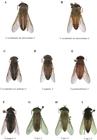
A – Tabanus occidentalis var. dorsovittatus ♀; B – Tabanus occidentalis var. dorsovittatus ♂; C – Tabanus occidentalis var. modestus ♀; D – Tabanus palpalis ♀; E – Tabanus pseudonebulosus ♀; F – Tabanus pungens ♀; G – Tabanus sp.1 ♀; H – Tabanus sp.1 ♂; I – Tabanus sp.2 ♂. Scale bar = 2 mm.
Distribution: Mexico to Argentina, Trinidad.
Tabanus occidentalisvar.modestus Wiedemann, 1828
Figure 4C
Material examined: 14-18.v.2016, Malaise Gressitt Gressitt, Krolow, T.K. & Valadares, A.C. leg. (3♀); idem, 03.v.2019, Malaise, Oliveira Junior, W. leg. (1♀); idem, 11-14-vii.2019, NZI, Alvim, B.G.C. e Equipe leg. (1♀).
Distribution: Honduras to Brasil (until Mato Grosso, Tocantins).
Tabanus palpalis Brèthes, 1910
Figure 4D
Material examined: 10-13.xii.2015, Malaise Townes, Krolow, T.K. & Equipe leg. (7♀); idem, 01-03.xi.2016, Malaise (2♀); idem, 10-13.xii.2015, Lençol iluminado, 18:00-06:00h (1♀); idem, 10-13. xii.2015, Malaise Gressitt Gressitt (1♀).
Distribution: Brazil (Pará, Mato Grosso, Tocantins, Goiás, Distrito Federal, Mato Grosso do Sul, São Paulo), eastern Bolivia, Paraguay, Argentina (Catamarca, Salta, Misiones).
*Tabanus pseudonebulosus Gorayeb & Barros, 2006
Figure 4E
Material examined: 11-14.ix.2015, Armadilha Malaise, Krolow, T.K. & Equipe leg. (10♀); idem, 13.ix.2019, Malaise, Oliveira, J.W. & Equipe leg. (4♀).
Distribution: Venezuela, Brazil (Amazonas, Pará, Tocantins, Mato Grosso do Sul).
*Tabanus pungens Wiedemann, 1828
Figure 4F
Material examined: 01-02.xi.2016, Lençol iluminado, Krolow, T.K. & Equipe leg. (1♀).
Distribution: Neotropics (except West Indies and Chile), USA (Texas) to Uruguay.
Tabanus sp. 1
Figure 4G-H
Material examined: 01-02.xi.2016, Lençol iluminado, Krolow, T.K. & Equipe leg. (6♀, 2♂); idem, 01-03.xi.2016, Malaise (1♀); idem, 27 30.iii.2017, Lençol iluminado, 18:00-22:00h, Furtado, L.B. leg. (1♀); idem, 30.iii.2017, Andrade, I.C.P. leg. (1♂); idem, 27-30. iii.2017, Vilarins, W.C.C. leg. (1♂).
Comments: The identification key for the Tabanus lineola complex (Fairchild 1983) leads the specimens to the dichotomy between T. occidentalis var. consequa or T. wilkersoni. According to the key T. occidentalis var. consequa has yellowish abdominal stripes, while T. wilkersoni has whitish abdominal stripes. Tabanus sp. 1 has white stripes, but not as well defined as those observed in other species.
Tabanus sp. 2
Figure 4I
Material examined: 30.iii.2017, Lençol iluminado, 18:00-22:00h, Andrade, I.C.P. leg. (1♂).
Comments: The identification key for males of the species group of Tabanus trivittatus (Carmo & Henriques 2019) leads this specimen to T. argentivittatus or T. callosus. However, in T. argentivittatus the notopleura is black while in Tabanus sp. 2 it is orangish. It differs from T. callosus by the color of the legs, this species has all the femora black and tibiae yellow, while Tabanus sp. 2 apparently has the median femur and the median and hind tibiae orangish. It is important to emphasize that our specimen had contact with some substance that changed its color, which made it difficult to determine a new species or as another valid species.
Discussion
The Tabanidae fauna recorded herein differs from that sampled by Lima et al. (2015). Only six species (C. inanis, L. exaestuans, T. cicur, T. mucronatus, T. importunus, and T. palpalis) and two varieties of T. occidentalis were the same as those recorded in the area of Cerrado sensu stricto.
Two species (D. immaculatus and D. fuscinervis) were recorded for the first time in the North region of Brazil, and other three species, D. falsifuscistigma, E. pictus, and L. albovarius, exclusively distributed in the Amazon, had their occurrence records expanded to a transition region between the Cerrado and Amazon domains. In addition, two genera (Eutabanus and Phorcotabanus) were formally recorded for the first time in the Tocantins state.
The state of Tocantins is located between two of the main Brazilian domains that are home to a large part of the country’s Tabanidae fauna. Despite this, only 44 species were recorded for the state, certainly an underestimated number, only 9% among the 488 species recorded for the country (Krolow & Henriques 2022). The present work updated the number of species to 65, which represents an increase of 47% in the richness of species for the state and corresponds to 13% of the species recorded for Brazil. This shows that the diversity of Tabanidae in the state tends to increase as new areas are explored, thus, southwestern, central and eastern regions of the state that still lack sampling (Figure 1) are good candidates for further studies and will possibly provide many new records.
Acknowledgments
The main author would like to thank the Conselho Nacional de Desenvolvimento Científico e Tecnológico (CNPq) for the scholarship granted (process number: 130326/2022-4). The third author would like to thank the Conselho Nacional de Desenvolvimento Científico e Tecnológico (CNPq) for the scholarship granted (process number 310214/2021-1). We would like to thank Drs. Tarso Alvim and Renato Torres Pinheiro for the support at the CPC. To PPBio, project: “Inventário da biodiversidade em áreas de ecótonos de Cerrado no Estado do Tocantins: grupos fúngicos, insetos e aves” (process number: 457443/2012-0). We thanks to Fundação de Amparo à Pesquisa do Tocantins (FAPT) and Coordenação de Aperfeiçoamento de Pessoal de Nível Superior (CAPES) – Edital PDPGFAP-2020 – for financial support.
-
Data AvailabilitySupporting data are available at <https://data.scielo.org/dataset.xhtml?persistentId=doi:10.48331/scielodata.KYPDRY>
References
- BARROS, A.T.M. 2001. Seasonality and Relative Abundance of Tabanidae (Diptera) Captured on Horses in the Pantanal, Brazil. Mem. Inst. Oswaldo Cruz, 96(7): 917-923.
- BARROS, A.T.M., FOIL, L.D. & VAZQUEZ, S.A.S. 2003. Mutucas (Diptera: Tabanidae) do Pantanal: Abundância Relativa e Sazonalidade na Sub-região da Nhecolândia. Boletim de Pesquisa e Desenvolvimento, 48: 1-18.
- BARROS, A.T.M. & GORAYEB, I.S. 1996. Chave de identificação para tabanídeos (Diptera: Tabanidae) do Pantanal, Sub-região da Nhecolândia, Mato Grosso do Sul, Brasil. Rev. Brasil. Biol , 56(3): 547-551.
- BASSI, R.M.A., CUNHA, M.C.I. & COSCARÓN, S. 2000. Estudo do comportamento de tabanídeos (Diptera, Tabanidae) do Brasil. Acta Biol. Par., 29: 101-115.
-
CARMO, D.D.D. & HENRIQUES, A.L. 2019. Taxonomy of Tabanus trivittatus species-group (Diptera: Tabanidae), with description of five new species. Zootaxa, 4554 (1): 63-100. https://doi.org/10.11646/zootaxa.4554.1.2.
» https://doi.org/10.11646/zootaxa.4554.1.2 - COSCARÓN, S. & PAPAVERO, N. 2009. Catalogue of Neotropical Diptera. Tabanidae. Neotrop. Dipt., 16: 1-199.
-
EVENHUIS, N.L. & PAPE, T. 2021. Systema Dipterorum. In O. Bánki, Y. Roskov, M. Döring, G. Ower, L. Vandepitte, D. Hobern, D. Remsen, P. Schalk, R.E. DeWalt, M. Keping, J. Miller, T. Orrell, R. Aalbu, R. Adlard, E.M. Adriaenssens, C. Aedo, E. Aescht, N. Akkari, P. Alfenas-Zerbini, et al. Catalogue of Life Checklist (3.1, May 2021). https://doi.org/10.48580/dfp3-3bz.
» https://doi.org/10.48580/dfp3-3bz - FAIRCHILD, G.B. 1983. Notes on Neotropical Tabanidae (Diptera). XIX. The Tabanus lineola complex.Misc. Pub., Ent. Soc. Amer. , 57: 1-50.
-
FAIRCHILD, G.B. & WILKERSON, R.C. 1981. New species of Esenbeckia (Proboscoides) (Diptera, Tabanidae) with a key to the subgenus. Florida Entomological Society, 64 (1): 158-175. http://jstor.org/stable/3494607
» http://jstor.org/stable/3494607 - GORAYEB, I.S. 1995. Tabanidae (Diptera) da Amazônia. XI. Sazonalidade das espécies da Amazônia Oriental e correlação com fatores climáticos. Bol. Mus. Paraense Emílio Goeldi, 9 (2): 241-281.
- GORAYEB, I.S. 1999. Tabanidae (Diptera) of the Amazon. XIV. Vertical stratification in an Eastern Amazonian Forest. Mem. Entomol. Internal., 14: 367-386.
- GORAYEB, I.S. 2000. Tabanidae (Diptera) da Amazônia. XVI – Atividade diurna de hematofagia de espécies da Amazônia Oriental, em áreas de mata e pastagens, correlacionada com fatores climáticos. Bol. Mus. Paraense Emílio Goeldi, 16(1): 23-63.
-
GUIMARÃES, R.R., JÚNIOR, R.R.G., HARLAN-RODRIGUES, R.S., GUIMARÃES, R.R. & CARVALHO, R.W. 2016. Checklist and Notes on Behavior of Horse Flies (Diptera: Tabanidae) from Marambaia Island, Rio de Janeiro, Brazil, with New Records for the State. Entomo Brasilis, 9(2): 73-80. https://doi.org/10.12741/ebrasilis.v9i2.585.
» https://doi.org/10.12741/ebrasilis.v9i2.585 - HAIDAR, R.F., FAGG, J.M.F., PINTO, J.R.R., DIAS, R.R., DAMASCO, G., SILVA, L.C.R. & FAGG, C.W. 2013. Florestas estacionais e áreas de ecótono no estado do Tocantins, Brasil: parâmetros estruturais, classificação das fitofisionomias florestais e subsídios para conservação. Acta Amazon., 43(3): 261-290.
- HENRIQUES, A.L. 1997. A Coleção de Tabanidae (Insecta: Diptera) do Instituto Nacional de Pesquisas da Amazônia (INPA), Manaus, Amazonas, Brasil. Bol.Mus. Para. Emílio Goeldi Sér. Zool, 11(1): 57-99.
- HENRIQUES, A.L. & GORAYEB, I.S. 1993. A Coleção de Tabanidae (Diptera) do Museu Paraense Emílio Goeldi, Belém, Pará, Brasil. Goeldiana Zoologia, 20: 1-23.
-
HENRIQUES, A.L. & KROLOW, T.K. 2019. The genus Leucotabanus Lutz (Diptera: Tabanidae) in the Amazon region, with the description of a new species. Zootaxa, 4651(2): 366-378. https://doi.org/10.11646/zootaxa.4651.2.10.
» https://doi.org/10.11646/zootaxa.4651.2.10 - HENRIQUES, A.L., KROLOW, T.K. & RAFAEL, J.A. 2012. Corrections and additions to Catalogue of Neotropical Diptera (Tabanidae) of Coscarón & Papavero (2009). Rev. Bras. Entomol., 56(3): 277-280.
- HENRIQUES, A.L. & RAFAEL, J.A. 1999. Tabanidae (Diptera) from Parque Nacional do Jaú, Amazonas, Brazil, with description of two new species of Diachlorus Osten Sacken. Mem.Entomol. Internl., 14: 195-222.
-
KARK, S. & RENSBURG, B.J. 2006. Ecotones: Marginal or central areas of transition? Isr. J. Ecol.Evol., 52: 29-53. http://dx.doi.org/10.1560/IJEE.52.1.29.
» https://doi.org/10.1560/IJEE.52.1.29 -
KOLLER, W.W., BARROS, A.T.M. & TEODORO, P.E. 2019. Diversity and population dynamic of Tabanidae (Insecta: Diptera) in the Cerrado-Pantanal ecotone. Bioscience Journal, 35: 1390-1398. http://dx.doi.org/10.14393/BJ-v35n5a2019-39502.
» https://doi.org/10.14393/BJ-v35n5a2019-39502 - KROLOW, T.K., BAYLESS, K.M. & HENRIQUES, A.L. 2012. Newly discovered males and new records of the uncommon Neotropical genera Eutabanus Kröber and Myiotabanus Lutz (Diptera: Tabanidae). Zootaxa, 3389: 25-33.
- KROLOW, T.K. & HENRIQUES, A.L. 2010. Taxonomic revision of the New World genus Chlorotabanus Lutz, 1913 (Diptera: Tabanidae). Zootaxa, 2656: 1-40.
-
KROLOW, T.K. & HENRIQUES, A.L. 2017. Checklist das espécies de mutucas (Diptera, Tabanidae) do estado do Mato Grosso do Sul, Brasil. Iheringia Série Zoologia, 107 (supl): 1-6. https://doi.org/10.1590/1678-4766e2017131.
» https://doi.org/10.1590/1678-4766e2017131 -
KROLOW, T.K. & HENRIQUES, A.L. 2022. Tabanidae in Catálogo Taxonômico da Fauna do Brasil. PNUD. Available: http://fauna.jbrj.gov.br/fauna/faunadobrasil/1914 Access: 21/06/2022.
» http://fauna.jbrj.gov.br/fauna/faunadobrasil/1914 -
KROLOW, T.K., HENRIQUES, A.L., GORAYEB, I.S., LIMEIRA-DEOLIVEIRA, F. & BUESTÁN, J. 2015. Taxonomic revision of the Neotropical genus Pityocera Giglio-Tos, 1896 (Diptera: Tabanidae: Scionini). Zootaxa, 3904: 301-333. http://dx.doi.org/10.11646/zootaxa.3904.3.1.
» https://doi.org/10.11646/zootaxa.3904.3.1 - KROLOW, T.K., KRÜGER, R.F. & RIBEIRO, P.B. 2007. Chave pictórica para os gêneros de Tabanidae (Insecta: Diptera) do bioma Campos Sulinos, Rio Grande do Sul, Brasil. Biota Neotrop., 7: 253-264.
- KRÜGER, R.F. & KROLOW, T.K. 2015. Seasonal patterns of horse fly richness and abundance in the Pampa biome of southern Brazil. J. Vector Ecol., 40: 364-372.
-
LIMA, H.I.L., KROLOW, T.K. & HENRIQUES, A.L. 2015. Checklist of horse flies (Diptera: Tabanidae) from Taquaruçu, Tocantins, Brazil, with new records for the state. Check List, 11(2): 1-8. http://dx.doi.org/10.15560/11.2.1596.
» https://doi.org/10.15560/11.2.1596 -
LIMA, H.I.L., KROLOW, T.K. & HENRIQUES, A.L. 2017. A New Species of Dichelacera (Dichelacera) Macquart (Diptera, Tabanidae) from the Brazilian Savannah. Neotrop. Entomol., 47: 380-384. https://doi.org/10.1007/s13744-017-0568-1.
» https://doi.org/10.1007/s13744-017-0568-1 - LUTZ, A. 1913. Tabanidas do Brasil e de alguns Estados visinhos. Tabaniden Brasiliens und einiger Nachbarstaaten. Mem. Inst. Oswaldo Cruz, 5(2): 142-191.
- LUTZ, A. 1915. Tabanidas do Brasil e de alguns Estados visinhos. Tabaniden Brasiliens und einiger Nachbarstaaten. Mem. Inst. Oswaldo Cruz, 7(1): 51-119.
- RAFAEL, J.A., GORAYEB, I.S., ROSA, M.S.S. & HENRIQUES, A.L. 1991. Tabanidae (Diptera) da Ilha de Maracá e Serra Pacaraima, Roraima, Brasil, com descrição de duas espécies novas. Acta Amazon., 21: 351-367.
-
SMITH, T.B., KARK, S., SCHNEIDER, C.J., WAYNE, R.K. & MORITZ, C. 2001. Biodiversity hotspots and beyond: the need for conserving environmental transitions. TRENDS Ecol. Evol., 16: 431. https://doi.org/10.1016/S0169-5347(01)02201-7.
» https://doi.org/10.1016/S0169-5347(01)02201-7


