 Preliminary checklist of dragonflies and damselflies (Insecta: Odonata) from the Serra do Japi Biological Reserve, Jundiaí, São Paulo, Brazil, and new records for the state
Abstract
The present study provides a preliminary Odonata inventory for the Serra do Japi Biological Reserve, an important Atlantic Forest conservation unit in São Paulo State, Brazil. We recorded 22 species, representing 7.5% of the Odonata fauna previously known for the state. Among them, three are new records for São Paulo, highlighting the potential for further discoveries in unexplored Atlantic Forest remnants. Libellulidae and Coenagrionidae were the most diverse and abundant families, a pattern similar to that observed in other studies of Atlantic Forest odonate assemblages. Species richness was similar between the lentic and lotic habitats, with some taxa exhibiting clear habitat preferences. The recorded species composition reflects the environmental heterogeneity of the SJBR and the availability of suitable microhabitats for odonates. Additionally, the presence of Brechmorhoga goncalvensis Vilela, Stefani-Santos & Ávila Júnior, 2021, and Heteragrion tiradentense Machado & Bedê, 2006, both listed as near threatened, underscores the role of the SJBR as an essential refuge for range-restricted and sensitive species. These findings reinforce the importance of Atlantic Forest reserves in maintaining regional Odonata diversity and contribute to a broader understanding of species distribution patterns.
Keywords
Inventory; Atlantic Forest; Anisoptera; Zygoptera
Resumo
O presente estudo fornece um inventário preliminar de Odonata para a Reserva Biológica da Serra do Japi, uma importante unidade de conservação da Mata Atlântica no estado de São Paulo, Brasil. Registramos 22 espécies, representando 7,5% da fauna de odonatos previamente conhecida para o estado. Entre elas, três correspondem a novos registros para São Paulo, destacando o potencial para novas descobertas em remanescentes pouco explorados da Mata Atlântica. Libellulidae e Coenagrionidae foram as famílias mais diversas e abundantes, um padrão semelhante ao observado em outros estudos sobre assembleias de odonatos da Mata Atlântica. A riqueza de espécies foi semelhante entre os habitats lênticos e lóticos, com alguns táxons apresentando claras preferências de habitat. A composição de espécies registrada reflete a heterogeneidade ambiental da SJBR e a disponibilidade de micro-habitats adequados para os odonatos. Além disso, a presença de Brechmorhoga goncalvensis Vilela, Stefani-Santos & Ávila Júnior, 2021, e Heteragrion tiradentense Machado & Bedê, 2006, ambas listadas como quase ameaçadas, ressalta o papel da SJBR como um refúgio essencial para espécies sensíveis e de distribuição restrita. Esses resultados reforçam a importância das reservas da Mata Atlântica na manutenção da diversidade regional de odonatos e contribuem para uma compreensão mais ampla dos padrões de distribuição das espécies.
Palavras-chave
Inventário; Mata Atlântica; Anisoptera; Zygoptera
Introduction
Representatives of the order Odonata, commonly known as dragonflies and damselflies, are classified into three suborders: Anisoptera (dragonflies), Zygoptera (damselflies), and Anisozygoptera, the latter of which is restricted to certain regions of Asia (Büsse, 2016). This order consists of insects that undergo an aquatic larval phase and a terrestrial adult phase (Pires & Périco, 2024), which play essential roles in ecosystems, such as regulating insect populations and maintaining the ecological balance in aquatic environments (May, 2019). Globally, an estimated 6,470 Odonata species have been described (Rafael et al., 2024; Paulson et al., 2025). In the Neotropical region, which is home to a high diversity of Odonata species, approximately 1.700 species are known (Olaya, 2019). Brazil, the largest country in this region, has 917 described species (Rafael et al., 2024; Pinto, 2024). Although the Southeastern region of Brazil has been the most studied (Miguel et al., 2017), there are still numerous knowledge gaps, especially in areas of the Atlantic Forest.
The Atlantic Forest, one of the most biodiverse biomes on the planet, is recognised for its high biodiversity and high rate of endemism (Myers et al., 2000, Joly et al., 2014, Marques et al., 2021). However, it faces intense anthropogenic pressure that threatens its integrity (Myers et al., 2000). Originally covering about 1.5 million km² along the Brazilian coastline, accounting for approximately 15% of the country’s total area; the biome extends across 17 states and includes a wide variety of ecosystems, such as dense ombrophilous forests, restinga, and mangroves (Ribeiro et al., 2009; Marques et al. 2021). However, only approximately 13% of its original cover remains, with most of it fragmented into small isolated remnants (Fundação SOS Mata Atlântica, 2018). These remnants house aquatic microhabitats such as streams, ponds, and bromeliads, which are essential for the life cycle of odonates (Kalkman et al., 2008).
Studies conducted within protected areas contribute to improving our knowledge of biodiversity in highly fragmented biomes, such as the Atlantic Forest, where most remaining habitats occur as small and isolated forest remnants embedded in human-modified landscapes (Ribeiro et al., 2009). Under these conditions, the availability and integrity of freshwater environments may strongly influence the persistence of aquatic insects, including Odonata, whose life cycles depend on both aquatic and surrounding terrestrial habitats (Kalkman et al., 2008; Brito et al., 2024). Habitat loss and landscape modification have led to declines in sensitive species, simplification of ecological communities, and biotic homogenization (Tabarelli et al., 2010; Araujo et al., 2022). Consequently, conservation units may serve as important refuges for species persistence and for maintaining the ecological interactions associated with these habitats (Haddad et al., 2015; Brito et al., 2024). Biodiversity inventories in these areas help document local species composition, identify habitat-associated taxa, and provide baseline data for future ecological studies and conservation planning.
Although some remnants of the Atlantic Forest, such as the Serra do Japi Biological Reserve (SJBR) in São Paulo, are legally protected, their importance in the conservation of local biodiversity is not yet fully understood due to the lack of local and regional biodiversity. Research on odonata fauna in São Paulo has been conducted by Costa et al. (2000), Ferreira-Peruquetti & Fonseca-Gessner (2003), and Pinto (2019). However, no studies have specifically focused on the Odonata fauna of the SJBR, highlighting the need for species inventories to enhance knowledge of odonates in this region. Therefore, this study aims to present a preliminary checklist of Odonata from the SJBR, report new species records for the state of São Paulo, and emphasize the reserve’s importance for biodiversity conservation within the Atlantic Forest.
Material e Methods
1. Study area
We conducted our study in the Serra do Japi Biological Reserve (SJBR), Jundiaí, located in the western portion of São Paulo State, Brazil. Serra do Japi is a remnant of the Atlantic Forest and is situated between the municipalities of Jundiaí, Cabreúva, Cajamar, and Pirapora do Bom Jesus, with coordinates of 23°12’S and 46°57’W. The total area of the reserve is approximately 354 km2, with altitudes ranging from 700 to 1.300 m. The predominant vegetation is a Semi-deciduous Seasonal Forest with fragments of montane forest and vegetation typical of rocky outcrops (Leitão-Filho & Morellato, 1997; Ballerini et al., 2021). Additionally, the region contains ponds with various types of aquatic plants and surrounding vegetation as well as first- to third-order streams, which contribute to environmental heterogeneity (Prefeitura de Jundiaí, 2008). The climate of the SJBR is classified as humid mesothermal without a dry season, with an average temperature exceeding 22°C during the hottest months (Rodrigues, 1986).
2. Data collection
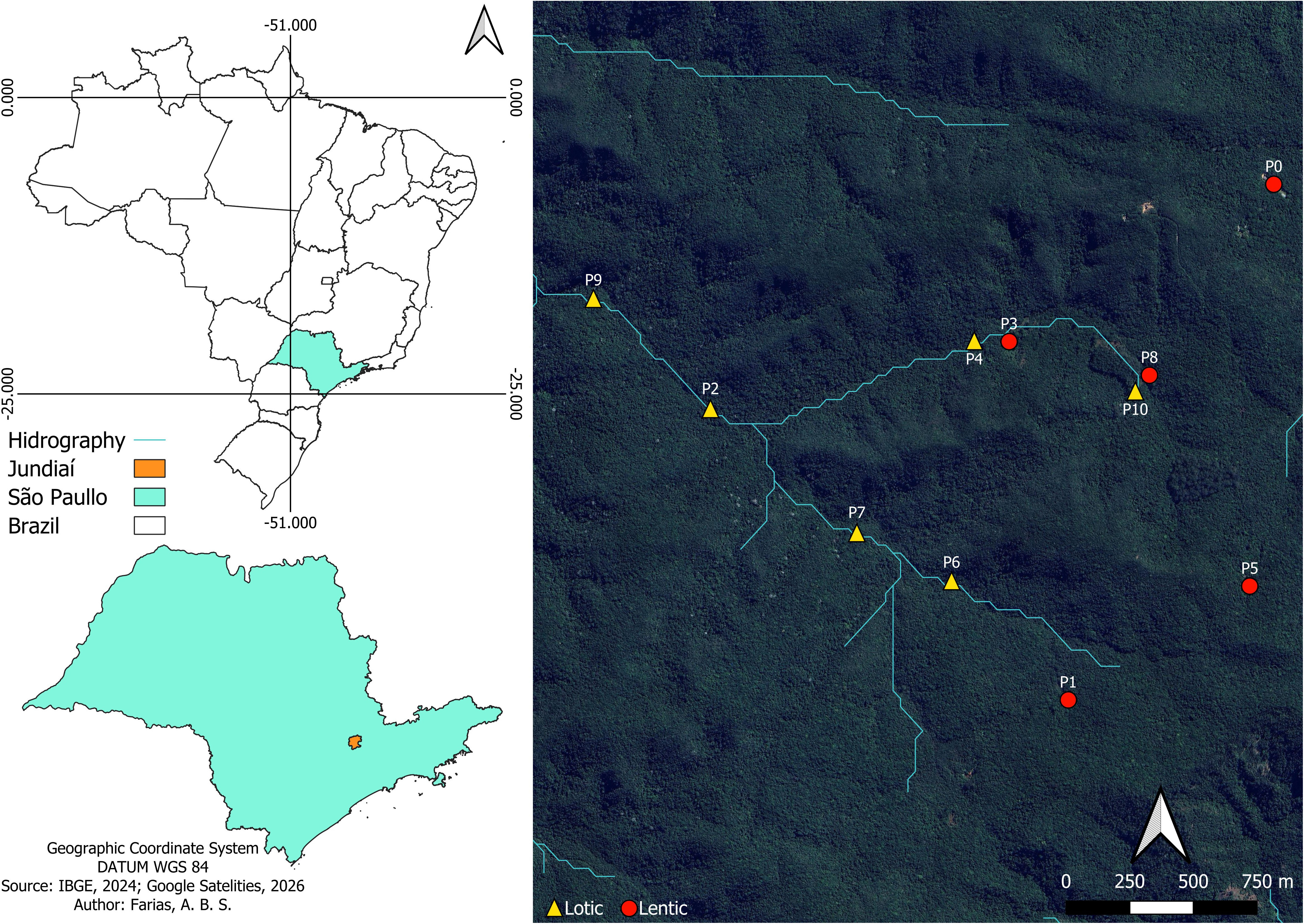
Collections were carried out during the dry season, between October and November 2024, at 11 sampling points (Figure 1), including 10 sites distributed among ponds (lentic) and streams (lotic), and one terrestrial site at the SJBR headquarters (Figure 2, Table 1). Lentic habitats consisted of small natural ponds located in open areas, approximately 10 m in length and 10 m in width on average, with depths ranging from shallow margins of 20–30 cm to deeper areas of approximately 3 m. These environments exhibited high canopy openness (approximately 90%), with aquatic macrophytes covering large portions of the water surface or concentrated along the margins, and predominantly clayey substrates. Lotic habitats consisted of narrow streams with widths ranging from approximately 0.8 to 1.5 m and depths varying from approximately 20 cm to 1 m. Canopy openness varied among the sampling points but remained below 50%, resulting in partially shaded conditions. No aquatic macrophytes were observed at these sites, although dense riparian vegetation surrounded the stream. The substrate was predominantly composed of gravel, and a high abundance of aquatic insect larvae, particularly from the orders Ephemeroptera, Plecoptera, and Trichoptera (EPT), was observed. Adult individuals were captured using active collection methods with entomological nets, preferably on sunny days, between 09:00 and 16:00, along the margins of predefined aquatic habitats (See Cezário et al., 2021). At each sampling point, two collectors walked standardized 100-meter transects, ensuring systematic collection. The total sampling effort was 44 hours of activity. Additionally, sporadic collections were made; in these cases, a single collector used an entomological net without a predefined path, along the margins of aquatic habitats, for approximately 1 h (P0; P9 and P10 - see Table 2). The collected specimens were placed in wax paper envelopes and treated according to the methodology described by Lencioni (2017). Taxonomic identification was performed at the species level using the keys of Garrison et al. (2006, 2010), Lencioni (2017) and specific literature. The collections were authorized by the Chico Mendes Institute for Biodiversity Conservation (ICMBio) (SISBIO #95620/1) and by Foundation Serra do Japi. The collected material was deposited in the Odonata Collection of the Ecology and Biodiversity Laboratory (LEBIO) at the Department of Ecology, Federal University of Sergipe (UFS), São Cristóvão, Sergipe.

Sampling sites in the Serra do Japi Biological Reserve, Jundiaí, located in the western portion of the state of São Paulo, Brazil. Triangles = lotic habitats and hexagons = lentic habitats.
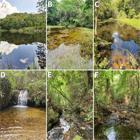
Sampling environments for Odonata in the Serra do Japi Biological Reserve, Jundiaí, São Paulo, Brazil: (A, B, and C) lentic and (D, E, and F) lotic environments. Photos: (A) by AG; (B and C) by JCS; and (D, E, and F) by ABSF, taken during field collection between October and November 2024.
Geographical location and characteristics of the study sites within the Serra do Japi Biological Reserve (coordinates in the UTM system; Datum WGS84) encompassing a variety of sampled habitats. These habitats include the headquarter (P0), pristine streams (P2, P4, P6, P7, P9 and P10), and small ponds (P1, P3, P5 and P8), and are representative of the diverse aquatic and terrestrial ecosystems found within the reserve (Figure 1). This variety provides a comprehensive overview of the Odonata fauna present in this ecologically significant region.
Composition of Odonata species recorded in the sampled habitats of the Serra do Japi Biological Reserve, including species list, number of individuals collected, and new records (*). Legends: Sampling points, Abundance, New Records, Chico Mendes Institute for Biodiversity Conservation (in portuguese: Instituto Chico Mendes de Conservação da Biodiversidade) (ICMBio), Risk Assessment System for Biodiversity (in portuguese: Sistema de Avaliação do Risco de Extinção da Biodiversidade) (SALVE); International Union for Conservation of Nature (IUCN), Least Concern (LC), Data Deficient (DD), Not Evaluated (N/A), and Near Threatened (NT).
3. Statistical analysis
To estimate the sampling effort efficiency, interpolation and extrapolation curves were constructed for the total number of sampled points divided into suborders (Anisoptera and Zygoptera). The curves (Hill number q = 0) were based on specimen abundance, with 95% confidence intervals determined from 1,000 resamplings (Chao et al., 2014). Sampling completeness was assessed by estimating sample coverage for each sampling site and separately for each suborder (Anisoptera and Zygoptera). Sample coverage represents the proportion of the total number of individuals in a community that belong to the species detected in the sample and is widely used as a measure of sampling sufficiency. We also used the multinomial species classification method - CLAM (alpha = 0.001; coverage limit = 10) to compare the abundance of communities and classify the collected odonates into different classes (specialist, generalist, and too rare). All analyses were performed in the R statistical environment, version 4.4.2 (R Core Team, 2024) using the vegan (Oksanen et al. 2025), and iNEXT packages (Hsieh & Chao, 2024).
4. Conservation status
Information on the conservation status of the species recorded in our manuscript was obtained through searches in The IUCN Red List of Threatened Species (IUCN, 2025) and Biodiversity Extinction Risk Assessment System (SALVE) (ICMBio, 2025).
Results
1. Species estimative, sampling sufficiency and species classification
The results of the accumulation curve indicated that although the curve approached stabilization, it was still possible to record a higher number of species with additional sampling. Regarding the suborders, extrapolation for Anisoptera estimated the occurrence of 22 species, an increase of 11 (50%) species beyond the total sampled. For Zygoptera, the curve indicated stabilization, indicating that increased sampling effort would be reflected in higher species richness. This suggests that the sampling conducted was not fully exhaustive and that increasing the number of samples could reveal a greater species diversity, particularly for Anisoptera, in areas or periods that were not sufficiently covered (see Figure 3).

A rarefaction curve based on Hill numbers with q = 0 (species richness) and a 95% confidence interval illustrates the diversity of Odonata species (Anisoptera, Zygoptera, and total) sampled in the Serra do Japi Biological Reserve, Jundiaí, São Paulo, Brazil. The solid line represents the rarefaction curve (interpolation of the observed species), while the dashed line represents the extrapolation curve, extending up to twice the reference sample size.
Sampling completeness, assessed through sample coverage, ranged from 64.9% to 100% across sampling sites. Coverage was highest at sites P0, P1, P6 and P8 (100%), followed by P3 (96.2%), P5 (95.7%), P4 (94.4%), P9 (92.5%) and P7 (90.5%), whereas lower values were observed at P2 (80.6%) and P10 (64.9%). For Anisoptera, coverage was 100% at P0, P1, P5, P7, P8 and P10, intermediate at P9 (92.9%) and P3 (83.5%), and lowest at P4 (66.7%). Anisoptera were not recorded at P2 and P6. For Zygoptera, coverage reached 100% at P3, P4, P6, P7, P8 and P9, was high at P5 (90.0%) and P2 (80.6%), and lowest at P10 (33.3%). Zygoptera were not recorded at P0 and P1. Overall, most sites exhibited high sampling completeness, although lower coverage at some sites indicates that additional sampling could still reveal undetected species, particularly for Anisoptera in under-sampled areas or periods.
The CLAM (Classification Method) classified species according to habitat specialization using a specialization threshold of 0.67 and α = 0.001. The analysis also indicated high sample coverage for both lentic (0.99) and lotic habitats (0.96). Most species were classified as too rare for reliable assignment (73,9%). Among the remaining species, three were classified as specialists of lotic habitat [Argia sordida Selys, 1865, Dasythemis minki (Karsch, 1890) e Heteragrion tiradentense Machado & Bedê, 2006 (13%)], two as lentic specialists [Acanthagrion lancea Selys, 1876 e Oxyagrion simile Costa, 1978 (8,7%)], and only one as a habitat generalist [Ischnura capreolus (Hagen, 1861) (4,3%)].
2. Species list
We collected 336 dragonfly and damselfly specimens, distributed between the suborders Zygoptera and Anisoptera, encompassing 22 species, 20 genera, and belonging to six families: Aeshnidae, Calopterygidae, Coenagrionidae, Gomphidae, Heteragrionidae, and Libellulidae (Figure 4, Table 2). A total of 223 (66%) individuals were collected from lentic habitats and 113 (34%) individuals were collected from lotic habitats (Figure 5A).

Dragonfly and Damselfly from Serra do Japi Biological Reserve: A – Acanthagrion lancea; B – Argia sordida; C – Brechmhoroga goncalvencis; D – Bryoplathanon globifer; E – Castoraeschna colorata; F – Coryphaeschna perrensi; G – Dasythemis mincki; H – Erythrodiplax fusca; I – Forsepsioneura sancta; J – Hetaerina brightwelli; K – Heteragrion tiradentense; L – Heteragrion rogertaylori; M – Ischnura capreolus; N – Macrothemis aff. mussiva; O – Micrathyia hypodidyma; P – Oxyagrion simile; Q – Perithemis tenera; R – Progomphus gracilis; S – Remartinia luteipennis; T – Rhionaeschna planaltica; U – Telebasis erythrina; V –Telebasis willinki. – Photographs: ABSF (A–E, G-N, P–S, V), JCS (F, O, U), and AG (T).

(A) Abundance of Odonata (Anisoptera and Zygoptera) in different habitats (Lotic and Lentic) in Serra do Japi Biological Reserve, Jundiaí, São Paulo, Brazil. (B) The abundance of Odonata (dragonflies and damselflies) species recorded during the field expedition from October to November 2024 at the Serra do Japi Biological Reserve, Jundiaí, São Paulo, Brazil. The specimens were arranged from the most to least abundant species.
The suborder Zygoptera was the most representative with 248 individuals recorded, accounting for 73.59% of the total sampled, with a richness of 11 species (Figure 5A). This suborder accounted for 77 (31%) individuals in lotic habitats and 117 (69%) individuals in lentic habitats (Table 2). The Coenagrionidae family stood out as the most abundant, with 206 individuals distributed among seven species: Acanthagrion lancea (N = 72), the most abundant species in this study; Oxyagrion simile (N = 53); Ischnura capreolus (N = 39); Argia sordida (N = 27); Telebasis willinki Fraser, 1948 (N = 8); Forcepsioneura sancta (Hagen in Selys, 1860) (N = 5); and Telebasis erythrina (Selys, 1876) (N = 2) (Figures 4-5B).
The suborder Anisoptera accounted for 26.11% of the samples, totalling 88 individuals from 11 taxa (Figure 5A). This suborder accounted for 51 (58%) individuals in lentic habitats and 37 (42%) individuals in lotic habitats (Figure 5A). The most diverse family was Libellulidae, comprising six species: Dasythemis mincki (N = 23), Perithemis tenera Kirby, 1889 (N = 16), Erythrodiplax fusca (Rambur, 1842) (N = 8), Macrothemis aff. musiva Calvert, 1898 (N = 5), Rhionaeschna planaltica (Calvert, 1952) (N = 6), and Castoraeschna colorata (Martin, 1908) (N = 14) (Figure 4–5B). Additionally, we recorded three new species records for the state of São Paulo: Rhionaeschna planaltica (Calvert, 1952), Brechmorhoga goncalvensis Vilela, Stefani-Santos & Ávila Júnior, 2021, and Heteragrion tiradentense (Table 2; Figure 4).
Discussion
This study represents the first preliminary comprehensive inventory of Odonata fauna conducted in the SJBR, a key conservation unit within the Atlantic Forest in São Paulo State. The Odonata species list for São Paulo, as presented by Costa et al. (2000), is one of the most extensive in Brazil, encompassing 251 species. In contrast, our study recorded 22 Odonata species within the SJBR, three of which represent new records for the state (Heteragrion tiradentense, Brechmorhoga goncalvensis and Remartinia luteipennis), accounting for approximately 7.5% of the species previously known for São Paulo. The diversity observed within the SJBR Odonata assemblage is noteworthy, especially given the relatively limited sampling effort in both temporal and spatial dimensions. The number of recorded odonates appeared to reflect the environmental heterogeneity of the reserve, along with the availability of suitable microhabitats for various species. This is further supported by the interpolation and extrapolation curves, which suggest that the observed diversity may exceed the numbers recorded in this study.
Although species richness might seem low at first glance, particularly considering the preliminary nature of this study and the restricted temporal and spatial sampling, our findings align with those of similar studies conducted in Atlantic Forest fragments (Renner et al., 2016; Pinto, 2019; PIRES et al., 2019; Farias et al., 2024; Calvão et al., 2024; Gomes et al., 2025), reinforcing the idea that relatively small inventories can still reveal meaningful biodiversity. Among the recorded taxa, the families Libellulidae and Coenagrionidae were the most diverse and abundant, a pattern commonly observed in other studies of odonate fauna within the Atlantic Forest (Santos et al., 2020; Araujo & Pinto, 2021; Ribeiro et al., 2021; Farias et al., 2024; Gomes et al., 2025). Species richness was similar between the two habitat types sampled (lentic and lotic), with eight species exclusive to lentic habitats, nine exclusive species to lotic habitats, and five species shared between the two habitats. However, we expect that species composition will differ between habitat types, following patterns already reported in the literature (Renner et al., 2016; Vilela, 2016; 2020; Ferreira-Peruquetti & de Marco, 2002). This inference is based on qualitative evidence, considering the number of exclusive species in each habitat and the species classification method, which identified at least three lotic specialists and two lentic specialists within the sampled assemblage. These results provide clear evidence of the habitat preferences of various species, suggesting high habitat differentiation between lentic and lotic environments. For example, species in the genera Argia, Forcepsioneura, Hetaerina, and Heteragrion are typically associated with lotic habitats (Vilela et al., 2020; Ferreira-Peruquetti & de Marco, 2002; Ribeiro et al., 2021), whereas Ischnura species are more commonly found in lentic habitats and frequently exhibit some form of habitat alteration (Renner et al., 2016).
Regarding the three new species records for São Paulo R. planaltica, B. goncalvensis, and H. tiradentense, we placed particular emphasis on B. goncalvensis and H. tiradentense. Both species are listed as Near Threatened (NT) in the Biodiversity Risk of Extinction Assessment System and have previously been recorded only in Minas Gerais and Rio de Janeiro (De Marco et al., 2023a; De Marco et al., 2023b). The occurrence of these species in the reserve expands their known distribution and highlights the importance of this protected area as a refuge for poorly documented taxa with a notable distribution in the Atlantic Forest. The discovery of new state records in a relatively well-studied region, such as São Paulo, indicates that the protected area may harbor additional undocumented species, reinforcing its value for local biodiversity conservation. Furthermore, this information can be used to strengthen management and conservation practices, mitigate threats, and protect species at risk of decline.
In particular, with regard to H. tiradentense, our results suggest that its populations may be severely fragmented, given the wide spacing among records. In addition, the surrounding region is highly urbanized, which may further exacerbate the disconnection of the population. The species was collected exclusively in lotic habitats and was generally observed perched at heights ranging from 2 to 2 m in shaded locations along the margins of water bodies where riparian vegetation was in good condition. This represents the fourth record of another species of this genus (H. rogertaylori) (Vilela et al., 2023). The stream section where the species was captured showed no evidence of human influence, which may indicate that the species is highly sensitive to any level of disturbance, and this inference is supported by the low number of individuals collected (two individuals). As observed for its congeners, a preference for shaded environments was evident in this study. Interestingly, the collected specimens were perched at distances greater than 2 m from stream margins.
Progomphus gracile was collected along the margins of the stream section with a small waterfall, where individuals were consistently observed perched on sand or rocks, as described in the literature (Ramírez, 2010). An exception was a recently emerged female found on a plant leaf while hardening its tegument. In addition, the larvae were observed to burrow into the sand. Bryoplathanon globifer was observed moving back and forth along a narrow stream section with numerous rocks at an approximate height of 1.5 m in an area of denser vegetation. Remartinia luteipennis and Coryphaeschna perrensi were considered rare in our study. However, Costa et al. (2000) classified these species as widely distributed within the state owing to their abundance. We further emphasize that Dias-Oliveira et al. (2025) described the larva of Micrathyria almeidai Santos, 1945, indicating the presence of this species in the study area. In addition, during a subsequent visit on 03 March 2025, a female specimen of Mecistogaster amalia (Burmeister, 1839) was observed and collected (pers. comm., C.A. Martínez-Martínez).
These species are found in proximity to aquatic environments with rocky substrates, highlighting their reliance on well-preserved habitats for survival (Machado & Bedê, 2006; Vilela et al., 2021). Interestingly, B. goncalvensis was previously reported at altitudes exceeding 1,250 and 1,670 m above sea level (Vilela et al., 2021), however, our records from the SJBR included specimens found at lower elevations (e.g. 995 and 1,043). This finding extends the known altitudinal range of this species, suggesting that it may exhibit greater ecological flexibility than previously understood.
Overall, the presence of Near Threatened species within the SJBR underscores the importance of this conservation unit as a refuge for sensitive and range-restricted odonates. Even with a short-term sampling effort, the preliminary inventory contributes valuable information on species distribution and reinforces the relevance of protected Atlantic Forest remnants for the conservation of regional Odonata diversity. A more continuous and robust sampling effort, particularly across different seasons, is necessary to better characterize the local assemblage, as short-term surveys may not capture the full seasonal variation in species occurrence. Such monitoring would contribute to a more comprehensive understanding of the diversity of Odonata in the SJRB.
Conclusion
This study represents the first preliminary inventory of odonates in the Serra do Japi Biological Reserve, revealing a diverse assemblage and three new records for the state of São Paulo. These findings highlight the importance of continuous surveys in Atlantic Forest remnants, as even well-studied regions can yield new species records. The presence of Brechmorhoga goncalvensis and Heteragrion tiradentense, both classified as Near Threatened, underscores the role of this conservation unit in maintaining odonate populations with restricted distributions. In addition, the discovery of these species in well-preserved aquatic environments reinforces the need for habitat conservation to ensure the persistence of sensitive taxa. As a preliminary assessment, the present study provides an important baseline for the Odonata fauna of the SJBR, however, additional sampling is necessary to obtain a more comprehensive understanding of species richness and composition. Expanding the sampling effort to include different seasons of the year, as well as a broader range of habitats and altitudinal zones within the reserve, would likely increase the number of recorded species and individuals. Seasonal variation in adult emergence and population density is well documented for Odonata, and year-round surveys are essential to capture species with restricted flight periods or low detectability. Therefore, continued and more extensive sampling, together with long-term monitoring programs, will be fundamental to fully characterize the Odonata assemblage of the SJBR and to strengthen conservation efforts aimed at preserving odonate biodiversity and habitat integrity in the Atlantic Forest.
Acknowledgments
We would like to express our sincere gratitude to Renata A. A. Cavallari and the Postgraduate Program in Entomology at the University of São Paulo, Ribeirão Preto/SP, for providing the Field Entomology Course. We also thank the Prefeitura de Jundiaí and Fundação Serra do Japi (Vania F. P. Nunes and Ronaldo Pereira) for their support and authorization during our stay at the reserve. We would also like to thank Sofia Monteiro Sorensen, Daniela Alejandra Torres Garcia, Alexsandra de Lima Klates for their assistance in the field. National Council for Scientific and Technological Development (CNPq) (Scholarships CNPq 313523/2025-8 for JCS). Coordination for the Improvement of Higher Education Personnel, Brazil (CAPES Financial Code Grant 001) (#88887.820575/2023-00 to ABSF). We also thank the anonymous reviewers.
Data Availability
Data used in this work were deposited in a permanent repository in accordance with the instructions for authors: https://doi.org/10.5281/zenodo.14983649
References
- ARAUJO, BR. & PINTO, ÂP. (2021). Dragonflies (Insecta: Odonata) from mananciais da serra, a tropical-araucaria forest ecotonal remnant in the southern atlantic forest, state of Paraná, Brazil. Zoologia, 38, e55283.
-
ARAUJO, BR., PINTO, ÂP. & PADIAL, AA. (2022). Influence of landscape homogenization due to river damming on dragonfly (Odonata) community structuring in a subtropical forest in the southern Atlantic Forest. Ecology, e2419. https://doi.org/10.1002/eco.2419
» https://doi.org/10.1002/eco.2419 -
BALLERINI, AP., CAMPOS, LA. & GALHARDI, AC. (2021). Os serviços ecossistêmicos e sua importância na gestão sustentável de um patrimônio natural: O caso da Serra do Japi. Brazilian Journal of Development, 7(12), 119522–119537. https://doi.org/10.34117/bjdv7n12-627
» https://doi.org/10.34117/bjdv7n12-627 -
BRITO, JS., SILVA, EC., FERREIRA, VRS., BASTOS, RC., CRUZ, GM., MONTELES, JS., LIMA, A., RASEIRA, M., BREJÃO, GL., OLIVEIRA-JUNIOR, JMB., DIAS-SILVA, K., MICHELAN, TS., CASATTI, L. & JUEN, L. (2024). The importance of national parks in maintaining the habitat integrity and diversity of Odonata species in Amazonian streams. Journal of Insect Conservation, 28, 315–330. https://doi.org/10.1007/s10841-023-00543-2
» https://doi.org/10.1007/s10841-023-00543-2 - BÜSSE, S. (2016). Morphological re-examination of Epiophlebia laidlawi (Insecta: Odonata) including remarks on taxonomy. International Journal Odonatology, 19(4), 221–238.
-
CALVÃO, LB., PIRES, MM., PÉRICO, E. & JUEN, L. (2024). Dragonflies (Insecta, Odonata) from northeast Santa Catarina and notes on the occurrence of species in the region. Biota Neotropica, 24(2), e20241620. https://doi. org/10.1590/1676-0611-BN-2024-1620
» https://doi.org/10.1590/1676-0611-BN-2024-1620 -
CEZÁRIO, RR., PENA-FIRME, P., PESTANA, GC., VILELA, DS., JUEN, L., CORDERO-RIVERA, A. & GUILLERMO, R. (2021). Sampling Methods for Dragonflies and Damselflies. In Measuring Arthropod Biodiversity (pp. 223–240). Springer. https://doi.org/10.1007/978-3-030-53226-0_9
» https://doi.org/10.1007/978-3-030-53226-0_9 - CHAO, A., GOTELLI, NJ., HSIEH, TC., SANDE, EL., MA, KH., COLWELL, RK. & ELLISON, AM. (2014). Rarefaction and extrapolation with Hill numbers: a framework for sampling and estimation in species diversity studies. Ecology Monography, 84, 45–67.
- COSTA, JM., MACHADO, ABM., LENCIONI, FA. & SANTOS, TC. (2000). Diversidade e distribuição dos Odonata (Insecta) no estado de São Paulo, Brasil: Parte I-Lista das espécies e registros bibliográficos. Publicações Avulsas do Museu Nacional, 80(1): 1–27.
-
DE MARCO JR, P., JUEN, L.; BRANT, A., BRASIL, LS., CARVALHO, AL., SANTOS, DA., VILELA, DS., SANTOS, JC., DE OLIVEIRA JR, JMB., FURIERI, KS., RODRIGUES, ME., DALZOCHIO, MS., FERREIRA, RGN. & NEISS, UG. (2023a). Brechmorhoga goncalvensis Sistema de Avaliação do Risco de Extinção da Biodiversidade – SALVE. Available at: https://salve.icmbio.gov.br Digital Object Identifier (DOI): https://doi. org/10.37002/salve.ficha.39015.1 - Last access in: [24 january 2025].
» https://doi.org/10.37002/salve.ficha.39015.1» https://salve.icmbio.gov.br Digital Object Identifier -
DE MARCO JR, P., JUEN, L.; BRANT, A., BRASIL, LS., CARVALHO, AL., SANTOS, DA., VILELA, DS., SANTOS, JC., DE OLIVEIRA JR, JMB., FURIERI, KS., RODRIGUES, ME., DALZOCHIO, MS., FERREIRA, RGN. & NEISS, UG. (2023b). Heteragrion tiradentense Sistema de Avaliação do Risco de Extinção da Biodiversidade – SALVE. Instituto Chico Mendes de Conservação da Biodiversidade - ICMBio. Available at: https://salve.icmbio.gov.br Digital Object Identifier (DOI): https://doi. org/10.37002/salve.ficha.30708.2 - Last access in: [24 january 2025].
» https://doi.org/10.37002/salve.ficha.30708.2» https://salve.icmbio.gov.br Digital Object Identifier -
DIAS-OLIVEIRA, TM., SANTOS, JC., URSO-GUIMARÃES, MV. & VILELA, DS. (2025). The F-0 exuvia of Micrathyria almeidai Santos, 1945 (Odonata: Libellulidae). Zootaxa, 5646(3), 344–350. https://doi. org/10.11646/zootaxa.5646.3.2
» https://doi.org/10.11646/zootaxa.5646.3.2 -
FARIAS, ABS., SANTOS-NETO, AM., VIANA, GM., VENTURA, IMC., SANTOS, SA., RÉGIS-SILVA, CC., VILELA, DS. & SANTOS, JC. (2024). Checklist of Odonata species from Serra of Itabaiana National Park, and an update and new records for the state of Sergipe, Brazil. Biota Neotropica 24(2), e20231609. https://doi.org/10.1590/1676-0611-BN-2023-1609
» https://doi.org/10.1590/1676-0611-BN-2023-1609 -
FERREIRA-PERUQUETTI, PS. & FONSECA-GESSNER, AA. (2003). Comunidade de Odonata (Insecta) em áreas naturais de Cerrado e monocultura no nordeste do Estado de São Paulo, Brasil: relação entre o uso do solo e a riqueza faunística. Revista Brasileira de Zoologia, 20(2), 219–224. https:// doi.org/10.1590/S0101-81752003000200008
» https://doi.org/10.1590/S0101-81752003000200008 -
FUNDAÇÃO SOS MATA ATLÂNTICA/INSTITUTO NACIONAL DE PESQUISAS ESPACIAIS. (2018). Atlas dos remanescentes forestais da Mata Atlântica, Período 2016–2017: Relatório Técnico. Available at: http:// mapas.sosma.org.br/
» http:// mapas.sosma.org.br/ - GARRISON, RW., VON ELLENRIEDER, N. & LOUTON, JA. (2006). Dragonfly genera of the new world: an illustrated and annotated key to the Anisoptera. The Johns Hopkins University Press, Baltimore.
- GARRISON, RW., VON ELLENRIEDER, N. & LOUTON, JA. (2010). Damselfly genera of the new world: an illustrated and annotated key to the Zygoptera. The Johns Hopkins University Press Baltimore.
-
GOMES, TC., FARIAS, ABS., SANTIAGO, MM., VENÂNCIO, H. & SANTOS, JC. (2025). A preliminary view of the odonatofauna from the Poxim-Açú River, São Cristóvão, Sergipe, Brazil. Biota Neotropica, 25(4), e20251814. https://doi.org/10.1590/1676-0611-BN-2025-1814
» https://doi.org/10.1590/1676-0611-BN-2025-1814 -
HADDAD, NM., BRUDVIG, LA., CLOBERT, J., DAVIES, KF., GONZALEZ, A., HOLT, RD., LOVEJOY, TE., SEXTON, JO., AUSTIN, MP., COLLINS, CD., COOK, WM., DAMSCHEN, EI., EWERS, RM., FOSTER, BL., JENKINS, CN., KING, AJ., LAURANCE, WF., LEVEY, DJ., MARGULES, CR., MELBOURN, BA., NICHOLLS, AO., ORROCK, JL., SONG, D. & TOWNSHEND, JR. (2015). Habitat fragmentation and its lasting impact on Earth’s ecosystems. Science Advances, 1(2), e1500052. https://doi.org/10.1126/sciadv.1500052
» https://doi.org/10.1126/sciadv.1500052 -
HSIEH, T., MA, K. & CHAO, A. (2024). iNEXT: Interpolation and Extrapolation for Species Diversity. R package version 3.0.1. Available at: http://chao.stat. nthu.edu.tw/wordpress/software-download/ Last access in: [04/12/2024]
» http://chao.stat. nthu.edu.tw/wordpress/software-download/ -
ICMBio. (2025). Risk Assessment System for Biodiversity – SALVE. Available at: https://salve.icmbio.gov.br/ Last access in: [24/01/2025].
» https://salve.icmbio.gov.br/ -
IUCN. (2025). The IUCN Red List of Threatened Species. Version 2024–2. https:// www.iucnredlist.org Accessed on [07 february 2025].
» https:// www.iucnredlist.org - JOLY, CA., METZGER, JP. & TABARELLI, M. (2014). Experiences from the Brazilian Atlantic Forest: ecological findings and conservation initiatives. New Phytologist, 204(3), 459–473.
-
KALKMAN, VJ., CLAUSNITZER, V., DIJKSTRA, KDB., ORR, AG., PAULSON, DR. & VAN TOL, J. (2008). Global diversity of dragonflies (Odonata) in freshwater. Hydrobiologia, 595(1), 351–363. https://doi. org/10.1007/s10750-007-9029-x
» https://doi.org/10.1007/s10750-007-9029-x - LEITÃO-FILHO, HF. & MORELLATO, LPC. (1997). Semideciduous forests of Southeastern Brasil ‒ Serra do Japi. In: DAVIS, SD., HEYWOOD, VH., HERRERA-MACBRYDE, O., VILLA-LOBOS, J., Hamilton, AC. (eds.) Centres for plant diversity: a guide and strategy for their conservation. Washington: IUCN, WWF, pp. 381–384.
- LENCIONI, FAA. (2017). Damselflies of Brazil – an illustrated identification guide – Southeast region. E-book.
- MACHADO, ABM. & BEDÊ, LC. (2006). Heteragrion tiradentense spec. nov. from the state of Minas Gerais, Brazil (Zygoptera: Megapodagrionidae). Odonatologica, 35(1), 47–54.
- MARQUES, MCM. & GRELLE, CEV. (2017). The Atlantic Forest: An introduction to the megadiverse forest of South America. In: MARQUES, MCM. & GRELLE, CEV. (eds.). The Atlantic Forest: History, biodiversity, threats and opportunities of the mega-diverse forest. Cham: Springer International Publishing, p. 3–23.
-
MAY, ML. (2019). Odonata: Who they are and what they have done for us lately: Classification and ecosystem services of Dragonflies. Insects, 10(3), 62. https://doi.org/10.3390/insects10030062
» https://doi.org/10.3390/insects10030062 - MIGUEL, TB., CALVÃO, LB., VITAL, MVC. & JUEN, L. (2017). A scientometric study of the order Odonata with special attention to Brazil. International Journal of Odonatology, 20(1): 27–42.
-
MYERS, N., MITTERMEIER, RA., MITTERMEIER, CG., FONSECA, GAB. & KENT, J. (2000). Biodiversity hotspots for conservation priorities. Nature, 403(6772), 853–858. https://doi.org/10.1038/35002501
» https://doi.org/10.1038/35002501 -
OKSANEN, J., SIMPSON, G., BLANCHET, F., KINDT, R., LEGENDRE, P., MINCHIN, P., O’HARA, R., SOLYMOS, P., STEVENS, M., SZOECS, E., WAGNER, H., BARBOUR, M., BEDWARD, M., BOLKER, B., BORCARD, D., BORMAN, T., CARVALHO, G., CHIRICO, M., DE CACERES, M., DURAND, S., EVANGELISTA, H., FITZJOHN, R., FRIENDLY, M., FURNEAUX, B., HANNIGAN, G., HILL, M., LAHTI, L., MARTINO, C., MCGLINN, D., OUELLETTE, M., RIBEIRO CUNHA, E., SMITH, T., STIER, A., TER BRAAK, C. & WEEDON J. (2025). Vegan: Community Ecology Package. R package version 2.7–2, https://CRAN.R-project.org/ package=vegan
» https://CRAN.R-project.org/ package=vegan - OLAYA, M. (2019). Odonatos en Latinoamérica: la riqueza de nuestra región. Hetaerina, 1(2), 4–5.
- PAULSON, D., SCHORR, M., ABBOTT, J., BOTA-SIERRA, C., DELIRY, C., DIJKSTRA, KDB. & LOZANO, F. (2025). World Odonata List. OdonataCentral, Univ. Alabama. (Accessed: 12/31/2025).
- PINTO, ÂP. (2019). First report on the dragonflies from Parque Estadual da Ilha do Cardoso, state of São Paulo, Brazil, with notes on the morphology and behavior of Lauromacromia picinguaba (Odonata: Corduliidae sl.). Studies on Neotropical Fauna and Environment, 54(1), 48–60.
-
PINTO, ÂP. (2024). Cap. 15, Odonata Fabricius, 1793, p. 187–233. In: RAFAEL, JA., MELO, GAR., DE CARVALHO, CJB., CASARI, S., & CONSTANTINO, R. (eds.). Insetos do Brasil: diversidade e taxonomia. 2ª ed. Manaus: Instituto Nacional de Pesquisas da Amazônia, 880 p. https://doi.org/10.61818/56330464c15
» https://doi.org/10.61818/56330464c15 -
PIRES, MM. & PÉRICO, E. (2024). Preliminary checklist of dragonflies (Insecta: Odonata) of the Santa Catarina State, Brazil. Biota Neotropica, 24(1), e20241614. https://doi.org/10.1590/1676-0611-BN-2024-1614
» https://doi.org/10.1590/1676-0611-BN-2024-1614 -
PIRES, MM., KOTZIAN, CB., SGANZERLA, C., PRASS, G., DALZOCHIO, M.S. & PÉRICO, E. (2019). Diversity of Odonata (Insecta) in Seasonal Deciduous Forest fragments in southern Brazil (state of Rio Grande do Sul), with a new record for the state and comments on the seasonal distribution of the species. Biota Neotropica, 19(4), e20190769. https://doi.org/10.1590/1676- 0611-BN-2019-0769
» https://doi.org/10.1590/1676-0611-BN-2019-0769 - PREFEITURA DE JUNDIAÍ. (2008). Plano de Manejo: Reserva Biológica Municipal da Serra do Japi-Jundiaí-SP.
-
R CORE TEAM. (2024). R version 4.3.3 (2024-02-29 ucrt) [Software]. R Foundation for Statistical Computing. Available at:: https://www.r-project.org
» https://www.r-project.org - RAFAEL, JA., MELO, GAR., DE CARVALHO, CJB., CASARI, SA. & CONSTANTINO, R. (2024). Apresentação: a diversidade de insetos no Brasil, p. x–xii. In: RAFAEL, JA., MELO, GAR., DE CARVALHO, CJB., CASARI, S., & CONSTANTINO, R. (eds.). Insetos do Brasil: diversidade e taxonomia. 2ª ed. Manaus: Instituto Nacional de Pesquisas da Amazônia, 880 p.
- RAMÍREZ, A. (2010). Capítulo 5: Odonata. Revista de Biología Tropical, 58, 97–136.
- RENNER, S., PÉRICO, E. & SAHLÉN, G. (2016). Man-made lakes form species-rich dragonfly communities in the Brazilian Atlantic Forest (Odonata). Odonatologica, 45(3–4), 135–154.
-
RIBEIRO, MC., METZGER, JP., MARTENSEN, AC., PONZONI, FJ. & HIROTA, MM. (2009). The Brazilian Atlantic Forest: How much is left, and how is the remaining forest distributed? Implications for conservation. Biological Conservation, 142(6), 1141–1153. https://doi.org/10.1016/j.biocon.2009.02.021
» https://doi.org/10.1016/j.biocon.2009.02.021 - RIBEIRO, C., FIRME, B., ARAUJO, SA., SÁ, A., ZANDER, F., TEIXEIRA, K., SANTOS, LR. & RODRIGUES, ME. (2021). Check-list of Odonata from the state of Bahia, Brazil: Ecological information, distribution, and new state records. Odonatologica, 50(3–4), 161–186.
-
RODRIGUES, RR. Levantamento florístico e fitossociológico das matas da Serra do Japi, Jundiaí, SP. (1986). Dissertação [Mestrado em Ciências Biológicas - Instituto de Biologia, Universidade Estadual de Campinas, São Paulo]. Available at:https://repositorio.unicamp.br/acervo/detalhe/56113
» https://repositorio.unicamp.br/acervo/detalhe/56113 - SANTOS, JC., VILELA, DS., ALMEIDA, WR., SANTOS, B., SANTOS, AE., BEZERRA, LMM., SANTOS, L., NETO, AMS., VENÂNCIO, H. & CARNEIRO, MAA. (2020). A rapid survey of dragonflies and damselflies (Insecta: Odonata) reveals 29 new records to Sergipe State, Brazil. Hetaerina, 2(2), 29–34.
-
TABARELLI, M., AGUIAR, AV., RIBEIRO, MC., METZGER, JP. & PERES, CA. (2010). Prospects for biodiversity conservation in the Atlantic Forest: Lessons from aging human-modified landscapes. Biological Conservation, 143(10), 2328–2340. https://doi.org/10.1016/j.biocon.2010.02.005
» https://doi.org/10.1016/j.biocon.2010.02.005 -
VILELA, DS., FERREIRA, RG. & DEL-CLARO, K. (2016). The odonata community of a brazilian vereda: seasonal patterns, species diversity and rarity in a palm swamp environment. Bioscience Journal, 32(1), 486–495. https://doi. org/10.14393/BJ-v32n2a2016-30491
» https://doi.org/10.14393/BJ-v32n2a2016-30491 -
VILELA, DS., KOROIVA, R., TOSTA, THA., NOVAES, MC. & GUILLERMO-FERREIRA, R. (2020). Dragonflies and damselflies from the West of Minas Gerais, Brazil: checklist and new records. Biota Neotropica, 20(1), e20190851. http://dx.doi.org/10.1590/1676-0611-BN-2019-0851
» https://doi.org/10.1590/1676-0611-BN-2019-0851 -
VILELA, DS., STEFANI-SANTOS, G., ÁVILA JÚNIOR, WF. & SOUZA, MM. 2021. Brechmorhoga goncalvensis sp. nov. from south-eastern Brazil (Odonata: Libellulidae). Odonatologica, 50(1–2), 81–94. https://doi. org/10.5281/zenodo.4746244
» https://doi.org/10.5281/zenodo.4746244 - VILELA, DS., LENCIONI, FA., BOTA-SIERRA, CA., WARE, JL. & BISPO, PC. 2023. Taxonomic revision of the Neotropical genus Heteragrion Selys, 1862 (Zygoptera: Heteragrionidae): male morphology, new species and illustrated key. Zootaxa, 5356(1), 1–96.