
 Organ and Tissue Transplants: An Analysis of Transplants Performed in the Northeast Region in 2024
ABSTRACT
Objectives: To analyze and discuss the statistics of organ and tissue transplants performed in the Northeast region in 2024.
Methods: This study employs an observational, descriptive design with a quantitative approach. The research was conducted using data extracted from the statistical reports of the Brazilian Transplant Registry (Registro Brasileiro de Transplantes [RBT]), made available electronically by the Brazilian Association of Organ Transplants (Associação Brasileira de Transplante de Órgãos [ABTO]). Data collection took place in July 2025.
Results: The state of Ceará (CE) stood out with the highest number of procedures, totaling 1,872 transplants, corresponding to 31.63% of the regional total. Subsequently, Pernambuco (PE) performed 1,365 transplants. Bahia (BA) performed 918 procedures, corresponding to 15.51%, while Maranhão performed 535 transplants, equivalent to 9.04%. The Northeast region has a total of 12,611 active patients on the transplant waiting list. BA leads with approximately 30.41% of the total. PE follows with approximately 24.70%, and CE ranks third with approximately 12.70%. The other states also have a significant number of patients on the waiting list.
Conclusion: Therefore, the objective of the study was achieved, considering that the statistics of transplants performed in 2024 in the Northeast region were analyzed and discussed.
Descriptors
Transplantation; Tissue and Organ Procurement; Organ Transplantation; Epidemiology
RESUMO
Objetivos: Analisar e discutir as estatísticas dos transplantes de órgãos e tecidos realizados na Região Nordeste no ano de 2024.
Métodos: Trata-se de um estudo observacional, descritivo, com abordagem quantitativa. A pesquisa foi conduzida utilizando dados extraídos dos relatórios estatísticos do Registro Brasileiro de Transplantes (RBT), disponibilizados eletronicamente pela Associação Brasileira de Transplante de Órgãos (ABTO). A coleta de dados ocorreu no mês de julho de 2025.
Resultados: O estado do Ceará (CE) destacou-se com o maior número de procedimentos, totalizando 1.872 transplantes, correspondendo a 31,63% do total regional. Subsequentemente, Pernambuco (PE) realizou 1.365 transplantes. A Bahia (BA) realizou 918 procedimentos, correspondendo a 15,51%, enquanto o Maranhão apresentou 535 transplantes, equivalente a 9,04%. A Região Nordeste registra um total de 12.611 pacientes ativos na lista de espera por transplantes. Bahia lidera com aproximadamente 30,41% do total. Em seguida, PE apresenta cerca de 24,70%, e CE ocupa a terceira posição, com aproximadamente 12,70%. Os outros estados também têm um número expressivo de pacientes na lista.
Conclusão: O objetivo do estudo foi alcançado, tendo em vista que foram analisadas e discutidas as estatísticas dos transplantes realizados no ano de 2024 na Região Nordeste.
Descritores
Transplante; Obtenção de Tecidos e Órgãos; Transplante de Órgãos; Epidemiologia
INTRODUCTION
Organ transplantation faces several challenges, such as the ability to meet the needs of all patients on waiting lists, which, during the process, may result in the death of some individuals. This reality is noted globally1. For patients on the waiting list, feelings such as anxiety and uncertainty are concomitant. Brazil is regarded as a global reference in organ donation and transplantation, a service comprehensively provided and free of charge through the Unified Health System (Sistema Único de Saúde — SUS), which is responsible for funding and performing more than 88% of all transplants in the country2.
In Brazil, there is a unified national list that encompasses all patients and organs available for transplantation in the country. The waiting list is coordinated by the National Transplant System (Sistema Nacional de Transplantes — SNT), an agency linked to the Ministry of Health (Ministério da Saúde — MS). The SNT establishes criteria for organ allocation, including immunological compatibility between donor and recipient, the patient's clinical urgency, waiting time on the list, and the organ's geographic availability3.
Nevertheless, the country faces challenges in optimizing the transplant waiting list, notably the low rate of effective organ donation, calculated as the proportion between the number of deceased donors who actually donated their organs and the total number of potential deceased donors. In 2022, this rate was 18%, diverging from the ideal target of 25%. Consequently, a considerable number of organs were not donated due to multiple factors, including family refusal, insufficient infrastructure or specialized teams, and delays in the diagnosis of brain death (BD), among others4.
Another challenge is the regional inequality in the supply and demand for organs. According to the 2022 report of the Brazilian Association of Organ Transplantation (Associação Brasileira de Transplante de Órgãos — ABTO), a variation in the effective donation rate was observed among the country’s regions, with the South and Southeast showing the highest rates, 28% and 23%, respectively. In contrast, the North (8%), Northeast (12%), and Center-West (13%) recorded the lowest rates. This discrepancy reflects cultural, socioeconomic, and infrastructural differences among the regions3.
The country currently has a National Center, 27 State Transplant Centers (Centrais Estaduais de Transplantes — CET), 78 Organ Procurement Organizations (Organizações de Procura de Órgãos — OPO), 516 Intra-hospital Commissions for Organ and Tissue Donation for Transplantation (Comissões Intra-hospitalares de Doação de Órgãos e Tecidos para Transplantes — CIHDOTT), 52 ocular tissue banks, 13 national technical chambers, 12 multi-tissue banks, 13 umbilical cord and placental blood banks, and 48 histocompatibility laboratories. This entire structure of the National Transplant System (Sistema Nacional de Transplantes — SNT) aims to improve the process of organ and tissue donation and transplantation2.
In line with this, the professionals of these commissions work daily to ensure that the process is carried out reliably. For example, the team of the Intra-hospital Commissions for Organ and Tissue Donation for Transplantation (Comissões Intra-hospitalares de Doação de Órgãos e Tecidos para Transplantes — CIHDOTT) actively searches for potential donors, assists in protocol implementation, and monitors the entire process together with the Organ Procurement Organizations (Organizações de Procura de Órgãos — OPO). Furthermore, they must promote continuous training for healthcare professionals to ensure the notification of death and the proper identification and management of potential donation situations5.
Therefore, this work is vital given the need for further studies on transplantation in Brazil, particularly in the Northeast Region, as well as the necessity of expanding and promoting organ and tissue donation in this area. These efforts are crucial to strengthen statistical indicators and to achieve a significant reduction in the transplant waiting list. Accordingly, the objective of this study is to analyze and discuss the statistics of organ and tissue transplants performed in the Northeast Region in 2024.
METHODS
This study consists of an observational, descriptive analysis employing a quantitative approach. The research was carried out using data extracted from the statistical reports of the Brazilian Transplant Registry (Registro Brasileiro de Transplantes — RBT), which are electronically accessible through the Brazilian Association of Organ Transplantation (Associação Brasileira de Transplante de Órgãos — ABTO). Data collection took place in July 2025. The studied population comprised all records related to organ and tissue transplants performed, as well as data from the waiting list in the Northeast Region in 2024.
This study was conducted based on a detailed analysis of data regarding organ and tissue transplants in the Northeast, an area of vast geographic extension and significant demographic and social relevance for the country. According to consolidated data from the latest demographic census, carried out in 2022 by the Brazilian Institute of Geography and Statistics (Instituto Brasileiro de Geografia e Estatística — IBGE), the total population of the Northeast reaches 54.6 million inhabitants. This significant figure positions it as the second most populous region in Brazil, behind only the Southeast Region. The population density and the cultural and geographic diversity of the region impose unique challenges and opportunities for healthcare, particularly concerning the logistics, procurement, and distribution of organs and tissues for transplantation6.
The analysis and tabulation of the collected data were carried out with the aid of Microsoft Excel 2019, applying simple descriptive statistics for the synthesis of data and observations. For an enhanced understanding of the results, charts and tables were prepared based on the quantitative method, presenting absolute and percentage values. These data were correlated with the scientific literature pertinent to the subject.
Considering that the data are publicly available and freely accessible and contain information of interest to public health, no direct implications for human subjects are observed. Consequently, the submission of this research to the Research Ethics Committee (Comitê de Ética em Pesquisa — CEP) was waived. This study complies with Resolutions No. 466/12, No. 510/2016, and No. 738/2024 of the National Health Council (Conselho Nacional de Saúde — CNS).
RESULTS
The results of this study comprise the analysis and interpretation of all records related to organ and tissue transplants performed, as well as data from the waiting list in the Northeast Region of Brazil in 2024. The results provide a comprehensive overview of the transplantation landscape across the States of the Northeast Region, highlighting the specific characteristics of each locality. This encompasses the identification of the principal organ demands, reflections on the capacity of transplant centers, and the challenges encountered in the donation and procurement process, as well as the ongoing initiatives aimed at optimizing the system.
Additionally, the study examines patterns in the waiting lists, evaluating the type of organ with the highest demand for donation and the geographic distribution of patients. The analysis of these data not only enables the quantification of transplantation activity in the region but also supports the identification of gaps and areas requiring greater investment and attention.
Figure 1 presents the distribution of organ and tissue transplants performed in the Northeast Region during the period under analysis. The examination of Fig. 1 reveals a heterogeneous distribution among the states. The State of Ceará (CE) stood out with the highest number of procedures, totaling 1,872 transplants, corresponding to 31.63% of the regional total. Subsequently, Pernambuco (PE) performed 1,365 transplants (23.06%). Bahia (BA) carried out 918 procedures, corresponding to 15.51%, while Maranhão (MA) recorded 535 transplants, equivalent to 9.04%.

Distribution of organ and tissue transplants performed by State in the Northeast Region, in 2024, São Luís, MA, 2025.
The other states presented the following numbers: Piauí (PI), 305 transplants (5.15%); Rio Grande do Norte (RN), 263 (4.44%); Paraíba (PB), 264 (4.46%); Alagoas (AL), 169 (2.86%); and Sergipe (SE), 228 (3.85%). The total number of transplants performed in the region amounted to 5,919, unevenly distributed across the states, reflecting differences in the capacity to carry out these procedures in the Northeast Region.
Table 1 presents the number of transplants performed in the Northeast Region, segmented by State and type of organ transplanted. In 2024, a total of 5,919 transplants were performed in the region.
Distribution of transplants performed in the Northeast Region according to the type of organ and tissue in 2024, São Luís, MA, 2025.
Ceará (CE) stood out with the highest number of transplants, totaling 1,872 procedures, which represents 31.63% of the regional total. Among these, 250 were kidney transplants, 251 were liver transplants, 35 were heart transplants, three were lung transplants, three were simultaneous pancreas–kidney transplants, and 1,330 were cornea transplants. Pernambuco (PE) recorded the second highest volume of transplants, with 1,365 procedures, including 372 kidney, 118 liver, 32 heart, six simultaneous pancreas–kidney, and 837 cornea transplants. Bahia (BA) and Maranhão (MA) also recorded significant volumes, with 918 and 535 procedures, respectively.
The other states presented comparatively lower numbers, indicating a heterogeneous distribution of procedures in the region. Piauí (PI) recorded 305 procedures, Rio Grande do Norte (RN) 263, Paraíba (PB) 264, Sergipe (SE) 228, and Alagoas (AL) 169. This distribution highlights the concentration of procedures in specific states, possibly due to the infrastructure and transplantation capacity available in the region.
The waiting list for transplants in the Northeast Region of the country remains a significant challenge and of great importance to public health. Figure 2 provides a detailed analysis of the data concerning active patients on this waiting list in the region.
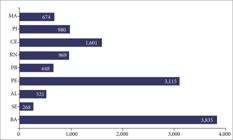
Distribution of active patients on the waiting list by State in the Northeast Region in 2024. São Luís, MA, 2025.
The Northeast Region registers a total of 12,611 active patients on the transplant waiting list. Bahia (BA) leads with 30.41% (3,835) of the total, followed by Pernambuco (PE), which accounts for 24.70% (3,115 patients), and Ceará (CE), occupying the third position with 12.70% (1,601 patients).
Other states also contribute significantly to the list: Piauí (PI) with 980 patients (7.77%); Rio Grande do Norte (RN) with 969 (7.68%); Maranhão (MA) with 674 (5.34%); Paraíba (PB) with 648 (5.14%); Alagoas (AL) with 521 (4.13%); and Sergipe (SE) with 268 (2.13%). Although AL and SE present smaller numbers, they nonetheless represent a meaningful share of the regional demand.
Table 2 illustrates the distribution of patients on the waiting list according to the type of organ or tissue required for transplantation, providing an understanding of the demands for transplant procedures in the region.
Distribution of active patients on the waiting list in the Northeast Region according to the type of organ and tissue in 2024, São Luís, MA, 2025.
Bahia (BA) leads in the number of patients on the waiting list, with a total of 3,835 individuals. Of these, 2,071 are awaiting kidney transplants, 48 require liver transplants, one requires a heart transplant, and 1,715 await cornea transplants. Pernambuco (PE) ranks second, with 3,115 patients, notably 1,681 awaiting kidneys and 1,333 awaiting corneas. Ceará (CE) occupies the third position, with 1,601 patients distributed as follows: 1,396 for kidney, 123 for liver, five for heart, seven for lung, two for pancreas, 13 for simultaneous pancreas–kidney, and 55 for cornea transplants. Collectively, these states demonstrate a particularly high demand for kidney transplants.
Piauí (PI) has 980 patients, with emphasis on 560 awaiting kidneys and 420 awaiting corneas. Rio Grande do Norte (RN) presents 969 patients on the list, Sergipe (SE) 228, and Alagoas (AL) 169. In Maranhão (MA), 674 patients are on the waiting list, including 164 for kidneys and 501 for corneas. Paraíba (PB) records 648 patients, of whom 154 await kidneys, 28 await liver, three await heart, and 463 await corneas, denoting a diversified demand. Alagoas (AL) registers 521 patients, with six awaiting kidneys, four awaiting a liver, one awaiting a heart, and 510 awaiting corneas. Sergipe (SE), in turn, has 268 active patients, all awaiting corneas, with no records for other organs.
DISCUSSION
The results of this study revealed a significant disparity in organ and tissue donation rates in the Northeast Region of the country. The heterogeneity observed in 2024 is evidenced by the concentration of procedures in Ceará (CE), which performed 1,872 transplants (31.63% of the regional total), in contrast to Alagoas (AL) and Sergipe (SE), which carried out 169 and 228 procedures, respectively. This discrepancy raises crucial questions concerning the factors that influence family decisions regarding donation, the efficiency of procurement and notification systems, and the urgency of implementing more effective public policies. Such policies should aim not only to increase awareness but also to strengthen local healthcare infrastructure.
Brazil holds the most comprehensive public organ transplant program in the world, ranking second in the number of transplants performed, surpassed only by the United States. However, the country faces notable inequalities and discrepancies across its territory, as well as considerable challenges in infrastructure, logistics, and geographic aspects, which impact the process of organ donation and transplantation7.
The gap between organ demand and supply, as identified in this study—with a total of 12,611 active patients on the waiting list in 2024 and only 5,919 transplants performed in the same year—is consistent with findings reported in the literature. A study8 revealed that transplant data in Brazil contrast with the demand for solid organs or tissues, which is more pronounced in the South and Northeast regions. Procurement logistics, the transplantation process, and the regional Gross Domestic Product (GDP) may influence the increase in these numbers.
From this perspective, another study9 ought to describe the distribution of solid organ transplants in Brazil and the information regarding the waiting list. The results indicated growth in the number of transplants performed between 2001 and 2017, partially attributable to the increase in authorized transplant centers. However, a concentration of these centers is observed in the South and Southeast regions, which denotes an unequal distribution of the service across the national territory.
Thus, the in-depth investigation revealed that, although the demand for transplants is high throughout the country, the supply of organs and tissues in the Northeast Region remains below the ideal level, contributing to long waiting lists and, in many cases, to the worsening of patients’ health conditions. Factors such as local culture, misinformation, and the lack of adequate resources for maintaining potential donors are identified as crucial elements underlying this reality.
A separate study10 conducted to identify the temporal trends in effective organ and tissue donor rates, notifications, and types of organs transplanted per million inhabitants in Brazil, reported an increase in notifications of potential donors and in effective donations at the national level. Regarding transplanted organs and tissues, a growing trend was observed for cornea transplantation in the North and Northeast regions.
Thus, the analysis of the results, in general terms, highlights a predominant demand for kidneys in several states of the Northeast Region, followed by a high demand for corneas. In 2024, the Northeast recorded 6,384 patients awaiting kidney transplantation and 5,881 patients awaiting cornea transplantation. Notably, 2,071 patients were awaiting kidneys in Bahia (BA), and 1,715 were awaiting corneas. Such data are crucial for guiding public health policies, optimizing resource allocation, and expanding organ procurement, with the aim of reducing waiting times and improving transplant success rates.
However, despite the legal progress in Brazil, the underreporting of brain death (BD) diagnoses and inefficiency in organ donation increase the waiting lists, due to the shortage of human and material resources, lack of training, and precarious infrastructure. To optimize the process, Transplant Center (CET) coordinators and the government must invest in mitigating resource inefficiency, in staff training, and in infrastructure and logistics. Public awareness campaigns on organ donation are also crucial7.
In the context of the pandemic caused by the novel coronavirus, severe acute respiratory syndrome coronavirus 2 (SARS-CoV-2), it is plausible that an adverse impact was exerted on the availability of transplant services for many patients requiring the procedure. The pandemic further intensified preexisting challenges faced by transplant service providers. In Brazil, it is estimated that the annual demand for solid organ transplants—including kidney, liver, heart, and lung—exceeds by threefold the number of procedures actually performed11. According to data from the ABTO report, in 2020 alone, 12,757 new patients were included on the waiting list12.
Thus, the high number of active patients on the waiting list underscores the pressing need to expand healthcare infrastructure and highlights the urgency of strategies that ensure equitable access to treatments. Understanding the distribution of these patients across the States of the region is essential for formulating more effective health policies and for the targeted allocation of resources, with the aim of mitigating inequalities and preserving lives.
CONCLUSION
Therefore, the study analyzed and discussed the statistics of transplants performed and the waiting list in the Northeast Region in 2024. The data from that year revealed a marked disparity in the distribution of the 5,919 transplants performed, with Ceará (CE) accounting for 31.63% of the procedures, followed by Pernambuco (PE) and Bahia (BA).
In contrast, the waiting list totaled 12,611 active patients, with the highest demand concentrated in Bahia (30.41%) and Pernambuco (24.70%). The results demonstrate that kidney and cornea transplants represent the predominant demand on the waiting list in most states of the Northeast, reaffirming the critical gap between demand and supply of organs in the region.
This study makes a substantial contribution to the strategic planning of public health policies, with the aim of mitigating waiting lists and expanding the availability of organs and tissues. It is recommended that such policies prioritize investment in infrastructure, logistics, and continuous professional training in order to optimize the donation process, thereby saving lives and enhancing the quality of life of countless patients.
ACKNOWLEDGEMENT
Not applicable.
-
DECLARATION OF USE OF ARTIFICIAL INTELIGENCE TOOLS
The authors declare that no artificial intelligence tools were used in the preparation, writing, data analysis, or review of this manuscript.
-
FUNDING
Not applicable.
DATA AVAILABILITY STATEMENT
Data will be available upon request.
References
-
Maio I, Aquino AB, Moraes GB. Transplante de órgãos no Brasil: desafios e possibilidades. Îandé: Ciências Humanidades, 2024; 8(1): 131-42. https://doi.org/10.36942/iande.v8i1.990
» https://doi.org/10.36942/iande.v8i1.990 -
Brasil. Ministério da Saúde. Brasil é o segundo maior transplantador de órgãos do mundo. Brasília (DF): MS; 2022. Disponível em: https://www.gov.br/saude/pt-br/assuntos/noticias/2022/fevereiro/brasil-e-o-segundo-maior-transplantador-de-orgaos-do-mundo
» https://www.gov.br/saude/pt-br/assuntos/noticias/2022/fevereiro/brasil-e-o-segundo-maior-transplantador-de-orgaos-do-mundo -
JusBrasil. Como funciona a fila de transplante no Brasil e no mundo. 2023. Disponível em: https://www.jusbrasil.com.br/artigos/como-funciona-a-fila-de-transplante-no-brasil-e-no-mundo/1944038727
» https://www.jusbrasil.com.br/artigos/como-funciona-a-fila-de-transplante-no-brasil-e-no-mundo/1944038727 -
USP. Agência Universitária de Notícias. Transplante e doação de órgãos são desafios à saúde pública. São Paulo (SP): USP; 2024. Disponível em: https://aun.webhostusp.sti.usp.br/index.php/2024/07/02/transplante-e-doacao-de-orgaos-sao-desafios-a-saude-publica/
» https://aun.webhostusp.sti.usp.br/index.php/2024/07/02/transplante-e-doacao-de-orgaos-sao-desafios-a-saude-publica/ -
Agência Minas. MG Transplantes realiza evento para ampliar busca ativa de potenciais doadores de órgãos. Belo Horizonte (MG): Secretaria de Estado de Comunicação Social; 2024. Disponível em: https://www.agenciaminas.mg.gov.br/noticia/mg-transplantes-realiza-evento-para-ampliar-busca-ativa-de-potenciais-doadores-de-orgaos
» https://www.agenciaminas.mg.gov.br/noticia/mg-transplantes-realiza-evento-para-ampliar-busca-ativa-de-potenciais-doadores-de-orgaos -
Instituto Brasileiro de Geografia e Estatística. Censo Brasileiro de 2022. Rio de Janeiro: IBGE; 2022. Disponível em: https://censo2022.ibge.gov.br/panorama/
» https://censo2022.ibge.gov.br/panorama/ -
Almeida J, Araujo CAS, Aguiar Roza B, Siqueira MM, Rocha E. Risk analysis of the organ donation-transplantation process in Brazil. Transplant Proc, 2021; 53(2): 607-11. https://doi.org/10.1016/j.transproceed.2021.01.018
» https://doi.org/10.1016/j.transproceed.2021.01.018 -
Souza MDC, Ferreira Júnior MA, Pompeo CM, Mota FM, Cury ERJ. Transplant management in Brazil: a temporal analysis of financial investments and procedures. Rev Esc Enferm, 2024; 58: e20240039. https://doi.org/10.1590/1980-220X-REEUSP-2024-0039en
» https://doi.org/10.1590/1980-220X-REEUSP-2024-0039en -
Soares LSD, Brito ES, Magedanz L, França FA, Araújo WN, Galato D. Transplantes de órgãos sólidos no Brasil: estudo descritivo sobre desigualdades na distribuição e acesso no território brasileiro, 2001-2017. Epidemiol Serv Saúde, 2020; 29: e2018512. https://doi.org/10.5123/S1679-49742020000100014
» https://doi.org/10.5123/S1679-49742020000100014 -
Santos FGTD, Mezzavila VAM, Rodrigues TFCDS, Cardoso LCB, Silva MD, Oliveira RR, et al. Trend of transplants and organ and tissue donations in Brazil: time series analysis. Rev Bras Enferm, 2021; 74(1): e20200058. https://doi.org/10.1590/0034-7167-2020-0058
» https://doi.org/10.1590/0034-7167-2020-0058 -
Manoel MNF, Santos SP, Amado CAF. Assessing the impact of COVID-19 on the performance of organ transplant services using data envelopment analysis. Health Care Manag Sci, 2023; 26: 217-37. https://doi.org/10.1007/s10729-023-09637-4
» https://doi.org/10.1007/s10729-023-09637-4 -
Associação Brasileira de Transplantes de Órgãos. Dimensionamento dos transplantes no Brasil e em cada estado (2013-2020). Registro Brasileiro de Transplantes. 2020; XXVI(4). Disponível em: https://site.abto.org.br/wp-content/uploads/2021/03/rbt_2020_populacao-1-1.pdf
» https://site.abto.org.br/wp-content/uploads/2021/03/rbt_2020_populacao-1-1.pdf
Edited by
-
Section editor:
Ilka de Fátima Santana F. Boin https://orcid.org/0000-0002-1165-2149

 Source: Elaborated by the authors.
 Source: Elaborated by the authors.