
 Splenic Embolization in the Management of Complications after Liver Transplantation: Integrative Review
ABSTRACT
Introduction: Liver transplantation is a definitive treatment for patients with end-stage liver disease and liver neoplasms. Vascular complications remain an important cause of morbidity and mortality in these patients. Splenic artery embolization is an alternative to improve the clinical and hemodynamic conditions of such patients.
Methods: The research was conducted in October 2025 on the PubMed and Literatura Latino-Americana e do Caribe em Ciências da Saúde (LILACS) platforms, based on the descriptors: “Splenic artery,” “Embolization, therapeutic,” and “Liver Transplantation”; 15 articles were selected based on eligibility criteria.
Results: Seven case reports and eight cohort studies, or retrospective case series were found, reflecting the current level of evidence on the application of splenic artery embolization in patients undergoing liver transplantation. Analysis of the articles allowed the data to be synthesized into three central thematic categories: indications for the procedure, techniques used, and clinical outcomes, including complications.
Conclusion: Splenic artery embolization is a minimally invasive, safe, and effective therapeutic strategy for the management of selected complications after liver transplantation, such as splenic artery steal syndrome, refractory ascites, hydrothorax, and hypersplenism.
Descriptors
Splenic Artery; Embolization, Therapeutic; Liver Transplantation
RESUMO
Introdução: O transplante hepático é um tratamento definitivo para pacientes com doença hepática terminal e neoplasias hepáticas. As complicações vasculares mantêm-se como uma importante causa de morbimortalidade nesses pacientes. A embolização da artéria esplênica (EAE) é uma alternativa para melhorar as condições clínicas e hemodinâmicas de tais pacientes.
Métodos: A pesquisa foi realizada em outubro de 2025 nas plataformas PubMed e Literatura Latino-Americana e do Caribe em Ciências da Saúde (LILACS), baseada nos descritores “Splenic artery”, “Embolization, therapeutic” e “Liver Transplantation”, sendo escolhidos 15 artigos com base nos critérios de elegibilidade.
Resultados: Foram encontrados sete relatos de caso e oito estudos de coorte ou séries de casos retrospectivos, refletindo o nível de evidência atual sobre a aplicação da EAE em pacientes submetidos ao transplante hepático. A análise dos artigos permitiu a síntese dos dados em três categorias temáticas centrais: as indicações do procedimento, as técnicas empregadas e os desfechos clínicos, incluindo as complicações.
Conclusão: A EAE é uma estratégia terapêutica minimamente invasiva, segura e eficaz para o manejo de complicações selecionadas após o transplante hepático, como a síndrome do roubo da artéria esplênica, a ascite refratária, o hidrotórax e o hiperesplenismo.
Descritores
Artéria Esplênica; Embolização Terapêutica; Transplante Hepático
INTRODUCTION
Liver transplantation is a definitive treatment for patients with end-stage liver disease, as well as in specific situations involving certain neoplasms. Even with advances in currently employed techniques, vascular complications remain a significant cause of post-transplant morbidity and mortality. Therefore, interventional radiological procedures, such as splenic artery embolization (SAE), are important alternatives to improve the clinical and hemodynamic conditions of these patients1.
The SAE consists of partial or complete occlusion of arterial flow to the spleen using embolic agents, such as vascular plugs, particles, or coils. The main objective of this technique is to redirect splenic flow to the liver by reducing the volume of blood directed to the portal system and, consequently, increasing hepatic arterial perfusion in a compensatory manner2,3. The main applications of this technique involve splenic artery steal syndrome (SASS)3, hypersplenism4, refractory ascites (RA), and hepatic hydrothorax5.
Despite the numerous benefits of SAE associated with increased hepatic perfusion and decreased portal hypertension, this procedure is not without complications. Among these, fever, abdominal pain, abscesses, and in some cases, splenic infarction and sepsis stand out6. In the current context of patients undergoing liver transplantation, such complications are gaining prominence due to their negative impact on morbidity and mortality.
Although the results currently available in the literature are encouraging, most are from case series and retrospective studies, underscoring the need for integrative reviews capable of gathering and critically evaluating evidence on the indications, techniques used, and clinical outcomes of SAE. Therefore, this study aims to analyze, through an integrative literature review critically, the available studies on the role of SAE in the management of complications after liver transplantation, considering its indications, techniques used, clinical efficacy, and safety profile.
METHODS
This study was reported according to the Preferred Reporting Items for Systematic Reviews and Meta-Analyses Extension for Scoping Reviews (PRISMA-ScR) Checklist. The methods used to conduct this integrative review were based on the analysis of articles in the PubMed and Latin American and Caribbean Literature in Health Sciences (Literatura Latino-Americana e do Caribe em Ciências da Saúde - LILACS) databases. To guide the study, the PICo strategy (acronym for population, interest, and context) was used to outline the following question: What is the role of splenic embolization in the management of post-liver transplant complications?
The search methodology, carried out in October 2025, was based on the combination of the following descriptors: "Splenic artery", "Embolization, therapeutic" and "Liver Transplantation", selected based on the Health Sciences Descriptors (Descritores em Ciências da Saúde - DeCS) and in Medical Subject Headings (MeSH) and combined with the Boolean operator “AND”. The search strategy implemented in both search platforms, LILACS and PubMed, was “Splenic artery” AND “Embolization, therapeutic” AND “Liver Transplantation”. No restrictions were applied regarding language or study type.
The inclusion criteria were studies published between 2015 and October 2025 that addressed the proposed theme and had full texts available in all languages. Exclusion criteria considered thematic focus not applicable to the content of this review, such as the use of embolization in patients not undergoing liver transplantation; the article format, such as editorials, letters, and clinical practice guidelines; and duplicate studies. As a result, 39 articles were found in PubMed and 45 in LILACS, totaling 84 articles (Table 1). To perform the selection process, the articles were imported into the RAYYAN® platform, where the abstracts were reviewed and analyzed against the aforementioned inclusion and exclusion criteria, yielding 15 articles (Fig. 1). The methodological quality of the articles was assessed using the Joanna Briggs Institute (JBI) tool, with the level of evidence evaluated according to the Oxford Classification (2011).

RESULTS
After selecting 15 articles for more detailed analysis from the 84 articles preliminarily obtained, following the aforementioned criteria, a complete reading of these articles was carried out in accordance with the inclusion and exclusion criteria in the databases, and the information shown in Table 2 was obtained. The articles were grouped as follows: seven case reports1,6-11 and eight cohort studies or retrospective case series1-5,12-14, reflecting the current level of evidence on the application of SAE in patients undergoing liver transplantation. The analysis of the articles allowed the synthesis of the data into three central thematic categories: indications for the procedure, techniques employed, and clinical outcomes, including complications.
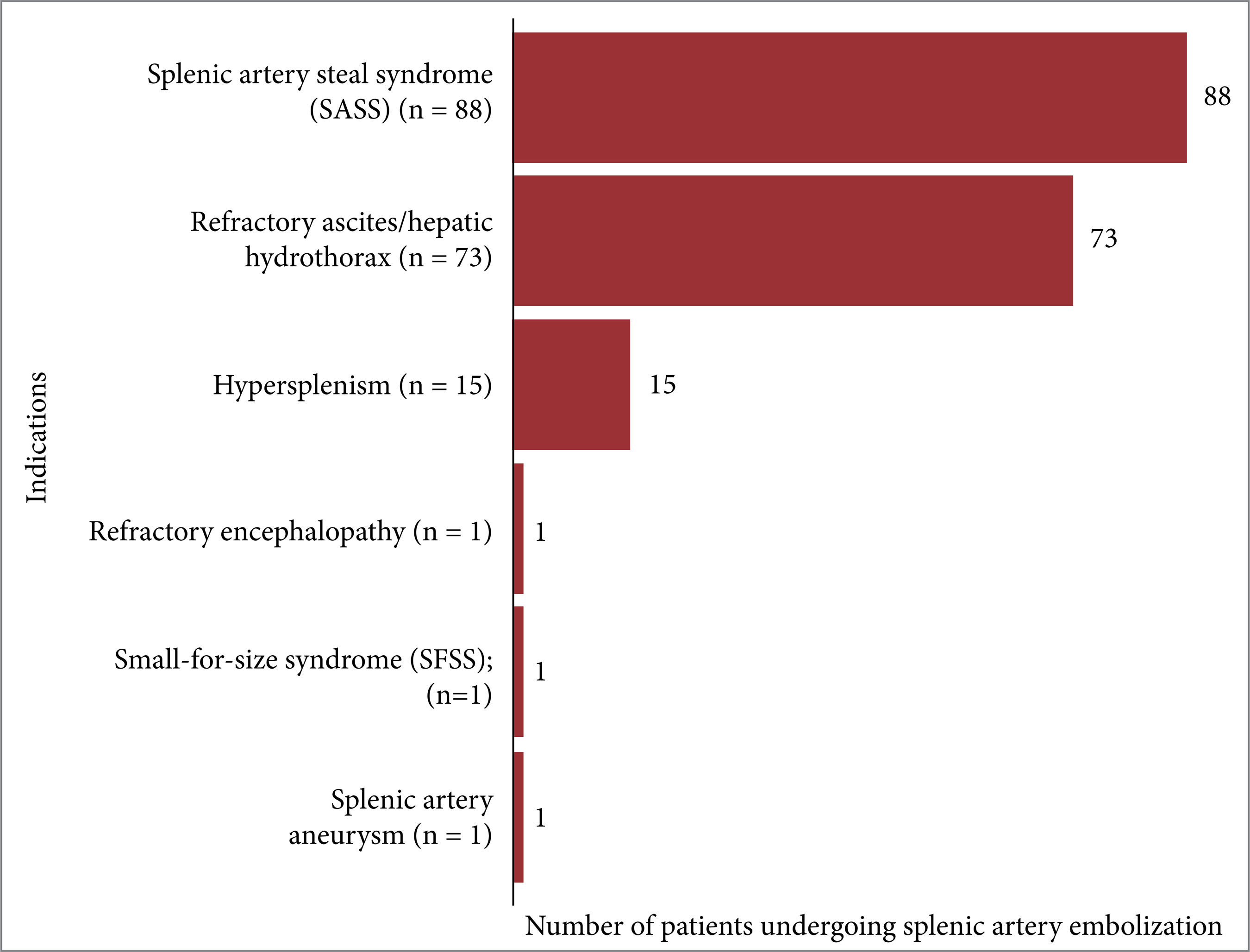
Among the most debated indications (Fig. 2), the SASS stands out. In these cases, SAE has proven to be an effective strategy for improving arterial perfusion of the liver graft4,7,11-14, as it can be performed simultaneously with diagnostic angiography, is minimally invasive and straightforward, and is associated with fewer complications. Among diagnostic methods, Doppler ultrasound has proven highly effective due to its wide availability and low cost4,7,12. However, angiography is considered the gold standard for diagnosing SASS, with computed tomography as an alternative, especially when Doppler ultrasound is inconclusive4,12,13.

Complications of persistent portal hypertension, such as RA and refractory hydrothorax (HH), represent the second largest group of indications for SAE. This method has proven to be an efficient strategy for reducing ascites volume1,2,5,8, reducing portal vein hyperflow, and improving hepatic artery inflow2. In DuBois et al.4, 80% of patients undergoing SAE experienced resolution of RA and/or HH, with 6 patients requiring additional interventions for resolution, including high-dose diuretics, paracentesis, hemodialysis, and a transjugular intrahepatic portosystemic shunt (TIPS). Several factors were positive predictors of RA and HH resolution, including high portal vein velocity pre-SAE, high intraoperative portal flow, and improved renal function5. Okabe et al.9 report a case in which SAE was necessary for the management of small-for-size syndrome after liver transplantation with a living donor, where the graft was small and presented significant portal hyperflow. In this context, after embolization, the patient presented a reduction in portal flow and reversed a possible progression to fulminant liver failure.8
In a smaller number of articles1,2,4,11, SAE was used in the management of hypersplenism before and after liver transplantation, with the main indications being the correction of cytopenias2,4 and the treatment of refractory hepatic encephalopathy11. Persistent hypersplenism after liver transplantation is a common finding that can complicate the use of immunosuppressive medications4. Performing SAE did not increase hemoglobin levels; however, platelet and white blood cell levels improved during the 2-year follow-up period after the procedure.4 In Maki et al.11, a post-liver transplant patient, presenting with cellular rejection and already with established liver cirrhosis, benefited from improved control of encephalopathy and hypersplenism after SAE. There was also the use of SAE for the treatment of a splenic artery aneurysm. On that occasion, the patient presented with splenic infarction and thrombosis of the central portal veins (right and left), the superior mesenteric vein, and the splenic vein6.
Regarding techniques, studies differ on the ideal approach. There is debate about the superiority of proximal embolization over distal embolization in SASS3, as well as comparisons between Amplatzer vascular plugs and coils2. Fleckenstein et al.3, in a retrospective study of 75 patients, found no significant differences between the proximal and distal splenic embolization groups in patients with SASS, especially after 30 days. Regarding the use of vascular plugs, Lee et al.2 reported that the Amplatzer vascular plug may be more effective than coils, due to faster reduction in ascites volume, shorter procedure time, and improvement in pancytopenia.
Regarding outcomes and safety, SAE was described as a safe and effective procedure by all participants. The most commonly reported complication was post-embolization syndrome (fever and abdominal pain), which was generally self-limiting1,2,5. Other complications, although rarer, have been described, including splenic infarction5, splenic abscess6, portal vein thrombosis6 and vascular complications5.
The final sample consisted of 15 studies, predominantly characterized by retrospective observational designs, including case reports6,7,9,10-12,14,15, case series1,5,8,13 and comparative cohorts2-4. According to the Oxford Centre for Evidence-Based Medicine classification (2011), most studies were at evidence level 4, reflecting the nature of the intervention in rare complications; however, some studies2-4 stood out by reaching evidence level 3, due to structuring comparative analyses between treatment groups or distinct clinical moments. The application of the JBI checklists demonstrated high overall methodological quality: reports and series showed rigor in defining criteria and clarity in protocols (proximal, distal, or total embolization), while cohorts presented valid strategies for measuring outcomes and follow-up, with reservations only for the study2, whose small sample size limited the control of confounding factors, in addition to having unbalanced groups.
DISCUSSION
This integrative review consolidates SAE as a versatile and minimally invasive therapeutic tool in the arsenal for managing post-liver transplant complications. Furthermore, it modulates the hemodynamics of the splenic, portal, and hepatic axes, promoting better graft perfusion by increasing hepatic artery flow and reducing portal hypertension.
SASS may be one of the indications for SAE and is the most debated in the studies analyzed. This vascular complication usually occurs 30 days after transplantation. It consists of a diversion of arterial flow from the hepatic artery to the splenic artery12. According to Jiang7, the incidence of SASS, after liver transplantation, can vary considerably, ranging from 0.6 to 10.1%. Several theories explain this pathophysiology, including splenic artery dilation, common in patients with chronic liver disease; increased hepatic resistance due to cellular edema; and reduced adenosine concentration in the hepatic artery, leading to arteriolar vasoconstriction12. Patients with this syndrome may present with elevated liver enzymes, cholestatic syndrome, and even acute liver failure. Diagnosis can be made using Doppler ultrasound by evaluating hepatic artery velocity, waveforms, and vascular resistance index; however, the gold standard is angiography.13 Treatment aims to restore arterial flow to the liver graft and can be performed through splenectomy, splenic artery ligation, or SAE; embolization plays a key role due to its less invasive nature.7
The management of refractory portal hypertension is a more complex application. RA is an uncommon and potentially serious complication that can develop post-liver transplant and is associated with reduced survival in the first year after transplantation. According to D’Amico et al.5, the estimated incidence of RA in these patients is 5 to 7% and can increase recipient mortality by up to 8.6 times. Continuous portal hyperflow, precipitated by splenic circulation, leads to decreased hepatic arterial flow through the so-called hepatic arterial buffer response. This system promotes the release of adenosine, an important vasodilator, in the portal system under low-flow conditions. However, in the context of persistent portal hypertension, this system reverses, leading to vasoconstriction of the hepatic artery and, later, to ascites and HH14. In this sense, partially interrupting splenic arterial flow promotes a reduction in venous circulation and, consequently, in flow over the portal vein8,9. Studies show positive results with both partial and total embolization for patients with RA. However, partial embolization appears to offer a better safety profile.3 This occurs because SAE, primarily if performed in the proximal portion, has a higher risk of developing splenic abscess, sepsis, splenic infarction, and portal vein thrombosis10.
Hypersplenism is reported less frequently in the literature. However, SAE has proven helpful in managing persistent cytopenias that hinder immunosuppression2,4. Following the procedure, there was a sustained increase in leukocyte and platelet counts; however, no significant impact on hemoglobin levels was demonstrated4. In isolation, in Maki et al.11, SAE was used as a treatment for refractory encephalopathy in a patient who had undergone late liver transplantation, resulting in clinical and laboratory improvement.
Regarding safety, SAE has proven to be a well-tolerated procedure with a low rate of serious adverse events. The most frequent complication was post-embolization syndrome, characterized by abdominal pain and fever, which was self-limiting2,5,14. More severe complications, such as splenic abscess, portal thrombosis, and splenic infarction, occurred sporadically and were generally associated with predisposing factors or extensive embolization5,6,10. In some selected cases, alternative approaches to SAE will be necessary to preserve the transplanted graft15.
It is essential to distinguish prior theoretical knowledge from the clinical evidence presented in this review. Although the relationship between reduced portal hyperflow and improved hepatic perfusion is well established, current data validate SAE as a concrete therapeutic tool. The procedure has proven superior to conservative management, ensuring graft viability in critical scenarios. However, interpreting this efficacy should be cautious due to the inherent limitations of primary studies. The predominance of case reports and retrospective series introduces considerable publication bias, in which favorable outcomes are more often reported than therapeutic failures. Furthermore, significant methodological heterogeneity is observed, with substantial variations in indication criteria, materials used (coils versus vascular plugs), and technique (proximal versus distal embolization), which hinder the development of standardized protocols. These gaps highlight that, although the intervention is promising, prospective multicenter studies are still needed to define clear predictors of success and assess the real impact on long-term graft survival.
CONCLUSION
SAE is a minimally invasive, safe, and effective therapeutic strategy for managing selected complications after liver transplantation. The evidence reviewed reveals a viable alternative to surgical reintervention for the management of SASS, as well as being a viable option for the treatment of persistent manifestations of portal hypertension, notably RA, HH, and hypersplenism. However, the current level of evidence warrants caution, as the literature analyzed consists chiefly of case reports and case series, with only three retrospective cohorts identified. This predominance of descriptive studies, coupled with technical heterogeneity, limits the generalizability of the findings. Therefore, although the immediate results are promising, the validation of robust clinical protocols depends on conducting future prospective, multicenter studies to standardize indications, optimize embolization techniques, and define the long-term outcomes of this procedure in the complex setting of post-liver transplantation.
ACKNOWLEDGEMENT
Not applicable.
DECLARATION OF USE OF ARTIFICIAL INTELIGENCE TOOLS
FUNDING
DATA AVAILABILITY STATEMENT
All dataset were generated or analyzed in the current study.
References
-
1 Rysmakhanov M, Doskali M, Taganova A, Kulmagambetov A, Smagulov A, Seidakhmetov A, et al. Splenic artery embolization in patients after orthotopic liver transplant. Exp Clin Transplant, 2015; 13 (Suppl. 3): 52-4. https://doi.org/10.6002/ect.tdtd2015.O43
» https://doi.org/10.6002/ect.tdtd2015.O43 -
2 Lee CY, Lim WX, Chen CL, Yong CC, Yu CY, Tsang LL, et al. Efficacy and safety of splenic artery embolization for intractable ascites using Amplatzer vascular plug versus coil after living donor liver transplantation. Diagn Interv Radiol, 2022; 28(5): 478-85. https://doi.org/10.5152/dir.2022.21027
» https://doi.org/10.5152/dir.2022.21027 -
3 Fleckenstein FN, Luedemann WM, Kücükkaya A, Auer TA, Plewe J, Hamm B, et al. Splenic artery steal syndrome in patients with orthotopic liver transplant: where to embolize the splenic artery? PLOS ONE, 2025; 17(3): e0263832. https://doi.org/10.1371/journal.pone.0263832
» https://doi.org/10.1371/journal.pone.0263832 -
4 DuBois B, Mobley D, Chick JF, Srinivasa RN, Wilcox C, Weintraub J. Efficacy and safety of partial splenic embolization for hypersplenism in pre- and post-liver transplant patients: a 16-year comparative analysis. Clin Imaging, 2019; 54: 71-7. https://doi.org/10.1016/j.clinimag.2018.11.012
» https://doi.org/10.1016/j.clinimag.2018.11.012 -
5 D’Amico G, Partovi S, Del Prete L, Matsushima H, Diago-Uso T, Hashimoto K, et al. Proximal splenic artery embolization for refractory ascites and hydrothorax post-liver transplant. Cardiovasc Interv Radiol, 2023; 46. https://doi.org/10.1007/s00270-023-03376-3
» https://doi.org/10.1007/s00270-023-03376-3 -
6 Livingston AJ, Hickman L, Imani RA, Alexopoulos SP, Matsuoka L. Noninvasive management of complications from splenic artery aneurysm embolization after liver transplant: a case report. Exp Clin Transplant, 2021; 20(2). https://doi.org/10.6002/ect.2020.0531
» https://doi.org/10.6002/ect.2020.0531 -
7 Jiang J, Ji Y, Liang Y, Ou Y, Zhang L. Splenic artery embolization for splenic artery steal syndrome after living donor liver transplantation: a case report. Transplant Proc, 2022; 54(10). https://doi.org/10.1016/j.transproceed.2022.09.020
» https://doi.org/10.1016/j.transproceed.2022.09.020 -
8 Pravisani R, Baccarani U, Adani G, Lorenzin D, Vit A, Cherchi V, et al. Splenic artery syndrome as a possible cause of late onset refractory ascites after liver transplantation: management with proximal splenic artery embolization. Transplant Proc, 2016; 48(2): 377-9. https://doi.org/10.1016/j.transproceed.2016.01.013
» https://doi.org/10.1016/j.transproceed.2016.01.013 -
9 Okabe H, Yoshizumi T, Ikegami T, Uchiyama H, Harimoto N, Itoh S, et al. Salvage splenic artery embolization for saving falling living donor graft due to portal overflow: a case report. Transplant Proc, 2016; 48(9): 3171-3. https://doi.org/10.1016/j.transproceed.2016.07.023
» https://doi.org/10.1016/j.transproceed.2016.07.023 -
10 Meighani A, Jafri SM, Raoufi M, Salgia R. Splenic artery embolization for treatment of refractory ascites after liver transplantation. ACG Case Rep J, 2016; 3(2): 136-8. Disponível em: https://doi.org/10.14309/crj.2016.25
» https://doi.org/10.14309/crj.2016.25 -
11 Maki H, Kaneko J, Arita J, Akamatsu N, Sakamoto Y, Hasegawa K, et al. Proximal total splenic artery embolization for refractory hepatic encephalopathy. Clin J Gastroenterol, 2017; 11(2): 156-60. https://doi.org/10.1007/s12328-017-0805-5
» https://doi.org/10.1007/s12328-017-0805-5 -
12 Liu DY, Yi ZJ, Tang Y, Niu NN, Li JX. Three case reports of splenic artery steal syndrome after liver transplantation. Transplant Proc, 2015; 47(10): 2939-43. https://doi.org/10.1016/j.transproceed.2015.10.037
» https://doi.org/10.1016/j.transproceed.2015.10.037 -
13 Teegen EM, Denecke T, Schmuck RB, Öllinger R, Geisel D, Pratschke J, et al. Impact of Doppler ultrasound on diagnosis and therapy control of lienalis steal syndrome after liver transplantation. Ann Transplant, 2017; 22: 440-5. https://doi.org/10.12659/aot.903526
» https://doi.org/10.12659/aot.903526 -
14 Nutu OA, Justo Alonso I, Marcacuzco Quinto AA, Calvo Pulido J, Jiménez Romero LC. Complete splenic embolization for the treatment of refractory ascites after liver transplantation. Rev Espanola Enfermedades Dig, 2018; 110(4). https://doi.org/10.17235/reed.2018.5338/2017
» https://doi.org/10.17235/reed.2018.5338/2017 -
15 Bulman JC, Weinstein JL, Moussa M, Ahmed M. Transsplenic arterial embolization for splenic artery steal following liver transplant. J Vasc Interv Radiol, 2021; 32(3): 474-5. https://doi.org/10.1016/j.jvir.2020.11.013
» https://doi.org/10.1016/j.jvir.2020.11.013

 Source: Elaborated by the authors.
 Source: Elaborated by the authors.