
 Organ Donations in the Northern Region of Brazil: An Epidemiological Profile from 2020 to 2024
ABSTRACT
Objectives: To analyze the epidemiological profile of organ donations in the Northern Region of Brazil, from 2020 to 2024.
Methods: Retrospective, quantitative, and epidemiological study, using secondary data from the Brazilian Association of Organ Transplantation (Associação Brasileira de Transplante de Órgãos). The variables [potential donors (PDs), actual donors (ADs), causes of death, gender, age group, interviews, and family refusal] were organized in a spreadsheet (Google Drive®) and analyzed using descriptive statistics (Microsoft Excel®), with the results presented in tables and graphs.
Results: An increasing trend in potential and actual donors was observed, with heterogeneity among states. Male donors predominated in the 18-64 age group, and the main causes of death were traumatic brain injury and stroke. Interviews and family refusals increased during the period, with variation in the refusal rate.
Conclusion: Family refusal, coupled with misinformation, was the main factor preventing organ donation. Structural, logistical, and professional training barriers contribute to regional inequalities, waiting lists, and organ shortages.
Descriptors
Organ Donation; Transplants; Nursing
RESUMO
Objetivos: Analisar o perfil epidemiológico das doações de órgãos na Região Norte do Brasil, de 2020 a 2024.
Métodos: Estudo retrospectivo, quantitativo e epidemiológico, com dados secundários da Associação Brasileira de Transplante de Órgãos. As variáveis [potenciais doadores (PDs), doadores efetivos (DEs), causas de óbito, gênero, faixa etária, entrevistas e recusa familiar] foram organizadas em planilha (Google Drive®) e analisadas por estatística descritiva (Microsoft Excel®), com os resultados apresentados em tabelas e gráficos.
Resultados: Observou-se tendência de aumento de PDs e de DEs, com heterogeneidade entre estados. Predominaram doadores do sexo masculino, na faixa etária de 18 a 64 anos, e as principais causas de óbito foram traumatismo cranioencefálico e acidente vascular cerebral. Entrevistas e recusas familiares aumentaram no período, com variação da taxa de recusa.
Conclusão: A recusa familiar, associada à desinformação, foi o principal fator para a não efetivação da doação. Barreiras estruturais, logísticas e de capacitação profissional contribuem para desigualdades regionais, filas de espera e insuficiência de órgãos.
Descritores
Doação de Órgãos; Transplantes; Enfermagem
INTRODUCTION
In 1964, Brazil performed its first organ transplant, a kidney transplant at the Hospital dos Servidores in the state capital of Rio de Janeiro1.
In Brazil, organ and tissue donation is regulated by Law No. 9,434, of February 4, 1997, which governs the removal of organs, tissues, and parts of the human body for transplantation and treatment purposes2, later regulated by Decree No. 9,175, of October 18, 2017, which updated the rules for the donation, transplantation and operation of the National Transplant System (Sistema Nacional de Transplantes-SNT)3.
Organ donation is an act of solidarity and is often the only therapeutic alternative for patients with serious chronic diseases or organ failure⁴. Transplantation is recognized as a safe and effective treatment, associated with improved quality of life and life expectancy5.
Under the coordination of the Ministry of Health (Ministério da Saúde-MS), the SNT is responsible for regulating, standardizing, overseeing, and monitoring all stages of the process, ensuring its execution in an ethical, safe, and transparent manner6.
The donation process involves identifying the potential donor (PD), diagnosing brain death (BD), clinical maintenance, and a family interview, a stage that requires an empathetic, supportive, and informative approach7,8.
Family refusal remains one of the main reasons donations are not carried out, often associated with misinformation, religious beliefs, and distrust of the healthcare team4.
The Ministry of Health defines BD as the total and irreversible loss of cortical or brainstem functions; after confirmation and family authorization, donation can be carried out9.
The diagnosis follows the criteria of Resolution No. 2,173, of November 23, 2017, of the Federal Council of Medicine, which determines clinical evaluation by two different physicians, associated with complementary examination, in patients in unresponsive coma, without supraspinal reactivity and with persistent apnea10.
Therefore, the present study aims to analyze the epidemiological profile of organ donation in the Northern Region of Brazil from 2020 to 2024, guided by the question: What are the epidemiological characteristics of organ donation in the Northern Region during this period?
METHODS
The present is a retrospective, quantitative, and epidemiological study based on organ donation records in the Northern Region of Brazil, covering the period from 2020 to 2024, as published by the Brazilian Association of Organ Transplantation (Associação Brasileira de Transplante de Órgãos - ABTO). Data collection took place from September to October 2025.
The use of this database is justified by its concentration of consolidated statistical information, allowing for a reliable description of the epidemiological dynamics of donations in the region.
ABTO is responsible for collecting, systematizing, and disseminating data from the State Health Departments, providing technical support to transplant center organizations, and contributing to regulatory improvements in the sector11.
All records of actual donors (ADs) from the Brazilian Transplant Registry No. 3 for the study period were included, excluding records with inconclusive or incomplete data.
The data were organized in a spreadsheet on Google Drive® and subsequently transferred to Microsoft Excel®, where tabulation, table, and graph creation, and descriptive analysis were performed in light of the scientific literature.
The variables analyzed included PDs, ADs, cause of death, gender, age group, interviews, and family refusal. PDs were considered those cases reported with a suspected or confirmed diagnosis of brain death, and ADs those with the procurement of at least one organ. The age group was categorized according to ABTO (< 5, 6-10, 11-17, 18-34, 35-49, 50-64, and ≥ 65 years), and the causes of death were classified as traumatic brain injury (TBI), cerebrovascular accident (CVA), and others. The family refusal rate was calculated as the ratio of refusals to interviews, multiplied by 100. The data were subjected to descriptive analysis [frequencies, per million population (pmp), and annual variation] and presented in tables, graphs, and linear trend lines (Microsoft Excel®).
The results were interpreted in light of current scientific literature on organ donation and transplantation in Brazil.
This study followed the recommendations of Resolution No. 510, of April 7, 2016, of the National Health Council. It was not submitted to the Research Ethics Committee because it involved publicly available data and did not identify the individuals involved in the research.
RESULTS
During the analyzed period, PD rates pmp in the Northern Region showed an increasing trend. The state of Rondônia (RO) stood out for the most significant growth, increasing from 43.5 pmp in 2020 to 148.4 pmp in 2024. The states of Acre (AC), Tocantins, and Roraima (RR) also registered progressive increases, while Amazonas (AM) maintained a discreet variation, with relative stability. The state of Pará (PA) presented the lowest rates among the states (Fig. 1).
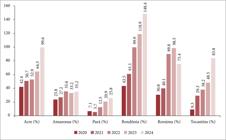
Figure 2 shows a discrepancy between the rates of DEs and the notifications of PDs pmp. RO presented the highest rates, with linear growth from 5.3 pmp in 2020 to 39.6 pmp in 2024. AM showed slight oscillations, maintaining relative stability. AC and RR registered practically zero rates; AC presented records only in 2023 and 2024 (6.4 pmp in both years), while RR presented data only in 2020.
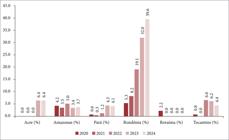
Table 1 shows an increase in the number of PDs and ADs in the Northern Region. RO showed the greatest increase, going from 58 PDs in 2020 to 176 in 2024, and from 7 ADs to 47 in the same period. AC and RR showed a progressive increase in PDs, but without a proportional increase in ADs. In the regional total, ADs increased from 26 in 2020 to 88 in 2024.
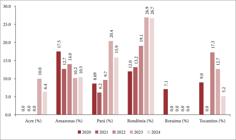
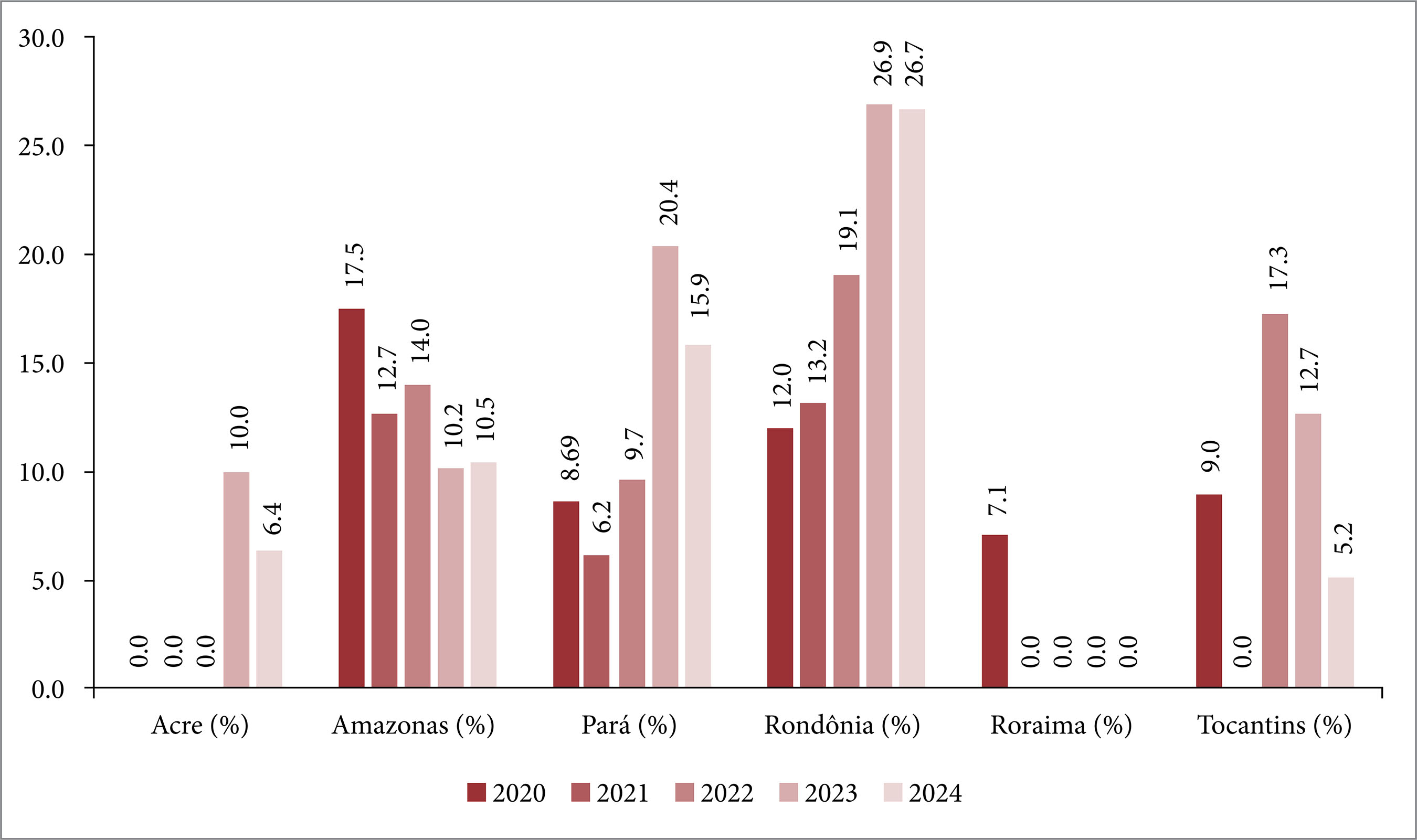
Figure 3 shows the organ donation completion rates by state. RO maintained the highest percentages throughout the period, remaining stable in 2024. AM recorded the highest rate in 2020 (17.5%), followed by a reduction in 2021, a slight increase in 2022, and no completions in subsequent years. PA showed annual variations, peaking in 2023 (20.4%). AC and RR recorded the lowest completion rates.
The data shows a continuous increase in PD rates, as confirmed by the linear trend line. AD rates also increased over the period, but with greater variability (Fig. 4).

The sociodemographic profile showed a predominance of donors aged 18-64, with a higher frequency among males. TBI and CVA were the main causes of death (Table 2).
Breakdown of age range, gender, and causes of death in the Northern Region from 2020 to 2024.
Figure 5 shows a continuous increase in the number of family interviews, from 89 in 2020 to 321 in 2024. Refusals followed this growth. The family refusal rate varied throughout the period, with the lowest percentage in 2022 (55.3%), a peak in 2023, and a reduction to 63.2% in 2024.

Quantitative data on family interviews, family refusal, and family refusal rate in the Northern Region from 2020 to 2024.
DISCUSSION
In Brazil, identifying potential donors still faces obstacles related to the difficulty in confirming brain death, a shortage of trained professionals, limitations in hospital infrastructure, and the overload on teams attending to neurocritical patients and emergency demands, compromising the quality of care for potential donors12,13. Despite the country having the largest public transplant program in the world, socioeconomic and territorial factors directly influence donation rates13.
This scenario helps explain why an increase in notifications does not always translate into actual donations: effectiveness depends on a sequential chain (diagnosis, maintenance, logistics, and consent), in which failures at any stage produce cumulative losses.
Recent strategies seek to reverse this scenario through the integrated action of Organ Procurement Organizations and the electronic platform for Organ and Tissue Donation (Plataforma Eletrônica de Doação de Órgãos e Tecidos-eDOT), according to the update from the Ministry of Health through Ordinance GM/MS No. 8,041, of September 1, 2025, strengthening the early identification of BD and reducing the loss of potential donors12,14,15.
From an analytical point of view, the expected gain from these measures is twofold: (i) to increase the sensitivity of PD detection and (ii) to reduce avoidable losses due to delayed notification, hemodynamic instability, and interruptions in the care flow.
The Northern Region showed an increase in notifications and donations, but indicators remained below the national average, corroborating ABTO data that highlight regional inequalities16. This difference suggests that the problem is not only "quantitative" (number of PDs), but above all "organizational and logistical": regions with greater installed capacity tend to convert notifications into captures more effectively. In contrast, regions with infrastructure and governance barriers remain low in effectiveness even when they notify more. The observed growth reflects advances in the organization of services, management, logistics, and the strengthening of the SNT, although unevenly across states6.
Although the SNT is present throughout the national territory, the Northern Region's geographical dimensions, logistical barriers, and structural limitations hinder recruitment, transportation, and access to services, contributing to healthcare-related migratory flows and the maintenance of regional disparities6. Analytically, this indicates that regional effectiveness depends on integrated healthcare networks and rapid response capacity (transport, teams, intensive care unit, laboratory, and regulation); losses due to ischemic time, bed unavailability, and fragmentation of care will increase.
A discrepancy was observed between organ donation notifications and the actual completion of donations. RO stood out for its higher rates, with linear growth from 5.3 pmp in 2020 to 39.6 pmp in 2024, a result associated with better organization of the process, from notification to obtaining family consent, as described in the literature12.
More than just an isolated "good performance," this finding indicates that governance interventions and standardization of the flow (diagnosis, maintenance, and family interview) can increase the notification-to-donation conversion rate. Thus, RO can be interpreted as an experience of greater organizational maturity within the region, suggesting that inequalities are not inevitable, but modulated by management capacity and network design.
Regarding the sociodemographic profile, males predominated (61.94%), especially among adults aged 18 to 64, a pattern similar to the national scenario. The greater involvement of men in risky situations, such as violence and accidents, is related to the higher occurrence of TBI, the main cause of BD, followed by CVA.
However, this finding differs from national data that indicate CVA as the predominant cause11,16-20. A plausible interpretation is that differences in regional mortality profiles, bed availability, and access to specialized services may alter the composition of reported causes: a greater weight of external causes tends to increase TBI, while more structured networks and population aging increase CVA.
Family refusal was the main barrier to successful donations, frequently associated with misinformation about brain death, religious beliefs, lack of knowledge of the donor's wishes, fear of bodily mutilation, and insecurity regarding the healthcare team13,21. Studies also highlight the difficulty of diagnosing based on the patient's clinical appearance, even with ventilatory support and apparent vital signs13,21,22.
At this point, refusal can be understood as a multifactorial phenomenon in which information asymmetry interacts with institutional trust and communication quality. Thus, reducing refusals requires more than general campaigns: it demands interview protocols, communication training, and structured emotional support, with accessible language and adequate decision-making time.
The family interview is a central step in the process, requiring technical preparation, communication skills, and a humanized approach from professionals, especially nurses, who play a fundamental role in welcoming, clarifying doubts, and providing emotional support to family members22,23.
In this context, the need for continuous training of teams, strengthening of communication strategies, and implementation of regionalized public policies that improve the logistics of collection and transportation, as well as the intensification of educational campaigns to expand the culture of donation and reduce refusals, is reinforced5,7,13,24.
In summary, the findings suggest that the most relevant gains for the Northern Region lie in "conversion" (notification → actual donation), through professional training, flow governance, and a logistical structure compatible with the territorial reality.
CONCLUSION
Analysis of the epidemiological profile of organ donations has allowed us to understand the relevance of transplantation as an essential strategy for promoting the life and health of patients with organ failure. Despite national progress, challenges persist that limit the expansion of donations, especially in the Northern Region.
Family refusal was the main factor associated with donation failure, often due to misinformation. Adding to this scenario are insufficient professional training and regional inequalities, which compromise logistics, service organization, and the effectiveness of the process, contributing to long waiting lists and organ shortages.
The influence of sociodemographic variables, such as age, gender, and level of information, on donation rates was observed. These findings reinforce the need for educational initiatives, continuous team training, and the implementation of regionalized public policies to optimize organ procurement, reduce losses, and expand access to transplantation.
Limitations include the use of publicly available secondary data from ABTO, the possibility of underreporting or inconsistencies in the records, and the logistical and structural barriers inherent to the Northern Region. Nevertheless, the study contributes to the planning of interventions and the development of future research on the topic.
ACKNOWLEDGEMENT
Not aplicable.
-
DECLARATION OF USE OF ARTIFICIAL INTELIGENCE TOOLS
The authors declare that no artificial intelligence tools were used in the preparation, writing, data analysis, or review of this manuscript.
-
FUNDING
Not aplicable.
DATA AVAILABILITY STATEMENT
All dataset were generated or analyzed in the current study.
References
-
1 Freitas AG da, Figueiredo DB de, Teixeira ST, Ramos RL, Machado HMB. Nursing, organ donation, and legal aspects: situational diagnosis in Brazil and Roraima. RSD, 2021;10(14). https://doi.org/10.33448/rsd-v10i14.22172
» https://doi.org/10.33448/rsd-v10i14.22172 -
2 BRASIL. Lei nº 9.434, de 4 de fevereiro de 1997. Dispõe sobre a remoção de órgãos, tecidos e partes do corpo humano para fins de transplante e tratamento e dá outras providências. Diário Oficial da União. 5 fev 1997. Disponível em: https://www.planalto.gov.br/ccivil_03/leis/l9434.htm Acesso em: 6 nov 2025.
» https://www.planalto.gov.br/ccivil_03/leis/l9434.htm -
3 BRASIL. Decreto nº 9.175, de 18 de outubro de 2017. Regulamenta a Lei nº 9.434, de 4 de fevereiro de 1997, que dispõe sobre a remoção de órgãos, tecidos, células e partes do corpo humano para fins de transplante e tratamento. Diário Oficial da União. 19 out 2017. Disponível em: https://www.planalto.gov.br/ccivil_03/_ato2015-2018/2017/decreto/d9175.htm Acesso em: 6 nov 2025.
» https://www.planalto.gov.br/ccivil_03/_ato2015-2018/2017/decreto/d9175.htm -
4 Solon AAB, Silva IC, Morel AN, Alencar SRM, Gonçalves A da C, Reis CA, et al. Conhecimento da equipe de enfermagem sobre o processo de doação de órgãos e tecidos para transplante. Revista Eletrônica Acervo Saúde, 2025: e18212. https://doi.org/10.25248/reas.e18212.2025
» https://doi.org/10.25248/reas.e18212.2025 -
5 Corsi CAC, Assunção LAV, Monteiro SL, Scarpelini KCG, Bento RL, Ribeiro MS, et al. A importância da reconstituição do corpo de doadores de órgãos e tecidos: um olhar sobre a dignidade humana. Braz J Transplant, 2024; 27. https://doi.org/10.53855/bjt.v27i1.566_PORT
» https://doi.org/10.53855/bjt.v27i1.566_PORT -
6 Souza MC, Ferreira JMA, Pompeo CM, Mota FM, Cury ERJ. Transplant management in Brazil: a temporal analysis of financial investments and procedures. Rev Esc Enferm USP, 2024; 58: e20240039. https://doi.org/10.1590/1980-220X-REEUSP-2024-0039en
» https://doi.org/10.1590/1980-220X-REEUSP-2024-0039en -
7 Marques MC, Melo AG. A atuação do enfermeiro frente as fragilidades encontradas no processo de doação de órgãos. Revista Faculdade do Saber. 2024 [acesso em: 16 nov 2025]; 9(21). Disponível em: https://rfs.emnuvens.com.br/rfs/article/view/276
» https://rfs.emnuvens.com.br/rfs/article/view/276 -
8 Silva IC, Oldoni AE, Zanardo JC, Pereira JL. Cenário de doação de órgãos e tecidos para transplante pós-morte na 16ª Região de Saúde/RS. Braz J Transplant, 2023; 26. https://doi.org/10.53855/bjt.v26i1.511_PORT
» https://doi.org/10.53855/bjt.v26i1.511_PORT -
9 BRASIL. Ministério da Saúde. Sistema Nacional de Transplantes. Disponível em: https://www.gov.br/saude/pt-br/composicao/saes/snt Acesso em: 22 nov 2025.
» https://www.gov.br/saude/pt-br/composicao/saes/snt -
10 BRASIL. Conselho Federal de Medicina. Resolução nº 2.173, de 23 de novembro de 2017. Define os critérios do diagnóstico de morte encefálica. Diário Oficial da União. 2017 dez 15; Seção 1: 274-6. Disponível em: https://sistemas.cfm.org.br/normas/visualizar/resolucoes/BR/2017/2173 Acesso em: 22 nov 2025.
» https://sistemas.cfm.org.br/normas/visualizar/resolucoes/BR/2017/2173 -
11 Associação Brasileira de Transplante de Órgãos. Dados numéricos da doação de órgãos e transplantes realizados por estado e instituição no período janeiro/setembro-2021. Registro Brasileiro de Transplantes. 2021 [acesso em 25 nov 2025]; XXVII(3). Disponível em: https://site.abto.org.br/wp-content/uploads/2021/11/RBT-2021-Trimestre-3-Pop.pdf
» https://site.abto.org.br/wp-content/uploads/2021/11/RBT-2021-Trimestre-3-Pop.pdf -
12 Restier RBO, Knihs NS, Salum NC, Nascimento KC, Pessoa JLE. Análise do perfil de pacientes neurocríticos com sinais clínicos de morte encefálica em um hospital do norte do Brasil. Braz J Transplant, 2025; 28. https://doi.org/10.53855/bjt.v28i1.636_PORT
» https://doi.org/10.53855/bjt.v28i1.636_PORT -
13 Moraes INS, Batista RHP, Gonçalves GFTG, Miranda YM, Souza JSS, Freire MELR, et al. Transplantes de órgãos na região norte do Brasil: desafios e avanços no panorama atual. In: XX Congresso Médico Amazônico; 2024; Belém (PA). Anais eletrônicos. Disponível em: https://doity.com.br/anais/xxcma/trabalho/380419 Acesso em: 28 nov 2025.
» https://doity.com.br/anais/xxcma/trabalho/380419 -
14 Silva GNA, Oliveira RR, Barbosa TG, Piris AP, Rios BRM, Martins AMEBL. Programa de transplantes e doações de órgãos: desafios da enfermagem no contexto de pandemia. Revista Bionorte. 2024 [acesso em: 28 nov 2025]; 13(1): 390-404. Disponível em: http://revistas.funorte.edu.br/revistas/index.php/bionorte/article/view/624
» http://revistas.funorte.edu.br/revistas/index.php/bionorte/article/view/624 -
15 BRASIL. Ministério da Saúde. Brasil bate recorde de transplantes e anuncia medidas para modernizar sistema e aumentar doações. 2025. Disponível em: https://www.gov.br/saude/pt-br/assuntos/noticias/2025/junho/brasil-bate-recorde-de-transplantes-e-anuncia-medidas-para-modernizar-sistema-e-aumentar-doacoes Acesso em: 5 dez 2025.
» https://www.gov.br/saude/pt-br/assuntos/noticias/2025/junho/brasil-bate-recorde-de-transplantes-e-anuncia-medidas-para-modernizar-sistema-e-aumentar-doacoes -
16 Associação Brasileira de Transplante de Órgãos. Dados numéricos da doação de órgãos e transplantes realizados por estado e instituição no período janeiro/setembro-2024. Registro Brasileiro de Transplantes. 2024 [acesso em: 25 nov 2025];XXV(3). Disponível em: https://site.abto.org.br/wp-content/uploads/2024/11/RBT2024-3t-abto-populacao.pdf
» https://site.abto.org.br/wp-content/uploads/2024/11/RBT2024-3t-abto-populacao.pdf -
17 Souza LMP, Tajra RS, Ribeiro MA, Ávila AR, Albuquerque IMN, Moreira RMM. Perfil de doadores efetivos de órgãos e tecidos. Revista Tendências da Enfermagem Profissional. 2019 [acesso em: 06 Dez 2025];11(1). Disponível em: https://www.coren-ce.org.br/wp-content/uploads/2020/01/Perfil-de-doadores-efetivos-de-%C3%B3rg%C3%A3os-e-tecidos.pdf
» https://www.coren-ce.org.br/wp-content/uploads/2020/01/Perfil-de-doadores-efetivos-de-%C3%B3rg%C3%A3os-e-tecidos.pdf -
18 Associação Brasileira de Transplante de Órgãos. Dimensionamento dos transplantes no Brasil e em cada estado (2013-2020). Registro Brasileiro de Transplantes. Acesso em: 25 Nov 2025. Disponível em: https://site.abto.org.br/wp-content/uploads/2020/08/2020_populacao_1.pdf
» https://site.abto.org.br/wp-content/uploads/2020/08/2020_populacao_1.pdf -
19 Associação Brasileira de Transplante de Órgãos. Dados numéricos da doação de órgãos e transplantes realizados por estado e instituição no período janeiro/setembro-2022. Registro Brasileiro de Transplantes. 2022 [acesso em: 25 nov 2025]; XXVIII(3). Disponível em: https://site.abto.org.br/wp-content/uploads/2022/11/rbt-naoassociado.pdf
» https://site.abto.org.br/wp-content/uploads/2022/11/rbt-naoassociado.pdf -
20 Associação Brasileira de Transplante de Órgãos. Dimensionamento dos transplantes no Brasil e em cada estado (2016-2023). Registro Brasileiro de Transplantes. 2023 [acesso em: 25 nov 2025]; XXX(4). Disponível em: https://site.abto.org.br/wp-content/uploads/2024/04/rbt2023-restrito.pdf
» https://site.abto.org.br/wp-content/uploads/2024/04/rbt2023-restrito.pdf -
21 Machado JR de F. Metodologias de pesquisa: um diálogo quantitativo, qualitativo e quanti-qualitativo. Revista Devir Educação. 2023 [acesso em: 7 dez 2025]; 7(1): e-697. Disponível em: https://devireducacao.ded.ufla.br/index.php/DEVIR/article/view/697/489
» https://devireducacao.ded.ufla.br/index.php/DEVIR/article/view/697/489 -
22 Magalhães JB, Schulz RS, Borges TP, Barata RS, Sampaio KCP, Lima RR, et al. Desafios da enfermagem no processo de doação para transplante de órgãos: revisão integrativa. Revista Eletrônica Acervo Saúde, 2020; 12(10): e4195. https://doi.org/10.25248/reas.e4195.2020
» https://doi.org/10.25248/reas.e4195.2020 -
23 Batista MEP, Telles CFS, Pierotto AAS, Barilli SLS, Rocha KR, Rosa RR, et al. Justificativas de familiares para a não autorização de doação de órgãos: estudo documental. Braz J Transplant, 2024; 27. https://doi.org/10.53855/bjt.v27i1.627_PORT
» https://doi.org/10.53855/bjt.v27i1.627_PORT -
24 Silva VS, Souza CUF, Silva MRB, Chicharo SCR, Tostes PP, Souza DRS. A efetividade do processo de doação de órgãos frente a nova legislação. Nursing (São Paulo), 2020; 23: 4018-35. https://doi.org/10.36489/nursing.2020v23i264p4018-4035
» https://doi.org/10.36489/nursing.2020v23i264p4018-4035
Edited by
-
Seccion editor
Ilka de Fátima Santana F. Boin https://orcid.org/0000-0002-1165-2149

 Source: Elaborated by the authors.
 Source: Elaborated by the authors.
 Source: Elaborated by the authors.
 Source: Elaborated by the authors.
 Source: Elaborated by the authors.