
 A Radiological Evaluation of Using NORM Residue in Building Materials
Abstract
The sulphate route for titanium dioxide production in Brazil yields 30,000 tons of annual residue, currently disposed of in industrial landfills. This long-term storage incurs significant maintenance and safety costs, alongside environmental impacts. This residue is enriched in the natural radionuclides of the uranium and thorium series and is classified as a NORM (Naturally Occurring Radioactive Material) residue. To minimize the environmental impact of such waste disposal, it is necessary to offer alternatives for its safe reuse, in line with the principles of sustainability. This paper evaluates the radiological exposure associated with incorporating this residue into interlocking and cement blocks. An experimental house was constructed with cement block walls and interlocking block flooring, and internal gamma exposure and radon concentration were measured. Results indicate that incorporating up to 23% of the residue does not elevate indoor radon concentration above the international limit of 200 Bq.m -3 and keeps external gamma exposure below 1 mSv.
Keywords:
Safe re-use of NORM residue; building materials; sustainability; circular economy
Resumo
A produção brasileira de dióxido de titânio pela rota do sulfato gera anualmente 30.000 toneladas de resíduos, que são descartados em aterros industriais. Esse armazenamento gera, a longo prazo, altos custos de manutenção e segurança, além de causar impacto ambiental. Este resíduo é enriquecido nos radionuclídeos naturais da série do urânio e do tório e é classificado como resíduo NORM (Naturally Occurring Radioactive Material). Para minimizar o impacto ambiental desse descarte de resíduo, é necessário oferecer alternativas para sua reutilização segura, em consonância com os princípios da sustentabilidade. Este estudo tem como objetivo avaliar a exposição radiológica decorrente do uso do resíduo como componente de blocos intertravados e blocos de cimento. Para isso, foi construída uma casa experimental totalmente revestida com blocos de cimento nas paredes e blocos intertravados no piso. No interior da casa, foram medidas a exposição interna à radiação gama e a concentração de radônio. Os resultados indicam que o uso de até 23% do resíduo não leva a concentrações internas de radônio acima do limite internacionalmente adotado (200 Bq.m -3 ) e que a exposição externa à radiação gama permanece abaixo de 1 mSv.
Palavras-chave:
Reutilização segura de resíduos NORM; materiais de construção; sustentabilidade; economia circular
1. INTRODUCTION
The majority of construction materials are composed of natural minerals and inherently contain background levels of natural radioactive nuclides. Rock and soil-based materials contain natural radionuclides of the uranium and thorium series, and the radioactive isotope of potassium. Within the uranium series, the decay chain starting from radium ( 226 Ra) is of primary radiological concern, and, therefore, often resulting in radium being used as a reference for uranium. Global average concentrations in the Earth's crust are approximately 40 Bq.kg -1 for radium, 40 Bq.kg -1 for thorium, and 400 Bq.kg -1 for potassium (UNSCEAR, 2000) [1]. Contemporary construction practices also incorporate various industrial residues. Certain residues can exhibit elevated concentrations of naturally occurring radionuclides, and for those classified as NORM (Naturally Occurring Radioactive Materials), the associated additional exposure to ionizing radiation is a relevant consideration.
Radiation exposure from building materials can be categorized as external and internal. External exposure arises from direct gamma irradiation. Internal exposure, conversely, is primarily attributed to the inhalation of radon ( 222 Rn), thoron ( 220 Rn), and their short-lived decay progeny. Radon is part of the radioactive decay series of uranium, which is present in building materials. Because radon is an inert gas, it can move rather freely through porous media such as building materials, although usually only a fraction of that produced in the material reaches the surface and enters the indoor air. In response to this issue, the European Commission has implemented a directive that restricts additional ionizing radiation exposure from building materials to below 1 mSv per year (expressed as effective dose) (EC, 1999) [2]. Given the impracticality of directly assessing the annual effective dose to the public attributable to building materials, the European Basic Safety Standards Directive (EU BSS) [3] established a pathway for dose limit compliance by setting limits on radionuclide activity concentrations within these materials. To categorize building materials from a radiation protection standpoint, the directive introduced a screening tool known as the index I . This index was calculated based on the activity concentrations of 226 Ra, 232 Th, and 40 K, according to Equation 1 [2]. Furthermore, the radium content in building materials should be limited to levels that make it unlikely to significantly contribute to exceeding the recommended indoor radon design level specified by the Commission Recommendation (200 Bq.m -3 ) (EC, 1999) [2].
The sulfate route for titanium dioxide production in Brazil yields approximately 60,000 tons of TiO 2 pigment annually, resulting in 30,000 tons of residue, known as UOW (unreacted ore waste), which is disposed of in industrial landfills. (Mazzilli et al., 2022) [4]. The raw material, ilmenite, has activity levels of natural radionuclides of approximately 207 Bq.kg -1 of uranium, 1016 Bq.kg -1 of thorium, 275 Bq.kg -1 of 226 Ra and 796 Bq.kg -1 of 228 Ra (Mazzilli et al., 2022) [4]. Uranium and thorium are soluble in sulfuric acid, which is used in the sulfation phase. Due to their solubility in the sulfuric acid employed in the sulfation phase, uranium and thorium are largely expected to be found in the liquor (the process solution for TiO 2 production), implying a low concentration of these isotopes in the resulting residue. In contrast, radium isotopes possess limited solubility in sulfuric acid and therefore tend to accumulate in the residue.
The current policy of stockpiling NORM (Naturally Occurring Radioactive Material) residue incurs significant long-term maintenance and safety costs, alongside adverse environmental impacts. To mitigate these environmental consequences, exploring safe reuse alternatives is crucial, aligning with circular economy principles and contributing to the Sustainable Development Goals (IAEA, 2013) [5]. A viable alternative would be the incorporation of the residue as a constituent of building materials.
Albuquerque et al. (2018) [6] assessed the impact of UOW addition, a residue from sulfate-route TiO 2 production, on the properties of coating mortars in both hardened and applied states. Their findings indicated that incorporating up to 15% of the residue did not significantly alter the physical and mechanical properties of the mortars, thus enabling a reduction in cement consumption through UOW reuse. Similarly, Llanes et al. (2018) [7] evaluated the use of a comparable waste and concluded that the residue offered benefits by reducing the heat of hydration, final setting time, expansion, and linear shrinkage compared to standard ordinary Portland cement.
Ribeiro et al. (2021) [8] investigated the impact of incorporating UOW residue from Brazilian TiO 2 production on coating mortar properties and assessed its radiological implications. They evaluated mixed cement-lime mortars with 5%, 10%, and 15% UOW additions (relative to cement mass) against a reference mortar, examining rheology, dynamic elastic modulus, and mechanical strength. Their findings indicated that UOW did not compromise the usability of coating mortars, showing no significant effect on their fresh, hardened, and applied state properties. The authors also evaluated the radiological risks of using UOW in coating mortars, concluding that its incorporation poses no significant health risks to occupants due to radiation exposure.
Utilizing NORM residue in building materials is feasible only if the radionuclide activity concentration in the final product does not pose any additional public exposure risk. Consequently, NORM residues are typically not used in their pure form but are blended with conventional construction materials. This paper aims to evaluate the radiological implications of incorporating varying amounts of UOW residue in the production of cement and interlocking blocks. The goal is to control and prevent radiological issues associated with large-scale application of these materials. Samples of cement and interlocking blocks containing different residue percentages were analyzed. The first sample, without residue addition, represents the "background." The second, with 3.5% residue, equates to an activity increase of 1 Bq.g -1 in the final product. The third sample, containing 23% residue, represents the technically feasible maximum content that still meets cement performance requirements. To ensure compliance with the international guidelines issued by the European Commission (EC, 1999) [2] and the Brazilian regulations mandated by the Comissão Nacional de Energia Nuclear (CNEN, 2016) [9], the following steps were carried out:
-
Measurement of the activity concentrations of radionuclides from the 238 U, 232 Th decay series ( 226 Ra, 228 Ra and 232 Th) and 40 K in the individual components of the cement and interlocking blocks (cement, sand, gravel and UOW) and in the final products with 0%, 3.5% and 23% of UOW;
-
Calculation of the screening index I ;
-
Assessment of internal gamma exposure and radon inhalation within an experimental dwelling constructed entirely with cement block walls and interlocking block flooring.
2. MATERIALS AND METHODS
The interlocking and cement blocks were prepared using cement, natural sand, gravel, and UOW residue in proportions of 0%, 3.5%, and 23%. The concentration of 226 Ra, 228 Ra, 232 Th and 40 K in samples of the UOW residue, cement, natural sand, gravel, and the final products with varying UOW residue proportions were determined using high-resolution gamma spectrometry. The detector used was an Hyper Pure Germanium detector (HPGe) GX2518, with 25% relative efficiency, from CAMBERRA. The counting time was 86,000 seconds. Samples weighing 100 grams were sealed in polyethylene containers for 30 days to allow the radioactive equilibrium between 226 Ra and its decay products gamma emitters. The radionuclide 226 Ra was determined taking into account the mean value of the photo peaks of the radionuclides: 214 Pb (295.21 keV and 351.93 keV) and 214 Bi (609.32 keV and 1120.30 keV). In the thorium series, only the equilibrium between 232 Th and 228 Th is essential for determining the concentration of 232 Th, which was determined from the intensity of the peaks of its descendants 212 Bi (727.33 keV and 1620.74 keV) and 212 Pb (238.63 keV).
The 228 Ra was determined by measuring the intensity of the peaks of 911.07 keV and 968.90 keV of 228 Ac. The concentration of 40 K was determined directly by using the peak of 1460.83 keV. The gamma spectra were analyzed with the InterWinner 6.0 from Eurisys Measures, taking into account the gamma peak area, the background radiation for the gamma transition considered, the sample weight, the detector efficiency and the counting time. The quality control of the measurements was carried out participating in the National Intercomparison Program, organized by Instituto de Radioproteção e Dosimetria, three times per year.
Index I was calculated from the concentration of 226 Ra, 232 Th and 40 K in the components of the cement blocks and interlocked blocks with various concentrations of UOW. Values of I lower than the unit indicate that the material can be used without restriction, as the additional radiation exposure will be less than 1 mSv. If the index I exceeds the value of 1 mSv, additional studies are needed to enable the safe use of these materials.
To validate the viability of these novel materials, an experimental house was constructed with certain rooms entirely lined with cement block walls and interlocking block flooring. This house was built as a pilot standard dwelling, incorporating all essential habitable features, including windows and doors (Figure 1). One half of the house featured concrete floors and brick walls without UOW addition (rooms 3 and 4 in Figure 2), while the other half utilized 23% UOW in its construction (rooms 1 and 2 in Figure 2). These semi-detached units had independent walls and two rooms each: one with a single door and the other with a door and a window. The roof and foundation were constructed without UOW addition. The rooms were used in a manner simulating normal occupancy, with windows opened during the day and closed at night.

(a) Reference House Floor Plan (b) Access doors to two rooms of the house (c) Floor of one of the bedrooms using interlocking blocks with 23% of UOW (d) Front view of the house.
The experimental house was designed for a comprehensive radiological evaluation, encompassing measurements of external gamma exposure (using Thermoluminescent Dosimeters - TLDs) and radon concentration. Radon measurements were conducted using a passive method with solid-state nuclear track detectors (CR 39 - Columbia Resin #39). Both sets of measurements were performed over a three-month period.
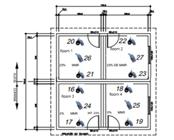
In each room of the house, three TLD dosimeters were positioned 1.80 m above the floor: two at a distance of 30 cm from the wall and one in the center. Two CR-39 (Columbia Resin No. 39) nuclear track detectors were placed 1.80 m above the floor, 30 cm away from the wall. All dosimeters were exposed for a period of three months. The sampling locations are illustrated in Figure 2. The background of the soil was measured outside the house.
3. RESULTS AND DISCUSSION
Table 1 presents the activity concentrations of 226 Ra, 228 Ra, 232 Th, and 40 K in cement, sand, gravel, UOW residue, and the final products (cement blocks and interlocking blocks) containing different proportions of the residue (0%, 2.3%, and 23%), along with their respective index I values.
As expected, the residue exhibited higher concentrations of 226 Ra, 228 Ra, and 232 Th compared to the raw materials. On the other hand, 40 K showed higher concentrations in cement and gravel samples. Potassium-40 is a naturally occurring radioactive isotope of potassium and is thus distributed relatively evenly in various ores and rocks.
The activity concentration index ( I ) values, calculated for the final products, were compared to recommended limits to assess external radiation hazards to humans from the building materials. Cement and interlocking blocks containing 3.5% UOW exhibited index ( I ) values of 0.7 and 0.8, respectively. These values, being below unity, indicate safe use from a radiation exposure perspective, implying that additional radiation exposure will be less than 1 mSv and thus the material can be used without restriction. However, incorporating 23% UOW resulted in index values exceeding 1, suggesting an exposure greater than 1 mSv. Consequently, further studies are necessary to evaluate the actual exposure within a dwelling constructed with these materials.
Table 2 presents the results for external gamma exposure and radon concentration measured within rooms constructed with 0% and 23% UOW. The same table also includes measurements taken outside the house to assess soil exposure. The locations of the sampling points are shown in Figure 2.
Radon concentrations measured by dosimeters placed 30 cm from the interior walls ranged from 27±8 to 92±16 Bq.m -3 . These results exceeded the mean value observed outside the house, 19±1 Bq.m -3 . Rooms built with cement and interlocking blocks containing 23% UOW (rooms 1 and 2 in Figure 2) exhibited higher radon concentrations. However, all results remained below the recommended investigation level for radon concentration (200 Bq.m -3 ). These findings indicate that incorporating 23% of the residue will not result in indoor radon concentrations exceeding the internationally adopted limit. Furthermore, external gamma exposure in all rooms remained at or below 0.1 mSv, demonstrating that using 23% of the residue will not cause any additional indoor gamma exposure above the 1 mSv limit.
4. CONCLUSIONS
This study assessed the feasibility of utilizing NORM residue as a construction material, specifically evaluating the radiation exposure to occupants of a house built with it. External gamma exposure and indoor radon concentration were measured and compared between houses built with and without the residue. The findings indicate that incorporating up to 23% UOW in cement and interlocking blocks is safe and complies with regulatory limits for both external gamma exposure to occupants and indoor radon concentration. Therefore, the use of construction materials containing up to 23% UOW residue is a feasible option from a public health perspective.
To conclude, the results derived from this case study offer valuable insights for the formulation of national standards and guidelines pertaining to the safe reuse and management of this residue in construction materials. Moreover, this approach warrants consideration as it embodies the principles of sustainability and is consistent with the tenets of a circular economy.
This work was supported by Conselho Nacional de Desenvolvimento Científico e Tecnológico (CNPq): Barbara Mazzilli- grant number 300835/95-7, Fernanda Yuri Muta- grant number 145651/2024-0 and Lara Vitoria Santos Couto-grant number 154057/2024 -0.
REFERENCES
-
1 UNSCEAR – United Nations Scientific Committee on the Effects of Atomic Radiation. Sources and Effects of Ionizing Radiation. New York, v. 1, Annex B: Exposures from natural radiation source, 2000. Disponível em: https://www.unscear.org/docs/publications/2000/UNSCEAR_2000_Annex-B.pdf
» https://www.unscear.org/docs/publications/2000/UNSCEAR_2000_Annex-B.pdf - 2 EC – European Commission. Radiation Protection 112. Radiological Protection Principles concerning the Natural Radioactivity of Building Materials. 1999.
- 3 EC, Council directive 2013/59/EURATOM of 5 December 2013 laying down basic safety standards for protection against the dangers arising from exposure to ionizing radiation Off. Official Journal of the European Union, L 13/1, 2013.
-
4 MAZZILLI, B. P.; CAMPOS, M. P.; OXOSSI, M. M.; CAJAZEIRA, L. Revalorisation of Residues in the Scope of the Circular Economy. Case study from the Titanium Dioxide Industry. In: 10th International Symposium on Naturally Occurring Radioactive Material - NORM X, Utrecht, Netherlands, May 2022. Disponível em: https://nucleus.iaea.org/sites/orpnet/resources/SitePages/NORMX.aspx
» https://nucleus.iaea.org/sites/orpnet/resources/SitePages/NORMX.aspx - 5 IAEA – International Atomic Energy Agency. Management of NORM Residues (IAEA-TECDOC-1712). Vienna: IAEA, 2013.
-
6 ALBUQUERQUE, D. D. M.; ANDRADE NETO, J. S.; AMORIM JÚNIOR, N. S.; SANTOS, V. S.; RIBEIRO, D. V. Evaluation of the Influence of the Waste Originated by the Production of Titanium Dioxide (URM) on the Physical-Mechanical Properties of Coating Mortars. Key Engineering Materials, v. 765, p. 319-323, 2018. Disponível em: https://doi.org/10.4028/www.scientific.net/KEM.765.319
» https://doi.org/10.4028/www.scientific.net/KEM.765.319» https://doi.org/10.4028/www.scientific.net/KEM.765.319 -
7 LLANES, M. C.; GONZÁLEZ, M. J. G.; MORENO, S. M. P.; RAYA, J. P. B. Recovery of ilmenite mud as an additive in commercial Portland cements. Environmental Science and Pollution Research, v. 25, p. 24695-24703, 2018. Disponível em: https://doi.org/10.1007/s11356-018-2498-9
» https://doi.org/10.1007/s11356-018-2498-9» https://doi.org/10.1007/s11356-018-2498-9 -
8 RIBEIRO, D. V.; AMORIM JÚNIOR, N. S.; ANDRADE NETO, J. S.; ALBUQUERQUE, D. D. M.; MAZZILLI, B. P. Performance and radiological implications of using residue from TiO₂ production as a component of coating mortars. Construction and Building Materials, v. 306, p. 124885, 2021. Disponível em: https://doi.org/10.1016/j.conbuildmat.2021.124885
» https://doi.org/10.1016/j.conbuildmat.2021.124885» https://doi.org/10.1016/j.conbuildmat.2021.124885 -
9 CNEN – Comissão Nacional de Energia Nuclear. CNEN NN 3.01: Requisitos de Segurança e Proteção Radiológica para Instalações Minero-Industriais. 2016. Disponível em: https://www.gov.br/cnen/pt-br/acesso-rapido/normas/grupo-4#1
» https://www.gov.br/cnen/pt-br/acesso-rapido/normas/grupo-4#1
Edited by
-
SCIENTIFIC EDITOR:
Prof. Dr. Bernardo Maranhão Dantas http://orcid.org/0000-0002-2388-6073
-
SCIENTIFIC EDITOR:
Prof. Dr. Alfredo Lopes Ferreira Filho http://orcid.org/0000-0002-0806-1284

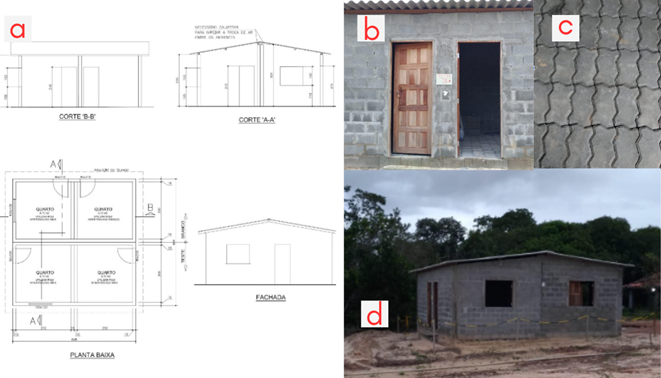 Figure 1: Reference house plan and structural details including access doors, bedroom floor with UOW blocks, and front view.
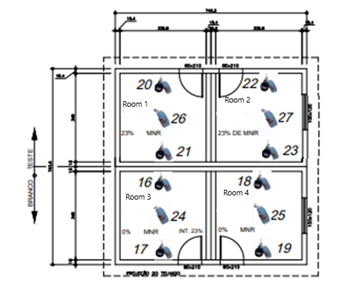 Figure 2: Placement of TLD and CR-39 dosimeters within the rooms.