 Effect of osmotic dehydration on the freeze-drying and hot air-drying process of Andean papaya
Abstract
Andean papaya (Carica pubescens) is a fruit of high nutritional and functional value; however, it has a rapid rate of respiration and ripening, which limits its shelf life. For this reason, the kinetics of the osmotic dehydration (OD) process and its influence on the freeze-drying and hot air-drying processes were evaluated in the present study. Six OD treatments were applied combining two temperatures (30 °C and 40 °C) and three concentrations of sucrose solution (40, 50 and 60 °Brix). Moisture loss curves were analyzed and adjusted to mathematical models to describe the drying kinetics. T6 (40 °C, 60 °Brix) presented the highest efficiency, achieving a moisture reduction of 48.51%. This treatment was selected for subsequent processing by freeze-drying and hot air drying, thus obtaining four types of Andean papaya slice samples: hot air dried (CD), hot air dried with osmotic dehydration as pretreatment (CD-OD), freeze dried (FD), and freeze dried with osmotic dehydration as pretreatment (FD-OD). The FD-OD sample showed moisture values of 8.95% ± 0.68, water activity (aw) 0.56 ± 0.03, density 1.41 ± 0.03 g/cm3, and vitamin C of 3.27 mg/100 g dry basis. Concerning color, a lightness 73.91 ± 5.19, a* value (-5.08 ± 1.11) and b* value (70.7 ± 3.75), similar to those of fresh fruit, were obtained. The textural profile showed a softer and more elastic texture than the fresh sample, with values of hardness 29.05 N, chewiness 3.49 N, gumminess 5.79 N and elasticity (0.61 mm); however, cohesiveness (0.02) was comparable to the control sample. The results confirmed that OD as a pretreatment improved the quality of the final product and represents an effective alternative to prolong the shelf life of Andean papaya.
Keywords:
Carica pubescens; Osmotic dehydration; Freeze-drying; Hot air drying; Kinetics; Pretreatment
Highlights
Osmotic dehydration as a pretreatment improved the quality and shelf life of Andean papaya
Verma's model was the one that best described the drying kinetics
Freeze-drying with osmotic pretreatment improved the texture and color of Andean papaya
1 Introduction
Andean papaya (Carica pubescens Lenné & K.Koch) is a species native to tropical America, with a high concentration in the Andean region of Peru, Ecuador and Colombia (Scheldeman et al., 2007). Also known as papaya de la sierra, it grows in high mountain areas between 1500 and 3000 meters above sea level, in warm-temperate climates (Patriani et al., 2024).
The fruit is green when unripe, turning yellow when ripe. It is characterized by a fresh aroma, sweet and sour flavor and morphology similar to the common papaya, although smaller in size (Patriani et al., 2024). It is a berry with a thin pericarp; with an interior full of seeds covered by mucilaginous tissue. Its shape is oblong -ovoid, with dimensions of 6.6 to 21 cm long and 4.5 to 9.8 cm wide (Hernández-Salinas et al., 2019). It is rich in bioactive compounds such as flavonoids, polyphenols, tannins, and triterpenoids (Patriani et al., 2024). This characteristic, together with its nutritional value and functional properties, has contributed to its global expansion (Vincent et al., 2022).
Currently, one of the main challenges in fruit postharvest is deterioration caused by microbial agents, a process that accelerates considerably between harvesting and consumption, especially in tropical regions, where high temperatures and high relative humidity favor the development of microorganisms (Ruelas-Chacón et al., 2013). Among these fruits, it can be found the Andean papaya (C. pubescens) which has a moisture content of 93.81% and is classified as a climacteric fruit due to its characteristic increase in ethylene production and respiratory rate during ripening (Zapana Yucra et al., 2024).
The synthesis of ethylene in this fruit triggers important physiological changes, promoting the development of sensory attributes such as color, texture, aroma, and flavor (Chen et al., 2022). It is noted that the first visible sign of ripening is the rapid change in skin color, followed by increased ethylene production and progressive softening of the pulp. These changes make C. pubescens vulnerable to post-harvest deterioration, significantly reducing its shelf life (Lemus-Mondaca et al., 2024). Andean papayas reach maturity approximately 12 days after being harvested (Salazar, 2021).
Dehydration is one of the oldest and most effective methods of food preservation, traditionally used to preserve fruits, grains, vegetables, meat, and fish by drying them in the sun, ensuring their availability in times of scarcity (Calín-Sánchez et al., 2020). By reducing the water content, microbial growth is inhibited and the biochemical reactions responsible for deterioration are slowed down, preserving its nutritional value (Badui, 2006).
Osmotic dehydration (OD) is a non-thermal technique that reduces the moisture content in fruits and vegetables by immersing them in hypertonic solutions, which extends the shelf life and stability of the product (Dahiya & Rajput, 2025). This process preserves the organoleptic, nutritional, and functional properties of the food (Parzanese, 2010), and is often combined with other drying methods, such as hot air drying, frying, or freeze-drying, to optimize the final quality (Asghari et al., 2024).
Freeze-drying minimizes the loss of compounds responsible for aroma and flavor, and this method preserves other essential components of food more efficiently (Orrego, 2015). In contrast, hot air drying, widely used for its simplicity and low cost, involves simultaneous heat and mass transfer to remove moisture. However, it can negatively affect heat-sensitive compounds such as vitamins and phenolic compounds (Chandra et al., 2021).
Although there is growing interest in complementary drying technologies to improve the quality of dehydrated fruits, studies on high Andean species such as the Andean papaya (C. pubescens) are still limited. Most research on OD has focused on tropical fruits such as mango, pineapple, and banana, thus focusing on parameters such as mass loss or solids transfer (Corrêa et al., 2011). There are few studies comparing freeze-drying and hot-air drying combined with osmotic pretreatments, especially those that comprehensively evaluate properties such as texture, vitamin C content, density, water activity (aw), moisture content, and drying kinetics (Yadav & Singh, 2022).
In this context, the present study aimed to fill these scientific gaps by applying OD as a preliminary stage to freeze-drying and hot air drying, using Andean papaya as the raw material. Unlike previous studies that have focused solely on specific physicochemical variables, this research incorporated a comprehensive assessment of the quality of the final product, including structural parameters relevant to its stability and acceptability. Likewise, a kinetic drying analysis was carried out, which allowed modeling moisture loss and optimizing processes focused on the conservation of bioactive compounds.
In this way, this work not only contributes to the technological use of Andean papaya, but also expands the body of knowledge on combined pre-treatment and drying strategies applied to understudied fruits, with potential for incorporation into the agro-industry of functional and export products. Therefore, the objective of this study is to evaluate the kinetics of the OD process and its influence on freeze-drying and hot air-drying processes.
2 Materials and methods
2.1 Place of performance
The research was carried out in the laboratories of the Peruvian Union University, Juliaca Campus, located at an altitude of 4029 meters above sea level in UTM Zone 19S (east: 372718.372 and north: 8284240.409).
2.2 Obtaining the material
The Andean papaya was harvested in the district of Sandia, province of Sandia, Puno region, Peru, at an altitude of 2,178 meters above sea level. The selected fruits were uniform in size, ripe, and free of external damage. White sugar (food grade, San Aurelio S.A.) and treated water (Cielo Industrias San Miguel (ISM)) were also used as complementary inputs.
2.3 Osmotic dehydration process as a pretreatment for freeze-drying and hot air drying.
It was carried out according to the methodology of Cañazaca Tito et al. (2022) with modifications, where Andean papayas were manually selected at physiological maturity, washed, and disinfected with a 100 ppm sodium hypochlorite solution. They were then cut lengthwise to remove the seeds, and uniform pieces were obtained using a 1.6 cm diameter hole punch. The pieces obtained were subjected to heat treatment by blanching at 80 °C for 5 minutes. For osmotic treatments, aqueous solutions of sucrose at 40%, 50%, and 60% (w/w) were prepared and used as osmotic agents in a sample/solvent ratio of 1:16 (w/w). OD was carried out at two controlled temperatures, 30 °C and 40 °C, using an analytical stirrer (VELP Scientifica, JLT6 flocculation Tester, Italy) equipped with six paddles, which allowed constant stirring at 80 rpm to be maintained during the established experimental time (speed in rpm and time in minutes).
To maintain a constant temperature during the OD process, an adapted thermal circulation system was used (see Figure 1), consisting of an IP68 ROHS centrifugal water recirculation pump (model JT - 800, INPUT: DC6V - 24V, Hmax: 80-800 cm, Qmax: 450-1100 L/H), connected to a 25L water bath (model BS - 11, Jeio Tech - Lab Companion, South Korea). This system allowed for continuous circulation of the thermal fluid, ensuring a stable temperature in the dehydration medium. During the osmotic process, periodic measurements of weight, moisture content, and water activity (aw) of the samples were taken at 20, 40, 60, 90, 120, 150, 180, 210, and 240 minutes to characterize the kinetics of water loss. After 240 minutes of OD, the samples were subjected to two drying methods: (1) Freeze - drying: a Telstar laboratory freeze dryer (H.W. Kessel S.A.C., Lima, Peru) was used, equipped with a high - performance JIN JIN Factory Store RCP vacuum pump (2XZ - 2/4/6 B direct-coupled rotary vane vacuum pump) and a -50 °C condenser, and the samples were frozen to -40 °C, followed by a primary sublimation stage at -20 °C for 16 hours and a secondary sublimation at 20 °C for 2 hours. (2) Hot air drying: a Food Dehydrator LT - 82 (Power: 400 watts, Hz: 60 Hz; Voltage: 220 V~) was used, dehydrating at temperatures of 40 °C and 60 °C for 16 hours, with an air flow speed of 2.5 m/s.
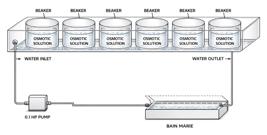
Adapted thermal circulation system to maintain the temperature of the osmotic solution for the osmotic dehydration of Andean papaya.
2.4 Drying kinetics
The moisture content data were adjusted to six mathematical models, reported according to González et al. (2021). The drying evolution was expressed by relative moisture (RM), defined as (Equation 1):
where: Mt = moisture content at time t (g water/g ms); M0 = initial moisture content; Me = equilibrium moisture content.
The following empirical and semi-empirical models were applied to describe the drying kinetics (Equations 2-7):
-
Newton's model:
-
Page model:
-
Henderson & Pabis (1961) model:
-
Logarithmic model:
-
Model by Midilli et al. (2002):
-
Model by Verma et al. (1985, cited by Cervera-Chiner et al., 2024):
The model parameters were estimated using nonlinear regression with Microsoft Excel 2016 (Microsoft Corporation, Redmond, WA, USA). The goodness of fit (GoF) was evaluated using the coefficient of determination (R2), the root mean square error (RMSE), and the average relative error (P). The following criteria were used:
-
Coefficient of determination (R2): The closer to 1, the better the fit.
-
Root mean square error (RMSE) (Equation 8):
-
Average relative error (P, in %) (Equation 9):
The model with the highest R2 and the lowest RMSE and P values was considered the most suitable for describing the drying kinetics of the product under study.
2.5 Physicochemical properties
2.5.1 Moisture determination
The moisture content of dehydrated Andean papaya was determined according to Association of Official Analytical Chemists (AOAC) 925.10 (Association of Official Analytical Chemists, 2019a). Five grams of chopped sample were dried at 105 °C for 6 hours in an ODHG-9030 heating drying oven (Oven, China) until a constant weight was achieved. After cooling in a desiccator, the moisture content was calculated on a wet basis. The analyses were performed in triplicate.
2.5.2 Water activity (aw)
Water activity (aw) was determined in accordance with ISO standard (International Organization for Standardization, 2017) Foodstuffs – Determination of water activity, using a Water Activity Meter WA - 160ª (Shinyei Technology, Japan), which operates on the principle of hygroscopic equilibrium (dew point method). Measurements were taken at 25 ± 1 °C, after calibration with standard solutions (aw 0.760 and 0.920), and were expressed as dimensionless values. The analyses were performed in triplicate.
2.5.3 True density
The true density of fresh and dehydrated Andean papaya was determined according to AOAC 920.212 (Association of Official Analytical Chemists, 2019b) using a pycnometer and distilled water as the displacement liquid. All measurements were performed in triplicate.
2.5.4 Color
Color was determined using a computer vision system described by Saldaña et al. (2014) and it was based on two stages as follows: image acquisition and processing. A Logitech C930e webcam (HD1080p) was used in a black booth with controlled LED lighting. The images were processed using specialized software that transformed the RGB values into CIE Lab* space. Measurements were taken in triplicate in different areas of the sample.
2.5.5 TPA
Texture profile analysis (TPA) was performed using an Instron model 34 TM universal texture analyzer (Instron Corporation, Norwood, MA, USA), belonging to the 3400 Series, equipped with an interchangeable 5 kN load cell. The samples were previously conditioned at a controlled room temperature (25 ± 1 °C) and subjected to two consecutive compression cycles until they reached 50% of their original height. The pre-test, test, and post-test speeds were set at 1.0 mm/s. Based on the force-deformation curves obtained, the following textural parameters were calculated: hardness (N), elasticity (mm), cohesiveness (dimensionless), gumminess (N), and chewiness (N·mm). Each test was performed in triplicate (n = 3) for each type of sample to ensure the repeatability and reliability of the results. Methodology adapted from (Peleg, 2019).
2.5.6 Vitamin C
Vitamin C was quantified according to method 31.61 of the Adolfo Lutz Institute (Instituto Adolfo Lutz, 2008), using iodometric titration based on the reduction of iodine by ascorbic acid in an acidic medium. Ten grams of the sample were homogenized and extracted with 0.5% oxalic acid (w/v). The filtered extract was titrated with 0.01 N iodine, using soluble starch as an indicator. The endpoint was identified by the persistent blue color change. The results were calculated on a wet basis using the corresponding equation and were subsequently corrected using the moisture content of the sample, finally being expressed as milligrams of ascorbic acid per 100 g of dry matter (Equation 10).
where: V = volume of iodine solution used in the titration (mL); N = normality of the iodine solution; 88 = gram equivalent of ascorbic acid; P = weight of the sample (g); 100 = correction factor to express the results per 100 g of sample.
2.6 Statistical analysis
All data were statistically analyzed using Analysis of Variance (ANOVA) and Least Significant Difference (LSD) multiple comparison test with a significance level of 95% (P < 0.05). Statgraphics Centurion XIX version 19 statistical software (Statistical Graphics Corp., Herndon, Va., USA) was used.
3 Results and discussions
3.1 Osmotic dehydration kinetics
The parameters of the six models were estimated using nonlinear regression analysis with samples of Andean papaya slices osmotically dehydrated at different sugar concentrations (°Brix) and temperature conditions (Table 1). The values of the constant k ranged from 0.0002 to 0.0542, which were very low compared to the study conducted by Cervera-Chiner et al. (2024). Higher values of the constant k indicated a higher rate of water loss in the OD process (Islam et al., 2019), as shown in the 40 °C – 60 °Brix treatment. The values of n ranged from 0.4437 to 1.0000, and the values of c ranged from 0.0968 to 0.2164. These values increased with increasing sugar concentration (°Brix). The values of a, g, and b did not vary in any of the treatments.
Model parameter values and statistical parameters of the six drying kinetics models applied to six osmotic dehydration pretreatments.
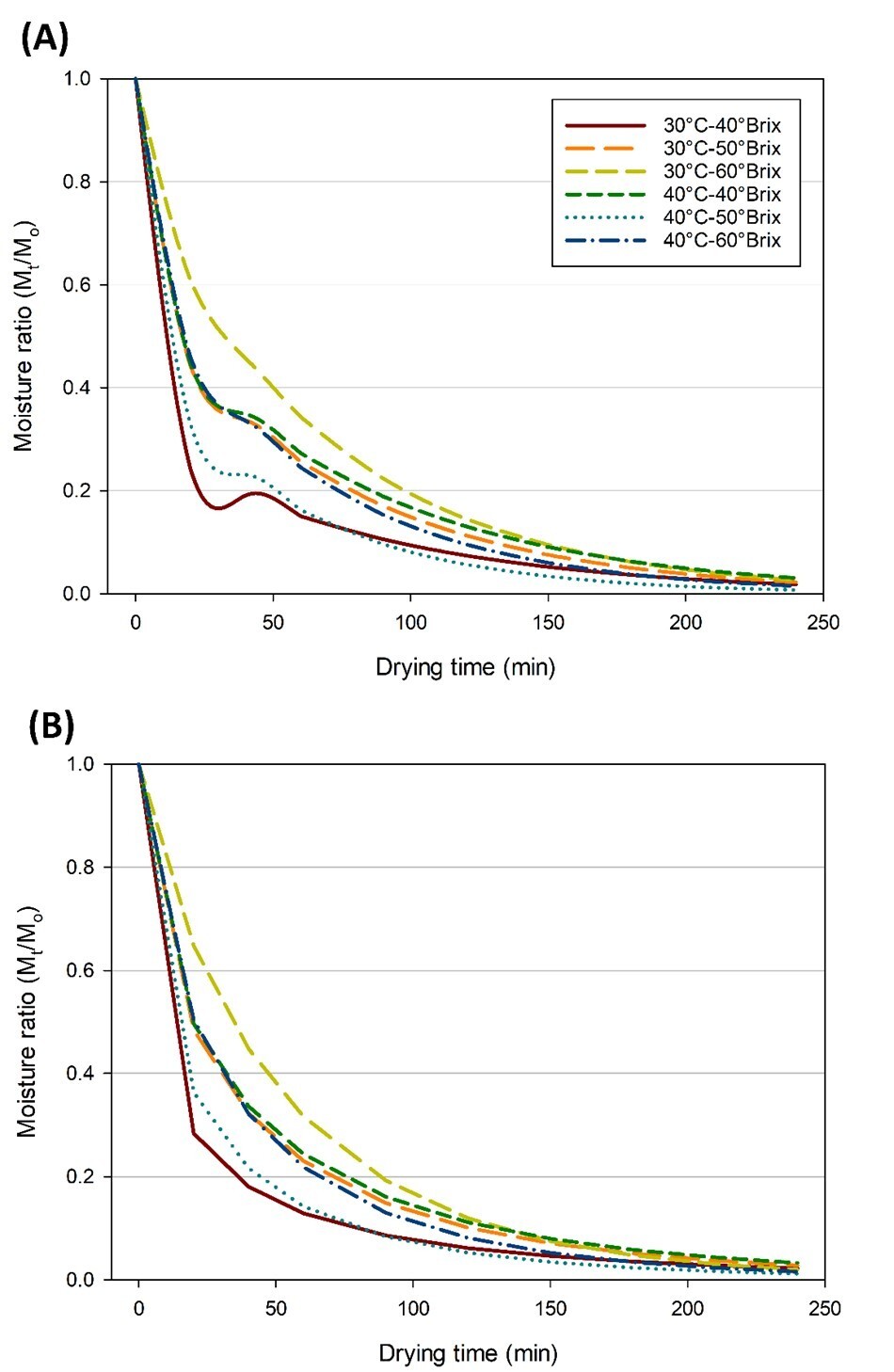
In addition, three statistical parameters were considered: R2, RMSE, and Percentage Error (PE) % values (Table 1). The model that best fits all OD treatments was the Verma model, followed by Page (Figure 2). The Verma model obtained an R2 value greater than 0.99 and lower values in RMSE (0.0047 - 0.0210) and PE (0.3530% - 0.3530%). Like the Page model, it obtained high values in R2 (> 0.99) and low values in RMSE and PE % compared to the other models.

Osmotic dehydration (OD) curves at different temperatures and sugar concentration conditions (°Brix), using the Verma (A) and Page (B) models.
These results are consistent with the study by Cervera-Chiner et al. (2024), in which the Verma and Page models also best described water loss during the drying process at different temperatures. The model with the highest R2 and the lowest RMSE and PE values was considered the most suitable for describing the OD kinetics of the product under study.
3.2 Moisture content and water activity
The Andean papaya had an initial moisture content of 92.51% ± 0.35, which is within the parameters reported by Concha et al. (2002), which were 90 to 95% moisture content. Similarly, Zapana Yucra et al. (2024) determined similar moisture content values of 93.81%. According to Zapata et al. (2002), fruits with high moisture content generally tend to deteriorate quickly. During osmotic dehydration, the moisture content of the fresh Andean papaya slices decreased over time (see Figure 3). In addition, the increase in temperature and osmotic concentration favoured the decrease in moisture content of the Andean papaya slices during OD, as evidenced by the 40 °C – 60 °Brix treatment, which decreased to 48.51% moisture in 240 min. This phenomenon also occurred in papaya slices (C. papaya L) osmotically dehydrated at 55 °C and 60 °Brix, reducing their moisture content to 58% in 4 hours (Islam et al., 2019).

Moisture content vs. osmotic dehydration time at different temperature conditions (30 °C and 40 °C) and Brix degrees (40, 50, and 60 °Brix).
Fresh Andean papaya had a water activity of 0.92 ± 0.003, according to Zapata et al. (2002). Generally, fruits with high moisture content tend to have a high water activity value that is very close to 1.0. This is why fruits such as Andean papaya are susceptible to rapid microbial growth.
The results for water activity (aw) and moisture content of the samples analyzed are shown in Table 2. It can be seen that the slices of Andean papaya CD, CD-OD, FD, and FD-OD have a water activity between 0.40 and 0.63 and a moisture content of 6.02 to 11.15%. Where dried slices of Andean papaya slightly increase their aw when they are pretreated by OD. In the case of CD-OD, the moisture content compared to CD, they coincide with the aw trend. The lowest aw value and moisture content was for CD drying (0.40 ± 0.02 and 6.02% ± 0.15, respectively). This event could be caused by the loss of free water during drying, which causes the cell membrane to shrink and become impermeable (Zimmer et al., 2024). The opposite occurred with CD-OD, as their aw (0.63 ± 0.02) and moisture content (10.38% ± 0.20) increased slightly, thus increasing the risk of microbial proliferation, as it would be almost outside the safe microbiological limits (aw < 0.6) (Chandra et al., 2021). To maintain the stability of CD-OD and prevent increases in aw during storage, it is recommended to use packaging materials with a high water vapor barrier, hermetic sealing, and storage in conditions of relative humidity < 60% and temperature < 25 °C. These measures can help keep the aw below the safety limit and extend the shelf life of the product (Rahman, 2009).
The FD and FD-OD samples showed intermediate water activity (aw) values compared to CD and CD-OD, suggesting that these drying methods could inhibit microbial growth. However, when the dehydrated Andean papaya slices are removed from the freeze dryer, they can quickly absorb water molecules on the surface of the pores due to the increase in atmospheric pressure, which explains the observed increase in moisture content. Chandra et al. (2021), Udomkun et al. (2018) and Udomkun et al. (2015) indicated that this phenomenon is related to the desorption-adsorption isotherm, which allows two samples with different aw values to have different moisture contents.
During drying, water activity (aw) decreases significantly, contributing to greater microbiological and enzymatic stability. Product moisture is reduced, which improves preservation but can also affect texture. To this end, prior OD reduces the initial water content, facilitating its removal during freeze-drying and hot air drying. Freeze-drying better preserves the porous structure, while hot air drying can cause cell collapse and reduce water retention capacity (Ratti, 2001).
3.3 True density
The density values of fresh and dried Andean papaya slices by CD, CD-OD, FD, and FD-OD can be seen in Table 2. It can be observed that the slices dried by CD-OD and FD-OD increased in density (~1.4 g/cm3) compared to the control (CD and FD) and fresh Andean papaya. In addition, FD-dried samples have the lowest density (0.47 ± 0.03) among all samples analyzed. The low true density observed in FD indicates that the solid mass present is not proportional to the volume occupied by the sample, possibly due to a porous internal structure generated during freeze-drying. According to Udomkun et al. (2018), the homogeneity of the pores and cell collapse of freeze-dried Andean papaya would be influenced by the pressure and temperature used at the sublimation interface of the freeze-drying process.
In contrast, the absorption of solids during the OD process (pretreatment) would affect their internal structure. Where a greater exchange of water molecules by the aqueous solution would cause an increase in density as well as a possible reduction in large cavity pores, which could explain the compact structure in the slices of Andean papaya dried by CD-OD and FD-OD (see Figure 4). This behaviour coincides with that of Udomkun et al. (2018) and Zimmer et al. (2024), who reported that, with different drying methods combined with OD pretreatment, the dried products showed microstructures with small pores, which explains the slight increase in density values. Furthermore, Figure 4 shows that CD drying would cause greater shrinkage and collapse of the cell structure than other drying methods, and that CD drying combined with OD would reduce these effects; the same occurred in garlic dried under similar conditions (Zimmer et al., 2024).

(A) Saturation vs. Hue, (B) Brightness vs. Hue, (C) color chart and photographs taken of fresh fruit, hot air dried (CD), freeze dried (FD), hot air dried with osmotic dehydration (CD-OD), and freeze dried with osmotic dehydration (FD-OD).
3.4 Color
The color of dehydrated fruits is a major factor in consumer acceptance. For this reason, the color properties of fresh fruit, used as a reference, were determined, yielding values of lightness (72.51 ± 5.92), a* (-3.55 ± 1.92), and b* (72.94 ± 4.06), to compare them with CD, FD, CD-OD, and FD-OD, both in CIELAB format (Table 3) and in HSL (Figure 4). The freeze-dried Andean papaya with pretreatment showed a brightness (73.91 ± 5.19), an a* value (-5.08 ± 1.11), and a b* value (70.7 ± 3.75) similar to the color parameters of fresh Andean papaya. Studies confirm that OD combined with freeze-drying better preserves the color of fruit due to low temperatures (Assis et al., 2018; Osae et al., 2024). The concentration of osmotic solution (sucrose, glucose, or maltose) stabilizes the pigmentation components of the dried product because removing water and increasing solids increases the concentration of carotenoids present in papaya (Garcia-Noguera et al., 2014; Moyano et al., 2002).
In contrast, Andean papaya dried by hot air without any pretreatment showed a slight decrease in brightness (61.46 ± 6.00), an increase in its a* value (6.73 ± 6.61), and a moderate decrease in its b* value (57.58 ± 8.30). These values represent a yellow color with less brightness and greater redness. The reduced brightness reflects the degradation of carotenoids due to heat, and the reddening could be due to oxidative browning of the surface (Chandra et al., 2021; Nimmanpipug & Therdthai, 2013). In contrast, it can be observed that freeze-dried Andean papaya without pretreatment showed greater brightness (L* = 73.15 ± 8.65), less yellowness (b* = 52.13 ± 9.12), and less redness (a* = -4.51 ± 3.07). These results are consistent with the distribution in the HSL format, where saturation decreases and brightness increases (see Figure 4). These values confirm that freeze-drying would reduce the non-enzymatic browning reaction. The color change (ΔE*) was lower for products pretreated with OD and higher for products dried without pretreatment (CD and FD). This is because CD increased its a* value (6.73 ± 6.61) and FD decreased its b* value (52.13 ± 9.12).
3.5 Vitamin C
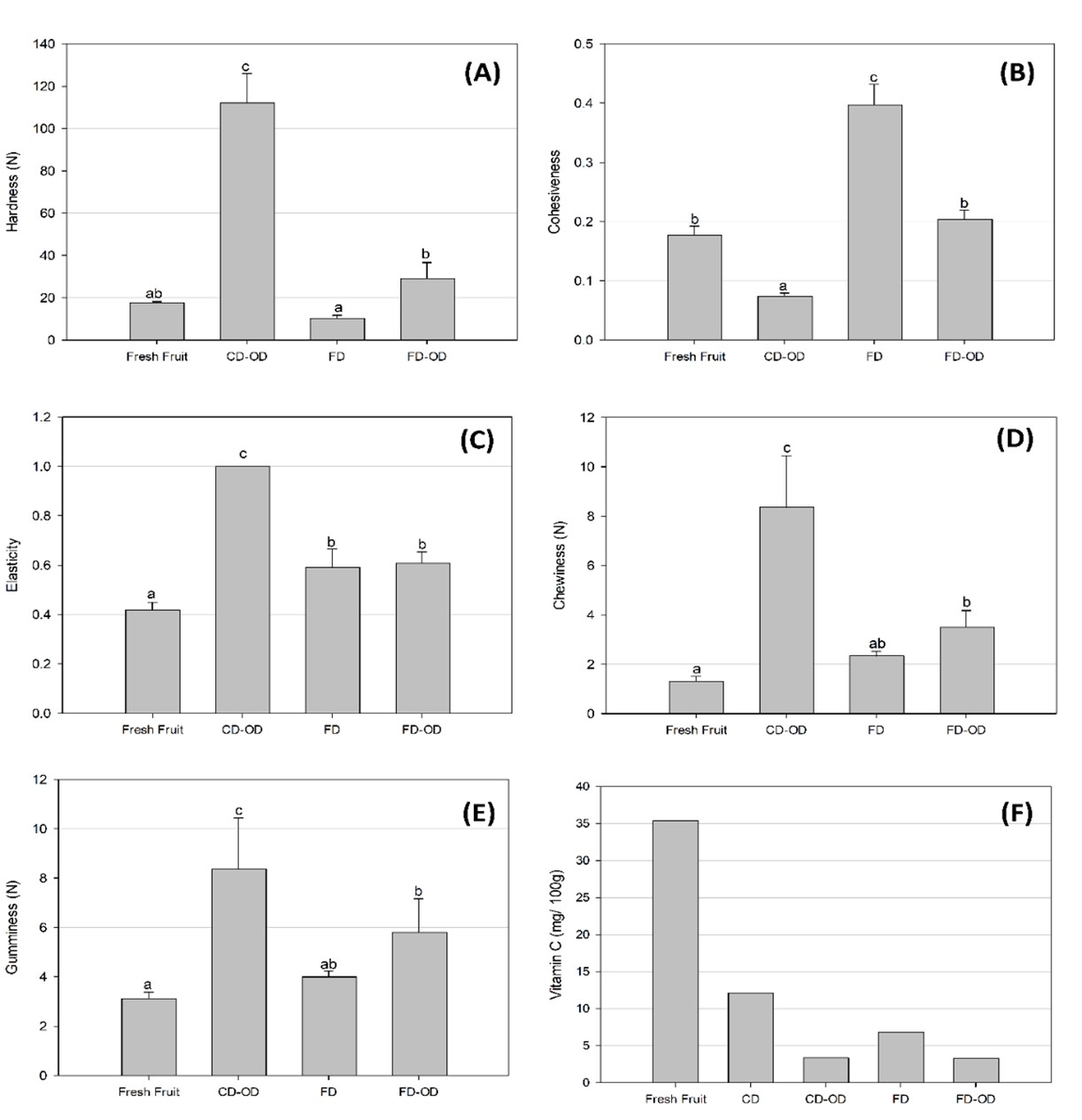
Vitamin C is an indicator of deterioration in dried fruits, due to its sensitivity to heat, oxygen, and light. The vitamin C content of fresh Andean papaya slices was 35.36 mg/100 g dry weight, higher than all dried samples (see Figure 5F). Similar results were found in the study by Islam et al. (2019). The samples of Andean papaya dried by CD, CD-OD, FD, and FD-OD exhibit a vitamin C (ascorbic acid) content of between 3 and 12 mg/100 g. Whereas, CD-dried slices of Andean papaya obtained a vitamin C content of 12.07 mg/100 g d.w., twice the amount found in freeze-dried Andean papaya (6.76 mg/100 g d.w.) and four times more than the amount in CD-OD and FD-OD (~3.27 mg/100g d.w.).

Texture profile and vitamin C content of fresh fruit and fruit dried under different conditions. (A) Hardness, (B) Cohesiveness, (C) Elasticity, (D) Chewiness, (E) Gumminess, and (F) Vitamin C.
The vitamin C content in CD-dried Andean papaya was higher than in other dried papayas due to the impermeability of its structure, which would hinder the passage of oxygen and prevent the degradation of vitamin C. In contrast, freeze-dried Andean papaya has a more porous structure, increasing oxygen availability and decreasing its vitamin C content. This fact would also be related to low water activity and density, respectively (Osae et al., 2024).
Andean papaya slices dried by CD-OD and FD-OD reduced their vitamin C content by up to 90% compared to fresh samples. This reduction is because during the drying process, the glass transition temperature may have been exceeded, meaning that the structure of the sugar or sucrose adsorbed during the OD recrystallized, losing its protective effect on bioactive compounds, increasing its density, and accelerating the oxidation or degradation of vitamin C (Forni et al., 1997; Kumar & Yadav, 2023). Numerous studies affirm that the type/concentration of osmotic solution, immersion time during OD, and drying temperature/time influence the preservation of vitamin C content (Forni et al., 1997; Islam et al., 2019; Layeghinia et al., 2025; Osae et al., 2024; Putri et al., 2023). According to Islam et al. (2019), as the osmotic solution (~60 °Brix) is increased and the drying temperature (~55 °C) decreases, the vitamin C content is reduced by half compared to fresh fruit.
3.6 TPA
The TPA results for fresh and dehydrated Andean papaya are shown in Figure 5. The hardness results for the CD samples exceeded the load limit of the texturometer, which explains the omission of the other texture parameters. In contrast, the hardness of dehydrated Andean papaya with CD-OD was highly hard (> 100 N) compared to the other treatments. This value was similar to the hardness (81 N) of papaya cubes pretreated and dried under similar conditions (Nimmanpipug & Therdthai, 2013). In addition, these high hardness values could be generated by high drying temperatures and long drying times, as this would cause structural collapse (lower porosity) and loss of permeability on the surface of the Andean papaya slices (Barragán-Iglesias et al., 2019). Therefore, more energy is required during the first bite of the slices.
On the other hand, fresh and freeze-dried Andean papaya slices with and without pretreatment have a hardness of ~20 N, making them softer than CD and CD-OD dried Andean papaya slices. In the freeze-drying process, the microstructure does not collapse because the frozen water molecules pass directly to water evaporation (sublimation process), generating air bubbles in its internal microstructure, which increases its porosity and decreases its hardness (10.18 N ± 1.54). Furthermore, when water is exchanged for solids in the FD-OD process, its hardness increases slightly to 29.06 N ± 7.55. This behaviour was similar in strawberries dried by FD-OD (Prosapio & Norton, 2017).
The cohesiveness of freeze-dried Andean papaya slices was higher (0.40 ± 0.02) than that of slices dried by CD-OD (0.07 ± 0.01) and FD-OD (0.20 ± 0.02); the latter value was similar to that of fresh papaya (0.18 ± 0.02). Andean papaya slices dried by CD-OD would have less deformation before breaking, while the FD and FD-OD processes would maintain the plant tissue and generate greater resistance to deformation. However, the cohesiveness of FD-OD is slightly lower than that of FD, because the increase in solute during the osmosis stage could have deformed the cell wall and divided the medium, as well as causing the degradation of polysaccharides, leaching of pectins, and other soluble acids from the walls (Sette et al., 2016; Udomkun et al., 2018) which would slightly weaken the three-dimensional structure of the product.
In terms of elasticity, Andean papaya slices dried by CD-OD were more elastic than FD, FD-OD, and fresh fruit. Fresh Andean papaya exhibited low elasticity due to its high moisture content, causing it to crumble quickly upon the first bite (Barragán-Iglesias et al., 2019). In contrast, slices dried by CD-OD returned to their original state upon initial compression due to the plasticizing agents in the sugar found inside the matrix, and due to changes in their circular structure.
Fresh Andean papaya slices are easy to chew (1.31 N ± 0.21), as are freeze-dried Andean papaya without (2.33 N ± 0.19) and with OD pretreatment (3.49 N ± 0.68). However, CD-OD dried Andean papaya is moderately difficult to chew (8.36 N ± 2.09), and these trends were similar in terms of gumminess. It was observed that both chewability and gumminess were influenced by the hardness and elasticity of the final products, a finding that was also reported in the study by Barragán-Iglesias et al. (2019).
4 Conclusion
Osmotic dehydration (OD) as a pretreatment proved to be an effective strategy for improving the quality of the final product and extending the shelf life of Andean papaya. Analysis of the drying kinetics revealed that Verma's model was the one that best fit all treatments, with greater moisture loss observed in the combination of 40°C and 60°Brix.
Samples treated by OD as a pretreatment in freeze-drying (FD-OD) showed significant improvements in their textural properties, exhibiting a softer and more elastic texture compared to the fresh sample. Likewise, a considerable reduction in moisture and water activity values was achieved, key factors in prolonging the product's shelf life. In terms of color, improvements were observed compared to the control sample, and an increase in density was recorded, attributable to the absorption of solids during pretreatment, suggesting modifications in the internal structure of the fruit. However, a decrease in vitamin C content was detected, possibly related to the recrystallization of sugars due to exceeding the glass transition temperature during drying, which would have affected the protection of bioactive compounds.
Dehydration as a pretreatment represents a viable alternative for preserving rapidly ripening fruits, maintaining or improving their texture and physicochemical properties. In addition, the valorization of this fruit through appropriate technological processes can contribute to the socioeconomic development of Andean papaya-producing communities, generating additional income and offering consumers healthy, ready-to-eat products with commercial potential in increasingly demanding markets.
Acknowledgements
The authors would like to thank the National University of the Altiplano Puno and the Professional School of Agroindustrial Engineering for the academic training they received. They also express their gratitude to the Peruvian Union University, Juliaca Campus, for facilitating the use of its laboratories for the development of this research.
Data Availability Statement
All data generated or analyzed in this study are included in this published article.
-
Cite as:
Huacantara Chambi, R. E., Ortega Barriga, R. E., & Prieto, J. M. (2026). Effect of osmotic dehydration on the freeze-drying and hot air-drying process of Andean papaya. Brazilian Journal of Food Technology, 29, 2026. https://doi.org/10.1590/1981-6723.0932025
-
Funding:
None.
References
-
Asghari, A., Zongo, P. A., Osse, E. F., Aghajanzadeh, S., Raghavan, V., & Khalloufi, S. (2024). Review of osmotic dehydration: Promising technologies for enhancing products’ attributes, opportunities, and challenges for the food industries. Comprehensive Reviews in Food Science and Food Safety, 23(3), e13346. PMid:38634193. https://doi.org/10.1111/1541-4337.13346
» https://doi.org/10.1111/1541-4337.13346 -
Assis, F. R., Morais, R. M. S. C., & Morais, A. M. M. B. (2018). Osmotic dehydration combined with freeze-drying of apple cubes and comparison with microwave drying and hot air drying. Advances in Food Science and Engineering, 2(1), 38-47. https://doi.org/10.22606/afse.2018.21005
» https://doi.org/10.22606/afse.2018.21005 - Association of Official Analytical Chemists – AOAC. (2019a). Official method 925.10: Solids (total) and moisture in flour. In Association of Official Analytical Chemists (Ed.), Official methods of analysis of AOAC International (21st ed.). Gaithersburg: AOAC.
- Association of Official Analytical Chemists – AOAC. (2019b). Official method 920.212: Density of solid and liquid foods by pycnometer. In Association of Official Analytical Chemists (Ed.), Official methods of analysis of AOAC International (21st ed.). Gaithersburg: AOAC.
- Badui, S. (2006). Química de los alimentos. México: Editorial Alhambra Mexicana.
-
Barragán-Iglesias, J., Rodríguez-Ramírez, J., Sablani, S. S., & Méndez-Lagunas, L. L. (2019). Texture analysis of dried papaya (Carica papaya L., cv. Maradol) pretreated with calcium and osmotic dehydration. Drying Technology, 37(7), 906-919. https://doi.org/10.1080/07373937.2018.1473420
» https://doi.org/10.1080/07373937.2018.1473420 -
Calín-Sánchez, A., Lipan, L., Cano-Lamadrid, A., Kharaghani, A., Masztalerz, K., Carbonell-Barrachina, A. A., & Figiel, A. (2020). Comparison of traditional and novel drying techniques and its effect on quality of fruits, vegetables and aromatic herbs. Foods, 9(9), 1261. https://doi.org/10.3390/foods9091261
» https://doi.org/10.3390/foods9091261 -
Cañazaca Tito, N., Carrillo Huamani, J., Coaquira Quispe, J. J., & Pilco Quesada, S. (2022). Effect of temperature and stirring speed on the osmotic dehydration of ginger (Zingiber officinale). Journal of High Andean Research, 24(3), 164-173. https://doi.org/10.18271/ria.2022.433
» https://doi.org/10.18271/ria.2022.433 -
Cervera-Chiner, L., Vilhena, N. Q., Larrea, V., Moraga, G., & Salvador, A. (2024). Influence of temperature on ‘Rojo Brillante’ persimmon drying: Quality characteristics and drying kinetics. Lebensmittel-Wissenschaft + Technologie, 197, 115902. https://doi.org/10.1016/j.lwt.2024.115902
» https://doi.org/10.1016/j.lwt.2024.115902 -
Chandra, A., Kumar, S., Tarafdar, A., & Nema, P. K. (2021). Ultrasonic and osmotic pretreatments followed by convective and vacuum drying of papaya slices. Journal of the Science of Food and Agriculture, 101(6), 2264-2272. PMid:33006388. https://doi.org/10.1002/jsfa.10847
» https://doi.org/10.1002/jsfa.10847 -
Chen, M., Gu, H., Wang, L., Shao, Y., Li, R., & Li, W. (2022). Exogenous ethylene promotes peel color transformation by regulating the degradation of chlorophyll and synthesis of anthocyanin in postharvest mango fruit. Frontiers in Nutrition, 9, 911542. PMid:35669069. https://doi.org/10.3389/fnut.2022.911542
» https://doi.org/10.3389/fnut.2022.911542 - Concha, J., Guevara, A., & Araujo, M. (2002). Obtaining wild papaya powder (Carica pubescens) by atomization. Revista INGENIERÍA UC, 9(1), 1-16.
- Corrêa, J. L. G., Gonçalves, C. S., & Devilla, I. A. (2011). Osmotic dehydration of mango slices: Effect of process variables on mass transfer kinetics and product quality. Journal of Food Processing and Preservation, 35(5), 641-648.
-
Dahiya, U., & Rajput, R. (2025). Osmotic dehydration in food processing: A review. European Journal of Nutrition & Food Safety, 17(5), 216-231. https://doi.org/10.9734/ejnfs/2025/v17i51720
» https://doi.org/10.9734/ejnfs/2025/v17i51720 -
Forni, E., Sormani, A., Scalise, S., & Torreggiani, D. (1997). The influence of sugar composition on the colour stability of osmodehydrofrozen intermediate moisture apricots. Food Research International, 30(2), 87-94. https://doi.org/10.1016/S0963-9969(97)00038-0
» https://doi.org/10.1016/S0963-9969(97)00038-0 -
Garcia-Noguera, J., Oliveira, F. I. P., Weller, C. L., Rodrigues, S., & Fernandes, F. A. N. (2014). Effect of ultrasonic and osmotic dehydration pre-treatments on the colour of freeze dried strawberries. Journal of Food Science and Technology, 51(9), 2222-2227. PMid:25190887. https://doi.org/10.1007/s13197-012-0724-x
» https://doi.org/10.1007/s13197-012-0724-x -
González, C., Gil, R., Moraga, G., & Salvador, A. (2021). Natural drying of astringent and non-astringent persimmon “rojo brillante”: Drying kinetics and physico-chemical properties. Foods, 10(3), 647. PMid:33803816. https://doi.org/10.3390/foods10030647
» https://doi.org/10.3390/foods10030647 - Henderson, S. M., & Pabis, S. (1961). Grain drying theory I: Temperature effect on drying coefficient. Journal of Agricultural Research Engineering, 6, 169-174.
-
Hernández-Salinas, G., Soto-Estrada, A., García-Pérez, E., Pérez-Vázquez, A., Rocandio-Rodríguez, M., & Córdova-Téllez, L. (2019). In situ morphological variation of Carica papaya L. native to Mexico. Revista Fitotecnia Mexicana, 42(1), 47-56. https://doi.org/10.35196/rfm.2019.1.47
» https://doi.org/10.35196/rfm.2019.1.47 - Instituto Adolfo Lutz – IAL. (2008). Analytical standards: Method 31.61 for the quantification of vitamin C (ascorbic acid). São Paulo.
- International Organization for Standardization – ISO. (2017). ISO 18787:2017: Foodstuffs: Determination of water activity. Geneva.
-
Islam, Z., Das, S., Monalisa, K., & Sayem, A. S. M. (2019). Influence of osmotic dehydration on mass transfer kinetics and quality retention of ripe papaya (Carica papaya L) during drying. AgriEngineering, 1(2), 220-234. https://doi.org/10.3390/agriengineering1020016
» https://doi.org/10.3390/agriengineering1020016 -
Kumar, P., & Yadav, K. C. (2023). Investigating the impact of microwave drying on papaya slice quality and drying attributes. Indian Journal of Food Engineering, 3(1), 7-13. https://doi.org/10.54105/ijfe.B1010.03011223
» https://doi.org/10.54105/ijfe.B1010.03011223 -
Layeghinia, N., Karimi, S., Abbasi, H., & Silavi, K. (2025). Effect of osmotic dehydration on qualitative and nutritional characteristics and kinetics of microwave drying of Iranian Quince slices. Journal of Agriculture and Food Research, 20, 101749. https://doi.org/10.1016/j.jafr.2025.101749
» https://doi.org/10.1016/j.jafr.2025.101749 -
Lemus-Mondaca, R., Puente-Díaz, L., Cifuentes, A., Lizama, K., & González, P. (2024). Chilean papaya (Vasconcellea pubescens): A native fruit with a high health-promoting functional potential. Antioxidants, 13(12), 1521. PMid:39765849. https://doi.org/10.3390/antiox13121521
» https://doi.org/10.3390/antiox13121521 -
Midilli, A., Kucuk, H., & Yapar, Z. (2002). A New model for single-layer drying. Drying Technology, 20(7), 1503-1513. https://doi.org/10.1081/DRT-120005864
» https://doi.org/10.1081/DRT-120005864 -
Moyano, P. C., Vega, R. E., Bunger, A., Garretón, J., & Osorio, F. A. (2002). Effect of combined processes of osmotic dehydration and freezing on papaya preservation. Food Science and Technology International = Ciencia y Tecnología de los Alimentos Internacional, 8(5), 295-301. https://doi.org/10.1177/1082013202008005183
» https://doi.org/10.1177/1082013202008005183 - Nimmanpipug, N., & Therdthai, N. (2013). Effect of osmotic dehydration time on hot air drying and microwave vacuum drying of papaya. Food and Applied Bioscience Journal, 1(1), 1-10.
- Orrego, C. (2015). Freezing and freeze-drying of food. In S. M. Jafari & N. Malekjani (Eds.), Drying technology in food processing: Unit operations and processing equipment in the food industry (pp. 203-240) Cambridge: Woodhead Publishing.
-
Osae, R., Adjonu, R., Apaliya, M. T., Engmann, F. N., Owusu-Ansah, P., Fauzia, A. S., Otoo, G. S., Kwaw, E., & Alolga, R. N. (2024). Freeze-thawing and osmotic dehydration pretreatments on physicochemical properties and quality of orange-fleshed sweet potato slice during hot air drying. Food Chemistry Advances, 5, 100843. https://doi.org/10.1016/j.focha.2024.100843
» https://doi.org/10.1016/j.focha.2024.100843 -
Parzanese, M. (2010). Tecnologías para la industria alimentaria (pp. 63-69). Buenos Aires: Alimentos Argentinos. Retrieved in 2025, August 28, from https://alimentosargentinos.magyp.gob.ar/contenido/revista/pdfs/58/ULTRASOSONIDOORIGINAL.pdf
» https://alimentosargentinos.magyp.gob.ar/contenido/revista/pdfs/58/ULTRASOSONIDOORIGINAL.pdf -
Patriani, P., Irgiadi, A., & Desnamrina, K. C. (2024). Effectiveness of Carica (Carica pubescens) marinade on buffalo meat physicochemical. IOP Conference Series. Earth and Environmental Science, 1354(1), 012010. https://doi.org/10.1088/1755-1315/1354/1/012010
» https://doi.org/10.1088/1755-1315/1354/1/012010 -
Peleg, M. (2019). The instrumental texture profile analysis revisited. Journal of Texture Studies, 50(5), 362-368. PMid:30714161. https://doi.org/10.1111/jtxs.12392
» https://doi.org/10.1111/jtxs.12392 -
Prosapio, V., & Norton, I. (2017). Influence of osmotic dehydration pre-treatment on oven drying and freeze drying performance. Lebensmittel-Wissenschaft + Technologie, 80, 401-408. https://doi.org/10.1016/j.lwt.2017.03.012
» https://doi.org/10.1016/j.lwt.2017.03.012 -
Putri, R. M., Jumeri, & Falah, M A F. (2023). Effects of osmotic dehydration pre-treatment on process and quality of freeze-dried strawberries (Fragaria x ananassa var. Mencir). IOP Conference Series. Earth and Environmental Science, 1200(1), 012030. https://doi.org/10.1088/1755-1315/1200/1/012030
» https://doi.org/10.1088/1755-1315/1200/1/012030 -
Rahman, M. S. (2009). Food stability beyond water activity and glass transtion: Macro-micro region concept in the state diagram. International Journal of Food Properties, 12(4), 726-740. https://doi.org/10.1080/10942910802628107
» https://doi.org/10.1080/10942910802628107 -
Ratti, C. (2001). Hot air and freeze-drying of high-value foods: A review. Journal of Food Engineering, 49(4), 311-319. https://doi.org/10.1016/S0260-8774(00)00228-4
» https://doi.org/10.1016/S0260-8774(00)00228-4 - Ruelas-Chacón, X., Reyes-Vega, M., Valdivia-Urdiales, B., Contreras-Esquivel, J. C., Montañez-Saenz, J. C., Aguilera-Carbó, A. F., & Peralta- Rodríguez, R. D. (2013). Conservación de frutas y hortalizas frescas y mínimamente procesadas con recubrimientos comestibles. Scientific Journal of the Autonomous University of Coahuila, 5(9), 31-37.
-
Salazar, M. L. C. (2021). Storage of transpiration characteristics in native papaya from Andahuaylas – Apurímac, Peru (Tesis pregrado). Universidad Nacional José María Arguedas, Andahuaylas. Retrieved in 2025, August 28, from https://hdl.handle.net/20.500.14168/646
» https://hdl.handle.net/20.500.14168/646 -
Saldaña, E., Siche, R., Castro, W., Huamán, R., & Quevedo, R. (2014). Measurement parameter of color on yacon (Smallanthus sonchifolius) slices using a computer vision system. Lebensmittel-Wissenschaft + Technologie, 59(2), 1220-1226. https://doi.org/10.1016/j.lwt.2014.06.037
» https://doi.org/10.1016/j.lwt.2014.06.037 -
Scheldeman, X., Willemen, L., Coppens d’Eeckenbrugge, E. R. P., Romeijn-Peeters, E., Restrepo, M. T., Romero Motoche, J., Jiménez, D., Lobo, M., Medina, C. i., Reyes, C., Rodriguez, D., Ocampo, J., Van Damme, P., & Goetghebeur, P. (2007). Distribution, diversity and environmental adaptation of highland papayas (Vasconcellea spp.) in tropical and subtropical America. Biodiversity and Conservation, 16(6), 1867-1884. https://doi.org/10.1007/s10531-006-9086-x
» https://doi.org/10.1007/s10531-006-9086-x -
Sette, P., Salvatori, D., & Schebor, C. (2016). Physical and mechanical properties of raspberries subjected to osmotic dehydration and further dehydration by air- and freeze-drying. Food and Bioproducts Processing, 100, 156-171. https://doi.org/10.1016/j.fbp.2016.06.018
» https://doi.org/10.1016/j.fbp.2016.06.018 -
Udomkun, P., Argyropoulos, D., Nagle, M., Mahayothee, B., & Müller, J. (2015). Sorption behaviour of papayas as affected by compositional and structural alterations from osmotic pretreatment and drying. Journal of Food Engineering, 157, 14-23. https://doi.org/10.1016/j.jfoodeng.2015.01.022
» https://doi.org/10.1016/j.jfoodeng.2015.01.022 -
Udomkun, P., Argyropoulos, D., Nagle, M., Mahayothee, B., Oladeji, A. E., & Müller, J. (2018). Changes in microstructure and functional properties of papaya as affected by osmotic pre-treatment combined with freeze-drying. Journal of Food Measurement and Characterization, 12(2), 1028-1037. https://doi.org/10.1007/s11694-018-9718-3
» https://doi.org/10.1007/s11694-018-9718-3 -
Vincent, L., Soorianathasundaram, K., Dinesh, M. R., Shivashankara, K. S., & C, V. (2022). Change in physiological parameters and partitioning of sugar upon Papaya ringspot virus infection in Carica papaya and its wild relatives. South African Journal of Botany, 151, 466-474. https://doi.org/10.1016/j.sajb.2022.10.033
» https://doi.org/10.1016/j.sajb.2022.10.033 - Yadav, B. S., & Singh, K. K. (2022). Comparative study on drying characteristics, quality and energy consumption of osmo-treated papaya using tray and freeze drying. Lebensmittel-Wissenschaft + Technologie, 154, 112676.
-
Zapana Yucra, F. E., Valdez Baca, W., Chila Choque, E., & Valenzuela Antezana, R. N. (2024). Physicochemical characterization of andean papaya in southern Peru. Revista Alfa, 8(23), 652-661. https://doi.org/10.33996/revistaalfa.v8i23.293
» https://doi.org/10.33996/revistaalfa.v8i23.293 - Zapata, J. E., Carvajal, L. M., & Montoya, N. (2002). Effects of solute concentration and syrup/fruit ratio on the kinetics of osmotic dehydration of sliced papaya. Interciencia, 27(5), 236-242.
-
Zimmer, A., Masztalerz, K., & Lech, K. (2024). Effect of osmotic dehydration in tomato juice on microstructure of garlic and on drying using different methods. Agriculture, 14(7), 1164. https://doi.org/10.3390/agriculture14071164
» https://doi.org/10.3390/agriculture14071164
Edited by
-
Section Editor:
Marta H. Taniwaki.