 Oxidised tannic acid as a bio-derived crosslinker for densifying amorphous tuna protein films: a chemistry–structure–property approach
Abstract
Tuna-processing by-products represent an abundant yet underutilised resource for sustainable biomaterials. This study introduces oxidised tannic acid (OTA) as a bio-derived crosslinker to reinforce protein-based films from tuna myofibrillar proteins and bone gelatin, offering a novel strategy to valorise fish-processing waste and improve film performance. OTA, produced by alkaline oxidation, was incorporated during film formation to maximise interchain coupling. Mechanical, Fourier Transform Infrared Spectroscopy (FTIR), X-ray Diffraction (XRD), Scanning Electron Microscopy (SEM), and barrier/hydration analyses linked chemistry and microstructure to performance. OTA increased tensile strength and lowered extensibility across matrices; in bone-gelatin films, strength rose from 6.30 ± 0.42 to 8.23 ± 0.62 N mm−2, while elongation fell from 85.16% ± 7.26% to 58.21% ± 2.39%. FTIR showed red-shifted –OH/–NH bands and intensified C=O/C–O signals, indicating stronger hydrogen bonding and quinone-mediated covalent linkages. XRD revealed tighter amorphous halos (15° to 25° 2θ) without emergent crystallinity, consistent with denser short-range packing. SEM showed more cohesive, less porous surfaces. Barrier/hydration properties improved in parallel (water vapour permeability decreased ~18% for MI-OTA and ~27% for BG-OTA; moisture content and water absorption also declined). Overall, OTA is an effective bio-derived crosslinker that densifies amorphous tuna protein networks, yielding stronger, less extensible, and more water-resistant films for sustainable packaging.
Keywords:
Crosslinking; Tuna by-product; Oxidized tannic acid; Myofibril/gelatin; Mechanical properties; Protein-based film
Highlights
Tuna-processing by-products were converted into protein-based biopolymer films reinforced by oxidised tannic acid (OTA)
OTA crosslinking significantly enhanced tensile strength while reducing chain mobility and film extensibility
Spectroscopic and structural analyses confirmed denser amorphous protein networks via hydrogen bonding and quinone-mediated linkages
OTA-treated films exhibited improved water resistance, supporting their potential for sustainable packaging applications
1 Introduction
The global use of petroleum-based plastic has led to numerous environmental problems, notably the increasing pollution from plastic waste, which threatens the sustainability of ecosystems (Bagavathsingh et al., 2025). In this context, research on bioplastics made from renewable and biodegradable resources has received significant attention in the field of sustainable materials (Kaur et al., 2024). Protein-based bioplastics are promising candidates, offering advantages such as good biodegradability, availability of raw materials, and excellent film-forming ability (Sarkar et al., 2025).
The tuna processing sector generates a high amount of byproducts, including skin, which accounts for a significant portion of the fish mass (Papadopoulou et al., 2025). These trimmings still retain a high content of myofibrillar proteins (Montazeri Shatouri et al., 2025), whereas the skin is rich in collagen that is convertible to gelatin (Gonapinuwala et al., 2025). The gelatin extracted from tuna skin has a dense, homogeneous texture (Gonapinuwala et al., 2025), meets the Indonesian national quality standard (Agustin, 2015), and exhibits characteristics similar to those of commercial gelatin (Joy et al., 2023). The pure protein films have not only limited solubility but also limited mechanical strength. Bioplastics made from Hermetia illucens myofibrillar protein with a glycerol ratio of 50:50 show a tensile strength of 2.5 MPa and high water solubility of around 70% (Barbi et al., 2019). On the other hand, bioplastics made from gelatin of pork, bovine, poultry, and fish origins generally have inferior mechanical strength compared to typical plastics (Zuravel et al., 2022).
The strengthening of films can be accomplished by various crosslinking reactions involving natural phenolic polymers such as tannin. Tannins can react with protein amino acids via covalent and non-covalent interactions, enhancing the film matrix and lowering the hydrophilic degradation rate (Chen et al., 2023; Zhong et al., 2023). Polyphenols also inhibit myofibrillar protein oxidation (Guo et al., 2021; Li et al., 2023) and improve gel texture (Wu et al., 2025).
In materials science, understanding the structural modifications induced by crosslinking requires comprehensive characterization techniques. Advanced analytical methods such as X-ray diffraction (XRD), Fourier transform infrared spectroscopy (FTIR), and scanning electron microscopy (SEM) are widely used to investigate structural organization, chemical bonding, and microstructural morphology of materials. Recent studies on oxide and glass-based materials have demonstrated that the combination of XRD, FTIR, and SEM analyses is effective in elucidating structure–property relationships and understanding how compositional modifications affect material performance (Budida et al., 2025; Guntu et al., 2025; Thumma & Guntu, 2025). For instance, structural characterization using these techniques can reveal changes in amorphous structure, bonding environments, and surface morphology that directly influence the mechanical and functional properties of materials
However, despite growing interest in protein-based bioplastics, several research gaps remain. Most previous studies have focused either on single-protein systems or on limited property evaluation, while the integrated utilization of myofibrillar proteins and gelatin derived from tuna processing byproducts has received little attention. Moreover, the structural mechanisms by which tannin-based crosslinking modifies the microstructure, intermolecular interactions, and durability of composite protein films remain insufficiently understood. This gap highlights the need for a comprehensive study that links crosslinking chemistry to the structural characterization and functional performance of protein-based films. By combining tannin, a natural crosslinking agent, with myofibrillar proteins and gelatin from tuna processing byproducts, we could obtain biopolymer films with improved mechanical, flexible, and water-resistant properties. This formulation not only dramatically improves the performance of the films but also provides a new approach to turning fishery industry waste into eco-friendly packaging materials.
The purpose of this research was to prepare biomaterial films based on myofibrillar protein and gelatin derived from tuna processing waste, using tannins as a cross-linking agent to enhance the mechanical and structural properties of the produced films. It is also intended to investigate the physicochemical and mechanical properties of the produced films, as well as to study the crosslinking mechanisms and their effects on the films' structural integrity. The end goal of the research project is to advance a value-added solution for the utilization of fishery waste in favor of sustainable packaging innovation.
2 Material and methods
2.1 Material
Byproduct filleting of tuna provided trimmings from a fishery located in Makassar, South Sulawesi, Indonesia. These materials were washed with chlorinated water (5 ppm) at 4 °C. Trimmings were ground for 1.5 min using a chopper (Philips HR1393/00, Netherlands) and then vacuum-sealed using a vacuum sealer (Philips, Netherlands) and stored at -26 °C before myofibrillar protein extraction. Gelatin is derived from the skin and bones of tuna, sourced from local small-scale industries. Tannic acid and all chemicals were procured from Sigma-Aldrich (St. Louis, MO, USA)
2.2 Myofibrillar protein extraction
Myofibrillar protein was extracted according to (Holwerda et al., 2026) with slight modification. The extraction process was conducted at 4°C. The ground trimmings meat was homogenized in three volumes of distilled water using a chopper (Philips HR1393/00, Netherlands) at 2000 rpm for 1.5 min. The homogenate was centrifuged at 4,500 rpm for 1 min using a refrigerated centrifuge (Heraeus, Biofuge Strattos, Germany), and the resulting supernatant was removed. The homogenization-centrifugation process was repeated 2 times. The resulting precipitate from homogenization-centrifugation was incubated in 0.6 M NaCl for 10 minutes and then homogenized at 2000 rpm for 15 minutes using a chopper (Philips HR1393/00, Netherlands). The supernatant was filtered through triple-layer gauze. The filtrate was washed with three volumes of deionized water and centrifuged at 4,500 rpm for 15 min. The washed minced (myofibrillar protein) obtained was frozen at −18°C.
2.3 Preparation of Oxidized Tannic Acid (OTA)
A stock solution of oxidized tannic acid (OTA) was obtained by dissolving tannic acid in deionized water at 60 °C with continuous stirring, and the pH was adjusted to 9 with 1 N NaOH. Then the solution (0.02% w/v) was oxygenated at 50 °C for 3.5 h to oxidize tannic acids to quinones.
2.4 Preparation of biopolymer films
Films composed of myofibrillar protein (MP), gelatin from skin (GS), and bone (GB), or their blends, were prepared following the method described by Neves et al. (2019), with slight modifications. Before preparing the film-forming solutions, the skin and bone gelatin powder were diluted in warm distilled water at 40 °C and gently stirred until completely dissolved to obtain homogeneous solutions. The gelatin solutions were adjusted to 0.986% (w/v) and 0.976% (w/v) for the skin gelatin and bone gelatin, respectively, corresponding to a protein content of 8.8 mg mL−1 for each solution. Protein-based biopolymer films were produced systematically by applying myofibril, skin gelatin, bone gelatin, and 1:1 (based on protein) mixtures of myofibril with either type of gelatin (Table 1). All formulations had a total protein content of 88 mg. Uniform additives, consisting of 1 g agar and 1.76 mL glycerin, were added to all mixtures to provide film-forming properties and flexibility. For OTA-containing films, the OTA solution was added along with the protein dispersion and agar during the early mixing stage to achieve maximum cross-linking.
Formulation design of protein-based biopolymer films incorporating myofibril, skin gelatin, and bone gelatin, and their blends without and with OTA.
2.5 Thermal conditions during film preparation and testing
The thermal profile applied during film preparation and characterization was carefully controlled to ensure reproducibility. Gelatin solutions were initially dissolved in distilled water at 40 °C to promote complete hydration of collagen-derived polypeptide chains. OTA was prepared at 60 °C and subsequently oxidized at 50 °C for 3.5 h under alkaline conditions (pH 9) to generate quinone intermediates. All film-forming mixtures were prepared at room temperature (≈25 °C) to avoid excessive thermal denaturation of proteins during mixing. After casting, the films were dried under controlled laboratory conditions (≈25 °C, relative humidity ~50-55%). Before mechanical testing, all films were conditioned for 48 h at 25 °C and 50% ± 5% relative humidity to stabilize their moisture content and mechanical properties. These controlled thermal conditions ensured consistent film formation and minimized thermal variability during structural and functional characterization.
2.6 Characterization of biopolymer films
2.6.1 Color measurements
Color analysis was conducted utilizing a General Colorimeter Color Tester JZ-300 (China). The L* value (lightness), along with the parameters a and b (representing red, green, blue, and yellow within the CIELAB color space), was determined for each system as the mean of five scans. The parameter a transitions from negative values (green) to positive values (red), whereas the parameter b transitions from negative to positive values when the sample is characterized as blue or yellow, respectively.
2.6.2 Thickness
The thickness of biopolymer films was measured using a digital micrometer with a resolution of 0.003 mm (Shahe 5202-25) at eight randomly selected locations, 60 mm from the edge (Wan et al., 2025). The mean values obtained from five measurements taken across various regions of each sample were used to calculate water vapor permeability and tensile properties.
2.6.3 Mechanical properties
Before mechanical testing, the film samples were conditioned for 48 hours at 25 °C under controlled relative humidity of 50 ± 5% (Rostamzad et al., 2016). The tensile strength (TS) and elongation at break (EAB%) were assessed in accordance with ASTM D882-02 standard method (Sanyang et al., 2015). Each film was cut into rectangular strips measuring 2.5 × 10 cm. The initial grip separation was set at 50 mm, with a crosshead speed of 50 mm/min. To ensure measurement reliability, the test was performed in quintuplicate for each sample.
2.6.4 Water vapor permeability (WVP)
The water vapor transmission rate (WVTR) was measured following a modified version of the ASTM E96 method. Biopolymer films were mounted on the openings of 25 mL glass vials, each containing 2 g of anhydrous calcium chloride (CaCl2) to maintain 0% relative humidity (RH) inside. These vials were then placed in a desiccator maintained at 90% RH using barium chloride (BaCl2) and stored in a controlled environment at 25 °C. Each film sample was tested in quintuplicate (n = 5). The water vapor permeability (WVP, g·mm·m-2 ·day-1 ·kPa-1) was calculated using the standard Equation 1.
where L is the average value of film thickness (mm), and ∆P is the difference in vapor pressure across both sides of the film (kPa).
2.6.5 Fourier Transform Infrared Spectroscopy (FTIR)
FTIR spectra in the transmission mode for both pure components (myofibrillar protein and bone gelatin) and their crosslinked with tannic acid biopolymer films were obtained across a wavenumber spectrum ranging from 400 to 4000 cm−1 at a resolution of 4 cm−1 utilizing an FT/IR-4200 spectrometer (JASCO, Tokyo, Japan). KBr served as the medium for the preparation of the various samples (at a concentration of 1/10 of the solid sample using a microspatula), which were subsequently positioned into a holder within the FTIR apparatus.
2.6.6 Scanning electron microscopy
The surface morphology and elemental composition of the films were analyzed using a scanning electron microscope (SEM; Hitachi TM3000) equipped with a SwiftED3000 energy-dispersive X-ray spectroscopy (EDS) system.
2.6.7 X-ray diffraction (XRD)
X-ray diffraction (XRD) was conducted on fish myofibril and bone-gelatin films, with and without oxidized tannic acid (OTA), to resolve OTA-induced structural changes. Films were equilibrated (25 °C, ~50% to 55% RH), cut and mounted flat on a silicon low-background holder, then scanned on a Cu Kα diffractometer (40 kV, 25 mA) using an analytical range of 2θ = 10-80° (preceded by a 5-80° screening when needed). Raw patterns were background-corrected and mildly smoothed before peak/halo analysis (position, intensity, FWHM), and shifts or sharpening/broadening were compared across formulations to infer interchain spacing and short-range ordering. The resulting structural descriptors were subsequently related to tensile and moisture-barrier performance, and data were archived in both raw and processed formats.
2.6.8 Moisture content and water absorption
Moisture content and water absorption of myofibril-gelatin biopolymer films were determined following the Wang et al. (2025) method with slight modification.
3 Results and discussion
3.1 Composition of myofibril and gelatin extracts derived from tuna processing byproducts
The qualitative characteristics and functional properties of myofibrils obtained from fish processing byproducts were sourced from the trimmings, while gelatin was derived from the skin and bone of tuna. These biopolymers were identified as primary feedstocks for producing biopolymer films. Before formulating the films, both extracts underwent a thorough series of proximate and functional property assessments, including evaluation of protein concentration, moisture content, lipid levels, and viscosity. The results from these assessments are summarized in Table 2.
Compositional and molecular analyses showed that the physicochemical properties of myofibrillar proteins and gelatin fractions derived from tuna processing byproducts differed markedly. The myofibrillar proteins derived from byproducts were highly moist (95.58%) and not very concentrated in protein substance (0.88%), similar to meat processing wastewater streams, which have shown moisture content ranging from 89.81% to 97.44% (Bethi et al., 2020) and protein content in the range of 1.28% to 7.04% (Cortez-Vega et al., 2017). The homogenates had moderate apparent viscosity (5.84 mPa·s at 0.88% w/v), indicating that the protein molecules were relatively dispersed and interacted through weak intermolecular forces. Such a loosely organized structure is typical for diluted myofibrillar protein suspensions and may influence the film-forming ability of the material. This characteristic suggests that additional interactions or crosslinking agents are required to improve the structural integrity of the resulting biopolymer films. Although protein contents in gelatin fractions isolated from tuna skin and bone were relatively high (89-90%) due to their relatively low moisture content (approximately 9%), reflecting a high concentration of collagen-based structure like gelatins from skin of the European sea bass (Dicentrarchus labrax) (Coppola et al., 2025) and mammalian (Li et al., 2025).
The viscosity of skin and bone gelatines (4.50-5.58 mPa·s at 6.67% w/v, 60 °C) was within the range observed for melted gelatine solutions in tests under standardized conditions (Jalili et al., 2022), similar to viscosities compared to mammalian gelatines, which typically range from 5.6 mPa·s for bovine gelatine (Mafazah, 2024). These viscosity values also correspond to previous conclusions, which reported that bone gelatins generally have a slightly higher viscosity than skin gelatins due to a higher content of high molecular weight (HMW) fractions, which are positively correlated with increased viscosity (He et al., 2024). In general, these results are evidence for the appropriateness of both myofibrillar and gelatin extracts as complementary protein resources for the development of protein-based biopolymer films. Thus, the valorization of these fish byproducts as functional biopolymers represents an eco-friendly strategy for identifying new packaging materials.
3.2 Characterization of protein-based biopolymer films
3.2.1 Color
The color and appearance of biopolymer films were influenced by the protein source and the presence of oxidized tannic acid (OTA), as shown in Table 3. Films made of only gelatin (skin or bone) presented higher L*, and were lighter in color and more transparent, providing a more attractive, uniform appearance. On the other hand, myofibril films exhibited darker and less transparent patterns, with lower L values and a* and b* (a measure of yellow) coloration tendency. The difference can be attributed to the compositional and chromophoric diversity in proteins. Gelatin, though rich in denaturable collagen, is lower in aromatic amino acids, and therefore its derived triple helix-based matrix scatters light uniformly to provide increased clarity. On the other hand, myofibrillar proteins (myosin and actin) containing tyrosine, tryptophan, and cysteine as reactive groups can be subjected to oxidation or Maillard-type reactions in the course of drying, yielding conjugated pigments, decreasing brightness (Qi et al., 2025).
The addition of gelatin into myofibril matrices significantly improved the optical appearance of the composite films. This effect can be attributed to the more homogeneous gelatin network, which enhances light scattering and reduces the visual impact of chromophoric compounds originating from myofibrillar proteins. The apertures of the gelatin network dissipate chromophoric density, improve light transmission, and provide a matrix resistant to oxidative browning. Therefore, myofibril-gelatin hybrid films presented between or higher (compared to the pure myofibril systems) lightness L values and lower redness a* and moderated yellowness b*, resulting in a film surface with higher visual uniformity.
The addition of OTA induced noticeable darkening of the films, indicating the formation of quinone intermediates during tannic acid oxidation. These quinones can react with amino acid residues such as lysine, cysteine, and tyrosine to form phenolic-protein complexes with conjugated structures that absorb visible light. During the auto-oxidation of OTA, quinone intermediates occur, and during phenol-protein coupling reactions, they will react with amino acids (lysine, cysteine, and tyrosine). Such reactions lead to the formation of quinone-protein complexes and conjugated aromatic structures absorbing visible light, resulting in increased b* and decreased L* (lightness). This oxidative crosslinking is beneficial for improving film stability and antioxidant properties, but it also darkens the film's appearance (Liu et al., 2025).
3.3 Mechanical properties
The mechanical properties of biopolymer films prepared from myofibrillar protein (MI), skin gelatin (SG), bone gelatin (BG), and their 1:1 protein-based mixtures (MI: SG and MI: BG) are summarized in Table 1. The tensile strength, elongation at break (EAB), and film thickness were significantly affected by the addition of oxidized tannic acid (OTA) (Table 4). Overall, crosslinking with OTA increased the tensile strength of all formulations compared with their respective references (p < 0.05); the most pronounced improvement was observed for bone gelatin-based films, where tensile strength increased from 6.30 ± 0.42 N·mm−2 to 8.23 ± 0.62 N·mm−2 after OTA incorporation. Comparable, though slightly smaller, enhancements were observed for MI: BG and SG films. These results indicate that OTA promotes intermolecular crosslinking between gelatin and protein chains, resulting in a denser and more cohesive polymeric network. Oxidized tannic acid generates reactive quinone groups that interact with nucleophilic amino acid residues via hydrogen bonding and covalent coupling, thereby increasing crosslink density and improving stress transfer across the polymer matrix. This behaviour is consistent with multiple reports showing that tannin-derived oxidized phenolics (including OTA) form covalent and non-covalent bonds with protein amino groups and side chains, thereby increasing crosslink density and tensile strength of protein-based films and hydrogels (Zhang et al., 2026). Concomitant with the increase in tensile strength, elongation at break decreased for all OTA-crosslinked films, indicating reduced molecular mobility within the polymer network. The formation of additional intermolecular bonds restricts the movement of protein chains, resulting in a stiffer structure with lower extensibility. For instance, bone gelatin films displayed a reduction in EAB from 85.16% ± 7.26% to 58.21% ± 2.39% following OTA treatment, which reflects the classical trade-off between strength and ductility when additional crosslinks are introduced. Similar reductions in elongation upon tannin/tannin-oxidation crosslinking have been widely reported for gelatin- and protein-based films (Li et al., 2024). Film thickness remained broadly comparable between treatments, although myofibril-based films showed a measurable increase in thickness after OTA addition. This slight thickening may be attributed to structural rearrangement and local aggregation of crosslinked protein domains during film casting and drying, an effect previously observed when polyphenolic crosslinkers alter gelation kinetics and microstructure (Shim et al., 2025). Taken together, these data confirm that oxidized tannic acid is an effective, naturally derived crosslinker that improves the mechanical performance of fish-derived protein films by increasing tensile strength while reducing flexibility. Among the tested matrices, the bone gelatin-based film exhibited the highest tensile strength and overall mechanical performance, indicating its particular suitability as a biomaterial matrix for fishery-derived biopolymer films.
Mechanical properties of biopolymer films produced from myofibrillar proteins, gelatin, and their blend without and with crosslinked OTA.
The improvement in tensile strength observed in OTA-treated films can be attributed to the densification of the protein network induced by OTA-mediated crosslinking. Oxidized tannic acid generates reactive quinone groups that interact with nucleophilic amino acid residues of myofibrillar proteins and gelatin through hydrogen bonding and covalent coupling reactions (Geng et al., 2023). These interactions increase crosslink density and reduce intermolecular spacing within the polymer matrix, resulting in a more compact network that efficiently transfers mechanical stress (Men et al., 2025). Consequently, tensile strength increases across all matrices after OTA incorporation.
However, the same structural densification also restricts polymer chain mobility, reducing elongation at break. The formation of additional intermolecular interactions limits chain sliding and molecular rearrangement during deformation, thereby producing stiffer films with lower extensibility. This classical trade-off between strength and ductility is particularly evident in gelatin-rich systems, where the higher density of reactive functional groups facilitates stronger OTA-mediated crosslinking, resulting in the largest increase in tensile strength. These mechanical trends are consistent with the structural evidence obtained from FTIR, XRD, and SEM analyses, which collectively indicate increased intermolecular interactions and densification of the protein network after OTA incorporation.
3.4 Microstructure of OTA-modified myofibril and gelatin biopolymer films: An integrated FTIR-XRD analysis
These two materials, MI/MI-OTA and BG/BG-OTA, describe the protein-rich network with low cohesive properties and the gelatin matrix rich in gelatinizing, high-cohesion molecules, respectively, in any system at opposite mechanical extremes. However, they are prime candidates for studying the molecular-level crosslinking mechanism by spectroscopic techniques. Molecular-level interactions were probed using Fourier Transform Infrared (FTIR) spectroscopy as well as mechanical property characterization (Figure 1). All spectra showed the characteristic absorption bands of proteins, i.e., O–H/N–H stretching (3200-3400 cm−1), amide I (C=O stretching) (1720-1650 cm−1), amide II (N–H bending and C–N stretching) region at 1550-1500 cm−1, and C-O stretching at ≈1100 cm−1 (Ajvazi et al., 2025; Chen et al., 2022). In MI and MI-OTA, a red shift was observed in the O–H/N–H stretching band from 3379 cm−1 to 3221 cm−1, demonstrating enhanced hydrogen bond interactions and possible formation of phenolic-amine linkages between OTA and myofibrillar proteins. The amide I band was observed around 1728 cm−1, indicating that OTA exerted less influence on the peptide chain but promoted an intermolecular hydrogen-bond network, including interactions with H2O molecules (Tan et al., 2024). In contrast, BG and BG-OTA showed more pronounced spectral changes. There was also a clear red shift observed in the O–H/N–H stretching band from 3400 cm−1 (BG) to 3230 cm−1 (BG-OTA), which suggested more hydrogen bond formation between OTA and gelatin molecules. Intensity changes also appeared in the amide II region (1497 cm−1), and a new absorption band was visible at 1126 cm−1, which may have resulted from C–O–C or C–O–Ph stretching vibrations of phenolic ester or ether linkages. These results indicate that the binding force of gelatin-OTA interactions is apparently stronger, attributable to hydrogen bonding and partial covalent bonding. Narrowing and redshift of the hydroxyl region further confirm a more compact hydrogen-bond network and enhanced molecular ordering (Ajvazi et al., 2025). These spectral changes indicate stronger intermolecular interactions within the protein matrix, which restrict molecular mobility and enhance resistance to mechanical deformation. Consequently, the observed FTIR shifts provide molecular-level evidence explaining the increase in tensile strength and the reduction in elongation at break observed in the mechanical tests. Effects are more pronounced in gelatin films (BG–BG-OTA), probably because of the higher concentration of available reactive OH and NH2 groups for polyphenol-mediated crosslinking.
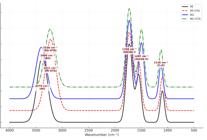
FTIR spectra of biopolymer films produced from myofibrillar and bone gelatin proteins with and without OTA crosslinking.
3.5 Structure-property relationship
The mechanical and FTIR data above enable the establishment of a structure-property relationship for the OTA-crosslinked protein–gelatin biopolymer films. OTA causes further formation of intermolecular bonds—hydrogen bonding and phenolic π-conjugation—strengthening the polymer network at the expense of flexibility. This double effect enhances the film without imparting increased brittleness, especially in collagen-based systems, where molecular packing yields adequate crosslink fixation (Reese et al., 2025). In conclusion, the reliable findings demonstrated the effectiveness of oxidized tannic acid as a natural crosslinker to strengthen the myofibrillar/gelatin network by both non-covalent and covalent interactions. These interactions result in better mechanical properties and possibly water resistance, indicating that OTA could be a green crosslinking agent for sustainable bioplastic materials.
The structural modifications induced by OTA can be explained by the oxidation of tannic acid into reactive quinone intermediates. These quinone groups are highly electrophilic and can interact with nucleophilic amino acid residues present in myofibrillar proteins and gelatin, such as lysine, cysteine, and tyrosine (Cole et al., 2025). Two main interaction mechanisms are involved. First, multiple hydroxyl groups of OTA form extensive hydrogen bonds with peptide backbone groups (–NH and C=O), strengthening intermolecular associations within the protein network (Xue et al., 2025). Second, quinone groups generated during oxidation can participate in covalent coupling reactions, including Schiff-base formation and Michael-type addition with amino or thiol groups of proteins. These combined non-covalent and covalent interactions increase crosslink density and promote a more compact molecular arrangement, thereby enhancing the mechanical strength and water resistance of the resulting biopolymer films.
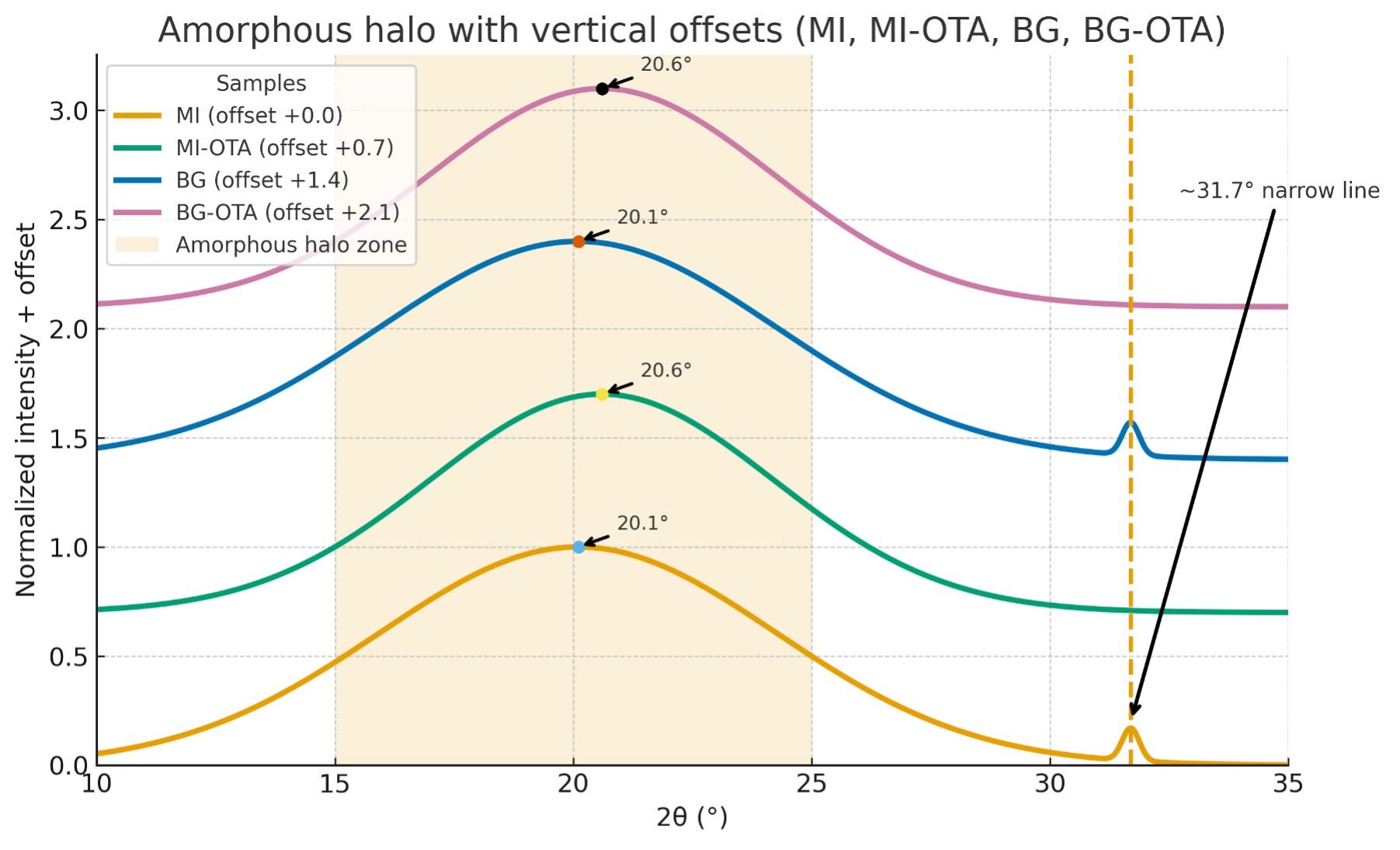
After uniform background correction and area normalization, the offset XRD overlay of MI, MI-OTA, BG, and BG-OTA is dominated—appropriately for protein films—by a broad amorphous halo in 15-25° 2θ (centered near ~20°). In polymer/biopolymer systems, the halo’s position and width (FWHM) quantify short-range packing and its dispersion; therefore, the slightly right-shifted and narrower amorphous halo observed in the OTA-treated films indicates tighter short-range molecular packing within the amorphous protein matrix. This densification suggests that OTA-induced crosslinking reduces intermolecular spacing and promotes a more compact structural arrangement, rather than the formation of new protein crystallites (the very sharp line at ~31.7° is a non-protein residue and is excluded from interpretation). The XRD patterns of both reference and OTA-treated films were dominated by a broad amorphous halo centered in the range of approximately 15-25° (2θ), which is characteristic of disordered protein-based polymer networks (Figure 2). After OTA incorporation, the halo position shifted slightly toward higher diffraction angles, and the halo width narrowed moderately. This behaviour indicates a reduction in intermolecular spacing and improved short-range molecular ordering within the amorphous matrix. The decrease in halo width suggests reduced structural heterogeneity, while the shift toward higher 2θ values reflects tighter molecular packing induced by OTA-mediated crosslinking. These changes collectively indicate an increase in packing density within the protein network rather than the formation of new crystalline domains. This halo-based reading of short-range order is standard in amorphous materials and biopolymer XRD (Sivakumar et al., 2026; Liu et al., 2020). The same structural signature agrees with FTIR—downshifted –OH/–NH bands and strengthened C=O/C–O features—consistent with phenolic (OTA) crosslinking via hydrogen bonding and quinone-mediated covalent linkages (e.g., Schiff-base/Michael-type) that compact the protein network (Lee et al., 2023). In turn, that tighter short-range packing provides a microstructural basis for the widely reported mechanical response of tannic-acid/oxidized-tannic-acid-crosslinked protein/biopolymer films, namely increased tensile strength and reduced extensibility (Zhang et al., 2023).

Baseline-subtracted, area-normalized XRD patterns of MI, MI-OTA, BG, and BG-OTA (10-35° 2θ), plotted with vertical offsets for clarity.
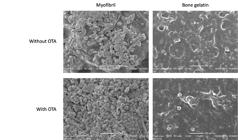
At ×200 (100 µm bar) (Figure 3), the reference MI surface exhibits discontinuous, rough aggregates and microcracks. At the same time, BG appears smoother but punctuated by rounded pores and flow-like features—both consistent with a loosely consolidated protein matrix. After OTA treatment, MI-OTA evolves into a denser granular network with tighter grain-to-grain contacts and fewer open voids, and BG-OTA shows a more cohesive, continuous surface with smaller pores and occasional fibrillar bridges, visual hallmarks of reduced free volume and improved interfacial adhesion. These morphological changes are consistent with the structural features observed in the XRD patterns of OTA-modified films, where a tighter amorphous halo indicates increased molecular packing. The SEM images therefore provide direct visual evidence that OTA crosslinking reduces pore formation and improves structural cohesion in the protein network, rather than creating new crystallites, the patterns show a tighter (and sometimes slightly right-shifted) amorphous halo in 15-25° 2θ, the accepted indicator of denser short-range packing in amorphous/biopolymer systems; sharp lines (e.g., ~31.7°) are non-protein residues and are excluded from structural inference. The same consolidation is supported chemically by FTIR, where red-shifted –OH/–NH bands and enhanced C=O/C–O features are characteristic of phenolic (tannic/oxidized tannic) crosslinking, involving stronger hydrogen bonding and quinone-mediated covalent linkages (Schiff-base/Michael-type) that compact protein networks (Chen et al., 2022).
This structural densification observed in the XRD analysis is consistent with the FTIR evidence of stronger hydrogen bonding and quinone-mediated covalent interactions, which promote a more compact protein network structure. Together, the SEM densification, the halo-based XRD evidence of tighter local packing, and the FTIR markers of increased interchain bonding provide a coherent microstructure-property explanation for the observed mechanical response of OTA-modified protein/gelatin films—tensile strength increases while extensibility decreases—a trend widely reported for tannic-acid/OTA crosslinked biopolymer films (Parsaei et al., 2022).
3.6 Barrier and moisture-related properties of myofibrillar- and gelatin-based biopolymer films crosslinked with OTA
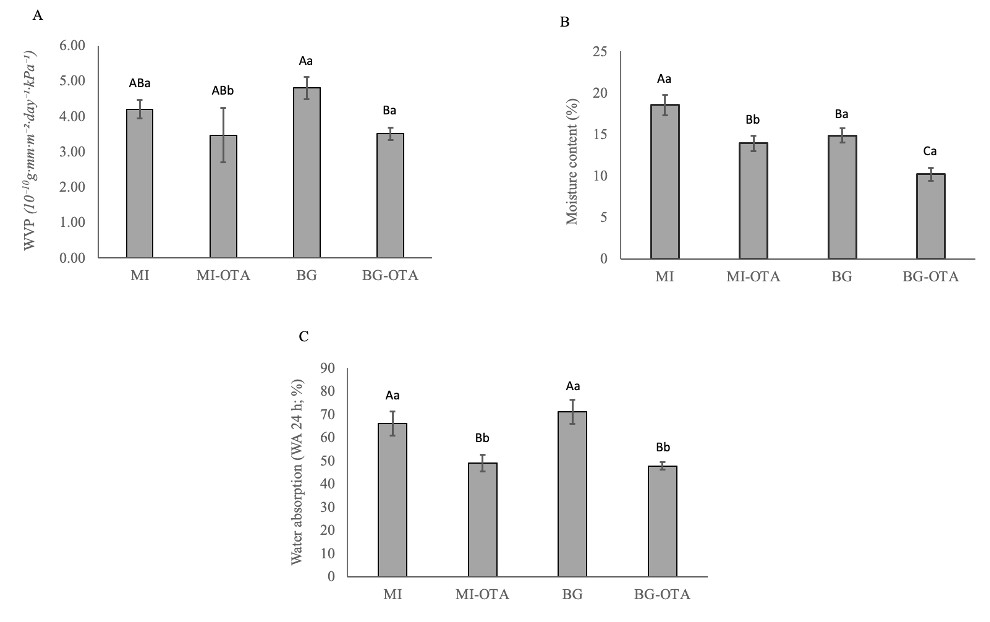
The barrier and hydration properties of the biopolymer films also supported these results (Figure 4). As previously observed at the molecular and mechanical levels, OTA crosslinking markedly enhanced the water-resistance tendencies of both myofibrillar- and gelatin-based films. Identically, for the MI-OTA, WVP was notably reduced from 4.20 to 3.47.10-10 g·mm·m-2 ·day-1 ·kPa-1, nearly 18%, while, for the BG-OTA, it also fell from 4.80 to 3.51-10 g·mm·m-2 ·day-1 ·kPa-1, a reduction by approximately 27%. In addition, there was a decline in MC from 18.58% to 13.95% and from 14.89% to 10.21%, and a decrease in WA from 66.07% to 49.04% and from 71.17% to 47.79% in MI and BG, respectively. These quantitative reductions demonstrate that OTA crosslinking improves the barrier properties of the films, particularly in gelatin-based systems. The higher density of reactive hydroxyl and amino groups in gelatin facilitates stronger interactions with oxidized tannic acid, resulting in a more compact network structure that limits water diffusion through the film matrix, consistent with the theoretically predicted differences in the density of hydroxyl and amino groups between gelatin and myofibrillar proteins. These reductions in permeability and water uptake were entirely consistent with the molecular evidence for improved molecular interactions.

Water vapor permeability (A), moisture content (B), and water absorption (C) of biopolymer films prepared from myofibrillar proteins (MI) and bone gelatin (BG), without (MI, BG) or with oxidized tannic acid crosslinking (MI-OTA, BG-OTA). Error bars represent the standard deviation (n = 3). Different uppercase letters (A-C) indicate significant differences (p < 0.05) among all film formulations. Different lowercase letters (a-b) indicate a significant difference (p < 0.05) between films derived from the same base material (MI or BG).
The improvements in barrier and hydration properties can be attributed to the structural modifications induced by OTA crosslinking. FTIR analysis revealed stronger hydrogen bonding and possible quinone-mediated covalent interactions between OTA and protein functional groups. These interactions increase intermolecular connectivity and promote the formation of a more compact molecular network (Xue et al., 2025). Consistently, XRD analysis showed a slightly tighter amorphous halo, indicating reduced intermolecular spacing and higher packing density within the protein matrix. SEM observations further confirmed this structural densification, revealing smoother surfaces and fewer pores in OTA-treated films.
The combined chemical and microstructural changes reduce free volume and limit diffusion pathways for water molecules (Zhao et al., 2025), thereby decreasing water vapour permeability and water absorption. In addition, stronger intermolecular interactions restrict the availability of hydrophilic sites that can interact with water molecules, resulting in lower moisture content. These findings demonstrate that OTA-induced network densification improves the barrier performance of tuna-derived protein films, supporting their potential use as sustainable packaging materials.
OTA integration caused distinct red shifts in the O–H/N–H stretching region, from 3379 to 3221 cm −1 in MI to MI-OTA and from 3400 to 3230 cm−1 in BG to BG-OTA, and a new peak at 1126 cm−1 attributed to C–O–C/C–O–Ph linkage likely strengthened hydrogen bonding and phenolic or ether linkage formation. Such attentional changes were related to tighter molecular arrangements, decreased room for chain movement, and reduced free space within the polymer. The mechanical results also indicated that OTA crosslinking increased films' TS by 20% to 30% and decreased Eb by 15-25%, indicating a firmer, denser network structure. This densification reduces the spacing for molecular flow and the number of free hydroxyl heads. Hence, water diffusion and rate are adversely impacted.
Therefore, OTA-treated films exhibit superior mechanical behavior and enhanced water-barrier properties. Indeed, these trends have been substantiated for phenolic-protein film systems. The water solubility and WVP of the fish gelatin films were decreased by over 40% in the presence of tannic and caffeic acids (Parsaei et al., 2022). Ardestani SS (2015) reported that the increasing tannic acid concentration in cow-gelatin films significantly decreased water absorption due to enhanced hydrogen-bonding and hydrophobic associations. The WVP of whey-protein films crosslinked using oxidized tannic acid was similarly below 20% (Wang & Xiong, 2021). Indeed, these findings demonstrate that OTA is a strong multifunctional linker that enhances both chemical and functional characteristics of biopolymer systems.
Overall, the combined analyses of mechanical performance, FTIR spectroscopy, XRD patterns, and SEM morphology reveal a clear structure–property relationship in OTA-modified protein films. The results demonstrate that oxidized tannic acid functions as a multifunctional crosslinker that simultaneously modifies intermolecular interactions, microstructural organization, and barrier performance of tuna-derived protein biopolymers. This integrated understanding highlights the novelty of using OTA to reinforce protein-based films derived from tuna processing by-products.
4 Conclusion
The present study addressed the research gap in understanding how oxidized tannic acid (OTA) modifies the structural organization and functional performance of protein-based films derived from tuna processing by-products. Based on the obtained results, the following conclusions can be drawn:
-
Tuna-processing by-products (myofibrillar protein and gelatin from skin and bone) were successfully valorised into protein-based biopolymer films, demonstrating their potential as sustainable raw materials for biodegradable packaging.
-
OTA acted as an effective natural crosslinking agent by promoting intermolecular interactions within the protein matrix, including hydrogen bonding and quinone-mediated covalent linkages between OTA and reactive amino acid residues.
-
Structural analyses confirmed OTA-induced network densification. FTIR revealed red shifts in the –OH/–NH stretching bands and intensified C=O/C–O signals, indicating stronger intermolecular interactions. XRD showed a tighter amorphous halo (15-25° 2θ), suggesting increased short-range molecular packing, while SEM images showed smoother, less porous film surfaces.
-
The densification of the protein network translated directly into improved mechanical performance. OTA incorporation increased tensile strength across all matrices while reducing elongation at break due to restricted polymer chain mobility.
-
OTA-induced structural modifications also enhanced barrier and hydration properties. Water vapour permeability, moisture content, and water absorption decreased significantly, indicating reduced free volume and limited diffusion pathways for water molecules within the film matrix.
-
Overall, the integration of OTA with tuna-derived protein matrices provides a promising strategy to strengthen protein-based biopolymer films and improve their functional properties, contributing to the development of sustainable packaging materials derived from the fishery industry by-products
Acknowledgements
This work was funded by the Directorate of Research and Community Service, Directorate General of Research and Development, Ministry of Higher Education, Science, and Technology of the Republic of Indonesia (Contract No.: 128/PL.22.7.1/SP-PG/2025).
Data Availability Statement
The data supporting this study are not publicly available, but can be requested from the corresponding author upon reasonable request.
Cite as:
Funding:
References
- Agustin, A. T. (2015). Kajian Gelatin Kulit Ikan Tuna (Thunnus albacares) yang diproses menggunakan asam asetat. Pros Sem Nas Masy Biodiv Indon, 1(5), 1186-1189.
-
Ajvazi, N., Milošev, I., Čelan Korošin, N., Rodič, P., & Božić, B. (2025). Enhancing cross-linking efficiency in gelatin-based hydrogels via incorporation of Tannic Acid, Pluronic F-127, and Phytic Acid. Polymers, 17(10), 1372. PMid:40430667. https://doi.org/10.3390/polym17101372
» https://doi.org/10.3390/polym17101372 -
Ardestani, S. S. (2015). The effects of tannic acid on some properties of cow gelatin’s film. Journal of Food Processing & Technology, 6(9), https://doi.org/10.4172/2157-7110.1000491
» https://doi.org/10.4172/2157-7110.1000491 -
Bagavathsingh, G., Duraisamy, J., Chandrasekeran, G., & Arumugam, R. D. (2025). Microplastics and ecosystem services: Persistence, disruption mechanisms, and mitigation strategies. Environmental Reviews, 33, 1-23. https://doi.org/10.1139/er-2025-0080
» https://doi.org/10.1139/er-2025-0080 - Barbi, S., Spinelli, R., Ferrari, A., & Montorsi, M. (2019). Design and environmental assessment of bioplastics from hermetia illucens prepupae proteins. Environmental Engineering and Management Journal, 18(10), 2123-2131.
-
Bethi, C. M. S., Narayan, B., Martin, A., & Kudre, T. G. (2020). Recovery, physicochemical and functional characteristics of proteins from different meat processing wastewater streams. Environmental Science and Pollution Research International, 27(20), 25119-25131. PMid:32342418. https://doi.org/10.1007/s11356-020-08930-x
» https://doi.org/10.1007/s11356-020-08930-x -
Budida, J., Rao, Ch. S., Chand, N. R., & Guntu, R. K. (2025). Spectral and structural tailoring of Sm2O3-Doped LiF-La2O3-PbO-B2O3 glasses for advanced luminescent devices. Journal of Electronic Materials, 54(11), 10611-10647. https://doi.org/10.1007/s11664-025-12286-8
» https://doi.org/10.1007/s11664-025-12286-8 -
Chen, C., Yang, H., Yang, X., & Ma, Q. (2022). Tannic acid: A crosslinker leading to versatile functional polymeric networks: A review. RSC Advances, 12(13), 7689-7711. PMid:35424749. https://doi.org/10.1039/D1RA07657D
» https://doi.org/10.1039/D1RA07657D -
Chen, Y., Qie, X., Quan, W., Zeng, M., Qin, F., Chen, J., Adhikari, B., & He, Z. (2023). Omnifarious fruit polyphenols: An omnipotent strategy to prevent and intervene diabetes and related complication? Critical Reviews in Food Science and Nutrition, 63(20), 4288-4324. PMid:34792409. https://doi.org/10.1080/10408398.2021.2000932
» https://doi.org/10.1080/10408398.2021.2000932 -
Cole, C. C., Pogostin, B. H., Cahue, K. A., Vardanyan, V. H., Bui, T. H., Farsheed, A. C., Swain, J. W. R., Makhoul, J. T., Dubackic, M., Holmqvist, P., Olsson, U., Kolomeisky, A. B., McHugh, K. J., & Hartgerink, J. D. (2025). Covalent stabilization of collagen mimetic triple helices and assemblies by dopa crosslinking. Chembiochem: A European Journal of Chemical Biology, 26(22), e202500268. PMid:40607775. https://doi.org/10.1002/cbic.202500268
» https://doi.org/10.1002/cbic.202500268 -
Coppola, A., Oliviero, M., De Cesare, N., Russo, N., Nappo, N., Buonocore, C., Della Sala, G., Tedesco, P., Palma Esposito, F., Galasso, C., de Pascale, D., D’Amora, U., & Coppola, D. (2025). Marine Collagen from european sea bass (Dicentrarchus labrax) waste for the development of chitosan/collagen scaffolds in skin tissue engineering. Marine Drugs, 23(10), 375. PMid:41149578. https://doi.org/10.3390/md23100375
» https://doi.org/10.3390/md23100375 -
Cortez-Vega, W. R., Fonseca, G. G., Bagatini, D. C., & Prentice, C. (2017). Influence of adding recovered protein from processing wastewater on the quality of mechanically separated chicken meat surimi like-material. Han-gug Chugsan Sigpum Hag-hoeji, 37(2), 162-167. PMid:28515639. https://doi.org/10.5851/kosfa.2017.37.2.162
» https://doi.org/10.5851/kosfa.2017.37.2.162 -
Geng, Y., Liu, X., Yu, Y., Li, W., Mou, Y., Chen, F., Hu, X., Ji, J., & Ma, L. (2023). From polyphenol to o ‐quinone: Occurrence, significance, and intervention strategies in foods and health implications. Comprehensive Reviews in Food Science and Food Safety, 22(4), 3254-3291. PMid:37219415. https://doi.org/10.1111/1541-4337.13182
» https://doi.org/10.1111/1541-4337.13182 -
Gonapinuwala, S. T., Kirk, S., Jones, J. R., de Croos, M. D. S. T., & Bronlund, J. E. (2025). Collagen with native triple-helical structure from representative cold-water and warm-water fish skins using a modified protocol. Food and Bioprocess Technology, 18(9), 7993-8007. https://doi.org/10.1007/s11947-025-03912-8
» https://doi.org/10.1007/s11947-025-03912-8 -
Guntu, R. K., Ashok, P., Sivaram, K., Shetty, P. B., Babu, S., & Israr, M. (2025). Investigations on thermoluminescence, photoluminescence and radiation shielding properties of Dy2O3 doped Li2O-Al2O3-SiO2-Y2O3 glasses for thermoluminescent dosimeter applications. Applied Physics. A, Materials Science & Processing, 131(9), 701. https://doi.org/10.1007/s00339-025-08757-8
» https://doi.org/10.1007/s00339-025-08757-8 -
Guo, A., Jiang, J., True, A. D., & Xiong, Y. L. (2021). Myofibrillar protein cross-linking and gelling behavior modified by structurally relevant phenolic compounds. Journal of Agricultural and Food Chemistry, 69(4), 1308-1317. PMid:33494593. https://doi.org/10.1021/acs.jafc.0c04365
» https://doi.org/10.1021/acs.jafc.0c04365 -
He, C., Ma, D., Zeng, M., Wang, Z., Chen, Q., Chen, J., & He, Z. (2024). Effect of molecular weight distributions on the gelation rate and other physicochemical properties of bovine bone gelatin (Type B). Food Bioscience, 57, 103461. https://doi.org/10.1016/j.fbio.2023.103461
» https://doi.org/10.1016/j.fbio.2023.103461 -
Holwerda, A. M., Aussieker, T., Senden, J., Bouwman, F. G., van Kranenburg, J., Overman, A., Snijders, T., Verdijk, L. B., Holm, L., & van Loon, L. J. C. (2026). Assessing the composition of myofibrillar and muscle connective protein fractions within skeletal muscle tissue. Critical Reviews in Food Science and Nutrition, 66(1), 248-258. PMid:40566702. https://doi.org/10.1080/10408398.2025.2522363
» https://doi.org/10.1080/10408398.2025.2522363 -
Jalili, S. H., Etemadian, Y., Alboofetileh, M., & Moradi, Y. (2022). Gelatine extraction from skipjack tuna (Katsuwonus pelamis) head bones by acid-hydrolysis method and its physicochemical and functional characterizations. Aquatic Food Studies, 2(1), https://doi.org/10.4194/AFS83
» https://doi.org/10.4194/AFS83 -
Joy, J. M., Dara, P. K., Amruth, P., Rosemol Jacob, M., Dhandapani, N., Mathew, S., & Anandan, R. (2023). Evaluation of the physicochemical and techno-functional properties of gelatin extracted from fish processing waste. International Journal of Bio-Resource and Stress Management, 14(May, 5), 733-742. https://doi.org/10.23910/1.2023.3471
» https://doi.org/10.23910/1.2023.3471 -
Kaur, N., Somasundram, C., Razali, Z., Mourad, A.-H. I., Hamed, F., & Ahmed, Z. F. R. (2024). Aloe vera/chitosan-based edible film with enhanced antioxidant, antimicrobial, thermal, and barrier properties for sustainable food preservation. Polymers, 16(2), 242. PMid:38257041. https://doi.org/10.3390/polym16020242
» https://doi.org/10.3390/polym16020242 -
Lee, S. J., Gwak, M. A., Chathuranga, K., Lee, J. S., Koo, J., & Park, W. H. (2023). Multifunctional chitosan/tannic acid composite films with improved anti-UV, antioxidant, and antimicrobial properties for active food packaging. Food Hydrocolloids, 136, 108249. https://doi.org/10.1016/j.foodhyd.2022.108249
» https://doi.org/10.1016/j.foodhyd.2022.108249 -
Li, H., Lu, X., Pang, C., Liang, R., Pan, S., Wei, F., & Guo, X. (2025). The characterization of physicochemical, nutritional, and flavor properties of bovine hide gelatin prepared from different raw materials. Foods, 14(17), 2941. PMid:40941057. https://doi.org/10.3390/foods14172941
» https://doi.org/10.3390/foods14172941 -
Li, M., Guo, L., Mu, Y., Huang, X., Jin, L., Xu, Q., & Wang, Y. (2024). Gelatin films reinforced by tannin-nanocellulose microgel with improved mechanical and barrier properties for sustainable active food packaging. Food Hydrocolloids, 149, 109642. https://doi.org/10.1016/j.foodhyd.2023.109642
» https://doi.org/10.1016/j.foodhyd.2023.109642 -
Li, N., Zhang, K., Dong, X., Xu, Y., Tan, Z., Cao, G., Liu, X., Zhou, D., & Li, D. (2023). Modification of the structure and function of myofibrillar protein by structurally relevant natural phenolic compounds. Food Bioscience, 53, 102676. https://doi.org/10.1016/j.fbio.2023.102676
» https://doi.org/10.1016/j.fbio.2023.102676 -
Liu, J., Zhang, C., Zhao, H., Yu, Y., Li, C., Cheng, P., Liu, P., Guan, F., Zhang, Y., & Yao, M. (2025). Horseradish peroxidase/hydrogen peroxide-cross-linked quaternized chitosan/protocatechualdehyde hydrogels with strong antioxidant and photothermal antibacterial properties for infected burn wounds. Biomacromolecules, 26(9), 6219-6232. PMid:40838841. https://doi.org/10.1021/acs.biomac.5c01183
» https://doi.org/10.1021/acs.biomac.5c01183 -
Liu, X., Luan, H., Jinglin, Y., Wang, S., Wang, S., & Copeland, L. (2020). A method for characterizing short-range molecular order in amorphous starch. Carbohydrate Polymers, 242, 116405. PMid:32564834. https://doi.org/10.1016/j.carbpol.2020.116405
» https://doi.org/10.1016/j.carbpol.2020.116405 -
Mafazah, E. M. (2024). Kulit Ikan Tuna Yellowfin (Thunnus albacares) untuk produksi gelatin dengan variasi larutan NaOH dan waktu. Journal of Innovative Food Technology and Agricultural Product, 2(1), 25-34. https://doi.org/10.31316/jitap.v2i1.6605
» https://doi.org/10.31316/jitap.v2i1.6605 -
Men, G., Niu, W., & Liu, X. (2025). Hydrogen‐bond‐mediated polymers: Strengthening, toughening, and stabilizing effects. Chemistry: A European Journal, 31(27), e202500674. PMid:40167175. https://doi.org/10.1002/chem.202500674
» https://doi.org/10.1002/chem.202500674 -
Montazeri Shatouri, M., Khabir, Z., Pirozzi, I., Demir Soker, P., & Haynes, P. A. (2025). Composition and detailed characterization of amino acids, peptides, proteins, fatty acids, and minerals of tuna trimming fish meal. ACS Food Science & Technology, 5(3), 1145-1155. https://doi.org/10.1021/acsfoodscitech.4c00992
» https://doi.org/10.1021/acsfoodscitech.4c00992 -
Neves, E. M. P. X., Pereira, R. R., Pereira, G. V. S., Vieira, L. L., & Lourenço, L. F. H. (2019). Effect of polymer mixture on bioplastic development from fish waste. Boletim do Instituto de Pesca, 45(4), e518. https://doi.org/10.20950/1678-2305.2019.45.4.518
» https://doi.org/10.20950/1678-2305.2019.45.4.518 -
Papadopoulou, S. N. A., Adamantidi, T., Kranas, D., Cholidis, P., Anastasiadou, C., & Tsoupras, A. (2025). A comprehensive review on the valorization of bioactives from marine animal by-products for health-promoting, biofunctional cosmetics. Marine Drugs, 23(8), 299. PMid:40863616. https://doi.org/10.3390/md23080299
» https://doi.org/10.3390/md23080299 -
Parsaei, E., Mohammadi Nafchi, A., Nouri, L., & Al-Hassan, A. A. (2022). The effects of tannic and caffeic acid as cross-linking agents on the physicochemical, barrier, and mechanical characteristics of cold-water fish gelatin films. Journal of Food Measurement and Characterization, 16(5), 3926-3934. https://doi.org/10.1007/s11694-022-01495-y
» https://doi.org/10.1007/s11694-022-01495-y -
Qi, Y., Wang, W., Yang, T., Ding, W., & Xu, B. (2025). Maillard reaction in flour product processing: Mechanism, impact on quality, and mitigation strategies of harmful products. Foods, 14(15), 2721. PMid:40807658. https://doi.org/10.3390/foods14152721
» https://doi.org/10.3390/foods14152721 -
Reese, C. J., Musgrave, G. M., Cardon, P., Ji, H., Shusteff, M., & Wang, C. (2025). Hydrogen bonding enhances the crystallinity of polymer networks synthesized by rapid and solventless photopolymerization. ACS Macro Letters, 14(8), 1189-1194. PMid:40763197. https://doi.org/10.1021/acsmacrolett.5c00406
» https://doi.org/10.1021/acsmacrolett.5c00406 -
Rostamzad, H., Paighambari, S. Y., Shabanpour, B., Ojagh, S. M., & Mousavi, S. M. (2016). Improvement of fish protein film with nanoclay and transglutaminase for food packaging. Food Packaging and Shelf Life, 7, 1-7. https://doi.org/10.1016/j.fpsl.2015.10.001
» https://doi.org/10.1016/j.fpsl.2015.10.001 -
Sanyang, M. L., Sapuan, S. M., Jawaid, M., Ishak, M. R., & Sahari, J. (2015). Effect of plasticizer type and concentration on tensile, thermal and barrier properties of biodegradable films based on sugar palm (Arenga pinnata) starch. Polymers, 7(6), 1106-1124. https://doi.org/10.3390/polym7061106
» https://doi.org/10.3390/polym7061106 -
Sarkar, A. K., Yang, Z., Astruc, T., & Amdursky, N. (2025). Aqueous‐based assembly of plant‐derived proteins yields a crosslinker‐Free biodegradable bioplastic consistent with green chemistry principles. ChemSusChem, 18(5), e202401567. PMid:39392314. https://doi.org/10.1002/cssc.202401567
» https://doi.org/10.1002/cssc.202401567 -
Shim, Y. H., Kong, T. Y., & Kim, S. Y. (2025). Reversible control of rheological properties in microgel composites via nanoparticle aggregation. ACS Applied Materials & Interfaces, 17(27), 39616-39627. PMid:40574577. https://doi.org/10.1021/acsami.5c06287
» https://doi.org/10.1021/acsami.5c06287 -
Sivakumar, T., Praveenkumar, S., & Vinothkumar, P. (2026). Structural, optical, and thermoluminescence properties of Sm3+ ions doped strontium titanium borophosphate glass for dosimetric applications. Inorganic Chemistry Communications, 185, 116105. https://doi.org/10.1016/j.inoche.2025.116105
» https://doi.org/10.1016/j.inoche.2025.116105 -
Tan, J., Wang, M., Ni, Z., Pei, R., Shi, F., & Ye, S. (2024). Intermolecular protein-water coupling impedes the coupling between the amide A and Amide I mode in interfacial proteins. Langmuir: The ACS Journal of Surfaces and Colloids, 40(12), 6587-6594. PMid:38486393. https://doi.org/10.1021/acs.langmuir.4c00246
» https://doi.org/10.1021/acs.langmuir.4c00246 -
Thumma, J., & Guntu, R. K. (2025). Design and evaluation of TiO2-enhanced phosphate glasses for dual-functionality: Photonic applications and radiation safety. Physica B, Condensed Matter, 716, 417735. https://doi.org/10.1016/j.physb.2025.417735
» https://doi.org/10.1016/j.physb.2025.417735 -
Wan, X., Li, N., Qiu, J., Wang, Q., Feng, Y., & Xiong, R. (2025). Hierarchical nanocellulose-based functional films: A sustainable and high-performance alternative to conventional plastic films. Biomacromolecules, 26(9), 5514-5546. PMid:40748329. https://doi.org/10.1021/acs.biomac.5c00783
» https://doi.org/10.1021/acs.biomac.5c00783 -
Wang, R., Sui, J., Chen, P., Silva‐Pedraza, Z., Bontekoe, J., Kim, J., Li, P., Pan, F., Schmuck, E. G., Osaki, S., Liu, B., & Wang, X. (2025). A hydro‐Expansive and degradable biomaterial enabling shape recovery of film‐Based devices in biofluids. Advanced Materials, 37(41), e10140. PMid:40728249. https://doi.org/10.1002/adma.202510140
» https://doi.org/10.1002/adma.202510140 -
Wang, Y., & Xiong, Y. L. (2021). Physicochemical and microstructural characterization of whey protein films formed with oxidized ferulic/tannic acids. Foods, 10(7), 1599. PMid:34359467. https://doi.org/10.3390/foods10071599
» https://doi.org/10.3390/foods10071599 -
Wu, Z., Qu, Y., Li, O., Benjakul, S., & Zhou, A. (2025). Improvement of gel properties of nemipterus virgatus myofibrillar protein emulsion gels by curdlan: Development and application to emulsified surimi. Gels, 11(9), 753. PMid:41002527. https://doi.org/10.3390/gels11090753
» https://doi.org/10.3390/gels11090753 -
Xue, S., Tan, W., Mao, S., Pan, H., Ye, X., Donlao, N., & Tian, J. (2025). Polyphenol‐Based functional materials: Structural insights, composite strategies, and biomedical applications. Advanced Science, 12(39), e08924. PMid:40864160. https://doi.org/10.1002/advs.202508924
» https://doi.org/10.1002/advs.202508924 -
Zhang, W., Roy, S., Ezati, P., Yang, D. P., & Rhim, J. W. (2023). Tannic acid: A green crosslinker for biopolymer-based food packaging films. Trends in Food Science & Technology, 136, 11-23. https://doi.org/10.1016/j.tifs.2023.04.004
» https://doi.org/10.1016/j.tifs.2023.04.004 -
Zhang, Z., Wang, S., Long, J., Hao, Z., & Liu, H. (2026). Adhesion properties of soybean protein/transglutaminase/pectin composite adhesives improved by adjusting tannic acid content. Journal of the Science of Food and Agriculture, 106(1), 238-248. PMid:40888557. https://doi.org/10.1002/jsfa.70153
» https://doi.org/10.1002/jsfa.70153 -
Zhao, Y., Zhang, H., Ding, Q., Zhao, G., Li, H., & Yang, L. (2025). Graphene nanosheets enhanced hygrothermal aging resistance of epoxy composites: A combined experimental and molecular dynamics simulation study. Advanced Engineering Materials, 27(18), 2501142. https://doi.org/10.1002/adem.202501142
» https://doi.org/10.1002/adem.202501142 -
Zhong, J., Zhou, D., Hu, P., Cheng, Y., & Huang, Y. (2023). Identification of the chemical composition of distiller’s grain polyphenols and their effects on the fecal microbial community structure. Food Chemistry: X, 20, 101001. PMid:38144726. https://doi.org/10.1016/j.fochx.2023.101001
» https://doi.org/10.1016/j.fochx.2023.101001 -
Zuravel, K., Zuravel, L., Adhikari, M., Luo, Z., & Gautam, B. (2022). Novel gelatin-based bioplastic materials designed to replace polystyrene and polypropylene in single-use hard plastics. Microscopy and Microanalysis, 28(S1), 1592-1593. https://doi.org/10.1017/S1431927622006377
» https://doi.org/10.1017/S1431927622006377
*
Corresponding Author: Muh Ali Arsyad, Pangkep State Polytechnic of Agriculture, Department of Agricultural Technology, Jl. Poros Makassar-Pare, km 83, Pangkep 90655, South Sulawesi - Indonesia, e-mail: muh.aliarsyadabdullah@gmail.comAssociate Editor: