 Study on techno-functional properties of pecan flour with different lipid content
Abstract
Pecan flour, obtained from the solid residue left after walnut oil extraction, is rich in proteins, dietary fiber, and phenolic compounds with antioxidant properties. This study evaluates the techno-functional properties of pecan flour with varying lipid contents. Key parameters include color (L*, a*, and b* values), bulk density, oil absorption capacity (OAC), water absorption capacity (WAC), emulsifying activity (EA), and stability (ES). A two-way factorial design was used to assess WAC, EA, and ES while varying pH and NaCl concentrations. Low-lipid pecan flour (20.7% ± 0.51%) showed a higher OAC (3.990% ± 0.024%) and a light beige color, while high-lipid flour (68.7% ± 0.61%) had a dark brown color and greater bulk density (0.532 ± 0.003 g/mL versus 0.217 ± 0.005 g/mL). WAC increased significantly in low-lipid flour at higher pH and lower NaCl levels, whereas high-lipid flour required higher NaCl concentrations to optimize WAC. EA and ES peaked at intermediate pH and NaCl levels, with low-lipid flour demonstrating superior emulsion properties due to its favorable hydrophilic-hydrophobic balance. The study highlights the complex interactions between pH, NaCl, and lipid content, significantly influencing WAC, EA, and ES. These findings provide insights for optimizing the functionality of pecan flour in food formulations. Also, the research establishes pecan flour as a promising ingredient for enhancing water retention and emulsion stability in food systems, contributing to sustainable food innovations and offering the potential for further exploration in complex food matrices.
Keywords:
Water absorption capacity; Oil absorption capacity; Emulsifying activity; Emulsifying stability; Natural antioxidant
HIGHLIGHTS
The lipid content of pecan flour is a critical factor for its use in food formulation
Low-lipid pecan flour demonstrates superior techno-functional performance in food systems
NaCl increased emulsion stability while lowering pH decreased it
1 Introduction
The exponential growth of the food processing industry worldwide has led to the generation of substantial quantities of by-products (pomace, husks, shells, husks, pods, husks, seeds, stems, stalks, bran, pulp waste, pressed cakes). Unfortunately, many of these by-products are underutilized and contribute significantly to environmental pollution. However, it's worth noting that these industrial by-products contain valuable nutrients, including protein, vitamins, minerals, and fiber. These by-products can be incorporated into a wide range of food products, including bread, buns, cakes, pastries, pasta, noodles, cookies, ice cream, yogurt, cheese, milkshakes, instant breakfast drinks, iced tea, and juices. They can also even be used as meat analogues in meat products. Given their versatility, the use of food processing by-products provides a sustainable solution for minimizing waste and maximizing resource efficiency in the food industry (Sharma et al., 2016).
Walnut flour has emerged as a new promising product in the baking industry, both as an addition and replacement for wheat flour in the production of bread, biscuits, noodles, and cakes (Vanhanen & Savage, 2006). This product is obtained from the partially defatted meal left over after the oil is extracted from the nuts through a cold pressing process (Sarkis et al., 2014). These by-products are recognized for their high nutritional and phytochemical content (Atanasov et al., 2018). The pecan nut flour (Carya illinoinensis (Wangenh) K. Koch) has a significant nutritional value, characterized by its high content of protein, fiber, and phenolic compounds (Muchuittia et al., 2023). It also contains essential minerals that are beneficial for consumer health (Maciel et al., 2020; Burbano & Correa, 2021). Its composition can vary based on the nut variety, cultivation condition, and extraction methods. The methods influence the retention of nutrients in both the oil and the by-product from the nuts. There are two main methods: solvent extraction and press extraction. While solvent extraction is efficient, it can reduce the nutritional quality of the final oil due to contamination with residual solvents (Zhang & Sun, 2023; Zhang et al., 2022). In contrast, cold pressing is a gentler and more sustainable method that promotes the preservation of bioactive compounds in both the oil and the pressed cake. However, the extraction efficiency of cold pressing is generally lower, resulting in a significant amount of residual oil left in the pressed cake (Fan et al., 2023).
Successful incorporation of flour derived from residual cake into food products requires a comprehensive characterization of its techno-functional properties. These properties such as water and oil retention capacity, emulsifying activity, swelling power, and foaming capacity, are crucial for determining the flour's behavior within various food matrices and its potential applications in products like baked goods, meat, and dairy items (Maciel et al., 2020; Chaparro et al., 2011). Furthermore, the techno-functional properties of the flour are not static and can be significantly influenced by its chemical composition and environmental conditions. Among these factors, pH and NaCl concentration are particularly relevant in the food industry because they can modulate the functionality of proteins and bioactive compounds within the flours. NaCl, as a salting agent, plays a critical role in altering protein solubility and modifying the electrostatic interactions among flour components. This change can affect properties such as emulsion stability and water retention (Damodaran, 1992). Similarly, pH influences the ionization of protein functional groups, which alters protein conformation and, consequently, their techno-functional properties, such as the emulsifying ability. Understanding the relationships between functional qualities and protein structure at different pH levels is crucial (Han et al., 2023; Xu et al., 2024). At acidic pH, gel formation by non-covalent interactions predominates, while at neutral pH, reactions involving intermolecular sulfide-disulfide exchanges are more favorable. Both variables are routinely controlled in industrial processes and are critical for ensuring the functional performance of food formulations. For example, in food matrices such as sauces, dressings, and meat products, properties like emulsification capacity, water and oil absorption, and interactions between protein-protein and protein-water are vital for product quality and functionality. Research on the functional properties of pecan flour from cold-pressed by-products is limited, especially regarding the combined effects of pH and NaCl concentration on its techno-functional characteristics. Most previous studies have focused on flours from other nuts or have only analized specific properties, without comprehensively addressing how these variables influence food matrices. This lack of information restricts the understanding required to optimize the use of pecan flour in diverse food formulations, highlighting the need for this study.
The selection of pH and NaCl concentration as the experimental variables in this study is based on their well-documented roles in determining the functional properties of flours. These variables were selected to provide a controlled and focused analysis of their specific effects on pecan flour, which is critical for optimizing its use in diverse food formulations. While other factors, such as temperature and humidity, also influence the techno-functional properties of flours, limiting this study to pH and NaCl concentration enables a deeper and more precise understanding of their impacts. Previous studies have confirmed that pH and NaCl are key determinants of functionality in similar flours and food matrices, further justifying their selection as the primary focus of this investigation (Damodaran, 1992; Maciel et al., 2020).
To optimize the use of pecan flour in food products, it is important to investigate how the pH and NaCl concentration affect its functional properties. A two-way factorial design enables a thorough exploration of the interactive effects between these independent variables, including potential synergistic or antagonistic interactions within the food matrix. In addition, Response Surface Methodology (RSM) provides a robust and efficient approach to modeling the complex relationships between the independent and dependent variables with a minimum number of experimental trials.
This project aimed to investigate the techno-functional properties of pecan flour with varying lipid content, resulting from the oil extraction process. The primary objective was to assess the color, bulk density, oil absorption capacity, water absorption capacity, emulsifying activity, and stability of the pecan flour. To this end, a two-way factorial design was used to explore the influence of pH and sodium concentration on the water absorption capacity, emulsifying activity, and stability of pecan flour. This approach provided valuable insights into its potential applications in various food matrices.
2 Materials and methods
The pecan flour (Carya illinoinensis var. Shoshoni) used in this study was obtained from local producers in Entre Ríos, Argentina (Noyer®). The flour was produced as a byproduct of cold-press oil extraction, followed by centrifugation to remove residual oil. The flour was then packaged and stored at 4 °C under refrigeration to maintain its quality until further analysis. All reagents used in the analyses were of analytical grade. All chemicals used in analyses were reagent grade.
The lipid content of the flour was quantified using the Soxhlet method (Association of Official Analysis Chemists, 2005, Nº 920.85), which confirmed a high lipid percentage. To reduce the lipid content, the Twisselmann method was used. This hot fat extraction technique is similar to those employed in the oil industry, which ensures effective degreasing. Analytical grade n-hexane (Sigma-Aldrich, Merck, St. Louis, MO, USA) was used for this process, resulting in flour with a significantly reduced fat content.
2.1 Evaluation of pecan flour
Pecan flours with high and low content of lipids were assessed for their color (L*, a*, and b* values), bulk density (g/mL), and oil absorption capacity (OAC, %). To investigate the influence of the food matrix conditions, an experiment was designed that varied the pH and NaCl concentrations. It studied the properties of water absorption capacity (WAC, %), emulsion activity (EA, %), and emulsion stability (ES, %).
The color parameters (Hunter L*, a* and b* values) were measured using a portable photocolourimeter (HUNTER LAB, MiniScan EZ, USA), which was calibrated with black and white reference mosaics. The color functions were calculated using the D65 illuminant at a distance of 2° from the standard observer. During the measurement, the sample was placed in a black box to prevent light from affecting the optical beam. Three measurements were taken for each sample, and the means with standard deviations were reported.
The bulk density was determined following Turan et al. (2015). A sample of 10 g was placed into a 25 mL graduated cylinder by constant tapping until there was no further change in volume. The volume was measured, and the bulk density of the samples was calculated, with results reported in g/mL. Each treatment was replicated twice.
For the oil absorption capacity (OAC), 1 g of flour was mixed with 10 mL of commercial sunflower oil in a centrifuge tube, which was vortexed at 20 °C for 30 seconds. Following this, it was centrifugated at 2500 rpm for 10 minutes. The supernatant was removed, and the difference in sample mass before and after oil uptake was quantified as oil uptake. OAC is expressed as the percentage of oil bound per gram of flour.
2.2 Evaluation of the effect of pH and sodium chloride pecan flour
The selection of pH values (3, 5, 7, and 9) and NaCl concentrations (0.1, 0.5, and 1.0 M) was based on their practical relevance in food production processes and their influence on the techno-functional properties of pecan flour. The pH range selected for analysis (3-9) includes typical values found in diverse food systems. While most food products have pH values between 3.5 and 7.0 (Andrés-Bello et al., 2013). Specific applications include acidic conditions found in dressings (Longtin et al., 2020) and sauces (Sun et al., 2021), neutral conditions characteristic of meat products (Feng et al., 2022), and alkaline conditions present in certain baked goods and functional beverages. Similarly, the selected NaCl concentrations reflect typical levels in low-salt (Kim et al., 2021) and processed foods, influencing protein interactions, water retention, and emulsion stability, ensuring applicability in industrial food formulations (Kameník et al., 2017; Petit et al., 2019).
2.2.1 Experimental design and statistical analysis
A two-way factorial design analyzed the effect of pH and chloride sodium concentration on the techno-functional properties of pecan flour, specifically YWAC (g water/g flour), YEA, and YES (%). The pH variable was coded at four levels: -1, 0, 1, 2 (3, 5, 7, and 9), and the chloride sodium concentration variable was coded at three levels -1, 0, 1 (0.1, 0.5, and 1.0 M) The central point was set at 0.1 M and 5 pH and replicated three times (Table 1). A third-order complete polynomial equation was used to fit the behavior of each measured variable as a function of pH and chloride sodium concentration (Myers et al., 2009) Equation 1:
where the response variable is indicated, with β0 representing the constant term, β1 and β2 are the linear coefficients, β11, β22, β12, β112, β122 are quadratic and interaction coefficients. X1 and X2 are the pH chloride sodium concentration. The data were modelled adopting backward stepwise analysis and only the variables that were significant at p < 0.05 were selected for the model construction.
2.2.2 Preparation of solutions
Solutions were prepared at pH levels of 3, 5, 7, and 9 using 0.1 N HCl (Sigma-Aldrich, Merck, St. Louis, MO, USA) and 0.1 N NaOH (Sigma-Aldrich, Merck, St. Louis, MO, USA) and NaCl solutions at 0.1; 0.5 and 1.0 M (Sigma-Aldrich, Merck, St. Louis, MO, USA) at 18 °C.
2.2.2.1 Techno-functional properties
The water absorption capacity: was determined by vortex mixing 1 g of flour and 10 mL of distilled water at various pH levels and NaCl concentrations for 30 seconds. The mixtures were then centrifuged at 2500 rpm for 10 min. at 25 °C. The supernatant was discarded, and the tubes were weighed. The absorbed water was calculated by taking the difference between the sediment weight minus the sample weight. WAC has been on g water per g of sample (Berton et al., 2002; Chandra et al., 2014).
Emulsifying activity (EA) and emulsifying stability (ES) were carried out using the method described by Turan et al. (2015) with some modifications. In a test tube, 1 g of flour was mixed with 15 mL of distilled water at various pH levels and NaCl concentrations. The mixture was then vortexed for 15 minutes. Next, 25 mL of distilled water at different pH and salt concentrations were added. Subsequently, 25 mL of sunflower oil were added to each tube, and the contents were mixed at 10000 rpm for 3 minutes at room temperature to create an emulsion. Finally, the samples were centrifuged at 2500 rpm for 10 minutes at room temperature. EA was calculated using Equation 2.
The emulsion was re-centrifuged after heating at 80 °C for 30 min., and then ES was calculated from the following Equation 3.
3 Results and discussion
The analysis of lipid content showed that the meal obtained from the producers had an initial lipid content of 68.7 ± 0.61%. Through a defatting process with n-hexane, flour was obtained with a residual lipid content of 20.7 ± 0.51%. The purpose of this defatting was to evaluate the impact of high lipid content on the techno-functional properties of the flour and to analyze how these properties are affected after the lipid content is reduced. The elevated lipid content is likely attributed to the oil extraction process.
The colors of the flours obtained were different. The flour with a high lipid content had a brown color, while the flour with a low lipid content was beige. This difference could be due to the defeating method used. Both samples displayed color heterogeneity due to the presence of the seed coat. The average L* value for both samples was lower than the value obtained by Burbano & Correa (2021) (L* = 52.9 ± 1.5), while the average values of a* and b* were higher (Table 2). On the other hand, Joshi et al. (2015) found that in pecan nut (Carya illinoinensis) and defatted Juglans Regia walnut flour, the L* value is much higher (86.03 ± 0.18 and 82.47 ± 0.12, respectively).
Color parameters, bulk density, and Oil Absorption Capacity (OAC) of non-defatted and low-lipid flour pecan flour.
Table 2 shows the bulk density values for both high-lipid and low-lipid flours. The bulk density of high-lipid flour was higher than that low-lipid flour. These results could be due to the higher content of lipid molecules, which can lead to increased particle compaction. Triglycerides can act as adhesives, aggregating carbohydrate and protein molecules (individually or collectively), leading to a higher apparent density (Joshi et al., 2015). When comparing these bulk density values with those reported for wheat flour in existing literature (Chandra et al., 2014), we found them to be lower. This lower bulk density presents an advantage in the formulation of complementary foods (Chandra et al., 2014).
Oil absorption capacity measures how oil can bind to matrices in food systems, indicating hydrophobicity. The oil absorption capacity of the high-lipid flour was significantly lower than that of the low-lipid flour, as shown in Table 2. This value may be due to the lipid content of the sample, which saturates lipophilic components, preventing external oil absorption. The result obtained for the high lipid flour agrees with the findings of Burbano & Correa (2021). Moreover, the nutritional potential of low-lipid flour as a flavor retainer in high-oil content systems is noteworthy. Its higher oil absorption capacity enhances the mouthfeel, flavor, and texture of food products (Poshadri et al., 2023), and it could be beneficial in sausage formulations by reducing cooking losses (Tahmasebi et al., 2016).
3.1 Evaluation of the effect of pH and sodium chloride
pH and NaCl concentration are critical factors in industrial processes that significantly influence the techno-functional properties of flour, such as water retention capacity and emulsification. This research focused on isolating these variables to optimize their effects in food formulations. During this approach, we acknowledged the influence of other factors, such as temperature and humidity, but excluded them to maintain experimental simplicity and control. Although these findings are based on controlled conditions, they provide a foundational understanding of the interactions between pH and NaCl, being the base for future studies. Further research should address more complex scenarios, including complete food matrices and processing conditions.
The regression coefficients obtained from polynomial models describing the relationship between functional properties, pH, and NaCl concentration of the aqueous solution, are shown in Table 3. These coefficients were determined by multiple regression analysis using a method of selecting significant variables at a level of p < 0.05. Significant probability values (p < 0.0001), the absence of a significant lack of fit (p > 0.05), and an “Adequate precision” value greater than 4 indicate that the proposed models adequately explain these variations (Myers et al., 2009).
Regression equation coefficients, presented as actual terms, for YWAC (g water/g flour), YEA, and YES (%) of high-lipid and low-lipid pecan flour. Statistical significance of the models (P), R2, lack of fit, and “adequate precision” coefficient.
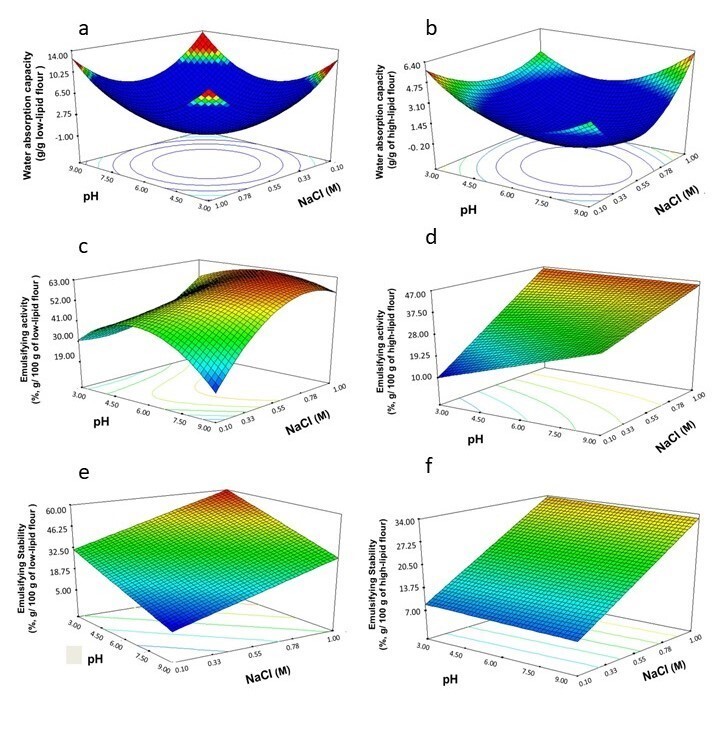
The water absorption capacity (WAC) of flour reflects its ability to retain moisture under certain conditions, such as centrifugation or pressure. WAC is a critical parameter for evaluating the quality of flour and its potential to form viscoelastic doughs, which are essential for various food products. The WAC of flour directly influences its texture, rheological behavior, and final quality (Edema et al., 2005). Figures 1a and 1b present the Response Surface (RS) for the water absorption of low-lipid and high-lipid flour, respectively. Both response surfaces exhibited a similar trend in water absorption, with a minimum observed at intermediate pH and NaCl concentration levels, as reflected by the negative quadratic coefficients in both models (Table 3). However, a significant increase in water absorption was noted at the extremes of both variables, supported by positive linear coefficients (Table 3). Low-lipid flour consistently showed a higher water absorption capacity than high-lipid flour. Both flours showed maximum water absorption at high pH levels, although at different NaCl concentrations. Low-lipid flour showed optimal water absorption at low NaCl concentrations, while high-lipid flour showed maximum water absorption at higher NaCl levels. The models also revealed a negative interaction coefficient (Table 3), suggesting a negative synergy between pH and NaCl concentration, which significantly affects water absorption capacity, particularly in high-lipid flour. According to Yusuf et al. (2008), flour's higher water absorption capacity is related to the presence of polar amino acids in proteins, which have an affinity for water molecules. The walnut flour contains polar amino acids, including aspartate, glutamate, serine, methionine, arginine, cysteine, histidine, lysine, threonine, glycine, and tyrosine (Burbano & Correa, 2021). Furthermore, we can say that the lower lipid content along with the lower NaCl concentration reduces protein-protein interactions while increasing the attraction between protein ions and NaCl ions. This interaction leads to a higher water absorption capacity. Given the essentiality of water retention capacity in a different food product such as broths, noodles, and baked goods, incorporating walnut flour into food processing operations could facilitate increased water addition to dough systems. This suggests its potential utility in the formulation of such products (Chandra et al., 2014).

Response surface for water absorption capacity (g water/g flour), emulsifying activity (EA) and emulsifying stability (ES) (%) of low-lipid flour (a, c, e) and high-lipid (b, d, f) pecan flour.
Emulsifying properties, consisting of emulsifying activity (EA) and emulsifying stability (ES) are essential for forming and maintaining stable emulsions. EA reflects the ability of a protein to reduce the interfacial tension between the oil and water phases, promoting emulsion formation. ES indicates a protein's ability to resist emulsion breakdown under various environmental stresses such as temperature changes, mechanical agitation, or salt presence, influencing the consistency of the interfacial area over time. These properties are critical for developing various food products such as dressings, beverages, and meat emulsions (Ma et al., 2011). The emulsifying properties of walnut proteins are strongly influenced by their isoelectric point, which is approximately at pH 4.5 (Mao & Hua, 2012). Deviation from the isoelectric point, whether by increasing acidity or alkalinity, leads to significant changes in these properties. Low- and high-lipid walnut flours exhibit their lowest emulsifying activity (EA) and emulsion stability (ES) values near the isoelectric point. These properties improve markedly as the pH moves away from this point. The emulsifying activity of low-lipid flour was modeled using a quadratic response surface, incorporating linear, interaction, and quadratic terms. The highest emulsifying activity was observed at intermediate pH and NaCl levels (Figure 1c), as evidenced by a positive interaction coefficient. However, a slight decrease was observed at higher and lower NaCl concentrations, as reflected by a negative linear coefficient (-60.3). Additionally, pH exhibited a negative quadratic effect. In the case of the emulsifying activity of high-lipid flour, the model (Table 3) suggests an inverse relationship between pH and NaCl with a negative interaction coefficient (-4.04). The response surface (Figure 1d) had a significant increase in emulsifying activity with increasing NaCl concentrations, particularly at higher pH levels. Overall, low-lipid flour exhibited superior emulsifying properties compared to high-lipid flour, suggesting a significant influence of lipid content on this functional characteristic. This may be due to the abundant fat content in walnuts; lipids can easily oxidize together with proteins in protein-based emulsions, affecting the stability of emulsions (Mestdagh et al., 2011). The results showed the marked impact of pH and NaCl concentration on the emulsifying activity of both high-lipid and low-lipid flour samples. The models describing the emulsifying stability of low-lipid flour and high-lipid flour were found to be linear concerning pH and NaCl concentration. The linear coefficients (Table 3) show that the concentration of NaCl had a positive effect on stability, while the pH had a negative effect. These findings highlight the critical role of NaCl in stabilizing emulsions formed with both types of flour. Furthermore, low-lipid flour demonstrated superior emulsion stability compared to high-lipid flour, as illustrated in Figure 1e and Figure 1f. The high emulsifying stability of low-lipid flour can enable a hydrophilic-hydrophobic balance of amino acids, and the effective stabilization of water-oil emulsions (Jiménez-Colmenero, 2013). Modifying environmental factors, such as pH and ionic strength, influence the intrinsic structure of proteins, impacting their emulsifying capacity. At acidic pH, gel formation by non-covalent interactions predominates, whereas intermolecular sulfide-disulfide exchange reactions are favored at neutral pH, consequently, emulsifying properties at acidic pH differ from those observed at neutral pH (Pastrana-Pastrana et al., 2025). The emulsifying properties of pecan flour make it a promising ingredient for various food applications, including salad dressings, beverages, and meat analogues (Ma et al., 2011). Improving the emulsifying properties of pecan flour is a research direction to enhance its use as an emulsifier.
4 Conclusions
We investigated the impact of lipid content, pH, and NaCl concentration on the techno-functional properties of walnut flour, focusing on water absorption capacity (WAC) and emulsifying properties. The defatting process significantly altered the flour's properties, with low-lipid flour demonstrating superior WAC and emulsifying activity (EA) and stability (ES) compared to high-lipid flour. The WAC of low-lipid flour was consistently higher across different pH and NaCl concentrations, particularly at high pH and low NaCl levels. Conversely, high-lipid flour required higher NaCl concentrations to reach optimal WAC. The results suggest that low-lipid flour may be more suitable for applications requiring high water retention, such as dough-based products, as its enhanced WAC supports improved texture and moisture retention. Emulsifying properties varied significantly with pH and NaCl concentration. Both flours showed minimum EA and ES near their isoelectric point (pH 4.5) and improved properties at pH levels farther from this point. Low-lipid flour outperformed high-lipid flour in emulsifying properties, particularly at intermediate NaCl concentrations. These results highlight the critical role of NaCl in stabilizing emulsions. Low-lipid flour's superior hydrophilic-hydrophobic balance likely contributes to its better emulsion stability, making it more suitable for dressings, beverages, and meat analogues. Overall, the findings emphasize the importance of lipid content, pH, and NaCl concentration in determining walnut flour's functional performance. This study provides valuable insights for optimizing walnut flour’s incorporation into diverse food systems, addressing its potential to improve water retention and emulsion stability in various applications.
Acknowledgements
The authors acknowledge the contributions of Noyer® for the material supplied. This research was funded by the collaboration of the University National of Entre Ríos. Experiments were funded as part of the project PID 9136.
-
Cite as:
Camera, N. G., Acosta, S., Muchiutti, G. S., & Larrosa, V. J. (2025). Study on techno-functional properties of pecan flour with different lipid content. Brazilian Journal of Food Technology, 28, e2024106. https://doi.org/10.1590/1981-6723.10624
-
Funding:
None.
References
-
Andrés-Bello, A., Barreto-Palacios, V., García-Segovia, P., Mir-Bel, J., & Martínez-Monzó, J. (2013). Effect of pH on color and texture of food products. Food Engineering Reviews, 5(3), 158-170. http://doi.org/10.1007/s12393-013-9067-2
» http://doi.org/10.1007/s12393-013-9067-2 - Association of Official Analysis Chemists – AOAC. (2005). Official methods of analysis (18th ed.). Arlington: AOAC.
-
Atanasov, A. G., Sabharanjak, S. M., Zengin, G., Mollica, A., Szostak, A., Simirgiotis, M., Huminiecki, Ł., Horbanczuk, O. K., Nabavi, S. M., & Mocan, A. (2018). Pecan nuts: A review of reported bioactivities and health effects. Trends in Food Science & Technology, 71, 246-257. http://doi.org/10.1016/j.tifs.2017.10.019
» http://doi.org/10.1016/j.tifs.2017.10.019 -
Berton, B., Scher, J., Villieras, F., & Hardy, J. (2002). Measurement of hydration capacity of wheat flour: Influence of composition and physical characteristics. Powder Technology, 128(2-3), 326-331. http://doi.org/10.1016/S0032-5910(02)00168-7
» http://doi.org/10.1016/S0032-5910(02)00168-7 -
Burbano, J. J., & Correa, M. J. (2021). Composition and physicochemical characterization of walnut flour, a by-product of oil extraction. Plant Foods for Human Nutrition, 76(2), 233-239. PMid:34032954. http://doi.org/10.1007/s11130-021-00898-4
» http://doi.org/10.1007/s11130-021-00898-4 -
Chandra, S., Singh, S., & Kumari, D. (2014). Evaluation of functional properties of composite flours and sensorial attributes of composite flour biscuits. Journal of Food Science and Technology, 52(6), 3681-3688. PMid:26028751. http://doi.org/10.1007/s13197-014-1427-2
» http://doi.org/10.1007/s13197-014-1427-2 - Chaparro, S. P., Gil, J. H., & Aristizabal, I. D. (2011). Efecto de la hidratación y la cocción en las propiedades físicas y funcionales de la harina de vitabosa (Mucuna deeringiana). Vitae, 18(2), 133-143.
- Damodaran, S. (1992). Amino acids, peptides and proteins. In S. Damodaran & K. L. Parkin (Eds.), Fennema’s food chemistry (Chap. 5). Boca Raton: CRC Press.
- Edema, M. O., Sanni, L. O., & Sanni, A. I. (2005). Evaluation of maize-soybean flour blends for sour maize bread production in Nigeria. African Journal of Biotechnology, 4(9), 911-918.
-
Fan, L., Xu, J., Guan, X., Li, R., & Wang, S. (2023). Developing radio frequency pretreatment technology for improving yield and quality of flaxseed oil extractions. Innovative Food Science & Emerging Technologies, 86, 103363. http://doi.org/10.1016/j.ifset.2023.103363
» http://doi.org/10.1016/j.ifset.2023.103363 -
Feng, C. H., Arai, H., & Rodríguez-Pulido, F. J. (2022). Evaluation of pH in sausages stuffed in a modified casing with orange extracts by hyperspectral imaging coupled with response surface methodology. Foods, 11(18), 2797. PMid:36140925. http://doi.org/10.3390/foods11182797
» http://doi.org/10.3390/foods11182797 -
Han, W., Shi, W., Gong, D., & Zhang, G. (2023). Improvement of solubility, emulsification property and stability of potato protein by pH-shifting combined with microwave treatment and interaction with pectin. Food Bioscience, 56, 103301. http://doi.org/10.1016/j.fbio.2023.103301
» http://doi.org/10.1016/j.fbio.2023.103301 -
Jiménez-Colmenero, F. (2013). Potential applications of multiple emulsions in the development of healthy and functional foods. Food Research International, 52(1), 64-74. http://doi.org/10.1016/j.foodres.2013.02.040
» http://doi.org/10.1016/j.foodres.2013.02.040 -
Joshi, A. U., Liu, C., & Sathe, S. K. (2015). Functional properties of select seed flours. Lebensmittel-Wissenschaft + Technologie, 60(1), 325-331. http://doi.org/10.1016/j.lwt.2014.08.038
» http://doi.org/10.1016/j.lwt.2014.08.038 -
Kameník, J., Saláková, A., Vyskočilová, V., Pechová, A., & Haruštiaková, D. (2017). Salt, sodium chloride or sodium? Content and relationship with chemical, instrumental and sensory attributes in cooked meat products. Meat Science, 131, 196-202. PMid:28551463. http://doi.org/10.1016/j.meatsci.2017.05.010
» http://doi.org/10.1016/j.meatsci.2017.05.010 -
Kim, T. K., Yong, H. I., Jung, S., Kim, H. W., & Choi, Y. S. (2021). Effect of reducing sodium chloride based on the sensory properties of meat products and the improvement strategies employed: A review. Journal of Animal Science and Technology, 63(4), 725-739. PMid:34447950. http://doi.org/10.5187/jast.2021.e74
» http://doi.org/10.5187/jast.2021.e74 -
Longtin, M., Price, R. E., Mishra, R., & Breidt, F. (2020). Modeling the buffer capacity of ingredients in salad dressing products. Journal of Food Science, 85(4), 910-917. PMid:32198767. http://doi.org/10.1111/1750-3841.15018
» http://doi.org/10.1111/1750-3841.15018 -
Ma, Z., Boye, J. I., Simpson, B. K., Prasher, S. O., Monpetit, D., & Malcolmson, L. (2011). Thermal processing effects on the functional properties and microstructure of lentil, chickpea, and pea flours. Food Research International, 44(8), 2534-2544. http://doi.org/10.1016/j.foodres.2010.12.017
» http://doi.org/10.1016/j.foodres.2010.12.017 -
Maciel, L. G., Ribeiro, F. L., Teixeira, G. L., Molognoni, L., Santos, J. N., Nunes, I. L., & Block, J. M. (2020). The potential of the pecan nut cake as an ingredient for the food industry. Food Research International, 127, 108718. PMid:31882109. http://doi.org/10.1016/j.foodres.2019.108718
» http://doi.org/10.1016/j.foodres.2019.108718 -
Mao, X., & Hua, Y. (2012). Composition, structure and functional properties of protein concentrates and isolates produced from walnut (Juglans regia L.). International Journal of Molecular Sciences, 13(2), 1561-1581. PMid:22408408. http://doi.org/10.3390/ijms13021561
» http://doi.org/10.3390/ijms13021561 -
Mestdagh, F., Kerkaert, B., Cucu, T., & De Meulenaer, B. (2011). Interaction between whey proteins and lipids during light-induced oxidation. Food Chemistry, 126(3), 1190-1197. http://doi.org/10.1016/j.foodchem.2010.11.170
» http://doi.org/10.1016/j.foodchem.2010.11.170 -
Muchuittia, G. S., Camera, N. G., & Larrosa, V. J. (2023). Analysis of walnut pecan flour (Carya illinoinensis var. Shoshoni) for high-quality dried fruit leather production. Journal of Agricultural, Food Science and Biotechnology, 1(3), 254-261. http://doi.org/10.58985/jafsb.2023.v01i03.30
» http://doi.org/10.58985/jafsb.2023.v01i03.30 - Myers, R. H., Montgomery, D. C., & Anderson-Cook, C. M. (2009), Response surface methodology: Process and product optimization using designed experiments (3rd ed., pp. 353-362). New York: Wiley.
-
Pastrana-Pastrana, Á. J., Flores-Gallegos, A. C., Roa-Acosta, D. F., Rodríguez-Herrera, R., & Solanilla-Duque, J. F. (2025). Rheological behavior of quinoa, lentil, and rice flour mixtures under different pH conditions. Food Hydrocolloids, 158, 110457. http://doi.org/10.1016/j.foodhyd.2024.110457
» http://doi.org/10.1016/j.foodhyd.2024.110457 -
Petit, G., Jury, V., Lamballerie, M., Duranton, F., Pottier, L., & Martin, J. L. (2019). Salt intake from processed meat products: Benefits, risks and evolving practices. Comprehensive Reviews in Food Science and Food Safety, 18(5), 1453-1473. PMid:33336907. http://doi.org/10.1111/1541-4337.12478
» http://doi.org/10.1111/1541-4337.12478 -
Poshadri, A., Deshpande, H. W., Machewad, G. M., Kshirsagar, R. B., Gadhe, K. S., & Kadam, S. D. (2023). Functional properties of selected composite gluten-free pseudocereals flour. Food and Humanity, 1, 1200-1205. http://doi.org/10.1016/j.foohum.2023.09.015
» http://doi.org/10.1016/j.foohum.2023.09.015 -
Sarkis, J. R., Côrrea, A. P. F., Michel, I., Brandeli, A., Tessaro, I. C., & Marczak, L. D. (2014). Evaluation of the phenolic content and antioxidant activity of different seed and nut cakes from the edible oil industry. Journal of the American Oil Chemists’ Society, 91(10), 1773-1782. http://doi.org/10.1007/s11746-014-2514-2
» http://doi.org/10.1007/s11746-014-2514-2 -
Sharma, S. K., Bansal, S., Mangal, M., Dixit, A. K., Gupta, R. K., & Mangal, A. K. (2016). Utilization of food processing by-products as dietary, functional, and novel fiber: A review. Critical Reviews in Food Science and Nutrition, 56(10), 1647-1661. PMid:25748244. http://doi.org/10.1080/10408398.2013.794327
» http://doi.org/10.1080/10408398.2013.794327 -
Sun, R., Vermeulen, A., Wieme, A. D., Vandamme, P., & Devlieghere, F. (2021). Identification and characterization of acid-tolerant spore-forming spoilage bacteria from acidified and low-acid pasteurized sauces. Lebensmittel-Wissenschaft + Technologie, 152, 112378. http://doi.org/10.1016/j.lwt.2021.112378
» http://doi.org/10.1016/j.lwt.2021.112378 -
Tahmasebi, M., Labbafi, M., Emam-Djomeh, Z., & Yarmand, M. S. (2016). Manufacturing the novel sausages with reduced quantity of meat and fat: The product development, formulation optimization, emulsion stability and textural characterization. Lebensmittel-Wissenschaft + Technologie, 68, 76-84. http://doi.org/10.1016/j.lwt.2015.12.011
» http://doi.org/10.1016/j.lwt.2015.12.011 -
Turan, D., Capanoglu, E., & Altay, F. (2015). In vestigating the effect of roasting on functional properties of defatted hazelnut flour by response surface methodology (RSM). Lebensmittel-Wissenschaft + Technologie, 63(1), 758-765. http://doi.org/10.1016/j.lwt.2015.03.061
» http://doi.org/10.1016/j.lwt.2015.03.061 -
Vanhanen, L. P., & Savage, G. P. (2006). The use of peroxide value as a measure of quality for walnut flour stored at five different temperatures using three different types of packaging. Food Chemistry, 99(1), 64-69. http://doi.org/10.1016/j.foodchem.2005.07.020
» http://doi.org/10.1016/j.foodchem.2005.07.020 -
Xu, J., Zhang, H., Deng, M., Guo, H., Cui, L., Liu, Z., & Xu, J. (2024). Formation mechanism of quinoa protein hydrolysate-EGCG complexes at different pH conditions and its effect on the protein hydrolysate-lipid co-oxidation in emulsions. Food Research International, 186, 114365. PMid:38729700. http://doi.org/10.1016/j.foodres.2024.114365
» http://doi.org/10.1016/j.foodres.2024.114365 -
Yusuf, A. A., Ayedun, H., & Sanni, L. O. (2008). Chemical composition and functional properties of raw and roasted Nigerian benniseed (Sesamum indicum) and bambara groundnut (Vigna subterranean). Food Chemistry, 111(2), 277-282. PMid:26047423. http://doi.org/10.1016/j.foodchem.2007.12.014
» http://doi.org/10.1016/j.foodchem.2007.12.014 -
Zhang, F., Zhu, F., Chen, B., Su, E., Chen, Y., & Cao, F. (2022). Composition, bioactive substances, extraction technologies and the influences on characteristics of Camellia oleifera oil: A review. Food Research International, 156, 111159. PMid:35651025. http://doi.org/10.1016/j.foodres.2022.111159
» http://doi.org/10.1016/j.foodres.2022.111159 -
Zhang, Y., & Sun, S. (2023). Tiger nut (Cyperus esculentus L.) oil: A review of bioactive compounds, extraction technologies, potential hazards and applications. Food Chemistry: X, 19, 100868. http://doi.org/10.1016/j.fochx.2023.100868
» http://doi.org/10.1016/j.fochx.2023.100868
Edited by
-
Associate Editor:
Marney Pascoli Cereda.