 Denaturation kinetics and processing of cream cheese substitute coagulated with lemon juice
Abstract
The objective of this study was to evaluate the kinetics of denaturation of milk proteins at different temperatures of 80 °C and 85 °C, using lemon juice as a coagulating agent. Subsequently, we develop a cream cheese substitute and analyze its rheological, physicochemical, and sensory properties in comparison with commercial cream cheese. The results indicated that a higher reaction rate constant (K) and a higher yield were obtained at 85 °C. For the preparation of the cream cheese substitute, three formulations were developed, differentiated by the type of hydrocolloids: M1 (0.11% guar gum, 0.11% xanthan gum, and 0.11% carob gum), M2 (0.165% guar gum and 0.165% xanthan gum), and M3 (0.165% guar gum and 0.165% carob gum). Samples M1, M2, and M3 presented a pseudoplastic fluid, while the Control sample presented a fluid closer to Newtonian, both with elastic behavior. At the physicochemical level, the M3 cream cheese substitute showed higher protein content and lower fat and moisture content than the commercial cream cheese. In the sensory analysis, the M3 sample showed greater perception of acidity, while the commercial cheese stood out in creaminess and spreadability, obtaining greater acceptance. The differences observed between the two products may be influenced by the composition of the milk used, affecting the structure and stability of the cream cheese.
KEYWORDS:
Fat; Hydrocolloids; Protein; Pseudoplastic; Rheology; Sensory
Highlights
Temperature and pH influenced protein denaturation and curd yield
Lemon juice and hydrocolloids improved the rheology of the cream cheese substitute
Milk composition affected the physicochemical and sensory properties of the cheese
1 Introduction
Milk is one of the most complete and versatile foods, widely used in the production of dairy products (Lajnaf et al., 2023). Its composition includes: fat 3.2 g/100 g, non-fat solids of 8.2 g/100 g, total solids 11.4 g/100 g, density between 1.0296-1.0340 g/ml, and acidity 0.13 to 0.17 g/100 g. Influenced by factors such as cattle breed, feed, and climate of the region (Ramírez-Rivera et al., 2021). In the last year, fresh milk production at the national level in Peru reached 2,230 thousand tons, with the Puno region, located in the southeast of the country in the Andean highlands, contributing 6.07% of the total, equivalent to 135,361 thousand tons (Instituto Nacional de Estadística e Informática, 2025).
Cream cheese is classified as a fresh, soft, spreadable, unripened cheese without rind (CODEX STAN 275, 1973) and pH between 4.5 and 4.8, product of acidification induced by lactic acid bacteria (Brighenti et al., 2020; Junaid et al., 2024). Its processing involves stages such as pasteurization, normalization of fat content, acidification, coagulation, and whey separation (Brighenti et al., 2020; González et al., 2022; Kim et al., 2022). The high proportion of fat is fundamental to achieving its creamy texture and distinctive sensory profile.
In the coagulation process, considered a crucial step in cheese manufacturing, caseins (αs1-casein, αs2-casein, β-casein, and κ-casein) and soluble milk proteins (β-lactoglobulin and α-lactoalbumin) interact to form curd, although whey proteins are often lost in the whey. Several approaches have been proposed to improve their recovery in the final product (Giroux et al., 2020; Nicosia et al., 2022). Conventionally, coagulation is performed by the rennet addition, acidification, or a combination of both, with chymosin being the most commonly used coagulant. However, the growing interest in sustainable technologies has driven the search for plant-based coagulants as functional alternatives to commercial rennet, due to their accessibility and lower environmental impact (Gutiérrez Méndez et al., 2019; Tarapata et al., 2021).
In this context, lemon juice, rich in citric acid (pH between 2.16 and 3.04), has been investigated for its ability to induce lactic coagulation by precipitating caseins (Martínez-Nicolas et al., 2022; Mejia Lopez et al., 2017; Rodríguez et al., 2020). Unlike chymosin, it represents a natural and functional alternative, with favorable sensory and nutritional properties. Moreover, its application becomes particularly relevant in rural or small-scale contexts, where access to industrial coagulants may be limited. Previous studies have shown that its use improves the physicochemical and sensory characteristics of fresh cheeses such as Wara in West Africa and Warankashi soft cheese, in addition to positively affecting their rheological properties, thanks to the interaction of citric acid with milk proteins (Heiru, 2021; Hussein et al., 2016; Kelleher et al., 2020; Nicosia et al., 2022).
High temperature heat treatment (UHT) also plays a key role in the quality of fermented dairy products, such as yogurt, cream cheese, or thermos quark. This process induces the denaturation of whey proteins, in particular of β-lactoglobulin, which allows its covalent interaction with k-casein on the surface of casein micelles, promoting a more cohesive protein network (Gutiérrez Méndez et al., 2019). This structure favors acid-induced co-gelation and results in firmer, more viscous, stable matrices with less syneresis (Freire et al., 2022; Guinee, 2021). In products made from heat-treated milk, the yield is usually higher due to the retention of moisture and whey proteins, especially when working at temperatures above 75 °C (Giroux et al., 2020).
The objective of this research is to evaluate the kinetics of milk protein denaturation at different temperatures using lemon juice as a coagulating agent. Subsequently, we will develop a cream cheese substitute and analyze its rheological, physicochemical, and sensory properties in comparison with a commercial cream cheese.
2 Materials and methods
The raw milk was collected from the livestock farm of the Universidad Peruana Unión, Campus Juliaca, (UTM 19S zone; east: 372718.372 and north: 8284240.409), located at 4,029 m.a.s.l., from dairy cattle of the Holstein, Brown Swiss, Kiwi cross, and Jersey breeds included (food grade citric acid and sodium bicarbonate (Jacmil Distribuciones S.R.L.)).
The ingredients used were: milk cream (Supermercados Peruanos S.A.), lactic acid bacteria: mesophilic (LYOFAST MW 039 S 5UC, Lactococcus lactis subsp. lactis, Sacco System, Linros S.R.L.) and thermophilic (LYOFAST Y 456 B, Streptococcus thermophilus, Sacco System, Linros S.R.L.), table salt (Supermercados Peruanos S.A.), sodium nitrate SIN 251 (Jacmil Distribuciones S.R.L.), and commercial hydrocolloids: Xanthan gum SIN 415, Guar gum SIN 412, and Carob gum E 410 (Polifood S.A.).
2.1 Kinetics of denaturation of milk proteins
Lemon juice (Citrus limon) was obtained using a manual stainless steel lemon squeezer (Facusa®, Supermercados Peruanos S.A.). The juice was filtered through a 10 cm diameter stainless steel fine mesh strainer (Ilko®, Supermercados Peruanos S.A.) to eliminate solid residues. The pH of 30mL of freshly squeezed juice was measured using a digital potentiometer with pH sensor (pH-BTA, Vernier Science Education, USA), with data viewer (LabQuest LQ-VIEW-E. USA), following the AOAC method (AOAC 981.12, 1982).
For pH normalization of lemon juice, 10% (w/v) citric acid and sodium bicarbonate solutions were prepared by dissolving 10g of each compound in distilled water and adjusting the final volume to 100ml, according to the procedure described by Pasgall Urra (2016). Once the pH of both solutions was determined, the pH of the lemon juice was normalized to 2.26 in a 30mL sample by controlled addition of these compounds, using Equations 1 and 2 described by Pasgall Urra (2016). The pH is normalized to 2.26 because, depending on the degree of physiological maturity, fruits can present variations in their natural acidity, which could affect the reproducibility of the process. The pH value mentioned was studied as a reference for the precipitation of serum proteins during acid coagulation.
For the protein denaturation kinetics, fresh milk was heated at temperatures of 80 °C and 85 °C. Once the desired temperature was reached, the standardized lemon juice was added using a volumetric pipette, maintaining a constant addition of 25 drops (≈ 1.25 mL) every 25 seconds. In parallel, 15mL aliquots of the mixture were extracted at defined intervals, deposited in 50mL beakers in which the pH was immediately determined using a previously calibrated potentiometer. The procedure continued until the coagulation of the caseins was visually evidenced and was carried out in duplicate.
The experimental data were fitted to kinetic models of order 0, 1, and 2 by nonlinear regression using Equations 3, 4, and 5:
where is the initial pH, k is the rate constant and t is the time in . The optimal model was selected using the coefficient of determination . The independent variables were temperature and time, while the response variables included the rate constant (K) and product yield.
The dependence of the velocity constant (K) on temperature was modeled by the Arrhenius Equation 6 mentioned by Mercatante et al. (2021):
where is the exponential factor, is the activation energy, is the universal gas constant (8.3124 KJ/mol), and T is the absolute temperature (°K). The values of the rate constant (K), for each temperature and each kinetic were obtained from Equations 3, 4, and 5, so it is possible to find the other parameters of the Arrhenius Equation.
The yield of samples obtained at the two temperatures evaluated (80 °C and 85 °C) was calculated using Equation 7, as mentioned by Villegas-Soto et al. (2017):
where Rq is the yield (%), Mq is the quantity of cheese obtained, and Ml is the quantity of milk used.
2.2 Elaboration of cream cheese substitute with acid coagulation by lemon juice
The preparation of the cream cheese coagulated with lemon juice was carried out in the Food Science and Technology Laboratory (CITAL) of the Universidad Peruana Unión, Juliaca campus. The raw milk used was obtained from dairy cattle of the Holstein, Brown Swiss, Kiwi cross, and Jersey breeds from the cattle farm on the university campus, which generated variability in its composition.
Two liters of raw milk per treatment were used, which was characterized by ultrasonic spectroscopy (Lactoscan S-50, Milkotronic, Bulgaria) (Zebib et al., 2023), obtaining the data in Table 1.
Raw milk was heated to 65 °C at a speed of 0.5 rpm in a Thermomix® TM6 machine (Vorwerk, USA), and fat was normalized to 12% using heavy cream, using mass balance Equation 8 (Dincer & Zamfirescu, 2018).
where and correspond to the amount and percentage of raw milk fat, while ( and ) represent the amount and percentage of milk cream fat. Final quantity and its target concentration (12%) were determined from this balance.
The standardized mixture was pasteurized at 72 °C for 15 seconds at a speed of 0.5 rpm in the same equipment and then cooled to 35 °C in 1L beakers. Subsequently, 40mL/L of freeze-dried mesophilic cultures (LYOFAST MW 039 S 5UC, Lactococcus lactis ssp. Cremoris, Lactococcus lactis ssp. lactis biovar diacetylactis, Sacco System, Linros S.R.L.) and 5mL/L thermophilic culture (LYOFAST Y 456 B, Lactobacillus delbrueckii ssp. bulgaricus Streptococcus thermophilus, Sacco System, Linros S.R.L.). Fermentation was controlled in an incubator (BINDER, Germany) at a temperature of 35 °C, ± 0.2 °C for 7 to 8 hours until a pH of 4.8 was reached, measured with a YY-1030 digital pH meter (accuracy ± 0.01).
The fermented sample was subjected to heat treatment at 85 °C for 2 minutes at a speed of 0.5 rpm in the Thermomix® TM6 equipment (Vorwerk, USA), then acid coagulation was performed by adding 20mL/L of lemon juice (Citrus limon) filtered and neutralized at pH 2.26. The curd was rested for 30 minutes in 1L beakers. It was then drained using a 12cm diameter stainless steel strainer (Facusa, Supermercado Peruano S.A), then homogenized at 75 °C for 30 minutes at a speed of 1rpm using the Thermomix® TM6 (Vorwerk, USA), where hydrocolloids (Guar Gum, Xanthan Gum and Carob Gum), table salt and sodium nitrate were added, according to the formulation in Table 2.
Finally, the product was packaged in high-density polyethylene (HDPE, food grade) containers and stored at 5 °C ± 1 °C in an LG refrigerator (LB41BPP, South Korea) until further analysis (Adapted from Brighenti et al., 2020; Gutiérrez Méndez et al., 2019).
2.3 Rheological analysis
Rheological tests on cream cheese samples were performed using an MRC 72 rheometer (Anton Paar, Austria), equipped with a parallel plate system (PP50) and a 2-mm gap. Each sample was run in duplicate at temperatures 5 °C, 10 °C, and 22 °C; flow curves were obtained with a shear rate between 〖0.01 to 1 s] ^(-1), on an increasing ramp (Amaral et al., 2022). The data obtained were modeled using the Herschel-Bulkley Equation 9 (Sun et al., 2024).
where σ is the shear stress (Pa), is the threshold stress (Pa), “K” is the consistency coefficient and “n” is the flow behavior index (dimensionless).
For the oscillatory tests, deformation tests were initially performed to determine the linear viscoelastic region (0.01% to 200%) at a fixed frequency of 1 Hz. Frequency sweeps were determined within the linear viscoelastic region, 0.03% to 0.08% at a frequency of 1 to 100.
The values of the storage modulus (G′), loss modulus (G”), and phase angle (σ) were obtained from the RVL (Linear Viscoelastic Region) observed during the deformation sweeps. The loss tangent (tan σ), which represents the dimensionless ratio , was also included in the results (Gutiérrez-Méndez et al., 2019).
2.4 Physicochemical analysis
The physicochemical analyses of the cream cheese were performed in triplicate following the methodologies established in the Peruvian Technical Standard (NTP). The variables analyzed were fat content, determined by the Rose-Gottlieb method according to NTP 202.126:1998 (Revised in 2014) (Instituto Nacional de Calidad, 1998a); protein, quantified using the Kjeldahl method, in according with NTP 202.119:1998 (revised in 2014) (Instituto Nacional de Calidad, 1998b); moisture, evaluated by the rapid method for cheese according to NTP 202. 149:1998 (Revised in 2014) (Instituto Nacional de Calidad, 1998c); pH, measured with a portable digital potentiometer model YY-1030, previously calibrated at pH 4.00 and 7.00 according to (NMX-F-317-S, 1978) (Estados Unidos Mexicanos, 1978); ash, determined according to NTP 202.126:1998 (Revised in 2014) (Instituto Nacional de Calidad, 1998a); and carbohydrates, calculated by difference from Equation 10:
2.5 Sensory analysis
Sensory analysis was performed using the Check-All-That-Apply (CATA) method, a technique widely used in sensory characterization with trained panelists, maximizing the acceptance of new products in the market, especially when variations in composition or processing are introduced (Llobell et al., 2019).
Two samples of cream cheese (commercial and experimental) were evaluated with 120 untrained participants from the Universidad Peruana Unión, Juliaca branch. The test was carried out in individual booths with standardized lighting. The refrigerated samples (20 g) were presented in plastic containers with random coding and disposable spoons with mineral water and water crackers for rinsing and texture evaluation.
A total of 12 sensory attributes were analyzed, grouped into the categories of color (white, light yellow), appearance (smooth), aroma (rancid, fermented, lactic), flavor (sour, sweet, bitter, sour, salty, savory, savory, mild flavor) and texture (creamy, sandy, sticky, melted, spreadable and buttery) (Foguel et al., 2021). Acceptability was evaluated with a 9-point scale (1 = “I don't like it”, 5 = “I neither like nor dislike it”, 9 = “I like it very much”).
2.6 Statistical analysis
Data were expressed as means ± deviations. Significant differences between means (p ≤ 0.05) were determined by analysis of variance (ANOVA) followed by the Tukey comparison test. Statgraphics 19 software was used for statistical analysis.
3. Results and discussion
3.1 Kinetics of denaturation of milk proteins
Table 3 shows the values of the coefficient of determination obtained for the reaction models of order 0, 1, and 2 in the kinetics of denaturation of milk proteins using lemon juice as a coagulating agent at temperatures of 80 °C and 85 °C. These values reflect the degree of fit of each model to the experimental data, enabling the identification of the equation that best describes the loss of protein structural stability as a function of time.
Coefficient of determination of protein denaturation kinetics in milk coagulated with lemon juice at 80 °C and 85 °C (mean ± standard deviation).
At 80 °C, the values show a homogeneous trend among the three models, with the first-order model obtaining the highest fit , followed by Order 2 , and the Order 0 model , the similarity in these values suggests that protein denaturation at this temperature follows a well-defined pattern, with a slight preference for the Order 1 model.
At 85 °C, a larger scatter in the values is observed, indicating greater complexity in the denaturation process. Although the Order 1 model still presents the best fit , the Order 2 model also shows a high correlation, while the Order 0 model presents the lowest fit .
The values of (K) obtained by fitting the Arrhenius model were at 80 °C and for 85 °C, confirming an increase in reaction rate with increasing temperature. Previous studies have shown significantly higher values, such as Mercatante et al. (2021), who obtained at 80 °C and at 90 °C, suggesting a higher denaturation rate under experimental conditions.
The activation energy obtained in this study at 11.59 KJ/mol is considerably lower than that reported by Mercatante et al. (2021) at 60.03 KJ/mol, indicating that protein denaturation in the presence of citric acid requires less energy to initiate. This effect is due to the neutralization of electrostatic repulsions between K-casein micelles, promoting micellar aggregation and the formation of semisolids by acid-thermal coagulation (Veracruz et al., 2023). Similar results have been reported in dairy systems subjected to heat stress, where the combination of temperature and acid pH accelerates protein denaturation (Diaz-Bustamante et al., 2023).
Regarding protein degradation, αS1-casein showed high thermal sensitivity (Abbring et al., 2020; Guinee, 2021). This is due to its flexible structure and lower number of disulfide bonds, which makes it susceptible to heat denaturation. In contrast, whey proteins present a more stable globular conformation; β-Lactoglobulin, in particular, has two disulfide bonds and a compact structure that requires higher temperatures for opening, as mentioned by Ong et al. (2020).
Regarding whey proteins, α-lactalbumin (α-LA) denatures at 65 °C, while β-lactoglobulin (β-LG) showed greater stability, requiring temperatures ≥72 °C according to investigations by Ong et al. (2020) and Pan et al. (2022). However, in acidic media, β-LG increases its thermal resistance, going from a denaturation temperature of 71 °C at pH 8.6 to 85 °C at pH 3 (Boye et al., 1997; Diaz-Bustamante et al., 2023). When whey proteins denature, their hydrophobic groups are exposed, leading to interactions with each other, forming aggregates or binding to casein micelles through irreversible disulfide bonds (Freire et al., 2022).
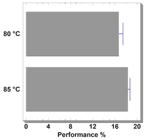
The effect of lemon juice as a coagulant was reflected in curd yield, which increased from 16.154% at 80 °C to 18.067% at 85 °C, evidencing an increase of 1.913% with temperature Figure 1. This result agrees with previous studies reporting improved solids retention at elevated temperatures in the presence of citric acid (Mejia Lopez et al., 2017; Veracruz et al., 2023). The combination of temperature and acidification favors whey protein denaturation, improving solids retention in the structural matrix of the product.
Finally, several studies have pointed out that cheese yield is highly correlated with milk composition, particularly with its fat and protein (casein) content (Bittante et al., 2021; Cecchinato et al., 2015). In this study, heating above 75 °C and the addition of lemon juice promoted protein retention in the curd, which is consistent with previous reports on yield optimization in fresh cheeses by thermal treatments and controlled acidification (Veracruz et al., 2023). These findings suggest that the combination of elevated temperatures and natural acidifying agents is an effective strategy to improve the functionality and structural stability of cream cheese.
3.2 Rheological properties
Figure 2 shows the flow curves of the cream cheese substitute at (5 °C, 10 °C, and 22 °C) compared to the Control sample. At 5 °C, samples M1, M2, and M3 exhibit a more pronounced pseudoplastic behavior, characterized by a decrease in viscosity with increasing shear rate. In contrast, the Control sample approaches Newtonian behavior, this difference suggesting weaker molecular interactions within its protein structure.
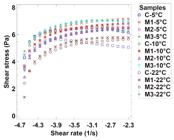
The higher pseudoplasticity of the formulated samples could be attributed to the resistance of the protein network to progressive deformation, generating a strain hardening effect (Digvijay et al., 2025). In addition, Lee et al. (2004) mentioned that products with lower moisture content tend to be firmer, while the reduction of gel firmness occurs when the moisture content is higher.
As the temperature increases to 10 °C, a progressive decrease in the viscosity of samples M1, M2, and M3 is observed, indicating a reduction of intermolecular interactions and greater ease of flow. However, the Control sample maintains a close behavior to Newtonian fluid, with a less marked decrease in viscosity compared to the other samples.
Finally, at 22 °C, all samples show a significant reduction in viscosity, indicating temperature dependence in the rheological behavior of cream cheese. The decrease in shear stress with increasing temperature suggests a reduction in the cohesion of the protein matrix, facilitating the fluidity of the product. This behavior agrees with previous studies indicating the influence of moisture, fat, protein, and hydrocolloid content on the viscoelastic properties of the product (Bayarri et al., 2012).
The results show that the temperature and sample composition significantly influence the consistency index (K) of cream cheese (Table 4). At temperatures of 5 °C and 10 °C, K values are higher, indicating greater resistance to flow, while at 22 °C, a considerable decrease is observed, indicating viscosity reduction with increasing temperature. This behavior is characteristic of protein matrices with high moisture and fat content (Fuentes et al., 2016; Talens Oliag et al., 2009).
Effect of temperature and type of sample on the consistency index (K) of cream cheese (mean ± standard deviation).
The Tukey test (p ≤ 0.05) confirms the significant differences between samples. The M1 and M2 formulations present higher values of K, indicating a higher resistance to flow, while the Control sample maintains lower values at all temperatures. On the other hand, sample M3, containing GG and GA, presents a behavior more similar to the Control sample, although with significant differences.
The inclusion of galactomannans in the milk matrix has been reported as a key factor in modifying the viscosity and viscoelastic properties of cream cheese, since these polysaccharides form interlaced networks that modify the viscosity and structural stability of the product (Brighenti et al., 2020).
The threshold stress of the Control sample is higher compared to the lemon juice-treated samples. At 5 °C and 10°C, it shows a higher initial resistance to flow due to its more stable protein structure. However, at 22 °C, the threshold stress decreases considerably, indicating less cohesion of the protein matrix with increasing temperature. Previous studies have reported that moisture content, fat, and protein interactions influence the threshold stress (Ben Amira et al., 2017; Kim et al., 2022).
The values of tan (δ), G”/G’, allow the viscoelastic behavior to be interpreted. Values of tan (δ) < 1 indicate a predominantly elastic component, while tan (δ) >1 suggests a more viscous behavior.
Rheological characterization of cream cheeses has shown that G' values decrease with increasing temperature, indicating a loss of structural rigidity and an increase in fluidity (Brighenti et al., 2008). In this study, the results in Table 5 showed that the control sample presented a predominantly elastic behavior at 5 °C and 10 °C, evidenced by G' values higher than G”, suggesting a solid and stable structure at low temperatures. However, at 22 °C, the samples experienced a transition towards viscoelastic behavior, reflected in a decrease in G' and a relative increase in fluidity, similar to the whole cream cheeses and Neufchatel reported by Brighenti et al. (2008).
Effect of temperature and sample type on G' (storage modulus), G” (loss modulus), and tan (δ) of cream cheese (mean ± standard deviation).
Sample M3 was the most similar to the control, maintaining an adequate rheological profile at low temperatures, while samples M1 and M2 presented fewer stable structures, possibly due to differences in the formation of the protein network, which happens in cheeses with the use of vegetable coagulants as mentioned (Gutiérrez-Méndez et al., 2019).
Factors such as milk pH and coagulant, as well as heat treatment, can significantly influence the viscoelastic properties of cream cheeses (Ben Amira et al., 2017). In addition, the protein-fat interaction, identified as a key factor in the structure of cream cheese (Kim, et al., 2022), as well as the use of hydrocolloids (Zhao et al., 2023), could explain the better stability of the M3 sample, positioning it as a promising alternative to control under refrigerated conditions, consistent with what was reported by (Wang et al., 2025) on the decrease of G' with increasing temperature.
3.3 Physicochemical characteristics
The selection of M3 for this analysis was justified by its similarity to the control in the rheological analysis, showing comparable viscoelastic behavior at low temperatures.
The comparative physicochemical analysis between the Control sample and the cream cheese substitute M3, obtained by acid coagulation with lemon juice, showed significant differences in several parameters, as shown in Table 6, highlighting the impact of the coagulation technique on the final composition. The acid pH (4.67) observed in the M3 sample is consistent with that reported for cheeses made with natural acids, where pH influences the water retention capacity and the stability of the protein matrix.
Comparison of physicochemical parameters between commercial cream cheese and cream cheese substitute obtained by acid coagulation with lemon juice (mean ± standard deviation).
The comparative physicochemical analysis between the Control sample and the cream cheese substitute M3, obtained by acid coagulation with lemon juice, showed significant differences in several parameters, as shown in Table 6, highlighting the impact of the coagulation technique on the final composition. The acid pH (4.67) observed in the M3 sample is consistent with that reported for cheeses made with natural acids, where pH influences the water retention capacity and the stability of the protein matrix.
The cream cheese had an acidic pH, low moisture, and moderate fat and protein content. These characteristics are typical of cream cheeses made with natural acids (Ong et al., 2020). The lower moisture content (46.66 ± 0.08%) in sample M3 was lower than the limit established for commercial cream cheeses (<55%), which may be attributed to the effect of lemon juice as a coagulating agent. This lower free water availability suggests a higher resistance to microbial growth, although microbiological analysis during storage is recommended to confirm this stability. In comparison, previous studies on African fresh cheeses such as Wara (46.64 ± 2.56%) and Warankashi (45.12 ± 0.28%) showed similar moisture values (Heiru, 2021; Hussein et al., 2016), reinforcing the influence of citric acid in reducing water content. The observed differences could be due to variation in lemon juice concentration, treatment temperature, and composition of the milk used (Kim et al., 2022).
The significantly higher protein content in the M3 sample (14.90% ± 0.04%) was significantly higher than that reported in Warankashi (13.90% ± 0.11%), and comparable to Wara (15.53% ± 1.16%) (Heiru, 2021; Hussein et al., 2016). This higher protein retention can be explained by coagulation at 85 °C, a temperature that favors the denaturation of whey proteins such as β-lactoglobulins, allowing their interaction with caseins to form a denser gelled network (Freire et al., 2022; Giroux et al., 2020). Additionally, the presence of mineral salts from lemon juice can enhance these interactions, as described in recent studies on protein gelation (Junaid et al., 2024). These conditions are especially beneficial in low-fat formulations, as they contribute to improving the structural firmness and acceptability of the product.
On the other hand, the fat content in the M3 sample (11.32% ± 0.08%) was lower than the minimum value required for commercial cream cheeses (> 33%), which could influence the texture and creaminess of the product. Compared to Warankashi (13.90% ± 0.11%) (Hussein et al., 2016), the difference could be associated with both dilution of the fat content by higher moisture and variability in the milk used and the acid concentration applied. The higher ash content (1.65% ± 0.03%) in the M3 sample suggests a higher mineral concentration, possibly derived from lemon juice, contributing to the ionic stability of the gel (Heiru, 2021). In addition, the high total carbohydrate content (25.48% ± 0.23%) could impact the organoleptic properties, providing a sweeter sensory perception.
The higher carbohydrate content in sample M3 can be attributed to the formulation of this sample (Ramírez-navas, 2025), such as the hydrocolloids guar gum and carob gum. These compounds, classified as galactomannans, are polysaccharides composed of mannose and galactose units, so they are part of the complex carbohydrate fraction (Brighenti et al., 2020). Although they are used in low concentrations, their incorporation can slightly increase the total carbohydrate content. These hydrocolloids are commonly used in reduced-fat foods that require the use of stabilizers of carbohydrate origin to maintain the texture and stability of the product (Zhao et al., 2023).
Overall, these results highlight the potential of lemon juice as an alternative coagulant in the production of functional cream cheeses, highlighting its effects on nutrient retention, structural stability, and potential shelf life.
3.4 Sensory properties
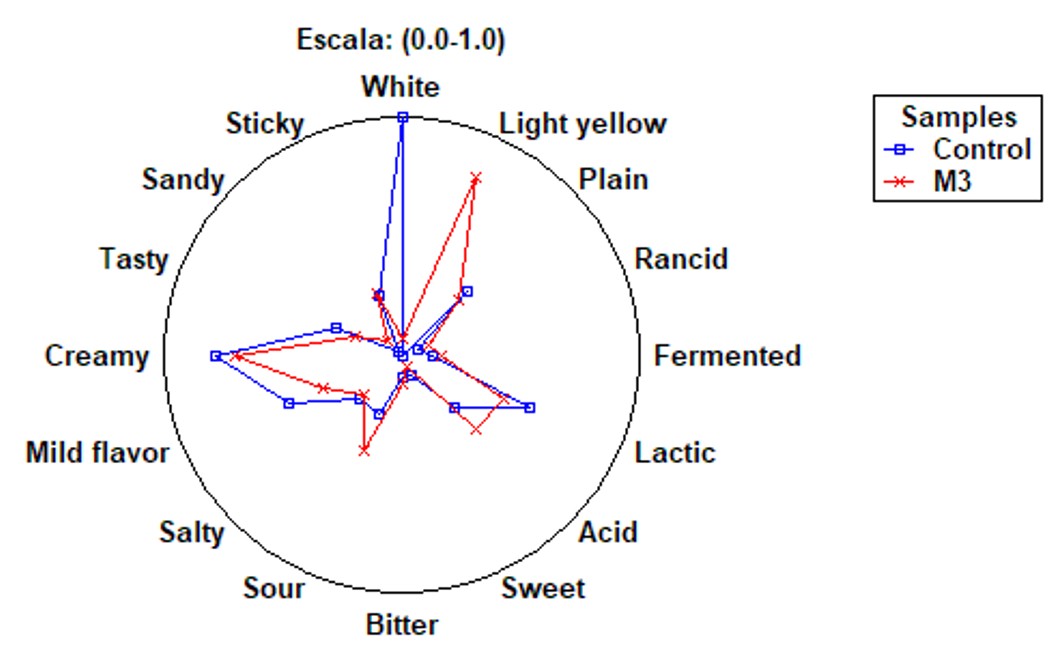
In the comparative sensory analysis between commercial cream cheese (CONTROL) and sample M3, carried out using the CATA method with 120 untrained panelists (Figure 3), perceived differences were observed in color, texture, and flavor profile. Commercial cream cheese scored higher in attributes such as creaminess, spreadability, buttery texture, and consistent lactic flavor due to its higher fat content, which contributes to a smoother mouthfeel and better dispersion of flavor compounds (González et al., 2022).
Comparison of sensory attributes obtained by CATA analysis between commercial cream cheese and cream cheese substitute made by acid coagulation with lemon juice.
The M3 cream cheese substitute, obtained by acid coagulation with lemon juice, presented a higher perception of attributes such as buttery texture, acidity, and sourness, attributed to its lower fat content, which increases the firmness of the product (Llobell et al., 2019). Fat reduction, although it may affect sensory perception, also responds to a growing demand for low-fat products, as protein is an essential component in maintaining cheese structure and stability (Junaid et al., 2024).
The comparative analysis Figure 4 highlighted that, although the Control sample was preferred for its balanced sensory profile, the M3 sample gained considerable acceptance, suggesting that untrained panelists positively valued its characteristic acid profile, similar to what has been reported in cheeses made with vegetable coagulants, where milk composition and coagulant type influence sensory properties (Ben Amira et al., 2017).

Comparative analysis of the degree of acceptance of commercial cream cheese and cream cheese substitute obtained by acid coagulation with lemon juice
This indicates that cream cheeses were influenced in their sensory perception by their physicochemical composition, especially their fat, protein, carbohydrate, and moisture content, factors that directly affect texture and mouthfeel (Bayarri et al., 2012). In addition, the role of fat as a vehicle for flavor compounds is crucial, and its reduction in the M3 sample may have contributed to a more intense perception of certain attributes, such as acidity (Llobell et al., 2019).
4 Conclusion
The study of protein denaturation kinetics with lemon juice allowed the identification of the temperature ranges that affect the structural stability of the main milk proteins, providing key information to optimize the coagulation process and product yield.
The M3 cream cheese substitute, formulated with guar gum and carob gum, showed greater similarity with the rheological properties of commercial cream cheese, with an elastic behavior, although with marked compositional differences, such as higher protein content and lower fat content. These differences influenced both texture and sensory acceptance, where the commercial product maintained a perceptual advantage attributed to its creaminess and composition.
Overall, lemon juice, like other acidulants, serves to coagulate serum proteins. It is also readily available, naturally sourced, and capable of accelerating the coagulation process, contributing to greater operational efficiency. The findings of this research provide scientific evidence on the viability of lemon juice as a natural coagulant, offering an alternative approach to conventional methods. In addition, the kinetic analysis applied is a useful tool for the thermal optimization of the process, representing a significant contribution to the development of sustainable and functional technologies in the dairy industry.
Acknowledgements
The authors would like to thank the Universidad Nacional del Altiplano - Escuela Profesional de Ingeniería Agroindustrial, the Universidad Peruana Unión Sede - Juliaca, and the laboratories Lácteos and Cital for their support in the execution of this study.
Data Availability Statement
All data generated or analyzed in this study are included in this published article.
-
Cite as:
Castro, R. A. S., Barriga, R. E. O., Choque, E. C., & Prieto, J. M. (2025). Denaturation kinetics and processing of cream cheese substitute coagulated with lemon juice. Brazilian Journal of Food Technology, 28, e2025027. https://doi.org/10.1590/1981-6723.2725.
-
Funding:
None.
References
-
Abbring, S., Xiong, L., Diks, M. A. P., Baars, T., Garssen, J., Hettinga, K., & Van Esch, B. C. A. M. (2020). Loss of allergy-protective capacity of raw cow’s milk after heat treatment coincides with loss of immunologically active whey proteins. Food & Function, 11(6), 4982-4993. PMid:32515464. http://doi.org/10.1039/D0FO01175D
» http://doi.org/10.1039/D0FO01175D -
Amaral, J. B. S., Grisi, C. V. B., Vieira, E. A., Ferreira, P. S., Rodrigues, C. G., Diniz, N. C. M., Vieira, P. P. F., Santos, N. A., Gonçalves, M. C., Braga, A. L. M., & Cordeiro, A. M. T. de M. (2022). Light cream cheese spread of goat milk enriched with phytosterols: Physicochemical, rheological, and microbiological characterization. Lebensmittel-Wissenschaft + Technologie, 157, 113103. http://doi.org/10.1016/j.lwt.2022.113103
» http://doi.org/10.1016/j.lwt.2022.113103 -
Bayarri, S., Carbonell, I., & Costell, E. (2012). Viscoelasticity and texture of spreadable cheeses with different fat contents at refrigeration and room temperatures. Journal of Dairy Science, 95(12), 6926-6936. PMid:22999281. http://doi.org/10.3168/jds.2012-5711
» http://doi.org/10.3168/jds.2012-5711 -
Ben Amira, A., Besbes, S., Attia, H., & Blecker, C. (2017). Milk-clotting properties of plant rennets and their enzymatic, rheological, and sensory role in cheese making: A review. International Journal of Food Properties, 20(1), S76-S93. http://doi.org/10.1080/10942912.2017.1289959
» http://doi.org/10.1080/10942912.2017.1289959 -
Bittante, G., Cecchinato, A., Tagliapietra, F., Schiavon, S., & Toledo-Alvarado, H. (2021). Effects of breed, farm intensiveness, and cow productivity level on cheese-making ability predicted using infrared spectral data at the population level. Journal of Dairy Science, 104(11), 11790-11806. PMid:34389149. http://doi.org/10.3168/jds.2021-20499
» http://doi.org/10.3168/jds.2021-20499 -
Boye, J. I., Ma, C. Y., Ismail, A., Harwalkar, V. R., & Kalab, M. (1997). Molecular and microstructural studies of thermal denaturation and gelation of β-Lactoglobulins A and B. Journal of Agricultural and Food Chemistry, 45(5), 1608-1618. http://doi.org/10.1021/jf960622x
» http://doi.org/10.1021/jf960622x -
Brighenti, M., Govindasamy-Lucey, S., Jaeggi, J. J., Johnson, M. E., & Lucey, J. A. (2020). Behavior of stabilizers in acidified solutions and their effect on the textural, rheological, and sensory properties of cream cheese. Journal of Dairy Science, 103(3), 2065-2076. PMid:31954572. http://doi.org/10.3168/jds.2019-17487
» http://doi.org/10.3168/jds.2019-17487 -
Brighenti, M., Govindasamy-Lucey, S., Lim, K., Nelson, K., & Lucey, J. A. (2008). Characterization of the rheological, textural, and sensory properties of samples of commercial US cream cheese with different fat contents. Journal of Dairy Science, 91(12), 4501-4517. PMid:19038925. http://doi.org/10.3168/jds.2008-1322
» http://doi.org/10.3168/jds.2008-1322 -
Cecchinato, A., Albera, A., Cipolat-Gotet, C., Ferragina, A., & Bittante, G. (2015). Genetic parameters of cheese yield and curd nutrient recovery or whey loss traits predicted using Fourier-transform infrared spectroscopy of samples collected during milk recording on Holstein, Brown Swiss, and Simmental dairy cows. Journal of Dairy Science, 98(7), 4914-4927. PMid:25958274. http://doi.org/10.3168/jds.2014-8599
» http://doi.org/10.3168/jds.2014-8599 -
Diaz-Bustamante, M. L., Keppler, J. K., Reyes, L. H., & Alvarez Solano, O. A. (2023). Trends and prospects in dairy protein replacement in yogurt and cheese. Heliyon, 9(6), e16974. PMid:37346362. http://doi.org/10.1016/j.heliyon.2023.e16974
» http://doi.org/10.1016/j.heliyon.2023.e16974 -
Digvijay, H., Huppertz, T., Kelly, A. L., & Lamichhane, P. (2025). Characterization of the impact of freezing on ripened Gouda cheese using small and large amplitude oscillatory shear rheology. Food Hydrocolloids, 162, 110980. http://doi.org/10.1016/j.foodhyd.2024.110980
» http://doi.org/10.1016/j.foodhyd.2024.110980 -
Dincer, I., & Zamfirescu, C. (2018). Thermodynamic aspects of energy. In I. Dincer (Ed.), Comprehensive energy systems (pp. 153-211, vol. 1). Amsterdam: Elsevier. http://doi.org/10.1016/B978-0-12-809597-3.00105-X
» http://doi.org/10.1016/B978-0-12-809597-3.00105-X - Estados Unidos Mexicanos. (1978). Determinacion de pH en alimentos (NMX-F-317-S, 1978). Ciudad de México: Secretaria de Comercio y Fomento Industrial.
-
Foguel, A., Neves Rodrigues Ract, J., & Claro da Silva, R. (2021). Sensory characterization of commercial cream cheese by the consumer using check-all-that-apply questions. Journal of Sensory Studies, 36(4), e12658. http://doi.org/10.1111/joss.12658
» http://doi.org/10.1111/joss.12658 -
Freire, P., Zambrano, A., Zamora, A., & Castillo, M. (2022). Thermal denaturation of milk whey proteins: A comprehensive review on rapid quantification methods being studied, developed and implemented. Dairy, 3(3), 500-512. http://doi.org/10.3390/dairy3030036
» http://doi.org/10.3390/dairy3030036 - Fuentes, A., Cortes, V., & Talens, P. (2016). Comportamiento reológico de un alimento en función su contenido en grasa Valencia: Universitat Politecnica de Valencia.
-
Giroux, H. J., Dupont, F., Villeneuve, G., & Britten, M. (2020). Effect of heating milk on whey protein denaturation and cheese-making properties. International Dairy Journal, 111, 104831. http://doi.org/10.1016/j.idairyj.2020.104831
» http://doi.org/10.1016/j.idairyj.2020.104831 -
González, E. R., Pino, J. A., & Rosales, A. N. (2022). Queso crema, una mirada en el tiempo. Food Science and Technology, 32(3), 65-74. Retrieved in 2025, March 06, from https://revcitecal.iiia.edu.cu/revista/index.php/RCTA/article/view/404
» https://revcitecal.iiia.edu.cu/revista/index.php/RCTA/article/view/404 -
Guinee, T. P. (2021). Effect of high-temperature treatment of milk and whey protein denaturation on the properties of rennet–curd cheese: A review. International Dairy Journal, 121, 105095. http://doi.org/10.1016/j.idairyj.2021.105095
» http://doi.org/10.1016/j.idairyj.2021.105095 -
Gutiérrez-Méndez, N., Balderrama-Carmona, A., García-Sandoval, S. E., Ramírez-Vigil, P., Leal-Ramos, M. Y., & García-Triana, A. (2019). Proteolysis and rheological properties of cream cheese made with a plant-derived coagulant from solanum elaeagnifolium. Foods, 8(2), 44. PMid:30704018. http://doi.org/10.3390/foods8020044
» http://doi.org/10.3390/foods8020044 -
Heiru, M. (2021). Effect of lemon juice concentration on proximate composition of cheese produced from cow’s milk. African Journal of Food, Agriculture, Nutrition and Development, 21(105), 18855-18868. http://doi.org/10.18697/ajfand.105.18385
» http://doi.org/10.18697/ajfand.105.18385 -
Hussein, J. B., Suleiman, A. D., Ilesanmi, J. Y. O., & Sanusi, S. A. (2016). Chemical composition and sensory qualities of West African soft cheese (Warankashi) produced from blends of cow milk and soy milk. Nigerian Journal of Tropical Agriculture, 16, 79-89. Retrieved in 2025, March 06, from https://www.researchgate.net/publication/319140777
» https://www.researchgate.net/publication/319140777 - Instituto Nacional de Estadística e Informática – INEI. (2025). Producción Nacional-Diciembre 2024 (Informe Técnico, no. 2). Lima: INEI.
- Instituto Nacional de Calidad – INACAL. (1998a). Milk and milk products raw milk fat in milk. Roese-Gottlieb Method. Peruvian Technical Standard (NTP 202.126:1998, Revised 2014). Lima: INACAL.
- Instituto Nacional de Calidad – INACAL. (1998b). Milk and milk products. Raw milk determination of nitrogen (total) in milk. Kjeldahl Method. Peruvian Technical Standard (NTP 202.119:1998, Revised 2014). Lima: INACAL.
- Instituto Nacional de Calidad – INACAL. (1998c). Leche y Productos Lacteos. Queso. Determinación de humedad. Método II. (Método rápido). Peruvian Technical Standard (NTP 202.149:1998). Lima: INACAL.
-
Junaid, M., Rehman, T., Imran, M., Inayat, S., Rehman, H. U., Ullah, E., Muzamil, H. S., & Younas, U. (2024). Impact on physico-chemical characteristics of cream cheese analogue using blend of dairy and vegetable fat. Discover Applied Sciences, 6(11), 580. http://doi.org/10.1007/s42452-024-05862-w
» http://doi.org/10.1007/s42452-024-05862-w -
Kelleher, C. M., Aydogdu, T., Murphy, K. M., O’Mahony, J. A., Kelly, A. L., O’Callaghan, D. J., & McCarthy, N. A. (2020). The effect of protein profile and preheating on denaturation of whey proteins and development of viscosity in milk protein beverages during heat treatment. International Journal of Dairy Technology, 73(3), 494-501. http://doi.org/10.1111/1471-0307.12679
» http://doi.org/10.1111/1471-0307.12679 -
Kim, J., Watkinson, P., Lad, M., Matia-Merino, L., Smith, J. R., & Golding, M. (2022). Effect of process and formulation variables on the structural and physical properties in cream cheese using GDL acidulant. Food Biophysics, 17(2), 273-287. http://doi.org/10.1007/s11483-022-09719-w
» http://doi.org/10.1007/s11483-022-09719-w -
Lajnaf, R., Feki, S., Ben Ameur, S., Attia, H., Kammoun, T., Ayadi, M. A., & Masmoudi, H. (2023). Cow’s milk alternatives for children with cow’s milk protein allergy: Review of health benefits and risks of allergic reaction. International Dairy Journal, 141, 105624. http://doi.org/10.1016/j.idairyj.2023.105624
» http://doi.org/10.1016/j.idairyj.2023.105624 -
Lee, S. K., Anema, S., & Klostermeyer, H. (2004). The influence of moisture content on the rheological properties of processed cheese spreads. International Journal of Food Science & Technology, 39(7), 763-771. http://doi.org/10.1111/j.1365-2621.2004.00842.x
» http://doi.org/10.1111/j.1365-2621.2004.00842.x -
Llobell, F., Cariou, V., Vigneau, E., Labenne, A., & Qannari, E. M. (2019). A new approach for the analysis of data and the clustering of subjects in a CATA experiment. Food Quality and Preference, 72, 31-39. http://doi.org/10.1016/j.foodqual.2018.09.006
» http://doi.org/10.1016/j.foodqual.2018.09.006 -
Martínez-Nicolas, J. J., Núñez-Gómez, D., Lidón, V., Martínez-Font, R., Melgarejo, P., Hernández, F., & Legua, P. (2022). Physico-chemical attributes of lemon fruits as affected by growing substrate and rootstock. Foods, 11(16), 2487. PMid:36010487. http://doi.org/10.3390/foods11162487
» http://doi.org/10.3390/foods11162487 -
Mejia Lopez, A., Rodas, S., & Baño, D. (2017). Denaturation of milk proteins and their influence on the yield of fresh cheese. Enfoque UTE, 8(2), 121-130. http://doi.org/10.29019/enfoqueute.v8n2.162
» http://doi.org/10.29019/enfoqueute.v8n2.162 -
Mercatante, M., Badin, E., Arballo, J., & Lespinard, A. (2021). Estudio cinético de parámetros de calidad nutricional y sensorial en leche tratada térmicamente. In Xth International Conference of Production Research-Americas – ICPR-Americas 2020, Bahía Blanca, Argentina. Retrieved in 2025, March 06, from http://sedici.unlp.edu.ar/handle/10915/135549
» http://sedici.unlp.edu.ar/handle/10915/135549 -
Nicosia, F. D., Puglisi, I., Pino, A., Caggia, C., & Randazzo, C. L. (2022). Plant milk-clotting enzymes for cheesemaking. Foods, 11(6), 1-16. PMid:35327293. http://doi.org/10.3390/foods11060871
» http://doi.org/10.3390/foods11060871 -
Ong, L., Pax, A. P., Ong, A., Vongsvivut, J., Tobin, M. J., Kentish, S. E., & Gras, S. L. (2020). The effect of pH on the fat and protein within cream cheese and their influence on textural and rheological properties. Food Chemistry, 332, 127327. PMid:32615380. http://doi.org/10.1016/j.foodchem.2020.127327
» http://doi.org/10.1016/j.foodchem.2020.127327 -
Pan, Z., Ye, A., Dave, A., Fraser, K., & Singh, H. (2022). Kinetics of heat-induced interactions among whey proteins and casein micelles in sheep skim milk and aggregation of the casein micelles. Journal of Dairy Science, 105(5), 3871-3882. PMid:35282918. http://doi.org/10.3168/jds.2021-21444
» http://doi.org/10.3168/jds.2021-21444 -
Pasgall Urra, L. (2016). Introducción a la fisiología ácido-base (Lecturas de Cátedra). Viedma: Universidad Nacional de Río Negro. Retrieved in 2025, March 06, from https://editorial.unrn.edu.ar/index.php/catalogo/346/view_bl/62/lecturas-de-catedra/44/introduccion-a-la-fisiologia-acido-base?tab=getmybooksTab&is_show_data=1
» https://editorial.unrn.edu.ar/index.php/catalogo/346/view_bl/62/lecturas-de-catedra/44/introduccion-a-la-fisiologia-acido-base?tab=getmybooksTab&is_show_data=1 -
Ramírez-navas, J. S. (2025). Cream cheese: Production process, composition and sensory characteristics. Tecnología Láctea Latinoamericana, (128), 32-41. Retrieved in 2025, March 06, from https://www.researchgate.net/publication/390597667
» https://www.researchgate.net/publication/390597667 -
Ramírez-Rivera, E. J., Herrera-Corredor, J. A., Toledo-López, V. M., Sauri-Duch, E., Rodriguez-Miranda, J., Juárez-Barrientos, J. M., Díaz-Rivera, P., & Herman-Lara, E. (2021). Effect of feeding type and artisanal process in microstructural and physicochemical parameters of fresh and ripened goat cheese. International Food Research Journal, 28(3), 423-434. http://doi.org/10.47836/ifrj.28.3.02
» http://doi.org/10.47836/ifrj.28.3.02 -
Rodríguez, J. A., Florido, A. L., & Hernández, M. A. (2020). Determinación de parámetros fisicoquímicos en jugos de frutas cítricas. Investigación y Desarrollo en Ciencia y Tecnología de Alimentos, 5, 233–238. Retrieved in 2025, March 06, from http://www.fcb.uanl.mx/IDCyTA/files/volume5/5/3/47.pdf
» http://www.fcb.uanl.mx/IDCyTA/files/volume5/5/3/47.pdf -
Sun, Y., Roos, Y. H., & Miao, S. (2024). Modifying physicochemical properties, rheology, and creaming stability of milk fat globule and membrane through ultrasound treatment. Ultrasonics Sonochemistry, 111, 107058. PMid:39277928. http://doi.org/10.1016/j.ultsonch.2024.107058
» http://doi.org/10.1016/j.ultsonch.2024.107058 -
Talens Oliag, P., Cortés López, V., & Fuentes López, A. (2009). Efecto de la temperatura en el comportamiento reológico de un alimento fluido. Valencia: Universitat Politècnica de València. Retrieved in 2025, March 06, from https://riunet.upv.es/handle/10251/83406
» https://riunet.upv.es/handle/10251/83406 -
Tarapata, J., Lobacz, A., & Zulewska, J. (2021). Physicochemical properties of skim milk gels obtained by combined bacterial fermentation and renneting: effect of incubation temperature at constant inoculum level. International Dairy Journal, 123, 105167. http://doi.org/10.1016/j.idairyj.2021.105167
» http://doi.org/10.1016/j.idairyj.2021.105167 -
Veracruz, A., Torralba-Antón, E., Poto-Remacha, A., Galián-Arnaldos, S., & Peinado-Ramón, B. (2023). Influence of the type of coagulation in murciano-granadina goat’s milk. AICA Revista, 18(2023), 50-56. Retrieved in 2025, March 06, from https://www.aicarevista.com/n%C3%BAmeros/vol%C3%BAmen-18-2023-1/
» https://www.aicarevista.com/n%C3%BAmeros/vol%C3%BAmen-18-2023-1/ - Villegas-Soto, N. R., Días-Abreu, J. A., & Hernández-Monzón, A. (2017). Evaluation of technological efficiency handmade elaboration of a fresh enzymatic clotting cheese. Tecnología Química, 37(3), 380-391.
-
Wang, B., Ma, X., Wang, F., Qi, G., Chen, M., Liu, A., & Fan, W. (2025). Effect of jujube pulp on the quality of cream cheese product during storage. Journal of Dairy Science, 108(3), 2293-2302, PMid:39647616. http://doi.org/10.3168/jds.2024-25723
» http://doi.org/10.3168/jds.2024-25723 -
Zebib, H., Abate, D., & Woldegiorgis, A. Z. (2023). Nutritional quality and adulterants of cow raw milk, pasteurized and cottage cheese collected along value chain from three regions of Ethiopia. Heliyon, 9(5), e15922. PMid:37215861. http://doi.org/10.1016/j.heliyon.2023.e15922
» http://doi.org/10.1016/j.heliyon.2023.e15922 -
Zhao, Y., Khalesi, H., He, J., & Fang, Y. (2023). Application of different hydrocolloids as fat replacer in low-fat dairy products: ice cream, yogurt and cheese. Food Hydrocolloids, 138, 108493. http://doi.org/10.1016/j.foodhyd.2023.108493
» http://doi.org/10.1016/j.foodhyd.2023.108493
Edited by
-
Associate Editor:
Elane S. Prudêncio.