 Valorization of Surimi wash water for biodegradable edible film development from milkfish, snakehead and skipjack tuna
Abstract
Surimi processing generates large volumes of wash water containing soluble proteins and minor nutrients, which contribute significantly to the organic load of industrial wastewater. The recovery of these biomacromolecules for edible film production offers an alternative valorization pathway aligned with circular bioeconomy principles. Edible films were developed from wash water from Chanos chanos (milkfish), Channa striata (snakehead), and Auxis thazard (skipjack tuna) using a standardized agar-glycerol formulation. Wash water was analyzed for protein and fat content, pH, Total Dissolved Solids (TDS), heavy metals, and microbiological quality. Film characterization included mechanical properties (tensile strength, elongation at break, Young’s modulus), moisture content, solubility, water vapor transmission rate (WVTR), and color parameters. All analyses were conducted in triplicate (n = 3), and results were statistically evaluated. Antimicrobial activity against Escherichia coli was assessed using the agar diffusion method. Protein levels in wash water ranged from 0.11-0.18%, with heavy metals remaining below FAO/WHO limits. Snakehead edible film (SHEF) demonstrated the best mechanical performance (tensile strength 10.69 N/mm2; elongation 33.98%), while milkfish edible film (MFEF) exhibited the weakest (4.42 N/mm2; 22.46%). Moisture content (10-12%) and solubility (30-45%) were highest in MFEF, indicating a more hydrophilic and less stable matrix. WVTR values were consistently high 25.01 g/m2·h (SHEF), 25.97 g/m2·h (MFEF), and 26.18 g/m2·h (skipjack tuna edible film - SJEF). Color variations were species-dependent, and none of the films exhibited antimicrobial activity against E. coli. Surimi wash water is a feasible, low-cost biomaterial for edible film production.
Keywords:
Barrier; Biodegradable; Edible film; Fish; Mechanical; Protein; Surimi wash water; Sarcoplasma
Highlights
Surimi wash water (milkfish, snakehead, skipjack) is safe (heavy metals below limits) and suitable as a circular-economy source for biodegradable edible films
Snakehead-based film shows the best mechanics (highest tensile strength, elongation, and Young’s modulus). In contrast, milkfish film is the weakest, with the highest moisture, solubility, and WVTR, resulting in a poor water-vapour barrier
All films lack antibacterial activity against E. coli, so they currently function only as passive packaging and need bioactive additives to become active films
1 Introduction
The Surimi industry is one of the essential subsectors in the processing of fishery products, producing high value-added products. However, the Surimi production process produces large amounts of liquid waste from the washing stage, which contains biomacromolecules such as proteins, peptides, and a small fraction of lipids (Fogaça et al., 2013; Long et al., 2022). This waste is known to have high biological oxygen demand (BOD) and total dissolved solids (TDS) values, so it has the potential to pollute the environment if not treated properly (Munawarah et al., 2024). Within the framework of the circular bioeconomy, the reuse of biomacromolecules from Surimi liquid waste can be a strategy to reduce environmental burden while producing value-added products. During Surimi processing, the repeated washing steps are known to remove a substantial portion of water-soluble (sarcoplasmic) proteins into the wash water stream, which contributes to elevated Biochemical Oxygen Demand/Chemical Oxygen Demand (BOD/COD) and nutrient loss. Instead of treating this fraction solely as wastewater, it could be noted that recovering it through direct conversion into biodegradable materials offers an alternative pathway with higher functional value.
One potential product is a protein-based edible film. Edible film is a thin, biodegradable layer that can be edible and serves as an alternative packaging to replace conventional plastic (Prakash & Mishra, 2023). Fish proteins can form film networks through hydrogen bonding, hydrophobic interactions, and cross-linking potential, making them an attractive candidate for active packaging development (Shiku et al., 2005). Compared to plant-based polymers, fish protein-based edible films tend to have better transparency, high barrier properties to oxygen gases, and the potential to be functional with the addition of bioactive agents (Li et al., 2023). Compared with conventional recovery routes such as producing protein concentrates, edible film production can provide a simpler and more directly applicable valorization approach because it does not necessarily require extensive purification, drying, or fractionation steps, while simultaneously generating a functional packaging material that supports waste minimization and circular bioeconomy objectives.
Some previous studies have explored the use of fish gelatin, myofibrillar protein isolates, and collagen in the manufacture of edible films with fairly good mechanical properties (Kaewprachu et al., 2016a, 2016b; Neves et al., 2019; Rahma et al., 2023). However, most studies still use pure protein ingredients or specific extraction results. The use of Surimi washing water, which is naturally abundant in industry, is still relatively rarely researched. In fact, this material has excellent potential as a source of functional protein for film formation and as a solution to reduce liquid waste. Several studies have explored edible films derived from proteins recovered from Surimi wash water or wash-water biomass/concentrates, but most works still rely on recovery/concentration steps rather than directly using wash water as the casting medium (Bourtoom et al., 2009; Gómez-Estaca et al., 2018; Li et al., 2025; Stine et al., 2012; Trilaksani et al., 2007).
Previous research has shown that fish protein-based edible films exhibit competitive mechanical properties, even in some cases superior to those of polysaccharides (Saputra et al., 2018). In addition, edible fish protein films have low oxygen permeability, making them practical lipid oxidation barriers in fatty food products (Enujiugha & Oyinloye, 2019). This proves that fish protein-based films are not only a plastic substitute but can also extend product shelf life. Apart from being passive packaging, edible film based on fish protein also has the potential as active packaging. With the addition of bioactive compounds, the film can acquire antimicrobial and antioxidant properties, which are beneficial for food safety and quality (Muñoz-Tebar et al., 2023). This opens up research opportunities for edible films based on Surimi washing water, not only to reduce waste but also to produce functional packaging products with high commercial value.
Based on this, this study aims to evaluate the potential use of fish Surimi washing water as a basic material for edible film. The research focuses on the analysis of mechanical properties (tensile strength, elongation, Young's modulus), barrier properties (water vapor transmission rate), film thickness, and microbiological quality. The results of the study are expected to enrich the literature on fish protein-based edible films, contribute to the management of waste in the fisheries industry, and support the development of environmentally friendly biodegradable food packaging.
2 Material and methods
2.1 Materials and tools
The main ingredient of this research is Surimi washing water from three fish species: Chanos chanos (milkfish), Channa striata (snakehead), and Auxis thazard (skipjack tuna). Additional materials consist of pure powder agar (Merck, Germany) as a film-forming matrix, glycerol (Merck, Germany) as a plasticizer, and sterile aquadest for dissolution. Chemicals for analysis include protein reagents (Bradford reagent, Bio-Rad, USA or Kjeldahl method with H2SO4 p.a., Merck), organic solvents for fat analysis (n-hexane, Merck), as well as microbiological media such as Lactose Broth (LB, Oxoid), Brilliant Green Lactose Bile Broth (BGLB, Oxoid), Plate Count Agar (PCA, Merck), and MacConkey agar (Oxoid) for the identification of Coliform and E. coli.
The tools used include a hotplate with a magnetic stirrer (IKA, Germany), a 500 mL glass beaker (Pyrex), a digital thermometer (Lutron), a stainless-steel mesh strainer, and a polystyrene Petri dish (Iwaki, Japan) as a film mold. The film is dried in a temperature-controlled oven (Memmert, Germany) and stored in a desiccant (Kartell, Italy). Thickness measurements were carried out using a digital micrometer (Mitutoyo, Japan), and mechanical properties were tested with the Universal Testing Machine (Instron 3345, USA) in accordance with ASTM D882 (American Society for Testing and Materials, 2018). Moisture content and solubility were analyzed using analytical scales (Sartorius, Germany). In contrast, barrier properties were tested using the ASTM E96 cup test method (American Society for Testing and Materials, 2022). Film color was analyzed using a Minolta CR-400 colorimeter (Konica Minolta, Japan). For microbiology, incubators (Memmert, Germany), laminar flow cabinets (Esco, Singapore), autoclaves (All American, USA), and micro pipettes (Eppendorf, Germany) are used. The inhibition test was carried out by the diffusion method using Mueller-Hinton agar media (Oxoid) inoculated with E. coli ATCC 25922.
2.2 Research procedure
Procedure was based on Rusli et al. (2024) with some adjustments. Film-Forming Solution (FFS) is carried out with a fixed formulation: agar 7.5 g, Surimi washing water 250 mL, and glycerol 2 mL per batch. Prior to film preparation, Surimi wash water from each fish species was filtered through a stainless-steel mesh to remove coarse particles and impurities. The filtered wash water was then homogenized by gentle stirring to ensure uniform distribution of dissolved solids before use. No additional concentration or protein/solids standardization was applied, as the study aimed to evaluate wash water in its original form as an industrial by-product stream. The Surimi washing water is placed in a 500 mL beaker and heated while stirring; Gradually, the powder is added to prevent clumping. The mixture is heated to a boil at about 95 °C and maintained at that temperature for 20-30 minutes to dissolve the agar and incorporate the protein components into the matrix. At a temperature of about 90-95 °C, add 2 mL of glycerol and stir well for 5-10 minutes. If air bubbles are visible, the FFS bulk is lightly depressed under vacuum or left to rest for a while before printing.
Casting and drying are done by pouring the predetermined volume of FFS into a flat mold or Petri dish evenly. The casting ratio used is ~0.20 mL/cm2 (adjust the volume to the print area) to ensure controlled film thickness, where the casting area (cm2) was calculated from the internal diameter of the Petri dish (A = πr2). This casting ratio was selected to obtain a target film thickness in the range of approximately 0.10-0.20 mm, consistent with the measured thickness values obtained in this study (0.11-0.17 mm). Once molded, the film is allowed to cool at room temperature for initial forming, then, the film was dried in the oven at 60 °C for ±10 hours until the dry film is easy to remove. The dried film is stored in a desiccant and conditioned at 25 °C and 50% RH for 48 hours before measurement.
2.3 Analysis procedures
Initial characterization was carried out on Surimi washing water from milkfish (C. chanos), snakehead (C. striata), and skipjack tuna (A. thazard). The parameters analyzed included pH with a digital pH meter, total dissolved solids (TDS) with a TDS meter, and soluble proteins using the Kjeldahl methods. The crude fat content was determined using the Soxhlet method with n-hexane as the solvent, and the moisture content was measured in a drying oven at 105 °C until constant weight. In addition, microbiological tests are carried out to determine the quality of raw materials, including Coliform and E. coli testing using the Most Probable Number (MPN) method in accordance with APHA procedures (American Public Health Association, 2001).
After the characterization of the raw materials, the resulting milkfish edible film (MFEF), snakehead edible film (SHEF), and skipjack tuna edible film (SJEF) were tested for their physical and mechanical properties. Film thickness was measured using a digital micrometer at nine different points. At the same time, mechanical properties (tensile strength, elongation at break, and Young's modulus) were analyzed using a Universal Testing Machine in accordance with ASTM D882 at a speed of 50 mm/min. The properties of the barrier are evaluated by measuring the water vapor transmission rate (WVTR) using the gravimetric method per ASTM E96. The moisture content of the film is determined by the oven method at 105 °C, while the solubility is tested by soaking the film in an aqueous solution for 24 hours. Film color is measured using a CIELab colorimeter (L*, a*, b*). Microbiological tests on the finished film were carried out by the extraction method into sterile distilled water, then Total Plate Count (TPC), Coliform, and E. coli were calculated. Antimicrobial activity was tested using the diffusion method with E. coli ATCC 25922 as the indicator bacterium.
2.4 Statistical analysis
All experiments were conducted in triplicate (n = 3), and the results were expressed as mean ± standard deviation (SD). Statistical analysis was performed to determine significant differences among treatments. The data were analyzed using one-way analysis of variance (ANOVA) followed by Tukey’s post-hoc test at a 95% confidence level (p < 0.05). Statistical calculations were carried out using IBM SPSS Statistics version 25 (IBM Corp., Armonk, NY, USA).
3 Result and discussion
3.1 Characterization of Fish Surimi washing water
Fish Surimi washing water is a liquid waste rich in biomacromolecules, especially protein and a small amount of fat. This composition provides an opportunity for utilization in the development of environmentally friendly edible films. Fish protein can form films with good mechanical properties due to its amino acid content, which can form hydrogen bonds and hydrophobic interactions (Delava et al., 2022; Shiku et al., 2005). This aligns with the concept of a circular economy, in which waste from the fisheries industry can be upcycled into functional materials (Coppola et al., 2021; Liu et al., 2021). Thus, Surimi washing water can act as an alternative source of biopolymers in the manufacture of biodegradable food packaging.
The test results showed that Surimi washing water from skipjack tuna, milkfish, and snakehead contained protein at 0.11-0.18% (Table 1). Although these concentrations are relatively low and vary among species, the wash water represents a complex aqueous system containing proteins together with other dissolved solids, which collectively contribute to film formation. In this study, the wash water was used as the whole-liquid fraction to reflect realistic industrial conditions rather than as a purified protein source. This study evaluates feasibility “as-is” using a fixed agar-glycerol formulation as a baseline platform; additional biopolymers/plasticizers are suggested only for future optimization. The fat content is very low (0-0.01%), which is advantageous because excess fat can interfere with the homogeneity of the film matrix (Devi et al., 2024; Falguera et al., 2011; Kumar et al., 2022). Under these conditions, soluble proteins act as functional macromolecules within a polysaccharide-supported matrix, while the agar network provides structural integrity. Variations in film properties, therefore, reflect not only protein concentration but also differences in the overall dissolved solids composition of the wash water among fish species, which influences polymer interactions, water binding, and matrix organization.
Environmental quality parameters are also essential to monitor. A high BOD value at 6844-15600 mg/L (Table 1) indicates a large organic load that can pollute the environment if not used (Padma et al., 2024). On a quantitative basis, this corresponds to approximately 6.8-15.6 g O2 per liter of wash water. Therefore, the use of Surimi washing water in edible films not only adds value but also reduces the risk of pollution. The pH ranges from 5.29 to 5.94 (Table 1), which is relatively acidic, corresponding to the optimum conditions of protein denaturation to form a film. Meanwhile, the TDS value is relatively high at 2286-3462 mg/L (Table 1), indicating the presence of dissolved solids that can contribute to polymer matrix formation. Based on Montero Garcia & Borderias (2023), reports indicate that Surimi washing can divert 30-50% of soluble proteins into the effluent, while recovery methods may retain >60-80% at the reports, and they indicate that Surimi washing can divert 30-50% of soluble proteins into the effluent, while recovery methods may retain >60-80% at laboratory scale (Oliveira et al., 2021), confirming the quantitative relevance of this stream. This study focuses on direct material feasibility rather than recovery yield or mass-balance optimization, which warrants dedicated scale-up and techno-economic evaluation in future work.
Material safety is also a significant concern. The heavy metals test results (Table 1) showed cadmium (0.0004-0.0015 mg/L) and lead (0.0001-0.0021 mg/L), both below the maximum thresholds set by FAO/WHO (Food and Agriculture Organization, 2011) for foodstuffs. This confirms that Surimi washing water is safe to use as a base material for edible film. However, a purification process is still required to ensure the stability and safety of the final product. With proper processing, heavy metal residues can be minimized, ensuring the resulting film complies with food safety standards.
In addition, biomacromolecules derived from fishery waste can be developed as active films, for example, by incorporating antimicrobial agents (Gulzar et al., 2023; Novak et al., 2020). The use of Surimi washing water has the potential to produce a multifunctional edible film that serves as both a biodegradable packaging material and an indicator of food quality when combined with temperature-sensitive or pH pigments. This aligns with the latest research direction to develop smart packaging from fishery resources.
Microbiological analysis showed the presence of different coliform contamination in each sample. Milkfish contains 460 APM/mL, while skipjack tuna and snakehead >1,100 APM/mL. This value indicates that, although all samples were contaminated, milkfish had relatively lower levels of Coliform. The test results also showed that all samples (milkfish, snakehead, and skipjack tuna) had E. coli levels <3.0 APM/mL, therefore indicating they remain within safe limits. The very low presence of E. coli shows that Surimi washing water is relatively safe from fecal contamination. However, hygiene measures are still required to ensure the microbiological stability of edible films. These findings are consistent with the research of Novak et al. (2020), and this study reported that protein biomass from fishery waste needs to be appropriately treated to ensure microbiological safety.
3.2 Mechanical characterization of edible film-based Surimi washing water
Edible films based on biomacromolecules from fish Surimi wastewater exhibited physical and mechanical characteristics that vary by fish species. The data showed that the MFEF had the lowest tensile strength (4.42 N/mm2) among the three groups, with SHEF (10.69 N/mm2) and SJEF (9.73 N/mm2) the highest. The low tensile strength value of milkfish indicates a low bond density between protein molecules in the film matrix. According to Ferenczy & Kellermayer (2022) and Lim et al. (2020), protein composition, particularly the content of hydrophobic and polar amino acids, significantly influences cross-linking interactions that contribute to the film's mechanical strength. One-way ANOVA indicated a significant difference in tensile strength among treatments (p < 0.05).
Elongation at break is an indicator of film elasticity. The film from milkfish has a value of 22.46%, lower than SHEF (33.98%) and SJEF (34.37%) (Table 2). This shows that milkfish film is often fragile. Low flexibility can be overcome by adding plasticizers such as glycerol or sorbitol to improve polymer chain mobility (Sanyang et al., 2016; Tan et al., 2024). Previous research on edible fish gelatin showed an increase in elongation of up to 40% with the addition of a plasticizer, signaling the need for formulation optimization for MFEF (Rahma et al., 2023). One-way ANOVA revealed a significant difference among treatments (p < 0.05), where MFEF was significantly lower than SHEF and SJEF, as indicated by different superscript letters in the table.
Based on the WVTR values (Table 2), SHEF (25.01 g/m2·h) produced the most compact film matrix, while MFEF (25.97 g/m2·h) was slightly more permeable, and SJEF (26.18 g/m2·h) showed the weakest barrier performance. Although the differences among species are minor, all WVTR values remain much higher than those typically reported for fish-protein films (<10 g/m2·h) (Athanasopoulou et al., 2024) or polysaccharide films (15-20 g/m2·h) (Olawade et al., 2024). High WVTR is due to the film's lower density resulting from the soluble protein composition of Surimi wash water, plus the use of glycerol as a plasticizer, which enhances the film's hydrophilic properties (Kaewprachu et al., 2018). One-way ANOVA indicated a statistically significant difference among treatments (p < 0.05), although the numerical differences were relatively small
Film thickness also affects mechanical properties. The MFEF has a thickness of 0.17 mm, which is larger than that of SHEF (0.12 mm) and SJEF (0.11 mm) (Table 2). According to Shiku et al. (2005), thicker films tend to have lower tensile strength due to uneven stress distribution. However, the thickness can also increase resistance to oxygen and light diffusion (Ratna et al., 2022). Thus, although milkfish is thicker, its mechanical properties still need to be improved by regulating protein concentration or using drying techniques. Statistical analysis using one-way ANOVA showed a significant difference in thickness among treatments (p < 0.05).
Young's modulus reflects the film's rigidity. MFEF has a modulus of 19.67 MPa, lower than SHEF (31.47 MPa) and SJEF (28.30 MPa) (Table 2). This value indicates that milkfish film is more pliable but less rigid. (Hou et al., 2023) showed that the Young’s modulus related to edible tilapia gelatin film can reach >40 MPa, indicating the presence of repair space. According to Shah et al. (2023), more controlled drying can increase the polymer matrix density, thereby improving Young's modulus. Heating the film-forming solution at approximately 95 °C for 20-30 min may induce partial denaturation of soluble proteins. However, this condition was intentionally applied to ensure complete agar dissolution, reduction of microbial load, and homogeneous matrix formation. In protein-polysaccharide film systems, moderate thermal unfolding is not necessarily detrimental, as it can promote intermolecular interactions and contribute to network stabilization (Bari et al., 2023). One-way ANOVA indicated a significant difference in Young’s modulus among treatments (p < 0.05)
In addition, the film's moisture content is 10-12%, with the highest value in MFEF (Table 2). Statistical analysis using one-way ANOVA indicated a significant difference in moisture content among treatments (p < 0.05). Higher moisture content is associated with the hydrophilic properties of soluble proteins that dominate the film matrix, thus increasing softness but also magnifying the risk of mechanical weakness (Liu et al., 2024a). The solubility of the film in water is also relatively high, with milkfish reaching 45% compared to snakehead and skipjack tuna. A significant difference in solubility was likewise observed among treatments (p < 0.05). High solubility indicates low cross-linking between protein and polysaccharide molecules, which affects the film's weak stability in aqueous environments (Kazemi-Taskooh & Varidi, 2024). These conditions suggest that although the edible film of milkfish is thick, its high humidity and high solubility make it less stable than that of the other two species.
Compared with other materials, snakehead produces films with the best mechanical performance, particularly in tensile strength, elongation, and Young’s modulus. At the same time, milkfish is superior only in terms of thickness, but with disadvantages in high moisture content, solubility, and WVTR. These differences are thought to be closely related to variations in protein and collagen structure between species, as reported by Liu et al. (2025) The biomacromolecular composition of fish greatly determines the formation of polymer tissues in edible films. The findings reinforce the research of Munir et al. (2020) which stated that different fish species can affect the mechanical properties of protein-based films.
From an applicative perspective, the edible film from milkfish Surimi wash water, although mechanically weak, easily dissolved, and has a high WVTR (weak barrier), is still relevant for use as an additional layer (coating) in dry or semi-dry food products that do not require strict moisture protection. Advanced formulations are needed to improve their performance, for example, by adding natural lipids, nanoparticles, or cross-linkers to lower solubility and WVTR. Thus, the use of Surimi wash water still has excellent prospects as a source of biomacromolecules for environmentally friendly edible films, thereby supporting waste management in the fisheries industry while strengthening the concept of a circular bioeconomy.
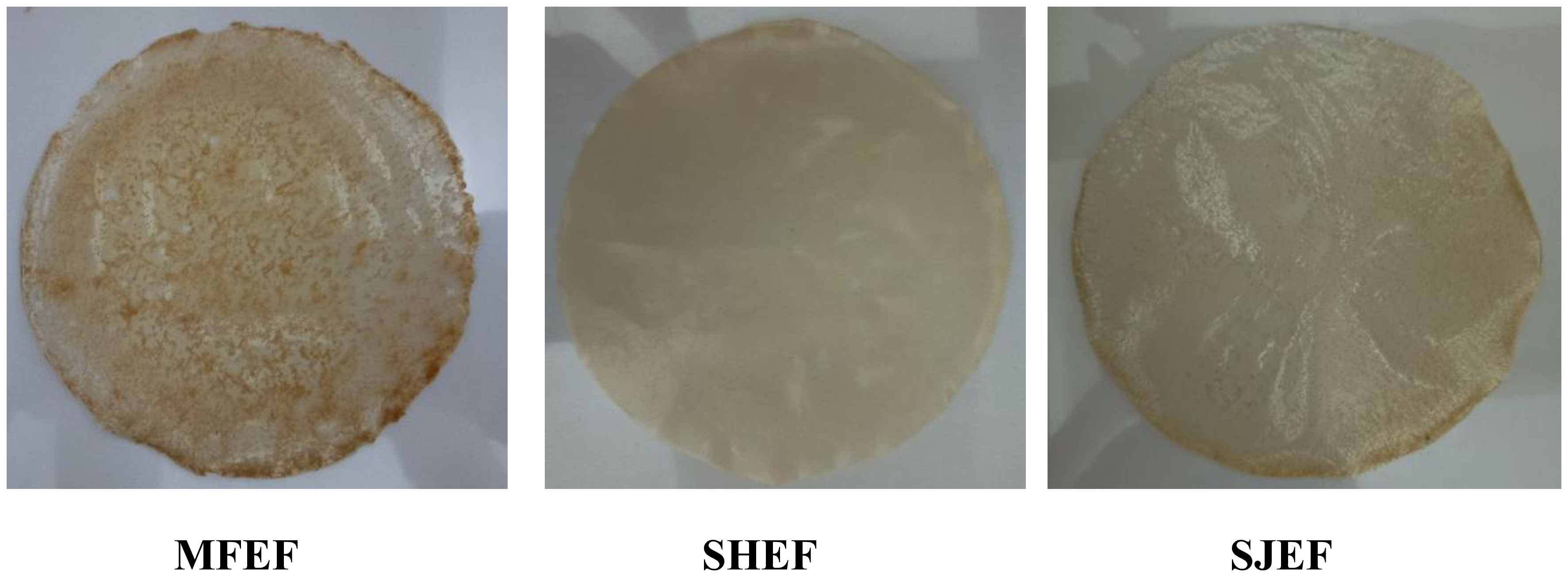
The color value of the edible film shows marked differences among fish species, reflecting variation in the composition of proteins and soluble pigments in Surimi wash water (Figure 1). MFEF had the lowest L* value (40.33), indicating lower brightness and darker colors than those of SHEF (54.33) and SJEF (46.33). A positive a* value in MFEF (4.67) indicates a reddish tendency. At the same time, SHEF and SJEF had a negative a* value, indicating a greenish bias that is common in fish protein-based films with low pigment content. The highest b* value in MFEF (27.67) means a more dominant yellowish color, possibly related to the presence of chromophore compounds from the soluble protein fraction and minor lipids. This variation is consistent with the findings of Masirah et al. (2024), which stated that differences in biomacromolecular and pigment composition between fish species directly affect the color parameters of edible films, including brightness and chromatic intensity.
3.3 Bacterial inhibition activity
The inhibition test results showed that the edible films from the Surimi washing waters of milkfish, skipjack tuna, and snakehead did not produce a significant barrier zone against E. coli. The inhibition zone diameter of the entire sample is 0-0.005 mm, equivalent to the control disc diameter (6.0 mm), indicating that the resulting film has no significant antibacterial activity. This can be explained by the edible film formulation used, which consists only of protein fractions from Surimi, agar, and glycerol, without the addition of antimicrobial bioactive compounds such as essential oils, organic acids, or phenolic extracts. These findings are in line with research Munir et al. (2020), which stated that protein-polysaccharide films are generally microbiologically neutral unless fortified with antimicrobial agents.
The characteristics of proteins in Surimi wash water can also influence the absence of inhibiting activity. Significant protein fractions, such as myosin, actinin, and albumin, detected through Sodium Dodecyl Sulfate-Polyacrylamide Gel Electrophoresis (SDS-PAGE), play a more critical role in film tissue formation and mechanical strength than bioactive functions (Liu et al., 2024b). Although some fish bioactive peptides are reported to have antibacterial activity, generally, they need to be produced through enzymatic hydrolysis to produce peptides of a specific chain length (Kang et al., 2023). Seeing that the film in this study did not undergo protein hydrolysis, it could be noted active antimicrobial compounds that inhibit E. coli growth were not formed. Future enhancement of antimicrobial functionality would most plausibly involve protein hydrolysis or incorporation of natural bioactive extracts, as these approaches directly target bioactive peptide formation rather than structural modification of the film matrix.
Appropriately, these results indicate that edible film from Surimi wash water is more suitable for passive packaging, with advantages in mechanical properties and barrier, but does not yet function as an active antibacterial packaging. To increase antimicrobial potential, a strategy that can be taken is to add natural bioactive compounds, such as essential oils from cinnamon or cloves (Huerta Lorenzo et al., 2024), phenolic compounds of green tea (Siriphap et al., 2022), or utilize antimicrobial peptides from the hydrolysis of fish protein (Okella et al., 2024). With this approach, edible films can be upgraded to active packaging that is not only environmentally friendly but also contributes to food safety.
4 Conclusion
This study concluded that Surimi wash water from milkfish, snakehead, and skipjack tuna is suitable as a raw material for edible film because it still contains essential biomacromolecules, is within the safe limits of heavy metals, and meets basic microbiology standards, thus answering the purpose of the study to evaluate its characteristics as a natural polymer source. The edible film produced showed different performance between species: snakehead produced film with the best mechanical properties, including the highest tensile strength, elongation, and Young's modulus; skipjack tuna was in the intermediate category; while milkfish produced films with the weakest mechanical properties, the highest moisture content and solubility, and the largest WVTR which indicated a less than optimal water vapor barrier ability. However, the entire film showed no antimicrobial activity against E. coli, consistent with the formulation's lack of bioactive compounds. Overall, Surimi wash water-based edible films are promising, but optimization is needed to lower WVTR and strengthen the matrix. The most feasible levers are wash-water concentration, matrix crosslinking, and lipid incorporation to improve moisture barrier performance.
Data Availability Statement
All data generated or analyzed in this study are included in this published article.
Cite as:
Funding:
References
- American Public Health Association – APHA. (2001). Compendium of methods for microbiological examination of foods. Washington, D.C.: APHA.
- American Society for Testing and Materials – ASTM. (2018). ASTM D882-18: Standard test method for tensile properties of thin plastic sheeting. West Conshohocken: ASTM International.
- American Society for Testing and Materials – ASTM. (2022). ASTM E96: Standard test methods for gravimetric determination of water vapor transmission rate of materials. West Conshohocken: ASTM International.
-
Athanasopoulou, E., Bigi, F., Maurizzi, E., Karellou, E. I. E., Pappas, C. S., Quartieri, A., & Tsironi, T. (2024). Synthesis and characterization of polysaccharide- and protein-based edible films and application as packaging materials for fresh fish fillets. Scientific Reports, 14(1), 517. PMid:38177403. https://doi.org/10.1038/s41598-024-51163-y
» https://doi.org/10.1038/s41598-024-51163-y -
Bari, T., Monirujjaman, M., Akter, F., & Alam, M. (2023). Effect of heat curing of film-forming solution on the properties of soy protein films. Asian Food Science Journal, 22(7), 1-7. https://doi.org/10.9734/afsj/2023/v22i7642
» https://doi.org/10.9734/afsj/2023/v22i7642 -
Bourtoom, T., Chinnan, M. S., Jantawat, P., & Sanguandeekul, R. (2009). Recovery and characterization of proteins precipitated from surimi wash-water. Lebensmittel-Wissenschaft + Technologie, 42(2), 599-605. https://doi.org/10.1016/j.lwt.2008.09.001
» https://doi.org/10.1016/j.lwt.2008.09.001 -
Coppola, D., Lauritano, C., Palma Esposito, F., Riccio, G., Rizzo, C., & de Pascale, D. (2021). Fish waste: From problem to valuable resource. Marine Drugs, 19(2), 116. PMid:33669858. https://doi.org/10.3390/md19020116
» https://doi.org/10.3390/md19020116 -
Delava, J. S., Maestre, K. L., Triques, C. C., Scheufele, F. B., Slusarski‐Santana, V., & Fiorese, M. L. (2022). Biodegradable and bioactive films or coatings from fish waste materials. In Inamuddin & T. Altalhi (Eds.), Biodegradable materials and their applications (pp. 75-140). Hoboken: Wiley. https://doi.org/10.1002/9781119905301.ch4
» https://doi.org/10.1002/9781119905301.ch4 -
Devi, L. S., Jaiswal, A. K., & Jaiswal, S. (2024). Lipid incorporated biopolymer based edible films and coatings in food packaging: A review. Current Research in Food Science, 8, 100720. PMid:38559379. https://doi.org/10.1016/j.crfs.2024.100720
» https://doi.org/10.1016/j.crfs.2024.100720 -
Enujiugha, V. N., & Oyinloye, A. M. (2019). Protein-lipid interactions and the formation of edible films and coatings. In L. Melton, F. Shahidi & P. Varelis (Eds.), Encyclopedia of food chemistry (pp. 478-482). Amsterdam: Elsevier. https://doi.org/10.1016/B978-0-08-100596-5.21477-7
» https://doi.org/10.1016/B978-0-08-100596-5.21477-7 -
Falguera, V., Quintero, J. P., Jiménez, A., Muñoz, J. A., & Ibarz, A. (2011). Edible films and coatings: Structures, active functions and trends in their use. Trends in Food Science & Technology, 22(6), 292-303. https://doi.org/10.1016/j.tifs.2011.02.004
» https://doi.org/10.1016/j.tifs.2011.02.004 -
Ferenczy, G. G., & Kellermayer, M. (2022). Contribution of hydrophobic interactions to protein mechanical stability. Computational and Structural Biotechnology Journal, 20, 1946-1956. PMid:35521554. https://doi.org/10.1016/j.csbj.2022.04.025
» https://doi.org/10.1016/j.csbj.2022.04.025 -
Fogaça, F. H. S., Trinca, L. A., Bombo, Á. J., & Silvia Sant’Ana, L. (2013). Optimization of the surimi production from mechanically recovered fish meat (MRFM) using response surface methodology. Journal of Food Quality, 36(3), 209-216. https://doi.org/10.1111/jfq.12019
» https://doi.org/10.1111/jfq.12019 - Food and Agriculture Organization – FAO World Health Organization – WHO. (2011). List of maximum levels for contaminants and toxins in foods. The Hague: Joint FAO/WHO Food Standards Programme, Codex Committee on Contaminants in Foods.
-
Gómez-Estaca, J., Montero, P., & Gómez-Guillén, M. C. (2018). Chemical characterization of wash water biomass from shrimp surimi processing and its application to develop functional edible films. Journal of Food Science and Technology, 55(10), 3881-3891. PMid:30228386. https://doi.org/10.1007/s13197-017-2532-9
» https://doi.org/10.1007/s13197-017-2532-9 -
Gulzar, S., Tagrida, M., Prodpran, T., Li, L., & Benjakul, S. (2023). Packaging films based on biopolymers from seafood processing wastes: Preparation, properties, and their applications for shelf‐life extension of seafoods. A comprehensive review. Comprehensive Reviews in Food Science and Food Safety, 22(6), 4451-4483. PMid:37680068. https://doi.org/10.1111/1541-4337.13230
» https://doi.org/10.1111/1541-4337.13230 -
Hou, B.-Y., Wang, B.-J., & Weng, Y.-M. (2023). Transglutaminase cross-linked and lysozyme-incorporated antimicrobial tilapia collagen edible films: Development and characterization. Foods, 12(7), 1475. PMid:37048296. https://doi.org/10.3390/foods12071475
» https://doi.org/10.3390/foods12071475 -
Huerta Lorenzo, B., Galán-Relaño, Á., Barba-Sánchez, E., Romero-Salmoral, A., Solarte Portilla, A. L., Gómez-Gascón, L., & Astorga Márquez, R. J. (2024). Potentiation of the antimicrobial effect of oxytetracycline combined with cinnamon, clove, oregano, and red thyme essential oils against mdr salmonella enterica strains. Animals, 14(9), 1347. PMid:38731351. https://doi.org/10.3390/ani14091347
» https://doi.org/10.3390/ani14091347 -
Kaewprachu, P., Osako, K., & Rawdkuen, S. (2018). Effects of plasticizers on the properties of fish myofibrillar protein film. Journal of Food Science and Technology, 55(8), 3046-3055. PMid:30065414. https://doi.org/10.1007/s13197-018-3226-7
» https://doi.org/10.1007/s13197-018-3226-7 -
Kaewprachu, P., Osako, K., Benjakul, S., & Rawdkuen, S. (2016a). Effect of protein concentrations on the properties of fish myofibrillar protein based film compared with PVC film. Journal of Food Science and Technology, 53(4), 2083-2091. PMid:27413238. https://doi.org/10.1007/s13197-016-2170-7
» https://doi.org/10.1007/s13197-016-2170-7 -
Kaewprachu, P., Osako, K., Benjakul, S., Tongdeesoontorn, W., & Rawdkuen, S. (2016b). Biodegradable protein‐based films and their properties: A comparative study. Packaging Technology & Science, 29(2), 77-90. https://doi.org/10.1002/pts.2183
» https://doi.org/10.1002/pts.2183 -
Kang, Y.-A., Kim, Y.-J., Jin, S.-K., & Choi, H.-J. (2023). Antioxidant, collagenase inhibitory, and antibacterial effects of bioactive peptides derived from enzymatic hydrolysate of Ulva australis. Marine Drugs, 21(9), 469. PMid:37755082. https://doi.org/10.3390/md21090469
» https://doi.org/10.3390/md21090469 -
Kazemi-Taskooh, Z., & Varidi, M. (2024). Interaction-induced characterization of animal-based protein-polysaccharide composite hydrogels: A review. Food Reviews International, 40(10), 3572-3604. https://doi.org/10.1080/87559129.2024.2366857
» https://doi.org/10.1080/87559129.2024.2366857 -
Kumar, L., Ramakanth, D., Akhila, K., & Gaikwad, K. K. (2022). Edible films and coatings for food packaging applications: A review. Environmental Chemistry Letters, 20(1), 875-900. https://doi.org/10.1007/s10311-021-01339-z
» https://doi.org/10.1007/s10311-021-01339-z -
Li, Q., Ye, T., Zhu, Y., Xia, L., Lin, L., & Lu, J. (2025). Sustainable development of fishery resources: Precipitation of protein from surimi rinsing wastewater by low-temperature plasma. Food Chemistry, 463(Pt 2), 141286. PMid:39288462. https://doi.org/10.1016/j.foodchem.2024.141286
» https://doi.org/10.1016/j.foodchem.2024.141286 -
Li, Q., Zhi, A., He, X., Shen, F., Fang, Y., Hu, Q., & Liu, X. (2023). Effect of modified atmosphere packaging assisted cold plasma on performance of edible soybean protein isolate films. Food Bioscience, 56, 103382. https://doi.org/10.1016/j.fbio.2023.103382
» https://doi.org/10.1016/j.fbio.2023.103382 -
Lim, L., Hettiarachchy, N. S., & Eswaranandam, S. (2020). Edible films and coatings from soybean and other protein sources. In A. E. Bailey & Y. H. Hui (Eds.), Bailey’s industrial oil and fat products (pp. 1-21). New York: Wiley. https://doi.org/10.1002/047167849X.bio084.pub2
» https://doi.org/10.1002/047167849X.bio084.pub2 -
Liu, J., Song, Z., Wang, Y., Pei, Y., & Tang, K. (2025). Edible films based on fish gelatin and soluble soybean polysaccharide enriched with tea polyphenol for active food packaging. Polymers, 17(16), 2174. PMid:40871120. https://doi.org/10.3390/polym17162174
» https://doi.org/10.3390/polym17162174 -
Liu, M., Zhang, X., Wei, A., Li, H., Zhang, H., Zheng, L., Xia, N., & Wang, J. (2024b). Protein‐based active films: Raw materials, functions, and food applications. Comprehensive Reviews in Food Science and Food Safety, 23(2), e13302. https://doi.org/10.1111/1541-4337.13302
» https://doi.org/10.1111/1541-4337.13302 -
Liu, R., Qiao, C., Liu, Q., Yao, J., & Xu, J. (2024a). Water state, thermal transition behavior and structure of hydrated gelatin films. Soft Matter, 20(7), 1603-1610. PMid:38273795. https://doi.org/10.1039/D3SM01462B
» https://doi.org/10.1039/D3SM01462B -
Liu, S.-H., Shen, M.-Y., Yang, C.-Y., & Chiang, C.-L. (2021). A study on circular economy material using fish scales as a natural flame retardant and the properties of its composite materials. Polymers, 13(15), 2446. PMid:34372049. https://doi.org/10.3390/polym13152446
» https://doi.org/10.3390/polym13152446 -
Long, K., Zhang, T., Park, J. W., Park, J., & Yin, T. (2022). Effect of modified washing process on water usage, composition and gelling properties of grass carp surimi. Journal of the Science of Food and Agriculture, 102(15), 7136-7143. PMid:35715889. https://doi.org/10.1002/jsfa.12079
» https://doi.org/10.1002/jsfa.12079 -
Masirah, P., Prihanto, A. A., Firdaus, M., & Setijawati, D. (2024). Upcycling fishery waste into edible films for sustainable food packaging. Research Journal of Chemistry and Environment, 28(12), 89-97. https://doi.org/10.25303/2812rjce089097
» https://doi.org/10.25303/2812rjce089097 -
Montero Garcia, M. P., & Borderias, A. J. (2023). Surimi and derived products. In V. Verrez-Bagnis (Ed.), Current challenges for the aquatic products processing industry (pp. 253-285). Newark: John Wiley & Sons. https://doi.org/10.1002/9781394264728.ch9
» https://doi.org/10.1002/9781394264728.ch9 -
Munawarah, S., Harahap, J., & Rohendi, A. (2024). Removal of COD, BOD, ammonia and TSS using electrocoagulation method with a combination of aluminum (AL) and iron (FE) electrodes in fish processing wastewater. Indonesian Journal of Environmental Sustainability, 1(2), 8-18. https://doi.org/10.22373/ijes.v1i2.4147
» https://doi.org/10.22373/ijes.v1i2.4147 -
Munir, S., Javed, M., Hu, Y., Liu, Y., & Xiong, S. (2020). The effect of acidic and alkaline ph on the physico-mechanical properties of surimi-based edible films incorporated with green tea extract. Polymers, 12(10), 2281. PMid:33027939. https://doi.org/10.3390/polym12102281
» https://doi.org/10.3390/polym12102281 -
Muñoz-Tebar, N., Pérez-Álvarez, J. A., Fernández-López, J., & Viuda-Martos, M. (2023). Chitosan edible films and coatings with added bioactive compounds: Antibacterial and antioxidant properties and their application to food products. A review. Polymers, 15(2), 396. PMid:36679276. https://doi.org/10.3390/polym15020396
» https://doi.org/10.3390/polym15020396 -
Neves, E. M. P. X., Pereira, R. R., Pereira, G. V. S., Pereira, G. V. S., Vieira, L. L., & Lourenço, L. F. H. (2019). Effect of polymer mixture on bioplastic development from fish waste. Boletim do Instituto de Pesca, 45(4), https://doi.org/10.20950/1678-2305.2019.45.4.518
» https://doi.org/10.20950/1678-2305.2019.45.4.518 -
Novak, U., Bajić, M., Kõrge, K., Oberlintner, A., Murn, J., Lokar, K., Triler, K. V., & Likozar, B. (2020). From waste/residual marine biomass to active biopolymer-based packaging film materials for food industry applications – a review. Physical Sciences Reviews, 5(3), https://doi.org/10.1515/psr-2019-0099
» https://doi.org/10.1515/psr-2019-0099 -
Okella, H., Odongo, S., Vertommen, D., & Okello, E. (2024). Identification, synthesis, and in vitro activities of antimicrobial peptide from african catfish against the extended-spectrum beta-lactamase (ESBL)-producing Escherichia coli. Pharmaceutics, 16(7), 850. PMid:39065546. https://doi.org/10.3390/pharmaceutics16070850
» https://doi.org/10.3390/pharmaceutics16070850 -
Olawade, D. B., Wada, O. Z., & Ige, A. O. (2024). Advances and recent trends in plant-based materials and edible films: A mini-review. Frontiers in Chemistry, 12, 1441650. PMid:39233921. https://doi.org/10.3389/fchem.2024.1441650
» https://doi.org/10.3389/fchem.2024.1441650 -
Oliveira, D. L., Grassi, T. L. M., Paiva, N. M., Santan, B. N., Nakamura, A. A., Bermejo-Poja, R., & Ponsano, E. H. G. (2021). Ultrafiltration for the recovery of proteins from surimi washing water. Food Science and Technology (Campinas), 41(Suppl 2), 458-464. https://doi.org/10.1590/fst.30120
» https://doi.org/10.1590/fst.30120 -
Padma, K. R., Anjum, M. R., Sankari, M., Don, K. R., Nakka, S., Harathi, K., & Sirisha, T. (2024). Transforming fish waste into high-value resources: A sustainable approach to circular bioeconomy. Uttar Pradesh Journal of Zoology, 45(23), 48-59. https://doi.org/10.56557/upjoz/2024/v45i234685
» https://doi.org/10.56557/upjoz/2024/v45i234685 -
Prakash, G., & Mishra, R. K. (2023). Edible and bio-based food packaging: A review. The Pharma Innovation, 12(7S), 1497-1505. https://doi.org/10.22271/tpi.2023.v12.i7Sr.21623
» https://doi.org/10.22271/tpi.2023.v12.i7Sr.21623 -
Rahma, R. A., Putri, W. D. R., Megatri, A. A., Nur, M., Mubarok, A. Z., & Wardana, A. A. (2023). Optimisation of fish gelatin and red pitaya peel powder edible film production. International Journal of Food Science & Technology, 58(10), 5578-5590. https://doi.org/10.1111/ijfs.16548
» https://doi.org/10.1111/ijfs.16548 -
Ratna, A., Aprilia, S., Arahman, N., Bilad, M. R., Suhaimi, H., Munawar, A. A., & Nasution, I. S. (2022). Bio-nanocomposite based on edible gelatin film as active packaging from clarias gariepinus fish skin with the addition of cellulose nanocrystalline and nanopropolis. Polymers, 14(18), 3738. PMid:36145881. https://doi.org/10.3390/polym14183738
» https://doi.org/10.3390/polym14183738 -
Rusli, A., Syamsuar, Santi, A., Malle, S., Arfini, F., Arsyad, M. A., Syukroni, I., & Inthe, M. G. (2024). Application of antimicrobial edible film incorporated with Caulerpa racemosa crude extract as active packaging of seaweed dodol. Applied Food Research, 4(2), 100625. https://doi.org/10.1016/j.afres.2024.100625
» https://doi.org/10.1016/j.afres.2024.100625 -
Sanyang, M. L., Sapuan, S. M., Jawaid, M., Ishak, M. R., & Sahari, J. (2016). Effect of plasticizer type and concentration on physical properties of biodegradable films based on sugar palm (arenga pinnata) starch for food packaging. Journal of Food Science and Technology, 53(1), 326-336. PMid:26787952. https://doi.org/10.1007/s13197-015-2009-7
» https://doi.org/10.1007/s13197-015-2009-7 -
Saputra, E., Alamsjah, A., & Abdillah, A. A. (2018). The characterization of edible coating from tilapia surimi as a biodegradable packaging. IOP Conference Series. Earth and Environmental Science, 137, 012071. https://doi.org/10.1088/1755-1315/137/1/012071
» https://doi.org/10.1088/1755-1315/137/1/012071 -
Shah, Y. A., Bhatia, S., Al-Harrasi, A., Afzaal, M., Saeed, F., Anwer, M. K., Khan, M. R., Jawad, M., Akram, N., & Faisal, Z. (2023). Mechanical properties of protein-based food packaging materials. Polymers, 15(7), 1724. PMid:37050337. https://doi.org/10.3390/polym15071724
» https://doi.org/10.3390/polym15071724 -
Shiku, Y., Hamaguchi, P. Y., Weng, W., & Tanaka, M. (2005). Film-forming mechanism of biodegradable films prepared from fish myofibrillar proteins. Nippon Shokuhin Kagaku Kogaku Kaishi, 52(8), 325-329. https://doi.org/10.3136/nskkk.52.325
» https://doi.org/10.3136/nskkk.52.325 -
Siriphap, A., Kiddee, A., Duangjai, A., Yosboonruang, A., Pook-In, G., Saokaew, S., Sutheinkul, O., & Rawangkan, A. (2022). Antimicrobial activity of the green tea polyphenol (−)-epigallocatechin-3-gallate (EGCG) against clinical isolates of multidrug-resistant vibrio cholerae. Antibiotics, 11(4), 518. PMid:35453268. https://doi.org/10.3390/antibiotics11040518
» https://doi.org/10.3390/antibiotics11040518 -
Stine, J. J., Pedersen, L., Smiley, S., & Bechtel, P. J. (2012). Recovery and utilization of protein derived from surimi wash‐water. Journal of Food Quality, 35(1), 43-50. https://doi.org/10.1111/j.1745-4557.2011.00424.x
» https://doi.org/10.1111/j.1745-4557.2011.00424.x -
Tan, M. W. M., Thornton, P. M., Thangavel, G., Bark, H., Dauskardt, R., & Lee, P. S. (2024). Toughening self‐healing elastomers with chain mobility. Advanced Science, 11(30), e2308154. PMid:38867394. https://doi.org/10.1002/advs.202308154
» https://doi.org/10.1002/advs.202308154 - Trilaksani, W., Riyanto, B., & Apriani, S. N. K. (2007). The characteristics of protein concentrate based-edible film recovery from tilapia (Oreochromis niloticus) surimi waste water. Buletin Teknologi Hasil Perikanan, 10(2), 60-72.
*
Corresponding Author: Andi Santi, Pangkep State Polytechnic of Agricultural, Department of Agriculture Technology, Jalan Poros Makassar, Parepare km 83, Mandalle, Pangkajene and Island, South Sulawesi 90655 - Indonesia, e-mail: andisanti@polipangkep.ac.idAssociate Editor: