 Agronomic performance of maize grown under green manure and organic compost application
Abstract
Maize (Zea mays L.) is one of the main commodities in Brazilian agribusiness and is considered the most widely cultivated crop in the world. By 2050, maize production must increase by approximately 70% to meet global demand. However, achieving high yields requires the application of large amounts of chemical fertilizers, which can be harmful to agroecosystems. In this context, the aim of this study was to evaluate the agronomic performance of maize, as well as the levels of soil organic matter and total organic carbon, as a function of organic matter application through green manure and organic compost. The experiment was conducted in a randomized block design, in a split-plot scheme [(3 x 3) + 1], with three leguminous species in the main plots (sunn hemp, pigeon pea and cowpea), three rates of organic compost in the subplots (0, 20, and 40 t ha−1), and one additional control (chemical fertilization). Agronomic parameters of maize and soil organic matter and total organic carbon contents were evaluated. Data were subjected to analysis of variance and means were compared using the Tukey test at a 5% probability level. The highest yield was obtained in the intercropping system with cowpea and 40 t ha−1 of organic compost, reaching a grain yield of 17.7 t ha−1. This represented an increase of over 20% compared to the same legume treatment without organic compost. Green manure combined with organic compost can replace chemical fertilization without compromising maize productivity. Organic compost associated with cowpea green manure provided higher maize yield compared to sunn hemp and dwarf pigeon pea. Soil organic matter and total organic carbon contents were not influenced by the green manure management combined with organic compost. Principal component analysis showed that maize yield parameters were more closely associated with the use of pigeon pea combined with 20 and 40 t ha−1 of organic compost, respectively.
Keywords:
cover crops; yield components; growth; Zea mays L
Resumo
O milho (Zea mays L.) é uma das principais commodities do agronegócio brasileiro, sendo considerado a maior cultura agrícola do mundo. Até 2050 é necessário o aumento da sua produção em aproximadamente 70% para atender a demanda mundial. Entretanto, para obtenção de alta produtividade, faz-se necessária a aplicação de elevadas doses de adubos químicos, o que pode ser prejudicial aos agroecossistemas. Neste contexto, objetivou-se avaliar o comportamento agronômico do milho, bem como os teores de matéria orgânica e carbono orgânico total do solo, em função da aplicação de matéria orgânica via adubação verde e composto orgânico. O experimento foi conduzido em delineamento de blocos casualizados, em esquema de parcela subdividida [(3 x 3) +1], sendo três leguminosas nas parcelas (crotalária, feijão guandu anão e feijão macassar), três doses de composto orgânico nas subparcelas (0, 20 e 40 t ha-1) e uma testemunha adicional (adubação química). Foram avaliados os parâmetros agronômicos do milho e os teores de materia orgânica e carbono orgânico do solo. Os dados foram submetidos a análise de variância e comparados pelo teste de Tukey a 5% de probabilidade. O maior rendimento foi obtido no consórcio com feijão macassar e 40 t ha-1 de composto orgânico, com produtividade de 17,7 t ha-1 de grãos. Demostrando um incremento superior a 20% em relação ao tratamento com a mesma leguminosa, sem adubação orgânica. A adubação verde, aliada a utilização do composto orgânico, pode substituir a adubação química, sem comprometer a produtividade de milho. O composto orgânico associado ao adubo verde de feijão macassar, proporciona maior produtividade do milho em comparação ao adubo verde de crotalária e de feijão guandu anão. Os teores de matéria orgânica e carbono orgânico total do solo, não foram influenciados pelos manejos de adubação verde associados ao composto orgânico. A análise de componentes principais mostrou que os parâmetros de rendimento do milho estão mais associados ao uso de feijão guandu com 20 e 40 t ha-1 de composto orgânico, respectivamente.
Palavras-chave:
culturas de cobertura; componentes de rendimento; crescimento; Zea mays L
1. Introduction
Maize (Zea mays L.) is one of the primary commodities of Brazilian agribusiness and is considered the most widely cultivated crop in the world (Dabija et al., 2021; Azad et al., 2022). It is predicted that by 2050, maize production will increase by approximately 70% to meet global demand (Gazzoni, 2017). However, the conventional production systems currently adopted are highly demanding in terms of nutrient supply, which is not always adequately met, due to the high demand for nitrogen-containing compounds (Muller et al., 2025). This system contributes to the intensification of soil degradation processes (Shaheb et al., 2021; Rathore et al., 2022; Silva et al., 2024), resulting in low yields (Brasil, 2024).
Furthermore, the excessive use of mineral fertilizers and agrochemicals has led to the physical, chemical, and biological degradation of soils, as well as groundwater contamination (Dong et al., 2022). An alternative to mitigate the impacts of these practices is the use of organic residues and green manure with cover crops, which contribute to nutrient cycling and enhance the resilience of agricultural systems. Plants such as legumes, grasses, and brassicas absorb essential nutrients, including nitrogen, phosphorus, and potassium, thereby preventing leaching and enriching the soil (Karasawa. 2024).
Green manure species, when used in combination with organic fertilization, improve the physical, chemical, and biological properties of the soil, in addition to increasing organic matter content and, consequently, crop productivity (Nurse et al., 2019; Wang et al., 2021). Maize responds positively to green manure with cover crop incorporation, and its yield can increase or decrease by about 50%, depending on the C:N ratio of these crops (Finney et al., 2016; White et al., 2017). According to Freitas (2020), green manure plants should produce large amounts of nitrogen-rich biomass and be capable of biological nitrogen fixation to supply nutrients to subsequent crops.
In evaluating maize production as a function of green manure with cover crops, Guerra et al. (2024) did not observe increases in yield. For Grandy et al. (2022), the C:N ratio is a crucial factor in selecting cover crop species, as the decomposition of organic matter in the soil mainly depends on the activity of microorganisms, which interact with the organic matter and improve nutrient availability and crop performance. Several studies have highlighted key aspects of residue decomposition in green manure systems, nitrogen supply through biomass, and its release to crops in both conventional and organic systems (Sievers and Cook, 2018; Nevins et al., 2020; Yang et al., 2019; Perrone et al., 2020), demonstrating the importance of these species for system sustainability.
Leoni et al. (2024) observed increased soil nitrogen content resulting from different leguminous cover crops, highlighting that legumes can reduce the need for mineral fertilizers. Other authors reported positive effects of pigeon pea [Cajanus cajan (L.) Millsp] for green manure due to its high nitrogen fixation capacity and biomass production (Berriel and Perdomo, 2023). Sunn hemp (Crotalaria juncea L.) is also a promising option, primarily for its ability to fix atmospheric nitrogen, high biomass production, and suppressive effects on plant-parasitic nematodes (Barbosa et al., 2020).
Previous studies have assessed the agronomic parameters of maize under organic fertilization (Hannet et al., 2021; Qaswar et al., 2021; Zhou et al., 2022) and green manure with cover crops (Yang et al., 2019; Perrone et al., 2020; Leoni et al., 2024). However, there is a lack of studies evaluating the combined effects of green manure and organic matter doses on maize agronomic performance and soil organic matter and total organic carbon contents. Therefore, the objective of this study was to evaluate the agronomic performance of maize and the levels of soil organic matter and total organic carbon as influenced by the application of organic matter through green manure and organic compost.
2. Materials and Methods
2.1. Experimental site
The study was carried out under field conditions during the 2014 growing season in the municipality of Garanhuns, Pernambuco, Brazil. The area is located at an altitude of 838 m, at 08°54’29” S latitude and 36°29’45” W longitude from Greenwich. According to the Köppen climate classification, the region has an As climate, characterized as tropical with a rainy season and a dry summer, with an average annual temperature of 20 °C and precipitation of 1,038 mm (Mota and Agendes, 1986) (Figure 1).

Average temperature, rainfall, and global solar radiation during the experimental period. Garanhuns - PE, 2025. Source: INMET (2015).
The soil in the experimental area is Sandy Loam, classified as Yellow Podzolic with a medium to clayey texture (Santos et al., 2011). Before establishing the experiment, physical and chemical analyses run on the 0-20 cm soil layer. The results were as follows: Texture (sandy loam); Bulk density: 1.64 g cm−3; Particle density: 2.64 g cm−3; 63% coarse sand; 22% fine sand; 7% silt; 8% clay; 2% Na; 75% flocculation degree; 1.05 mm cm−1 residual moisture; 0.44 mm cm−1 available water; 28.55 g kg−1 organic matter; pH (H2O): 5.90; 44 mg dm−3 of P; 0.90 cmolc dm−3 of Ca; 0.75 cmolc dm−3 of Mg; 0.13 cmolc dm−3 of K; 1.56 cmolc dm−3 of H; 0 cmolc dm−3 of Al; 1.18 cmolc dm−3 of S; 3.4 cmolc dm−3 of CEC; 54% base saturation and 0% aluminum saturation.
2.2. Experimental design
A randomized block design (RBD) was used in a split-plot scheme [(3 × 3) + 1], with three legume species as the main plot sunn hemp (Crotalaria juncea L.), cowpea (Vigna unguiculata L. Walp), and dwarf pigeon pea (Cajanus cajan L. Millsp.)), three organic compost rates (0, 20, and 40 t ha−1) as subplots, and one additional control treatment with mineral fertilization. Each treatment was replicated three times, resulting in a total of 30 experimental units. Each plot covered an area of 12 m2 (5.0 × 2.4 m).
2.3. Management and application of treatments
On September 9, 2014, green manure species were sown: sunn hemp, cowpea, and pigeon pea spaced 0.3 m between rows. The seeding rate was 12 seeds per linear meter for sunn hemp and pigeon pea, and 8 seeds per linear meter for cowpea.
The pulses were harvested and incorporated into the soil at full flowering. Before cutting, plant samples were collected from 1 m2 in the valuable area of each plot to determine fresh and dry biomass. Fresh biomass was measured by weighing, and dry biomass was obtained by drying the material in a forced-air oven at 65 °C until constant weight. The dry matter production of the legume species used as green manure varied among species. The highest biomass yield was obtained with sunn hemp (8.6 t ha−1), followed by dwarf pigeon pea (4.45 t ha−1) and cowpea (4.4 t ha−1).
Ten days after incorporation, maize (Zea mays L.) was sown with 0.80 × 0.2 m spacing. The functional area of each plot consisted of ten plants in the central rows. Sowing was done manually, placing two seeds per hole of the conventional cultivar PRE 32D10. At the three-leaf stage (V3), thinning was performed, establishing a final stand of 62.500 plants ha−1. Fertilization in the mineral treatment was based on soil analysis and the fertilizer recommendation manual for the state of Pernambuco (Cavalcante, 2008), with 20 kg ha−1 of P2O5, 60 kg ha−1 of K2O as base, and 40 kg ha−1 of N as topdressing.
The chemical composition of the organic compost was as follows: 280 g kg−1 organic matter; 13% moisture; 13.1 g kg−1 N; 1.90 g kg−1 P; 9 g kg−1 K; 27.3 g kg−1 Ca; 4 g kg−1 Mg; 162 g kg−1 C; C/N ratio: 12/1; 5 g kg−1 B; 27 g kg−1 Cu; 2970 g kg−1 Fe; 39 g kg−1 Mn; 93 g kg−1 Zn; 760 g kg−1 Na; pH (H2O): 6.3. Drip irrigation was used, activated according to weather conditions. The irrigation depth was determined using the FAO 56 model: ETc = ETo × Kc, where ETc = crop evapotranspiration, ETo = reference evapotranspiration, and Kc = crop coefficient.
2.4. Data collection
At 60 days after sowing, at full flowering, the following parameters were measured using a portable chlorophyll meter (ClorofiLOG CFL1030, Falker): total chlorophyll index (CL T), chlorophyll a (CL a), chlorophyll b (CL b), and a/b chlorophyll ratio (RZ a/b). Three plants per subplot were randomly selected, and six readings were taken on the middle third of the leaf opposite and below the first ear (Vargas et al., 2012). These leaves were then collected for chemical analysis of nitrogen (N) and crude protein (CP) content using the Kjeldahl method (AOAC, 1995).
At harvest, the following parameters were recorded: plant height (PH, m); ear insertion height (EIH, cm); stalk diameter (SD, mm); leaf area (LA, cm2); dry matter (DM, t ha−1); number of grains per ear (NG/E); average number of ears per plant (NE/P); ear diameter (ED, mm); ear length (EL, cm); number of grain rows (NGR); number of grains per row (NG/R); 1,000-grain weight (TGW, g); grain yield (GY, t ha−1); total soil organic carbon (TOC, g kg−1); and soil organic matter (S.O.M., g kg−1). TGW was calculated from eight subsamples of 100 grains per subplot, adjusted to 13% moisture. Grain yield was determined by weighing the ears from the functional area of each experimental unit, adjusting to 13% moisture, and converting the results to t ha−1. TOC was determined according to Yeomans and Bremner (1988), and S.O.M. was calculated by multiplying TOC by 1.724.
2.5. Statistical analysis
The data were subjected to analysis of variance, and means were compared using Tukey’s test at a 5% significance level. Subsequently, principal component analysis (PCA) was applied to examine the interrelationships among the variables under study. Significant principal components (PCs) were selected according to the Kaiser (1960) criterion, considering only eigenvalues greater than 1.0 (Lamichhane et al., 2021). All statistical analyses were performed using R Studio software (R Studio Team, 2021).
3. Results
The dry matter yield (DM) of maize plants was significantly influenced by green manure treatments (p < 0.05). The combination of cowpea with organic compost at a rate of 40 t ha−1 resulted in the highest DM yield, exceeding by more than 20% the value observed for cowpea without compost application, which presented the lowest performance (Table 1).
Mean values of agronomic variables of maize plants, as well as soil organic matter and total organic carbon content, under fertilization with different cover crops and compost doses. Garanhuns, PE. 2015.
Regarding the number of ears per plant (NE/P), there was a significant difference among the legume species used as green manure (p < 0.05) at the 20 t ha−1 compost dose. Dwarf pigeon pea promoted the highest NE/P, statistically differing only feijão macassar.
The chlorophyll a/b ratio (R a/b) differed significantly depending on the legume species used (p < 0.05). The lowest mean values were recorded in treatments with sunn hemp and cowpea combined with 40 t ha−1 of organic compost, representing a reduction of over 12% in R a/b compared to the treatment with dwarf pigeon pea, which showed the best performance.
Leaf area (LA), number of ears per plant (NE/P), and ear diameter (ED) also differed significantly as a function of the fertilization treatments (p < 0.05). The highest means were recorded with the application of 20 and 40 t ha−1 of organic compost in the plots with cowpea, sunn hemp, and cowpea, respectively.
Grain yield differed across treatments. The highest yield was obtained in the combination of cowpea and 40 t ha−1 of organic compost, reaching 17.7 t ha−1 of grain. This value represents an increase of over 20% compared to the treatment with the same legume but without organic fertilization, which yielded 14.1 t ha−1. The remaining variables presented in Table 1 were not significantly affected by the treatments (p > 0.05).
In Table 2, it can be observed that only chlorophyll a content in leaves of plants fertilized with sunn hemp combined with 20 t ha−1 of organic compost was lower than that recorded in leaves of plants cultivated with mineral fertilization. No significant differences (p > 0.05) were found for the other evaluated variables (chlorophyll a, b, total chlorophyll, chlorophyll a/b ratio, N, and CP) between the organic and chemical fertilization treatments.
Mean values of chlorophyll contents, nitrogen, and crude protein in maize plants as a function of fertilization with different cover crops and compost doses. Garanhuns, PE. 2015.
Table 3 presents the comparison between organic treatments (compost doses and green manures) and the mineral chemical treatment, considering the evaluated agronomic parameters. No statistically significant differences (p > 0.05) were observed between treatments for plant height (PH), aboveground dry mass (DM), leaf area (LA), insertion height of the first ear (EIH), number of ears per plant (NE/P), ear length (EL), and average ear diameter (ED). A significant difference was observed only for stem diameter (SD), with better performance in plants subjected to mineral chemical fertilization compared to those cultivated with green manures of pigeon pea and cowpea, both at zero compost dose.
Mean values of agronomic parameters of maize plants as a function of fertilization with different cover crops and compost doses. Garanhuns, PE. 2015.
In Table 4, only the variable productivity showed statistically lower values compared to mineral chemical fertilization when maize plants were fertilized with cowpea green manure in the absence of organic compost. For the other analyzed variables, no significant differences were observed between mineral and organic fertilizers (p > 0.05).
Mean values of yield parameters of maize plants, soil organic matter, and total organic carbon contents as a function of fertilization with different cover crops and compost doses. Garanhuns, PE. 2015.
In Figures 2a and 2b, the principal component analysis (PCA) is presented. In the first biplot (Figure 2a), the percentage variance explained by each component is shown, where the first principal component (PC1) explains 38.17%, the second (PC2) explains 20.21%, and together they explain 58.38% of the total variance of the data. According to Figure 2a, the variables have arrows pointing in different directions, indicating correlations among them: a positive correlation when the angle between arrows is less than 90°, a negative correlation when the angle is greater than 90°, and no correlation when the angle is equal to 90°.
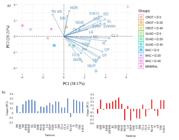
Graphs of principal component 1 (PC1) versus principal component 2 (PC2), based on the agronomic characteristics of maize and the contents of soil organic matter and total organic carbon, in response to fertilization with cover crops and organic compost. The vector plot (a) shows the eigenvector of each variable. The bar plot (b) shows the loadings of each variable on PC1 and PC2. For full variable names, see the Methods section.
Figure 2b shows the loading plot of each variable on the first and second principal components (PC1 and PC2). It is possible to observe that the variables with the highest positive contributions to data variability in PC1 were EWH, EWWH, EL, ED, CL T, and N, indicating that these variables are primarily responsible for separating treatments along PC1. For the second principal component (PC2), the variables with the highest positive contributions were NGR, ED, EL, EIH, N, TOC, and S.O.M., suggesting these variables best represent the differentiation of treatments along this axis. Variables NG/R, NE/P, CL b, GY, and DM showed negative loadings, indicating an inverse relationship with the treatments that stand out positively on PC2.
4. Discussion
The use of different legumes as green manure did not cause significant changes in chlorophyll a, b, and total contents, suggesting that nitrogen and magnesium uptake elements that constitute the chlorophyll molecule occurred similarly among maize plants (Oliveira, 2024). It is important to highlight that, in addition to soil nitrogen availability, other factors such as edaphoclimatic conditions, cultivar, levels of other nutrients, light availability, insect attack, water stress, planting density, and pesticide use can influence leaf chlorophyll content (Pedroza-Sandoval et al., 2017). According to Fornari et al. (2020) and Ponte Filho et al. (2023), high chlorophyll content in maize leaves is positively correlated with grain yield and biomass production, since this pigment is directly linked to photosynthetic activity and consequently to the synthesis and translocation of photoassimilates to the grains (Santos et al., 2023).
Total nitrogen and crude protein contents indicated that maize plants in all treatments were within the adequate foliar nitrogen range, based on the reference values established by Werner et al. (1996), which vary between 27.5 and 32.5 g kg−1. These results are consistent with those reported by Kappes et al. (2013), who observed foliar nitrogen contents between 25.3 and 26.3 g kg−1 in maize fertilized with Sunn Hemp.
Regarding stem diameter, similar results were found by Kappes et al. (2013), who did not observe differences when using Sunn Hemp and millet green manures over two consecutive cropping years. Concerning leaf area, differences were observed only between treatments with Cowpea and Pigeon pea at the 40 t ha−1 compost dose. This suggests that higher doses of organic compost influenced growth parameters, especially when combined with Cowpea green manure, which resulted in maize plants with larger leaf areas. Ağirağaç and Zorer Çelebi (2025) also reported significant effects on maize leaf area due to organomineral fertilizer application.
Carvalho et al. (2004), using green manures including Pigeon pea and Sunn Hemp, did not find significant differences in the height of first ear insertion over two years, reporting values of 1.06–1.12 m for plants fertilized with Pigeon pea and 1.10–1.16 m for those with Sunn Hemp. Overall, maize plants in this experiment achieved greater ear insertion heights, ranging from 1.10 to 1.20 m.
Almeida (2021), when evaluating the number of grain rows in maize as a function of green fertilization, observed a positive influence of the treatments, noting that the number of rows is determined during the vegetative stage between V6 and V10. At this stage, nutrient availability, especially nitrogen, is crucial for the plant. In another study, Yang et al. (2015) also found no significant effects at the beginning of trials with wheat and maize conducted in China when using organic fertilizer sources. The authors attributed these results to nutrient immobilization by soil microorganisms and the slow release of nutrients. However, over time, both wheat and maize yields became significantly affected.
For the leaf area variable, as shown in Table 1, the doses of organic compost combined with the incorporation of the green manure Cowpea promoted an increase in this parameter. At the dose of 20 t ha−1, maize plants exhibited larger leaf areas (>7000 cm2). These findings suggest that green fertilization combined with organic fertilization can promote good development and productivity of maize, since leaf area represents the crop’s growth capacity and is directly related to productivity. Well-nourished leaves have a greater capacity to assimilate CO2 and perform photosynthesis, resulting in higher biomass accumulation (Mata et al., 2010). In another study with hybrid maize, Cancellier et al. (2011) observed that the largest leaf area occurred with the application of 40 t ha−1 of manure; however, the values reported by these authors (4909 cm2) were still lower than those found in the present study.
Ear length was influenced by compost doses in maize plants fertilized with Sunn Hemp. The same effect was not observed when doses were evaluated within the green manures Pigeon pea and Cowpea. According to Table 1, there was an increase in the number of ears from maize plants fertilized with compost doses combined with the Pigeon pea green manure; as compost doses increased, there was a positive response of up to 20 t ha−1. Souza et al. (2015) observed higher numbers of ears, yield, and average weight when maize plants were subjected to green manure (Sunn Hemp and white lupin) and organic compost fertilization.
Compost doses influenced ear diameter only in maize plants fertilized with Sunn Hemp, which was not observed in plants fertilized with other green manures (Table 1). Maize plants fertilized with increasing compost doses in the presence of Cowpea reached higher yields corresponding to the increase in compost doses, with 40 t ha−1 yielding the highest values.
Fabunmi and Agbonlahor (2012) also obtained higher maize yields when applying green manure Cowpea. The high yields observed in this study may be related, among other factors, to the temperature recorded during the maize growing cycle, which was adequate for better crop development. Nighttime average temperatures below 24 °C reduce cellular respiration, resulting in greater accumulation of photoassimilates and favoring the grain-filling phase (Galvão et al., 2015).
According to Assis et al. (2006), the potential productivity of maize plants depends on the genetic characteristics of the cultivar, temperature, and solar radiation. Since no thermal limitations occurred during maize development, this may have contributed to the plants reaching their maximum productive potential. In addition to temperature, total chlorophyll and nitrogen levels found in leaves were within the recommended ranges for achieving high yields (Ponte Filho et al., 2023). These results indicate that the green and organic manures used in this trial enable maize plants to be as vigorous as those managed with mineral fertilization.
Silva et al. (2007), after four consecutive years of organic compost application in maize cultivation, obtained good yields regardless of plant population, exceeding 8 t ha−1. The authors observed that continuous organomineral fertilization over several years resulted in significant yield increases.
No significant difference was found between total organic carbon and soil organic matter content under chemical and organic treatments (Table 4). Supporting this, Souza and Guimarães (2013) did not observe significant differences in soil organic matter content when using these legumes in pre-cultivation, possibly due to the short cultivation period (2 years).
Principal component analysis (PCA) showed distinct patterns in fertilization management. Treatments with green manures and organic compost exhibited different behavior compared to chemical fertilization, which was grouped separately in the graph. This indicates that green manuring with legumes and organic compost was responsible for changes in maize agronomic variables, soil organic matter, and total organic carbon content. These findings corroborate those of Basso and Silva (2024), who, comparing organic and chemical fertilization, found that chemical fertilization can be entirely replaced by organic fertilization without yield loss in maize.
5. Conclusions
Green manure combined with organic compost can replace chemical fertilization without harming maize productivity.
Organic compost combined with Cowpea green manure provides higher maize productivity than crotalaria and Pigeon pea green manures.
Soil organic matter and total organic carbon contents were not influenced by the management of green manuring combined with organic compost.
Principal component analysis showed that maize yield parameters are more associated manure combined with 20 and 40 t ha−1 of organic compost, respectively.
Data Availability Statement
The research data are only available upon request to the corresponding author.
References
-
AĞIRAĞAÇ, Z. and ZORER ÇELEBI, Ş., 2025. Combined applications and multi-faceted evaluations of humic acid, seaweed, and vermicompost with chemical and organo-mineral fertilizers on corn, part I: chlorophyll concentration. Journal of Plant Nutrition, vol. 48, no. 3, pp. 406-417. http://doi.org/10.1080/01904167.2024.2405030
» http://doi.org/10.1080/01904167.2024.2405030 - ALMEIDA, M.S., 2021. Produtividade do milho sob efeito residual de adubação verde. Redenção: Universidade da Integração Internacional da Lusofonia Afro-Brasileira, 12 p. Trabalho de Graduação em Agronomia.
-
ASSIS, J.P., DOURADO-NETO, D., REICHARDT, K., MANFRON, P.A., MARTIN, T.N. and BONNECARRÈRE, R.A.G., 2006. Simulated climatic data and potential productivity of maize. Pesquisa Agropecuária Brasileira, vol. 41, no. 5, pp. 731-737. http://doi.org/10.1590/S0100-204X2006000500003
» http://doi.org/10.1590/S0100-204X2006000500003 - ASSOCIATION OF OFFICIAL ANALYTICAL CHEMISTS – AOAC, 1995. Official methods of analysis of AOAC International 16th ed. Rockville: AOAC International.
-
AZAD, A., UL, M., CHESTI, H., SHAFI, S. and QAYOOM, S., 2022 [viewed 4 June 2025]. Effect of different sowing dates and nitrogen levels on the nitrogen content and uptake of maize under temperate conditions of Kashmir [online]. Available from: https://www.researchgate.net/publication/382490018
» https://www.researchgate.net/publication/382490018 - BARBOSA, I.R., SANTANA, R.S., MAUAD, M. and GARCIA, R.A., 2020. Dry matter production and nitrogen, phosphorus, and potassium uptake in Crotalaria juncea and Crotalaria spectabilis. Tropical Agricultural Research, vol. 50, e61011.
- BASSO, L.P. and SILVA, O.H., 2024. Avaliação de adubo orgânico, organomineral e químico na cultura do milho. Dourados: Faculdade de Ciências Agrárias, Universidade Federal da Grande Dourados, 27 p. Trabalho de Conclusão de Curso em Agronomia.
-
BERRIEL, V. and PERDOMO, C.H., 2023. Cajanus cajan: a promising high-nitrogen fixing cover crop for Uruguay. Frontiers in Agronomy, vol. 5, pp. 1214811. http://doi.org/10.3389/fagro.2023.1214811
» http://doi.org/10.3389/fagro.2023.1214811 -
BRASIL. Companhia Nacional de Abastecimento – CONAB, 2024 [viewed 4 June 2025]. Monitoring brazilian grain harvest: fifth survey [online]. Available from: https://www.conab.gov.br/info-agro/safras/graos
» https://www.conab.gov.br/info-agro/safras/graos -
CANCELLIER, L.L., AFFÉRRI, F.S., ADORIAN, G.C., RODRIGUES, H.V.M., MELO, A.V., PIRES, L.P.M. and CANCELLIER, E.L., 2011. Organic fertilization in the seeding line on maize development and productivity. Semina: Ciências Agrárias, vol. 32, pp. 527-540. http://doi.org/10.5433/1679-0359.2011v32n2p527
» http://doi.org/10.5433/1679-0359.2011v32n2p527 -
CARVALHO, M.A.C., SORATTO, R.P., ATHAYDE, M.L.F., ARF, O. and SÁ, M.E., 2004. Maize productivity in succession to green manures in no-tillage and conventional systems. Pesquisa Agropecuária Brasileira, vol. 39, no. 1, pp. 47-53. http://doi.org/10.1590/S0100-204X2004000100007
» http://doi.org/10.1590/S0100-204X2004000100007 - CAVALCANTE, F.J., 2008. Recomendações de adubação para o estado de Pernambuco. 3. ed. Recife: IPA, 154 p.
-
DABIJA, A., CIOCAN, M.E., CHETRARIU, A. and CODINĂ, G.G., 2021. Maize and sorghum as raw materials for brewing, a review. Applied Sciences, vol. 11, no. 7, pp. 3139. http://doi.org/10.3390/app11073139
» http://doi.org/10.3390/app11073139 -
DONG, Y., YANG, J., ZHAO, X., YANG, S., MULDER, J., DÖRSCH, P. and ZHANG, G., 2022. Lixiviação de nitrato e acúmulo de N em um solo vermelho subtropical típico com fertilização com N. Geoderma, vol. 407, pp. 115559. http://doi.org/10.1016/j.geoderma.2021.115559
» http://doi.org/10.1016/j.geoderma.2021.115559 - FABUNMI, T. and AGBONLAHOR, M., 2012. Economics of maize production under different cowpea-based green manure practices in derived savanna zone oF Nigeria. Journal of Organic Systems, vol. 7, no. 2, pp. 5-13.
-
FINNEY, D.M., WHITE, C.M. and KAYE, J.P., 2016. Biomass production and carbon/nitrogen ratio influence ecosystem services from cover crop mixtures. Agronomy Journal, vol. 108, no. 1, pp. 39-52. http://doi.org/10.2134/agronj15.0182
» http://doi.org/10.2134/agronj15.0182 -
FORNARI, E.Z., GAVIRAGHI, L., BASSO, C.J., PINHEIRO, M.V.M., VIAN, A.L. and SANTI, A.L., 2020. Relationship between photosynthetic pigments and corn production under nitrogen sources. Pesquisa Agropecuária Tropical, vol. 50, e63661. http://doi.org/10.1590/1983-40632020v5063661
» http://doi.org/10.1590/1983-40632020v5063661 - FREITAS, L.A., 2020. Plantas de cobertura como provedora de nitrogênio e adubação nitrogenada na cultura do milho. Pato Branco: Universidade Tecnológica Federal do Paraná, 68 p. Tese de Doutorado em Produção Vegetal.
- GALVÃO, J.C.C., BORÉM, A. and PIMENTEL, M.A., 2015. Milho do plantio à colheita Viçosa: UFV, 351 p.
-
GAZZONI, D.L., 2017. How to feed 10 billion citizens by 2050? Ciência e Cultura, vol. 69, no. 4, pp. 33-38. http://doi.org/10.21800/2317-66602017000400012
» http://doi.org/10.21800/2317-66602017000400012 -
GRANDY, A.S., DALY, A.B., BOWLES, T.M., GAUDIN, A.C.M., JILLING, A., LEPTIN, A., MCDANIEL, M.D., WADE, J. and WATERHOUSE, H., 2022. The nitrogen gap in soil health concepts and fertility measurements. Soil Biology & Biochemistry, vol. 175, pp. 108856. http://doi.org/10.1016/j.soilbio.2022.108856
» http://doi.org/10.1016/j.soilbio.2022.108856 -
GUERRA, D., BRAUN, V.L., REDIN, M., SILVA, D.M., SOUZA, E.L., BOHRER, R.E.G. and LANZANOVA, M.E., 2024. Silage and grain productivity of maize in succession to winter cover crops. Investigación Agraria, vol. 26, no. 1, pp. 1-6. http://doi.org/10.18004/investig.agrar.2024.junio.2601795
» http://doi.org/10.18004/investig.agrar.2024.junio.2601795 -
HANNET, G., SINGH, K., FIDELIS, C., FARRAR, M.B., MUQADDAS, B. and BAI, S.H., 2021. Effects of biochar, compost, and biochar-compost on soil total nitrogen and available phosphorus concentrations in a corn field in Papua New Guinea. Environmental Science and Pollution Research International, vol. 28, no. 21, pp. 27411-27419. http://doi.org/10.1007/s11356-021-12477-w PMid:33507513.
» http://doi.org/10.1007/s11356-021-12477-w -
INSTITUTO NACIONAL DE METEOROLOGIA – INMET, 2015 [viewed 26 September 2025]. Dados meteorológicos: temperatura média, precipitação e radiação solar global (Garanhuns – PE) [online]. Available from: https://bdmep.inmet.gov.br/
» https://bdmep.inmet.gov.br/ -
KAISER, H.F., 1960. The application of electronic computers to factor analysis. Educational and Psychological Measurement, vol. 20, no. 1, pp. 141-151. http://doi.org/10.1177/001316446002000116
» http://doi.org/10.1177/001316446002000116 - KAPPES, C., ARF, O. and ANDRADE, J.A.C., 2013. Maize productivity under different soil management and nitrogen doses. Revista Brasileira de Ciência do Solo, vol. 37, no. 5, pp. 1310-1321. http://doi.org/10.1590/S0100- 06832013000500020.
-
KARASAWA, T., 2024. Beneficial effects of cover crops on various soil functions and nutrient supply. Soil Science and Plant Nutrition, vol. 70, no. 4, pp. 237-245. http://doi.org/10.1080/00380768.2024.2360022
» http://doi.org/10.1080/00380768.2024.2360022 -
LAMICHHANE, S., EĞILMEZ, G., GEDIK, R., BHUTTA, M.K.S. and ERENAY, B., 2021. Benchmarking OECD countries’ sustainable development performance: a goal-specific principal component analysis approach. Journal of Cleaner Production, vol. 287, pp. 125040. http://doi.org/10.1016/j.jclepro.2020.125040
» http://doi.org/10.1016/j.jclepro.2020.125040 -
LEONI, F., LAZZARO, M., CARLESI, S. and MOONEN, A.C., 2024. Screening suitable legumes for living mulches to support nitrogen dynamics and weed control in a durum wheat-forage sorghum crop sequence. Field Crops Research, vol. 307, pp. 109246. http://doi.org/10.1016/j.fcr.2023.109246
» http://doi.org/10.1016/j.fcr.2023.109246 - MATA, J.F., DA SILVA, J.C., RIBEIRO, J.F., AFFÉRRI, F.S. and VIEIRA, L.M., 2010. Production of hybrid maize under doses of bovine manure. Pesquisa Aplicada & Agrotecnologia, vol. 3, no. 3
- MOTA, F.S. and AGENDES, O.O., 1986. Climate and agriculture in Brazil Porto Alegre: Sagra.
- MÜLLER, T.M., TABALDI, L.A., FIPKE, G.M., CUNHA, V.S., RIBEIRO, L.P. and MARTIN, T.N., 2025. Atividade enzimática e alterações morfológicas em híbridos de milho inoculados com Azospirillum brasilense via tratamento de sementes e folhas. Revista Brasileira de Biologia, vol. 85, e288948.
-
NEVINS, C.J., LACEY, C. and ARMSTRONG, S., 2020. Synchrony of cover crop decomposition, enzyme activity, and nitrogen availability in a Midwestern U.S. maize agroecosystem. Soil & Tillage Research, vol. 197, pp. 104518. http://doi.org/10.1016/j.still.2019.104518
» http://doi.org/10.1016/j.still.2019.104518 -
NURSE, R.E., MENSAH, R., ROBINSON, D.E. and LEROUX, G.D., 2019. Adzuki bean (Vigna angularis), oilseed radish (Raphanus sativus), and cereal rye (Secale cereale) as living mulches with and without herbicides to control annual grasses in sweet corn (Zea mays). Canadian Journal of Plant Science, vol. 99, no. 2, pp. 152-158. http://doi.org/10.1139/cjps-2018-0113
» http://doi.org/10.1139/cjps-2018-0113 - OLIVEIRA, L.C.A., 2024. Papel fisiológico do magnésio na fotossíntese, atividade da Rubisco e Fixação Biológica de Nitrogênio em genótipos de soja. Jaboticabal: Universidade Estadual Paulista, 145 p. Tese de Doutorado em Agronomia.
-
PEDROZA-SANDOVAL, A., YÁÑEZ-CHÁVEZ, L.G., SÁNCHEZ-COHEN, I., SAMANIEGO-GAXIOLA, J.A. and TREJO-CALZADA, R., 2017. Hydrogel, biocompost, and its effect on photosynthetic activity and production of forage maize plants (Zea mays L.). Acta Agronomica, vol. 66, no. 1, pp. 63-68. http://doi.org/10.15446/acag.v66n1.50868
» http://doi.org/10.15446/acag.v66n1.50868 -
PERRONE, S., GROSSMAN, J., LIEBMAN, A., SOOKSA-NGUAN, T. and GUTKNECHT, J., 2020. Nitrogen fixation and productivity of winter annual legume cover crops in organic production systems of the Upper Midwest. Nutrient Cycling in Agroecosystems, vol. 117, no. 1, pp. 61-76. http://doi.org/10.1007/s10705-020-10055-z
» http://doi.org/10.1007/s10705-020-10055-z -
PONTE FILHO, F.L., POMPEU, R.C.F.F., SAGRILO, E., ANDRADE, H.A.F., COSTA, C.P.M. and SOUZA, H.A., 2023. Productivity and nutrient export in a maize and forage grasses intercropping under semiarid conditions. Revista Brasileira de Saúde e Produção Animal, vol. 24, pp. 20220029. http://doi.org/10.1590/s1519-994020220029
» http://doi.org/10.1590/s1519-994020220029 -
QASWAR, M., JING, H., AHMED, W., ABBAS, M., DONGCHU, L., KHAN, Z.H., JUSHENG, G., SHUJUN, L. and HUIMIN, Z., 2021. Linkages between ecoenzymatic stoichiometry and microbial community structure under long-term fertilization in paddy soil: a case study in China. Applied Soil Ecology, vol. 161, pp. 103860. http://doi.org/10.1016/j.apsoil.2020.103860
» http://doi.org/10.1016/j.apsoil.2020.103860 -
RATHORE, S.S., BABU, S., SHEKHAWAT, K., SINGH, R., YADAV, S.K., SINGH, V.K. and SINGH, C., 2022. Designing energy cum carbon-efficient environmentally clean production system for achieving green economy in agriculture. Sustainable Energy Technologies and Assessments, vol. 52, pp. 102190. http://doi.org/10.1016/j.seta.2022.102190
» http://doi.org/10.1016/j.seta.2022.102190 - R STUDIO TEAM, 2021. RStudio: Integrated development environment for R Boston: RStudio.
- SANTOS, H.G., CARVALHO JÚNIOR, W., DART, R.O., ÁNGLIO, M.L.D., SOUSA, J.S., PARES, J.G., FONTANA, A., MARTINS, A.L.S. and OLIVEIRA, A.P., 2011. The new soil map of Brazil: updated legend. Rio de Janeiro: Embrapa Solos, 67 p.
-
SANTOS, L.A., BARBOSA, B.S., PINTO, C.C., SZARESKI, V.J., CARVALHO, I.R., PIMENTEL, J.R., TROYJACK, C., ROSA, T.C., KOCH, F., DUBAL, Í.T.P., SANTOS, A.K.C.F., SCHUCH, L.O.B., MARTINAZZO, E.G., PEDÓ, T. and AUMONDE, T.Z., 2023. Initial growth and chlorophyll indices of maize plants originating from seeds of different shapes and sizes. Agronomy Science and Biotechnology, vol. 10, pp. 1-16. http://doi.org/10.33158/ASB.r194.v10.2024
» http://doi.org/10.33158/ASB.r194.v10.2024 -
SHAHEB, M.R., VENKATESH, R. and SHEARER, S.A., 2021. A review of the effect of soil compaction and its management for sustainable crop production. Journal of Biosystems Engineering, vol. 46, no. 4, pp. 417-439. http://doi.org/10.1007/s42853-021-00117-7
» http://doi.org/10.1007/s42853-021-00117-7 -
SIEVERS, T. and COOK, R.L., 2018. Above- and belowground decomposition of cereal rye and hairy vetch. Soil Science Society of America Journal, vol. 82, pp. 147-155. http://doi.org/10.2136/sssaj2017.05.0139
» http://doi.org/10.2136/sssaj2017.05.0139 - SILVA, R.G., GALVÃO, J.C.C., MIRANDA, G.V., SILVA, D.G. and ARNHOLD, E., 2007. Produtividade de milho em diferentes sistemas produtivos. Revista Verde, vol. 2, no. 2, pp. 136-141.
-
SILVA, J.S.L., SILVA, J.H.B., SILVA, A.V., SILVA, L.K.P., FERREIRA, J.S., GUEDES, J.V.S., SANTIAGO, M.S.T., COSTA, E.N., FREITAS, P.V.M. and MIELEZRSKI, F., 2024. Use of neem vegetable cake (Azadirachta indica A. Juss) increases corn productivity. Brazilian Journal of Biology = Revista Brasileira de Biologia, vol. 84, e281515. http://doi.org/10.1590/1519-6984.281515
» http://doi.org/10.1590/1519-6984.281515 - SOUZA, J.L. and GUIMARÃES, G.P., 2013. Chemical changes promoted by the pre-cultivation of Crotalaria juncea associated with fertilization using organic compounds with different nitrogen levels. Revista Brasileira de Agropecuária Sustentável, vol. 3, no. 2, pp. 1-8.
-
SOUZA, J.L., GUIMARÃES, G.P. and FAVARATO, L.F., 2015. Vegetable development and soil attributes with green manure and organic compounds under nitrogen levels. Horticultura Brasileira, vol. 33, pp. 19-26. http://doi.org/10.1590/S0102-053620150000100004
» http://doi.org/10.1590/S0102-053620150000100004 -
VARGAS, V.P., SANGOI, L., ERNANI, P.R., SIEGA, E., CARNIEL, G. and FERREIRA, M.A., 2012. Os atributos nas folhas são mais eficientes que o N mineral no solo para avaliar a disponibilidade desse nutriente para o milho. Bragantia, vol. 71, no. 2, pp. 245-255. http://doi.org/10.1590/S0006-87052012000200014
» http://doi.org/10.1590/S0006-87052012000200014 -
WANG, Y., GHIMIRE, S., WANG, J., DONG, R. and LI, Q., 2021. Alternative management systems of beef cattle manure for reducing nitrogen loadings: a case-study approach. Animals, vol. 11, no. 2, pp. 574. http://doi.org/10.3390/ani11020574 PMid:33672132.
» http://doi.org/10.3390/ani11020574 - WERNER, J.C., PAULINO, V.T., CANTARELLA, H., ANDRADE, N.D.O., QUAGGIO, J.A., RAIJ, B.V. and FURLANI, A.M.C., 1996. Recomendações de adubação e calagem para o Estado de São Paulo Campinas: Instituto Agronômico & Fundação IAC, pp. 245-248.
-
WHITE, C.M., DUPONT, S.T., HAUTAU, M., HARTMAN, D., FINNEY, D.M., BRADLEY, B., LACHANCE, J.C. and KAYE, J.P., 2017. Managing the trade-off between nitrogen supply and retention with cover crop mixtures. Agriculture, Ecosystems & Environment, vol. 237, pp. 121-133. http://doi.org/10.1016/j.agee.2016.12.016
» http://doi.org/10.1016/j.agee.2016.12.016 -
YANG, J., GAO, W. and REN, S., 2015. Long-term effects of combined application of chemical nitrogen with organic materials on crop yields, soil organic carbon and total nitrogen in fluvo-aquic soil. Soil & Tillage Research, vol. 151, pp. 67-74. http://doi.org/10.1016/j.still.2015.03.008
» http://doi.org/10.1016/j.still.2015.03.008 -
YANG, X.M., DRURY, C.F., REYNOLDS, W.D. and REEB, M.D., 2019. Legume cover crops provide nitrogen to maize during a three-year transition to organic production. Agronomy Journal, vol. 111, no. 6, pp. 3253-3264. http://doi.org/10.2134/agronj2018.10.0652
» http://doi.org/10.2134/agronj2018.10.0652 -
YEOMANS, J.C. and BREMNER, J.M., 1988. A rapid and precise method for routine determination of organic carbon in soil. Communications in Soil Science and Plant Analysis, vol. 19, no. 13, pp. 1467-1476. http://doi.org/10.1080/00103628809368027
» http://doi.org/10.1080/00103628809368027 -
ZHOU, Z., ZHANG, S., JIANG, N., XIU, W., ZHAO, J. and YANG, D., 2022. Effects of organic fertilizer incorporation practices on crop productivity, soil quality, and soil fauna feeding activity in wheat-maize rotation systems. Frontiers in Environmental Science, vol. 10, pp. 1058071. http://doi.org/10.3389/fenvs.2022.1058071
» http://doi.org/10.3389/fenvs.2022.1058071
Edited by
-
Editor:
Takako Matsumura Tundisi