 Improving sperm quality of large South American catfish using trehalose-based activating solutions
Abstract
Leiarius marmoratus, Zungaru jahu, and Phractocephalus hemioliopterus are large South American catfish species of high commercial and environmental value. This study aimed to evaluate the effect of trehalose solutions at different concentrations (25, 50, 75, and 100 mM), used as activating media, on sperm kinetic parameters over time (10 to 60 seconds post-activation). Sperm from L. marmoratus (n = 4), Z. jahu (n = 2), and P. hemioliopterus (n = 4) were collected following hormonal induction. A pooled sperm sample per species was activated with trehalose solutions and distilled water (control). Sperm kinetics were assessed using a Computer Assisted Sperm Analyzer (CASA). Mean sperm volumes were 0.78 ± 0.17 mL for L. marmoratus, 0.5 ± 0.2 mL for Z. jahu, and 2.4 ± 0.9 mL for P. hemioliopterus. In L. marmoratus, 50 and 75 mM trehalose solutions significantly improved motility duration, percentage, velocity, and progression compared to water. Similarly, 50 and 75 mM trehalose prolonged Z. jahu sperm motility, particularly after 40 seconds, although no significant effect was observed in the first 30 seconds. For P. hemioliopterus, higher trehalose concentrations (75 and 100 mM) increased sperm velocities and progression while reducing motility; thus, distilled water and lower trehalose concentrations (25 and 50 mM) solutions proved more effective. Trehalose solutions containing 50 and 75 mM are recommended for L. marmoratus and Z. jahu sperm activation. For P. hemioliopterus activating sperm, distilled water is better indicated, and trehalose solutions containing more than 50 mM should be avoided.
Keywords:
Leiarius marmoratus; Zungaru jahu; Phractocephalus hemioliopterus; fish sperm; sperm activation
Resumo
Leiarius marmoratus, Zungaru jahu e Phractocephalus hemioliopterus são bagres sul-americanos de grande porte e elevado valor comercial e ambiental. Este estudo avaliou o efeito de soluções de trealose em diferentes concentrações (25, 50, 75 e 100 mM), utilizadas como meio ativador, sobre os parâmetros cinéticos espermáticos de 10 a 60 segundos após a ativação. O sêmen das três espécies (L. marmoratus, n = 4; Z. jahu, n = 2; P. hemioliopterus, n = 4) foi coletado após indução hormonal e formado um pool por espécie, ativado com soluções de trealose e água destilada (controle). A cinética espermática foi analisada por meio de Computer Assisted Sperm Analyzer CASA. Os volumes médios de sêmen foram de 0,78 ± 0,17 mL (L. marmoratus), 0,5 ± 0,2 mL (Z. jahu) e 2,4 ± 0,9 mL (P. hemioliopterus). Para L. marmoratus, soluções de trealose a 50 e 75 mM melhoraram significativamente a duração e a qualidade da motilidade espermática em comparação à água destilada. Em Z. jahu, 50 e 75 mM de trealose prolongaram a motilidade espermática após 40 s, sem efeito significativo nos primeiros 30 s. Já para P. hemioliopterus, as soluções de trealose em altas concentrações (75 e 100 mM) aumentaram as velocidades e a progressão espermática, porém reduziu a motilidade; assim, a água destilada as baixas concentrações de trealose (25 e 50 mM) provaram ser mais eficazes. As soluções de trealose a 50 e 75 mM são recomendadas para ativação do sêmen de L. marmoratus e Z. jahu, enquanto para P. hemioliopterus recomenda-se o uso de água destilada, evitando-se concentrações superiores a 50 mM de trealose.
Palavras-chave:
Leiarius marmoratus; Zungaru jahu; Phractocephalus hemioliopterus; sêmen de peixe; ativação de sêmen
1. Introduction
The global production of captive fish is constantly growing, driven by the increase in demand for food and economic development generated by the increase in the world population (FAO, 2022). Following global trends, Brazilian fish production grew 67.3% between 2014 and 2024, reaching 968,745 tons (Peixe BR, 2025). The Brazilian production of native fish corresponded to 29.7% of the total fish produced. Among the species produced are catfish. The leading destination of this production is for meat consumption, sport fishing, and aquarium market (Segaran et al., 2023).
Leiarius marmoratus (Gill, 1870) (Siluriformes, Pimelodidae), popularly known as peixe-onça is an endemic species in the Amazon basin. In the natural environment, males and females migrate to reproduce, which is why it is considered a rheophilic species. Reproduction occurs during the months of greatest rainfall, from November to February. Oocyte fertilization occurs externally, in environments with fast-flowing water and abundant food for the offspring (Nakatani et al., 2001). The males are widely used in fish farms for crossing with females of the Pseudoplatystoma genus, generating a hybrid fish that adapts better to captivity than pure animals. Furthermore, the hybrid generated by crossing has an omnivorous eating habit and has the same meat quality as the pure species, maximizing production profits without compromising acceptance by the consumer market (Fantini et al., 2019).
The Zungaro jahu (Ihering, 1898) (Siluriformes, Pimelodidae), popularly known as jaú and manguruyú, is a large catfish endemic to the La Plata River basin (Boni et al., 2011). This species is rheophilic with external fertilization, and the reproduction period is from December to February in the natural environment (Agostinho et al., 2003). The natural stocks of this species are decreasing due to human actions (Avigliano et al., 2023), leading to a ban on its meat commercialization in some regions of the La Plata basin (Fuentes and Mantinian, 2021). The Z. jahu artificial reproduction technique has been successfully carried out in captivity; however, the low sperm volume is considered an issue (Viveiros and Godinho, 2009), and little information is available about its reproductive biology (Avigliano et al., 2023).
Phractocephalus hemioliopterus (Schneider, 1801) (Siluriformes, Pimelodidae) is popularly known as red-tail catfish in English, pirarara in Portuguese, and cajaro in Spanish (Guilherme et al., 2023). There is little information about the reproductive biology of this species. What is known is that it performs reproductive migration and external fertilization. In the Xingu River, Brazil (Amazon basin), males and females reach sexual maturity at 77.8 cm and present gametes capable of reproduction from October to January (Freitas and Montag, 2019). P. hemioliopterus is one of the largest catfish species in the Amazon and Tocantins-Araguaia basins. In these basins, the species is essential for sport and commercial fishing (Barletta et al., 2015). Furthermore, P. hemioliopterus is an ornamental fish appreciated by aquarists (Guilherme et al., 2023).
Migratory Neotropical catfish are not capable of reproducing naturally in captivity. To reproduce these species in captivity, hormonal induction followed by artificial reproduction is necessary (Agostinho et al., 2008), generally from November to February, when there is greater light, temperature, and rainfall. The fish's sperm is usually immobile within the reproductive tract. The spermatozoon motility of freshwater fishes activates when they come into contact with a hypotonic aqueous solution in relation to seminal plasma in the external environment (Alavi and Cosson, 2006). During artificial reproduction, the aqueous solution is added to the container where the gametes are located to activate and promote fertilization. Studies have shown that the use of sugar-based activating solutions promoted an increase in sperm quality in Leuciscus cephalus (Lahnsteiner et al., 1992), Sparus aurata (Lahnsteiner and Caberlotto, 2012) and the following neotropical species Rhamdia quelen (Adames et al., 2015), Prochilodos lineatus (Viveiros et al., 2016), Prochilodus vimboides (França et al., 2020).
Over the years, the reproduction biotechniques for catfish in captivity have been developed and improved (Segaran et al., 2023). These biotechnologies, especially artificial reproduction, are essential for producing these species in captivity, which helps commercial fish farms and conservation programs for natural stocks of fish species. Importantly, such biotechnologies also play a crucial role in preserving Amazon fish species, many of which face increasing threats due to habitat degradation and overfishing. Nowadays, the three catfish are reproduced in commercial fish farms. Our research group published the first study showing the seminal characteristics of Zungaru jahu and Phractocephalus hemioliopterus (Da Costa et al., 2024). Previously, our partner group showed the seminal characteristics of Leiarius marmoratus (Spica et al., 2021). Due to the low volume and high incidence of sperm with morphological anomalies, it is necessary to create techniques that increase sperm movement efficiency, increasing the fertilization chance during the artificial reproduction of these species in captivity. Therefore, this study aims to evaluate the effect of trehalose solutions at different concentrations, used as activating solutions, on the sperm kinetic parameters over the motility time of the three large South American catfishes.
2. Materials and Methods
2.1. Experimental local and ethics statement
All experimental procedures were performed at the commercial fish farm Piraí in Terenos, Mato Grosso do Sul, Brazil (20°25'57″ S and 55°17'11″ W) during the spawning season (October/November). Animal handling and experimental protocols used were approved by the Ethics Committee on the Use of Animals from the Federal University of Mato Grosso do Sul (approval No. 1083/2019).
2.2. Fish handling and sperm collection
The fish were housed in a 1,000 m2 excavated pond of with continuous daily water renewal at rate of 10%. They received 14 mm extruded carnivorous fish feed (Supra, Alisul, Brazil; composition: 88% dry matter, 40% crude protein, 8% ether extract, 3% fibrous matter, 13% mineral matter, 1.5% calcium, 1% phosphorus, digestible energy 3,400 kcal/kg). Feed occurred once daily, in an amount equivalent to 1% of the biomass of each tank. The fish’s health and behaviour were monitored daily during feeding sessions. During the spawning season, males of L. marmoratus (n = 4; 3.3 ± 0.5 kg of body weight), Z. jahu (n = 2; 7.6 ± 1.1 kg) and P. hemioliopterus (n = 4; 11.5 ± 1.1 kg) were selected following Araújo et al. (2014)’s recommendations, transported to the reproduction laboratory, and identified using a microchip (AnimallTAG, São Carlos, Brazil). The fish resided in 1,000 L aquariums with continuous water renewal, maintained at an average temperature of 27.6 ± 0.9 ºC, and exposed to a natural photoperiod.
Males were hormonally induced using double intraperitoneal doses of carp pituitary extract (CPE), the first dose at 1.2 mg/kg and after 10 hours administrated a second at 2.8 mg/kg following the fish farm protocol. After 7 hours (water 27.6 °C; approximately 190 accumulated thermal units, ATU), the animals were anesthetized with eugenol (50 mg/L), and the sperm samples were collected by anteroposterior massage in the ventral region of the fish. Samples were collected with a 1 mL syringe, and the sperm volume (mL) was recorded and immediately diluted in 5% BTS (Beltsville Thawing Solution, Minitüb, Tiefenbach/Landshut, Germany; 79.9% glucose, 12.7% sodium citrate, 2.7% EDTA, 2.7% NaHCO3, 1.6% KCl, and 0.4% gentamicin; diluted in distilled water; 325 mOsm/kg; pH 7.6) in a ratio (1:1 L. marmoratus and Z. jahu; 1:0.5 P. hemioliopterus; sperm: extender) (Yasui et al., 2015). Dilution in the BTS extender was performed because of the low seminal volume obtained in the collection and the contamination risk by urine that could activate motility prematurely, which would have made using the samples unfeasible. After dilution, one pool of each sperm species was formed and maintained in a cooling box (12 ± 2 °C) until the analyses were conducted.
2.3. Experimental design
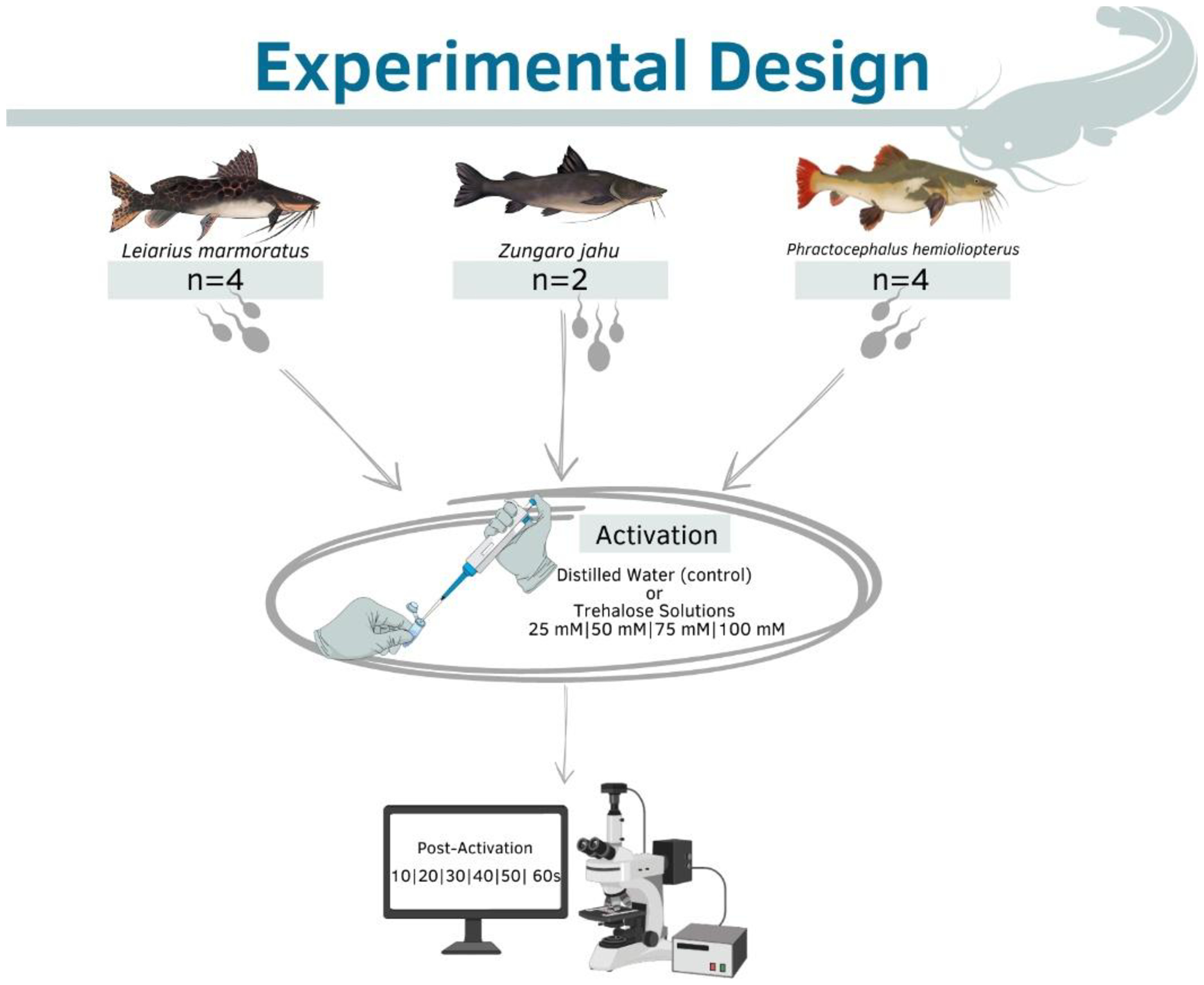
The experimental design is summarized in Figure 1. The study was performed in a completely randomized design using L. marmoratus (n = 4), Z. jahu (n = 2), and P. hemioliopterus (n = 4). One sperm pool of each species was formed. The sperm kinetics parameters during the motility times (10, 20, 30, 40, 50, and 60 s) were compared in sperm samples after being activated with distilled water or trehalose solutions (25 mM, 50 mM, 75 mM, or 100 mM). Three activations (n = 3) using each treatment were performed, with each activation considered one repetition. It is important to emphasize that the three repetitions per treatment represent technical replicates, as all kinetic evaluations were carried out on a single pooled sperm sample per species. Therefore, the statistical comparisons reflect variation within this pooled sample, rather than biological variability among individual males. Trehalose concentrations were chosen based on Viveiros et al. (2016). They reported a positive correlation between higher glucose concentrations in the activating solution and better maintenance of sperm kinetic parameters post-activation. However, above 100 mM glucose showed no further benefits.
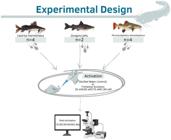
Experimental design to compare the kinetics parameters of L. marmoratus (n = 4), Z. jahu (n = 2), and P. hemioliopterus (n = 4) sperm activated with distilled water or trehalose solutions in different concentrations (25, 50, 75, and 100 mM; diluted in distilled water) along the time after activation (10, 20, 30, 40, 50, and 60 s). The analysis was performed using Computer-Assisted Sperm Analyzer (CASA) in three repetitions.
2.4. Spermatozoa kinetic parameters
A sperm aliquot of 1 µL was pipped into a plastic tube (1.5 mL) and activated with 50 µL of distilled water (control), or trehalose (Merck, Darmstadt, Germany) solutions (25, 50, 75, or 100 mM; diluted in distilled water) at 28 °C, reaching a ratio of 1:51 (sperm: activating solution). Immediately, 5 µL of active sperm was pipped into a Neubauer chamber (0.1 mm depth) under a light microscope trinocular light microscope (Bel Solaris, Milan, Italy) at 100x magnification with a camera (Basler AC640-120uc, 658 × 492 pixels, 120 frames per second (fps), Ahrensburg, Germany) attached for video recording. Spermatic movements videos were recorded at 100 fps and captured by a computer (Microsoft Windows 8 operating system, Intel core i7 processor, 2.4 GHz CPU, and 8 GB of memory) connected to the camera using Pylon Viewer 4 software (Version 4.1.0.3660 64-Bit; Basler, Ahrensburg, Germany). A 60-second video recording was initiated 10 s after sperm activation. Subsequently, these videos were edited using VirtualDub software (Version 1.10.04; Microsoft Virtual Studio, Redmond, USA), and divided into 6 sequences of 100 images, with each sequence corresponding to a 10 s time interval for analysis (e.g., 10-20 s, 20-30 s, etc.). The reported time points (10 s, 20 s, etc.) represent the average of these respective 10 s intervals. Afterwards, the image sequences were imported by ImageJ software (Version 1.53e 64-Bit, National Institutes of Health, USA) and analyzed using the Computer-Assisted Sperm Analyzer (CASA) free plug-in software (Wilson-Leedy and Ingermann, 2007). The parameters analyzed were: percentage of motility sperm in relation to static (MOT - %); curvilinear velocity (VCL - µm s-1), average path velocity (VAP - µm s-1), straight line velocity (VSL - µm s-1); sperm straightness (STR - %), wobble (WOB - %), progression (PROG - µm), and beat cross frequency (BCF - Hz) (Verstegen et al., 2002). The detection parameters used to analyze the samples in the CASA plug-in were a = 1; b = 40; c = 100; d = 10; e = 10; f = 10; g = 30; h = 5; i = 1; j = 15; k = 15; l = 25; m = 80; n = 80; o = 50; p = 60; q = 100; r = 556.24; s = 0; t = 0.
2.5. Statistical analysis
The data are expressed as the mean ± standard deviation (SD). Normality (Shapiro-Wilk) and homogeneity (O’Neill Mathews) were verified. When data did not show normality or homogeneity, it was transformed (LOG), and the outliers were excluded using the ROUT test (Q = 1%). For normal and homogeneous data, ANOVA (one-way) was performed followed by a Tukey test. For non-normal data, Kruskal Wallis's non-parametric analysis was performed following Dunn's test. The level of significance for all statistical tests was set at 95% confidence level. Statistical analysis and graph construction were performed using GraphPad Prism 7.04 and R Studio 2022.07.1.
3. Results
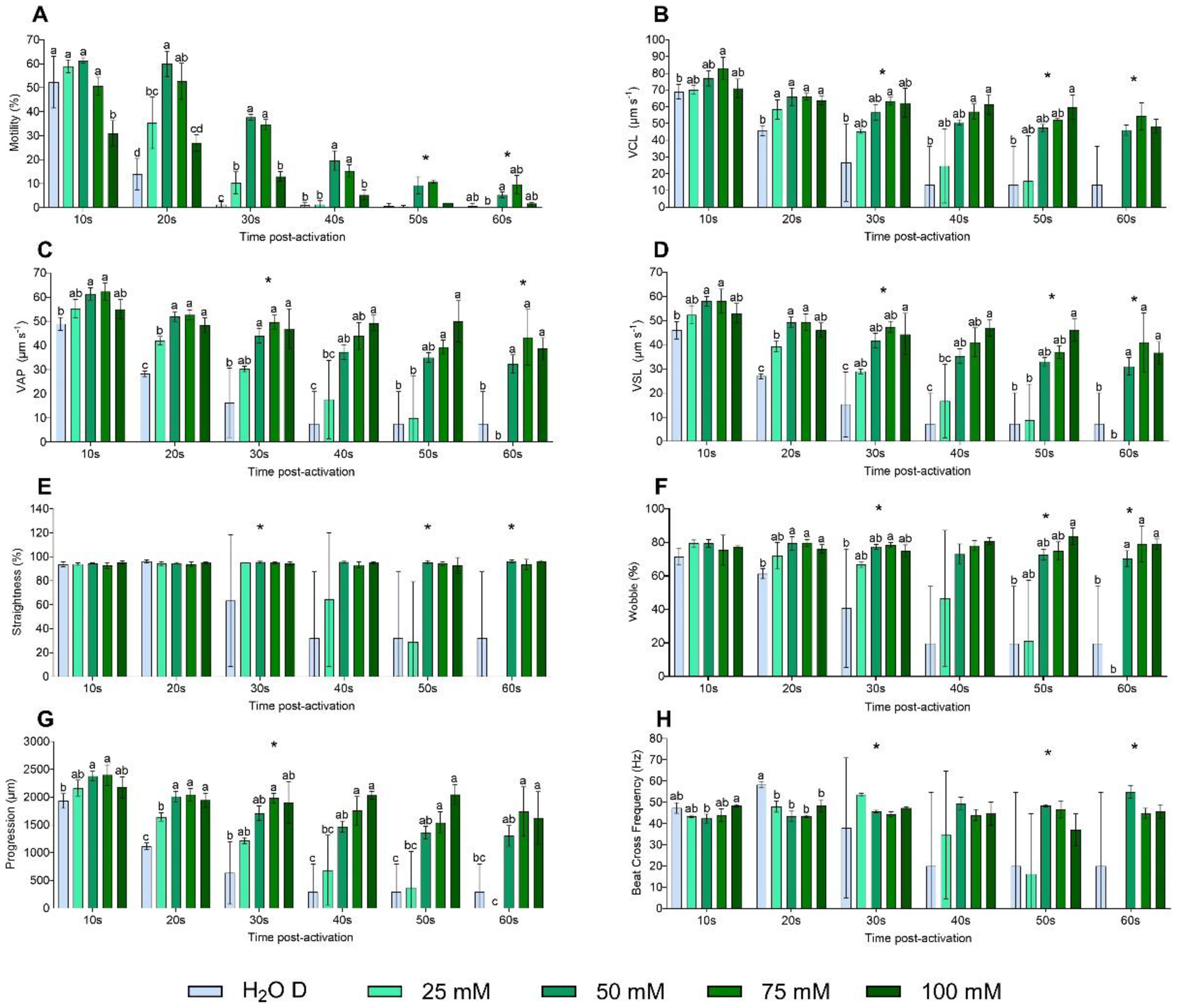
The observed L. marmoratus volume sperm was 0.8 ± 0.2 mL, Z. jahu was 0.5 ± 0.2 mL, and P. hemioliopterus, was observed 2.4 ± 0.9 mL The L. marmoratus sperm motility (Figure 2A) decreased over time after activation. Trehalose solutions containing up to 75 mM promoted initial sperm motility (10 s) similar to distilled water. At 20 s post-activation, distilled water showed a 39% decrease, while 50 and 75 mM trehalose maintained initial MOT levels. At 30 s, MOT was 38% and 35% for 50 and 75 mM respectively, versus 10% for 25 mM and close 0% using distilled water . At 40s, MOT was higher using 50 and 75 mM than sperm activated with 25 and 100 mM solutions. At 50 s, MOT persisted only in 50 and 75 mM, lasting until 60 s post-activation.
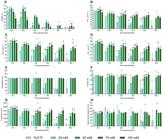
Sperm kinetic results of L. marmoratus activated with trehalose solutions (25, 50, 75, or 100 mM) and distilled water (control). Graphs show motility (MOT – A), curvilinear velocity (VCL – B), average path velocity (VAP – C), straight line velocity (VSL – D), straightness (STR – E), wobble (WOB – F), progression (PROG – G) and beat cross frequency (BCF – H) analyzed by computer-assisted sperm analyzer (CASA) 10, 20, 30, 40, 50, and 60 seconds after activation. Bars indicate mean ± SD. Different letters indicate differences between means (P < 0.05; Tukey’s or Dunn’s test), asterisks indicate that non-parametric Kruskal-Wallis followed by Dunn’s test was performed.
Trehalose solutions also increased L. marmoratus sperm velocity. At 10 to 40 s, 75 mM promoted higher VCL than distilled water; 100 mM provided higher VCL than distilled water at 20, 40, 50, and 60 s (Figure 2B). Trehalose at 50 to 100 mM improved VAP (Figure 2C) and VSL (Figure 2D) post-activation. Straightness was unaffected (Figure 2E). WOB remained stable with 50–100 mM trehalose, while distilled water showed a drop after 20 s (Figure 2F). Trehalose also improved PROG. At 10s, 50 and 75 mM had PROG than samples distilled water; later, 50, 75, and 100 mM trehalose maintained this advantage (Figure 2G). The use of trehalose solutions also influenced sperm BCF. At 10 s, 100 mM showed a higher BCF than sperm activated with 50 mM. At 20s, sperm activated with distilled water showed a higher BCF than samples activated with all trehalose solutions. At the other evaluation times, no differences were observed between treatments (Figure 2H).
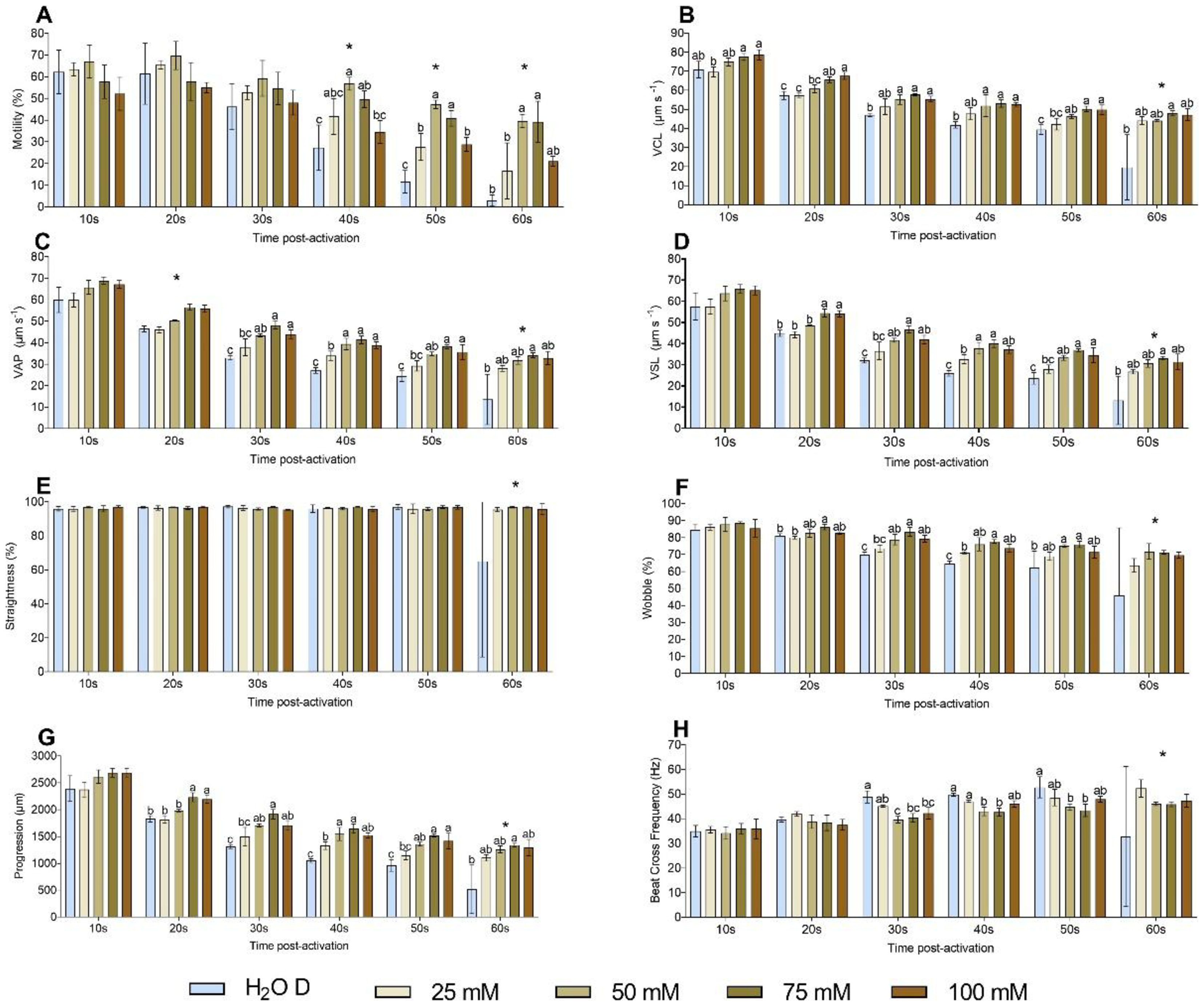
Trehalose at 50 and 75 mM prolonged Z. jahu sperm motility. At 10, 20, and 30 s, no differences in MOT were observed between distilled water and trehalose solutions. From 40 s onwards, samples activated with solutions containing 50 and 75 mM trehalose showed higher MOT than with distilled water. At 60 s, these concentrations maintained 39% MOT, while samples activated with distilled water showed MOT close to 0% (Figure 3A).
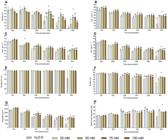
Sperm kinetic results of Z. jahu activated with trehalose solutions (25, 50, 75, or 100 mM) and distilled water (control). Graphs show motility (MOT – A), curvilinear velocity (VCL – B), average path velocity (VAP – C), straight line velocity (VSL – D), straightness (STR – E), wobble (WOB – F), progression (PROG – G) and beat cross frequency (BCF – H) analyzed by computer-assisted sperm analyzer (CASA) 10, 20, 30, 40, 50, and 60 seconds after activation. Bars indicate mean ± SD. Different letters indicate differences between means (P < 0.05; Tukey’s or Dunn’s test), asterisks indicate that non-parametric Kruskal -Wallis followed by Dunn’s test was performed.
Trehalose also sustained sperm velocities (Figure 3B, C, D). At 10 s, no velocity differences were observed, however, from 20 s onward, trehalose solutions showed higher sperm velocities than distilled water. The sperm activation with distilled water and trehalose solutions did not affect the STR in all evaluation times (Figure 3E). WOB remained stable from 20 s with 50, 75, and 100 mM trehalose, while after sperm distilled water showed a WOB decrease along the motility time (Figure 3F). At 10 s, PROG did not differ; however, at 20 s, 75 and 100 mM showed the highest sperm PROG. Between 30 s and 50 s, samples activated with 50, 75, and 100 mM trehalose showed higher PROG than sperm activated with distilled water (Figure 3G), supporting its use for maintaining progressive motility. In contrast to previous sperm parameters, samples activated with distilled water showed higher BCF than sperm activated with 50 or 75 mM trehalose 30 s after sperm activation (Figure 3H).
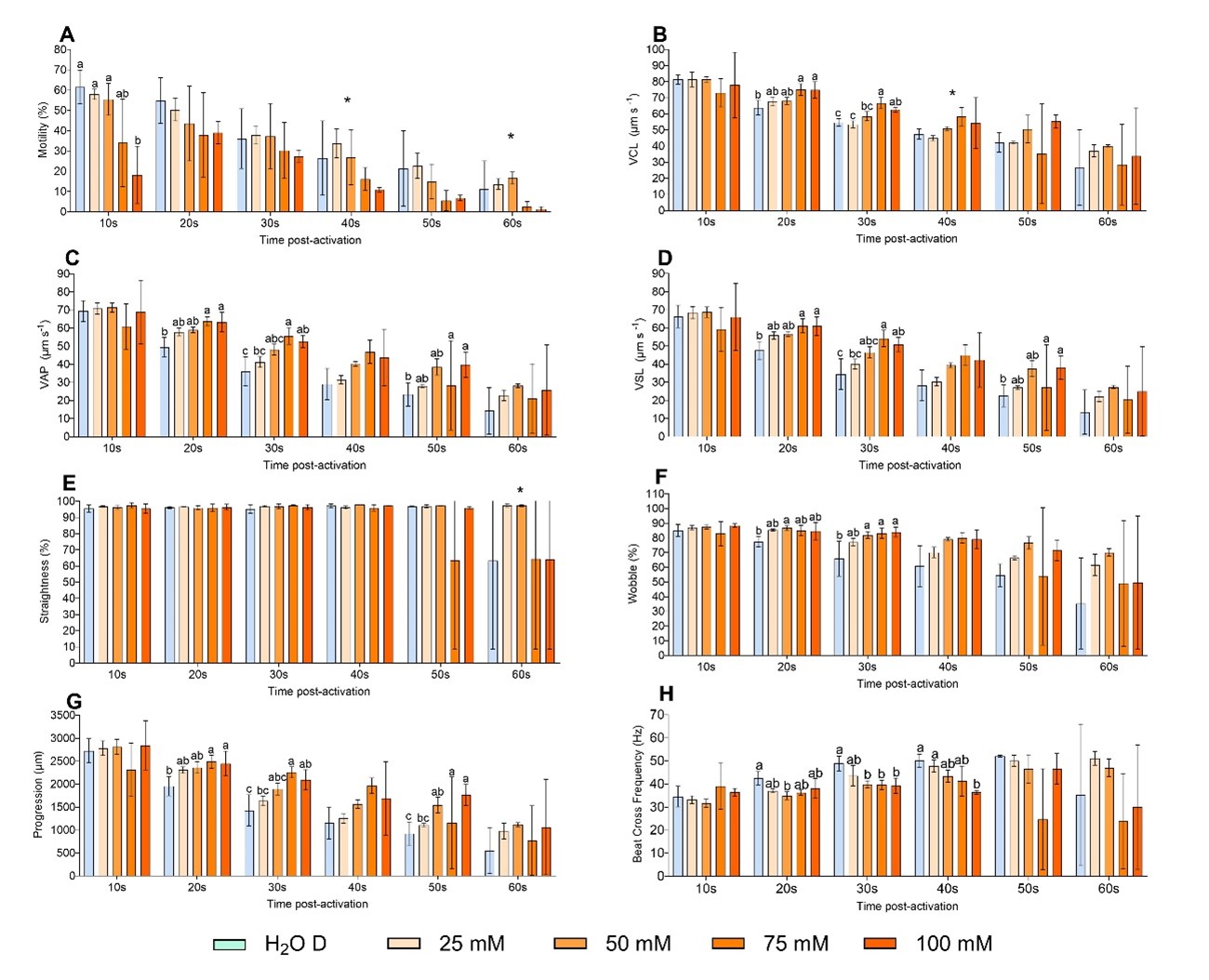
Sperm motility of P. hemioliopterus decreased post-activation; however, a motility increase was observed in samples activated with 75 and 100 mM trehalose solutions between 10 and 20 s. At 10 s, samples activated with distilled water (62%) and trehalose solutions containing 25 (58%) and 50 mM (56%) showed a higher MOT than sperm activated using 100 mM trehalose (18%). In subsequent evaluation times, MOT differences among treatments were not observed (Figure 4A).
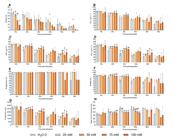
Sperm kinetic results of P. hemioliopterus activated with trehalose solutions (25, 50, 75, or 100 mM) and distilled water (control). Graphs show motility (MOT – A), curvilinear velocity (VCL – B), average path velocity (VAP – C), straight line velocity (VSL – D), straightness (STR – E), wobble (WOB – F), progression (PROG – G) and beat cross frequency (BCF – H) analyzed by computer-assisted sperm analyzer (CASA) 10, 20, 30, 40, 50, and 60 seconds after activation. Bars indicate mean ± SD. Different letters indicate differences between means (P < 0.05; Tukey’s or Dunn’s test), asterisks indicate that non-parametric Kruskal -Wallis followed by Dunn’s test was performed.
Trehalose solution did not affect the sperm velocities at the initial activation time (10 s). On the other hand, at 20 and 30 s for VCL (Figure 4B) and 20, 30, and 50 s after activation for VAP (Figure 4C) and VSL (Figure 4D), the sperm activated with trehalose solutions containing 75 and 100 mM showed higher velocities than samples activated with distilled water. This indicates that using trehalose solutions as an activator could prolong the initial velocities of motile sperm. The sperm STR was not affected at any evaluation times (Figure 4E). The same was observed for WOB at 10 s. However, the trehalose solutions maintained sperm WOB until 30 s post-activation (Figure 4F). These concentrations also led to higher sperm PROG at 20, 30, and 50 s than the samples were activated with distilled water, with no differences at other evaluation times (Figure 4G). Sperm samples activated using distilled water show higher BCF at different evaluation times than those activated with trehalose solutions: 20 s - 50 mM, 30 s - 50, 75, and 100 mM, and 40 s - 100 mM (Figure 4H).
4. Discussion
The large catfishes used in this study are of commercial and environmental interest. These animals bred in captivity are commercialized for food, sport fishing, ornamental, and repopulation in a natural environment (Coutinho et al., 2019; Paulino et al., 2020; Guilherme et al., 2023). The three species perform external fertilization and share the same problem: they produce a low sperm volume. In the present study, we found that using trehalose solutions as a activating sperm for L. marmoratus and Z. jahu increased and prolonged sperm kinetic parameters. This finding may contribute directly to increasing the production of these species in captivity, given the inherent difficulty of the reproductive management of these specimens and thereby preserving their natural stocks.
The reproductive management of these species in captivity is complicated, as breeders are large, especially Z. Jahu and P. hemioliopterus, and release a low sperm volume. For the three species of catfish, we observed a low sperm volume and spermatozoa concentration about the live weight of the breeders (L. marmoratus 0.8 mL - 3.3 kg; Z. jahu 0.5 mL - 7.4 kg; P. hemioliopterus 2.4 mL - 11.8 kg). For comparison, the Rhamdia quelen breeders weighing 0.762 kg produced 13 mL of sperm (França et al., 2022). Other study reported for L. marmoratus a sperm volume of 0.81 mL (Spica et al., 2021). These values are close to those found for this species in the present study. On the other hand, for Z. jahu, the collection of 1.9 mL of sperm was reported (Nogueira et al., 2012), a value significantly higher than those we found. The discrepancy in results can be justified because the sperm volume of Neotropical fishes varies in inter and intra-fish species (Viveiros and Godinho, 2009). Low sperm volume makes artificial reproduction of fish in captivity difficult. Therefore, it is necessary to apply and develop techniques to enhance sperm use.
Sperm motility in freshwater fishes with external fertilization is activated by contact with a hypotonic aqueous solution in relation to seminal plasma (Alavi and Cosson, 2006). The physical-chemical characteristics and the composition of the sperm-activating aqueous solution influence the quality of sperm kinetic parameters and the duration of sperm motility (Alavi and Cosson, 2005, 2006). In the present study, we observed that L. marmaratus and Z. jahu sperm samples activated with trehalose solutions (50 and 75 mM) showed longer motility time and maintained the kinetic parameters quality for longer than samples activated with distilled water. The same was reported in other Neotropical fishes, such as Rhamdia quelen using a fructose-based activating solution (Adames et al., 2015) and in Prochilodus vimboides using a glucose-based activating solution (França et al., 2020). The sperm energy used to carry out flagellar movement and primary metabolism is obtained by the nutrient breakdown of internal and external origin (Kholodnyy et al., 2020). Even though the gametes' mechanisms of absorption of these nutrients are not yet known (Kholodnyy et al., 2020).
The faster decrease of sperm kinetic parameters over time in samples activated with distilled water can be explained by the fact that the fish sperm was released into an external environment without metabolic substrates and ions. Therefore, the energy to maintain sperm motility comes only from the ATP reserve deposited in mitochondria during spermatogenesis (Kholodnyy et al., 2020). Furthermore, the osmotic shock caused by activation using distilled water or solutions with very low osmolality causes a high water influx into cells (Hu et al., 2009), causing damage to the membrane and potentially leading to dysfunction of these structures (Bondarenko et al., 2013). In contrast, using trehalose solutions to activate P. hemioliopterus sperm did not cause the same effect observed in the spermatozoa motility of L. marmoratus and Z. jahu. This indicates a physiological and metabolic difference between spermatozoa using energy substrates in the external environment to generate energy. The same inability was observed for Brycon orbignyanus, since sperm samples activated with a glucose-based solution did not show a longer sperm motility duration or better kinetic parameters than samples activated with a sodium chloride-based activating solution (França et al., 2020).
Activation of L. marmoratus and Z. jahu sperm samples with trehalose solutions (50 and 75 mM) maintained sperm motility and velocities for longer after activation, consequently increasing the sperm's ability to move. This fact increases sperm fertilization capacity because spermatozoa must move close to the oocytes to fertilize (Cosson, 2019). Furthermore, sperm activation with trehalose solutions at concentrations of 50 and 75 mM increased sperm velocities, which are essential in the external reproduction of fish. Authors have already reported high correlations between sperm velocities and fertilization rate for Neotropical fishes such as Rhamdia quelen (Neumann et al., 2019), Prochilodu lineatus (Viveiros et al., 2010) and Colossoma macropomum (Gallego et al., 2017). When the oocyte is released, it must be fertilized as soon as possible, as it hydrates in water and the micropyle closes, making fertilization impossible. This way, faster sperm can fertilize the oocyte before the micropyle closes.
A methodological limitation of this study is that, due to the limited semen volume obtained from each breeder, the experiments were conducted using a single pooled sample per species. Consequently, the statistical analyses are based on technical replicates, which describe the response of the pooled sample but do not capture the biological variability that would occur among multiple individuals. This restricts the generalizability of the results to the broader population, as inter-individual variation in sperm kinetics could not be assessed. Nevertheless, pooling was essential to ensure sufficient volume for all activating solutions and time points, as commonly required in studies with large Neotropical catfish species. Future studies incorporating larger numbers of breeders are needed to validate whether the patterns observed here are consistent at the population level.
The fact that we conducted the study on a commercial fish farm restricted the experiment's sample size. The broodstock used was large, making handling difficult and posing a risk of death to the fish. Since these broodstock have a high market value, the fish farm did not provide a larger number of fish for collection. Even so, present study is one of the few to investigate about the captivity reproduction of these three large South American catfish and the first to develop a methodology capable of increasing sperm efficiency. Our data showed that using trehalose solutions (50 and 75 mM) in activating L. marmoratus and Z. jahu sperm samples increased and maintained sperm kinetic parameters, consequently increasing the sperm reproductive potential during artificial reproduction. Applying the knowledge obtained in this study to the reproduction of L. marmoratus, Z. jahu, and P. hemioliopterus in captivity will make the production process more efficient and serve as a basis for developing other studies with large South American catfish.
Our results, by optimizing sperm activation for L. marmoratus and Z. jahu, demonstrate a significant advance in reproductive biotechnologies applied to large South American catfish. Such innovations align perfectly with the emerging concept of 'One Conservation', which proposes an integrated view of biodiversity conservation (Pizzutto et al., 2021). This concept emphasizes the interconnectedness between in situ and ex situ conservation strategies, anthropogenic actions in the environment (sustainability), and scientific research in various fields. The ability to improve semen quality and, consequently, the efficiency of assisted reproduction in captivity, as demonstrated in this study, is fundamental for the success of ex situ conservation programs. By facilitating the maintenance of viable populations under human care, which is particularly challenging for species with low seminal volume and complex management, such as those studied our research directly contributes to the formation of 'insurance populations' and to the potential for genetic exchange with wild populations, essential for ecosystem restoration and for addressing the growing threat of mass species extinction. For example, the reproductive success of Neotropical freshwater fish is strongly influenced by hydrological variability and extreme climatic events, which can lead to partial or complete loss of reproductive cycles during periods of drought (Brambilla et al., 2025). This holistic approach, which values basic and applied science in the ex-situ context, is crucial for ensuring the long-term persistence of species with commercial and environmental value.
5. Conclusion
Our results are limited due to the small sample size used, and the analyses were conducted on pooled sperm samples; however, activating solutions containing 50 or 75 mM trehalose are indicated to improve and maintain the sperm quality of L. marmoratus and Z. jahu along the motility time. Conversely, for P. hemioliopterus, distilled water is better indicated for activating sperm, as it provided higher initial motility, and trehalose solutions containing more than 50 mM should be avoided.
Acknowledgements
This study was financed in part by the Coordenação de Aperfeiçoamento de Pessoal de Nível Superior - Brasil (CAPES) - Finance Code 001. This study was financed in part by the Universidade Federal de Mato Grosso do Sul – UFMS/MEC – Brasil. We would also like to thank the Conselho Nacional de Desenvolvimento Cientifico e Tecnológico (CNPq) for financial support through projects: 444572/2024-4 and 403157/2024-2. Researchers D.P. Streit Jr (305387/2022-7), J.L. Benato (20172/2025-3), J.A. Povh (312072/2021-0), N.S. Teixeira (grant 153681/2025-0) and T.S. França (141717/2019-0, 200285/2021-1, and 2518796) are CNPq research fellows.
Data Availability Statement
The present study’s raw data is available at https://doi.org/10.5281/zenodo.14133808
References
-
ADAMES, M.S., DE TOLEDO, C.P.R., NEUMANN, G., BUZZI, A.H., BURATTO, C.N., PIANA, P.A. and BOMBARDELLI, R.A., 2015. Optimization of the sperm: oocyte ratio and sperm economy in the artificial reproduction of Rhamdia quelen using fructose as a sperm motility modulator. Animal Reproduction Science, vol. 161, pp. 119-128. https://doi.org/10.1016/j.anireprosci.2015.08.014 PMid:26364705.
» https://doi.org/10.1016/j.anireprosci.2015.08.014 - AGOSTINHO, A.A., GOMES, L.C., SUZUKI, H.I. and JÚLIO JUNIOR, H.F., 2003. Migratory fishes of the Upper Rio Paraná Basin, Brazil. In: J. CAROLSFELD, B. HARVEY, C. ROSS and A. BAER, eds. Migratory fishes of South America: biology, fisheries, and conservation status Victoria: World Fisheries Trust/IDRC/World Bank, pp. 19-98.
-
AGOSTINHO, A.A., PELICICE, F.M. and GOMES, L.C., 2008. Dams and the fish fauna of the Neotropical region: impacts and management related to diversity and fisheries. Brazilian Journal of Biology = Revista Brasileira de Biologia, vol. 68, no. 4, suppl., pp. 1119-1132. https://doi.org/10.1590/S1519-69842008000500019 PMid:19197482.
» https://doi.org/10.1590/S1519-69842008000500019 -
ALAVI, S.M.H. and COSSON, J., 2005. Sperm motility in fishes. (I) Effects of temperature and pH: a review. Cell Biology International, vol. 29, no. 2, pp. 101-110. https://doi.org/10.1016/j.cellbi.2004.11.021 PMid:15774306.
» https://doi.org/10.1016/j.cellbi.2004.11.021 -
ALAVI, S.M.H. and COSSON, J., 2006. Sperm motility in fishes. (II) Effects of ions and osmolality: a review. Cell Biology International, vol. 30, no. 1, pp. 1-14. https://doi.org/10.1016/j.cellbi.2005.06.004 PMid:16278089.
» https://doi.org/10.1016/j.cellbi.2005.06.004 -
ARAÚJO, J.Ê.X.S., STREIT JUNIOR, D.P., RIBEIRO, J.S.A., MARTINS, E.F.F., SOUZA, F.N., OLIVEIRA, C.A.L., RIBEIRO, R.P., LOPERA-BARRERO, N.M. and POVH, J.A., 2014. Ovopel and carp pituitary extract as spawning inducers in males of the Amazon catfish Leiarius marmoratus (Gill, 1970). Brazilian Archives of Biology and Technology, vol. 57, no. 6, pp. 882-886. https://doi.org/10.1590/S1516-8913201402469
» https://doi.org/10.1590/S1516-8913201402469 -
AVIGLIANO, E., POUILLY, M., VARGAS, F., PENHA, J., SILVA, N., BOUCHEZ, J., SÁNCHEZ, S. and VOLPEDO, A.V., 2023. Environmental history of one of the largest freshwater neotropical fish (Zungaro jahu) from otolith isotopic analysis. River Research and Applications, vol. 39, no. 5, pp. 887-896. https://doi.org/10.1002/rra.4120
» https://doi.org/10.1002/rra.4120 -
BARLETTA, M., CUSSAC, V.E., AGOSTINHO, A.A., BAIGÚN, C., OKADA, E.K., CATELLA, A.C., FONTOURA, N.F., POMPEU, P.S., JIMÉNEZ-SEGURA, L.F., BATISTA, V.S., LASSO, C.A., TAPHORN, D. and FABRÉ, N.N., 2015. Fisheries ecology in South American river basins. In: J. CRAIG, ed. Freshwater fisheries ecology New York: John Wiley & Sons, pp. 311-348. https://doi.org/10.1002/9781118394380.ch27
» https://doi.org/10.1002/9781118394380.ch27 -
BONDARENKO, O., DZYUBA, B., COSSON, J., YAMANER, G., PROKOPCHUK, G., PSENICKA, M. and LINHART, O., 2013. Volume changes during the motility period of fish spermatozoa: interspecies differences. Theriogenology, vol. 79, no. 5, pp. 872-881. https://doi.org/10.1016/j.theriogenology.2013.01.005 PMid:23394972.
» https://doi.org/10.1016/j.theriogenology.2013.01.005 -
BONI, T.A., PADIAL, A.A., PRIOLI, S.M.A.P., LUCIO, L.C., MANIGLIA, T.C., BIGNOTTO, T.S., PANARARI-ANTUNES, R.S., PRIOLI, R.A. and PRIOLI, A.J., 2011. Molecular differentiation of species of the genus Zungaro (Siluriformes, Pimelodidae) from the Amazon and Paraná-Paraguay River basins in Brazil. Genetics and Molecular Research, vol. 10, no. 4, pp. 2795-2805. https://doi.org/10.4238/2011.November.10.2 PMid:22095604.
» https://doi.org/10.4238/2011.November.10.2 -
BRAMBILLA, E.M., SUIBERTO, M.R., BIALETZKI, A., PORTO-FORESTI, F. and NOGUEIRA, M.G., 2025. Extreme climatic events affecting freshwater fish reproduction in the Neotropics. Brazilian Journal of Biology = Revista Brasileira de Biologia, vol. 85, pp. e289459. https://doi.org/10.1590/1519-6984.289459 PMid:40435068.
» https://doi.org/10.1590/1519-6984.289459 -
COSSON, J., 2019. Fish sperm physiology: structure, factors regulating motility, and motility evaluation. In: Y. BOZKURT, ed. Biological research in aquatic science London: IntechOpen, pp. 11-36.. https://doi.org/10.5772/intechopen.85139
» https://doi.org/10.5772/intechopen.85139 -
COUTINHO, N.M., TEIXEIRA MÁRSICO, E., CINQUINI, M.A., ALVES DA SILVA, F., GUERRA MONTEIRO, M.L., ARAÚJO DE MORAES, I. and CONTE-JUNIOR, C., 2019. Lipid distribution in the meat of jau (Zungaro jahu) and the influence of storage temperature on its fat stability. Archives of Veterinary Science, vol. 24, pp. 22-31. https://doi.org/10.5380/avs.v24i3.58676
» https://doi.org/10.5380/avs.v24i3.58676 -
DA COSTA, B.B., RODRIGUES, R.B., POVH, J.A., SANCHES, E.A., TEIXEIRA, N.S., FRANÇA, T.S., SPICA, L.N., MACHADO, T.L.F., BENATO, J.L., STAWINSKI, C.V., KASAI, R.Y.D. and STREIT JUNIOR, D.P., 2024. Descriptive analysis of the sperm of three South American catfish species maintained ex situ and the influence of morphology on sperm movement. Theriogenology Wild, vol. 4, pp. 100080. https://doi.org/10.1016/j.therwi.2024.100080
» https://doi.org/10.1016/j.therwi.2024.100080 -
FANTINI, L.E., CORRÊA FILHO, R.A.C., MARTINS, T.X., LAICE, L.M., SERAPHIM, G.N., SILVA, A.L.N., HANSON, T. and POVH, J.A., 2019. Growth curve comparison of native fish cachara (Pseudoplatystoma reticulatum) and cachapinta hybrid (P. reticulatum × Pseudoplatystoma corruscans). Aquaculture (Amsterdam, Netherlands), vol. 506, pp. 70-74. https://doi.org/10.1016/j.aquaculture.2019.03.020
» https://doi.org/10.1016/j.aquaculture.2019.03.020 - FOOD AND AGRICULTURE ORGANIZATION – FAO, 2022. The state of world fisheries and aquaculture 2022 Rome: FAO.
-
FRANÇA, T., GOMES, I.C., SANCHES, E.A., ATEHORTÚA, M.P., TEIXEIRA, N.S., RODRIGUES, R.B., DE FREITAS, T.R., GALUPPO, A.G., QUIRINO, M., BENATO, J.L., MACHADO, T.L.F., MARQUES, L.S., BUSTAMANTE-FILHO, I.C., BORTOLOZZO, F.P. and STREIT JUNIOR, D.P., 2022. Post-thaw dilution of Rhamdia quelen sperm improves the reproductive success. Animal Reproduction Science, vol. 243, pp. 107018. https://doi.org/10.1016/j.anireprosci.2022.107018 PMid:35716630.
» https://doi.org/10.1016/j.anireprosci.2022.107018 -
FRANÇA, T.S., MOTTA, N.C., EGGER, R.C., OLIVEIRA, A.V. and MURGAS, L.D.S., 2020. Impact of activation solutions on fresh and frozen-thawed sperm motility and fertilization success for two species of migratory freshwater fishes. Theriogenology, vol. 149, pp. 6-15. https://doi.org/10.1016/j.theriogenology.2020.03.016 PMid:32224378.
» https://doi.org/10.1016/j.theriogenology.2020.03.016 -
FREITAS, T.M.S. and MONTAG, L.F.A., 2019. Population and reproductive parameters of the red-tailed catfish, Phractocephalus hemioliopterus (Pimelodidae: Siluriformes), from the Xingu River. Neotropical Ichthyology, vol. 17, no. 2, pp. 1-8. https://doi.org/10.1590/1982-0224-20190015
» https://doi.org/10.1590/1982-0224-20190015 - FUENTES, C.M. and MANTINIAN, J.E., 2021. Síntesis de las Regulaciones de la Pesca en la Cuenca del Río de la Plata en Territorio Argentino Buenos Aires: Coordinación de Pesca Continental, Dirección de Planificación Pesquera, Subsecretaría de Pesca y Acuicultura.
-
GALLEGO, V., CAVALCANTE, S.S., FUJIMOTO, R.Y., CARNEIRO, P.C.F., AZEVEDO, H.C. and MARIA, A.N., 2017. Fish sperm subpopulations: changes after cryopreservation process and relationship with fertilization success in tambaqui (Colossoma macropomum). Theriogenology, vol. 87, pp. 16-24. https://doi.org/10.1016/j.theriogenology.2016.08.001 PMid:27616215.
» https://doi.org/10.1016/j.theriogenology.2016.08.001 -
GUILHERME, H.O., RIBEIRO, P.A.P., PRADO, V.G.L., BAHIENSE, R.N., GAMARANO, P.G., OLIVEIRA, C.G., FREITAS, D.A. and COSTA, L.S., 2023. Feeding behaviour, locomotion rhythms and blood biochemistry of the neotropical red‐tail catfish (Phractocephalus hemioliopterus). Journal of Fish Biology, vol. 102, no. 4, pp. 803-815. https://doi.org/10.1111/jfb.15317 PMid:36648082.
» https://doi.org/10.1111/jfb.15317 -
HU, J., ZHANG, Y., ZHOU, R. and ZHANG, Y., 2009. Changes in extracellular osmolality initiate sperm motility in freshwater teleost rosy barb Puntius conchonius. Theriogenology, vol. 72, no. 5, pp. 704-710. https://doi.org/10.1016/j.theriogenology.2009.05.009 PMid:19576625.
» https://doi.org/10.1016/j.theriogenology.2009.05.009 -
KHOLODNYY, V., BORYSHPOLETS, S., DZYUBA, B. and COSSON, J., 2020. Energetics of fish spermatozoa. In: J. BETSY and S. KUMAR, eds. Cryopreservation of fish gametes Singapore: Springer Nature, pp. 69-116.. https://doi.org/10.1007/978-981-15-4025-7_4
» https://doi.org/10.1007/978-981-15-4025-7_4 -
LAHNSTEINER, F., PATZNER, R.A. and WEISMANN, T., 1992. Monosaccharides as energy resources during motility of spermatozoa in Leuciscus cephalus (Cyprinidae, Teleostei). Fish Physiology and Biochemistry, vol. 10, no. 4, pp. 283-289. https://doi.org/10.1007/BF00004477 PMid:24214325.
» https://doi.org/10.1007/BF00004477 -
LAHNSTEINER, F. and CABERLOTTO, S., 2012. Motility of gilthead seabream (Sparus aurata) spermatozoa and its relation to temperature, energy metabolism and oxidative stress. Aquaculture, vol. 370-371, pp. 76-83. https://doi.org/10.1016/j.aquaculture.2012.09.034
» https://doi.org/10.1016/j.aquaculture.2012.09.034 - NAKATANI, K., AGOSTINHO, A.A., BAUMGARTNER, G., BIALETZKI, A., SANCHES, P.V., MAKRAKIS, M.C. and PAVANELLI, C.S., 2001. Ovos e larvas de peixes de água doce: desenvolvimento e manual de identificação 1st ed. Maringá: Editora UEM, 378 p.
-
NEUMANN, G., SANCHES, P.V. and BOMBARDELLI, R.A., 2019. Effects on fertility of motile sperm to egg ratio with use of cryopreserved Rhamdia quelen semen at different post-activation times. Animal Reproduction Science, vol. 201, pp. 84-92. https://doi.org/10.1016/j.anireprosci.2019.01.001 PMid:30621964.
» https://doi.org/10.1016/j.anireprosci.2019.01.001 -
NOGUEIRA, L.B., AZEVEDO, P.G., CANELHAS, M.R., BEDORE, A.G., LOPES, J.M. and GODINHO, H.P., 2012. Induced spawning and early ontogeny in hatchery-reared catfish Zungaro jahu (Siluriformes: pimelodidae). Neotropical Ichthyology, vol. 10, no. 1, pp. 89-98. https://doi.org/10.1590/S1679-62252012000100009
» https://doi.org/10.1590/S1679-62252012000100009 -
PAULINO, R.R., FORTES-SILVA, R., PRIETO-GUEVARA, M.J., RODRIGUES, E.J.D., COSTA, L.S., ALVES, A.P.C., TELES, A.O. and ROSA, P.V., 2020. Dietary lipid level and source affect metabolic responses in hybrid catfish (Pseudoplatystoma reticulatum × Leiarius marmoratus). Aquaculture Research, vol. 51, no. 4, pp. 1567-1583. https://doi.org/10.1111/are.14504
» https://doi.org/10.1111/are.14504 - PEIXE BR, 2025. Anuário Peixe BR da piscicultura 2025 São Paulo: Peixe BR.
-
PIZZUTTO, C.S., COLBACHINI, H. and JORGE-NETO, P.N., 2021. One Conservation: the integrated view of biodiversity conservation. Animal Reproduction, vol. 18, no. 2, pp. e20210024. https://doi.org/10.1590/1984-3143-ar2021-0024 PMid:34122656.
» https://doi.org/10.1590/1984-3143-ar2021-0024 -
SEGARAN, T.C., AZRA, M.N., PIAH, R.M., LANANAN, F., TÉLLEZ-ISAÍAS, G., GAO, H., TORSABO, D., KARI, Z.A. and NOORDIYANA, M.N., 2023. Catfishes: A global review of the literature. Heliyon, vol. 9, no. 9, pp. e20081. https://doi.org/10.1016/j.heliyon.2023.e20081 PMid:37810135.
» https://doi.org/10.1016/j.heliyon.2023.e20081 -
SPICA, L.N., SANCHES, E.A., STREIT JUNIOR, D.P.S., CORREA FILHO, R.A.C., BRASILEIRO, L.O., RODRIGUES, R.B., KASAI, R.Y.D. and POVH, J.A., 2021. Successive seminal collections from Leiarius marmoratus during the reproductive period. Animal Reproduction Science, vol. 234, pp. 106852. https://doi.org/10.1016/j.anireprosci.2021.106852 PMid:34583146.
» https://doi.org/10.1016/j.anireprosci.2021.106852 -
VERSTEGEN, J., IGUER-OUADA, M. and ONCLIN, K., 2002. Computer assisted semen analyzers in andrology research and veterinary practice. Theriogenology, vol. 57, no. 1, pp. 149-179. https://doi.org/10.1016/S0093-691X(01)00664-1 PMid:11775967.
» https://doi.org/10.1016/S0093-691X(01)00664-1 -
VIVEIROS, A.T.M. and GODINHO, H.P., 2009. Sperm quality and cryopreservation of Brazilian freshwater fish species: a review. Fish Physiology and Biochemistry, vol. 35, no. 1, pp. 137-150. https://doi.org/10.1007/s10695-008-9240-3 PMid:19189240.
» https://doi.org/10.1007/s10695-008-9240-3 -
VIVEIROS, A.T.M., NASCIMENTO, A.F., ORFÃO, L.H. and ISAÚ, Z.A., 2010. Motility and fertility of the subtropical freshwater fish streaked prochilod (Prochilodus lineatus) sperm cryopreserved in powdered coconut water. Theriogenology, vol. 74, no. 4, pp. 551-556. https://doi.org/10.1016/j.theriogenology.2010.03.018 PMid:20494428.
» https://doi.org/10.1016/j.theriogenology.2010.03.018 -
VIVEIROS, A.T.M., LEAL, M.C., FRANÇA, T.S., ALMEIDA, I.L.G. and ISAÚ, Z.A., 2016. Osmolality and composition of the activating solution affects motility of fresh and frozen Prochilodus lineatus sperm differently. Animal Reproduction Science, vol. 173, pp. 73-79. https://doi.org/10.1016/j.anireprosci.2016.08.014 PMid:27601320.
» https://doi.org/10.1016/j.anireprosci.2016.08.014 -
WILSON-LEEDY, J.G. and INGERMANN, R.L., 2007. Development of a novel CASA system based on open source software for characterization of zebrafish sperm motility parameters. Theriogenology, vol. 67, no. 3, pp. 661-672. https://doi.org/10.1016/j.theriogenology.2006.10.003 PMid:17137620.
» https://doi.org/10.1016/j.theriogenology.2006.10.003 -
YASUI, G.S., SENHORINI, J.A., SHIMODA, E., PEREIRA-SANTOS, M., NAKAGHI, L.S.O., FUJIMOTO, T., ARIAS-RODRIGUEZ, L. and SILVA, L.A., 2015. Improvement of gamete quality and its short-term storage: an approach for biotechnology in laboratory fish. Animal, vol. 9, no. 3, pp. 464-470. https://doi.org/10.1017/S1751731114002511 PMid:25391393.
» https://doi.org/10.1017/S1751731114002511
Edited by
-
Editor:
Elisabeth Henschel