 Population structure of Pacific oysters Crassostrea gigas (Bivalvia, Ostreidae) from north-eastern waters of Aceh province, Indonesia
Abstract
Oysters (Crassostrea gigas) are among the primary economic resources for coastal communities, while have a positive impact on the economies of fisherman families that have lower to middle incomes. This research aims to determine the population structure of Crassostrea gigas that are distributed in the north-eastern waters of Aceh Province, Indonesia. Sampling occurred in 9 areas along the northeastern coast of Aceh Province, with 50 oysters gathered from each region. The total length, width, and height of the morphometric characteristics were measured using a digital caliper with an error margin of 0.01 mm. The morphometric data underwent statistical analysis, encompassing ANOVA, discriminant analysis, and closest neighbor analysis. Results revealed that all the morphometric characters of the oysters at the 9 sampling locations were significantly different (p < 0.05). The results of discriminant and nearest neighbor analysis showed two different populations of C. gigas in Aceh. Whereas one population of C. gigas was only found in Banda Aceh, the other one population could be found in 8 other regencies. Results of this population structure analysis reflect the environmental conditions of the sampling locations as well as the evolution patterns of C. gigas in Aceh Province. This study revealed that there are several populations of C. gigas in Aceh Province which indicate morphological variations related to the species' evolutionary process.
Keywords:
morphometric; discriminant analysis; evolutionary process; oysters; nearest neighbor analysis
Resumo
Esta pesquisa tem como objetivo determinar a estrutura populacional das ostras Crassostrea gigas, que se distribuem nas águas do nordeste da província de Aceh, na Indonésia. A amostragem foi realizada em nove distritos ao longo da costa nordeste da província de Aceh e foram recolhidas 50 ostras em cada distrito. Com o recurso de um paquímetro digital (erro = 0,01 mm), foram medidos o comprimento total, a largura e a altura, para compor os caracteres morfométricos. Os dados morfométricos foram depois submetidos a análise estatística, incluindo ANOVA, análise discriminante e análise do vizinho mais próximo. Os resultados da ANOVA revelaram que todos os caracteres morfométricos das ostras, nos nove locais de amostragem, foram significativamente diferentes (p<0,05). Os resultados da análise discriminante e do vizinho mais próximo mostraram duas populações diferentes de C. gigas em Aceh. Enquanto uma população de C. gigas foi encontrada apenas em Banda Aceh, a outra população pôde ser encontrada em outros oito distritos. Os resultados desta análise da estrutura populacional refletem as condições ambientais dos locais de amostragem, bem como os padrões de evolução de C. gigas na província de Aceh.
Palavras-chave:
morfométrica; análise discriminante; processo evolutivo; ostras; análise do vizinho mais próximo
1. Introduction
Aceh Province has relatively diverse coastal resources, including fish (Batubara et al., 2017; Nur et al., 2019; Fadli et al., 2020; Octavina et al., 2021), seaweeds (Erniati et al., 2023; Gazali et al., 2023), lobsters (Akmal et al., 2023; Irfannur et al., 2024), crabs (Ulfa et al., 2018), and oysters (Kasmini et al., 2019; Kasmini and Batubara, 2023). The majority of Acehnese who reside in the province's coastline region rely heavily on this resource. Oysters (Crassostrea gigas Thunberg, 1793) are among the primary economic resources for coastal communities. While male fishermen catch the fish in the ocean, the females' catches have a positive impact on the economies of fisherman families that have lower to middle incomes (Dzikira et al., 2022). Therefore, in order to ensure the sustainability of oyster utilization, oyster resources must be managed.
Until recently, 25 species of the genus Crassostrea have been successfully identified around the world (WoRMS, 2021). Among them, C. gigas is the most dominant species in the province of Aceh (Sarong et al., 2015; Kasmini et al., 2019; Ramadhaniaty et al., 2021; Kasmini and Batubara, 2023). This species has the widest spread in the world compared to other species (Cognie et al., 2006), they typically stick to a variety of hard media in the coastal sea and can be cultivated throughout the year (Kasmini et al., 2019). C. gigas is also an important species in the estuary region as it serves as a shadowing, cultivation, nutrient cycle, and bioindicator in the ecology (Kasmini and Batubara, 2022).
Research on C. gigas that has been carried out includes morphology (Evseev et al., 1996), growth (Brusca and Ardil, 1974; Bae et al., 1978; Almeida et al., 1999; Bochenek et al., 2001; Borges et al., 2002; Harding and Mann, 2006), bioindicators (Huanxin et al., 2000; Geffard et al., 2003; Banker and Sumner, 2020), reproduction (Barber, 1996; Castaños et al., 2009; Enríquez-Díaz et al., 2009), physiology (Child and Laing, 1998; Beninger and Cannuel, 2006; Mai et al., 2012; González-Fernández et al., 2018; Zheng et al., 2021), and ecological function (Walles et al., 2015). In Aceh, research on this species is still limited to distribution (Fadli et al., 2012), bioindicators (Sarong et al., 2015; Astuti et al., 2016; Kasmini and Batubara, 2023), reproduction (Kasmini et al., 2019), biology (Kasmini and Batubara, 2022), and morphology (Kasmini et al., 2018). Studies related to the population structure have never been conducted.
Research related to morphology through various approaches has been conducted by Liu et al. (2024) on the geometric morphometric method of grouping C. gigas and C. ariakensis; Vialova (2020) on the comparative morphology of diploid and triploid C. gigas; Batista et al. (2008) on the comparison of shell and muscle shapes of C. angulata and C. gigas; Acarli et al. (2023) on the morphometric characteristics of C. gigas in Bandirma Bay, Marmara Sea; Aydin et al. (2021) on DNA identification and morphometric characteristics in the southern Black Sea. However, there have been no reports regarding the population structure of C. gigas in various locations in the north-eastern waters of Aceh Province, Indonesia.
Population structure is the identification of species based on their biogeographical spread (Kreft and Jetz, 2010). The history of life and population expansion can also be revealed in the population structure. In addition, the population structure is also related to mortality, birth rate, age, biotic potential, dispersion, growth patterns, and development (Zhang et al., 2015). As a result, this study is crucial to identify the C. gigas population in Aceh, allowing population management to be conducted based on the distribution regions themselves.
Population structure is identifying species based on their biogeographical spread (Kreft and Jetz, 2010). The population structure also provides insight into the evolution of life and population growth. Furthermore, mortality, birth rate, age, biotic potential, dispersion, growth patterns, and development are correlated with population structure (Zhang et al., 2015). In order to manage the population based on the actual distribution area, it is important to conduct research on the population structure of C. gigas in Aceh Province, Indonesia.
2. Materials and Methods
2.1. Location and time of study
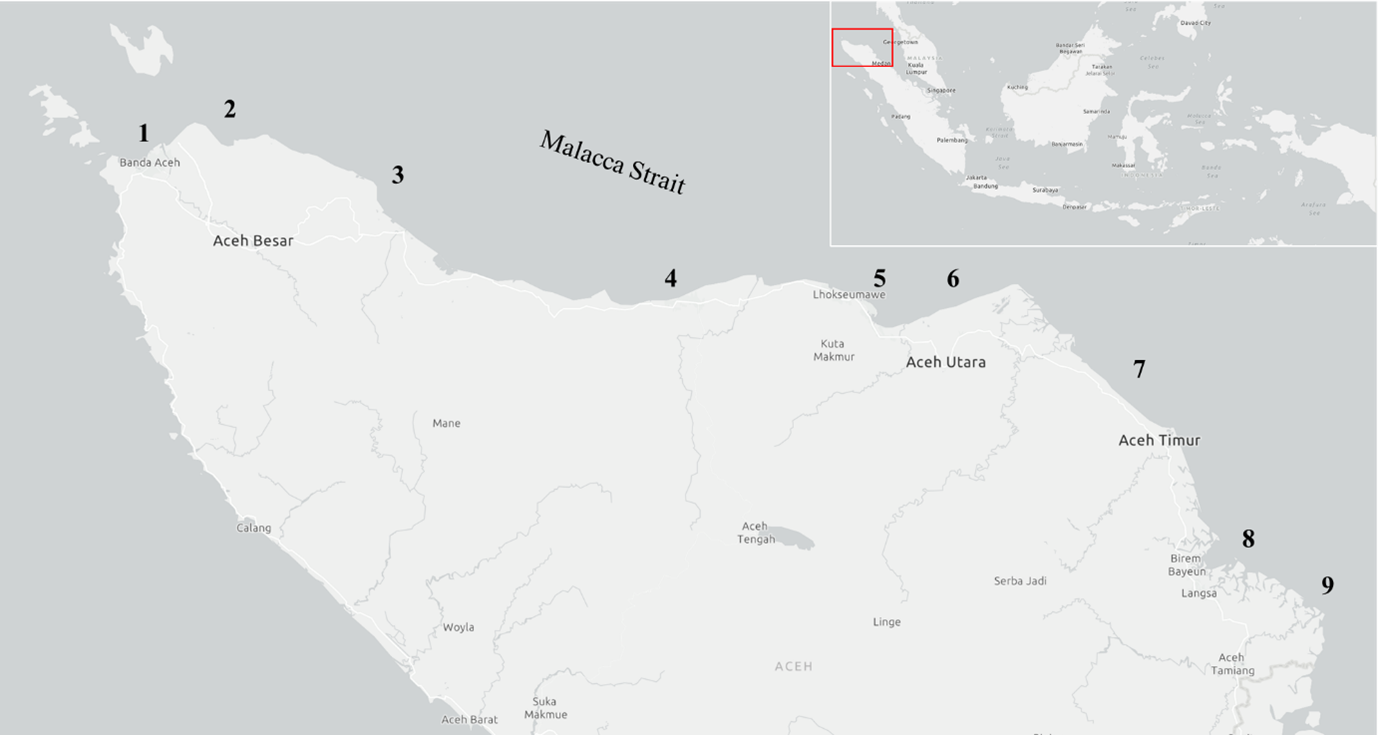
The samples were taken along the north-east waters of the Province of Aceh, covering 9 regencies, including Banda Aceh, Aceh Besar, Pidie, Bireuen, Lhokseumawe, Aceh Utara, Aceh Timur, Langsa, and Aceh Tamiang (Figure 1 and Table 1). The sampling time was collected from June to August 2022. The samples that have been collected were measured in their morphometric characteristics at the Marine Biology Laboratory, Faculty of Marine and Fisheries, Universitas Syiah Kuala, Banda Aceh, Indonesia.
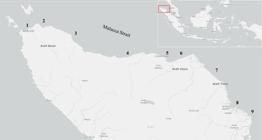
The map of sampling (Crassostrea gigas) locations, where (1) Banda Aceh, (2) Aceh Besar, (3) Pidie, (4) Bireuen, (5) Lhokseumawe, (6) Aceh Utara, (7) Aceh Timur, (8) Langsa, and (9) Aceh Tamiang.
Location and coordinates of sampling of Crassostrea gigas along the North-East coast of Aceh Province, Indonesia.
2.2. Sampling procedure
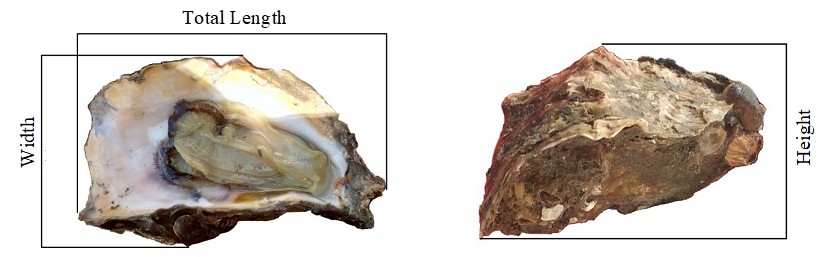
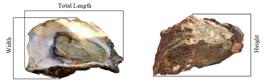
Oyster sampling amounted to 50 samples per location and all samples were then measured for morphometric characteristics. The body weight of C. gigas that has been collected were measured using a digital scale (accuracy 0.01 g). Morphometric measurements were then conducted using digital calibers (accuracy 0.01 mm), including three parameters that are total length, width, and height (Kasmini et al., 2018) (Figure 2).
2.3. Data analysis
Data analysis is performed using ANOVA test to determine the significance of the morphometric character based on the location of the sampling. While for population clustering (MANOVA) was used for the analysis of discriminant function and nearest neighbor. This statistical analysis was done using the SPSS program ver. 27.
3. Results
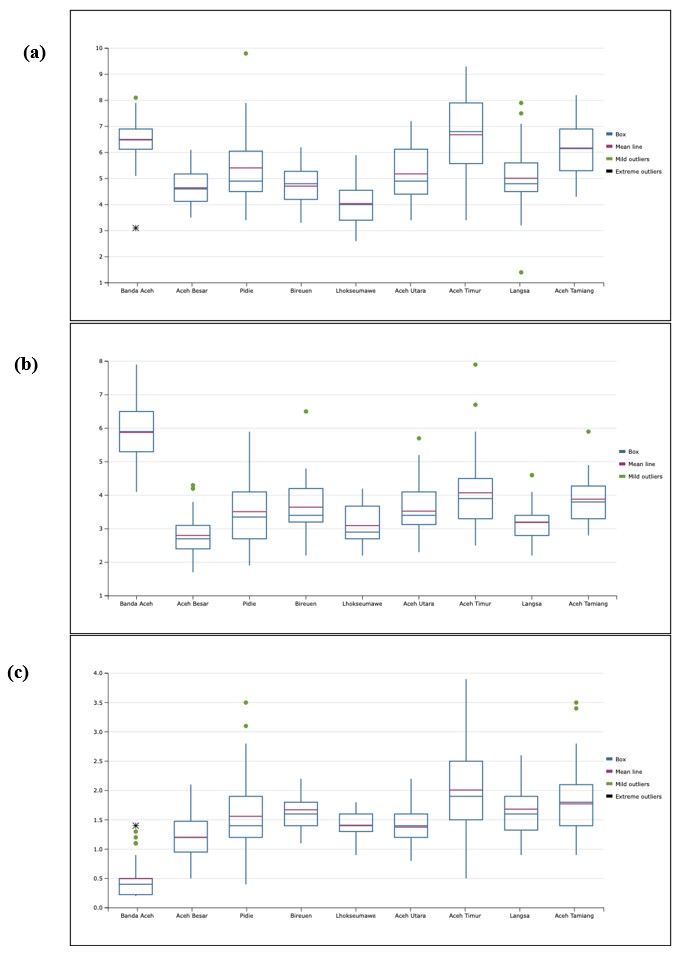
The ANOVA analysis showed the entire morphometric character of the 9 sampling locations differs significantly (p < 0.05). The highest mean value of the total length found in the collections from Aceh Timur, that reached 66.8 ± 1.43 mm, while the lowest value was from Lhokseumawe (40.38 ± 0.74 mm) (Figure 3). The highest width ratio values are shown on collections from Banda Aceh (58.76 ± 0.82 mm), with the lowest values was 28.02 ± 0.61 mm. Higher height ratio is shown in collections of Aceh Timur, while the lowest found in Banda Aceh, 20.08 ± 0.72 mm and 4.98 ± 0.33 mm respectively (Table 2).
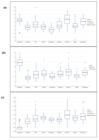
Stock chart of total length (a), width (b), and height (c) of pacific oyster (Crassostrea gigas) in 9 sampling locations.
ANOVA statistical test of morphometric characters of pacific oyster (Crassostrea gigas) in the 9 sampling locations.
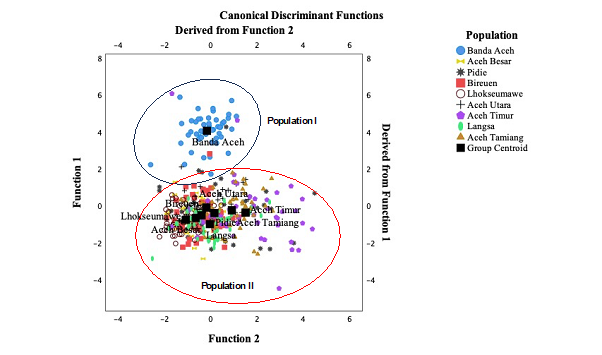
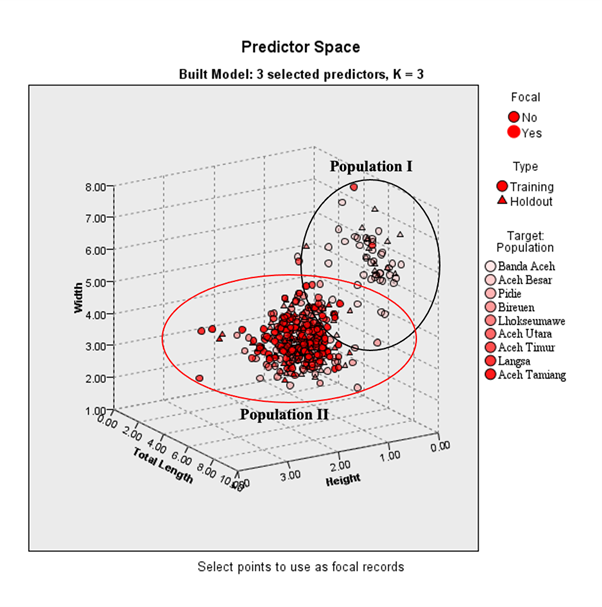
The discriminant analysis result showed there are two populations of C. gigas in Aceh (Figures 4 and 5). Whereas one population of C. gigas was only found in Banda Aceh, the other one population could be found in 8 other regencies. The morphometric characteristics of C. gigas collections from Banda Aceh had a relatively high variation compared to the other regencies, as C. gigas collections from Aceh Besar, Pidie, Bireun, Lhokseumawe, Aceh Utara, Aceh Timur, Langsa and Aceh Tamiang tend to have similar morphometric characteristics.
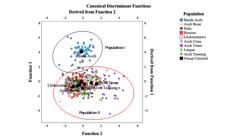
Discriminant functions analysis of Crassostrea gigas population structure based on scatter plot simulation.
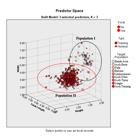
Nearest neighbor analysis of Crassostrea gigas population structure based on scatter plot simulation.
The eagenvalues in discriminant analysis indicates that only function 1 was eligible for further testing (values >1), whereas function 2 and 3 were not. Based on the value % variance shows that each value reaches 75.1% on function 1, 19.5% on function 2, and 5.4% on function 3. These results show the morphometric character that most contributes to discriminating any population, is the width on function 1 (Table 3).
Multivariate analysis on morphometric characteristics of Crassostrea gigas in 9 sampling location.
4. Discussion
The morphometric analysis revealed that there are two populations of C. gigas in Aceh, one population was found only distributed in Banda Aceh, while the other population distributed in 8 other regencies. These results revealed there was a morphological variation that occurs in the population of C. gigas from Banda Aceh. The morphometric characteristics of the C. gigas population in Banda Aceh has significant different ratio values of total length, width, and height compared to other populations. A species' morphological variation demonstrates morphological adaptability to various circumstances in nature and represents a evolutionary pattern (Wang et al., 2020). Additionally, one of the factors causing variety in species is the availability of nutrients and food sources (Chen et al., 2010). Earlier studies have recorded morphological variation also found in Cynodon dactylon (Wang et al., 2020), Caragana microphylla (Chen et al., 2010), Pinus tabulaeformis (Ji et al., 2017), Achnanthidium minutissimum (Potapova and Hamilton, 2007), and Tamarindus indica. (Okello et al., 2018).
This morphometric research also revealed the range of distribution area of C. gigas in the Province of Aceh based on population. One population obtained the distribution area located in Banda Aceh, where the coastline extends for almost 14 km, meanwhile the other population is distributed over a wider region, encompassing 8 regencies and a coastline that is approximately 476 km long. Geographically, Banda Aceh is the centre government of the Aceh Province, in which have more massive industrial and human activity than the 8 other regencies. It is estimated that the corrosion factor affects the morphological differences of C. gigas between sampling areas, where Banda Aceh water is likely to be more polluted than other sampling areas. Previous research conducted showed that Banda Aceh's waters have been contaminated with heavy metals such as Cd, Pb, Zn, phosphate and nitrates (Rusydi et al., 2021; Ondara et al., 2022), and some of these heavy metals have also contaminated C. gigas, including Cd, Pb, and Zn (Sarong et al., 2015).
Based on the total length to width ratio, C. gigas from Banda Aceh was cumulatively higher than other regions with the values of 64.82 ± 0.83 mm and 58.76 ± 0.82 mm, respectively. However, the contradiction with the height ratio is significantly lower than other regions, with the value of 4.98 ± 0.33 mm, while the other 8 regencies have ratio values between 12.02−20.08 mm. These findings showed that C. gigas in Banda Aceh appears longer and wider, but thinner than other sample collections (Figure 3 and Table 2). As for C. gigas in the remaining 8 regions, it appears to be more proportional to their height, which directly affects the larger size of C. gigas meat than the population of Banda Aceh.
5. Conclusions
The study's findings demonstrated that there were substantial differences in all of the morphometric variables across all sampling locations. The results of discriminant and nearest neighbor analysis revealed there are two populations of C. gigas in Aceh, with one population of C. gigas is distributed in Banda Aceh and the other population found in other eight regencies of sampling locations. Therefore, it can be concluded that the Province of Aceh harbors two distinct populations of C. gigas, each of which reflects unique environmental features and evolutionary trends. Based on the results of this study, stakeholders can manage oysters based on 2 characteristic populations and further research is needed on the most optimal growth patterns between the 2 C. gigas populations from Aceh Province.
Acknowledgements
The author would like to thank Rio Batubara, and Muntazir who have provided assistance in the field and the laboratory.
Data Availability Statement
Data are available upon request.
References
-
ACARLI, S., YILDIZ, H. and VURAL, P., 2023. Morphometric characteristics of invasive species Magallana gigas (Thunberg, 1793) in Bandırma Bay, Marmara Sea. Marine Science and Technology Bulletin, vol. 12, no. 3, pp. 322-331. http://doi.org/10.33714/masteb.1337592
» http://doi.org/10.33714/masteb.1337592 -
AKMAL, Y., IRFANNUR, I., MULIARI, M., BATUBARA, A.S., YUNUS, M., PLUMERIASTUTI, H. and DHAMAYANTI, Y., 2023. A comprehensive description of the exoskeleton of six Lobster species (Genus Panulirus) in Aceh Province, Indonesia. Fisheries Research, vol. 264, pp. 106731. http://doi.org/10.1016/j.fishres.2023.106731
» http://doi.org/10.1016/j.fishres.2023.106731 - ALMEIDA, M.J., MACHADO, J. and COIMBRA, J., 1999. Growth and biochemical composition of Crassostrea gigas (Thunberg) and Ostrea edulis (Linné) in two estuaries from the north of Portugal. Journal of Shellfish Research, vol. 18, pp. 139-146.
- Astuti, I., Karina, S. and Dewiyanti, I., 2016. Analisis kandungan logam berat Pb pada tiram Crassostrea cucullata di pesisir Krueng Raya, Aceh Besar. Jurnal Ilmiah Mahasiswa Kelautan dan Perikanan Unsyiah, vol. 1, no. 1, pp. 104-113.
-
AYDIN, M., BILTEKIN, D., BREUGELMANS, K. and BACKELJAU, T., 2021. First record, DNA identification and morphometric characterization of Pacific oyster, Crassostrea gigas (Thunberg, 1793) in the southern Black Sea. BioInvasions Records, vol. 10, no. 4, pp. 838-852. http://doi.org/10.3391/bir.2021.10.4.08
» http://doi.org/10.3391/bir.2021.10.4.08 - BAE, P.A., PYEN, C.K., KO, C.S., KIM, Y. and KANG, P.A., 1978. Studies on suspended culture of oyster, Crassostrea gigas, in the Korean Coastal (III) on the growth rate of oyster depending on the environmental factors in each growing area. Bulletin of Fisheries Research Development Agency, vol. 20, pp. 109-111.
-
BANKER, R.M. and SUMNER, D.Y., 2020. Structure and distribution of chalky deposits in the pacific oyster using x-ray computed tomography (CT). Scientific Reports, vol. 10, no. 1, pp. 12118. http://doi.org/10.1038/s41598-020-68726-4 PMid:32694560.
» http://doi.org/10.1038/s41598-020-68726-4 - BARBER, B.J., 1996. Gametogenesis of eastern oysters, Crassostrea virginica and pacific oyster C. gigas in disease-endemic lower chesapeake bay. Journal of Shellfish Research, vol. 15, pp. 285-290.
-
BATISTA, F.M., BEN-HAMADOU, R., FONSECA, V.G., TARIS, N., RUANO, F., REIS-HENRIQUES, M.A. and BOUDRY, P., 2008. Comparative study of shell shape and muscle scar pigmentation in the closely related cupped oysters Crassostrea angulata, C. gigas and their reciprocal hybrids. Aquatic Living Resources, vol. 21, no. 1, pp. 31-38. http://doi.org/10.1051/alr:2008019
» http://doi.org/10.1051/alr:2008019 -
BATUBARA, A.S., MUCHLISIN, Z.A., THAMREN, M.Y., USNARDI, U. and FADLI, N., 2017. Check list of marine fishes from Simeulue Island waters, Aceh Province, Indonesia. Aceh Journal of Animal Science, vol. 2, no. 2, pp. 77-84. http://doi.org/10.13170/ajas.2.2.9584
» http://doi.org/10.13170/ajas.2.2.9584 -
BENINGER, P.G. and CANNUEL, R., 2006. Acquisition of particle processing capability in the oyster Crassostrea gigas: ontogeny of the mantle pseudofeces rejection tracts. Marine Ecology Progress Series, vol. 325, pp. 153-163. http://doi.org/10.3354/meps325153
» http://doi.org/10.3354/meps325153 - BOCHENEK, E.A., KLINCK, J.M., POWELL, E.N. and HOFMAN, E.E., 2001. A biochemically based model of the growth and development of Crassostrea gigas larvae. Journal of Shellfish Research, vol. 20, pp. 243-266.
- BORGES, M.E., DOS-SANTOS, E. and CAZZANIGA, N.J., 2002. Density and growth of pacific oyster Crassostrea gigas in an intertidal oyster reef in the Southern Atlantic Coast of Buenos Aires Province, Argentina. Paris: IAPSO. (no. IB03-46).
- BRUSCA, G. and ARDIL, D., 1974. Growth and survival of Oyster Crassostrea gigas, C. virginica, and Ostrea edulis in Mauritius. Revue Agricole et Sucrière de l’Ile Maurice, vol. 53, pp. 111-131.
-
CASTAÑOS, C., PASCUAL, M. and CAMACHO, A.P., 2009. Reproductive biology of the nonnative oyster, Crassostrea gigas (Thunberg, 1793), as a key factor for its successful spread along the rocky shores of Northern Patagonia, Argentina. Journal of Shellfish Research, vol. 28, no. 4, pp. 837-847. http://doi.org/10.2983/035.028.0413
» http://doi.org/10.2983/035.028.0413 -
CHEN, X.H., GAO, Y.B., ZHAO, T.T., ZHU, M.J., CI, H.C. and XIAO-YAN, S., 2010. Morphological variations of Caragana microphylla populations in the Xilingol Steppe and their relationship with environmental factors. Acta Ecologica Sinica, vol. 30, no. 2, pp. 50-55. http://doi.org/10.1016/j.chnaes.2010.03.001
» http://doi.org/10.1016/j.chnaes.2010.03.001 -
CHILD, A.R. and LAING, I., 1998. Comparative low temperature tolerance of small Juvenile European, Ostrea edulis L., and pacific oysters, Crassostrea gigas Thunberg. Aquaculture Research, vol. 29, no. 2, pp. 103-113. http://doi.org/10.1111/j.1365-2109.1998.tb01114.x
» http://doi.org/10.1111/j.1365-2109.1998.tb01114.x -
COGNIE, B., HAURE, J. and BARILLÉ, L., 2006. Spatial distribution in a temperate coastal ecosystem of the wild stock of the farmed oyster Crassostrea gigas (Thunberg). Aquaculture, vol. 259, no. 1-4, pp. 249-259. http://doi.org/10.1016/j.aquaculture.2006.05.037
» http://doi.org/10.1016/j.aquaculture.2006.05.037 -
DZIKIRA, T.M., PURWOKO, A. and RINI, E.S., 2022. Analysis the development of oyster cultivation (Crassostrea Sp.) on coastal communities’s income. Journal of Environmental and Development Studies, vol. 3, no. 2, pp. 12-23. http://doi.org/10.32734/jeds.v3i2.8133
» http://doi.org/10.32734/jeds.v3i2.8133 -
ENRÍQUEZ-DÍAZ, M., POUVREAU, S., CHÁVEZ-VILLALBA, J. and LE PENNEC, M., 2009. Gametogenesis, reproductive investment, and spawning behavior of the pacific giant oyster Crassostrea gigas: evidence of an environment-dependent strategy. Aquaculture International, vol. 17, no. 5, pp. 491-506. http://doi.org/10.1007/s10499-008-9219-1
» http://doi.org/10.1007/s10499-008-9219-1 -
ERNIATI, E., ERLANGGA, E., ANDIKA, Y. and MULIANI, M., 2023. Seaweed diversity and community structure on the west coast of Aceh, Indonesia. Biodiversitas, vol. 24, no. 4, pp. 2189-2200. http://doi.org/10.13057/biodiv/d240431
» http://doi.org/10.13057/biodiv/d240431 -
EVSEEV, G.A., YAKOVLEV, Y.M. and LI, X., 1996. The anatomy of the pacific oyster, Crassostrea gigas (Thurnberg) (Bivalvia: ostreidae). Publications of the Seto Marine Biological Laboratory, vol. 37, no. 3-6, pp. 239-255. http://doi.org/10.5134/176265
» http://doi.org/10.5134/176265 -
FADLI, N., MOHD NOR, S.A., OTHMAN, A.S., SOFYAN, H. and MUCHLISIN, Z.A., 2020. DNA barcoding of commercially important reef fishes in Weh Island, Aceh, Indonesia. PeerJ, vol. 8, pp. e9641. http://doi.org/10.7717/peerj.9641 PMid:32844060.
» http://doi.org/10.7717/peerj.9641 -
FADLI, N., SETIAWAN, I. and FADHILAH, N., 2012. Keragaman makrozoobenthos di perairan Kuala Gigieng, Kabupaten Aceh Besar. Depik, vol. 1, no. 1, pp. 45-52. http://doi.org/10.13170/depik.1.1.26
» http://doi.org/10.13170/depik.1.1.26 -
GAZALI, M., JOLANDA, O., HUSNI, A., NURJANAH, N., MAJID, F.A.A., ZURIAT, Z. and SYAFITRI, R., 2023. In Vitro α-Amylase and α-Glucosidase Inhibitory Activity of Green Seaweed Halimeda tuna Extract from the Coast of Lhok Bubon, Aceh. Plants, vol. 12, no. 2, pp. 393. http://doi.org/10.3390/plants12020393 PMid:36679105.
» http://doi.org/10.3390/plants12020393 -
GEFFARD, O., GEFFARD, A., HIS, E. and BUDZINSKI, H., 2003. Assessment of the bioavailability and toxicity of sediment-associated polycyclic aromatic hydrocarbons and heavy metals applied to Crassostrea gigas embryos and larvae. Marine Pollution Bulletin, vol. 46, no. 4, pp. 481-490. http://doi.org/10.1016/S0025-326X(02)00451-4 PMid:12705922.
» http://doi.org/10.1016/S0025-326X(02)00451-4 -
GONZÁLEZ-FERNÁNDEZ, C., TALLEC, K., LE-GOÏC, N., LAMBERT, C., SOUDANT, P., HUVET, A., Suquet, M., Berchel, M. and PAUL-PONT, I., 2018. Cellular responses of pacific oyster (Crassostrea gigas) gametes exposed in vitro to polystyrene nanoparticles. Chemosphere, vol. 208, pp. 764-772. http://doi.org/10.1016/j.chemosphere.2018.06.039 PMid:29902761.
» http://doi.org/10.1016/j.chemosphere.2018.06.039 -
HARDING, J.M. and MANN, R., 2006. Age and growth of wild suminoe (Crassostrea ariakensis, Fugita 1913) and pacific (C. gigas, Thunberg 1793) oysters from Laizhou Bay, China. Journal of Shellfish Research, vol. 25, no. 1, pp. 73-82. http://doi.org/10.2983/0730-8000(2006)25[73:AAGOWS]2.0.CO;2
» http://doi.org/10.2983/0730-8000(2006)25[73:AAGOWS]2.0.CO;2 -
HUANXIN, W., LEJUN, Z. and PRESLEY, B.J., 2000. Bioaccumulation of heavy metals in oyster (Crassostrea virginica) tissue and shell. Environmental Geology, vol. 39, no. 11, pp. 1216-1226. http://doi.org/10.1007/s002540000110
» http://doi.org/10.1007/s002540000110 -
IRFANNUR, I., SAPUTRA, S., MULIARI, M., AKMAL, Y. and BATUBARA, A.S., 2024. Characterization of Six Lobster Species of Genus Panulirus (Decapoda, Palinuridae) from Aceh Waters, Indonesia Based on Morphometric Analysis.Zoodiversity, vol. 58, no. 2, pp. 89-102. http://doi.org/10.15407/zoo2024.02.089
» http://doi.org/10.15407/zoo2024.02.089 -
JI, M., DENG, J., YAO, B., CHEN, R., FAN, Z., GUAN, J., Li, X., Wu, F. and NIKLAS, K.J., 2017. Ecogeographical variation of 12 morphological traits within Pinus tabulaeformis: the effects of environmental factors and demographic histories. Journal of Plant Ecology, vol. 10, pp. 386-396. http://doi.org/10.1093/jpe/rtw033
» http://doi.org/10.1093/jpe/rtw033 -
KASMINI, L. and BATUBARA, A.S., 2022. Biology and ecological functional of Genus Crassostrea (Bivalvia: Ostreidae): a review. Depik, vol. 11, no. 1, pp. 75-84. http://doi.org/10.13170/depik.11.1.23444
» http://doi.org/10.13170/depik.11.1.23444 -
KASMINI, L. and BATUBARA, A.S., 2023. Microplastic contamination and growth pattern of oyster; Crassostrea gigas in a coastline. Global Journal of Environmental Science and Management, vol. 9, pp. 753-764. http://doi.org/10.22034/gjesm.2023.04.07
» http://doi.org/10.22034/gjesm.2023.04.07 -
KASMINI, L., BARUS, T.A., SARONG, M.A. and MULYA, M.B., 2018. Morphometric study of pacific oyster (Crassostrea gigas) in the coastal area of Banda Aceh. Journal of Physics: Conference Series, vol. 1116, pp. 052037. http://doi.org/10.1088/1742-6596/1116/5/052037
» http://doi.org/10.1088/1742-6596/1116/5/052037 -
KASMINI, L., BARUS, T.A., SARONG, M.A., MULYA, M.B. and BATUBARA, A.S., 2019 [viewed 3 Nov 2024]. Reproductive biology of pacific oyster (Crassostrea gigas): a decade after the tsunami disaster in Aceh, Indonesia. Jordan Journal of Biological Sciences [online], vol. 12, pp. 553-560. Available from: https://jjbs.hu.edu.jo/files/vol12/n5/Paper%20Number%204.pdf
» https://jjbs.hu.edu.jo/files/vol12/n5/Paper%20Number%204.pdf -
KREFT, H. and JETZ, W., 2010. A framework for delineating biogeographical regions based on species distributions. Journal of Biogeography, vol. 37, no. 11, pp. 2029-2053. http://doi.org/10.1111/j.1365-2699.2010.02375.x
» http://doi.org/10.1111/j.1365-2699.2010.02375.x -
LIU, Q., GUO, Y., YANG, Y., MAO, J., WANG, X., LIU, H., TIAN, Y. and HAO, Z., 2024. Geometric morphometric methods for identification of oyster species based on morphology. Biodiversity Data Journal, vol. 12, pp. e115019. http://doi.org/10.3897/BDJ.12.e115019 PMid:38444838.
» http://doi.org/10.3897/BDJ.12.e115019 -
MAI, H., CACHOT, J., BRUNE, J., GEFFARD, O., BELLES, A., BUDZINSKI, H. and MORIN, B., 2012. Embryotoxic and genotoxic effects of heavy metals and pesticides on early life stages of pacific oyster (Crassostrea gigas). Marine Pollution Bulletin, vol. 64, no. 12, pp. 2663-2670. http://doi.org/10.1016/j.marpolbul.2012.10.009 PMid:23122627.
» http://doi.org/10.1016/j.marpolbul.2012.10.009 -
NUR, F.M., BATUBARA, A.S., PERDANA, A.W., ERIANI, K. and MUCHLISIN, Z.A., 2019. Checklist of coral fishes in Lhoknga and Lhok Mata Ie Beaches, Aceh Besar, Indonesia. IOP Conference Series. Earth and Environmental Science, vol. 348, no. 1, pp. 012104. http://doi.org/10.1088/1755-1315/348/1/012104
» http://doi.org/10.1088/1755-1315/348/1/012104 -
OCTAVINA, C., ULFAH, M., FAZILLAH, M.R., AGUSTIAR, M., RAZI, N.M. and SAKINAH, R., 2021. The condition of reef fish (family Chaetodontidae) in Krueng Raya and Ujong Pancu waters, Aceh Besar District. IOP Conference Series. Earth and Environmental Science, vol. 869, no. 1, pp. 012023. http://doi.org/10.1088/1755-1315/869/1/012023
» http://doi.org/10.1088/1755-1315/869/1/012023 -
OKELLO, J., OKULLO, J.B.L., EILU, G., NYEKO, P. and OBUA, J., 2018. Morphological variations in Tamarindus indica Linn. fruits and seed traits in the different agroecological zones of Uganda. International Journal of Ecology, vol. 2018, pp. 1-12. http://doi.org/10.1155/2018/8469156
» http://doi.org/10.1155/2018/8469156 -
ONDARA, K., WISHA, U.J., AGUSTINA, S., ATMADIPOERA, A.S. and PURNAWAN, S., 2022. Using pollution index to determine water quality in Banda Aceh waters, Indonesia. Jurnal Rekayasa Kimia and Lingkungan, vol. 17, no. 1, pp. 64-72. http://doi.org/10.23955/rkl.v17i1.25155
» http://doi.org/10.23955/rkl.v17i1.25155 -
POTAPOVA, M. and HAMILTON, P.B., 2007. Morphological and ecological variation within the Achnanthidium minutissimum (Bacillariophyceae) species complex 1. Journal of Phycology, vol. 43, no. 3, pp. 561-575. http://doi.org/10.1111/j.1529-8817.2007.00332.x
» http://doi.org/10.1111/j.1529-8817.2007.00332.x -
RAMADHANIATY, M., OCTAVINA, C., PUTRI, F.A., KARINA, S. and ICHSAN., 2021. The density and distribution of pacific oyster (Crassostrea gigas) in Krueng Cut, Aceh Besar. IOP Conference Series. Earth and Environmental Science, vol. 869, no. 1, pp. 012056. http://doi.org/10.1088/1755-1315/869/1/012056
» http://doi.org/10.1088/1755-1315/869/1/012056 -
RUSYDI, I., SAVIRA, D., PUTRA, D.F., DEWIYANTI, I. and DEFIRA, C.N., 2021. Analysis of Pb and Cd heavy metal contents in green mussel (Pernaviridis L.) in Alue Naga Waters, Banda Aceh. IOP Conference Series. Earth and Environmental Science, vol. 869, no. 1, pp. 012074. http://doi.org/10.1088/1755-1315/869/1/012074
» http://doi.org/10.1088/1755-1315/869/1/012074 - SARONG, M.A., JIHA, C., MUCHLISIN, Z.A., FADLI, N. and SUGIANTO, S., 2015. Cadmium, lead and zinc contamination on the oyster Crassostrea gigas muscle harvested from the estuary of Lamnyong River, Banda Aceh City, Indonesia. Aquaculture, Aquarium, Conservation & Legislation, vol. 8, pp. 1-6.
-
ULFA, M., IKEJIMA, K., POEDJIRAHAJOE, E., FAIDA, L.R.W. and HARAHAP, M.M., 2018. Effects of mangrove rehabilitation on density of Scylla spp.(mud crabs) in Kuala Langsa, Aceh, Indonesia. Regional Studies in Marine Science, vol. 24, pp. 296-302. http://doi.org/10.1016/j.rsma.2018.09.005
» http://doi.org/10.1016/j.rsma.2018.09.005 -
VIALOVA, O.Y., 2020. Comparative morphological analysis of diploid and triploid oysters, Crassostrea gigas, farmed in the Black Sea. Turkish Journal of Veterinary and Animal Sciences, vol. 44, no. 3, pp. 740-746. http://doi.org/10.3906/vet-1907-50
» http://doi.org/10.3906/vet-1907-50 -
WALLES, B., MANN, R., YSEBAERT, T., TROOST, K., HERMAN, P.M. and SMAAL, A.C., 2015. Demography of the ecosystem engineer Crassostrea gigas, related to vertical reef accretion and reef persistence. Estuarine, Coastal and Shelf Science, vol. 154, pp. 224-233. http://doi.org/10.1016/j.ecss.2015.01.006
» http://doi.org/10.1016/j.ecss.2015.01.006 -
WANG, M., ZHANG, J., GUO, Z., GUAN, Y., QU, G., LIU, J., Guo, Y. and YAN, X., 2020. Morphological variation in Cynodon dactylon (L.) Pers., and its relationship with the environment along a longitudinal gradient. Hereditas, vol. 157, no. 1, pp. 1-11. http://doi.org/10.1186/s41065-020-00117-1 PMid:32051037.
» http://doi.org/10.1186/s41065-020-00117-1 -
WORLD REGISTER OF MARINE SPECIES – WoRMS, 2021 [viewed 3 Nov 2024]. WoRMS taxon details of Crassostrea [online]. Available from: http://www.marinespecies.org/aphia.php?p=taxdetailsandid=138297andallchildren=1
» http://www.marinespecies.org/aphia.php?p=taxdetailsandid=138297andallchildren=1 -
ZHANG, Q.D., JIA, R.Z., MENG, C., TI, C.W. and WANG, Y.L., 2015. Diversity and population structure of a dominant deciduous tree based on morphological and genetic data. AoB Plants, vol. 7, pp. plv103. http://doi.org/10.1093/aobpla/plv103 PMid:26311734.
» http://doi.org/10.1093/aobpla/plv103 -
ZHENG, Z., KAWAKAMI, D., ZHANG, D., NEGISHI, L., ABOMOSALLAM, M., ASAKURA, T., Nagata, K. and SUZUKI, M., 2021. Identification and functional analysis of cadmium-binding protein in the visceral mass of Crassostrea gigas. Scientific Reports, vol. 11, no. 1, pp. 1-14. http://doi.org/10.1038/s41598-021-90882-4 PMid:34050239.
» http://doi.org/10.1038/s41598-021-90882-4
Edited by
-
Editor:
Takako Matsumura Tundisi