 Oil degradation potential and preliminary genomic insights of Pseudomonas veronii strain KHB2.9 isolated from oil-contaminated coastal soil
Abstract
Indigenous bacteria with hydrocarbon-degrading capabilities have consistently been prioritized in strategies for bioremediating oil-contaminated soils. This study reports the isolation, identification, and phenotypic characterization supported by preliminary genomic analysis of Pseudomonas veronii strain KHB2.9 from oil-contaminated sandy soil in Cam Ranh Bay, Khanh Hoa, Vietnam. The strain demonstrated robust growth in Bushnell-Haas medium supplemented with 1% crude oil, diesel, or mixed oil as the sole carbon source, with the highest biomass observed in diesel oil. Redox-based 2,6-dichlorophenol indophenol (DCPIP) assays indicated substantial hydrocarbon oxidation activity, particularly in diesel oil and mixed oil substrates. Further GC-MS analyses revealed that a preferential degradation of medium-chain n-alkanes (C13-C17), whereas only limited removal of branched isoprenoids and long-chain n-alkanes was observed for the strain KHB2.9 under aerobic conditions. The KHB2.9’s genomic analysis revealed a 2.59 Mbp draft genome with 3,010 predicted protein-coding genes, including key alkane, cycloalkane, and aromatic hydrocarbon degradation genes (alkB, pcaH, pcaD, catA, and various dioxygenase and hydrolase genes). Phylogenetic analysis clustered KHB2.9 closely with other P. veronii strains known for their ability to biodegrade hydrocarbons. In addition, strain KHB2.9 exhibited biosurfactant production, as demonstrated by drop-collapse and emulsification assays, which likely contributed to enhanced hydrocarbon bioavailability. Due to the fragmented nature of the draft genome, genomic results are interpreted conservatively and primarily used to support phenotypic observations rather than to exhaustively reconstruct metabolic pathways. These findings highlight P. veronii KHB2.9 as a promising candidate for developing microbial consortia or biopreparations for bioremediation of petroleum-contaminated saline soils in Vietnam and similar coastal environments.
Keywords:
biodegradation; genome sequencing; indigenous bacteria; oil degradation; Pseudomonas
Resumo
Bactérias autóctones com capacidade de degradação de hidrocarbonetos têm sido consistentemente priorizadas em estratégias de biorremediação de solos contaminados por petróleo. Este estudo relata o isolamento, a identificação e a caracterização fenotípica, apoiados por uma análise genômica preliminar da cepa Pseudomonas veronii KHB2.9, isolada de solo arenoso contaminado por petróleo na Baía de Cam Ranh, província de Khanh Hoa, Vietnã. A cepa apresentou crescimento robusto em meio Bushnell-Haas suplementado com 1% de petróleo bruto, óleo diesel ou óleo misto como única fonte de carbono, sendo observada a maior biomassa no tratamento com diesel. Ensaios redox baseados em 2,6-diclorofenol indofenol (DCPIP) indicaram atividade substancial de oxidação de hidrocarbonetos, particularmente nos substratos diesel e óleo misto. Análises adicionais por GC-MS revelaram degradação preferencial de n-alcanos de cadeia média (C13-C17), enquanto apenas remoção limitada de isoprenoides ramificados e n-alcanos de cadeia longa foi observada para a cepa KHB2.9 sob condições aeróbias. A análise genômica de KHB2.9 revelou um genoma draft de 2,59 Mbp com 3.010 genes codificadores de proteínas preditos, incluindo genes-chave envolvidos na degradação de alcanos, cicloalcanos e hidrocarbonetos aromáticos (alkB, pcaH, pcaD, catA e diversos genes de dioxigenases e hidrolases). A análise filogenética agrupou KHB2.9 proximamente a outras cepas de P. veronii conhecidas por sua capacidade de biodegradar hidrocarbonetos. Além disso, a cepa KHB2.9 apresentou produção de biossurfactantes, demonstrada por ensaios de colapso de gota e emulsificação, o que provavelmente contribuiu para o aumento da biodisponibilidade dos hidrocarbonetos. Devido à natureza fragmentada do genoma draft, os resultados genômicos são interpretados de forma conservadora e utilizados principalmente para apoiar as observações fenotípicas, em vez de reconstruir exaustivamente as vias metabólicas. Em conjunto, esses achados destacam P. veronii KHB2.9 como um candidato promissor para o desenvolvimento de consórcios microbianos ou biopreparações destinadas à biorremediação de solos salinos contaminados por petróleo no Vietnã e em ambientes costeiros semelhantes.
Palavras-chave:
biodegradação; sequenciamento do genoma; bactérias autóctones; degradação de óleo; Pseudomonas
1. Introduction
Oil contamination poses serious threats to coastal ecosystems, particularly in saline sandy areas, thereby necessitating the development and implementation of effective bioremediation strategies (Bekins and Herkelrath, 2026; Ikhumetse et al., 2026). The global demand for fuel has led to an increase in petroleum hydrocarbon (PH) pollution, with approximately eight million tons released into soil and water environments annually. Concentrations of oil in industrial effluents can reach as high as 40,000 mg L-1, representing a major ecological threat (Akpan et al., 2025). This pollution leads to the accumulation of toxic chemical pollutants along the food chain, harming flora and fauna (Al-Hammdani et al., 2025). Furthermore, oil spills significantly compromise "blue carbon" ecosystems such as mangroves, which serve as essential carbon sinks, thereby exacerbating climate vulnerability (Akpan et al., 2025; Elisha, 2025).
Cam Ranh Bay, located in Khanh Hoa Province, Vietnam, is a coastal area that has experienced petroleum contamination. Anthropogenic causes, including pipeline failures, accidental ruptures of transportation vessels, and leaks from storage tanks, are the primary sources of such contamination (Ikhumetse et al., 2026). Despite the cessation of oil storage and utilization activities for many years, residual petroleum pollution persists in the soil. In such environments, bioremediation - utilizing indigenous microbial populations capable of hydrocarbon degradation - offers a sustainable, eco-friendly, and cost-effective alternative to traditional physical and chemical treatment methods (Ayed et al., 2015; Sakthipriya et al., 2015). Recent studies emphasize that autochthonous (indigenous) microorganisms have distinct advantages over allochthonous species because they are naturally adapted to the specific contaminated environment and can thrive more effectively (Ikhumetse et al., 2026; Nkantion et al., 2025).
Microorganisms involved in bioremediation metabolize complex petroleum hydrocarbons into simpler, less toxic compounds, thereby contributing to the detoxification and restoration of polluted environments (Parthipan et al., 2017). The degradation of aromatic compounds is primarily executed through oxidative pathways. The initial and most critical step is catalyzed by dioxygenase enzyme systems, which incorporate molecular oxygen into the aromatic ring - a reaction that is often the rate-limiting step in the degradation pathway (Ikhumetse et al., 2026). Numerous bacterial taxa have demonstrated the capacity to utilize hydrocarbons as the sole source of carbon and energy (Patowary et al., 2017). Among these, the genus Pseudomonas is particularly notable for its metabolic versatility and high degradation potential. Recent findings recorded Pseudomonas aeruginosa strains achieving crude oil degradation rates of up to 97.80% (Ikhumetse et al., 2026; Keerthana & Raghunath, 2025). Pseudomonas species are capable of oxidizing a broad spectrum of hydrocarbon compounds, including aliphatic, monoaromatic compounds, polycyclic aromatic hydrocarbons (PAHs), and methylated or halogenated derivatives (Ivanova et al., 2022). The efficacy of these biological processes is directly influenced by environmental factors such as time, oil content, and nutrient availability (Ikhumetse et al., 2026; Sami, 2025).
Within this genus, Pseudomonas veronii has emerged as a promising candidate for bioremediation due to its ability to degrade diverse petroleum fractions such as alkanes and PAHs. Genomic analysis has identified key genes involved in these processes, such as the nah operon for naphthalene degradation and genes for alkane oxidation like alkB and rubA/B (Sami, 2025). This capacity is attributed to its extensive enzymatic repertoire and biosurfactant production, which facilitates emulsification and increases the bioavailability of hydrophobic compounds (Zhang et al., 2011). Furthermore, the ability of P. veronii to form robust biofilms enhances its survival and activity in extreme environmental conditions, including high salinity and nutrient limitation.
Previous studies have reported the widespread presence of P. veronii in petroleum-contaminated environments such as groundwater, marine sediments, and coastal sandy soils. Imperato et al. (2019) identified two P. veronii strains from the Bóbrka oilfield in Poland that efficiently degraded linear hydrocarbons and aromatic compounds, with genomes encoding genes involved in alkane oxidation (such as alkB and rubA/B) and dioxygenase enzymes. Moreover, P. veronii was noted for its ability to survive in salt-rich and harsh environments, an important trait for applications in the treatment of saline soils (Imperato et al., 2019). According to the study by Mullaeva et al. (2022), P. veronii strain 7-41 is capable of degrading both aliphatic hydrocarbons (C7 - C11) and aromatic compounds (e.g., naphthalene and salicylate at 0.02 g L-1) over a wide temperature range (4-30 °C). Genetic and physiological analyses revealed that hydrocarbon degradation genes in this strain are encoded on a conjugative IncP-7 plasmid, organized into the canonical alk and nah operons commonly found in pseudomonads.
As part of a broader investigation to explore the bioremediation potential of oil pollution in Cam Ranh Bay, this study aimed to isolate indigenous bacterial strains capable of growing in hydrocarbon-containing media and degrading different petroleum hydrocarbons, with the ultimate goal of applying them to the restoration of oil-contaminated soils. To achieve this, bacteria were isolated from oil-polluted soil samples in the region, identified using molecular techniques - including 16S rRNA gene sequencing and whole genome sequencing - and evaluated for their ability to degrade various petroleum hydrocarbons.
2. Materials and Methods
2.1. Composition of culture media and hydrocarbon sources
Bushnell-Haas (BH) medium (HiMedia) supplemented with a 5% (v/v) crude oil and diesel oil mixture (5:95 v/v, hereafter referred to as mixed oil) was used for inoculating soil samples and isolating bacterial consortia. To select for halotolerant isolates, NaCl was added to a final concentration of 30‰ during the first enrichment cycle. Individual bacterial strains were isolated using nutrient agar plates. Crude oil and diesel oil obtained from an oil tanker in Vung Tau and from the Petrolimex company in Vietnam, respectively, were clean (free of impurities) and sterilized by autoclaving at 121 °C and 15 psi for 15 minutes, followed by 0.22 μm membrane filtration (Muriel-Millán et al. 2019).
2.2. Soil sampling
Prior to sampling, the topsoil layer, plant litter, branches, and leaves were carefully removed from the sampling areas. Soil samples were collected from a depth of 30 cm. For each site, a composite sample was prepared by mixing soil from five subsampling points arranged in an "X" pattern, with a distance of 50 cm from each vertex to the center point. The collected soil was homogenized by passing through a fine mesh sieve (2 mm) to remove debris and large gravel particles. Homogenized samples were placed in sterile polyethylene bags and stored at 4 °C and further physicochemical and microbiological analyses were performed.
2.3. Isolation of hydrocarbon-degrading bacteria
Oil‑contaminated sandy soil was collected from a former pollution site in Cam Ranh Bay, Khanh Hoa Province, Vietnam (≈500 m from the shoreline; elevation ≈6 m). To enrich hydrocarbon‑degrading bacteria, 1 g of soil was inoculated into BH broth containing 30‰ NaCl and 5% (v/v) mixed oil, following Satpute et al. (2010). Cultures were incubated at 30 °C on a rotary shaker (150 rpm) for 7 days. Ten percent of the suspension was then transferred to fresh BH medium and incubated under the same conditions. After three enrichment cycles, 100 µL of the consortium was serially diluted (10-4-10-6) and spread onto BH agar. Plates were incubated at 30 °C for 48 h. Morphologically distinct colonies were purified by repeated streaking on nutrient agar. The isolate designated KHB2.9 was examined by light microscopy, Gram staining, and scanning electron microscopy. The physicochemical properties of the soil samples are summarised in Table S1 (Supplementary Material).
2.4. Diesel oil degradation efficiency by gravimetric analysis
Selected isolates were followed by an evaluation of the diesel oil-degrading rate over time. Briefly, bacterial isolates were inoculated in BH medium containing 5% (v/v) diesel oil. The cultures were incubated in a rotary shaker at 150 rpm and 30 °C for 10 days. Residual oil was extracted from the broth using n-hexane solvent extraction. After complete solvent evaporation, the remaining oil was weighed to determine its mass. A control flask, containing only mineral medium and diesel oil without bacterial inoculation, was subjected to the same experimental conditions to serve as a baseline reference. All experiment was performed in triplicate. The efficiency of DO degradation was subsequently calculated using the following equation: Degradation efficiency (%) = ((Ci – Cf)/Ci)*100, where Ci and Cf are the initial and final oil concentrations (g), respectively.
2.5. Bacterial growth in different hydrocarbon sources
The growth potential of selected isolates was assessed following a modified version of Rahman et al. (2002). Five millilitres of actively growing culture (OD600≈ 1.0) were inoculated into 100 mL of sterilised mineral medium supplemented with 1% (v/v) of the test hydrocarbon (crude oil, diesel oil or mixed oil) in 500 mL Erlenmeyer flasks. Cultures were incubated at 30 °C with shaking at 150 rpm for 14 days, alongside uninoculated control flasks. Growth was monitored at 2‑day intervals by measuring OD600 (UV‑VIS spectrophotometer, Shimadzu UV‑1800, Japan). All assays were performed in triplicate.
2.6. Hydrocarbon degradation assay using 2,6-dichlorophenol indophenol (DCPIP)
The hydrocarbon degradation capacity of KHB2.9 was evaluated using a modified 2,6-dichlorophenol indophenol (DCPIP) reduction assay (Obi et al., 2016). DCPIP serves as an artificial electron acceptor that changes from blue (oxidized form) to colorless (reduced form) upon accepting electrons released during microbial oxidation of hydrocarbons. The extent of DCPIP reduction thus provides a quantitative measure of hydrocarbon oxidation activity.
Sterile BH medium (100 mL) containing 1% (v/v) of the hydrocarbon substrate (crude oil, diesel, or their mixture), 0.1% (v/v) Tween 80 (to improve hydrocarbon bioavailability), and 0.6 mg mL-1 DCPIP was inoculated with 1 mL of a 24-48 h culture of KHB2.9 (OD600≈ 1.0). Appropriate controls were included: (i) uninoculated medium with hydrocarbon and DCPIP (abiotic control), and (ii) medium with DCPIP and KHB2.9 but without hydrocarbon (biotic control). Cultures and uninoculated controls were incubated at 30 °C in the dark with shaking (150 rpm) for 14 days. At 2-day intervals, cultures were centrifuged (10,000 rpm, 10 min), and the reduction of DCPIP in the cell-free supernatants was quantified spectrophotometrically at 609 nm. The percentage of hydrocarbon biodegradation was calculated based on DCPIP decolorization using the Formula 1:
where At is the absorbance of the treated sample at time t, and A0 is the absorbance of the abiotic control at time 0 (corrected for any background from the biotic control). This calculation assumes a linear relationship between DCPIP reduction and hydrocarbon oxidation, as established in previous studies using similar assay conditions (Obi et al., 2016).
2.7. GC-MS analysis of n-alkane biodegradation
To further quantify the biodegradation of petroleum hydrocarbons by Pseudomonas veronii strain KHB2.9, residual n-alkanes in a crude oil and diesel oil mixture were analyzed using gas chromatography-mass spectrometry (GC-MS). Biodegradation experiments were conducted in BH mineral medium supplemented with a mixture of crude oil diluted in diesel oil (final concentration 1%, v/v) as the sole carbon source. Actively growing cultures of strain KHB2.9 (OD600 ≈ 1.0) were inoculated at 5% (v/v) and incubated at 30 °C with shaking at 150 rpm for 14 days. Abiotic control samples (T0) containing the same oil mixture without bacterial inoculation were prepared in parallel to account for non-biological hydrocarbon losses. At the end of the incubation period, microbial activity was terminated by acidifying the cultures to pH ≈ 2 using 6 M HCl. Residual hydrocarbons were extracted three times with equal volumes of n-hexane. The combined organic phases were dried over anhydrous sodium sulfate (Na2SO4), filtered, and concentrated under a gentle stream of nitrogen to a final volume of 1 mL before analysis.
GC-MS analysis was performed using a gas chromatograph coupled to a mass spectrometer equipped with an HP-5MS capillary column (30 m × 0.25 mm × 0.25 µm). Helium was used as the carrier gas at a constant flow rate of 1.0 mL min−1. Samples were injected in splitless mode with an injector temperature of 280 °C. The oven temperature program was set from 60 °C (held for 2 min) to 300 °C at a rate of 10 °C min-1, with a final hold of 10 min. The mass spectrometer was operated in electron impact (EI) mode at 70 eV, scanning from m/z 50 to 500.
Individual n-alkanes (C8-C36), as well as the isoprenoids pristane and phytane, were identified based on mass spectral matching with the NIST library and retention time comparison with reference data. Quantification was performed using relative GC-MS peak areas. The percentage of biodegradation for each n-alkane fraction was calculated by comparing peak areas in inoculated samples with those in abiotic control samples (T0), and results are presented as relative degradation efficiencies
2.8. Screening of biosurfactant-producing bacteria
Biosurfactant production of strain KHB2.9 was evaluated using the drop-collapse and emulsification activity (E24) test, following the methods described by Patowary et al. (2017). Strain KHB2.9 was cultured in BH broth supplemented with 1% (v/v) of crude oil, diesel oil, or mixed oil at 30 °C in a rotary shaker incubator (150 rpm) for 30 days. After incubation, cultures were centrifuged at 10,000 rpm for 30 minutes at 4 °C, and the supernatants were filter-sterilized through 0.45 μm membranes to obtain cell-free supernatants (CFS).
2.8.1. Drop-collapse assay
For the drop-collapse assay, 100 μL of crude oil was added to clean glass microscope slides, and 10 μL of CFS of strain KHB2.9 was carefully placed at the center of each oil drop. After a 1-minute incubation at room temperature, the drop spread was examined under a light microscope at 10× magnification. A collapsed drop with a diameter ≥ 0.5 mm was recorded as a positive result for biosurfactant production, whereas drops with no spreading were considered negative. Distilled water was used as the negative control. All tests were performed in triplicate, and mean values were recorded.
2.8.2. Emulsification activity test
To evaluate emulsification potential, equal volumes (3 mL) of CFS of strain KHB2.9 and each test hydrocarbon (diesel oil, crude oil, or mixed oil) were added to sterile glass test tubes and vigorously vortexed for 2 minutes. The mixtures were left undisturbed at room temperature for 24 h. Emulsification index (E24%) was calculated using the Formula 2:
Each assay was conducted in triplicate. High E24% values indicated strong emulsifying capacity, which is an indirect measure of biosurfactant activity.
2.9. Genomic DNA extraction and 16S rRNA gene sequencing
Genomic DNA of strain KHB2.9 was extracted from the culture cultivated in BH medium supplemented with 0.5% (w/v) glucose, using the ZR Fungal/Bacterial DNA MiniPrep™ Kit (Zymo Research, UK) according to the manufacturer’s instructions. The 16S rRNA gene was amplified using the universal primer pair (27F; 1492R) as described by Tuyen et al. (2022). The PCR products were purified and sequenced by the Macrogen sequencing facility (Korea). The resulting 16S rRNA sequence was analyzed using the BLAST tool on the NCBI website (https://www.ncbi.nlm.nih.gov/) to identify closely related sequences from the GenBank database. A phylogenetic tree was constructed using the Neighbor-Joining method in MEGA X from aligned 16S rRNA gene sequences. The sequence data have been deposited in the NCBI GenBank.
2.10. Whole-genome sequencing and bioinformatic analysis
Genomic DNA from strain KHB2.9 was extracted using standard protocols and assessed for integrity on a 1 % agarose gel. Concentration and purity were measured with a NanoDrop 1000 spectrophotometer. High‑quality DNA was fed and used to construct sequencing libraries with the NEBNext® Ultra™ II DNA Library Prep Kit, according to the manufacturer’s instructions. Libraries were sequenced on an Illumina DNBSeq‑G99 platform (MGI), generating 150 bp paired‑end reads.
Raw reads were processed with fastp v0.23.1 (Chen et al., 2018) to remove adapters and low‑quality bases (Phred ≥ 30). Cleaned reads were assembled de novo using Unicycler v0.4.8 (Wick et al., 2017) with parameters optimised for bacterial genomes. Assembly metrics (N50, L50, total length and contig number) were evaluated using QUAST v5.2.0 (Gurevich et al., 2013), and genome completeness and contamination were assessed with CheckM v1.2.1 (Parks et al., 2015). Functional annotation was performed with Prokka v1.14.6 (Seemann, 2014), using genus‑specific settings to predict coding sequences, rRNA, tRNA and other non‑coding RNAs. Taxonomy was assigned using GTDB‑Tk v2.1.1 (GTDB release R207) (Chaumeil et al., 2020), which provides a phylogenomically consistent classification for prokaryotic genomes.
3. Results
3.1. Hydrocarbon-degrading bacterial isolate
After performing three successive enrichment cycles in BH medium supplemented with a mixed oil and oil-contaminated sandy soil, seven morphologically distinct bacterial isolates were obtained from oil-contaminated sandy soil collected at Cam Ranh Bay. To preliminarily assess their hydrocarbon-degrading capabilities, each isolate was inoculated into BH mineral medium containing 5% (v/v) diesel oil. Gravimetric analysis over a 10-day incubation period revealed degradation efficiencies ranging from 44.4% to 59% (Figure 1A). Notably, isolate KHB2.9 exhibited the highest degradation efficiency (59 ± 1.55%), followed by KHB5.9 and KHB3.5 with respective values of 57.6 ± 1.56% and 55.3 ± 2.01%. The remaining isolates showed lower degradation performance. Therefore, KHB2.9 has selected for further morphological and phenotypic characterization. On nutrient agar, KHB2.9 formed smooth, glossy, milky-white, circular colonies with well-defined edges. KHB2.9 cells observed under light microscopy and Scanning Electron Microscopy (SEM) showed that short, Gram-negative rods, measuring 1-3 µm in length (Figure 1B, 1C). These findings indicate that KHB2.9 is a promising candidate for future applications in hydrocarbon bioremediation.

Diesel oil degradation efficiency of bacterial isolates cultured in BH medium over a 10-day incubation period (A) and colony morphology on nutrient agar (B) and cells (C) of the KHB2.9 strain recorded using light microscopy and scanning electron microscopy (SEM, x50000), respectively.
3.2. Growth of KHB2.9 on different hydrocarbon sources
The growth kinetics of the bacterial strain KHB2.9 in BH medium supplemented with crude oil, diesel oil, or a crude-diesel mixed oil were monitored over 14 days by measuring OD600 at 2-day intervals (Figure 2A). Across all conditions, a gradual increase in cell density was observed over time, indicating active utilization of oil hydrocarbons as carbon sources. For diesel oil, the highest overall biomass accumulation was supported throughout the incubation period. The OD600 value increased steadily from 0.024 ± 0.001 on day 2 to a maximum of 1.02 ± 0.05 by day 14. This suggests that diesel oil, with its relatively lower molecular weight hydrocarbons, is more readily metabolized by the strain. When the culture medium contained mixed oil, it showed moderate growth, with an OD600 of 0.91 ± 0.046 at day 14. While the growth trend was slightly lower than in diesel alone, it was consistently higher than in crude oil, indicating partial enhancement of crude oil biodegradability when combined with diesel. And medium supplemented with crude oil as the sole carbon source resulted in the lowest growth rate. OD600 value increased slowly during the early phase and reached a final value of only 0.86 ± 0.043 at day 14. This reflects the more complex and recalcitrant nature of crude oil hydrocarbons, which may limit microbial accessibility and degradation efficiency. Therefore, the bacterial growth was markedly influenced by the type of oil substrate source provided. In terms of growth rate, diesel oil facilitated the most rapid biomass increase between days 4 and 10, whereas crude oil showed delayed, slower growth throughout the experimental period.

Characterization of growth performance (A) and Oil biodegradation (B) of the bacterial strain KHB2.9 cultured in BH medium supplemented with crude oil, diesel oil, or a mixed oil (crude-diesel mixture) over a 14-day incubation period.
3.3. Estimation of hydrocarbon oxidation using the DCPIP assay
The hydrocarbon-oxidizing activity of strain KHB2.9 was further evaluated using the 2,6-dichlorophenol indophenol (DCPIP) reduction assay, which provides a redox-based estimation of microbial hydrocarbon oxidation. In this assay, the biodegradation potential of strain KHB2.9 was assessed using the redox dye DCPIP as an electron acceptor. The dye reduction, indicated by a color change from blue to colorless, confirmed hydrocarbon oxidation activity. In all assays with different oil substrates, KHB2.9 induced progressive decolorization of DCPIP over time. Measurements of OD609 revealed a change after 24 h, followed by a gradual enhancement at two-day intervals throughout the incubation period. Calculation of the oil degradation efficiency demonstrated a continuous increase during the experimental timeframe, reaching a maximum after 14 days. At this point, the highest degradation efficiency was observed with diesel oil (53.85 ± 0.05%), followed by the mixed oil (47.69 ± 0.06%) and crude oil (42.56 ± 0.04%) (Figure 2B). It should be noted that the DCPIP assay provides an indirect estimation of hydrocarbon oxidation based on electron transfer and does not directly quantify residual hydrocarbons. Therefore, these results were further validated by chemical analysis using GC-MS, as described below.
3.4. GC-MS analysis of n-alkane biodegradation
To obtain direct chemical evidence of hydrocarbon biodegradation by strain KHB2.9, residual n-alkanes in cultures grown on a mixed oil were analyzed by gas chromatography-mass spectrometry (GC-MS) after 14 days of incubation. Abiotic control samples (T0), prepared without bacterial inoculation, were analyzed in parallel to account for non-biological hydrocarbon losses.
GC-MS chromatograms showed a pronounced and selective depletion of n-alkanes in the KHB2.9-inoculated sample compared with the abiotic control (T0) (Figure S1A, S1B, Supplementary Material). Quantitative analysis demonstrated that medium-chain n-alkanes were preferentially degraded by strain KHB2.9. In particular, n-alkanes ranging from C13 to C17 exhibited the highest degradation efficiencies, with removal rates exceeding 85% for n-tridecane (C13), n-pentadecane (C15), and n-hexadecane (C16) (Table 1). Moderate degradation was observed for n-dodecane (C12), n-tetradecane (C14), and n-eicosane (C20).
GC-MS analysis of biodegradation of low- and medium-chain n-alkanes (C8-C20) in a mixed oil by Pseudomonas veronii KHB2.9 after 14 days.
In contrast, branched isoprenoid hydrocarbons showed greater resistance to biodegradation. Pristane exhibited partial removal, whereas phytane remained largely recalcitrant, a pattern characteristic of aerobic microbial degradation of petroleum hydrocarbons. Long-chain n-alkanes (≥ C21) showed limited changes in abundance, and in some cases apparent enrichment relative to the control, likely reflecting preferential depletion of more labile, lower-molecular-weight hydrocarbons rather than de novo synthesis (Table S2) (Supplementary Material).
Overall, the total concentration of n-alkanes (C8-C36) decreased by approximately 48% compared with the abiotic control, which is consistent with the hydrocarbon oxidation trends estimated by the DCPIP assay for the mixed oil substrate. Together, the GC-MS data provide direct chemical confirmation of the hydrocarbon-degrading capacity of Pseudomonas veronii strain KHB2.9 and demonstrate its strong preference for medium-chain n-alkanes under saline, aerobic conditions.
3.5. Biosurfactant production of strain KHB2.9
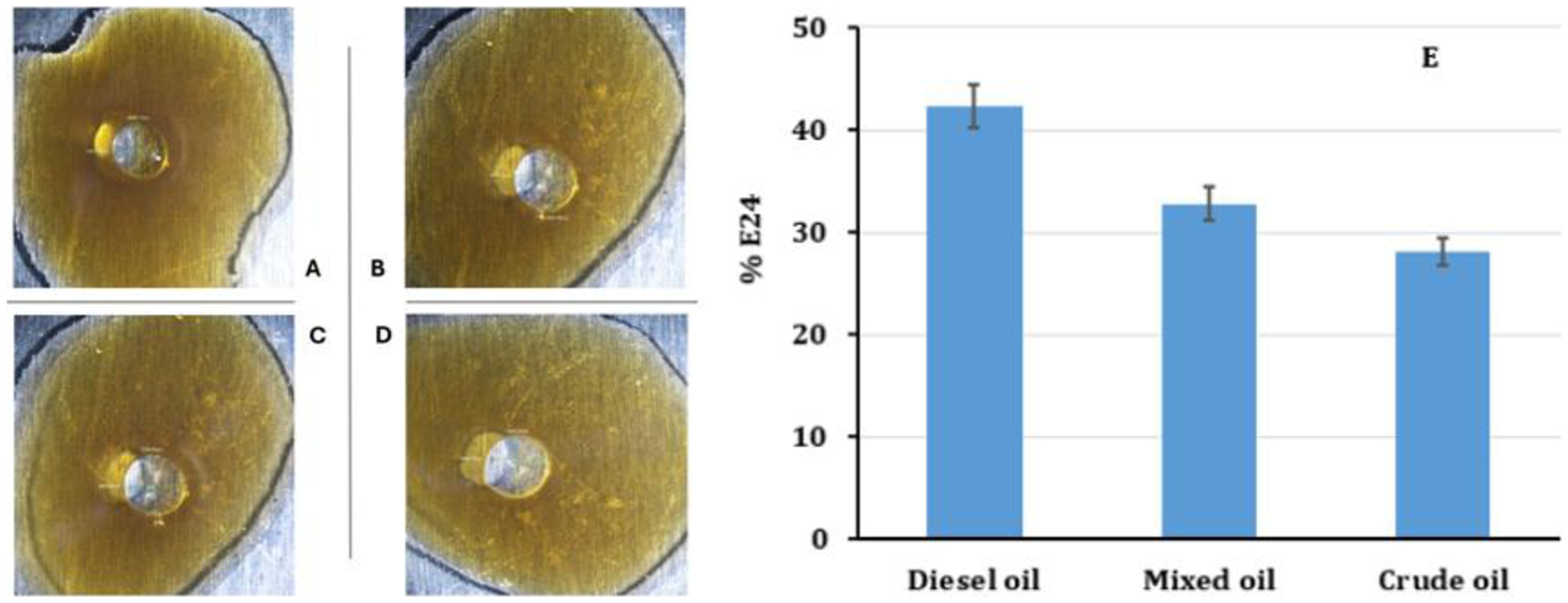
The biosurfactant-producing potential of strain KHB2.9 was qualitatively evaluated using the drop-collapse assay in the presence of different hydrocarbon substrates: crude oil, diesel oil, or mixed oil. As shown in Figure 3A-D, the CFS of strain KHB2.9 exhibited a positive drop-collapse effect across all tested oils, with varying degrees of spreading. The drop diameter was used as an indicator of surface tension reduction and biosurfactant activity. The largest collapse diameter was recorded in the diesel oil treatment (3.98 ± 0.004 mm), followed by mixed oil (3.92 ± 0.004 mm) and crude oil (3.85 ± 0.005 mm). In contrast, the negative control (distilled water) exhibited a significantly smaller diameter (3.3 ± 0.003 mm), indicating negligible spreading due to the absence of surface-active compounds. These results suggest that biosurfactants present in the CFS effectively reduced the surface tension of the oil-water interface, facilitating drop collapse. The greater spreading observed in diesel- and mixed-oil conditions may be attributed to increased biosurfactant yield and/or higher solubility and emulsification efficiency of lighter hydrocarbons compared to crude oil. Notably, the fact that all experimental conditions yielded drop diameters well above the 0.5 mm threshold confirms the positive production of biosurfactants by strain KHB2.9.

Drop collapse assay of surfactants (A-D) and emulsification activity (E) of KHB2.9 strain on various oils. A - negative control; B - diesel oil; C - crude oil; D - mixed oil.
In addition, the KHB2.9 exhibited effective bio-emulsification activity against all tested oils. As shown in Figure 3E, KHB2.9 indicated the highest activity with diesel oil (42.6 ± 0.3%), followed by mixed oil (32.7 ± 0.15%) and crude oil (27.8 ± 0.25%). This demonstrated its ability to alter the physical properties of these oils by increasing their spreadability.
3.6. Draft genome and taxonomic identification of strain KHB2.9
Sequencing of the isolate yielded 2,819,520 reads, producing 408,029,302 base pairs with a Q30 score of 90.3%, indicating high-quality and reliable sequencing data suitable for downstream genomic analysis. De novo assembly using these reads generated a draft genome composed of 1,063 contigs, with an overall length of 2.59 Mbp (accession no. JBLTYW000000000.1 on GenBank). The largest contig was 41,396 bp, and the N50 and L50 values were 2,769 bp and 220, respectively. The GC content averaged 56.42%, and the estimated genome completeness was 36.54%, suggesting that additional sequencing or hybrid assembly strategies are needed to improve assembly quality.
Pairwise genome comparisons using the Genome-to-Genome Distance Calculator (GGDC), employing Formula 2 optimized for draft genomes, revealed high digital DNA-DNA hybridization (dDDH) values of 92.5% and 89.7% between strain KHB2.9 and Pseudomonas veronii strains OST1911 and 7-41, respectively. The corresponding genome distances were 0.0095 and 0.0125, with probabilities of exceeding the 70% species threshold at 96.55% and 95.69%, respectively. These values strongly support the assignment of KHB2.9 to the species P. veronii. In contrast, comparisons with P. fluorescens SBW25 and P. putida KT2440 resulted in dDDH values well below the species delineation threshold, indicating more distant phylogenetic relationships. The narrow confidence intervals further reinforce the genomic coherence of strain KHB2.9 within the P. veronii clade (Table 2) (Meier-Kolthoff et al., 2022). Additionally, ANI analysis confirmed high nucleotide identity between KHB2.9 and P. veronii OST1911 (98.47%) and P. veronii 7-41 (97.97%), while values for SBW25 and KT2440 were significantly lower (86.94% and 78.04%, respectively) (Richter et al., 2015).
Pairwise genome comparisons between strain KHB2.9 and other Pseudomonas strains based on GGDC (Formula 2) and ANI analyses.
To complement the genome-based results of dDDH and ANI, 16S rRNA gene sequence analyses were performed. The 16S rRNA gene (1,532 bp) recovered from the assembled genome of KHB2.9 showed 100% similarity to partial sequences of P. veronii strains, including T1, OST1911, G2, 7-41, and 1YdBTEX2. An independently amplified 16S rRNA gene (1,537 bp, deposited under accession PQ555358.1) using universal primers (27F; 1492R) was found to be identical to the assembled sequence, confirming its accuracy. A phylogenetic tree constructed from this 16S rRNA gene sequence revealed that strain KHB2.9 clustered closely with P. veronii strains 7-41 and nBP5, supported by a bootstrap value of 80% (Figure 4). These strains have been previously characterized as efficient hydrocarbon degraders (Mullaeva et al., 2022), further supporting the environmental and taxonomic alignment of KHB2.9.

Phylogenetic tree of strain KHB2.9 based on the sequence of 16S rRNA gene (1537 bp). Bootstrap values (%) based on 1000 replications are listed at the branching point.
3.7. The oil-degrading related genomic elements of strain KHB2.9
In the genome statistics of the KHB2.9 strain, a total of 3010 genes were predicted, 2981 of which were protein-coding genes and 29 of which were RNA genes (2 rRNA genes and 27 tRNA genes. About 40% of the protein-coding genes were assigned to a putative function, with the remaining annotated as hypothetical proteins. Most of the genes in the putative functions group were distributed within the COG (Clusters of Orthologous Groups) functional categories (Table 3).
Genomic analysis of Pseudomonas veronii strain KHB2.9 revealed a diverse set of genes involved in the degradation of petroleum-derived compounds, including alkanes, cycloalkanes, and aromatic hydrocarbons (Table 4). Key genes encoding enzymes for n-alkane and cycloalkane catabolism were identified, including alkB, adhA, adhT, gabD1, calB, davD, and xylG. These genes corresponding to enzymes alkane monooxygenase, alcohol dehydrogenase, and aldehyde dehydrogenase are distributed across multiple genomic loci. Similarly, genes associated with cycloalkane and aromatic hydrocarbon degradation were detected (dmoA, cat, pcaH, pmdD, rutD), encoding various monooxygenases, dioxygenases, and hydrolases. Several genes responsible for surface-active compounds synthesis, such as rmlC, algA1, algA2, algC, and alg8 were indicated on the genome sequence KHB2.9. However, the genes for rhamnolipid production, such as rhlA, rhlB, and rhlC, were not detected in the current draft genome (Table 4). Besides, the ompW gene (on locus WM0082406A01_02537), which encodes the outer membrane protein W and helps uptake oil hydrocarbons across the bacterial cell wall into the cytoplasm, was found in the genome sequence KHB2.9.
Genes responsible for hydrocarbon degradation and biosurfactant synthesis annotated in the genomic sequence KHB2.9.
4. Discussion
Environments subject to prolonged oil pollution provide favorable conditions for the growth and development of many microorganisms (Kuyukina and Ivshina, 2019). Predominant bacterial genera such as Pseudomonas, Acinetobacter, Bacillus, and Rhodococcus are commonly found in oil-contaminated samples (e.g., inland, coastal areas) (Dohare et al., 2024; Stancu, 2025; Shandookh et al., 2024). In this study, strain KHB2.9 was isolated from a previously oil-contaminated sandy soil sample with high TPHs content (3754 mg kg-1), at the coast of Cam Ranh Bay, Vietnam. Through independent 16S rRNA gene analysis and de novo genome sequencing, KHB2.9 was identified as belonging to Pseudomonas veronii. It exhibited the highest biomass in a diesel oil medium (OD600 reached 1.02 ± 0.05 by day 14), followed by mixed oil and then crude oil. The ability of KHB2.9 to utilize all three different petroleum oils (diesel, mixed, and crude) is consistent with many published studies. Species such as P. aeruginosa, P. putida, P. veronii, and P. fluorescens isolated from oil-contaminated soil or oil well water achieve cell biomass ranging from 0.8 to 1.3 in media containing diesel or crude oil (Wu et al., 2023; Shandookh et al., 2024; Dohare et al., 2024). This indicates that these bacteria utilize petroleum hydrocarbons as carbon sources for metabolism to support their growth. Among these substrates, diesel oil is a lighter, more refined petroleum product that microorganisms can more readily use than crude oil due to the latter’s higher content of impurities. Strain KHB2.9 grew well in all three tested oils and likely metabolized most of the hydrocarbons present. Consistent with the cell biomass results, KHB2.9 exhibited the highest hydrocarbon degradation efficiency with diesel oil (53.85 ± 0.05%), followed by mixed oil and then crude oil. Compared to Pseudomonas strains reported in previous studies, P. veronii KHB2.9 shows a hydrocarbon degradation efficiency at a similar level (47-68%). This suggests that KHB2.9’s hydrocarbon-degrading performance is quite competitive, consistent with the highly active Pseudomonas group in oil pollution remediation. The similarity in growth and conversion performance between KHB2.9 and other Pseudomonas strains reported in the literature further supports the feasibility of using this strain for the bioremediation of oil pollution.
In addition to gravimetric and redox-based assays, GC-MS analysis provided direct chemical evidence for hydrocarbon biodegradation by strain KHB2.9. The selective depletion of medium-chain n-alkanes (C13-C17) observed after 14 days of incubation is consistent with the preferential utilization of more bioavailable hydrocarbon fractions under aerobic conditions (Rojo, 2009; Mullaeva et al., 2022). The limited removal of branched isoprenoids and long-chain n-alkanes further reflects well-documented patterns of microbial alkane degradation. Given that the GC-MS experiment was conducted using the mixed oil under controlled laboratory conditions, these results should be interpreted as indicative of substrate preference rather than exhaustive degradation capacity. Nevertheless, the concordance between GC-MS profiles, DCPIP reduction, and growth data strengthens the evidence for the hydrocarbon-degrading potential of P. veronii strain KHB2.9 (Obi et al., 2016; Dohare et al., 2024).
Biosurfactants play a pivotal role in petroleum hydrocarbon degradation by emulsifying and enhancing the bioavailability of hydrophobic compounds. This process is crucial for microorganisms to access, uptake, and degrade hydrocarbons, highlighting the potential of biosurfactant-producing bacteria (Elumalai et al., 2021). This study demonstrates that KHB2.9 produces surface-active compounds that reduce tension on hydrophobic surfaces, as evidenced by the drop-collapse test. The drop diameter reached approximately 3.98 mm with diesel oil, and slightly smaller values with mixed oil (3.92 mm) and crude oil. The emulsification efficiency (E24%) of KHB2.9 was highest with diesel (42.6 ± 0.3%) and lower with mixed oil and crude oil. Some P. aeruginosa strains exhibited emulsification activity as high as 60-90% (Patowary et al., 2017), whereas other species, such as P. oryzihabitans (Hosseini et al., 2024) and P. stutzeri (Sharma et al., 2018), displayed emulsification levels slightly below and above that of KHB2.9, respectively, depending on the hydrocarbon type. As a result, while KHB2.9 does not rank among the highest biosurfactant-producing Pseudomonas strains, it consistently produces biosurfactants within the typical range reported for many pseudomonads, contributing to oil dispersion and supporting its potential usefulness in environmental applications.
Although the complete genome of P. verronii strain KHB2.9 has not yet been studied, the genomic analysis of KHB2.9 revealed a diverse set of hydrocarbon-degrading genes distributed across multiple loci, including alkB (alkane 1-monooxygenase), a group of adh (alcohol dehydrogenase), of gabD1, calB, davD, and xylG (aldehyde dehydrogenase), of pcaH, pmdD, cat, rutD, and dmoA (mono-, dioxygenases and hydrolases). These enzymes constitute the core of two major degradation routes: alkane oxidation and aromatic ring cleavage via catechol and protocatechuate intermediates. The presence of alkB in KHB2.9 indicates its ability to initiate alkane degradation through terminal hydroxylation, a capability also reported in well-known strains such as P. putida GPo1, Alcanivorax borkumensis SK2, and P. aeruginosa PAO1 (Rojo, 2009). For aromatic compound degradation, KHB2.9 encodes the key enzymes of the β-ketoadipate pathway, including cat (catechol 1,2-dioxygenase), pcaH, pmdD, and rutD, which are also found in other hydrocarbon-degrading species such as P. putida, Acinetobacter baylyi, and Burkholderia sp. (Garrido-Sanz et al., 2019).
The identification of genes involved in the biosynthesis of rhamnose precursors (e.g., rmlC) and alginate-related clusters (e.g., algC) suggests a potential to produce biosurfactants that may contribute to the emulsification of petroleum-derived substrates and enhance the degradation of various hydrocarbons. The role of rmlC within the rmlABCD operon is well established in rhamnolipid biosynthesis, as it encodes a key epimerase required for the production of dTDP-L-rhamnose, a precursor for rhamnolipid assembly (Wang et al., 2014). Similarly, algC has been shown to provide critical sugar precursors for rhamnolipid production, and mutants lacking algC display significantly reduced biosurfactant synthesis in Pseudomonas aeruginosa. These findings support the view that the presence of rmlC and alg genes in hydrocarbon-degrading bacteria may serve as genomic indicators of biosurfactant-producing potential, consistent with the phenotypic observations reported here.
Furthermore, previous studies have demonstrated a close correlation between the presence of biosurfactant gene clusters and the ability of microorganisms to emulsify and degrade hydrocarbons. For example, Pseudomonas sp. P-1, carrying the rhl gene cluster, was shown to produce rhamnolipids and degrade crude oil hydrocarbons (Pacwa-Płociniczak et al., 2014). Likewise, Dietzia maris As-13-3, which harbors the rmlBDAC, rhlABC, and algC genes, produced di-rhamnolipids in the presence of long-chain alkanes, exhibiting strong surface tension reduction and emulsification activity (Wang et al., 2014). Comparative genomic analyses have also revealed that P. aeruginosa strains isolated from hydrocarbon-contaminated environments consistently possess complete rhlABC clusters, correlating with their hydrocarbon-degradation capacities (Huarcaya et al., 2025). More broadly, genome mining identified more than 80 bacterial species carrying homologs of rhl and rml genes, many of which were subsequently confirmed to produce rhamnolipids experimentally (Magri and Abdel-Mawgoud, 2022). Taken together, these observations reinforce that the genomic annotations obtained here are consistent with the phenotypic evidence of biosurfactant production and emulsification activity demonstrated in this study.
Compared with previously reported hydrocarbon-degrading bacteria isolated from coastal provinces of Vietnam such as Nha Trang, Vung Tau, Da Nang, and Con Dao, where Pseudomonas and Acinetobacter species were found to be predominant (Doan et al., 2016; Hai et al., 2009; Hien et al., 2002; Huy et al., 1999), the strain KHB2.9 has been comprehensively characterized at both the phenotypic and genomic levels, revealing a consistent hydrocarbon-degrading phenotype supported by a defined set of catabolic genes.
Overall, this study demonstrates that bacterial strain KHB2.9 efficiently degrades petroleum-derived hydrocarbons, particularly medium-chain n-alkanes, highlighting its potential for environmental and industrial bioremediation. The genomic data generated here also provide a valuable foundation for future research on xenobiotic degradation pathways and the development of new biotechnological solutions to environmental challenges. Future work will focus on long-read genome sequencing, targeted hydrocarbon fraction analysis, and consortium-based bioremediation trials under saline coastal conditions.
5. Conclusion
Pseudomonas veronii KHB2.9, isolated from oil-contaminated sandy soil in Cam Ranh Bay, Khanh Hoa, Vietnam, exhibited a robust hydrocarbon-degrading phenotype supported by complementary gravimetric, redox-based, and chemical analyses. Phylogenetic analysis based on 16S rRNA gene sequencing and draft genome data confirmed that strain KHB2.9 belongs to the species Pseudomonas veronii, closely related to other hydrocarbon-degrading strains. Strain KHB2.9 demonstrated strong growth on diesel oil, crude oil, and a crude oil-diesel mixture, with the highest biomass and hydrocarbon oxidation activity observed in diesel oil. Redox-based DCPIP assays indicated substantial hydrocarbon oxidation, which was further supported by GC-MS analysis revealing selective and efficient biodegradation of medium-chain n-alkanes (C13-C17) in a crude oil-diesel mixture. Genomic analysis identified key genes associated with alkane oxidation, aromatic compound degradation, and biosurfactant-related pathways, providing supportive evidence for the observed biodegradation phenotype, although complete metabolic pathway reconstruction awaits improved genome assemblies.
Taken together, these findings highlight Pseudomonas veronii KHB2.9 as a promising indigenous bacterial candidate for the development of bioremediation strategies targeting petroleum-contaminated saline coastal soils. Future studies should focus on long-read genome sequencing, targeted analysis of additional hydrocarbon fractions, and pilot-scale or consortium-based bioremediation trials under field-relevant conditions.
Supplementary Material
Supplementary material accompanies this paper.
Table S1
Table S2
Figure S1.
This material is available as part of the online article from https://doi.org/10.1590/1519-6984.300561
Acknowledgements
This work was supported by the Joint Vietnam-Russia Tropical Science and Technology Research Center under grant number SH.Đ1.04/23, and by KT-Grant, KTest under grant number KT-GRANT 2024-01.
Data Availability Statement
The entire dataset supporting the results of this study was published in the article itself.
References
-
AKPAN, S.B., ACHI, O.K. and EJIKEME, N., 2025. Physicochemical properties of sediment and isolation of hydrocarbon-degrading bacteria from crude oil-contaminated Iko River Estuary. Traektoriâ Nauki, vol. 11, no. 11, pp. 4010-4019. https://doi.org/10.22178/pos.124-45
» https://doi.org/10.22178/pos.124-45 -
AL-HAMMDANI, N.S., SAAED, I.O. and ALOUSH, R.H., 2025. Accumulation of some heavy metals in the vegetative parts of Phragmites australis, which grow in polluted soil by oily wastewater discharged from Salah Al-Din oil refineries, Iraq. Tikrit Journal of Pure Science, vol. 30, no. 5, pp. 18-24. https://doi.org/10.25130/tjps.v30i6.1865
» https://doi.org/10.25130/tjps.v30i6.1865 -
AYED, H.B., JEMIL, N., MAALEJ, H., BAYOUDH, A., HMIDET, N. and NASRI, M., 2015. Enhancement of solubilization and biodegradation of diesel oil by biosurfactant from Bacillus amyloliquefaciens An6. International Biodeterioration & Biodegradation, vol. 99, pp. 8-14. https://doi.org/10.1016/j.ibiod.2014.12.009
» https://doi.org/10.1016/j.ibiod.2014.12.009 -
BEKINS, B.A. and HERKELRATH, W.N., 2026. Natural source zone depletion of crude oil in the subsurface: processes controlling mass losses of individual compounds. Water Resources Research, vol. 62, no. 1, e2025WR041964. https://doi.org/10.1029/2025WR041964
» https://doi.org/10.1029/2025WR041964 -
CHAUMEIL, P.A., MUSSIG, A.J., HUGENHOLTZ, P. and PARKS, D.H., 2020. GTDB-Tk: a toolkit to classify genomes with the Genome Taxonomy Database. Bioinformatics, vol. 36, no. 6, pp. 1925-1927. https://doi.org/10.1093/bioinformatics/btz848 PMid:31730192.
» https://doi.org/10.1093/bioinformatics/btz848 -
CHEN, S., ZHOU, Y., CHEN, Y. and GU, J., 2018. fastp: an ultra-fast all-in-one FASTQ preprocessor. Bioinformatics, vol. 34, no. 17, pp. i884-i890. https://doi.org/10.1093/bioinformatics/bty560 PMid:30423086.
» https://doi.org/10.1093/bioinformatics/bty560 -
DOAN, C.D.P., SANO, A., TAMAKI, H., PHAM, H.N.D., DUONG, X.H. and TERASHIMA, Y., 2016. Identification and biodegradation characteristics of oil-degrading bacteria from subtropical Iriomote Island, Japan, and tropical Con Dao Island, Vietnam. Tropics, vol. 25, no. 4, pp. 147-159. https://doi.org/10.3759/tropics.MS16-01
» https://doi.org/10.3759/tropics.MS16-01 -
DOHARE, S., RAWAT, H.K., BHARGAVA, Y. and KANGO, N., 2024. Characterization of diesel degrading indigenous bacterial strains, Acinetobacter pittii and Pseudomonas aeruginosa, isolated from oil contaminated soils. Indian Journal of Microbiology, vol. 64, no. 2, pp. 749-757. https://doi.org/10.1007/s12088-024-01317-3 PMid:39011005.
» https://doi.org/10.1007/s12088-024-01317-3 - ELISHA, O.D., 2025. Blue carbon, oil pollution, and environmental justice: leadership strategies for mangrove restoration and blue economy development in the Niger Delta. In: N.P. OLOLUBE and M.U. OCHOMA, eds. Perspectives on environmental management and analytical chemistry: a Festschrift in Honour of Professor Victor Akujuru and Professor Gloria Ukalina Obuzor. Chennai: Pearl Publishers, pp. 175-196.
-
ELUMALAI, P., PARTHIPAN, P., HUANG, M., MUTHUKUMAR, B., CHENG, L., GOVARTHANAN, M. and RAJASEKAR, A., 2021. Enhanced biodegradation of hydrophobic organic pollutants by the bacterial consortium: impact of enzymes and biosurfactants. Environmental Pollution, vol. 289, pp. 117956. https://doi.org/10.1016/j.envpol.2021.117956 PMid:34426181.
» https://doi.org/10.1016/j.envpol.2021.117956 -
GARRIDO-SANZ, D., REDONDO-NIETO, M., GUIRADO, M., PINDADO JIMÉNEZ, O., MILLÁN, R., MARTIN, M. and RIVILLA, R., 2019. Metagenomic insights into the bacterial functions of a diesel-degrading consortium for the rhizoremediation of diesel-polluted soil. Genes, vol. 10, no. 6, pp. 456. https://doi.org/10.3390/genes10060456 PMid:31207997.
» https://doi.org/10.3390/genes10060456 -
GUREVICH, A., SAVELIEV, V., VYAHHI, N. and TESLER, G., 2013. QUAST: quality assessment tool for genome assemblies. Bioinformatics, vol. 29, no. 8, pp. 1072-1075. https://doi.org/10.1093/bioinformatics/btt086 PMid:23422339.
» https://doi.org/10.1093/bioinformatics/btt086 -
HAI, H., INOUE, D., MOMOTANI, N., YU, N., TOYAMA, T., SEI, K. and IKE, M., 2009. Characterization of novel 4-n-butylphenol-degrading Pseudomonas veronii strains isolated from rhizosphere of giant duckweed, Spirodela polyrrhiza. Japanese Journal of Water Treatment Biology, vol. 45, no. 2, pp. 83-92. https://doi.org/10.2521/jswtb.45.83
» https://doi.org/10.2521/jswtb.45.83 -
HIEN, L.T., DO THU PHUONG, P.T.T., NGA, D.P., HOANG HAI, P.T., HANG, P.T.M. and TATEDA, M., 2002 [viewed 5 September 2025]. Field test on cleaning of oil pollution on Nhatrang beach of Vietnam. In: M. FUJITA and P.H. VIET, eds. Annual Report of FY 2000, The Core University Program between Japan Society for the Promotion of Science (JSPS) and National Centre for Natural Science and Technology (NCST) [online]. Osaka: University of Osaka, pp. 70-74. Available from: https://hdl.handle.net/11094/12963
» https://hdl.handle.net/11094/12963 -
HOSSEINI, S., SHARIFI, R., HABIBI, A. and ALI, Q., 2024. Molecular identification of rhamnolipids produced by Pseudomonas oryzihabitans during biodegradation of crude oil. Frontiers in Microbiology, vol. 15, pp. 1459112. https://doi.org/10.3389/fmicb.2024.1459112 PMid:39234543.
» https://doi.org/10.3389/fmicb.2024.1459112 -
HUARCAYA, R.A.P., CASTILLO-VILCAHUAMAN, C., MARTEL-TORRES, S.B., RAFAEL, F.A.M. and MORENO, S.M.G., 2025. Comparative genomics of rhamnolipid synthesis and monoaromatic hydrocarbon tolerance genes in environmental Pseudomonas aeruginosa strains. F1000 Research, vol. 13, pp. 1519. https://doi.org/10.12688/f1000research.158761.2 PMid:40297566.
» https://doi.org/10.12688/f1000research.158761.2 -
HUY, N.Q., JIN, S., AMADA, K., HARUKI, M., HUU, N.B., HANG, D.T., HA, D.T., IMANAKA, T., MORIKAWA, M. and KANAYA, S., 1999. Characterization of petroleum-degrading bacteria from oil-contaminated sites in Vietnam. Journal of Bioscience and Bioengineering, vol. 88, no. 1, pp. 100-102. https://doi.org/10.1016/S1389-1723(99)80184-4 PMid:16232582.
» https://doi.org/10.1016/S1389-1723(99)80184-4 -
IKHUMETSE, A.A., ABIOYE, P.O., OYEWOLE, O.A., KOVO, A.S. and IJAH, U.J.J., 2026. Biosynthesis of Pseudomonas aeruginosa mediated silver nanoparticles for remediation of crude oil contaminated water. RSC Advances, vol. 16, no. 2, pp. 1212-1239. https://doi.org/10.1039/D5RA08196C PMid:41487389.
» https://doi.org/10.1039/D5RA08196C -
IMPERATO, V., PORTILLO-ESTRADA, M., MCAMMOND, B.M., DOUWEN, Y., VAN HAMME, J.D., GAWRONSKI, S.W., VANGRONSVELD, J. and THIJS, S., 2019. Genomic diversity of two hydrocarbon-degrading and plant growth-promoting Pseudomonas species isolated from the oil field of Bóbrka (Poland). Genes, vol. 10, no. 6, pp. 443. https://doi.org/10.3390/genes10060443 PMid:31212674.
» https://doi.org/10.3390/genes10060443 -
IVANOVA, A.A., MULLAEVA, S.A., SAZONOVA, O.I., PETRIKOV, K.V. and VETROVA, A.A., 2022. Current research on simultaneous oxidation of aliphatic and aromatic hydrocarbons by bacteria of genus Pseudomonas. Folia Microbiologica, vol. 67, no. 4, pp. 591-604. https://doi.org/10.1007/s12223-022-00966-5 PMid:35318574.
» https://doi.org/10.1007/s12223-022-00966-5 - KEERTHANA, N. and RAGHUNATH, V.S., 2025. Microbial degradation of used engine oil by Pseudomonas putida and Azotobacter chroococcum via biosurfactant production. Annals of Computer Science and Intelligence Systems, vol. 13, no. 5, pp. 59-64.
-
KUYUKINA, M.S. and IVSHINA, I.B., 2019. Bioremediation of contaminated environments using Rhodococcus In: H.M. ALVAREZ, ed. Biology of Rhodococcus Cham: Springer International Publishing, vol. 16, pp. 231-270. https://doi.org/10.1007/978-3-030-11461-9_9
» https://doi.org/10.1007/978-3-030-11461-9_9 -
MAGRI, M. and ABDEL-MAWGOUD, A.M., 2022. Identification of putative producers of rhamnolipids/glycolipids and their transporters using genome mining. Current Research in Biotechnology, vol. 4, pp. 152-166. https://doi.org/10.1016/j.crbiot.2022.02.002
» https://doi.org/10.1016/j.crbiot.2022.02.002 -
MEIER-KOLTHOFF, J.P., SARDÀ CARBASSE, J., PEINADO-OLARTE, R.L. and GÖKER, M., 2022. TYGS and LPSN: a database tandem for fast and reliable genome-based classification and nomenclature of prokaryotes. Nucleic Acids Research, vol. 50, no. D1, pp. D801-D807. https://doi.org/10.1093/nar/gkab902 PMid:34634793.
» https://doi.org/10.1093/nar/gkab902 -
MULLAEVA, S.A., DELEGAN, Y.A., STRELETSKII, R.A., SAZONOVA, O.I., PETRIKOV, K.V., IVANOVA, A.A., DYATLOV, I.A., SHEMYAKIN, I.G., BOGUN, A.G. and VETROVA, A.A., 2022. Pseudomonas veronii strain 7-41 degrading medium-chain n-alkanes and polycyclic aromatic hydrocarbons. Scientific Reports, vol. 12, no. 1, pp. 20527. https://doi.org/10.1038/s41598-022-25191-5 PMid:36443410.
» https://doi.org/10.1038/s41598-022-25191-5 -
MURIEL-MILLÁN, L.F., RODRÍGUEZ-MEJÍA, J.L., GODOY-LOZANO, E.E., RIVERA-GÓMEZ, N., GUTIERREZ-RIOS, R.M., MORALES-GUZMÁN, D., TREJO-HERNÁNDEZ, M.R., ESTRADAS-ROMERO, A. and PARDO-LÓPEZ, L., 2019. Functional and genomic characterization of a Pseudomonas aeruginosa strain isolated from the southwestern Gulf of Mexico reveals an enhanced adaptation for long-chain alkane degradation. Frontiers in Marine Science, vol. 6, pp. 572. https://doi.org/10.3389/fmars.2019.00572
» https://doi.org/10.3389/fmars.2019.00572 - NKANTION, N.U., AS, T.L., UMOYEN, A.J., ETUKUDO, O.M. and BASSEY, N.S., 2025. Microbial pathways to sustainable polycyclic aromatic hydrocarbon remediation. Journal of Bioscience and Biotechnology Discovery, vol. 10, no. 5, pp. 112-119.
-
OBI, L.U., ATAGANA, H.I. and ADELEKE, R.A., 2016. Isolation and characterisation of crude oil sludge degrading bacteria. SpringerPlus, vol. 5, no. 1, pp. 1946. https://doi.org/10.1186/s40064-016-3617-z PMid:27933233.
» https://doi.org/10.1186/s40064-016-3617-z -
PARKS, D.H., IMELFORT, M., SKENNERTON, C.T., HUGENHOLTZ, P. and TYSON, G.W., 2015. CheckM: assessing the quality of microbial genomes recovered from isolates, single cells, and metagenomes. Genome Research, vol. 25, no. 7, pp. 1043-1055. https://doi.org/10.1101/gr.186072.114 PMid:25977477.
» https://doi.org/10.1101/gr.186072.114 -
PARTHIPAN, P., PREETHAM, E., MACHUCA, L.L., RAHMAN, P.K., MURUGAN, K. and RAJASEKAR, A., 2017. Biosurfactant and degradative enzymes mediated crude oil degradation by bacterium Bacillus subtilis A1. Frontiers in Microbiology, vol. 8, pp. 193. https://doi.org/10.3389/fmicb.2017.00193 PMid:28232826.
» https://doi.org/10.3389/fmicb.2017.00193 -
PATOWARY, K., PATOWARY, R., KALITA, M.C. and DEKA, S., 2017. Characterization of biosurfactant produced during degradation of hydrocarbons using crude oil as sole source of carbon. Frontiers in Microbiology, vol. 8, pp. 279. https://doi.org/10.3389/fmicb.2017.00279 PMid:28275373.
» https://doi.org/10.3389/fmicb.2017.00279 -
RAHMAN, M., COLQUE-NAVARRO, P., KÜHN, I., HUYS, G., SWINGS, J. and MÖLLBY, R., 2002. Identification and characterization of pathogenic Aeromonas veronii biovar sobria associated with epizootic ulcerative syndrome in fish in Bangladesh. Applied and Environmental Microbiology, vol. 68, no. 2, pp. 650-655. https://doi.org/10.1128/AEM.68.2.650-655.2002 PMid:11823203.
» https://doi.org/10.1128/AEM.68.2.650-655.2002 -
RICHTER, M., ROSSELLÓ-MÓRA, R., GLÖCKNER, F.O. and PEPLIES, J., 2015. JSpeciesWS: a web server for prokaryotic species circumscription based on pairwise genome comparison. Bioinformatics, vol. 32, no. 6, pp. 929-931. https://doi.org/10.1093/bioinformatics/btv681 PMid:26576653.
» https://doi.org/10.1093/bioinformatics/btv681 -
ROJO, F., 2009. Degradation of alkanes by bacteria. Environmental Microbiology, vol. 11, no. 10, pp. 2477-2490. https://doi.org/10.1111/j.1462-2920.2009.01948.x PMid:19807712.
» https://doi.org/10.1111/j.1462-2920.2009.01948.x -
SAKTHIPRIYA, N., DOBLE, M. and SANGWAI, J.S., 2015. Bioremediation of coastal and marine pollution due to crude oil using a microorganism Bacillus subtilis. Procedia Engineering, vol. 116, pp. 213-220. https://doi.org/10.1016/j.proeng.2015.08.284
» https://doi.org/10.1016/j.proeng.2015.08.284 -
SAMI, K., 2025. Plant microbe synergistic Rhizoremediation mechanisms for polycyclic aromatic hydrocarbon contaminated soils in the Nigerian environment. Plant Scientific Application, vol. 1, no. 2, pp. 15-22. https://doi.org/10.64229/ws17bq36
» https://doi.org/10.64229/ws17bq36 -
SATPUTE, S.K., BANPURKAR, A.G., DHAKEPHALKAR, P.K., BANAT, I.M. and CHOPADE, B.A., 2010. Methods for investigating biosurfactants and bioemulsifiers: a review. Critical Reviews in Biotechnology, vol. 30, no. 2, pp. 127-144. https://doi.org/10.3109/07388550903427280 PMid:20210700.
» https://doi.org/10.3109/07388550903427280 -
SEEMANN, T., 2014. Prokka: rapid prokaryotic genome annotation. Bioinformatics, vol. 30, no. 14, pp. 2068-2069. https://doi.org/10.1093/bioinformatics/btu153 PMid:24642063.
» https://doi.org/10.1093/bioinformatics/btu153 -
SHANDOOKH, F.K., MOHAMMED, M.K. and JABBAR, A.D., 2024. Bioremediation of hydrocarbon pollutants by Pseudomonas putida under optimal conditions. Advancements in Life Sciences, vol. 11, no. 4, pp. 761-766. https://doi.org/10.62940/als.v11i4.1963
» https://doi.org/10.62940/als.v11i4.1963 -
SHARMA, R., SINGH, J. and VERMA, N., 2018. Optimization of rhamnolipid production from Pseudomonas aeruginosa PBS towards application for microbial enhanced oil recovery. 3 Biotech, vol. 8, no. 1, pp. 20. https://doi.org/10.1007/s13205-017-1022-0 PMid:29276658.
» https://doi.org/10.1007/s13205-017-1022-0 -
STANCU, M.M., 2025. Investigating the potential of native soil bacteria for diesel biodegradation. Microorganisms, vol. 13, no. 3, pp. 564. https://doi.org/10.3390/microorganisms13030564 PMid:40142457.
» https://doi.org/10.3390/microorganisms13030564 -
TUYEN, D.T., THANH, N., KHOA, N. and CUONG, N.C., 2022. Identification of hydrocarbon-degrading bacterial consortium isolated from the oil-contaminated muddy soil in Hanoi, Vietnam. Povolzhskiy Journal of Ecology, vol. 2, no. 2, pp. 206-215. https://doi.org/10.35885/1684-7318-2022-2-206-215
» https://doi.org/10.35885/1684-7318-2022-2-206-215 -
WANG, W., CAI, B. and SHAO, Z., 2014. Oil degradation and biosurfactant production by the deep sea bacterium Dietzia maris As-13-3. Frontiers in Microbiology, vol. 5, pp. 711. https://doi.org/10.3389/fmicb.2014.00711 PMid:25566224.
» https://doi.org/10.3389/fmicb.2014.00711 -
WICK, R.R., JUDD, L.M., GORRIE, C.L. and HOLT, K.E., 2017. Unicycler: resolving bacterial genome assemblies from short and long sequencing reads. PLoS Computational Biology, vol. 13, no. 6, e1005595. https://doi.org/10.1371/journal.pcbi.1005595 PMid:28594827.
» https://doi.org/10.1371/journal.pcbi.1005595 -
WU, B., XIU, J., YU, L., HUANG, L., YI, L. and MA, Y., 2023. Degradation of crude oil in a co-culture system of Bacillus subtilis and Pseudomonas aeruginosa. Frontiers in Microbiology, vol. 14, pp. 1132831. https://doi.org/10.3389/fmicb.2023.1132831 PMid:37250029.
» https://doi.org/10.3389/fmicb.2023.1132831 -
ZHANG, Z., HOU, Z., YANG, C., MA, C., TAO, F. and XU, P., 2011. Degradation of n-alkanes and polycyclic aromatic hydrocarbons in petroleum by a newly isolated Pseudomonas aeruginosa DQ8. Bioresource Technology, vol. 102, no. 5, pp. 4111-4116. https://doi.org/10.1016/j.biortech.2010.12.064 PMid:21227683.
» https://doi.org/10.1016/j.biortech.2010.12.064
#
*
e-mail: lointt@ib.ac.vnEditor: