
 Perception and knowledge of organic farmers about pests and natural enemies
Abstract
Knowledge about pests is essential for agriculture, as they can cause significant damage to crops. However, it is equally important to understand the natural enemies that assist farmers in controlling pest insect populations, thereby reducing the need for inputs and promoting production sustainability. The ability to recognize and identify natural enemies is even more relevant for producers who employ environmentally friendly and agroecological-based management techniques, such as biological pest control. Thus, the objective of this study was to assess the level of knowledge of organic and agroecological transition farmers in northern Paraná, Brazil, regarding the identification of pests and natural enemies, aiming to understand how the socioeconomic profile of the respondents influences their understanding of the ecological relationships between insects in the agroecosystem. To this end, a survey-type research was conducted in which 41 organic or agroecological transition farmers were interviewed in person. Farmers, in general, were able to recognize and identify pests in their crops however, they did not achieve the same success regarding natural enemies, highlighting their lack of awareness of the ecological role of this group of insects in the context of integrated pest management. It was observed that the species with the highest identification accuracies were: Aphis gossypii (100%), Bemisia tabaci (100%), Tuta absoluta (97.6%), Frankliniella sp. (95.1%), and Agrotis ípsilon (92.7%), all categorized as pests. On the other hand, the species with the lowest identification accuracies were: Lebia concinna (53.7%), Callida sp. (53.7%), Allograpta sp. (36.6%), Orius spp. (19.5%), and the bug from the Reduviidae family (17.1%), all belonging to the natural enemies group. It is evident that technical assistance and rural extension actions should focus on training and educating farmers dedicated to organic production about biological control management through the conservation and creation of habitats for natural enemies on their properties.
Keywords:
agroecology; organic production; biological control; entomology
Resumo
O conhecimento acerca dos insetos-pragas é essencial para a agricultura, pois estas podem causar grandes prejuízos às culturas. É igualmente importante conhecer os inimigos naturais que ajudam no controle das populações de insetos-pragas, reduzindo a aplicação de inseticidas e promovendo a sustentabilidade da produção. A capacidade de reconhecer e identificar os inimigos naturais é ainda mais relevante para produtores que utilizam técnicas de manejo de base agroecológica, menos agressivas ao meio ambiente, como o controle biológico de pragas. Dessa forma, o objetivo deste estudo foi verificar o nível de conhecimento dos agricultores orgânicos, ou em transição agroecológica, na identificação de pragas e inimigos naturais, e compreender como o perfil socioeconômico desses agricultores influencia no seu entendimento sobre as relações ecológicas entre insetos e agroecossistema. Foi realizada uma pesquisa do tipo survey, na qual 41 agricultores orgânicos, ou em transição agroecológica, foram entrevistados presencialmente. Os agricultores, em geral, foram capazes de reconhecer e identificar as pragas em suas lavouras, mas não tiveram o mesmo sucesso em relação aos inimigos naturais, evidenciando o desconhecimento da importância ecológica desse grupo de insetos no contexto do manejo integrado de pragas. Observou-se que as espécies com maior número de acertos na identificação foram: Aphis gossypii (100%), Bemisia tabaci (100%), Tuta absoluta (97,6%), Frankliniella sp. (95,1%) e Agrotis ípsilon (92,7%), sendo todas categorizadas como pragas. Já as espécies com menores acertos foram: Lebia concinna (53,7%), Callida sp. (53,7%), Allograpta sp. (36,6%), Orius spp. (19,5%) e o percevejo da família Reduviidae (17,1%), todas pertencentes ao grupo dos inimigos naturais. Nesse contexto, verifica-se a necessidade de ações da assistência técnica e extensão rural direcinadas a capacitação desse agricultores em controle biológico, para conservação e criação de habitats para os inimigos naturais nas propriedades.
Palavras-chave:
agroecologia; produção orgânica; controle biológico; entomologia
1. Introduction
Integrated Pest Management (IPM) is an agricultural practice defined as a decision-making process involving the coordinated use of multiple tactics, including biological, chemical, and physical practices, to optimize pest control (Prokopy, 2003). Biological pest control is a key element in IPM, being an ecologically viable strategy in both organic or agroecological farming systems and conventional plantings. Adopting biological pest control involves management strategies aimed at increasing the population of natural enemies in cultivation areas, thus reducing the farmer’s need for chemical insecticides (Baker et al., 2020). Due to the promotion of more significant equity among groups of natural enemies of agricultural pests, biological control is more efficient in organic production areas (Crowder et al., 2010). In these areas, the diversity of natural enemies is higher than that observed in conventional systems, with few groups of these beneficial insects. In complex landscapes with more natural habitats, biological control is also more efficient, as these areas have more diverse populations of natural enemies, resulting in lower pest pressure on agricultural production (Bianchi et al., 2006). Additionally, increasing plant diversity and managing habitats for natural enemies contribute to reducing pests and pesticide use (Hatt et al., 2017).
Identifying pest insects and natural enemies in the context of IPM is fundamental, both from a management perspective and concerning production costs and the maintenance of productivity in agricultural areas (Grijalva et al., 2024). This knowledge is even more relevant for producers who use less environmentally aggressive and agroecological-based management techniques. In this context, organic farming uses techniques such as IPM, crop rotation, and diversification based on ecological processes adapted to local conditions. These techniques minimize external inputs, such as synthetic insecticides, and make it possible to produce food more sustainably, preserving water, soil, biodiversity, and farmers' quality of life (Reganold and Wachter, 2016).
In Brazil, according to Law 10.831 (Brasil, 2003), organic agricultural production systems aim for economic and ecological sustainability. Among other factors, these systems present a characteristic of using cultural, biological, and mechanical methods instead of synthetic compounds like fertilizers, insecticides, fungicides and herbicides. They are subject to control and certification mechanisms. Notably, according to Law 10.831, these systems aim to preserve the biological diversity of natural ecosystems and promote the recomposition or increase in biological diversity in modified ecosystems. Given this, several farmers have started an agroecological transition process, which represents a gradual change in the practices and management of agroecosystems, incorporating ecological principles and technologies, as established in the National Policy for Agroecology and Organic Production – PNAPO (Brasil, 2012). Thus, since natural enemies are indispensable for reducing pest populations in crops, the producer needs to understand the production system as a whole, have knowledge of the ecological interactions, and be able to identify and differentiate pests and natural enemies (Altieri et al., 2005). In this sense, it is hypothesized that agroecological-based farmers, as part of an ecological management production system, can identify pests and natural enemies that occur in their crops, using agricultural practices that increase the population of beneficial insects and enhance their action against pests.
Therefore, the objective of the current study was to verify the level of knowledge of organic farmers, or those in agroecological transition, in identifying pests and natural enemies, and to understand how the socioeconomic profile of the farmers influences their understanding of the ecological relationships between insects and the agroecosystem.
2. Materials and Methods
2.1. Study location and research participants
The research was conducted with 41 vegetable producers from different municipalities in the northern region of the state of Paraná, including Arapongas, Bandeirantes, Faxinal, Londrina, and Sertaneja. The group of interviewees included certified organic farmers or those in the process of agroecological transition.
2.2. Data collection instruments
A survey was conducted with the farmers, using a semi-structured questionnaire, which included questions about producer identification (name, sex, age, and contact); socioeconomic aspects (education, monthly family income, and production unit area); general production aspects (main crops, control and management methods, technical assistance, and management strategies); and insect identification using printed cards. According to Mineiro (2020), a survey is an investigation where information is only discovered through direct inquiry with the research subject. Fowler Junior (2011) highlights that a survey aims to provide statistical descriptions of people through questioning, usually applied to a sample.
The number of questionnaires applied was defined according to the sampling criteria for qualitative research established by Creswell and Poth (2017) and Marshall and Rossman (2014), who recommend interviewing 20 to 50 individuals. The applications took place in person, between November 2022 and March 2023.
Regarding insect identification, each card contained an identification number, an enlarged image of an insect, a life-size image with scale, and the common name of the species. A total of fourteen cards were used, one for each insect, seven of which were pests and the other seven were natural enemies. The selection of species considered in the study was carried out according to Moura et al. (2020), Guimarães et al. (2020), Michereff Filho et al. (2019), and Silva et al. (2013).
The selected pest species were: Agrotis ipsilon (Hufnagel, 1767); Aphis gossypii (Glover, 1877); Bemisia tabaci (Gennadius, 1889); Diabrotica speciosa (Germar, 1824); Frankliniella sp. (Karny, 1910); Liriomyza spp. (Mik, 1894); and Tuta absoluta (Meyrick, 1917) (Figure 1). The selected natural enemy species were: Allograpta sp. (Osten Sacken, 1875); Callida sp. (Latreille, 1824); Eriopis conexa (Germar, 1824); Harmonia axyridis (Pallas, 1773); Lebia concinna (Brullé, 1838); Orius spp. (Wolff, 1811); and a species of assassin bug from the family Reduviidae (Latreille, 1807) (Figure 2).


2.3 Data analysis
Once the data collection was completed, the data were transcribed, tabulated, and classified into different categories: (i) property area, (ii) age group, (iii) monthly family income, (iv) education level, (v) technical assistance, (vi) number of pests and (vii) natural enemies recognized by the producers, and (viii) number of correct identifications of pests and (ix) natural enemies by the producers. After categorizing the variables, they were disaggregated into subcategories.
The categories (i) property area, (ii) age group, (iii) monthly family income, considered based on the minimum wage of 2022, which was US$ 228.00 (R$ 1,212.00), (iv) education level, and (v) technical assistance were divided into subcategories, while the categories (vi) number of pests and (vii) natural enemies recognized by the farmers, (viii) number of correct identifications of pests, and (ix) natural enemies were not separated into subcategories (Table 1).
The interviewees were asked the following questions: “Do you recognize the insect in the image on the card?” with a possible yes or no answer. They were then asked: “Do you identify the insect on the card as a pest or a natural enemy?” with a possible answer of pest or natural enemy. Thus, recognition indicates that the producer has had visual contact with the insect, while identification indicates that the producer correctly classified the insect as a pest or natural enemy. After categorizing the variables, the descriptive statistical analysis of the data was performed, to identify the profile of the respondents and compare whether there were relationships between the variables. The Shapiro-Wilk Test (P <0.05) was performed to assess the normality of the data regarding the recognition and identification of pests and natural enemies. A non-parametric approach was used through the Wilcoxon Test for paired samples to compare recognition between the two insect groups. The Student's t-test (P <0.05) was applied to the differences between the two variables to compare correct identifications between the groups.
ANOVA (P <0.05) was used to compare the groups with respect to the correct identification of natural enemies by education level. The Student's t-test was applied after verifying the normality of the data, to assess the correct identification of natural enemies between producers who receive technical assistance and those who do not. However, the correct identification of pests between the two independent groups was analyzed by the Mann-Whitney test (P <0.05) due to the lack of normality for this variable. The statistical analyses were performed using R software.
3. Results and Discussion
As observed in Table 1, in general, the interviewees are predominantly adult men, over 45 years of age, with a high level of education, with a monthly family income between 2 and 4 minimum wages, and with 78% of this income being obtained exclusively from agroecological-based agricultural production. The labor employed in production is mainly family-based, and the majority receive technical assistance services on rural properties with an area of up to 10 ha.
Regarding sex, it is noteworthy that there was a predominance of male interviewees (68.3%), although this is lower than the national (81%) and state (86%) averages of men leading agricultural establishments (IBGE, 2019). However, it is of note that the presence of women in organic and agroecological areas (31.7%) is significant when compared to the reality of Brazil and Paraná, as observed by Brito et al. (2023) in the state of São Paulo. Compared to conventional systems, women have greater representation occurs in the planning, investment, and marketing processes of organic production (Caumo and Staduto, 2014).
The average age of the interviewed farmers is 45.7. Despite this, 43.9% are up to 45 years old, indicating a younger age group in agroecological areas than in agricultural establishments in general in Brazil and Paraná, where the population under 45 years old represents only 19% and 26%, respectively (IBGE, 2019).
Regarding the level of education, most respondents studied for more than twelve years (46.3%), followed by producers with nine to twelve years of study (29.3%) (Table 1). This is a significant contrast to the data from the 2017 Brazilian Census of Agriculture (IBGE, 2019), as only 6% and 13% of agricultural producers had completed higher education and high school, respectively (IBGE, 2019).
Regarding insect recognition, the p-value obtained from the Wilcoxon Signed-Rank Test (P < 0.05) indicates a significant difference between the recognition of natural enemies and pests by farmers. The Boxplot in Figure 3a shows the distribution of the correct answers for each class, indicating less variability in the recognition of pests compared to natural enemies. This fact shows the greater familiarity of the farmers with the pest group and may also indicate a low presence of natural enemies in the study areas. Regarding the correct identification of insects in the two groups, the Student's t-test (P < 0.05) obtained a low p-value, indicating that there is a significant difference in the identification of the ecological role of insects in the agroecosystem by farmers, with the average identification of pests being higher than that of beneficial organisms (Figure 3b).
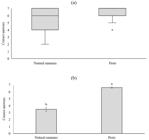
Boxplot (a) representing the distribution of the number of insects recognized by farmers, classified into groups of natural enemies and pests. The analysis was performed using the Wilcoxon Signed-Rank Test (V = 41.5; p-value < 0.05). Graph (b) representing the average correct identification by farmers in each group of insects. The differences between the groups were analyzed using the Student's t-test applied to the differences between the two variables to compare the correct identification between the groups (t = -10.297; p-value < 0.05).
Stratifying recognition by species (Figure 4a), it was found that the most widely recognized were Harmonia axyridis (100%), Diabrotica speciosa (100%), Aphis gossypii (97.6%), Tuta absoluta (97.6%), and Bemisia tabaci (97.6%), with four of these being pests and only one a natural enemy. The least recognized species were the assassin bug from the family Reduviidae (73.2%), Callida sp. (73.2%), Orius spp. (73.2%), Allograpta sp. (65.9%), and Lebia concinna (56.1%), all classified as natural enemies. Regarding the correct identification of the insect as a pest or natural enemy (Figure 4b), the species with the highest numbers of correct identifications were Aphis gossypii (100%), Bemisia tabaci (100%), Tuta absoluta (97.6%), Frankliniella sp. (95.1%), and Agrotis ipsilon (92.7%), all categorized as pests. The species with the lowest numbers of correct identifications were Lebia concinna (53.7%), Callida sp. (53.7%), Allograpta sp. (36.6%), Orius spp. (19.5%), and the assassin bug from the family Reduviidae (17.1%), all belonging to the group of natural enemies.

Levels (a) for recognition and (b) for correct identification of different species of pest and natural enemy species.
It is noticed that the low percentage of correct identification of beneficial bugs can be explained by the association with the brown stink bug (Euschistus heros), which is a well-known pest of this crop. Regarding the higher correct identification of the ladybug as a natural enemy, Martínez-Sastre et al. (2020) show that another species of this beetle (Coccinella septempunctata Linnaeus, 1978) was the most recognized as a natural enemy among apple producers. Notably, a high population density of ladybugs is associated with lower use of pesticides, due to the reduction in pest levels in production areas (Huang et al., 2018). Conversely, the results of Martínez-Sastre et al. (2020) demonstrate a low identification rate of the syrphid fly (Allograpta sp.) as a natural enemy, as observed in Figure 4b.
Based on the presented results, it is inferred that farmers find it easier to recognize pests because, in general, they are directly related to the crop of economic interest, and the damage caused is easily visualized, in other words, producers have an anthropological view of insects, similar to what was reported in a study of fungi (Calaça et al., 2022). Van Mele et al. (2001) also observed this behavior, identifying that producers describe pests mainly based on specific attack symptoms or the affected plant organs.
On the other hand, farmers' identification and recognition of natural enemies are more complex due to the diversity of habitats and different modes of action of these organisms in pest control. The issue of not identifying these insects as natural enemies can be explained by the difficulty in observing these arthropods, combined with the farmers' lack of perception of their importance (Bentley, 1992). There is a strong correlation between identifying the insect as a natural enemy and the knowledge and ability to recognize it as a biological control agent (Martínez-Sastre et al., 2020). Thus, it is not enough to recognize the insect; the farmer must also be able to associate it with its ecological functions, which is a considerable barrier, as pointed out by Van Mele et al. (2001).
In this sense, education level is a fundamental element that can influence the understanding of the role of organisms in the agricultural system and their relationships. Martínez-Sastre et al. (2020) highlight that producers with more activity experience and a higher education level tend to identify a greater number of natural enemies in their crops. However, in the sample of agroecological farmers analyzed, no significant differences were found in the correct identification of natural enemies between education levels according to the ANOVA results, with a p-value of 0.256. Figure 5 shows the representation of the average of each evaluated education level and its respective standard error.

Mean number of natural enemies identified by farmers according to education level (years of study). Comparison performed using ANOVA (F = 1.408; p-value = 0.256).
Although high levels of correct answers were found regarding the identification of pests, no analyses were performed due to the low variability in the number of correct answers within the groups. This demonstrates the ease of farmers in identifying insects that cause economic damage, regardless of education level.
The results indicate that, even among organic or agroecological transition farmers with a high level of education, knowledge about the insects responsible for natural pest control is limited. This deficiency tends to hinder the adoption of conscious practices that conserve these organisms and maximize their benefits. In this regard, Wyckhuys et al. (2019) emphasize farmers' general lack of awareness about biological control, and the existence and the role of natural enemies. In a study on natural enemies in cotton, Huang et al. (2018) found that only one farmer out of 311 interviewed indicated being aware of the presence of natural enemies in their field. Similarly, Morales and Perfecto (2000) also identified low levels of knowledge about the role of these insects in pest control, with only 10% of producers indicating arthropods and other animals as agents of natural control. This limited ecological knowledge influences the dependence on inputs and pest management practices (Wyckhuys et al., 2019).
Analysis of the correct identification of natural enemies (Figure 6a) with respect to technical assistance identified that, among the interviewed producers, there was no significant difference in the number of correct answers between the group that receives assistance and the group that does not (t = -0.27; p-value > 0.05). Regarding the identification of pests (Figure 6b), both groups obtained high accuracy rates, suggesting that technical assistance does not directly influence the identification of the role of these insects in the agroecosystem (W = 80.50; p-value = 0.746).

Mean number (a) of correct identification of natural enemies by farmers with or without technical assistance. The differences between the groups were analyzed using the Student's t-test to compare the correct identifications between the groups (t = -0.27; p-value > 0.05). Boxplot (b) representing the distribution of the number of pests identified by farmers according to whether they received technical assistance or not. The analysis was performed using the Mann-Whitney test (W = 80.50; p-value > 0.05).
Nevertheless, the importance of technical support for farmers in accurately identifying these organisms is highlighted, especially for disseminating knowledge about insect group interactions and management strategies. As noted by Van Mele et al. (2001), farmer training should address this knowledge gap and the lack of appreciation of the benefits provided by natural enemies in agricultural production.
In this sense, the results demonstrate the need for technical support to focus on actions aimed at training and educating farmers about the importance of the ecological role of natural enemies in the agricultural system, within the context of integrated pest management (IPM). Matteson et al. (1994) highlight that extension methods focused on IPM help farmers to understand the effects of each decision in their management, motivating them to increasingly seek agronomic and ecological information to guide their interventions in the field. Actions with farmers that focus on improving knowledge of biological control and identifying natural enemies are fundamental (Martínez-Sastre et al., 2020). Therefore, it is essential that farmers, in general, adopt measures that contribute to the preservation and enhancement of the action of beneficial insects at the property level, thus reducing the use of inputs and, consequently, production costs.
Thus, practices such as biological control, that conserve and restore uncultivated habitats are important in preserving and increasing ecosystem services, with the adoption of organic systems, hedgerows, and cultivated flower strips being recommended strategies (Medeiros et al., 2018). On the other hand, the preventive application of insecticides in conventional production areas is costly, does not bring long-term benefits for pest control, and also negatively affects natural enemies (Krauss et al., 2011). Farmers who better understand the role of natural enemies are less likely to use pesticides in production areas (Wyckhuys and O'Neil, 2007). Additionally, Huang et al. (2018) show that adopting practices that promote increasing ladybug density for aphid (Aphis gossypii) control in agricultural areas brings considerable environmental and economic benefits to farmers. These practices cannot be limited to using inputs that do not harm beneficial insects, but should focus on creating an ecological infrastructure that is able to provide housing and providing resources for these organisms (Landis et al., 2000).
4. Conclusion
Knowledge about natural enemies and their ecological role in agroecosystems is fundamental for developing more efficient and sustainable agriculture, contributing to improving biological pest control. However, it was observed that farmers find it easier to recognize and identify pests compared to natural enemies. It was also found that even organic or agroecological transition farmers with good education and access to technical assistance have limited knowledge about the ecological function of natural enemies in production areas. Therefore, it is necessary to emphasize technical assistance and rural extension actions in disseminating knowledge about the natural biological control promoted by these beneficial insects.
Acknowledgements
To the Fundo Paraná - Secretaria da Ciência, Tecnologia e Ensino Superior do Estado do Paraná for providing financial support. To Dr. Inês Fumiko Ubukata Yada for the support in statistical analyses, and to Dr. Adriano Thibes Hoshino for providing the insect images used in the study.
References
- ALTIERI, M.A., NICHOLLS, C.I. and FRITZ, M.A., 2005. Manage insects on your farm: a guide to ecological strategies College Park, MD: Sustainable Agriculture Research and Education (SARE). Handbook Series Book 7. 135 p.
-
BAKER, B.P., GREEN, T.A. and LOKER, A.J., 2020. Biological control and integrated pest management in organic and conventional systems. Biological Control, vol. 140, pp. 104095. http://doi.org/10.1016/j.biocontrol.2019.104095
» http://doi.org/10.1016/j.biocontrol.2019.104095 -
BENTLEY, J.W., 1992. Alternatives to pesticides in Central America: applied studies of local knowledge. Culture & Agriculture, vol. 44, no. 44, pp. 10-13. http://doi.org/10.1525/cuag.1992.12.44.10
» http://doi.org/10.1525/cuag.1992.12.44.10 -
BIANCHI, F.J.J.A., BOOIJ, C.J.H. and TSCHARNTKE, T., 2006. Sustainable pest regulation in agricultural landscapes: a review on landscape composition, biodiversity and natural pest control. Proceedings. Biological Sciences, vol. 273, no. 1595, pp. 1715-1727. http://doi.org/10.1098/rspb.2006.3530 PMid:16790403.
» http://doi.org/10.1098/rspb.2006.3530 -
BRASIL, 2003 [viewed 2 February 2024]. Lei nº 10.831, de 23 de dezembro de 2003. Dispõe sobre a agricultura orgânica e dá outras providências Diário Oficial da União, Brasília, DF, 24 dez. Available from: https://www.planalto.gov.br
» https://www.planalto.gov.br -
BRASIL, 2012 [viewed 2 February 2024]. Decreto nº 7.794, de 20 de agosto de 2012. Institui a Política Nacional de Agroecologia e Produção Orgânica - PNAPO e dá outras providências iário Oficial da União, Brasília, DF, 21 ago. Available from: https://www.planalto.gov.br
» https://www.planalto.gov.br -
BRITO, T.P., ARAGÃO, S.S., SOUZA-ESQUERDO, V.F.D. and PEREIRA, M.D.S., 2023. Perfil dos agricultores orgânicos e as formas de avaliação da conformidade orgânica no estado de São Paulo. Revista de Economia e Sociologia Rural, vol. 61, no. 3, pp. e260825. http://doi.org/10.1590/1806-9479.2022.260825
» http://doi.org/10.1590/1806-9479.2022.260825 -
CALAÇA, F.J.S., SOUSA, D.G., BELÉM-JUNIOR, J.S., FAQUIM, R.C.P., XAVIER-SANTOS, S., SILVA-NETO, C.M. and SOUZA, M.M.O., 2022. Perception of fungi by farmers in the Cerrado. Brazilian Journal of Biology = Revista Brasileira de Biologia, vol. 82, pp. e236219. http://doi.org/10.1590/1519-6984.236219
» http://doi.org/10.1590/1519-6984.236219 -
CAUMO, A.J. and STADUTO, J.A.R., 2014. Produção orgânica: uma alternativa na agricultura familiar. Revista Capital Científico-Eletrônica, vol. 12, no. 2, pp. 45-64. http://doi.org/10.5935/2177-4153.20140011
» http://doi.org/10.5935/2177-4153.20140011 - CRESWELL, J.W. and POTH, J.W. 2017. Qualitative inquiry and research design: choosing among five approaches. 4th ed. California: SAGE Publications, 488 p.
-
CROWDER, D.W., NORTHFIELD, T.D., STRAND, M.R. and SNYDER, W.E., 2010. Organic agriculture promotes evenness and natural pest control. Nature, vol. 466, no. 7302, pp. 109-112. http://doi.org/10.1038/nature09183 PMid:20596021.
» http://doi.org/10.1038/nature09183 - FOWLER JUNIOR, F.J., 2011. Pesquisa de levantamento 4. ed. Porto Alegre: Penso, 232 p.
-
GRIJALVA, I., SKIDMORE, A.R., MILNE, M.A., OLAYA-ARENAS, P., KAPLAN, I., FOSTER, R.E. and YANINEK, J.S., 2024. Integrated pest management enhances biological control in a US midwestern agroecosystem by conserving predators and non-pest prey. Agriculture, Ecosystems & Environment, vol. 368, pp. 109009. http://doi.org/10.1016/j.agee.2024.109009
» http://doi.org/10.1016/j.agee.2024.109009 - GUIMARÃES, J.A., MICHEREFF FILHO, M., MOURA, A.P., SCHMIDT, F.G.V., SOUSA, N.C.M., SPECHT, A., LOPES, L.H.R., INOUE-NAGATA, A.K., LIMA, M.F., TORRES, J.B. and SILVA, P.S., 2020. Guia de identificação de pragas do pimentão Brasília, DF: Embrapa Hortaliças, 113 p.
-
HATT, S., LOPES, T., BOERAEVE, F., CHEN, J. and FRANCIS, F., 2017. Pest regulation and support of natural enemies in agriculture: experimental evidence of within field wildflower strips. Ecological Engineering, vol. 98, pp. 240-245. http://doi.org/10.1016/j.ecoleng.2016.10.080
» http://doi.org/10.1016/j.ecoleng.2016.10.080 -
HUANG, J., ZHOU, K., ZHANG, W., DENG, X., VAN DER WERF, W., LU, Y., WU, K. and ROSEGRANT, M.W., 2018. Uncovering the economic value of natural enemies and true costs of chemical insecticides to cotton farmers in China. Environmental Research Letters, vol. 13, no. 6, pp. 064027. http://doi.org/10.1088/1748-9326/aabfb0
» http://doi.org/10.1088/1748-9326/aabfb0 - INSTITUTO BRASILEIRO DE GEOGRAFIA E ESTATÍSTICA – IBGE, 2019. Censo agropecuário 2017: resultados definitivos Rio de Janeiro: IBGE.
-
KRAUSS, J., GALLENBERGER, I. and STEFFAN-DEWENTER, I., 2011. Decreased functional diversity and biological pest control in conventional compared to organic crop fields. PLoS One, vol. 6, no. 5, pp. e19502. http://doi.org/10.1371/journal.pone.0019502 PMid:21611171.
» http://doi.org/10.1371/journal.pone.0019502 -
LANDIS, D.A., WRATTEN, S.D. and GURR, G.M., 2000. Habitat management to conserve natural enemies of arthropod pests in agriculture. Annual Review of Entomology, vol. 45, no. 1, pp. 175-201. http://doi.org/10.1146/annurev.ento.45.1.175 PMid:10761575.
» http://doi.org/10.1146/annurev.ento.45.1.175 - MARSHALL, C. and ROSSMAN, G.B., 2014. Designing qualitative research 6th ed. London: SAGE Publications, 352 p.
-
MARTÍNEZ-SASTRE, R., GARCÍA, D., MIÑARRO, M. and MARTÍN-LÓPEZ, B., 2020. Farmers’ perceptions and knowledge of natural enemies as providers of biological control in cider apple orchards. Journal of Environmental Management, vol. 266, pp. 110589. http://doi.org/10.1016/j.jenvman.2020.110589 PMid:32392141.
» http://doi.org/10.1016/j.jenvman.2020.110589 -
MATTESON, P.C., GALLAGHER, K.D. and KENMORE, P.E., 1994. Extension of integrated pest management for planthoppers in Asian irrigated rice: empowering the user. In: R.F. DENNO and T.J. PERFECT, eds. Planthoppers: their ecology and management Boston, MA: Springer US, pp. 656-685. http://doi.org/10.1007/978-1-4615-2395-6_21
» http://doi.org/10.1007/978-1-4615-2395-6_21 -
MEDEIROS, H.R., HOSHINO, A.T., RIBEIRO, M.C., MORALES, M.N., MARTELLO, F., NETO, O.C.P., CARSTENSEN, D.W. and DE OLIVEIRA MENEZES JUNIOR, A., 2018. Non-crop habitats modulate alpha and beta diversity of flower flies (Diptera, Syrphidae) in Brazilian agricultural landscapes. Biodiversity and Conservation, vol. 27, no. 6, pp. 1309-1326. http://doi.org/10.1007/s10531-017-1495-5
» http://doi.org/10.1007/s10531-017-1495-5 - MICHEREFF FILHO, M., SCHMIDT, F.G.V., SOUSA, N.C.M., SPECHT, A., MOURA, A.P., LOPES, L.H.R., INOUE-NAGATA, A.K., LIMA, M.F., GUIMARAES, J.A. and TORRES, J.B., 2019. Guia para Identificação de Pragas do Tomateiro Brasília, DF: Embrapa Hortaliças. 102 p.
-
MINEIRO, M., 2020. Pesquisa de survey e amostragem: aportes teóricos elementares. Revista de Estudos em Educação e Diversidade, vol. 1, no. 2, pp. 284-306. http://doi.org/10.22481/reed.v1i2.7677
» http://doi.org/10.22481/reed.v1i2.7677 -
MORALES, H. and PERFECTO, I., 2000. Traditional knowledge and pest management in the Guatemalan highlands. Agriculture and Human Values, vol. 17, no. 1, pp. 49-63. http://doi.org/10.1023/A:1007680726231
» http://doi.org/10.1023/A:1007680726231 - MOURA, A.P., MICHEREFF FILHO, M., GUIMARÃES, J., LIMA, M., SCHMIDT, F., SOUSA, N.D.M., LOPES, L.H.R., RIBEIRO, M.G.P.M. and SPECHT, A., 2020. Guia para identificação de pragas da alface Brasília, DF: Embrapa Hortaliças, 103 p.
-
PROKOPY, R.J., 2003. Two decades of bottom-up, ecologically based pest management in a small commercial apple orchard in Massachusetts. Agriculture, Ecosystems & Environment, vol. 94, no. 3, pp. 299-309. http://doi.org/10.1016/S0167-8809(02)00036-1
» http://doi.org/10.1016/S0167-8809(02)00036-1 -
REGANOLD, J.P. and WACHTER, J.M., 2016. Organic agriculture in the twenty-first century. Nature Plants, vol. 2, no. 2, pp. 15221. http://doi.org/10.1038/nplants.2015.221 PMid:27249193.
» http://doi.org/10.1038/nplants.2015.221 - SILVA, A.C., GOMES, C.C., SACRAMENTO, F.Z., GARCIA, G.L., SCHULTZ, H., PIAN, L.B., ALMEIDA, L.H.M., AGUIAR, L.A. and TAMASHIRO, L.A.G., 2013. Guia para o reconhecimento de inimigos naturais de pragas agrícolas Brasília, DF: Embrapa, 47 p.
-
VAN MELE, P., CUC, N.T.T. and VAN HUIS, A., 2001. Farmers’ knowledge, perceptions and practices in mango pest management in the Mekong Delta, Vietnam. International Journal of Pest Management, vol. 47, no. 1, pp. 7-16. http://doi.org/10.1080/09670870150215559
» http://doi.org/10.1080/09670870150215559 -
WYCKHUYS, K.A.G. and O’NEIL, R.J., 2007. Local agroecological knowledge and its relationship to farmers’ pest management decision making in rural Honduras. Agriculture and Human Values, vol. 24, no. 3, pp. 307-321. http://doi.org/10.1007/s10460-007-9068-y
» http://doi.org/10.1007/s10460-007-9068-y -
WYCKHUYS, K.A.G., HEONG, K.L., SANCHEZ-BAYO, F., BIANCHI, F.J.J.A., LUNDGREN, J.G. and BENTLEY, J.W., 2019. Ecological illiteracy can deepen farmers’ pesticide dependency. Environmental Research Letters, vol. 14, no. 9, pp. 093004. http://doi.org/10.1088/1748-9326/ab34c9
» http://doi.org/10.1088/1748-9326/ab34c9


