 Association of genetic variants with the progression of COVID-19 symptoms in diabetic patients: a systematic review and in silico protein interaction analysis
Abstract
Diabetes mellitus is a global public health issue and, at the onset of the COVID-19 pandemic, was identified as a risk factor associated with high morbidity and mortality in cases of acute respiratory infection caused by the SARS-CoV-2 coronavirus. This study investigated genetic variants in diabetic patients with COVID-19 through a systematic analysis of the PubMed/NCBI, EMBASE, Web of Science, SCOPUS, and Virtual Health Library databases, with the protocol registered on the PROSPERO platform (registration number CRD42020181311). Fifteen genetic variants were associated with five specific genes in symptomatic diabetic patients with COVID-19. Inheritance models, diabetic individuals carrying the heterozygous genotype TC (VDR rs4516035) showed ~10–15-fold higher odds of symptomatic COVID-19. Protein-protein interaction (PPI) analysis showed that the proteins ACE, ACE2, IL-6, and IL-17 exhibited strong predicted interactions with each other, as well as with insulin and the TMPRSS2 protease. Limitations include small number of eligible studies, heterogeneity in populations and outcome definitions. These preliminary findings highlight the need for further studies to understand better the relationship between the identified genetic variants and the progression of COVID-19 in diabetic patients.
Keywords:
COVID-19; SARS-CoV-2; coronavirus; diabetes mellitus; polymorphisms
Resumo
A diabetes mellitus é um problema global de saúde pública e, no início da pandemia de COVID-19, foi identificada como um fator de risco associado a alta morbidade e mortalidade em casos de infecção respiratória aguda causada pelo coronavírus SARS-CoV-2. Este estudo investigou variantes genéticas em pacientes diabéticos com COVID-19 por meio de uma análise sistemática das bases de dados PubMed/NCBI, EMBASE, Web of Science, SCOPUS e Biblioteca Virtual em Saúde, com o protocolo registrado na plataforma PROSPERO (número de registro CRD42020181311). Quinze variantes genéticas foram associadas a cinco genes específicos em pacientes diabéticos sintomáticos com COVID-19. Em modelos de herança, indivíduos diabéticos portadores do genótipo heterozigoto TC (VDR rs4516035) apresentaram probabilidade de10 a 15 vezes maior de apresentar COVID-19 sintomático. A análise da interação proteína-proteína (IPP) mostrou que as proteínas ECA, ECA2, IL-6 e IL-17 apresentaram fortes interações previstas entre si, bem como com a insulina e a protease TMPRSS2. As limitações incluem o pequeno número de estudos elegíveis, a heterogeneidade nas populações e as definições de desfechos. Esses achados preliminares destacam a necessidade de estudos adicionais para melhor compreender a relação entre as variantes genéticas identificadas e a progressão da COVID-19 em pacientes diabéticos.
Palavras-chave:
COVID-19; SARS-CoV-2; coronavírus; diabetes mellitus; polimorfismos
1. Introduction
The COVID-19 outbreak, declared a pandemic by the WHO in March 2020, has resulted in over 6.9 million deaths as of November 2023 (Mahase, 2020; WHO, 2019). The disease exhibits a wide ranging from asymptomatic to critical illness, including pneumonia, acute respiratory distress syndrome (ARDS), and multi-organ failure, often linked to the “cytokine storm” (Alhazzani et al., 2020; Xie and Chen, 2020). Factors such as viral load, host characteristics (age, sex, comorbidities, and genetics), ventilatory response, and timing of diagnosis influence disease outcomes (Alhazzani et al., 2020; Xie and Chen, 2020; Gattinoni et al., 2020; Figueroa-Pizano et al., 2021).
Comorbidities like older age, hypertension, obesity, Diabetes mellitus (DM), cardiovascular diseases, lung and kidney diseases, and vitamin D deficiency exacerbate disease progression (Gattinoni et al., 2020; Figueroa-Pizano et al., 2021). These conditions contribute to a chronic pro-inflammatory state, endothelial dysfunction, and impaired immune responses, which together heighten susceptibility to viral replication, cytokine storm, and thrombotic complications. Studies published in the Brazilian Journal of Biology have also emphasized the biological mechanisms involved in COVID-19 pathogenesis, particularly those related to viral entry through ACE2 and TMPRSS2 and the resulting systemic inflammatory response (Campos et al., 2020). However, the relationship between DM and COVID-19 genetics remains poorly understood. This study addresses a knowledge gap regarding host genetics in DM and COVID-19 conducted a systematic review to identify genetic polymorphisms associated with COVID-19 severity in diabetics, proposing a genetic inheritance model and protein-protein interaction (PPI) networks. The findings aim to improve clinical management, enable personalized treatments, and guide future research to identify relevant genetic variants.
2. Materials and Methods
2.1. Protocol, registration and search strategy
This systematic review was registered in the International Prospective Register of Systematic Reviews (PROSPERO: CRD42020181311) on November 2, 2021, and follows the PRISMA 2020 guidelines (Page et al., 2021). The methodology used for the development of this systematic review was previously published by Silveira et al. (2024).
Briefly, a systematic search was conducted on November 25, 2023, across PubMed/NCBI, EMBASE, Web of Science, SCOPUS, and Virtual Health Library (VHL), along with additional searches on Google Scholar (first 10 pages) and reference lists of included studies. Two independent reviewers evaluated the strategy following PRESS guidelines (McGowan et al., 2016), adapting it to each database (see the S1 Supplementary material).
The search strategy combined keywords in specific orders, and a Relevance Test 1 (RT1)—a manual, dual screening of titles and abstracts, was developed and applied by the researchers to ensure that at least two of the selected descriptors were present: 1. “COVID-19” or “SARS-CoV-2” or “Novel Coronavirus” or “2019-nCoV” or “Coronavirus” (title/abstract); 2. “Polymorphism” or “Genetic polymorphism” or “Genetic probability” (title/abstract); 3. “Diabetes” or “diabetes mellitus” (title/abstract); 4. (1) and (2) or (1) and (3). Any discrepancies between reviewers were resolved by consensus.
2.2. Eligibility criteria
This review included observational studies published from 2019 to 2023, a period chosen because it encompasses the entire COVID-19 pandemic, in peer-reviewed journals reporting on polymorphisms in genes associated with COVID-19 progression in diabetic patients. No language restrictions were applied. The inclusion and exclusion criteria, based on the Patient, Exposure, Comparators, Outcome, and Study Design (PECOS) method, are described in S2 Supplementary material. Studies without full texts and/or suspected of data duplication were excluded. Complications and deaths associated with COVID-19 were considered secondary outcomes and were recorded only when explicitly reported in the included studies, rather than being actively searched for during the literature review.
2.3. Study selection and data extraction
Two authors (LCS, KdFS) independently selected the studies and extracted the data, resolving disagreement through consensus or, if necessary, with the third reviewer (RdSS). All studies were imported to the Rayyan® platform to optimize the selection process, with duplicates removed during the initial screening (Ouzzani et al., 2016). Titles, abstracts and subsequently full texts were reviewed to confirm eligibility. Peer-reviewed original papers published with no language restriction that satisfied the eligibility criteria were included. The nomenclature of genes, genomic location, and polymorphisms were verified using the National Center for Biotechnology Information (NCBI) database, in Gene (NCBI, 2025a) and Single Nucleotide Polymorphism (SNP) (NCBI, 2025b) sections.
Information extracted from selected articles included: reference, year of publication, country, data collection period, type of study, gene, genomic location, genotyping method, polymorphism; type of polymorphism; sample size of case and control groups; genotypic or allelic comparison performed and their frequencies; Odds ratio (OR) and 95% confidence interval (CI), p-value.
2.4. Risk of methodological bias in individual studies
The risk of methodological bias was assessed using the Joanna Briggs Institute (JBI) Critical Appraisal Instrument for Cohort Studies (Moola et al., 2020a) and Case-Control Studies (Moola et al., 2020b) (see the S3 and S4 Supplementary material). The tool has eleven specific questions for cohort studies and ten questions for case-control studies to be answered with “Yes”, “No”, “Unclear” or “Not applicable”. Studies that achieved “Yes” or “Not Applicable” to more than 80% of the questions were classified as low risk of bias.
Two independent reviewers assessed methodological bias. A third reviewer performed data synthesis and discrepancies were resolved by consensus between the reviewers. The methodological quality assessment was not used as a criterion for study eligibility.
2.5. Data analysis
For statistical analyses, four inheritance models (codominant, dominant, recessive, and overdominant) were applied for the genetic association analyses. The Fisher’s Exact Test was used to compare genotype frequencies between symptomatic and asymptomatic groups. Hardy–Weinberg equilibrium was assessed, also using the Fisher’s Exact Test, to confirm genotype distribution consistency within the control or asymptomatic groups of each included study. Binomial logistic regression was used to estimate the parameters of each model and calculate the Odds Ratio and confidence interval. For all statistical approaches, a significance level of 5% was considered. All analyses were carried out using R software version 4.2.1 (R Core Team, 2022).
2.6. In silico protein interaction analysis
The in silico protein interaction analysis (PPI) of genes identified in the systematic review stage was carried out by submitting the sequences of the proteins ACE, ACE2, IL-6, IL-17a, and VDR in the online database STRING version 12.0. (STRING, 2025; Abdollahzadeh et al., 2021). STRING scores represent confidence levels based on multiple evidence sources. Additionally, the protein sequences of insulin (INS) and the human trans-membrane serine protease enzyme 2 (TMPRSS2) were also used for in silico analysis due to the relationship with DM pathophysiology mechanisms (Rachdaoui, 2020) and dissemination of the virus SARS-CoV-2 (Jackson et al., 2022).
The sequences of all proteins were obtained from the online database UNIPROT (Bateman et al., 2023). The hyperparameters used in the PPIs were: i) network type: full STRING network; false discovery right (FDR): 0.05; score medium confidence: 0.400. For cluster analysis of STRING, the proteins were grouped into 04 (four) clusters organized according to the biological characteristics of said proteins.
3. Results
3.1. Methodological results
3.1.1. Search results and studies selection
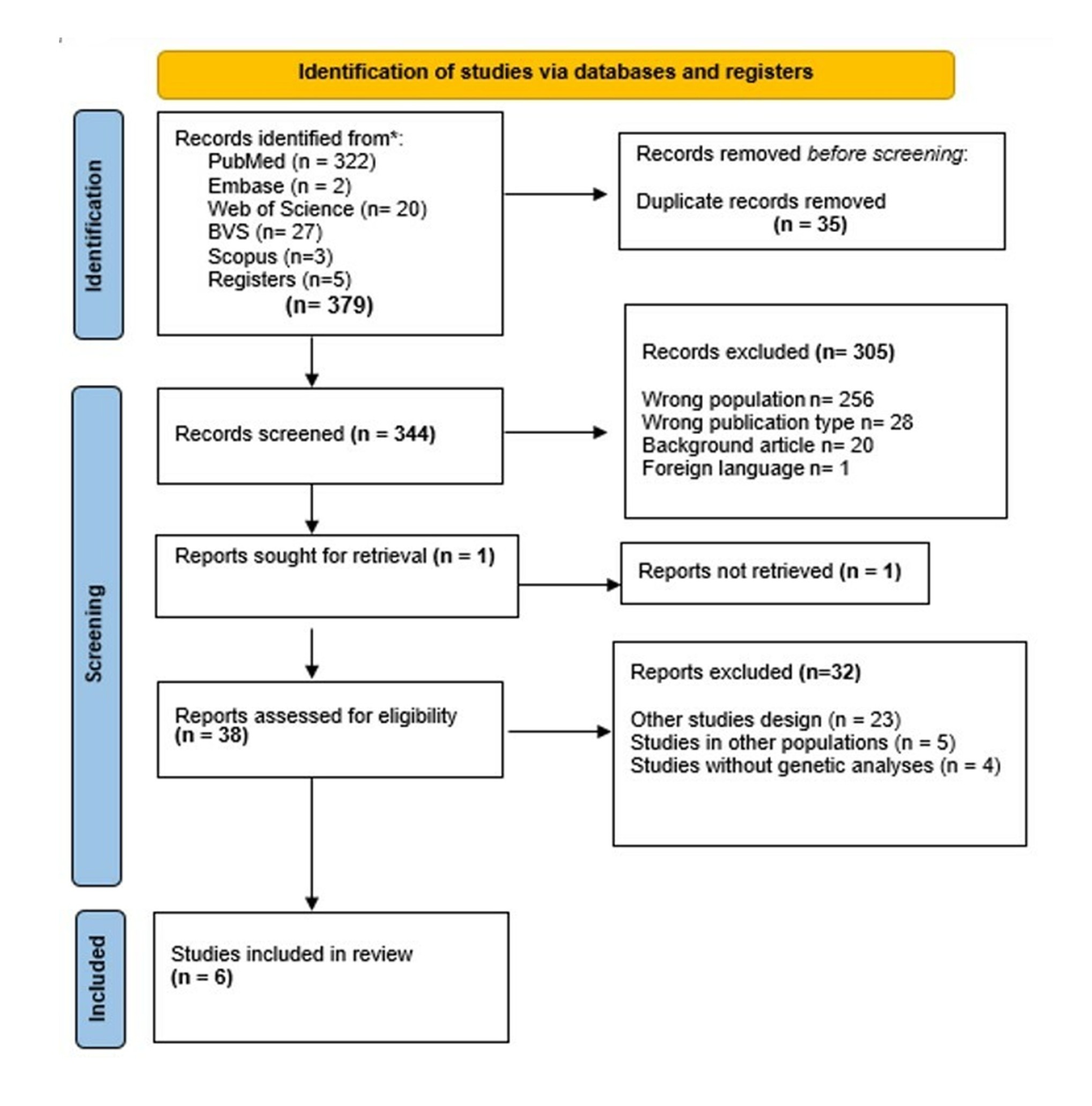
A total of 379 articles were identified, with 35 duplicates removed. After screening 344 studies by title and abstracts, 305 were excluded for not meeting inclusion criteria. Only one study was not retrieved despite attempts to contact the authors. Full-text eligibility was assessed for 38, but 32 were excluded for the following reasons: 23 studies were not observational, 5 studies included individuals with DM and other comorbidities in the same group or did not have DM in the groups and 4 studies did not present genotyping data. Finally, 6 studies met all inclusion criteria and were included in this systematic review. The PRISMA flow diagram illustrates the process (Figure 1).

3.1.2. Methodological quality within individual studies
The six studies included in this review showed a low risk of methodological bias (see the S5 Supplementary material), as both received “yes” for all parameters, except in question 10 for the checklist for cohort studies “Were strategies to address incomplete follow-up utilized?” which obtained “Not applicable”, thus reaching 100% of adequacy. In the checklist for case-control studies question 6. “Were confounding factors identified?” and question 7. “Were strategies to deal with confounding factors stated?” the article of Khalaf’s et al. (2023) obtained “Not applicable” too.
3.1.3. Study characteristics
The patient data collection period of the studies included in our review predominantly ranged from April 2020 to April 2021. Only the study by Khalaf et al. (2023) does not directly state the data collection period but only informs the ethnic ascertainment period on December 1, 2021. This data compiled from the six eligible articles included in our review generated a database with 293 diabetic individuals with COVID-19. Of these diabetic individuals with COVID-19, 30 individuals from European (Spanish) and 263 individuals from Asian (92 Iranians, 47 Saudi Arabs, 37 Indians, 75 Turks, and 12 Iraqis), as described in S6 Supplementary material.
The diagnosis of COVID-19 of the participants considered in our review was based on a positive reverse transcriptase-polymerase chain reaction (RT-PCR) test result, following WHO (2022) guidelines. The organization of these participants in the studies included in this review used different approaches. Briefly, Abdollahzadeh et al. (2021) and Íñiguez et al. (2021) grouped participants into asymptomatic, mild/moderate symptomatic, and severe/critical symptomatic. However, Íñiguez's et al. (2021) study considered other comorbidities in addition to DM, and, regrettably, no diabetic was included in the asymptomatic group. Additionally, studies by Muzaffar Mir et al. (2021) and Khalaf et al. (2023) only evaluated asymptomatic healthy individuals who did not meet our inclusion criteria. The studies by Verma et al. (2021) and Elbasan et al. (2023) evaluated only hospitalized patients, and the details of the selection are in S7 Supplementary material.
In our review, the 263 diabetic patients with COVID-19 were grouped into two groups: asymptomatic and symptomatic, following the classification of World Health Organization (WHO, 2022). Considering the participants included in this review, fifteen genetic variants were associated with five specific genes in symptomatic diabetic for COVID-19: angiotensin-converting enzyme (ACE), angiotensin-converting enzyme 2 (ACE 2), interleukin 6 (IL-6), interleukin 17a (IL-17a) and vitamin D receptor (VDR) genes, as described in S6 Supplementary material.
3.2. Analytical results
3.2.1. Analysis of VDR variants
The inheritance models of the VDR gene showed that the co-dominant model for the asymptomatic group presented 81.25% of individuals with wild genotype (TT), while the heterozygous (TC) and recessive (CC) genotypes conferred a frequency of 12.50% and 6.25%, respectively. On the other hand, in the symptomatic group, the wild genotype (TT) was observed in 26.32% of individuals, while the heterozygous (TC) and recessive (CC) genotypes presented a frequency of 59.21% and 14.47%, respectively. The results of the inheritance model for SNP rs4516035 were described in Table 1 and the others were described in S8 Supplementary material.
Genotypic and allelic distribution, and association of symptoms with genetic variants in the VDR gene (SNP rs4516035) (Abdollahzadeh et al., 2021).
In the dominant model, in the asymptomatic group, 81.25% of individuals carrying the wild genotype”. (TT), while in the group of heterozygous (TC) and recessive (CC) genotypes, the frequency was 18.75%. In the symptomatic group, 26.31% of individuals presented the wild genotype (TT) and 73.68% were included in the group of heterozygous (TC) and recessive (CC) genotypes.
In the overdominant model, for the asymptomatic group, the frequencies were 12.50% for individuals heterozygous genotype (TC), while in the dominant (TT) and recessive (CC) genotypes were 87.50%, respectively. Regarding the genotypic frequencies, in the symptomatic group, the results obtained were 59.21% for the heterozygous genotype (TC), and 40.78% were included in the dominant (TT) and recessive genotype (CC). However, the recessive model did not show a statistically significant difference (see Table 1), as are all other SNPs for the VDR gene.
The risk association for the heterozygous genotype (TC) for rs4516035, both in the codominant and dominant models conferred a 14,624 (CI= 3.612 – 99.307, p=0.0008) and 12,133 (CI=3.490 – 57.057; p=0.0003)-fold increase risk for the development of COVID-19 symptoms, respectively. Finally, for the overdominant model, it was observed a 10,161-fold increased risk (CI= 2.599 – 67.673; p=0.003) for the development of COVID-19 symptoms.
Interestingly, allelic analysis also showed a significant difference among symptomatic and asymptomatic individuals (p=0.006). Thus, the presence of the mutant allele (C) appears to influence the susceptibility to the progression of COVID-19 symptoms in diabetics, but it is not possible to conclude since the recessive genotype did not present significant statistics when compared to the dominant one, as already mentioned.
3.2.2. In silico protein interaction analysis
The in silico PPI suggested how the proteins ACE, ACE 2, IL-6, IL-17a, and VDR (in the STRING named NR1|2) interact with each other and with the INS and TMPRSS2 protease. In the STRING database, the Vitamin D receptor (VDR) is referred to as NR1I2, which is the gene symbol used to represent this protein. The interaction network obtained showed that INS was included in cluster 01. On the other hand, cluster 02 was composed of the proteins ACE, ACE2, and TMPRSS2. Cluster 03, in turn, was composed of the IL-6 and IL-17a proteins. Cluster 04 included only the VDR protein (NR1|2).
The PPI, considering a confidence value > 0.7, did not indicate the interaction of the VDR protein (NR1|2) with any other protein (see the S9 Supplementary material). Therefore, we chose to decrease the confidence parameter to ≥ 0.4, was selected to balance sensitivity and specificity. In this new analysis, the proteins that presented the highest interaction scores were: ACE 2 with TMPRSS2 (0.999), IL-17a with IL-6 (0.980), ACE with ACE 2 (0.956), IL-6 with INS (0.933), ACE with TMPRSS2 (0.862), ACE with INS (0.849), ACE 2 with IL-6 (0.838) and, finally, ACE with IL-6 (0.776), Figure 2.

Clustering and network of interactions of VDR, ACE1, ACE2, IL6, and IL17 proteins with INS and TMPRSS2. Interactions were estimated from the affinity score between proteins calculated using text mining, experiments, databases, co-expression, neighborhood, gene fusion, and co-occurrence. VDR (N1|2): Vitamin D3 receptor; ACE1: Angiotensin-converting enzyme 1; ACE2: Angiotensin-converting enzyme 2; IL6: Interleukin-6; IL17: Interleukin-17; INS: Insulin; TMPRSS2: Transmembrane protease serine 2. Cluster 1 (Red): INS; Cluster 2 (Yellow): ACE1, ACE2, and TMPRSS2; Cluster 3 (Green): IL6 and IL17; Cluster 5 (Blue): N1|2. (Image built in the STRING database).
It is noteworthy that the VDR protein (NR1|2) did not present any parameter with high reliability, only with medium and low reliability and its sequential identity reported by STRING was 42% (see the S10 Supplementary material). Additionally, the sequences of the INS, IL-17a, IL-6, ACE, ACE 2, and TMPRSS2 protease showed 100% identity with STRING (see the S10 Supplementary material). All information obtained by PPI Analysis is described in Figure 2 and the association model between DM and COVID-19 is proposed in Figure 3.

The model proposed by this study shows how the interaction of proteins ACE, ACE2, IL-6, IL-17a, and VDR (NR12), INS, and TMPRSS2. This is Model can explain, to some extent, the association of DM with the worsening of COVID-19COVID19 and how SNP rs4516035 may be contributing to the development of the symptomatic form of this disease.
4. Discussion
During the COVID-19 pandemic, diabetics exhibited a higher mortality rate and were classified as a high-risk group (Sharma et al., 2022; Solé et al., 2006). However, the association between DM and the worsening of COVID-19 has not been elucidated. This review identified 15 polymorphisms in diabetics with COVID-19, considering the presence or absence of symptoms as the response variable (Íñiguez et al., 2021). Did not include any diabetics in the asymptomatic group, and therefore, the inheritance model was constructed only for the genes analyzed by Abdollahzadeh et al. (2021). The SNP rs4516035 in the VDR gene was associated with an increased risk of COVID-19 symptoms, in this study. Forler et al. (2014) previously concluded that an individual's resistance to diseases may depend on the structure and expression of the protein-protein interaction network, whose functional efficiency varies among individuals due to genetic variability, referred to in the aforementioned study as “network polymorphisms.” Thus, in this study, the PPI indicated interactions between ACE, ACE2, IL-6, IL- 17a and VDR (NR1|2), human insulin and TMPRSS2 and we propose a model that links DM and the worsening of COVID-19, highlighting the role of the SNP rs4516035 in the symptomatic form of the disease.
While this variant showed the strongest association among those analyzed, other genes investigated, such as ACE, ACE2, IL-6, and IL-17A, also play crucial biological roles that may jointly influence COVID-19 progression in diabetic patients. The renin–angiotensin system (RAS), inflammatory cytokines, and vitamin D signaling represent interconnected pathways that may act synergistically in determining disease severity (Rachdaoui, 2020; Forler et al., 2014).
The molecular interactions between ACE2, TMPRSS2, and the Spike (S) protein of SARS-CoV-2 are crucial for the establishment of COVID-19 (Gęca et al., 2022; Hoffmann et al., 2020; Jackson et al., 2022). On the other hand, the Renin-Angiotensin System (RAS), responsible for regulating processes such as inflammation, blood pressure, and insulin secretion, is affected by the binding of the Spike protein to the ACE2 receptor, facilitating viral fusion with cell membranes through the TMPRSS2 (Jackson et al., 2022; Costa et al., 2020; Sang et al., 2021; Shukla and Banerjee, 2021; Senapati et al., 2021). Thus, the negative regulation of the RAS and ACE2 contributes to the pathogenesis of lung injury in COVID-19 (Tan et al., 2018; Marshall et al., 2004).
In diabetics, ACE inhibitors reduce the expression of ACE2 to control complications such as high blood pressure and renal dysfunction, thus it was postulated that the diabetic individual would present lower infectivity by SARS-CoV-2 (Chhabra et al., 2013; Silveira et al., 2018). Furthermore, the high concentration of fatty acids activates inflammatory pathways, weakening immunity (Russo et al., 2021). The imbalance between pro and anti-inflammatory cytokines, exacerbated by polymorphisms such as IL-10 (rs1800896), avers chronic inflammation (Campos et al., 2022). In patients with COVID-19, elevated cytokines, such as IL-6, IL-1B, IL-2, IL-7, TNF-α, result in the “cytokine storm,” worsening inflammation and creating a cycle of progression between DM and COVID-19 (Ramasamy and Subbian, 2021; Mehta et al., 2020).
In our study, the PPI indicated the interaction of IL-6, IL-17a, and ACE/ACE2, highlighting the role of IL-6 in the differentiation of Th-17 cells, which secrete IL-17a, a cytokine associated with pro-inflammatory syndrome in diabetics and the cytokine storm in COVID-19 (Abdel-Moneim et al., 2018; Wang et al., 2020). Th17 cell differentiation is mediated by retinoic acid receptors activated by active vitamin D, linking DM to the worsening of COVID-19, although it does not explain the clinical variability in symptomatic cases (Jetten and Cook, 2020; Pinho et al., 2019). It is suggested that SNPs may influence this heterogeneity, but their analysis was not possible due to the review nature of our study.
The COVID-19 pandemic highlighted the role of vitamin D in controlling the cytokine storm and regulating inflammatory genes such as IL-1β, IL-2, IL-6, IL-12, IL-17, TNF-α (Pinho et al., 2019; Fernandez et al., 2022). In our study, the SNP rs4516035 in the VDR gene was associated with a higher risk of developing COVID-19 symptoms in heterozygous individuals, affecting VDR transcription and vitamin D signaling, impacting both innate and adaptive immune responses, as proposed in our model (see Figure 3).
The SNP rs4516035, characterized by the substitution of thymine with cytosine in the promoter region of the VDR gene, has been associated with lower transcriptional activity, vitamin D deficiency, and an increased risk of severe respiratory infections, including tuberculosis, severe bronchiolitis caused by respiratory syncytial virus (RSV), and pneumonia (Bayram et al., 2022). The “C” allele of this SNP is associated with increased alveolar-capillary barrier permeability and greater progression of symptoms, especially in diabetics, due to hyperglycemia and impaired immunity (Dancer et al., 2015).
Vitamin D has been associated with the risk of thrombosis and fatal comorbidities in patients with COVID-19, and it is recommended by the U.S. Food and Drug Administration (FDA) for the prevention of multiorgan damage, coagulopathy, mortality, stroke, and the progression of symptoms (Ilie et al., 2020; Dancer et al., 2015; Uguz et al., 2022; Tao et al., 2021; Biesalski, 2020; Weir et al., 2020; Ali, 2020; Aygun, 2020; Sengupta et al., 2021; Grant et al., 2020).
The “CC” genotype of the SNP rs4516035 presents a higher risk of COVID-19 progression in diabetics, and studies suggest that controlling hepatic gluconeogenesis may improve clinical outcomes (Barreto et al., 2023). Studies have highlighted the relationship between vitamin D and morbidity and mortality in COVID-19, as well as its role in diabetic dyslipidemia and acute respiratory distress syndrome (Wang et al., 2022). These studies suggest that vitamin D supplementation could be a potential therapeutic strategy in the future (Contreras-Bolívar et al., 2023).
Although our results suggest a possible association between the SNP rs4516035 in the VDR gene and the worsening of COVID-19 in diabetics, a causal relationship could not be established. Our study had limitations, such as the lack of control over comorbidities or the exclusion of asymptomatic individuals in some of the studies reviewed, heterogeneity, ethnic bias and sample size. Experimental studies, longitudinal cohort studies, and clinical trials are recommended to deepen the understanding of the role of vitamin D in COVID-19 in diabetic individuals. Despite these limitations, the study highlights the importance of personalized medicine, using genotyping to assess the risk of COVID-19 progression in diabetic and guide treatment strategies, such as early hospitalization (Goetz and Schork, 2018; Andryukov et al., 2021).
5. Conclusion
This study reviewed and identified 15 genetic variants associated with five genes in symptomatic diabetic patients, highlighting the SNP rs4516035 in the VDR gene as a potential risk factor for severe COVID-19 symptoms under codominant, dominant, and superdominant models. The findings reinforce the role of vitamin D in modulating inflammation, suggesting that genetically influenced vitamin D levels may affect disease progression. Although the presence of a risk genotype does not directly alter symptom severity, it enables more targeted clinical monitoring, contributing to personalized care. We emphasize the preliminary nature of this study and the urgent need for replication in larger and more diverse cohorts. Moreover, future research should investigate whether specific genetic polymorphisms modulate COVID-19 severity in diabetic patients by integrating genomic association studies, functional validation, and multi-omic analyses. Stratified approaches and predictive clinical-genetic models may help identify high-risk individuals and guide tailored interventions within precision medicine frameworks.
Supplementary Material
Supplementary material accompanies this paper.
S1 Suplementary material
S2 Suplementary material
FIGURA S3
FIGURA S4
FIGURA S5
S6 Suplementary material
S7 Suplementary material
S8 Supplementary material
Figure S9
S10 Supplementary material
This material is available as part of the online article from https://doi.org/10.1590/1519-6984.297127
Data Availability Statement
The entire data set that supports the results of this study was published in the article itself.
References
-
ABDEL-MONEIM, A., BAKERY, H.H. and ALLAM, G., 2018. The potential pathogenic role of IL-17/Th17 cells in both type 1 and type 2 diabetes mellitus. Biomedicine and Pharmacotherapy, vol. 101, pp. 287-292. http://doi.org/10.1016/j.biopha.2018.02.103 PMid:29499402.
» http://doi.org/10.1016/j.biopha.2018.02.103 -
ABDOLLAHZADEH, R., SHUSHIZADEH, M.H., BARAZANDEHROKH, M., CHOOPANI, S., AZARNEZHAD, A., PAKNAHAD, S., PIRHOUSHIARAN, M., MAKANI, S.Z., YEGANEH, R.Z., AL-KATEB, A. and HEIDARZADEHPILEHROOD, R., 2021. Association of Vitamin D receptor gene polymorphisms and clinical/severe outcomes of COVID-19 patients. Infection, Genetics and Evolution, vol. 96, pp. 105098. http://doi.org/10.1016/j.meegid.2021.105098
» http://doi.org/10.1016/j.meegid.2021.105098 -
ALHAZZANI, W., MØLLER, M.H., ARABI, Y.M., LOEB, M., GONG, M.N., FAN, E., OCZKOWSKI, S., LEVY, M.M., DERDE, L., DZIERBA, A., DU, B., ABOODI, M., WUNSCH, H., CECCONI, M., KOH, Y., CHERTOW, D.S., MAITLAND, K., ALSHAMSI, F., BELLEY-COTE, E., GRECO, M., LAUNDY, M., MORGAN, J.S., KESECIOGLU, J., MCGEER, A., MERMEL, L., MAMMEN, M.J., ALEXANDER, P.E., ARRINGTON, A., CENTOFANTI, J.E., CITERIO, G., BAW, B., MEMISH, Z.A., HAMMOND, N., HAYDEN, F.G., EVANS, L. and RHODES, A., 2020. Surviving Sepsis Campaign: guidelines on the management of critically ill adults with Coronavirus Disease 2019 (COVID-19). Intensive Care Medicine, vol. 46, no. 5, pp. 854-887. http://doi.org/10.1007/s00134-020-06022-5 PMid:32222812.
» http://doi.org/10.1007/s00134-020-06022-5 -
ALI, N., 2020. Role of vitamin D in preventing of COVID-19 infection, progression and severity. Journal of Infection and Public Health, vol. 13, no. 10, pp. 1373-1380. http://doi.org/10.1016/j.jiph.2020.06.021 PMid:32605780.
» http://doi.org/10.1016/j.jiph.2020.06.021 -
ANDRYUKOV, B.G., BESEDNOVA, N.N., KUZNETSOVA, T.A. and FEDYANINA, L.N., 2021. Laboratory-based resources for COVID-19 diagnostics: traditional tools and novel technologies. a perspective of personalized medicine. Journal of Personalized Medicine, vol. 11, no. 1, pp. 42. http://doi.org/10.3390/jpm11010042 PMid:33451039.
» http://doi.org/10.3390/jpm11010042 -
AYGUN, H., 2020. Vitamin D can prevent COVID-19 infection-induced multiple organ damage. Naunyn-Schmiedeberg’s Archives of Pharmacology, vol. 393, no. 7, pp. 1157-1160. http://doi.org/10.1007/s00210-020-01911-4 PMid:32451597.
» http://doi.org/10.1007/s00210-020-01911-4 -
BARRETO, E.A., CRUZ, A.S., VERAS, F.P., MARTINS, R., BERNARDELLI, R.S., PAIVA, I.M., LIMA, T.M., SINGH, Y., GUIMARÃES, R.C., DAMASCENO, S., PEREIRA, N., ALVES, J.M., GONÇALVES, T.T., FORATO, J., MURARO, S.P., SOUZA, G.F., BATAH, S.S., PROENCA-MODENA, J.L., MORI, M.A., CUNHA, F.Q., LOUZADA-JUNIOR, P., CUNHA, T.M., NAKAYA, H.I., FABRO, A., DE OLIVEIRA, R.D.R., ARRUDA, E., RÉA, R., RÉA NETO, Á., FERNANDES DA SILVA, M.M. and LEIRIA, L.O., 2023. COVID-19-related hyperglycemia is associated with infection of hepatocytes and stimulation of gluconeogenesis. Proceedings of the National Academy of Sciences of the United States of America, vol. 120, no. 21, e2217119120. http://doi.org/10.1073/pnas.2217119120 PMid:37186819.
» http://doi.org/10.1073/pnas.2217119120 -
BATEMAN, A., MARTIN, M.-J., ORCHARD, S., MAGRANE, M., AHMAD, S., ALPI, E., BOWLER-BARNETT, E.H., BRITTO, R., BYE-A-JEE, H., CUKURA, A., DENNY, P., DOGAN, T., EBENEZER, T.G., FAN, J., GARMIRI, P., DA COSTA GONZALES, L.J., HATTON-ELLIS, E., HUSSEIN, A., IGNATCHENKO, A., INSANA, G., ISHTIAQ, R., JOSHI, V., JYOTHI, D., KANDASAAMY, S., LOCK, A., LUCIANI, A., LUGARIC, M., LUO, J., LUSSI, Y., MACDOUGALL, A., MADEIRA, F., MAHMOUDY, M., MISHRA, A., MOULANG, K., NIGHTINGALE, A., PUNDIR, S., QI, G., RAJ, S., RAPOSO, P., RICE, D.L., SAIDI, R., SANTOS, R., SPERETTA, E., STEPHENSON, J., TOTOO, P., TURNER, E., TYAGI, N., VASUDEV, P., WARNER, K., WATKINS, X., ZARU, R., ZELLNER, H., BRIDGE, A.J., AIMO, L., ARGOUD-PUY, G., AUCHINCLOSS, A.H., AXELSEN, K.B., BANSAL, P., BARATIN, D., BATISTA NETO, T.M., BLATTER, M.-C., BOLLEMAN, J.T., BOUTET, E., BREUZA, L., GIL, B.C., CASALS-CASAS, C., ECHIOUKH, K.C., COUDERT, E., CUCHE, B., DE CASTRO, E., ESTREICHER, A., FAMIGLIETTI, M.L., FEUERMANN, M., GASTEIGER, E., GAUDET, P., GEHANT, S., GERRITSEN, V., GOS, A., GRUAZ, N., HULO, C., HYKA-NOUSPIKEL, N., JUNGO, F., KERHORNOU, A., LE MERCIER, P., LIEBERHERR, D., MASSON, P., MORGAT, A., MUTHUKRISHNAN, V., PAESANO, S., PEDRUZZI, I., PILBOUT, S., POURCEL, L., POUX, S., POZZATO, M., PRUESS, M., REDASCHI, N., RIVOIRE, C., SIGRIST, C.J.A., SONESSON, K., SUNDARAM, S., WU, C.H., ARIGHI, C.N., ARMINSKI, L., CHEN, C., CHEN, Y., HUANG, H., LAIHO, K., MCGARVEY, P., NATALE, D.A., ROSS, K., VINAYAKA, C.R., WANG, Q., WANG, Y. and ZHANG, J., 2023. UniProt: the Universal Protein Knowledgebase in 2023. Nucleic Acids Research, vol. 51, no. D1, pp. D523-D531. http://doi.org/10.1093/nar/gkac1052 PMid:36408920.
» http://doi.org/10.1093/nar/gkac1052 - BAYRAM, F., APAYDIN, T., ARSLAN, E., POLAT, H., YILMAZ, I., GÖZÜ, H., HAKLAR, G. and ATA, P., 2022. Effects of VDR polymorphisms on the COVID-19 Symptoms. Gazi Medical Journal, vol. 33, no. 1, pp. 39-40.
-
BIESALSKI, H.K., 2020. Vitamin D deficiency and co-morbidities in COVID-19 patients: a fatal relationship? Nfs Journal, vol. 20, pp. 10-21. http://doi.org/10.1016/j.nfs.2020.06.001 PMid:40476932.
» http://doi.org/10.1016/j.nfs.2020.06.001 -
CAMPOS, D.M.O., OLIVEIRA, C.B.S., ANDRADE, J.M.A. and OLIVEIRA, J.I.N., 2020. Fighting COVID-19. Brazilian Journal of Biology = Revista Brasileira de Biologia, vol. 80, no. 3, pp. 698-701. http://doi.org/10.1590/1519-6984.238155 PMid:32555974.
» http://doi.org/10.1590/1519-6984.238155 -
CAMPOS, J.S., SANTOS, K.F., COSTA, C.C.P., BARROS, J.B.S., GONÇALVES, V.S.S., ASSUNÇÃO, L.P., REIS, A.A.S. and SANTOS, R.S., 2022. Genetic epidemiology of Type 2 Diabetes mellitus and complications in the Brazilian population. Genetics and Molecular Research, vol. 21, no. 1, pp. 1307-1317. http://doi.org/10.4238/gmr18969
» http://doi.org/10.4238/gmr18969 -
CHHABRA, K.H., XIA, H., PEDERSEN, K.B., SPETH, R.C. and LAZARTIGUES, E., 2013. Pancreatic angiotensin-converting enzyme 2 improves glycemia in angiotensin II-infused mice. American Journal of Physiology. Endocrinology and Metabolism, vol. 304, no. 8, pp. E874-E884. http://doi.org/10.1152/ajpendo.00490.2012 PMid:23462816.
» http://doi.org/10.1152/ajpendo.00490.2012 -
CONTRERAS-BOLÍVAR, V., GARCÍA-FONTANA, B., GARCÍA-FONTANA, C. and MUÑOZ-TORRES, M., 2023. Vitamin D and COVID-19: where are we now? Postgraduate Medicine, vol. 135, no. 3, pp. 195-207. http://doi.org/10.1080/00325481.2021.2017647 PMid:34886758.
» http://doi.org/10.1080/00325481.2021.2017647 -
COSTA, L.B., PEREZ, L.G., PALMEIRA, V.A., MACEDO E CORDEIRO, T., RIBEIRO, V.T., LANZA, K. and SIMÕES E SILVA, A.C., 2020. Insights on SARS-CoV-2 molecular interactions with the renin-angiotensin system. Frontiers in Cell and Developmental Biology, vol. 8, pp. 559841. http://doi.org/10.3389/fcell.2020.559841 PMid:33042994.
» http://doi.org/10.3389/fcell.2020.559841 -
DANCER, R.C., PAREKH, D., LAX, S., D’SOUZA, V., ZHENG, S., BASSFORD, C.R., PARK, D., BARTIS, D.G., MAHIDA, R., TURNER, A.M., SAPEY, E., WEI, W., NAIDU, B., STEWART, P.M., FRASER, W.D., CHRISTOPHER, K.B., COOPER, M.S., GAO, F., SANSOM, D.M., MARTINEAU, A.R., PERKINS, G.D. and THICKETT, D.R., 2015. Vitamin D deficiency contributes directly to the acute respiratory distress syndrome (ARDS). Thorax, vol. 70, no. 7, pp. 617-624. http://doi.org/10.1136/thoraxjnl-2014-206680 PMid:25903964.
» http://doi.org/10.1136/thoraxjnl-2014-206680 -
ELBASAN, O., BAYRAM, F., YAZAN, C.D., APAYDIN, T., DASHDAMIROVA, S., POLAT, H., ARSLAN, E., YILMAZ, İ., KARIMI, N., ŞENGEL, B.E., YILMAZ, S.S., ÇELIK, Ö.F., ATA, P., HAKLAR, G. and GÖZÜ, H., 2023. Angiotensin-Converting Enzyme (ACE) level, but not ACE gene polymorphism, is associated with prognosis of COVID-19 infection: implications for diabetes and hypertension. PLoS One, vol. 18, no. 7, e0288338. http://doi.org/10.1371/journal.pone.0288338 PMid:37432962.
» http://doi.org/10.1371/journal.pone.0288338 -
FERNANDEZ, G.J., RAMÍREZ-MEJÍA, J.M. and URCUQUI-INCHIMA, S., 2022. Vitamin D boosts immune response of macrophages through a regu-latory network of microRNAs and mRNAs. The Journal of Nutritional Biochemistry, vol. 109, pp. 109105. http://doi.org/10.1016/j.jnutbio.2022.109105 PMid:35858666.
» http://doi.org/10.1016/j.jnutbio.2022.109105 -
FIGUEROA-PIZANO, M.D., CAMPA-MADA, A.C., CARVAJAL-MILLAN, E., MARTINEZ-ROBINSON, K.G. and CHU, A.R., 2021. The underlying mechanisms for severe COVID-19 progression in people with diabetes mellitus: a critical review. AIMS Public Health, vol. 8, no. 4, pp. 720-742. http://doi.org/10.3934/publichealth.2021057 PMid:34786431.
» http://doi.org/10.3934/publichealth.2021057 -
FORLER, S., KLEIN, O. and KLOSE, J., 2014. Individualized proteomics. Journal of Proteomics, vol. 107, pp. 56-61. http://doi.org/10.1016/j.jprot.2014.04.003 PMid:24732725.
» http://doi.org/10.1016/j.jprot.2014.04.003 -
GATTINONI, L., CHIUMELLO, D., CAIRONI, P., BUSANA, M., ROMITTI, F., BRAZZI, L. and CAMPOROTA, L., 2020. COVID-19 pneumonia: different respiratory treatments for different phenotypes? Intensive Care Medicine, vol. 46, no. 6, pp. 1099-1102. http://doi.org/10.1007/s00134-020-06033-2 PMid:32291463.
» http://doi.org/10.1007/s00134-020-06033-2 -
GĘCA, T., WOJTOWICZ, K., GUZIK, P. and GÓRA, T., 2022. Increased risk of COVID-19 in patients with diabetes mellitus-current challenges in pathophysiology, treatment and prevention. International Journal of Environmental Research and Public Health, vol. 19, no. 11, pp. 6555. http://doi.org/10.3390/ijerph19116555 PMid:35682137.
» http://doi.org/10.3390/ijerph19116555 -
GOETZ, L.H. and SCHORK, N.J., 2018. Personalized medicine: motivation, challenges, and progress. Fertility and Sterility, vol. 109, no. 6, pp. 952-963. http://doi.org/10.1016/j.fertnstert.2018.05.006 PMid:29935653.
» http://doi.org/10.1016/j.fertnstert.2018.05.006 -
GRANT, W.B., LAHORE, H., MCDONNELL, S.L., BAGGERLY, C.A., FRENCH, C.B., ALIANO, J.L. and BHATTOA, H.P., 2020. Evidence that vitamin D supplementation could reduce risk of influenza and COVID-19 infections and deaths. Nutrients, vol. 12, no. 4, pp. 988. http://doi.org/10.3390/nu12040988 PMid:32252338.
» http://doi.org/10.3390/nu12040988 -
HOFFMANN, M., KLEINE-WEBER, H., SCHROEDER, S., KRÜGER, N., HERRLER, T., ERICHSEN, S., SCHIERGENS, T.S., HERRLER, G., WU, N.H., NITSCHE, A., MÜLLER, M.A., DROSTEN, C. and PÖHLMANN, S., 2020. SARS-CoV-2 cell entry depends on ACE2 and TMPRSS2 and is blocked by a clinically proven protease inhibitor. Cell, vol. 18, no. 2, pp. 271-280.e8. http://doi.org/10.1016/j.cell.2020.02.052 PMid:32142651.
» http://doi.org/10.1016/j.cell.2020.02.052 -
ILIE, P.C., STEFANESCU, S. and SMITH, L., 2020. The role of vitamin D in the prevention of coronavirus disease 2019 infection and mortality. Aging Clinical and Experimental Research, vol. 32, no. 7, pp. 1195-1198. http://doi.org/10.1007/s40520-020-01570-8 PMid:32377965.
» http://doi.org/10.1007/s40520-020-01570-8 -
ÍÑIGUEZ, M., PÉREZ-MATUTE, P., VILLOSLADA-BLANCO, P., RECIO-FERNANDEZ, E., EZQUERRO-PÉREZ, D., ALBA, J., FERREIRA-LASO, M.L. and OTEO, J.A., 2021. ACE gene variants rise the risk of severe COVID-19 in patients with hypertension, dyslipidemia or diabetes: a Spanish pilot study. Frontiers in Endocrinology, vol. 12, pp. 688071. http://doi.org/10.3389/fendo.2021.688071 PMid:34489863.
» http://doi.org/10.3389/fendo.2021.688071 -
JACKSON, C.B., FARZAN, M., CHEN, B. and CHOE, H., 2022. Mechanisms of SARS-CoV-2 entry into cells. Nature Reviews. Molecular Cell Biology, vol. 23, no. 1, pp. 3-20. http://doi.org/10.1038/s41580-021-00418-x PMid:34611326.
» http://doi.org/10.1038/s41580-021-00418-x -
JETTEN, A.M. and COOK, D.N., 2020. (Inverse) Agonists of retinoic acid–related orphan receptor γ: regulation of immune responses, inflammation, and autoimmune disease. Annual Review of Pharmacology and Toxicology, vol. 60, no. 1, pp. 371-390. http://doi.org/10.1146/annurev-pharmtox-010919-023711 PMid:31386594.
» http://doi.org/10.1146/annurev-pharmtox-010919-023711 -
KHALAF, Q.A., RASOOL, K.H. and NAJI, E.N., 2023. Evaluation of IL-6 and IL-17A gene polymorphisms in Iraqi patients infected with COVID-19 and Type 2 Diabetes Mellitus. Human Antibodies, vol. 31, no. 3, pp. 35-44. http://doi.org/10.3233/HAB-230007 PMid:37458031.
» http://doi.org/10.3233/HAB-230007 -
MAHASE, E., 2020. China coronavirus: WHO declares international emergency as death toll exceeds 200. BMJ, vol. 368, pp. m408. http://doi.org/10.1136/bmj.m408 PMid:32005727.
» http://doi.org/10.1136/bmj.m408 -
MARSHALL, R.P., GOHLKE, P., CHAMBERS, R.C., HOWELL, D.C., BOTTOMS, S.E., UNGER, T., MCANULTY, R.J. and LAURENT, G.J., 2004. Angiotensin II and the fibroproliferative response to acute lung injury. American Journal of Physiology. Lung Cellular and Molecular Physiology, vol. 286, no. 1, pp. L156-L164. http://doi.org/10.1152/ajplung.00313.2002 PMid:12754187.
» http://doi.org/10.1152/ajplung.00313.2002 -
MCGOWAN, J., SAMPSON, M., SALZWEDEL, D.M., COGO, E., FOERSTER, V. and LEFEBVRE, C., 2016. PRESS peer review of electronic search strategies: 2015 guideline statement. Journal of Clinical Epidemiology, vol. 75, pp. 40-46. http://doi.org/10.1016/j.jclinepi.2016.01.021 PMid:27005575.
» http://doi.org/10.1016/j.jclinepi.2016.01.021 -
MEHTA, P., MCAULEY, D.F., BROWN, M., SANCHEZ, E., TATTERSALL, R.S. and MANSON, J.J., 2020. COVID-19: consider cytokine storm syndromes and immunosuppression. Lancet, vol. 395, no. 10229, pp. 1033-1034. http://doi.org/10.1016/S0140-6736(20)30628-0 PMid:32192578.
» http://doi.org/10.1016/S0140-6736(20)30628-0 - MOOLA, S., MUNN, Z., TUFANARU, C., AROMATARIS, E., SEARS, K., SFETCU, R., CURRIE, M., QURESHI, R., MATTIS, P., LISY, K. and MU, P.-F., 2020a. Explanation of analytical cross sectional studies critical appraisal. In: E. AROMATARIS and Z. MUNN, eds. JBI manual for evidence synthesis Adelaide: Joanna Briggs Institute, pp. 1-5.
- MOOLA, S., MUNN, Z., TUFANARU, C., AROMATARIS, E., SEARS, K., SFETCU, R., CURRIE, M., QURESHI, R., MATTIS, P., LISY, K. and MU, P.-F., 2020b. Systematic reviews of etiology and risk. In: E. AROMATARIS and Z. MUNN, eds. JBI manual for evidence synthesis Adelaide: Joanna Briggs Institute,, chap. 7.
-
MUZAFFAR MIR, M.M., MIR, R., ALGHAMDI, M.A.A., ALSAYED, B.A., WANI, J.I., ALHARTHI, M.H. and AL-SHAHRANI, A.M., 2021. Strong association of angiotensin converting enzyme-2 gene insertion/deletion polymorphism with susceptibility to SARS-CoV-2, hypertension, coronary artery disease and COVID-19 disease mortality. Journal of Personalized Medicine, vol. 11, no. 11, pp. 1098. http://doi.org/10.3390/jpm11111098 PMid:34834450.
» http://doi.org/10.3390/jpm11111098 -
NATIONAL CENTER FOR BIOTECHNOLOGY INFORMATION – NCBI, 2025a [viewed 21 May 2025]. Gene [online]. Available from: https://www.ncbi.nlm.nih.gov/gene
» https://www.ncbi.nlm.nih.gov/gene -
NATIONAL CENTER FOR BIOTECHNOLOGY INFORMATION – NCBI, 2025b [viewed 21 May 2025]. dbSNP [online]. Available from: https://www.ncbi.nlm.nih.gov/snp/
» https://www.ncbi.nlm.nih.gov/snp/ -
OUZZANI, M., HAMMADY, H., FEDOROWICZ, Z. and ELMAGARMID, A., 2016. Rayyan-a web and mobile app for systematic reviews. Systematic Reviews, vol. 5, no. 1, pp. 210. http://doi.org/10.1186/s13643-016-0384-4 PMid:27919275.
» http://doi.org/10.1186/s13643-016-0384-4 -
PAGE, M.J., MCKENZIE, J.E., BOSSUYT, P.M., BOUTRON, I., HOFFMANN, T.C., MULROW, C.D., SHAMSEER, L., TETZLAFF, J.M., AKL, E.A., BRENNAN, S.E., CHOU, R., GLANVILLE, J., GRIMSHAW, J.M., HRÓBJARTSSON, A., LALU, M.M., LI, T., LODER, E.W., MAYO-WILSON, E., MCDONALD, S., MCGUINNESS, L.A., STEWART, L.A., THOMAS, J., TRICCO, A.C., WELCH, V.A., WHITING, P. and MOHER, D., 2021. The PRISMA 2020 statement: an updated guideline for reporting systematic reviews. PLoS Medicine, vol. 18, no. 3, e1003583. http://doi.org/10.1371/journal.pmed.1003583 PMid:33780438.
» http://doi.org/10.1371/journal.pmed.1003583 -
PINHO, R.C.M., DIAS, R.S.A.D.M., BANDEIRA, F., FARIAS RODRIGUES, J.K., DA SILVA, R.C., CROVELLA, S., DOS SANTOS, E.U.D. and CIMÕES, R., 2019. Polymorphisms of the vitamin D receptor gene (FOKI, CDX2, and GATA) and susceptibility to chronic periodontitis in diabetic and non-diabetic individuals: a case-control study. Journal of Investigative and Clinical Dentistry, vol. 10, no. 1, e12370. http://doi.org/10.1111/jicd.12370 PMid:30338675.
» http://doi.org/10.1111/jicd.12370 -
R CORE TEAM, 2022 [viewed 21 May 2025]. R: a language and environment for statistical computing [online]. Vienna: R Foundation for Statistical Computing. Available from: https://www.R-project.org/
» https://www.R-project.org/ -
RACHDAOUI, N., 2020. Insulin: The Friend and the Foe in the Development of Type 2 Diabetes Mellitus. International Journal of Molecular Sciences, vol. 21, no. 5, pp. 1770. http://doi.org/10.3390/ijms21051770 PMid:32150819.
» http://doi.org/10.3390/ijms21051770 -
RAMASAMY, S. and SUBBIAN, S., 2021. Critical determinants of cytokine storm and Type I interferon response in COVID-19 pathogenesis. Clinical Microbiology Reviews, vol. 34, no. 3, e00299-20. http://doi.org/10.1128/CMR.00299-20
» http://doi.org/10.1128/CMR.00299-20 -
RUSSO, S., KWIATKOWSKI, M., GOVORUKHINA, N., BISCHOFF, R. and MELGERT, B.N., 2021. Meta-Inflammation and metabolic reprogramming of macrophages in diabetes and obesity: the importance of metabolites. Frontiers in Immunology, vol. 12, pp. 746151. http://doi.org/10.3389/fimmu.2021.746151 PMid:34804028.
» http://doi.org/10.3389/fimmu.2021.746151 -
SANG, E.R., TIAN, Y., MILLER, L.C. and SANG, Y., 2021. Epigenetic evolution of ACE2 and IL-6 genes: non-canonical interferon-stimulated genes correlate to COVID-19 susceptibility in vertebrates. Genes, vol. 12, no. 2, pp. 154. http://doi.org/10.3390/genes12020154 PMid:33503821.
» http://doi.org/10.3390/genes12020154 -
SENAPATI, S., BANERJEE, P., BHAGAVATULA, S., KUSHWAHA, P.P. and KUMAR, S., 2021. Contributions of human ACE2 and TMPRSS2 in determining host-pathogen interaction of COVID-19. Journal of Genetics, vol. 100, no. 1, pp. 12. http://doi.org/10.1007/s12041-021-01262-w PMid:33707363.
» http://doi.org/10.1007/s12041-021-01262-w -
SENGUPTA, T., MAJUMDER, R. and MAJUMDER, S., 2021. Role of vitamin D in treating COVID-19-associated coagulopathy: problems and perspectives. Molecular and Cellular Biochemistry, vol. 476, no. 6, pp. 2421-2427. http://doi.org/10.1007/s11010-021-04093-6 PMid:33604809.
» http://doi.org/10.1007/s11010-021-04093-6 -
SHARMA, P., BEHL, T., SHARMA, N., SINGH, S., GREWAL, A.S., ALBARRATI, A., ALBRATTY, M., MERAYA, A.M. and BUNGAU, S., 2022. COVID-19 and diabetes: association intensify risk factors for morbidity and mortality. Biomedicine and Pharmacotherapy, vol. 151, pp. 113089. http://doi.org/10.1016/j.biopha.2022.113089
» http://doi.org/10.1016/j.biopha.2022.113089 -
SHUKLA, A.K. and BANERJEE, M., 2021. Angiotensin-converting-enzyme 2 and renin-angiotensin system inhibitors in COVID-19: an update. High Blood Pressure & Cardiovascular Prevention : the Official Journal of the Italian Society of Hypertension, vol. 28, no. 2, pp. 129-139. http://doi.org/10.1007/s40292-021-00439-9 PMid:33635533.
» http://doi.org/10.1007/s40292-021-00439-9 - SILVEIRA, L.C., SILVA, E.G., AZEVEDO, R.M., ANJOS, L.R.B., CHAGAS, R.F., ALCÂNTARA, E.C., SANTOS, R.S. and REIS, A.A.S., 2018. ACE insertion/deletion polymorphism and diabetic nephropathy: an evidence-based meta-analysis. GMR, vol. 18, pp. 18378.
- SILVEIRA, L.C., SANTOS, K.F., CAMPOS, J.S. and REIS, A.A.S., 2024. Genetic determinants associated with the progression of COVID-19 symptoms in diabetic patients: a systematic review protocol. Genetics and Molecular Research, vol. 23, no. 1, GMR19199. http://doi.org/10.4238/gmr19199.
-
SOLÉ, X., GUINÓ, E., VALLS, J., INIESTA, R. and MORENO, V., 2006. SNPStats: a web tool for the analysis of association studies. Bioinformatics, vol. 22, no. 15, pp. 1928-1929. http://doi.org/10.1093/bioinformatics/btl268 PMid:16720584.
» http://doi.org/10.1093/bioinformatics/btl268 -
STRING, 2025 [viewed 21 May 2025]. STRING version 12.0 [online]. Available from: https://string-db.org/
» https://string-db.org/ -
TAN, W.S.D., LIAO, W., ZHOU, S., MEI, D. and WONG, W.F., 2018. Targeting the renin-angiotensin system as novel therapeutic strategy for pulmonary diseases. Current Opinion in Pharmacology, vol. 40, pp. 9-17. http://doi.org/10.1016/j.coph.2017.12.002 PMid:29288933.
» http://doi.org/10.1016/j.coph.2017.12.002 -
TAO, J., LOU, F. and LIU, Y., 2021. The role of vitamin D in the relationship between gender and deep vein thrombosis among stroke patients. Frontiers in Nutrition, vol. 8, pp. 755883. http://doi.org/10.3389/fnut.2021.755883 PMid:34926545.
» http://doi.org/10.3389/fnut.2021.755883 -
UGUZ, B., OZTAS, S., ZENGIN, I., TOPAL, D., TIRYAKIOGLU, S.K., YILMAZTEPE, M.A. and KARAKUS, A., 2022. Relationship between vitamin D deficiency and thrombus load in patients with ST-elevation myocardial infarction. European Review for Medical and Pharmacological Sciences, vol. 26, no. 19, pp. 7015-7023. http://doi.org/10.26355/eurrev_202210_29885 PMid:36263549.
» http://doi.org/10.26355/eurrev_202210_29885 -
VERMA, S., ABBAS, M., VERMA, S., KHAN, F.H., RAZA, S.T., SIDDIQI, Z., AHMAD, I. and MAHDI, F., 2021. Impact of I/D polymorphism of angiotensin-converting enzyme 1 (ACE1) gene on the severity of COVID-19 patients. Infection, Genetics and Evolution, vol. 91, pp. 104801. http://doi.org/10.1016/j.meegid.2021.104801 PMid:33676010.
» http://doi.org/10.1016/j.meegid.2021.104801 -
WANG, J., JIANG, M., CHEN, X. and MONTANER, L.J., 2020. Cytokine storm and leukocyte changes in mild versus severe SARS-CoV-2 infection: review of 3939 COVID-19 patients in China and emerging pathogenesis and therapy concepts. Journal of Leukocyte Biology, vol. 108, no. 1, pp. 17-41. http://doi.org/10.1002/JLB.3COVR0520-272R PMid:32534467.
» http://doi.org/10.1002/JLB.3COVR0520-272R -
WANG, M.K., YU, X.L., ZHOU, L.Y., SI, H.M., HUI, J.F. and YANG, J.S., 2022. Potential role of vitamin D in patients with diabetes, dyslipidaemia, and COVID-19. World Journal of Critical Care Medicine, vol. 11, no. 2, pp. 112-114. http://doi.org/10.5492/wjccm.v11.i2.112 PMid:35433313.
» http://doi.org/10.5492/wjccm.v11.i2.112 -
WEIR, E.K., THENAPPAN, T., BHARGAVA, M. and CHEN, Y., 2020. Does vitamin D deficiency increase the severity of COVID-19? Clinical Medicine, vol. 20, no. 4, pp. e107-e108. http://doi.org/10.7861/clinmed.2020-0301 PMid:32503801.
» http://doi.org/10.7861/clinmed.2020-0301 -
WORLD HEALTH ORGANIZATION – WHO, 2019 [viewed 21 May 2025]. Coronavirus (COVID-19) dashboard [online]. Geneva: WHO. Available from: https://covid19.who.int/WHO-COVID-19-global-data.csv
» https://covid19.who.int/WHO-COVID-19-global-data.csv -
WORLD HEALTH ORGANIZATION – WHO, 2022 [viewed 21 May 2025]. Clinical management of COVID-19: living guideline [online]. Geneva: WHO. Available from: https://iris.who.int/handle/10665/362783
» https://iris.who.int/handle/10665/362783 -
XIE, M. and CHEN, Q., 2020. Insight into 2019 novel coronavirus: an updated interim review and lessons from SARS-CoV and MERS-CoV. International Journal of Infectious Diseases, vol. 94, pp. 119-124. http://doi.org/10.1016/j.ijid.2020.03.071 PMid:32247050.
» http://doi.org/10.1016/j.ijid.2020.03.071
Edited by
-
Editor:
Marcelo A.M. Esquisatto