 Genetic diversity and divergence time of three slow loris species (Primates, Lorisidae) in Indonesia based on mitochondrial COI sequence
Abstract
Seven slow loris (Nycticebus spp.) are recognised in Indonesia, all of which are globally threatened: greater slow loris (N. coucang), Philippine slow loris (N. menagensis), Sumatran slow loris (N. hilleri), Bangka slow loris (N. bancanus), Bornean slow loris (N. borneanus), Kayan slow loris (N. kayan) and Javan slow loris (N. javanicus). These species were identified by morphology, genetics, or both. Here, we evaluated the diversity of the full region of mitochondrial COI (MT-COI) sequence diversity in three Indonesian slow loris species: N. coucang (n= 20), N. menagensis (n=4) and N. javanicus (n=19). As a result of sequencing, different 18 haplotypes of N. coucang, 4 haplotypes of N. menagensis and 14 haplotypes of N. javanicus were detected. The MT-COI sequences of each “species” were analysed using MEGA, DNAsp, ARLEQUINE, AMOVA, and BEAST to evaluate genetic diversity and divergence time within and between species of slow loris. The lowest pairwise genetic distance was found between N. coucang and N. menagensis (0.04 - 0.06), followed by N. javanicus and N. menagensis (0.05 - 0.11), and N. javanicus and N. coucang (0.05 - 0.12). A phylogenetic tree revealed that N. coucang and N. bengalensis were included in a cluster, whereas N. menagensis and N. javanicus were classified into different clusters. In addition, about 80% of the genetic variation among three slow loris species in Indonesia could be explained by geographic variation. Our results suggest that N. javanicus diverged from other slow loris species at 13.82 Mya (Middle Miocene period). This was followed in the Early Pleistocene period (2.44 Mya), when N. coucang and N. bengalensis were diverged in a different cluster.
Keywords:
genetic divergence time; mitochondrial COI sequence; pairwise genetic distance; phylogenetic analysis; slow loris
Resumo
Sete espécies de loris-lento (Nycticebus spp.) são reconhecidas na Indonésia, todas globalmente ameaçadas: loris-lento-grande (N. coucang), loris-lento-filipino (N. menagensis), loris-lento-de-sumatra (N. hilleri), loris-lento-de-bangka (N. bancanus), loris-lento-de-bornéu (N. borneanus), loris-lento-de-kayan (N. kayan) e loris-lento-de-java (N. javanicus). Essas espécies foram identificadas por morfologia, genética ou ambas. Neste estudo, avaliamos a diversidade da sequência completa da região do gene mitocondrial COI (MT-COI) em três espécies de loris-lento da Indonésia: N. coucang (n=20), N. menagensis (n=4) e N. javanicus (n=19). Como resultado do sequenciamento, foram detectados 18 haplótipos diferentes de N. coucang, 4 haplótipos de N. menagensis e 14 haplótipos de N. javanicus. As sequências de MT-COI de cada espécie foram analisadas utilizando MEGA, DNAsp, ARLEQUINE, AMOVA e BEAST para avaliar a diversidade genética e o tempo de divergência dentro e entre as espécies de loris-lento. A menor distância genética entre pares foi encontrada entre N. coucang e N. menagensis (0,04 - 0,06), seguida por N. javanicus e N. menagensis (0,05 - 0,11), e N. javanicus e N. coucang (0,05 - 0,12). Uma árvore filogenética revelou que N. coucang e N. bengalensis foram agrupados em um mesmo cluster, enquanto N. menagensis e N. javanicus foram classificados em clusters diferentes. Além disso, cerca de 80% da variação genética entre três espécies de loris-lento na Indonésia poderia ser explicada pela variação geográfica. Nossos resultados sugerem que N. javanicus divergiu de outras espécies de loris-lento em 13,82 Mya (período do Mioceno Médio). Isso foi seguido no período do Pleistoceno Inferior (2,44 Mya), quando N. coucang e N. bengalensis divergiram em um aglomerado diferente.
Palavras-chave:
tempo de divergência genética; sequência COI mitocondrial; distância genética pareada; análise filogenética; loris-lento
1. Introduction
The slow loris (Nycticebus spp.) is a small, nocturnal, arboreal primate found in South and Southeast Asia. Until recently, the IUCN Red List recognised five species of slow loris: the Sunda slow loris (N. coucang), Bornean slow loris (N. menagensis), Javan slow loris (N. javanicus), pygmy slow loris (N. pygmaeus, later elevated to the genus Xanthonycticebus), and Bengal slow loris (N. bengelensis) (Somura et al., 2012; Mittermeier et al., 2013). Munds et al. (2013) later classified the slow lorises on Borneo and Bangka into four different species based on morphological and pelage studies: N. menagensis, N. bancanus, N. borneanus, and N. kayan. Blair et al. (2023), using DNA from museum specimens, concurred that three species occur on Borneo, but that their distribution did not match that of Munds et al. (2013). They furthermore supported the separation of Sumatran lorises into two species, reconfirmed the Javan slow loris as distinct, as well as named a second species of pygmy loris (X. intermedius).
Taxonomically, the identification of slow loris species has been carried out based on hair colour, the type and colour of head stripes, and other physical characteristics such as skull and limb measurements (Wirdateti et al., 2016; Blair et al., 2023). Genetic identification can be performed using nuclear genes, such as the melanocortin 1 receptor (MC1R) gene (Munds et al., 2021), the mitochondrial D-loop region (Pan et al., 2007; Wirdateti et al., 2019), and MT-COI (Munds et al., 2018). Numerous studies have used nuclear genes and other mitochondrial DNA markers besides the COI gene, particularly for Indonesian populations.
Despite the wider recognition of increased diversity within Indonesian lorises, only three slow loris species in Indonesia (N. coucang, N. menagensis, and N. javanicus) have been protected by the government since 1973 through the Indonesian Ministry of Agriculture Decree No. 66/Kpts/Um/2/1973, which was reinforced by Government Regulation No. 7 of 1999 concerning plant and animal protection (Adi, 2017). Internationally, however, seven Indonesian slow loris species are listed as Vulnerable, Endangered or Critically Endangered on the IUCN Red List (Nekaris et al., 2020). Therefore, research evaluating the diversity within the three taxa protected under Indonesian government law using MT-COI sequences is crucial to improve our understanding of slow loris diversity and to enhance conservation efforts.
2. Materials and Methods
2.1. Sample collection
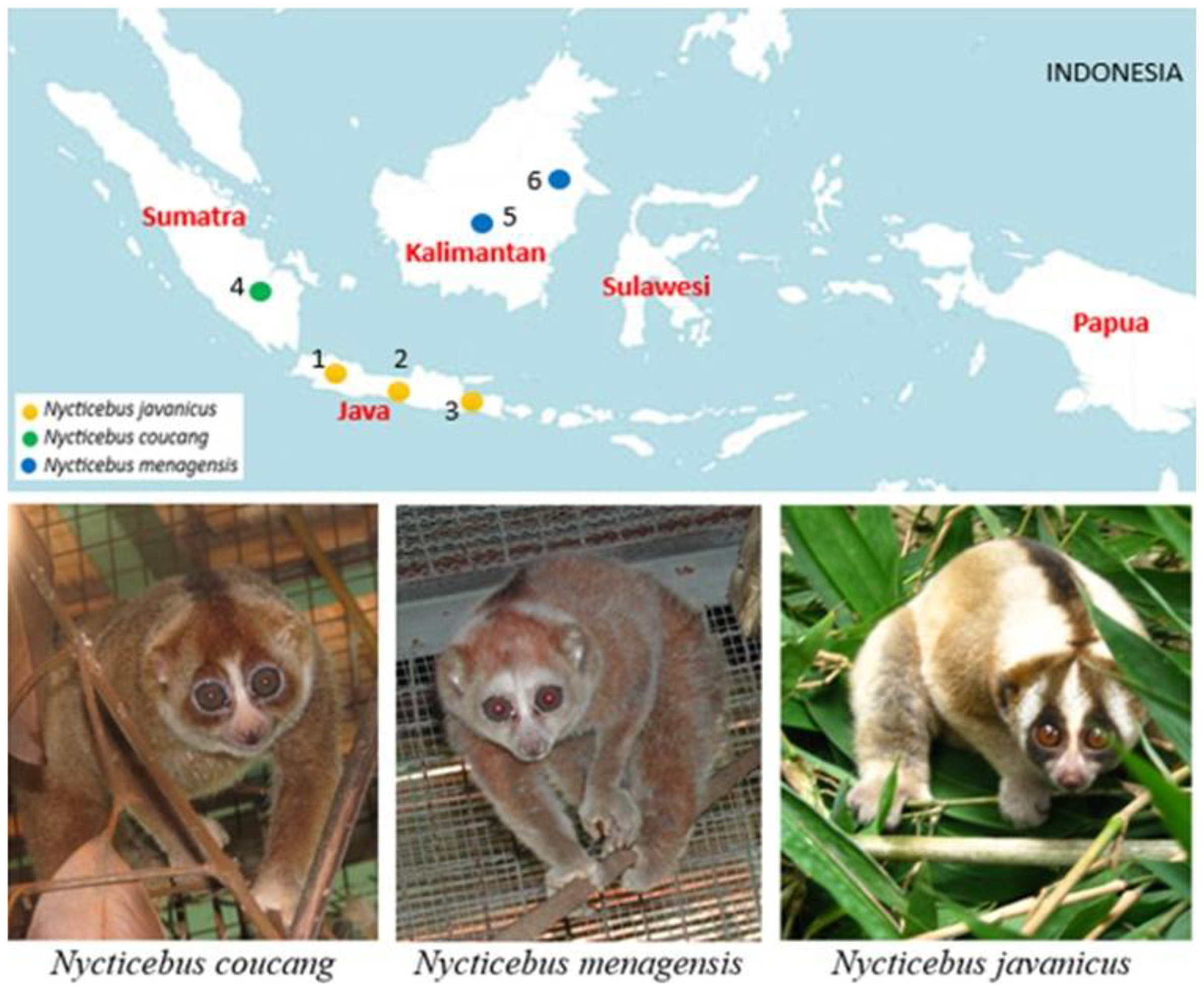
A total of 43 slow loris samples were collected for this study, consisting of 20 confiscated individuals and 23 wild individuals (Table 1). The wild slow lorises were obtained from various populations across the islands of Java, Sumatra, and Kalimantan (Figure 1; Table 1). Colletion of wild specimens was conducted under the Wild Plant and Animal Transportation Certificate issued by the Indonesian Ministry of Environment and Forestry (Approval No.: 3a 411 M.2/BIDTEK.1/KSA/8/2019). DNA samples were collected from each individual between July 2008 and January.
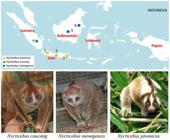
Map showing sampling sites of three slow loris species (Nycticebus spp.) in West Java (1), Central Java (2), East Java (3), South Sumatra (4), Central Kalimantan (5) and East Kalimantan (6) regions of Indonesia. Photo by Wirdateti (2019).
Based on morphological characteristics, the confiscated slow lorises were identified as N. javanicus (7 samples) and N. coucang (13 samples). The wild individuals from Sumatra (6 samples), Java (13 samples), and Kalimantan (4 samples) were identified as N. coucang, N. javanicus, and N. menagensis, respectively. DNA materials were obtained from blood (12 samples), tissue (12 samples), hair (14 samples), and fecal matter (5 samples). Blood samples were preserved in EDTA, while tissue and fecal samples were preserved in absolute ethanol.
2.2. DNA amplification
Total DNA extraction was performed using the Dneasy Blood and Tissue Kit according to the appropriate protocols (Qiagen, Valencia, USA). The protocol was modified by adding proteinase K because of the high protein content in hair. Approximate 1540 bp of the (MT-COI) of slow loris was amplified using a primer pair of Forward: 5’- AGG CCT GGT AAA AAG GGG ATT TGA C -3’ and Reverse: 5’- AAT TCA ACC TAT AAT TTA ACT TGA C -3’ [1].
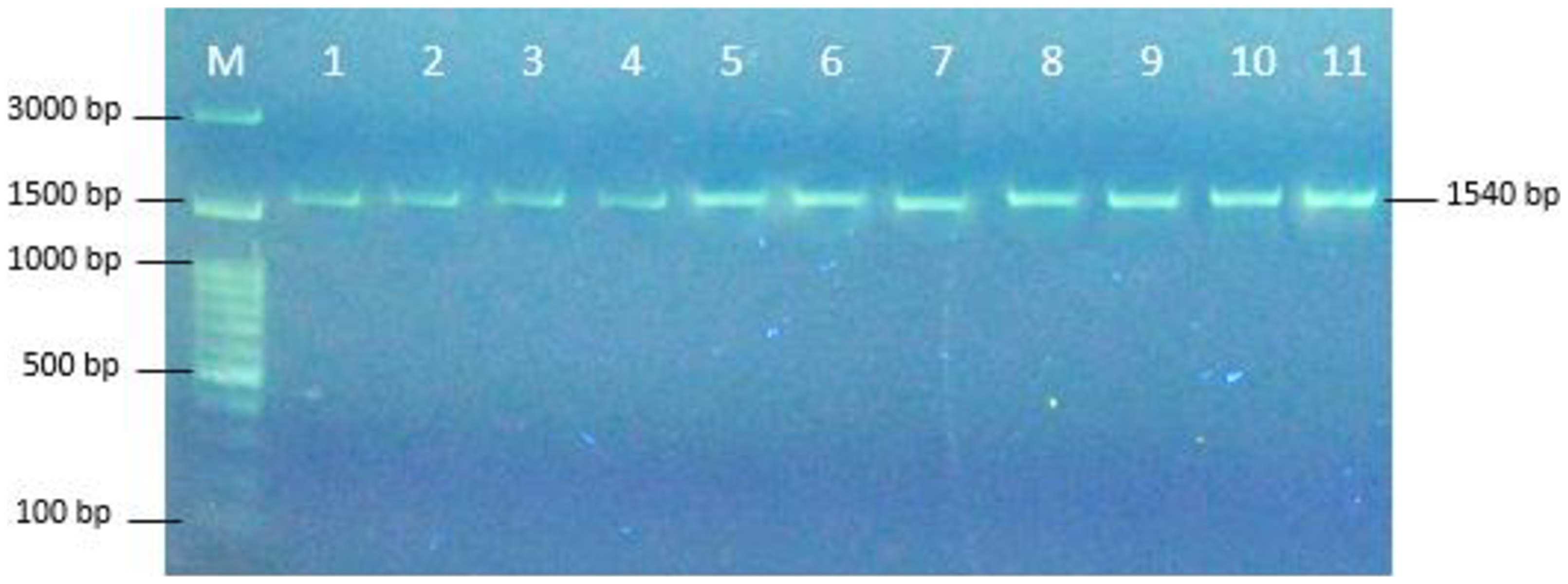
The PCR amplification was done in National Research and Innovation Agency (BRIN) in Bogor, West Java. The PCR kit KOD FX (Toyobo, Japan) was used for PCR amplification. The amplification of MT-COI region was performed in a total volume of 30 µl containing 1 µl DNA template, 17 µl KOD FX (Toyobo, Japan), 2.5 µl each of forward and reverese primer, and distilled water (MQ) up to 30 µl. The PCR conditions were 98 °C 30 sec (pre-denaturation), 35 cycles (denaturation 98 °C 10 sec, annealing 62 °C 10 sec, extension 72 °C 1 min 20 sec) and a final extension of 72 °C 10 min. After the PCR, 1 µl of PCR product were electrophorased on 1.5% agarose gel to confirm good amplification (Figure 2). The sequencing reaction were done using the same forward and reverse primers used in PCR amplification. DNA sequencing was performed with Genetic Analyzer 3130 (Applied Biosystem) at Primate Research Institute (Inuyama Campus), Kyoto University Japan, and partially at FirstBase, Singapore, using the Sanger method.
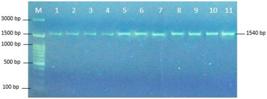
Amplification of slow loris MT-COI region along 1540 bp on 1% agarose gel. M: DNA ladder100 bp; Line 1-11: DNA samples.
2.3. Data analysis
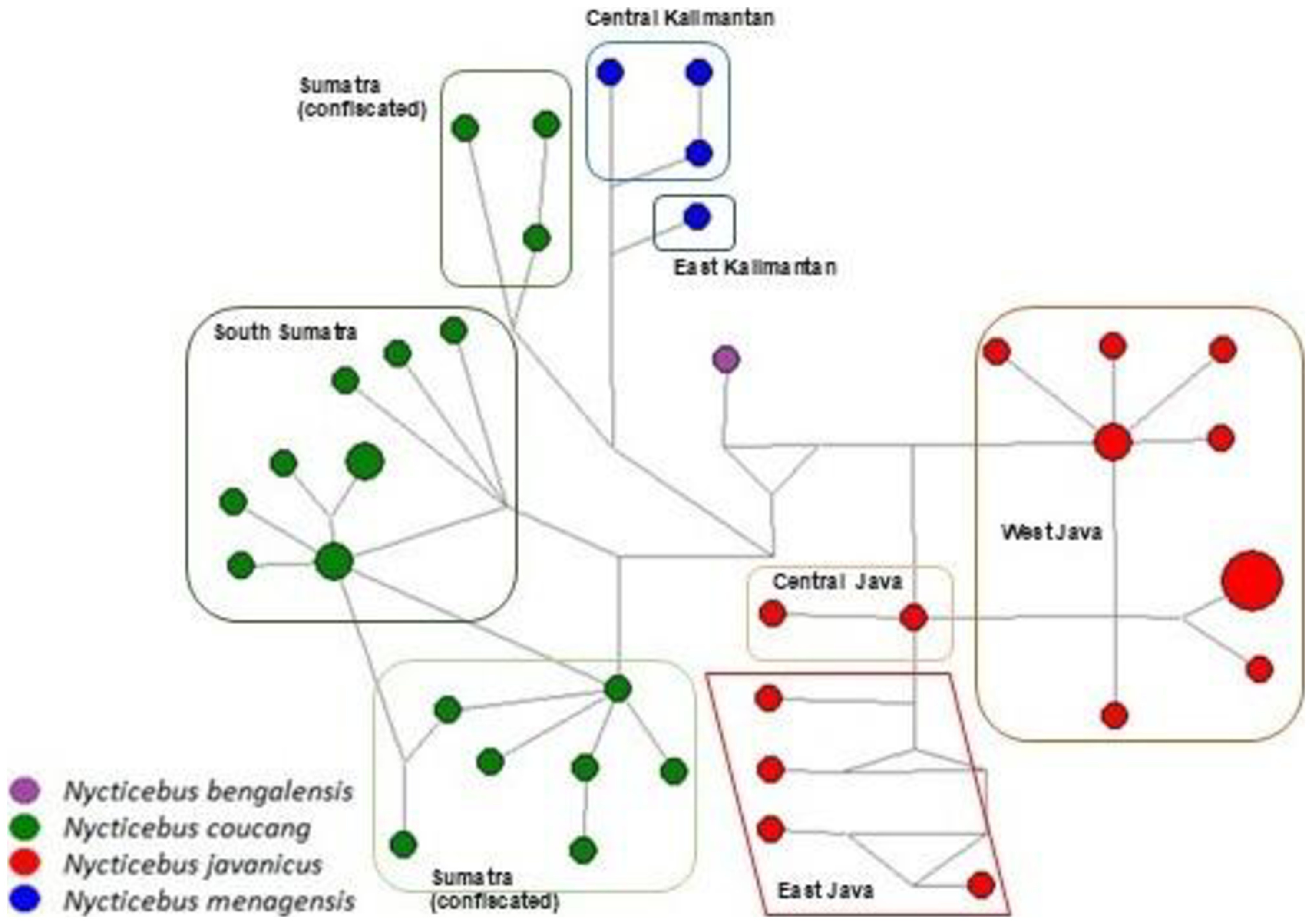
In addition to the 43 MT-COI sequences of slow loris obtained in this study, five reference sequences from GenBank database were included in phylogenetic analysis, ─i.e. N. bengalensis (GQ249899), N. coucang (GQ 259900), N. menagensis (GQ259901), X. pygmaeus (GQ259902) and Perodicticus potto (NC 012764.1) as the outgroup. Alignment of MT-COI sequences was performed using the BioEdit package (Hall, 2011). After the alignment process were done, approximate 1510 bp of 48 sequences were then become the analysis substances. We calculated the genetic diversity parameters, such as haplotype diversity (Hd), nucleotide diversity (pi), Tajima’s D test and Fu’s Fs statistics value using a DNAsp package (Librado and Rozas, 2009). The construction of a haplotype map for slow loris MT-COI was initiated by analyzing the aligned sequences of different haplotypes detected in this study using DNAsp software (Librado and Rozas, 2009). The resulting haplotype network was subsequently visualized and refined using Network 4.
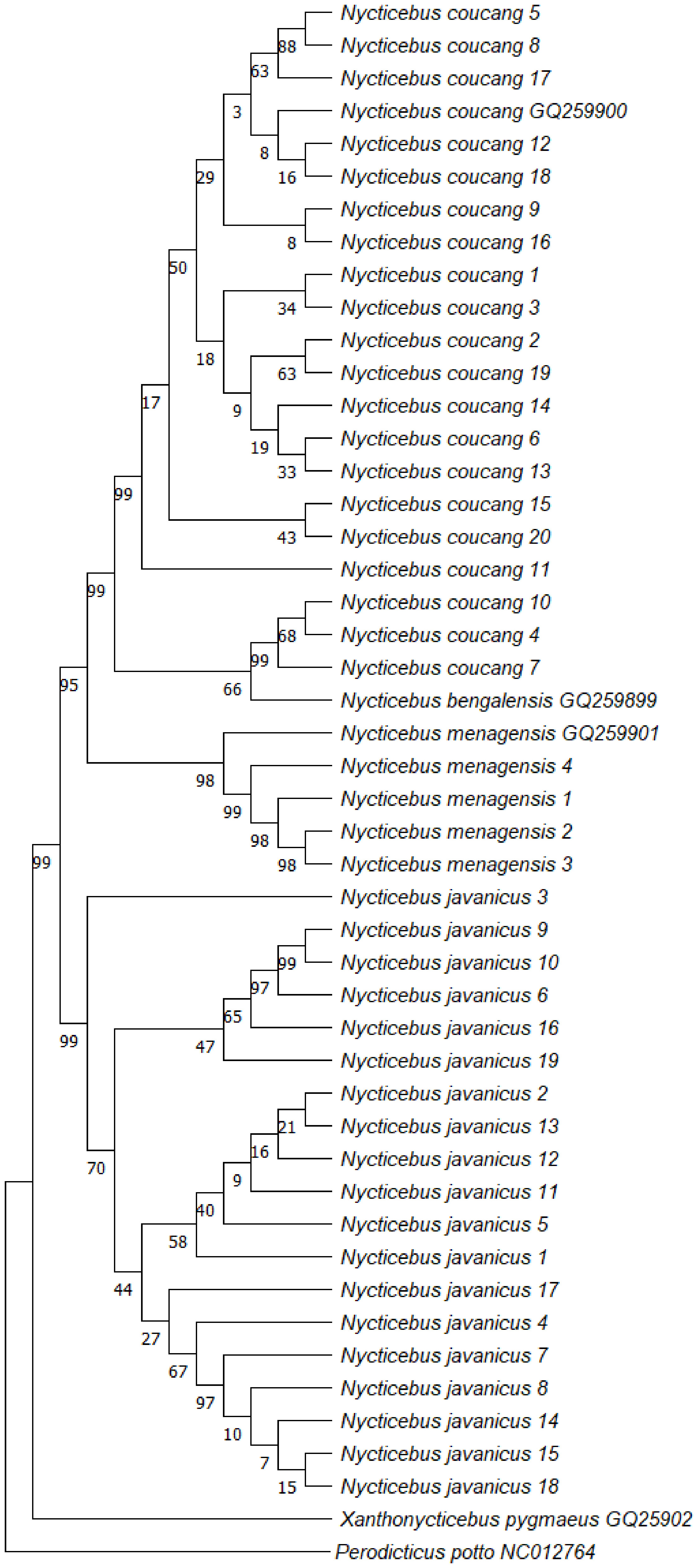
In order to infer the evolutionary history of slow loris studied here, a phylogenetic tree was reconstructed by using the Maximum Likelihood method with the Hasegawa Kishino-Yano (HKY85) model of base substitution (Hasegawa et al., 1985). A discrete Gamma distribution was used to model evolutionary rate differences among sites (5 categories (+G, parameter = 0.5601)). Evolutionary analyses were conducted in MEGA11 (Tamura et al., 2021). Bootstrap analysis was implented with 10,000 replicates. Then, analysis of molecular variance (AMOVA) was performed using ARLEQUINE package (Excoffier and Lischer, 2010) to test the geographical effect to genetic variation in MT-COI sequences of slow loris.
To estimate the divergence time of slow loris, HKY+G5+F model (Hasegawa et al., 1985) was chose, because it describes the substitution pattern the best based on Find Best DNA/Protein Models tool (Nei and Kumar, 2000) in MEGA 11 (Tamura et al., 2021). Then, a BEAST package (Bouckaert et al., 2019; Bouckaert, 2022) was used to estimate the divergence time in MT-COI sequences of slow loris with the Strict Clock model (Douglas et al., 2021). Furthermore, a Calibrated Yule model (Heled and Drummond, 2012) was constructed to show clear diverging points of every included species. For the calibration points, the origin of Asian lorisids estimated at 37.85 Mya (95% highest probability densities (HPD) = 32.96-42.40 Mya) (Pozzi et al., 2015) and the estimated divergence time of Xanthonycticebus and Nycticebus at 11.34 Mya (HPD = 8.59-14.17 Mya) (Blair et al., 2023), were used. The posterior tree file generated by BEAST was summarized using TreeAnnotator (Heled and Bouckaert, 2013) to produce a maximum clade credibility (MCC) tree, with mean node heights and posterior probabilities assigned to each clade. Then, the summarized tree performance and convergence were evaluated using Tracer v1.7.2, confirming that the analysis achieved reliable sampling of the posterior with ESS values well above 200 for all key parameters, including clock rate and tree topology. For the analysis result with BEAST, we added stratigraphy information with R software 4.4.2 version.
3. Results
As a result of sequencing, different 18 haplotypes of 20 N. coucang samples, 4 haplotypes of 4 N. menagensis and 14 haplotypes of 19 N. javanicus were detected, respectively. DNA sequencing results revealed a discrepancy between morphological and molecular identification, where a sample initially identified as N. javanicus based on morphology was subsequently confirmed to be N. coucang through molecular analysis that is from confiscated sample. Thus, the research samples are N. coucang (n=20), N. javanicus (n=19), and N. menagensis (n=4). Among the 20 confiscated samples, molecular identification revealed 14 samples as N. coucang and 6 samples as N. javanicus, whereas previous morphological identification had classified 13 samples as N. coucang and 7 samples as N. javanicus. In this study, the identification of slow loris species was performed following the morphological characteristics, particularly the pattern and color of the stripes from the head to the back, the color of the fur on the back of the head, and body size, N. javanicus is larger than N. coucang (see Figure 1). Therefore, all slow loris species had the high Hd value and low pi value as presented in Table 2. The highest number of haplotypes was found in N. coucang (18) and followed by N. javanicus (14) and N. menagensis (4). The highest number of polymorphic sites was found in N. javanicus (157) and followed by N. coucang (85) and N. menagensis (24). In addition, the negative Tajima’s D test values were found in each slow loris species under study. While, a negative Fu’s Fs statistics was found in N. coucang.
Genetic diversity of MT-COI sequence in three slow loris species (Nycticebus spp.) from Indonesia.
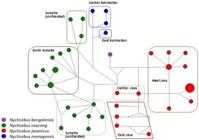
The network diagram among Lorisidae species revealed that N. coucang, N. menagensis and N. javanicus were classified in three different clusters based on MT-COI sequence (Figure 3). The phylogenetic tree analysis revealed that the Lorisidae species can be characterized in their origin species cluster with MT-COI diversity (Figure 4).
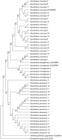
Phylogenetic tree of Lorisidae species based on MT-COI region with Maximum Likelihood method.
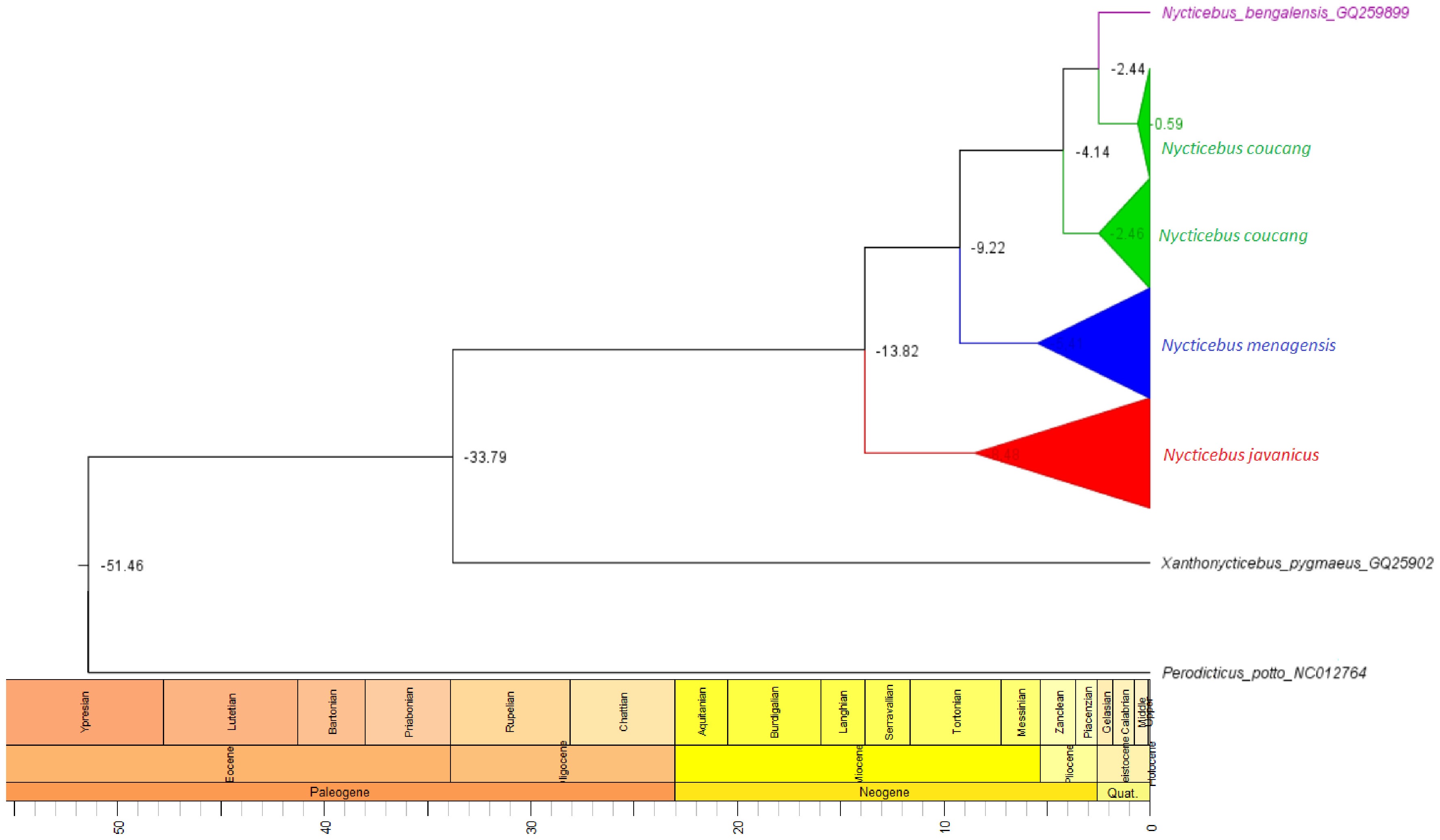
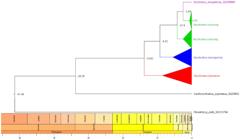
The lowest pairwise genetic distance value was found between N. coucang and N. bengalensis (0.01-0.03). While, N. coucang and N. menagensis had the lower genetic distance (0.04-0.06) rather than in comparison with N. javanicus (0.05-0.12) as shown in Table 3. As a sequence from distinct genus, X. pygmaeus had a high genetic distance with other slow loris species (0.11-0.16). The AMOVA revealed that about 78% of genetic diversity in three slow loris species under study was assigned to the among population variation (Table 4), which is considered to be affected by geographical factors since the range of the three species are separated by ocean. The genetic divergence time analysis confirmed that three genera of Lorisidae (Nycticebus, Perodicticus and Xanthonycticebus) diverged since 51.46 Mya (Early Eocene period) as shown in Figure 5. The divergence of Xanthonycticebus and Nycticebus had happened since approximately 33.79 Mya (Early Oligocene period). Specifically, a speciation in Nycticebus spp under study has occurred since 13.82 Mya (Middle Miocene period).
Pairwise genetic distance among the species of Nycticebus and X. pygmaeus based on MT-COI sequence.
Results of the analysis of molecular variance (AMOVA) of three slow loris species (Nycticebus spp.) from Indonesia according to MT-COI sequence.
4. Discussion
The MT-COI sequences of three Lorisidae species in Indonesia exhibit high genetic diversity and are valuable for species characterization. High genetic diversity in the MT-COI region has previously been reported in various primate groups, including squirrel monkeys (Saimiri spp.) in South America (Ruiz-Garcia et al., 2015), tarsiers (Tarsius spp.) in Indonesia (Wirdateti et al., 2015), macaques (Macaca spp.) in Indonesia (Hasibuan et al., 2017), and langurs (Semnopithecus spp.) in Nepal (Khanal et al., 2022). The high haplotype diversity (Hd) values observed in the slow loris species in this study indicate the presence of multiple maternal lineages. Conversely, the low nucleotide diversity (π) values and negative Tajima’s D values suggest signals of population expansion in these species.
Hd values below 0.50 are generally considered low, while values above 0.50 are classified as high. Meanwhile, π values are categorized as low (0.01-0.04), moderate (0.05-0.07), or high (0.08-0.10), as defined by Bandelt et al. (1999). Previous studies have reported high percentages of genetic variance explained by geographical factors in some primates─for example, 60% in Sumatran orangutans (Pongo abelii) and 87% in Bale monkeys (Chlorocebus djamdjamensis) (Nater et al., 2012; Mekonnen et al., 2018). In contrast, geographic effects accounted for less than 30% of genetic diversity in red colobus monkeys (Procolobus rufomitratus), crested mangabeys (Cercocebus galeritus), and chimpanzees (Pan troglodytes) (Mbora and McPeek, 2010; Mitchell et al., 2015).
The results of AMOVA in this study demonstrated that 78% of the genetic variation was partitioned among populations, reflecting pronounced genetic strtucture across slow loris lineages. This high among-population variance is consistent with the deep divergence times estimated for N. javanicus, N. menagensis, and N. coucang, which likely originated during the Middle Miocene. The strong differentiation is further explained by the Sundaland paleogeography, where periodic marine transgressions and long-standing sea barriers restricted dispersal among islands (Hall, 2013), coupled with the inherently limited mobility of slow lorises. Together, these factors underline the importance of historical isolation in shaping the present-day genetic landscape of Nycticebus.
The placement of Perodicticus potto as an outgroup in this study aligns with the classification proposed by Pozzi et al. (2020), which places P. potto in the Perodictinae subfamily (along with the genus Arctocebus), while Nycticebus spp. (slow lorises) belong to the Lorisinae subfamily (together with the genera Loris and Xanthonycticebus). Pozzi et al. (2020) noted that this phylogenetic relationship is supported by previous studies based on DNA sequence data (Chatterjee et al., 2009; Fabre et al., 2009; Perelman et al., 2011; Springer et al., 2012; Pozzi et al., 2014a, b; 2015; Munds et al., 2018) as well as retroposons insertions (Roos et al., 2004).
Masters et al. (2005) estimated that the divergence between the Lorisidae and their sister clade, the Galagidae, occured approximately 42.2 million years ago (Mya), while the split between the Perodictinae and Lorisinae subfamilies took place around 31.4 Mya. According to Masters et al. (2005), these divergence events were influenced by geological shifts, notably when the Indiana subcontinent drifted northward from Gondwana (around 65 Mya) and eventually collided with the Afro-Arabian plate. A temporary landmass known as Greater Somalia is thought to have connected Afro-Arabia with the Indian subcontinent for at least 13-20 million years (Torsvik et al., 1998; Chatterjee and Scotese, 1999; Hofmann et al., 2000; de Wit, 2003; O’Neill et al., 2003; Reeves and de Wit, 2000). This geological connection may have facilitated the dispersal of the common ancestor of the Lorisinae into India, rather than requiring dispersal through southern Eurasia, which have been less suitable for arboreal fauna such as the slow loris (Masters et al., 2005).
In this study, X. pygmaeus diverged from Nycticebus spp. at about 33.79 Mya based on MT-COI sequence. This finding exceeding to the previous research that reporting X. pygmaeus diverged from Nycticebus spp. at 6.4 - 26.4 mya. Generally, the estimation of divergence time between two distinct genera with molecular material source are 10-20 mya, with some reaching at 25 mya. In the case of Xanthonycticebus and Nycticebus, in all likelihood, the divergence time happened at Late to Middle Miocene and probably in the early Oligocene (Nekaris and Nijman, 2022). Previously, several studies worked to estimate the genetic divergence time in Nycticebus spp. as presented in Table 5.
The estimation of divergence time between Xanthonycticebus and Nycticebus (in million years ago, range is expressed as the HPD of divergence time estimation).
Previously, Xanthonycticebus was classified within the genus Nycticebus until Nekaris and Nijman (2022) elevated it to a new genus based on morphological, behavioural, and molecular evidence. Behavioural studies have shown that X. pygmaeus, which lives sympatrically with N. bengalensis, has different dietary patterns: X. pygmaeus feeds on exudates from seasonal trees, whereas N. bengalensis feeds on exudates from non seasonal trees (Nekaris et al., 2010). When slow lorises disperse into new habitats, they must adapt to new enviromental conditions, such as the availability of food resources – which can lead to sympatric speciation over a very long period of time.
The phylogenetic topology observed in the slow loris species studied here is similar to that reported by Rovie-Ryan et al. (2018), who found that N. javanicus is the oldest of all slow loris species and does not share a recent common ancestor with the other extant slow loris species. It is also similar to Blair et al. (2023), who also had N. javanicus diverging earlier, but reported on two different Javan clades with contradictory information. This contrast with findings by Nekaris and Nijman (2022) and Pozzi et al. (2015), who reported N. coucang as the oldest slow loris species. According to the current analysis, N. javanicus diverged from other slow loris species around 13.82 Mya during the Miocene period. Some of this confusion may be due to misidentification of species in museums or on Genbank or lack of knowledge of the origin of the material.
Around 40 Mya, before Sundaland formed, the area that is now Java, Sumatra and Borneo was part of a large landmass that still connected to the Indo-Burma (Hall, 2013). At that point of time, the most recent common ancestor (MRCA) of all Nycticebus might be start to migrated southward from Indo-Burma, and then diverged from Xanthonycticebus at around 33.79 Mya. The discovery of the ?Nycticebus linglom fossil in Thailand (Mein and Ginsburg, 1997), which was around 17-18 million years old, may provide additional evidence that the MRCA of Nycticebus migrated far southward after it separated from the Xanthonycticebus population in the north.
During the Miocene (25-5.3 Mya) and Pliocene (5.3-2.6 Mya), the climate in area that become Sundaland was generally hot, perhumid, and covered by rainforrest with sea levels approximately 25 meters or more above present levels (Haywood et al., 2009; Naish and Wilson, 2009; Woodruff, 2010). Geologically, around 20 Mya until 10 Mya, the area that is now Java (proto-Java) and Sumatra (proto-Sumatra) consisted of only a few small, separated islands while the western part of Borneo was part of a large landmass connected to the Malaysian Peninsula and Indo-Burma (Hall, 2013). At around 13.82 Mya, the common ancestor of N. javanicus and N. menagensis start to diverged after the MRCA migrated southward. However, this assumption requires further explanation about the hypothesis of a land bridge that were connected proto-Java and proto-Borneo.
Approximately at 10 Mya, there was a clear evidence regarding a connecting landmass that linked parts of the proto-Sumatra with proto-Borneo that still attached to the main Indo-Burma landmass (Hall, 2013). This landbridge may allowed the common ancestor of N. menagensis to expand its range to other landmasses such as Sumatra, as indicated that N. menagensis was separated from N. coucang at around 9.22 Mya.
Like other members of Lorisidae, slow lorises are arboreal primates inhabiting diverse forest types, including primary and secondary forests (Rovie-Ryan et al., 2018). Dense forest canopies are particularly important for slow lorises, as they allow these animals to move cautiously from tree to tree (Lehtinen, 2013). Mason et al. (2019) proposed that during the mid-Miocene (~4.5-3.5 Mya), Sundaland may have been more evergreen with dense canopies, coherent with the divergence time of N. coucang into two different cluster at around 4.14 Mya.
Around 3.2 Mya, driven by orbital variations, global temperaturers began to decline, and by 2.7 Mya, ice sheets had started forming in the Northern Hemisphere, marking the onset of the glacial phases (Bintanja and van de Wal, 2008; Sosdian and Rosenthal, 2009; Woodruff, 2010). As the ice sheets expanded, global sea levels fell, causing the Sundaland to emerge from beneath the sea (Woodruff, 2010) and served a dispersal corridor between Southeast Asia and western Indonesia for both terestrial (Mason et al., 2019) and arboreal taxa.
Since approximately 2.4 Mya, it is estimated that ~48 cycles of long glacial (cold) and short interglacial (warm) periods have occured, initially ever ~41,000 years and shifting to a ~100,000-year cycle around 800,000 years ago (Woodruff, 2010). Based on MT-COI sequences, N. coucang is identified as the sister taxon to N. bengalensis, consistent with findings from Pan et al. (2007) and Rovie-Ryan et al. (2018), with a divergence time of approximately 2.44 Mya (Early Pleistocene period). A study by Chen et al. (2005) reported that the subspecies N. coucang coucang is genetically closer to N. bengalensis than to other subspecies of N. coucang. Groves (2001) also documented evidence of hybrids between N. coucang coucang and N. bengalensis. It is possible that gene flow through hybridization has occured between N. coucang and N. bengalensis, as they coexist sympatrically in parts of southern Thailand and Malaysia (Rovie-Ryan et al., 2018), and their divergence time is relatively recent compared to other slow loris species.
This study expected to contribute to the conservation of slow loris species in Indonesia through several approaches, including the formulation of new regulations for new species that lack adequate legal protection, the reinforcement of monitoring systems to prevent illegal trade, and the tightening of controls over the possession of slow lorises without proper certification or legal documentation.
5. Conclusion
Three species of Nycticebus sp. in this study found in Indonesia are distributed across three major islands: Sumatra, Java, and Kalimantan. One of the species, N. javanicus, is endemic to Java Island. The three species can be morphologically distinguished by their body size, head and back stripe patterns, and body hair. Based on genetic distance and phylogenetic tree analysis, two distinct clusters were formed, with N. javanicus showing a more distant relationship to the other two species, N. coucang and N. menagensis, which share a closer relationship. Geographical and temporal separation of the Sundaland landmass likely influenced the formation of Nycticebus species in Indonesia from their ancestor, genus Xanthonycticebus. The haplotype diversity analysis suggests that the N. javanicus population on Java Island is more vulnerable to extinction compared to the other two species found on Sumatra and Kalimantan. Factors such as forest area, habitat availability, and hunting pressure contribute to the decline in genetic diversity, as seen in N. javanicus, which is distributed in Java's smaller and more fragmented forests, leading to its classification as Critically Endangered on the International Union for Conservation of Nature (IUCN) Red List.
Acknowledgements
This research was conducted under the Indonesian Research Permit No. 366/KSDAE/SET/KSA2/8/2019 and funded by the Cooperative Research Program Primate Research Institute (PRI) Kyoto University, Inuyama Japan. Sample collections were funded through National Research and Innovation Agency (BRIN) projects of Indonesia Goverment. We would also like to express our gratitude to Dr. Takakazu Yumoto, Professor Emeritus of Kyoto University for the support in this research collaboration. This research was funded by the Primate Research Institute (PRI) for the Cooperative Research Program for laboratories research and data analysis; and by the Indonesian Institute of Sciences (LIPI) Biodiversity Research Programme for sample collection.
Data Availability Statement
The DNA sequence data generated for this study are currently being submitted to GenBank
References
- ADI, W.P., 2017. Implementasi CITES (Convention on International Trade in Endangered Species of Wild Fauna and Flora) dalam menangani perdagangan kukang ilegal di Indonesia. Journal of International Relations, vol. 3, no. 4, pp. 21-31.
-
BANDELT, H.J., FORSTER, P. and ROHL, A., 1999. Median-joining networks for inferring intraspecific phylogenies. Molecular Biology and Evolution, vol. 16, no. 1, pp. 37-48. https://doi.org/10.1093/oxfordjournals.molbev.a026036 PMid:10331250.
» https://doi.org/10.1093/oxfordjournals.molbev.a026036 -
BINTANJA, R. and VAN DE-WAL, R.S.W., 2008. North American ice-sheet dynamics and the onset of 100,000-year glacial cycles. Nature, vol. 454, no. 7206, pp. 869-872. https://doi.org/10.1038/nature07158 PMid:18704083.
» https://doi.org/10.1038/nature07158 -
BLAIR, M.E., CAO, G.T., LOPEZ-NANDAM, E.H., VERONESE-PANIAGUA, D.A., BIRCHETTE, M.G., KENYON, M., MD-ZAIN, B.M., MUNDS, R.A., NEKARIS, K.A., NIJMAN, V., ROOS, C., THACH, H., STERLING, E. and LE, M., 2023. Molecular phylogenetic relationships and unveiling novel genetic diversity among slow and pygmy lorises, including resurrection of Xanthonycticebus intermedius. Genes, vol. 14, no. 3, pp. 643. https://doi.org/10.3390/genes14030643
» https://doi.org/10.3390/genes14030643 -
BOUCKAERT, R., 2022. An efficient coalescent epoch model for Bayesian phylogenetic inference. Systematic Biology, vol. 71, no. 6, pp. 1549-1560. https://doi.org/10.1093/sysbio/syac015 PMid:35212733.
» https://doi.org/10.1093/sysbio/syac015 -
BOUCKAERT, R., VAUGHAN, T.G., BARIDO-SOTTANI, J., DUCHENE, S., FOURMENT, M., GAVRYUSHKINA, A., HELED, J., JONES, G., KÜHNERT, D., DE MAIO, N., MATSCHINER, M., MENDES, F.K., MÜLLER, N.F., OGILVIE, H.A., DU PLESSIS, L., POPINGA, A., RAMBAUT, A., RASMUSSEN, D., SIVERONI, I., SUCHARD, M.A., WU, C.H., XIE, D., ZHANG, C., STADLER, T. and DRUMMOND, A.J., 2019. BEAST 2.5: an advanced software platform for Bayesian evolutionary analysis. PLoS Computational Biology, vol. 15, no. 4, e1006650. https://doi.org/10.1371/journal.pcbi.1006650 PMid:30958812.
» https://doi.org/10.1371/journal.pcbi.1006650 -
CHATTERJEE, H.J., HO, S.Y.W., BARNES, I. and GROVES, C., 2009. Estimating the phylogeny and divergence times of primates using a supermatrix approach. BMC Evolutionary Biology, vol. 9, no. 259, pp. 19333-19338. https://doi.org/10.1186/1471-2148-9-259 PMid:19860891.
» https://doi.org/10.1186/1471-2148-9-259 - CHATTERJEE, S. and SCOTESE, C.R., 1999. The break up of Gondwana and the evolution and biogeography of the Indian plate. Proceedings of the National Academy of Sciences, India Section A: Physical Sciences, vol. 65, no. 3, pp. 397-425.
-
CHEN, J.H., PAN, D., GROVES, C., WANG, Y.X., NARUSHIMA, E., FITCH-SNYDER, H., CROW, P., THANH, V.N., RYDER, O., ZHANG, H.-W., FU, Y. and ZHANG, Y., 2005. Molecular phylogeny of Nycticebus inferred from mitochondrial genes. International Journal of Primatology, vol. 27, no. 4, pp. 1187-1200. https://doi.org/10.1007/s10764-006-9032-5
» https://doi.org/10.1007/s10764-006-9032-5 -
DE-WIT, M.J., 2003. Madagascar: heads it’s a continent, tails it’s an island. Annual Review of Earth and Planetary Sciences, vol. 31, no. 1, pp. 213-248. https://doi.org/10.1146/annurev.earth.31.100901.141337
» https://doi.org/10.1146/annurev.earth.31.100901.141337 -
DOUGLAS, J., ZHANG, R. and BOUCKAERT, R., 2021. Adaptive dating and fast proposals: revisiting the phylogenetic relaxed clock model. PLoS Computational Biology, vol. 17, no. 2, e1008322. https://doi.org/10.1371/journal.pcbi.1008322 PMid:33529184.
» https://doi.org/10.1371/journal.pcbi.1008322 -
EXCOFFIER, L. and LISCHER, H.E.L., 2010. Arlequine suite ver 3.5: a new series programs to perform population genetics analyses under Linux and Windows. Molecular Ecology Resources, vol. 10, no. 3, pp. 564-567. https://doi.org/10.1111/j.1755-0998.2010.02847.x PMid:21565059.
» https://doi.org/10.1111/j.1755-0998.2010.02847.x -
FABRE, P.H., RODRIGUES, A. and DOUZERY, E.J.P., 2009. Patterns of macroevolution among primates inferred from a supermatrix of mitochondrial and nuclear DNA. Molecular Phylogenetics and Evolution, vol. 53, no. 3, pp. 808-825. https://doi.org/10.1016/j.ympev.2009.08.004 PMid:19682589.
» https://doi.org/10.1016/j.ympev.2009.08.004 -
GROVES, C.P., 2001. Primate taxonomy. Washington, D.C.: Smithsonian Institution Press. https://doi.org/10.1086/343645
» https://doi.org/10.1086/343645 - HALL, T., 2011. BioEdit: an important software for molecular biology. GERF Bulletin of Biosciences, vol. 2, no. 1, pp. 60-61.
-
HALL, R., 2013. The palaeogeography of Sundaland and Wallacea since the Late Jurassic. Journal of Limnology, vol. 72, no. s2, pp. 1-17. https://doi.org/10.4081/jlimnol.2013.s2.e1
» https://doi.org/10.4081/jlimnol.2013.s2.e1 -
HASEGAWA, M., KISHINO, H. and YANO, T., 1985. Dating of the human-ape splitting by a molecular clock of mitochondrial DNA. Journal of Molecular Evolution, vol. 22, no. 2, pp. 160-174. https://doi.org/10.1007/BF02101694 PMid:3934395.
» https://doi.org/10.1007/BF02101694 -
HASIBUAN, F.E., MANTIRI, F.R. and RUMENDE, R.R.H., 2017. The study intraspecific variation sequences and phylogenetic celebes black Macaque (Macaca nigra) using COI gene. Jurnal Ilmiah Sains, vol. 17, no. 1, pp. 59-67. https://doi.org/10.35799/jis.17.1.2017.15558
» https://doi.org/10.35799/jis.17.1.2017.15558 -
HAYWOOD, A.M., DOWSETT, H.J., VALDES, P.J., LUNT, D.J., FRANCIS, J.E. and SELLWOOD, B.W., 2009. Introduction. Pliocene climate, processes and problems. Philosophical Transactions. Series A, Mathematical, Physical, and Engineering Sciences, vol. 367, no. 1886, pp. 3-17. https://doi.org/10.1098/rsta.2008.0205 PMid:18852089.
» https://doi.org/10.1098/rsta.2008.0205 -
HELED, J. and BOUCKAERT, R., 2013. Looking for trees in the forest: summary tree from posterior samples. BMC Evolutionary Biology, vol. 13, pp. 221. https://doi.org/10.1186/1471-2148-13-221 PMid:24093883.
» https://doi.org/10.1186/1471-2148-13-221 -
HELED, J. and DRUMMOND, A.J., 2012. Calibrated tree priors for relaxed phylogenetic and divergence time estimation. Systematic Biology, vol. 61, no. 1, pp. 138-149. https://doi.org/10.1093/sysbio/syr087 PMid:21856631.
» https://doi.org/10.1093/sysbio/syr087 -
HOFMANN, C., FERAUD, G. and COURTILLOT, V., 2000. 40Ar/39Ar dating of mineral separates and whole rocks from the western Ghats lava pile: further constraints on duration and age of Deccan traps. Earth and Planetary Science Letters, vol. 180, no. 1-2, pp. 13-27. https://doi.org/10.1016/S0012-821X(00)00159-X
» https://doi.org/10.1016/S0012-821X(00)00159-X -
HORVATH, J.E., WEISROCK, D.W., EMBRY, S.L., FIORENTINO, I. and BALHOFF, J.P., 2008. Develpment and application of a phylogenomic toolkit: resolving the evolutionary history of Madagascar’s lemurs. Genome Research, vol. 18, no. 3, pp. 489-499. https://doi.org/10.1101/gr.7265208 PMid:18245770.
» https://doi.org/10.1101/gr.7265208 -
KHANAL, L., CHALISE, M.K., JIANG, X.L. and KYES, R.C., 2022. Mitochondrial genetic diversity and structure of the Langur population in a complex landscape of the Nepal Himalaya. Diversity, vol. 14, no. 2, pp. 69. https://doi.org/10.3390/d14020069
» https://doi.org/10.3390/d14020069 - LEHTINEN, J., 2013. Distribution of the Javan Slow Loris (Nycticebus javanicus): assessing the presence in East Java, Indonesia. Oxford: Oxford Brooks University. Ph.D. thesis.
-
LIBRADO, P. and ROZAS, J., 2009. DnaSP v5: a software for comprehensive analysis of DNA polymorphism data. Bioinformatics, vol. 25, no. 11, pp. 1451-1452. https://doi.org/10.1093/bioinformatics/btp187 PMid:19346325.
» https://doi.org/10.1093/bioinformatics/btp187 -
MASON, V.C., HELGEN, K.M. and MURPHY, W.J., 2019. Comparative phylogeography of forest dependent mammals reveals paleo-forest corridors throughout Sundaland. The Journal of Heredity, vol. 110, no. 2, pp. 158-172. https://doi.org/10.1093/jhered/esy046 PMid:30247638.
» https://doi.org/10.1093/jhered/esy046 -
MASTERS, J.C., ANTHONY, N.M., DE-WIT, M.J. and MITCHELL, A., 2005. Reconstructing the evolutionary history of the Lorisidae using morphological, molecular, and geological data. American Journal of Physical Anthropology, vol. 127, no. 4, pp. 465-480. https://doi.org/10.1002/ajpa.20149 PMid:15693029.
» https://doi.org/10.1002/ajpa.20149 -
MBORA, D.N.M. and MCPEEK, M.A., 2010. Endangered species in small habitat patches can possess high genetic diversity: the case of the Tana River red colobus and mangabey. Conservation Genetics, vol. 11, no. 5, pp. 1725-1735. https://doi.org/10.1007/s10592-010-0065-0
» https://doi.org/10.1007/s10592-010-0065-0 - MEIN, P. and GINSBURG, L., 1997. Les mammifères du gisement miocène in férieur de Li Mae Long, Thaïlande: Systématique, biostratigraphie et paléoenvironnement. Geodiversitas, vol. 19, pp. 783-844.
-
MEKONNEN, A., RUENESS, E.K., STENSETH, N.C., FASHING, P.J., BEKELE, A., HERNANDEZ-AGUILAR, R.A., MISSBACH, R., HAUS, T., ZINNER, D. and ROOS, C., 2018. Population genetic structure and evolutionary history of Bale monkeys (Chlorocebus djamdjamensis) in the southern Ethiopia highland. BMC Evolutionary Biology, vol. 18, no. 1, pp. 106. https://doi.org/10.1186/s12862-018-1217-y PMid:29986642.
» https://doi.org/10.1186/s12862-018-1217-y -
MITCHELL, M.W., LOCATELLI, S., GHOBRIAL, L., POKEMPNER, A.A., CLEE, P.R.S., ABWE, E.E., NICHOLAS, A., NKEMBI, L., ANTHONY, N.M., MORGAN, B.J., FOTSO, R., PEETERS, M., HAHN, B.H. and GONDER, M.K., 2015. The population genetics of wild chimpanzees in Cameroon and Nigeria suggests a positive role for selection in the evolution of chimpanzee subspecies. BMC Evolutionary Biology, vol. 15, no. 1, pp. 3. https://doi.org/10.1186/s12862-014-0276-y PMid:25608610.
» https://doi.org/10.1186/s12862-014-0276-y - MITTERMEIER, R.A., RYLANDS, A.B. and WILSON, D.E., eds., 2013. Handbook of the mammals of the world: primates Barcelona: Lynx Edicions, vol. 3.
-
MUNDS, R.A., NEKARIS, K.A.I. and FORD, S.M., 2013. Taxonomy of the Bornean slow loris, with new species Nycticebus kayan (Primates, Lorisidae). American Journal of Primatology, vol. 75, no. 1, pp. 46-56. https://doi.org/10.1002/ajp.22071 PMid:23255350.
» https://doi.org/10.1002/ajp.22071 -
MUNDS, R.A., TITUS, C.L., EGGERT, L.S. and BLOMQUIST, G.E., 2018. Using a multi-gene approach to infer the complicated phylogeny and evolutionary history of lorises (Order Primates: family Lorisidae). Molecular Phylogenetics and Evolution, vol. 127, pp. 556-567. https://doi.org/10.1016/j.ympev.2018.05.025 PMid:29807155.
» https://doi.org/10.1016/j.ympev.2018.05.025 -
MUNDS, R.A., TITUS, C.L., MOREIRA, L.A., EGGERT, L.S. and BLOMQUIST, G.E., 2021. Examining the molecular basis of coat color in a nocturnal primate family (Lorisidae). Ecology and Evolution, vol. 11, no. 9, pp. 4442-4459. https://doi.org/10.1002/ece3.7338 PMid:33976821.
» https://doi.org/10.1002/ece3.7338 -
NAISH, T.R. and WILSON, G.S., 2009. Constraints on the amplitude of mid-Pliocene (3.6–2.4 Ma) eustatic sea-level fluctuations from the New Zealand shallow-marine sediment record. Philosophical Transactions. Series A, Mathematical, Physical, and Engineering Sciences, vol. 367, no. 1886, pp. 169-187. https://doi.org/10.1098/rsta.2008.0223 PMid:18852088.
» https://doi.org/10.1098/rsta.2008.0223 -
NATER, A., ARORA, N., GREMINGER, M.P., VAN-SCHAICK, C.P., SINGLETON, I., WICH, S.A., FREDRIKSSON, G., PERWITASARI-FARAJALLAH, D., PAMUNGKAS, J. and KRUTZEN, M., 2012. Marked population structure and recent migration in the critically endangered Sumatran Orangutan (Pongo abelii). The Journal of Heredity, vol. 104, no. 1, pp. 2-13. https://doi.org/10.1093/jhered/ess065 PMid:23077232.
» https://doi.org/10.1093/jhered/ess065 -
NEI, M. and KUMAR, S., 2000. Molecular evolution and phylogenetics. New York: Oxford University Press. https://doi.org/10.1093/oso/9780195135848.001.0001
» https://doi.org/10.1093/oso/9780195135848.001.0001 -
NEKARIS, K.A.I. and NIJMAN, V., 2022. A new genus name for pygmy lorises, Xanthonycticebus gen. nov. (Mammalia, Primates). Zoosystematics and Evolution, vol. 98, no. 1, pp. 87-92. https://doi.org/10.3897/zse.98.81942
» https://doi.org/10.3897/zse.98.81942 -
NEKARIS, K.A.I., SHEKELLE, M., WIRDATETI, W., RODE-MARGONO, E.J. and NIJMAN, V., 2020. Nycticebus javanicus. In: INTERNATIONAL UNION FOR CONSERVATION OF NATURE, ed. The IUCN Red List of Threatened Species 2020: e.T39761A205911512. Gland: IUCN. https://doi.org/10.2305/IUCN.UK.2020-2.RLTS.T39761A205911512.en
» https://doi.org/10.2305/IUCN.UK.2020-2.RLTS.T39761A205911512.en -
NEKARIS, K.A.I., STARR, C.R., COLLINS, R.L. and WILSON, A., 2010. Comparative ecology of exudate feeding by lorises (Nycticebus, Loris) and pottos (Perodicticus, Arctocebus). In: A. BURROWS and L.T. NASH, eds. The evolution of exudativory in primates New York: Springer, pp. 155-168. https://doi.org/10.1007/978-1-4419-6661-2_8
» https://doi.org/10.1007/978-1-4419-6661-2_8 -
O’NEILL, C., MULLER, D. and STEINBERGER, B., 2003. Geodynamic implications of moving Indian Ocean hotspots. Earth and Planetary Science Letters, vol. 215, no. 1-2, pp. 151-168. https://doi.org/10.1016/S0012-821X(03)00368-6
» https://doi.org/10.1016/S0012-821X(03)00368-6 -
PAN, D., CHEN, J.H., GROVES, C., WANG, Y.X., NARUSHIMA, E., FITCH-SNYDER, H., CROW, P., JINGGONG, X., THANH, V.N., RYDER, O., CHEMNICK, L., ZHANG, H.-W., FU, Y.-X. and ZHANG, Y.-P., 2007. Mitochondrial control region and population genetic patterns of Nycticebus bengalensis and N. pygmaeus. International Journal of Primatology, vol. 28, no. 4, pp. 791-799. https://doi.org/10.1007/s10764-007-9157-1
» https://doi.org/10.1007/s10764-007-9157-1 -
PERELMAN, P., JOHNSON, W.E., ROOS, C., SEUANEZ, H.N., HORVATH, J.E., MOREIRA, M.A., KESSING, B., PONTIUS, J., ROELKE, M., RUMPLER, Y., SCHNEIDER, M.P., SILVA, A., O’BRIEN, S.J. and PECON-SLATTERY, J., 2011. A molecular phylogeny of living primates. PLOS Genetics, vol. 7, no. 3, e1001342. https://doi.org/10.1371/journal.pgen.1001342 PMid:21436896.
» https://doi.org/10.1371/journal.pgen.1001342 -
POZZI, L., DISOTELL, T.R. and MASTERS, J.C., 2014a. A multilocus phylogeny reveals deep lineages within African galagids (Primates: Galagidae). BMC Evolutionary Biology, vol. 14, no. 72, pp. 72. https://doi.org/10.1186/1471-2148-14-72 PMid:24694188.
» https://doi.org/10.1186/1471-2148-14-72 -
POZZI, L., HODGSON, J.A., BURRELL, A.S., STERNER, K.N., RAAUM, R.L. and DISOTELL, T.R., 2014b. Primate phylogenetic relationships and divergence dates inferred from complete mitochondrial genomes. Molecular Phylogenetics and Evolution, vol. 75, pp. 165-183. https://doi.org/10.1016/j.ympev.2014.02.023 PMid:24583291.
» https://doi.org/10.1016/j.ympev.2014.02.023 -
POZZI, L., NEKARIS, K.A.I., PERKIN, A., BEARDER, S.K., PIMLEY, E.R., SCHULZE, H., STREICHER, U., NADLER, T., KITCHENER, A., ZISCHLER, H., ZINNER, D. and ROOS, C., 2015. Remarkable ancient divergences amongst neglected lorisi form primates. Zoological Journal of the Linnean Society, vol. 175, no. 3, pp. 661-674. https://doi.org/10.1111/zoj.12286 PMid:26900177.
» https://doi.org/10.1111/zoj.12286 -
POZZI, L., ROOS, C. and BLAIR, M.E., 2020. Molecular advances in LORISID taxonomy and phylogeny. In: K.A.I. NEKARIS and A.M. BURROWS, eds. Part I - evolution, morphology and the fossil record. evolution, ecology and conservation of lorises and pottos Cambridge: Cambridge University Press, pp. 57-66. https://doi.org/10.1017/9781108676526.007
» https://doi.org/10.1017/9781108676526.007 -
REEVES, C.V. and DE-WIT, M.J., 2000. Making ends meet in Gondwana: retracing the transforms of the Indian Ocean and reconnecting shear zones. Terra Nova, vol. 12, no. 6, pp. 272-280. https://doi.org/10.1046/j.1365-3121.2000.00309.x
» https://doi.org/10.1046/j.1365-3121.2000.00309.x -
ROOS, C., SCHMITZ, J. and ZISCHLER, H., 2004. Primate jumping genes elucidate strepsirrhine phylogeny. Proceedings of the National Academy of Sciences of the United States of America, vol. 101, no. 29, pp. 10650-10654. https://doi.org/10.1073/pnas.0403852101 PMid:15249661.
» https://doi.org/10.1073/pnas.0403852101 -
ROVIE-RYAN, J.J., GANI, M., GAN, H.M., BOLONGON, G.G., TAN, C.C., RAZAK, N., ROSLI, N., AZIZ, M.A. and MATKASIM, K., 2018. Rediscovery of Nycticebus coucang insularis Robinson, 1917 (Primates: Lorisidae) at Tioman Island and its Mitochondrial Genetic Assessment. Sains Malaysiana, vol. 47, no. 10, pp. 2533-2542. https://doi.org/10.17576/jsm-2018-4710-30
» https://doi.org/10.17576/jsm-2018-4710-30 -
RUIZ-GARCIA, M., LUENGAS-VILLAMIL, K., LEGUIZAMON, N., DE-THOISY, B. and GALVES, H., 2015. Molecular phylogenetics and phylogeography of all the Saimiri taxa (Cebidae, Primates) inferred from mt COI COII gene sequences. Primates; Journal of Primatology, vol. 56, no. 2, pp. 145-161. https://doi.org/10.1007/s10329-014-0452-0 PMid:25348174.
» https://doi.org/10.1007/s10329-014-0452-0 -
SOMURA, H., HORI, H. and MANOME, Y., 2012. Sequence analysis of mitochondrial DNAs of 12S rRNA, 16S rRNA, and Cytochrome Oxidase Subunit 1(COI) regions in slow lorises (Genus Nycticebus) may contribute to improved identification of confiscated specimens. ISRN Zoology, vol. 2012, pp. 498731. https://doi.org/10.5402/2012/498731
» https://doi.org/10.5402/2012/498731 -
SOSDIAN, S. and ROSENTHAL, Y., 2009. Deep-sea temperature and ice volume changes across the Pliocene-Pleistocene climate transitions. Science, vol. 325, no. 5938, pp. 306-310. https://doi.org/10.1126/science.1169938 PMid:19608915.
» https://doi.org/10.1126/science.1169938 -
SPRINGER, M.S., MEREDITH, R.W., GATESY, J., EMERLING, C.A., PARK, J., RABOSKY, D.L., STADLER, T., STEINER, C., RYDER, O.A., JANEČKA, J.E., FISHER, C.A. and MURPHY, W.J., 2012. Macroevolutionary dynamics and historical biogeography of primate diversification inferred from a species supermatrix. PLoS One, vol. 7, no. 11, e49521. https://doi.org/10.1371/journal.pone.0049521 PMid:23166696.
» https://doi.org/10.1371/journal.pone.0049521 -
TAMURA, K., STECHER, G. and KUMAR, S., 2021. MEGA 11: Molecular Evolutionary Genetics Analysis Version 11. Molecular Biology and Evolution, vol. 38, no. 7, pp. 3022-3027. https://doi.org/10.1093/molbev/msab120 PMid:33892491.
» https://doi.org/10.1093/molbev/msab120 -
TORSVIK, T.H., TUCKER, R.D., ASHWAL, L.D., EIDE, E.A., RAKOTOSOLOFO, N.A. and DE-WIT, M.J., 1998. Late Cretaceous magmatism in Madagascar: paleomagnetic evidence for a stationary Marion hotspot. Earth and Planetary Science Letters, vol. 164, no. 1-2, pp. 221-232. https://doi.org/10.1016/S0012-821X(98)00206-4
» https://doi.org/10.1016/S0012-821X(98)00206-4 - WIRDATETI, W., WULANDARI, S.W. and KUSWANDI, P.C., 2015. Genetic marker on Tarsier (Tarsius spp.) using cytochrome oxidase I gene (COI) of mitochondrial DNA (mtDNA) through sequencing method. Jurnal Biologi Indonesia, vol. 11, no. 2, pp. 275-284.
- WIRDATETI, W., INDRIANA, E. and HANDAYANI, H., 2016. Analisis Sekuen DNA Mitokondria Cytochrome Oxidase I (COI) mtDNA Pada Kukang Indonesia (Nycticebus spp) sebagai Penanda Guna Pengembangan Identifikasi Spesies. Jurnal Biologi Indonesia, vol. 12, no. 1, pp. 119-128.
-
WIRDATETI, W., AZIZA, H. and HANDAYANI, H., 2019. Keragaman Genetik Kukang Jawa (Nycticebus javanicus) Menggunakan Control Region (D-loop) DNA Mitokondria (mtDNA). Jurnal Veteriner, vol. 20, no. 3, pp. 360-368. https://doi.org/10.19087/jveteriner.2019.20.3.360
» https://doi.org/10.19087/jveteriner.2019.20.3.360 -
WOODRUFF, D.S., 2010. Biogeography and conservation in Southeast Asia: how 2.7 million years of repeated environmental fluctuations affect today’s patterns and the future of the remaining refugial-phase biodiversity. Biodiversity and Conservation, vol. 19, no. 4, pp. 919-941. https://doi.org/10.1007/s10531-010-9783-3
» https://doi.org/10.1007/s10531-010-9783-3
Edited by
-
Editor:
Takako Matsumura Tundisi