 Length-weight relationship and condition factor of 11 fish species in streams of a protected area in the Acre River basin, northern Brazil
Abstract
This study evaluated the length-weight relationship (LWR) and the relative condition factor (Kn) of 11 fish species in streams of the São Francisco Igarapé Environmental Protection Area (APA), located in the Acre River Basin, Amazon. LWR is an essential tool for assessing growth, body condition, and biomass of fish populations, reflecting aspects of species' well being. Additionally, the relative condition factor (Kn) is a crucial parameter for indicating the physical state and health of species, reflecting the amount of energy accumulated relative to size. The research revealed that the growth coefficient (b) ranged from 2.65 to 3.33, indicating predominantly isometric growth in several species, where weight gain parallels length growth. Fish were collected at seven sampling points using active search methods. Results showed that most species exhibited isometric growth, with Kn values ranging from 0.71 to 1.4, with 8 species showing Kn values greater than 1. These results suggest that the São Francisco Igarapé APA provides favorable conditions for fish growth and health, although some species showed variations in growth and well being indices, possibly due to environmental pressures. This study contributes to the understanding of the biological dynamics of fish populations in the region and provides valuable information for the management and conservation of species in protected areas of the Amazon.
Keywords:
Amazon; biomass; body condition; growth patterns
Resumo
Este estudo avaliou a relação comprimento-peso (LWR) e o fator de condição relativo (Kn) de 11 espécies de peixes em igarapés da Área de Proteção Ambiental (APA) do Igarapé São Francisco, localizada na bacia do rio Acre, Amazônia. O LWR é uma ferramenta essencial para avaliar o crescimento, a condição corporal e a biomassa de populações de peixes, refletindo aspectos do bem-estar das espécies. Além disso, o fator de condição relativo (Kn) é um parâmetro crucial para indicar o estado físico e a saúde das espécies, refletindo a quantidade de energia acumulada em relação ao tamanho. A pesquisa revelou que o coeficiente de crescimento (b) variou entre 2,65 e 3,33, indicando predominantemente crescimento isométrico em várias espécies, onde o aumento de peso acompanha o crescimento em comprimento. Os peixes foram coletados em sete pontos amostrais utilizando métodos de busca ativa. Os resultados indicaram que a maioria das espécies exibiu crescimento isométrico, com valores de Kn variando entre 0,71 e 1,4, sendo que 8 espécies apresentaram valores de Kn superiores a 1. Esses resultados sugerem que a APA do Igarapé São Francisco oferece condições favoráveis para o crescimento e a saúde dos peixes, embora algumas espécies apresentaram variações nos índices de crescimento e bem-estar, possivelmente devido a pressões ambientais. Este estudo contribui para o entendimento da dinâmica biológica das populações de peixes na região e fornece informações valiosas para o manejo e a conservação das espécies em áreas protegidas da Amazônia.
Palavras-chave:
Amazônia; biomassa; condição corporal; padrões de crescimento
1. Introduction
Morphometric patterns exhibited by fish species may vary in response to the environment, providing insights into the fish life cycle and indicating whether there is size stratification among different populations (Freitas et al., 2014; Pessali et al., 2022; Amazonas et al., 2024). The Length-weight relationship (LWR) is widely used in monitoring different biological aspects of ichthyofauna (Castro et al., 2019; Zuchi et al., 2020), since its basic biometric data may be able to indicate patterns across different populations that can be used to estimate indirect growth, biomass, body condition and condition factor (Lubich et al., 2021; Pessali et al., 2022; Khan et al., 2023).
The relative condition factor (Kn) serves as a quantitative measure of a fish's physiological condition, encompassing aspects such as reproductive potential, developmental stages, and overall physical well being (Ali et al., 2014). Higher Kn values can indicate better condition, often linked to energy storage, reproductive preparation, or favorable environmental conditions. Conversely, lower Kn values suggest depleted energy reserves, possibly due to limited food availability, environmental stress, or post-spawning depletion. These variations highlight the influence of ecological and biological factors on fish health (Goel et al., 2011). Consequently, the condition factor provides insights into both recent feeding status and reproductive health, making it a crucial parameter for assessing fish resilience in their environment.
The Amazon basin harbors the greatest richness of freshwater fish species in the world (Reis et al., 2016; Dagosta and Pinna, 2019; Jézequel et al., 2020). This is related to the diversity of habitats distributed across various aquatic environments such as rivers, lakes, and streams, which allows the occurrence of species with different life strategies (Junk and Furch, 1993; Winemiller et al., 2016). In this sense, it is essential to analyze the LWR of amazonian fishes in order to understand the growth patterns of different populations and provide data for understanding ecological processes and life history (Lubich et al., 2021; Pessali et al., 2022).
The Acre River represents one of the primary tributaries of the Purus River, situated within the south-western quadrant of the Amazon basin. Part of Acre River Basin is an Environmental Protection Area (APA), the Igarapé São Francisco APA, a type of a Brazilian Sustainable Use Unit created to protect biodiversity, regulate human occupation of the area, and ensure the sustainable use of natural resources (Art. 14°, incise I; caput Art. 15°; Brasil, 2000), to help safeguard and rehabilitate the watercourses and their surrounding ecosystems inside the 30,004 ha (ha) protected area (SEMA, 2023).
There is a paucity of studies on the length-weight relationship (LWR) of fish species in the Acre River basin. Notable exceptions include Corrêa et al. (2018), who investigated three cichlid species in a tributary of the Acre River, and Silva et al. (2019), who analyzed 14 fish species along the main river. In contrast, other regions of the Amazon, such as the Purus River basin, have been more extensively studied in this regard, as demonstrated by the study of Oliveira et al. (2022).”
LWR data provide a valuable means of assessing the health of fish species and ecosystem conditions, especially in the face of advancing deforestation in the Amazon (Blevins et al., 2013; Ali et al., 2014). Therefore, the collection of additional data on LWR is essential to provide critical insights that support effective management and conservation strategies for fish populations, as well as to guide public policies in areas requiring preservation or restoration (Lubich et al., 2021; Pessali et al., 2022). In the present study, we estimated the length-weight relationship and the relative condition factor of 11 stream fish species, providing the first data for streams within a protected area in the Acre River basin. It is expected that in environmental protection areas there will be favorable conditions for the development of the fish life cycle, considering that the anthropic pressure on the resources in these environments are reduced.
2. Materials and Methods
2.1. Study area
The São Francisco stream hydrographic basin is situated in the western portion of the municipality of Rio Branco (AC) and serves as a tributary to the left bank of the Acre River (Vieira and Lacerda, 2005). The main drainage channel in the basin is the São Francisco stream, whose main tributaries are the Senzala, Onça, Saituba, Dias Martins and Batista streams on the right bank (northern part of the basin). There are only a few tributaries on the left bank, all of which are intermittent and of limited length (Vieira and Lacerda, 2005).
The fish were collected at seven sampling points in the Igarapé São Francisco APA watershed (see Figure 1) between May 5 and 12, 2023. Active collection was conducted using a variety of sampling equipment: a) a trawl 10 m long, 2.25 m high and with a mesh size of 5 mm between adjacent nodes per collection; b) a paddle with a mesh size of 5 mm, 30 cm wide and 50 cm long; and c) two sieves with a mesh size of 5 mm, 50 cm wide and 80 cm long. At each site, we used the collection methods simultaneously for 30 min, thus having a sampling effort of one hour and 30 min per site sampled (Oliveira et al., 2022; Olentino et al., 2023). The specimens were collected in accordance with the guidelines set forth by the Biodiversity Authorization and Information System-SISBio/Instituto Chico Mendes de Conservação da Biodiversidade-ICMBio (license number 11.778).
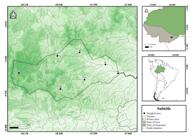
Location of the 7 sampled sites in the APA Igarapé São Francisco, Acre State, northern Brazil. Black dots indicate the sampled sites. Black lines represent the streams. Black dashed lines represent the boundaries of the APA Igarapé São Francisco.
After each sampling, the fish were euthanized with Eugenol (Concea, 2013), then packed in plastic bags with 5% formalin, labeled, taken to the laboratory and identified according to specialized bibliographies (Claro-García et al., 2013; Queiroz et al., 2013 a, b e c). When necessary, specialists were consulted. Scientific names were based on Fricke et al. (2024). Subsequently, standard length (SL, cm) was measured using a millimeter ichthyometer, and total weight (W, g) was determined using a semi-analytical scale. The fish were then transferred to 70% ethanol, and voucher specimens were deposited in the fish collection of the Federal University of Acre (UFAC), Rio Branco municipality, State of Acre, Northern Brazil (vouchers MUFAC1355 to MUFAC1391).
We used population parameters to assess the well being of each fish species. We calculated the length-weight relationships (LWRs) for the species the linear regression of natural log-transformed data: W = a*SLb, where W = total weight of the fish (g); a = a coefficient of body shape; SL = standard length (cm); and b = an exponent of the variation in body shape (Le Cren 1951; Froese 2006). Outliers were identified graphically by plotting L vs W measurements and excluded manually (Froese and Binohlan 2000). The growth type was estimated using the confidence interval 95% from b coefficient (Froese 2006). We then estimated the relative condition factor (Kn) using the equation K = W/aSLb, where W is the observed weight of each individual and SL is the weight estimated using the constants a and b from the LWR. A higher Kn indicates better fish welfare, with values expected to be close to or above 1 (Le Cren, 1951).
3. Results
A total of 579 fish belonging to the orders Characiformes and Siluriformes were captured. Table 1 summarizes data results. The b values ranged from 2.65 Knodus smithi (Fowler, 1913) to 3.33 of Steindachnerina guentheri (Eigenmann & Eigenmann, 1889). The relative condition factor (Kn) ranged from 0.71 S. guentheri to 1.4 Ctenobrycon spirulus (Valenciennes, 1850), with nine species showing values above 1. According to the findings of the study, seven species (64%) displayed isometric growth, three species (18%) showed positive allometric growth, and two species (18%) demonstrated negative allometric growth (Table 1).
Descriptive statistics, length-weight relationship and relative condition factor of 12 fish species sampled in streams of the Igarapé São Francisco, Acre State, northern Brazil.
4. Discussion
The results indicate that the allometric coefficient (b) is a reliable indicator of the observed relationships, since the majority of species exhibited b values within the expected range (2.5-3.5), which is consistent with previous findings (Froese, 2006). This suggests the growth for isometric and/or allometric positive or negative, indicating that the development of mass gain may be proportional to length gain, or that mass gain may exceed growth in length (Le Cren, 1951). This phenomenon can be observed in the species A. bimaculatus and S. guentheri, which exhibited positive isometric and allometric growth, respectively. However, the b value for Knodus smithi and Serrapinnus gr. microdon was found to be less than 3, which suggests negative allometric growth, indicating that growth in length exceeds that of weight gain (Le Cren, 1951; Oliveira et al., 2022).
The existence of differences in b values can be attributed to a series of factors, both internal and external, that operate within the environment. Factors such as parasitism, anthropogenic impacts, and intraspecific and interspecific competition require a more comprehensive evaluation of these populations. These factors may include, but are not limited to, the following: small sample, availability of food resources, environmental stress caused by unfavorable biotic and abiotic conditions, sex of the specimens, and others (Froese 2006; Silva et al., 2019; Oliveira et al., 2022).
Environmental and anthropogenic pressures, such as deforestation, pollution, and fishing activities, can significantly affect the development of fish species, directly impacting their body condition and overall well being (Castello et al., 2013). Currently, the greatest challenges in protected areas are related to the degradation of riparian vegetation and the improper use of water resources (Junk, 2013), which compromise the availability of shelter and food. Essential factors for the healthy growth of fish (Pompeu et al., 2012).
The results of the weight-length ratio show a favorable growth pattern for the fish species of the São Francisco River APA, with the exception of the two species Serrapinnus cf. microdon and Knodus smithi that exhibited indices outside the expected, indicating possible instability of the well being and health of the fish of these two populations, suggesting that these species may be suffering environmental pressures from the degradation of vegetation that compromises the feeding and energy allocation of these fish (Junk, 2013; Mendes et al., 2021). The information about the weight-length relationship contributes to the understanding of these relationships between fish health and environmental quality, allowing the development of conservation strategies aimed at fish stocks (Pinheiro et al., 2021)
These findings suggest that the environment is suitable for their growth, with a potential abundance of food resources and minimal competition between co-occurring species, low disease detection and reproductive success trend (Gomiero et al., 2010; Mendes et al., 2021), These patterns of health indicators can be confirmed due to the high (>1) relative condition factor values observed for most species. The value of the relative condition factor is related to the energy accumulation during the life cycle of fish, whether intended for growth or reproduction (Schwartzkopf and Cowan Junior, 2017). Fish tend to accumulate energy, proportionally to the availability of resources, which consequently tend to vary according to hydrological seasonality, given that in the flood period there is a greater availability of food and in the dry period less availability, which can influence health standards, thus verifying that the environment is considered adequate due to the value of the condition factor (Espínola et al., 2012; Mendes et al., 2021). Our findings underscore the need for continuous monitoring and targeted conservation measures, such as riparian zone restoration and sustainable resource management. Future research should explore the impacts of environmental heterogeneity and hydrological seasonality on fish populations, contributing to policies that support the sustainable management of aquatic biodiversity in the Amazon.
Acknowledgments
We are grateful for funding support from the authors’ grants: MSA (163889/2022-8) and LFAM (Processes 302881/2022-1) thanks the National Council for Scientific and Technological Development (CNPq), for the master’s scholarship and research productivity grant. LPO (88887.939430/2024-00), ICSP (88887.848008/2023-00) and LFGP (88887.894370/2023-00) thanks the Coordination for the Improvement of Higher Education Personnel (CAPES) for the PhD scholarship. MCF is grateful for the master’s scholarship (No. 132591/2025-1) awarded by the Conselho Nacional de Desenvolvimento Científico e Tecnológico (CNPq). We would like to thank the research team of the Laboratório de Ictiologia e Ecologia Aquática at the Universidade Federal do Acre in Rio Branco, Tecman Florestas and Secretária de Estado de Meio Ambiente do Acre for their support.
Data Availability Statement
The research data are only available upon request to the corresponding author.
References
- ALI, S., BARAT, A., KUMAR, P., SATI, J., KUMAR, R. and HALDAR, R.S., 2014. Study of length weight relationship and condition factor for the golden mahseer, Tor Putitora from Himalayan rivers of India. Journal of Environmental Biology, vol. 35, pp. 225-228.
-
AMAZONAS, M.G., OLENTINO, D., LUBICH, C., DUNCAN, W.P. and YAMAMOTO, K.C., 2024. Length-weight relationship for Potamotrygon wallacei (Carvalho, Rosa and Araújo, 2016) caught in the middle Negro River, Barcelos, Brazilian Amazon. Brazilian Journal of Biology = Revista Brasileira de Biologia, vol. 84, pp. e253497. https://doi.org/10.1590/1519-6984.253497 PMid:35043834.
» https://doi.org/10.1590/1519-6984.253497 -
BLEVINS, Z.W., EFFERT, E.L., WAHL, D.H. and SUSKI, C.D., 2013. Land use drives the physiological properties of a stream fish. Ecological Indicators, vol. 24, pp. 224-235. https://doi.org/10.1016/j.ecolind.2012.06.016
» https://doi.org/10.1016/j.ecolind.2012.06.016 -
BRASIL. Subchefia de Assuntos Jurídicos, 2000 [viewed 1 October 2024]. Lei nº 9.985, de 18 de julho de 2000 [online]. Diário Oficial da República Federativa do Brasil, Brasília, 19 julho. Available from: http://www.planalto.gov.br/ccivil_03/leis/l9985.htm
» http://www.planalto.gov.br/ccivil_03/leis/l9985.htm -
CASTELLO, L., MCGRATH, D.G., HESS, L.L., COE, M.T., LEFEBVRE, P.A., PETRY, P., MACEDO, M.N., RENÓ, V.F. and ARANTES, C.C., 2013. The vulnerability of Amazon freshwater ecosystems. Conservation Letters, vol. 6, no. 4, pp. 217-229. https://doi.org/10.1111/conl.12008
» https://doi.org/10.1111/conl.12008 -
CASTRO, P.M.G., MATSUMOTO, A.A., BRAZÃO, M.L., BASILIO, L.M. and MARUYAMA, L.S., 2019. Length–weight relationships and biological aspects for 34 fish species from Três Irmãos Reservoir, Lower Tietê River basin, SP – Brazil. Boletim do Instituto de Pesca, vol. 45, no. 3, pp. e458. https://doi.org/10.20950/1678-2305.2019.45.3.458
» https://doi.org/10.20950/1678-2305.2019.45.3.458 -
CLARO-GARCÍA, A., ABRAHÃO, V., VIEIRA, L., JARDULI, L. and SHIBATTA, O., 2013. Fishes (Osteichthyes: Actinopterygii) from igarapés of the rio Acre basin, Brazilian Amazon. Check List, vol. 9, no. 6, pp. 1410-1438. https://doi.org/10.15560/9.6.1410
» https://doi.org/10.15560/9.6.1410 - CONSELHO NACIONAL DE CONTROLE DE EXPERIMENTAÇÃO ANIMAL – CONCEA, 2013. Diretrizes da prática de eutanásia do Concea Brasília: MCTI/CONCEA, pp. 54.
-
CORRÊA, F., SOUZA, S.R. and JUNO, S.V.L., 2018. Length‐weight relationship of three cichlid species in a stream in southwestern Amazon, Brazil. Journal of Applied Ichthyology, vol. 34, no. 5, pp. 1255-1257. https://doi.org/10.1111/jai.13778
» https://doi.org/10.1111/jai.13778 -
DAGOSTA, F.C.P. and PINNA, M., 2019. The fishes of the Amazon: distribution and biogeographical patterns, with a comprehensive list of species. Bulletin of the American Museum of Natural History, vol. 2019, no. 431, pp. 1-163. https://doi.org/10.1206/0003-0090.431.1.1
» https://doi.org/10.1206/0003-0090.431.1.1 -
ESPÍNOLA, L.A., JÚLIO-JUNIOR, H.F. and BENEDITO, E., 2012. Invasive non-native species of fish in upper Paraná river Basin, Brazil: variations of caloric content in Cichla kelberi. Neotropical Ichthyology, vol. 10, no. 2, pp. 401-408. https://doi.org/10.1590/S1679-62252012005000002
» https://doi.org/10.1590/S1679-62252012005000002 -
FREITAS, T.M.S., PRUDENTE, B.S., FONTOURA, N.F. and MONTAG, L.F.A., 2014. Length weight relationships of dominant fish species from Caixiuanã National Forest, Eastern Amazon, Brazil. Journal of Applied Ichthyology, vol. 30, no. 5, pp. 1081-1083. https://doi.org/10.1111/jai.12436
» https://doi.org/10.1111/jai.12436 -
FRICKE, R., ESCHMEYER, W.N. and VAN DER LAAN, R., 2024 [viewed 1 October 2024]. Eschmeyer’s catalog of fishes: genera, species, references [online]. San Francisco: Institute for Biodiversity Science and Sustainability. Available from: http://researcharchive.calacademy.org/research/ichthyology/catalog/fishcatmain.asp
» http://researcharchive.calacademy.org/research/ichthyology/catalog/fishcatmain.asp -
FROESE, R., 2006. Cube law, condition factor and weight–length relationships: history, meta‐analysis and recommendations. Journal of Applied Ichthyology, vol. 22, no. 4, pp. 241-253. https://doi.org/10.1111/j.1439-0426.2006.00805.x
» https://doi.org/10.1111/j.1439-0426.2006.00805.x -
FROESE, R. and BINOHLAN, C., 2000. Empirical relationships to estimate asymptotic length, length at first maturity and length at maximum yield per recruit in fishes, with a simple method to evaluate length frequency data. Journal of Fish Biology, vol. 56, no. 4, pp. 758-773. https://doi.org/10.1111/j.1095-8649.2000.tb00870.x
» https://doi.org/10.1111/j.1095-8649.2000.tb00870.x - GOEL, C., BARAT, A., PANDE, V., ALI, S. and KUMAR, R., 2011. Length-weight relationship of snow trout (Schizothorax richardsonii) based on linear and nonlinear models from Hill Stream of Uttarakhand, India. World Journal of Fish and Marine Sciences, vol. 3, pp. 85-488.
-
GOMIERO, L.M., VILLARES-JUNIOR, G.A. and BRAGA, F.M.S., 2010. Length-weight relationship and condition factor for Oligosarcus hepsetus (Cuvier, 1829) in Serra do Mar State Park - Santa Virgínia Unit, Atlantic Forest, São Paulo, Brazil. Biota Neotropica, vol. 10, no. 1, pp. 101-105. https://doi.org/10.1590/S1676-06032010000100009
» https://doi.org/10.1590/S1676-06032010000100009 -
JÉZÉQUEL, C., TEDESCO, P.A., BIGORNE, R., MALDONADO-OCAMPO, J.A., ORTEGA, H., HIDALGO, M., MARTENS, K., TORRENTE-VILARA, G., ZUANON, J., ACOSTA, A., AGUDELO, E., BARRERA MAURE, S., BASTOS, D.A., BOGOTÁ GREGORY, J., CABECEIRA, F.G., CANTO, A.L.C., CARVAJAL-VALLEJOS, F.M., CARVALHO, L.N., CELLA-RIBEIRO, A., COVAIN, R., DONASCIMIENTO, C., DÓRIA, C.R.C., DUARTE, C., FERREIRA, E.J.G., GALUCH, A.V., GIARRIZZO, T., LEITÃO, R.P., LUNDBERG, J.G., MALDONADO, M., MOJICA, J.I., MONTAG, L.F.A., OHARA, W.M., PIRES, T.H.S., POUILLY, M., PRADA-PEDREROS, S., DE QUEIROZ, L.J., RAPP PY-DANIEL, L., RIBEIRO, F.R.V., RÍOS HERRERA, R., SARMIENTO, J., SOUSA, L.M., STEGMANN, L.F., VALDIVIEZO-RIVERA, J., VILLA, F., YUNOKI, T. and OBERDORFF, T., 2020. A database of freshwater fish species of the Amazon Basin. Scientific Data, vol. 7, no. 1, pp. 96. https://doi.org/10.1038/s41597-020-0436-4 PMid:32193422.
» https://doi.org/10.1038/s41597-020-0436-4 -
JUNK, W.J. and FURCH, K., 1993. A general review of tropical South American floodplains. Wetlands Ecology and Management, vol. 2, no. 4, pp. 231-238. https://doi.org/10.1007/BF00188157
» https://doi.org/10.1007/BF00188157 - JUNK, W.J., ed., 2013.The central Amazon floodplain: ecology of a pulsing system Springer Science & Business Media.
-
KHAN, W., NAQVI, S.M.H.M., UL HASSAN, H., KHAN, S., ULLAH, U. and DE LOS RÍOS ESCALANTE, P., 2023. Length-weight relationship: eight species of Cyprinidae from river Panjkora, Khyber Pakhtunkhwa, Pakistan. Brazilian Journal of Biology = Revista Brasileira de Biologia, vol. 83, pp. e242922. https://doi.org/10.1590/1519-6984.242922 PMid:34817020.
» https://doi.org/10.1590/1519-6984.242922 -
LE CREN, E.D., 1951. The length-weight relationship and seasonal cycle in gonad weight and condition in the perch (Perca fluviatilis). The Journal of Animal Ecology, vol. 20, no. 2, pp. 201-219. https://doi.org/10.2307/1540
» https://doi.org/10.2307/1540 -
LUBICH, C.C.F., OLENTINO, D., DE CARVALHO, F.C.E. and YAMAMOTO, K.C., 2021. Length-weight relationship of 12 species of freshwater fish caught in the middle and lower stretches of the Negro River basin, Brazilian Amazon. Journal of Applied Ichthyology, vol. 37, pp. 626-630. https://doi.org/10.1111/jai.14210
» https://doi.org/10.1111/jai.14210 -
MENDES, Y.A., OLIVEIRA, R.S., MONTAG, L.F.A., ANDRADE, M.C., GIARRIZZO, T., ROCHA, R.M. and FERREIRA, M.A.P., 2021. Sedentary fish as indicators of changes in the river flow rate after impoundment. Ecological Indicators, vol. 125, pp. 107466. https://doi.org/10.1016/j.ecolind.2021.107466
» https://doi.org/10.1016/j.ecolind.2021.107466 -
OLENTINO, D., LUBICH, C.C.F., ROCHA, M.D.P., SANTOS, J.H.N., GOMES, T., BELTRÃO, H., SILVA, J.F. and YAMAMOTO, K.C., 2023. Length-weight relationships of fish from sandy beaches. Brazilian Journal of Biology = Revista Brasileira de Biologia, vol. 83, pp. e250003. https://doi.org/10.1590/1519-6984.250003 PMid:34669803.
» https://doi.org/10.1590/1519-6984.250003 -
OLIVEIRA, L.P., SILVA, R.S., VIRGILIO, L.R., CORRÊA, F. and VIEIRA, L.J.S., 2022. Allometric relationships of six fish species of the order Characiformes in oxbow lakes on the floodplain of the middle Purus river, Amazon. Ecología Austral, vol. 32, no. 2, pp. 594-598. https://doi.org/10.25260/EA.22.32.2.0.1218
» https://doi.org/10.25260/EA.22.32.2.0.1218 -
PESSALI, T.C., SALVADOR, G.N., ALVES, C.B.M., DRAGER, D.H.C., ZAWADZKI, C.H., PRATA, E.G., VIEIRA, F., SANTOS, G.B., ROSA, G.R., PENIDO, I.S., GOMES, J.P.C., BRITO, M.F.G., POMPEU, P.S., LEITÃO, R.P., DOS SANTOS, S.A., BARROSO, T.A., RIBEIRO, T.C., SOUSA, T.J., DALA-CORTE, R.B. and FREITAS, T.M.S., 2022. Length–weight relationships of 78 fish species from São Francisco River basin, Brazil. Journal of Applied Ichthyology, vol. 38, no. 3, pp. 344-351. https://doi.org/10.1111/jai.14312
» https://doi.org/10.1111/jai.14312 -
PINHEIRO, J.C.R., GONÇALVES, L.A.B., MENDES, Y.A., SOUZA, R.F.C., ANDRADE, M.C. and ROCHA, R.M., 2021. Length‐weight relationships of four fish species from the Tucuruí Lake Conservation Units Mosaic, Tocantins River Basin, Amazon, Brazil. Journal of Applied Ichthyology, vol. 37, no. 6, pp. 989-991. https://doi.org/10.1111/jai.14251
» https://doi.org/10.1111/jai.14251 -
POMPEU, P.D.S., AGOSTINHO, A.A. and PELICICE, F.M., 2012. Existing and future challenges: the concept of successful fish passage in South America. River Research and Applications, vol. 28, no. 4, pp. 504-512. https://doi.org/10.1002/rra.1557
» https://doi.org/10.1002/rra.1557 - QUEIROZ, L.J., TORRENTE-VILARA, G., OHARA, W.M., PIRES, T.H.S., ZUANON, J. and DORIA, C.R.C., 2013a. Peixes do Rio Madeira São Paulo: Santo Antônio Energia, vol. I.
- QUEIROZ, L.J., TORRENTE-VILARA, G., OHARA, W.M., PIRES, T.H.S., ZUANON, J. and DORIA, C.R.C., 2013b. Peixes do Rio Madeira São Paulo: Santo Antônio Energia, vol. II.
- QUEIROZ, L.J., TORRENTE-VILARA, G., OHARA, W.M., PIRES, T.H.S., ZUANON, J. and DORIA, C.R.C., 2013c. Peixes do Rio Madeira São Paulo: Santo Antônio Energia, vol. III.
-
REIS, R.E., ALBERT, J.S., DI DARIO, F., MINCARONE, M.M., PETRY, P. and ROCHA, L.A., 2016. Fish biodiversity and conservation in South America. Journal of Fish Biology, vol. 89, no. 1, pp. 12-47. https://doi.org/10.1111/jfb.13016 PMid:27312713.
» https://doi.org/10.1111/jfb.13016 -
SECRETARIA DE ESTADO DO MEIO AMBIENTE DO ACRE – SEMA. 2023 [viewed 30 October 2025] Área de Proteção Ambiental Igarapé São Francisco. Available from: https://www.mma.gov.br/areas-protegidas/cadastro-nacional-de-ucs
» https://www.mma.gov.br/areas-protegidas/cadastro-nacional-de-ucs -
SCHWARTZKOPF, B.D. and COWAN JUNIOR, J.H., 2016. Seasonal and sex differences in energy reserves of red snapper Lutjanus campechanus on natural and artificial reefs in the northwestern Gulf of Mexico. Fisheries Science, vol. 83, no. 1, pp. 13-22. https://doi.org/10.1007/s12562-016-1037-1
» https://doi.org/10.1007/s12562-016-1037-1 -
SILVA, R.S., CORRÊA, F., DE OLIVEIRA, L.P. and VIEIRA, L.J., 2019. Length–weight relation of the 14 fish species occurring on sandy beaches along a tropical river in the Amazon. Journal of Applied Ichthyology, vol. 35, no. 2, pp. 622-624. https://doi.org/10.1111/jai.13852
» https://doi.org/10.1111/jai.13852 - VIEIRA, L.J.S. and LACERDA, C.M.B., 2005. Peça de criação Área de Proteção Ambiental (APA) Igarapé São Francisco Rio Branco: Secretaria de Estado de Meio Ambiente e Recursos Naturais.
-
WINEMILLER, K.O., MCINTYRE, P.B., CASTELLO, L., FLUET-CHOUINARD, E., GIARRIZZO, T., NAM, S., BAIRD, I.G., DARWALL, W., LUJAN, N.K., HARRISON, I., STIASSNY, M.L.J., SILVANO, R.A.M., FITZGERALD, D.B., PELICICE, F.M., AGOSTINHO, A.A., GOMES, L.C., ALBERT, J.S., BARAN, E., PETRERE JUNIOR, M., ZARFL, C., MULLIGAN, M., SULLIVAN, J.P., ARANTES, C.C., SOUSA, L.M., KONING, A.A., HOEINGHAUS, D.J., SABAJ, M., LUNDBERG, J.G., ARMBRUSTER, J., THIEME, M.L., PETRY, P., ZUANON, J., TORRENTE VILARA, G., SNOEKS, J., OU, C., RAINBOTH, W., PAVANELLI, C.S., AKAMA, A., VAN SOESBERGEN, A. and SÁENZ, L., 2016. Balancing hydropower and biodiversity in the Amazon, Congo, and Mekong. Science, vol. 351, no. 6269, pp. 128-129. https://doi.org/10.1126/science.aac7082 PMid:26744397.
» https://doi.org/10.1126/science.aac7082 -
ZUCHI, N., RÖPKE, C., SHIBUYA, A., FARAGO, T., CARMONA, M., ZUANON, J. and AMADIO, S., 2020. Length-weight relationship of fish species from Central Amazon floodplain. Journal of Applied Ichthyology, vol. 36, no. 6, pp. 837-841. https://doi.org/10.1111/jai.14082
» https://doi.org/10.1111/jai.14082
Edited by
-
Editor:
Felipe Polivanov Ottoni