 Spatial ecological patterns of gastropods in relation to mangrove density in Kemujan Mangrove Forests, Karimunjawa National Park, Indonesia
Abstract
Mangrove ecosystems play a crucial role in supporting coastal biodiversity by providing vital habitats and ecological services for many marine organisms, including gastropods. Despite the extensive mangrove coverage in the Karimunjawa Islands, information on the composition, distribution, and ecological significance of gastropods in this region remains limited. This study investigates the diversity, abundance, and spatial distribution of gastropod species inhabiting the Kemujan mangrove forest in the Karimunjawa Islands. A total of eight gastropod species from six families were recorded across three sampling stations. The two most abundant species, Pirenella cingulata (Gmelin, 1791) and Terebralia sulcata (Born, 1778), both belonging to the Potamididae family, were widely distributed across all sites. Station 2, characterized by the lowest mangrove density, supported the highest gastropod abundance (80 Ind./5 m2), diversity (H’ = 1.73), and evenness (J' = 0.83). In contrast, Station 1, with the highest mangrove density, exhibited the lowest abundance (53.6 ± 40 Ind./5 m2) and diversity (H’ = 1.05) and the highest dominance (D = 0.39). A strong negative correlation was observed between mangrove density and gastropod abundance. Denser mangrove stands are associated with increased shading, softer sediment, reduced food availability, and fewer habitat options—factors that may reduce habitat suitability for diverse gastropod communities. These findings underscore the influence of mangrove structure on gastropod assemblages and offer valuable insights for the conservation and management of mangrove ecosystems in the Karimunjawa Islands.
Keywords:
gastropods; Karimunjawa Islands; mangroves; potamididae; species distribution
Resumo
Os ecossistemas de manguezais desempenham um papel crucial no apoio à biodiversidade costeira, fornecendo hábitats vitais e serviços ecológicos para muitos organismos marinhos, incluindo gastrópodes. Apesar da extensa cobertura de manguezais nas Ilhas Karimunjawa, as informações sobre a composição, distribuição e importância ecológica dos gastrópodes nesta região ainda são limitadas. Este estudo investiga a diversidade, abundância e distribuição espacial das espécies de gastrópodes que habitam a floresta de manguezais de Kemujan, nas Ilhas Karimunjawa. Um total de oito espécies de gastrópodes, pertencentes a seis famílias, foi registrado em três estações de amostragem. As duas espécies mais abundantes, Pirenella cingulata e Terebralia sulcata, ambas da família Potamididae, estavam amplamente distribuídas em todos os locais. A Estação 2, caracterizada pela menor densidade de manguezais, apresentou a maior abundância de gastrópodes (80 indivíduos/5 m2), diversidade (H’ = 1,73) e equitabilidade (J’ = 0,83). Em contraste, a Estação 1, com a maior densidade de manguezais, apresentou a menor abundância (53,6 indivíduos/5 m2) e diversidade (H’ = 1,05), além da maior dominância (D = 0,39). Foi observada uma forte correlação negativa entre a densidade de manguezais e a abundância de gastrópodes. Áreas de manguezais mais densas estão associadas a maior sombreamento, sedimento mais macio, menor disponibilidade de alimento e menos opções de hábitat — fatores que podem reduzir a adequação do hábitat para comunidades diversas de gastrópodes. Esses achados ressaltam a influência da estrutura do manguezal sobre os agrupamentos de gastrópodes e oferecem insights valiosos para a conservação e gestão dos ecossistemas de manguezais nas Ilhas Karimunjawa.
Palavras-chave:
gastrópodes; Ilhas Karimunjawa; manguezais; potamididae; distribuição de espécies
1. Introduction
Mangrove forests serve as crucial nursery habitats for various marine species, aid in preventing shoreline erosion, and play a significant role in carbon storage (Abino et al., 2014; Asadi et al., 2018; Besset et al., 2019). The structural complexity of mangrove vegetation offers habitat to various species, including gastropods, which are one of the essential molluscs in mangrove ecosystems (Ali et al., 2024; Ebadzadeh et al., 2024). Gastropods help nutrient cycling by decomposing organic matter, thereby improving soil fertility and the availability of nutrients (Ebadzadeh et al., 2024). They feed on a range of substances, including decomposing plant material, which they process and later excrete as waste that is rich in nutrients (Keerthana et al., 2023; Reis et al., 2021). While mangrove forest in Karimunjawa is extensive, little is known about their gastropod communities.
Karimunjawa is a distinguished archipelago located approximately 80 kilometers north of Java’s coastline. Administratively governed by the Jepara Regency in Central Java, this tropical region encompasses a diverse range of ecosystems and coastal landscapes. The largest island, Karimunjawa Island, is characterized by its lush vegetation and pristine shorelines, serving as the primary hub of activity within the archipelago. With a total land area of 46 km2, the archipelago reaches its highest elevation at approximately 506 meters above sea level. Home to a population of around 10,000 residents, Karimunjawa consists of several smaller satellite islands, the majority of which rise less than 10 meters above sea level (Benardi et al., 2020). Among these, Kemujan Island is the second-largest inhabited island, where coastal communities thrive amidst picturesque maritime surroundings (Asadi et al., 2024).
The Karimunjawa Islands, recognized as a marine national park in Indonesia, are renowned for their abundant marine biodiversity and well-maintained mangrove ecosystems (Asadi et al., 2024). Nevertheless, these ecosystems are under threat from human activities and natural alterations, including deforestation, pollution, and climate-related challenges such as rising sea levels and temperature variations (Abino et al., 2014; Besset et al., 2019; Ebadzadeh et al., 2024; Murdiyarso et al., 2015). Understanding the composition and structure of the gastropods in Kemujan's mangrove forests of Karimunjawa Islands is crucial for comprehending the functioning of these ecosystems. Due to their relationship with their environment, gastropods are excellent bioindicators of habitat and stressors that could affect mangrove ecosystems (Fitria et al., 2023).
Numerous environmental factors, including salinity, substrate type, vegetation cover, and tides, influence the variety of gastropods in mangrove areas (Afwanudin et al., 2019). Nutrient availability, competition, and predation are some of the factors that affect the composition and distribution of gastropod species (Ali et al., 2024; Yeo et al., 2024). Nevertheless, actual research concerning gastropod assemblages within the Karimunjawa Islands is scarce. Therefore, studies related to gastropods in the mangrove forests of the Karimunjawa Islands could contribute to broader ecological knowledge that will be useful in devising conservation measures for these unique ecosystems.
Therefore, this study aims to investigate the diversity, abundance, and spatial distribution of gastropod species in relation to mangrove density in the Kemujan mangrove forest, located in the Karimunjawa Islands, Indonesia. Understanding these spatial ecological patterns is essential for detecting environmental changes and developing targeted conservation and management strategies. Given the biodiversity significance and ecological sensitivity of the region, these findings will contribute to safeguarding the ecological integrity of mangrove ecosystems both locally and in similar coastal areas worldwide.
2. Materials and Methods
2.1. Data collection
We conducted this study in the Kemujan Trekking Mangrove (TMK), a part of the mangrove ecosystems of the Karimunjawa Marine National Park. The area contains diverse mangrove ecosystems that are crucial as habitats for invertebrates, especially gastropods. Although mangroves cover a wide area in this location, information about the composition, distribution, and ecological significance of gastropods is not well known.
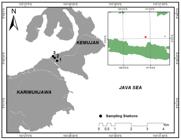
Field data were collected in July and August 2024, during the southeast monsoon that characterizes the dry season. The study area comprised three sampling stations, each characterized by distinct mangrove densities and substrate types. Station 1, located in the landward zone with peat sediment, exhibited the highest density at approximately 5,480 trees/ha. Station 2, situated in the intermediate zone with sandy-peat mixed sediment, contained around 2,460 trees/ha. Station 3, positioned in the seaward zone with sand-mud mixed sediment, supported approximately 2,680 trees/ha. Ceriops tagal (Perr.) C.B.Rob., the most dominant species, accounting for 60% of the total mangrove population. Other mangrove species, such as Rhizophora apiculata Blume and Lumnitzera racemosa Willd., were present in smaller numbers. Changes in the tides and the buildup of sediment affect the mangrove ecosystem in TMK (Asadi et al., 2024; Hickmah et al., 2021). These factors create a variety of microhabitats that affect where gastropods live. Table 1 and Figure 1 present the coordinates and a map of the study areas.Samples were taken at low tide from three designated stations (see Figure 1), with five sampling plots each. In a 10x10m plot, mangroves were identified and their DBH were measured; also within this context, five 1×1m plots were designated for identifying gastropods. This timing marks the start of the dry season. The Kemujan Tracking Mangroves (KTM) site was picked because it stands as the main point of the mangrove forest within Karimunjawa Marine National Park. All gastropod samples were immediately placed into a sample box and preserved in a solution of 5-7% neutralized formalin. The identification of samples was done using a wide range of reference materials, which included the publications by Arbi (2014), Dolorosa and Galon (2014), Reid (2014), and Baharuddin and Marshall (2014). Shell length, width, color pattern, spire shape, and aperture form were examined to aid in species identification following standard taxonomic keys. Following identification, we measured each sample using a vernier caliper, took a digital camera photo, and then stored it in a collection bottle for further analysis. We analyzed the collected data by detailing the morphological characteristics in accordance with the relevant literature.
Stations, coordinates and characteristics of sampling stations at Kemujan Trekking Mangrove (TMK).
2.2. Community structure analysis
The ecological indices used in this gastropod research include the Shannon-Wiener diversity index, Pielou's evenness index, and Simpson's dominance index. These indices help assess species diversity, distribution, and dominance within the studied gastropod community (Cañada, 2020; Dolorosa and Galon, 2014). By analyzing these indices, researchers can gain insights into the ecological balance and health of the habitat (Cai et al., 2016; Roberts, 2019).
The ecological indices are formulated using model as per Zar (2010). Shannon-Wiener diversity index (H') quantifies species diversity by considering both richness and evenness within a community. Pielou's evenness index (J') measures how evenly individuals are distributed among species in a community. Meanwhile, The Simpson dominance index (D) measures the probability that two individuals randomly selected from a sample belong to the same species. The formulas of the Shannon–Wiener Index (Ortiz-Burgos, 2016), Pielou’s Index of Evenness (Pielou, 1966), and Simpson’s Index of Dominance (Zar, 2010) are as follows:
-
Shannon-Wiener Index (H′):
where
-
Maximum diversity (Hmax):
-
Pielou’s Index of Evenness (J):
-
Simpson’s Index of Dominance (D)
where
3. Results
3.1. Mangrove composition
A total of 531 mangrove trees, representing eight distinct species, were identified at the sampling locations, with Ceriops tagal comprising 60% of the total mangrove population in the examined regions. This particular species was noted for having the smallest diameter at breast height (DBH), recorded at 6.87 ± 4.02 cm, whereas the average DBH across all mangrove species was 14.98 ± 6.70 cm. Station 1 recorded the highest number of mangroves, totalling 274 trees; however, it also exhibited the least diversity among research stations. Furthermore, Xylocarpus moluccensis (Lam.) M.Roem., Bruguiera sexangula (Lour.) Poir., and Excoecaria agallocha L. were observed to have the lowest individual counts, with 1, 2, and 5 trees, respectively (refer to Table 2).
3.2. Gastropods distribution and abundance
The sampling locations identified a total of eight gastropod species from six different families. The species included Cassidula nucleus (Gmelin, 1791), Monoplex pilearis (Linnaeus, 1758), Neripteron violaceum (Gmelin, 1791), Notocochlis gualteriana (Récluz, 1844), Pirenella cingulata (Gmelin, 1791), Rhinoclavis vertagus (Linnaeus, 1767), Telescopium Telescopium (Linnaeus, 1758), and Terebralia sulcata (Born, 1778). Among these, the most widely distributed gastropod species in the study areas were P. cingulata and T. sulcata from the family Potamididae, both of which were found at every station and sampling site. On the other hand, only four sampling plots recorded M. pilearis, indicating its least widespread distribution (Table 3).
The research stations yielded a total of 1,052 gastropods. The species P. cingulata and T. sulcata, belonging to the family Potamididae, were not only the most widely distributed but also the most numerous, with counts of 366 and 292 individuals, respectively. Only at stations 2 and 3 did we record R. vertagus, which ranked third in terms of abundance with 137 individuals. In contrast, T. telescopium, N. gualteriana, and M. pilearis exhibited the lowest numbers, with 13, 32, and 35 individuals, respectively (Table 4).
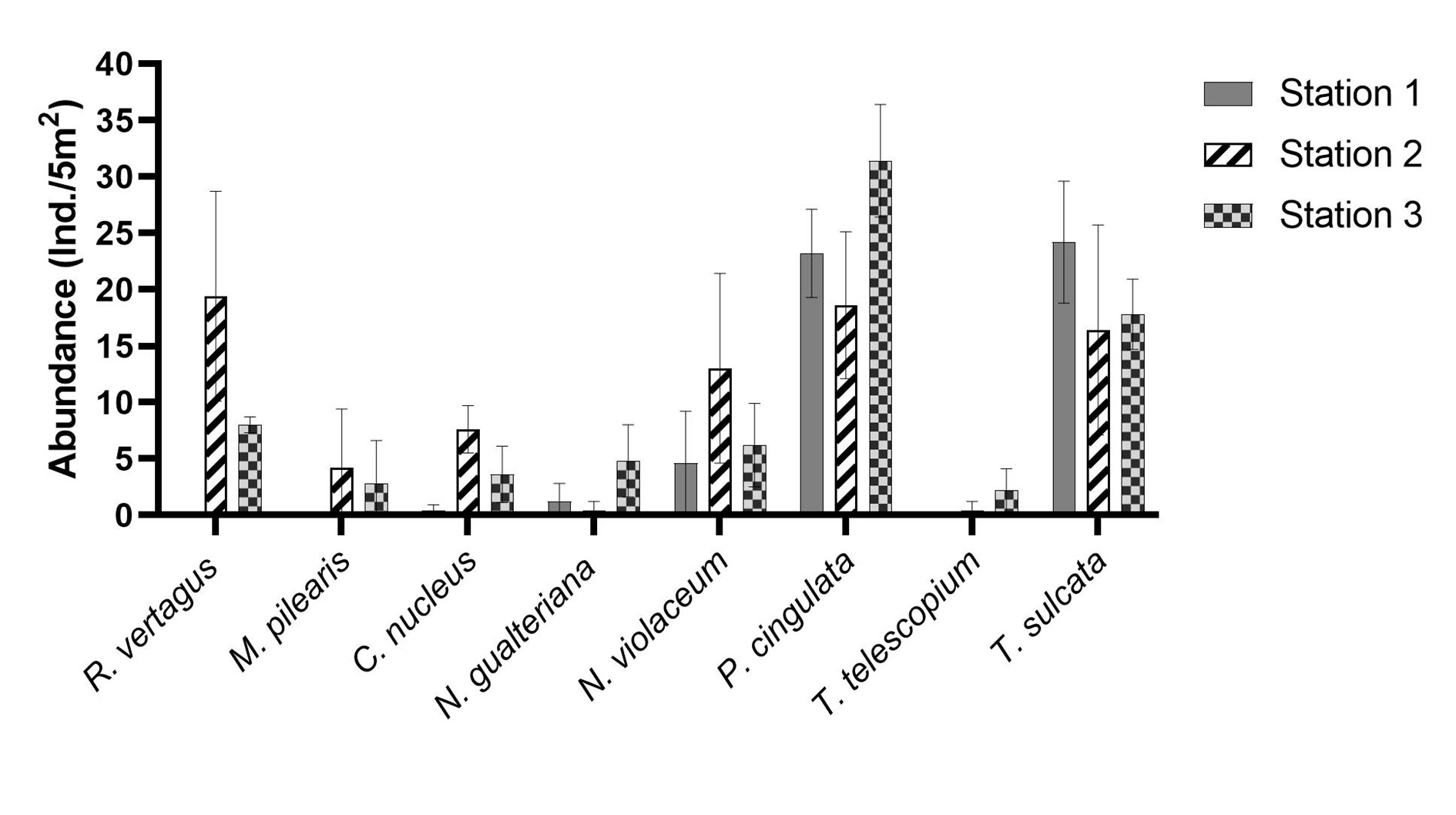
The highest average abundance of gastropods was P. cingulata in station 3 (31.4 ± 5 ind./5m2), T. sulcata, and P. cingulata in station 1 (24.2 ± 5.4 ind./5m2) and (23.2 ± 3.9 ind./5m2), respectively. Overall, the two-way ANOVA test of the average abundance of gastropods in each station showed significant differences (P < 0.01). It was found that there were no significant differences between research stations for some gastropod species, such as M. pilearis and N. gualteriana (P > 0.1), where the average abundance was only 2.3 ± 2.1 ind./5m2 and 2.4 ± 2.1 ind./5m2, respectively (Figure 2).

3.3. Diversity, evenness and dominance of gastropods
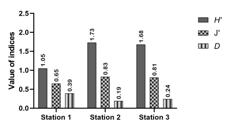
The ecological indices reveal variations in species diversity, evenness, and dominance across the three stations. Station 1 recorded the lowest Shannon-Wiener diversity index (H’) of 1.05, the lowest Pielou’s evenness index (J') of 0.65, and the highest Simpson’s dominance index (D) of 0.39. Station 2 exhibited the highest species diversity with H' = 1.73, along with the highest evenness (J' = 0.83) and the lowest dominance (D = 0.19). Station 3 recorded a diversity index of H’ = 1.63, slightly lower than Station 2, with an evenness index of J’ = 0.81 and a dominance index of D = 0.24 (Figure 3).
4. Discussion
4.1. Gastropod in the mangrove areas
Mangrove forests are essential to snails that live in them because they provide important services like a place to breed, a nursery, food, and safety from predators (Arfiati et al., 2024; Caril et al., 2023; Reid et al., 2008). They also play an important part in the cycling of nutrients in mangrove ecosystems (Guntur et al., 2019; Purnama et al., 2024). Eight species of gastropods from six families and eight genera were found in the mangrove tracking areas of Kemujan, which is in the Karimunjawa Islands. A study conducted in the same forest in 2013 reported a similar number of gastropod species (eight species), with Cerithidea cingulata as the dominant species and abundance values within a comparable range, around 55–179 ind,/25 m2 (Imam et al., 2014). However, it appears that the species was misidentified, as the currently accepted name for Cerithidea cingulata (Gmelin, 1791) is Pirenella cingulata (Gmelin, 1791) (MolluscaBase, 2025).
Among the six families discovered, Potamididae boasted the most diverse range of species. It was made up of three species and 671 individuals, which is more than 60% of the gastropod population. In contrast, the families Neritidae and Cymatiidae contributed the least, with only 32 and 35 individual gastropods recorded, respectively.
The Potamididae, commonly known as mudwhelks or mangrove snails, is a large group of gastropod species that live in tropical and subtropical areas. They can be found in the Indo-West Pacific, South Asia, East Africa, northern Australia, and the Pacific islands (Reid et al., 2008). They are typical inhabitants of coastal mudflats in tropical and warm temperate seas in intertidal zones with fluctuating salinity (Harzhauser et al., 2023). The family is most diverse in the Indo-West Pacific region, including countries like Indonesia, Malaysia, and the Philippines, while smaller populations exist along the coasts of the Arabian Peninsula and West Africa (Cañada, 2020; Harzhauser et al., 2023; Yolanda et al., 2016). Potamididae made up 97% of all the gastropod populations in the mangrove forests of Casiguran, Aurora, Philippines. Cerithidea cingulata alone accounted for 93% of all observed gastropods (Cañada, 2020). In this study, P. cingulata had the highest average density (4.88 individuals per m2), and contributed 54.56% of Potamididae family and 34.79% of gastropod population in the sampling areas. Similarly, P. cingulata displays the highest number of individuals in mangrove ecosystems on the western coast of Kandakuliya, Kalpitiya, Sri Lanka (Sandaruwan et al., 2024). Previous studies show that P. cingulata is an obligate deposit feeder that forms dense aggregations on wet, fine-textured intertidal sediments, especially muddy sand or sandy-mud flats near mangroves (Solanki et al., 2017; Yadav et al., 2025). In our study, Stations 2 and 3 had lower mangrove density than Station 1, offering more open mudflat area. The substantially higher abundance at Station 3 is likely due to its finer sandy-mud substrate, compared to Station 2’s sandy-peat sediments, which are less favorable for foraging and movement (Yadav et al., 2025).
The second most populous species of gastropods, T. sulcata, exhibited an average density of 3.89 individuals per square meter, representing 27.75% of the total gastropods recorded in the study areas. This figure is significantly lower than the findings from Pulau Panjang, Banten, where a density of 15 individuals per square meter of T. sulcata was documented (Patria and Putri, 2017). Meanwhile, T. Telescopium, also belonging to the Potamididae family, exhibited the lowest population distribution, with only 32 individuals recorded. This species primarily inhabits the muddy substrates of mangrove foreshores and the slightly submerged mudflats that occur during high tide. Its natural habitat includes mangrove forests located in West and Central Indo-Pacific region (Palanisamy et al., 2020). The global population of this species is experiencing a decline, primarily due to habitat destruction and the deforestation of mangroves. Additionally, this species occupies a specific ecological niche that contributes to its lower population density compared to other gastropod species (Adamu et al., 2024).
4.2. Community structure of gastropods
Station 1 recorded only five species of gastropods, whereas both Station 2 and Station 3 each recorded eight species. Consequently, Station 1 exhibited the lowest Shannon-Wiener diversity index (H’) of 1.05, while Stations 2 and 3 had diversity indices (H’) of 1.78 and 1.68, respectively. Those values are much higher compared to those in the Pancer Cengkrong mangrove ecosystem, Trenggalek Regency, East Java, where the diversity index ranges between 0.84 and 1.3 (Arfiati et al., 2024). The Shannon diversity index of gastropods, ranging from 1.05 to 1.78, reflects a moderate level of species diversity in the studied habitats. This range suggests variations in species richness and evenness, potentially influenced by environmental conditions and habitat characteristics (Guntur et al., 2019). The Shannon-Wiener Diversity Index combines both species richness and species evenness into a single measure of species diversity. The Shannon-Wiener Diversity Index shows how diverse and fair an ecosystem is. Lower values show that there are few dominant species or low species richness (Caril et al., 2023; Reis et al., 2021).
Station 2 exhibited the highest diversity index (H’=1.78), accompanied by the highest evenness index (J' = 0.83) and the lowest dominance index (D = 0.19). The dominance index serves to illustrate the degree to which one or a few species prevail within the community, which is often inversely correlated with both evenness and diversity (Thukral et al., 2019). A Simpson's Dominance Index between 0.19 and 0.39 means that there is low to moderate biodiversity, which means that some species are more common than others. However, the community is still pretty balanced compared to ecosystems with much higher D values. A lower D value suggests greater biodiversity and a more equitable distribution of species (Arfiati et al., 2024; Harahap et al., 2022).
4.3. Correlation between mangroves and gastropods
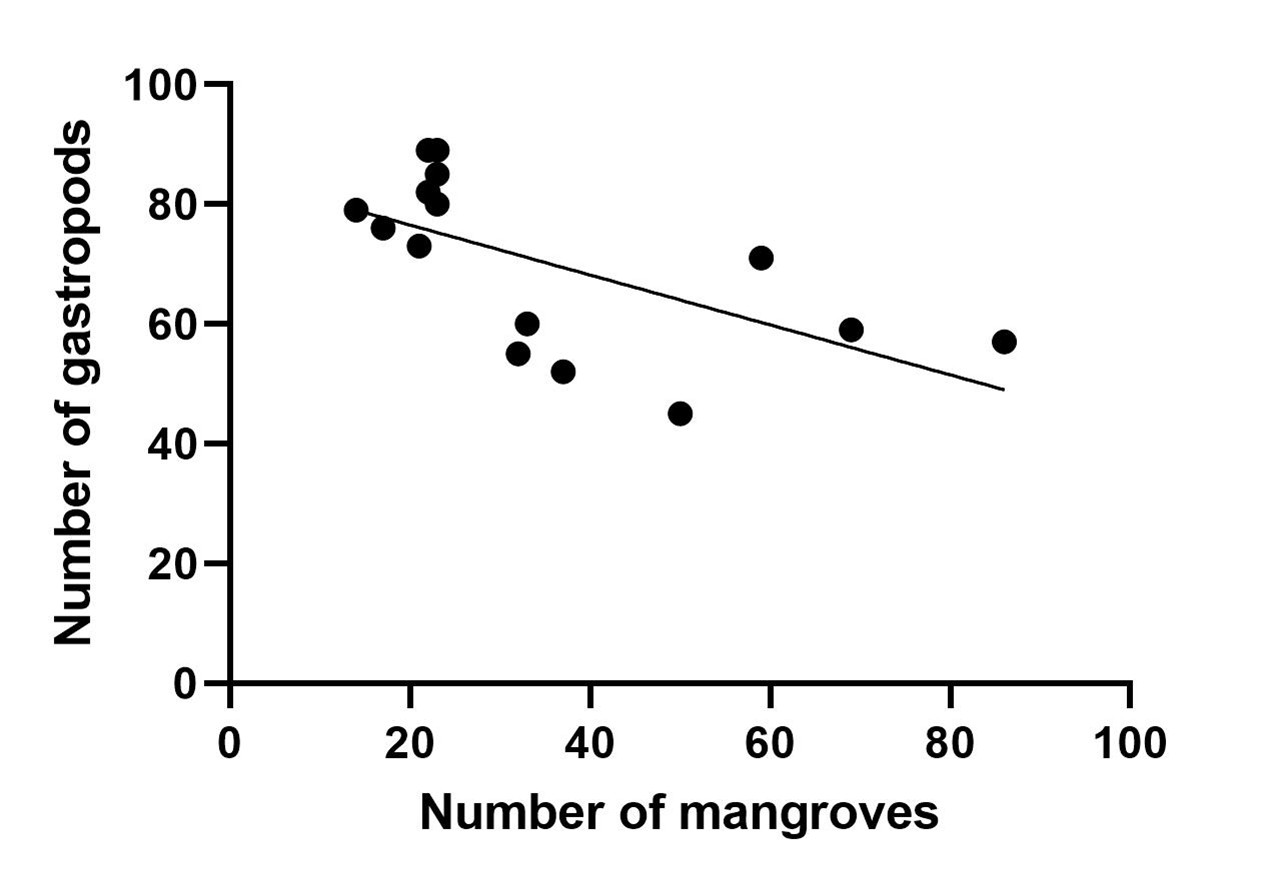
The regression model shows a statistically significant negative relationship between mangroves density and gastropods abundance. It means the higher the numbers of mangroves, the fewer the gastropods. However, the model only explains a moderate amount (38.07%) of the variation in gastropods. This suggests that the abundance of gastropods may also be affected by things that aren't included in the model (Figure 4).
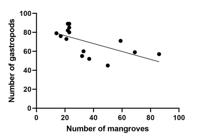
Studies have shown that gastropod abundance often peaks in moderately dense mangroves or in areas where mangroves are sparse. This is because moderate density provides enough shelter while still allowing for sunlight, algal growth, and adequate oxygen. Lower-density mangroves create a more open environment with less organic buildup, making conditions favorable for gastropod populations (Adamu et al., 2024; Keerthana et al., 2023). On the other hand, many of the problems listed above—low light, low oxygen, high sedimentation, and more predators—come together in high-density mangroves to make it harder for gastropods to live and reproduce (Purnama et al., 2024; Reid et al., 2008).
Furthermore, the three sampling stations showed distinct ecological characteristics that influenced gastropod assemblages. Station 1, located in the landward zone, exhibited the highest mangrove density (274 trees) but the lowest mangrove richness (2 species) and the lowest gastropod abundance (268 individuals) and species richness (6 species). This pattern suggests a negative relationship between mangrove density and gastropod density, possibly due to limited habitat heterogeneity and reduced availability of open microhabitats (Adamu et al., 2024; Keerthana et al., 2023). In contrast, Stations 2 and 3, characterized by lower mangrove densities (123 and 134 trees, respectively) but higher mangrove richness (5 and 6 species) and more diverse sediment types (sandy-peat and sand–mud mixtures), supported greater gastropod abundance (400 and 384 individuals) and higher species richness (8 species each). These findings indicate that while dense mangrove stands may limit space for gastropod activity, mangrove richness and substrate diversity provide structural complexity, feeding resources, and microhabitats that promote higher gastropod diversity and abundance (Cañada, 2020; Caril et al., 2023).
One limitation of this study is that fieldwork was carried out solely during the dry season (July–August), a period characterized by minimal rainfall and relatively stable salinity levels. Seasonal variations may affect gastropod assemblages due to alterations in freshwater input, sediment dynamics, and the production of mangrove litter. Consequently, the negative correlation we identified between mangrove density and gastropod abundance must be understood in the context of dry-season conditions. To account for temporal fluctuations and provide a more comprehensive understanding of the interactions between gastropods and mangroves, future investigations should incorporate multi-seasonal surveys.
5. Conclusion
This study highlights the diversity, abundance, and distribution of gastropods in the mangrove forests of Kemujan Trekking Mangrove (TMK), Karimunjawa Islands. A total of eight gastropod species from six families were identified, with Pirenella cingulata and Terebralia sulcata being the most dominant and widely distributed species. The results show that the types and numbers of gastropods are affected by the structure of mangroves. Station 2 has the most variety and balance of species. The finding that areas with a lot of mangroves have fewer gastropods suggests that thick mangrove growth may create conditions that are not suitable for these animals.
Understanding the ecological role of gastropods in mangrove ecosystems is essential for effective conservation and management strategies. This study shows important information about how gastropod communities relate to mangrove habitats. This knowledge can help protect these important coastal ecosystems. Future research should look at other environmental factors, like water quality and sediment type, to better understand how they influence the different types of snails living in mangrove forests.
Acknowledgements
We extend our sincere gratitude to Universitas Brawijaya for the invaluable publication support. We also thank the authorities of Karimunjawa National Park for their essential field support (Permit No. 1777/T.34/TU/SIMAKSI/07/2024), which greatly contributed to the success of our work.
Data Availability Statement
The entire data set that supports the results of this study was published in the article itself.
References
-
ABINO, A.C., CASTILLO, J.A.A. and LEE, Y.J., 2014. Assessment of species diversity, biomass, and carbon sequestration potential of a natural mangrove stand in Samar, the Philippines. Forest Science and Technology, vol. 10, no. 1, pp. 2-8. http://doi.org/10.1080/21580103.2013.814593
» http://doi.org/10.1080/21580103.2013.814593 -
ADAMU, H.O., HUSSAINI, R.O., MOHAMMED, E.O. and IZEGAEGBE, J.I., 2024. Modeling habitat suitability for Cerithidea rhizophorarum and Telescopium telescopium in Indo-West Pacific mangroves. Ecology and Evolution, vol. 14, no. 10, pp. e70384. http://doi.org/10.1002/ece3.70384 PMid:39355116.
» http://doi.org/10.1002/ece3.70384 -
AFWANUDIN, A., SARONG, M.A., EFENDI, R., DELI, A. and IRHAM, M., 2019. The community structure of gastropods as bioindicators of water quality in Krueng Aceh, Banda Aceh. IOP Conference Series. Earth and Environmental Science, vol. 348, no. 1, pp. 012122. http://doi.org/10.1088/1755-1315/348/1/012122
» http://doi.org/10.1088/1755-1315/348/1/012122 -
ALI, M., AL-MUTAIRI, M. and SUBRAHMANYAM, M.N.V., 2024. Seasonal variation of intertidal Gastropoda at rocky and sandy habitats of Umm Al-Namil Island, Kuwait, north-western Arabian Gulf. Aquatic Ecology, vol. 58, no. 3, pp. 931-948. http://doi.org/10.1007/s10452-024-10116-3
» http://doi.org/10.1007/s10452-024-10116-3 -
ARBI, U., 2014 [viewed 02 March 2025]. Taksonomi dan filogeni keong famili Potamididae (Gastropoda: Mollusca) di Indonesia berdasarkan karakter morfologi [online]. Sekolah Pascasarjana, Institut Pertanian Bogor. Available from: http://repository.ipb.ac.id/handle/123456789/73020
» http://repository.ipb.ac.id/handle/123456789/73020 - ARFIATI, D., IRANAWATI, F., ANDHANI, T.D., ORCHIDA, K., APRILIAN, K.F., INAYAH, Z.N. and PRATIWI, R.K., 2024. Gastropod community structure in mangrove Pancer Cengkrong ecosystem, Trenggalek Regency, East Java. International Journal of Innovative Science and Research Technology, vol. 9, no. 11, pp. 2815-2821.
-
ASADI, M.A., AL-KAREEM, A.S., APRILIANTO, R.Y., SARTIMBUL, A., YAMINDAGO, A. and RIYADI, A., 2024. Assessment of mangrove structures and biomass on islands along the Java Sea: A case study on Bawean Islands and Karimunjawa Islands. Frontiers in Ecology and Evolution, vol. 12, pp. 1422749. http://doi.org/10.3389/fevo.2024.1422749
» http://doi.org/10.3389/fevo.2024.1422749 - ASADI, M., YONA, D. and MUHAMMAD, Z.F., 2018. Comparing carbon in sediment of primary and artificially generated mangrove forests. Disaster Advances, vol. 11, no. 11, pp. 18-26.
-
BAHARUDDIN, N. and MARSHALL, D., 2014 [viewed 03 March 2024]. Common aquatic gastropods of Brunei [online]. Institute for Biodiversity and Environmental Research, Universiti Brunei Darussalam. Available from: https://www.researchgate.net/publication/283048448_Common_Aquatic_Gastropods_of_Brunei#fullTextFileContent
» https://www.researchgate.net/publication/283048448_Common_Aquatic_Gastropods_of_Brunei#fullTextFileContent - BENARDI, A., KAHFI, A. and TAUFIQI, K., 2020. Life and livelihood of Javanese society in Karimunjawa (analysis of education level and interethnic interaction patterns). IJTIMAIYA: Journal of Social Science Teaching, vol. 4, pp. 44.
-
BESSET, M., GRATIOT, N., ANTHONY, E.J., BOUCHETTE, F., GOICHOT, M. and MARCHESIELLO, P., 2019. Mangroves and shoreline erosion in the Mekong River delta, Vietnam. Estuarine, Coastal and Shelf Science, vol. 226, pp. 106263. http://doi.org/10.1016/j.ecss.2019.106263
» http://doi.org/10.1016/j.ecss.2019.106263 -
CAI, Y., LU, Y., LIU, J., DAI, X., XU, H., LU, Y. and GONG, Z., 2016. Macrozoobenthic community structure in a large shallow lake: disentangling the effect of eutrophication and wind-wave disturbance. Limnologica, vol. 59, pp. 1-9. http://doi.org/10.1016/j.limno.2016.03.006
» http://doi.org/10.1016/j.limno.2016.03.006 -
CAÑADA, M.C., 2020. Species richness and abundance of bivalves and gastropods in mangrove forests of Casiguran, Aurora, Philippines. Open Journal of Ecology, vol. 10, no. 12, pp. 778-787. http://doi.org/10.4236/oje.2020.1012048
» http://doi.org/10.4236/oje.2020.1012048 -
CARIL, A., VERGARA JUNIOR, R., SANTOS, R., ESTANDARTE, M., BERNABE, J., AGGABAO, M.J., BANTIGUE, P., GUINTO, A. and SAGUIL, N., 2023. Diversity of marine macro molluscan bivalves and gastropods in the intertidal areas of Barangay Paniman, Caramoan, Camarines Sur, Philippines. IOP Conference Series. Earth and Environmental Science, vol. 1278, no. 1, pp. 012010. http://doi.org/10.1088/1755-1315/1278/1/012010
» http://doi.org/10.1088/1755-1315/1278/1/012010 - DOLOROSA, R. and GALON, F., 2014. Species richness of bivalves and gastropods in Iwahig River-Estuary, Palawan, the Philippines. International Journal of Fisheries and Aquatic Studies, vol. 2, no. 1, pp. 207-215.
-
EBADZADEH, H., SHOJAEI, M.G. and SEYFABADI, J., 2024. The effect of habitat structural complexity on gastropods in an arid mangrove wetland. Wetlands Ecology and Management, vol. 32, no. 1, pp. 139-151. http://doi.org/10.1007/s11273-023-09966-9
» http://doi.org/10.1007/s11273-023-09966-9 -
FITRIA, Y., ROZIRWAN, FITRANI, M., NUGROHO, R.Y., FAUZIYAH and PUTRI, W.A.E., 2023. Gastropods as bioindicators of heavy metal pollution in the Banyuasin estuary shrimp pond area, South Sumatra, Indonesia. Acta Ecologica Sinica, vol. 43, no. 6, pp. 1129-1137. http://doi.org/10.1016/j.chnaes.2023.05.009
» http://doi.org/10.1016/j.chnaes.2023.05.009 - GUNTUR, G., ASADI, M., LUTHFI, O., BINTORO, G. and JULLANDA, M., 2019. Ecology of bivalves in the intertidal area of Ngemboh, Gresik, East Java, Indonesia. Aquaculture, Aquarium, Conservation & Legislation, vol. 12, no. 2, pp. 523-534.
-
HARAHAP, I.M., SYAHRIAL, S., ERNIATI, E., ERLANGGA, E., IMANULLAH, I. and EZRANETI, R., 2022. Gastropoda Telescopium telescopium (Linnaeus, 1758) in the mangrove forest of Cut Mamplam Village, Aceh Province, Indonesia. Jurnal Kelautan Tropis, vol. 25, no. 2, pp. 156-168. http://doi.org/10.14710/jkt.v25i2.13353
» http://doi.org/10.14710/jkt.v25i2.13353 -
HARZHAUSER, M., GUZHOV, A., LANDAU, B.M., KERN, A.K. and NEUBAUER, T.A., 2023. Oligocene to Pleistocene mudwhelks (Gastropoda: Potamididae, Batillariidae) of the Eurasian Paratethys Sea – Diversity, origins and mangroves. Palaeogeography, Palaeoclimatology, Palaeoecology, vol. 630, pp. 111811. http://doi.org/10.1016/j.palaeo.2023.111811
» http://doi.org/10.1016/j.palaeo.2023.111811 -
HICKMAH, N., MASLUKAH, L., WULANDARI, S., SUGIANTO, D. and WIRASATRIYA, A., 2021. Study of organic carbon stock in sediments in the Karimunjawa mangrove vegetation area. Indonesian Journal of Oceanography, vol. 3, no. 4, pp. 419-426. http://doi.org/10.14710/ijoce.v3i4.12494
» http://doi.org/10.14710/ijoce.v3i4.12494 -
IMAM, S., SANTOSO, A. and PRIBADI, R., 2014. Gastropod community structure in the mangrove tracking area of Kemujan, Karimunjawa National Park. Journal of Marine Research, vol. 3, no. 4, pp. 595-604. http://doi.org/10.14710/jmr.v3i4.11420
» http://doi.org/10.14710/jmr.v3i4.11420 -
KEERTHANA, M., ARISEKAR, U., KINGSTON, S.D. and SUDHAN, C., 2023. Malacofaunal diversity (Gastropods and Bivalves) along the mangrove forest area of the Gulf of Mannar marine biosphere region, South India. Regional Studies in Marine Science, vol. 67, pp. 103201. http://doi.org/10.1016/j.rsma.2023.103201
» http://doi.org/10.1016/j.rsma.2023.103201 -
MOLLUSCABASE, 2025 [viewed 29 August 2025]. Cerithidea cingulata (Gmelin, 1791) [online]. Available from: https://www.molluscabase.org/aphia.php?p=taxdetails&id=758899
» https://www.molluscabase.org/aphia.php?p=taxdetails&id=758899 -
MURDIYARSO, D., PURBOPUSPITO, J., KAUFFMAN, J.B., WARREN, M.W., SASMITO, S.D., DONATO, D.C., MANURI, S., KRISNAWATI, H., TABERIMA, S. and KURNIANTO, S., 2015. The potential of Indonesian mangrove forests for global climate change mitigation. Nature Climate Change, vol. 5, no. 12, pp. 1089-1092. http://doi.org/10.1038/nclimate2734
» http://doi.org/10.1038/nclimate2734 -
ORTIZ-BURGOS, S., 2016. Shannon-weaver diversity index. In: M.J. KENNISH, ed. Encyclopedia of estuaries Dordrecht: Springer, pp. 572-573. https://doi.org/10.1007/978-94-017-8801-4_233
» https://doi.org/10.1007/978-94-017-8801-4_233 -
PALANISAMY, S.K., PRASANNA KUMAR, C., PARAMASIVAM, P. and SUNDARESAN, U., 2020. DNA barcoding of horn snail Telescopium telescopium (Linnaeus C, 1758) using mt-COI gene sequences. Regional Studies in Marine Science, vol. 35, pp. 101109. http://doi.org/10.1016/j.rsma.2020.101109
» http://doi.org/10.1016/j.rsma.2020.101109 -
PATRIA, M.P. and PUTRI, S.A., 2017. The role of Terebralia (Gastropoda: Potamididae) in carbon deposits at mangrove forest Pulau Panjang, Serang-Banten. AIP Conference Proceedings, vol. 1844, no. 1, pp. 040002. http://doi.org/10.1063/1.4983438
» http://doi.org/10.1063/1.4983438 -
PIELOU, E.C., 1966. The measurement of diversity in different types of biological collections. Journal of Theoretical Biology, vol. 13, pp. 131-144. https://doi.org/10.1016/0022-5193(66)90013-0
» https://doi.org/10.1016/0022-5193(66)90013-0 -
PURNAMA, M.F., PRAYITNO, S.B., MUSKANANFOLA, M.R. and SURYANTI, S., 2024. Tropical gastropod density and diversity in the mangrove forest of Totobo Village, Southeast Sulawesi, Indonesia. Biodiversitas (Surakarta), vol. 25, no. 4, pp. 1663-1675. http://doi.org/10.13057/biodiv/d250436
» http://doi.org/10.13057/biodiv/d250436 -
REID, D.G., 2014. The genus Cerithidea Swainson, 1840 (Gastropoda: Potamididae) in the Indo-West Pacific region. Zootaxa, vol. 3775, no. 1, pp. 1-65, 3-65. http://doi.org/10.11646/zootaxa.3775.1.1 PMid:24871618.
» http://doi.org/10.11646/zootaxa.3775.1.1 -
REID, D.G., DYAL, P., LOZOUET, P., GLAUBRECHT, M. and WILLIAMS, S.T., 2008. Mudwhelks and mangroves: The evolutionary history of an ecological association (Gastropoda: Potamididae). Molecular Phylogenetics and Evolution, vol. 47, no. 2, pp. 680-699. http://doi.org/10.1016/j.ympev.2008.01.003 PMid:18359643.
» http://doi.org/10.1016/j.ympev.2008.01.003 -
REIS, A., ALVES, A.T., DÓREA, A., BENELI, T.M., SANTOS FREITAS, T.S. and BARROS, F., 2021. Distribution and movement of the mangrove gastropod Littoraria angulifera. Estuarine, Coastal and Shelf Science, vol. 250, pp. 107145. http://doi.org/10.1016/j.ecss.2020.107145
» http://doi.org/10.1016/j.ecss.2020.107145 -
ROBERTS, F.S., 2019. Measurement of biodiversity: richness and evenness. In: H.G. KAPER and F.S. ROBERTS, eds. Mathematics of planet earth: protecting our planet, learning from the past, safeguarding for the future Cham: Springer International Publishing, pp. 203-224. http://doi.org/10.1007/978-3-030-22044-0_8
» http://doi.org/10.1007/978-3-030-22044-0_8 -
SANDARUWAN, R.D.C., PERERA, I.J.J.U.N., SANJANA, B.H. and BELLANTHUDAWA, B.K.A., 2024. Mangrove snail diversity as a tool for biomonitoring the mangrove-based coastal habitats. Regional Studies in Marine Science, vol. 78, pp. 103793. http://doi.org/10.1016/j.rsma.2024.103793
» http://doi.org/10.1016/j.rsma.2024.103793 - SOLANKI, D., KANEJIYA, J. and GOHIL, B., 2017. Ecological status of Pirenella cingulata (gmelin, 1791) (gastropod: potamididae) in mangrove habitat of Ghogha Coast, Gulf of Khambhat, India. CIBTech Journal of Zoology, vol. 6, no. 2, pp. 10-16.
-
THUKRAL, A.K., BHARDWAJ, R., KUMAR, V. and SHARMA, A., 2019. New indices regarding the dominance and diversity of communities, derived from sample variance and standard deviation. Heliyon, vol. 5, no. 10, pp. e02606. http://doi.org/10.1016/j.heliyon.2019.e02606 PMid:31667419.
» http://doi.org/10.1016/j.heliyon.2019.e02606 -
YADAV, R., PATHAN, F., DESAI, A., YOGI, D.S., DEEPAK, R.P., NANDAKUMAR, K., NANAJKAR, M., SHETYE, S. and DAMARE, S., 2025. Rheotaxis and hygropetry governs the behaviour of Pirenella cingulata populations on a tropical mesotidal mudflat. Marine Environmental Research, vol. 210, pp. 107257. http://doi.org/10.1016/j.marenvres.2025.107257 PMid:40494091.
» http://doi.org/10.1016/j.marenvres.2025.107257 -
YEO, H.H.J., YEO, J.Y. and TODD, P.A., 2024. Relative predation intensity of an intertidal gastropod on artificial coastal defense structures. Ecology and Evolution, vol. 14, no. 5, pp. e11385. http://doi.org/10.1002/ece3.11385 PMid:38742187.
» http://doi.org/10.1002/ece3.11385 - YOLANDA, R., ASIAH and DHARMA, B., 2016. Mudwhelks (Gastropoda: Potamididae) in mangrove forest of Dedap, Padang Island, Kepulauan Meranti District, Riau Province, Indonesia. Journal of Entomology and Zoology Studies, vol. 4, no. 2, pp. 155-161.
- ZAR, J.H., 2010. Biostatistical analysis 5th ed. Upper Saddle River, NJ: Prentice Hall.
Edited by
-
Editor:
Takako Matsumura Tundisi