 Review of gall-associated insects in the Melastomataceae family
Abstract
Although research on gall-associated insects has increased in recent years in Brazil, little is known about this fauna in the Melastomataceae family. Here, we compiled information on the fauna of insects associated with galls induced in species of the Melastomataceae in different Brazilian biomes. Scientific articles on the fauna associated with galls were obtained through the “Web of Science” database. Further, data on associated fauna obtained from the inventories were analyzed and compiled into dynamic tables. To investigate the relationship of inducers with host plants, we performed a network analysis using the 'igraph' R package. We observed 100 insect galls in Melastomataceae, of which only 32 host plant species were identified to the species level and had associated fauna present. The largest number of insect galls was found in the Atlantic Forest (73%) or in Atlantic Forest and Cerrado transition areas (18%). About 52% of the insects belong to the family Cecidomyiidae and 37% of the insects to the order Lepidoptera. Insects belonging to the family Cecidomyiidae induced galls on the following genera Miconia Ruiz and Pav., Tibouchina Aubl. and Leandra Raddi. Besides inducing galls on these same genera, insects of the order Lepidoptera induced galls exclusively on Maieta guianensis Aubl. In short, we found that taxonomic knowledge of the fauna associated with galls in Melastomataceae is very incipient, the distribution of the fauna associated with galls in Brazil is restricted to regions with the presence of specialists in the group.
Keywords:
Atlantic Forest; Cecidomyiidae; galling insects; Lepidoptera
Resumo
Embora a pesquisa sobre insetos associados a galhas tenha aumentado nos últimos anos no Brasil, pouco se sabe sobre essa fauna na família Melastomataceae. Aqui, compilamos informações sobre a fauna de insetos associados a galhas induzidas em espécies de Melastomataceae em diferentes biomas brasileiros. Artigos científicos sobre a fauna associada a galhas foram obtidos por meio do banco de dados “Web of Science”. Além disso, dados sobre a fauna associada obtidos dos inventários foram analisados e compilados em tabelas dinâmicas. Para investigar a relação dos indutores com as plantas hospedeiras, realizamos uma análise de rede usando o pacote R 'igraph'. Observamos 100 galhas de insetos em Melastomataceae, das quais apenas 32 espécies de plantas hospedeiras foram identificadas ao nível de espécie e tinham fauna associada presente. O maior número de galhas de insetos foi encontrado na Mata Atlântica (73%) ou em áreas de transição Mata Atlântica e Cerrado (18%). Cerca de 52% dos insetos pertencem à família Cecidomyiidae e 37% dos insetos à ordem Lepidoptera. Insetos pertencentes à família Cecidomyiidae induziram galhas nos seguintes gêneros Miconia Ruiz e Pav., Tibouchina Aubl. e Leandra Raddi. Além de induzir galhas nestes mesmos gêneros, insetos da ordem Lepidoptera induziram galhas exclusivamente em Maieta guianensis Aubl. Em suma, verificamos que o conhecimento taxonômico da fauna associada a galhas em Melastomataceae é muito incipiente, a distribuição da fauna associada a galhas no Brasil é restrita a regiões com presença de especialistas do grupo.
Palavras-chave:
Mata Atlântica; Cecidomyiidae; insetos galhadores; Lepidoptera
1. Introduction
Research on insect galls and associated insects has grown over the last 30 years in Brazil (Araújo, 2018; Araújo et al., 2019). This has contributed to the ecological and evolutionary understanding of this insect-plant interaction, as well as agricultural aspects, since many insects induce galls in cultivated plants of socio-economic interest (Araújo et al., 2019). Recent studies, however, show a geographic bias in the distribution of inventories, since most of these are carried out in areas of Atlantic Forest and Cerrado, the same biomes where important research centers and taxonomists specialized in the family Cecidomyiidae (Insecta, Diptera) are located (Araújo et al., 2019; Maia and Silva, 2021; Urso-Guimarães et al., 2024).
The Melastomataceae family is indicated in several gall inventories as hosts for galling insects (Maia, 2014; Flor et al., 2022), however few studies have focused their attention on this family. This botanical family is one of the ten most diverse botanical families among Angiosperms, with approximately 5,900 species and with great diversity in the Neotropical region (Ulloa Ulloa et al., 2022). In Brazil, it has about 1,440 species and can be easily found in all biomes, mainly Atlantic Forest, Cerrado and Amazon (Reflora, 2025). Systematic review is an important tool that combines information from multiple sources to explain a topic or concept in a comprehensive manner. Analyses on the associated gall fauna have already been performed for Fabaceae (Santos-Silva and Araújo, 2020), Asteraceae (Flor et al., 2022), and Myrtaceae (Maia and Cruz, 2023). However, no similar analyses have been carried out with the Melastomataceae family.
Although in the literature the terms "associated fauna" and "secondary fauna" are often used as synonyms and encompass parasitoids, inquilines, successors, kleptoparasites, symbionts and predators, and exclude inducers, here, using a more comprehensive form, we consider any gall-associated individual found as associated fauna. Given the importance of gall-associated insects in different Brazilian ecosystems and the lack of data on galls in Melastomataceae in Brazil, our study compiled information on the fauna of insects associated with galls induced in species of the Melastomataceae family in different Brazilian biomes from 2011 to 2020 to answer the following questions: 1) What is the state of the art of taxonomic knowledge of the fauna associated with galls? 2) What is the distribution of the fauna associated with galls in Brazil? 3) What are the main inducers?
2. Material and Methods
The Web of Science is a database widely used for scientific research, including meta-analysis, as it has a data source, quality, and coverage (Zhu and Liu, 2020). Scientific articles on the fauna associated with galls were obtained through the “Web of Science” database via the Periodicals Portal of the Coordination for the Improvement of Higher Education Personnel (CAPES, 2023), using the combination of the following keywords “insect galls”, “associated fauna”, “insetos galhadores” and “fauna associada” on October 5, 2023. After this initial search, the studies were filtered for the Melastomataceae family. The survey was carried out in Portuguese and English and filtered for the Brazilian territory. The search was limited to studies/inventories with primary data, which had carried out sampling of insect galls and associated fauna.
Data on associated fauna obtained from the inventories were analyzed and compiled into dynamic tables in Microsoft Excel. We retrieved the following information from each study: host plant, gall shape, gall organ, presence or absence of trichomes, coloration, biome in which the gall was found, associated fauna and location of the study. Although all galls were recorded and characterized, our Systematic review focused on host species at a specific level to observe specific associations between fauna and host plant species.
The gall morphotypes of the same plant species and different authors were checked to avoid duplication and later standardized following Isaias et al. (2013). Furthermore, we checked all the scientific names of the host plants and geographic distribution in the Flora e Funga do Brasil - Reflora project (Reflora, 2025).
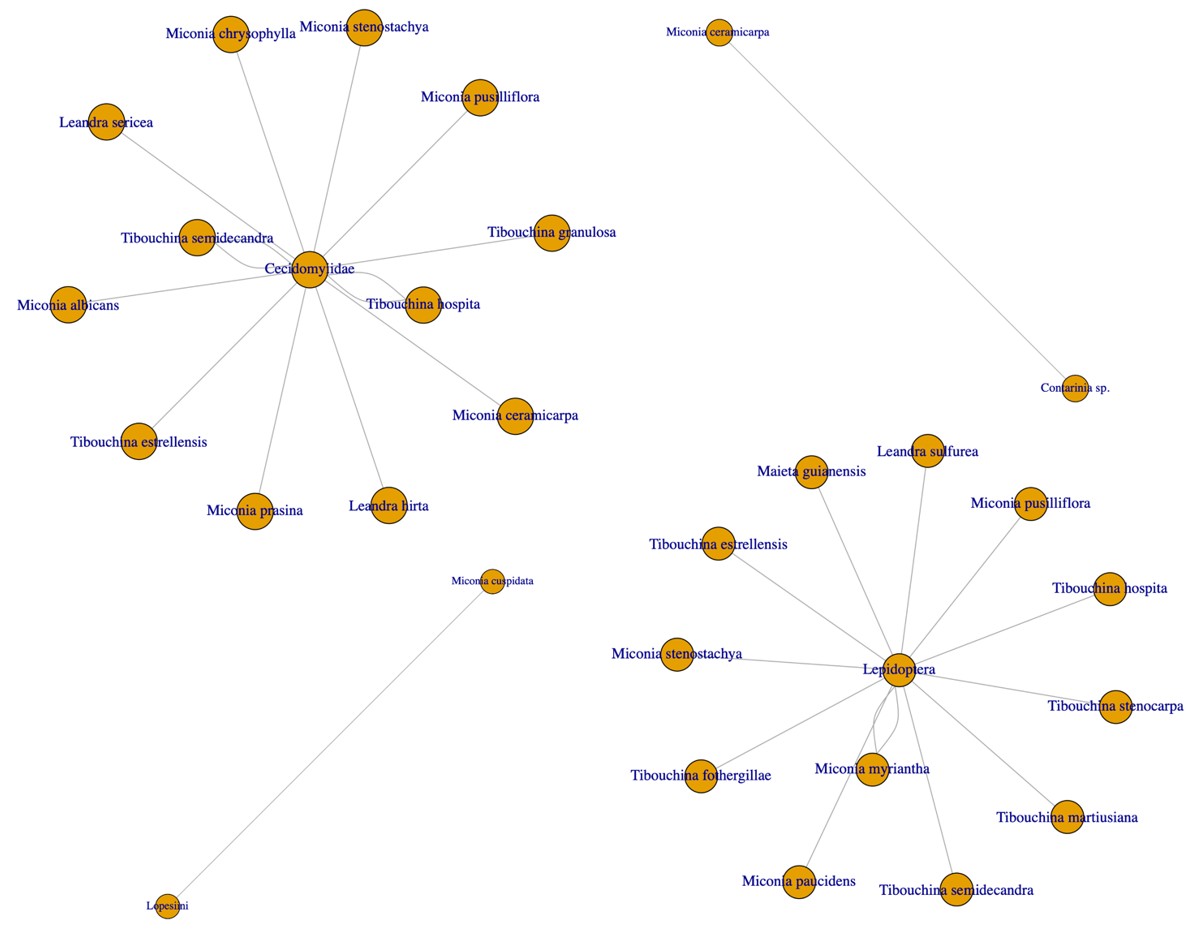
Network analysis is the process of investigating the relationships and interactions within a network, typically to understand the structure, dynamics, or functionality of the network. To investigate the relationship of inducers (Cecidomyiidae, Lepidoptera, Lopesiini and Contarinia sp.) with host plants, we performed a network analysis using the 'igraph' R package (Csárdi et al., 2025). All figures were created with custom R script. Version R 4.1.1 (R Foundation, 2023).
3. Results
We compiled and analyzed 16 scientific articles on gall-associated fauna published in the “Web of Science” database from 2011 to 2020. We obtained 100 insect galls in Melastomataceae. Out of the 100, only 32 host plant species were identified at the species level and had associated fauna present (Table 1). The globoid shape was the most abundant with about 55%, followed by the fusiform (32%). Regarding the most affected plant organ, the leaf was the most impacted (50%), followed by buds (23%), stems (19%) and petiole (7%). Insect galls were found among 8 genera of Melastomataceae. About 49% of the galls were found in the genus Miconia Ruiz and Pav. and 27% in species of Tibouchina Aubl. The largest number of insect galls was found in the Atlantic Forest (73%) or in Atlantic Forest and Cerrado transition areas (18%) (Figure 1, Table 1). We also observed that 62% of insect galls did not have trichomes in Melastomataceae, about 32% had trichomes present and 6% of the studies did not report this characteristic. The most frequently found color in insect galls was green (43%), followed by brown (28%). About 8% of studies reported galls with more than one color (Table 1).

Characterization of insect galls found in Melastomataceae from 2011 to 2020. (A) gall shapes, (B) plant organs, (C) host plant genus and (D) biomes.
Approximately 43% of the studies did not record any associated fauna and 57% of the studies recorded at least one individual associated with galls in Melastomataceae. Among the recorded individuals, 52% of the insects belong to the family Cecidomyiidae and 37% of the insects to the order Lepidoptera. Two insects were identified at the tribe level (Lopesiini) and three at the genus level (Lopesia Rübsaamen, 1908 and Contarinia Rondani, 1860) for the family Cecidomyiidae. Furthermore, insects belonging to the following groups were recorded: Hymenoptera (8), Muscomorpha (1), Psocoptera (1) and Coleoptera (1).
Insects belonging to the family Cecidomyiidae induced galls on the following genera Miconia, Tibouchina, and Leandra Raddi. Besides inducing galls on these same genera, insects of the order Lepidoptera induced galls exclusively on Maieta guianensis Aubl. Both Cecidomyiidae and Lepidoptera induced galls on the same species Miconia stenostachya DC., Miconia pusilliflora (DC.) Naudin, Tibouchina hospital Cogn., Tibouchina estrellensis (Raddi) Cogn. and Tibouchina semidecantha (Schrank and Mart. ex DC.) Cogn. Cecidomyiidae induced two different shapes on T. semidecantha and T. hospita. Lepidopterans induced two different shapes on Miconia myriantha Benth. (Figure 2, Table 1).
Interactions of gall-inducing inducers (Cecidomyiidae, Lepidoptera, Lopesiini and Contarinia sp.) and host plants based on net the work analysis.
4. Discussion
Here, we observed 100 gall morphotypes in Melastomataceae, a number smaller than those recorded by Flor et al. (2022) for Asteraceae (n=487) and by Santos-Silva and Araújo (2020) for Fabaceae (n=438). Almost half of the insect galls of Melastomataceae did not have records of associated fauna and the few that were recorded did not have taxonomic identification at more specific levels, making it difficult to understand the relationships between host plant and gall. According to Maia and Silva (2021), taxonomic knowledge about the fauna associated with galls is still very deficient and suffers from a geographical bias, which in turn is determined by the concentration of research centers and cecidologists in some regions. This fact is also confirmed here, where the Atlantic Forest continues to be the most investigated biome over the years.
The Atlantic Forest had the highest record of insect galls in Melastomataceae. This biome is characterized by having many species of Melastomataceae, mainly representatives of the following genera Miconia, Tibouchina, and Leandra in seasonal forests and Miconia and Leandra in forest formations (Goldenberg et al., 2012). Miconia was the genus with the highest number of galls recorded and, not coincidentally, is frequently identified as a host of insect galls by other authors (Silva and Almeida-Cortez, 2006; Vecchi et al., 2013). As Fernandes (1992) states, this can be explained through the plant taxon size hypothesis, where she predicts a positive correlation between family and/or genus size and galling insects, since Miconia is the most representative genus from the Melastomataceae family (Cunha et al., 2019). Another relevant characteristic in this study was the large number of green galls, which are very frequent in inventories (Lima and Calado, 2018; Maia and Mascarenhas, 2017) and may be the result of the influence of many variables, including the age of the gall and the presence of chlorophyll (Isaias et al., 2013).
Unlike Flor et al. (2022) who observed that most galls are induced on the stem in the Asteraceae family, we found that in Melastomataceae most galls are induced on the leaves. This pattern is reported in most studies on galls (Menezes et al., 2023; Isaias et al., 2024; Araújo et al., 2024; Maia and Silva, 2021; Maia and Mascarenhas, 2023) and occurs because the leaves are the most abundant resource (Maia and Mascarenhas, 2017), with a large nutritional reserve and more malleable, allowing more variations in shape (Isaias et al., 2013). Furthermore, the leaf is also the plant organ that insects of the Cecidomyiidae family tend to gall most frequently (Maia 2013) and were the most frequent inducers in our study.
The family Cecidomyiidae is the main taxon of galling insects in the Neotropics, and the results of this study confirm this (Carneiro et al., 2009). However, we observed a significant association between Lepidoptera and Melastomataceae, and such a relationship has already been mentioned by other authors (Maia et al., 2008). Both Cecidomyiids and Lepidopterans induced galls on the same genera of host plants, except for the gall found on the species M. guianensis, which was induced exclusively by a Lepidoptera. According to the authors, this was the first record of galls on this plant species, which highlights the ecological importance of this species as a gall host, since galls are considered the extended phenotype of gallers (Stone and Schönrogge, 2003).
One limitation of our study lies in its focus on primary gall inventories, as different specialists such as botanists, zoologists, and ecologists tend to investigate distinct aspects of this ecological interaction. Nonetheless, this approach enables a preliminary assessment of the insect fauna associated with the Melastomataceae family. Another limitation is the defined timeframe, which may exclude species that are frequently studied by ecologists. We recommend that future assessments incorporate other types of studies, including taxonomic studies that describe new insect gall species associated, historical contributions such as those by José Tavares, and ecological or botanical studies that report new records or investigate abundance and other ecological traits of galls.
Other revisional studies have already compiled information on the fauna of insects associated with galls for the families Asteraceae (Flor et al., 2022), Fabaceae (Santos-Silva and Araújo, 2020) and Myrtaceae (Maia and Cruz, 2023). However, this is the first study that gathers data on Melastomataceae. Here, we showed that Cecidomyiidae and Lepidoptera are the main inducers, that the genera that harbor more morphotypes are the most representative of the family and that the most affected plant organ is also the most frequent in the Neotropical region. Our study also highlights that the taxonomic identification of both host plants and inducers and other associated insects is the great limitation. Furthermore, the scarcity of studies in certain biomes shows the need for more studies in different Brazilian regions to better understand the associated fauna of galling insects in Melastomataceae. These studies are extremely important, as they can gather data and thus attempt to demonstrate specific relationships, such as those that occur between the inducer and the host plant, in addition to characterizing the galls within the plant family. In short, we found that taxonomic knowledge of the fauna associated with galls in Melastomataceae is very incipient, the distribution of the fauna associated with galls in Brazil is restricted to regions with the presence of specialists in the group. This review shows the diversity of gall-associated insects in Melastomataceae across multiple biomes, providing valuable insights for conservation strategies and guiding new research questions on this important insect-plant interaction.
Acknowledgements
We thank the Federal University of Western Bahia (UFOB) for the structure provided and the National Council for Scientific and Technological Development (CNPq) for the master's scholarship to M.V.S. (Term of grant 131406/2024-8).
Data Availability Statement
We hereby declare, for all appropriate purposes, that the entire data set supporting the results of this study was published in the article itself. We certify that there is no additional data to be made available beyond what is already included in the submitted manuscript.
References
-
ARAÚJO, T.D.J., MAIA, V.C., CARNEIRO, M.A.A. and SANTOS-SILVA, J., 2024. Insect galls of the Chapada Diamantina, Rio de Contas, Bahia, Brazil. Papéis Avulsos de Zoologia, vol. 64, pp. e202464005. http://doi.org/10.11606/1807-0205/2024.64.005
» http://doi.org/10.11606/1807-0205/2024.64.005 -
ARAÚJO, W.S., 2018. 30 years of research on insect galls in Brazil: a scientometric review. Papéis Avulsos de Zoologia, vol. 58, pp. e20185834. http://doi.org/10.11606/1807-0205/2018.58.34
» http://doi.org/10.11606/1807-0205/2018.58.34 -
ARAÚJO, W.S., FERNANDES, G.W. and SANTOS, J.C., 2019. An overview of inventories of gall-inducing insects in Brazil: looking for patterns and identifying knowledge gaps. Anais da Academia Brasileira de Ciências, vol. 91, no. 1, pp. e20180162. http://doi.org/10.1590/0001-3765201920180162 PMid:30916155.
» http://doi.org/10.1590/0001-3765201920180162 -
CAPES. [online], 2023 [viewed 5 Oct 2023]. Available from: https://www.periodicos.capes.gov.br/
» https://www.periodicos.capes.gov.br/ -
CARNEIRO, M.A.A., BRANCO, C.S., BRAGA, C.E., ALMADA, E.D., COSTA, M., MAIA, V.C. and FERNANDES, G.W., 2009. Are gall midge species (Diptera, Cecidomyiidae) host-plant specialists? Revista Brasileira de Entomologia, vol. 53, no. 3, pp. 365-378. http://doi.org/10.1590/S0085-56262009000300010
» http://doi.org/10.1590/S0085-56262009000300010 - CSÁRDI, G., NEPUSZ, T., MÜLLER, K., HORVÁT, S., TRAAG, V., ZANINI, F. and NOOM, D., 2025. igraph: Network Analysis and Visualization in R. R package version 2.1.3 Zenodo. http://doi.org/10.5281/zenodo.7682609.
-
CUNHA, G.O.S., DA CRUZ, D.C. and MENEZES, A.C.S., 2019. An overview of Miconia genus: chemical constituents and biological activities. Pharmacognosy Reviews, vol. 13, no. 26, pp. 77-88. http://doi.org/10.5530/phrev.2019.2.8
» http://doi.org/10.5530/phrev.2019.2.8 -
FERNANDES, G.W., 1992. Plant family size and age effects on insular gall-forming species richness. Global Ecology and Biogeography Letters, vol. 2, no. 3, pp. 71-74. http://doi.org/10.2307/2997508
» http://doi.org/10.2307/2997508 -
FLOR, I.C., MAIA, V.C. and CARNEIRO, M.A.A., 2022. Geographic distribution patterns of galling insects in a protected area of Atlantic forest (Southeast, Brazil). Papéis Avulsos de Zoologia, vol. 62, pp. e202262025. http://doi.org/10.11606/1807-0205/2022.62.025
» http://doi.org/10.11606/1807-0205/2022.62.025 -
GOLDENBERG, R., BAUMGRATZ, J.F.A. and SOUZA, M.L.D.R., 2012. Taxonomia de Melastomataceae no Brasil: retrospectiva, perspectivas e chave de identificação para os gêneros. Rodriguésia, vol. 63, no. 1, pp. 145-161. http://doi.org/10.1590/S2175-78602012000100011
» http://doi.org/10.1590/S2175-78602012000100011 -
ISAIAS, R.M.D.S., CARNEIRO, R.G.S., OLIVEIRA, D.C. and SANTOS, J.C., 2013. Illustrated and annotated checklist of Brazilian gall morphotypes. Neotropical Entomology, vol. 42, no. 3, pp. 230-239. http://doi.org/10.1007/s13744-013-0115-7 PMid:23949804.
» http://doi.org/10.1007/s13744-013-0115-7 -
ISAIAS, R.M.D.S., KRAUS, J.E., COSTA, E.C. and CARNEIRO, R.G.S., 2024. The anatomy of neotropical galls and the untold lessons about the morphogenetical potentialities of plants. Rodriguésia, vol. 75, pp. e01542023. http://doi.org/10.1590/2175-7860202475007
» http://doi.org/10.1590/2175-7860202475007 -
LIMA, V.P. and CALADO, D., 2018. Morphological characterization of insect galls and new records of associated invertebrates in a Cerrado area in Bahia State, Brazil. Brazilian Journal of Biology = Revista Brasileira de Biologia, vol. 78, no. 4, pp. 636-643. http://doi.org/10.1590/1519-6984.169502 PMid:29319753.
» http://doi.org/10.1590/1519-6984.169502 - MAIA, V.C. and CRUZ, K.D., 2023. Cecidomyiidae (Diptera) on Myrtaceae in Brazil: richness and geographic distribution. Anais da Academia Brasileira de Ciências, vol. 95, no. 2, pp. e20200684. PMid:37585890.
-
MAIA, V.C. and MASCARENHAS, B., 2017. Insect galls of the Parque Nacional do Itatiaia (southeast region, Brazil). Anais da Academia Brasileira de Ciências, vol. 89, no. 1, suppl. 0, pp. 505-575. http://doi.org/10.1590/0001-3765201720160877 PMid:28562824.
» http://doi.org/10.1590/0001-3765201720160877 -
MAIA, V.C. and MASCARENHAS, B., 2023. Insect galls of Parque Nacional da Serra dos Órgãos (Rio de Janeiro State, Southeastern Brazil). Papéis Avulsos de Zoologia, vol. 63, pp. e202363040. http://doi.org/10.11606/1807-0205/2023.63.040
» http://doi.org/10.11606/1807-0205/2023.63.040 -
MAIA, V.C. and SILVA, B.G., 2021. Insect galls of the Brazilian Cerrado: associated fauna. Biota Neotropica, vol. 21, no. 3, pp. e20211202. http://doi.org/10.1590/1676-0611-bn-2021-1202
» http://doi.org/10.1590/1676-0611-bn-2021-1202 -
MAIA, V.C., 2011. Characterization of insect galls, gall makers, and associated fauna of Platô Bacaba (Porto de Trombetas, Pará, Brazil). Biota Neotropica, vol. 11, no. 4, pp. 37-53. http://doi.org/10.1590/S1676-06032011000400003
» http://doi.org/10.1590/S1676-06032011000400003 -
MAIA, V.C., 2013. Galhas de insetos em restingas da região sudeste do Brasil com novos registros. Biota Neotropica, vol. 13, no. 1, pp. 183-209. http://doi.org/10.1590/S1676-06032013000100021
» http://doi.org/10.1590/S1676-06032013000100021 -
MAIA, V.C., 2014. Insect galls of Itamonte (Minas Gerais, Brazil): characterization and occurrence. Biota Neotropica, vol. 14, no. 1, pp. e20133839. http://doi.org/10.1590/S1676-06033839
» http://doi.org/10.1590/S1676-06033839 -
MAIA, V.C., and SIQUEIRA, E.S., 2020. Insect galls of the Reserva Biológica União, Rio de Janeiro, Brazil. Biota Neotropica, vol. 20, no. 1, pp. e20190758. https://doi.org/10.1590/1676-0611-BN-2019-0758
» https://doi.org/10.1590/1676-0611-BN-2019-0758 -
MAIA, V.C., MAGENTA, M.A.G. and MARTINS, S.E., 2008. Ocorrência e caracterização de galhas de insetos em áreas de restinga de Bertioga (São Paulo, Brasil). Biota Neotropica, vol. 8, no. 1, pp. 167-197. http://doi.org/10.1590/S1676-06032008000100020
» http://doi.org/10.1590/S1676-06032008000100020 -
MENEZES, J.B.D., LIMA, V.P. and CALADO, D.C., 2023. Insect galls from the Serra da Bandeira (Barreiras, Western Bahia, Brazil). Biota Neotropica, vol. 23, no. 4, pp. e20231527. http://doi.org/10.1590/1676-0611-bn-2023-1527
» http://doi.org/10.1590/1676-0611-bn-2023-1527 -
R FOUNDATION. [online], 2023 [viewed 5 Oct 2023]. Available from: https://www.R-project.org/
» https://www.R-project.org/ -
REFLORA. [online], 2025 [viewed 13 Jan 2025]. Jardim Botânico do Rio de Janeiro. Available from: http://floradobrasil.jbrj.gov.br
» http://floradobrasil.jbrj.gov.br -
SAITO, V.S. and URSO-GUIMARÃES, M.V., 2012. Characterization of galls, insect galls and associated fauna of Ecological Station of Jataí (Luiz Antônio, SP). Biota Neotropica, vol. 12, pp. 99-107. https://doi.org/10.1590/S1676-06032012000300011
» https://doi.org/10.1590/S1676-06032012000300011 -
SANTOS-SILVA, J. and ARAUJO, T.J., 2020. Are Fabaceae the principal super-hosts of galls in Brazil? Anais da Academia Brasileira de Ciências, vol. 92, no. 2, pp. e20181115. http://doi.org/10.1590/0001-3765202020181115 PMid:32785425.
» http://doi.org/10.1590/0001-3765202020181115 -
SILVA, S.C.L. and ALMEIDA-CORTEZ, J.S., 2006. Galhas entomógenas de Miconia prasina (Sw.) DC (Melastomataceae) em remanescentes de Floresta Atlântica Nordestina. Lundiana : International Journal of Biodiversity, vol. 7, no. 1, pp. 33-37. http://doi.org/10.35699/2675-5327.2006.22182
» http://doi.org/10.35699/2675-5327.2006.22182 -
STONE, G.N. and SCHÖNROGGE, K., 2003. The adaptive significance of insect gall morphology. Trends in Ecology & Evolution, vol. 18, no. 10, pp. 512-522. http://doi.org/10.1016/S0169-5347(03)00247-7
» http://doi.org/10.1016/S0169-5347(03)00247-7 -
ULLOA ULLOA, C., ALMEDA, F., GOLDENBERG, R., KADEREIT, G., MICHELANGELI, F.A., PENNEYS, D.S., STONE, R.D. and VERANSO-LIBALAH, M.C., 2022. Melastomataceae: global diversity, distribution, and endemism. In: R. GOLDENBERG, F.A. MICHELANGELI and F. ALMEDA, eds. Systematics, evolution, and ecology of melastomataceae Cham: Springer. http://doi.org/10.1007/978-3-030-99742-7_1
» http://doi.org/10.1007/978-3-030-99742-7_1 -
URSO-GUIMARÃES, M.V., ARAÚJO, W.S. and SANTOS, J.C., 2024. Gall-inducing insect inventories in Brazil: update, perspectives, and challenges. The Pan-Pacific Entomologist, vol. 100, no. 4, pp. 309-332. http://doi.org/10.3956/2024-100.4.309
» http://doi.org/10.3956/2024-100.4.309 -
VECCHI, C., MENEZES, N.L., OLIVEIRA, D.C., FERREIRA, B.G. and ISAIAS, R.M.S., 2013. The redifferentiation of nutritive cells in galls induced by Lepidoptera on Tibouchina pulchra (Cham.) Cogn. reveals predefined patterns of plant development. Protoplasma, vol. 250, no. 6, pp. 1363-1368. http://doi.org/10.1007/s00709-013-0519-6 PMid:23779213.
» http://doi.org/10.1007/s00709-013-0519-6 -
ZHU, J. and LIU, W., 2020. A tale of two databases: the use of Web of Science and Scopus in academic papers. Scientometrics, vol. 123, no. 1, pp. 321-335. http://doi.org/10.1007/s11192-020-03387-8
» http://doi.org/10.1007/s11192-020-03387-8
Edited by
-
Editor:
Takako Matsumura Tundisi