
 Optimizing radish (Raphanus sativus L.) production through alternative nitrogen sources
Abstract
Radish is a tuberous vegetable rich in nutrients, making it a great option for crop rotation on small and medium-sized properties. In this way, the determination adequate sources and doses of nitrogen (N) is essential to guarantee the development of this crop without excessive losses through leaching, reducing both damage to the environment and production costs. Thus, the objective of this study was to evaluate the growth and physiology of radish cultivated under fertilization with different sources and doses of N. The experiment was carried out in a greenhouse located in the experimental area of the Biotechnology and Plant Breeding Sector of the Department of Biosciences of the Center for Agrarian Sciences, Federal University of Paraíba, Areia, Paraíba, Brazil. The experimental design was in randomized blocks in a 2 x 5 factorial scheme (two sources of nitrogen fertilization – urea and ammonium sulfate; and five doses of nitrogen fertilizer – 0, 15, 30, 45 and 60 kg ha-1) with four replications. Plant height, fresh and dry mass of roots, fresh and dry mass of shoots, number of leaves, leaf area, gas exchange, chlorophyll index and chlorophyll fluorescence were evaluated. Radish growth was positively influenced by N sources and doses. The application of urea was more efficient for plant growth, chlorophyll a index and total chlorophyll index, and fertilization with 15.0 kg ha-1 of urea was the most efficient way to increase the growth and production of radish plants.
Keywords:
Raphanus sativus L.; physiology; biometrics; urea; ammonium sulfate
Resumo
O rabanete é um vegetal tuberoso rico em nutrientes, tornando-se uma ótima opção para rotação de culturas em propriedades de pequeno e médio porte. Dessa forma, a determinação de fontes e doses adequadas de nitrogênio (N) é essencial para garantir o desenvolvimento dessa cultura sem perdas excessivas por lixiviação, reduzindo tanto os danos ao meio ambiente quanto os custos de produção. Assim, o objetivo deste estudo foi avaliar o crescimento e a fisiologia do rabanete cultivado sob fertilização com diferentes fontes e doses de N. O experimento foi realizado em uma estufa localizada na área experimental do Setor de Biotecnologia e Melhoramento de Plantas do Departamento de Biosciências do Centro de Ciências Agrárias, Universidade Federal da Paraíba, Areia, Paraíba, Brasil. O delineamento experimental foi em blocos ao acaso em um esquema fatorial 2 x 5 (duas fontes de fertilização nitrogenada – ureia e sulfato de amônio; e cinco doses de fertilizante nitrogenado – 0, 15, 30, 45 e 60 kg ha-1) com quatro repetições. Foram avaliados a altura das plantas, massa fresca e seca das raízes, massa fresca e seca das partes aéreas, número de folhas, área foliar, trocas gasosas, índice de clorofila e a fluorescência da clorofila. O crescimento do rabanete foi positivamente influenciado pelas fontes e doses de N. A aplicação de ureia foi mais eficiente para o crescimento das plantas, índice de clorofila a e índice total de clorofila, sendo a fertilização com 15,0 kg ha-1 de ureia a forma mais eficiente de aumentar o crescimento e a produção das plantas de rabanete.
Palavras-chave:
Raphanus sativus L.; fisiologia; biometria; ureia; sulfato de amônio
1. Introduction
Radish (Raphanus sativus L.) is an economically significant root crop native to Europe and Asia, with a long history of cultivation and domestication (Chorol, 2019). It is one of the earliest vegetables to be harvested and is cultivated worldwide due to its adaptability to diverse climatic conditions. Its importance lies in its high nutritional value, culinary versatility, and relatively short growth cycle, making it a valuable crop for subsistence and commercial farming. Radish is valued for its phytochemicals, which offer numerous health benefits, including digestive support and potential therapeutic applications (Chorol, 2019). It is consumed fresh and has medicinal and vitamin properties, rich in phosphorus, calcium, potassium, folic acid, and dietary fibers and low calorie content (Lim et al., 2019).
Given its nutritional value, rapid growth, and agricultural relevance, successful radish production depends on proper soil and nutrient management. It requires soils with good fertility, forms a large amount of biomass in the storage organ (bulb), and, therefore, demands a substantial supply of nutrients within a relatively short growing period (Oliveira et al., 2017). Fertilization accounts for most of the production costs on small farms. Therefore, although radish is a promising alternative for diversification on these small farms, the high cost of fertilization can significantly impact its economic viability. These elevated costs can reduce the profit margins for farmers, making radish cultivation less attractive (Viciedo et al., 2017). Thus, it is of paramount importance that fertilization is carried out in an appropriate way for crop. Although ammonium sulfate often results in improved physiological performance due to its sulfur content, its considerably higher cost compared with urea limits its adoption in many cropping systems, particularly among smallholders.
Several factors can affect the production of radish crops, including the availability of nitrogen (N) in the substrate (Yousaf et al., 2021). As one of the most essential nutrients for plant development, nitrogen is key in determining yield and quality. N deficiency can directly affect the performance of vegetables, leading to reductions in leaf area, chlorophyll content, and photosynthetic activity, so proper management is required to obtain higher biomass production and yield (Tegeder and Rentsch, 2010; Nascimento et al., 2017). On the other hand, excessive nitrogen application can impair plant development, causing leaf darkening, excessive vegetative growth, and increased susceptibility to pests, diseases, and water stress (Castro et al., 2016). Furthermore, excess fertilization can lead to unnecessary costs to the producer and damage to the environment (Lim et al., 2019).
It was hypothesized that nitrogen fertilization would improve the physiological performance and yield of radish plants and that ammonium sulfate would promote better results than urea. Given this, this study aimed to evaluate the production and physiology of radish as a function of fertilization with different N sources and doses.
2. Materials and Methods
2.1. Study location
The experiment was carried out in a greenhouse located in the experimental area of the Biotechnology and Plant Breeding Sector of the Department of Biosciences of the Center for Agrarian Sciences, Federal University of Paraíba, Areia, Paraíba, Brazil, whose geographic coordinates are 6º57',48" S and 35º41',30" W, with an altitude of 618 m. According to the Köppen classification, the local climate is of the 'As' type, with dry and hot periods and rainfall in winter (Alvares et al., 2013).
During the experiment (August to September 2024), daily minimum and maximum temperatures and relative humidity were recorded using a digital thermo-hygrometer (AKSO® AK28new) (Figure 1).

2.2. Experimental design
The experimental design was randomized blocks in a 2 × 5 factorial scheme, with two N fertilization sources: urea and ammonium sulfate and five doses (0, 15, 30, 45 and 60 kg ha -1), with four replicates. Each plant was considered as an experimental unit.
2.3. Plant material
The seedlings were produced in polyethylene pots with a capacity of 5.0 dm3. The two seeds of radish (Raphanus sativus L., cv. Vip Crimson – Isla®) were sown per pot at a depth of approximately 2 cm. Thinning was performed 10 days after sowing (DAS), keeping the plant vigorous per pot. The substrate used was Mecplant® (Telêmaco Borba, Paraná, Brazil), composed of 60% pine bark, 15% fine-grade vermiculite, 15% superfine vermiculite and 10% humus. The chemical characterization of the substrate used is presented in Table 1.
Before application with the different nitrogen sources and doses, a standardization was performed for height, diameter at stem height and two pairs of leaves to reduce the heterogeneity of the experiment during crop establishment, yield and fruit quality. Thinning was performed 9 days after sowing (DAS), keeping one (more vigorous) seedling per container. Irrigation was carried out manually according to the plant's water needs, which was established by the drainage lysimeter method (Henschel et al., 2022).
2.4. Variables analyzed
2.4.1. Plant growth
The growth and physiology variables were determined 15 and 30 days after sowing. For the growth variables, plant height was evaluated, measuring from the soil base to the last leaf incision of the plant; the measurement was made using a graduated ruler, and the values were expressed in cm. The crown diameter was measured using a digital caliper, and the values were expressed in mm. The number of leaves was determined by counting all leaves. Leaf area was determined according to the Equation 1:
where LA = leaf area (cm2), L = leaf length (cm), W = leaf width (cm), N = number of leaves per plant, and f = correction factor for radish (0.57), dimensionless (Motoki et al., 2022).
2.4.2. Gas exchange
Gas exchange was determined with an infrared gas analyzer (IRGA, LCpro-SD Portable Photosynthesis System, ADC BioScientific, Hoddesdon, ENG). The measurements were done from 8 to 10 a.m., using artificial light fixed at 1000 μmol of photons m-2 s-1, 385 μmol of CO2 concentration and ambient temperatures. Stomatal conductance (gs – mol H2O m–2 s–1), net photosynthesis (A – μmol CO2 m–2 s–1), transpiration (E – mmol H2O m–2 s–1), water use efficiency (WUE = A/E), intrinsic water use efficiency (iWUE = A/gs), internal carbon concentration (Ci – μmol CO2 mol ar–1), vapor pressure deficit (VPD – DPVleaf-air), and instantaneous carboxylation efficiency (iCE = A/Ci) were evaluated in leaves located in the middle third.
The initial (F0), maximum (Fm) and variable (Fv) fluorescence and the quantum yield of photosystem II (Fv/Fm) were measured between 8 and 11 a.m., using a modulated fluorometer (OptiSciences Inc. model - model OS-30p, Hudson, USA.), in a leaf in the middle third per plant, pre-adapted to the dark for 30 minutes. The a, b and total chlorophyll indices were measured on the third leaf from the apex of each plant with a digital chlorophyll meter (ClorofiLOG, model CFL 1030, Porto Alegre, RS).
At the end of the experiment, at 30 DAS, the plants were harvested and partitioned into roots, leaves, and stems. The fresh mass of the plants was determined with the aid of a 0.001 g precision analytical balance. Then, the parts of the plants were packed in Kraft paper bags and submitted to the oven with forced air circulation at a temperature of 65 ºC until reaching constant weight. The plant's dry mass was measured with a precision analytical balance (0.001 g).
2.5. Statistical analyses
The data obtained were submitted to analysis of variance (p ≤ 0.05), and when significant, regression analysis was performed. The data were processed using the statistical program R (R Core Team, 2021). The graphs were made using Sigma Plot® 12.5 (Systat Software, San Jose, CA, USA). The assumptions of normality and homoscedasticity were verified prior to conducting the ANOVA, using the Shapiro–Wilk and Levene tests, respectively.
3. Results
Chlorophyll a, chlorophyll b and total chlorophyll indices were higher in radish plants subjected to fertilization with urea, with increments of 3.19, 9.09 and 5.06% when compared to fertilization with ammonium sulfate (Figures 2A, 2B and 2C).

Chlorophyll a (A), chlorophyll b (B) and total chlorophyll (C) indices of radish plants fertilized with different nitrogen sources. Means followed by the same letter do not differ by Tukey test at 5% probability level.
The increase in N doses increased variable fluorescence (Fv) and maximum fluorescence (Fm), providing increments of 8.91 and 11.20% in plants fertilized with ammonium sulfate and 13.40 and 18.51% in plants fertilized with urea, respectively (Figure 3A). Although the largest percentage increases were observed using urea, no statistically significant differences were found between the nitrogen sources evaluated (Figure 3B). Numerical trends showed that ammonium sulfate resulted in slightly higher chlorophyll fluorescence values.

Maximum fluorescence (A) and variable fluorescence (B) of radish plants fertilized with different nitrogen sources and doses. Means followed by the same letter do not differ by Tukey test at 5% probability level. * and ** indicate significant differences by the F test at 0.05 or 0.01 probability, respectively.
The application of ammonium sulfate reduced stomatal conductance (gs), increasing it at the dose of 60 kg ha-1, and the lowest gs (0.21 mol H2O m-2 s-1) was observed at the N dose of 37.8 kg ha-1 (Figure 4A). The maximum gs (0.25 mol H2O m-2 s-1) was observed in plants fertilized with 27.49 kg ha-1 of N in the form of urea. Regarding the N sources, at the dose of 45 kg ha-1, gs was higher with urea than with ammonium sulfate.
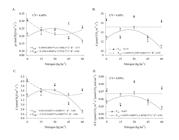
Stomatal conductance (A), net CO2 assimilation rate (B), transpiration (C) and intrinsic carboxylation efficiency (D) of plants fertilized with different nitrogen sources and doses. Means followed by the same letter do not differ by Tukey test at 5% probability level. * and ** indicate significant differences by the F test at 0.05 or 0.01 probability, respectively.
The highest net CO2 assimilation rate (A - 14.52 μmol CO2 m-2 s-1) was observed in radish plants fertilized with 23.90 kg ha-1 of N in the form of urea. Ammonium sulfate doses did not influence this variable, obtaining an average of 15.15 μmol CO2 m-2 s-1 (Figure 4B). The transpiration rate (E) decreased by 2.7% with increasing N doses under ammonium sulfate fertilization, while the highest transpiration (3.62 mmol H2O m-2 s-1) was observed with the application of 20.93 kg ha-1 of N in the form of urea (Figure 4C). At the N dose of 60 kg ha-1, the highest A was observed in plants fertilized with ammonium sulfate. The doses of ammonium sulfate did not influence the intrinsic carboxylation efficiency (iCE), but the doses of urea had an influence, with the highest iCE (0.064 μmol CO2 mol air-1) observed at the N dose of 23.53 kg ha-1 (Figure 4D).
N doses positively influenced plant height up to 15 DAS, while N sources influenced plant height up to 30 DAS. The highest value of plant height (21.48 cm) at 15 DAS was observed at the N dose of 34.65 kg ha-1 (Figure 5A). At 30 DAS, plants fertilized with urea had higher plant height, with an increase of 5.42% compared to those fertilized with ammonium sulfate (Figure 5B).

Plant height at 15 DAS (A) and 30 DAS (B) of radish plants fertilized with different nitrogen sources and doses. Means followed by the same letter do not differ by Tukey test at 5% probability level. * and ** indicate significant differences by the F test at 0.05 or 0.01 probability, respectively.
Fertilization with urea did not influence the shoot dry mass of radish leaves, with a mean value was 1.41 g. Fertilization with ammonium sulfate influenced this variable, with the highest fresh mass (18.18 g) at the N dose of 52.58 kg ha-1 (Figure 6A). The highest dry mass (1.66 g) was observed at the N dose of 60 kg ha-1 (Figure 6B). The application of urea did not significantly interfere in the number of leaves as a function of N doses. Under ammonium sulfate, there was an increase of 3.79% up to the N dose of 35.75 kg ha-1, with subsequent reduction (Figure 6C).

Shoot fresh mass (A), shoot dry mass (B) and number of leaves (C) of radish plants fertilized with different nitrogen sources and doses. Means followed by the same letter do not differ by Tukey test at 5% probability level. Full balls compare ammonium sulfate and hollow balls compare urea. * and ** indicate significant differences by the F test at 0.05 or 0.01 probability, respectively.
For tuberous root dry mass, the N sources did not influence results; only the N doses had a significant effect, with the maximum estimated value (2.66 g) observed at the N dose of 48 kg ha−1 (Figure 7A and 7B).

Fresh mass (A) dry mass (B) and shoot/root ratio (C) in 30-day-old Raphanus sativus L. plants fertilized with two nitrogen sources (urea and ammonium sulfate) at five N rates (0, 15, 30, 45, and 60 kg ha−1). (a) Plant phenotype at the end of cultivation. Means followed by the same letter do not differ by Tukey test at 5% probability level. Full balls compare ammonium sulfate and hollow balls compare urea. * and ** indicate significant differences by the F test at 0.05 or 0.01 probability, respectively.
4. Discussion
The results demonstrated that nitrogen fertilization influenced chlorophyll indices, photosynthetic performance, and biomass accumulation of radish plants, with distinct responses between urea and ammonium sulfate. Although numerical increments were higher under urea fertilization, the lack of statistical significance between N sources in most variables highlights that both sources were equally efficient in providing N under the experimental conditions. However, the physiological responses observed suggest complementary effects linked to the chemical nature of each fertilizer. Despite the potential benefits of ammonium sulfate, including its contribution of sulfur and its rapid availability, its higher market cost compared with urea represents a major constraint for farmers. Several studies highlight that the economic return does not always justify its use, especially when urea provides comparable agronomic performance at a significantly lower cost.
The increase in chlorophyll a, b and total chlorophyll under urea fertilization is consistent with the higher N concentration of this source (45% N), which likely enhanced N availability for chlorophyll biosynthesis. Since N is a structural component of chlorophyll molecules (Chen et al., 2024), its adequate supply directly translates into improved pigment accumulation, as also observed by Carvalho et al. (2024) and Rahimikhoob et al. (2020). Similar results were reported by Eid et al. (2020) in potatoes, where urea promoted greater pigment content compared with other N sources. This reinforces the role of urea as a rapidly effective N source when volatilization losses are minimized.
Chlorophyll fluorescence variables (Fv, Fm) increased linearly with N supply, evidencing the positive effect of nitrogen on PSII integrity and photochemical efficiency. Under N deficiency, electron transport and PSII reaction centers may be damaged, leading to photoinhibition (Wang et al., 2016; Mu and Chen, 2021). The slight tendency for higher fluorescence values under ammonium sulfate, although not statistically significant, may be attributed to the presence of sulfur. Sulfur is essential for the synthesis of amino acids such as cysteine and methionine, which are involved in redox homeostasis and osmotic adjustment, potentially improving nutrient uptake and water relations (Shah et al., 2022). Thus, sulfur-containing fertilizers may provide secondary physiological benefits beyond N supply.
Gas exchange parameters (gs, A, E, iCE) revealed that plant responses were dose-dependent and modulated by the source. Intermediate doses of urea maximized gs and A, indicating enhanced CO2 uptake and photosynthetic activity, whereas high doses induced a decline, possibly due to metabolic imbalances and osmotic stress caused by N oversupply (Liao et al., 2022). This behavior supports the hypothesis that urea enhances photosynthesis at optimal doses but may trigger stomatal closure at supra-optimal levels, a mechanism consistent with soil salinity or toxicity risks (Hannachi and Van Labeke, 2018). In contrast, ammonium sulfate maintained more stable values, suggesting a buffering effect due to its lower N concentration and associated S contribution.
Plant height was positively affected by N at early stages, with greater increases under urea at 30 DAS. This agrees with Ansari et al. (2022), who reported that urea fertilization enhances radish growth due to the crop’s short cycle, which reduces volatilization losses. However, excessive N doses reduced growth, consistent with antagonistic effects on Ca and K uptake, which are vital for cell wall stability and enzyme activation (Ibrahim et al., 2018).
Biomass accumulation showed contrasting responses: leaf dry mass was maximized with ammonium sulfate, while root growth responded primarily to N dose rather than source. The superior performance of ammonium sulfate for leaf mass may be linked to its immediate N release (Farooq et al., 2024), whereas urea requires hydrolysis and ammonification before becoming available (Beig et al., 2020). This differential availability pattern may explain why smaller doses of urea were sufficient for tuberization, while ammonium sulfate required higher doses to stimulate similar responses.
Excessive N reduced tuberous root biomass, reflecting nutrient imbalances and possible physiological stress. Above 35–40 kg ha−1, the uptake of Mg, Ca, and K is likely inhibited due to competitive absorption processes, as previously described by Zhang et al. (2021). This finding highlights the importance of optimizing N fertilization rates in radish cultivation, as intermediate doses not only maximize yield but also ensure balanced nutrient uptake and sustainability of production systems.
Overall, the study indicates that both urea and ammonium sulfate are effective N sources for radish, but they induce distinct physiological responses: urea favors chlorophyll synthesis and photosynthesis at optimal doses, whereas ammonium sulfate enhances leaf biomass and may offer secondary benefits associated with sulfur nutrition. From an agronomic perspective, the choice between N sources should consider not only yield potential but also crop stage, soil conditions, and long-term nutrient balance.
5. Conclusions
-
Nitrogen application with the urea source (15 kg ha-1) was more efficient for the growth of radish plants.
-
Urea application promoted higher chlorophyll a, chlorophyll b, total chlorophyll indices in radish plants compared to the application of ammonium sulfate.
-
The dose of 15 kg ha-1 of urea is the most recommended for the production of radish. Given the agronomic responses observed and the relative cost of nitrogen sources, urea at 15 kg ha−1 represents the most efficient and economically viable option for radish production.
-
Data Availability Statement
The entire data set that supports the results of this study was published in the article itself.
References
-
ALVARES, C.A., STAPE, J.L., SENTELHAS, P.C., GONCALVES, J.L., DE, M. and SPAROVEK, G., 2013. Köppen’s climate classification map for Brazil. Meteorologische Zeitschrift (Berlin), vol. 22, no. 6, pp. 711-728. https://doi.org/10.1127/0941-2948/2013/0507
» https://doi.org/10.1127/0941-2948/2013/0507 -
ANSARI, M.S., AHMAD, G., KHAN, A.A., MOHAMED, H.I. and ELHAKEM, A., 2022. Coal fly ash and nitrogen application as eco-friendly approaches for modulating the growth, yield, and biochemical constituents of radish plants. Saudi Journal of Biological Sciences, vol. 29, no. 6, pp. 103306. https://doi.org/10.1016/j.sjbs.2022.103306 PMid:35602867.
» https://doi.org/10.1016/j.sjbs.2022.103306 -
BEIG, B., NIAZI, M.B.K., JAHAN, Z., HUSSAIN, A., ZIA, M.H. and MEHRAN, M.T., 2020. Coating materials for slow release of nitrogen from urea fertilizer: a review. Journal of Plant Nutrition, vol. 43, no. 10, pp. 1510-1533. https://doi.org/10.1080/01904167.2020.1744647
» https://doi.org/10.1080/01904167.2020.1744647 -
CASTRO, B.F., SANTOS, L.G.D., BRITO, C.F., FONSECA, V.A. and BEBE, F.V., 2016. Produção de rabanete em função da adubação potássica e com diferentes fontes de nitrogênio. Revista de Ciências Agrárias (Lisboa), vol. 39, no. 3, pp. 341-348. https://doi.org/10.19084/RCA15131
» https://doi.org/10.19084/RCA15131 -
CARVALHO, L.M., MELO, E.D.O.L., DA SILVA FILHO, F.S., DOS ANJOS, J.L., BORGES, A.L., DA SILVA, A.J. and DE CARVALHO, H.W.L., 2024. Influência das doses de nitrogênio no acúmulo de prolina e nitrogênio total e na produção de frutos jovens de laranjeira ‘Pera’ em três porta-enxertos cultivados em regime de sequeiro. Scientia Horticulturae, vol. 338, pp. 113755. https://doi.org/10.1016/j.scienta.2024.113755
» https://doi.org/10.1016/j.scienta.2024.113755 -
CHEN, L., XU, M., CHENG, Z. and YANG, L., 2024. Efeitos da deficiência de nitrogênio na fotossíntese, fluorescência da clorofila a sistema antioxidante e compostos de enxofre em Oryza sativa. International Journal of Molecular Sciences, vol. 25, no. 19, pp. 10409. https://doi.org/10.3390/ijms251910409 PMid:39408737.
» https://doi.org/10.3390/ijms251910409 -
CHOROL, S., 2019. Antioxidant content in different parts of radish (Raphanus sativus L.) from cold arid Ladakh region of Trans- Himalaya (Jammu and Kashmir). Pharmacognosy Journal, vol. 11, no. 5, pp. 1064-1070. https://doi.org/10.5530/pj.2019.11.166
» https://doi.org/10.5530/pj.2019.11.166 -
EID, M.A.M., ABDEL-SALAM, A.A., SALEM, H.M., MAHROUS, S.E., SELEIMAN, M.F., ALSADON, A.A., SOLIEMAN, T.H.I. and IBRAHIM, A., 2020. Interaction effects of nitrogen source and irrigation regime on tuber quality, yield, and water use efficiency of Solanum tuberosum L. Plants, vol. 9, no. 1, pp. e110. https://doi.org/10.3390/plants9010110 PMid:31952245.
» https://doi.org/10.3390/plants9010110 -
FAROOQ, M.S., MAHMOOD, R., HAMEED, A., ALI, S., NADEEM, F., AWAN, T.H. and AHMAD, Z., 2024. Optimizing nitrogen sources in top dressing for wheat: field study on growth, yield, and ammonia volatilization. Scientifica, vol. 2024, no. 1, pp. 8882675. https://doi.org/10.1155/2024/8882675 PMid:39376251.
» https://doi.org/10.1155/2024/8882675 -
HANNACHI, S. and VAN LABEKE, M.C., 2018. Salt stress affects germination, seedling growth and physiological responses differentially in eggplant cultivars (Solanum melongena L.). Scientia Horticulturae, vol. 228, pp. 56-65. https://doi.org/10.1016/j.scienta.2017.10.002
» https://doi.org/10.1016/j.scienta.2017.10.002 -
HENSCHEL, J.M., DANTAS, E.F.O., SOARES, V.A., SANTOS, S.K., SANTOS, L.W.O., DIAS, T.J. and BATISTA, D.S., 2022. Salicylic acid mitigates the effects of mild drought stress on radish (Raphanus sativus) growth. Functional Plant Biology : FPB, vol. 49, no. 9, pp. 822-831. https://doi.org/10.1071/FP22040 PMid:35697057.
» https://doi.org/10.1071/FP22040 - IBRAHIM, M.E.H., ZHU, X., ZHOU, G., ALI, A.Y.A., AHMAD, I. and FARAHK, G.A., 2018. Nitrogen fertilizer alleviated negative impacts of NaCl on some physiological parameters of wheat. Pakistan Journal of Botany, vol. 50, no. 6, pp. 2097-2104.
-
LIAO, Q., DING, R.S., DU, T.S., KANG, S.Z., TONG, L. and LI, S., 2022. Stomatal conductance drives variations of yield and water use of maize under water and nitrogen stress. Agricultural Water Management, vol. 268, pp. 107651. https://doi.org/10.1016/j.agwat.2022.107651
» https://doi.org/10.1016/j.agwat.2022.107651 -
LIM, H.W., SONG, K.Y., CHON, J.W., JEONG, D. and SEO, K.H., 2019. Antimicrobial action of Raphanus raphanistrum subsp. sativus (radish) extracts against foodborne bacteria present in various milk products: a preliminary study. Journal of Dairy Science and Biotechnology, vol. 37, no. 3, pp. 187-195. https://doi.org/10.22424/jmsb.2019.37.3.187
» https://doi.org/10.22424/jmsb.2019.37.3.187 -
MOTOKI, K., KINOSHITA, Y., NAKANO, R., HOSOKAWA, M. and NAKAZAKI, T., 2022. Quantitative analysis of florigen for the variability of floral induction in cabbage/radish inter-generic grafting. Plant & Cell Physiology, vol. 63, no. 9, pp. 1230-1241. https://doi.org/10.1093/pcp/pcac098 PMid:35792499.
» https://doi.org/10.1093/pcp/pcac098 -
MU, X. and CHEN, Y., 2021. The physiological response of photosynthesis to nitrogen deficiency. Plant Physiology and Biochemistry : PPB, vol. 158, pp. 76-82. https://doi.org/10.1016/j.plaphy.2020.11.019 PMid:33296848.
» https://doi.org/10.1016/j.plaphy.2020.11.019 -
NASCIMENTO, M.V.,SILVA JUNIOR, R.L.S., FERNANDES, L.R., XAVIER, R.C., BENETT, K.S., SELEGUINI, A. and BENETT, C.G.S., 2017. Manejo da adubação nitrogenada nas culturas de alface, repolho e salsa. Revista de Agricultura Neotropical, vol. 4, no. 1, pp. 65-71. https://doi.org/10.32404/rean.v4i1.1099
» https://doi.org/10.32404/rean.v4i1.1099 -
OLIVEIRA, R.J., GATIBONI, L.C., BRUNETTO, G., MIQUELLUTI, D.J. and VALICHESKI, R.R., 2017. Resposta da beterraba a adubação com nitrogênio, enxofre e micronutrientes em um Cambissolo Háplico. Horticultura Brasileira, vol. 35, no. 1, pp. 63-68. https://doi.org/10.1590/s0102-053620170110
» https://doi.org/10.1590/s0102-053620170110 -
R CORE TEAM, 2021 [accessed 10 October 2025]. A language and environment for statistical computing [software]. Vienna: R Foundation for Statistical Computing. Available from: https://www.r-project.org/
» https://www.r-project.org/ -
RAHIMIKHOOB, H., SOHRABI, T. and DELSHAD, M., 2020. Development of a critical nitrogen dilution curve for basil (Ocimum basilicum L.) under greenhouse conditions. Journal of Soil Science and Plant Nutrition, vol. 20, no. 3, pp. 881-891. https://doi.org/10.1007/s42729-020-00174-5
» https://doi.org/10.1007/s42729-020-00174-5 -
SHAH, S.H., PARREY, Z.A., ISLAM, S., TYAGI, A., AHMAD, A. and MOHAMMAD, F., 2022. Exogenously applied sulphur improves growth, photosynthetic efficiency, enzymatic activities, mineral nutrient contents, yield and quality of Brassica juncea L. Sustainability (Basel), vol. 14, no. 21, pp. 14441. https://doi.org/10.3390/su142114441
» https://doi.org/10.3390/su142114441 -
TEGEDER, M. and RENTSCH, D., 2010. Uptake and partitioning of amino acids and peptides. Molecular Plant, vol. 3, no. 6, pp. 997-1011. https://doi.org/10.1093/mp/ssq047 PMid:21081651.
» https://doi.org/10.1093/mp/ssq047 -
VICIEDO, D.O., PRADO, R., DE, M., TOLEDO, R.L., SANTOS, L.C.N. and CALZADA, K.P., 2017. Response of radish seedlings (Raphanus sativus L.) to different concentrations of amoniacal nitrogen in absence and presence of silicon. Agronomia Colombiana, vol. 35, no. 2, pp. 198-204. https://doi.org/10.15446/agron.colomb.v35n2.62772
» https://doi.org/10.15446/agron.colomb.v35n2.62772 -
WANG, X., WANG, L. and SHANGGUAN, Z., 2016. Leaf gas exchange and fluorescence of two winter wheat varieties in response to drought stress and nitrogen supply. PLoS One, vol. 11, no. 11, pp. e0165733. https://doi.org/10.1371/journal.pone.0165733 PMid:27802318.
» https://doi.org/10.1371/journal.pone.0165733 -
YOUSAF, M., BASHIR, S., RAZA, H., SHAH, A.N., IQBAL, J., ARIF, M., BUKHARI, M.A., MUHAMMAD, S., HASHIM, S., ALKAHTANI, J., ALWAHIBI, M.S. and HU, C., 2021. Role of nitrogen and magnesium for growth, yield and nutritional quality of radish. Saudi Journal of Biological Sciences, vol. 28, no. 5, pp. 3021-3030. https://doi.org/10.1016/j.sjbs.2021.02.043 PMid:34025178.
» https://doi.org/10.1016/j.sjbs.2021.02.043 -
ZHANG, J., HE, P., DING, W., ULLAH, S., ABBAS, T., LI, M., AI, C. and ZHOU, W., 2021. Identifying the critical nitrogen fertilizer rate for optimum yield and minimum nitrate leaching in a typical field radish cropping system in China. Environmental Pollution, vol. 268, no. Pt B, pp. 115004. https://doi.org/10.1016/j.envpol.2020.115004 PMid:33010674.
» https://doi.org/10.1016/j.envpol.2020.115004
Edited by
-
Editor:
Takako Matsumura Tundisi
The entire data set that supports the results of this study was published in the article itself.


