
 Aspects of the biology of Mugil curema (Osteichthyes, Mugilidae) in the Amazon coast, Brazil
Abstract
Mugil curema is an estuarine and coastal fish species widely distributed in tropical and subtropical regions. It is an important resource for fisheries in Maranhão, among the most exploited and commercialized species. Given its relevance, studies on its reproductive dynamics are essential for effective stock management. This study aimed to analyze the reproductive aspects of M. curema in an estuarine area of the Northeast region of Brazil. Specimens were collected monthly from January to December 2021 in the estuary of the Paciência River, Maranhão, and morphometric data were analyzed to determine maturation stages, reproductive indices, and the size at first maturation. A total of 942 samples of M. curema were analyzed (827 female and 115 male). Females were more abundant (7.19F:1M), with a significantly larger mean size (t-test, p<0.05). The mean total length and mean total weight were 20.44 (± 3.38 cm) and 82.29 g (± 32.20 g), respectively. The weight-length relationship revealed distinct growth patterns: females exhibited positive allometry, whereas males exhibited negative allometry. A higher proportion of juveniles was recorded, indicating that the area functions as a nursery ground. Based on the gonadosomatic index (GSI), peak reproductive activity occurred in May and July; however, females with hydrated oocytes were also observed in other months. A correlation was observed between precipitation and reproductive rates. Histological analysis indicated total spawning, with synchronous development of two oocyte groups. The estimated length at first sexual maturity for both sexes was 19.04 cm. The reproductive aspects of M. curema appear closely linked to environmental conditions and seasonal cycles, highlighting the need for targeted management strategies to ensure the sustainability and conservation of this key fishery resource.
Keywords:
reproduction; management; spawning strategy; sexual maturity; gonadosomatic index
Resumo
Mugil curema é uma espécie de peixe estuarino e costeiro amplamente distribuída em regiões tropicais e subtropicais. Trata-se de um recurso importante para a pesca no estado do Maranhão, estando entre as espécies mais exploradas e comercializadas. Dada sua relevância econômica, estudos sobre a dinâmica reprodutiva são fundamentais para o manejo eficaz dos estoques. Este estudo teve como objetivo analisar os aspectos reprodutivos de M. curema numa região estuarina do Nordeste do Brasil Foram coletados exemplares mensalmente entre os meses de janeiro e dezembro de 2021 no estuário do Rio Paciência, sendo analisados dados morfométricos, estágios de maturação, índices reprodutivos e tamanho de primeira maturação. Um total de 942 exemplares de M. curema foram analisados (827 fêmeas e 115 machos). As fêmeas foram mais numerosas (7.19F:1M) e apresentaram um comprimento médio significativamente superior (teste t, p<0,05). A média do tamanho total e do peso foram 20.44 (± 3.38 cm) and 82.29 g (± 32.20 g), respectivamente. A relação peso-comprimento indicou padrões de crescimento distintos, com crescimento alométrico positivo em fêmeas e negativo em machos. Observou-se maior proporção de indivíduos juvenis, o que caracteriza a área como um berçário. Com base no índice gonadossomático (GSI), os picos de atividade reprodutiva ocorreram em maio e julho, embora fêmeas com ovócitos hidratados tenham sido registradas em outros meses. Foi observada correlação entre a pluviosidade e os índices reprodutivos. A análise histológica indicou uma desova total, caracterizada pelo desenvolvimento sincrônico de dois grupos de ovócitos. O comprimento médio de primeira maturação sexual, para sexos agrupados, foi estimado em 19,04 cm. Os aspectos reprodutivos da espécie mostraram-se estreitamente relacionados às condições ambientais e à sazonalidade, ressaltando a necessidade de medidas de manejo adequadas para garantir a conservação desse importante recurso pesqueiro.
Palavras-chave:
reprodução; manejo; estratégia de desova; maturidade sexual; índice gonadossomático
1. Introduction
Mugil curema Valenciennes, 1836, known as mullet is a species of fish in the Mugilidae family, widely distributed in tropical and subtropical regions along the Atlantic and Pacific coasts (Harrison, 2008; Durand et al., 2012). This species has a wide distribution and abundance along the Brazilian coast (Ibáñez Aguirre and Gallardo-Cabello, 2004; Albieri et al., 2010a; Mendonça and Bonfante, 2011; Silva et al., 2018).
Mullet fishing is a traditional practice throughout the Brazilian coast and is primarily exploited by small-scale fisheries (Gómez and Cervigón, 1987; Figueiredo and Menezes, 2015; Wongtschowski, 2016). In Maranhão, this species is essential for local fisheries production, supporting many small communities (Almeida, 2015).
The reproduction of M. curema exhibits migratory patterns to spawning areas, seasonal reproductive cycles, and synchronous gonadal development. These factors are influenced by environmental variables such as temperature, salinity and food availability (Ibáñez Aguirre and Gallardo-Cabello, 2004; Solomon and Ramnarine, 2007). This catadromous species recruits juvenile fish to lagoons and estuaries after offshore spawning (Ditty and Shaw, 1996).
To date, research on the reproductive aspects of this species has evolved significantly, providing detailed information on annual reproductive cycles, sex ratio, and hormonal physiology, in addition to studies that relate climate change and alterations in coastal ecosystems with the reproductive phenology of M. curema (Marin et al., 2003; Ndiaye et al., 2022; Diaby et al., 2022; Rangely et al., 2024). Generally, individuals of M. curema from the Brazilian coast have a prolonged reproductive period, with one or two spawning peaks throughout the year (Ferreira, 1989; Santana, 2004; Albieri et al., 2010b; Rosa Araújo and Silva, 2013; Fernandez and Dias, 2013; Diniz et al., 2020). Furthermore, there is growing interest in sustainable management and conservation of the species due to fishing pressure and degradation of their natural habitats.
Studies involving the reproductive aspects of the leading fish stocks have social, economic and biological importance, as they can provide information on species stocks (Soares et al., 2014; Santos and Sousa, 2017). Information such as first maturation size and other reproductive parameters can help understand the annual population regulation mechanisms and facilitate an understanding of the variability in recruitment (Silva et al., 2021; Nunes et al., 2024).
It is worth noting that quantitative aspects such as the weight-length relationship, condition factor, and GSI constitute important parameters for fisheries biology studies, providing essential information on the population dynamics of species necessary for the management and preservation of a rational fishing environment (Lizama and Ambrosio, 2003).
To date, there have not been any histological observations of the seasonal variations in the gonadal cell development to determine the spawning season of M. curema from the Maranhão coast. Therefore, based on the hypothesis that this species has reproductive activity on the coast of Maranhão, this study aimed to examine critical parameters related to reproduction in M. curema from the Brazilian Amazon coast, with a focus on gonadal development and the spawning season, which can be used as tools for management measures for this species.
2. Material and Methods
Specimens of M. curema were collected at the time of unloading of boats, monthly from January to December 2021, from commercial fishing in the municipality of Raposa. For monthly sampling, an average of 70 fish were randomly collected upon landing by the institution's researchers. This municipality is located on the island of São Luís, MA. Fishing for these organisms is carried out along the Paciência River estuary (see Figure 1) using a cast net with a 20-mm mesh between consecutive knots and a gillnet with a 50-mm mesh between successive knots.

In the laboratory of Fishing Biology of the State University of Maranhão, the individuals were measured in total length (Tl in mm) using a digital caliper (0.01 mm); and total and gutted weight (TW and GW in g, respectively) using a scale with a precision of 0.01 g. Temperature and precipitation data were obtained from the website of the National Institute of Meteorology – INMET (INMET, 2025) for the year 2021. All gonads were removed, weighed with gonad weight (GW) in g, identified by sex, and fixed in 10% neutralized formalin.
The sex determination and maturation stages were indicated through macroscopic analyses and confirmed with histological analysis described by Vazzoler (1996). The description of the development phases of female germ cells was utilized, adapting the proposal by Brown-Peterson et al. (2011) to identify the stages of gonadal maturation.
To verify the sample's isometry or allometry, the total length (Tl) and total weight (Tw) data were plotted in scatter plots, with the parameters a and b of this relationship estimated by the least squares method, as described by the Equation 1:
Where: Tw = total weight; Tl = total length; a = condition factor; b = angular coefficient of the power curve or allometry coefficient. This variance reflects the proportion of reserves allocated to the gonads, serving as an additional indicator of the reproductive period (Vazzoler, 1996).
The sex ratio was calculated to characterize the population's gender composition. The chi-square test (χ2) was used to determine the statistical differences in the number of organisms between sexes over the total period (Cavalcante et al., 2012).
The mean length at first sexual maturity (L50) was estimated by fitting the logistic model to the proportion of sexually mature individuals in total length classes, according to the Equation 2:
where P is the proportion of mature individuals in each length class, L is the mean total length of the class, r is the slope of the curve (rate of increase in maturity with length), and L50 represents the length at which 50% of individuals are sexually mature (Hunter and Macewicz, 1985). The model was adjusted using nonlinear regression, considering the sexes grouped. For better visualization of the results, 2 cm Tl classes were used.
The highest GSI values indicate the reproductive period, obtained monthly, for female specimens. The monthly frequencies of gonadosomatic ratios were estimated by summing the gonadosomatic ratio for each female and dividing by the total number of females. The Gonadosomatic Index (GSI) was calculated according to the equation proposed by Maddock and Burton (1998) to indicate the reproductive period, as follows: GSI = GW/GW × 100. Where: GW = gonad weight (g); GW = gutted weight (g).
The condition factor was estimated using the Equation 3 suggested by Hardardottir et al. (2001):
Where: Tw = total weight (g); Tl = total length (cm).
The spawning season was evaluated by varying the mean values of the Gonadosomatic Index (GSI), the condition factor (K), and the monthly frequency of the maturity stages. The joint analysis of these indices allows us to more accurately define the phases of the reproductive cycle and the peak spawning period of the populations.
The data were subjected to preliminary statistical analysis to verify the assumptions of normality and homogeneity of variances, using the Shapiro–Wilk test and Levene's test, respectively. When these assumptions were met, parametric tests were applied; otherwise, the corresponding nonparametric tests were used. The Shapiro-Wilk test was used to test the normality of the data variances of the Tl, Tw and GSI and K. The One-Way ANOVA was applied to the normal, homogeneous data, followed by the Tukey test. For the variable that did not meet the ANOVA assumptions, the Kruskal-Wallis test was used to detect significant differences (p < 0.05). The condition factor (K) was also examined seasonally using the Student's t-test. The confidence interval was calculated for each seasonal K value (α = 0.05). The statistical analyses were conducted using the Past 3.14 software.
3. Results
A total of 942 samples of M. curema were analyzed (827 female and 115 male), with total lengths (Tl) ranging from 12.90 cm to 31 cm and an average of 20.44 cm (± 3.38 cm). The sex ratio was 7.192F:1M. According to the chi-square test (χ2 = 3.85; p = 0.05), a significant difference was observed for the total sampled, with the number of females exceeding that of males in all collection months (Table 1).
Monthly values for sex ratio, total size, and total weight of Mugil curema species captured from January to December 2021 on the Amazon coast, Brazil.
The highest Tl frequencies were observed in the 18.00 to 20.00 cm classes. Females presented a greater size range, from 12.90 cm to 31 cm, while the variation in male specimens was from 14 cm to 30 cm Tl. However, despite the variation in size range, no significant difference was observed between the averages (20.58 cm for females and 20.12 cm for males) of Tl (F = 1.27; GL = 1; p = 0.44) (see Figure 2).

Frequency of total length for females (light gray) and males (dark gray) of the species Mugil curema captured from January to December 2021 on the Amazon coast, Brazil. The line inside the box indicates the mean Tl, the ends of the box indicate the Tl percentile, and the bars indicate the maximum and minimum Tl.
Total weight (Tw) ranged from 12.65 g to 272.60 g, with an average of 82.29 g (± 32.20 g). The highest frequencies of Tw were observed in the 44.00 to 76.00 cm classes. Females presented a greater weight range, from 12.65 g to 235 g, while the variation in male specimens was from 31.50 g to 272.60 g. However, despite the variation in weight range, no significant difference was observed between the average (81.64 cm for females and 87.01 cm for males) of Tl (F = 1.56; GL = 1; p = 0.16).
For the calculation of the size of the first maturation (L50) in a grouped manner, the result obtained was 19.04 cm (see Figure 3).
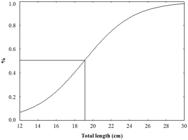
Minimum length at first gonadal maturation (L50) for grouped sexes of Mugil curema, acquired from January to December 2021 on the Amazon coast, Brazil.
The value of the relationship between the morphometric variables total weight (Tw) and total length (Tl) indicated that the type of growth was negative allometric for males (b = 2.76) and positive for females (b = 3.17) (see Figure 4).

Weight-length relationship for males (black) and females (gray) of the Mugil curema species captured from January to December 2021 on the Amazon coast, Brazil.
The monthly analysis of the mean gonadosomatic index (GSI) indicated higher values in April (2.04 ± 0.47) and May (4.65 ± 2.45). There were decreases in these values between June and August, with low values also observed in February (0.03 ± 0.09) and November (0.023 ± 0.11), which are associated with the low ovarian weight during this period. The ANOVA test revealed a significant difference (p < 0.05) in GSI means across the analyzed months (see Figure 5). Precipitation peaks occurred in February (365.9 mm), March (691.8 mm), and May (392.4 mm), which are months of the region's rainy season (January to June), according to INMET data.

Mean Gonadosomatic Index (GSI) (horizontal line inside the bars) for Mugil curema females related, respectively, to Precipitation (mm) (dashed gray line) (A) and Temperature (ºC) (solid gray line) (B) captured from January to December 2021, on the Amazon coast, Brazil. Bars indicate standard deviation.
A similar trend was observed between the monthly GSI and the temperature variation throughout the study period. The average temperature was 31 °C, with the highest temperature (32 °C) occurring in October. This corresponds to the dry season in the region (July to December), which was characterized by low rainfall.
For the comparison of mean Condition Factor (K) values (sexes combined) across months, only February (489 ± 139.98) and December (547.93 ± 450.19) showed significant differences when compared to the other months (F = 11.98; p < 0.05). When comparing condition factor between the dry and rainy seasons, a statistically significant difference was observed (t = -2.17; p = 0.015). Higher values were recorded during the rainy season, indicating an improved fish condition during this period.
Microscopic evaluation of the ovaries revealed the presence of M. curema individuals in maturation stages A (Immature), B (Developing), C (Spawning capable) and D (Regressing). Stage A: is characterized by the presence of only oocytes in primary growth (PG); stage B: is characterized by the presence of oocytes in the cortical alveolar phase (CA), primary and secondary vitellogenesis (Vtg1 and Vtg2); stage C: presents oocytes in tertiary vitellogenesis (Vtg3), germinal vesicle migration (GVM), germinal vesicle breakdown (GVBD), hydrated oocytes (HO); and stage D: atresia and postovulatory follicles (POF) present. Presence of oocytes in the CA and vitellogenic phases (Vtg1 and Vtg2).
It was observed that individuals in maturational stage A were present in all months of the study and accounted for the largest proportion (84%) of the sample. For maturational stages B, C and D, the largest percentages of individuals occurred in May (44.2%), October (53.4%) and September (42%), respectively (see Figure 6). It was observed that in May, high rainfall and temperatures influenced gonadal development. Considering the proportion of mensal reproductuve phases, the reproductive activity of the species appears to occur from October to May.

Monthly variation of the female maturational stages of Mugil curema acquired on the Amazon coast, Maranhão, Brazil. A: Immature, B: Developing; C: Spawning capable; D: Regressing or Regenerating.
Histological data of 17 spawning capable females indicate that this species exhibits total spawning, characterized by the synchronous development of two oocyte stages: primary growth (PG) and tertiary vitellogenic (Vtg3) (see Figure 7). However, more in-depth studies with seasonal analysis of oocyte size and developmental stages should be conducted to confirm this type of spawning.

Photomicrographs of ovarian histology of Mugil curema, illustrating the spawning capable reproductive phase. PG = primary growth oocyte; Vtg3 = tertiary vitellogenic oocyte.
4. Discussion
The mean length values reported in the present study (20.44 cm ± 3.38) for the species M. curema are comparable to those reported by Diniz et al. (2020; 20.50 ± 10 cm). The similarity in length is due to both studies being developed in the same region and coming from the same stock. When compared with different coastal waters of Northeast Brazil, Oliveira et al. (2011b) in Rio Grande do Norte and Martins et al. (2017) in Ceará, obtained slightly higher mean Tl for populations of M. curema, with 27.98 ± 4.15 cm and 23.05 ± 14.85 cm, respectively. These differences in size may be associated with oceanographic factors that differ between the studied regions. The estuarine region of Maranhão is characterized by hypotonic and turbulent waters and a highly variable salinity regime (Cavalcanti, 2018). Estuaries in the coastal region of Rio Grande do Norte and Ceará, on the other hand, have more stable and saline conditions, sandy substrates, and greater transparency, favoring the development of estuarine and marine species (Frazão, 1998). Furthermore, the studied regions exhibit distinct fishing activities, and differences in fishing effort affect the size of the sampled population (Damasio et al., 2016). Another factor to consider is that the study region is limited to the collection area and the species' natural migration.
For the total weight of M. curema, the average value found was 82.65 ± 42.16 g, presenting evident differences between the works of Rosa Araújo and Silva (2013) in the Vaza Barris River estuary, Sergipe, Brazil, and Freitas (2017) with specimens captured on the northern coast of Rio Grande do Sul with values of 274.75 ± 205.75 g and 290 ± 90 g, respectively. Santos and Sousa (2017) describe how the growth patterns of juvenile and adult mugilids in the Northeast region of the country are influenced by seasonal variations between rainy and dry periods. This is complemented by Vieira (1991), who explains that the species also employs a strategy to increase its weight, facilitating its entry into estuaries via the sea, and thereby changing its diet from pre-recruitment. Smaller juveniles occupy areas adjacent to estuaries and coastal lagoons until they enter the nursery area.
The values determined for the regression coefficients indicate that the weight x length relationship presents positive allometry (b>3) for females. Several factors, including population density (since females were more abundant than males), food availability, and reproductive processes (such as gonad development), may have contributed to the disproportionate increase in weight in relation to length. The negative allometry value for male specimens indicates a relative increase in weight smaller than in length. According to Rosa Araújo and Silva (2013), negative allometric values can be explained by factors such as population density, food availability and abiotic conditions, whose interaction affects the estimation of the respective regression parameters.
Therefore, Gomiero et al. (2010) in a study on the weight-length relationship and condition factor of the species Oligosarcus hepsetus in the Atlantic Forest confirms that in environments with slight seasonal variation, such as the Brazilian Northeast, occasional reproductive periods can last longer. In this case, only part of the population of a species reproduces at the same time and feeding and fat accumulation can occur for most of the year.
Females were more representative than males in this study and in those by Diniz et al. (2020) and Rosa Araújo and Silva (2013), with proportions of 1.94:1 and 1.63:1, respectively. Quiñonez-Velázquez and López-Olmos (2011) clarify in a study conducted in the southwest Gulf of California that the primary reason for the predominance of sexual relations is that the ecosystem provides suitable conditions for the development and survival of juveniles. Some factors may account for the significant difference in the proportion between males and females, reproductive strategy (Vélez-Arellano et al., 2022), reproductive seasonality (Oliveira et al., 2011a), fishing selectivity (Oliveira et al., 2012) and environmental factors (Okumuş and Başçinar 1997). Vélez-Arellano et al. (2022) also suggest that M. curema may exhibit protandry (protandric hermaphroditism) — that is, individuals that function as males when smaller and change to females as they grow — which would generate a pattern with more males in small classes and more females in larger classes.
The results obtained from this study revealed two spawning peaks (April to May and July), as analyzed through the condition factor, GSI, and evaluation of the monthly proportion of maturational stages. Lowerre-Barbieri et al. (2011) explain that seasonality influences the reproductive periods and feeding frequencies of fish species in aquatic ecosystems.
On the coast of Maranhão, the river regime and temperature regime follow particular characteristics due to the geographic location, the tropical climate and the direct influence of wind and rain systems in the region, being marked by two main seasons determined by the occurrence and absence of rain: rainy season (first half of the year) and dry season (second half of the year), based on data from the National Institute of Meteorology – INMET. Therefore, at the study site, where rainfall regimes are the primary factor defining the seasons, the increase in GSI relative to April and May may be attributable to increased river input during the rainy season.
Different reproductive periods have been found for this species along the Atlantic coast. Diniz et al. (2020) studied the reproductive parameters of Mugil curema along the Amazonian coast of Maranhão and revealed that the highest reproductive peaks occurred in December and January for males and in March for females. In a study conducted in Rio Grande do Norte, Brazil, Oliveira et al. (2011b) found that the proportion of mature males and females sampled each month suggested that spawning occurs from November to March. Research by Marin et al. (2003) in the region of Margarita Island, Venezuela, revealed maximum levels of successful spawning from December to January, which significantly correlated with periods of increased growth.
According to Murua and Saborido-Rey (2003), individuals of M. curema could be classified as total spawners with group synchronous oocyte development. According to the histological analysis in this study, the same pattern was observed. Other studies also determined this type of spawning on the coast of Brazil (Santana, 2004; Ferreira, 1989; Albieri et al., 2010a; Fernandez and Dias, 2013).
Pinheiro and Goitein (2014), Diniz et al. (2020), Silva et al. (2021), in research carried out in the same area of activity as this study, estimated the size of 25.39, 19.60 and 19.93 cm, respectively, for the first sexual maturation (L50) of M. curema for grouped sexes. This size is close to that found in this study, which obtained a L50 of 19.04 cm. Thus, it was possible to observe an early maturation strategy, indicating that the reproductive activity of the species may be affected, as they are removed from the environment before developing at least one reproductive cycle (Rounsefell, 1959; Ibáñez Aguirre and Gallardo-Cabello, 2004).
Given this, the publications systematized by this study, with L50 results of up to 27.5 cm for grouped sexes of M. curema, demonstrate results for first gonadal maturation size values that are close to those of Marin et al. (2003) with L50 of 24.3 cm for the same species in Venezuela, and of (Ibáñez Aguirre and Gallardo-Cabello, 2004) with 27.8 cm of L50 for females of the same species in the Gulf of Mexico, in agreement with what is stated in the literature.
Analysis of the total data shows a large proportion of immature (young) organisms or those at the beginning of maturation, which is characteristic of two processes: the selectivity of the device is capturing smaller organisms in greater quantities, or the study area is not considered an area suitable for reproduction, but rather for nursery and feeding. However, further studies are needed to confirm this hypothesis.
5. Conclusion
Based on the parameters used in this study, individuals from the Amazon Coast of Maranhão were smaller and lighter, indicating greater impact in the sampled region and interference with the reproductive activity of the studied resource. Based on the observed data, the study region can also be considered a recruitment zone, as a high proportion of juvenile organisms were sampled.
A predominance of female specimens (6.12:1) was observed, which may be associated with environmental or anthropogenic factors.
The weight-to-length ratio differed between the sexes, with males exhibiting negative allometry and females positive.
It was observed that the species exhibits reproductive activity at the collection site, with the greatest activity in April and May, when environmental factors influence its reproduction.
Given this, it is concluded that controlling fishing efforts on the Amazon Coast of Maranhão is necessary, particularly through measures targeting the gear used in the activity to avoid the capture of M. curema smaller than 19.04 cm.
Data Availability Statement
The datasets used and analyzed during the current study are available from the corresponding author on reasonable request.
References
- ALBIERI, R.J., ARAÚJO, F.G. and UEHARA, W., 2010a. Differences in reproductive strategies between two co-occurring mullets Mugil curema Valenciennes 1836 and Mugil liza Valenciennes 1836 (Mugilidae) in a tropical bay. Tropical Zoology, vol. 23, no. 1, pp. 51.
-
ALBIERI, R.J., ARAÚJO, F.G. and RIBEIRO, T.P., 2010b. Gonadal development and spawning season of white mullet Mugil curema (Mugilidae) in a tropical bay: short communication. Journal of Applied Ichthyology, vol. 26, no. 1, pp. 105-109. https://doi.org/10.1111/j.1439-0426.2009.01369.x
» https://doi.org/10.1111/j.1439-0426.2009.01369.x - ALMEIDA, Z., 2015. Os Recursos Pesqueiros Marinhos e Estuarinos do Maranhão: Biologia, Tecnologia, Socioeconomia, Estado da Arte e Manejo Belém: Universidade Federal do Pará. Tese de Doutorado em Zoologia.
-
BROWN-PETERSON, N.J., WYANSKI, D.M., SABORIDO-REY, F., MACEWICZ, B.J. and LOWERRE-BARBIERI, S.K., 2011. A standardized terminology for describing reproductive development in fishes. Marine and Coastal Fisheries, vol. 3, no. 1, pp. 52-70. https://doi.org/10.1080/19425120.2011.555724
» https://doi.org/10.1080/19425120.2011.555724 -
CAVALCANTE, L.F.M., OLIVEIRA, M.R. and CHELLAPPA, S., 2012. Aspectos reprodutivos do Ariacó, Lutjanus synagris nas Águas Costeiras do Rio Grande do Norte. Biota Amazônia, vol. 2, no. 1, pp. 45-50. https://doi.org/10.18561/2179-5746/biotaamazonia.v2n1p45-50
» https://doi.org/10.18561/2179-5746/biotaamazonia.v2n1p45-50 - CAVALCANTI, L.F., 2018. Variabilidade espaço-temporal do fitoplâncton ao longo de um gradiente salino em um estuário tropical de macromaré na margem equatorial brasileira São Luis: UFMA.
-
DAMASIO, L.M.A., LOPES, P.F.M., PENNINO, M.G., CARVALHO, A.R. and SUMAILA, U.R., 2016. Size matters: fishing less and yielding more in smaller-scale fisheries. ICES Journal of Marine Science, vol. 73, no. 6, pp. 1494-1502. https://doi.org/10.1093/icesjms/fsw016
» https://doi.org/10.1093/icesjms/fsw016 -
DIABY, M., AKADJE, C.M.A., AGNISSAN, J.-P.A. and N’DA, K., 2022. Reproduction of five mullet fish (Mugilidae) in Grand-Lahou Lagoon, Côte d’Ivoire: size at first sexual maturity, reproduction period and sex ratio. International Journal of Fauna and Biological Studies, vol. 9, no. 5, pp. 38-44. https://doi.org/10.22271/23940522.2022.v9.i5a.932
» https://doi.org/10.22271/23940522.2022.v9.i5a.932 -
DINIZ, A.L.C., CARVALHO, I.F.S., SILVA, Á.P.C., ALMEIDA, D.S., FERREIRA, L.J.S., CANTANHÊDE, L.G., CARVALHO NETA, R.N.F. and ALMEIDA, Z.S., 2020. Parâmetros da reprodução de Mugil curema (Mugilidae, Telesostei) capturados em uma área da costa amazônica maranhense, Brasil. Brazilian Journal of Development, vol. 6, no. 3, pp. 11277-11289. https://doi.org/10.34117/bjdv6n3-119
» https://doi.org/10.34117/bjdv6n3-119 - DITTY, J.G. and SHAW, R.F., 1996. Spatial and temporal distribution of larval striped mullet (Mugil cephalus) and white mullet (M. Curema, Family: Mugilidae) in the northern Gulf of Mexico, with notes on mountain mullet, Agonostomus monticola. Bulletin of Marine Science, vol. 59, no. 2, pp. 271-288.
-
DURAND, J.D., CHEN, W.J., SHEN, K.N., FU, C. and BORSA, P., 2012. Genus-level taxonomic changes implied by the mitochondrial phylogeny of grey mullets (Teleostei: mugilidae). Comptes Rendus Biologies, vol. 335, no. 10–11, pp. 687-697. https://doi.org/10.1016/j.crvi.2012.09.005 PMid:23199637.
» https://doi.org/10.1016/j.crvi.2012.09.005 -
FERNANDEZ, W.S. and DIAS, J.F., 2013. Aspects of the reproduction of Mugil curema Valenciennes, 1836 in two coastal systems in southeastern Brazil. Tropical Zoology, vol. 26, no. 1, pp. 15-32. https://doi.org/10.1080/03946975.2013.775052
» https://doi.org/10.1080/03946975.2013.775052 - FERREIRA, L.I., 1989. Estudo de aspectos da reprodução de Mugil curema Valenciennes, 1836 (Pisces, Mugilidae) no estuário de São Vicente São Paulo: Universidade de São Paulo.
- FIGUEIREDO, J.L. and MENEZES, N.A., 2015. Manual de peixes marinhos do sudeste do Brasil São Paulo: Universidade de São Paulo.
- FRAZÃO, E.P., 1998. Caracterização hidrodinâmica e morfo-sedimentar do estuário Potengi e áreas adjacentes : subsídios para controle e recuperação ambiental no caso de derrames de hidrocarboneto Natal: Universidade Federal do Rio Grande do Norte, 195 p. Dissertação de Mestrado em Geodinâmica.
- FREITAS, R.R., 2017. Caracterização das populações de Tainha (Mugil spp.) capturadas pela pesca artesanal e avaliação dos agentes bacterianos associados no litoral norte do Rio Grande do Sul Rio Grande do Sul : Universidade de Rio Grande.
- GÓMEZ, A. and CERVIGÓN, F., 1987. Perspectivas del cultivo de peces marinos en el Caribe Sur y noreste de Suramérica. Revista Latinoamericano de Acuicultura, vol. 34, pp. 40-50.
-
GOMIERO, L.M., VILLARES JUNIOR, G.A. and BRAGA, F.M.S., 2010. Relação peso-comprimento e fator de condição de Oligosarcus hepsetus (Cuvier, 1829) no Parque Estadual da Serra do Mar - Núcleo Santa Virgínia, Mata Atlântica, estado de São Paulo, Brasil. Biota Neotropica, vol. 10, no. 1, pp. 101-105. https://doi.org/10.1590/S1676-06032010000100009
» https://doi.org/10.1590/S1676-06032010000100009 - HARDARDOTTIR, K., KJESBU, O.S. and MARTEINSDOTTIR, G., 2001. Relationship between atresia, fish size and condition in Icelandic cod (Gadus morhua L.) London: International Council for the Exploration of the Sea.
- HARRISON, I.J., 2008. Mugilidae. In: M.L.J. STIASSNY, G.G. TEUGELS and C.D. HOPKINS, eds. The fresh and brackish water fishes of Lower Guinea, West-Central Africa Paris: Institut de Recherche pour le Développement, pp. 450-471.
- HUNTER, J.R. and MACEWICZ, B.J., 1985. Measurement of spawning frequency in multiple spawning fishes. NOAA Technical Report NMFS, vol. 36, pp. 79-94.
- IBÁÑEZ AGUIRRE, A.L. and GALLARDO-CABELLO, M., 2004. Reproduction of mugil cephalus and M. curema (Pisces: Mugilidae) from a coastal lagoon in the Gulf of Mexico. Bulletin of Marine Science, vol. 75, no. 1, pp. 37-49.
-
INSTITUTO NACIONAL DE METEOROLOGIA – INMET, 2025 [viewed 11 October 2025]. Dados meteorológicos diários da estação São Luís (MA) [online]. Available from: https://bdmep.inmet.gov.br/
» https://bdmep.inmet.gov.br/ -
LIZAMA, M.L.A.P. and AMBROSIO, A.M., 2003. Crescimento, recrutamento e mortalidade do pequi Moenkhausia intermédia (Osteichthyes, Characidae) na planície de inundação do alto rio Paraná, Brasil. Acta Scientiarum. Biological Sciences, vol. 25, no. 2, pp. 329-333. https://doi.org/10.4025/actascibiolsci.v25i2.2020
» https://doi.org/10.4025/actascibiolsci.v25i2.2020 -
LOWERRE-BARBIERI, S.K., GANIAS, K., SABORIDO-REY, F., MURUA, H. and HUNTER, J.R., 2011. Reproductive timing in marine fishes: Variability, temporal scales, and methods. Marine and Coastal Fisheries, vol. 3, no. 1, pp. 71-91. https://doi.org/10.1080/19425120.2011.556932
» https://doi.org/10.1080/19425120.2011.556932 -
MADDOCK, D.M. and BURTON, M.P., 1998. Gross and histological of ovarian development and related condition changes in American plaice. Journal of Fish Biology, vol. 53, no. 5, pp. 928-944. https://doi.org/10.1111/j.1095-8649.1998.tb00454.x
» https://doi.org/10.1111/j.1095-8649.1998.tb00454.x - MARIN, E., QUINTERO, A., BUSSIÈRE, D. and DODSON, J.J., 2003. Reproduction and recruitment of white mullet (Mugil curema) to a tropical lagoon (Margarita Island, Venezuela) as revealed by otolith microstructure. Fish Bulletin, vol. 101, no. 4, pp. 809-821.
- MARTINS, A.C., 2017. Biologia e manejo sustentável de espécies pesqueiras na região Nordeste do Brasil. Boletim de Ciências do Mar, vol. 12, no. 3, pp. 89-104.
-
MENDONÇA, J.T. and BONFANTE, T.M., 2011. Assessment and management of white mullet Mugil curema (Valencienne, 1836) (Mugilidae) fisheries of the south coast of São Paulo state, Brazil. Brazilian Journal of Biology = Revista Brasileira de Biologia, vol. 71, no. 3, pp. 663-672. https://doi.org/10.1590/S1519-69842011000400010 PMid:21881789.
» https://doi.org/10.1590/S1519-69842011000400010 -
MURUA, H. and SABORIDO-REY, F., 2003. Female reproductive strategies of marine fish species of the North Atlantic. Journal of Northwest Atlantic Fishery Science, vol. 33, pp. 23-31. https://doi.org/10.2960/J.v33.a2
» https://doi.org/10.2960/J.v33.a2 -
NDIAYE, W., NDIAYE, K., SARR, A. and DIÉDHIOU, P., 2022. Effect of environmental parameters on the reproduction of the white mullet (Mugil curema, Valenciennes, 1836) in the Saloum Delta (Senegal). Journal of Biology and Life Science, vol. 13, no. 1, pp. 50. https://doi.org/10.5296/jbls.v13i1.18914
» https://doi.org/10.5296/jbls.v13i1.18914 -
NUNES, Y.B.S., MILKE, R., SILVA, L.R., FRANÇA, C.L., COSTA, C.E.S.S., NUNES, J.L.S. and FIGUEIREDO, M.B., 2024. Length at first sexual maturity of the freshwater fish fauna of the Baixada Maranhense Environmental Protection Area. Brazilian Journal of Biology = Revista Brasileira de Biologia, vol. 84, pp. e256697. https://doi.org/10.1590/1519-6984.256697 PMid:35043838.
» https://doi.org/10.1590/1519-6984.256697 -
OKUMUŞ, I. and BAŞÇINAR, N., 1997. Population structure, growth and reproduction of introduced Pacific mullet, Mugil so-iuy, in the Black Sea. Fisheries Research, vol. 33, no. 1-3, pp. 131-137. https://doi.org/10.1016/S0165-7836(97)00073-8
» https://doi.org/10.1016/S0165-7836(97)00073-8 -
OLIVEIRA, M.R., COSTA, E.F.S., ARAÚJO, A.S., PESSOA, E.K.R. and CHELLAPPA, S., 2012. Sex ratio and length-weight relationship for five marine fish species from Brazil. Journal of Marine Biology & Oceanography, vol. 1, no. 2. https://doi.org/10.4172/2324-8661.1000103
» https://doi.org/10.4172/2324-8661.1000103 - OLIVEIRA, M.F., COSTA, E.F.S., FREIRE, F.A.M., OLIVEIRA, J.E.L. and LUCHIARI, A.C., 2011a. Some aspects of the biology of white mullet, Mugil curema (Osteichthyes, Mugilidae), in the northeastern region, Brazil. Pan-American Journal of Aquatic Sciences, vol. 6, no. 2, pp. 138-147.
- OLIVEIRA, M.F., COSTA, E.F.S., OLIVEIRA, J.E.L, 2011b. Aspectos biológicos da tainha (Mugil curema) no estuário do rio Potengi, RN. Revista Brasileira de Biologia e Tecnologia, vol. 5, no. 1, pp. 23-30.
- PINHEIRO, M.S.S. and GOITEIN, R., 2014. Estrutura de uma população e aspectos biológicos de Mugil curema valenciennes, 1836 (Pisces, Mugilidae), em um manguezal da Raposa, Brasil. Revista de Ciências da Saúde, vol. 16, no. 2, pp. 58-65.
-
QUIÑONEZ-VELÁZQUEZ, C. and LÓPEZ-OLMOS, J.R., 2011. Juvenile growth of white mullet Mugil curema (Teleostei: Mugilidae) in a coastal lagoon southwest of the Gulf of California. Latin American Journal of Aquatic Research, vol. 39, no. 1, pp. 25-32. https://doi.org/10.3856/vol39-issue1-fulltext-3
» https://doi.org/10.3856/vol39-issue1-fulltext-3 -
RANGELY, J., DE BARROS, M., SOUTO-VIEIRA, D., OLIVEIRA, M.N.T.S.C., DA SILVA, V.E.L., DE ASSIS, I.O. and FABRÉ, N.N., 2024. Congeneric and sympatric tropical mullets respond differently to environmental variability: insights into coexistence. Marine and Freshwater Research, vol. 75, no. 9, pp. MF23108. https://doi.org/10.1071/MF23108
» https://doi.org/10.1071/MF23108 - ROSA ARAÚJO, A. and SILVA, F.D., 2013. Aspectos da pesca e biologia da tainha, Mugil curema (Osteichthyes: Mugilidae), no estuário do Rio Vaza Barris, Sergipe, Brasil. Arquivos de Ciências do Mar, vol. 46, no. 1, pp. 29-38.
-
ROUNSEFELL, G.A., 1959. On the dynamics of exploited fish populations. Limnology and Oceanography, vol. 4, no. 2, pp. 231-233. https://doi.org/10.4319/lo.1959.4.2.0231
» https://doi.org/10.4319/lo.1959.4.2.0231 - SANTANA, F.M.S., 2004. Biologie, Pêche et Dynamique de la Population de Mulet Blanc (Mugil curema, Valenciennes, 1836) de Pernambuco – Brésil Quimper: University of Bretagne Occidentale.
- SANTOS, J.M. and SOUSA, A.C., 2017. Importância das técnicas de manejo sustentável na pesca de Mugil curema em águas costeiras. Revista Brasileira de Pesca e Recursos Aquáticos, vol. 8, no. 1, pp. 35-46.
-
SILVA, V.E.L., TEIXEIRA, E., BATISTA, V. and FABRÉ, N., 2018. Spatial distribution of juvenile fish species in nursery grounds of a tropical coastal area of the south-western Atlantic. Acta Ichthyologica et Piscatoria, vol. 48, no. 1, pp. 9-18. https://doi.org/10.3750/AIEP/02299
» https://doi.org/10.3750/AIEP/02299 -
SILVA, Á.P.C., CARVALHO, I.F.S., DINIZ, A.L.C., CANTANHÊDE, L.G. and ALMEIDA, Z.S., 2021. Tamanho de primeira maturação para cinco espécies de peixes em uma área da Costa Amazônica Maranhense, Brasil. Research. Social Development, vol. 10, no. 3, pp. e23610313146. https://doi.org/10.33448/rsd-v10i3.13146
» https://doi.org/10.33448/rsd-v10i3.13146 -
SOARES, M.G.M., FREITAS, C.E.C. and OLIVEIRA, A.C.B., 2014. Assembleias de peixes associadas aos bancos de macrófitas aquáticas em lagos manejados da amazônia central, Amazonas, Brasil. Acta Amazonica, vol. 44, no. 1, pp. 143-152. https://doi.org/10.1590/S0044-59672014000100014
» https://doi.org/10.1590/S0044-59672014000100014 -
SOLOMON, F.N. and RAMNARINE, I.W., 2007. Reproductive biology of white mullet, Mugil curema (Valenciennes) in the Southern Caribbean. Fisheries Research, vol. 88, no. 1-3, pp. 133-138. https://doi.org/10.1016/j.fishres.2007.06.024
» https://doi.org/10.1016/j.fishres.2007.06.024 - VAZZOLER, A.E.A.M., 1996. Biologia da reprodução de peixes teleósteos: teoria e prática Maringá: Eduem.
-
VÉLEZ-ARELLANO, N., SÁNCHEZ-CÁRDENAS, R., SALCIDO-GUEVARA, L.A., RAMIREZ-PEREZ, J.S. and SOBERANO-PALOMARES, I.M., 2022. Gonadal development, sex ratio, and length at sexual maturity of white mullet Mugil curema (Actinopterygii: Mugilidae) inhabiting southeastern Gulf of California. Latin American Journal of Aquatic Research, vol. 50, no. 3, pp. 417-429. https://doi.org/10.3856/vol50-issue3-fulltext-2817
» https://doi.org/10.3856/vol50-issue3-fulltext-2817 -
VIEIRA, J.P., 1991. Juvenile mullets (Pisces: Mugilidae) in the estuary of Lagoa dos Patos, RS, Brazil. Copeia, vol. 1991, no. 2, pp. 409. https://doi.org/10.2307/1446590
» https://doi.org/10.2307/1446590 -
WONGTSCHOWSKI, C.L., 2016. The nektonic components of a tropical area (Araça Bay, Brazil). Frontiers in Marine Science, vol. 3, pp. 160. https://doi.org/10.3389/conf.FMARS.2016.05.00160
» https://doi.org/10.3389/conf.FMARS.2016.05.00160
*
e-mail: figmarina@gmail.com.Editor:


