 Relations of habitat integrity and spatial structure on the Gerromorpha community (Hemiptera: Heteroptera) in streams under the influence of protected area in Oriental Amazon
Abstract
The community of semiaquatic insects (Gerromorpha) is related to forest cover and habitat integrity, as well as spatial factors such as the distance between streams. Therefore, our objective was to evaluate the effect of spatial structure and habitat integrity (HII) on the composition, abundance and richness of Gerromorpha in streams across an environmental gradient inside and outside the Floresta Nacional de Carajás (FLONA Carajás). Our hypotheses: i) habitat integrity has a positive effect on the richness and abundance of Gerromorpha, since the availability of resources provides the existence of a greater number of species and consequently a greater abundance and richness of these species; ii) species composition is structured by habitat integrity, considering that preserved sites provide better conditions for the coexistence of specialist species or rare species; iii) the composition of Gerromorpha will be structured by the distance between streams (as some species may have dispersal limitations). Sampling was conducted in 10 streams (five inside of a protected area and five around protected areas). To determine habitat integrity, we used the Habitat Integrity Index (HII). For data analysis, we used linear models to test the effect of HII on richness and abundance. Finally, we used db-RDA to test for differences in species composition in relation to HII and spatial structure. Our results richness and abundance are not influenced by HII not corroborating our hypotheses. Furthermore, our results showed that the species composition of Gerromorpha is influenced only by spatial structure, and not for HII, confirming our hypothesis. This lack of differences can be attributed to the small variation in HII between the streams sampled. Our findings highlight the importance of spatial structure for the composition of Gerromorpha species and of the forest for maintaining habitat integrity and aquatic biodiversity.
Keywords:
freshwater; semiaquatic bugs; Amazonia; Habitat Integrity Index (HII)
Resumo
A comunidade de insetos semiaquáticos (Gerromorpha) está relacionada à cobertura florestal e à integridade do habitat, além de fatores espaciais como a distância entre os riachos. Portanto, nosso principal objetivo foi avaliar o efeito da estrutura espacial e da integridade do habitat (IIH) na composição, abundância e riqueza de Gerromorpha em riachos em um gradiente ambiental dentro e fora da Floresta Nacional de Carajás (FLONA Carajás). Nossas hipóteses i) a integridade do habitat tem um efeito positivo sobre a riqueza e a abundância de Gerromorpha, uma vez que a disponibilidade de recursos proporciona a existência de um maior número de espécies e, consequentemente, uma maior abundância e riqueza dessas espécies; ii) a composição de espécies é estruturada pela integridade do habitat, considerando que locais preservados proporcionam melhores condições para a coexistência de espécies especialistas ou espécies raras. iii) a composição de Gerromorpha será estruturada pela distância entre os riachos (uma vez que algumas espécies podem ter limitações de dispersão. Gerromorpha foram coletados em 10 riachos (cinco dentro da área protegida e cinco no entorno). Para determinar a integridade do habitat em cada riacho, usamos o Índice de Integridade do Habitat (IIH). Para as análises de dados, utilizamos modelos lineares para verificar o efeito do IIH na riqueza e abundância. Finalmente, usamos a db-RDA para testar as diferenças na composição de espécies em relação ao IIH e a estrutura espacial. Nossos resultados mostraram que a riqueza e abundância não tiveram influência do IIH. Enquanto a composição de espécies de Gerromorpha foi influenciada pela estrutura espacial. Nossos resultados demonstram baixa variação do IIH, abundância e riqueza entre os riachos amostrados. Nossos achados destacam a importância da estrutura espacial para a composição de espécies Gerromorpha e da floresta para a manutenção da integridade do habitat e da biodiversidade aquática.
Palavras-chave:
água doce; insetos semiaquáticos; Amazônia; Índice de Integridade do Habitat (IIH)
1. Introduction
The destruction of vegetation is a major problem for streams and aquatic biodiversity (Dala-Corte et al., 2020). Even with efforts to delimit areas for biodiversity conservation, human pressure on the area surrounding the units can directly affect environmental conditions (Pinheiro and Durigan, 2009). Protected areas generally have a higher level of environmental quality and species diversity compared to unprotected areas (Sousa et al., 2025; Brito et al., 2024). The streams located inside the protected areas have more stable channels with many physical habitats showing no signs of alteration, this structural stability contributes significantly to increasing the diversity and abundance of aquatic organisms (Restello et al., 2020).
Outside protected areas, various threats affect aquatic ecosystems, such as unplanned urbanization, illegal land use for livestock, agriculture and widespread deforestation for commercial purposes (Couceiro et al., 2007; Juen et al., 2016). This fragmentation process results in changes to the composition of biological communities and interspecific interactions, reducing environmental quality (Almeida et al., 2009). The loss of canopy cover compromises thermal regulation, the entry of allochthonous organic matter, and the provision of micro-habitats, resulting in a loss of resources that can provide shelter and food essential for the maintenance of aquatic communities (Monteiro-Júnior et al., 2014; Brito et al., 2024).
The distribution of species is generally related to the environmental conditions and resources available in the habitat (Leibold et al., 2004), as well as geographical distances, the dispersal capacity of species and neutral processes (Hubbell, 2001). According to the species sorting paradigm, species composition is mainly determined by environmental factors (e.g. vegetation, water quality, substrate), which will promote greater species differentiation (Leibold et al., 2004). While geographical distance can cause increased or decreased similarity in terms of species composition (Heino et al., 2015), increased distance between streams can result in reduced dispersal (especially of species with limited dispersal), cause biogeographical isolation and increased dissimilarity between communities.
In most aquatic insects, dispersal by flight is a strategy for searching for resources and avoiding adverse conditions such as environmental changes and, in these cases, the success and maintenance of the population is achieved by the dispersal of winged populations (Cunha and Juen, 2020). Thus, distance from streams can be a regulating factor for aquatic communities. In addition, habitat quality (Habitat Integrity Index - HII) can be a determining factor for aquatic communities, as more preserved streams tend to have higher species richness, offer greater availability of microhabitats, greater forest cover for shelter, reproduction and feeding for various species. Degraded streams are generally associated with high values of electrical conductivity, pH and water temperature (Veras et al., 2019; Brasil et al., 2020) and preserved streams are related to high dissolved oxygen (Giehl et al., 2020; Brasil et al., 2020). Several studies have shown HII to be a determining factor for aquatic insect communities (Dias-Silva et al., 2010; Brasil et al., 2020).
Tropical streams have a high diversity of aquatic and semiaquatic insects, especially in the smaller first to third order streams (Polhemus and Polhemus, 2008). Among the semi-aquatic insects, there are representatives of the infraorder Gerromorpha (Hemiptera: Heteroptera), are predators that live above the water, in the middle of vegetation or in plant roots (Dias-Silva et al., 2013). These individuals depend on the environmental quality and can be more or less abundant depending on habitat integrity (Dias-Silva et al., 2010; Cunha and Juen, 2017; Silva et al., 2024; Franco et al., 2023).
In Brazil, Conservation Units are divided into two groups in the National System of Nature Conservation Units: integral protection units and sustainable use units, which include National Forests (Brasil, 2000). This category includes areas with a predominance of native vegetation and allows for the sustainable use of forest resources and scientific study (Brasil, 2000). The effectiveness of protected areas in conserving aquatic insect communities remains in Brazil unclear, largely due to a lack of biogeographic data and limited knowledge on species distribution, particularly in the Neotropical region (Rodrigues and Gaston 2002; Nóbrega and De Marco Junior, 2011; Dias-Silva et al., 2021). Considering the important ecosystem role of aquatic insects, managing them within protected areas is vital for their functioning and ecological resilience (Godoy et al., 2016; Chowdhury et al., 2023). However, there is little assessment of how well protected areas conserve insects (Nicácio et al., 2020; Chowdhury et al., 2023; Brito et al., 2024; Sousa et al., 2025).
In this context, our objective was to evaluate the effect of spatial structure and habitat integrity (HII) on the composition, abundance and richness of Gerromorpha in streams across an environmental gradient inside and outside the Floresta Nacional de Carajás (FLONA Carajás). Our hypotheses: i) habitat integrity has a positive effect on the richness and abundance of Gerromorpha, since the availability of resources provides the existence of a greater number of species and consequently a greater abundance and richness of these species; ii) species composition is structured by habitat integrity, considering that preserved sites provide better conditions for the coexistence of specialist species or rare species (Guterres et al., 2021; Franco et al., 2023); iii) the composition of Gerromorpha will be structured by the distance between streams (as some species may have dispersal limitations).
2. Material and Methods
2.1. Study area
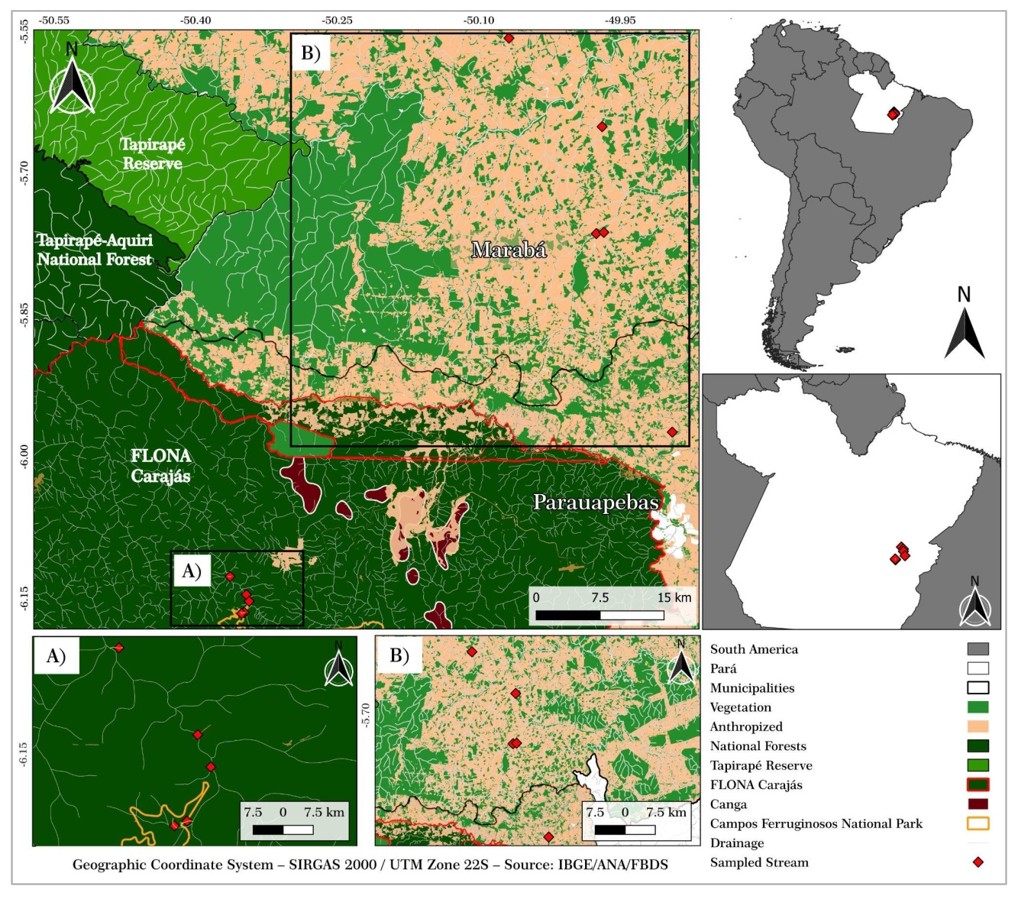
The study was conducted in 10 streams, five located inside and five outside the FLONA Carajás in the Brazilian Amazon, situated in the southeast region of Pará State (Figure 1). The FLONA Carajás is a Protected area for Sustainable Use (SU) located in the Brazilian Amazon. It is a public domain with extensive vegetation cover, predominantly indigenous species and which provides for the sustainable use of resources, mainly mining, as governed by Lei N. 9.985 of July 18, 2000 (Brasil, 2000), as well as scientific activities (Sousa et al., 2021). The FLONA Carajás has a great demand for scientific studies on the characterization of the site, flora and fauna, ecology and environmental management (Gonçalves and Santos, 2008; Souza et al., 2021).
With an area of approximately 400.000 hectares, it covers the municipalities of Parauapebas (76,51%), Canaã dos Carajás (22,50%) and Água Azul do Norte (0,99%) (ICMBio, 2017). The FLONA Carajás is composed of Open Ombrophilous Forest, Dense Ombrophilous Forest and Ferruginous Rupestrian Field. With average annual temperatures of 21ºC to 22ºC, differing from the areas between Marabá and Parauapebas with 25ºC to 26ºC, annual temperature range between the hottest and coldest months does not exceed 3ºC. The rainy season is between November and April, while the dry season is between May and October (ICMBio, 2017).
The main characteristic of the FLONA Carajás is its ferrous soil, which is rich in minerals (Brasil, 2000). The main activities carried out in the FLONA Carajás are mining and plant extraction (Jaborandi and nuts, others). Activities such as pasture, fishing and hunting are carried out in its surroundings. In addition, surrounding the FLONA Carajás is the Carajás Mosaic, including others protected areas the Itacaiúnas National Forest, the Tapirapé-Aquiri National Forest, the Tapirapé Biological Reserve, the Igarapé Gelado Environmental Protection Area and the Xicrin do Catetê Indigenous Land (Viana et al., 2016). Together, they total an area of approximately 1.207.000 hectares that represents a barrier for the protection and conservation of biodiversity amidst the adjacent anthropogenic processes in the region (ICMBio, 2017).
2.2. Biological sampling
In each stream, a transect 100 m length was demarcated, subdivided into 20 segments of 5 meters each. Gerromorpha were collected from the surface of the water in each segment using a sieve (18 cm in diameter and 1-mm mesh) (Dias-Silva et al., 2010). The samples were collected only once from each stream during the dry season (October 2022 and September 2023). After collection, the material was stored in 85% alcohol and the individuals were identified to species level using a stereomicroscope and specialized taxonomic keys (Hungerford and Matsuda, 1958; Nieser, 1994; Moreira et al., 2008; Padilla-Gil and Moreira, 2013; Floriano and Moreira, 2015; Magalhães et al., 2016; Floriano et al., 2017; Rodrigues et al., 2021). The specimens were deposited in the Laboratório de Ecologia – LABECO, Universidade Federal do Pará, Altamira, Pará, Brasil.
2.3. Habitat Integrity Index - HII
To assess the integrity of each stream, we used the Habitat Integrity Index (HII) proposed by Nessimian et al., (2008). This index is made up of 12 questions that assess riparian vegetation, land use, channel conditions, type of substrate and other characteristics of the stream bed and bank. The index ranges from 0 to 1, with values closer to 1 indicating preserved streams and values closer to 0 indicating degraded streams. The HII is widely used and related to the distribution of Heteroptera and other aquatic insects (Dias-Silva et al., 2020b; Brasil et al., 2020; Moy et al., 2022; Cunha et al., 2022).
2.4. Spatial variables
The spatial structure was obtained using Principal Coordinates Analysis of the Truncated Distance Matrix (PCNM) (Dray et al., 2006), the axes of the PCNM were selected using Moran's Index. Positive and significant p < 0.05 axes were selected (PCNM1, PCNM3, PCNM5). Positive and significant Moran's Index values indicate spatial autocorrelation, while negative values indicate random distribution. Statistical significance was tested using 999 permutations (Monte Carlo test). The PCNM was generated with the ‘pcnm’ function and the axes were selected with the ‘moran.randtest’ function from the vegan (Oksanen et al., 2019) and adespatial (Dray et al., 2019) packages.
2.5. Data analysis
We use a Principal Component Analysis (PCA) with the twelve HII observations per Stream to summarise the variation in integrity, denoted by the acronym ‘Q’. We also used the total HII value as a bubble variable to differentiate between sites with higher and lower habitat integrity (Legendre and Legendre, 2012). Only question number eleven (Q11), referring to aquatic vegetation, had to be removed from the analysis as it had a variance equivalent to zero. In the index, this question obtained the same value for all the streams, as all the streams were classified as ‘When present, consists of mosses and patches of algae’ (Nessimian et al., 2008). We used the Broken-Stick criterion to check which components were more explanatory than chance. The vegan (Oksanen et al., 2019) and ggplot2 (Wickham, 2016) packages were used.
We used linear models (Simple Linear Regression) to evaluate the effect of HII on the richness and abundance of Gerromorpha species, testing the assumptions of normality and homogeneity of variances (Zar, 2010). To check the effect of spatial structure and HII on Gerromorpha species composition, we used distance-based Redundancy Analysis (db-RDA; Legendre and Anderson, 1999), to check the effect of HII, we used the abundance matrix (Bray-Curtis), and we inserted the spatial vectors as covariates to analyse the possible effect of spatial autocorrelation. Finally, to check the effect of space, we used the abundance matrix and the spatial vectors. For the db-RDA we tested significance with the ‘anova’ function with 999 permutations, vegan and adespatial packages.
3. Results
3.1. Characterization of the habitat integrity of the streams sampled
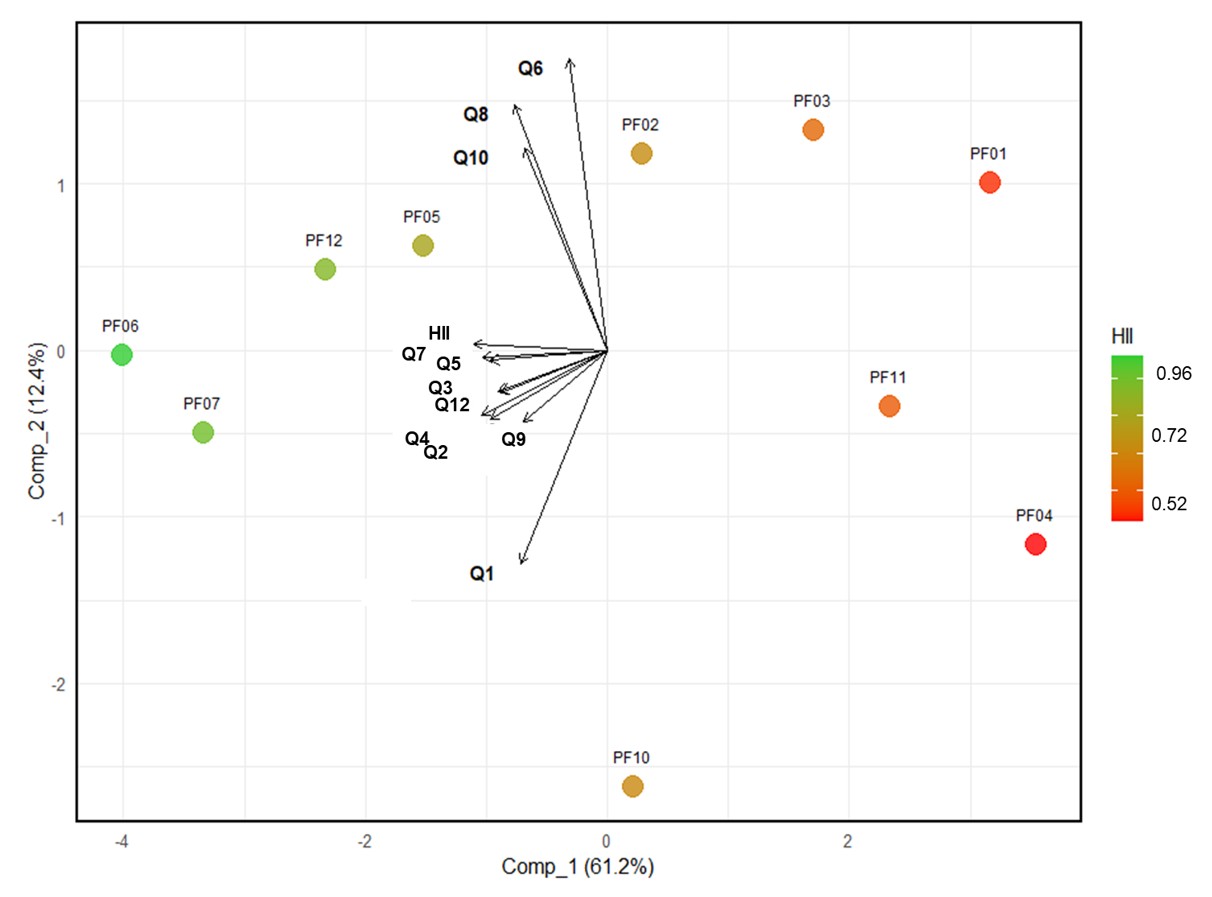
The Habitat Integrity Index of the sampled streams ranged from 0.52 to 0.96 (average 0.73). Some of the streams collected were influenced by anthropogenic activities, especially those outside the protected areas, such as PF01 (0.52) and PF04 (0.54) in pasture areas, and inside the FLONA Carajás only PF11 (0.60) was influenced by natural treefall in the surrounding area, which caused siltation in some sections of the stream, the entry of large gravel, destabilized banks, and clearings in the riparian forest.
The PCA using the HII questions explained 73.6% of the variation, with 61.2% on the first axis and 12.4% on the second axis (Figure 2). Streams PF01, PF02, PF03, PF04, PF10 and PF11 are furthest to the right of the graph, representing streams with lower habitat integrity values (red). The others follow the arrows of the observations to the right, representing the side with the highest habitat integrity values (green). It can be seen that streams with higher HII values are positively related to habitats with retention devices (Q5), better soil bank structure (Q7), the presence of an excavated bank (Q8) and debris (Q12). While streams with low HII values have a negative relationship with Q5, Q7, Q8, Q12, as well as the quality of the riparian vegetation zone (Q4) and the stream bed (Q9).

PCA using the values of the HII observations, represented by the code ‘Q’ and its number in the index. Q1 - Land use pattern beyond the riparian zone; Q2 - Width of riparian forest; Q3 - Completeness of riparian forest; Q4 - Vegetation of riparian zone within 10 m of channel; Q5 - Retention devices; Q6 - Channel sediments; Q7 - Bank structure; Q8 - Bank undercutting; Q9 - Stream bottom; Q10 - Riffles and pools, or meanders; Q12 - Detritus. HII values as a bubble variable represented as colours in each stream. The colour gradient represents the integrity gradient between the sites sampled, ranging from orange-red (lowest value) to dark blue (highest value).
3.2. Description of Gerromorpha Community
A total of 1.467 Gerromorpha were sampled, distributed into four families (Gerridae, Hydrometridae, Mesoveliidae and Veliidae), 13 genera, and 34 species (Supplementary Material; Table S1). The Veliidae family had the highest species richness (N= 24). The most abundant species were Rhagovelia tenuipes Champion, 1898 (N=61), Brachymetra lata Shaw, 1933 (N=119) and Oiovelia chenae Rodrigues; Melo, 2014 (N=65). The least representative species in terms of number of individuals were Microvelia hamadae Santos, Rodrigues, Couceiro; Moreira, 2021, Rhagovelia elegans Uhler, 1894, Rheumatobates minutus flavidus Drake; Harris, 1942 and Stridulivelia sp.01 with 1 individual each.
3.3. Effect Index Habitat Integrity (HII) and spatial structure in community Gerromorpha
When we evaluated the effect of HII on abundance and richness, we found no effect of HII on abundance (F(1,8)= 0.002; p= 0.962; adjusted R2= -0.124) and richness (F(1,8)= 0.105; p= 0.753; adjusted R2= -0.110), not corroborating our hypothesis i). The Gerromorpha species composition among the streams sampled, showed no significant differences in relation to HII (F= 1.197; p= 0.343; adjusted R2= 0.025), contradicting our hypothesis ii).
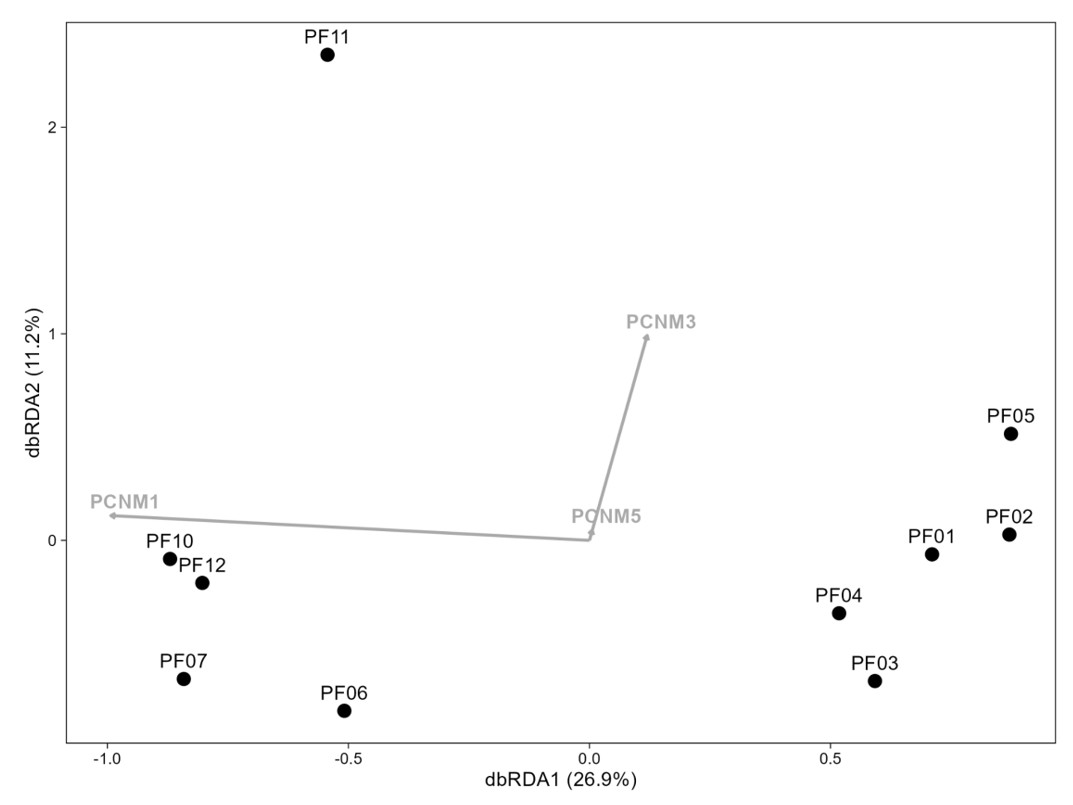
The Gerromorpha community showed a relationship with spatial structure (PCNM1), indicating that the distance between the streams sampled interferes with species distribution (F= 3.019; p= 0.003; adjusted R2= 0.20). The first two axes of the db-RDA explained 38.1% of the variation in the data (Figure 3). Only PCNM1 showed an association with variation in community structure, suggesting a broad-scale spatial pattern influencing the distribution of Gerromorpha species among the streams sampled, corroborating our hypothesis iii) that the distance between the streams would have an effect on the structure of the community.

Variation in composition between streams in relation to spatial variables (PCNM), resulting from distance-based redundancy analysis (db-RDA).
4. Discussion
The absence of a significant effect of the Habitat Integrity Index (HII) on the abundance and richness of Gerromorpha may indicate that the HII did not capture sufficiently broad variations to reflect detectable changes in the abundance and richness. The HII values among the sampled streams showed low variation (0.52 to 0.96), which may mask the effect on richness and abundance, since the variable HII is usually a good predictor of species richness (Dias-Silva et al., 2020a; Moy et al., 2022).
Furthermore, the lack of response in abundance and richness does not necessarily imply the absence of impact. Although the streams sampled are distributed between a protected area and the surrounding area with anthropogenic activities, such as grazing. These streams, located outside the protected area, had some kind of vegetation around them. In addition, some of the streams are connected, which may facilitate the dispersal of these species. Gerromorpha, although responsive to habitat alterations, also exhibits a high dispersal capacity, which can buffer the local effects of degradation (Cunha and Juen, 2017). Thus, even in more altered environments, the presence and abundance of tolerant species may mask potential losses of more sensitive species. Depending on the intensity of the impact, species can become more or less abundant, or remain unchanged.
The species composition of Gerromorpha was not structured by the Habitat Integrity Index (HII); however, we observed a spatial effect on community structure. This pattern suggests that spatial processes, such as the proximity among streams, hydrological connectivity, and the active or passive dispersal of species, are influencing the assemblage composition (Franco et al., 2023). Some Gerromorpha species have an expressive dispersive capacity and sensitivity to changes in their microhabitats, abandoning the site within a few generations if necessary and thus generating alarm dimorphism, being considered tolerant to minor disturbances (Dias-Silva et al., 2010; Cunha and Juen, 2017).
As a consequence, spatially proximate sites tend to share more species, even when exhibiting varying levels of habitat integrity. Geographic distance may thus structure communities more strongly than environmental variables, particularly under conditions of environmental homogeneity or when the gradient of anthropogenic disturbance is narrow (Heino et al., 2015). Moreover, the observation of this pattern aligns with metacommunity theory, which posits that the composition of local communities is shaped not only by environmental conditions but also by the dispersal capacity of organisms to colonize available habitats (Leibold et al., 2004; Grönroos et al., 2013).
The absence of a clear environmental structure, combined with the observed spatial influence, is consistent with the mass effect mechanism, whereby high habitat connectivity promotes a continuous flow of individuals among sites within a region (Leibold et al., 2004). In this context, the similarity in species composition among nearby stream metacommunities is not solely attributable to local environmental factors but also to the biological exchange occurring among streams. Therefore, variation in species composition is driven not only by abiotic factors, but also by the interaction among dispersal limitations of Gerromorpha species, the historical land use surrounding the Carajás National Forest (FLONA Carajás), and the spatial connectivity among stream habitats (Leibold et al., 2004; Heino et al., 2015).
The most abundant species in our study were R. tenuipes, R. evidis, B. lata and O. chenae. Of these species, R. evidis and B. lata are more sensitive and associated with forested streams (Cunha and Juen, 2017). The most abundant species were found in streams both inside and outside the protected area, except for O. chenae, a generalist species which was found only in streams outside the protected area. In addition, the protected area may act as a corridor between streams, since it ensures the protection of the riparian forest and habitats along these water bodies. This is particularly relevant given that the distribution patterns and composition of semiaquatic insect communities are commonly influenced by dispersal, spatial and environmental characteristics, yet they are easily affected by changes resulting from anthropogenic activities (Cunha and Juen, 2017; Barbosa et al., 2020; Bakonyi et al., 2022).
5. Conclusion
Our results showed that the Gerromorpha community was related to spatial structure, i.e. nearby streams interfere with the distribution of species, since they have a dispersal capacity. Furthermore, there was no influence of the HII on their richness and abundance. In general, the streams closest to each other have similar species composition and environmental conditions, as shown by the low variation in HII values. Despite this, it was possible to note the differentiation between the integrity of streams inside and outside protected areas such as the FLONA Carajás. Therefore, our findings highlight the importance of spatial structure for the composition of Gerromorpha species and of the forest for maintaining habitat integrity and aquatic biodiversity.
Supplementary Material
Supplementary material accompanies this paper.
Table S1.
This material is available as part of the online article from https://doi.org/10.1590/1519-6984.293768.
Acknowledgements
This study was financed by TCCE ICMBio/Vale nº.01/2022, MFF is grateful to PIBIC/UFPA, ACLN and ESL thanks the Coordenação de Aperfeiçoamento de Pessoal de Nível Superior - Brasil (CAPES) - Finance Code 001, for doctoral grants, KS is grateful for TCCE ICMBio/Vale nº.01/2022 for magister science grants and ISC is grateful for CNPQ, number process (141501/2024-3) for the doctoral grants. We are also grateful for the CNPQ - Conselho Nacional de Desenvolvimento Científico e Tecnológico for produtivity research grants KDS number process (311550/2023-1).
Data Availability Statement
We declare that the database can be made available upon request.
-
This document has an erratum: https://doi.org/10.1590/1519-6984.293768er
References
-
ALMEIDA, E.F., OLIVEIRA, R.B., MUGNAI, R. and BAPTISTA, D.F., 2009. Effects of small dams on the benthic community of streams in an Atlantic Forest area of southeastern Brazil. International Review of Hydrobiology, vol. 94, no. 2, pp. 179-193. http://doi.org/10.1002/iroh.200811113
» http://doi.org/10.1002/iroh.200811113 -
BAKONYI, G., VÁSÁRHELYI, T. and SZABÓ, B., 2022. Pollution impacts on water bugs (Nepomorpha, Gerromorpha): state of the art and their biomonitoring potential. Environmental Monitoring and Assessment, vol. 194, no. 4, pp. 301. http://doi.org/10.1007/s10661-022-09961-2 PMid:35344112.
» http://doi.org/10.1007/s10661-022-09961-2 -
BARBOSA, B.B., DA COSTA COELHO, C.J., MORAES, L.A. and DOS SANTOS, L.A., 2020. Unidades de Conservação no Brasil: um enfoque para a Região dos Cocais, no Leste Maranhense. Research, Society and Development, vol. 9, no. 9, pp. e568997473. http://doi.org/10.33448/rsd-v9i9.7473
» http://doi.org/10.33448/rsd-v9i9.7473 -
BRASIL, 2000 [viewed 6 March 2024]. Lei nº 9.985, de 18 de julho de 2000. Regulamenta o art. 225, § 1o, incisos I, II, III e VII da Constituição Federal, institui o Sistema Nacional de Unidades de Conservação da Natureza e dá outras providências Dispõe sobre o Sistema Nacional de Unidades de Conservação da Natureza – SNUC e dá outras providências [online]. Diário Oficial da República Federativa do Brasil, Brasília. Available from: https://www.planalto.gov.br/ccivil_03/leis/l9985.htm
» https://www.planalto.gov.br/ccivil_03/leis/l9985.htm -
BRASIL, L.S., LIMA, E.L., SPIGOLONI, Z.A., RIBEIRO-BRASIL, D.G. and JUEN, L., 2020. The habitat integrity index and aquatic insect communities in tropical streams: a meta-analysis. Ecological Indicators, vol. 116, pp. 106495. http://doi.org/10.1016/j.ecolind.2020.106495
» http://doi.org/10.1016/j.ecolind.2020.106495 -
BRITO, J.S., SILVA, E.C., FERREIRA, V.R.S., BASTOS, R.C., CRUZ, G.M., MONTELES, J.S., LIMA, A., RASEIRA, M., BREJÃO, G.L., OLIVEIRA-JUNIOR, J.M.B., DIAS-SILVA, K., MICHELAN, T.S. and JUEN, L., 2024. The importance of national parks in maintaining the habitat integrity and diversity of Odonata species in Amazonian streams. Journal of Insect Conservation, vol. 28, no. 2, pp. 315-330. http://doi.org/10.1007/s10841-023-00543-2
» http://doi.org/10.1007/s10841-023-00543-2 -
CHOWDHURY, S., JENNIONS, M.D., ZALUCKI, M.P., MARON, M., WATSON, J.E.M. and FULLER, R.A., 2023. Protected areas and the future of insect conservation. Trends in Ecology & Evolution, vol. 38, no. 1, pp. 85-95. http://doi.org/10.1016/j.tree.2022.09.004 PMid:36208964.
» http://doi.org/10.1016/j.tree.2022.09.004 -
COUCEIRO, S.R.M., HAMADA, N., LUZ, S.L.B., FORSBERG, B.R. and PIMENTEL, T.P., 2007. Deforestation and sewage effects on aquatic macroinvertebrates in urban streams in Manaus, Amazonas, Brazil. Hydrobiologia, vol. 575, no. 1, pp. 271-284. http://doi.org/10.1007/s10750-006-0373-z
» http://doi.org/10.1007/s10750-006-0373-z -
CUNHA, E.J. and JUEN, L., 2017. Impacts of oil palm plantations on changes in environmental heterogeneity and Heteroptera (Gerromorpha and Nepomorpha) diversity. Journal of Insect Conservation, vol. 21, no. 1, pp. 111-119. http://doi.org/10.1007/s10841-017-9959-1
» http://doi.org/10.1007/s10841-017-9959-1 -
CUNHA, E.J. and JUEN, L., 2020. Environmental drivers of the metacommunity structure of insects on the surface of tropical streams of the Amazon. Austral Ecology, vol. 45, no. 5, pp. 586-595. http://doi.org/10.1111/aec.12873
» http://doi.org/10.1111/aec.12873 -
CUNHA, E.J., CRUZ, G.M., FARIA, A.P.J., OLIVEIRA, J.N. and JUEN, L., 2022. Urban development and industrialization impacts on semiaquatic bugs diversity: a case study in eastern Amazonian streams. Water Biology and Security, vol. 1, no. 3, pp. 100061-100067. http://doi.org/10.1016/j.watbs.2022.100061
» http://doi.org/10.1016/j.watbs.2022.100061 -
DALA-CORTE, R.B., MELO, A.S., SIQUEIRA, T., BINI, L.M., MARTINS, R.T., CUNICO, A.M., PES, A.M., MAGALHÃES, A.L.B., GODOY, B.S., LEAL, C.G., MONTEIRO‐JÚNIOR, C.S., STENERT, C., CASTRO, D.M.P., MACEDO, D.R., LIMA‐JUNIOR, D.P., GUBIANI, É.A., MASSARIOL, F.C., TERESA, F.B., BECKER, F.G., SOUZA, F.N., VALENTE-NETO, F., SOUZA, F.L., SALLES, F.F., BREJÃO, G.L., BRITO, J.G., VITULE, J.R.S., SIMIÃO-FERREIRA, J., DIAS-SILVA, K., ALBUQUERQUE, L., JUEN, L., MALTCHIK, L., CASATTI, L., MONTAG, L., RODRIGUES, M.E., CALLISTO, M., NOGUEIRA, M.A.M., SANTOS, M.R., HAMADA, N., PAMPLIN, P.A.Z., POMPEU, P.S., LEITÃO, R.P., RUARO, R., MARIANO, R., COUCEIRO, S.R.M., ABILHOA, V., OLIVEIRA, V.C., SHIMANO, Y., MORETTO, Y., SÚAREZ, Y.R. and ROQUE, F.O., 2020. Thresholds of freshwater biodiversity in response to riparian vegetation loss in the Neotropical region. ZENNI, R. Journal of Applied Ecology, vol. 57, no. 7, pp. 1391-1402. http://doi.org/10.1111/1365-2664.13657
» http://doi.org/10.1111/1365-2664.13657 -
DIAS-SILVA, K., BRASIL, L.S., JUEN, L., CABETTE, H.S.R., COSTA, C.C., FREITAS, P.V. and DE MARCO JUNIOR, P., 2020a. Influence of local variables and landscape metrics on Gerromorpha (Insecta: Heteroptera) assemblages in savanna streams, Brazil. Neotropical Entomology, vol. 49, no. 2, pp. 191-202. http://doi.org/10.1007/s13744-019-00748-8 PMid:31989407.
» http://doi.org/10.1007/s13744-019-00748-8 -
DIAS-SILVA, K., BRASIL, L.S., OLIVEIRA, K., SOARES, H. and JUEN, L., 2020b. Land use change causes environmental homogeneity and low beta-diversity in Heteroptera of streams. Annales de Limnologie - International. Annales de Limnologie, vol. 56, pp. 1-9. http://doi.org/10.1051/limn/2020007
» http://doi.org/10.1051/limn/2020007 -
DIAS-SILVA, K., CABETTE, H.S.R., JUEN, L. and DE MARCO JUNIOR, P., 2010. The influence of habitat integrity and physical-chemical water variables on the structure of aquatic and semi-aquatic Heteroptera. Zoologia, vol. 27, no. 6, pp. 918–930. https://doi.org/10.1590/S1984-46702010000600013
» https://doi.org/10.1590/S1984-46702010000600013 -
DIAS-SILVA, K., MOREIRA, F.F.F., GIEHL, N.F.D.S., NÓBREGA, C.C. and CABETTE, H.S.R., 2013. Gerromorpha (Hemiptera: Heteroptera) of eastern Mato Grosso State, Brazil: checklist, new records, and species distribution modeling. Zootaxa, vol. 3736, no. 3, pp. 201-235. http://doi.org/10.11646/zootaxa.3736.3.1 PMid:25112624.
» http://doi.org/10.11646/zootaxa.3736.3.1 -
DIAS-SILVA, K., VIEIRA, T.B., MOREIRA, F.F.F., JUEN, L. and HAMADA, N., 2021. Protected areas are not effective for the conservation of freshwater insects in Brazil. Scientific Reports, vol. 11, no. 1, pp. 21247. http://doi.org/10.1038/s41598-021-00700-0 PMid:34711886.
» http://doi.org/10.1038/s41598-021-00700-0 -
DRAY, S., LEGENDRE, P. and PERES-NETO, P.R., 2006. Spatial modelling: a comprehensive framework for principal coordinate analysis of neighbour matrices (PCNM). Ecological Modelling, vol. 196, no. 2-3, pp. 483- 493. http://doi.org/10.1016/j.ecolmodel.2006.02.015
» http://doi.org/10.1016/j.ecolmodel.2006.02.015 -
DRAY, S., BAUMAN, D., BLANCHET, G., BORCARD, D., CLAPPE, S., GUENARD, G., JOMBART, T., LAROCQUE, G., LEGENDRE, P., MADI, N. and AND WAGNER, H.H., 2019 [viewed 6 March 2024]. Adespatial: Multivariate multiscale spatial analysis (R package version 0.3-7) [software]. Available from: https://CRAN.R-project.org/package=adespatial
» https://CRAN.R-project.org/package=adespatial -
FLORIANO, C.F.B. and MOREIRA, F.F.F., 2015. A new species of Rhagovelia Mayr, 1865 (Hemiptera: Heteroptera: Veliidae) from Brazil. Zootaxa, vol. 4018, no. 3, pp. 437-443. http://doi.org/10.11646/zootaxa.4018.3.7 PMid:26624050.
» http://doi.org/10.11646/zootaxa.4018.3.7 -
FLORIANO, C.F.B., MOREIRA, F.F.F. and BISPO, P.C., 2017. South American species of Stridulivelia (Hemiptera: Heteroptera: Veliidae): identification key, diagnoses, illustrations, and updated distribution. Proceedings of the Entomological Society of Washington, vol. 119, no. 1, pp. 24-49. http://doi.org/10.4289/0013-8797.119.1.24
» http://doi.org/10.4289/0013-8797.119.1.24 -
FRANCO, C.L., CUNHA, E.J., AZEVÊDO, C.A.S. and MOREIRA, F.F.F., 2023. Effects of environmental factors and ecological integrity on semiaquatic bugs (Hemiptera: Heteroptera: Gerromorpha) diversity in Cerrado streams. Journal of Insect Conservation, vol. 27, no. 6, pp. 987-997. http://doi.org/10.1007/s10841-023-00514-7
» http://doi.org/10.1007/s10841-023-00514-7 -
GIEHL, N.F.D.S., CABETTE, H.S.R., DIAS-SILVA, K. and BATISTA, J.D., 2020. Variation in the diversity of semiaquatic bugs (Insecta: Heteroptera: Gerromorpha) in altered and preserved veredas. Hydrobiologia, vol. 847, no. 16, pp. 3497-3510. http://doi.org/10.1007/s10750-020-04364-1
» http://doi.org/10.1007/s10750-020-04364-1 -
GODOY, B.S., QUEIROZ, L.L., LODI, S. and OLIVEIRA, L.G., 2016. Environment and spatial influences on aquatic insect communities in Cerrado streams: the relative importance of conductivity, altitude, and conservation areas. Neotropical Entomology, vol. 46, no. 2, pp. 151-158. http://doi.org/10.1007/s13744-016-0452-4 PMid:27909952.
» http://doi.org/10.1007/s13744-016-0452-4 -
GONÇALVES, F.G. and SANTOS, J.R.D., 2008. Composição florística e estrutura de uma unidade de manejo florestal sustentável na Floresta Nacional do Tapajós, Pará. Acta Amazonica, vol. 38, no. 2, pp. 229-244. http://doi.org/10.1590/S0044-59672008000200006
» http://doi.org/10.1590/S0044-59672008000200006 -
GRÖNROOS, M., HEINO, J., SIQUEIRA, T., LANDEIRO, V., KOTANEN, J. and BINI, L., 2013. Metacommunity structuring in stream networks: roles of dispersal mode, distance type, and regional environmental context. Ecology and Evolution, vol. 3, no. 13, pp. 4473-4487. http://doi.org/10.1002/ece3.834 PMid:24340188.
» http://doi.org/10.1002/ece3.834 -
GUTERRES, A.P.M., CUNHA, E.J. and JUEN, L., 2021. Tolerant semiaquatic bugs species (Heteroptera: Gerromorpha) are associated to pasture and conventional logging in the Eastern Amazon. Journal of Insect Conservation, vol. 25, no. 4, pp. 555-567. http://doi.org/10.1007/s10841-021-00316-9
» http://doi.org/10.1007/s10841-021-00316-9 -
HEINO, J., SOININEN, J., ALAHUHTA, J., LAPALAINEN, J. and VIRTANEN, R., 2015. A comparative analysis of metacommunity types in the freshwater realm. Ecology and Evolution, vol. 5, no. 7, pp. 1525-1537. http://doi.org/10.1002/ece3.1460 PMid:25897391.
» http://doi.org/10.1002/ece3.1460 - HUBBELL, S.P., 2001. The Unified Neutral Theory of Biodiversity and Biogeography Princeton: Princeton University Press, 375 p., Monographs in Population Biology, vol. 32.
- HUNGERFORD, H.B. and MATSUDA, R., 1958. Two new genera of Gerridae with the description of a new species. Journal of the Kansas Entomological Society, vol. 31, no. 2, pp. 113-117.
- ICMBio, 2017. Plano de Pesquisa Geossistemas Ferruginosos da Floresta Nacional de Carajás Brasília: ICMBio, 82 p.
-
JUEN, L., CUNHA, E.J., CARVALHO, F.G., FERREIRA, M.C., BEGOT, T.O., ANDRADE, A.L., SHIMANO, Y., LEÃO, H., POMPEU, P.S. and MONTAG, L.F.A., 2016. Effects of oil palm plantations on the habitat structure and biota of streams in Eastern Amazon. River Research and Applications, vol. 32, no. 10, pp. 2081-2094. http://doi.org/10.1002/rra.3050
» http://doi.org/10.1002/rra.3050 -
LEGENDRE, P. and ANDERSON, M.J., 1999. Distance-based redundancy analysis: testing multispecies responses in multifactorial ecological experiments. Ecological Monographs, vol. 69, no. 512, pp. 1-24. http://doi.org/10.1890/0012-9615(1999)069[0001:DBRATM]2.0.CO;2
» http://doi.org/10.1890/0012-9615(1999)069[0001:DBRATM]2.0.CO;2 - LEGENDRE, P. and LEGENDRE, L., 2012. Numerical ecology Amsterdam: Elsevier.
-
LEIBOLD, M.A., HOLYOAK, M., MOUQUET, N., AMARASEKARE, P., CHASE, J.M., HOOPES, M.F., HOLT, R.D., SHURIN, J.B., LAW, R., TILMAN, D., LOREAU, M. and GONZALEZ, A., 2004. The metacommunity concept: a framework for multi-scale community ecology. Ecology Letters, vol. 7, pp. 601-613. http://doi.org/10.1111/j.1461-0248.2004.00608.x
» http://doi.org/10.1111/j.1461-0248.2004.00608.x -
MAGALHÃES, O.M., MOREIRA, F.F.F. and GALVÃO, C., 2016. A new species of Rhagovelia Mayr, 1865 (Hemiptera: Heteroptera: Veliidae) from Pará State, with an updated key to Brazilian species of the robusta group. Zootaxa, vol. 4171, no. 3, pp. 586-594. http://doi.org/10.11646/zootaxa.4171.3.12 PMid:27701220.
» http://doi.org/10.11646/zootaxa.4171.3.12 -
MONTEIRO-JÚNIOR, C.S., JUEN, L. and HAMADA, N., 2014. Effects of urbanization on stream habitats and associated adult dragonfly and damselfly communities in central Brazilian Amazonia. Landscape and Urban Planning, vol. 127, no. 1, pp. 28-40. http://doi.org/10.1016/j.landurbplan.2014.03.006
» http://doi.org/10.1016/j.landurbplan.2014.03.006 -
MOREIRA, F.F.F., RIBEIRO, J.R.I. and NESSIMIAN, J.L., 2008. A synopsis of the species of Mesovelia (Insecta: Heteroptera: Mesoveliidae) occurring in the floodplain of the Amazon River, Brazil, with redescriptions of Mesovelia mulsanti White and M. zeteki Harris & Drake. Acta Amazonica, vol. 38, no. 3, pp. 443-451. http://doi.org/10.1590/S0044-59672008000300020
» http://doi.org/10.1590/S0044-59672008000300020 -
MOY, K.M., BRASIL, L.S., OLIVEIRA-JÚNIOR, J.M.B., JUEN, L., VIEIRA, T.B. and DIAS-SILVA, K., 2022. Effects of Environmental Changes on Gerromorpha (Heteroptera: Hemiptera) Communities from Amazonian Streams. Hydrobiology, vol. 1, no. 1, pp. 111-121. http://doi.org/10.3390/hydrobiology1010008
» http://doi.org/10.3390/hydrobiology1010008 -
NESSIMIAN, J.L., VENTICINQUE, E.M., ZUANON, J., DE MARCO, P., GORDO, M., FIDELIS, L. and BATISTA, J.D. and JUEN, L., 2008. Land use, habitat integrity, and aquatic insect assemblages in Central Amazonian streams. Hydrobiologia, vol. 614, pp. 117-131. http://doi.org/10.1007/s10750-008-9441-x
» http://doi.org/10.1007/s10750-008-9441-x -
NICACIO, G., CUNHA, E.J., HAMADA, N. and JUEN, L., 2020. How habitat filtering can affect taxonomic and functional composition of aquatic insect communities in small Amazonian streams. Neotropical Entomology, vol. 49, no. 5, pp. 652-661. http://doi.org/10.1007/s13744-020-00780-z PMid:32440832.
» http://doi.org/10.1007/s13744-020-00780-z - NIESER, N., 1994. A new species and a new status in Neogerris Matsumura (Heteroptera: Gerridae) with a key to American species. Storkia, vol. 3, pp. 27-37.
-
NÓBREGA, C.C. and DE MARCO JUNIOR, P., 2011. Unprotecting the rare species: a niche-based gap analysis for odonates in a core Cerrado area. Diversity & Distributions, vol. 17, no. 3, pp. 491-505. http://doi.org/10.1111/j.1472-4642.2011.00749.x
» http://doi.org/10.1111/j.1472-4642.2011.00749.x -
OKSANEN, J., BLANCHET, F.G., FRIENDLY, M., KINDT, R., LEGENDRE, P., MCGLINN, D., MINCHIN, P.R., O’HARA, R.B., SIMPSON, G.L., SOLYMOS, P., STEVENS, M.H.H., SZOECS, E. and WAGNER, H. 2019 [viewed 6 March 2024]. vegan: Community Ecology Package (R package version 2.5-6) [software]. Available from: https://CRAN.R-project.org/package=vegan
» https://CRAN.R-project.org/package=vegan -
PADILLA-GIL, D.N. and MOREIRA, F.F.F., 2013. Two new species of Microvelia Westwood, 1834 (Hemiptera: Heteroptera: Veliidae) from Colombia, with a key to Colombian species. Zootaxa, vol. 3745, no. 5, pp. 587-595. http://doi.org/10.11646/zootaxa.3745.5.7 PMid:25113373.
» http://doi.org/10.11646/zootaxa.3745.5.7 -
PINHEIRO, E.S. and DURIGAN, G., 2009. Dinâmica espaço-temporal (1962-2006) das fitofisionomias em unidade de conservação do Cerrado no sudeste do Brasil. Revista Brasileira de Botanica, vol. 32, no. 3, pp. 441-454. http://doi.org/10.1590/S0100-84042009000300005
» http://doi.org/10.1590/S0100-84042009000300005 -
POLHEMUS, J.T. and POLHEMUS, D.A., 2008. Global diversity of true bugs (Heteroptera; Insecta) in freshwater. Hydrobiologia, vol. 595, no. 1, pp. 379-391. http://doi.org/10.1007/s10750-007-9033-1
» http://doi.org/10.1007/s10750-007-9033-1 -
RESTELLO, R.M., BATTISTONI, D., SOBCZAK, J.R., VALDUGA, A.T., BALVEDI, B., ZANIN, E.M., DECIAN, V.S. and HEPP, L.U., 2020. Effectiveness of protected areas for the conservation of aquatic invertebrates: a study-case in southern Brazil. Acta Limnologica Brasiliensia, vol. 32, no. 2, pp. e5. http://doi.org/10.1590/s2179-975x9416
» http://doi.org/10.1590/s2179-975x9416 -
RODRIGUES, A.S.L. and GASTON, K.J., 2002. Maximising phylogenetic diversity in the selection of networks of conservation areas. Biological Conservation, vol. 105, no. 1, pp. 103-111. http://doi.org/10.1016/S0006-3207(01)00208-7
» http://doi.org/10.1016/S0006-3207(01)00208-7 -
RODRIGUES, J.M.S., NERY, L., RODRIGUES, H.D.D. and MOREIRA, F.F.F., 2021. Survey of the semiaquatic bugs (Hemiptera: Heteroptera: Gerromorpha) from Alagoas and Sergipe, Northeast Brazil. Zootaxa, vol. 4958, no. 1, pp. 103-159. http://doi.org/10.11646/zootaxa.4958.1.9 PMid:33903456.
» http://doi.org/10.11646/zootaxa.4958.1.9 -
SILVA, B.L., GUTERRES, A.P., SANTANA, S.S., CUNHA, E.J. and JUEN, L., 2024. The loss of riparian vegetation along streams causes morphological divergences in functional traits of semiaquatic insects (Heteropteran: Gerromorpha) in the eastern Amazon. Environmental Monitoring and Assessment, vol. 196, no. 10, pp. 914-922. http://doi.org/10.1007/s10661-024-13056-5 PMid:39254814.
» http://doi.org/10.1007/s10661-024-13056-5 -
SOUSA, A.S., LOBO, H.A.S. and CARDOSO-LEITE, E., 2021. Potencialidades para o uso turístico sustentável na Floresta Nacional de Carajás (PA). Revista Brasileira de Ecoturismo, vol. 14, no. 5, pp. 737-750. http://doi.org/10.34024/rbecotur.2021.v14.12850
» http://doi.org/10.34024/rbecotur.2021.v14.12850 -
SOUSA, K.S., BRITO, J.S., CRUZ, G.M., BASTOS, R.C., MENDOZA-PENAGOS, C.C., SILVA, E., MONTAG, L., OLIVEIRA-JUNIOR, J.M.B., BREJÃO, G., CASATTI, L., MICHELAN, T.S., JUEN, L. and DIAS-SILVA, K., 2025. Odonata diversity and ecological thresholds in protected areas of the Brazilian Amazon. Neotropical Entomology, vol. 54, no. 1, pp. 51-65. http://doi.org/10.1007/s13744-025-01265-7 PMid:40140221.
» http://doi.org/10.1007/s13744-025-01265-7 -
SOUZA, C.B.G., CARNEIRO, F.S., RODRIGUES, H.C.T., RIBEIRO, E.G.P., AMARAL, A.P.M., SILVA, J.S.L.P., ARAUJO, S.C.A. and CASTRO, C.V.B., 2021. Análise espaço-temporal de Área de Proteção Permanente para a gestão ambiental municipal em Parauapebas no estado do Pará-Brasil. Research, Society and Development, vol. 10, no. 6, pp. e24110615491. http://doi.org/10.33448/rsd-v10i6.15491
» http://doi.org/10.33448/rsd-v10i6.15491 -
VERAS, D.S., CASTRO, E.R., LUSTOSA, G.S., AZEVÊDO, C.A.S. and JUEN, L., 2019. Evaluating the habitat integrity index as a potential surrogate for monitoring the water quality of streams in the cerrado-caatinga ecotone in northern Brazil. Environmental Monitoring and Assessment, vol. 191, no. 9, pp. 562. http://doi.org/10.1007/s10661-019-7667-x PMid:31410581.
» http://doi.org/10.1007/s10661-019-7667-x -
VIANA, P.L., MOTA, N.F.O., GIL, A.S.B., SALINO, A., ZAPPI, D.C., HARLEY, R.M., ILKIU-BORGES, A.L., SECCO, R.S., ALMEIDA, T.E., WATANABE, M.T.C., SANTOS, J.U.M., TROVÓ, M., MAURITY, C. and GIULIETTI, A.M., 2016. Flora das cangas da Serra dos Carajás, Pará, Brasil: história, área de estudos e metodologia. Rodriguésia, vol. 67, no. 5, pp. 1107-1124. http://doi.org/10.1590/2175-7860201667501
» http://doi.org/10.1590/2175-7860201667501 -
WICKHAM, H., 2016 [viewed 6 March 2024]. ggplot2: Elegant graphics for data analysis 2nd ed. Berlin: Springer-Verlag. Available from: https://ggplot2.tidyverse.org
» https://ggplot2.tidyverse.org - ZAR, J.H., 2010. Biostatistical analysis 5th ed. Upper Saddle River, N.J: Pearson Education.
Edited by
-
Editor:
Takako Matsumura Tundisi