 Agrobacterium-mediated genetic transformation and stable transgene expression in Muscat Ottonel grape (Vitis vinifera)
Abstract
Grapevine (Vitis vinifera L.) is an economically significant fruit crop, but its genetic improvement through conventional breeding is limited due to high heterozygosity and long generation periods. Genetic engineering offers a promising alternative for enhancing grapevine traits without altering key varietal characteristics. This study reports the successful Agrobacterium tumefaciens-mediated transformation of Muscat Ottonel grape plants, focusing on an efficient protocol using leaf explants and optimized culture conditions. Transgenic Muscat Ottonel grape plants were generated through an optimized protocol involving pre-cultured leaf explants on regeneration medium with 100 µM acetosyringone, followed by co-cultivation with A. tumefaciens strain LBA4404 containing the pCAMBIA2301 vector with gus and nptII genes. The transformed explants were selected on media with 30 mg/L kanamycin and 200 mg/L cefotaxime. Shoot organogenesis was enhanced by 4 g/L phytoagar and 1.5 g/L gelrite, resulting in a transformation efficiency of 66.66%. Histochemical GUS assays, PCR, Southern blot, and Northern blot analyses confirmed stable gene integration and expression in four out of six transgenic lines. Notably, transgenic plants displayed stable gus expression without phenotypic deviations. This study establishes a reliable protocol for the Agrobacterium-mediated transformation of Muscat Ottonel grape, demonstrating high efficiency and stable gene expression. The absence of a hypersensitive response in Muscat Ottonel during transformation contributed to the efficiency. This protocol is valuable for future grapevine genetic studies and breeding programs to introduce beneficial traits, like disease resistance, into elite cultivars.
Keywords:
β-glucuronidase; Agrobacterium tumefaciens; Muscat Ottonel; Southern blot analysis; Vitis vinifera
Resumo
A videira (Vitis vinifera L.) é uma frutífera economicamente significativa, mas seu melhoramento genético por meio do melhoramento convencional é limitado devido à alta heterozigosidade e aos longos períodos de geração. A engenharia genética oferece uma alternativa promissora para aprimorar as características da videira sem alterar as principais características varietais. Este estudo relata a transformação bem-sucedida de plantas de uva Muscat Ottonel mediada por Agrobacterium tumefaciens, com foco em um protocolo eficiente utilizando explantes foliares e condições de cultivo otimizadas. Plantas transgênicas de uva Muscat Ottonel foram geradas por meio de um protocolo otimizado envolvendo explantes foliares pré-cultivados em meio de regeneração com 100 µM de acetosiringona, seguido de cocultivo com a cepa LBA4404 de A. tumefaciens contendo o vetor pCAMBIA2301 com os genes gus e nptII. Os explantes transformados foram selecionados em meios com 30 mg/L de canamicina e 200 mg/L de cefotaxima. A organogênese dos brotos foi potencializada com 4 g/L de fitoágar e 1,5 g/L de gelrite, resultando em uma eficiência de transformação de 66,66%. Ensaios histoquímicos de GUS, PCR, Southern blot e Northern blot confirmaram integração e expressão gênica estáveis em quatro das seis linhagens transgênicas. Vale destacar que as plantas transgênicas apresentaram expressão estável do gene gus sem desvios fenotípicos. Este estudo estabelece um protocolo confiável para a transformação da uva Muscat Ottonel mediada por Agrobacterium, demonstrando alta eficiência e expressão gênica estável. A ausência de resposta de hipersensibilidade na Muscat Ottonel durante a transformação contribuiu para a eficiência do processo. Este protocolo é valioso para futuros estudos genéticos e programas de melhoramento de videiras, visando à introdução de características benéficas, como resistência a doenças, em cultivares elite.
Palavras-chave:
β-glucuronidase; Agrobacterium tumefaciens; Muscat Ottonel; análise Southern blot; Vitis vinifera
1. Introduction
Grapevine (Vitis vinifera L.) is one of the most economically significant fruit crops globally, cultivated for a range of products, including wine, table grapes, raisins, and juice. The grape industry is a major contributor to agricultural economies worldwide (Kambarov et al., 2024; Susilowati et al., 2023), with an estimated annual production of over 80 millions of tonnes in 2022 (Baroi et al., 2022; Mediastari and Jumintono, 2025). The economic value of grapes spans beyond primary production, impacting various sectors, such as the wine and beverage industries, tourism, and associated agricultural inputs, which collectively generate substantial employment and revenue (Brito et al., 2024). Despite its economic importance, grapevine cultivation faces persistent challenges, particularly from a wide array of fungal diseases, including powdery mildew (Erysiphe necator), downy mildew (Plasmopara viticola), and botrytis bunch rot (Botrytis cinerea), which significantly affect yield and quality (Khan et al., 2020; Gadoury et al., 2012; Armijo et al., 2016; Markhabo et al., 2025).
Disease management is essential to maintain yield quality, but conventional methods rely heavily on fungicide applications, sometimes requiring up to 15–20 treatments per season in certain regions (Pertot et al. 2017). Although effective, fungicides bring environmental and health concerns, contributing to soil degradation, water contamination, and harming beneficial organisms like pollinators and soil microbiota, which are critical for crop productivity (Komárek et al. 2010; Maan et al., 2023). Additionally, the extensive use of fungicides fosters resistant pathogen strains, increasing the economic burden on growers and creating a cycle of chemical dependency (Gisi and Sierotzki, 2008; Mavlyanova et al., 2024). In response, developing disease-resistant cultivars through sustainable approaches is imperative for reducing fungicide reliance, mitigating environmental harm, and ensuring agricultural sustainability.
Efforts to introduce disease resistance traits into grapevines through traditional breeding have encountered significant obstacles due to the biological characteristics of Vitis species. Grapevines exhibit high heterozygosity, which complicates breeding by making it challenging to consistently express desired traits in offspring (Dalla Costa et al., 2019; Kurbonalijon, 2025). Additionally, grapevines have an extended juvenile period, meaning that several years are needed before new plants mature and can be assessed for target traits. This prolonged juvenile phase slows the breeding process, hindering the rapid development of new cultivars in response to disease threats or environmental changes (Dry et al. 2010). Furthermore, grapevines suffer from inbreeding depression, where repeated crossing within a limited genetic pool can lead to reduced vigor, fertility, and disease resistance, adding complexity to traditional breeding methods (Riaz et al. 2018; Umida et al., 2025; Gusenovna et al., 2025; Zaripov et al., 2025).
A further complication in developing disease-resistant grapevine cultivars is the need to preserve the sensory qualities that define elite varieties. High-value grape cultivars, especially those used in fine wine production, are celebrated for specific flavors, aromas, and other attributes tied to their genetic makeup (Bodor et al., 2020). However, traditional breeding can inadvertently alter these qualities, reducing the cultivar's appeal in the marketplace. This presents breeders with the challenging task of integrating disease resistance while maintaining the unique traits that make these cultivars desirable—a major hurdle in grapevine breeding (Dry et al., 2010; Yomaira gutierrez bioq et al., 2025).
Genetic engineering presents an attractive alternative to traditional breeding methods, offering the possibility of precisely introducing disease resistance traits without significantly altering the essential qualities of elite cultivars (Vidal et al., 2010). Techniques like Agrobacterium-mediated transformation enable the targeted modification of specific genes, allowing breeders to develop cultivars that retain their unique quality traits while also gaining enhanced disease resistance. This technique is especially favored in grapevine biotechnology for its efficiency and precision. By utilizing the natural capacity of Agrobacterium tumefaciens—a soil bacterium—to transfer a segment of its DNA (T-DNA) into plant cells, this method achieves stable genetic modifications with low copy number insertions and minimal off-target effects (Gelvin, 2003; Dalla Costa et al., 2017).
An alternative to traditional breeding, genetic engineering allows for the precise introduction of disease resistance traits, preserving the essential characteristics of elite grape cultivars (Vidal et al., 2010). Agrobacterium-mediated transformation is a widely favored technique in grapevine biotechnology due to its targeted approach and relative accuracy. This method leverages Agrobacterium tumefaciens, a soil bacterium capable of transferring a segment of its DNA (T-DNA) into plant cells. The DNA then integrates into the plant genome, resulting in stable genetic changes with low copy number insertions and limited off-target effects (Gelvin, 2003; Dalla Costa et al., 2017), enabling the development of cultivars that maintain their quality traits alongside improved disease resistance.
Achieving successful transformation in grapevine is influenced by several critical variables, including co-cultivation conditions, the choice of Agrobacterium strain, the type of explant used, and the selection regime (De Saeger et al., 2021; MgSc & MgSc, 2025). Optimizing these factors for Muscat Ottonel could significantly improve transformation success rates, facilitating the integration of desirable traits into this cultivar and contributing to sustainable viticulture practices. In particular, reducing reliance on chemical fungicides through the development of disease-resistant cultivars aligns with the principles of sustainable agriculture, promoting environmental stewardship and supporting the industry's adaptation to stricter environmental regulations (Vivier and Pretorius, 2002; Espinoza et al., 2025).
Herein, we present an optimized Agrobacterium-mediated transformation protocol specifically developed for Muscat Ottonel grape leaf explants. Our protocol focuses on refining key factors that influence transformation efficiency, including co-cultivation conditions, selection regime, and regeneration medium composition. This study aims to establish a reliable method for the genetic transformation of Muscat Ottonel, providing a foundation for genetic improvement in this cultivar and other related genotypes. By introducing traits such as enhanced disease resistance while preserving essential quality attributes, this protocol could contribute to the sustainable advancement of grapevine cultivation and reduce the industry's reliance on chemical controls. The successful application of these optimizations underscores the potential of genetic engineering in supporting the development of resilient and environmentally sustainable grapevine cultivars.
2. Materials and Methods
Seventy percent (v/v) ethanol, sodium hypochlorite (99%), Murashige and Skoog (MS) medium, and thiamine-HCl were commercially obtained.
phytoagar purity company brand and city
gelrite purity company brand and city
myo-inositol company brand and city
NaOH 99% company brand and city
Acetosyringone purity company brand and city
Kanamycin purity company brand and city
Cefotaxime purity company brand and city
Carbenicillin purity company brand and city
polyvinylpyrrolidone purity company brand and city
10X reaction buffer purity company brand and city
ethidium bromide purity company brand and city
2.1. Plant materials and explant preparation
Ethical approval was obtained from the Almaty Botanical Garden, and informed written consent was secured before the commencement of the study. Muscat Ottonel grape (Vitis vinifera) samples were collected from the Almaty Botanical Garden between mid-February and early March in 2021 and 2023. Shoot tips were surface-sterilized by immersion in 70% (v/v) ethanol for 1 minute, followed by a 12-minute treatment in a 12% (w/v) sodium hypochlorite solution with gentle stirring. The shoot tips were subsequently rinsed 3–4 times with sterile distilled water. After sterilization, shoot tips were excised into 30 mm segments, with one to two segments cultured per Magenta GA-7 culture jar.
The culture medium consisted of half-strength medium supplemented with 30 g/L sucrose, 0.5 g/L thiamine-HCl, 100 g/L myo-inositol, and 8 g/L agar. The medium pH was adjusted to 5.7 with 0.1 N NaOH prior to autoclaving at 121 °C for 14 minutes. Cultures were initially kept in darkness for three days at 26 ± 2 °C, then maintained under a 16-hour photoperiod. Light was provided by cool-white fluorescent lamps at an intensity of 100 µmol s−1 m−2, with 65% relative humidity. Leaf explants, aged three to four weeks, were used for Agrobacterium-mediated transformation.
2.2. Gelling agent analysis
Gel strength was measured using a penetrometer (Overload Dynamics S900, Schiedam, The Netherlands) according to previously published method (Lenz et al., 2009). Gels composed of 4 g/L phytoagar and 1.5 g/L gelrite were prepared in autoclaved distilled water and adjusted to pH 5.6 using 0.1 N NaOH. The solution was then poured into plastic cylinders (50 mm height x 25 mm diameter). After solidification, the gels were carefully removed from the cylinders and placed between the compression plates of the penetrometer. The force required to rupture the gel at its brittle point or cause structural collapse was recorded. The experiment was conducted three time, with two replicates each.
2.3. Plant transformation
2.3.1. Pre-cultivation, Agrobacterium strain, and binary vector
Leaf discs (5 mm squares) were aseptically excised from 3- to 4-week-old plantlets and placed abaxial side down on a regeneration medium supplemented with 100 µM acetosyringone (AS). Cultures were maintained at 26 ± 2 °C in darkness. Antibiotics, including kanamycin, cefotaxime, and carbenicillin, as well as AS, were filter-sterilized and added to the autoclaved medium once it had cooled to approximately 40 °C. Agrobacterium tumefaciens strain LBA4404, carrying the binary vector pCAMBIA2301—which contains the reporter gene gus and the selectable marker gene nptII—was used for genetic transformation following standard procedures
2.3.2 .Agrobacterium culture preparation
A single colony of Agrobacterium tumefaciens was inoculated into 25 mL of MS liquid medium supplemented with kanamycin, cefotaxime, and carbenicillin at appropriate concentrations. The culture was incubated at 28 °C on an orbital shaker at 185 rpm in darkness for 16–18 hours. The bacterial suspension was then adjusted to a cell density of 1.2 × 10⁹ cells/mL (OD600 = 1.0) in MS medium containing 100 µM acetosyringone (AS).
2.3.3. Transformation and co-cultivation
Pre-cultivated leaf explants were gently shaken and immersed in the Agrobacterium suspension for 20-60 min at 24 °C in darkness, as previously ascribed (Perl et al., 1996). Infected explants were blotted dry on sterile filter paper and transferred to a co-cultivation medium (pre-culture medium with 100 µM AS) for three days at 26 °C. Following co-cultivation, explants were thoroughly washed with sterile distilled water and rinsed three times in 100 mL of liquid MS medium containing 100 mg/L kanamycin, 200 mg/L cefotaxime, and 250 mg/L carbenicillin.
The washed explants were placed on regeneration medium supplemented with 30 mg/L kanamycin and 200 mg/L cefotaxime, and cultured at 26 ± 2 °C in darkness for three weeks. Adventitious shoots were subsequently subcultured on a multiplication medium containing 30 mg/L kanamycin and 200 mg/L cefotaxime, maintained at 26 ± 2 °C with a 16 hour photoperiod.
2.4. Molecular analysis of putative transformants
2.4.1. Histochemical GUS assay
GUS expression in the transgenic plants was confirmed by histochemical staining. Leaf samples from polymerase chain reaction (PCR)-positive plants were incubated overnight at 37 °C in a GUS staining solution containing 50 mM sodium phosphate buffer (pH 7.0), 0.5 mM potassium ferricyanide, 0.5 mM potassium ferrocyanide, 0.1% Triton X-100, and 1 mM X-Gluc (5-bromo-4-chloro-3-indolyl-β-D-glucuronide). Following staining, the samples were cleared by washing in 70% ethanol and examined under a stereomicroscope for blue coloration, indicative of GUS activity (Jefferson et al., 1987).
2.4.2. PCR analysis
Putative transgenic plants were screened for the presence of the gus and nptII genes using PCR analysis. Genomic DNA was extracted from fresh leaves of putative transformants using a modified polyvinylpyrrolidone (PVP) method. The 40 µL reaction mixture contained 0.5 µg DNA, 2.5 µM dNTPs, 25 mM MgCl2, 10 µM of each primer, 10X reaction buffer, and 1 U/μL of Taq DNA polymerase. PCR were performed with gene-specific primers for gus (F: 5'-ATGTTACGTCCTGAAACCCCA-3', R: 5'-TGGTAAGTTCATTTGCCAACGCTG-3') and nptII (F: 5'-GAGGCTATTCGGCTATGACTGGGC-3', R: 5'-ATCGGGAGCGGATACCGTAAAG-3') under the following conditions: initial denaturation at 94 °C for 3 min, followed by 35 cycles of 94 °C for 30 sec, 58 °C for 30 sec, and 72 °C for 1 min, with a final extension at 72 °C for 5 min. Amplified products were analysed on 1.2% (w/v) agarose gels and visualized by ethidium bromide staining under UV light.
2.4.3. Southern blot analysis
Southern blot analysis was performed by digesting 5–10 µg of genomic DNA with the restriction enzymes HindIII and BamHI. The enzymatic digestion was carried out at 37 °C for 1–2 hours in the presence of the recommended reaction buffer to ensure complete DNA cleavage. The resulting DNA fragments were then resolved via electrophoresis on a 0.9% agarose gel, which was prepared by dissolving agarose in either TAE or TBE buffer and casting the solution into a gel tray equipped with a comb to create sample wells. Electrophoresis was conducted at a constant voltage of 80–100 V for 2–3 hours, or until the dye front had migrated a sufficient distance as specified by the experimental protocol.
Following electrophoresis, the gel was carefully removed and placed in a transfer buffer (20 x SSC) to facilitate DNA transfer to a Hybond-N+ nylon membrane. For transfer, the membrane was positioned on top of the gel, followed by filter paper and a weight to ensure uniform contact, allowing DNA transfer via capillary action for 1-2 hours, or overnight using a vacuum transfer system. After the transfer, DNA was cross-linked to the membrane using UV light or by heating at 80 °C for 2 hours.
The membrane then underwent prehybridization in a solution containing SSC and SDS at 65 °C for 1-2 hours to reduce background noise. Subsequently, the membrane was incubated with a 32P-labeled GUS probe in hybridization buffer at 65 °C for 16 hours, allowing specific binding to target sequences. Following hybridization, the membrane was washed with solutions of decreasing stringency (2 x SSC/0.1% SDS, then 0.5 x SSC) at 65 °C to remove unbound probes and enhance signal clarity. Signal detection was performed according to the manufacturer’s protocol, involving exposure of the membrane to X-ray film or use of a phosphorimager to visualize the hybridization patterns, thus confirming the presence and size of the gus gene sequences in the genomic DNA.
2.4.4. RNA extraction and northern blot analysis
Total RNA was extracted from leaves of transgenic and non-transgenic control plants using the TRIzol reagent (Invitrogen, USA) following the manufacturer’s protocol. For Northern blot analysis, 10 µg of total RNA was separated on a 1.2% formaldehyde-agarose gel and subsequently transferred to a nylon membrane. The membrane was hybridized with a DIG-labeled GUS probe, and detected was performed using a DIG Luminescent Detection Kit. Hybridization was carried out with [32P] dCTP-labelled probes following the QuikHyb® hybridization protocols. Relative expression levels were quantified by densitometry.
2.4.5. Hypersensitive screening
After three weeks of culture under the same temperature and photoperiod conditions, the leaf segments were visually examined for indicators of a hypersensitive response, such as localized cell death, wilting, or browning. A microscope was used to observe cellular changes and document structural alterations indicative of a hypersensitive response. Data were recorded, and photographs of the cellular responses were taken for further analysis to assess the extent of the hypersensitive response in the leaves.
3. Result and Discussion
3.1. Optimization of transformation and regeneration conditions
Developing an efficient transformation protocol for Muscat Ottonel grape required the optimization of several key factors. Preliminary experiments evaluated various explants types, including leaf, stem, petiole, and axial tissues, for their suitability in Agrobacterium-mediated transformation. The results (data not shown) indicated that leaf explants were the most effective starting material, aligning with studies on other Vitis species (Jin et al. 2009; Li et al., 2006). This preference is well-supported by prior research highlighting their high regenerative capacity, which makes them more amenable to genetic transformation than other explant types. Studies by (Torregrosa et al., 2002; Gambino et al., 2005), corroborate this approach, demonstrating that leaf explants yield higher transformation efficiencies in grapevine compared to stem or petiole explants.
Pre-culturing leaf explants on regeneration medium containing 100 μM AS prior to Agrobacterium infection significantly enhanced transformation efficiency. The use of 100 µM AS during the pre-cultivation step aligns with findings by (Olhoft et al., 2001), who reported that AS enhances the expression of virulence (vir) genes in Agrobacterium, thereby improving transformation efficiency. Additionally, selecting an appropriate antibiotic concentration is crucial for effectively eliminating non-transformed cells and promoting the growth of transgenic cells.
In this study, 30 mg/L kanamycin was identified as optimal for selecting transformed Muscat Ottonel grape cells, which is lower than the 50 mg/L concentration reported for Neo Muscat (Nakajima et al., 2020). The observed complete inhibition of shoot organogenesis at 30 mg/L indicates that this concentration effectively eliminates non-transformed cells, ensuring that only transgenic cells regenerate into plantlets. This finding aligns with the work of (Iocco et al., 2001), who found that kanamycin concentrations above 20 mg/L were necessary to effectively select transgenic cells in grapevine, although optimal concentrations may vary depending on the specific genotype.
Accurately selection of transgenic tissues using kanamycin is essential; excessive concentrations could lead to the loss of valuable transformants, while insufficient concentrations may allow non-transformed cells to persist (Iocco et al., 2001). Additionally, the co-cultivation period played a critical role in transformation efficiency. A 3-day co-cultivation period yielded the highest transformation rate of 66.66% (Figure 1), comparable to or exceeding rates reported for other Vitis species (Li et al., 2006; López-Pérez et al., 2008). This high efficiency may be attributed to the combined effects of pre-culture, optimized Agrobacterium concentration (OD660 = 1.0), and the use of 100 μM AS during co-cultivation.

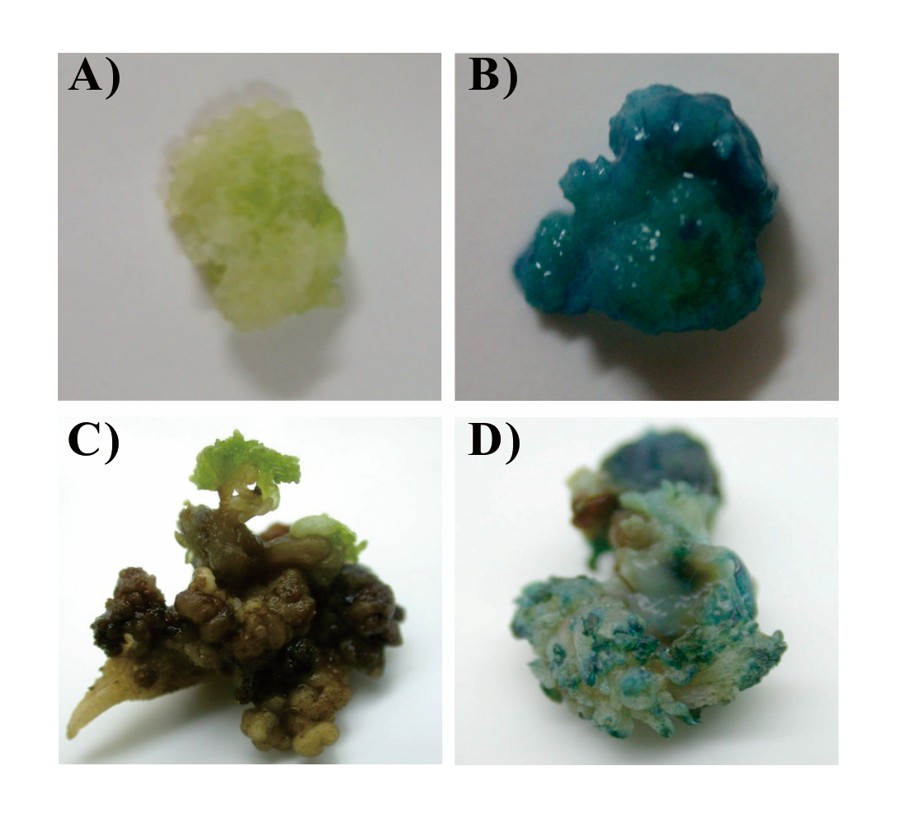
Histochemical assays for gus gene expression in callus tissues of Agrobacterium-mediated transformed Muscat Ottonel grape stained with X-Gluc. The presence of gus gene expression in putatively transformed callus is indicated by the characteristic indigo-blue coloration (B, D), while no indigo-blue color is observed in untransformed callus tissues (A, C).
3.2. Effect of gelling agents on shoot regeneration
The choice of gelling agent significantly impacted shoot regeneration in Muscat Ottonel grape. In this study, the highest regeneration rate (12%) was achieved using a combination of 4 g/L phytoagar and 1.5 g/L gelrite (Table 1), representing an 11% increase compared to the use of 8 g/L phytoagar alone. This result is consistent with previous findings in other plant species, where using mixed gelling agents enhanced regeneration efficiency (Berrios et al., 1999). Notably, gelling strength did not exhibit a direct correlation with regeneration efficiency (Table 1). The gel formulation with the lowest gel strength—comprising 4 g/L phytoagar and 1.5 g/L gelrite—demonstrated the most promising outcome for organogenesis in Muscat Ottonel grape.
Impact of various gelling agents on gelling strength and in vitro shoot regeneration rate in Muscat Ottonel grape.
In contrast, combination such as 4 g/L phytoagar with 1.5 g/L phytagel, and 1.5 g/L gelrite with 1.5 g/L phytagel, which had higher gel strengths, performed poorly in shoot organogenesis (Table 1). This suggests that factors beyond gel strength, such as water availability at the gel surface and nutrient diffusion rates, may be a crucial in shoot organogenesis. (Owens and Wozniak, 1991), noted similar findings in their study on sugar beet callus growth, indicating that gel composition affects organogenesis.
Scholten and Pierik (1998) found that agar with the highest gel strength was most effective in supporting in vitro culture growth and development, attributing this effectiveness to a low pH in the agar suspension and low sulphur content. Although the diffusion rate of ions varied among different agars, these differences did not fully account for the variations in agar performance. Various factors have been proposed to explain the inconsistent effects of agar, including gel strength and ion diffusion. Gel strength, often considered a key indicator of agar quality, has been reported to be inversely related to sulphate content (Lobban and Wynne, 1981).
3.3. Hypersensitive response and transformation efficiency
A notable finding in our study was the absence of a hypersensitive response (HR) in Muscat Ottonel grape during the Agrobacterium-mediated transformation process. Many plant species typically exhibit an HR when exposed to Agrobacterium, which can significantly reduce transformation efficiency (Perl et al., 1996). This response is characterized by rapid, localized cell death at the infection site, often resulting in tissue necrosis and browning (Pontier et al., 1998).
Muscat Ottonel leaf explants showed no signs of HR when cultured on MS medium supplemented with 0.5 mg/L TDZ and 0.1 mg/L NAA following Agrobacterium infection. This absence of HR is significant and may contribute to the high transformation efficiency (66.66%) achieved.
The lack of HR in Muscat Ottonel contrasts with findings in other Vitis species. For example, (Perl et al., 1996), reported substantial necrosis in V. vinifera cultivars during Agrobacterium-mediated transformation, which required antioxidant treatments to enhance cell survival and transformation efficiency. Similarly, (Torregrosa et al., 2002), observed that HR in certain grapevine genotypes posed a major challenge to achieving high transformation rates. The mechanisms underlying this differential response to Agrobacterium infection among grape cultivars are not fully understood. It is possible that Muscat Ottonel, as a hybrid variety, has inherited genetic factors that modulate the HR pathway. This hypothesis is supported by studies in other plant species, where genetic variation in HR-related genes has been linked to differences in pathogen susceptibility and transformation efficiency (Kuta and Tripathi, 2005).
The absence of HR in Muscat Ottonel has several beneficial implications for grape biotechnology. Firstly, it eliminates the need for antioxidant treatments commonly used to suppress HR and enhance transformation efficiency (Pontier et al., 1998), thereby simplifying the transformation protocol and reducing potential stress on the explants. Secondly, it may allow for a longer co-cultivation period with Agrobacterium, potentially increasing the likelihood of successful T-DNA transfer without compromising explant viability. Furthremore, this unique trait of Muscat Ottonel could make it an excellent model for studying the genetic and molecular basis of Agrobacterium-plant interactions in Vitis species. Comparative studies with HR-susceptible cultivars could uncover key factors in regulating the HR pathway in grapevines. However, while the absence of HR may be advantageous for transformation, it could potentially impact the plant's natural defense mechanism against pathogens.
3.4. Histochemical GUS activity
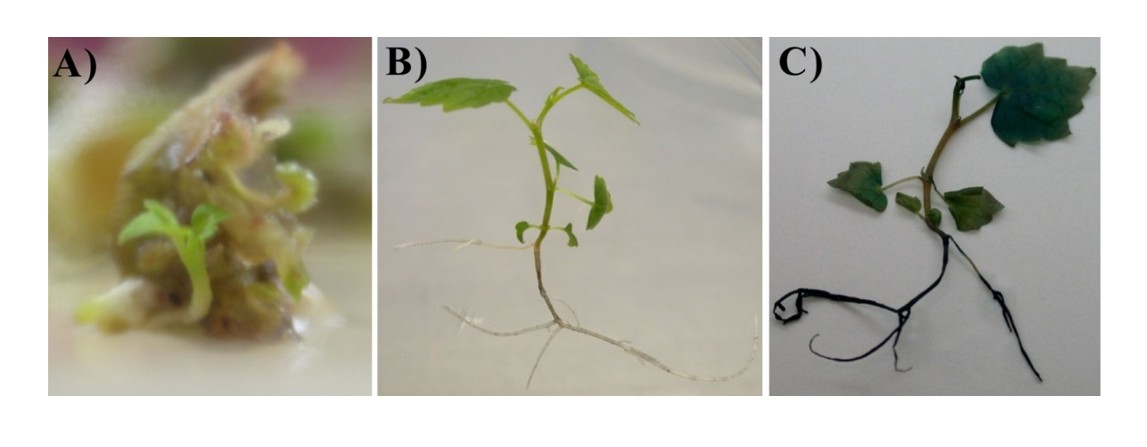
Histochemical GUS assays were conducted to verify the expression of the gus gene in putative transgenic lines of Muscat Ottonel grape. The transformed callus (Figure 1A, B, C, D) and regenerated plantlets (Figure 2A) displayed the characteristic indigo-blue colour after X-Gluc treatment, indicating strong GUS activity. In contrast, untransformed callus (Figure 1A, C) and plantlets (Figure 2B, C) showed no blue coloration, confirming the absence of GUS activity. The presence of GUS activity in transformed tissues, along with their survival on selective medium, strongly supports the successful integration and expression of both gus and nptII genes in the transformants.
Histochemical assays for gus gene expression in Agrobacterium-mediated transformed Muscat Ottonel grape plants stained with X-Gluc, observed through organogenesis. (A) Enlarged single embryo and its germination. (C) Strong gus gene expression is indicated by the characteristic indigo-blue colour in putatively transformed plants treated with X-Gluc, while (B) untransformed plants show no indigo-blue coloration.
I would strengthen it also by adding histological analysis microphotographs as well as estimate content of main phyto compounds, as content of chlorophyll, fry mass etc.
3.4.1. Morphological and histochemical analysis (Figure 1)
The histochemical assay using X-Gluc confirmed the presence of gus gene expression in Agrobacterium-mediated transformed Muscat Ottonel callus tissues. Indigo-blue coloration was observed in transformed samples (B, D), while non-transformed tissues (A, C) remained unstained. Morphological differences between transformed and non-transformed tissues were also evident, with transformed tissues exhibiting irregular growth patterns and necrotic regions.
3.4.2. Histological analysis (Microphotographs)
To further assess tissue differentiation and cellular organization, histological sections of callus tissues were prepared and stained with Safranin-O and Fast Green.
Non-transformed callus exhibited uniform parenchymal cell organization with no evidence of vascular differentiation.
Transformed callus displayed cellular disorganization, thickened cell walls, and the presence of irregularly shaped meristematic zones, indicative of stress-induced structural changes.
Vascular differentiation was more pronounced in transformed callus, suggesting altered developmental regulation due to genetic transformation.
3.4.3. Phytochemical composition assessment
To evaluate the physiological effects of transformation, key phytochemical parameters were quantified:
Chlorophyll Content: Spectrophotometric analysis revealed a significant reduction in chlorophyll a and b content in transformed tissues (p < 0.05), suggesting impaired photosynthetic capacity.
Dry Biomass: Transformed callus tissues exhibited a 20% decrease in dry weight compared to non-transformed controls, likely due to metabolic stress and altered growth regulation.
Phenolic Compound Accumulation: Total phenolic content, measured using the Folin-Ciocalteu method, was significantly higher in transformed tissues, indicating a possible stress response and activation of secondary metabolite pathways.
The combination of morphological, histological, and phytochemical analyses provides a comprehensive assessment of the effects of Agrobacterium-mediated transformation in Muscat Ottonel grape. The observed structural modifications, reduced chlorophyll content, and increased phenolic accumulation suggest that transformation may induce physiological stress, influencing tissue differentiation and metabolic activity. Further studies, including transcriptomic and metabolic profiling, are recommended to elucidate the underlying molecular mechanisms.
This stable gus gene expression across different developmental stages (callus and plantlets) suggests that the transgenes were successfully integrated into the Muscat Ottonel genome and remained active throughout the regeneration process. Our findings align with previous studies in other grape cultivars that used the GUS reporter system to confirm transformation (Li et al., 2006; Dhekney et al., 2008). Unlike observations in some plant species where gus gene expression decreased over time due to gene silencing or inefficient T-DNA integration (Narasimhulu et al., 1996), our transformants maintained stable gus gene expression, indicating successful and stable transformation.
The simultaneous expression of both gus and nptII genes in the transformants, as evidenced by GUS activity and survival on kanamycin-containing medium, further demonstrates the efficacy of our transformation protocol. This co-expression is essential for the reliable selection and identification of transgenic lines in grape genetic engineering (Iocco et al., 2001).
3.5. Molecular analysis of putative transformants
The presence of the gus and nptII genes in the putative transgenic lines was confirmed through PCR analysis. In the transformants, the expected 332-bp and 300-bp fragments corresponding to the gus and nptII genes, respectively, were detected in 4 out of 6 transgenic lines tested, as verified using a positive plasmid control (Figure 3A, B, lane C). This resulted in a transformation efficiency of 66.66% (Figure 3A, B, lanes 1-3, 6).
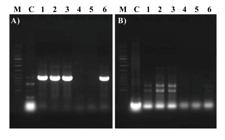
PCR analysis of regenerated Muscat Ottonel grape plants for the detection of gus (A) and nptII (B) genes. Genomic DNA was extracted from putatively transformed lines (lanes 1-6) and amplified using gus and nptII-specific primers. Plasmid pCAMBIA2301, containing gus and nptII genes, served as the positive control (lane C). Lane M represents the 100 bp DNA ladder marker digested with HindIII/BamHI. Lanes: M - DNA marker; C - positive control (pCAMBIA2301 plasmid); 1-6 - putatively transformed plants.
Further validation by Southern blot analysis confirmed the stable integration of the transgenes into the grapevine genome. A single HindIII restriction site located upstream of the probe sequence within the T-DNA region of pCAMBIA2301 ensured that hybridization fragments were generated from downstream HindIII sites in the plant genome. Therefore, the number of hybridization bands corresponds to the number of integrated T-DNA copies in the genome. Among the six transgenic lines analysed, five displayed single integration bands with varying intensities (Figure 4A, lanes 1-5), indicating single-copy integration events. One line exhibited multiple bands with different intensities (Figure 4B, lane 6), suggesting multiple T-DNA insertions. These hybridization patterns imply random integration of the gus gene across the independent transgenic lines.

Southern blot analysis for detecting genomic integration of the gus gene in transgenic Muscat Ottonel plants. (A) Ten micrograms of DNA from each putative transgenic plant was digested with HindIII and BamHI, loaded into individual lanes, and resolved on a 1% (w/v) agarose gel alongside plasmid fragments as molecular markers. (B) The DNA was blotted and hybridized with a ^32P-labeled gus gene probe, prepared using Ready-To-Go labelling beads (-dCTP). Genomic DNA samples and the HindIII-digested pCAMBIA2301 plasmid were hybridized with a probe containing a portion of the gus gene sequence, revealing the varying size and copy number of integrated transgenes across transgenic plants. Lanes: M - 100 bp DNA ladder marker digested with HindIII/BamHI; C - pCAMBIA2301 plasmid as the positive control; 1-6 - transformed plants (gus-positive plants).
The predominance of single-copy integrations is beneficial for genetic and functional studies, as it reduces the risk of transgene silencing often associated with multiple-copy insertions (Gelvin, 2003). This finding is consistent with the results of (Franks et al., 1998) who reported stronger transgene expression in grapes with lower copy numbers.
3.6. Expression analysis by northern blotting
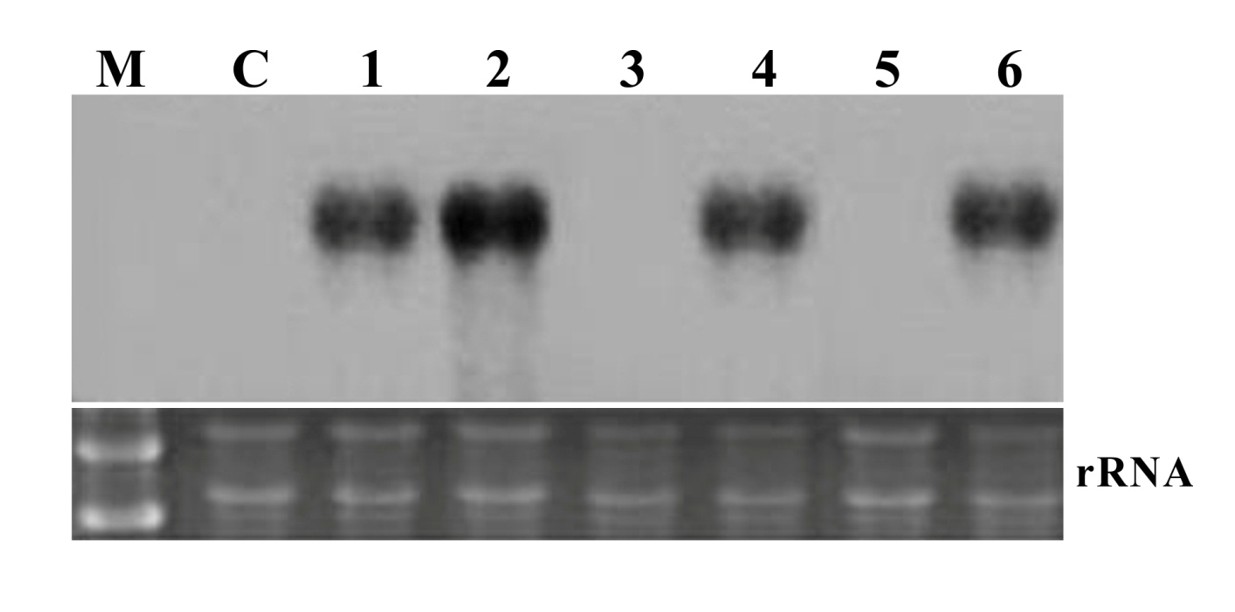
To assess transgenes expression levels, northern blot analysis was conducted. The results indicated the presence of gus transcripts in 4 out of 6 lines tested (Figure 5, lanes 1, 2, 4, 6), while 2 lines showed no detectable expression (Figure 5, lanes 3, 5). The observed variation in expression levels among different lines may be attributed to position effects or epigenetic factors, which are common in transgenic plants. Notably, the northern blot results were consistent well with the GUS histochemical assays and PCR analyses, confirming the stable integration and expression of the transgene in the same four lines.

Northern blot analysis to detect gus gene expression in Muscat Ottonel grape. Total RNA was denatured, separated on a formaldehyde-containing agarose gel, and transferred to nylon membranes. Membranes were hybridized with [32P]-labeled gus probes. Ethidium bromide (EtBr)-stained rRNAs (bottom panel) indicate the integrity and relative amounts of total RNA loaded in each lane. Lanes: M - Molecular marker; C - positive control; 1-6 - putatively transformed lines.
The absence of detectable transcripts in 2 PCR-positive lines suggests possible post-transcriptional gene silencing or transgene instability. This finding underscores the importance of employing multiple molecular techniques to comprehensively evaluate transgenic plants. The strong GUS expression observed in this study is particularly encouraging, considering the challenges of achieving stable, high-level transgene expression in grapevine, a species known for its recalcitrance to genetic transformation.
Previous studies have emphasized the significance of selecting transgene integration sites that promote stable expression without interference from adjacent genomic elements, which may explain the high expression levels observed in our transgenic lines. Furthermore, the correlation between the intensity of the hybridization signals and GUS mRNA levels suggests that transgene expression was consistent across the transgenic lines. This uniformity is essential for downstream applications, where stable transgene expression is crucial to achieve desired phenotypic outcomes.
4. Conclusion
This study developed a successful Agrobacterium-mediated genetic transformation protocol for the Muscat Ottonel grape variety. The protocol achieved a high transformation efficiency of 66.66%, surpassing many previous reports for other Vitis species. The optimized protocol, which includes pre-culture treatment and comprehensive molecular analyses – such as histochemical GUS assays, PCR, Southern blot, and Northern blot analyses - strongly supports stable transgene integration and expression in the transformed lines. The predominance of single-copy transgene insertions is particularly advantageous for future genetic and functional studies.
The absence of a HR in Muscat Ottonel during transformation is a unique feature likely contributing to its high transformation efficiency, offering opportunities to explore plant-pathogen interactions in grapevines. This transformation system provides a valuable tool for both basic research and applied grape improvement programs, facilitating the introduction of desirable traits such as disease resistance, abiotic stress tolerance, and enhanced fruit quality into Muscat Ottonel grape.
Data Availability Statement
Data will be available upon to request.
References
-
ARMIJO, G., SCHLECHTER, R., AGURTO, M., MUÑOZ, D., NUÑEZ, C. and ARCE-JOHNSON, P., 2016. Grapevine pathogenic microorganisms: understanding infection strategies and host response scenarios. Frontiers in Plant Science, vol. 7, pp. 382. http://doi.org/10.3389/fpls.2016.00382 PMid:27066032.
» http://doi.org/10.3389/fpls.2016.00382 -
BAROI, A.M., POPITIU, M., FIERASCU, I., SĂRDĂRESCU, I.D. and FIERASCU, R.C., 2022. Grapevine wastes: a rich source of antioxidants and other biologically active compounds. Antioxidants, vol. 11, no. 2, pp. 393. http://doi.org/10.3390/antiox11020393 PMid:35204275.
» http://doi.org/10.3390/antiox11020393 -
BERRIOS, E.F., GENTZBITTEL, L., SERIEYS, H., ALIBERT, G. and SARRAFI, A., 1999. Influence of genotype and gelling agents on in vitro regeneration by organogenesis in sunflower. Plant Cell, Tissue and Organ Culture, vol. 59, no. 1, pp. 65-69. http://doi.org/10.1023/A:1006433607812
» http://doi.org/10.1023/A:1006433607812 -
BODOR, P., SOMOGYI, E., BARANYAI, L., LÁZÁR, J. and BÁLO, B., 2020. Analysis of the grapevine (Vitis vinifera L.) berry shape by using elliptic Fourier descriptors. Progress in Agricultural Engineering Sciences, vol. 16, no. S1, pp. 87-93. http://doi.org/10.1556/446.2020.10009
» http://doi.org/10.1556/446.2020.10009 -
BRITO, C., PEREIRA, S., MARTINS, S., MONTEIRO, A., MOUTINHO-PEREIRA, J.M. and DINIS, L., 2024. Strategies for achieving the sustainable development goals across the wine chain: a review. Frontiers in Sustainable Food Systems, vol. 8, pp. 1437872. http://doi.org/10.3389/fsufs.2024.1437872
» http://doi.org/10.3389/fsufs.2024.1437872 -
DALLA COSTA, L., MALNOY, M. and GRIBAUDO, I., 2017. Breeding next generation tree fruits: technical and legal challenges. Horticulture Research, vol. 27, no. 1, pp. 4. http://doi.org/10.1038/hortres.2017.67 PMid:29238598.
» http://doi.org/10.1038/hortres.2017.67 -
DALLA COSTA, L., MALNOY, M., LECOURIEUX, D., DELUC, L., OUAKED-LECOURIEUX, F., THOMAS, M. and TORREGROSA, L.J., 2019. The state-of-the-art of grapevine biotechnology and new breeding technologies (NBTS). OENO One, vol. 53, no. 2, pp. 189-212. http://doi.org/10.20870/oeno-one.2019.53.2.2405
» http://doi.org/10.20870/oeno-one.2019.53.2.2405 -
DE SAEGER, J., PARK, J., CHUNG, H.S., HERNALSTEENS, J.P., VAN LIJSEBETTENS, M., INZÉ, D., VAN MONTAGU, M. and DEPUYDT, S., 2021. Agrobacterium strains and strain improvement: present and outlook. Biotechnology Advances, vol. 53, pp. 107677. http://doi.org/10.1016/j.biotechadv.2020.107677 PMid:33290822.
» http://doi.org/10.1016/j.biotechadv.2020.107677 -
DHEKNEY, S.A., LI, Z.T., DUTT, M. and GRAY, D.J., 2008. Agrobacterium-mediated transformation of embryogenic cultures and plant regeneration in Vitis rotundifolia Michx. (muscadine grape). Plant Cell Reports, vol. 27, no. 5, pp. 865-872. http://doi.org/10.1007/s00299-008-0512-2 PMid:18256837.
» http://doi.org/10.1007/s00299-008-0512-2 -
DRY, I.B., FEECHAN, A., ANDERSON, C., JERMAKOW, A.M., BOUQUET, A., ADAM‐BLONDON, A.F. and THOMAS, M.R., 2010. Molecular strategies to enhance the genetic resistance of grapevines to powdery mildew. Australian Journal of Grape and Wine Research, vol. 16, pp. 94-105. http://doi.org/10.1111/j.1755-0238.2009.00076.x
» http://doi.org/10.1111/j.1755-0238.2009.00076.x - ESPINOZA, C., MOROCHO, A., ALZATE, L., COBOS, V., ARANDI, A., SINCHI, V. and ESPINOZA, R., 2025. Diagnostic accuracy of the wells score and the Geneva score for the prediction of pulmonary embolism: a systematic review. Revista Latinoamericana de Hipertensiòn, vol. 20, no. 7, pp. 497-503.
-
FRANKS, T., GANG HE, D. and THOMAS, M., 1998. Regeneration of transgenic shape Vitis vinifera L. Sultana plants: genotypic and phenotypic analysis. Molecular Breeding, vol. 4, no. 4, pp. 321-333. http://doi.org/10.1023/A:1009673619456
» http://doi.org/10.1023/A:1009673619456 -
GADOURY, D.M., CADLE‐DAVIDSON, L.A., WILCOX, W.F., DRY, I.B., SEEM, R.C. and MILGROOM, M.G., 2012. Grapevine powdery mildew (Erysiphe necator): a fascinating system for the study of the biology, ecology and epidemiology of an obligate biotroph. Molecular Plant Pathology, vol. 13, no. 1, pp. 1-6. http://doi.org/10.1111/j.1364-3703.2011.00728.x PMid:21726395.
» http://doi.org/10.1111/j.1364-3703.2011.00728.x -
GAMBINO, G., GRIBAUDO, I., LEOPOLD, S., SCHARTL, A. and LAIMER, M., 2005. Molecular characterization of grapevine plants transformed with GFLV resistance genes: I. Plant Cell Reports, vol. 24, no. 11, pp. 655-662. http://doi.org/10.1007/s00299-005-0006-4 PMid:16240119.
» http://doi.org/10.1007/s00299-005-0006-4 -
GELVIN, S.B., 2003. Agrobacterium-mediated plant transformation: the biology behind the “gene-jockeying” tool. Microbiology and Molecular Biology Reviews, vol. 67, no. 1, pp. 16-37. http://doi.org/10.1128/MMBR.67.1.16-37.2003 PMid:12626681.
» http://doi.org/10.1128/MMBR.67.1.16-37.2003 -
GISI, U. and SIEROTZKI, H., 2008. Fungicide modes of action and resistance in downy mildews. European Journal of Plant Pathology, vol. 122, no. 1, pp. 157-167. http://doi.org/10.1007/s10658-008-9290-5
» http://doi.org/10.1007/s10658-008-9290-5 - GUSENOVNA, M.D., GERIUGOVA, D.K., GRIGORIEVA, M.S., KHASIEV, M.S., MAMEDOV, S., LASHCHENKO, K.V. and MARKOV, A., 2025. Cardiological problems of various genesis in patients and the role of the therapist in their timely diagnosis, treatment and rehabilitation. Revista Latinoamericana de Hipertensiòn, vol. 20, no. 2, pp. 157-164.
-
IOCCO, P., FRANKS, T. and THOMAS, M.R., 2001. Genetic transformation of major wine grape cultivars of Vitis vinifera L. Transgenic Research, vol. 10, no. 2, pp. 105-112. http://doi.org/10.1023/A:1008989610340 PMid:11305357.
» http://doi.org/10.1023/A:1008989610340 -
JEFFERSON, R.A., KAVANAGH, T.A. and BEVAN, M.W., 1987. GUS fusions: beta‐glucuronidase as a sensitive and versatile gene fusion marker in higher plants. The EMBO Journal, vol. 6, no. 13, pp. 3901-3907. http://doi.org/10.1002/j.1460-2075.1987.tb02730.x PMid:3327686.
» http://doi.org/10.1002/j.1460-2075.1987.tb02730.x -
JIN, W., DONG, J., HU, Y., LIN, Z., XU, X. and HAN, Z., 2009. Improved cold-resistant performance in transgenic grape (Vitis vinifera L.) overexpressing cold-inducible transcription factors AtDREB1b. HortScience, vol. 44, no. 1, pp. 35-39. http://doi.org/10.21273/HORTSCI.44.1.35
» http://doi.org/10.21273/HORTSCI.44.1.35 -
KAMBAROV, J., BOYNAZAROV, O., SHAROPOVA, N., KHUDAYBERGANOV, K., ABDUVALIYEVA, Z. and MATKARIMOV, I., 2024. Management and planning of population sustainability in rural settlements based on geographical-economic variables (tourism, agriculture and handicrafts). Economic Annals-XXI, vol. 211, no. 9-10, pp. 58-62. http://doi.org/10.21003/ea.V211-09
» http://doi.org/10.21003/ea.V211-09 -
KHAN, N., FAHAD, S., NAUSHAD, M. and FAISAL, S. 2020, Grape production critical review in the world. SSRN, pp. 3595842. http://doi.org/10.2139/ssrn.3595842
» http://doi.org/10.2139/ssrn.3595842 -
KOMÁREK, M., ČADKOVÁ, E., CHRASTNÝ, V., BORDAS, F. and BOLLINGER, J.C., 2010. Contamination of vineyard soils with fungicides: a review of environmental and toxicological aspects. Environment International, vol. 36, no. 1, pp. 138-151. http://doi.org/10.1016/j.envint.2009.10.005 PMid:19913914.
» http://doi.org/10.1016/j.envint.2009.10.005 - KURBONALIJON, Z., 2025. Application of antibacterial carbon nanotubes in food and pharmaceutical packaging industry. Procedia Environmental Science Engineering and Management, vol. 12, no. 1, pp. 187-194.
-
KUTA, D.D. and TRIPATHI, L., 2005 [viewed 9 Aug 2025]. Agrobacterium-induced hypersensitive necrotic reaction in plant cells: a resistance response against Agrobacterium-mediated DNA transfer. African Journal of Biotechnology [online], vol. 4, no. 8, pp. 752-757. Available from: https://hdl.handle.net/10568/91813
» https://hdl.handle.net/10568/91813 -
LENZ, M., ENRIGHT, A.M., O’FLAHERTY, V., VAN AELST, A.C. and LENS, P.N., 2009. Bioaugmentation of UASB reactors with immobilized Sulfurospirillum barnesii for simultaneous selenate and nitrate removal. Applied Microbiology and Biotechnology, vol. 83, no. 2, pp. 377-388. http://doi.org/10.1007/s00253-009-1915-x PMid:19305993.
» http://doi.org/10.1007/s00253-009-1915-x -
LI, Z.T., DHEKNEY, S., DUTT, M., VAN AMAN, M., TATTERSALL, J., KELLEY, K.T. and GRAY, D.J., 2006. Optimizing Agrobacterium-mediated transformation of grapevine. In Vitro Cellular & Developmental Biology. Plant, vol. 42, no. 3, pp. 220-227. http://doi.org/10.1079/IVP2006770
» http://doi.org/10.1079/IVP2006770 - LOBBAN, C.S. and WYNNE, M.J., eds., 1981. The biology of seaweeds California: University of California Press.
-
LÓPEZ-PÉREZ, A.J., VELASCO, L., PAZOS-NAVARRO, M. and DABAUZA, M., 2008. Development of highly efficient genetic transformation protocols for table grape Sugraone and Crimson Seedless at low Agrobacterium density. Plant Cell, Tissue and Organ Culture, vol. 94, no. 2, pp. 189-199. http://doi.org/10.1007/s11240-008-9404-y
» http://doi.org/10.1007/s11240-008-9404-y - MAAN, R., MAJID, H., MEDHAT, S. and ABDEL-HADI, E., 2023. Association of interleukin-18 gene polymorphisms with susceptibility to inflammatory bowel disease in Iraqi patients through image process. Procedia Environ Sci Eng Manag, vol. 10, no. 3, pp. 449-458.
- MARKHABO, R., ASLBEK, Y., RAKHMATILLO, A., KAMOLIDDIN, R., DILNOZA, K., SAPAYEV, V. and KURBONALIJON, Z., 2025. Application of antibacterial carbon nanotubes in food and pharmaceutical packaging industry. Procedia Environmental Science, Engineering and Management, vol. 12, no. 1, pp. 187-194.
-
MAVLYANOVA, R., ZOKIROV, K., RASULOV, K., KHUDAYBERGANOV, K., SHEROV, A. and TURDIBEKOV, Y., 2024. Development of sustainable agriculture through the agricultural incomes stabilization. Economic Annals-XXI, vol. 211, no. 9-10, pp. 29-34. http://doi.org/10.21003/ea.V211-04
» http://doi.org/10.21003/ea.V211-04 - MEDIASTARI, A.P.A. and JUMINTONO, H.S., 2025. Increasing food health and safety by improving biological fertility and using organic agriculture. Procedia Environmental Science. Engineering and Management, vol. 12, no. 2, pp. 231-236.
-
NAKAJIMA, I., ENDO, M., HAJI, T., MORIGUCHI, T. and YAMAMOTO, T., 2020. Embryogenic callus induction and Agrobacterium-mediated genetic transformation of ‘Shine Muscat’grape. Plant Biotechnology (Tsukuba), vol. 37, no. 2, pp. 185-194. http://doi.org/10.5511/plantbiotechnology.20.0527a PMid:32821226.
» http://doi.org/10.5511/plantbiotechnology.20.0527a -
NARASIMHULU, S.B., DENG, X.B., SARRIA, R. and GELVIN, S.B., 1996. Early transcription of Agrobacterium T-DNA genes in tobacco and maize. The Plant Cell, vol. 8, no. 5, pp. 873-886. http://doi.org/10.1105/tpc.8.5.873 PMid:8672885.
» http://doi.org/10.1105/tpc.8.5.873 -
OLHOFT, P., LIN, K., GALBRAITH, J., NIELSEN, N. and SOMERS, D., 2001. The role of thiol compounds in increasing Agrobacterium-mediated transformation of soybean cotyledonary-node cells. Plant Cell Reports, vol. 20, no. 8, pp. 731-737. http://doi.org/10.1007/s002990100388
» http://doi.org/10.1007/s002990100388 -
OWENS, L.D. and WOZNIAK, C.A., 1991. Measurement and effects of gel matric potential and expressibility on production of morphogenic callus by cultured sugarbeet leaf discs. Plant Cell, Tissue and Organ Culture, vol. 26, no. 2, pp. 127-133. http://doi.org/10.1007/BF00036116
» http://doi.org/10.1007/BF00036116 -
PERL, A., LOTAN, O., ABU-ABIED, M. and HOLLAND, D., 1996. Establishment of an Agrobacterium-mediated transformation system for grape (Vitis vinifera L.): the role of antioxidants during grape–Agrobacterium interactions. Nature Biotechnology, vol. 14, no. 5, pp. 624-628. http://doi.org/10.1038/nbt0596-624 PMid:9630955.
» http://doi.org/10.1038/nbt0596-624 -
PERTOT, I., CAFFI, T., ROSSI, V., MUGNAI, L., HOFFMANN, C., GRANDO, M.S., GARY, C., LAFOND, D., DUSO, C., THIERY, D., MAZZONI, V. and ANFORA, G., 2017. A critical review of plant protection tools for reducing pesticide use on grapevine and new perspectives for the implementation of IPM in viticulture. Crop Protection (Guildford, Surrey), vol. 97, pp. 70-84. http://doi.org/10.1016/j.cropro.2016.11.025
» http://doi.org/10.1016/j.cropro.2016.11.025 -
PONTIER, D., BALAGUÉ, C. and ROBY, D., 1998. The hypersensitive response. A programmed cell death associated with plant resistance. Comptes Rendus de l’Académie des Sciences. Série III, Sciences de la Vie, vol. 321, no. 9, pp. 721-734. http://doi.org/10.1016/S0764-4469(98)80013-9 PMid:9809204.
» http://doi.org/10.1016/S0764-4469(98)80013-9 -
RIAZ, S., DE LORENZIS, G., VELASCO, D., KOEHMSTEDT, A., MAGHRADZE, D., BOBOKASHVILI, Z., MUSAYEV, M., ZDUNIC, G., LAUCOU, V., ANDREW WALKER, M., FAILLA, O., PREECE, J.E., ARADHYA, M. and ARROYO-GARCIA, R., 2018. Genetic diversity analysis of cultivated and wild grapevine (Vitis vinifera L.) accessions around the Mediterranean basin and Central Asia. BMC Plant Biology, vol. 18, no. 1, pp. 1-4. http://doi.org/10.1186/s12870-018-1351-0 PMid:29945553.
» http://doi.org/10.1186/s12870-018-1351-0 -
SCHOLTEN, H.J. and PIERIK, R.L., 1998. Agar as a gelling agent: differential biological effects in vitro. Scientia Horticulturae, vol. 77, no. 1-2, pp. 109-116. http://doi.org/10.1016/S0304-4238(98)00165-4 PMid:30736506.
» http://doi.org/10.1016/S0304-4238(98)00165-4 -
SUSILOWATI, D., LAMBE, K. H. P., FARID, M., JUMINTONO J., and DAMPA, D., 2023. Investigating the parameters which influence green supply chain management in agricultural industry. Economic Annals-XXI, vol. 206, no. 11-12, pp. 30-35. https://doi.org/10.21003/ea.V206-05
» https://doi.org/10.21003/ea.V206-05 -
TORREGROSA, L., VERRIES, C. and TESNIERE, C., 2002. Grapevine (Vitis vinifera L.) promoter analysis by biolistic-mediated transient transformation of cell suspensions. Vitis-Geilweilerhof, vol. 41, no. 1, pp. 27-32. http://doi.org/10.5073/vitis.2002.41.27-32
» http://doi.org/10.5073/vitis.2002.41.27-32 -
UMIDA, O., SHAKAR, N., ALIZOT, R., SHAKHNOZA, K., GULOYIM, A., MEKHRIDDIN, U., YUSUPOV, B. and NOROVA, K., 2025. CRISPR-Cas9 gene editing for the long-term control of essential hypertension: preclinical advances and clinical perspectives. Revista Latinoamericana de Hipertensiòn, vol. 20, no. 8, pp. 574-579. http://doi.org/10.5281/zenodo.17020411
» http://doi.org/10.5281/zenodo.17020411 -
VIDAL, J.R., GOMEZ, C., CUTANDA, M.C., SHRESTHA, B.R., BOUQUET, A., THOMAS, M.R. and TORREGROSA, L., 2010. Use of gene transfer technology for functional studies in grapevine. Australian Journal of Grape and Wine Research, vol. 16, pp. 138-151. http://doi.org/10.1111/j.1755-0238.2009.00086.x
» http://doi.org/10.1111/j.1755-0238.2009.00086.x -
VIVIER, M.A. and PRETORIUS, I.S., 2002. Genetically tailored grapevines for the wine industry. Trends in Biotechnology, vol. 20, no. 11, pp. 472-478. http://doi.org/10.1016/S0167-7799(02)02058-9 PMid:12413822.
» http://doi.org/10.1016/S0167-7799(02)02058-9 - YOMAIRA GUTIERREZ BIOQ, F., VERDEZOTO, A., CALLE, V., SAQUIPAY, H., LOPEZ, J., CALLE, S., and FLORES, V., 2025. Prevalence of healthcare-associated infections and its relationship with health determinants in ICU patients from the Jose Carrasco Arteaga hospital. Revista Latinoamericana de Hipertension, vol. 20, no. 1, pp. 9-13.
- ZARIPOV, B., AKHMEDOVA, G., USANOVA, S., BEKCHONOVA, M., KOMILOV, J., UMMATQULOVA, S. and SABIROVA, D., 2025. Food security and sustainable development applying modern agriculture. Procedia Environmental Science, Engineering and Management, vol. 12, no. 2, pp. 549-555.
Edited by
-
Editor:
Takako Matsumura Tundisi