 Effect of complex microbial preparation of free-living and symbiotic nitrogen-fixing bacteria for agricultural crops
Abstract
The aim of this work was to study the newly developed biofertilizer and plant growth-promoting activity of a consortium of bacterial strains Azotobacter chroococcum MDC 6111, Paenibacillus polymyxa MDC 280 and symbiotic nitrogen-fixing bacteria Rhizobium leguminosarum MDC 5609, Mesorhizobium ciceri MDC 6048 and Bradyrhizobium japonicum MDC 5789. It should be noted that in the biofertilizer formula, the strains A. chroococcum and P. polymyxa are unaltered components, and the nodule bacteria are included depending on the type of crop, taking into account the specificity of these bacteria to plants. In this case, both the nitrogen-fixing capacity and the phosphate-mobilizing activity of these bacteria were taken into account. It was found that the increase in the organic layer content from 2.73 to 5.79% occurs with the active participation of microbial strains introduced into the soil. During the plant growth period, an increase in mobile nitrogen forms (NO3-) to 71.9 mg-eq/100 g and soil saturation with molecular nitrogen to 16.2 mg/100 g were detected. A decrease in the content of phosphorus salts (Р2О5, РО43-) and potassium (K+) to 2.86, 3.82 and 5.86 mg-eq/100 g, respectively, was shown. Thus, the content of the immobile form of potassium (K2O) decreases approximately 3 times, and the amount of immobile phosphorus (P2O5) - 3.63 times. These processes in the soil are due to the active activity of nitrogen-fixing and phosphate-solubilizing bacteria, as well as the use of these ions by plants. At the same time, the nitrogen (N) content increases by 2.38 times, and its mineralized form - NO3- by 3.0 times, respectively. As a result of the field experiments, it was found that the tested soil rhizobacteria actively adhere to seeds and seedlings, spreading in the rhizosphere of plants, contributing to the effective action of the biopreparation, thereby fixing more nitrogen. Microorganisms in the process of metabolism increase the efficiency of obtaining soluble salts of phosphorus, potassium and calcium by plants. In general, it was found that joint inoculation of rhizobacteria strains demonstrated higher growth parameters and plant biomass, and crop ripening is achieved 12-20 days earlier compared to the control options. The use of biopreparation in agriculture allows to improve the content of the organic component of the soil, thereby contributing to the restoration of the ecological balance of the soil.
Keywords:
Azotobacter сhroococcum; Paenybacillus polymyxa; symbiotic nitrogen-fixing bacteria; Plant Growth-Promoting Rhizobacteria (PGPR); biofertilizer; phosphate solubilization
Resumo
O objetivo deste trabalho foi estudar o biofertilizante recém-desenvolvido e a atividade promotora do crescimento vegetal de um consórcio de cepas bacterianas Azotobacter chroococcum MDC 6111, Paenibacillus polymyxa MDC 280 e bactérias simbióticas fixadoras de nitrogênio Rhizobium leguminosarum MDC 5609, Mesorhizobium ciceri MDC 6048 e Bradyrhizobium japonicum MDC 5789. Ressalta-se que, na formulação do biofertilizante, as cepas A. chroococcum e P. polymyxa são componentes inalterados, e as bactérias nodulares são incluídas de acordo com o tipo de cultura, considerando-se a especificidade dessas bactérias para as plantas. Nesse caso, foram consideradas tanto a capacidade de fixação de nitrogênio quanto a atividade de mobilização de fosfato dessas bactérias. Verificou-se que o aumento do teor da camada orgânica de 2,73% para 5,79% ocorre com a participação ativa de cepas microbianas introduzidas no solo. Durante o período de crescimento da planta, foi detectado um aumento nas formas móveis de nitrogênio (NO3-) para 71,9 mg-eq/100 g e a saturação do solo com nitrogênio molecular para 16,2 mg/100 g. Foi demonstrada uma diminuição no teor de sais de fósforo (Р2О5, РО43-) e potássio (K+) para 2,86, 3,82 e 5,86 mg-eq/100 g, respectivamente. Assim, o teor da forma imóvel de potássio (K2O) diminui aproximadamente 3 vezes, e a quantidade de fósforo imóvel (P2O5) reduziu 3,63 vezes. Esses processos no solo devem-se à atividade ativa de bactérias fixadoras de nitrogênio e solubilizadoras de fosfato, bem como ao uso desses íons pelas plantas. Ao mesmo tempo, o teor de nitrogênio (N) aumentou em 2,38 vezes, e sua forma mineralizada(NO3-) elevou-se em 3,0 vezes, respectivamente. Como resultado dos experimentos de campo, constatou-se que as rizobactérias do solo testadas aderem ativamente às sementes e mudas, espalhando-se na rizosfera das plantas, contribuindo para a ação efetiva do biopreparador, fixando assim mais nitrogênio. Os microrganismos em processo de metabolismo aumentam a eficiência da obtenção de sais solúveis de fósforo, potássio e cálcio pelas plantas. Em geral, constatou-se que a inoculação conjunta de linhagens de rizobactérias demonstrou parâmetros de crescimento e biomassa vegetal mais elevados, e a maturação das culturas é alcançada de 12 a 20 dias antes, em comparação com as opções de controle. O uso de biopreparadores na agricultura permite melhorar o teor do componente orgânico do solo, contribuindo para a restauração do equilíbrio ecológico do solo.
Palavras-chave:
Azotobacter сhroococcum; Paenybacillus polymyxa; bactéria simbiótica fixadora de nitrogênio; Rizobactérias Promotoras de Crescimento de Plantas (PGPR); biofertilizante; solubilização de fosfato
1. Introduction
The development of methods for restoring the natural balance of soil microflora, the use of various preparative complexes individually and in various compositions is of paramount importance for agricultural enterprises in order to restore degraded soils. At the same time, a sufficient supply of nitrogen ensures high yields, since this chemical element is the most effective for plant growth and development, connecting to vital functions: photosynthesis, protein formation, respiration, etc. (Kurrey et al., 2018; Sumbul et al., 2020). Plant growth parameters are significantly reduced due to insufficient nitrogen supply (Werner and Newton, 2005; Padda et al., 2017a). On the other hand, the widespread use of chemical fertilizers leads to certain changes in natural biocenoses (Jana et al., 2024). Therefore, the environmental study of these problems is becoming increasingly relevant (Jnawali et al., 2015; Galleguillos et al., 2000). In addition, the decline in natural soil fertility causes increasing attention to biological farming, the essence of which is to use the potential of natural ecosystems, in particular nitrogen-fixing microorganisms (Vance and Graham, 1995; Aseri et al., 2008; Kizilkaya, 2009).
There are three main groups of microorganisms that fix atmospheric nitrogen: those that enter into symbiosis with higher plants (bacteria of the genera Rhizobium, Bradyrhizobium, Mezorhizobium, Sinorhizobium, Azorhizobium) (Vance, 2001), free-living (Azotobacter, Beijerinckia, Bacillus, Clostridium, Klebsiella) (Spaink, 1998, 2002; Vadakattu and Paterson, 2006; Padda et al., 2017a) and associative (Azospirillum) (Vlassak and Reynders, 1979; Stephan et al., 1981). The creation and use of biopreparations based on nitrogen-fixing microorganisms is the most effective method for increasing plant productivity and the quality of their harvest, allowing to maintain the natural fertility of soils and the ecological balance of the environment. Their use makes it possible to regulate the number and activity of beneficial microflora in the rhizosphere of cultivated crops, as well as to provide plants with nitrogen fixed from the atmosphere (Behl et al., 2003; Diaz-Barrera and Soto, 2010; Wani et al., 2016; Gothandapani et al., 2017; Padda et al., 2017b).
Nowadays, the list of biotechnological products for plant growing has expanded significantly and includes preparations created on the basis of free-living, associative, symbiotrophic nitrogen-fixing and phosphate-mobilizing bacteria, as well as binary action preparations obtained as a result of a combination of various microorganisms (El-Dsouky et al., 2003; Siddiqui et al., 2014; Abdel-Galeil et al., 2022). Significant improvement in plant growth and yield is observed with co-inoculation of plant growth-promoting bacteria (PGPB) (Bhattacharyya and Jha, 2012; Ansari et al., 2017; Di Benedetto et al., 2017; Wani and Gopalakrishnan, 2019). Thus, Badawy et al. (2003) claim that co-inoculation of P. polymyxa in a mixture with A. chroococcum strains results in significantly more intensive vegetative growth of plants and yield compared to the use of these crops separately. There are also studies aimed at studying the symbiotic interaction of A. chroococcum strains with R. leguminosarum strains (Rodelas et al., 1999). According to a group of authors (Hadi and Bano, 2010; Dashadi et al., 2011; Ibrahim and El-Sawah, 2022) using a mixture of A. chroococcum and R. leguminosarum cultures, a significant economic effect is achieved. The combination of these species enhances plant growth and nitrogen fixation, increases the yield and quality characteristics of the crop, in particular peas. Combinations of P. polymyxa and R. leguminosarum have been studied much less (Petersen et al., 1996). Nevertheless, Figueiredo et al. (2008a) states that when beans are treated together with a mixture of Rhizobium and P. polymyxa strains, a significant effect on growth and nodule formation is observed compared to inoculation with Rhizobium alone, which is especially pronounced under drought conditions (Figueiredo et al., 2008b).
According to the works of the authors Ansari et al. (2017), Prajapati et al. (2008), Soleimanzadeh and Gooshchi (2013) and Chhonkar et al. (2009) the nitrogen-fixing and phosphate-mobilizing activity of A. chroococcum, P. polymyxa and R. leguminosarum cultures for agricultural and grain crops has been studied for many years, but studies of the interaction of these bacteria in a consortium are relatively limited. In this regard, the selection of strains was based on our long-term investigations on the comprehensive characterization of the biological properties of beneficial soil microflora. In particular, the distribution, species composition, morphological, physiological and biochemical features of oligonitrophilic microorganisms in various soils of Armenia and the plant rhizosphere were studied (Malkhasyan, 2002; Nikoghosyan and Bagdasaryan, 2003; Matevosyan et al., 2019; Harutyunyan et al., 2021). The spectrum of biologically active compounds synthesized by target bacteria was shown. It has been established that with the participation of Azotobacter strains, significant amounts of extracellular (lysine, arginine, aspartic and glutamic acids, alanine, valine, glycine) and intracellular (cysteine, histidine, glycine, tyrosine, phenylalanine) amino acids are synthesized (Nikoghosyan, 1982). The nitrogen cycle in soils near Lake Sevan was studied. Seasonal dynamics, prevalence and potential nitrogen-fixing activity of aerobic and anaerobic microorganisms were shown. The dynamics of nitrogenase activity was revealed and the true nitrogen-fixing activity of A. chroococcum strains and their mutants was established; a method for selecting active cultures using the acetylene method was developed. It has been shown that nitrogen-fixing activity reaches its maximum in the logarithmic growth phase of the Azotobacter culture and does not correlate with an increase in its biomass and the titer of living cells (Nikoghosyan, 1981; Nikoghosyan and Bagdasaryan, 2004). A pronounced ability to transform organic and inorganic phosphorus compounds was revealed in communities of nitrogen-fixing microorganisms living in the rhizosphere of cereal crops (Nikoghosyan and Bagdasaryan, 2009). In laboratory and greenhouse experiments, the efficiency and mechanisms of coexistence of symbiotic and free-living bacteria in associations with a complete absence of antagonism were revealed (Stepanyan et al., 2010a, b; Matevosyan et al., 2013). When studying interspecies relationships, the antimicrobial activity of Azotobacter strains was revealed in relation to phytopathogenic bacteria of the species Xanthomonas beticola, Erwinia carotovora, E. aroideae, Pseudomonas lachrymans, P. tabaci, P. lycopersicum, etc., as well as fungi Fusarium oxysporum, F. moniliforme, Rhizoctonia solani, Cladosporum herbarum (Melkonyan and Budagyan, 1981). At the same time, according to Malkhasyan (2002), the Bacillus polymyxa culture does not have an antagonistic effect against most strains of symbiotic bacteria of vetch (Rhizobium leguminosarum bv. viciae), sainfoin (Rhizobium leguminosarum bv. simplex) and alfalfa (Ensifer meliloti), unlike other species of the spore-forming bacteria group B. sulbtilis and B. mesentericus. Methods have been developed for storage and long-term conservation of the culture collection of nitrogen-fixing microorganisms without loss of nitrogen-fixing activity. It was shown that on natural substrates (chernozem, pumice), bacteria are guaranteed to retain their viability for 18-20 years with a titer by the end of the storage period within 1.8-0.92 x 10⁹ CFU per g of substrate. At the same time, when storing cultures under vaseline oil or in physiological solution, by the end of the 8th year of storage, the titer of viable CFUs decreased to 0.68-0.33 109/g. The method of lyophilization of symbiotic bacterial strains proposed by us made it possible to maintain their cell viability for at least 2 years practically at the initial level with a titer of over 109 CFU/g (Matevosyan et al., 2003; Harutyunyan et al., 2024).
The work is devoted to the study of a consortium of free-living bacterial strains A. chroococcum, P. polymyxa and symbiotic (nodule) nitrogen-fixing bacteria, which have pronounced biofertilizer and growth-promoting activity. The major aim of this investigation was to identify promising biopreparation that could enhance nutrient availability, growth and yield of crop plants and other indicators that could be positively correlated with increased yield in biofertilizer-based farming systems.
2. Material and Methods
The development of a biopreparation with pronounced soil-fertilizing and рlant growth-promoting activity was carried out using strains of nitrogen-fixing (free-living and symbiotic) and phosphate-solubilizing bacteria, including A. chroococcum, P. polymyxa, R. leguminosarum, M. ciceri, B. japonicum (more than 600 strains) deposited in the Collection of Cultures of the Microbial Depository Center (MDC) of the Scientific and Production Center “Armbiotechnology” of the National Academy of Sciences of Armenia.
2.1. Strains isolation and maintenance
All strains were previously isolated from arid, uncultivated soils of Armenia and studied in the Laboratory of Alternative Energy Sources.
The strain Azotobacter chroococcum MDC 6111 was isolated from the rhizosphere of wheat (chestnut soils, Mkhchyan village (845 m above sea level), Artashat district, Armenia. Gram-negative, highly mobile, rods in a young culture, then oval or coccoid, occurring singly, in pairs. Size - up to 2.1 μm in diameter. The growth pattern in a young culture is homogeneous, in a mature one - granular. Under unfavorable conditions it forms cysts with the formation of mucus. It is characterized by pronounced pigmentation. Aerobe. The optimal growth temperature is 27-28 ° C, the optimal pH for growth is 7.0-7.5. The pH range for growth in different soils is pH 6.8-8.5. Average CFU/ml is 3x10⁹. Per 1 g of consumed glucose fixes 13.5 mg of nitrogen, given that most A. chroococcum cultures assimilate no more than 10 mg of molecular nitrogen per 1 g of consumed carbon source.
Maintenance on Ashby nutrient medium (g/l): K2HPO4 - 0.2; MgSO4 - 0.2; K2SO4 - 0.1; NaCl-0.2; CaCO3 - 3.0; sucrose -15.0; agar – 14.0 (Figure 1a).
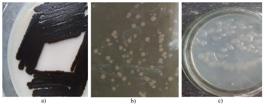
Bacterial strains on nutrient media (a) Azotobacter chroococcum MDC 6111 on Ashby agar; (b) Paenibacillus polymyxa MDC 280 on meat-peptone agar; (c) Rhizobium leguminosarum MDC 5609 on Bean agar.
Paenibacillus polymyxa strain MDC 280 was isolated from chernozem samples in Armenia. Gram-positive bacterium. Vegetative cells are large, rod-shaped, mobile. Spores are cylindrical, located subterminally, sporangia are weakly inflated. Cell size: 2.0-5.0 x 0.6-0.8 μm. Aerobe. Forms whitish colonies on meat-peptone agar. Optimum growth temperature is 30-350C. Paenibacillus polymyxa culture actively fixes nitrogen, solubilizes phosphates (up to 280 mg/l Ca3(PO4)2 per day). Does not grow at pH 5.7, withstands NaCl concentrations up to 7.0%. Has a pronounced bactericidal and fungicidal effect.
Maintenance on a nutrient medium meat-peptone agar (g/l): peptone – 10.0, starch – 10.0, NaCl – 5.0, agar (if necessary) – 20.0. Meat broth – 1 l. pH 7.2–7.4 (Figure 1b).
The strain Rhizobium leguminosarum MDC 5609 was isolated from a pea nodules (brown soil, 1000 m above sea level, Noragavit region, Armenia). Gram-negative, motile, polymorphic rods, 1.5-5.0 x 0.6-0.7 µm in size. On an agar nutrient medium, it forms spherical colonies with a smooth edge. Colonies in a daily culture are homogeneous, then finely granular. Aerobe. Optimum growth temperature is 27-28°C. Active nitrogen fixer. Increases the yield of pea seeds by 15.0-24.0%.
Maintenance on nutrient media: YEMA (Yeast Extract Mannitol Agar) (g/l): K2HPO4 - 0.5; Mg SO4 - 0.2; NaCl - 0.1; CaCO3 - 4.0; mannitol-10.0; yeast extract-1.0; distilled water; pH 6.8-7.0.
Bean agar (g/l): Beans (or peas) – 5.0, K2HPO4 - 0.5, sucrose – 10.0, agar – 20.0 (Figure 1c).
Mesorhizobium ciceri strain MDC 6048, symbiotic root nodule bacterium, host plant - chickpea (Cicer arietinum L., 1753), isolated from brown soil, Gyumri, Armenia. Gram-negative, singly, in pairs or in chains arranged rods, 1.1-2.8 x 0.5-0.6 µm in size, motile. On agar nutrient medium forms round, white, slimy, convex, 1-1.5 mm in size colonies with smooth edges, pigmentation of the medium is not expressed. Aerobe. Optimum growth temperature 27-280C. Active nitrogen fixer. Increases chickpea seed yield by 12.5-18.0% (Harutyunyan et al., 2018).
Maintenance on a nutrient media: YEMA аnd Bean agar.
Bradyrhizobium japonicum strain MDC 5789 isolated from soybean nodules (loamy carbonate soil, Tavush district, Armenia). Gram-negative, motile, polymorphic rods, 3.2-1.2x0.6-0.5 µm in size. Forms spherical colonies with smooth edges on agar nutrient medium. White in color with 1-2 inclusions. Optimum growth temperature 27-280C. Active nitrogen fixer. Increases soybean yield by 22.8-35.0%.
Maintenance on a nutrient media: YEMA.
2.2. Inoculation method
Pre-sowing seed treatment was carried out with a suspension of bacteria with a titer of 109 CFU/ml. A suspension of A. chroccoccum, P. polymyxa cultures and a mixture of R. leguminosarum, M. ciceri, B. japonicum strains was offered in the following parts 10:1:1, respectively. Root crops were inoculated together with perlite. Barley seeds, tomato and pepper seedlings were treated for 40 min with a suspension of this mixture as a soaking before cultivation. Also, the suspension mixture was added at the rate of 20 ml per seedling once after 21 days of cultivation.
2.3. Analysis of the physicochemical properties of the experimental soil
The content of plant-available nutrients in soil extracts was determined using a spectrophotometric soil analyzer - LASA AGRO 3900 Step Systems (Soil Testing Equipment - Professional Systems, Germany, 2022) according to the instructions for the corresponding test cuvettes.
The determination of soil pH was carried out using a colorimetric method based on the change in color of a number of indicators (Piskunov,2004; Gabibov et al., 2020).
Mobile phosphorus in the soil was determined using the Machigin method (Glukhikh, 2023). Available phosphorus from carbonate soils was extracted with a 1% solution of ammonium carbonate.
The determination of exchangeable potassium was carried out by precipitation of a minimum amount of potassium with cobalt nitrite using the Maslova method (Piskunov,2004). The method is based on the extraction of potassium from the soil with a solution of CH3COONH4 (with a concentration of 1 mol/dm3) at a soil to solution ratio of 1:10 and subsequent determination of potassium in the extract using a flame photometer.
The number of mobile forms of nitrogen in the soil was determined by hydrolysis using 0.5 N sulfuric acid. 50% NaOH was used for titration (Kallas et al., 2020). The total nitrogen content was determined by the Kjeldahl method (Aguirre, 2023).
The data obtained were statistically analyzed according to the method described by Gomez and Gomez (1984).
3. Results
The collection fund of nitrogen-fixing (free-living and symbiotrophic) and phosphate-solubilizing bacteria of the Microbial Depository Center exceeds 600 strains, however, to solve the practical aim of the research, the decisive role in the selection of target cultures was determined by their origin (isolation substrates: soil types, their climatic and geographical position, host plant), morphological, cytological, physiological, cultural, biochemical characteristics, etc. All strains were previously isolated from arid, uncultivated soils of Armenia and studied in the Laboratory of Alternative Energy Sources. As a result, the following strains were selected to form a promising consortium of soil fertilizers: A. chroococcum, P. polymyxa, R. leguminosarum, M. ciceri and B. japonicum, each of which has a practical purpose of performing a specific function in the association. It is important to note that the symbiotic bacteria Rhizobium, Mesorhizobium and Bradyrhizobium in the preparation, in addition to their main function - nitrogen fixation, are considered by us as solubilizers of inorganic phosphorus (Panosyan and Babayan, 1965). This process occurs due to a decrease in the pH of the medium, due to the extrusion of the H+ ion and the release of low-molecular organic acids that chelate the bound cations.
We studied the influence of the associative action of the consortium cultures on the morphometric and growth characteristics of a number of crops and vegetables of barley (Hordeum vulgare L.), corn (Zea mays L.), sunflower (Helianthus annuus L.), beet (Beta vulgaris L.), tomatoes (Solanum lycopersicum L.), pepper (Capsicum annuum L.) in open ground conditions.
Field work was carried out on the experimental site of the Scientific and Production Center “Armbiotechnology” of the NAS RA in the sowing seasons of 2023/2024 with 2-fold replication. Pre-sowing agrochemical analysis of the soil showed that it is light loamy in mechanical composition and is classified as a brown, semi-desert type. The soil was characterized by a relatively low content of the organic layer - 2.73%, low salinity - 0.092%, low concentration of carbonates (0.67 mg-eq/100 g) and sulfates (0.07 mg-eq/100 g), as well as various content indicators for soils of this type of essential nutrients: mobile forms of nitrogen (NO3-) - 30.2 mg-eq/100 g, phosphorus (PO43-) - 14.0 mg-eq/100 g and potassium (K+) - 14.7 mg-eq/100 g (Table 1a).
Summary agrochemical characteristics of soil samples before (1a), during growth (1b) and after harvest (1c) of experimental crops.
During plant growth, significant changes in the agrochemical parameters of the soil are observed (Table 1b). According to the analysis results, the increase in the organic layer content from 2.73 to 5.79%, in our opinion, occurs due to not only natural microbiological processes associated with the decomposition of plant matter residues (seeds, leaves, etc.), but also with the active participation of the introduced microorganism cultures. During the plant growth period, an increase in mobile nitrogen forms (NO3-) was revealed - 71.9 mg-eq / 100 g and soil saturation with molecular nitrogen - up to 16.2 mg / 100 g. At the same time, the content of phosphorus salts (P2O5, PO43-) and potassium (K +) decreases to 2.86, 3.82 and 5.86 mg-eq /100 g, respectively. Thus, the content of the immobile form of potassium (K2O) decreases by about 3 times, and the amount of immobile phosphorus (P2O5) - by 3.63 times. Undoubtedly, these processes in the soil are caused by the activity of phosphate-solubilizing bacteria, as well as by the uptake of these ions by plants. At the same time, the nitrogen content (N) increases by 2.38 times, and its mineralized form - NO3- by 3.0 times, respectively.
At the end of the vegetation period of plants and harvesting, the soil was also analyzed (Table 1c). In addition to the usual indicators, the content of heavy metals Zn and Cu was additionally determined. Their concentration fluctuated, respectively, within the range of 1.12-1.48 mg-eq/100 g of sample, which is generally comparable with the available literature data for semi-desert brown soil types. In such quantities, these metals can be used by plants as growth stimulants. The content of the organic layer in soil samples treated with the biopreparation at different stages of vegetation fluctuated between 5.79 and 2.98%, which indicates active processes occurring in the soil with the use of the biopreparation, especially since humification is a cyclic and dynamic process characterized by maintaining a balance between the formation of the organic layer (humus) and its decomposition. Also at the end of the growing season, a significant increase in sulfate ions (SO42-) from 0.09 to 35.0 mg-eq/100 g in the soil without the use of the biopreparation, and up to 39.1 mg-eq/100 g - with the biopreparation is noted. Sulfur is actively involved in oxidation-reduction processes and promotes nitrogen fixation from the atmosphere. Lack of sulfates is the main reason for the decrease in soil fertility, especially in soil with a non-leaching water regime. The source of sulfate accumulation in the soil is sulfuric acid, and as a consequence, an increase in soil acidity, which is observed in our experiments.
At the end of the growing season, as a result of using the biopreparation, the content of ions available to plants in mg/100 g of the sample as a whole and compared to the control increased significantly: N from 2.51 to 4.43 mg/100 g, PO4 - from 18.99 to 29.51, K - from 14.0 to 28.9, respectively (Table 1c). It is also necessary to pay attention to changes in soil pH at the end of field tests, as one of the factors of oxidation-reduction processes in the soil with the participation of the microbial communities we tested, taking into account the specific activity of the experimental plants themselves (Table 2).
Phenological observations and harvest records of the experimental plant groups were conducted throughout the growing season. Plant growth indices expressed as plant height, average number of grains and seeds, average weight of tomatoes, root crops and maize cobs depending on the use of the studied consortium strains or without them are presented in Tables 3 - 8, from which it follows that in all experimental variants the yield increase compared to the control was significant. Table 3 presents the results of the effect of the biopreparation on the barley plant, from which it is evident that the biopreparation, including in combination with perlite, contributes to an increase in the number of grains in an ear by almost 1.5-2 times. Also, the plants treated with the biopreparation significantly exceeded the control plants in 1000-grain weight (69.5-73.5 g and 37.1-41.7 g, respectively).
Particularly impressive results were obtained when treating beet crops with biopreparation. In the experimental groups, the plants compare favorably with the control ones both in height and green mass weight, and in the weight of mature root crops (Table 4).
Similar results were obtained when testing the biopreparation on bell pepper and tomato plants (Tables 5 and 6). In both cases, the plants treated with the biopreparation surpassed the control plants to varying degrees in the comparatively short flowering phase, height and average weight of fruits. The beet, bell pepper and tomato plants were favorably distinguished by an advance in flowering by 20 days, height and strength of stems, weight, quantity and ripening rate of fruits, which is consistent with the results of other studies on the growth-promoting effect of strains nitrogen-fixing bacteria on the development of the aforementioned agricultural crops (Barakat and Gabr, 1998; Islam et al., 2013).
The studies also showed that biopreparation had a positive effect on the growth and productivity properties of maize (Table 7). The data obtained indicate a stable increase in yield, which is expressed in the average plant height in the flowering (86.3-89.2 cm) and fruiting (127.8-130.1 cm) phases, and the weight of cobs in the wax ripeness phase (87.5-95.7 g).
Analysis of the data in Table 8 shows that when treating sunflower seeds with the claimed composition of the biopreparation, the germination energy and viability of plants increase by 10-12%, while there is a significant increase in the average height of stems in the flowering phase by 10-11% and the weight of 1000 seeds by 42%.
4. Discussion
Thus, as a result of the experiments it was established that the combinations of free-living A. chroococcum MDC 6111, P. polymyxa MDC 280 and symbiotrophiic nitrogen-fixing bacteria R. leguminosarum MDC 5609, M. ciceri MDC 6048, B. japonicum MDC 5789 included in the composition of the biopreparation depending on the type of crops, reliably increase the supply of nitrogen and phosphorus to plants, thereby significantly increasing the yield. It should be noted that in the formula of the biofertilizer, the strains of A. chroococcum and P. polymyxa are unchanged components, and the nodule symbiotic bacteria are included depending on the type of agricultural crop, taking into account the specificity of these bacteria to plants. In this case, both the nitrogen-fixing capacity and the phosphate-mobilizing activity of these bacteria were taken into account, each of which has a practical purpose of performing a specific function in the association (Harutyunyan et al., 2024; Khachatryan et al., 2023).
The positive effect of the A. chroococcum strain is due to their ability to solubilize plant nutrients, fix free nitrogen in the air under aerobic conditions, and the water-soluble pigment of the microorganism melanin, according to research, protects the nitrogenase enzyme system from the effects of oxygen (Spaink et al., 2012; Wani et al., 2013). The P. polymyxa MDC 280 strain lives in the rhizosphere of plants, forming a biofilm and takes part in the bioprotection of plants, in addition, it produces a group of polymyxin antibiotics with bactericidal and fungicidal activity, and also has significant phosphate solubilizing activity, also possessing some nitrogen-fixing activity. Their adhesive ability was also taken into account, which made it possible to do without additional adhesives. It is important to note that the symbiotic bacteria Rhizobium, Mesorhizobium and Bradyrhizobium in the preparation, in addition to their main function - nitrogen fixation, are considered by us as solubilizers of inorganic phosphorus. This process occurs due to a decrease in the pH of the medium, due to the displacement of the H+ ion and the release of low-molecular organic acids that chelate the bound cations (Siddiqui et al., 2014; Ruzzi and Aroca, 2015).
The improving effect of mixed biofertilizers is due to the fact that the microorganisms included in the preparation enter into synergistic relationships with each other, thereby fixing more nitrogen than if a monoculture is used. Microorganisms, in the process of metabolism, increase the efficiency of obtaining soluble salts of phosphorus, potassium and calcium by plants (Badawy et al., 2003; Salim et al., 2007; Saleh et al., 2007; Siddiqui et al., 2014;). According to Bhattacharyya and Jha (2012), Ansari et al. (2017), Wani and Gopalakrishnan (2019), physiologically active substances secreted by microorganisms stimulate the growth and development of plants, as a result of which crop ripening is achieved 12-20 days earlier compared to the control options. The use of biopreparation also improves the content of the organic component of the soil, thereby helping to restore the ecological balance of the soil (Sumbul et al., 2020). To improve the results obtained, a study on the introduction of cyanobacteria of the genus Nostoc into the composition of mixed biofertilizers seems promising (Abdel-Galeil et al, 2022).
5. Conclusion
The concept of sustainable agricultural development is aimed at reducing the use of chemical fertilizers. The transition to chemical-free agriculture with an emphasis on the zero-use approach is ongoing. Since the use of chemical fertilizers is a significant environmental problem, one of the possible solutions to overcome this problem is the study of biological approaches, particularly the use of nitrogen-fixing microorganisms.
Based on the data obtained, it can be concluded that the composition we created is of great agricultural significance, since it can be used to increase the yield of numerous agricultural crops, including cereals, vegetables, oilseeds, root crops, and legumes.
Thus, as a result of the experiments, it was established that the tested soil bacteria actively adhere to seeds and seedlings, and, spreading in the rhizosphere of plants, contribute to the effective action of the biopreparation.
The microorganisms included in the preparation enter into synergistic relationships with each other, thereby fixing more nitrogen than if a monoculture is used.
In association with plant roots, they receive the necessary nutrients for their vital activity (sugars, organic acids, etc.) from root secretions, microorganisms, in the process of metabolism, increase the efficiency of obtaining soluble salts of phosphorus, potassium and calcium by plants.
Physiologically active substances secreted by microorganisms stimulate the growth and development of plants, as a result of which the ripening of the crop is achieved earlier compared to the control options.
Acknowledgements
The work was supported by the Organic agriculture laboratory of the Armenian National Agrarian University of the Ministry of ESCS. This research was funded by the Science Committee of the Ministry of ESCS of Armenia (grant number 23EDP-4D003).
Data Availability Statement
All data generated or analyzed during this study is included in this published article.
References
- ABDEL-GALEIL, L., AREF, E. and MONA, M. 2022. Comparison between nitrogen biofertilizers source (blue green algae and bacteria) on growth of date palm plantlets (Phoenix dactylifera Malacabe) during acclimatization stage. Acta Horticulturae, vol. 1371, pp. 295-304. https://doi.org/10.17660/ActaHortic.2023.1371.41.
- AGUIRRE, J., 2023. The Kjeldahl method: 140 years Cham: Springer Cham, pp. 53-78.
-
ANSARI, R., RIZVI, R., SUMBUL, A. and MAHMOOD, I., 2017. PGPR: current vogue in sustainable crop production. In: V. KUMAR, M. KUMAR, S. SHARMA and R. PRASAD, eds. Probiotics and plant health Singapore: Springer, pp. 455-472. http://doi.org/10.1007/978-981-10-3473-2_21
» http://doi.org/10.1007/978-981-10-3473-2_21 -
ASERI, G., JAIN, N., PANWAR, J., RAO, A. and MEGHWAL, P., 2008. Biofertilizers improve plant growth, fruit yield, nutrition, metabolism and rhizosphere enzyme activities of pomegranate (Punica granatum L.) in Indian Thar Desert. Scientia Horticulturae, vol. 117, no. 2, pp. 130-135. http://doi.org/10.1016/j.scienta.2008.03.014
» http://doi.org/10.1016/j.scienta.2008.03.014 - BADAWY, F., EL DSOUKY, M., SADIEK, H. and ABO BAKER, A., 2003. Response of tomato to inoculation with single and multi-strain inoculants of different bacterial species. Assiut Journal of Agricultural Sciences., vol. 34, no. 5, pp. 275-286.
- BARAKAT, M. and GABR, S., 1998. Effect of different biofertilizer types and nitrogen fertilizer levels on tomato plants. ALEXJA, vol. 43, pp. 149-160.
-
BEHL, R., SHARMA, H., KUMAR, V. and NARULA, N., 2003. Interactions amongst mycorrhiza, Azotobacter chroococcum and root characteristics of wheat varieties. Journal Agronomy & Crop Science, vol. 189, no. 3, pp. 151-155. http://doi.org/10.1046/j.1439-037X.2003.00026.x
» http://doi.org/10.1046/j.1439-037X.2003.00026.x -
BHATTACHARYYA, P.N. and JHA, D., 2012. Plant growth-promoting rhizobacteria (PGPR): emergence in agriculture. World Journal of Microbiology & Biotechnology, vol. 28, no. 4, pp. 1327-1350. http://doi.org/10.1007/s11274-011-0979-9 PMid:22805914.
» http://doi.org/10.1007/s11274-011-0979-9 - CHHONKAR, P., PAREEK, R., RAO, D. and ADIYA, T., 2009. Soil biology and biochemistry: fundamentals of soil science New Delhi: Indian Society of Soil Science, pp. 535-565.
- DASHADI, M., KHOSRAVI, H., MOEZZI, A., NADIAN, H., HEIDARI, M. and RADJABI, R., 2011. Co-inoculation of Rhizobium and Azotobacter on growth indices of faba bean under water stress in the green housegreenhouse condition. Advanced Studies in Biology, vol. 3, pp. 373-385.
-
DI BENEDETTO, N., CORBO, M., CAMPANIELLO, D., CATALDI, M., BEVILACQUA, A., SINIGAGLIA, M. and FLAGELLA, Z., 2017. The role of plant growth promoting bacteria in improving nitrogen use efficiency for sustainable crop production: a focus on wheat. AIMS Microbiology, vol. 3, no. 3, pp. 413-434. http://doi.org/10.3934/microbiol.2017.3.413 PMid:31294169.
» http://doi.org/10.3934/microbiol.2017.3.413 - DIAZ-BARRERA, A. and SOTO, E., 2010. Biotechnological uses of Azotobacter vinelandii: current state, limits and prospects. African Journal of Biotechnology, vol. 9, no. 33, pp. 5240-5250. http://doi.org/10.5897/AJB10.025.
- EL-DSOUKY, M., BADAWY, F. and SADIEK, H., 2003. Response of soybean to mixed inoculations with Bradyrhizobium and rhizobacteria. Assiut Journal of Agricultural Sciences., vol. 34, no. 5, pp. 287-300.
-
FIGUEIREDO, M., BURITY, H., MARTINEZ, C. and CHANWAY, C., 2008b. Alleviation of drought stress in the common bean (Phaseolus vulgaris L.) by co-inoculation with Paenibacillus polymyxa and Rhizobium tropici. Applied Soil Ecology, vol. 40, no. 1, pp. 182-188. http://doi.org/10.1016/j.apsoil.2008.04.005
» http://doi.org/10.1016/j.apsoil.2008.04.005 -
FIGUEIREDO, M., MARTINEZ, C., BURITY, H. and CHANWAY, C., 2008a. Plant growth-promoting rhizobacteria for improving nodulation and nitrogen fixation in the common bean (Phaseolus vulgaris L.). World Journal of Microbiology & Biotechnology, vol. 24, no. 7, pp. 1187-1193. http://doi.org/10.1007/s11274-007-9591-4
» http://doi.org/10.1007/s11274-007-9591-4 -
GABIBOV, M., VINOGRADOV, D., BYSHOV, N. and FADKIN, G., 2020 [viewed 25 November 2024]. Agrochemistry textbook [online]. Ryazan: Ryazan State Agrotechnological University, 404 p. Available from: https://e.lanbook.com/book/164063
» https://e.lanbook.com/book/164063 -
GALLEGUILLOS, C., AGUIRRE, C., BAREA, J. and AZCÓN, R., 2000. Growth promoting effect of two Sinorhizobium meliloti strains (a wild type and its genetically modified derivative) on a non-legume plant species in specific interaction with two arbuscular mycorrhizal fungi. Plant Science, vol. 159, no. 1, pp. 57-63. http://doi.org/10.1016/S0168-9452(00)00321-6 PMid:11011093.
» http://doi.org/10.1016/S0168-9452(00)00321-6 - GLUKHIKH, M., 2023. Agrochemistry 2nd ed. St. Petersburg: Publishing House Lan, 132 p.
- GOMEZ, K. and GOMEZ, A., 1984. Statistical procedures for agricultural research 2nd ed. New York: John Wiley and Sons, 680 p.
-
GOTHANDAPANI, S., SEKAR, S. and PADARIA, J., 2017. Azotobacter chroococcum: Utilization and potential use for agricultural crop production: an overview. International Journal of Advanced Research in Biological Sciences, vol. 4, no. 3, pp. 35-42. http://doi.org/10.22192/ijarbs.2017.04.03.004
» http://doi.org/10.22192/ijarbs.2017.04.03.004 - HADI, F. and BANO, A., 2010. Effect of diazotrophs (Rhizobium and Azatebactor) on growth of maize (Zea mays L.) and accumulation of lead (Pb) in different plant parts. Pakistan Journal of Botany, vol. 42, no. 6, pp. 4363-4370.
- HARUTYUNYAN, S., STEPANYAN, T., HAKOBYAN, V. and GOGINYAN, V., 2021. Growth characteristics of salt-tolerant nodule bacteria. In: International Scientific and Practical Conference Biotechnology: Science and Practice, Innovation and Business, 20-22 October 2021, Yerevan, Armenia. Yerevan: Yerevan State University, pp. 43-48.
- HARUTYUNYAN, S.H., STEPANYAN, T.H., MATEVOSYAN, F.S. and HAKOBYAN, V.P., 2018. Productivity of biofertilizer Rhizօmix for peas (Pisum sativum) and chickpeas (Cicer arietinum). In: 4th International Scientific and Practical Conference of Young Scientists and Specialists: “Ecological-biological problems of the use of natural resources in agriculture”, 20-21 April 2018, Moscow. Moscow: HSE University, pp. 26-33.
-
HARUTYUNYAN, S., STEPANYAN, T., KHACHATRYAN, G. and GOGINYAN, V., 2024. Biodiversity, spreading and practical appliance of nodule bacteria in Armenia: Review. In: R.P. SINGH, S. SARSAN, H. PANOSYAN, G. MANCHANDA and A. KUMAR, eds. Microbial essentialism: an industrial prospective Cambridge: Academic Press, pp. 419-442. http://doi.org/10.1016/B978-0-443-13932-1.00007-6
» http://doi.org/10.1016/B978-0-443-13932-1.00007-6 -
IBRAHIM, H. and EL-SAWAH, A., 2022. The mode of integration between azotobacter and rhizobium affect plant growth, yield, and physiological responses of pea (Pisum sativum L.). Journal of Soil Science and Plant Nutrition, vol. 22, no. 2, pp. 1238-1251. http://doi.org/10.1007/s42729-021-00727-2
» http://doi.org/10.1007/s42729-021-00727-2 -
ISLAM, M., SULTANA, T., JOE, M., YIM, W., CHO, J. and SA, T., 2013. Nitrogen-fixing bacteria with multiple plant growth-promoting activities enhance growth of tomato and red pepper. Journal of Basic Microbiology, vol. 53, no. 12, pp. 1004-1015. http://doi.org/10.1002/jobm.201200141 PMid:23553337.
» http://doi.org/10.1002/jobm.201200141 -
JANA, B., CHATTOPADHYAY, R., DAS, R. and KANTHAL, S., 2024. Bio-fertilizer: an alternative to chemical fertilizer in agriculture. International Journal of Research in Agronomy, vol. 7, no. 4, pp. 144-149. http://doi.org/10.33545/2618060X.2024.v7.i4c.539
» http://doi.org/10.33545/2618060X.2024.v7.i4c.539 - JNAWALI, A., OJHA, R. and MARAHATTA, S., 2015. Role of Azotobacter in soil fertility and sustainability: a review. Advances in Plants & Agriculture Research, vol. 2, no. 6, pp. 00069. http://doi.org/10.15406/apar.2015.02.00069.
- KALLAS, E., NOVIKOVA, A. and VALEVICH, T., 2020. Determination of quantitative and qualitative characteristics of humus by various methods and interpretation of the results obtained: methodical instructions Tomsk: Tomsk State University Publishing House, 55 p.
-
KHACHATRYAN, G., STEPANYAN, T., HARUTYUNYAN, S. and GOGINYAN, V., 2023. Isolation of fenugreek nodule bacteria from arid and uncultivated soils and their impact on hostplants. Reports of NAS RA, vol. 2, no. 123, pp. 60-67. http://doi.org/10.54503/0321-1339-2023.123.2-60
» http://doi.org/10.54503/0321-1339-2023.123.2-60 - KIZILKAYA, R., 2009. Nitrogen fixation capacity of Azotobacter spp strains isolated from soils in different ecosystems and relationship between them and the microbiological properties of soils. Journal of Environmental Biology, vol. 30, no. 1, pp. 73-82. PMid:20112866.
- KURREY, D., SHARMA, R., LAHRE, M. and KURREY, R., 2018. Effect of Azotobacter on physio-chemical characteristics of soil in onion field. Pharma Inn. J., vol. 7, no. 2, pp. 108-113.
- MALKHASYAN, A., 2002. Specific physiological and biochemical peculiarities of bacteria of Bacillus polymyxa species. Biological Journal of Armenia, vol. 51, no. 1-2, pp. 163-164.
- MATEVOSYAN, F., HARUTYUNYAN, S., ALEKSANYAN, N. and STEPANYAN, T., 2003. Methods of conservation of nodule bacteria cultures. Biological Journal of Armenia, vol. 55, no. 4, pp. 316-323.
- MATEVOSYAN, F., HARUTYUNYAN, S., STEPANYAN, T. and HAKOBYAN, V., 2019. The possibility of using nodule bacteria stored on different substrates in order to improve the ecological balance of the soil. In: Material of the V International Scientific and Practical Conference Young Scientists and Specialists, 8-9 November 2019, Pavlodar. Pavlodar: Innovative University of Eurasia, pp. 125-139.
- MATEVOSYAN, F., HARUTYUNYAN, S., STEPANYAN, T. and ALEKSANYAN, N., 2013. Root sap as Exogenous factor for the adhesion of nodule bacteria. Biological Journal of Armenia, vol. 65, no. 4, pp. 30-34.
- MELKONYAN, J. and BUDAGYAN, E., 1981. Antagonistic effect of Azotobacter on phytopathogenic fungi and bacteria. Microbiological Proceedings, vol. 8, pp. 78-83.
- NIKOGHOSYAN, V. and BAGDASARYAN, I., 2004. On composition and activity of nitrogen fixation of communities of nitrogen-fixing microorganisms. Biological Journal of Armenia, vol. 56, no. 3-4, pp. 247-250.
- NIKOGHOSYAN, V., 1981. On some peculiarities of determination of nitrogenase activity of Azotobacter by Acetylenes. Biological Journal of Armenia, vol. 34, no. 3, pp. 269-273.
- NIKOGHOSYAN, V., 1982. About the dynamics of nitrogenase activity and protein synthesis in the process of development of Azotobacter. Biological Journal of Armenia, vol. 35, no. 10, pp. 358-359.
- NIKOGHOSYAN, V. and BAGDASARYAN, I., 2009. About the presence of microorganisms transforming the phosphorus compounds in the nitrogen-fixing communities. Biological Journal of Armenia, vol. 61, no. 1, pp. 72-74.
- NIKOGHOSYAN, V. and BAGDASARYAN, I., 2003. Distribution of the nonsymbiotic nitrogen- fixers in the root zone of leguminous plants. Biological Journal of Armenia, vol. 55, no. 1-2, pp. 45-49.
- PADDA, K., PURI, A. and CHANWAY, C., 2017a. Paenibacillus polymyxa: a prominent biofertilizer and biocontrol agent for sustainable agriculture. In: V.S. MEENA, P.K. MISHRA, J.K. BISHT and A. PATTANAYAK, eds. Agriculturally important microbes for sustainable agriculture volume 2: applications in crop production and protection Singapore: Springer Nature Singapore, pp. 165-191. https://doi.org/10.13560/j.cnki.biotech.bull.1985.2008.01.030.
-
PADDA, K., PURI, A., ZENG, Q., CHANWAY, C. and WU, X., 2017b. Effect of GFP-tagging on nitrogen fixation and plant growth promotion of an endophytic diazotrophic strain of Paenibacillus polymyxa. Botany, vol. 95, no. 9, pp. 933-942. http://doi.org/10.1139/cjb-2017-0056
» http://doi.org/10.1139/cjb-2017-0056 - PANOSYAN, A.K. and BABAYAN, G.S., 1965. Phosphatase activity as one of the species-specific features of phosphorobacteria. Reports NAS RA, vol. 1, no. 40, pp. 61-64.
-
PETERSEN, D.J., SRINIVASAN, M. and CHANWAY, C., 1996. Bacillus polymyxa stimulates increased Rhizobium etli populations and nodulation when co-resident in the rhizosphere of Phaseolus vulgaris. FEMS Microbiology Letters, vol. 142, no. 2-3, pp. 271-276. http://doi.org/10.1111/j.1574-6968.1996.tb08442.x PMid:8810510.
» http://doi.org/10.1111/j.1574-6968.1996.tb08442.x - PISKUNOV, A., 2004. Methods of agrochemical research Moscow: Publishing House Kolos, 312 p.
- PRAJAPATI, K., YAMI, K. and SINGH, A., 2008. Plant growth promotional effect of Azotobacter chroococcum, Piriformospora indica and vermicompost on rice plant. NAST, vol. 9, pp. 85-90. http://doi.org/10.3126/njst.v9i0.3170.
-
RODELAS, B., GONZÁLEZ-LÓPEZ, J., MARTÍNEZ-TOLEDO, M., POZO, C. and SALMERÓN, V., 1999. Influence of Rhizobium/Azotobacter and Rhizobium/Azospirillum combined inoculation on mineral composition of faba bean (Vicia faba L.). Biology and Fertility of Soils, vol. 29, no. 2, pp. 165-169. http://doi.org/10.1007/s003740050540
» http://doi.org/10.1007/s003740050540 -
RUZZI, M. and AROCA, R., 2015. Plant growth-promoting rhizobacteria act as biostimulants in horticulture. Scientia Horticulturae, vol. 196, pp. 124-134. http://doi.org/10.1016/j.scienta.2015.08.042
» http://doi.org/10.1016/j.scienta.2015.08.042 -
SALEH, M., DARWISH, F. and HANNA, M., 2007. Effect of different types and levels of organic fertilizers combined with biofertilizers on growth and yield of tomato grown in sandy soil. Journal of Agricultural Science, vol. 32, no. 7, pp. 5553-5568. http://doi.org/10.21608/jpp.2007.219776
» http://doi.org/10.21608/jpp.2007.219776 - Salim, E., Abu El-fotoh, H., EL-MANCY, M., 2007. Productivity of tomato plants treated with some biological, organic and inorganic fertilizers. Egypt. Journal of Soil Science, vol. 47, no. 3, pp. 215-231.
- SIDDIQUI, A., SHIVLE, R., MAGODIYA, N. and TIWARI, K., 2014. Mixed effect of Rhizobium and Azotobacter as biofertilizer on nodulation and production of chickpea, Cicer arietinum. Bioscience Biotechnology Research Communications, vol. 7, pp. 46-49.
- SOLEIMANZADEH, H. and GOOSHCHI, F., 2013. Effects of Azotobacter and nitrogen chemical fertilizer on yield and yield components of wheat (Triticum aestivum L.). World Applied Sciences Journal, vol. 21, no. 8, pp. 1176-1180. http://doi.org/10.5829/idosi.wasj.2013.21.8.2702.
- SPAINK, H., 1998. Flavonoids as regulators of plant development: new insights from studies of plant-Rhizobia interactions. In: J.T. ROMEO, K.R. DOWNUM and R. VERPOORTE, eds. Phytochemical signals and plant-microbe interactions Boston: Springer US, pp. 167-177.
-
SPAINK, H.P., 2002. Plant-microbe interactions: a receptor in symbiotic dialogue. Nature, vol. 417, no. 6892, pp. 910-911. http://doi.org/10.1038/417910a PMid:12087390.
» http://doi.org/10.1038/417910a -
SPAINK, H., KONDOROSI, A. and HOOYKAAS, P., 2012 [viewed 25 November 2024]. The Rhizobiaceae: molecular biology of model plant-associated bacteria [online]. London: Springer Science & Business Media, 566 p. Available from: https://link.springer.com/book/10.1007/978-94-011-5060-6
» https://link.springer.com/book/10.1007/978-94-011-5060-6 - STEPANYAN, T., ALEKSANYAN, N., MATEVOSYAN, F. and HARUTYUNYAN, S., 2010a. Influence of nodule bacteria in association with soil microorganisms on nitrogen fixation. Biological Journal of Armenia, vol. 58, no. 1-2, pp. 41-47.
- STEPANYAN, T., HARUTYUNYAN, S., ALEKSANYAN, N., MATEVOSYAN, F. and HAKOBYAN, J., 2010b. Use of nodule bacteria in association with free-living soil bacteria to inoculation non-legume plants. Biological Journal of Armenia, vol. 62, no. 3, pp. 86-90.
- STEPHAN, M.P., PEDROSA, F.O. and DÖBEREINER, J., 1981. Physiological studies with Azospirillum spp. In: P.B. VOSE and A.P. RUSCHEL, eds. Associative N2 fixation Boca Raton: CRC Press, pp. 7-13.
-
SUMBUL, A., ANSARI, R., RIZVI, R. and MAHMOOD, I., 2020. Azotobacter: A potential bio-fertilizer for soil and plant health management. Saudi Journal of Biological Sciences, vol. 27, no. 12, pp. 3634-3640. http://doi.org/10.1016/j.sjbs.2020.08.004 PMid:33304174.
» http://doi.org/10.1016/j.sjbs.2020.08.004 - VADAKATTU, G. and PATERSON, J., 2006. Free-living bacteria lift soil nitrogen supply. Farming Ahead, vol. 169, pp. 40.
-
VANCE, C.P., 2001. Symbiotic nitrogen fixation and phosphorus acquisition. Plant nutrition in a world of declining renewable resources. Plant Physiology, vol. 127, no. 2, pp. 390-397. http://doi.org/10.1104/pp.010331 PMid:11598215.
» http://doi.org/10.1104/pp.010331 -
VANCE, C. and GRAHAM, P., 1995. Nitrogen fixation in agriculture: application and perspectives. In: I.A. TIKHONOVICH, N.A. PROVOROV, V.I. ROMANOV and W.E. NEWTON, eds. Nitrogen fixation: fundamentals and applications Dordrecht: Springer, pp. 77-86. http://doi.org/10.1007/978-94-011-0379-4_10
» http://doi.org/10.1007/978-94-011-0379-4_10 - VLASSAK, K. and REYNDERS, R., 1979. Agronomic aspects of biological dinitrogen fixation by Azospirillum spp. In Associative N2 fixation In: P. B. VOSE and A. P. RUSCHEL, eds. Boca Raton: CRC Press, pp. 93-102.
-
WANI, S., CHAND, S. and ALI, T., 2013. Potential use of Azotobacter chroococcum in crop production: an overview. Current Agriculture Research Journal, vol. 1, no. 1, pp. 35-38. http://doi.org/10.12944/CARJ.1.1.04
» http://doi.org/10.12944/CARJ.1.1.04 -
WANI, S., CHAND, S., WANI, M., RAMZAN, M. and HAKEEM, K., 2016. Azotobacter chroococcum a potential biofertilizer in agriculture: an overview. In: K. HAKEEM, J. AKHTAR and M. SABIR, eds. Soil science: agricultural and environmental prospectives Cham: Springer, pp. 333-348. http://doi.org/10.1007/978-3-319-34451-5_15
» http://doi.org/10.1007/978-3-319-34451-5_15 -
WANI, S. and GOPALAKRISHNAN, S., 2019. Plant growth-promoting microbes for sustainable agriculture. In: R. SAYYED, M. REDDY, S. ANTONIUS, eds. Plant Growth Promoting Rhizobacteria (PGPR): prospects for sustainable agriculture Singapore: Springer, pp. 19-45. http://doi.org/10.1007/978-981-13-6790-8_2
» http://doi.org/10.1007/978-981-13-6790-8_2 -
WERNER, D. and NEWTON, W., 2005. Nitrogen fixation in agriculture, forestry, ecology and the environment London: Springer Science & Business Media, 350 p. http://doi.org/10.1007/1-4020-3544-6
» http://doi.org/10.1007/1-4020-3544-6
Edited by
-
Editor:
Takako Matsumura Tundisi