 Phosphate solubilization capacity by bacteria in soybean crops
Abstract
The availability of phosphorus (P) to plants is reduced by its binding to solid mineral and soil organic particles. However, phosphate-solubilizing microorganisms can increase nutrient availability by secreting extracellular enzymes such as fosfatases. The objective was to evaluate the phosphate solubilization capacity of bacteria coinoculated in soybean crops. Soybean plants were grown in nutrient solution in a combination of treatments of bacteria inoculated into the seeds [Bradyrhizobium japonicum (Brady); Brady + Pseudomonas fluorescens (Pf); Brady + Bacillus megaterium (Bm) + Bacillus subtilis (Bs); and Brady + Bs] with doses of P. In the laboratory, another experiment was conducted to evaluate the phosphate solubilization capacity in the NBRIP solid culture medium by the bacteria Bs, Bs+Bm, Pf and the isolate of Pseudomonas spp. The root dry mass increased by 201.26% with Brady+Bs coinoculation. Considering the phosphorus content in the aerial part of plant content for a dose of 40 kg ha-1 of NH4H2PO4, with B. japonicum + P. fluorescens resulted in an increase of 26.7% in relation to the control. The use of B. japonicum + B. megaterium/B. subtilis increased the phosphorus concentration in the shoot plant by 22.5%. In the laboratory solubilization test, the bacteria B. subtilis showed a medium phosphate solubilization index, making this bacterium an alternative for better use of this nutrient in the soil.
Keywords:
Bradyrhizobium japonicum; Pseudomonas fluorescens; Bacillus subtilis
Resumo
A disponibilidade de fósforo (P) para as plantas é reduzida pela sua ligação a minerais sólidos e partículas orgânicas do solo. No entanto, os microrganismos solubilizadores de fosfato podem aumentar a disponibilidade de nutrientes através da secreção de enzimas extracelulares, como as catalases. O objetivo deste estudo foi avaliar a capacidade de solubilização de fosfato de bactérias coinoculadas na cultura da soja. Plantas de soja foram cultivadas em solução nutritiva em uma combinação de tratamentos de bactérias inoculadas nas sementes [Bradyrhizobium japonicum (Brady); Brady + Pseudomonas fluorescens (Pf); Brady + Bacillus megaterium (Bm) + Bacillus subtilis (Bs); e Brady + Bs] com doses de P. Em laboratório, outro experimento foi conduzido para avaliar a capacidade de solubilização de fosfato no meio de cultura sólido NBRIP pelas bactérias Bs, Bs+Bm, Pf e pelo isolado de Pseudomonas spp. Houve aumento no teor de P nas folhas de acordo com as doses de fósforo. A massa seca da raiz aumentou 201,26% com a coinoculação Brady+Bs. Considerando o teor de fósforo na parte aérea da planta para a dose de 40 kg ha-1 de NH4H2PO4, o tratamento com B. japonicum + P. fluorescens resultou em aumento de 26,7% em relação ao tratamento controle. O uso de B. japonicum + B. megaterium/B.subtilis aumentou a concentração de fósforo na parte aérea em 22,5%. No teste de solubilização em laboratório, a bactéria Bacillus subtilis apresentou médio índice de solubilização de fosfato, tornando esta bactéria uma alternativa para melhor aproveitamento deste nutriente no solo.
Palavras-chave:
Bradyrhizobium japonicum; Pseudomonas fluorescens; Bacillus subtilis
1. Introduction
Phosphorus (P) is an essential element for plants as it participates in the flow of cellular energy and in the composition of several macromolecules. P is part of the structure of nucleotides and phospholipids and participates in the processes of photosynthesis, respiration, energy storage and transfer, cell division and growth, etc (Barra et al., 2019). Therefore, its availability in the soil influences plant growth and development (Li et al., 2017; Lu et al., 2016). The main source of P for agricultural soils is phosphate fertilizers obtained from the mining of phosphate rocks, which are finite and have a high extraction cost, which tends to increase the price of these fertilizers (Wu et al., 2023).
Presently, Brazil stands as the fourth-largest global consumer of fertilizers, as indicated by the International Fertilizer Association (Brasil, 2022). Phosphate fertilizers and soil amendments are employed intensively in Brazilian agriculture, the country consumed respectively 11,8 million and 33,0 million tons of phosphate fertilizers and limestone (IPNI, 2017). In 2020, Brazil imported 73% of its phosphorus (P) required for agricultural purposes, amounting to 4,8 million tons of monoammonium phosphate (MAP), equivalent to 2,3 million tons of phosphorus oxide (P2O5), as reported (GlobalFert, 2021). This scenario underscores Brazil's dependence on the importation of phosphorus. More than 40 countries extract phosphate rock from phosphate deposits. China, Morocco, the United States, and Russia stand as the top four phosphate producers, accounting for approximately 79% of the total global production (Ruan et al., 2019).
Most P in the soil is unavailable due to adsorption to colloids and soil organic matter, fixation to primary and secondary minerals, or immobilization in soil biota. An alternative to increasing P availability in the soil is the use of solubilizing microorganisms. Plant growth-promoting bacteria (PGPB) can solubilize calcium, iron, aluminum and magnesium phosphates, which results in increased P availability to plants (Cruz et al., 2022; Ferraro et al., 2023). The use of GPB in hydroponic systems tends to have similar results in sand tests, which in general where these bacteria are used tend to increase phosphorus solubilization compared to the control without microorganisms (Qin et al., 2011).
Several mechanisms are used by these microorganisms to solubilize phosphates, such as the production of siderophores, organic acids, and secretion of extracellular enzymes called phosphatases (Prabhu et al., 2019). PGPB (Plant Growth-Promoting Bacteria) associate with plants and inhabit the rhizosphere zone, playing various roles in regulation, growth promotion, and development of plants. These bacteria utilize root exudates from plants to fuel their metabolic processes (Kumar et al., 2024). For the process, PGPB use specific attributes such as chemotaxis, lipopolysaccharides, and exopolysaccharides, and cell motility is enabled by structures such as fimbriae and pili (Yadav and Chandra, 2020).
The bacteria Bacillus megaterium, B. subtilis and Pseudomonas fluorescens have been frequently researched as potential phosphate solubilizers (Aberathna et al., 2022). In a study carried out with different isolates of B. subtilis, Chagas Junior et al. (2022) found that isolates Bs01, Bs02, and Bs04 obtained higher phosphate concentrations than the control, with a solubilization percentage that ranged from 350 to 7100% on the sixth day of growth. The greater acquisition of P by crops is mainly due to the increase in the root system and the solubilization of P present in the rhizosphere (Sousa et al., 2021). In studies with bacteria of the genus Bacillus, they demonstrated the capacity to reduce phosphate fertilization by 33 to 50% in corn, soybean, and rice (Granada et al., 2018; Oliveira-Paiva et al., 2020).
However, it is necessary to significantly increase research efforts on this topic. The essentiality of P for agriculture is unquestionable, however the increasing costs of phosphate fertilizers for importing countries have become one of the major problems of modern agriculture. Increasing the supply of inoculants containing microorganisms efficient in phosphate solubilization can contribute to better use of P that is fixed in the soil, reducing the amounts of P added annually by phosphate fertilizers. The prospecting and selection of phosphate-solubilizing microorganisms are fundamental steps for the development of new inoculants. In this sense, the objective was the phosphate solubilization capacity of bacteria coinoculated in soybean crops.
2. Materials and Methods
2.1. Plant cultivation
The experiment was conducted in a completely randomized design, with three replications in a bifactorial design (4x4), with the first factor (Bradyrhizobium japonicum) (Brady), Brady + Pseudomonas fluorescens, Brady + Bacillus megaterium + Bacillus subtilis and Brady + Bacillus subtilis in combination with a second factor with four doses of phosphorus (0, 40, 80 and 120 kg/ha NH4H2PO4), totaling 16 treatments. The soybean seeds used were the NS5959 IPRO cultivar and were inoculated with four commercial inoculants. The “Brady” inoculant was composed of Bradyrhizobium japonicum strains SEMIA 5079 and SEMIA 5080 (7 x 10⁹ UFC mL-1). The “Pf” inoculant was composed of Pseudomonas fluorescens CCTB03 at a concentration of 1 x 10⁹ UFC mL-1. The “BmBs” inoculant was composed of Bacillus megaterium (BRM 119) + B. subtilis (BRM 2084) both at concentrations of 1 x 10⁹ UFC mL-1. The “Bsu” inoculant was composed of B. subtilis CCTB04 at a concentration of 1 x 10⁹ UFC mL-1.
Cell counting was performed by serial dilution and plating on nutrient agar culture medium, as described below. The inoculants were combined as follows: Brady + Pf; Brady + Bm + Bs; Brady + Bsu and Brady. All inoculants were used at a dose of 100 mL for 50 kg of seeds. The inoculated seeds were sown in trays with commercial substrate and kept for two weeks in a greenhouse with daily irrigation. Subsequently, four seedlings were transplanted into the hydroponic system, consisting of an eight-liter container with a nutrient solution from Hoaglang and Arnon (1950). The concentrations of P in the nutrient solution were 0; 23.01; 57.52 and 138.04 mg L-1. The total concentrations (mg L-1) of macronutrients in the nutrient solution were: 0.435 of KNO3, 0.432 of Ca (NO3)2, 0.246 of MgSO4, 0.136 of KH2PO4 and 0.230 of NH4H2PO4. pH was maintained at 7.0 by frequent corrections with 1M NaOH 0.1 mL L-1 of the micronutrient stock solution composed of (mg L-1) CuSO4 5H2O (0.031), MnCl24H2O (0.103), ZnSO47H2O (0.149), NiSO46H2O (0.012), H2MnO4 (0.024) and H3BO3 (0.401). Iron was added separately as iron ethylenediaminetetraacetic acid (Fe-EDTA) (1 mg L-1 of the nutrient solution).
The plants were grown in the greenhouse until the R2 stage (full flowering), from 10/02/2020 to 19/03/2020. The plants were grown in a greenhouse until the R2 stage (full flowering), from 10/02/2020 to 19/03/2020. The variables analyzed were P content in aerial part (PPA) and root dry mass (SARM). To determine the P content, 35 trifoliate leaves were collected per treatment before harvest, dried in forced air at 60°C until constant mass, weighed, and subjected to P evaluation. The determination of P in the leaf tissue was performed by spectrophotometry from an aliquot extracted from the ammonium molybdate and amino naphtholsulfonic acid solution. The dry mass of the roots of the four plants per repetition was determined after drying as described above.
2.2. Phosphate solubilization
The experiment consisted of a completely randomized design with four treatments (inoculants) and three replications. The treatments were the inoculants Bs+Bm, Pf, Bsu, and Pseudomonas spp. (Bac 71) at the concentrations shown in Table 1. The latter consisted of a Pseudomonas spp. with cell concentration of 1 x 10⁹ CFU mL-1. Bacteria were isolated from commercial products by plating on nutrient agar culture medium (3 g of meat extract, 10 g of peptone, 2.5 g of glucose and 15 g of agar, 1L of distilled water, pH 7.0) and incubation at 28°C in the dark. To evaluate phosphate solubilization, bacteria were cultivated in solid NBRIP culture medium (Nautiyal, 1999), composed of 10 g of glucose; 5 g of (Ca5(OH)(PO4)3) (calcium hydroxyapatite); 5 g of MgCl2 6H2O; 0.25 g of MgSO4 7H2O; 0.2 g of KCl; 0.1 g of (NH4)2 SO4; 15 g of agar; 1L of distilled water and pH 7.0. The Petri dishes with the NBRIP culture medium were inoculated in their center with a subculture loop, from an isolated colony obtained in the nutrient agar culture medium and incubated at 28°C in the dark. The diameter of the halo and the colony were measured after three and 17 days of incubation, using a digital caliper. The phosphate solubilization index (SI) was calculated by dividing the halo diameter by the colony diameter according to Berraquero et al. (1976), being classified as low (IS < 2), medium (2 ≥ IS ≤ 4) and high (IS > 4).
In vitro colony-forming units of phosphate-solubilizing bacteria 12 hours after inoculation, containing the bacteria Bacillus subtilis, Bacillus megaterium + Bacilus subtilis, Pseudomonsas fluorescens and BAC 71 in culture medium.
2.3. Statistical analysis
The data were subjected to compliance with the assumptions of the mathematical model (Steel and Torrie, 1986) and analysis of variance (ANOVA). When significant, regression analysis was performed for P doses. The analyses were carried out using the statistical software Sisvar® 5.6 (Ferreira, 2011). To analyze the phosphorus content, the leaves of all plants in the treatment were used, with no repetitions, which made statistical analysis impossible.
3. Results
For the greenhouse experiment, the relationship between treatments with microorganisms and P doses in the nutrient solution was verified in relation to phosphorus concentration in soybean leaf tissue (Figure 1). When phosphorus is not used in the solution, there is the lowest concentration of P in the leaf tissue for all treatments with microorganisms, with no statistical difference among them. However, when P is introduced into the solution above 23.01 mg L-1, variations in the P content of the leaves were observed. Considering the dose of 23.01 mg L-1 of P, the treatment with B. japonicum + P. fluorescens (T2) obtained an increase of 26.7% in relation to the control treatment and the use of B. japonicum + B. megaterium/B.subtilis resulted in a 22.5% increase in phosphorus concentration in the shoot. When the highest dose of P was used (138.04 mg L-1), all treatments with B. japonicum added with some solubilizing bacteria showed a higher concentration phosphorus content in the aerial part of the plant (Table 2 ).
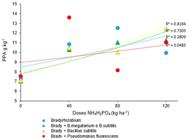
Phosphorus content in the aerial part-PPA (g kg-1), in the different doses of NH4H2PO4 (0; 40; 80 and 120 kg ha-1) in relation to the treatments with bacteria in hydroponics.
Average of phosphorus content in the aerial part-PPA (g kg-1) at different doses of NH4H2PO4 (0; 40; 80 and 120 kg ha-1) in relation to treatments with bacteria in hydroponics.
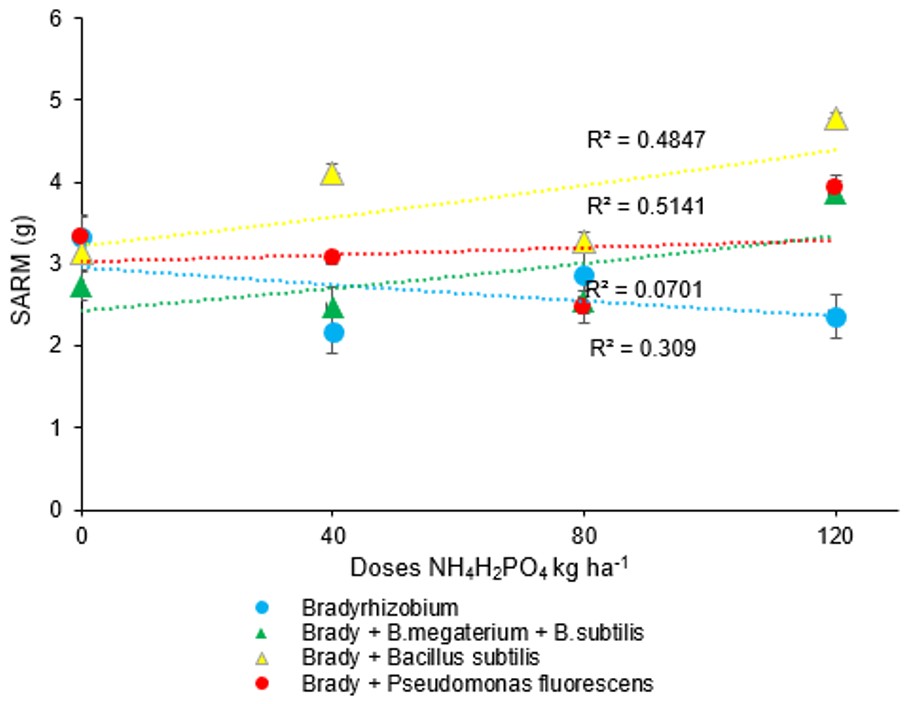
Significant differences were observed between treatments, considering root dry mass (Table 3). Among the observed data, the treatments that best fit the regression model are T3 and T4. The treatment using B. japonicum along with B. subtilis showed the best response in terms of root dry mass production with increasing doses of phosphorus. The application of these microorganisms along with B. megaterium also responded positively to the application of NH4H2PO4 (Figure 2). The use of growth-promoting microorganisms, such as B. subtilis, B. megaterium, and P. fluorescens, with the nitrogen-fixing B. japonicum, allows for greater root growth, and these bacteria were evaluated for their phosphate solubilization capacity in a future laboratory experiment (Table 4).

Root dry mass (SARM), at different doses of NH4H2PO4 (0; 40; 80 and 120 kg ha-1) in relation to treatments with bacteria in hydroponics.
Average of root dry mass (SARM), at different doses of NH4H2PO4 (0; 40; 80 and 120 kg ha-1) in relation to treatments with bacteria in hydroponics.
Table 5 shows the results obtained in laboratory solubilization tests. It can be seen that the solubilization index of the isolates varied in relation to the time and the isolate used, presenting values between 0.28 and 2.04.
Phosphate solubilization index (IS= Halo diameter (mm) / Colony diameter (mm)) by isolates of Bacillus subtilis, Bacillus subtilis/Bacillus megaterium, Pseudomonas fluorescens and Pseudomonas spp. BAC 71, on two evaluation dates.
Treatments with microorganisms B. subtilis + B. megaterium (T2), P. fluorescens (T3) and Pseudomonas spp. BAC 71 (T4) were considered low solubilizers, demonstrating indices between zero and 1.38. The B. subtillis isolate (T1) was considered a medium solubilizer, with indices of 2.04 in the evaluation 17 days after incubation. Considering low and medium solubilization of the microorganisms tested, even so, it can be seen in figure 3 that interaction occurs with the medium forming the solubilization halo.

Phosphorus-solubilizing bacteria in culture medium forming a solubilization halo at 17 days.
4. Discussion
The results obtained report the ability of Bacillus bacteria, together with B. japonicum, to utilize the added P. The most efficient way for plants to access P is through the presence of microorganisms that absorb and immobilize phosphorus, gradually releasing it into the soil (Withers et al., 2018). The use of phosphate-solubilizing microorganisms with phosphate fertilizer increases microbial enzymatic activity, as well as nutrient cycling (Cheng et al., 2023). In hydroponic systems, the efficiency of adding Bacillus spp. is reported, improving plant growth, as well as the accumulation of P in plant tissues and the increase of chlorophyll content in the leaves (Cerozi and Fitzsimmons, 2016).
The use of phosphorus-solubilizing microorganims has demonstrated positive responses in several studies, such as greater plant height, greater grain yield and even greater phosphorus absorption in various crops such as rice (Rawat et al., 2022), common bean (Bedine et al., 2022), corn (You et al., 2020) and soybean (Guimarães et al., 2021). However, the use of PGPB does not always present differences in relation to plant growth and development. Mahanta et al. (2018), used microorganims via soil in wheat and soybean crops and observed that there was no statistical difference between these treatments and the control, however, differences may occur when using doses of P. The use of B. subtilis with a reduction in the recommended dose of P, in the case of corn, increased the chlorophyll content and consequently the production of dry mass in the crop. Bacillus subtilis can excrete phytohormones such as 3-acetic acid, in addition to stimulating mitotic sites in roots, favoring root growth (Silva et al., 2022).
The use of microorganisms of the genus Pseudomonas has been studied as beneficial microorganisms, which promote plant growth, increase plant tolerance to diseases, and also increase the availability of nutrients in the soil (Chandra et al., 2020). The response to the use of PGPB microorganisms is greater in restricted and adverse environmental conditions, especially when it comes to nutritional and water stress (Silva and Pires, 2017).
There is a very intense interaction around the roots with exudates, microorganisms and soil (Vives-Peris et al., 2018). Many researchers have already proven the benefits of microorganisms, whether through the production of root exudates, better phytosanitary condition, cost reduction, greater productivity, among other benefits (Meena et al., 2017). However, the efficiency of the microorganisms used depends on factors such as availability of water, oxygen, temperature and adequate pH (Martin et al., 2023).
The solubilization capacity of some bacteria such as the Bacillus genus, they synthesize root hormones such as indoleacetic acid (IAA), which increases the root area, allowing greater exploration of the roots, and consequently greater absorption of water and nutrients (Babalola, 2010). However, other genera such as Pseudomonas, Bradyrhizobium and Azospirillum, induce the promotion of root hairs by stimulating cell multiplication (Bulgarelli et al., 2013). The production of siderophores and organic acids are examples of these mechanisms, which result in increased secretion of enzymes (Rana et al., 2020; Puri et al., 2020). Bacteria of the genus Bacillus have been the most researched as phosphate solubilizers. In this research, the bacterium B. subtilis in isolation was the one with a medium solubilization capacity (2.04), whereas the other bacteria (B. subtilis with B. megaterium and P. fluorescens) had a low solubilization capacity (Berraquero et al., 1976).
Bashan et al. (2012) reported that for a bacteria to be considered a solubilizer, it needs to, in addition to solubilizing tricalcium phosphate, also solubilize iron and/or aluminum phosphate. As future perspectives, these microorganisms can be used in bioinputs in isolation or formulated, contributing to the sustainability and profitability of agricultural production.
5. Conclusion
The use of the bacteria B. subtilis, B. megaterium and P. fluorescens increased the concentration of phosphorus in soybean leaves and also increased the dry mass of soybean roots when the doses of P in the nutrient solution were increased. The bacterium B. subtilis was the one with the highest phosphate solubilization rate, which is considered an alternative to increase the availability of phosphorus in the soil.
Acknowledgements
To the Conselho Nacional de Desenvolvimento Científico e Tecnológico (CNPq - Processes 312480/2020-2), the Coordenação de Aperfeiçoamento de Pessoal de Nível Superior (CAPES), Brasil - Finance code 001, and the Fundação de Amparo à Pesquisa do Estado do Rio Grande do Sul (FAPERGS – Processes 22/2551-0001644-8) for granting scholarships to the authors. To the scholarship students and volunteers for helping in data collection.
-
Data Availability Statement
All datasets supporting the findings of this study have been published within the article itself.
References
- ABERATHNA, A.A.A.U., SATHARASINGHE, D.A., JAYASOORIYA, A.P., JINADASA, R.N., MANOPRIYA, S., JAYAWEERA, B.P.A., FERNANDO, C.A.N., WEERATHILAKE, W.A.D.V., PRATHAPASINGHE, G.A., LIYANAGE, J.A. and PREMARATHNE, J.M.K.J.K., 2022. Increasing the bioavailability of phosphate by using microorganisms.. International Journal of Agronomy, vol. 17, pp. 4305501.
-
BABALOLA, O.O., 2010. Beneficial bacteria of agricultural importance. Biotechnology Letters, vol. 32, no. 11, pp. 1559-1570. http://doi.org/10.1007/s10529-010-0347-0 PMid:20635120.
» http://doi.org/10.1007/s10529-010-0347-0 -
BARRA, P.J., PONTIGO, S., DELGADO, M., PARRA-ALMUNA, L., DURAN, P., VALENTINE, A.J., JORQUERA, M.A. and MORA, M.L., 2019. Phosphobacteria inoculation enhances the benefit of P–fertilization on Lolium perenne in soils contrasting in P–availability. Soil Biology & Biochemistry, vol. 136, pp. 107516. http://doi.org/10.1016/j.soilbio.2019.06.012
» http://doi.org/10.1016/j.soilbio.2019.06.012 -
BASHAN, Y., SALAZAR, B.G., MORENO, M., LOPEZ, B.R. and LINDERMAN, R.G., 2012. Restoration of eroded soil in the Sonoran Desert with native leguminous trees using plant growth-promoting microorganisms and limited amounts of compost and water. Journal of Environmental Management, vol. 102, pp. 26-36. http://doi.org/10.1016/j.jenvman.2011.12.032 PMid:22425876.
» http://doi.org/10.1016/j.jenvman.2011.12.032 -
BEDINE, M.A.B., IACOMI, B., TCHAMENI, S.N., SAMEZA, M.L. and FEKAM, F.B., 2022. Harnessing the phosphate-solubilizing ability of Trichoderma strains to improve plant growth, phosphorus uptake and photosynthetic pigment contents in common bean (Phaseolus vulgaris). Biocatalysis and Agricultural Biotechnology, vol. 45, pp. 102510. http://doi.org/10.1016/j.bcab.2022.102510
» http://doi.org/10.1016/j.bcab.2022.102510 - BERRAQUERO, F.R., BAYA, A.M. and CORMENZANA, A.R., 1976. Establecimiento de índices para el estudio de la solubilización de fosfatos por bacterias del suelo. Ars Pharmaceutica, vol. 17, no. 4, pp. 399-406.
-
BRASIL. Secretaria Especial de Assuntos Estratégicos, 2022 [viewed 7 November 2022]. Plano Nacional de Fertilizantes 2050: uma estratégia para os fertilizantes no Brasil [online]. SAE. https://static.poder360.com.br/2022/03/plano-nacional-de-fertilizantes-brasil-2050.pdf
» https://static.poder360.com.br/2022/03/plano-nacional-de-fertilizantes-brasil-2050.pdf -
BULGARELLI, D., SCHLAEPPI, K., SPAEPEN, S., VAN THEMAAT, E.V.L. and SCHULZE-LEFERT, P., 2013. Structure and functions of the bacterial microbiota of plants. Annual Review of Plant Biology, vol. 64, no. 1, pp. 807-838. http://doi.org/10.1146/annurev-arplant-050312-120106 PMid:23373698.
» http://doi.org/10.1146/annurev-arplant-050312-120106 -
CEROZI, B.S. and FITZSIMMONS, K., 2016. Use of Bacillus spp. to enhance phosphorus availability and serve as a plant growth promoter in aquaponics systems. Scientia Horticulturae, vol. 211, pp. 277-282. http://doi.org/10.1016/j.scienta.2016.09.005
» http://doi.org/10.1016/j.scienta.2016.09.005 -
CHAGAS JUNIOR, A.F., BRAGA JUNIOR, G.M., LIMA, C.A., MARTINS, A.L.L., SOUZA, M.C. and CHAGAS, L.F.B., 2022. Bacillus subtilis como inoculante promotor de crescimento vegetal em soja. Diversitas Journal, vol. 7, no. 1, pp. 0001-0016. http://doi.org/10.48017/dj.v7i1.2071
» http://doi.org/10.48017/dj.v7i1.2071 -
CHANDRA, H., KUMARI, P., BISHT, R., PRASAD, R. and YADAV, S., 2020. Plant growth promoting Pseudomonas aeruginosa from Valeriana wallichii displays antagonistic potential against three phytopathogenic fungi. Molecular Biology Reports, vol. 47, no. 8, pp. 6015-6026. http://doi.org/10.1007/s11033-020-05676-0 PMid:32734439.
» http://doi.org/10.1007/s11033-020-05676-0 -
CHENG, Y., NARAYANAN, M., SHI, X., CHEN, X., LI, Z. and MA, Y., 2023. Phosphate-solubilizing bacteria: their agroecological function and optimistic application for enhancing agro-productivity. The Science of the Total Environment, vol. 901, pp. 166468. http://doi.org/10.1016/j.scitotenv.2023.166468 PMid:37619729.
» http://doi.org/10.1016/j.scitotenv.2023.166468 -
CRUZ, J.A., TUBANA, B.S., FULTZ, L.M., DALEN, M.S. and HAM, J.H., 2022. Identification and profiling of silicate-solubilizing bacteria for plant growth-promoting traits and rhizosphere competence. Rhizosphere, vol. 23, pp. 100566. http://doi.org/10.1016/j.rhisph.2022.100566
» http://doi.org/10.1016/j.rhisph.2022.100566 -
FERRARO, A.C., FRANÇA, A.C., MACHADO, C.M.M., AGUIAR, F.R., OLIVEIRA, L.L., BRAGA NETO, A.M. and OLIVEIRA, R.G., 2023. Commercial characteristics of coffee seedlings produced with different sources of phosphorus and plant growth-promoting bacteria. Brazilian Journal of Biology, vol. 83, pp. e270262. http://doi.org/10.1590/1519-6984.270262 PMid:37075429.
» http://doi.org/10.1590/1519-6984.270262 -
FERREIRA, D.F., 2011. Sisvar: a computer statiscal analysis system. Ciência e Agrotecnologia, vol. 35, no. 6, pp. 1039-1042. http://doi.org/10.1590/S1413-70542011000600001
» http://doi.org/10.1590/S1413-70542011000600001 -
GLOBALFERT, 2021 [viewed 20 May 2021]. GlobalFert [online]. Available from: https://globalfert.com.br/
» https://globalfert.com.br/ -
GRANADA, C.E., PASSAGLIA, L.M.P., SOUZA, E.M. and SPEROTTO, R.A., 2018. Is phosphate solubilization the forgotten child of plant growth-promoting rhizobacteria? Frontiers in Microbiology, vol. 9, pp. 2054. http://doi.org/10.3389/fmicb.2018.02054 PMid:30233533.
» http://doi.org/10.3389/fmicb.2018.02054 -
GUIMARÃES, V.F., KLEIN, J. and KLEIN, D.K., 2021. Promoção de crescimento e solubilização de fosfato na cultura da soja: coinoculação de sementes com Bradyrhizobium japonicum e Pseudomonas fluorescens. Research. Social Development, vol. 10, no. 11, pp. e366101120078. https://doi.org/rdelosv16.n46-012
» https://doi.org/rdelosv16.n46-012 - HOAGLANG, D.R. and ARNON, D.I., 1950. The water culture method for growing plants without soil Berkeley: University of California, 347 p.
-
INTERNATIONAL PLANT NAMES INDEX – IPNI, 2017 [viewed 20 July 2017]. Consumo aparente de fertilizantes e matéria-primas em 2016 [online]. Available from: http://brasil.ipni.net/article/BRS-3132#aparente
» http://brasil.ipni.net/article/BRS-3132#aparente -
KUMAR, A., NAROJU, S.P., KUMARI, N., ARSEY, S., KUMAR, D., GUBRE, D.F., ROYCHOWDHURY, A., TYAGI, S. and SAINI, P., 2024. The role of drought response genes and plant growth promoting bacteria on plant growth promotion under sustainable agriculture: A review. Microbiological Research, vol. 286, pp. 127827. http://doi.org/10.1016/j.micres.2024.127827 PMid:39002396.
» http://doi.org/10.1016/j.micres.2024.127827 -
LI, C., LI, C., ZHANG, H., LIAO, H. and WANG, X., 2017. The purple acid phosphatase GmPAP21 enhances internal phosphorus utilization and possibly plays a role in symbiosis with rhizobia in soybean. Physiologia Plantarum, vol. 159, no. 2, pp. 215-227. http://doi.org/10.1111/ppl.12524 PMid:27762446.
» http://doi.org/10.1111/ppl.12524 -
LU, L., QIU, W., GAO, W., TYERMAN, S.D., SHOU, H. and WANG, C., 2016. OsPAP10c, a novel secreted acid phosphatase in rice, plays an important role in the utilization of external organic phosphorus. Plant, Cell & Environment, vol. 39, no. 10, pp. 2247-2259. http://doi.org/10.1111/pce.12794 PMid:27411391.
» http://doi.org/10.1111/pce.12794 -
MAHANTA, D., RAI, R.K., DHAR, S., VARGHESE, E., RAJA, A. and PURAKAYASTHA, T.J., 2018. Modification of root properties with phosphate solubilizing bacteria and arbuscular mycorrhiza to reduce rock phosphate application in soybean-wheat cropping system. Ecological Engineering, vol. 111, pp. 31-43. http://doi.org/10.1016/j.ecoleng.2017.11.008
» http://doi.org/10.1016/j.ecoleng.2017.11.008 -
MARTIN, T.N., VEY, R.T., VIEIRA, F.C.B., JACQUES, R.J.S. and FERREIRA, M.M., 2023. How did the coinoculation of Bradyrhizobium and Azospirillum become indispensable for soybean production in Brazil? Symbiosis, vol. 91, no. 1-3, pp. 119-137. http://doi.org/10.1007/s13199-023-00951-7
» http://doi.org/10.1007/s13199-023-00951-7 -
MEENA, V.S., MEENA, S.K., VERMA, J.P., KUMAR, A., AERON, A., MISHRA, P.K., BISHT, J.K., PATTANAYAK, A., NAVEED, M. and DOTANIYA, M.L., 2017. Plant beneficial rhizospheric microorganism (PBRM) strategies to improve nutrients use efficiency: a review. Ecological Engineering, vol. 107, pp. 8-32. http://doi.org/10.1016/j.ecoleng.2017.06.058
» http://doi.org/10.1016/j.ecoleng.2017.06.058 -
NAUTIYAL, C.S., 1999. An efficient microbiological growth medium for screening phosphate solubilizing microorganisms. FEMS Microbiology Letters, vol. 170, no. 1, pp. 265-270. http://doi.org/10.1111/j.1574-6968.1999.tb13383.x PMid:9919677.
» http://doi.org/10.1111/j.1574-6968.1999.tb13383.x -
OLIVEIRA-PAIVA, C.A., MARRIEL, I.E., GOMES, E.A., COTA, L.V., SANTOS, F.C., SOUSA, S.M., LANA, U.G.P., OLIVEIRA, M.C., MATTOS, B.B. and ALVES, V.M.C., 2020 [viewed 20 May 2023]. Viabilidade técnica e econômica do Biomaphos® (Bacillus subtilis CNPMS B2084 e Bacillus megaterium CNPMS B119) nas culturas de milho e soja [online]. Embrapa. https://www.embrapa.br/busca-de-publicacoes/-/publicacao/1126348/viabilidade-tecnica-e-economica-do-biomaphos-bacillus-subtilis-cnpms-b2084-e-bacillus-megaterium-cnpms-b119-nas-culturas-de-milho-e-soja
» https://www.embrapa.br/busca-de-publicacoes/-/publicacao/1126348/viabilidade-tecnica-e-economica-do-biomaphos-bacillus-subtilis-cnpms-b2084-e-bacillus-megaterium-cnpms-b119-nas-culturas-de-milho-e-soja - PRABHU, N., BORKAR, S. and GARG, S., 2019. Phosphate solubilization by microorganisms: overview, mechanisms, applications and advances. In: S.N. MEENA and M.M. NAIK, eds. Advances in biological sciences research Cambridge: Academic Press, pp. 161-176. http://doi.org/10.1016/B978-0-12-817497-5.00011-2.
-
PURI, A., PADDA, K.P. and CHANWAY, C.P., 2020. In vitro and in vivo analyses of plant-growth-promoting potential of bacteria naturally associated with spruce trees growing on nutrient-poor soils. Applied Soil Ecology, vol. 149, pp. 103538. http://doi.org/10.1016/j.apsoil.2020.103538
» http://doi.org/10.1016/j.apsoil.2020.103538 -
QIN, L., JIANG, H., TIAN, J., ZHAO, J. and LIAO, H., 2011. Rhizobia enhance acquisition of phosphorus from different sources by soybean plants. Plant and Soil, vol. 349, no. 1-2, pp. 25-36. http://doi.org/10.1007/s11104-011-0947-z
» http://doi.org/10.1007/s11104-011-0947-z -
RANA, K.L., KOUR, D., KAUR, T., DEVI, R., YADAV, A.N., YADAV, N., DHALIWAL, H.S. and SAXENA, A.K., 2020. Endophytic microbes: biodiversity, plant growth-promoting mechanisms and potential applications for agricultural sustainability. Antonie van Leeuwenhoek, vol. 113, no. 8, pp. 1075-1107. http://doi.org/10.1007/s10482-020-01429-y PMid:32488494.
» http://doi.org/10.1007/s10482-020-01429-y -
RAWAT, P., SHARMA, A., SHANKHDHAR, D. and SHANKHDHAR, S.C., 2022. Improvement of phosphorus uptake, phosphorus use efficiency, and grain yield of upland rice (Oryza sativa L.) in response to phosphate-solubilizing bacteria blended with phosphorus fertilizer. Pedosphere, vol. 32, no. 5, pp. 752-763. http://doi.org/10.1016/j.pedsph.2022.06.005
» http://doi.org/10.1016/j.pedsph.2022.06.005 -
RUAN, Y., HE, D. and CHI, R., 2019. Review on beneficiation techniques and reagents used for phosphateores. Minerals, vol. 9, no. 4, pp. 253. http://doi.org/10.3390/min9040253
» http://doi.org/10.3390/min9040253 -
SILVA, C.D.R., LUZ, J.H.S., ANDRADE, J.G., OLIVEIRA, H.P. and SIEBENEICHLER, S.C., 2022. Inoculação de bactérias solubilizadores de fosfato no milho: reduzir ou não a adubação fosfatada? Insight dos primeiros estádios vegetativos. Agri-Environmental Sciences, vol. 8, no. 2, pp. 022013. http://doi.org/10.36725/agries.v8i2.7935
» http://doi.org/10.36725/agries.v8i2.7935 - SILVA, S.R. and PIRES, J.L.F., 2017. Resposta do trigo BRS Guamirim à aplicação de Azospirillum, nitrogênio e substâncias promotoras do crescimento. Revista Ciência Agronômica, vol. 48, pp. 631-638. http://doi.org/10.5935/1806-6690.20170073.
-
SOUSA, S.M., OLIVEIRA, C.A., ANDRADE, D.L., CARVALHO, C.G., RIBEIRO, V.P., PASTINA, M.M., MARRIEL, I.E., LANA, U.G.P. and GOMES, E.A., 2021. Tropical Bacillus strains inoculation enhances maize root surface area, dry weight, nutrient uptake and grain yield. Journal of Plant Growth Regulation, vol. 40, pp. 867-877. http://doi.org/10.1007/s00344-020-10146-9
» http://doi.org/10.1007/s00344-020-10146-9 - STEEL, R.G. and TORRIE, J.H., 1986. Principles and procedures of statistics: a biometrical approach Nova York: McGraw Hill, 666 p.
-
VIVES-PERIS, V., MOLINA, L., SEGURA, A., GÓMEZ-CADENAS, A. and PÉREZ-CLEMENTE, R.M., 2018. Root exudates from citrus plants subjected to abiotic stress conditions have a positive effect on rhizobacteria. Journal of Plant Physiology, vol. 228, pp. 208-217. http://doi.org/10.1016/j.jplph.2018.06.003 PMid:30078434.
» http://doi.org/10.1016/j.jplph.2018.06.003 -
WITHERS, P.J.A., RODRIGUES, M., SOLTANGHEISI, A., DE CARVALHO, T.S., GUILHERME, L.R.G., BENITES, V.M., GATIBONI, L.C., DE SOUSA, D.M.G., NUNES, R.S., ROSOLEM, C.A., ANDREOTE, F.D., OLIVEIRA JUNIOR, A., COUTINHO, E.L.M. and PAVINATO, P.S., 2018. Transitions to sustainable management of phosphorus in Brazilian agriculture. Scientific Reports, vol. 8, no. 1, pp. 2537. http://doi.org/10.1038/s41598-018-20887-z PMid:29416090.
» http://doi.org/10.1038/s41598-018-20887-z -
WU, Z., SHE, L., YE, P., ZHU, T., LI, J., ZHANG, X., MA, M. and WANG, T., 2023. Extraction of H3PO4 from low-grade phosphate rocks leachate of HCl-route by the mixture of TBP and IPE: Optimization, mass transfer and mechanism. Journal of Molecular Liquids, vol. 370, pp. 120861. http://doi.org/10.1016/j.molliq.2022.120861
» http://doi.org/10.1016/j.molliq.2022.120861 -
YADAV, S. and CHANDRA, R. 2020. Biofilm-mediated bioremediation of pollutants from the environment for sustainable development. In: M.K. YADAV and B.P. SINGH, eds. New and future developments in microbial biotechnology and bioengineering: microbial biofilms. Amsterdam: Elsevier, pp. 177-203. http://doi.org/10.1016/B978-0-444-64279-0.00014-1
» http://doi.org/10.1016/B978-0-444-64279-0.00014-1 -
YOU, M., FANG, S., MACDONALD, J., XU, J. and YUAN, Z.C., 2020. Isolation and characterization of Burkholderia cenocepacia CR318, a phosphate solubilizing bacterium promoting corn growth. Microbiological Research, vol. 233, pp. 126395. http://doi.org/10.1016/j.micres.2019.126395 PMid:31865096.
» http://doi.org/10.1016/j.micres.2019.126395
Edited by
-
Editor:
Takako Matsumura Tundisi
All datasets supporting the findings of this study have been published within the article itself.