 Environmental Education and water consumption in homes in rural areas
Abstract
Water is a basic resource for the survival of human beings, however, not everyone has access to this resource and they look for ways to survive under unfavorable conditions; for this purpose, environmental education focused on water safety consumption is fundamental to improve their habits. Therefore, this study aimed to evaluate the impact of an educational intervention in homes in rural areas that lack access to drinking water and is supplied by surface wells. A pre-experimental quantitative methodology was used that involves three stages: diagnosis, educational intervention and evaluation. The results showed that the educational intervention had significant changes in knowledge and water safety consumption habits (p < 0.001), furthermore learning persisted after the educational intervention and habits continued to improve; also, it was identified that there were no significant differences in gender and educational level. It is concluded that implementing short-term environmental education programmes contributes to bringing about change in vulnerable populations that do not have access to safe drinking water.
Keywords:
environmental education; lack of drinking water; water safety; public health
Resumo
A água é um recurso básico para a sobrevivência do ser humano. Entretanto, nem todos têm acesso a este recurso e, dessa forma, acabam procurando formas de sobreviver em meio a condições desfavoráveis. É importante ressaltar que a educação ambiental focada no consumo seguro da água é fundamental para melhorar seus hábitos. A partir desse contexto, este estudo teve como objetivo avaliar o impacto de uma intervenção educativa em uma área rural que não tem acesso à água potável e é abastecida por poços superficiais. Foi utilizada uma metodologia quantitativa pré-experimental que envolve três etapas: diagnóstico, intervenção educativa e avaliação. Os resultados mostraram que a intervenção educativa trouxe mudanças significativas no conhecimento e nos hábitos de consumo seguro de água (p < 0,001). Além disso, o aprendizado persistiu após a intervenção educativa e os hábitos continuaram a melhorar. Identificou-se também que não houve diferenças significativas em termos de gênero e nível educacional. Conclui-se que a implementação de programas de educação ambiental de curto prazo contribui para provocar mudanças no conhecimento e nos hábitos das populações vulneráveis que não têm acesso à água potável.
Palavras-chave:
educação ambiental; falta de água potável; segurança hídrica; saúde pública
1. Introduction
At the present time, water is a basic resource for human survival; however, inaccessibility, lack of treatment and inadequate management have a negative impact on people's health and education (Tesha et al., 2019). In addition, economic growth, population growth, increasing urbanization and the climate crisis are factors contributing to water resource scarcity. Therefore, it is essential to promote responsible and conscious practices in the use of water to preserve our natural environment (Fino et al., 2021). To achieve this, it is necessary to align these practices with two of the Sustainable Development Goals: health and well-being, clean water and sanitation; these goals seek to encourage the rational use of resources and promote social well-being, as well as a culture of long-term sustainability (Murillo-Vargas et al., 2023). As a result, the development of accurate management models for the allocation of water resources, as well as the promotion of sustainable consumption habits (Alves et al., 2023) are fundamental.
In Latin America, according to the Banco Mundial (2023) report, Peru is the third most water-rich country and eighth globally; however, it is worrying that only 50% of the Peruvian population has access to safe drinking water services and only 43% have properly managed sanitation facilities. According to data provided by the Superintendencia Nacional de Servicios de Saneamiento – SUNASS (Peru, 2023), rural areas are the most affected, because 3 out of every 100 people receive adequately chlorinated water; while human settlements are communities that do not have access to safe drinking water and are supplied by tanker trucks, as reported by (National Geographic Musuk, 2021). Since water is not available to all, it requires citizen commitment to its care and use, and institutions are key to promoting conscious and responsible consumption (Schneiderhan-Opel and Bogner, 2021), generating socio-environmental awareness in the population towards better water management (Lozano Vásquez et al., 2022); and this can be achieved through multidisciplinary environmental education programmes (Ramírez Suárez et al., 2023).
In this context, studies have been carried out that focus on diagnosis related to both water treatment and health education. One of them is the study by Desye et al. (2023), which highlights that the lack of adequate water treatment practices in households is due to lack of efficient training and poor hygiene practices. In addition, other studies such as Makokove et al. (2022) and Moropeng et al. (2021) argue that there is a need to intensify health and hygiene education among the rural population, with special emphasis on the form of storage on the way water is stored and treated, as this is a crucial factor in the fight against infectious diseases.
Gizaw et al. (2019) and Sridhar et al. (2020) state that the effectiveness of water, sanitation and hygiene education is critical because it motivates communities to take care of their health; however, these studies focus on diagnosis and health education, including aspects such as personal hygiene and handwashing.
There are few studies that focus on extremely vulnerable populations who lack access to water safety and are in a state of survival; for them, teaching water saving or hand washing habits may not be as relevant to the reality of their lives. In this sense, this study seeks to evaluate the impact of environmental education in a rural area that lacks access to drinking water and is supplied by surface wells without authorization from the National Water Authority. This programme includes a diagnosis of drinking water quality, an educational intervention to the population and a subsequent evaluation, with the aim of providing the study area with the necessary knowledge to improve their habits in consuming safer water, thereby reducing the risks to their health.
2. Materials and Methods
2.1. Study area
The study was carried out in the rural area of Lircay, located in the province of Angaraes in Peru. This population consisted of approximately 650 families who do not have drinking water services and are forced to dig in wet areas to obtain water in a precarious manner. However, the ways of storing water do not provide adequate conditions for human consumption, which in the long term represents a risk to the health of all members of these families.
To determine the sample, the formula of a finite population of 650 households was used, with a confidence level of 95% and a margin of error of 5%. The sample size obtained was 152 families; however, it is important to note that only 65 families were continuously involved in the development of the educational intervention and were informed about the aims of this research.
2.2. Study design
This study had a quantitative approach of pre-experimental nature, following the methodology proposed by Hernández et al. (2006), based on a pre-test and post-test with a single group; that is, it did not have a control group and only one survey was applied before and after the environmental education program. This study was also carried out in 03 stages as shown below.
2.2.1. Diagnostic
To know the problematic of water consumption in the rural area of Lircay, four field visits were made. During the first visit, the lack of drinking water was identified through direct observation and informal conversations with local residents. During the second visit, the wells were mapped using the Global Positioning System (GPS), identifying 68 water wells as the main source of supply; later the data were uploaded to the Geographic Information System software (ArcGIS version 10.5) to identify the sampling points, determining 12 points. Finally, during the third and fourth visits, the water samples were collected and examined at the Soil and Water Research Laboratory (LABISAG) accredited by the National Quality Institute (INACAL-DA-Registration N°LE 170) (supplementary material).
2.2.2. Educational intervention
The educational intervention consisted of four sessions (Table 1), conducted over 3 months. These sessions were held in the communal premises of Lircay on Saturday at 9:00 am, lasting 90 minutes. In order to determine the topics to be covered in the sessions, there was coordination with the community's board of directors, taking into account their needs and the real problems of the area; in addition, each session was led by professionals specialising in health, sanitation education and water treatment.
2.2.3. Evaluation and test design
Three evaluations were carried out, one before the educational intervention and two after it. Regarding the subsequent evaluations, the first one was carried out at the end of the sessions in august, while the second test was conducted 15 days later, in order to assess the changes in the participants' knowledge and habits. The test assessed knowledge and habits on water safety consumption, consisted of 24 items related to the educational intervention sessions, with a Likert response scale. The instrument was also validated by expert judgement, who were responsible for delivering the sessions.
2.3. Data analysis
To analyse the information, descriptive statistics included the calculation of statistics such as mean and standard deviation were used, and inferential statistics to test the hypothesis. This analysis was carried out using R software, Friedman's test and a post hoc memenyt test; and the Mann-Whitney U test was applied for the dimensions of gender and educational level.
3. Results
3.1. Sociodemographic characteristics of the participants
Table 2 shows the sociodemographic characteristics of the respondents, of which the majority were women, of whom only (17%) had completed higher education compared to the men who only (7%), the rest of the population had incomplete primary and secondary education. In addition, (35%) of the women were domestic workers as opposed to the men (23%) who were self-employed or blue-collar workers.
3.2. Impact of the environmental education program on the consumption of water safety in homes in rural areas (Figure 1)

Impact on participants’ knowledge (A) and habits (B) as the educational program is implemented.
Regarding the level of knowledge, when applying the Memenyt post hoc test, two groups were identified: group “a” corresponding to the period prior to the implementation of the environmental education program and group “b” corresponding to the period after the educational intervention (X^2=114.32, p<0.001); in addition, it was identified that the participants maintained the knowledge acquired during the environmental education program 15 days after the end of the intervention (post-after). In addition, with respect to safe water consumption habits, three groups were identified: group “a” corresponding to the period before the implementation of the environmental education program, group “b” corresponding to the period after the educational intervention and group “c” corresponding to 15 days after the end of the educational program (X^2=98.82, p<0.001); also, it was identified that the participants improved their safe water consumption habits 15 days after the end of the intervention (post-after).
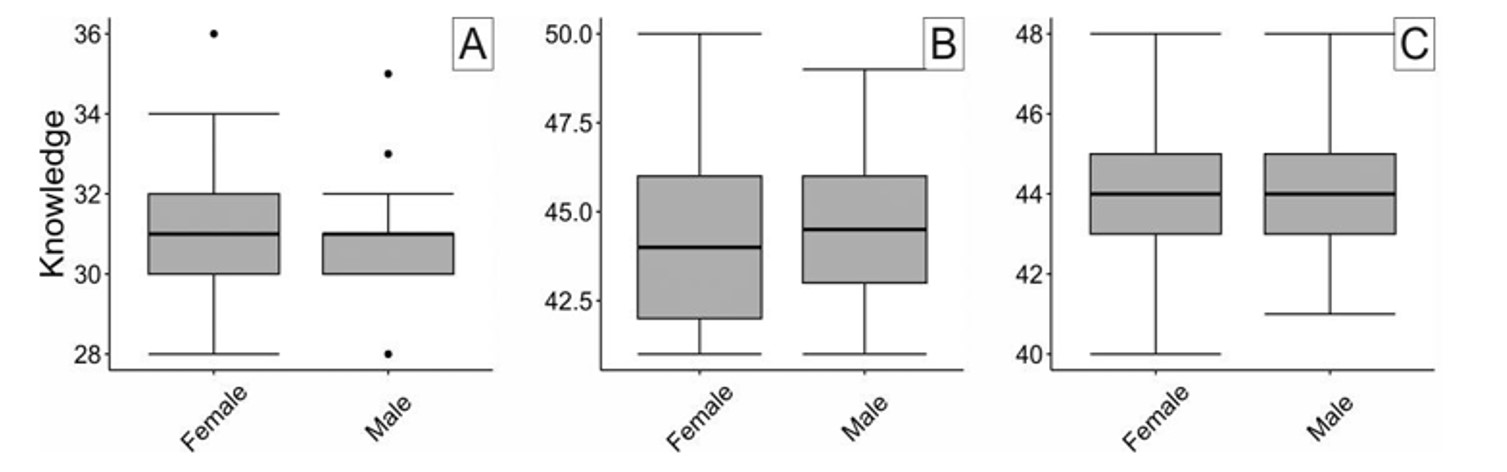
3.3. Differences in educational evaluations regarding knowledge and habits for water safety consumption according to the gender of the participants (Figure 2)

Differences in each educational assessment with respect to knowledge according to the participants' gender, at three evaluation moments: before (group A), after (group B), and 15 days after the educational intervention (group C).
The statistical test values (W=645.5, P=0.7) indicate that there are no significant differences in the degree of knowledge of water safety consumption according to the gender of the participants at the three evaluation moments: before (group A), after (group B) and 15 days after the educational intervention (group C) (Figure 3).

Differences in each educational assessment regarding water safety consumption habits according to the participants' gender, at three evaluation moments: before (group A), after (group B), and 15 days after the educational intervention (group C).
The statistical test values (W=702.5 P=0.3) indicate that there are no significant differences in water safety consumption habits according to the gender of the participants at the three evaluation moments: before (group A), after (group B) and 15 days after the educational intervention (group C).
3.4. Differences in educational evaluations regarding knowledge and habits for water safety consumption according to educational level of the participants (Figure 4)

Differences in each educational assessment with respect to knowledge according to the educational level of the participants at three evaluation moments: before (group A), after (group B) and 15 days after the educational intervention (group C).
The statistical test values before educational intervention. (W=530.5, P=0.92) and after the application of the corresponding program (W=595, P=0.49) indicate that there are no significant differences in the degree of knowledge of water safety consumption at the three evaluation moments: before (group A), after (group B) and 15 days after the educational intervention (group C) (Figure 5).

Differences in each educational assessment regarding water safety consumption habits according to the educational level of the participants at three evaluation moments: before (group A), after (group B) and 15 days after the educational intervention (group C).
The statistical test values (W=511.5, P=0.7) indicate that there are no significant differences in water safety consumption habits according to the educational level of the participants at the three evaluation moments: before (group A), after (group B) and 15 days after the educational intervention (group C). In group C, the results confirm the lack of significant changes in habits following the intervention, considering the differences on the participants' educational level.
4. Discussion
In this study, we evaluated the impact of an educational intervention focused on water safety consumption as a strategy to improve public health in vulnerable populations; it had a significant impact on the level of knowledge of people who do not have access to drinking water and depend on surface wells as a source of supply. It is important to note that there are few studies that focus specifically on the topic of water safety consumption, as most focus on the water cycle, personal hygiene, and hand washing; however, such these findings support the effectiveness of educational interventions. One of them is the study by Valenzuela-Morales et al. (2022), focused on water conservation, which improved the knowledge of children belonging to rural communities in Mexico that lack access to drinking water (p < 0.001); also after 3 months of completing the educational intervention, the knowledge acquired by the children was maintained. Similarly, in our study it was evidenced how the villagers maintained the knowledge, which indicates the effectiveness of short-term programs in vulnerable populations. It also coincides with Del Rey et al. (2021) study, which highlights that educational programs in Spain are effective, generating greater changes in the knowledge of students aged 8 to 16 years, and mentions that educational interventions increase the participants' intention to learn. The same happened in this study, since the citizens' intention to learn increased due to the concern and vulnerable situation in which they live.
It is important to point out that, in the dimension of knowledge of water safety consumption, the analysis of water quality was included as before the educational intervention, citizens did not know the composition of the water they consumed and related health risks. The settlers learned of higher levels of lead and arsenic in the water which influenced them to make positive changes in their drinking habits. These results coincide with some studies that also focused on water quality analysis; for example, the research by Boyden et al. (2023) stated that water in the San Joaquin Valley of California was contaminated by arsenic. Another study by Ko and Sakai (2022), indicated the presence of coliforms in water in Myanmar. These studies analyze water so that the population can transfer this knowledge to their relatives and take preventive measures; similarly, in our study, the people who participated in the educational intervention transmitted their knowledge to their neighbors or relatives because of their concern.
On the other hand, this study also had an impact (p <0.001) on the improvement of water safety consumption habits; however, it was observed that before the educational intervention some people already practiced some habits, such as: boiling well water and using legia. After the educational intervention, when it was learned that the use of bleach was not pertinent due to the excess of lead and arsenic in the water, it is attributed that the villagers stopped practicing this habit. In the 15-day evaluation after the end of the educational intervention, habits continued to improve, which may be due to the concern and commitment of the individuals for the care of their health. Despite finding few studies that evaluated changes in water safety consumption habits through environmental education programs; the study by Del Rey et al. (2021) was identified, which highlights those educational interventions changed the attitudes of students from 8 to 16 years of age, who began to use water better. Another study was by Gizaw et al. (2019) which mentions that water, sanitation and hygiene (WASH) education contributes to improved hand washing hygiene habits (p<0.05) in children living in rural Dembiya; however, the present study did not focus on hand washing hygiene habits, because the reality of the population is different; that is why this study focused on the care and storage of water safety either from rain or cisterns.
Regarding the differences found in the three moments of evaluation of the educational intervention in gender and educational level, no differences were found (p>0.001); however, Del Rey et al. (2021) in his study of students evaluated from 8 to 16 years old, found significant differences in gender, males showed greater learning from the educational intervention and had greater intention to learn, while females had a higher score in attitudes regarding water care.
4.1. Limitations
It is important to recognize the limitations that have influenced family participation and data collection during the development of the educational intervention. In the first place, some participants were reluctant to get involved in the process because they did not have the time, distrusted the study or felt that their contribution would not have a significant impact on the improvement of water services. Another limitation has been that the only viable day to gather participants has been on Sundays. Therefore, it is considered that this temporal restriction may have excluded individuals whose occupations or personal commitments prevented them from participating in weekend activities.
5. Conclusions
The environmental education program has proven to be effective in improving awareness and promoting water safety consumption habits in a vulnerable population that draws its water from surface wells with unsafe drinking water, demonstrating the effectiveness of environmental education as a key strategy to address water supply issues in vulnerable communities.
Short-term environmental education has proven to be effective in promoting lasting changes in water consumption habits in vulnerable communities, since by acquiring knowledge about the composition of the water they consume, they have been motivated to improve their consumption habits and adopt measures to ensure their health.
The environmental education program on water safety consumption has had a positive impact on all the population, regardless of gender or educational level, guaranteeing equal access and the benefits of this type of program.
Acknowledgements
All the authors are highly thankful to National University of Huancavelica, Huancavelica – Peru for their moral support.
References
-
ALVES, M., NOGUEIRA, C. and PINTO, H., 2023. Social innovations for sustainable water use: small-scale experiences in Lajedo de Timbaúba (Brazil) and Tamera (Portugal). CIDADES, Comunidades e Territórios, no. Sp23, pp. 55-73. http://doi.org/10.15847/cct.28095
» http://doi.org/10.15847/cct.28095 -
BANCO MUNDIAL, 2023 [viewed 9 July 2024]. Perú: acciones estratégicas para la seguridad hídrica [online]. Washington, D.C.: Banco Mundial. Available from: https://documents1.worldbank.org/curated/en/099062023100531967/pdf/P17363602652300490a20b 067e3b55cf68d.pdf
» https://documents1.worldbank.org/curated/en/099062023100531967/pdf/P17363602652300490a20b -
BOYDEN, H., GILLÁN, M., MOLINA, J., GADGIL, A. and TSENG, W., 2023. Community perceptions of arsenic contaminated drinking water and preferences for risk communication in California’s San Joaquin Valley. International Journal of Environmental Research and Public Health, vol. 20, no. 1, pp. 813. http://doi.org/10.3390/ijerph20010813 PMid:36613135.
» http://doi.org/10.3390/ijerph20010813 -
DEL REY, R., OJEDA, M., MORA-MERCHÁNA, J., SÁNCHEZ-DÍAZ, M.N. MORGADO, B. and LASAGA, M.J., 2021. Environmental education: effects on knowledge, attitudes and perceptions, and gender differences. International Research in Geographical and Environmental Education, vol. 31, no. 4, pp. 281-303. http://doi.org/10.1080/10382046.2021.1977004
» http://doi.org/10.1080/10382046.2021.1977004 -
DESYE, B., TESFAYE, A., BERIHUN, G., SISAY, T., DABA, C. and BERHANU, L., 2023. Household water treatment practice and associated factors in Ethiopia: a systematic review and meta-analysis. PLoS One, vol. 18, no. 6, e0285794. http://doi.org/10.1371/journal.pone.0285794 PMid:37289814.
» http://doi.org/10.1371/journal.pone.0285794 -
FINO, A., VICHI, F., LEONARDI, C. and MUKHOPADHYAY, K., 2021. An overview of experiences made and tools used to inform the public on ambient air quality. Atmosphere, vol. 12, no. 11, pp. 1524. http://doi.org/10.3390/atmos12111524
» http://doi.org/10.3390/atmos12111524 -
GIZAW, Z., ADDISU, A. and DAGNE, H., 2019. Effects of water, sanitation and hygiene (WASH) education on childhood intestinal parasitic infections in rural Dembiya, northwest Ethiopia: an uncontrolled before- and-after intervention study. Environmental Health and Preventive Medicine, vol. 24, no. 1, pp. 16. http://doi.org/10.1186/s12199-019-0774-z PMid:30851729.
» http://doi.org/10.1186/s12199-019-0774-z - HERNÁNDEZ, R., FERNÁNDEZ, C. and PILAR BAPTISTA, P., 2006. Metodología de la investigación. 4. ed. Bogotá: McGraw-Hill Interamericana Editores, S.A.
-
KO, H. and SAKAI, H., 2022. Water sanitation, hygiene and the prevalence of diarrhea in the rural areas of the delta region of Myanmar. Journal of Water and Health, vol. 20, no. 1, pp. 149-156. http://doi.org/10.2166/wh.2021.192 PMid:35100162.
» http://doi.org/10.2166/wh.2021.192 -
LOZANO VÁSQUEZ, K., VERÁSTEGUI, C., PAREDES JIMÉNEZ, H. and REVILLA MARREROS, M., 2022. Sustainable development goals and environmental education: communication strategies for its consolidation. Revista Venezolana de Gerencia, vol. 27, no. 8, pp. 1249-1262. http://doi.org/10.52080/rvgluz.27.8.33
» http://doi.org/10.52080/rvgluz.27.8.33 -
MAKOKOVE, R., MACHERERA, M., KATIVHU, T. and GUDO, D., 2022. The effect of household practices on the deterioration of microbial quality of drinking water between source and point of use in Murewa district, Zimbabwe. Journal of Water and Health, vol. 20, no. 3, pp. 518-530. http://doi.org/10.2166/wh.2022.251 PMid:35350004.
» http://doi.org/10.2166/wh.2022.251 -
MOROPENG, R., BUDELI, P. and MOMBA, M., 2021. An integrated approach to hygiene, sanitation, and storage practices for improving microbial quality of drinking water treated at point of use: a case study in Makwane Village, South Africa. International Journal of Environmental Research and Public Health, vol. 18, no. 12, pp. 6313. http://doi.org/10.3390/ijerph18126313 PMid:34200851.
» http://doi.org/10.3390/ijerph18126313 -
MURILLO-VARGAS, G., ICO-BRATH, D. and GONZALEZ-CAMPO, C., 2023. Análisis de la articulación de los objetivos de desarrollo sostenible en la estrategia de la universidad privada. Revista Iberoamericana de Educación Superior, vol. 39, no. 14, pp. 190-204. http://doi.org/10.22201/iisue.20072872e.2023.39.1536
» http://doi.org/10.22201/iisue.20072872e.2023.39.1536 -
NATIONAL GEOGRAPHIC MUSUK, 2021 [viewed 9 July 2024]. Perú: la problemática del acceso al agua potable en asentamientos humanos en la periferia de Lima [online]. Available from: https://www.nationalgeographicla.com/medio- ambiente/2020/06/problematica-del-acceso-al-agua-potable-lima-peru
» https://www.nationalgeographicla.com/medio- -
PERU. La Superintendencia Nacional de Servicios de Saneamiento – SUNASS, 2023 [viewed 9 July 2024]. El 10% la población peruana no tiene agua potable y 23% no accede al alcantarillado [online]. Lima, 22 jun. Available from: https://www.gob.pe/institucion/sunass/noticias/781301-el-10-la-poblacion-peruana-no-tiene-agua-potable-y-23-no-accede-al-alcantarillado
» https://www.gob.pe/institucion/sunass/noticias/781301-el-10-la-poblacion-peruana-no-tiene-agua-potable-y-23-no-accede-al-alcantarillado -
RAMÍREZ SUÁREZ, V., ACOSTA-CASTELLANOS, P., CASTRO ORTEGON, Y.A. and QUEIRUGA-DIOS, A., 2023. current state of environmental education and education for sustainable development in primary and secondary (K- 12) schools in Boyacá, Colombia. Sustainability, vol. 15, no. 13, pp. 10139. http://doi.org/10.3390/su151310139
» http://doi.org/10.3390/su151310139 -
SCHNEIDERHAN-OPEL, J. and BOGNER, F.X., 2021. The effect of environmental values on German primary school students’ knowledge on water supply. Water, vol. 13, no. 5, pp. 702. http://doi.org/10.3390/w13050702
» http://doi.org/10.3390/w13050702 -
SRIDHAR, M., OKAREH, O. and MUSTAPHA, M., 2020. Assessment of knowledge, attitudes, and practices on water, sanitation, and hygiene in some selected LGAs in Kaduna State, Northwestern Nigeria. Journal of Environmental and Public Health, vol. 2020, pp. 6532512. http://doi.org/10.1155/2020/6532512 PMid:32934659.
» http://doi.org/10.1155/2020/6532512 -
TESHA, I., MACHUNDA, R., NJAU, K. and MPOLYA, E., 2019. Water-handling patterns and associated microbial profiles in relation to hygiene in Babati Town, Tanzania. Journal of Environmental and Public Health, vol. 2019, pp. 5298247. http://doi.org/10.1155/2019/5298247 PMid:31236117.
» http://doi.org/10.1155/2019/5298247 -
VALENZUELA-MORALES, G., HERNÁNDEZ-TÉLLEZ, M., RUIZ-GÓMEZ, M., GÓMEZ-ALBORES, M., ARÉVALO-MEJÍA, R. and MASTACHI-LOZA, C., 2022. Water conservation education in elementary schools: the case of the Nenetzingo River Catchment, Mexico. Sustainability, vol. 14, no. 4, pp. 2402. http://doi.org/10.3390/su14042402
» http://doi.org/10.3390/su14042402