
 Ichthyoplankton distribution in a fragmented river stretch in a semi-arid Brazilian watershed
ABSTRACT
The Jequitinhonha River in Brazil is located in a region with a large proportion of endemic freshwater fish species. Currently, it is fragmented in its middle stretch by the Irapé Hydroelectric Power Plant. Few studies have been done on the dynamics of fish eggs and larvae in this region. Thus, the objectives of this study were to present a panoramic view of the spatial and temporal distribution of the eggs and larval assemblage in the Upper-Middle stretch of Jequitinhonha River Basin, and to relate them to the existing environmental characteristics. Sampling was conducted every three days between October 2014 and March 2015 at two stretches located upstream and two downstream of the dam. A total of 2,916 eggs and 2,709 larvae were collected. The highest density of eggs and larvae was collected in the environments located downstream of the dam, but the fragmentation of the Jequitinhonha River by the dam did not influence the distribution of larval assemblages either upstream or downstream of the reservoir. The environments downstream of the dam, especially the Araçuaí tributary, appeared to significantly contribute to the reproductive success of fish species in the region.
Accessory route; Dam; Eggs and larvae; Jequitinhonha River; Reproduction
RESUMO
O Rio Jequitinhonha está localizado em uma região com elevada diversidade de peixes de água doce endêmicos. Atualmente, encontra-se fragmentado no seu trecho médio pela Usina Hidrelétrica Irapé, e pouco se conhece sobre a dinâmica de ovos e larvas de peixes nessa região. Nesse sentido, este estudo teve como objetivos apresentar um panorama da distribuição espacial e temporal de ovos e da assembleia de larvas no alto-médio Rio Jequitinhonha e relacioná-las às características dos ambientes existentes nessa área. As amostragens foram realizadas a cada três dias entre outubro/2014 e março/2015, em dois ambientes situados a montante e dois a jusante da barragem de Irapé. Foram coletados 2.916 ovos e 2.709 larvas de peixes, e a maior densidade de ovos e larvas foi capturada no trecho localizado a jusante da barragem, no entanto a fragmentação do Rio Jequitinhonha pelo barramento não influenciou na distribuição da assembleia de larvas de peixes situadas nem a montante nem a jusante do reservatório. Os ambientes situados a jusante da barragem, principalmente o tributário Araçuaí, parecem contribuir de forma importante para o sucesso reprodutivo das espécies de peixes da região.
Rota alternativa; Barragem; Ovos e larvas; Rio Jequitinhonha; Reprodução
INTRODUCTION
Brazil is home to the largest river system in the world. Therefore, it has the richest aquatic biota on the planet (Nogueira et al., 2010; Tourinho et al., 2020). According to Lewinsohn and Prado (2006), 13.2% of the ichthyofauna of the world is concentrated in the Brazilian territory, making it an extremely fish diverse country. There are records of 3,661 species of freshwater fish described in the country (Froese and Pauly, 2024).
The Jequitinhonha River Basin (JRB) drains the Brazilian east coast and is an ecoregion with the highest proportion of endemic fish among Brazilian freshwater fish communities (Abell et al., 2008). Twenty-seven species of fish are considered endemic, with taxonomic descriptions spread across the literature. This high degree of endemism is attributed to its geological formation, a result of ancient (Gondwanaland separation) and recent tectonic events, that caused a capture of the headwaters between adjacent watersheds (Camelier and Zanata, 2014).
Although it has a high degree of endemism and is considered as a region with a large number of endangered species in southeastern Brazil (Agostinho et al., 2005; Rosa and Lima, 2008), Steindachneridion amblyurum (Eigenmann & Eigenmann, 1888), Nematocharax venustus (Weitzman, Menezes & Britski, 1986), Rhamdia jequitinhonha (Silfvergrip, 1996), Simpsonichthys perpendicularis (Costa, Nielsen & de Luca, 2001), and Brycon devillei (Castelnau, 1855) are on the official lists of threatened species (Machado et al., 2008). Nonetheless, the number of vulnerable species may be higher due to the scarcity of scientific studies have been reported on JRB. The scarcity of information regarding the ichthyofauna of the region is due to the absence of sampling, especially in tributaries and their headwaters (Machado et al., 2008).
The Jequitinhonha River, the main river of the basin, is 1,082-km long and runs through the states of Minas Gerais and Bahia, under sub-humid (upper reach) and semi-arid regions (middle and lower reaches) (IBGE, 1997). The waters of this river flow through constrained channel, without floodplains, connected to small periodic tributaries in most part of its course (Brasil, 2006).
Compared to other rivers in southeastern Brazil, it is among the least explored basin considering its hydroelectric potential (ANEEL, 2016). The Jequitinhonha River has two hydroelectric power plants (HPP): Irapé and Itapebi (Albertoni, 2009; CEMIG, 2017). The Irapé HPP began its operation in 2006, whereas Itapebi began its operation three years earlier, in 2003.
Despite the importance of the hydroelectric sector for the country’s economic development, such enterprises alter the quality of the habitats and the dynamics of the aquatic biota (Agostinho et al., 2008; Lemos et al., 2021). They can also modify historical patterns of biological production in the distribution of biodiversity both in space and time, as well as change the functions and services produced by aquatic ecosystems (Nilsson et al., 2005; Garrett et al., 2021). Besides, the fragmentation of the river by a dam can impede the reproductive success of fish (Arantes et al., 2011) or prevent the recruitment of juveniles (Pelicice et al., 2015).
Numerous studies have been conducted to identify the influence of HPPs on the life cycle of fish, including studies on eggs, larval dynamics, and juvenile’s recruitment (Hermes-Silva et al., 2009; Reynalte-Tataje et al., 2012b; Suzuki and Pompeu, 2016; Silva et al., 2018; Lopes et al., 2019; Silva et al., 2020; Gogola et al., 2023). The conservation of fish stocks in fragmented rivers can occur associated with the existence of long river stretches (Lopes et al., 2019). These stretches must attend to the demand of fishes for different types of habitats and flow conditions (Gogola et al., 2010; Reynalte-Tataje et al., 2012b). In these circumstances, free flowing tributaries are being considered important for fish conservation at fragmented systems and can work as an alternative route for migration and reproduction of fishes (Suzuki et al., 2013; Nunes et al., 2015; Marques et al., 2018; Pachla et al., 2022).
In this context, this study evaluated the reproductive activity of the fish assemblage (through the occurrence of ichthyoplankton) in the upper-middle Jequitinhonha River. Our aim was to present a panoramic view of the spatial and temporal distribution of fish eggs, fish larval developmental stages, and fish larval assemblages in the region, and their relation to the characteristics of the environments located upstream and downstream of the Irapé HPP. So, the study tested the hypothesis that the distribution of eggs and larvae, and the composition of larval assemblage is different along the upper-middle Jequitinhonha River stretch, which is fragmented by the Irapé HPP.
MATERIAL AND METHODS
Study area
The study was conducted in the upper-middle region of the Jequitinhonha River, the area fragmented by the presence of Irapé HPP (Fig. 1). Two sampling stations were selected in lotic stretches upstream of the reservoir, one on the Itacambiruçu River (UPI), and another on the Jequitinhonha River (UPJ), about 60 and 140 km upstream the Irapé dam, respectively. Two other sampling stations were selected downstream of the dam, one in the Jequitinhonha River just before the mouth of the Araçuaí River, 80 km downstream of the dam (DNJ), and another in the tributary Araçuaí River (DNA) (Table 1).

Map of the study region indicating the sampling stations selected in the upper-middle Jequitinhonha River during October 2014 to March 2015.
Characterization of the selected sampling stations in the middle region of Jequitinhonha River, in the area under the influence of the Irapé hydroelectric power plants, from October 2014 to March 2015.
Sampling
Sampling was conducted by local fishermen residing in the region, who were previously trained by a technical team to guarantee the standardization of sampling procedures.
The ichthyoplankton samples were collected, during the reproductive season for fish in the semi-arid region (Chellappa et al., 2009, 2013), every three days from October 2014 to March 2015, totaling 60 samples at each of the four sampling stations. All samplings were collected at dusk (~8 p.m.), when it is expected a higher ichthyoplankton abundance (Hermes-Silva et al., 2009), by a trawl in the subsurface for 10 min, with a conical-cylinder planktonic net (mesh 0.5 mm). The volume of filtered water was obtained through flow meters (General Oceanics model 2030R) arranged at the opening of the nets. The collected material was fixed in a 4% formalin solution buffered with CaCO3 and sent to the laboratory for processing.
In the laboratory, eggs and larvae were separated from the rest of the material sampled using Bogorov’s plate and a stereomicroscope (Leica EZ 4HD). The larvae were identified to the lowest possible taxonomic level according to a specialized reference (Nakatani et al., 2001), and also using the developmental sequence technique proposed by Ahlstrom et al. (1976). This technique consists of comparing the morphology of smaller individuals to a known juvenile form. Whenever possible, larvae were classified in four larval stages according to Ahlstrom et al. (1976), as modified by Nakatani et al. (2001), as follow: yolk-sac, preflexion, flexion, and postflexion. An image capture program (LAS V.4.8) was used to assist in species identification and classification of the stage of development. All ichthyoplankton daily data was grouped by month for each locality.
In order to assess the correlation between environmental variables and the occurrence of eggs and larvae, some parameters were collected for every sampling day. During sampling, the water temperature (°C) was measured using a mercury thermometer and the data were recorded in their spreadsheet. Data on water flow (m3.s-1) and rainfall (mm) for every sampling day were provided by Companhia Energética de Minas Gerais and Agência Nacional de Águas e Saneamento Básico. All environmental data were grouped by month for each locality.
Vouchers of fish species was deposited at Ichthyology Collection of the Núcleo de Pesquisas em Limnologia, Ictiologia e Aquicultura of the Universidade Estadual de Maringá, in Maringá, Paraná, Brazil.
Following an existing protocol (Tanaka, 1973; Nakatani et al., 2001), density estimates at different developmental stages were standardized to 10 m3 of filtered water and then transformed by log10 (x + 1) to reduce the weight of extreme values. All samples obtained every three days from a single station were considered replicates.
Statistical analysis
The assumptions of normality and homoscedasticity were performed by the Shapiro-Wilk and Levene’s tests, respectively. The spatial and temporal variation in the density of eggs and larvae and the difference in environmental variables were analyzed using the non-parametric Kruskal-Wallis’ test, and, when significant (p < 0.05), Dunn’s a posteriori test was performed to identify pairwise differences. All environmental variables were previously transformed into log10 (x + 1) to achieve the assumptions of normality and homogeneity of variance.
A permutational multivariate analysis of variance (PERMANOVA) was used to compare the structure of larval fish assemblages between sampling stations across months. The unifactorial PERMANOVA and its pair-wise test were used to evaluate the spatio-temporal variation in larval species composition and abundance. This analysis was conducted using the Bray-Curtis similarity matrix constructed with data previously transformed by the fourth root. The statistical significance of the PERMANOVA was tested with 9,999 permutations. These multidimensional analyses were performed using PRIMER 7 software with the PERMANOVA + package. Additionally, the permutational dispersion method (PERMDISP) was used to test the assumption of independence and homogeneity of multivariate dispersions within groups.
To determine how environmental variables affected the larval assemblage distribution of each of the sampled stations, a redundancy analysis (RDA) was performed using the RDA command in vegan package. For this, the larval matrix (composed by larvae identified to the gender and specific level) was transformed using Hellinger transformation (Rao, 1995), and the environmental variables were standardized using the decostand command in the vegan package. A permutation test (randomly replicated 9,999 times) was performed to evaluate the performance and significance of the generated model. The RDA analyses were performed using R 3.5.0 (R Core Team, 2023).
RESULTS
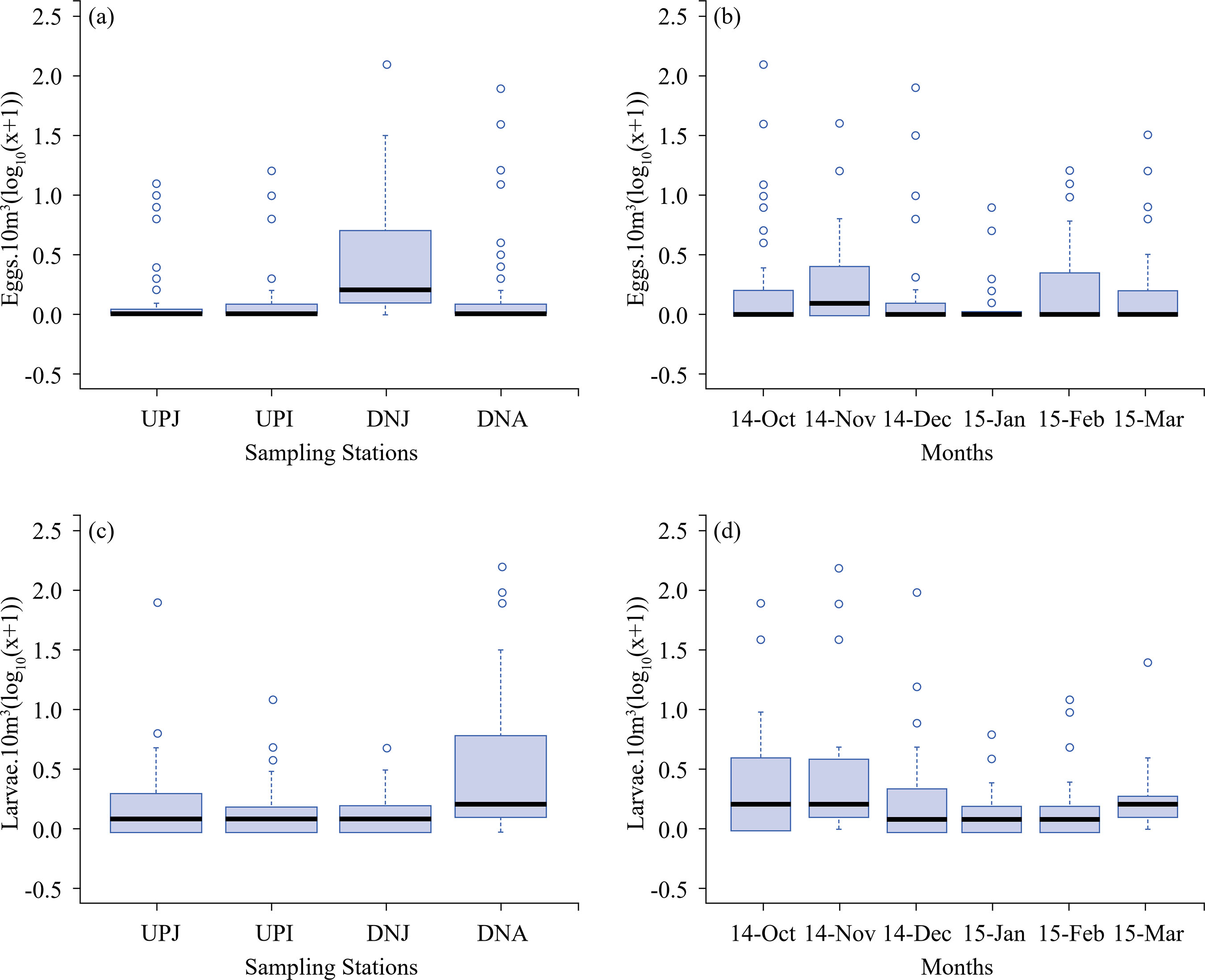
During the study period, 2,916 eggs were collected. Significant spatial variation in egg density was observed among the sampled stations, with the highest density observed at DNJ (p < 0.01; Fig. 2a). A total of 2,709 fish larvae was caught, and the highest density of larvae in the region was observed at DNA (p < 0.01; Fig. 2c). There was no temporal variation in the egg or larval density between the different sampling months (p > 0.05; Figs. 2b and 2d).

Spatial and temporal variation of eggs and fish larvae density–organisms/10 m3 (log10 (x+1) – at different sampling stations and between October 2014 and March 2015 in the upper-middle Jequitinhonha River. (a) Spatial distribution of fish eggs; (b) temporal distribution of fish eggs; (c) spatial distribution of fish larvae; (d) temporal distribution of fish larvae.
Twenty-five taxa were identified, 20 of them at least at the gender level, represented by 16 genera, 14 families, and four orders. Characiformes represented 72% of the total larvae captured, followed by Siluriformes, with 27%. The orders Cichliformes and Gymnotiformes were represented by only two and seven individuals, respectively. Among the 14 families identified, those with the highest number of taxa were Characidae, with six, and Anostomidae and Loricariidae, with two taxa each, whereas the other families had only one taxon each. Among the 25 taxa found, 11 were identified to the generic level and nine to the specific level.
Characiformes and Siluriformes orders were identified at all sampling stations. Among the most frequently captured taxa, Characidae was present at all sampling stations and had the highest percentage of frequency of occurrence (FO%) during the entire sampling period (37.1%). Megaleporinus spp., which was captured at all sampling stations, presented 29.5% of FO% (Table 2).
Descriptive statistics and length–weight relationship parameters of the 17 estuarine fishes caught in the Caeté, Marajó and Parnaíba estuaries from northern and northeast Brazilian coast in the period of January and July 2018, and April 2015. Family order following Nelson et al. (2016).
Larvae of the genera Megaleporinus and Prochilodus, which are considered migratory species in other river basins (Carolsfeld et al., 2003), were captured both in environments located upstream and downstream of the Irapé dam (Table 2).
Considering the occurrence of each larval stage among the four evaluated, the yolk-sac stage (46.6%) was the most commonly captured larval developmental stage mainly occurring at the DNJ (67.9%) and DNA (48.7%). The preflexion stage (45.3%) had higher percentages at UPJ (54.2%) and DNA (48.4%). For the flexion (2.8%) and postflexion (5.3%) stages, the capture proportions were higher at UPI with 21.6 and 44.6%, respectively.
The Kruskal-Wallis’ test showed significant differences for environmental variables among the sampling stations (p < 0.01; Table 3). Spatially, water temperature was significantly higher at DNA than at UPI and UPJ (p < 0.01). Water flow in DNJ was significantly higher than in UPI (p < 0.01). No significant differences were observed for mean rainfall values among the different sampling stations. Temporally, no significant difference was observed between the sampling months (p > 0.01).
Mean values (± standard deviation) of environmental variables observed at the different sampling stations located in the upper-middle Jequitinhonha River for the samples taken between October 2014 and March 2015.
The PERMANOVA results showed a significant difference in the composition of the larval fish assemblage between sampling stations (Pseudo F = 4.46; p < 0.01) and between months (Pseudo F = 3.52; p < 0.01). The pairwise test identified a significant difference in larval assemblage among all environments (p < 0.01). However, the PERMDISP was significant, and its paired test showed significance in comparison between UPI and all other stations, as well as DNA compared with UPJ. This indicated that the dispersion of the samples at UPI was heterogeneous with respect to their centroid, indicating a combination of differences in localization and dispersion between groups in the multivariate space, as well as the comparison between DNA and UPJ.
The temporal variation of the assemblage structure was evidenced in the pairwise test, showing differentiation between some months analyzed regarding species composition, except for November in relation to December, February, and March, December in relation to February and March, and also February in relation to March (p > 0.01).
The RDA generated significant models (p < 0.01, permutational ANOVA, permutations = 9,999) and constrained 93% of fish larvae variance in relation to the explanatory variables. The Monte Carlo permutation test was significant for axes (F = 6.6; p = 0.001) and rejected the null hypothesis of independence between fish larvae and explanatory variables. The environmental variables tested were selected by RDA using forward selection and were significant (p < 0.01). The first axis (RDA 1, F = 12.5, p = 0.001) accounted for 61% of the variance and was negatively correlated with water temperature (-0.53) and positively correlated with water flow (0.70) and rainfall (0.51). The second axis (RDA 2, F = 6.0, p = 0.001) accounted for 32% and was negatively correlated with water temperature (-0.74) and positively correlated with water flow (0.62) and rainfall (0.46). RDA also showed similarities between DNJ, in the main river, and DNA, in a tributary, both located downstream of Irapé HPP. The samples from the UPI segregated from the other sampling stations and UPJ samples were well dispersed between the RDA axes (Fig. 3).

Redundancy analysis (RDA) ordination of the fish larvae assemblage of the upper-middle Jequitinhonha River according to environmental variables from October 2014 to March 2015.
According to the taxa distribution, larvae of the genus Megaleporinus spp. and Prochilodus spp. were positively correlated with water flow. The larvae of Wertheimeria maculata (Steindachner, 1877) and Serrasalmus brandtii (Lütken, 1875) were positively correlated with water temperature. The other species were grouped around the crossing of the axes of the RDA (Fig. 3).
DISCUSSION
This study showed that several fish species were successful in spawning and rear their offspring in this fragmented river stretch, including migratory fish species, both upstream and downstream of the Irapé HPP. Additionally, some patterns were observed in the distribution of egg and larvae density, with higher abundance of ichthyoplankton downstream of the dam, mainly in the Araçuaí River, for rearing larvae. This tributary appeared to contribute significantly to the conservation of fish species in the region.
The larval assemblage observed in the river stretch under study was composed mainly by the Characiformes and Siluriformes orders, showing a similar pattern to that found in other basins in the neotropical region (Lowe-McConnell, 1987; Malabarba and Malabarba, 2014). This pattern was also observed by Godinho et al. (1999) in an ichthyofauna survey in the Jequitinhonha basin.
There are 72 species of fish described for the JRB, however Pugedo et al. (2016) suggested that this number should reach 110 species. The larval assemblage identified in this study consisted of 25 taxa. Due to the high degree of endemism (Abell et al., 2008) and the lack of studies on ichthyoplankton in that region, many of the captured larvae were only identified to the family level.
Among the species identified in this study, we highlighted some that are important to fishing in the region, especially those related to the genera Megaleporinus and Prochilodus, which occurred in environments upstream and downstream of the dam. Some species of these genus, found in other watersheds, exhibit migratory behavior (Carolsfeld et al., 2003; Baldisserotto and Gomes, 2010); thus, revealing the importance of environments for the conservation of these species in the region.
Considering that the reproduction of migratory fish requires a connection of different habitats that meet the needs of different phases of the life cycle (Winemiller, 1989; Makrakis et al., 2012; Suzuki et al., 2013), the presence of larvae of this genus upstream and downstream of the Irapé HPP shows that they are succeeded in completing their life cycles in both regions. Besides, the presence of these larvae was registered in environments distant more than 200 km from each other, as well as in a tributary, which proves the existence of spawning and breeding sites both upstream and downstream the dam. However, the presence of the dam over time could generate genetic isolation between populations because of the absence of gene flow between populations that inhabit downstream and upstream areas (Pompeu et al., 2012). Therefore, it is crucial monitoring these species, upstream and downstream, for the purpose of assessing the possibility of genetic exchanges throughout populations and choose the best mode of action for preserving genetic variation.
The presence of larvae of W. maculata, an endemic species of the region, in all environments under study, also deserves to be noticed. Vono and Birindelli (2007), who described the natural history of this Doradidae in the basin, highlighted the need for conservation of stretches free of anthropogenic influences in the basin, such as the Araçuaí tributary river. In this study, the Araçuaí River was the one that exhibited the highest density for W. maculata larvae, reinforcing the importance of this environment for the maintenance of the stock of this species.
It is also important to note the presence of larvae of S. brandtii in JRB, an invasive species (Pugedo et al., 2016). This taxon was recorded in the reservoir for the first time in 2009 and after few years became dominant in this environment (Andrade et al., 2019). Although this species was not found in lotic environments above the Irapé reservoir by Andrade et al. (2019), in this study it was the second most abundant taxon at the UPI sampling station, where juveniles were also caught in 2016. No larvae were found in UPJ, suggesting that the upper stretches from Jequitinhonha River are still free from this invasive species.
The highest intensity of reproductive activity was observed in the environments downstream of the dam, both in the main river and in the Araçuaí River, a free-flowing tributary in the region. The importance of tributary river mouths as areas for breeding young forms of fish has been observed in other studies (Zaniboni-Filho and Schulz, 2003; Corrêa et al., 2010; Gogola et al., 2010; Reynalte-Tataje et al., 2012b; Suzuki et al., 2013; Sulzbacher et al., 2023). Free flowing tributaries are also being considered important for conservation and can work as an alternative route for migration and reproduction (Antonio et al., 2007; Reynalte-Tataje et al., 2011; Silva et al., 2015; Nunes et al., 2015; Casarim et al., 2018; Marques et al., 2018; Lopes et al., 2019). The results obtained in this study also reinforced the ecological importance of tributaries for several fish species, suggesting that these environments should be studied as a matter of priority, and that conservation measures should be adopted to mitigate impacts on fragmented environments.
In addition to the marked influence caused by variation in rainfall and river levels (Nascimento and Nakatani, 2006; Baumgartner et al., 2008; Hermes-Silva et al., 2009; Suzuki and Pompeu, 2016), some physical factors, such as water temperature, can strongly influence the distribution of the ichthyoplanktonic community (Baumgartner et al., 2008; Reynalte-Tataje et al., 2012a). Temperature as a decisive factor for the fish reproductive process was observed in the Paraná River (Baumgartner et al., 1997; Bialetzki et al., 2002) and the Uruguay River (Reynalte-Tataje et al., 2008; Reynalte-Tataje et al., 2012c). In these two watersheds, there was a direct relationship between the increase in water temperature and the higher reproductive intensity of some fish species. In this study, the highest density of captured larvae occurred in the environment where the highest water temperature values were recorded.
The structure of the larval assemblage in the Jequitinhonha River exhibited differentiation in the temporal and spatial scales. However, this segregation was more pronounced regarding species abundance in different sampling environments and months, without much variation in its composition, revealing fish reproductive activity in all regions. The fragmentation of the Jequitinhonha River did not influence the distribution of the larvae assemblies upstream and downstream of the Irapé Dam; however, the environments upstream and downstream of the dam, mainly the Jequitinhonha River and the Araçuaí tributary, respectively, seem to significantly contribute to the conservation of fish species in the region. Although part of Jequitinhonha River upstream Irapé dam is a protected area under a state law (from its source to the mouth of the Tabatinga River), there is an important stretch about 150 km of free-flowing river uncover by the law (from Tabatinga River until HPP Irapé reservoir, which includes the UPJ sampled segment). Also, the Araçuaí River basin, despite having shown extreme relevance for fish reproduction in the region, is intensely modified by eucalyptus plantations, soil erosion, and intense water deficit (evapotranspiration greater than precipitation in the last 50 years), which progressively reduces the Araçuaí River flow (Leite and Fujaco, 2010). These results demonstrate the importance of JRB for the reproductive activity of fish and possibly for the recruitment and conservation of species. This can be achieved protective; conservation and restoration measures need to be urgently implemented in the region to preserve this important endemic ichthyofauna.
CONCLUSION
The present study demonstrated that several fish species, both upstream and downstream of the Irapé HPP, may successfully reproduce, spawn, and develop their young in this region of the JBR. Nevertheless, it was also noted that there is an important difference in ichthyoplankton abundance in the areas downstream of the dam, especially in the Araçuaí River, indicating that it provides an essential role in the number and diversity of fish larvae species in the region.
ACKNOWLEDGMENTS
The authors would like to thank David A. Reynalte-Tataje for his help with larvae identification. We also thank Andréa Bialetzki from Universidade Estadual de Maringá for the deposit of larvae specimens in the Ichthyology Collection of the Núcleo de Pesquisas em Limnologia, Ictiologia e Aquicultura.
DATA AVAILABILITY STATEMENT
Data will be available upon request from the author.
REFERENCES
-
Abell, R.; Thieme, M.L.; Revenga, C.; Bryer, M.; Kottela, M.; Bogutskayan, N.; Coad, B.; Mandrak, N.; Balderas, S.C.; Bussing, W.; Stiassny, M.L.J.; Skelton, P.; Allen, G.R.; Unmack, P.; Naseka, A.; Ng, R.; Sindorf, N.; Robertson, J.; Armijo, E.; Higgins, J.V.; Heibel, T.J.; Wikramanayake, E.; Olson, D.; Lópes, H.L.; Reis, R.E.; Lundberg, J.G.; Pérez, M.H.S; Petry, P. 2008. Freshwater ecoregions of the world: A new map of biogeographic units for freshwater biodiversity conservation. BioScience, 58(5): 403-414. https://doi.org/10.1641/B580507
» https://doi.org/10.1641/B580507 -
Agência Nacional de Energia Elétrica (ANEEL). Mapa dos empreendimentos de geração de energia elétrica ANEEL. Available at: https://sigel.aneel.gov.br/portal/home/webmap/viewer.html?webmap=45374c61bd3e40e3a484878003fae937 Accessed on: Nov. 15, 2016.
» https://sigel.aneel.gov.br/portal/home/webmap/viewer.html?webmap=45374c61bd3e40e3a484878003fae937 -
Agostinho, A.A.; Pelicice, F.M.; Gomes, L.C. 2008. Dams and the fish fauna of the Neotropical region: impacts and management related to diversity and fisheries. Brazilian Journal Biology, 68(4 Suppl.): 1119-1132. https://doi.org/10.1590/S1519-69842008000500019
» https://doi.org/10.1590/S1519-69842008000500019 -
Agostinho, A.A.; Thomaz, S.M.; Gomes, L.C. 2005. Conservation of the biodiversity of Brazil's inland waters. Conservation Biology, 19(3): 646-652. https://doi.org/10.1111/j.1523-1739.2005.00701.x
» https://doi.org/10.1111/j.1523-1739.2005.00701.x - Ahlstrom, E.H.; Butler, J.L.; Sumida, B.Y. 1976. Pelagic stromateoid fishes (Pisces, Perciformes) of the Eastern Pacific: kinds, distributions, and early life histories and observations of five of these from the Northwest Atlantic. Bulletin of Marine Science, 26(3): 285-402.
- Albertoni, S.C. 2009. The Itapebi Hydroelectric development in the Jequitinhonha River. In: Piasentin, C. (ed.). Main Brazilian Dams III: Design, construction and performance. Brazilian Committee on Dams. Santa Catarina: Impressul. p. 221-310.
-
Andrade, F.R.; Silva, L.D.; Guedes, I.; Santos, A.M.; Pompeu, P.S. 2019. Non-native white piranhas graze preferentially on caudal fins from large netted fishes. Marine and Freshwater Research, 70(4): 585-593. https://doi.org/10.1071/MF18202
» https://doi.org/10.1071/MF18202 -
Antonio, R.R.; Agostinho, A.A.; Pelicice, F.M.; Bailly, D.; Okada, E.K.; Dias, J.H.P. 2007. Blockage of migration routes by dam construction: Can migratory fish find alternative routes? Neotropical Ichthyology, 5(2): 177-184. https://doi.org/10.1590/S1679-62252007000200012
» https://doi.org/10.1590/S1679-62252007000200012 -
Arantes, F.P.; Santos, H.B.; Rizzo, E.; Sato, Y.; Bazzoli, N. 2011. Collapse of the reproductive process of two migratory fish (Prochilodus argenteus and Prochilodus costatus) in the Três Marias Reservoir, São Francisco River, Brazil. Journal of Applied Ichthyology, 27: 847-853. https://doi.org/10.1111/j.1439-0426.2010.01583.x
» https://doi.org/10.1111/j.1439-0426.2010.01583.x - Baldisserotto, B.; Gomes, L. de C. 2010. Espécies para piscicultura no Brasil Santa Maria: Editora UFSM.
-
Baumgartner, G.; Nakatani, K.; Cavicchioli, M.; Baumgartner, M.S.T. 1997. Some aspects of the ecology of fish larvae in the floodplain of the high Paraná River, Brazil. Revista Brasileira de Zoologia, 14(3): 551-563. https://doi.org/10.1590/S0101-81751997000300005
» https://doi.org/10.1590/S0101-81751997000300005 -
Baumgartner, G.; Nakatani, K.; Gomes, L.C.; Bialetzki, A., Sanches, P.V.; Makrakis, M.C. 2008. Fish larvae from the upper Paraná River: Do abiotic factors affect larval density? Neotropical Ichthyology, 6(4): 551-558. https://doi.org/10.1590/S1679-62252008000400002
» https://doi.org/10.1590/S1679-62252008000400002 -
Bialetzki, A.; Nakatani, K.; Sanches, P.V.; Baumgartner, G. 2002. Spatial and temporal distribution of larvae and juveniles of Hoplias aff. malabaricus (Characiformes, Erythrinidae) in the Upper Paraná River floodplain, Brazil. Brazilian Journal of Biology, 62(2): 211-222. https://doi.org/10.1590/S1519-69842002000200004
» https://doi.org/10.1590/S1519-69842002000200004 - Brasil. 2006. Ministério do Meio Ambiente. Caderno da região hidrográfica Atlântico Leste Brasília: Ministério do Meio Ambiente, Secretaria de Recursos Hídricos.
-
Camelier, P.; Zanata, A.M. 2014. Biogeography of freshwater fishes from the Northeastern Mata Atlântica freshwater ecoregion: distribution, endemism, and area relationships. Neotropical Ichthyology, 12(4): 683-698. https://doi.org/10.1590/1982-0224-20130228
» https://doi.org/10.1590/1982-0224-20130228 - Carolsfeld, J.; Harvey, B.; Ross, C.; Baer, A. 2003. Migratory fishes of South America Victoria, British Columbia: World Fisheries Trust.
-
Casarim, R.; Prado, I.G.; Loures, R.C.; Pompeu, P.S. 2018. Fish movement patterns in a Neotropical free-flowing tributary located downstream from a large dam. Marine and Freshwater Research, 69(10): 1626-1634. https://doi.org/10.1071/MF17216
» https://doi.org/10.1071/MF17216 -
Chellappa, S.; Bueno, R.M.; Chellappa, T.; Chellappa, N.T.; Val, V.M.F.A. 2009. Reproductive seasonality of the fish fauna and limnoecology of semi-arid Brazilian reservoirs. Limnologica, 39(4): 325-329. https://doi.org/10.1016/j.limno.2009.06.003
» https://doi.org/10.1016/j.limno.2009.06.003 - Chellappa, S.; Nascimento, W.S.; Barros, N.H.C.; Araujo, A.S.; Chellappa, N.T. 2013. Reproductive characteristics and strategies and of freshwater fish species from the Semi-arid region of Brazil. Animal Biology Journal, 4(2): 85-114.
-
Companhia Energética de Minas Gerais S/A (CEMIG) (2017). Usinas CEMIG. Available at: http://www.cemig.com.br Accessed on: Sept. 18, 2017.
» http://www.cemig.com.br -
Corrêa, R.N.; Hermes-Silva, S.; Reynalte-Tataje, D.A.; Zaniboni-Filho, E. 2010. Distribution and abundance of fish eggs and larvae in three tributaries of the Upper Uruguay River (Brazil). Environmental Biology of Fishes, 91(1): 51-61. https://doi.org/10.1007/s10641-010-9759-x
» https://doi.org/10.1007/s10641-010-9759-x -
Froese, R.; Pauly, D. (eds.). 2024. List of freshwater fishes reported from Brazil. FishBase Available at: https://www.fishbase.de/country/CountryChecklist.php?showAll=yes&what=list&trpp=50&c_code=076&cpresence=Reported&sortby=alpha2&ext_CL=on&vhabitat=fresh Accessed on: Apr. 8, 2024.
» https://www.fishbase.de/country/CountryChecklist.php?showAll=yes&what=list&trpp=50&c_code=076&cpresence=Reported&sortby=alpha2&ext_CL=on&vhabitat=fresh -
Garrett, K.; McManamay, R.A.; Wang, J. 2021. Global hydropower expansion without building new dams. Environmental Research Letters, 16(11): 114029. https://doi.org/10.1088/1748-9326/ac2f18
» https://doi.org/10.1088/1748-9326/ac2f18 - Godinho, H.P.; Godinho, A.L.; Vono, V. 1999. Peixes da bacia do rio Jequitinhonha. In: Lowe‐McConnel, R.H. (ed.). Estudos ecológicos de comunidades de peixes tropicais São Paulo: EDUSP. p. 414‐423.
-
Gogola, T.M.; Daga, V.S.; Silva, P.R.L.; Sanches, P.V.; Gubiani, E.A.; Baumgartner, G.; Delariva, R.L. 2010. Spatial and temporal distribution patterns of ichthyoplankton in a region affected by water regulation by dams. Neotropical Ichthyology, 8(2): 341-349. https://doi.org/10.1590/S1679-62252010000200013
» https://doi.org/10.1590/S1679-62252010000200013 -
Gogola, T.M.; Silva, P.R.L.; Maciel, A.L.; Baumgartner, D.; Piana, P.A.; Sanches, P.V. 2023. Fish functional biotic simplification in a Neotropical reservoir: An approach from the ichthyoplankton. Ecology of Freshwater Fish, 32(4): 874-885. https://doi.org/10.1111/eff.12729
» https://doi.org/10.1111/eff.12729 -
Hermes-Silva, S.; Reynalte-Tataje, D.A.; Zaniboni-Filho, E. 2009. Spatial and temporal distribution of ichthyoplankton in the upper Uruguay River, Brazil. Brazilian Archives of Biology and Technology, 52(4): 933-944. https://doi.org/10.1590/S1516-89132009000400017
» https://doi.org/10.1590/S1516-89132009000400017 - Instituto Brasileiro de Geografia e Estatística (IBGE). 1997. Diagnóstico ambiental da Bacia do Rio Jequitinhonha: diretrizes gerais para a ordenação territorial Salvador: IBGE.
-
Leite, M.G.P.; Fujaco, M.A.G. 2010. A long-term annual water balance analysis of the Araçuaí River Basin, Brazil. Journal of Geographical Sciences, 20(6): 938-946. https://doi.org/10.1007/s11442-010-0822-5
» https://doi.org/10.1007/s11442-010-0822-5 -
Lemos, E.B.; Paes-de-Souza, M.; Souza, D.B.; Riva, F.R. 2021. Review on Governance in Hydroelectric Projects and Impacts on Natural Resources. International Journal of Business Administration, 12(6): 25-35. https://doi.org/10.5430/ijba.v12n6p25
» https://doi.org/10.5430/ijba.v12n6p25 -
Lewinsohn, T.M.; Prado, P.I. 2006. Avaliação do estado de conhecimento da biodiversidade brasileira Brasília: Ministério do Meio Ambiente. Available at: http://biodiverso.blogspot.com.br/2006/11/publicaes-avaliao-do-estado-de.html Accessed on: Jun. 22, 2006.
» http://biodiverso.blogspot.com.br/2006/11/publicaes-avaliao-do-estado-de.html -
Lopes, J.M.; Pompeu, P.S.; Alves, C.B.M.; Peressin, A.; Prado, I.G.; Suzuki, F.M. Facchin, S.; Kalapothakis, E. 2019. The critical importance of an undammed river segment to the reproductive cycle of a migratory Neotropical fish. Ecology of Freshwater Fish, 28(2): 302-316. https://doi.org/10.1111/eff.12454
» https://doi.org/10.1111/eff.12454 - Lowe-McConnell, R.H. 1987. Ecological studies in tropical fish communities. Cambridge: Cambridge University Press.
- Machado, A.B.M.; Drummond, G.M.; Paglia, A.P. 2008. Livro vermelho da fauna brasileira ameaçada de extinção Brasília: MMA; Belo Horizonte: Fundação Biodiversitas.
-
Makrakis, M.C.; Miranda, L.E.; Makrakis, S.; Fontes Jr., H.M.; Morlis, W.G.; Dias J.H.P.; Garcia, J.O. 2012. Diversity in migratory patterns among Neotropical fishes in a highly regulated river basin. Journal of Fish Biology, 81(2): 866-881. https://doi.org/10.1111/j.1095-8649.2012.03346.x
» https://doi.org/10.1111/j.1095-8649.2012.03346.x - Malabarba, L.R.; Malabarba, M.C. 2014. Filogenia e classificação dos peixes neotropicais. In: Baldisserotto, B.; Cyrino, J.; Urbinati, E. C. (eds.). Biologia e Fisiologia de Peixes Neotropicais de Água Doce Jaboticabal: FUNEP. p. 1-12.
-
Marques, H.; Dias, J.H.P.; Perbiche-Neves, G.; Kashiwaqui, E.A.L.; Ramos, I.P. 2018. Importance of dam-free tributaries for conserving fish biodiversity in Neotropical reservoirs. Biological Conservation, 224: 347-354. https://doi.org/10.1016/j.biocon.2018.05.027
» https://doi.org/10.1016/j.biocon.2018.05.027 - Nakatani, K.; Agostinho, A.A.; Baumgartner, G.; Bialetzki, A.; Sanches, P.V.; Makrakis, M.C.; Pavaneli, C.S. 2001. Ovos e larvas de peixes de água doce: Desenvolvimento e manual de identificação Maringá: EDUEM.
-
Nascimento, F.L.; Nakatani K. 2006. Relações entre fatores ambientais e a distribuição de ovos e larvas de peixes na sub-bacia do rio Ivinhema, Estado de Mato Grosso do Sul, Brasil. Acta Scientiarum. Biological Sciences, 28(2): 117-122. https://doi.org/10.4025/actascibiolsci.v28i2.1027
» https://doi.org/10.4025/actascibiolsci.v28i2.1027 -
Nilsson, C.; Reidy, C.A.; Dynesius, M.; Revenga, C. 2005. Fragmentation and flow regulation of the world’s large river systems. Science, 308(5720): 405-408. https://doi.org/10.1126/science.1107887
» https://doi.org/10.1126/science.1107887 -
Nogueira, C.; Buckup, P.A.; Menezes, N.A.; Oyakawa, O.T.; Kasecker, T.P.; Ramos Neto, M.B.; da Silva, J.M.C. 2010. Restricted-range fishes and the conservation of Brazilian freshwaters. PloS One, 5(6), e11390. https://doi.org/10.1371/journal.pone.0011390
» https://doi.org/10.1371/journal.pone.0011390 -
Nunes, D.M.F.; Magalhães, A.L.B.; Weber, A.A.; Gomes, R.Z.; Normando, F.T.; Santiago, K.B.; Rizzo, E.; Bazzoli, N. 2015. Influence of a large dam and importance of an undammed tributary on the reproductive ecology of the threatened fish matrinxã Brycon orthotaenia Günther, 1864 (Characiformes: Bryconidae) in southeastern Brazil. Neotropical Ichthyololy, 13(2): 317-324. https://doi.org/10.1590/1982-0224-20140084
» https://doi.org/10.1590/1982-0224-20140084 -
Pachla, L.A.; Hartmann, P.B.; Massaro, M.V.; Pelicice, F.M.; Reynalte‐Tataje, D.A. 2022. Recruitment of migratory fish in free‐flowing rivers with limited floodplain development. Aquatic Conservation: Marine and Freshwater Ecosystems, 32(12): 1888-1900. https://doi.org/10.1002/aqc.3860
» https://doi.org/10.1002/aqc.3860 -
Pelicice, F.M.; Pompeu, P.S.; Agostinho, A.A. 2015. Large reservoirs as ecological barriers to downstream movements of Neotropical migratory fish. Fish and Fisheries, 16(4): 697-715. https://doi.org/10.1111/faf.12089
» https://doi.org/10.1111/faf.12089 -
Pompeu, P.S.; Agostinho, A.A.; Pelicice, F.M. 2012. Existing and future challenges: the concept of successful fish passage in South America. River Research and Applications, 28(4): 504-512. https://doi.org/10.1002/rra.1557
» https://doi.org/10.1002/rra.1557 -
Pugedo, M.L.; Andrade Neto, F.R.A.; Pessali, C.; Birindelli, J.L.O.; Carvalho, D.C. 2016. Integrative taxonomy supports new candidate fish species in a poorly studied neotropical region: the Jequitinhonha River Basin. Genetica, 144(3): 341-349. https://doi.org/10.1007/s10709-016-9903-4
» https://doi.org/10.1007/s10709-016-9903-4 -
R Core Team. 2023. R: A language and environment for statistical computing. Vienna: R Foundation for Statistical Computing. Available at: https://www.R-project.org/ Accessed on: May 15, 2023.
» https://www.R-project.org/ - Rao, C.R. 1995. A review of canonical coordinates and an alternative to correspondence analysis using Hellinger distance. Quëstiió, 19(1): 23-63.
-
Reynalte-Tataje, D.A.; Agostinho, A.A.; Bialetzki, A.; Hermes-Silva, S.; Fernandes, R.; Zaniboni-Filho, E. 2012a. Spatial and temporal variation of the ichthyoplankton in a subtropical river in Brazil. Environmental Biology of Fishes, 94(2): 403-419. https://doi.org/10.1007/s10641-011-9955-3
» https://doi.org/10.1007/s10641-011-9955-3 - Reynalte-Tataje, D.A.; Hermes-Silva, S.; Silva, P.A.; Bialetzki, A.; Zaniboni-Filho, E. 2008. Locais de crescimento de larvas de peixes na região do alto. In: Zaniboni-Filho, E.; Nuñer, A.P.O. (eds.). Reservatório de Itá: Estudos ambientais, desenvolvimento de tecnologias de cultivo e conservação da ictiofauna Florianópolis: Editora UFSC. p. 159-193.
-
Reynalte-Tataje, D.A.; Nakatani, K.; Fernandes, R., Agostinho, A.A.; Bialetzki, A. 2011. Temporal distribution of ichthyoplankton in the Ivinhema River (Mato Grosso do Sul State/Brazil): Influence of environmental variables. Neotropical Ichthyology, 9(2): 427-36. https://doi.org/10.1590/S1679-62252011005000017
» https://doi.org/10.1590/S1679-62252011005000017 -
Reynalte-Tataje, D.A.; Nuñer, A.P.O.; Nunes, M.C.; Garcia, V.; Lopes, C.A. Zaniboni-Filho, E. 2012a. Spawning of migratory fish species between two reservoirs of the upper Uruguay River, Brazil. Neotropical Ichthyoloy, 10(4): 829-835. https://doi.org/10.1590/S1679-62252012000400016
» https://doi.org/10.1590/S1679-62252012000400016 -
Reynalte-Tataje, D.A.; Zaniboni-Filho, E.; Bialetzki, A.; Agostinho, A.A. 2012c. Temporal variability of fish larvae assemblages: influence of natural and anthropogenic disturbances. Neotropical Ichthyology, 10(4): 837-846. https://doi.org/10.1590/S1679-62252012000400017
» https://doi.org/10.1590/S1679-62252012000400017 - Rosa, R.S.; Lima, F.C.T. 2008. Peixes: Os peixes brasileiros ameaçados de extinção. In: Machado, A.B.M.; Drummond, G.M.; Paglia, A.P. (eds.). Livro vermelho da fauna brasileira ameaçada de extinção Brasília: MMA; Belo Horizonte: Fundação Biodiversitas. p. 8-285.
-
Silva, F.O.; Andrade-Neto, F.R.; Hermes-Silva, S.; Silva, J.O.; Zaniboni-Filho, E.; Prado, I.G.; Peressin, A.; Pelicice, F.M. 2020. Spawning and recruitment of a migratory fish in a semi-arid river system without floodplain. Inland Waters, 10(4): 529-541. https://doi.org/10.1080/20442041.2020.1805977
» https://doi.org/10.1080/20442041.2020.1805977 -
Silva, P.S.; Makrakis, M.C.; Miranda, L.E.; Makrakis, S.; Assumpção, L.; Paula, S.; Dias, J.H.P.; Marques, H. 2015. Importance of reservoir tributaries to spawning of migratory fish in the upper Paraná River. River Research and Applications, 31(3): 313-322. https://doi.org/10.1002/rra.2755
» https://doi.org/10.1002/rra.2755 -
Silva, P.S.; Miranda, L.E.; Makrakis, S.; de Assumpção, L.; Dias, J.H.P.; Makrakis, M.C. 2018. Tributaries as biodiversity preserves: An ichthyoplankton perspective from the severely impounded Upper Paraná River. Aquatic Conservation Marine and Freshwater Ecosystems, 29(2): 258-269. https://doi.org/10.1002/aqc.3037
» https://doi.org/10.1002/aqc.3037 -
Sulzbacher, R.; Massaro, M.V.; Brutti, V.C.; Hartmann, P.B.; Pachla, L.A.; Reynalte-Tataje, D.A. 2023. Importance of biotopes of a neotropical river for ichthyoplankton: patterns in biotope association, community structure and spatial distribution. Biologia, 78(9): 2409-2422. https://doi.org/10.1007/s11756-023-01372-z
» https://doi.org/10.1007/s11756-023-01372-z -
Suzuki, F.M.; Pompeu, P.S. 2016. Influence of abiotic factors on ichthyoplankton occurrence in stretches with and without dams in the upper Grande River basin, south-eastern Brazil. Fisheries Management and Ecology, 23(2): 99-108. https://doi.org/10.1111/fme.12159
» https://doi.org/10.1111/fme.12159 - Suzuki, F.M.; Zambaldi, L.P.; Pompeu, P.S. 2013. Mapping the critical habitats for migratory species of the upper Grande River region, Minas Gerais State, Brazil. Applied Ecology and Environmental Research, 11(4): 645-659.
- Tanaka, S. 1973. Stock assessment by means of Ichthyoplankton surveys. FAO Fisheries Technical Paper, 122: 33-51.
-
Tourinho, M.P.; Costa, A.P.T.; Martins, K.P.; Bandeira, M.G.S.; Barbosa, F.G. 2020. Scientific knowledge on threatened species of the Brazilian Red List: freshwater fish as a case study. Environmental Biology of Fishes, 103: 719-731. https://doi.org/10.1007/s10641-020-00978-5
» https://doi.org/10.1007/s10641-020-00978-5 - Vono, V.; Birindelli, J.L.O. 2007. Natural history of Wertheimeria maculata, a basal doradid catfish endemic to eastern Brazil (Siluriformes: Doradidae). Ichthyological Exploration of Freshwaters, 18(2): 183-191.
-
Winemiller, K.O. 1989. Patterns of variation in life history among South American fishes in seasonal environments. Oecologia, 81(2): 225-241. https://doi.org/10.1007/bf00379810
» https://doi.org/10.1007/bf00379810 - Zaniboni-Filho, E.; Schulz, U.H. 2003. Migratory fishes of the Uruguay River. In: Carolsfeld, J.; Harvey, B.; Baer, A.; Ross, C. (eds.). Migratory fishes of the South America: Biology, social importance and conservation status Victoria, British Columbia: World Fisheries Trust. p. 135-168.
Edited by
-
Section editor:
Raniere Garcez C. Sousa https://orcid.org/0000-0002-5620-389X

 UPJ: upstream Jequitinhonha; UPI: upstream Itacambiruçu; DNJ: downstream Jequitinhonha; DNA: downstream Araçuaí.
 UPJ: upstream Jequitinhonha; UPI: upstream Itacambiruçu; DNJ: downstream Jequitinhonha; and DNA: downstream Araçuaí.