 Larval survival at early stages of the amphidromous prawn Macrobrachium acanthurus and Macrobrachium olfersii (Caridea: Palaemonidae) in different salinities
ABSTRACT
Macrobrachium acanthurus and M. olfersii have been widely studied, with M. acanthurus recognized for its aquaculture potential. Both species exhibit an amphidromous life cycle, in which larvae migrate to brackish waters to complete their development. This study evaluated the effect of salinity on early larval survival, testing two hypotheses: 1) that gradual acclimation to lower salinities increases short-term survival; and 2) that there is an optimal salinity range for larval survival. Two experiments were conducted. The first evaluated the short-term survival of M. olfersii larvae during gradual acclimation from freshwater to different salinities (0, 6, 11, 14, 20, and 24 g/L). Survival was high (86–94%) and showed no significant differences among treatments, rejecting the first hypothesis but confirming the effectiveness of the acclimation protocol. The second experiment evaluated the long-term survival of both species at salinities of 0, 6, 12, 16, 22, and 28 g/L. Survival was significantly influenced by salinity, with higher mortality at the extremes and better performance at intermediate levels. Nevertheless, the overall decline indicates that successful larviculture depends on the interaction between salinity, nutrition, and other environmental factors.
Keywords
Larviculture; Native species; Latin America; Sustainable aquaculture
RESUMO
Macrobrachium acanthurus e M. olfersii têm sido amplamente estudados, sendo M. acanthurus uma espécie com potencial aquícola. Ambas apresentam ciclo de vida anfídromo, no qual as larvas migram para águas salobras para completar o desenvolvimento. Este estudo avaliou o efeito da salinidade na sobrevivência larval inicial, testando duas hipóteses: 1) a aclimatação gradual em salinidades mais baixas aumenta a sobrevivência a curto prazo; e 2) existe uma faixa ótima de salinidade para a sobrevivência larval. Foram conduzidos dois experimentos. O primeiro avaliou a sobrevivência de curto prazo de larvas de M. olfersii durante aclimatação gradual da água doce para diferentes salinidades (0, 6, 11, 14, 20 e 24 g/L). A sobrevivência foi elevada (86–94%) e não apresentou diferenças significativas entre os tratamentos, rejeitando a primeira hipótese, mas confirmando a eficácia do protocolo de aclimatação. O segundo experimento avaliou a sobrevivência a longo prazo de ambas espécies em salinidade 0, 6, 12, 16, 22 e 28 g/L. A sobrevivência foi significativamente influenciada pela salinidade, com maior mortalidade nos extremos e melhor desempenho em níveis intermediários. Ainda assim, a mortalidade geral indica que o sucesso da larvicultura depende da interação entre salinidade, nutrição e outros fatores ambientais.
Palavras-chave
Larvicultura; Espécies nativas; América Latina; Aquicultura sustentável
INTRODUCTION
Prawn farming is a key sector in global aquaculture, producing 12.5 million tons and generating US$ 92 billion in 2022 (FAO, 2024). This growth is driven by dominant species like the marine shrimp Penaeus (Litopenaeus) vannamei Boone, 1931 and the freshwater prawn Macrobrachium rosenbergii (De Man, 1879). However, the widespread cultivation of these non-native species raises concerns about their potential threats to local biodiversity and ecosystems when they are introduced into environments in which they do not naturally occur (Cunha et al., 2013; Tavares & Mendonça Jr., 2004). This highlights the need for a shift toward sustainable practices that prioritize the use of native species, which aligns with global initiatives such as the Sustainable Development Goals 2 and 14 (Zero Hunger and Life Below Water).
In Brazil, species of the genus Macrobrachium (Spence Bate, 1868) represent a promising alternative for aquaculture, offering a balance between economic potential and environmental sustainability. The genus is known for its wide geographic distribution and diverse life strategies, with some species inhabiting exclusively freshwater environments, while others have an amphidromous life cycle (Anger, 2003; Garcia-Guerrero et al., 2013; Maciel & Valenti, 2009; Valenti et al., 2021). Amphidromy involves adults living in freshwater but migrating to estuarine areas for reproduction, in which larval development occurs (Ammar et al., 2001; Barbieri et al., 2016; Rossi & Mantelatto, 2013). These native species are also notable for their economic or ecological importance in aquatic ecosystems (Pincinato & Asche, 2016). Their natural ecological role and adaptability make them valuable resources for local communities and key candidates for a more sustainable aquaculture approach.
In this genus, Macrobrachium acanthurus (Wiegmann, 1836) and M. olfersii (Wiegmann, 1836) are two species of particular interest due to their complementary roles in native prawn research. Macrobrachium acanthurus is recognized for its high reproductive and growth potential, making it suitable for commercial aquaculture (Garcia-Guerrero et al., 2013; Rodrigues et al., 2021). Its broad geographic range and economic importance in artisanal fisheries also make it an ideal candidate for aquaculture expansion, particularly given the growing demand for locally sourced products (Garcia-Guerrero et al., 2013). Although M. olfersii does not have the same commercial appeal, it serves as a valuable model for laboratory experiments (Rezende et al., 2023). Studies with such species are crucial for generating fundamental knowledge on native prawn biology and management, which is vital for developing sustainable aquaculture and conservation strategies.
The prawn farming production system is divided into two main phases: larviculture and grow-out. The larviculture phase, which focuses on the development of larvae until they reach the post-larval stage, is particularly critical for the viability of the culture (Pavanelli, 2010). The larval period is highly sensitive to environmental changes, requiring precise control to ensure successful metamorphosis and minimize energy expenditure (Araújo & Valenti, 2017; Villafuerte-Mojica et al., 2016). For amphidromous species like M. acanthurus and M. olfersii, salinity is a key factor that influences survival, molting, metabolism, and behavior, as many physiological processes depend on maintaining a stable osmotic and ionic environment (Anger, 2003; Boyd & Tucker, 2014; Cieluch et al., 2004; Spradlin & Saha, 2022). Therefore, the monitoring and management of these environmental factors, such as salinity, are essential for larval development and survival.
While previous studies have explored the effects of salinity on the larviculture of these and other species (Lima et al., 2021a; Rezende et al., 2023; Rodrigues et al., 2018), there remains a need for more specific data on the early larval survival of M. acanthurus and M. olfersii under controlled experimental conditions. Based on the premise that environmental factors like salinity are critical to larval development, we formulated two hypotheses to be tested. Our first hypothesis was that the acclimation of M. olfersii larvae to a lower final salinity results in a higher short-term survival rate than acclimation to a higher final salinity, since the transition to a higher final salinity, even if gradual, imposes greater osmotic stress on the larvae, compromising their adaptation and survival compared to the transition to a lower salinity. Our second hypothesis was that there is an optimal salinity range for the survival of M. acanthurus and M. olfersii larvae, and that exposure to very low or very high salinities outside this range results in a significant reduction in larval survival.
To test these hypotheses, our study was designed in two distinct experiments. The first experiment, conducted with M. olfersii, aimed to specifically understand and detail the acclimation process from freshwater to different salinity levels. The second experiment, conducted on both species, tested the survival of larvae at a wider range of salinities to determine species-specific tolerances. Our findings provide a fundamental contribution to the understanding of larval tolerance and will assist in the development of more effective sustainable aquaculture and conservation strategies.
MATERIALS AND METHODS
Sampling and cultivation of ovigerous females
Ovigerous females of M. olfersii and M. acanthurus were obtained through samplings conducted, respectively, in the Burundanga River (14°21’25.4”S; 39°00’24.9”W), located in the municipality of Itacaré, and in the Cachoeira River (14°78’44.8”S; 39°10’45.3”W), located in the municipality of Ilhéus, both in the state of Bahia, Brazil, with authorization for scientific activities from Chico Mendes Institute for Biodiversity Conservation/Ministry of the Environment and Climate Change (no. 87844-1). Samples were collected during the day (morning) by three people using a circular sieve with a 60 cm diameter and a 2 mm mesh following the upstream direction of the river.
After sampling, the specimens were stored in plastic bags containing river water from the sampling sites with pressurized air and transported to the Sciences Laboratory II at the Jorge Amado campus (CJA), Universidade Federal do Sul da Bahia. Upon arrival, females were gradually acclimated to laboratory conditions in rectangular glass aquariums (20 cm wide × 33 cm long × 25 cm high, with a capacity of 15 L). The water used was sourced from an underground well at the CJA campus and was dechlorinated for the experiment by storing it in plastic containers with constant aeration until no chlorine was detected. The acclimation process consisted of a gradual water exchange over a 2-hour period. The females were maintained in these aquariums for approximately one week under natural temperature and photoperiod. They were housed together, with three or four individuals per aquarium.
After approximately one week in the acclimation aquariums, each ovigerous female was transferred to an individual aquarium (6- to 8-L capacity) and maintained with constant aeration until the eggs hatched. The incubation stages were monitored daily by observing egg characteristics, such as color and eye pigmentation (Rodrigues et al., 2018), to identify females in the final embryonic stages. This step was crucial for the logistical organization and preparation of the larval experiments, as the females were collected at different stages of development. Following hatching, females were removed, and the experimental phase began with the newly hatched larvae.
Temperature, pH, and dissolved oxygen were measured three times per week using a multiparameter meter (AKSO AK88). Ammonia (NH3) and nitrite (NO-2) levels were measured weekly using freshwater colorimetric kits (Alcon, LabconTest). Partial water changes were performed on average every two days, and a natural photoperiod was maintained (Lima et al., 2021a). The females were fed extruded shrimp feed (35% crude protein) once a day ad libitum.
Two experiments were conducted to evaluate the effect of salinity on the larval survival of M. acanthurus and M. olfersii. The first experiment, with M. olfersii, investigated the larval survival response to different final salinities following the same gradual acclimation procedure over a timeframe of 4 to 6 hours (Choudhury, 1970). The objective was to understand if a transition to higher salinities, even when gradual, would result in a different survival rate compared to a transition to lower salinities, as this crucial acclimation process is often only briefly described in the literature (Choudhury, 1970, 1971; Dugger & Dobkin, 1975; Rezende et al., 2023; Rodrigues et al., 2017; Santos et al., 2007; Soeiro et al., 2016). The final salinities reached in this first experiment were the subject of larval survival evaluation. The duration varied slightly among treatments due to minor fluctuations in the drip rate across replicates, despite continuous monitoring. The second experiment, which was the main study, evaluated the larval survival of both M. acanthurus and M. olfersii at different salinity levels. The specific range of salinities for this experiment was selected to reflect conditions commonly studied in the relevant literature. The same acclimation procedure used in the first experiment was applied to acclimate the larvae before the start of this study.
Experiment I
This experiment evaluated the survival of newly hatched M. olfersii larvae in response to different salinity levels. The setup consisted of two rectangular containers (30 and 50 L) adapted as water baths (Soeiro et al., 2016), which were connected by a polyvinyl chloride (PVC) pipe system to ensure a single water flow (Attachments 1 in Guimarães Júnior, 2026). Temperature control was achieved using Roxin/HT-1300/100w immersion heaters. Glass jars served as the experimental units. Larvae, which hatched in freshwater, were attracted to light, collected with a pipette, counted using a stereoscope (MOTIC/SMZ-161), and transferred to experimental units at a stocking density of 20 larvae per unit.
The larvae were gradually acclimated in different salinity treatments. The final salinities reached at the end of the acclimation period were 6, 11, 14, 20, and 24 g/L. This was a completely randomized design with five replicates per treatment, and the acclimation process took place over a period of 4 to 6 hours, as recommended by Choudhury (1970). A control group was maintained in freshwater (0 g/L) under the same experimental conditions but without the acclimation process. A drip system with an average flow rate of 33 drops per minute was used for acclimation. Larvae were initially placed in glass jars containing 100 mL of freshwater, and 400 mL of saline water (at the appropriate concentration for each treatment) was gradually added over the acclimation period. The duration of the acclimation varied slightly among replicates due to minor fluctuations in the drip rate, despite continuous monitoring.
At the end of the acclimation period, temperature, dissolved oxygen, pH, and salinity were measured using a multi-parameter meter (AKSO AK88). Larval survival was then assessed. Larvae were removed from the experimental units with pipettes and individually examined under a stereoscope. Dead larvae were identified by the absence of swimming activity and a whitish coloration (Choudhury, 1970), whereas living larvae displayed a clear, transparent appearance and responded to mechanical stimuli. The survival rate was calculated by subtracting the number of dead larvae at the end of the experiment from the initial number of larvae and was expressed as a percentage.
Experiment II
To evaluate the larval survival of M. acanthurus and M. olfersii at different salinities during larviculture, two separate experiments were conducted, one for each species. Both experiments used an open culture system with partial water exchange three times a week. Larvae from six females (three of each species) hatched in freshwater aquaria and were gradually acclimated to different salinity levels (0, 6, 12, 16, 22, and 28 g/L) using a drip system (Attachments 2 in Guimarães Júnior, 2026). These specific salinity values were chosen to assess survival across a broader salinity range, aligning with the objective of this main experiment. The experiments for each species were conducted at different times and were therefore not simultaneous.
The larvae were stored in six 3-L glass jars for acclimation before being randomly transferred to their experimental units. This gradual, drip-based acclimation process was performed following the methodology established in experiment I. The experiment followed a completely randomized design, using 30 cylindrical glass jars (500 mL) wrapped in black plastic. These jars represented six treatments: 0 (control), 6 (6S), 12 (12S), 16 (16S), 22 (22S), and 28 g/L (28S), with five replicates each. The aeration system consisted of a SunSun ACO-001 air compressor, hoses, and porous stones (Attachments 2 in Guimarães Júnior, 2026). Larvae were counted using Petri dishes under a binocular stereoscope (MOTIC/SMZ-161) and transferred to their respective units at a density of 20 larvae per experimental unit, in 500 mL of water.
Larval cultivation and survival
The larvae were monitored daily, and dead larvae were removed using a Pasteur pipette and counted. Survival rates were calculated daily by considering the number of live larvae counted on the previous day as 100%. This approach allowed for an accurate representation of daily survival trends and accounted for gradual mortality over time.
The physicochemical variables of the water, such as temperature, dissolved oxygen, pH, salinity, ammonia, and nitrite, were monitored thrice a week, except for ammonia and nitrite, which were measured once a week (Santos, 2017). Partial water changes were performed every two days using a mixture of seawater and freshwater. The larvae were fed daily with newly hatched Artemia sp. nauplii, in the proportion of 25 nauplii per larva (adapted from Lima et al., 2021b). After feeding, the aeration was paused for 15 min. The debris was removed by siphoning using a Pasteur pipette.
Culture analysis and larval development
The larval stage index (LSI) was assessed every two days (Maciel & Valenti, 2014). Seven larvae were removed, and their stages were identified according to descriptions by Choudhury (1970) for M. acanthurus and Dugger and Dobkin (1975) for M. olfersii. The LSI was calculated using the Eq. 1:
where: Si: the larval stage; ni: number of larvae in stage Si; N: the total number of larvae analyzed (Manzi et al., 1977).
The experiment ended when either total larval mortality occurred or post-larvae emerged, as defined by Guerao and Cuesta (2014).
Data analysis
All data were subjected to the Shapiro-Wilk’s normality test (α = 0.05) (Shapiro & Wilk, 1965) and Levene’s homogeneity test (α = 0.05). A generalized linear model (GLM) was used to evaluate the effect of salinity on larval survival during acclimation. In the second experiment, a generalized linear mixed model (GLMM) was applied using the glmmTMB package (Brooks et al., 2017). GLMM was used to compare larval survival between distinct salinities, using salinity treatments (and control) and days of cultivation as fixed effects and repetitions within treatments as random effects to account for the hierarchical structure of data. Models were fitted with negative binomial distribution (nbinom2), due to overdispersion, and a zero-inflated component structured either as an intercept model (~1) or as a function of explanatory fixed variables (treatment and/or days of cultivation), due to the excess zeros in data. To assess the differences, a post-hoc pairwise comparison was performed with the emmeans package (Lenth, 2023). As complementary analysis, Kruskal-Wallis’ tests were applied independently for each day of cultivation, followed by Dunn’s post-hoc test with Holm’s correction using the rstatix package (Kassambara, 2019). These tests were conducted to evaluate the differences of each treatment along the days avoiding loss of statistical power if GLMM were fitted separately for each day. In addition, a descriptive analysis of the physicochemical parameters was performed. Statistical significance was set at p < 0.05. All analyses were performed using RStudio software (R Core Team 2024).
RESULTS
Experiment I
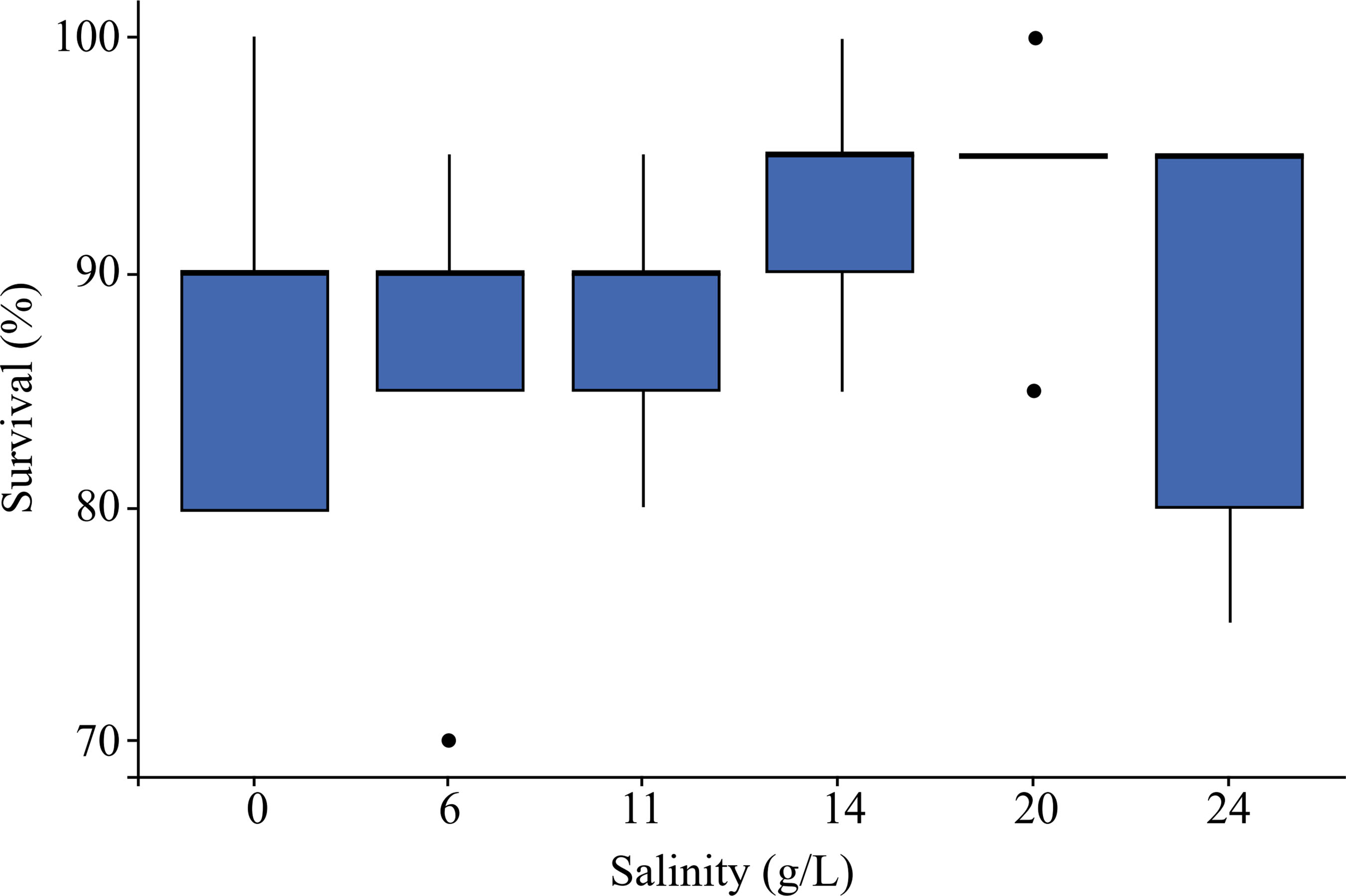
The first experiment, which focused on the acclimation process, had a duration of approximately 4 to 6 hours. At the end of this period, larval survival ranged from 86 (in treatments 6 and 24 g/L) to 94% (in treatment 20 g/L). The GLM showed no significant differences in survival among the treatments (p > 0.21) (Fig. 1). No abrupt changes in the physicochemical variables were observed, which is consistent with the short duration of the experiment and did not allow for significant variations in parameters, such as temperature, dissolved oxygen, and pH. Additionally, the use of a temperature control method (water bath) ensured that the temperature fluctuations remained minimal. Descriptive statistics, including the maximum, minimum, average, and standard deviation values for these variables, are presented in Attachments 3 (Guimarães Júnior, 2026).

Boxplot of the percentage of living individuals of Macrobrachium olfersii (Wiegmann, 1836) for each salinity tested at the end of the acclimatization experiment. The central line represents the median, the box indicates the interquartile range (IQR), the whiskers extend to a maximum of 1.5 times the IQR, and the dots represent outliers.
Experiment II
Macrobrachium acanthurus (Wiegmann, 1836) larval survival
The GLMM results (Fig. 2) showed significant differences in the larval survival of M. acanthurus from the control and some of the salinity treatments (p < 0.05). However, the treatment 6S did not present a statistical difference from the control (GLMM, p = 0.22). Additionally, the salinity treatments did not demonstrate differences among each other (GLMM, p > 0.05). The mean ratio among treatments showed higher survival of larvae from 12S to 28S, however, only in a variation from 24 to 27% better than control.

Larval survival of Macrobrachium acanthurus (Wiegmann, 1836) in different salinity treatments (0, 6, 12, 16, 22, and 28 g/L) over a seven-day cultivation period. The lines represent the average survival percentage, and the vertical bars indicate the standard deviation.
Through the cultivation period, the mortality increased during the days, gradually from the first to the third day, and drastically from the fifth day (GLMM, p < 0.01). The Kruskal-Wallis’ analysis demonstrated differences among treatments from the first to the third day (p < 0.01), while on the other days no statistical differences were observed among treatments (p > 0.05). On the first and second day, the control differed from 12S, 16S and 28S (DUNN, p < 0.05), while 6S and 22S did not differ (DUNN, p > 0.05). Still on these days, the salinity treatments did not differ from each other (DUNN, p > 0.05). On the third day, a similar pattern was observed, being distinct from the first and second day only by the treatment 12S not differing from the control (DUNN, p > 0.05).
Throughout the experimental period, the physicochemical variables did not undergo major changes between the treatments. The maximum, minimum, mean, and standard deviation values for the temperature, dissolved oxygen, pH, and salinity are presented in Attachment 4 (Guimarães Júnior, 2026). Total ammonia and nitrite were almost undetectable with maximum values of 0.016 and 0.25, respectively.
Macrobrachium olfersii (Wiegmann, 1836) larval survival
For M. olfersii, statistically significant differences were observed between the salinities tested (GLMM, p < 0.01) (Fig. 3). In general, all treatments (6S to 28S) statistically differed from the control (0S) (GLMM, p < 0.01 to p = 0.03). Among the treatments, S6 differed from all treatments (GLMM, p < 0.05), except from S28 (GLMM, p = 0.72) and the intermediate salinity treatments S16 differed from the S28 (GLMM, p < 0.01), while the others did not show difference among each other (GLMM, p > 0.05). Additionally, the mean ratio among treatments showed that S16 had the higher survival (50.4%) in relation to the control, while S6 had the lowest survival rate 27.2%. Throughout the cultivation period, the mortality increased along the days. The first day presented a 56.6% higher mean rate of survival than the seventh day, while the eighth day presented 100% of mortality in all treatments (GLMM, p < 0.01). The statistical differences among days in comparison to the first day began on the fourth day (GLMM, p < 0.01), while on the second and third day no differences in the larval mortality were found (GLMM, p > 0.05).

Larval survival of Macrobrachium olfersii (Wiegmann, 1836) in different salinity treatments (0, 6, 12, 16, 22, and 28 g/L) over an eight-day cultivation period. The lines represent the average survival percentage, and the vertical bars indicate the standard deviation.
The Kruskal-Wallis’ analysis demonstrated that the differences among treatments occurred from the first to sixth day (p < 0.01), and on the seventh day no differences were observed (p > 0.05). On the eighth day, no statistical comparison was able to be performed since every treatment showed total mortality. On the first day of cultivation, the control treatment did not differ significantly from the S6 (DUNN, p = 0.13), but it differed from the other treatments (DUNN, p < 0.01), whereas no significant differences were found among the other treatments (DUNN, p > 0.050). On the second and third day, mortality rates showed slight variations, with the control group differing from 16S and 22S only (DUNN, p < 0.01), and the treatments did not differ among each other (DUNN, p > 0.05).
On the fourth day, the control differed significantly from 12S, 16S, and 22S, and the 6S treatment also differed from 16S (DUNN, p < 0.01), but the other salinity treatments did not differ from each other (DUNN, p > 0.05). On the fifth day, the only significant statistical differences were found between the treatment 16S and the control and the treatment 6S (DUNN, p > 0.01). On the sixth day, treatment 16S differed from the control, the treatment 6S, and the treatment 28S (DUNN, p < 0.05).
Throughout the experimental period, the physicochemical variables did not undergo major changes between the treatments. The maximum, minimum, mean, and standard deviation values for temperature, dissolved oxygen, pH, and salinity are listed in Attachment 5 (Guimarães Júnior, 2026). Total ammonia was present at low concentrations with a maximum value of 0.026. No nitrite was detected in this study.
Larval stage
The developmental stages of the larvae of both species were monitored throughout the experimental period. For M. acanthurus, dead larvae in stage III were observed on the fifth day of cultivation in the 6 g/L salinity treatment. All other larvae remained in the zoea II stage until the seventh day (Attachments 6 and 7, in Guimarães Júnior, 2026). For M. olfersii, only zoea stages I and II were identified throughout the eight-day experimental period. In all salinity treatments, except for the freshwater control, zoea II was observed for both species.
DISCUSSION
The results of this study confirmed that salinity significantly affects the larval survival of M. acanthurus and M. olfersii. A key finding from our first experiment was the remarkable short-term tolerance of M. olfersii larvae to the acclimation process, demonstrating their osmoregulatory flexibility in the initial phase. However, our second experiment revealed that over a longer cultivation period, this tolerance is contingent on a suitable environment. Intermediate salinity levels (12 and 16 g/L) were crucial for maintaining survival rates, while extreme salinities (0 and 28 g/L) resulted in significantly higher mortality. Additionally, a key finding was the severely limited larval development observed for both species, which highlights the complexity of their larviculture. These findings collectively support the hypothesis that the early larval stages (zoea I) of both species show a degree of tolerance to salinity variability, but that survival and development depend on a balance of suitable saline conditions and other environmental factors.
The low mortality rates observed in experiment I demonstrated that M. olfersii larvae possess a remarkable short-term capacity to tolerate salinity variations. This osmoregulatory flexibility is a crucial evolutionary strategy for survival in dynamic estuarine environments, in which salinity can fluctuate significantly (Honda et al., 2021; Huong et al., 2010; Mazancourt & Ravaux, 2024). These findings are particularly relevant for larviculture, as the acclimation from freshwater to a saline environment is a critical initial step. Therefore, the detailed methodology of this experiment provides a foundational understanding of the acclimation process for new studies. The successful application of this method with M. olfersii suggests that it can be used as a model for other Macrobrachium species with similar life habits.
Our two experiments complement each other, revealing a more complete picture of the initial larval survival response of the two species studied to salinity. Experiment I demonstrated the remarkable short-term tolerance of M. olfersii larvae to salinity variations. This finding is crucial for the initial management of larviculture, as it shows that a careful and gradual acclimation process can mitigate mortality and prepare larvae for controlled saline environments. However, these results must be considered in light of experiment II, in which high mortality was observed, particularly in the extreme salinity treatments. Intermediate salinities, despite also showing mortality, resulted in a significantly higher survival rate, demonstrating that the larvae can tolerate and survive a longer period under these conditions. This suggests that while the larvae demonstrate some tolerance, they are not equipped to handle prolonged exposure to a laboratory environment. Factors beyond salinity—such as nutrition, water quality, or the inherent physiological fragility of these early larval stages in captivity—may have contributed to the high mortality rates. This physiological tolerance reinforces the crucial role of maintaining suitable saline conditions to prolong the survival of both species, a finding that is consistent with observations from other studies on amphidromous species (Anger, 2003; Huong et al., 2010; Lima et al., 2021b; Wei et al., 2021).
Survival patterns in experiment II revealed a differentiated survival response to salinity, with intermediate conditions offering a distinct advantage over extreme ones. For M. olfersii, higher survival rate was observed at 16 g/L. The high overall mortality throughout the experiment, however, did not prevent this salinity from demonstrating its potential as a favorable condition for long-term culture. Macrobrachium acanthurus larvae showed a similar pattern, with a trend toward better survival observed at salinities between 12 and 22 g/L. This suggests a potentially broader salinity tolerance for this species. It is important to highlight that the drastic decline in survival after the third day precludes a definitive conclusion about an optimal range. However, the preference for intermediate salinities in M. acanthurus is consistent with findings in the literature, which also indicate that these conditions are most suitable for larval survival (Huong et al., 2010; Rodrigues et al., 2018; Saraswathy et al., 2021; Soeiro et al., 2016; Wei et al., 2021). This comparative difference in survival patterns between species highlights the importance of species-specific assessments in aquaculture.
The findings of this study, particularly regarding larval survival in intermediate salinities, align with previous work on amphidromous species (Fukuda et al., 2015; Lima et al., 2021b; Rodrigues et al., 2017; Valenti et al., 2009; Wei et al. 2021). For M. acanthurus, the trend of better survival in intermediate salinities is consistent with the results of Rodrigues et al. (2018), who also highlighted the importance of intermediate salinity levels for larval survival of this species. For M. olfersii, our study observed a higher survival at 16 g/L, while Rezende et al. (2023) reported higher survival at a salinity of 10 g/L. This difference in the best survival rates in intermediate salinities for the same species underscores the need for a detailed understanding of the tolerances to this variable for different species and potentially for different populations. These findings reinforce the challenges in obtaining high survival rates reported in the literature, which suggests that factors such as salinity, diet, feeding management, and other variables are crucial for the development of successful farming techniques (Louzada et al., 2011; Makombu et al., 2023; Mallasen & Valenti, 2007; Rodrigues et al., 2018; Santos et al., 2007).
The limited larval development beyond the zoea II stage was a key finding of this study and a biologically relevant outcome given the species’ life cycle. While Choudhury (1970) documented the zoea III stage for M. acanthurus between the sixth and ninth day post-hatching, our study observed this stage as early as day 5. However, the absence of more individuals at this stage prevents a precise conclusion about potential temporal variations in development compared with Choudhury’s (1970) observations. The similar pattern for M. olfersii, in which only zoea stages I and II were identified throughout the 8-day period, reinforces the challenges in obtaining complete metamorphosis in laboratory conditions. This finding suggests that a full understanding of the nutritional and environmental needs of these species is a critical step in developing a viable larviculture protocol, which is particularly challenging given the fragility of these early larval stages (Dugger & Dobkin, 1975).
The high mortality and limited development observed in this study suggest that factors beyond salinity, such as nutrition and general rearing conditions, are also key determinants for the survival and development of these species (Louzada et al., 2011; Makombu et al., 2023; Mallasen & Valenti, 2007; Santos et al., 2007). The larval stages of Macrobrachium are planktotrophic from the zoea II stage onward and thus require adequate food for molting and development (Araújo & Valenti, 2017; Aviz et al., 2018; Maciel & Valenti, 2014). However, the observation of some larvae with empty stomachs suggests that, despite the availability of feed, the larvae may not have fed efficiently. This could be due to a variety of reasons, including energetic costs associated with osmotic stress (Honda et al., 2021; McNamara & Faria, 2012), or difficulties in food acquisition (Araújo & Valenti, 2017).
During both the acclimation and cultivation periods, physicochemical variables (temperature, pH, dissolved oxygen, ammonia, and nitrite) were maintained within the recommended ranges for Macrobrachium larviculture (Aviz et al., 2018; Louzada et al., 2011; Quadros et al., 2004; Rodrigues et al., 2017; Santos et al., 2007; Thomaz et al., 2004). Maintaining these parameters within optimal ranges is essential because fluctuations can negatively affect larval health by compromising their metabolic rate, growth, and overall physiological processes (Araújo & Valenti, 2017; Lima et al., 2021a; Louzada et al., 2011; Makombu et al., 2023; Mallasen & Valenti, 2007; Santos et al., 2007). Ensuring stable conditions minimized additional stress on the larvae, allowing the effects of salinity to be evaluated with greater confidence.
Because M. acanthurus and M. olfersii depend on estuarine environments for larval survival, the findings of this study have important implications for their conservation. Our results on salinity tolerance and the observed mortality at extreme levels highlight the vulnerability of these species to changes in estuarine conditions (Ramírez et al., 2011). Anthropogenic pressures, such as changes in river flow, climate change, and pollution, can alter the natural salinity of these areas (Jud, 2014; Lee et al., 2025; Robins et al., 2016). Since larval survival is dependent on intermediate salinity ranges, these changes can compromise population survival and, consequently, the successful recruitment of new individuals (Pescinelli et al., 2016; Ramírez et al., 2011; Ribeiro et al., 2019). Therefore, understanding the specific salinity tolerance limits for each life stage is essential for both developing sustainable aquaculture protocols for these native species and serving as a basis for the management and protection of other native species that may be more vulnerable to environmental changes.
CONCLUSION
This study provides valuable data on the survival response of early larval stages of M. acanthurus and M. olfersii to varying salinities. The results from the acclimation experiment confirmed that a careful and gradual transition from freshwater to a saline environment can mitigate mortality during this critical phase. Furthermore, our findings from the bioassay corroborated existing literature, confirming that while extreme salinities (0 and 28 g/L) compromise larval survival, intermediate salinities (12–16 g/L) are more favorable. The limited development beyond the zoea II stage observed in our study indicates that, in addition to salinity, a comprehensive larviculture protocol depends on a delicate balance between salinity, nutrition, and other environmental factors. Therefore, the continued investigation of these interactions is essential to improve the viability and sustainability of the larviculture of native species.
ACKNOWLEDGMENTS
The authors thank the Universidade Federal do Sul da Bahia for providing infrastructure. Special thanks to Raquel Xavier, Milena Leite, and Evelyn Maria for their invaluable assistance with the experiments and field collections. Additionally, we are grateful to the laboratory technicians Lucas, Fernanda, and Regiane for their technical support throughout the study.
DECLARATION OF USE OF ARTIFICIAL INTELLIGENCE TOOLS
FUNDING
DATA AVAILABILITY STATEMENT
The data are available in https://doi.org/10.5281/zenodo.19379787.
REFERENCES
-
Ammar, D., Müller, Y. M. R., & Nazari, E. M. (2001). Biologia reprodutiva de Macrobrachium olfersii (Wiegman) (Crustacea, Decapoda, Palaemonidae) coletados na Ilha de Santa Catarina, Brasil. Revista Brasileira de Zoologia, 18(2), 529-537.https://doi.org/10.1590/S0101-81752001000200024
» https://doi.org/10.1590/S0101-81752001000200024 -
Anger, K. (2003). Salinity as a key parameter in the larval biology of decapod crustaceans. Invertebrate Reproduction & Development, 43(1), 29-45. https://doi.org/10.1080/07924259.2003.9652520
» https://doi.org/10.1080/07924259.2003.9652520 -
Araújo, M. C., & Valenti, W. C. (2017). Effects of feeding strategy on larval development of the Amazon River prawn Macrobrachium amazonicum Revista Brasileira de Zootecnia, 46(2), 85-90. https://doi.org/10.1590/s1806-92902017000200001
» https://doi.org/10.1590/s1806-92902017000200001 -
Aviz, M. A. B., Abrunhosa, F. A., Maciel, M., & Maciel, C. R. (2018). On feeding of the freshwater prawn larvae Macrobrachium rosenbergii Boletim do Instituto de Pesca, 44(4), e373. https://doi.org/10.20950/1678-2305.2018.44.4.373
» https://doi.org/10.20950/1678-2305.2018.44.4.373 -
Barbieri, E., Moreira, P., Luchini, L. A., Ruiz, K., & Muñoz, A. (2016). Assessment of acute toxicity of carbofuran in Macrobrachium olfersii (Wiegmann, 1836) at different temperature levels. Toxicology and Industrial Health, 32(1), 7-14. https://doi.org/10.1177/0748233713484655
» https://doi.org/10.1177/0748233713484655 - Boyd, C. E., & Tucker, C. S. (2014). Handbook for aquaculture water quality Agricultural Research Service.
-
Brooks, M. E., Kristensen, K., Van Benthem, K. J., Magnusson, A., Berg, C. W., Nielsen, A., Skaug, H. J., Maechler, M., & Bolker, B. M. (2017). glmmTMB balances speed and flexibility among packages for zero-inflated generalized linear mixed modeling. The R Journal, 9(2), 378-400. https://doi.org/10.32614/RJ-2017-066
» https://doi.org/10.32614/RJ-2017-066 -
Cieluch, U., Anger, K., Aujoulat, F., Buchholz, F., Charmantier-Daures, M., & Charmantier, G. (2004). Ontogeny of osmoregulatory structures and functions in the green crab Carcinus maenas (Crustacea, Decapoda). Journal of Experimental Biology, 207(2), 325-336. https://doi.org/10.1242/jeb.00759
» https://doi.org/10.1242/jeb.00759 -
Choudhury, P. C. (1970). Complete larval development of the palaemonid shrimp Macrobrachium acanthurus (Wiegmann, 1836), reared in the laboratory. Crustaceana, 18, 113-132. https://doi.org/10.1163/156854070X00743
» https://doi.org/10.1163/156854070X00743 -
Choudhury, P. C. (1971). Laboratory rearing of larvae of the palaemonid shrimp Macrobrachium acanthurus (Wiegmann, 1836). Crustaceana, 21, 113-126. https://doi.org/10.1163/156854071X00300
» https://doi.org/10.1163/156854071X00300 - Cunha, L., Ortiz, D. A., Nunes, V. J., & Xavier, P. G. (2013). Problema ambiental causado pela prática da Aquicultura: Uma revisão sobre a introdução de espécies exóticas e doenças no ambiente. Anais do Salão Internacional de Ensino, Pesquisa e Extensão, 3, 1-4.
-
Dugger, D. M., & Dobkin, S. A. (1975). Contribution to knowledge of the larval development of Macrobrachium olfersii (Wiegmann, 1836) (Decapoda, Palaemonidae). Crustaceana, 29(1), 1-30. https://doi.org/10.1163/156854075X00018
» https://doi.org/10.1163/156854075X00018 -
Food and Agriculture Organization (FAO) (2024). The State of World Fisheries and Aquaculture. Blue Transformation in action FAO. Retrieved from https://openknowledge.fao.org/items/8ab20ccf-1e9d-4ae6-836c-ca770d16da01
» https://openknowledge.fao.org/items/8ab20ccf-1e9d-4ae6-836c-ca770d16da01 - Fukuda, H., Amaral, J. F., & Valenti, W. C. (2015). Effect of salinity on the embryonic development of Macrobrachium acanthurus (Decapoda: Palaemonidae). Journal of Crustacean Biology, 35(3), 309-315.
-
Garcia-Guerrero, M. U., Becerril-Morales, F., Veja-Villasante, F., & Espinosa-Chuarand, L. (2013). Los langostinos del género Macrobrachium con importancia económica y pesquera en América Latina: conocimiento actual, rol ecológico y conservación. Latin American Journal of Aquatic Research, 41(4), 651-675. https://doi.org/10.3856/vol41-issue4-fulltext-3
» https://doi.org/10.3856/vol41-issue4-fulltext-3 - Guerao, G., & Cuesta, J. A. (2014). Caridea. In J. W. Martin, J. Olesen & J. T. Høeg (Eds.), Atlas of Crustacean Larvae (pp. 250-255). Johns Hopkins University Press.
-
Guimarães Júnior, S. S. (2026). Appendices and attachments Zenodo. https://doi.org/10.5281/zenodo.19379788
» https://doi.org/10.5281/zenodo.19379788 -
Honda, S., Hamasaki, K., & Dan, S. (2021). Effects of temperature and salinity on larval survival, duration and growth of the atyid shrimp Caridina serratirostris under laboratory conditions. Aquatic Animals, AA2021, AA2021-11. https://doi.org/10.34394/aquaticanimals.AA2021.0_AA2021-11
» https://doi.org/10.34394/aquaticanimals.AA2021.0_AA2021-11 -
Huong, D. T. T., Wang, T., Bayley, M., & Phuong, N. T. (2010). Osmoregulation, growth and moulting cycles of the giant freshwater prawn (Macrobrachium r osenbergii) at different salinities. Aquaculture Research, 41(12), 1738-1748.https://doi.org/10.1111/j.1365-2109.2010.02486.x
» https://doi.org/10.1111/j.1365-2109.2010.02486.x - Jud, B. P. (2014). Anthropogenic disturbances in estuarine ecosystems: the effects of altered freshwater inflow, introduction of invasive species, and habitat alteration in the Loxahatchee River, FL [master’s thesis]. Florida International University.
-
Kassambara, A. (2019). rstatix: Pipe-friendly framework for basic statistical tests R. package version 0.7.2. Retrieved from https://cran.r-project.org/package=rstatix
» https://cran.r-project.org/package=rstatix -
Lee, J., Biemond, B., Van Keulen, D., Huismans, Y., Van Westen, R. M., De Swart, H. E., Dijkstra, H. A., & Kranenburg, W. M. (2025). Global increases of salt intrusion in estuaries under future environmental conditions. Nature Communications, 16, 3444. https://doi.org/10.1038/s41467-025-58783-6
» https://doi.org/10.1038/s41467-025-58783-6 -
Lenth, R. (2023). emmeans: Estimated Marginal Means, aka Least-Squares Means R package version 1.8.5. Retrieved from https://cran.r-project.org/package=emmeans
» https://cran.r-project.org/package=emmeans -
Lima, J. P. V., Melo, F. P., Ferreira, M. G. P., Flickinger, A. H., & Correia, E. S. (2021a). Larviculture of the painted river prawn Macrobrachium carcinus in different culture systems. Aquacultural Engineering, 92, 102139. https://doi.org/10.1016/j.aquaeng.2020.102139
» https://doi.org/10.1016/j.aquaeng.2020.102139 -
Lima, J. P. V., Melo, F. P., Ferreira, M. G. P., Flickinger, A. H., & Correia, E. S. (2021b). Lethal salinity and survival for Macrobrachium carcinus larvae subjected to osmotic stress. Estuarine, Coastal and Shelf Science, 262, 107602. https://doi.org/10.1016/j.ecss.2021.107602
» https://doi.org/10.1016/j.ecss.2021.107602 - Louzada, R., Amaral, A. A., & Hermes, C. A. (2011). Efeito da salinidade sobre o desenvolvimento larval do camarão de água doce Macrobrachium carcinus XV Encontro Latino Americano de Iniciação Científica e XI Encontro Latino Americano de Pós-Graduação, 4.
- Maciel, C. R., & Valenti, W. C. (2009). Biology, fisheries, and aquaculture of the Amazon River prawn Macrobrachium amazonicum: A review. Nauplius, 17, 61-79.
-
Maciel, C. R., & Valenti, W. C. (2014). Assessing the potential of partial replacing of Artemia by practical inert diet in the larviculture of the Amazon River prawn. Boletim do Instituto de Pesca, 40(1), 69-78. Retrieved from https://institutodepesca.org/index.php/bip/article/view/1022/1001
» https://institutodepesca.org/index.php/bip/article/view/1022/1001 -
Makombu, J. G., Bih, C. A., Nkongho, G. O., Oben, P. M., Ndi, R. N., Chombe, C. N., Verkijika, M. B., Sonkeng, G. K., Guegang, T., & Brown, J. H. (2023). Effect of temperature on embryonic development and offspring performance of the African river prawn, Macrobrachium vollenhovenii African Journal of Aquatic Science, 48(3), 315-326.https://doi.org/10.2989/16085914.2023.2232411
» https://doi.org/10.2989/16085914.2023.2232411 -
Mallasen, M., & Valenti, W. C. (2007). Larval development of the giant river prawn Macrobrachium rosenbergii at different ammonia concentrations and pH values. Journal of the World Aquaculture Society, 36(1), 32-41. https://doi.org/10.1111/j.1749-7345.2005.tb00128.x
» https://doi.org/10.1111/j.1749-7345.2005.tb00128.x -
Manzi, J. J., Maddox, M. B., & Sandifer, P. A. (1977). Algal supplement enhancement of Macrobrachium rosenbergii (De Man) larviculture. Proceedings of the World Mariculture Society, 8(1-4), 207-223. https://doi.org/10.1111/j.1749-7345.1977.tb00119.x
» https://doi.org/10.1111/j.1749-7345.1977.tb00119.x -
Mazancourt, V., & Ravaux, J. (2024). Amphidromous shrimps (Decapoda: Caridea): current knowledge and future research. Journal of Crustacean Biology, 44(1), ruae003. https://doi.org/10.1093/jcbiol/ruae003
» https://doi.org/10.1093/jcbiol/ruae003 -
McNamara, J. C., & Faria, S. C. (2012). Evolution of osmoregulatory patterns and gill ion transport mechanisms in the decapod Crustacea: A review. Journal of Comparative Physiology B, 182, 997-1014. https://doi.org/10.1007/s00360-012-0665-8
» https://doi.org/10.1007/s00360-012-0665-8 - Pavanelli, C. A. M. (2010). Viabilidade técnica e econômica da larvicultura do camarão-da-amazônia, Macrobrachium amazonicum , em diferentes temperaturas [Mastering dissertation]. Universidade Estadual Paulista “Júlio de Mesquita Filho”.
- Pescinelli, H. A., Santos, D. L., Gontijo, I. S., & Lima, M. B. (2016). Population biology and size at the onset of sexual maturity of the amphidromous prawn Macrobrachium olfersii (Decapoda, Palaemonidae) in an urban river in southeastern Brazil. Journal of Crustacean Biology, 36(3), 323-333.
-
Pincinato, R. B. M., & Asche, F. (2016). The development of Brazilian aquaculture: Introduced and native species. Aquaculture Economics & Management, 20(3), 312-323. https://doi.org/10.1080/13657305.2016.1177862
» https://doi.org/10.1080/13657305.2016.1177862 - Quadros, M. L. A., Maciel, C., Bastos, S., & Sampaio, I. (2004). Reprodução do camarão canela - Macrobrachium acanthurus em condições controladas de laboratório e montagem de um atlas para identificação de estágios larvais. Revista Científica da UFPA, 4, 1-11.
-
R Core Team (2024). R: A Language and Environment for Statistical Computing R Foundation for Statistical Computing. Retrieved from https://www.R-project.org/
» https://www.R-project.org/ -
Ramírez, A., Engman, A., Rosas, K. G., Perez-Reyes, O., & Martinó-Cardona, D. M. (2011). Urban impacts on tropical island streams: Some key aspects influencing ecosystem response. Urban Ecosystems, 15, 315-325. https://doi.org/10.1007/s11252-011-0214-3
» https://doi.org/10.1007/s11252-011-0214-3 -
Rezende, N. D. S., Pirovani, N. D. S. N., & Preto, B. D. L. (2023). Efeito de diferentes níveis de salinidade da água sobre a sobrevivência de larvas de Macrobrachium olfersii Observatório de la Economía Latinoamericana, 21(12), 26163-26175. https://doi.org/10.55905/oelv21n12-145
» https://doi.org/10.55905/oelv21n12-145 -
Ribeiro, D. C. S., Palheta, G. D. A., Pamplona, F. C., Hamoy, I. G., Santos, M. L. S., & Melo, N. F. A. C. (2019). Effects of environmental factors on succession of micro-phytoplankton community in a marine shrimp pond and adjacent Amazon estuary. Boletim do Instituto de Pesca, 45(4), e508.https://doi.org/10.20950/1678-2305.2019.45.4.508
» https://doi.org/10.20950/1678-2305.2019.45.4.508 -
Robins, P. E., Davies, J., & Sajjad, A. (2016). A review of climate change impacts on UK estuaries National Oceanography Centre. Retrieved from https://www.ukri.org/wp-content/uploads/2021/12/091221-NERC-LWEC-WaterReportSource13-ReviewEstuaries.pdf
» https://www.ukri.org/wp-content/uploads/2021/12/091221-NERC-LWEC-WaterReportSource13-ReviewEstuaries.pdf - Rodrigues, M. M., Almeida, L. C. F., & Bertini, G. (2018). Survival rate of Macrobrachium acanthurus (Caridea: Palemonidae) larvae in laboratory conditions under different salinities and diets. Pan-American Journal of Aquatic Sciences, 13(2), 121-130.
-
Rodrigues, M. M., López Greco, L. S., Almeida, L. C. F., & Bertini, G. (2021). Reproductive performance of Macrobrachium acanthurus (Crustacea, Palaemonidae) females subjected to unilateral eyestalk ablation. Acta Zoológica, 103(3), 326-334. https://doi.org/10.1111/azo.12374
» https://doi.org/10.1111/azo.12374 -
Rodrigues, R. A., Vetorelli, M. P., & Araújo, P. F. R. (2017). Regime alimentar na larvicultura de Macrobrachium acanthurus (Wiegmann, 1836) em sistema aberto. Revista Brasileira de Engenharia de Pesca, 10(1), 17-30. https://doi.org/10.18817/repesca.v10i1.1119
» https://doi.org/10.18817/repesca.v10i1.1119 -
Rossi, N., & Mantelatto, F. L. (2013). Molecular analysis of the freshwater prawn Macrobrachium olfersii (Decapoda, Palaemonidae) supports the existence of a single species throughout its distribution. PLoS One, 8(1), e54698. https://doi.org/10.1371/journal.pone.0054698
» https://doi.org/10.1371/journal.pone.0054698 -
Santos, E. P., Leal, A. L. G., Silva, P. M. M., & Correia, E. S. (2007). Influência de diferentes dietas na sobrevivência larval do camarão de água doce Macrobrachium carcinus (Linnaeus, 1758). Acta Scientiarum. Biological Sciences, 29(2), 121-124.https://doi.org/10.4025/actascibiolsci.v29i2.444
» https://doi.org/10.4025/actascibiolsci.v29i2.444 -
Santos, I. T. F. (2017). Avaliação da atividade de enzimas digestivas em hepatopâncreas de juvenis de camarão de água doce (Macrobrachium rosenbergii. [monograph]. Universidade Federal da Paraíba. Retrieved from https://repositorio.ufpb.br/jspui/handle/123456789/4372
» https://repositorio.ufpb.br/jspui/handle/123456789/4372 -
Saraswathy, R., Muralidhar, M., Balasubramanian, C. P., Rajesh, R., Sukumaran, S., Kumararaja, P., Dayal, J. S., Avunje, S., Nagavel, A., & Vijayan, K. K. (2021). Osmo‐ionic regulation in whiteleg shrimp, Penaeus vannamei, exposed to climate change‐induced low salinities. Aquaculture Research, 52, 771-782. https://doi.org/10.1111/are.14933
» https://doi.org/10.1111/are.14933 -
Shapiro, S. S., & Wilk, M. B. (1965). An analysis of variance test for normality (complete samples). Biometrika, 52(3-4),591-611. https://doi.org/10.2307/2333709
» https://doi.org/10.2307/2333709 -
Soeiro, R. K. S., Rocha, C. P., Maciel, M., Abrunhosa, F. A., & Maciel, C. R. (2016). Relationship between the coastal origin of the freshwater prawn Macrobrachium amazonicum and salinity levels in the hatchery. Boletim do Instituto de Pesca, 42(3), 691-703. https://doi.org/10.20950/1678-2305.2016v42n3p691
» https://doi.org/10.20950/1678-2305.2016v42n3p691 -
Spradlin, D. A., & Saha, S. (2022). Saline aquaponics: A review of challenges, opportunities, components, and system design. Aquaculture, 555, 738173. https://doi.org/10.1016/j.aquaculture.2022.738173
» https://doi.org/10.1016/j.aquaculture.2022.738173 - Tavares, M., & Mendonça Jr., J. B. (2004). Introdução de crustáceos decápodes exóticos no Brasil: Uma roleta ecológica. In J. S. V. S. Rosa & C. C. L. Souza (Eds.), Água de lastro e bioinvasão (v. 1, pp. 1-17). Interciências.
-
Thomaz, L. A., Oshiro, L. M. Y., Bambozzi, A. C., & Seixas Filho, J. T. (2004). Desempenho larval do camarão-d’água-doce (Macrobrachium rosenbergii De Man, 1879) submetido a diferentes regimes alimentares. Revista Brasileira de Zootecnia, 33(6 Suppl. 2), 1934-1941. https://doi.org/10.1590/S1516-35982004000800003
» https://doi.org/10.1590/S1516-35982004000800003 -
Valenti, W. C., Barros, H. P., Moraes-Valenti, P., Bueno, G. W., & Cavalli, R. O. (2021). Aquaculture in Brazil: Past, present and future. Aquaculture Reports, 19, 100611. https://doi.org/10.1016/j.aqrep.2021.100611
» https://doi.org/10.1016/j.aqrep.2021.100611 -
Valenti, W. C., Mallasen, M., & Barros, H. P. (2009). Sistema de recirculação e rotina de manejo para larvicultura de camarões de água doce Macrobrachium rosenbergii em pequena escala. Boletim do Instituto de Pesca, 35(1), 141-151.Retrieved from https://institutodepesca.org/index.php/bip/article/view/845/829
» https://institutodepesca.org/index.php/bip/article/view/845/829 - Villafuerte-Mojica, A., Hernández-Hernández, L. H., Fernández-Araiza, M. A., & Ángeles, L. O. (2016). Contribution to the knowledge of nutrient requirements of the native freshwater prawn (Macrobrachium acanthurus). Hidrobiológica, 26, 15-22.
-
Wei, J., Tian, L., Wang, Y., Yu, L., & Zhu, X. (2021). Effects of salinity, photoperiod, and light spectrum on larval survival, growth, and related enzyme activities in the giant freshwater prawn, Macrobrachium rosenbergii Aquaculture, 530, 735794. https://doi.org/10.1016/j.aquaculture.2020.735794
» https://doi.org/10.1016/j.aquaculture.2020.735794 - Wiegmann, A. F. A. (1836). Beschreibung einiger neuen Crustaceen des Berliner Museums aus México und Brasilien. Archiv für Naturgeschichte, 2(1), 145-151.