
 Empathy in PhD students in bioethics: a qualitative phenomenological study
Abstract
Empathy is one of the most relevant themes in contemporary discussions about ethics and bioethics. This feeling is cultivated by biographical experiences that help us to understand the vulnerability and mortality that defines us as human beings. An exploratory qualitative study was conducted, with a phenomenological focus, to understand the experiences and meanings of empathy and its relationship with bioethics from the perspective of a group of PhD students in bioethics. The results were grouped into three thematic categories: pity; experiences about empathy; and empathy and bioethics. Empathy is described as a virtue in Aristotelian terms. It concludes that empathy is fundamental to bioethics and is not just an emotional response or a guiding principle, but an action to make the world a fairer and better place to live.
Bioethics; Empathy; Education; Social Values; Emotions
Resumo
A compaixão é um dos temas mais relevantes nas discussões contemporâneas sobre ética e bioética. Esse sentimento é cultivado por experiências biográficas que ajudam a compreender a vulnerabilidade e a mortalidade que nos define como seres humanos. Foi realizado um estudo qualitativo exploratório, com enfoque fenomenológico, para compreender as experiências e significados da compaixão e sua relação com a bioética na perspectiva de um grupo de estudantes de doutorado em bioética. Os resultados foram agrupados em três categorias temáticas: significado da compaixão; experiências sobre compaixão; e compaixão e bioética. A compaixão é descrita como uma virtude em termos aristotélicos. Conclui que a compaixão é fundamental para a bioética e não é apenas uma resposta emocional ou um princípio orientador, mas uma ação para tornar o mundo um lugar mais justo e melhor para se viver.
Bioética; Empatia; Educação; Valores Sociais; Emoções
Resumen
La compasión es uno de los tópicos de mayor relevancia en las discusiones contemporáneas sobre ética y bioética. La compasión se nutre de las experiencias biográficas que nos permiten comprender la vulnerabilidad y la mortalidad que nos define como seres humanos. Se realizó un estudio cualitativo exploratorio con diseño fenomenológico para comprender las experiencias y significados de la compasión y su relación con la bioética desde la perspectiva de un grupo de estudiantes de doctorado en bioética. Los resultados se agruparon en tres categorías temáticas: el significado de la compasión, experiencias sobre la compasión; y la compasión y la bioética. Se describe la compasión como una virtud en términos aristotélicos. En conclusión, la compasión es fundamental para la bioética y no es solo una respuesta emocional o un principio orientador, sino que ante todo es una acción para hacer del mundo un lugar más justo y mejor para vivir.
Bioética; Empatía; Educación; Valores sociales; Emociones
Empathy is one of the most relevant themes in contemporary discussions on ethics and bioethics 1, to the point of currently talking about the ethics of empathy 2. Debates about empathy are not recent in the history of philosophy. From Aristotle, Spinoza, and Schopenhauer to even Nussbaum and Melich have dealt with this theme in the philosophical sphere, either tangentially or incisively. In rhetoric, Aristotle 3 describes empathy as a feeling (which can be pleasant or unpleasant) manifested by an evil that seems serious and painful to someone who does not deserve it and recognizes that this situation of vulnerability is common and, therefore, can happen to everyone. According to Spinoza, empathy is to let oneself be affected, to feel a certain sadness in the face of the suffering of others, being part of the so-called sad affections that undermine human capacity and the power of action 4.
Schopenhauer, nevertheless, states that empathy is not only a human emotion, but also a fundamental pillar of morality. According to his analysis, every human action responds to a motivation, whether for pleasure or pain to oneself or to others. From this starting point, Schopenhauer 5 affirms that the possibility of transforming the interest of others into a personal incentive is conditioned to identification with others, to the annulment of that individual difference on which selfishness is based. Therefore, the actions of empathy are the only ones that have moral value, because the individual identifies with the suffering of others and acts to alleviate it 5.
In this sense, Mélich 6 affirms that the fundamental ethical notions are neither good, nor duty, nor dignity, but suffering, sensitivity, and empathy in the face of the pain and finitude of others; nor are they norms or impositions, but the recognition of the fragility and vulnerability of the human condition.
From other perspectives, empathy is not only a fundamental characteristic of the human being but has been a crucial element for evolutionary development. According to Sáez 7, there are fossil traces of how hominids had empathy behaviors since the prehistoric period; and not only that, but this ability to feel and act empathy towards other members of the group is essential to our survival and success as a species.
The paleoanthropological excavations described by Sáez 7 They found the skull of a girl with unilateral left lambdoid craniosynostosis, a malformation in which the bones of the skull close prematurely in some of its anatomical sutures, generating complications in the development and growth of the brain and causing motor and cognitive disorders. Nevertheless, the group did not abandon this girl with disabilities but chose to protect and care for her. Is there something more human than choosing to want? 7 This finding was the first fossilized act of love, and the fossil was named Benjamina, the most beloved.
In the case of bioethics, some authors 8,9 consider empathy as a fundamental element that guides moral decision-making, especially in complex situations involving life and human dignity. This deep feeling, rooted in the shared fragility of human existence, encourages us to connect with the suffering of others, recognizing their humanity and seeking to alleviate their pain. This is because empathy is based on biographical experiences that enable us to understand the vulnerability and mortality that defines us as human beings. Such experiences, marked by misfortune or neglect, place us in a common point and become the driving force of moral action.
Considering the great diversity of conceptualizations about empathy, and within the scope of the PhD in bioethics about the discussions generated throughout evolution, it is proposed to conduct an academic exercise with doctoral students from semesters I to IV, to answer the following question: what are the experiences and meanings that a group of PhD students in bioethics have about empathy and its relationship with bioethics?
Method
An exploratory qualitative study was conducted, with a phenomenological focus, to understand the experiences and meanings of empathy and its relationship with bioethics from the perspective of a group of PhD students in bioethics. Phenomenology as a methodological approach in bioethics stands out for its subjective and intersubjective character, which is linked to the essence of the human being, enabling access to perspectives of everyday life, which are part of time and space in the world. The phenomenological method enables us to visualize this known reality via sensory and living experiences and that is part of the relationship of the individuals with the world 10.
Participant selection
PhD students in bioethics from semesters I to IV participated in this study; and the sample was intentional theoretical. A diverse sample was selected regarding gender, age, and profession (physicians with different specialties, teachers, physical therapists, lawyers, and nurses). This focus group integrates, as described by Basnet 11, a maximum quorum of between six and 10 participants to ensure a rich and diverse dynamic.
Data collection
After the aim of the study and the dynamics of the focus group were explained to the participants, a date was set to conduct interviews with them. The focus group dynamics took place over Zoom based on previous experiences of the research group 12. The focus group development relied on an experienced moderator to facilitate the discussion and ensure that all participants had the opportunity to speak and focus on the relevant issues. Among the initial agreements with the participants, the order of participation, time of participation, and discussion of agreements and disagreements at various moments of the focus group were established.
Before the focus group, a data collection instrument was developed via semi-structured interviews, with enough flexibility to explore emerging issues. The moderator recorded verbal and non-verbal languages, consensuses, and disagreements among the participants, as well as information about the dynamics of the group and the environment in which they were. With the authorization of the participants, the session was recorded and later transcribed in Microsoft Word.
After the theme introduction, the discussion was guided by three thematic axes (experiences and narratives regarding empathy; meaning of empathy and its relationship with bioethics; and challenges and opportunities of empathy). At the end of each question, deliberative spaces were created, and, at the end of the session, the participants validated their narratives and evaluated the dynamics and development of the focus group.
Data analysis
The analytical techniques of Van Manen’s phenomenology were used with some of his categories of analysis: time, space, and body. This technique involves carefully reading the transcripts of the interviews, identifying recurring themes and subthemes, and constructing a comprehensive and coherent description of the experiences and meanings of empathy in the group of PhD students.
Subsequently, with the help of the ATLAS.ti software, semantic networks were created and the most relevant statements or reports for each question were selected. In addition, the notes on verbal and non-verbal language were analyzed, as well as the statements obtained to refine the selection of the participants’ reports, which would accompany the interpretation and analysis of the themes and subthemes, considering the identified agreements and disagreements. Finally, the results were shared among the researchers to adjust and complement the content on each pre-established topic for the study.
This research was conducted within the scope of doctoral training as an academic exercise. However, the study was conducted with all the methodological details for later publication; before the submission process and the beginning of editing, ethical approval was awaited; in addition, it was classified as an exploratory qualitative study within the scope of the doctoral training process.
Ethical aspects
The confidentiality and anonymity of the answers were guaranteed, promoting a safe and trustworthy environment, in which participants felt safe sharing their experiences and opinions without judgment. All participants granted their informed consent before conducting the interviews. The confidentiality of the data was guaranteed; and the identity of the participants was protected. According to Resolution 8,430 of 1993, this study is classified as risk-free. This study was submitted to the Research Bioethics Committee of the Remington University Corporation as a retrospective qualitative study, with approval in minute eight of 2024.
Results
Nine PhD students from semesters III and IV participated: a physician with a specialization in neonatology, a physician with a specialization in pediatrics, a physician with a specialization in critical medicine and intensive care, a physician with a specialization in gynecology, a graduate in physical education and recreation and sports, a nurse with a specialization in critical care and a master’s degree in university teaching, a nurse with a master’s degree in bioethics, a physical therapist, and a lawyer. Each of the participants’ individual, professional, and academic perspectives enabled active participation. The results were assembled into three thematic categories: meaning of empathy; experiences about empathy; and empathy and bioethics.
Meaning of empathy for PhD students of bioethics
The main conclusions of the categories, as well as the emerging themes, are described below. First, the participants point out that empathy is a virtue in the Aristotelian sense. Although this author does not describe it in these terms, empathy was considered an action that manifests itself from the pain or suffering of others and that aims precisely to help others in their pain, for this it requires acts such as listening, touching, hugging, time, welcoming others, or simply being present; being there with others is, in itself, an action.
In the same way, this feeling described in terms of virtue is shown as a middle ground in which it cannot be excessive, and it is necessary to strike a balance between self-empathy and the combination of wisdom, prudence, and justice to be more and more exemplary and in the search for eudaimonia.
Empathy is not limited to an inner feeling, but manifests itself in concrete actions, enabling a connection with others on a deeper level. In this sense, the question of being there for others is crucial:
“To be empathetic is to share time with others, to touch others with their permission, but also to allow yourself to be touched by them” (HGF-2).
Giving time means being present for others, offering our attention and active listening, without judging or interrupting them. It involves dedicating quality time to understanding their needs, emotions, and thoughts, and simple gestures such as a hug, handshake, an appropriate word, silence, or affection can be the empathetic response to them.
In the words of one of the participants in this study,
“An empathetic person becomes empathetic by being empathetic. Empathy is also in the little things, in everyday life, in those small actions in which one recognizes others as another and, at the same time, as similar” (MGF-4).
In the same sense, another participant states:
“Sometimes we see empathy as something that is only at the limits of life, but it can be with patients, with your colleagues, with your family. For example, motherhood made me see the world with different eyes, it gave me more empathy” (MGF-2).
As an emerging subcategory of great importance, humbleness emerges in the epistemic, moral, and cultural spheres as a possibility of empathy:
“We are empathetic when we recognize ourselves as a needy being, a being in need, from all points of view, knowledge, ethical reasoning and, above all, it is a being that suffers” (MGF-1).
Empathy is always an action,
“One cannot keep feeling and suffering with others, it is not possible to remain passive; empathy implies an action, an action mobilized by a certain moral sensitivity” (MGF-2).
However, acting with empathy can sometimes be as simple as listening, hugging, touching, or accompanying. In this sense, one of the participants states:
“Sometimes it’s simply being with, being for, being willing. Often suffering is not totally avoided or diminished, but company, a proper word, an appropriate gesture, or not feeling alone may be what the other person needs” (HGF-3).
Note that empathy described as a virtue in Aristotelian terms is a middle ground between apathy and dyspathy:
“We need people who are more empathetic and less apathetic, but real, that is, that empathy materializes in everyday actions, which can be as a virtue, a habit, or a way of life” (MGF-6).
And it is not only necessary to be empathetic in front of others, but also a special appeal to self-empathy. In this sense, one of the questions raised was:
“Would it be possible to sympathize with others when I do not sympathize with myself? It may be so at first, but in the long run it would imply weariness, some discomfort with one’s own life, which could undermine empathy for others” (HGF-2).
Figure 1 shows the semantic network in which the meaning of empathy is represented in the participants’ reports.
Experiences on empathy in doctoral students in bioethics
Training in bioethics seems to be a catalyst for empathy in students. Some participants describe being able to be more empathetic or rescue some lost moral sensitivity:
“When we start studying bioethics, we feel that we are transforming ourselves and we look at life with another look, from another perspective, and I could mostly say that they are the lenses of empathy. Sometimes we tend to get carried away or touched more easily, it can be said that we recover part of a humanity that was lost in medical training” (MGF-8).
“We feel like we are creating a shell, or we let ourselves be carried away by the automatic system, but bioethics and life itself are responsible for showing it is necessary to stop along the way to see the world in a different way, to find the world and oneself again” (HGF-2).
Life experiences about empathy are diverse, ranging from clinical situations at different stages of the life cycle to educational and jurisprudential narratives:
“With patients at the end of life, two paradoxical situations seem to arise. Sometimes it is difficult to let them go, and other times to keep them, that is, sometimes we are very anxious about assistance, while at other times, when it can be done, it is set aside by criteria of utility and profitability; if we were more empathetic, such situations could be solved better” (MGF-3).
“The teaching practice is, by excellence, an empathetic action, one must act with and for the formation of the student; it is the other represented in the student and in society that must move the exercise of teaching. Sometimes, we need to better understand who the student is and what he needs; delve a little deeper into their world” (MGF-7).
Some professionals describe how they observe the barriers or difficulties to empathy from their disciplines, ranging from the rigor of processes and procedures to professional training and the neoliberal model:
“From the point of view of law, people sometimes tend to judge hastily, to go straight to what the norm and the law say, without observing who the person is, without trying to understand how and why events occurred. The lawsuits have everything but empathy. When we recognize this, we take action to make its environment of action a more empathetic one” (HG-2).
In this sense, another participant states:
“Sometimes, in health we limit ourselves to what the norm, protocol, and guidelines say and leave aside what the patient demands from us. This neglect of the others in the care of the procedure is more common than we think and is a form of selfishness” (MGF-3).
In the training of health professionals, cruel pedagogies are often used or at least this is how they are perceived by the participants:
“We demand students and doctors to be empathetic, when many of them have been mistreated, humiliated, and underestimated during the training processes, so these cycles seem to repeat themselves” (HG-2).
“Being empathetic in a world in which utility is the most important value is challenging. We want to, but sometimes the system doesn’t enable it. With 15 minutes of time to assess patients, how can we take care of them? With precarious wages and working conditions, how can we really have an empathetic stance in healthcare? In the context of an armed conflict in which violence and social apathy have become naturalized, it is very complex to make empathy an everyday virtue” (HG-3).
Experiencing a lack of empathy is an opportunity to seek empathy,
“When we experience the dehumanization of education and health with family members or in our own flesh, we reflect on the need for empathy” (MGF-2).
“Sometimes we become immune to the crying of newborns, the crying of pregnant women, the requests of users and the manifestations of pain, but when it is someone close to us who goes through this, it becomes more evident that what is missing is empathy” (FGM-3).
Empathy and training in bioethics
The participants claim to face significant emotional challenges during their bioethics training, especially when dealing with sensitive issues related to case analysis in different contexts, such as end-of-life decision-making, voluntary termination of pregnancy, and in general, social injustice:
“In bioethical training, empathy is a crucial issue not only from a theoretical point of view, but also from the transformation of realities. Each of the research works is permeated by empathy.”
What would bioethics be without empathy? Could bioethics exist without empathy? Should empathy be thought of as a bioethical principle? These were some of the questions that arose throughout the discussion.
“Empathy is the foundation of bioethics, they are inseparable. During bioethics training, we grow as a professional, but as we learn to listen to different points of view, we experience a pluralism from the constant practice of deliberation” (MG-8).
However, the participants agree that training in bioethics and, in general, empathy is scarce in schools and universities:
“Chairs or subjects in bioethics are still considered support subjects, they are in some cases optional and do not have the necessary weight” (MG-7).
“I’ve been asked why I study bioethics or what bioethics is for, and they look at me with much more suspicion when I mention that I also have a background in philosophy” (HGF-4).
We would like to thank the study participants.
“In part, this is due to the prevailing rationality, to the neoliberal model: why should we be empathetic when what prevails is to compete to produce and consume? Why take care of what can be replaced? Empathy seems to be against the hegemonic order, it is a virtue, but it requires a certain courage to practice it and recognizing its non-monetary value is also necessary. To speak of empathy is to speak of virtues in the Aristotelian sense; even more than a duty, because empathy must be a habit, a practice of daily life; empathy is made in actions of care for the others” (MGF-1).
Teaching empathy and empathetic pedagogy are two major challenges for contemporary society. Thus:
“It is important to include emotional education in the curriculum of medical training and bioethics. Courses should include specific modules on emotional intelligence, empathy, and empathy. Empathy must pass through the body, it must be experienced during formation, at the same time it must be incorporated into teachers who are a living example of empathy” (MG-3).
Moreover,
“The PhD courses and, in general, undergraduate studies in medicine are not examples of empathy, they are usually training processes crossed by suffering and serious mental health problems” (HGF-4).
To conclude, one of the great challenges for bioethics is that:
“PhD and master’s courses in bioethics have a great challenge, which is to transform curricula, integrate bioethics, abolish the pedagogy of cruelty, and make the world a more empathetic place, because bioethics must transform people so that they take care of the world and everything that exists” (MGF-4).
Figure 2 shows the qualitative synthesis of the results.
Discussion
While empathy is often seen as noble and desirable, defining its nature as a value, virtue, emotion, or sentiment shows conceptual challenges 13,14. However, there is a necessity of a combination of several paradigms of science for a better understanding of empathy, hence the works of Damasio 15 and Sáez 7 are fundamental in this field.
Bioethics as “a set of investigations, discourses and practices, generally multidisciplinary and pluralistic, which aim to clarify and, if possible, resolve ethical issues, raised by biomedical and biotechnological Research and development within societies characterized, at varying levels, as individualistic, multicultural, and evolutionary,” 16 is fundamental to empathy especially because it questions individualism and the hegemonic economic model.
One of the aspects described by this study is that empathy goes hand in hand with the moral recognition of others, of a certain ontological and epistemic humbleness, sharing common existences such as vulnerability, death and suffering, which corroborates what has been described by other authors 17,18. Empathy is based on the recognition of ontological dignity, with the fact of existing and the inevitability of perishing. Therefore, it is necessary to recognize that all living beings are susceptible to suffering and harm. This understanding of empathy provides an ecstatic denotation, that is, outside of oneself and not selfish, which goes beyond the mere pursuit of one’s own well-being.
The challenges in training in bioethics and empathy share barriers imposed on the teaching of the human sciences or the social and humanistic components. Humanities have played a crucial role in human history. According to Nussbaum 19, nowadays many parents feel embarrassed that their children study art or literature, or how the participants in this study are questioned about their PhD training processes in bioethics. The author 19 argues that this educational crisis is due to a thirst for money and a utilitarian orientation of states and educational systems with large cuts in investment in the arts and humanities to favor techno-scientific development, promoting the production of uncritical subjects, skilled in an instrumental rationality, utilitarian but not empathetic, capable of living in a pluralistic world.
Nussbaum 19 affirms that while empathy is linked to justice, it is not enough to achieve it fully by focusing on necessity and not addressing freedom, rights, or respect for human dignity. Furthermore, although empathy implies that the person does not fully deserve the suffering they are going through, being recognized as a sufferer, this does not guarantee that they have the right to receive help. More studies are needed to reach this conclusion.
However, empathy makes us see the importance of a person’s needs and seriously consider their possible right to receive help, thus acting as an essential bridge to justice 20. Therefore, education in all areas is necessary to cultivate the ability to imagine the experiences of others, to participate in their suffering and to mobilize to mitigate or avoid it. To this end, Nussbaum 20 proposes that humanities and arts have an important place in education from elementary school onwards and that their vital functions beyond economic growth be recognized.
In this sense, it is necessary to take a stand against the pedagogies of cruelty 21, as a means of countering the hegemonic instrumentalist order to a certain imposition of the masculine, lack of empathy, technocracy, uprooting, lack of sensitization, and the limited capacity to establish bonds. Instead, a culture of care and empathy should be promoted.
Final considerations
This study aimed to identify how empathy is fundamental to bioethics from training, and practice and research. Empathy is not just an emotional response, a guiding principle, but an action to deepen the understanding of the needs and suffering of people and communities. The relation with bioethics is two-way, there is no bioethics without empathy, and there can be no empathy outside the disciplinary field of bioethics, although there are many concepts or meanings of empathy.
In the PhD course in bioethics, the virtue of empathy is highlighted from the perspective of virtue ethics. However, challenges were also identified regarding teaching empathy and making education a more empathetic and less cruel process of knowledge construction in a contemporary world focused on the overvaluation of technoscience and economic growth.
References
-
1 Quintero Velásquez JC. La compasión como eje de una ética de la razón cordial en la comunicación mediada por tecnologías. Trab Soc [Internet]. 2021 [acesso 23 jan 2025];23(1):31-50. DOI: 10.15446/ts.v23n1.87686
» https://doi.org/10.15446/ts.v23n1.87686 -
2 Garcia Uribe JC. Cuidar del cuidado: Ética de la compasión, más allá de la protocolización del cuidado de enfermería. Cult Los Cuid [Internet]. 2020 [acesso 23 jan 2025];24(57):52-60. Disponível: http://hdl.handle.net/10946/4912
» http://hdl.handle.net/10946/4912 - 3 Aristóteles. Retórica. Barcelona: Editorial Gredos; 2022.
-
4 Spinoza B. Ética demostrada según el orden geométrico [Internet]. Madrid: Trotta; 2000 [acesso 23 jan 2025]. Disponível: https://bit.ly/4bAwOZG
» https://bit.ly/4bAwOZG - 5 Schopenhauer A, López de Santa María P. Los dos problemas fundamentales de la ética. Madrid: Siglo XXI de España; 2016.
- 6 Mèlich JC. Ética de la compasión. Barcelona: Herder; 2010.
- 7 Sáez R. Evolución humana: Prehistoria y origen de la compasión. Córdoba: Almuzara; 2019.
- 8 Uribe JCG, García MMV. Por una Bioética cotidiana: ética de la compasión. In: Jaramillo FLO, Alzate MT, editores. Bioética Plural IV. Medellín: Universidad CES; 2022.
-
9 Washburn CJ. Compasión y bioética. Acta Bioeth [Internet]. 2004 [acesso 23 jan 2025];10(2). DOI: 10.4067/S1726-569X2004000200011
» https://doi.org/10.4067/S1726-569X2004000200011 -
10 Guerrero-Castañeda RF, Prado ML, Kempfer SS, Ojeda Vargas MG. Momentos del proyecto de investigación fenomenológica en enfermería. Index Enferm [Internet]. 2017 [acesso 23 jan 2025];26(1-2):67-71. Disponível: https://bit.ly/4i9a3yx
» https://bit.ly/4i9a3yx -
11 Basnet HB. Focus group discussion: a tool for qualitative inquiry. Res J Cult Soc. [Internet]. 2018 [acesso 23 jan 2025];3(3):81-8. DOI: 10.3126/researcher.v3i3.21553
» https://doi.org/10.3126/researcher.v3i3.21553 -
12 Uribe JCG, Duque MOG, Ceballos MMM, Montoya IDCC, Giraldo CP, Orjuela CAG et al. Qualitative perspectives of isolation experiences due to COVID-19 of a bioethicist's groups in training, with interdisciplinary healthcare activity. Medellín, Colombia. September 2020. Rev Bras Med Trab [Internet]. 2022 [acesso 23 jan 2025];21(2). DOI: 10.47626/1679-4435-2022-874
» https://doi.org/10.47626/1679-4435-2022-874 -
13 Garcia Uribe JC. Cuidar del cuidado: ética de la compasión, más allá de la protocolización del cuidado de enfermería. Cult Los Cuid [Internet]. 2020 [acesso 23 jan 2025];24(57):52-60. DOI: 10.14198/cuid.2020.57.05
» https://doi.org/10.14198/cuid.2020.57.05 -
14 Garcia-Uribe JC, Pinto-Bustamante BJ. Beyond compassion fatigue, compassion as a virtue. Nurs Ethics [Internet]. 2023 [acesso 23 jan 2025]. DOI: 10.1177/09697330231196228
» https://doi.org/10.1177/09697330231196228 - 15 Damasio AR. Looking for Spinoza: joy, sorrow, and the feeling brain. San Diego: Harcourt; 2003.
- 16 Hottois G. Qué es la bioética. 2 a ed. Bogotá: Universidad El Bosque; 2020. p. 11.
-
17 Esquivel Garzón N, Olivella M, Bastidas CV. Conectarnos con la compasión para preservar el cuidado humanizado: una reflexión acerca del cuidado que brinda la enfermería. Rev Latinoam Bioét [Internet]. 2022 [acesso 23 jan 2025];22(2):39-49. DOI: 10.18359/rlbi.5339
» https://doi.org/10.18359/rlbi.5339 -
18 Velásquez JCQ. La compasión como eje de una ética de la razón cordial en la comunicación mediada por tecnologías. Trab Soc [Internet]. 2021 [acesso 23 jan 2025];23(1):31-50. DOI: 10.15446/ts.v23n1.87686
» https://doi.org/10.15446/ts.v23n1.87686 - 19 Nussbaum MC. Not for profit: why democracy needs the humanities. Princeton: Princeton University Press; 2010.
-
20 Nussbaum M. Compassion: the basic social emotion. Social Philosophy and Policy. Cambridge Care [Internet]. 1996 [acesso 23 jan 2025];13(1):27-58. DOI: 10.1017/S0265052500001515
» https://doi.org/10.1017/S0265052500001515 - 21 Segato RL. Contra-pedagogías de la crueldad. Buenos Aires: Prometeo Libros; 2018.
Edited by
-
Responsible editor-
Dilza Teresinha Ambrós Ribeiro

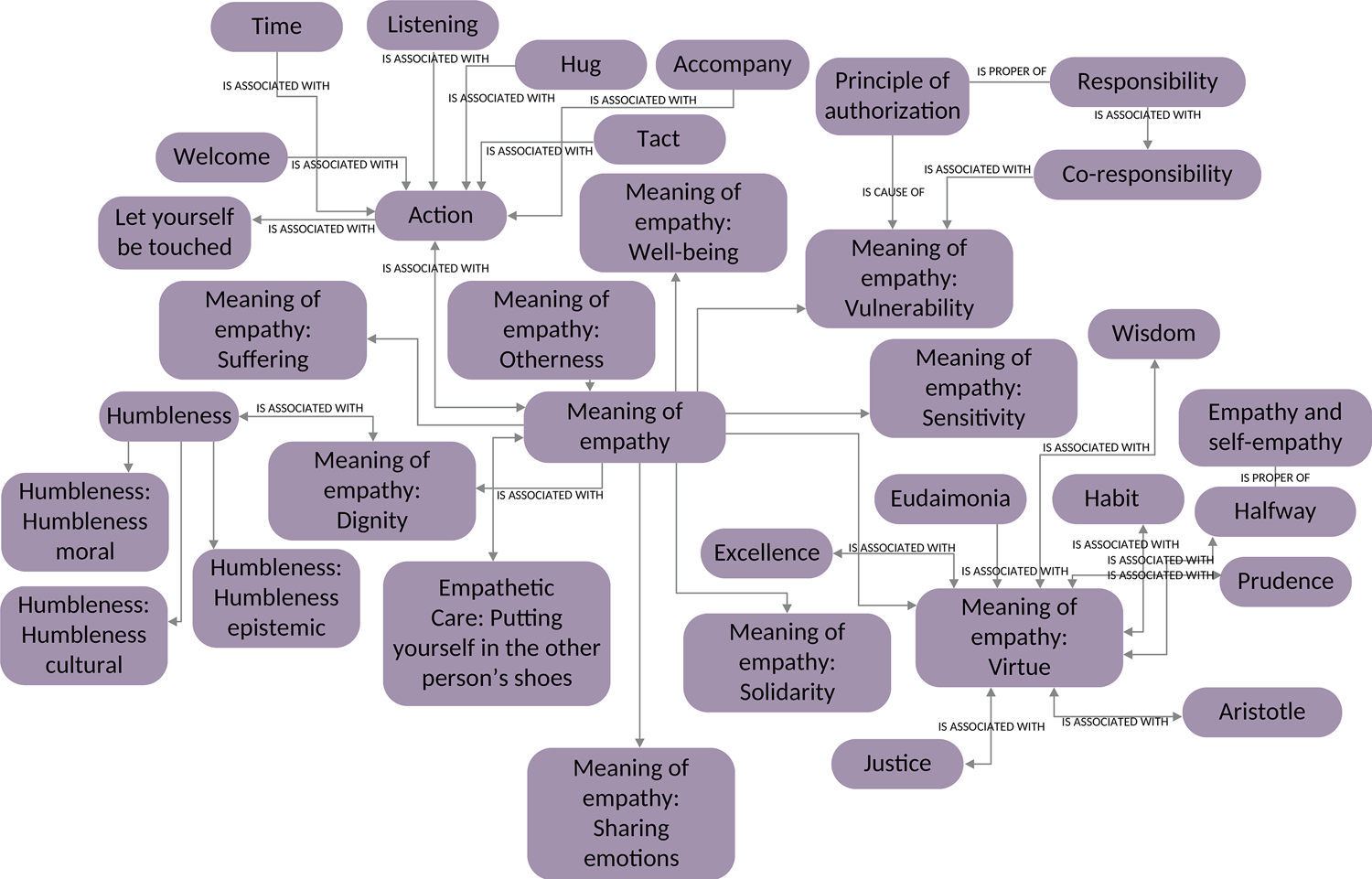 Prepared by the authors in ATLAS.ti.
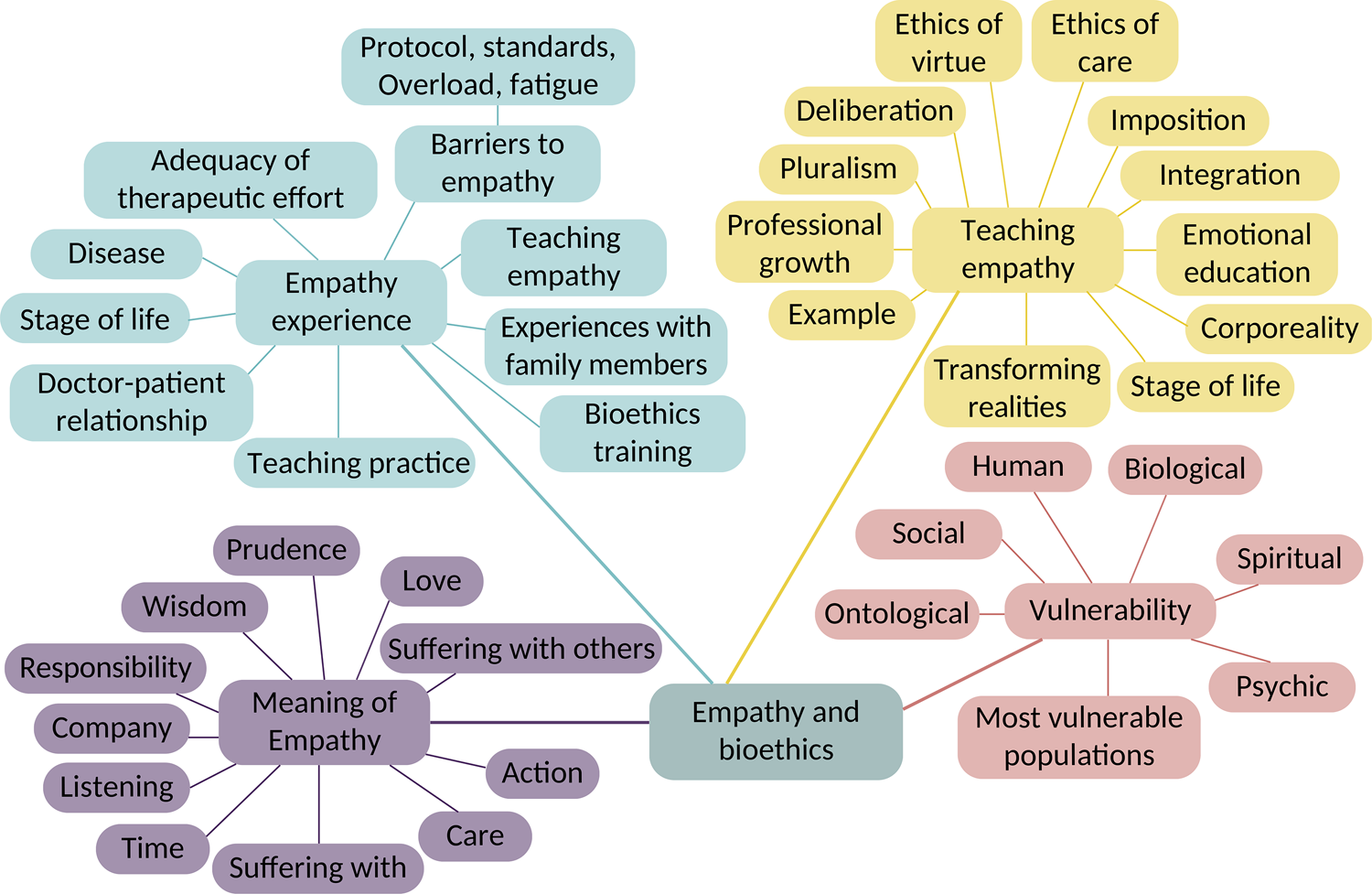 Prepared by the authors in Draw.io.