 Bioethical implications of artificial intelligence use in the health area: an integrative literature review
Abstract
The presence of artificial intelligence in everyday life is evident, and it is no different in the field of health, where it has become an important tool in helping to diagnose illnesses, decision making, provide clinical care and develop health research, among other things. This study analyzed recent published research on the bioethical implications of the application of artificial intelligence in healthcare. This is an integrative literature review, with data collected from the Scientific Electronic Library Online, the Virtual Health Library and the National Center for Biotechnological Information of the National Library of Medicine. The results show that although artificial intelligence is seen and used as an aid to health, professionals remain apprehensive regarding the ethical and bioethical aspects and legal responsibilities regarding its use.
Artificial intelligence; Bioethics; Technology
Resumo
A presença da inteligência artificial no cotidiano é patente, não sendo diferente no campo da saúde, em que ela vem se tornando ferramenta importante no auxílio do diagnóstico de doenças, na tomada de decisões, nos cuidados clínicos, no desenvolvimento de pesquisas em saúde, entre outros. O estudo analisou as recentes pesquisas publicadas sobre as implicações bioéticas da aplicação da inteligência artificial na área da saúde. Trata-se de estudo de revisão integrativa de literatura, com levantamento de dados nas bases Scientific Electronic Library Online, Biblioteca Virtual em Saúde e National Center for Biotechnolohy Information da National Library of Medicine. Entre os resultados, os estudos apontam que, embora a inteligência artificial seja vista e utilizada como instrumento de auxílio à saúde, ainda há apreensão por parte dos profissionais no que tange aos aspectos éticos e bioéticos e às responsabilidades legais quanto a seu uso.
Inteligência artificial; Bioética; Tecnologia
Resumen
La presencia de la inteligencia artificial en lo cotidiano es evidente, y en el campo de la salud esta tecnología se ha convertido en una herramienta importante en el diagnóstico de enfermedades, en la toma de decisiones, en la atención clínica, en el desarrollo de la investigación en salud, etc. Este estudio analizó las investigaciones recientes sobre las implicaciones bioéticas de la aplicación de la inteligencia artificial en el campo de la salud. Se trata de una revisión integradora de la literatura, con recopilación de datos en las bases de datos Scientific Electronic Library Online, Biblioteca Virtual en Salud y National Center for Biotechnology Information de la National Library of Medicine. Los resultados destacan que, aunque la inteligencia artificial es vista y utilizada como una herramienta para ayudar la salud, los profesionales todavía tienen recelo a los aspectos éticos y bioéticos y las responsabilidades legales del uso de esta tecnología.
Inteligencia artificial; Bioética; Tecnología
Artificial intelligence (AI) has been evidently present in everyday life. The situation is not different in the field of health, where it has become an important tool in diagnosis, decision-making, clinical care, and research, among others. Artificial intelligence generally refers to computer programs performing tasks commonly associated with intelligent beings based on algorithms 1.
The World Health Organization (WHO) 1 recognizes that artificial intelligence has numerous benefits not only for society but also for health care professionals, since it provides improved efficiency in the effective diagnosis of health problems and strengthens safe treatments, including by reducing overload on health care professionals and systems, which impacts the development of public policies geared toward the real needs of the population. However, despite all benefits involving AI, the bioethical aspects related to the use of this technological tool and the medium- and long-term consequences of its use on the provision of care and on the doctor-patient relationship must be noted, since it is still a new technology and there are no laws and guidelines that regulate it directly. Therefore, its applicability still requires discussions and improvements.
The guide entitled Ethics and governance of artificial intelligence for health, published in 2021, states that the use of AI in health must be based on ethical precepts that guarantee and ensure greater transparency for both professionals and users 1. Throughout the document, the basic ethical principles for the use of artificial intelligence as a tool for health are presented with a view to providing guidelines for professionals, developers and users, namely: non-maleficence; beneficence; justice or equity and autonomy 1.
Also according to the WHO, the use of AI will enable people in low-income countries with little access to health care services to obtain them. However, it is necessary to invest beyond technology in education and to inform the population on the use of this tool and on the maintenance and preservation of their rights 1.
Considering the above, this article sought to analyze recently published research on the bioethical implications of using artificial intelligence in the field of health, through an integrative literature review, based on the following guiding question: what are the main bioethical implications related to artificial intelligence applied to health?
Method
This is an integrative literature review; this methodology can aggregate knowledge based on studies on a specific issue to provide a wide range of scientific knowledge 2. According to Mendes, Silveira and Galvão 3, an integrative review is built in six stages, namely: 1) identification of the object and guiding question; 2) choice of inclusion and exclusion criteria for the research; 3) establishment of the information to be extracted; 4) analysis of the chosen studies; 5) interpretation of the results; and 6) presentation of the review/synthesis of knowledge.
To obtain inputs for the study and in line with steps 1 and 2 mentioned above, we carried out, in May/June 2024, the survey of articles published in the last five years, that is, 2019–2024, in the Scientific Electronic Library Online (SciELO), Virtual Health Library (VHL) and National Center for Biotechnolohy Information at the National Library of Medicine (PubMed) databases, using the descriptors “bioethics,” “artificial intelligence,” and “technology,” associated with the Boolean operator “and.” We adopted the following inclusion criteria: articles that had as descriptors “bioethics,” “artificial intelligence,” and “technology” and that were available in full for download. We excluded repeated articles whose text was not available in full.
After completing the publication survey stage, we examined titles and abstracts for screening based on the inclusion criteria established for the research, followed by a careful and systematic reading of the included articles.
Results
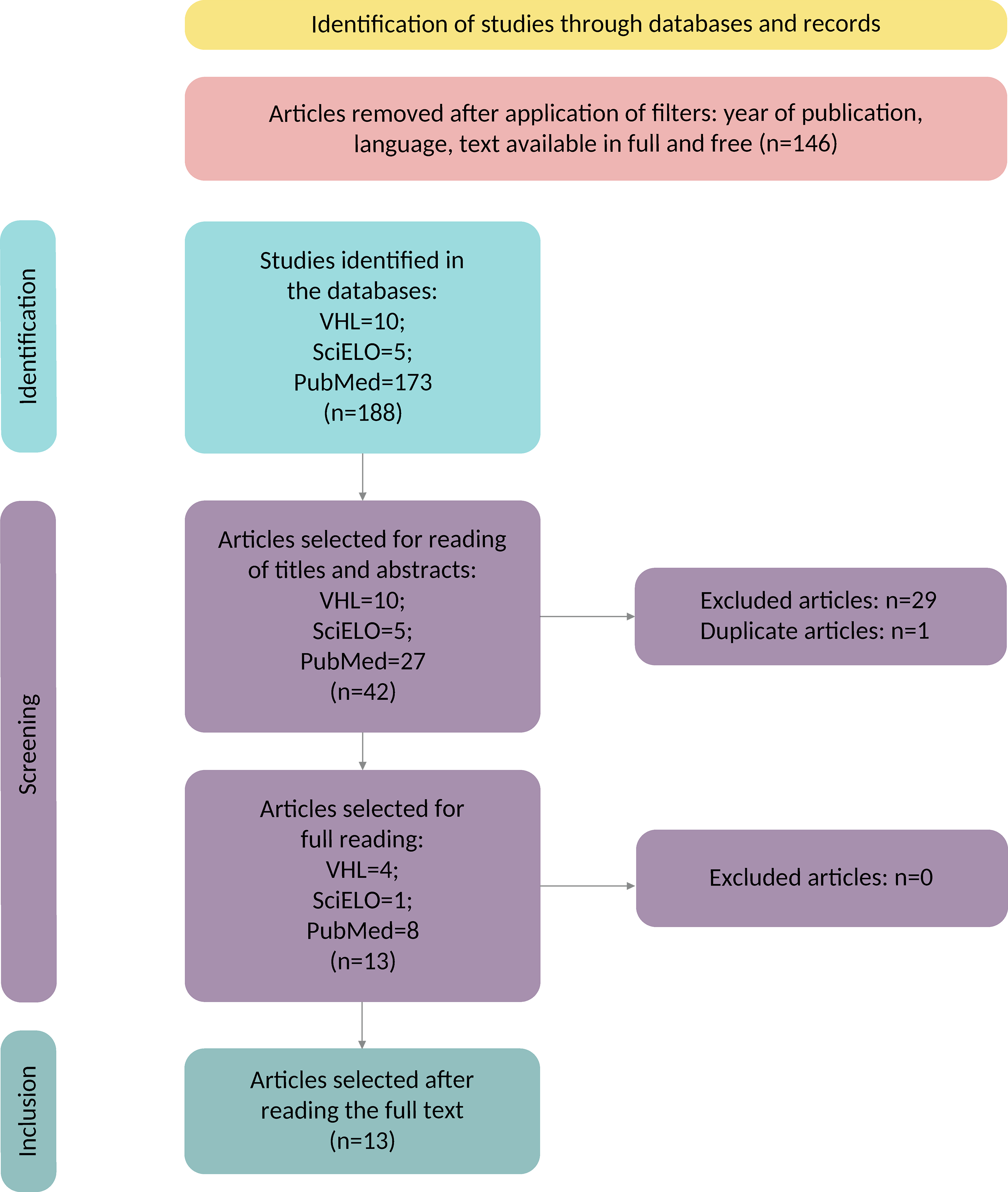
An extensive search was carried out in the electronic databases PubMed, SciElo and VHL, with the aid of the methodological tool Preferred Reporting Items for Systematic Reviews and Meta-Analyses (PRISMA). The search retrieved 188 articles that had the appropriate descriptors and, finally, 13 articles were selected for the present review based on the inclusion and exclusion criteria, and duplicate articles were removed (Figure 1).

The selected manuscripts were thoroughly analyzed, and the relevant variables extracted for this review are presented in Chart 1. The years of publication ranged between 2019 and 2024; as for the language of publication, we identified two articles in Portuguese, three in Spanish and eight in English.
These studies discuss the advantages and bioethical concerns of the use of AI in the field of health, noting the challenges of availability of and access to such tools by the most vulnerable populations and issues of consent and autonomy of the individual, data confidentiality and privacy, institutional and professional responsibility, and fear that they replace the physical and intellectual role of health care professionals.
Discussion
Theare undeniable contributions of technological advances to society, such as artificial intelligence. Thus, the current world context is increasingly emphasized when proposing discussions about the complex impacts of these resources on our everyday lives, due to the difficulty in understanding their technical characteristics and concepts and the wide range of their field of action. Thus, it is necessary to adopt a detailed approach to the ethical-legal implications involved in such theme 4.
Given this context, it is noted that health-related fields do not escape the applicability of AI, which is already conditioned, as can be seen in telematic service platforms, in its wide use in diagnosis with laboratory tests and bioimaging, and in decision-making processes, providing possible improvements in technical support and clinical care 4-6.
Therefore, considering the new context of health care that we are experiencing and what the consequences of future developments will be, the studies reviewed here invite us to reflect on the bioethical implications of such changes. First, the impact of the use of AI on the experience of the professional-patient relationship is noted, and it is essential to understand the limitations of these systems and to certify the elements of human intelligence 6,7.
The authors emphasize the importance of face-to-face connection and question the fact that machines learn only with language, without incorporating themselves into the physical world, without experiencing the connection of vocabulary with objects, properties and feelings. Thus, they do not understand words in the same way as people, being unable to perceive emotions, as well as to interact in a cultural context and express empathy 6-8.
These are irreplaceable aspects in decision-making processes, as described by the neurobiology of emotions, which points out that, by excluding them, the role of the moral, ethical, political and plural values of narratives and worldviews is nullified. In addition, there is a risk of losing critical thinking in relation to the use of technologies, which would make us mere impassive operators, a mute extension of the programmable mechanism of the machine we operate 7.
Other recurring concerns refer to the confidentiality and privacy of data obtained and stored, as well as to professional responsibility and the informed consent process in the use of AI. It is worth noting that the right to confidentiality of sensitive patient data is provided for in the 2009 Universal Declaration on Bioethics and Human Rights . However, with the use of AI, cyberattacks and leaks of such information for private benefit become a real risk, such as the use of these data by health insurers 5,6.
Thus, the protection of collected medical information becomes the responsibility of institutions and professionals. The State should establish principles and rules that ensure patients will have their privacy and integrity respected, so their data is only accessed with consent. This already occurs in the United States, where the collection, storage, and release of personal health information are regulated by the Health Insurance Portability and Accountability Act (HIPAA), which defines what personal information must undergo anonymization and de-identification steps 9-11.
The texts also address the fear that AI instruments occupy the current function of humans; however, it is essential to note that the former are not sufficiently capable of replacing the latter, and should exclusively assist the procedures of health care professionals. Thus, in order to avoid such future repercussions, humans should perform their activities with the responsibility and reliability desired by patients, which are irreplaceable characteristics and behaviors 12.
However, health care providers become liable to errors when they uncritically use this technology or when, in decision-making, they consider only the values of those who program the machine, introducing the so-called “machine paternalism,” leaving aside their own values, judgments and autonomy, as well as those of patients. Thus, the professionals have the obligation of involving the individuals in the dialog, transparently clarifying the advantages and disadvantages of using AI 10,12-14.
Considering the significant transformations in the work of health care professionals due to the advent of AI, it is essential to address this issue already the training stage, that is, it should be incorporated into the curricula in order to address the extensive applicability of AI in the field of health and, concomitantly, establish a parallel with the fundamental principles of bioethics. It is also suggested that some tools, such as ChatGPT, are useful in ethical education, as they help clarify terms and theories 15,16.
Finally, in relation to the foundation of the discussions established here, we note the emphasis on the principlist approach to bioethics, which proposes the principles of justice, non-maleficence and autonomy, which are important in the choice and use of AI tools in the context of health. In addition, principlism contributes significantly in this context as it enables understanding that no principle or rule can be applied correctly without practical wisdom and virtue 17.
Final considerations
Although the use of AI in the field of health as a technological tool, which contributes to diagnoses and treatments, has indisputable benefits for health care professionals, users and the health care system as a whole, it still lacks information regarding the protection of collected data and bioethical aspects. It is also necessary to discuss the role of health care professionals and the State in maintaining and guaranteeing the secrecy and confidentiality of users.
The findings of this research indicate that, despite the benefits of using AI in the field of health, it does not replace the judicious evaluation of health care professionals, who should keep in mind that AI is a supporting instrument, with the professionals being responsible for the last word in the conduct of cases, thus minimizing possible errors that a systematic use of AI, without any analysis based on knowledge, would cause.
References
-
1 World Health Organization. Ethics and governance of artificial intelligence for health: WHO guidance [Internet]. Geneva: WHO; 2021 [acesso 14 out 2024]. p. 5. Tradução livre. Disponível: https://www.who.int/publications/i/item/9789240029200
» https://www.who.int/publications/i/item/9789240029200 -
2 Souza MT, Silva MD, Carvalho R. Integrative review: what is it? How to do it? Einstein (São Paulo) [Internet]. 2010 [acesso 14 out 2024];8(1):102-6. DOI: 10.1590/S1679-45082010RW1134
» https://doi.org/10.1590/S1679-45082010RW1134 -
3 Mendes KDS, Silveira RCCP, Galvão CM. Revisão integrativa: método de pesquisa para a incorporação de evidências na saúde e na enfermagem. Texto & contexto enferm [Internet]. 2008 [acesso 14 out 2024];17(4):758-64. DOI: 10.1590/S0104-07072008000400018
» https://doi.org/10.1590/S0104-07072008000400018 -
4 Frez Pulgar GA. Bioética e integración de la inteligencia artificial en la medicina: reflexiones desde el cine sobre la condición humana y la responsabilidad hacia las generaciones futuras. Aesthethika [Internet]. 2023 [acesso 14 out 2024];19(2):41-7. Disponível: https://tinyurl.com/ycy96pd3
» https://tinyurl.com/ycy96pd3 -
5 Actis AA. Consideraciones bioéticas en relación con el uso de la inteligencia artificial en mastología. DOAJ [Internet]. 2021 [acesso 14 out 2024];37(4):e37413. Disponível: https://tinyurl.com/39awws7y
» https://tinyurl.com/39awws7y -
6 Duarte ES, Moura FS, Oliveira LP, Garcia LF. Aspectos bioéticos da utilização de sistemas de inteligência artificial no campo da saúde: um estudo exploratório. Rev bioét derecho [Internet]. 2023 [acesso 14 out 2024];57:263-85. DOI: 10.1344/rbd2023.57.35146
» https://doi.org/10.1344/rbd2023.57.35146 -
7 Bustamante BJP. ¿Operarios impasibles? Desafíos de la educación y la experiencia médico paciente en relación con la inteligencia artificial. Aesthethika [Internet]. 2023 [acesso 14 out 2024];19(2):49-56. Disponível: https://tinyurl.com/44kbsxkj
» https://tinyurl.com/44kbsxkj -
8 Tai MCT. The impact of artificial intelligence on human society and bioethics. Tzu Chi Med J [Internet]. 2020 [acesso 14 out 2024];32(4):339-43. DOI: 10.4103/tcmj.tcmj_71_20
» https://doi.org/10.4103/tcmj.tcmj_71_20 -
9 Nunes HC, Guimarães RMC, Dadalto L. Desafios bioéticos do uso da inteligência artificial em hospitais. Rev. bioét. (Impr.) [Internet]. 2022 [acesso 14 out 2024];30(1):82-93. DOI: 10.1590/1983-80422022301509PT
» https://doi.org/10.1590/1983-80422022301509PT -
10 Oliva A, Grassi S, Vetrugno G, Rossi R, Morte GD, Pinchi V, Caputo M. Management of medico-legal risks in digital health era: a scoping review. Front Med [Internet]. 2022 [acesso 14 out 2024];8:821756. DOI: 10.3389/fmed.2021.821756
» https://doi.org/10.3389/fmed.2021.821756 -
11 Cohen G, Evgeniou T, Gerke S, Minssen T. The european artificial intelligence strategy: implications and challenges for digital health [Internet]. Lancet Digit Health. 2020 [acesso 14 out 2024];2(7):e376-e379. DOI: 10.1016/S2589-7500(20)30112-6
» https://doi.org/10.1016/S2589-7500(20)30112-6 -
12 Savulescu J, Giubilini A, Vandersluis R, Mishra A. Ethics of artificial intelligence in medicine. Singapore Med J [Internet]. 2024 [acesso 14 out 2024];65(3):150-8. DOI: 10.4103/singaporemedj.SMJ-2023-279
» https://doi.org/10.4103/singaporemedj.SMJ-2023-279 -
13 Nebeker C, Torous J, Bartlett ERJ. Building the case for actionable ethics in digital health research supported by artificial intelligence. BMC Med [Internet]. 2019 [acesso 14 out 2024];17(1):137. DOI: 10.1186/s12916-019-1377-7
» https://doi.org/10.1186/s12916-019-1377-7 -
14 Prakash S, Balaji JN, Joshi A, Surapaneni KM. Ethical conundrums in the application of artificial intelligence (AI) in healthcare - a scoping review of reviews. J Pers Med [Internet]. 2022 [acesso 14 out 2024];12(11):1914. DOI: 10.3390/jpm12111914
» https://doi.org/10.3390/jpm12111914 -
15 Livanis E, Voultsos P, Vadikolias K, Pantazakos P, Tsaroucha A. Understanding the ethical issues of brain-computer interfaces (BCIs): a blessing or the beginning of a dystopian future? Cureus [Internet]. 2024 [acesso 14 out 2024];16(4):e58243. DOI: 10.7759/cureus.58243
» https://doi.org/10.7759/cureus.58243 -
16 Kapsali MZ, Livanis E, Tsalikidis C, Oikonomou P, Voultsos P, Tsaroucha A. Ethical concerns about ChatGPT in healthcare: a useful tool or the tombstone of original and reflective thinking? Cureus [Internet]. 2024 [acesso 14 out 2024];16(2):54759. DOI: 10.7759/cureus.54759
» https://doi.org/10.7759/cureus.54759 - 17 Rocha DM. Bioética e o principialismo: um estudo a partir de Wittgenstein [dissertação]. Florianópolis: UFSC; 2008.
Edited by
-
Responsible editor
– Dilza Teresinha Ambrós Ribeiro