
 Consequences of Value Co-Creation on Customers in Three Service Sectors
ABSTRACT
Service-Dominant Logic focuses on service, relationships, and interactions among actors and resources, leading to idiosyncratic value co-creation (VCC). However, there is uncertainty about the consequences of this co-creation on the customer and whether they are generalized across different service sectors. Therefore, this article investigates VCC and its potential consequences for the customer. At the customer level, we adopt the DART model of VCC and its various relationship with constructs Satisfaction and Trust and those of these constructs with construct Loyalty. We encompass customers from banks, mobile services, and higher education in Brazil, conducting an online survey with 1012 consumers. From the conceptual model, seven hypotheses were developed, of which five had their relationships supported. Structural Equation Modeling supports the relationships between VCC (on one hand), and Trust (Affective and Cognitive), and Satisfaction (on the other), as well as the predictive roles of the latter two concepts on Loyalty. However, there are similarities and differences among customers in the three sectors in these relationships. This study highlights important aspects of the value co-creation process in the three analyzed services. It also emphasizes the importance of the relationship among process actors, highlighting the active participation of customers throughout the entire value co-creation.
KEYWORDS:
Value Co-creation; Satisfaction; Trust; Loyalty
RESUMO
A Lógica Serviço-Dominante tem foco em serviço, relações e interações entre atores e recursos conducentes à idiossincrática cocriação de valor (CCV). Há dúvida, porém, sobre as consequências dessa cocriação no cliente e se elas se generalizam nos diversos ramos de serviços. Então, este artigo investiga a CCV e potenciais consequências para o cliente. Tomamos, no nível do cliente, o modelo DART de CCV e suas relações com satisfação e confiança e as desses construtos com a lealdade. Contemplamos clientes de bancos, telefonia móvel e ensino superior no Brasil, com um levantamento online de 1012 consumidores. A partir do modelo conceitual, foram desenvolvidas 7 hipóteses, das quais 5 tiveram suas relações suportadas. A Modelagem de Equações Estruturais suporta as relações entre CCV (de um lado) e Confiança (Afetiva e Cognitiva) e Satisfação (do outro), bem como os papéis preditivos dos dois últimos conceitos na Lealdade. Mas há tanto semelhanças quanto diferenças - entre os clientes dos três ramos - nessas relações. O trabalho apresenta aspectos importantes do processo de cocriação de valor nos três serviços analisados. Também exalta a importância do relacionamento entre os atores do processo, em que destaca a participação ativa dos clientes ao longo de toda a cocriação de valor.
PALAVRAS-CHAVE:
Cocriação de Valor; Satisfação; Confiança; Lealdade
1. INTRODUCTION
The Service Profit Chain (SPC) asserts that value creation emerges from interactions between the company, employees, and customers (Hogreve et al., 2017), where employee satisfaction influences customer satisfaction, impacting overall company performance (Chi & Gursoy, 2009). The model has its origins in the research of Reichheld and Sasser Jr. (1990), who advocate the reduction of failures until the delivery of service with zero defects, Schlesinger and Heskett (1991), who address the importance of services and a business model focused on them, and Roth and Van Der Velde (1991), who establish a link between operational and marketing metrics. The advancement of these studies led to Heskett et al. (1994) SPC, which highlights the strength of the links and integrates several performance drivers with the theoretical explanation of their interdependencies (Silvestro & Cross, 2000). However, the SPC is silent on Value Co-creation, a concept that gained prominence in the Marketing theory with Service-Dominant Logic (SDL). This is a substantive academic knowledge gap, which leaves SPC and SDL as distinct perspectives.
This article connects SPC to Value Co-creation (VCC) and other customer outcomes. The basis is Service-Dominant Logic (SDL), which considers organizations as transformers of resources (Vargo & Lusch, 2004) to serve customers (Lusch, Vargo, & O'Brien, 2007), in which the value defined and co-created with the active and unique performance of each client (Vargo, 2008). The VCC process involves interactions among different economic actors and customers (Grönroos & Voima, 2013), with a crucial emphasis on the role of customers (Neghina et al., 2015).
In a service encounter, the mirror metaphor reinforces the co-creative nature of value. This is because employee satisfaction is reflected in customer satisfaction (Heskett et al., 1997) and their purchase intentions (Evanschitzky et al., 2011). Satisfaction depends on the confirmation/disconfirmation of expectations after purchase and consumption (Halstead et al., 1993), while employees influence both this expectation (at an early stage) and its subsequent confirmation/disconfirmation (Jones & Taylor, 2018).
This ‘mirror of satisfaction’ indicates a win-win logic between supplier and customer (Di Mascio, 2010). For both parties to gain-whether psychologically, monetarily, or in any other way-the customer must trust the company and its employees (Sirdeshmukh, Singh, & Sabol, 2002). Customer trust in the organization relies on their relationship with employees (Ennew et al., 2011) and the fulfillment of promises in delivering value propositions, which underpin co-creation (Chen, Chen, & Wu, 2017). Within the two dimensions of Trust, the Affective one refers to emotions and feelings that involve the customer and the provider (Johnson & Grayson, 2005; Lewis & Weigert, 1985a). However, its Cognitive dimension is rational (Terres & Santos, 2013) and involves the provider's reputation (Ha et al., 2016). Trust affects customer Loyalty, which influences market growth and organizational financial outcomes (Akhgari, Bruning, Finlay, & Bruning, 2018; Oliver, 1999). Such Loyalty is directed to products, services, events, and/or activities (Uncles et al., 2003) and has behavioral and attitudinal dimensions (Oliver, 1999).
However, in the study of VCC in services, the roles of the customer and the service provider still need to be clearly differentiated. VCC and its customer perception, as opposed to the service provider, remain undeciphered in literature (Tommasetti, Troisi, & Vesci, 2017). Divergences leave a gap in understanding and measuring the VCC process and even the VCC result (Holmqvist et al., 2020). SDL has VCC as a pillar, yet its consequences in service require further investigation (Skålén et al., 2015). Given all the above, the question posed by this article is: In the convergence between SDL and SPC, how do VCC, Satisfaction, Trust, and Loyalty relate to service customers? The objective is to evaluate the VCC process and its consequences on the customer (Satisfaction, affective and cognitive trust, loyalty). Based on the literature, we formulated hypotheses and tested them with customers from three types/branches of services in Brazil: banking, mobile services (encompassing voice and data transmission), and education. When it comes to the process of of transition and adoption of new models such as fintech, banks in Brazil are some of the best structured in the world (Pinochet et al., 2019), which justifies investigating it. The mobile telephone sector in Brazil is enormous: in March 2022, there were around 256.4 million accesses to its system (Anatel, 2022). In higher education, the INEP (2022) indicated growth of 5% in 2021. The method of investigation chosen was quantitative, using structural equation modeling and application in the SmartPLS software. From the theoretical framework, the conceptual Model was constructed with seven hypotheses, five of which had their relationships supported, demonstrating the importance of the DART model from the perspective of value co-creation in the service profit chain. In fact, the contribution of the research consists of adding the concept of value co-creation to the service profit chain. Note that this addition of a construct was carried out from the perspective of the service customer.
2. THEORETICAL BACKGROUNDS
For more than four decades, services literature has described customers and suppliers as active agents in creating, producing, delivering, and controlling services (Johnston, 1989). Customers, in these processes, have at least three roles: (1) productive resource, (2) collaborator for quality, Satisfaction, and value, and (3) potential competitor of the provider when producing the service itself (Bitner et al. al., 1997).
In the 2000s, with the SDL, the VCC process gained prominence (Vargo & Lusch, 2004) among clients, company agents, and others. Business resources are brought to customers through interaction with their employees and systems (McColl-Kennedy et al., 2012). For VCC, the collaboration that provides essential resources and capabilities to processes results in value based on dialogic interactions (Ballantyne & Varey, 2006). Customer participation gains importance due to its influence on the company's financial performance (Chan et al., 2010). According to VCC premises, value is not defined by the supplier but rather by exchanging resources between providers, users, and other co-creators (Tommasetti et al., 2017).
VCC always depends on customer decisions and actions and involves interactions between process actors and service exchanges (Brambilla et al., 2017). In the DART model, these interactions in the organizational system have the dimensions of Dialogue, Access, Risk Assessment, and Transparency (Prahalad & Ramaswamy, 2004a; Albinsson et al., 2016). Dialogue, which is essential, requires interaction between the customer and the company in the search for viable VCC alternatives and solutions (Prahalad & Ramaswamy, 2004a). Becker, Santos, and Nagel (2016) point out that companies that actively communicate (Dialogue) with customers tend to receive higher Satisfaction.
In addition, the customer needs access to people and other resources to exchange information and yet other resources (Albinsson et al., 2016). This access importance goes beyond the VCC process, encompassing the design and production processes (Prahalad & Ramaswamy, 2004b). This involves the customer in the role of co-producer, and it requires Transparency from actors; hence, the asymmetry of information that allowed the company to explore different markets has been disappearing (Prahalad & Ramaswamy, 2004a). With the symmetry of information comes the symmetry of exchanges (Lusch & Vargo, 2008), the consequence of which is customer trust (Ramaswamy, 2009). However, this Trust also depends on assessing the risks and benefits of products and services (Prahalad & Ramaswamy, 2004a). Therefore, Transparency stands out even more in the VCC process (Prahalad & Ramaswamy, 2004b).
VCC is positively related to Satisfaction and behavioral intention (Sweeney et al., 2015). Customer satisfaction is a judgment of how much a product or service meets or exceeds expectations (Gupta & Zeithaml, 2006). The evaluation starts from the customer experience with a product, service, and, above all, with the company (Anderson et al., 1994). The VCC process includes co-production, in which the customer acts as a resource (Chathoth et al., 2013). Founded on the DART model, in its relationship between VCC and Customer Satisfaction, the first hypothesis is formed
-
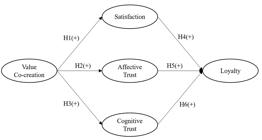
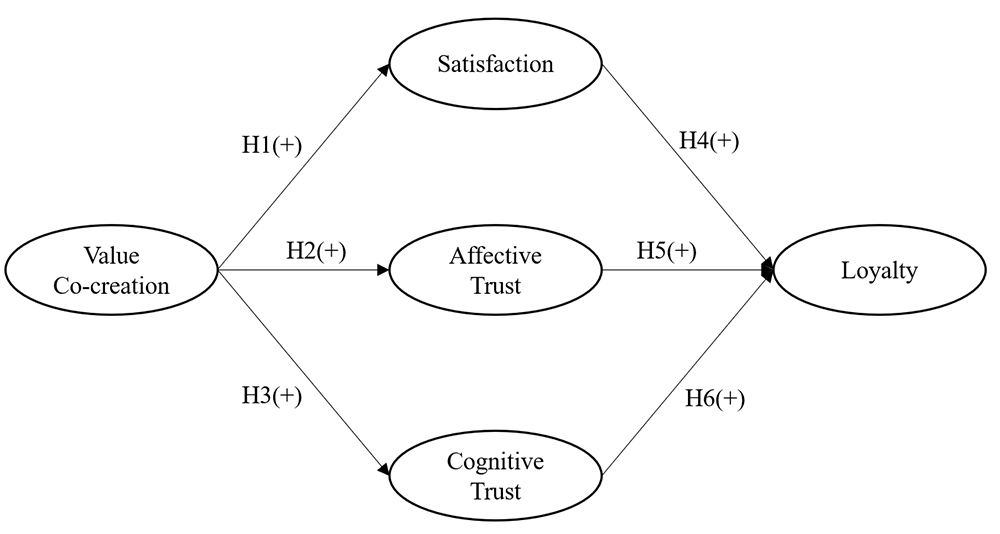
H1: The VCC process positively impacts Customer Satisfaction.
Trust, another construct around VCC (Miles, 2014), is an expectation that the provider will fulfill its promises (Chen, Chen, & Wu, 2017). The VCC process depends on the meeting between the provider and the client (Medler-Liraz, 2016) to expand the exchange of experiences, with the client sharing helpful information with the VCC. Trust unfolds in rationality and affectivity (Agustin & Singh, 2005), which are related to each other (Erdem & Ozen, 2003); they are beliefs with cognitive or affective connotations (Johnson & Grayson, 2005). Affective Trust is established in emotional bonds between individuals (Lewis & Weigert, 1985b) and care and concern for others (Johnson & Grayson, 2005). The deepening of emotional connections elevates Trust beyond what is justified by rationality, which increases the role of affective Trust (Ha et al., 2016). From this reasoning emerges the second hypothesis
-
H2: The VCC process positively impacts Affective Trust.
Cognitive Trust (Corgnet et al., 2016) captures the most rational perspective (Swift & Hwang, 2013; Terres & Santos, 2013) as a response to an incomplete state of knowledge or information (Johnson & Grayson, 2005). The information necessary to achieve Cognitive Trust is related to the probability that the partner, in exchange, will fulfill their obligations and honor their reputation (Ha et al., 2016). These are the bases of the following hypothesis
-
H3: The VCC process positively impacts Cognitive Confidence.
Service customer satisfaction is not just about technical performance but about the set of exchange processes with the provider and its staff, such as communication and expectation management (Campbell & Finch, 2004). The better the Satisfaction and attitude of the employee, the higher the Satisfaction of the customers (Otterbring, 2017). On the other hand, customer reactions are influenced by cultural variables (Zhang et al., 2013), and thus, Satisfaction and Loyalty may differ across regions and countries (Kursunluoglu, 2014), which is addressed in studies on the SPC (Kim, 2014). Furthermore, Satisfaction is positively related to Loyalty (Hogreve et al., 2017). Such foundations lead to the following hypothesis
-
H4: Customer satisfaction positively impacts Loyalty.
Trust, as a precept of marketing relationships, influences the behavior of actors in exchanges (Gefen, 2002). Trust generates collaborative behavior between customers and the organization (Morgan & Hunt, 1994). Such Trust, a strategic intangible asset for organizations, requires financial, psychological, sociological, and time investments (Akrout et al., 2016). Customer trust is a requirement for commitment, which is a strong predictor of Loyalty (Ennew et al., 2011; Esterik-Plasmeijer & Raaij, 2017). These reasonings support the following hypotheses
-
H5: Affective Trust positively impacts customer Loyalty
-
H6: Cognitive Trust positively impacts customer Loyalty.
Attitudinal Loyalty is a commitment to repurchase a product or reuse a service consistently (Oliver, 1999); the customer intends to maintain a relationship with the supplier (Sirdeshmukh et al., 2002). Thus, Loyalty expresses an intended behavior toward the service and/or the company (Andreassen & Lindestad, 1998). Even in the face of competitors' marketing efforts, loyal customers repeat purchases from the same brand (Oliver, 1999) or even renew contracts with it (Andreassen & Lindestad, 1998).
In the context of SPC, given the scientific ideal of generalization, it would be excellent if the derived hypotheses were supported across different service sectors. However, it is more likely that relationships vary among sectors. This perspective leads to the following hypothesis
-
H7: Among the service sectors, there are differences in the other hypotheses (H1 to H6).
The combination of the seven hypotheses leads to the Conceptual Model of the article, outlined in Figure 1. The Model is supported by SPC by both Heskett et al. (1994) and Kim (2014).
3. METHOD
In a quantitative and cross-sectional scheme, the Conceptual Model was empirically tested with samples of customers in Brazil from three branches of mass services: banking (322 valid responses), mobile (311 valid responses), and higher education (with 379 valid responses). We chose these sectors because (1) they are mass services, thus having vast customer bases, facilitating data collection; (2) there is a good interaction process between customers and providers; (3) they are well represented throughout the national territory, reflecting something of a Brazilian perspective on the VCC process.
For VCC in the perception of the Service Customer, we use the scale by Albinsson et al. (2016), translated and adapted to the Brazilian context by Becker et al. (2016). For Service Customer Trust, we adopted the Terres & Santos (2013) scale, with the Affective and Cognitive dimensions. For Service Customer Satisfaction, we use the scale by Homburg et al. (2009) and Yee et al. (2011), with six items validated according to DeVellis (2003). The Service Customer Loyalty scale was that of Souza, Gosling and Gonçalves (2013), developed in Brazil.
Data was collected using a digital questionnaire on the platform SurveyMonkey. Only the first questionnaire coming from an IP (internet protocol,an identifier for a device connected to the internet) was accepted. Invitations to respond to the questionnaire were sent by email and posted on social media platforms (e.g., Facebook, Instagram, and WhatsApp) by the authors, requesting to forward the invitation (the snowball technique). Harman's simple test for common method bias did not reveal bias in the data. The normality test revealed variables deviating from normal distribution.
Structural Equation Modeling (SEM) deals well with complex models and has an alternative for data that does not adhere to the multivariate normal distribution (Ringle, Silva & Bido, 2014), as is the case here. The SEM encompasses stages of conceptual model specification, evaluation, and adjustments of each measurement model, and structural model assessment (Hair et al., 2013). In the article, the estimation of the structural model followed: (a) the precepts of Hair et al. (2017); (b) the approach of Wetzels, Odekerken-Schröder and Van Oppen (2009) of repeating the items (measured variables) of the first-order latent variable in the second-order latent variable. The evaluation of the measurement model included internal consistency (Cronbach's Alpha and Composite Reliability), Convergent Validity (Average Variance Extracted), and discriminant validity (Fornell Larcker Criterion and Heterotrait-Monotrait Ratio). The VIF, R², adjusted R², and f² indexes were also examined. The evaluation of the structural model covered the bootstrapping procedure, the beta coefficient, standard deviation, t-test, and p-value. Still using SEM, a multigroup analysis was carried out to examine H7, which addresses differences in the remaining relationships of the conceptual model among customers from the three branches of services.
4. RESULTS AND DISCUSSION
4.1. Sample Profile
The total sample reached 1012 customers. In the context of banking services, the sample had 322 valid respondents, of which 174 (54%) declared themselves to be male. Regarding marital status, 112 of those who declared themselves male were married, compared to 64 females. As for education, 24 men had post-graduation compared to 30 women. 43 men had a master's degree, while 32 women hold this title.
From the mobile telephone service perspective, the sample covered 311 valid respondents, of which 182 declared themselves female (58.5%); only two did not want to identify their gender (0.6%). Of the female respondents, 82 are single, and 70 are married (corresponding to 83.5% of this gender); 58 men have a higher degree, and 72 women have this title. There are 25 female doctors and only 13 men with the title.
Finally, concerning higher education services covering bachelor's and technological degrees, the sample had 379 respondents. Among them, females account for 57.8% of the total. There are 344 single respondents, 31 married and four divorced.
4.2. Examination of Measurement Models
Examination of the construct measurement models revealed the need for some adjustments. In the Cognitive Confidence construct, item CCG6 (Given the history of our relationship with this company, I have reason to doubt the institution's competence) and in Affective Trust, item CCA2 (I feel that this company shows care towards me), the reason is the factor loading lower than 0.4 (Hair et al., 2017). Value Co-Creation is a 2nd-order variable composed of Dialogue, Accessibility, Risk, and Transparency. After these adjustments, there is internal consistency in the scales, with Cronbach's alpha and Composite Reliability greater than 0.7, the minimum reference (Ringle et al., 2014). Such indicators are in Table 1 and those referring to convergent validity (Fornell & Larcker, 1981). In Table 1, the AVE values support the convergence of the conceptual model constructs.
Table 1 also endorses discriminant validity, which indicates the distinction between one construct and another (Hair Jr. et al., 2009), the dissimilarity between indexes of different constructs (Götz et al., 2010), that is, each construct is unique, without being represented in another construct of a model (Hair et al., 2017). We use two criteria to examine discriminant validity. The first, more conservative, according to Hair et al. (2017), is that of Fornell Larcker. The second criterion is the Heterotrait-Monotrait Ratio, which correlates indicators of different constructs with indicators of the same construct. This correlation (called disattenuated) up to 0.85, established by Hair et al. (2017), expresses discriminant validity. Table 1 shows the square root of the AVE (Fornell-Larcker criterion) and the confidence interval of the HTMT ratio (values less than 1). Therefore, it is inferred that there is discriminant validity in the conceptual model.
Table 2 shows each latent variable's VIF (variance inflation factor), which indicates the degree of multicollinearity between variables (Hair Jr. et al., 2009). The highest VIF is 2.952 (Satisfaction to Loyalty ratio). Since the VIFs are lower than the limit of 3.0 (Hair et al. 2019), it is inferred that there is low collinearity between the conceptual Model constructs.
Pearson's coefficient of determination (R²) expresses the predictive accuracy of a model (Hair et al., 2017). In social and behavioral sciences, an R² of up to 2% is considered a small effect, R² around 13% as a medium effect, and R² above 26% as a large effect (Ringle et al., 2014). The coefficients of determination of the conceptual model, reported in Table 2, show high explanatory power of the regressions as the adjusted R² values are between 36.5% and 49.3%. Cohen's indicator (f²) for effect size assesses each construct's usefulness for adjusting a model. 0.02, 0.15, and 0.35 indicate weak, medium, or substantial (respectively) influence of an exogenous latent variable on an endogenous latent variable. For the conceptual model, in Table 2, the majority of f² is low. The only large effect is between Satisfaction and Loyalty (f²=0.206). These values come from the PLS algorithm in the SmartPLS software.
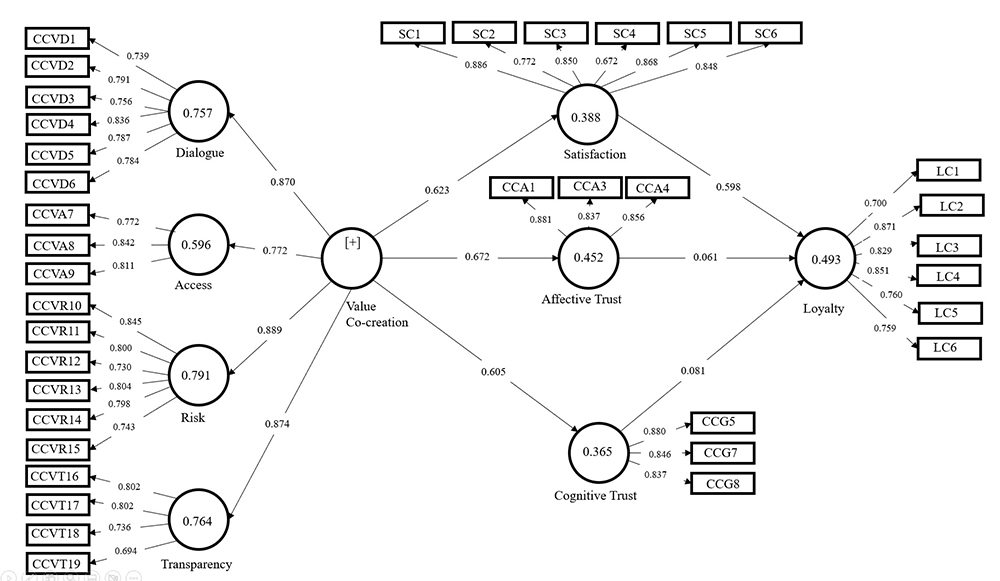
Figure 2 shows the adjusted model, with the path coefficient between latent variables, the R² of each endogenous variable, and the factor loadings of each item measured in the respective latent variable.
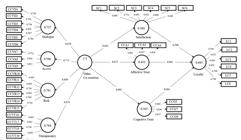
In SEM, we applied bootstrapping, a non-parametric procedure that extracts several subsamples, estimates models for each of them, and estimates parameters from the set of models (Hair et al., 2018). The relationship between the constructs is measured using the student's t-test, whose coefficients evaluate the relationship between constructs at an adopted significance level.
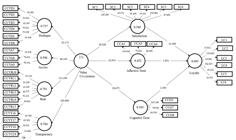
The values generated by bootstrapping, with 10,000 resamples for the general sample (customers from the three service sectors), are in Table 3. Five hypotheses are supported; only one is rejected (H5, relationship between Affective Trust and Loyalty). Furthermore, we applied bootstrapping to the sample from each sector. Then H5 is rejected in all sectors. H6, on the relationship between Cognitive Trust and Loyalty, is rejected in banking and higher education services.
The interactivity between customers and service providers is prominent in services. This allows customers to obtain a series of benefits, constituting favorable experiences, with the potential for an increased preference for the service provider (Jaakkola et al., 2015). Regarding this interaction, providers have increased communication channels, such as smartphone applications, websites, and profiles on social media. Interactive processes are the basis of VCC, according to Vargo and Lusch (2004, 2008) and Prahalad and Ramaswamy (2004a, b). The benefits experienced by the service customer, hedonic and utilitarian (Verleye, 2015), lead to Satisfaction, Trust, and Loyalty.
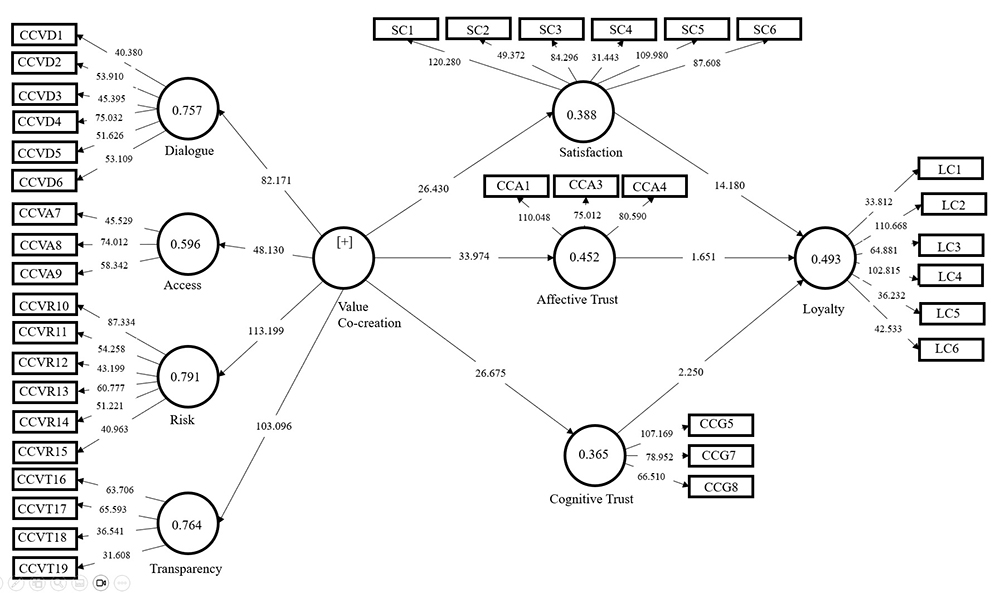
The results in Table 3 highlight the positive impact of the VCC process on Satisfaction. This converges with Sweeney et al. (2015), highlighting the interaction between actors in the VCC process. In fact, VCC is a process centered on the interaction between customers and the staff who serve them (Neghina et al., 2015). In H1, the positive relationship between VCC and Satisfaction is evident (Γ = 0,623, t(1012) = 26,430 and p <0.001), which corroborates Sweeney et al. (2015) on the VCC process, in which the interaction between the provider and the customer culminates in Satisfaction. The customer, as a co-producer and co-creator, has increased their understanding of the relationship with the service provider, fostering an active approach to seeking information (Grönroos & Voima, 2013) posture that affects both interaction and behavior (Jamilena et al., 2017). From the DART model, the importance of Dialogue and Customer Access to the process emerges (Prahalad & Ramaswamy, 2004a). The relationship between VCC Risk and Satisfaction highlights the understanding of service risks by customers (Prahalad & Ramaswamy, 2004b). Finally, Transparency also matters in the VCC process (Tanev et al., 2011), in addition to reducing information asymmetry (Taghizadeh et al., 2016), as it has a positive impact on Customer Satisfaction.
The foundation of VCC, as shown by Miles (2014), is the relationship between the service provider and the customer in the service. However, a fruitful relationship requires Trust (Chen, Chen, & Wu, 2017), such as the expectation that the partner is willing and able to act in the relationship's best interests (Sirdeshmukh et al., 2002). Customer trust is based on the supplier's honesty, goodwill, and competence (Walter & Ritter, 2003). Trust involves obligations, responsibilities, and expectations created by the customer that the provider will fulfill what was promised, agreed upon, and pre-established (Luarn & Lin, 2003; Sirdeshmukh et al., 2002).
The structural path Value Co-creation → Affective Trust (Γ =0,672, t(1012)= 33.974 and p <0.001) supports H2. The empirical results strengthen the premise of interaction between provider and customer in the service (Jaakkola et al., 2015) and point to VCC related to Cognitive and Affective Trust (H2). Affective has been identified as the result of the relationship based on emotional and affective aspects between provider and customer (Akrout et al., 2016; Sirdeshmukh et al., 2002). Cognitive Confidence (H3) is also positively related to the VCC process. Cognitive Trust focuses on rationality, with the customer expecting the provider to fulfill its role in the VCC and service provision (Erdem & Ozen, 2003). Cognitive Trust seeks, based on shared experience and knowledge, to reduce the uncertainty of the relationship (Ziegler & Golbeck, 2007). There is support for H3, with the positive impact of VCC on Cognitive Confidence (Γ = 0.605, t(1012)= 26,675, p <0.001).
Literature has reported, for decades, the effect of customer satisfaction on customer loyalty (Kondasani & Panda, 2015). This relationship covers goods (tangible) and services (intangible). Satisfaction is a relevant objective for service organizations to obtain positive customer behaviors, such as Loyalty, and subsequent effects (profitability and market growth, for example) (Chen, 2012). In SPC (Maddern et al., 2007), Satisfaction is one of the main precursors to Loyalty. The empirical results (Γ = 0.598, t(1012)= 14.180, p <0.001) corroborate the relationship between Satisfaction and Loyalty. This converges with Chen and Wang (2016) and studies on SPC (Hogreve et al., 2017).
Another antecedent of Loyalty mentioned in the literature, is Trust (Sirdeshmukh et al., 2002). Customer trust in the provider strengthens Loyalty, reducing the likelihood of switching providers (Guenzi & Georges, 2010). The basis of Trust is the relationship between the customer and the provider (Corgnet et al., 2016). Furthermore, Ennew et al. (2011) point out Trust as a determinant in the exchange relationship between service provider and customer, reiterating the VCC process. However, even with aspects of security, familiarity, and personal nature that guide interactions in the VCC process with Affective Trust, it is impossible to say that Loyalty occurs from this relationship. This can be seen in the results of H5, which lead to rejection; despite the positive relationship, it is not significant (Γ = 0.061, t(1012) = 1.651, p =0.099).
On the other hand, the relationship between Cognitive Trust and Loyalty is significant, supporting H6 (Γ = 0.081, t(1012) = 2.250, p >0.05). Cognitive Trust, established from the belief that the provider is able to delivery services (rational perceptions) (Dadzie et al., 2018), influences Loyalty.
Figure 3 shows the Model with t-test values in the SEM.
Regarding hypothesis H7, we applied multigroup analysis (MGA) to evaluate the differences in path coefficients, between the customer samples (2 to 2) from the three sectors (banking, mobile services, higher education), in hypotheses H1 to H6. The results are in Table 4, with sectors 2 to 2. At the level of p value 0.05, adopted in the article, the differences in H1, H2, H4 and H5 are non-significant. For example, in H1 (relationship between Value Co-creation and Satisfaction), the difference in coefficients between banking and higher education customers is 0.045, with a p value of 0.418 (Table 4). Therefore, although H1 is supported at 0.1% in the entire sample (n=1092; table 3), the corresponding differences, in H1, between coefficients in the three pairs of sectoral groups are non-significant.
Also regarding H7, there are only significant differences in the relationship between Value Co-creation and Cognitive Trust between customers of the pairs (i) bank and higher education (dif. = ?0.116, p value = 0.020) and (ii) higher education and telephone services (dif. = 0.126, p value = 0.013). The values of the regression coefficients between Value Co-creation and Cognitive Trust (banking - Γ=0.606; higher education - Γ=0.722; mobile services - Γ=0.596) make the differences between these sectors significant.
Therefore, H7 is rejected. It is worth noting that the three sectoral groups (banking, higher education, mobile services) of customers, taken together, support H1 to H4 and H6. However, in the paired comparison between the groups in the first six hypotheses of the Conceptual model, the differences between the contributions of each group are not significant.
5. CONCLUSION
We investigated the VCC using Prahalad and Ramaswamy’s (2004b) DART model and Albinsson et al.’s (2016) scale, examining its effects on customers in three service sectors. Regarding its impact on Satisfaction, the results corroborate Sweeney et al. (2015) and Navarro, Llinares and Garzon (2016) regarding the role of the relationship between actors in shaping Satisfaction. This implies that the Value co-creation process is determinant for Customer Satisfaction. Another highlight is the impact on customer trust, both affective and cognitive, from the VCC process. This is because promises and psychological contracts made by the provider, whether explicit or implicit, are more likely to be realized with the customer's active participation. In other words, the customer hopes to be part of the VCC process.
The relationship between Satisfaction and Loyalty, already well-researched but not always confirmed, was also corroborated. This relationship is supported by Oliver (1999), Zins (2001), and Kim (2014). Although the VCC process is linked to Affective and Cognitive Trust (Ennew et al., 2011), only the latter predicts Loyalty. A more careful examination of this difference, which may be linked to the transactional orientation of the company, is suggested. In addition to evaluating the relationship between Trust and Satisfaction with Loyalty, we identified the dimension of the DART model that requires more managerial attention to improve the VCC process; that is, it is crucial to promote Customer Access to ensure Value Co-creation.
Customer participation in the VCC process reduces the gap between their expectations and perception of service performance. This occurs because co-production and co-participation make the customer co-responsible for the service, causing them to assume possible errors and reap the results of their own actions. This holds true even in technology-mediated interactions, as Larivière et al. (2017) explain. In general, the involvement, exchange of information, risk-sharing, and mitigation of doubts and uncertainties that occur in the VCC process positively affect Customer Satisfaction and Trust, which, in turn, impact Loyalty (thus reinforcing the provider's relational orientation).
5.1. Managerial Implications
Based on the research findings, marketing management needs to enhance Customer Access to people and resources (Albinsson et al. (2016)) to improve VCC and product and service design processes (Prahalad & Ramaswamy, 2004b). Strengthening Dialogue (Prahalad & Ramaswamy, 2004a) is another source for improving the VCC process. Even with the relationships between the VCC process (on one side) and Satisfaction and Trust, the Dialogue between the actors in co-creation was insufficient to establish a proper connection. It is through Dialogue that Trust gains strength. The lack or deficiency of Dialogue between the provider and customer in banking and mobile services is a weakness. Additionally, the provider's behavior can affect consumer behavior (Furnham & Milner, 2013), as VCC is a dynamic process between actors in service delivery (Vargo & Lusch, 2017).
5.2. Limitations and Future Studies
Among the limitations of this study is the single cross-section (Rindfleisch et al., 2008). Due to the speed in collecting customer data on various constructs, this cut has disadvantages. With data from a single moment, analyses can be less profound than those of a longitudinal scheme, which allows for better inferences. Another limitation is the convenience sample, restricting inferences about the population. Finally, the integration of the VCC process into the broader framework of SPC (Heskett et al., 1994; Hogreve et al., 2017) and the utilization of the SDL (with several fundamental premises and even axioms) demand more studies, as it encompasses many other relationships and actors. For instance, is there a robust relationship between VCC and Employee Satisfaction? Another limitation is the need for more depth in exploring the VCC within each sector. For example, is the VCC process more intense in banking, higher education, or mobile services? The multigroup analysis covered all three sectors, but a detailed examination of the conceptual model and its hypotheses in each sector is suggested. Advances in addressing these various limitations would enhance the academic standing of the topic and its contributions to knowledge and practice in marketing and management driven by VCC.
References
- Agustin, C., & Singh, J. (2005). Curvilinear Effects of Consumer Loyalty Determinants in Relational Exchanges. Journal of Marketing Research, 42(1), 96-108.
- Akhgari, M., Bruning, E. R., Finlay, J., & Bruning, N. S. (2018). Image, performance, attitudes, trust, and loyalty in financial services. International Journal of Bank Marketing, 36(4), 744-763.
- Akrout, H., Diallo, M. F., Akrout, W., & Chandon, J. L. (2016). Affective trust in buyer-seller relationships : A two-dimensional scale. Journal of Business & Industrial Marketing, 31(2), 260-273.
- Albinsson, P. A., Perera, B. Y., & Sautter, P. T. (2016). DART scale development: Diagnosing a firm's readiness for strategic value co-creation. Journal of Marketing Theory and Practice, 24(1), 42-58.
-
Anatel (Agência Nacional de Telecomunicações). (2022, July 10). Relatórios de Acompanhamento https://www.gov.br/anatel/pt-br/dados/relatorios-de-acompanhamento/2022#R2022_8
» https://www.gov.br/anatel/pt-br/dados/relatorios-de-acompanhamento/2022#R2022_8 - Anderson, J. C., Hakansson, H., & Johanson, J. (1994). Dyadic Business Relationships within a Business Network Context. Journal of Marketing, 58(4), 1-15.
- Andreassen, T. W., & Lindestad, B. (1998). Customer loyalty and complex services: The impact of corporate image on quality, customer satisfaction and loyalty for customers with varying degrees of service expertise. International Journal of Service Industry Management, 9(1), 7-23.
- Ballantyne, D., & Varey, R. J. (2006). Creating value-in-use through marketing interaction: The exchange logic of relating, communicating and knowing. Marketing Theory, 6(3), 335-348.
- Becker, L. C. B., Santos, C. P., & Nagel, M. (2016). A Relação entre os Elementos da Cocriação, Satisfação e Confiança no contexto de Serviços. Revista Brasileira de Marketing, 15(02), 263-280.
- Bitner, M. J., Faranda, W. T., Hubbert, A. R., & Zeithaml, V. A. (1997). Customer contributions and roles service delivery. International Journal of Service Industry Management, 8(3), 193-205.
- Brambilla, F. R., Hantt, A. F., Meneghello, L. C., & Volmer, R. S. (2017). Cocriação e Confiança Percebida: relações em um cenário de inovação disruptiva de serviço. Caderno Profissional de Marketing Unimep, 5(3), 75-88.
- Campbell, L., & Finch, E. (2004). Customer satisfaction and organisational justice. Facilities, 22(7/8), 178-189.
- Chan, K. W., Yim, C. K., & Lam, S. S. (2010). Is Customer Participation in Value Creation a Double-Edged Sword? Evidence from Professional Financial Services Across Cultures. Journal of Marketing, 74(3), 48-64.
- Chathoth, P., Altinay, L., Harrington, R. J., Okumus, F., & Chan, E. S. W. (2013). Co-production versus co-creation: A process-based continuum in the hotel service context. International Journal of Hospitality Management, 32(1), 11-20.
- Chen, C. F., & Wang, J. P. (2016). Customer participation, value co-creation, and customer loyalty - A case of airline online check-in system. Computers in Human Behavior, 62(September), 346-352.
- Chen, P. Y., Chen, K. Y., & Wu, L. Y. (2017). The impact of trust and commitment on value creation in asymmetric buyer-seller relationships: The mediation effect of specific asset investments. Journal of Business and Industrial Marketing, 32(3), 457-471.
- Chen, S. C. (2012). The customer satisfaction-loyalty relation in an interactive e-service setting: The mediators. Journal of Retailing and Consumer Services, 19(2), 202-210.
- Chi, C. G., & Gursoy, D. (2009). Employee satisfaction, customer satisfaction, and financial performance: An empirical examination. International Journal of Hospitality Management, 28(2), 245-253.
- Corgnet, B., Espín, A. M., Hernán-González, R., Kujal, P., & Rassenti, S. (2016). To trust, or not to trust: Cognitive reflection in trust games. Journal of Behavioral and Experimental Economics, 64(October), 20-27.
- Dadzie, K. Q., Dadzie, C. A., & Williams, A. J. (2018). Trust and duration of buyer-seller relationship in emerging markets. Journal of Business and Industrial Marketing, 33(1), 134-144.
- DeVellis, R. F. (2003). Scale Development, Theory and Applications Sage Publications.
- Di Mascio, R. (2010). The Service Models of Frontline Employees. Journal of Marketing, 74(4), 63-80.
- Ennew, C., Kharouf, H., & Sekhon, H. (2011). Trust in UK financial services: A longitudinal analysis. Journal of Financial Services Marketing, 16(1), 65-75.
- Erdem, F., & Ozen, J. (2003). Cognitive and affective dimensions of trust in developing team performance. Team Performance Management: An International Journal, 9, 131-135.
- Evanschitzky, H., Groening, C., Mittal, V., & Wunderlich, M. (2011). How Employer and Employee Satisfaction Affect Customer Satisfaction: An Application to Franchise Services. Journal of Service Research, 14(2), 136-148.
- Fornell, C., & Larcker, D. F. (1981). Structural Equation Models with Unobservable Variables and Measurement Error: Algebra Structural Equation Models. Journal of Marketing Research, 18(3), 382-388.
-
Furnham, A., & Milner, R. (2013). The impact of mood on customer behavior: Staff mood and environmental factors. Journal of Retailing and Consumer Services, 20(6), 634-641. https://doi.org/10.1016/j.jretconser.2013.06.001
» https://doi.org/10.1016/j.jretconser.2013.06.001 - Gefen, D. (2002). Customer Loyalty in E-Commerce. Journal of the Association for Information Systems, 3(1), 27-51.
- Götz, O., Liehr-Gobbers, K., & Krafft, M. (2010). Evaluation of Structural Equation Models using the Partial Least Squares (PLS) Approach. In V. E. Vinzi, J. Henseler, W. W. Chin, & H. Wang (Eds.), Handbook of Partial Least Squares: Concepts, Methods and Applications (pp. 691-711). Springer Berlin Heidelberg.
- Grönroos, C., & Voima, P. (2013). Critical service logic: Making sense of value creation and co-creation. Journal of the Academy of Marketing Science, 41(2).
- Guenzi, P., & Georges, L. (2010). Interpersonal trust in commercial relationships. European Journal of Marketing, 44(1/2), 114-138.
- Gupta, S., & Zeithaml, V. A. (2006). Customer metrics and their impact on financial performance. Marketing Science, 25(6), 718-739.
- Ha, H. Y., John, J., John, J. D., & Chung, Y. K. (2016). Temporal effects of information from social networks on online behavior. Internet Research, 26(1), 213-235.
- Hair Jr., J. F., Black, W. C., Babin, B. J., Anderson, R. E., & Tatham, R. L. (2009). Análise Multivariada de Dados Bookman.
- Hair, J. F., Black, W. C., Babin, B. J., & Anderson, R. E. (2013). Multivariate Data Analysis (7th ed.). Pearson Prentice Hall.
- Hair, J. F., Hult, G. T. M., Ringle, C. M., & Sarstedt, M. (2017). A Primer on Partial Least Squares Structural Equation Modeling (2nd ed.). Sage Publications.
- Hair, J. F., Risher, J. J., Sarstedt, M., & Ringle, C. M. (2019). When to use and how to report the results of PLS-SEM. European Business Review, 31, 1, 2-24.
- Hair, J. F., Sarstedt, M., Ringle, C. M., & Gudergan, S. P. (2018). Advanced Issues in Partial Least Squares Structural Equation Modeling Sage Publications.
- Halstead, D., Dröge, C., Cooper, M. B., Halstead, D., Dröge, C., & Cooper, M. B. (1993). Product Warranties and Post-purchase Service. Journal of Services Marketing, 7(1), 33-40.
- Heskett, J. L., Sasser, W. E., Jr, & Schlesinger, L. A. (1997). The Service Profit Chain: How leading companies link profit and growth to loyalty, Satisfaction and Value The Free Press.
- Heskett, J. L., Jones, T. O., Loveman, G. W., Sasser, W. E., & Schlesinger, L. A. (1994). Putting the Service Profit Chain to Work. Harvard Business Review, 72, 164-174.
- Hogreve, J., Iseke, A., Derfuss, K., & Eller, T. (2017). The Service-Profit Chain: A Meta-Analytic Test of a Comprehensive Theoretical Framework. Journal of Marketing, 81(3), 41-61.
-
Holmqvist, J., Visconti, L. M., Grönroos, C., Guais, B., & Kessous, A. (2020). Understanding the value process: Value creation in a luxury service context. Journal of Business Research, 120(July), 114-126. https://doi.org/10.1016/j.jbusres.2020.07.002
» https://doi.org/10.1016/j.jbusres.2020.07.002 - Homburg, C., Wieseke, J., & Hoyer, W. D. (2009). Social Identity and the Service-Profit Chain. Journal of Marketing, 73(2), 38-54.
-
INEP (Instituto Nacional de Estudos e Pesquisas Educacionais Anísio Teixeira). (2022, July 10). https://download.inep.gov.br/educacao_superior/censo_superior/documentos/2022/apresentacao_censo_da_educacao_superior_2022.pdf
» https://download.inep.gov.br/educacao_superior/censo_superior/documentos/2022/apresentacao_censo_da_educacao_superior_2022.pdf - Jaakkola, E., Helkkula, A., & Aarikka-Stenroos, L. (2015). Service experience co-creation: Conceptualization, implications, and future research directions. Journal of Service Management, 26(2), 182-205.
- Jamilena, D. M. F., Peña, A. I. P., & Molina, M. A. R. (2017). The Effect of Value-Creation on Consumer-Based Destination Brand Equity. Journal of Travel Research, 56(8), 1011-1031.
- Johnson, D., & Grayson, K. (2005). Cognitive and affective trust in service relationships. Journal of Business Research, 58(4), 500-507.
- Johnston, R. (1989). The Customer as Employee. International Journal of Operations & Production Management, 9(5), 15-23.
- Jones, M. A., & Taylor, V. A. (2018). Marketer requests for positive post-purchase satisfaction evaluations: Consumer depth interview findings. Journal of Retailing and Consumer Services, 41, 218-226.
- Kim, G. J. (2014). Applying the Service Profit Chain model to the Korean restaurant industry. International Journal of Hospitality Management, 36(1), 1-13.
- Kondasani, R. K. R., & Panda, R. K. (2015). Customer perceived service quality, satisfaction and loyalty in Indian private healthcare. International Journal of Health Care Quality Assurance, 28(5), 452-467.
- Kursunluoglu, E. (2014). Shopping centre customer service: Creating customer satisfaction and loyalty. Marketing Intelligence and Planning, 32(4), 528-548.
- Larivière, B., Bowen, D., Andreassen, T. W., Kunz, W., Sirianni, N. J., Voss, C., Wünderlich, N. V, & De Keyser, A. (2017). “Service Encounter 2.0”: An investigation into the roles of technology, employees and customers. Journal of Business Research, 79(October), 238-246.
- Lewis, J. D., & Weigert, A. J. (1985a). Social Atomism, Holism, and Trust. Sociological Quarterly, 26(4), 455-471.
- Lewis, J. D., & Weigert, A. J. (1985b). Trust as a Social Reality. Social Forces, 63(4), 967-985.
- Luarn, P., & Lin, H. H. (2003). A Customer Loyalty Model for E-Service Context. Journal of Electronic Commerce Research, 4(4), 156-167.
- Lusch, R. F., & Vargo, S. L. (2008). The service-dominant mindset. Service Science, Management and Engineering Education for the 21st Century , January 2008, 89-96.
- Lusch, R. F., Vargo, S. L., & O’Brien, M. (2007). Competing through service: Insights from service-dominant logic. Journal of Retailing, 83(1), 5-18.
- Maddern, H., Maull, R., & Smart, A. (2007). Customer satisfaction and service quality in UK financial services. International Journal of Operations & Production Management, 27, 998-1019.
- McColl-Kennedy, J. R., Vargo, S. L., Dagger, T. S., Sweeney, J. C., & Kasteren, Y. van. (2012). Health Care Customer Value Co-creation Practice Styles. Journal of Service Research, 15(4), 370-389.
- Medler-Liraz, H. (2016). The role of service relationships in employees’ and customers’ emotional behavior, and customer-related outcomes. Journal of Services Marketing, 30(4), 437-448.
- Miles, C. (2014). Rhetoric and the foundation of the Service-Dominant Logic. Journal of Organizational Change Management, 27(5), 744-755.
- Morgan, R. M., & Hunt, S. H. (1994). The Commitment-Trust Theory of Relationship Marketing. Journal of Marketing, 58(3), 20-38.
- Navarro, S., Llinares, C., & Garzon, D. (2016). Exploring the relationship between co-creation and satisfaction using QCA. Journal of Business Research, 69(4), 1336-1339.
- Neghina, C., Caniëls, M. C. J., Bloemer, J. M. M., & Birgelen, M. J. H. van. (2015). Value co-creation in service interactions: Dimensions and antecedents. Marketing Theory, 15(2), 221-242.
- Oliver, R. L. (1999). Whence Consumer Loyalty? Journal of Marketing, 63(Special Issue), 33-44.
- Otterbring, T. (2017). Smile for a while: The effect of employee-displayed smiling on customer affect and satisfaction. Journal of Service Management, 28(2), 284-304.
- Pinochet, L. H. C., Diogo, G. T., Lopes, E. L., Herrero, E., & Bueno, R. L. P. (2019). Propensity of contracting loan services from FinTechs in Brazil. International Journal of Bank Marketing, 37(5), 1190-1214.
- Prahalad, C. K., & Ramaswamy, V. (2004a). Co-creation experiences: The next practice in value creation. Journal of Interactive Marketing, 18(3), 5-14.
- Prahalad, C. K., & Ramaswamy, V. (2004b). Co‐creating unique value with customers. Strategy & Leadership, 32(3), 4-9.
- Ramaswamy, V. (2009). Are You Ready for the Co-Creation Movement? Technical Communication, 49(2), 162-170.
- Reichheld Frederick, F., Sasser, W. E., Jr. (1990). Zero Defections_ Quality Comes to Services.pdf. Harvard Business Review, 68(5), 105-111.
- Rindfleisch, A., Malter, A. J., Ganesan, S., & Moorman, C. (2008). Cross-Sectional Versus Longitudinal Survey Research: Concepts, Findings, and Guidelines. Journal of Marketing Research, 45(3), 261-279.
- Ringle, C. M., Silva, D., & Bido, D. S. (2014). Structural Equation Modeling with the Smartpls. Revista Brasileira de Marketing, 13(02), 56-73.
- Roth, A. V., & Der Velde, M. van. (1991). Operations as marketing: A competitive service strategy. Journal of Operations Management, 10(3), 303-328.
- Schlesinger, L A., & Heskett, J. L. (1991). The Service-Driven Service Company.pdf. Harvard Business Review, 69(5), 71-81.
- Silvestro, R., & Cross, S. (2000). Applying the service profit chain in a retail environment: Challenging the “satisfaction mirror.” International Journal of Service Industry Management, 11(3), 244-268.
- Sirdeshmukh, D., Singh, J., & Sabol, B. (2002). Consumer Trust, Value, and Loyalty in Relational Exchanges. Journal of Marketing, 66(1), 15-37.
-
Skålén, P., Gummerus, J., Koskull, C., von., & Magnusson, P. R. (2015). Exploring value propositions and service innovation: A service-dominant logic study. Journal of the Academy of Marketing Science, 43(2), 137-158. https://doi.org/10.1007/s11747-013-0365-2
» https://doi.org/10.1007/s11747-013-0365-2 - Souza, B. B. P., Gosling, M. M., & Gonçalves, C. A. (2013). Mensuração do Mix de Marketing de Serviços, da Satisfação e da Lealdade em clientes de um Banco de Varejo. Revista Brasileira de Marketing, 12(2), 108-132.
- Sweeney, J. C., Danaher, T. S., & McColl-Kennedy, J. R. (2015). Customer Effort in Value Co-creation Activities. Journal of Service Research, 18(3), 318-335.
- Swift, P. E., & Hwang, A. (2013). The impact of affective and cognitive trust on knowledge sharing and organizational learning. Learning Organization, 20(1), 20-37.
- Taghizadeh, S. K., Jayaraman, K., Ismail, I., & Rahman, S. A. (2016). Scale development and validation for DART model of value co-creation process on innovation strategy. Journal of Business and Industrial Marketing, 31(1), 24-35.
- Tanev, S., Bailetti, T., Allen, S., Milyakov, H., Durchev, P., & Ruskov, P. (2011). How do value co-creation activities relate to the perception of firms’ innovativeness? Journal of Innovation Economics, 7(1), 131.
- Terres, M. D. S., & Santos, C. P. (2013). Desenvolvimento de uma Escala para Mensuração das Confianças Cognitiva, Afetiva e Comportamental e Verificação de seus Impactos na Lealdade. Revista Brasileira de Marketing, 12(1), 122-148.
- Tommasetti, A., Troisi, O., & Vesci, M. (2017). Measuring customer value co-creation behavior: Developing a conceptual model based on service-dominant logic. Journal of Service Theory and Practice, 27(5), 930-950.
- Uncles, M. D., Dowling, G. R., & Hammond, K. (2003). Customer loyalty and customer loyalty programs. Journal of Consumer Marketing, 20(4-5), 294-316.
- Esterik-Plasmeijer, P. W. J. van., & Raaij, W. F. van. (2017). Banking system trust, bank trust, and bank loyalty. International Journal of Bank Marketing, 35(1), 97-111.
- Vargo, S. L. (2008). Customer integration and value creation. Journal of Service Research, 11(2), 211-215.
- Vargo, S. L., & Lusch, R. F. (2004). Evolving to a new dominant logic for marketing. Journal of Marketing, 68(1), 1-17.
- Vargo, S. L., & Lusch, R. F. (2008). From goods to service(s): Divergences and convergences of logics. Industrial Marketing Management, 37(3), 254-259.
- Vargo, S. L., & Lusch, R. F. (2017). Service-dominant logic 2025. International Journal of Research in Marketing, 34(1), 46-67.
- Verleye, K. (2015). The co-creation experience from the customer perspective: Its measurement and determinants. Journal of Service Management, 26(2), 321-342.
- Walter, A., & Ritter, T. (2003). The influence of adaptations, trust, and commitment on value-creating functions of customer relationships. Journal of Business and Industrial Marketing, 18(4-5), 353-365.
- Wetzels, M., Odekerken-Schröder, G., & Van Oppen, C. (2009). Using PLS Path Modeling for Assessing Hierarchical Construct Models: Guidelines and Empirical Illustration. MIS Quarterly, 33(1), 177-195.
- Yee, R. W. Y., Yeung, A. C. L., & Cheng, T. C. E. (2011). The service-profit chain: An empirical analysis in high-contact service industries. International Journal of Production Economics, 130(2), 236-245.
- Zhang, Z., Zhang, Z., & Law, R. (2013). Regional effects on customer satisfaction with restaurants. International Journal of Contemporary Hospitality Management, 25(5), 705-722.
- Ziegler, C. N., & Golbeck, J. (2007). Investigating interactions of trust and interest similarity. Decision Support Systems, 43(2), 460-475.
- Zins, A. H. (2001). Relative attitudes and commitment in customer loyalty models. International Journal of Service Industry Management, 12(3), 269-294.
Edited by
-
ASSOCIATE EDITOR
Emerson Mainardes https://orcid.org/0000-0003-2525-275X
-
EDITOR-IN-CHIEF
Talles Vianna Brugni https://orcid.org/0000-0002-9025-9440

 Source: developed by the authors
 Source: developed by the authors
 Source: Research data