 Who Trains Researchers, and How do They Learn to Conduct Research?
ABSTRACT
We invite the academic community in administration and accounting to reflect on the training of researchers. This article addresses two guiding questions: Who trains researchers, and how do they learn to conduct research? We argue that the faculty’s research and teaching capacities are complementary, but that research production is prioritized at the expense of training new researchers. Thus, it is important to prepare faculty to train researchers for both academic and industry settings. Accordingly, this “Thinking Outside the Box” (TOB) article examines researcher training from two dimensions: the practice of scientific research and faculty development focused on researcher training. We do not claim that these dimensions represent the only possible approaches; rather, we seek to advance the debate between instruction-oriented and research-oriented teaching. In addition, we propose an agenda for future studies and contributions to institutional practices within graduate programs.
Keywords:
researcher training; faculty development and training; research in administration and accounting; learning of researchers and advisors
A BRIEF REFLECTIVE CONTEXT
This “Thinking Outside the Box” (TOB) article stems from an initiative by the editors of the Brazilian Administration Review (BAR) to broaden the journal’s scope by introducing the theme of Education and Research in Management and Accounting. When invited to contribute, we were prompted to reflect on researcher training. This perspective is both timely and necessary, as such training is widely regarded as a central pillar of the university (Thomas, 1995). The assumption that the preparation of higher education educators was already sufficient (Kuenzer & Moraes, 2005), combined with the belief that an education associated with scientific production would inevitably drive welfare and economic growth, fueled the “commodification of education and research” and a culture of academic productivism (Machado & Bianchetti, 2011). This dynamic also affects graduate students (Severiano et al., 2021) and manifests in the conflict between teaching and research (Silva, 2019).
Academic productivism has proven counterproductive for both researchers-in-training and newly graduated PhDs. It has fostered processes of “excess and exploitation” (Pearce & Pechmann, 2025) and reduced research to mere evaluative metrics (Magnin et al., 2020). Faculty members’ motivation and mental health are similarly affected as teaching becomes increasingly precarious and trivialized (Brognoli et al., 2025).
For academia, access to spaces that foster reflection - such as those offered by BAR - reinforces the relevance of deepening studies on teaching activities, encompassing both teaching and research. Such spaces make it possible to go further by enabling reflection on learning processes and the development of competencies involved in conducting research and in teaching how to conduct research in higher education, particularly in administration and accounting.
The Brazilian Academy of Management (ANPAD) was established in the 1970s through the initiative of research-based graduate programs (known in Brazil as stricto sensu), with the mission of promoting quality in teaching and research in administration and accounting. Since then, ANPAD has become the primary forum for interaction among affiliated programs, research groups, and the international community. Within ANPAD, the Management & Accounting Teaching and Research (EPQ) division was created in 2001, pioneered by scholars such as Tânia Maria Diederichs Fischer, Pedro Lincoln Carneiro Leão de Mattos, and Sylvia Constant Vergara. This division represented a landmark effort to foster studies ranging from faculty development to field-specific research methodologies.
In 2024, the EPQ division was renamed Management & Accounting Education and Research (EDP). This change reflects a broader conception of education beyond just classroom instruction, recognizing it as a distinct scientific field. The new EDP framework introduces thematic areas such as didactic-pedagogical training, critical perspectives on education and research, management of and within higher education, education for diversity and inclusion, digital transformation, the development of teaching cases, and education and research for complex and plural organizations, including their epistemological and ethical foundations.
Despite advances in contemporary research, a persistent dilemma remains regarding the profile of the administrators we aim to educate. The 2021 Brazilian National Curriculum Guidelines for undergraduate administration programs established by the National Council of Education (CNE) emphasize professional practice, technological mastery, and resource optimization (Resolução CNE/CES n. 5 [CNE/CES Resolution No. 5], 2021). This profile is predominantly technical rather than scientific, limiting student engagement in research to occasional participation in the Institutional Scientific Initiation Scholarship Program (PIBIC), where they investigate organizational and societal issues.
Consequently, a prevailing view holds that research in administration and accounting should primarily address practical organizational problems and demands arising in professional contexts. According to this view, such research must be conducted by practitioners and their advisors. This orientation tends to marginalize research focused on the educational process per se, including analyses of the advisor-advisee relationship and studies of the graduate-level trajectory by which a student becomes a researcher.
Stricto sensu graduate education in Brazil, coordinated by the Coordination for the Improvement of Higher Education Personnel (CAPES), recognizes the need to position advanced training as a viable professional pathway for recent graduates and as a driver of national development. Within graduate program evaluations, the range of activities undertaken throughout the educational process allows for an assessment of their transformative effects on graduates and, through them, on society (CAPES, 2025). While academia demands well-trained researchers and, specifically in the field of administration and accounting, research-oriented practitioners, there is an underlying teaching-learning process in faculty development for both researchers and practitioners. These reflections give rise to a set of guiding questions for higher education, summarized in Table 1.
In light of these questions, this article stimulates discussion on researcher training across two dimensions: (a) the practice of scientific research and (b) faculty development oriented toward researcher training. We selected these dimensions because scientific research is an essentially educational practice (Bruner, 1996; Demo, 2017), grounded in experience (Dewey, 1963) and action-reflection, which generates a profound awareness of the researcher’s own process of knowing (Coghlan & Nzembayie, 2025).
SCIENTIFIC RESEARCH PRACTICE
Scientific research practice critically examines the rationales, interests, convictions, ethical assumptions, and values underlying research outcomes, whether empirically verified or not. In academic settings, this practice permeates teaching from the undergraduate level onward, particularly through university-sponsored undergraduate research programs. These programs are essential for preparing students for research careers and strengthening the education of future administrators. At this stage, faculty members advise and teach the fundamentals of both theoretical and applied research. Nevertheless, the relevance and practical significance of the knowledge produced through such initiatives remain under scrutiny (Cunliffe & Pavlovich, 2022; Flyvbjerg, 2001; Ford et al., 2003).
When faculty members who are active researchers teach across both undergraduate and graduate levels, they often prioritize research production over “teaching for research,” which includes advising master’s and doctoral students. While students who have participated in undergraduate research typically carry forward the practices learned from their advisors, faculty members often focus on conducting research rather than examining how the teaching-learning process itself is developed. This raises a critical question: Does knowing how to conduct research necessarily imply knowing how to teach others to do so? Ultimately, who prepares researchers to train future researchers? While these questions may seem self-evident, they are essential for prompting graduate programs and research groups to reflect on their responsibility. They must not only produce research but also engage deliberately in the pedagogy of research, including the specific methodologies and teaching-learning approaches they adopt (Barbosa da Silva et al., 2025).
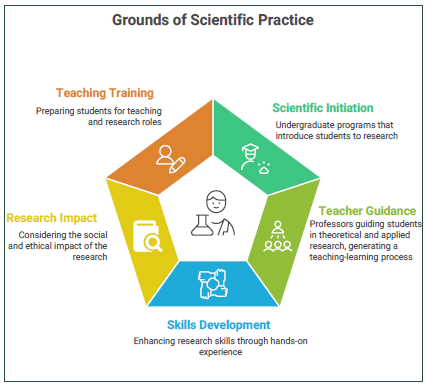
A researcher’s trajectory encompasses a diverse and expanding set of responsibilities. These include reflecting on the societal impact of research (Edwards & Meagher, 2020) in alignment with pressing contemporary issues (Bispo, 2022) and producing knowledge that addresses social problems (Sandes-Guimarães & Hourneaux, 2020), while considering the effects of such knowledge across different societal contexts (Boussebaa et al., 2025; Kumar et al., 2024). Researchers are also expected to draft reports, lead community outreach projects, and serve as peer reviewers for scientific journals. In the following discussion, we examine didactic preparation, undergraduate research training, research impact, competency development, and advising practices as foundational elements of scientific research practice (see Figure 1).

As academics, we devote substantial time to determining what to study and selecting theories to enhance efficiency; however, comparatively little attention is given to the practice of critical reflexivity (Cunliffe, 2004). From this perspective, research practice should be understood as a continuous, embodied, and relational learning process. The outcomes of this process include the development of practical reflexivity, empathy, and self-reflection (Eriksen, 2012) for both advisors and their students.
RESEARCHER TRAINING
Leading universities in the United States have traditionally expected their most accomplished professors to be active research scholars. This expectation rests on the assumption that they possess cutting-edge knowledge and remain engaged in continuous learning, including reflection on their own teaching practices (Pearce & Huang, 2012). However, many scholars warn of the declining usefulness of research in administration for teaching administration and for practitioners. Consequently, researcher training often competes with teaching for faculty time and commitment, creating a disconnect between the two despite their potential complementarity (Balkin & Mello, 2012), particularly within stricto sensu graduate education (Bispo, 2020).
In North American academia, this separation is often described as a divide between the worlds of practitioner researchers and academic researchers (Zeichner, 1998). A similar division exists in Brazil between faculty primarily focused on classroom instruction and those dedicated to training researchers for either academic or professional careers (Kuenzer & Moraes, 2005).
In higher education, PhD-holding faculty working exclusively at the undergraduate level are generally perceived as ‘teaching-oriented,’ with their research often limited to advising or mentoring undergraduate projects. In contrast, those in graduate programs are seen as ‘research-oriented,’ conducting research in their areas of expertise, advising master’s and doctoral students, and teaching courses in graduate curricula. Nevertheless, both groups contribute to the education of professionals who may pursue research in academic or non-academic contexts. The pedagogical work involved in training students thus generates and requires specific forms of educational knowledge and competence that remain insufficiently studied and underutilized in researcher training.
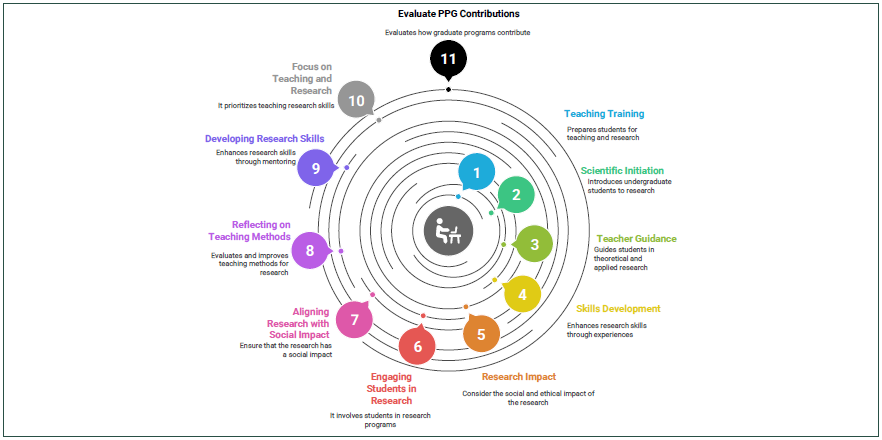
Research in Administration has undergone significant changes, with scholars adopting new perspectives, engaging with interdisciplinary themes, innovating in problem formulation, and expanding research possibilities through more critical and reflexive approaches (Alvesson & Sandberg, 2024). Despite these advances, researcher training continues to require several core commitments: (1) fostering open, plural, interdisciplinary dialogue within academia; (2) improving the quality, timeliness, and relevance of evaluations in journals and at academic conferences, particularly in national and international contexts (Bispo, 2024); and (3) expanding the purposes of research beyond traditionally recognized ones, with greater attention to its societal impact rather than focusing exclusively on academic audiences (Cunliffe & Pavlovich, 2022). Figure 2 illustrates these reflections through a researcher training cycle that highlights the actions required to develop competencies and skills.

Reflecting on researcher training also entails considering the education of future faculty members. Accordingly, discussions within graduate programs about educating the next generation of researchers (Pittaway et al., 2023) pose a significant challenge, as they foreground the relationship among curricular debates in undergraduate and graduate programs in Administration, teaching practices aimed at student development, and a shift from teaching-centered to learning-centered approaches (Whetten, 2021). This shift positions education as a process that generates forms of knowledge that extend beyond conventional scientific research practices.
We argue that researcher training should align the knowledge produced with the goal of improving people’s lives at work and within organizations, while fostering continuous reflection on what teaching practice entails and on who is responsible for educating students, both as researchers and as practitioners in the field of administration (Santos & Silva, 2019). In graduate education, the advisor’s pedagogical capacity plays a central role in research practice. The advisor-advisee relationship is therefore fundamental to the development of teaching-learning processes in research.
Graduate programs have contributed to the development of students’ research competencies. However, while some programs emphasize cultivating research skills, most graduates ultimately assume teaching responsibilities in undergraduate programs. This reality highlights the importance of critically examining the orientation and contributions of Graduate Programs in Administration and Accounting (PPGAs) to the didactic-pedagogical preparation of master’s and doctoral students. From this perspective, researcher training requires clearer guidance for developing knowledge through theoretical, methodological, and empirical reflection (Sandberg & Alvesson, 2021), in support of research that is meaningful and relevant.
What is observed in scientific practice is not an outright disregard for meaning or relevance but rather the prioritization of research outcomes for their potential to produce articles publishable in highly ranked journals under the CAPES evaluation system. It has thus become commonplace to first question whether a study is likely to be published in a prestigious outlet before considering how the research process itself ensured scientific rigor and social impact.
By adopting this perspective, we emphasize that researcher training, as an educational process, must be guided by a commitment - by both students and faculty - to reflect educational impact in its outcomes, whether immediate, operational, broad, indirect, cultural, political, or social (Bispo & Davel, 2021, p. 2). We therefore invite the academic community to critically reflect on technicist approaches to education and the productivist logic embedded in research, teaching, and outreach activities, and to recognize teaching as a critical, relational, and transformative practice (Bispo et al., 2025).
SYNTHESIZING THE ARGUMENT: DO THOSE WHO TRAIN RESEARCHERS RESEARCH THEIR TEACHING PRACTICE?
The purpose of this Thinking Outside the Box (TOB) article was to reflect on researcher training through two central dimensions: scientific research practice and faculty development oriented toward researcher training. Rather than an end in itself, this article serves as an invitation to frame researcher training in administration and accounting as a learning process grounded in research learning.
Research practice and researcher training are often seen as activities that require substantial time and energy from faculty members. This perception has been reinforced by institutional arrangements that emphasize separation rather than the integration of teaching and research, thereby perpetuating the perceived conflict between instruction-oriented and research-oriented teaching. It is essential to reaffirm that teaching and research can generate a synergistic relationship. Exploring the nature of this relationship, particularly how faculty members can align teaching activities with research practices in the field, offers significant potential benefits, including teaching informed by research findings and research that is meaningful and accessible to students.
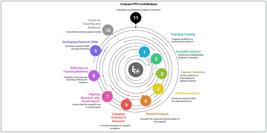
Figure 3 illustrates this proposed integration between scientific research practice and faculty development.
Beyond reflecting on the relationship among these dimensions, this article seeks to contribute to the development of a research agenda for scholars and research groups in the field, whether supported by funding calls or developed through master’s theses and doctoral dissertations, and to inform institutional practices within graduate programs.
The proposed research agenda, which frames the teaching of research as an educational practice, invites scholars to explore researchers’ lived experiences throughout the research process; the interrelationships among theoretical, methodological, and ethical knowledge; the conduct of research as enacted by students and faculty within advising relationships; teaching practice as a form of knowledge embedded in research practice; and students’ emotional experiences as they learn to conduct research. It also calls for studies of faculty development and its influence on teaching practices that train researchers, as well as investigations into how the preparation of teacher-researchers contributes to educational outcomes.
Regarding institutional practices in graduate programs, we recommend strengthening faculty development initiatives and improving processes for evaluating research outcomes; fostering faculty training through partnerships between academic researchers and professionals from non-academic organizations; and designing curricula that are more coherent and explicitly oriented toward faculty preparation in administration and accounting.
This article also aims to prompt reconsideration of how researchers and faculty members who train researchers are educated in administration and accounting, as well as of the knowledge produced about these processes. Thus, it encourages future research on research practice itself and on researcher training as a distinct and relevant field of inquiry.
Leading agendas for training reviewers, promoting studies on the training of researchers and their advisors, and rethinking the content taught in administration programs to incorporate scientific, educational, and pedagogical practices into teaching are among the actions that merit attention. Such initiatives may foster a more reflexive stance toward research practice among students and contribute to the comprehensive development of researchers and faculty members.
We emphasize that, just as the continuous improvement of scientific research is essential, it is equally necessary to advance knowledge and teaching practices for those who train researchers. We therefore invite faculty members, researchers, and research group leaders to transform researcher training into an ongoing process of development that enables the teaching-learning of student-researchers and supports the formation of future generations of scholars.
REFERENCES
-
Alvesson, M., & Sandberg, J. (2024). The art of phenomena construction: A framework for coming up with research phenomena beyond ‘the usual suspects’. Journal of Management Studies, 61(5), 1737-1765. https://doi.org/10.1111/joms.13123
» https://doi.org/10.1111/joms.13123 -
Balkin, D. B., & Mello, J. A. (2012). Facilitating and creating synergies between teaching and research: The role of the academic administrator. Journal of Management Education, 36(4), 471-494. https://doi.org/10.1177/1052562911420372
» https://doi.org/10.1177/1052562911420372 -
Barbosa da Silva, A., Barbosa da Silva, R., Marback Neto, G., & Rossetto, C. R. (2025). Metodologias ativas na educação superior: Análise do uso e domínio na prática de docentes de cursos de administração. Administração: Ensino e Pesquisa, 26(1), e2563. https://doi.org/10.13058/raep.2025.v26n1.2563
» https://doi.org/10.13058/raep.2025.v26n1.2563 -
Bispo, M. S. (2020). Contradições da pós-graduação em administração brasileira. Revista Eletrônica de Ciência Administrativa, 19(2), 169-180. https://doi.org/10.21529/RECADM.2020007
» https://doi.org/10.21529/RECADM.2020007 -
Bispo, M. S. (2022). Refletindo sobre administração contemporânea. Revista de Administração Contemporânea, 26(1), e210203. https://doi.org/10.1590/1982-7849rac2022210203.en
» https://doi.org/10.1590/1982-7849rac2022210203.en -
Bispo, M. S. (2024). Implicações da colonização acadêmica nos periódicos científicos brasileiros em administração. Revista de Administração Contemporânea, 28(1), e240049. https://doi.org/10.1590/1982-7849rac2024240049.en
» https://doi.org/10.1590/1982-7849rac2024240049.en -
Bispo, M., Correia Lima, M., & Demo, P. (2025). Editorial - Desafios da Docência em Cursos de Graduação em Administração. Administração: Ensino E Pesquisa, 25(3). https://doi.org/10.13058/raep.2024.v25n3.2683
» https://doi.org/10.13058/raep.2024.v25n3.2683 -
Bispo, M. S. & Davel, E. P. B. (2021). Impacto Educacional na Pesquisa. Organizações & Sociedade, 28(97), 233-240. https://doi.org/10.1590/1984-92302021v28n9700EN
» https://doi.org/10.1590/1984-92302021v28n9700EN -
Boussebaa, M., Alcadipani, R., Vianna, F., Pina, M. C., & Clegg, S. (2025, in press). Englishization beyond the Global North: Dependency, struggle, and resistance in Brazilian management research. Academy of Management Learning & Education. https://doi.org/10.5465/amle.2023.0245
» https://doi.org/10.5465/amle.2023.0245 -
Brognoli, P. C., Rodrigues, M. B., & Souza, A. B. N. P. M. (2025). A banalização do trabalho docente: Desafios dos professores no curso de Administração. Administração: Ensino e Pesquisa, 25(3), 227-250. https://doi.org/10.13058/raep.2024.v25n3.2571
» https://doi.org/10.13058/raep.2024.v25n3.2571 - Bruner, J. (1996). The culture of education. Cambridge: Harvard University Press.
-
Coghlan, D., & Nzembayie, K. F. (2025). Putting the scholar back into scholarship, the researcher into research, the knower into knowing, the entrepreneur into entrepreneurship: A call to interiority. Management Learning. Advance online publication. https://doi.org/10.1177/13505076251377545
» https://doi.org/10.1177/13505076251377545 -
Coordenação de Aperfeiçoamento de Pessoal de Nível Superior. (2025). VII Plano Nacional de Pós-Graduação 2025-2030. Brasília: CAPES. https://www.gov.br/capes/pt-br/assuntos/noticias/conselho-superior-aprova-vii-plano-nacional-de-pos-graduacao
» https://www.gov.br/capes/pt-br/assuntos/noticias/conselho-superior-aprova-vii-plano-nacional-de-pos-graduacao -
Cunliffe, A. L. (2004). On Becoming a Critically Reflexive Practitioner. Journal of Management Education, 28, 407-426. https://doi.org/10.1177/1052562904264440
» https://doi.org/10.1177/1052562904264440 -
Cunliffe, A. L., & Pavlovich, K. (2022). Making our work matter: From spectator to engagement through public organization and Management studies. Academy of Management Perspectives, 36(3), 879-895. https://doi.org/10.5465/amp.2020.0051
» https://doi.org/10.5465/amp.2020.0051 - Demo, P. (2017). Pesquisa: princípio científico e educativo (14ª. Ed.). Cortez.
- Dewey, J. (1963). Experience and Education. Collier Books.
-
Edwards, D. M., & Meagher, L. R. (2020). A framework to evaluate the impacts of research on policy and practice: A forestry pilot study. Forest Policy and Economics, 114, 101975. https://doi.org/10.1016/j.forpol.2019.101975
» https://doi.org/10.1016/j.forpol.2019.101975 -
Eriksen, M. (2012). Facilitating authentic becoming. Journal of Management Education, 36(5), 698-736. https://doi.org/10.1177/1052562911423883
» https://doi.org/10.1177/1052562911423883 -
Flyvbjerg, B. (2001). Making social science matter: Why social inquiry fails and how it can succeed again. (S. Sampson, Trans.). Cambridge University Press. https://doi.org/10.1017/CBO9780511810503
» https://doi.org/10.1017/CBO9780511810503 -
Ford, E. W., Duncan, W. J., Bedeian, A. G., Ginter, P. M., Rousculp, M. D., & Adams, A. M. (2003). Mitigating risks, visible hands, inevitable disasters, and soft variables: Management research that matters to managers. Academy of Management Perspectives, 17, 46-60. https://doi.org/10.5465/ame.2003.9474811
» https://doi.org/10.5465/ame.2003.9474811 -
Kuenzer, A. Z., & Moraes, M. C. M. (2005). Temas e tramas na pós-graduação em educação. Educação & Sociedade, 26(93), 1341-1363. https://doi.org/10.1590/S0101-73302005000400015
» https://doi.org/10.1590/S0101-73302005000400015 -
Kumar, A., Soundararajan, V., Bapuji, H., Köhler, T., Alcadipani, R., Morsing, M., & Coraiola, D. M. (2024). Unequal worlds: Management education and inequalities. Academy of Management Learning & Education, 23, 379-386. https://doi.org/10.5465/amle.2024.0318
» https://doi.org/10.5465/amle.2024.0318 -
Machado, A. M. N., & Bianchetti, L. (2011). (Des)fetichização do produtivismo acadêmico: Desafios para o trabalhador-pesquisador. Revista de Administração de Empresas, 51(3), 244-254. https://doi.org/10.1590/S0034-75902011000300005
» https://doi.org/10.1590/S0034-75902011000300005 -
Magnin, L. S. L. T., Faria, J. H., Penteado, R. C., & Takahashi, A. R. W. (2020). Produtivismo na pós-graduação em Administração: Posicionamentos dos pesquisadores brasileiros, estratégias de produção e desafios enfrentados. REAd. Revista Eletrônica de Administração, 26(2), 265-299. http://dx.doi.org/10.1590/1413-2311.284.95633
» http://dx.doi.org/10.1590/1413-2311.284.95633 -
Pearce, J. L., & Huang, L. (2012). The decreasing value of our research to management education. Academy of Management Learning & Education, 11(2), 247-262. https://doi.org/10.5465/amle.2011.0554
» https://doi.org/10.5465/amle.2011.0554 -
Pearce, J., & Pechmann, C. (2025). When does it become overkill and exploitation? Journal of Management Inquiry, 34(4), 378-384. https://doi.org/10.1177/10564926251330825
» https://doi.org/10.1177/10564926251330825 -
Pittaway, L. A., Tantawy, M. M., Corbett, A. C., & Brush, C. (2023). Improving doctoral educator development: A scaffolding approach. Journal of Management Education, 47(6), 618-648. https://doi.org/10.1177/10525629231197219
» https://doi.org/10.1177/10525629231197219 -
Resolução CNE/CES n. 5, de 14 de outubro de 2021. (2021). Institui as Diretrizes Curriculares Nacionais do curso de graduação em Administração. Conselho Nacional de Educação. Câmara de Educação Superior. Diário Oficial da União, seção1, p.47. http://pesquisa.in.gov.br/imprensa/jsp/visualiza/index.jsp?data=18/10/2021&jornal=515&pagina=47
» http://pesquisa.in.gov.br/imprensa/jsp/visualiza/index.jsp?data=18/10/2021&jornal=515&pagina=47 -
Sandes-Guimarães, L. V. D., & Hourneaux, F. (2020). Research impact-what is it, after all? Editorial impact series part 1. RAUSP Management Journal, 55(3), 283-287. https://doi.org/10.1108/RAUSP-07-2020-202
» https://doi.org/10.1108/RAUSP-07-2020-202 -
Sandberg, J., & Alvesson, M. (2021). Meanings of theory: Clarifying theory through typification. Journal of Management Studies, 58(2), 487-516. https://doi.org/10.1111/joms.12587
» https://doi.org/10.1111/joms.12587 -
Santos, G. T., & Silva, A. B. (2019). “Diving” into the meanings and revealing conceptions of being a professor in management. RAM. Revista de Administração Mackenzie, 20(5), eRAMG190144. https://doi.org/10.1590/1678-6971/eRAMG190144
» https://doi.org/10.1590/1678-6971/eRAMG190144 -
Severiano, E., Jr., Cunha, D. O., Zouain, D. M., Gonçalves, C. P. (2021). Produtivismo acadêmico e suas consequências para a produção científica na área de Administração. Revista Eletrônica de Administração, 27(2), 343-374. http://dx.doi.org/10.1590/1413-2311.317.103796
» http://dx.doi.org/10.1590/1413-2311.317.103796 -
Silva, A. B. (2019). Produtivismo acadêmico multinível: Mercadoria Performativa na Pós-graduação em Administração. Revista de Administração de Empresas, 59(5), 341-352. http://doi.org/10.1590/s0034-759020190504
» http://doi.org/10.1590/s0034-759020190504 -
Thomas, C. (1995). Helping students complete master’s theses through active supervision. Journal of Management Education, 19(2), 240-249. https://doi.org/10.1177/105256299501900209
» https://doi.org/10.1177/105256299501900209 -
Whetten, D. A. (2021). Republication of “Principles of effective course design: What I wish I had known about learning-centered teaching 30 years ago”. Journal of Management Education, 45(6), 834-854. https://doi.org/10.1177/10525629211044985
» https://doi.org/10.1177/10525629211044985 - Zeichner, K. M. (1998). Para além da divisão entre professor-pesquisador e pesquisador acadêmico. In C. M. Geraldi, D. Fiorentini, & E. M. Pereira (Orgs.), Cartografia do trabalho docente: Professor(a)-pesquisador(a) (pp. 207-236). Mercado de Letras.
-
Zeichner, K. (2023). The “Turn Once Again Toward Practice-Based Teacher Education” revisited. Journal of Teacher Education, 74(2), 178-180. https://doi.org/10.1177/00224871231160401
» https://doi.org/10.1177/00224871231160401
-
How to cite:
Araujo, G. F., & Villardi, B. Q. (2025). Who trains researchers, and how do they learn to conduct research?. BAR-Brazilian Administration Review, 22(4), e250233. DOI: https://doi.org/10.1590/1807-7692bar2025250233
-
Data Availability:
BAR - Brazilian Administration Review encourages data sharing but, in compliance with ethical principles, it does not demand the disclosure of any means of identifying research subjects.
-
Plagiarism Check:
BAR maintains the practice of submitting all documents received to the plagiarism check, using specific tools, e.g.: iThenticate.
-
Peer review:
is responsible for acknowledging an article’s potential contribution to the frontiers of scholarly knowledge on business or public administration. The authors are the ultimate responsible for the consistency of the theoretical references, the accurate report of empirical data, the personal perspectives, and the use of copyrighted material. This content was evaluated using the double-blind peer review process. The disclosure of the reviewers’ information on the first page is made only after concluding the evaluation process, and with the voluntary consent of the respective reviewers.
-
JEL Code:
Y8
Edited by
-
Editors-in-Chief:
Ricardo Limongi https://orcid.org/0000-0003-3231-7515(Universidade Federal de Goiás, Brazil)
BAR - Brazilian Administration Review encourages data sharing but, in compliance with ethical principles, it does not demand the disclosure of any means of identifying research subjects.

 Source: Napkin IA.
 Source: Napkin IA.
 Source: Napkin IA.