Morphological and molecular identification of buttonweed species in Brazil
Abstract
Background: Buttonweed (genera Borreria and Mitracarpus) is an emerging, difficult to control weed increasingly prevalent in agricultural areas of Brazil, particularly in the Cerrado biome.
Objective: Identify four buttonweed accessions, common in agricultural areas of the Brazilian Cerrado, in addition to separate and group the species based on molecular analysis.
Methods: Seeds were collected, sown in pots, and plants cultivated under greenhouse and field conditions. At the time of field transplantation, part of the plants from each accession was sent to the laboratory for molecular analysis. The species of the four accessions were determined based on vegetative and reproductive morphological characteristics, using identification keys for Borreria and Mitracarpus species. In the laboratory, samples were processed, and DNA was extracted for subsequent PCR amplification, Sanger sequencing, sequence alignment, and phylogenetic analysis.
Results: The accessions were identified as Borreria diacrodonta L.M. Miguel & E.L. Cabral, Borreria spinosa Cham. & Schltdl. ex DC, Borreria verticillata (L.) G. Mey., and Mitracarpus hirtus (L.) DC, corresponding to accessions PA-01, PA-02, PA-03, and PA-04, respectively. The phylogenetic analysis showed that the PA-01 accession grouped with B. diacrodonta, the PA-02 accession grouped with B. spinosa, the PA-03 accession grouped with B. verticillata and the PA-04 accession grouped with M. hirtus.
Conclusions: Three species of Borreria and Mitracarpus hirtus were identified, and confirmed by molecular analysis. Borreria diacrodonta was reported for the first time as a weed in Brazil. This study provided additional morphological and molecular information to correctly identify the buttonweed species in Brazil.
Borreria; Mitracarpus; Rubiaceae; Phylogenetic analysis
1. Introduction
Buttonweed poses a growing challenge in Brazilian agricultural crops due to the difficulty of control measures and tolerance to glyphosate (Martins and Christoffoleti, 2014; Lourenço et al., 2021; Kalsing et al., 2020). This weed has become a significant issue in agricultural areas of the MATOPIBA region (encompassing the states of Maranhão, Tocantins, Piauí, and Bahia), with increasing occurrence in other producing regions, including Mato Grosso, Goiás, Minas Gerais, and Distrito Federal. Consequently, buttonweed is an emerging weed, difficult to manage, and increasingly common in agricultural areas of Brazil, particularly in the Cerrado biome.
Glyphosate tolerance has facilitated the selection of buttonweed in agricultural areas, particularly following the adoption of glyphosate-tolerant transgenic soybeans, which increased the frequency of glyphosate applications within a single growing season. Tolerance refers to the inherent ability of a species to survive herbicide applications at recommended rates, which would be lethal to other species, without significant impacts on its growth and development (Christoffoleti and López-Ovejero, 2008). Studies have indicated that glyphosate control of buttonweed decreased with plant growth (Lima et al., 2019a), attributed to reduced absorption and translocation of the herbicide (Fadin et al., 2018).
One of the difficulties in managing this weed is the identification of species, as they are morphologically similar and exhibit considerable phenotypic variation between plants of the same species, particularly regarding plant size or leaf size and shape. Buttonweed species belong to the genera Borreria and Mitracarpus of the Rubiaceae family, within the tribe Spermacoceae. These species are native to Brazil but are also distributed across other countries in the Americas (Miguel et al., 2025; Souza et al., 2025). Most of the studies performed on the species identification were based solely on morphological analysis (Martins et al., 2009; Cabral et al., 2011; Souza et al., 2022), and up to now, very few studies have employed molecular analysis aiming buttonweed species identification (Miguel et al., 2022).
Another problem and confusion in buttonweed identification is the genus Borreria G. Mey. and the inclusion of some or all its species in the genus Spermacoce L. Botanists studying Neotropical flora recognize Borreria as distinct from Spermacoce based on flower, pollen, and carpological characteristics (Bacigalupo, 1972; Cabral et al., 2011; Miguel and Cabral 2013), whereas specialists of Paleotropical flora treat Borreria as part of Spermacoce s.l. (Verdcourt, 1976; Harwood and Dessein 2005). Moreover, molecular phylogenetic studies provide evidence of multiple distinct lineages, supporting the separation of Borreria from Spermacoce (Miguel et al. 2018; Carmo et al. 2025).
DNA sequencing has significantly advanced species identification and plant taxonomy, proving advantageous for several research fields, including weed science. DNA barcodes, standardized sequences used to identify organisms through DNA amplification, sequencing, and comparison with reference databases containing extensive species records, are increasingly utilized (Letsiou et al., 2024). Despite their potential, many weed species remain understudied with respect to DNA barcoding and sequencing for assessing species diversity across different regions. In this study, DNA sequencing, along with morphological analysis, was employed to identify the species of weeds commonly known as buttonweed.
Accurate species identification in a specific area or region is critical for assessing herbicide tolerance levels and establish more assertive and less generic management recommendations. This study was conducted to identify four buttonweed accessions common in agricultural areas of the Brazilian Cerrado and separating and grouping the species by morphological and phylogenetic analysis.
2. Material and Methods
2.1 Seed collection and plant growth
Four buttonweed accessions were selected based on their frequency and importance as weeds in agricultural areas of the Brazilian Cerrado. Three accessions originated from agricultural areas in the Distrito Federal and Minas Gerais, while one was sourced from the buttonweed collection at the Embrapa Cerrados experimental station in Planaltina, Distrito Federal. Details of the collection sites, including geographic coordinates and elevation, are provided in Table 1.
The collected seeds were sown in pots maintained in a greenhouse at Embrapa Cerrados in Planaltina, Distrito Federal. Each accession was sown in six pots, with two plants per pot after thinning. Forty days after sowing, plants from three pots were transplanted to the field, while the remaining plants were sent to the Molecular Biology Laboratory at Syngenta’s Research and Development Department in Holambra, São Paulo, for molecular analysis.
2.2 Morphological analysis
During flowering, field-grown plants were photographed using a stereomicroscope with 2-4× magnification to document leaves, stems, inflorescences, flowers, fruits, and seeds. The leaf type, shape, pubescence, and coloration, as well as the plant growth habit, average height, and inflorescence type and position, were also evaluated.
The species of the four accessions were determined based on vegetative and reproductive morphological characteristics, using identification keys for Borreria and Mitracarpus species from the literature (Souza et al., 2010; Cabral et al., 2011; Miguel et al., 2018).
2.3 Molecular analysis
2.3.1 Sample preparation and DNA extraction
Four accessions, designated as PA-01, PA-02, PA-03, and PA-04, with three plants per accession, were analyzed in this study. Leaf samples from each of the 12 plants were collected and placed into 2.0 mL microcentrifuge tubes for DNA isolation. Samples consisted of fresh leaf tissue from plants grown from seeds in the greenhouse. Leaf tissue was homogenized with ceramic beads using an automated homogenizer (Bead Ruptor Elite, Omni). Genomic DNA was extracted from approximately 100 mg of leaf tissue using the Wizard Genomic DNA Purification Kit (Promega) according to the manufacturer’s instructions. DNA was quantified using the DeNovix instrument (Wilmington, Delaware). DNA samples were stored at -20 °C until further processing.
2.3.2 PCR amplification and Sanger sequencing
Polymerase chain reaction (PCR) amplification targeted two nuclear rDNA regions: the internal transcribed spacer (ITS; primer ITS_P17: CTA CCG ATT GAA TGG TCC GGT GAA; primer ITS_P25: GGG TAG TCC CGC CTG ACC TG; Popp and Oxelman, 2001) and the external transcribed spacer (ETS; primer 18S-E: GCA GGA TCA ACC AGG TAG CA; primer HedETS-Erit: TGG WTA GCA CGG TTT GGT TGG A; Wikström et al., 2013). PCR reactions were conducted in a 25 µL volume containing 2.0 µL of template DNA (approximately 70 ng), 5.0 µL of 5X GoTaq Buffer, 0.5 µL of 10 mM dNTPs (Sinapse), 1.5 µL of 25 mM MgCl2, 0.5 µL of each primer at 10 µM, 0.2 µL of GoTaq G2 Hot Start Polymerase (Promega), and 14.8 µL of ultrapure nuclease-free water (Sigma). PCR conditions included an initial denaturation at 95 °C for 3 min, followed by 32 cycles of 95 °C for 30 s, 58 °C for 30 s, 72 °C for 75 s, with a final extension at 72 °C for 5 min. PCR product amplification was verified by electrophoresis on a 1.2% agarose gel using a 100 bp molecular weight ladder (Sinapse).
PCR products were purified using the ExoSAP-IT™ Express reagent (Thermo Fisher) according to the manufacturer’s instructions. Purified PCR products were diluted tenfold, and 1.5 µL was used in the sequencing reaction. Sequencing reactions were conducted using the BigDye Terminator Cycle Sequencing Kit (Thermo Fisher), and Sanger sequencing was performed on an Applied Biosystems 3500 Genetic Analyzer (Thermo Fisher). All sequence electropherograms were visually inspected for quality and consistency, edited as needed, and consensus sequences were generated from forward and reverse reads.
2.3.3 Sequence alignment and phylogenetic analysis
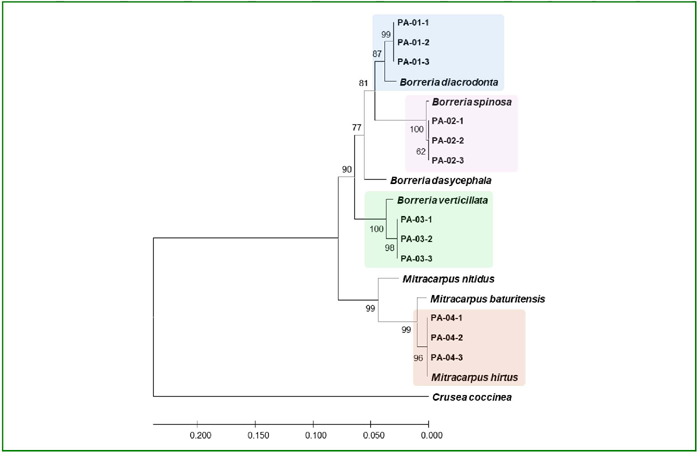
Consensus sequences were assembled using Unipro UGENE software (Okonechnikov et al., 2012). Species identification for each accession was confirmed by comparing ITS and ETS sequences against GenBank using BLASTn, selecting matches with an e-value < 1e-10, the highest score, and >95% sequence identity. Sequence alignments for each region were performed using the MUSCLE® algorithm (Edgar, 2004) implemented in MEGA 11 software (Tamura et al., 2021). Phylogenetic trees were constructed in MEGA 11 using the Neighbor-Joining method (Saitou and Nei, 1987) with 1000 bootstrap replicates. Alignment gaps were treated as missing data, with all characters assigned equal weight. Bootstrap support values, indicating the percentage of replicate trees where associated taxa clustered together (1000 replicates), are shown adjacent to the branches (Felsenstein, 1985). The tree was drawn to scale, with branch lengths proportional to the evolutionary distances used to infer the phylogenetic tree. Evolutionary distances were calculated using the p-distance method (Nei and Kumar, 2000), expressed as the number of base differences per site.
All positions containing gaps and missing data were excluded using the complete deletion option. Crusea coccinea ‘Crug Crimson’ (GenBank accessions KF737010 and KF737052) was used as an outgroup. Four Borreria species, Borreria diacrodonta (syn. Diacrodon compressus, voucher Bolland, GenBank accessions MF166816 and MF166805), Borreria spinosa (voucher Viana et al. 5917, GenBank accessions MF166817 and MF166806), Borreria dasycephala (voucher Miguel et al. 18, GenBank accessions MF166818 and MF166807), and Borreria verticillata (syn. S. verticillata, voucher De Block et al. 632, GenBank accession AM939544 and AM933016) were used as the ingroup for Borreria. Three Mitracarpus species, Mitracarpus nitidus (GenBank accessions KM215344 and KM215305), Mitracarpus baturitensis (GenBank accessions KM215378 and KM215303), and Mitracarpus hirtus (voucher Keller 11863, GenBank accession MZ064084; voucher RQHN00251, GenBank accession MH050292) were used as the ingroup for Mitracarpus.
3. Results and Discussion
3.1 Morphological analysis and species identification
Accession PA-01 plants are subshrubby, semi-prostrate, highly branched, with tetragonal stems and glabrous internodes, averaging 26.2 cm in height; leaves are sessile, pseudoverticillate, glabrous, and dark green in adaxial side, discolorous; inflorescences are hemispherical, consisting of one apical glomerule and up to three bilateral axillary glomerules (Table 2). These plants were identified as B. diacrodonta L.M. Miguel & E.L. Cabral (Figure 1).
Plant morphological characteristics by accession for leaves (L), stems (S), glomerules (GL), growth habit (GH), and mean plant height (PH; cm)

Borreria diacrodonta. Plant (A), stipular sheath (B), apical inflorescence (C), flower (D), fruit (E), and seeds (F)
Borreria diacrodonta is distinguished from other species within the genus, such as B. spinosa and B. verticillata, by its cuneiform to obovate capsules, strongly compressed at the septum. In contrast, B. spinosa and B. verticillata plants exhibit ovate to narrowly obovate, or globose to subglobose capsules. Additionally, B. diacrodonta fruits are indehiscent or tardily dehiscent, splitting into two indehiscent valves (mericarps), each containing one or two laterally compressed, narrowly elliptic seeds (ventral view) (Miguel et al., 2018). B. diacrodonta is a homotypic synonymous with Diacrodon compressus Sprague (Miguel et al., 2018). This is the first time that B. diacrodonta is registered as a weed in soybean crops. This species is known for Paraguay and Brazil. In this last country is distributed in Alagoas, Bahia, Ceará, Paraíba, Pernambuco, Piauí, Rio Grande do Norte, and Sergipe (Miguel et al. 2025). B. diacrodonta inhabits mainly in Caatinga vegetation, and in transitional zone between Caatinga and Cerrado. Recently, it was registered in Restinga, and exhibits greater ecological range because it establish in highly saline environments with hot, dry microclimates, high luminosity, and low nutrient input, as observed in coastal dunes (Sousa et al., 2025).
Accession PA-02 plants are subshrubby, erect, with tetragonal stems and glabrous internodes, averaging 52.7 cm in height; leaves are opposite to pseudoverticillate, elliptic, with an acute apex and attenuate base, glabrous, and light green on both side; inflorescences are hemispherical glomerules, both apical and axillary. These plants were identified as B. spinosa Cham. & Schltdl. ex DC (Figure 2).

Borreria spinosa. Flowering branch (A), stipular sheath (B), apical inflorescence (C), flower (D), open corolla (E), immature green fruits (F), and seeds (G)
Borreria spinosa, synonymous with B. densiflora DC., exhibits considerable phenotypic variations among individuals. Plants may be herbaceous or subshrubby, erect, with heights ranging from 10 to 100 cm, with tetragonal branches that are glabrous, or pubescent, pseudoverticillate leaves due to brachyblasts, and inflorescences consisting of 1 to 5 apical and axillary glomerules per branch (Nepomuceno et al., 2018; Zappi et al., 2017). Leaf morphology varies significantly, with blades ranging from symmetrical, elliptic to lanceolate, with attenuate base, acute apex, entire margin, and pinnate venation (Lima et al., 2019b). B. spinosa plants are perennial and may develop rhizomes (Luna and Druetta, 2018).
Field observations showed that after cutting during soybean harvest, B. spinosa plants modify their aerial architecture, transitioning from an erect growth form, reaching up to 1.0 m in height, to a semi-prostrate growth form with a maximum height of 30-40 cm and intense basal branching. Even at small sizes, these plants rapidly initiate flowering, producing and dispersing seeds into the soil. This response is driven by environmental conditions, particularly drought, as the Cerrado region experiences scarce or absent rainfall from April to late September or early October. During this period, plants enter a state of metabolic dormancy in the field.
Borreria spinosa is native to Brazil and widely distributed across the Americas, from Mexico to Argentina. In Brazil, it is distributed across the Amazon, Caatinga, Cerrado, and Atlantic Forest phytogeographic domains (Miguel et al., 2025).
Accession PA-03 plants are subshrubby, erect, averaging 54.4 cm in height, with tetragonal, glabrous, dark green stems; leaves are pseudoverticillate, elliptic, and glabrous, with an acute apex and truncate base; inflorescences are globose, consisting of 1 to 3 glomerules per branch. These plants were identified as B. verticillata (L.) G. Mey. (Figure 3).

Borreria verticillata. Flowering branch (A), stipular sheath (B), leaves (C), apical inflorescence (D), flowers (E), open corolla (F), fruits (G), and seeds (H)
Borreria verticillata is a perennial species, reproducing by seeds, and may be herbaceous or subshrubby, semi-prostrate to erect, with heights ranging from 20 to 100 cm; branches are cylindrical and glabrous; leaves are pseudoverticillate due to well-developed brachyblasts, sessile to pseudopetiolate; inflorescences are globose, highly compact, developing at the branch apex with 1 to 3 glomerules per branch; and seeds are neutral photoblastic (Cabral et al., 2011; Kissmann and Groth, 2000; Nepomuceno et al., 2018; Zappi et al., 2017). Leaves exhibit a symmetrical and elliptic blade, truncate base, acute apex, and pinnate venation (Lima et al., 2019b). B. verticillata is widely distributed across the Americas, from the United States to Argentina, and has been introduced to Africa (Miguel et al., 2018; Zappi et al., 2017). This species produces fruits with variable dehiscence, both valves may be dehiscent, resembling B. spinosa, or both may be indehiscent, but in this case, with uncompressed capsules and seeds (Miguel et al., 2018), this type of dehiscence is frequent in plants from southern Brazil (Zappi et al., 2017).
B. spinosa is distinguished from B. verticillata by its hemispherical glomerules (versus globose glomerules) and flowers with linear-triangular calyx lobes (versus linear-spatulate calyx lobes) (Miguel et al., 2018; Nepomuceno et al., 2018). Seeds of B. spinosa and B. verticillata are elliptic to obovate; however, B. spinosa seeds are larger and possess a wider longitudinal groove covered by a strophiole compared to other Borreria species here analyzed (Miguel et al., 2018).
Leaves also allow taxon delimitation, since the spacing between secondary veins differs among species. B. spinosa exhibits four to five pairs of secondary veins per side, decreasing toward the base, while B. verticillata has three to four pairs of secondary veins per side, increasing toward the base (Lima et al., 2019b).
Accession PA-04 plants are herbaceous, erect, averaging 23.5 cm in height, with cylindrical, pubescent branched stems and apical and axillary glomerules. These plants were identified as M. hirtus (L.) DC. (Figure 4).

Mitracarpus hirtus. Plant (A), flowering branch (B), axillary inflorescence (C), flower (D), corolla viewed from above showing stamens (E), upper part of the fruit (F), and seed (G)
Mitracarpus hirtus exhibits considerable phenotypic variation in plant size, leaves shape and size, and indumentum density and quality. In general, the plants are herbaceous, ranging from 15 to 70 cm in height, and may be erect, ascending, or decumbent, with cylindrical, subtetragonal to tetragonal-marginated stems, solitary or bearing 1 to 7 densely pilose to glabrous lateral branches (Souza et al., 2010). M. hirtus is a pantropical therophyte with autochoric seed dispersal, forming persistent seed banks. The seeds are positive photoblastic (Kissmann and Groth, 2000). This characteristic is critical for developing management strategies for M. hirtus, such as maintaining soil cover with plant residues to inhibit seed germination by reducing light exposure. This species is native to the Americas. In Brazil, its distribution is widespread, occurring in nearly all states (Souza et al., 2010; Souza et al., 2025).
Mitracarpus hirtus is easily differentiated from all Borreria species treated here by the following set of morphological characters. In M. hirtus the calyx lobes are always 4, unequal, 2 calyx lobes larger and 2 shorter (vs. only 2 calyx lobes in B. diacrodonta, B. spinosa and B. verticillata), the corolla is hypocrateriform (vs. infundibulliform or campanulate corolla), capsule dehiscence is transverse (vs. longitudinal dehiscence or indehiscent fruit), seeds are quadrangular with a x-shaped groove on ventral face (vs. ellipsoidal or obovoid seeds with a longitudinal groove on ventral face).
3.2 Molecular analysis and species identification
Consensus sequences for accessions PA-01, PA-02, PA-03, and PA-04 were deposited in GenBank under accession numbers PV789019, PV789020, PV789021 and PV789022 for ITS sequences and PV791788, PV791789, PV791790, and PV791791 for the ETS sequences. BLASTN analysis revealed that accession PA-01 exhibited 99.75% and 97.78% nucleotide sequence identity with Diacrodon compressus voucher Bolland (syn. B. diacrodonta) for ITS (GenBank accession MF166816) and ETS (GenBank accession MF166805), respectively. Accession PA-02 showed 100% and 99.37% nucleotide sequence identity with B. spinosa (syn. B. densiflora) voucher Viana et al. 5917 for ITS (GenBank accession MF166806) and ETS (GenBank accession MF166817), respectively. Accession PA-03 exhibited 98.02% and 97.78% nucleotide sequence identity with Spermacoce verticillata (syn. B. verticillata) voucher De Block et al. 632 for ITS (GenBank accession AM939544) and ETS (GenBank accession AM933015), respectively. Accession PA-04 showed 99.75% and 97.78% nucleotide sequence identity with M. hirtus voucher RQHN00962 for ITS (GenBank accession MH050290) and M. hirtus voucher Keller 11863 (CTES) for ETS (GenBank accession MZ064084), respectively.
The phylogenetic analysis confirmed that accession PA-01 clustered with B. diacrodonta, and accession PA-02 clustered with B. spinosa (Figures 5 and 6). B. diacrodonta and B. spinosa form a sister group, constituting subclades within a strongly supported clade (NJ-BS=99), and are closely related to B. dasycephala Cham. & Schltdl. Bacigalupo & E.L. Cabral, as previously reported (Miguel et al., 2018) (Figure 5). Accession PA-03 clustered with B. verticillata (NJ-BS=100), and accession PA-04 clustered with M. hirtus (NJ-BS=100) (Figures 5 and 6). All clades were well-defined and strongly supported by NJ-BS values based on 1000 bootstrap replicates (Figure 5). These molecular analyses provided additional confidence in buttonweed species identification, which is critical as many morphological characteristics are indistinguishable among species of Borreria and Mitracarpus, particularly in juvenile plants.

NJ tree showing the clustering of each accession based on the nuclear ITS analysis. Values at the nodes represent bootstrap support (NJ-BS) with 1,000 bootstraps

NJ tree showing the clustering of each accession based on the nuclear ETS analysis. Values at the nodes represent bootstrap support (NJ-BS) with 1,000 bootstraps
These species are often confused with each other in the field due to their similarities. Taxonomic keys used to identify species require the presence of fruits and seeds. However, it is undesirable for weeds to bear fruit in cultivated areas because seed propagation is the main form of reproduction for weeds.
Previous studies have been conducted on the morphological description of some of these species (Souza et al., 2010; Cabral et al., 2011; Zappi et al., 2017; Nepomuceno et al.,2018) and even on their molecular sequences (Miguel et al., 2018; Nuñez-Florentin et al., 2024). However, all of these studies were based on herbarium material collected in natural areas and treated these species separately in floristic studies from different Brazilian states, mainly from taxonomic and phylogenetic perspectives.
This work compiles species commonly registered as weeds and known as buttonweed, and describes their morphological characteristics, highlighting both vegetative and reproductive differences. Additionally, molecular sequences obtained from cultivated specimens in Brazil are provided. These molecular analyses provide additional confidence in buttonweed species identification, which is critical as many morphological characteristics are difficult to differentiate or interpret among species of Borreria and Mitracarpus, particularly in young plants.
The results of this study are crucial to understanding the diversity of buttonweed species, which highlights the need for further studies on the biology of each species as they can show distinct herbicide responses and may require specific weed management strategies. Additionally, future studies on genetic diversity within a buttonweed species, for instance, within B. spinosa and within B. diacrodonta, are needed and will greatly aid the understanding of phenotyc variations observed in the field, which leads to species misidentification.
4. Conclusion
Three species of Borreria and Mitracarpus hirtus were identified, and confirmed by molecular analysis, supporting the need of DNA sequencing studies for the correct identification of these weed species.
Borreria diacrodonta was reported for the first time as a weed in Brazil.
This study provided additional morphological and molecular information to correctly identify the buttonweed species in Brazil.
-
Funding
The authors would like to acknowledge the Federal District Research Support Foundation (FAPDF) for funding the research (Process number 00193-00002091/2023-66).
-
Data availability
All of the data that support the findings of this study are available in the main text or Supplementary Material
References
- Bacigalupo NM. [Observations on some species of the genera Spermacoce L. and Spermacoceodes O.K. (Rubiaceae)]. Darwiniana.1972;17:341-57. Spanish.
-
Cabral EL, Miguel LM, Salas RM. [Two new species of Borreria (Rubiaceae), synopsis and key to the species for Bahia, Brazil]. Acta Bot Bras. 2011;25(2):255-76. Portuguese. Available from: https://doi.org/10.1590/S0102-33062011000200002
» https://doi.org/10.1590/S0102-33062011000200002 -
Carmo JAM, Reginato M, Sobrado SV, Miguel LM, Janssens SB, Dessein S et al. There and back again: molecular phylogenetics of the Brazilian endemic Psyllocarpus (Rubiaceae: Spermacoceae) supports a circumscription of the genus based on its original concept. Bot J Linn Soc. 2025;208(1):43-57. Available from: https://doi.org/10.1093/botlinne-an/boae059
» https://doi.org/10.1093/botlinne-an/boae059 - Christoffoleti PJ, López-Ovejero RF. [Weed resistance to herbicides: definitions, bases, and status in Brazil and worldwide]. In: Christoffoleti PJ, editor. [Aspects of weed resistance to herbicides]. 3th ed. Piracicaba: Associação Brasileira de Ação a Resistência de Plantas Daninhas; 2008. p.9-29. Portuguese.
-
Edgar RC. MUSCLE: multiple sequence alignment with high accuracy and high throughput. Nucleic Acids Res. 2004;32(5):1792-7. Available from: https://doi.org/10.1093/nar/gkh34
» https://doi.org/10.1093/nar/gkh34 -
Fadin DA, Tornisielo VL, Barroso AAM, Ramos S, Reis FC, Monquero PA. Absorption and translocation of glyphosate in Spermacoce verticillata and alternative herbicide control. Weed Res. 2018;58(5):389-96. Available from: https://doi.org/10.1111/wre.12329
» https://doi.org/10.1111/wre.12329 -
Felsenstein J. Confidence limits on phylogenies: an approach using the bootstrap. Evolution. 1985; 39(4):783-791. Available from: https://doi.org/10.2307/2408678
» https://doi.org/10.2307/2408678 -
Harwood R, Dessein S. Australian Spermacoce (Rubiaceae: Spermacoceae): I northern territory. Aust Syst Bot. 2005;18(4):297-365. Available from: https://doi.org/10.1071/SB03024
» https://doi.org/10.1071/SB03024 -
Kalsing A, Rossi CVS, Lucio FR, Minozzi GB, Gonçalves FP, Valeriano R. Efficacy of control of glyphosate-tolerant species of the Rubiaceae family through double-knockdown applications. Planta Daninha. 2020;38:1-9. Available from: https://doi.org/10.1590/S0100-83582020380100023
» https://doi.org/10.1590/S0100-83582020380100023 - Kissmann KG, Groth D. [Weed and noxious plants]. 2nd ed. São Paulo: Basf, 2000. Portuguese.
-
Letsiou S, Madesis P, Vasdekis E, Montemurro C, Grigoriou ME, Skavdis G et al. DNA barcoding as a plant identification method. Appl Sci. 2024;14(4):1-12. Available from: https://doi.org/10.3390/app14041415
» https://doi.org/10.3390/app14041415 -
Lima CC, Silva RP, Jeronimo AV, Hirata ACS, Monquero PA. [Phenological stages associated with chemical control in the management of spermacocea densifloraoriginated from seeds and sprouts]. Rev Bras Herbic. 2019A;18(3):1-7. Portuguese. Available from: https://doi.org/10.7824/rbh.v18i3.686
» https://doi.org/10.7824/rbh.v18i3.686 -
Lima MPS, Soares A, Sousa JLR, Carvalho MS, Porto JMP, Braga FT. Leaf architecture of Rubiaceae Juss. from caatinga vegetation in Brazil. Biota Neotrop. 2019b;19(1):1-7. Available from: https://doi.org/10.1590/1676-0611-BN-2017-0473
» https://doi.org/10.1590/1676-0611-BN-2017-0473 -
Lourenço MFC, Cunha PCR, Pereira WJ, Gonçalves DJ, Siqueira APS. [Effect of glyphosate rates and herbicide tank mixtures on the control of Spermacoce verticillata in soybean pre-sowing]. Rev Agron Bras. 2021;5:1-13. Portuguese. Available from: https://doi.org/10.29372/rab202108
» https://doi.org/10.29372/rab202108 - Luna IM, Druetta M. [Efficacy of desiccant herbicides in the control of Borreria spinosa and their interaction with application timing and fluroxypyr mixture]. Quimilí: INTA, 2018. Spanish.
-
Martins BAB, Cabral EL, Souza VC, Christoffoleti PJ. A new variety of the weed Borreria densiflora DC. (Rubiaceae). Weed Biol Manag. 2009;9(4):286-91. Available from: https://doi.org/10.1111/j.1445-6664.2009.00352.x
» https://doi.org/10.1111/j.1445-6664.2009.00352.x -
Martins BAB, Christoffoleti PJ. Herbicide efficacy on Borreria densi-flora control in pre- and post-emergence conditions. Planta Daninha. 2014;32(4):817-25. Available from: https://doi.org/10.1590/S0100-83582014000400017
» https://doi.org/10.1590/S0100-83582014000400017 -
Miguel LM, Cabral EC. Borreria krapocarmeniana, a new cryptic species recovered through taxonomic analyses of Borreria scabiosoides and Borreria linoides (Spermacoceae, Rubiaceae). Syst Bot. 2013;38(3):769-81. Available from: https://doi.org/10.1600/036364413X670368
» https://doi.org/10.1600/036364413X670368 -
Miguel LM, Sobrado SV, Cabral EL, Salas RM, Souza EB, Florentín JE et al. [Borreria in Flora and Funga of Brazil]. Rio de Janeiro: Jardim Botânico do Rio de Janeiro; 2025[access June 12, 2025]. Portuguese. Available from: https://floradobrasil.jbrj.gov.br
» https://floradobrasil.jbrj.gov.br -
Miguel LM, Sobrado SV, Florentín JE, Cabral EL, Salas RM. Borreria kelleri (Spermacoceae, Rubiaceae), a new species from Argentina and Paraguay. Nordic J Bot. 2022;(5):1-10. Available from: https://doi.org/10.1111/njb.03507
» https://doi.org/10.1111/njb.03507 -
Miguel LM, Sobrado SV, Janssens S, Dessein E, Cabral EL. The monotypic Brazilian genus Diacrodon is a synonym of Borreria (Spermacoceae, Rubiaceae): morphological and molecular evidences. An. Acad. Bras. Ciênc. 2018; 90(2):1397-1415. Available from: https://doi.org/10.1590/0001-3765201820170314
» https://doi.org/10.1590/0001-3765201820170314 -
Nei M, Kumar S. Molecular evolution and phylogenetics. New York: Oxford University Press; 2000[access Oct 31, 2023]. Available from: https://doi.org/10.1093/oso/9780195135848.001.0001
» https://doi.org/10.1093/oso/9780195135848.001.0001 -
Nepomuceno FAA, Souza EB, Nepomuceno IV, Miguel LM, Cabral EL, Loiola MIB. [The genus Borreria (Spermacoceae, Rubiaceae) in the state of Ceará, Brazil]. Rodriguésia. 2018;69(2):715-31. Portuguese. Available from: https://doi.org/10.1590/2175-7860201869232
» https://doi.org/10.1590/2175-7860201869232 -
Nuñez-Florentin M, González VV, Florentín JE, Salas RM, Dessein S, Janssens SB et al. Multiple sources of evidence unravel a complex taxonomic history: the new genus Leonoria of the Spermacoce clade (Spermacoceae-Rubiaceae). Syst Biodivers. 2024;22(1). Available from: https://doi.org/10.1080/14772000.2024.2330367
» https://doi.org/10.1080/14772000.2024.2330367 -
Okonechnikov K, Golosova O, Fursov M, the UGENE team. Unipro UGENE: a unified bioinformatics toolkit. Bioinformatics. 2012; 28:1166-1167. Available from: http://dx.doi.org/10.1093/bioinformatics/bts091
» https://doi.org/10.1093/bioinformatics/bts091 -
Popp M, Oxelman B. Inferring the history of the polyploid Silene aegaea (Caryophyllaceae) using plastid and homoeologous nuclear DNA sequences. Molec Phylogenet Evol. 2001;20(3):474-81. Available from: https://doi.org/10.1006/mpev.2001.0977
» https://doi.org/10.1006/mpev.2001.0977 -
Saitou N, Nei M. The neighbor-joining method: a new method for reconstructing phylogenetic trees. Mol Biol Evol. 1987;4(4):406-25. Available from: https://doi.org/10.1093/oxfordjournals.molbev.a040454
» https://doi.org/10.1093/oxfordjournals.molbev.a040454 -
Sousa FC, Silva ANF, Carvalho US, Santos Jr. SMS, Santos-Filho FS, Almeida Jr. EB. [Expansion of the geographic distribution of Borreria diacrodonta L.M. Miguel & E.L. Cabral (Rubiaceae) to the Restinga of Piauí, Brazil]. Paubrasilia. 2025;8(Suppl.):1-6. Portuguese. Available from: https://doi.org10.33447/paubrasilia.2025s.e0193s.
» https://doi.org/10.33447/paubrasilia.2025s.e0193s. -
Souza EB, Cabral EL, Zappi DC. [Revision of Mitracarpus (Rubiaceae-Spermacoceae) from Brazil]. Rodriguésia. 2010;61(2):319-52. Portuguese. Available from: https://doi.org/10.1590/2175-7860201061213
» https://doi.org/10.1590/2175-7860201061213 -
Souza EB, Fader AAC, Cabral EL, Nepomuceno FAA, Florentín JE, Carmo JAM et al. [Mitracarpus in Flora and Funga of Brazil]. Rio de Janeio: Jardim Botânico do Rio de Janeiro; 2025[access June 12, 2025]. Portuguese. Available from: https://floradobrasil.jbrj.gov.br
» https://floradobrasil.jbrj.gov.br -
Souza EB, Nepomuceno A, Ribeiro MLRC, Miguel LM. Borreria savannicola (Spermacoceae, Rubiaceae), a new species from savanna patches within the Caatinga, Ceará State, Brazil. Phytotaxa. 2022;576(3):279-88. Available from: https://doi.org/10.11646/phytotaxa.576.3.4
» https://doi.org/10.11646/phytotaxa.576.3.4 -
Tamura K, Stecher G, Kumar S. MEGA11: molecular evolutionary genetics analysis version 11. Mol Biol Evol. 2021;38(7):3022-7. Available from: https://doi.org/10.1093/molbev/msab120
» https://doi.org/10.1093/molbev/msab120 - Verdcourt B. Rubiaceae (part 1): spermacoceae. In: Polhill RM, editor. Flora of Tropical East Africa. London: Whitefriars; 1976. p.339-74
-
Wikström N, Neupane S, Karehed J, Motley TJ, Bremer B. Phylogeny of Hedyotis L. (Rubiaceae: Spermacoceae): redefining a complex Asian-Pacific assemblage. Taxon. 2013;62(2):357-74. Available from: https://doi.org/10.12705/622.2
» https://doi.org/10.12705/622.2 -
Zappi DC, Miguel LM, Sobrado SV, Salas RM.[Flora of the cangas of Serra dos Carajás, Pará, Brazil: Rubiaceae]. Rodriguésia. 2017;68(3spe):1091-137. Portuguese Available from: https://doi.org/10.1590/2175-7860201768347
» https://doi.org/10.1590/2175-7860201768347
Edited by
-
Editor in Chief:
Carol Ann Mallory-Smith
-
Associate Editor:
Caio Brunharo
All of the data that support the findings of this study are available in the main text or Supplementary Material