
 DECONSTRUCTION CURRICULAR STRUCTURES: AN ANALYSIS OF ARCHITECTURE AND URBANISM PROGRAMS IN MINAS GERAIS, USING ENADE 2019 RESULTS
Abstract
The curricular structure is an important tool for organizing students' academic paths. Traditionally, curricula are a list of interdependent and organized contents and subject matters, connected to the graduate’s professional practice, defined by the hours allocated to each discipline. Its structure is defined by a set of prerequisites, where basic topics is presented first, gradually leading to more complex and broad thinking. However, students often have different backgrounds and experiences, which results in diverse academic journeys. In this sense, curricular flexibility can be an important element in enabling students' adaptation to the course and allowing for deeper and broader learning, according to their interests. This topic was investigated through the analysis of curricular structures and course pedagogic project, assessing their performance based on data obtained during Enade 2019 for Architecture and Urbanism courses, in the state of Minas Gerais, which received scores of 4 and 5. Findings show that more flexible curricular structures produced similar or superior objective results in Enade, compared to more rigid projects, and that flexibility does not create knowledge gap for students. Furthermore, it was noted that more flexible structures lead to greater student engagement in courses and in the overall pedagogical process.
Keywords:
curricular structure; course pedagogic project; flexibility
Resumo
A estrutura curricular é um importante instrumento de organização dos percursos discentes. Apesar de sua estrutura tradicionalmente linear, caminhando dos conteúdos simples para os complexos, a realidade é que os discentes realizam percursos muito diversos. Nesse sentido, a flexibilidade curricular pode ser um elemento para viabilizar a adaptação dos discentes ao curso de acordo com seu histórico e seu interesse. Essa hipótese foi investigada por meio da análise de estruturas curriculares e projetos pedagógicos de Arquitetura e Urbanismo em Minas Gerais, relacionando-os ao desempenho obtido no Enade 2019, com enfoque naqueles que obtiveram conceitos 4 e 5. Verificou-se que estruturas curriculares flexíveis produzem conceitos Enade iguais ou superiores a projetos rígidos, e que a flexibilidade não é fator de geração de lacunas de conteúdo na formação. Além disso, estruturas flexíveis apresentaram maior adesão dos discentes aos cursos e aos processos pedagógicos.
Palavras-chave:
estrutura curricular; projeto pedagógico; flexibilidade
Resumen
La estructura curricular es una herramienta importante para organizar los recorridos académicos de los estudiantes. Tradicionalmente, los currículos son un conjunto de contenidos interdependientes y organizados, vinculados a las atribuciones profesionales de los egresados, definidos por la carga horaria otorgada a cada uno. Su estructura es definida por un conjunto de requisitos previos, en los cuales se presentan primero los contenidos más básicos o sencillos, llevando progresivamente a un pensamiento más complejo y amplio. Sin embargo, los estudiantes muchas veces presentan trayectorias y experiencias diferenciadas que producen recorridos muy diversos. En este sentido, la flexibilidad curricular puede ser un elemento importante para posibilitar la adaptación de los estudiantes al curso y permitir profundizaciones y ampliaciones de acuerdo con sus intereses. El tema fue investigado a través del análisis de estructuras curriculares y proyectos pedagógicos, evaluando su desempeño a partir de datos obtenidos durante el ENADE 2019 en cursos de Arquitectura y Urbanismo en el estado de Minas Gerais que obtuvieron calificaciones de 4 y 5. Se verificó que las estructuras curriculares más flexibles producen resultados objetivos en el ENADE iguales o superiores a los proyectos más rígidos, y que la flexibilidad no es un factor que genere lagunas de contenido en la formación de los estudiantes. Además, se percibió en las estructuras más flexibles una mayor adhesión de los estudiantes a los cursos y al proceso pedagógico en su conjunto
Palavras clave:
estructuras curriculares; proyectos pedagógicos; flexibilidad
1 CURRICULAR STRUCTURE AND EDUCATION
Since educational processes result from collective effort, it becomes essential to establish elements that ensure synergy and consistency to in coordinating necessary actions. In this sense, education acquires institutional contours, structured around a set of documents that orient the daily practices of those directly involved in teaching and learning. The main instrument in this regard is the Course Pedagogical Project (PPC), which presents the underlying conceptual framework, the objectives of the intended training, and the set of knowledge and skills required of graduates. Within the scope of professional education, the project is referenced in the Lei de Diretrizes e Bases da Educação (LDB -Education Bases and Guidelines Act) (Brasil, 1996) across various levels of education, but it is formally required at the higher education level by the Conselho Nacional de Educação (CNE) -through its Câmara de Ensino Superior (CES) -as stated in Parecer CNE/CES No. 334 (Brasil, 2019). Art. 7. The text formally introduces the term and defines the recommendations and actions to be included in PPCs, as well as their articulation with the broader institutional and societal context.
According to Araújo (2024, p. 3), “the pedagogical project or political-pedagogical project is the product of participatory planning capacity. The different designations given to this instrument sometimes reflect the political intentionality that permeates pedagogical action.” Thus, it becomes evident that there are no neutral choices detached from the social context in which they exist; pedagogical projects are always marked by ideological and political3 dimensions that are essential to their organization. Drafting a project is therefore linked to an epistemology of both education and, in the case of professional and/or higher education, of the field of study and practice. Tyler (2013, p. 600) argues:
If the school4 believes its primary function is to teach people to adjust to society, it will emphasize obedience to current authorities, loyalty to contemporary traditions and practices, and skills for dealing with existing techniques of life; whereas if it emphasizes its revolutionary function, it will be more concerned with critical analysis, the ability to confront new problems, and the capacity for self-determination, freedom, and self-discipline.
From an educational perspective, one may adopt the categorization proposed by Scardamalia and Bereiter (1989, as cited in Gimeno Sacristán & Pérez Gómez, 2007), who distinguish four models or perspectives that shape practice in different ways: cultural transmission, skills training, natural development, and conceptual change. Within this categorization, only the knowledge transmission model focuses primarily on content and subject matters. In the others, the student’s capacity, pace, and experiences are fundamental elements of the educational process and should guide learning.
In this regard, Perrenoud’s (2000, p. 50) points out the individuality of educational paths:
To understand this distinction, one must accept a shift in perspective, placing oneself in the student’s position, considering their educational trajectory [...] as a sequence of life experiences that have contributed to shaping their personality, their knowledge capital, their competencies, their relationship with learning, and their identity. In this sense, all educational trajectories are in fact individualized, since no two individuals ever live exactly the same experiences.
Drawing on Bourdieu’s concepts, he concludes that real inequalities in cultural capital result in unequal consideration of individuals in both symbolic and practical domains. He rejects absolute models of individualized teaching, such as tutoring, and instead seeks institutional structures that better manage time (through learning cycles), groupings (based on projects, needs, and levels), and instruments that can orient individual trajectories within this organization. Thus, the standardization and hierarchization of knowledge by course duration disregard the potential diversity of possible paths, attempting to force learning into a single, uniform trajectory.
In building an epistemology of professional practice, Schön (1983) distinguishes between the traditional model of technical rationality and his alternative, reflection-in-action. In the former, profession is a highly specialized occupation, grounded in a substantial, systematic body of scientific knowledge and in techniques for producing or applying that knowledge, mastered by the expert. In his alternative model, however, everyday professional practice involves judgments based on the applicability of knowledge to the situations at hand. Knowledge becomes tacit through its constant use; it exists in its application. What matters, then, is the instrumental use of knowledge in addressing demands over which one has little control. Reflective processes thus occur both while dealing with previously acquired knowledge—in terms of adaptation and application—and regarding the encountered problems. Pondering on professional training, Schön (2000) argues that it is not enough to offer a framework of scientific and technical knowledge to be appropriated by students. One must also cultivate the ability to select and apply such knowledge to problems that take on real-world contours. Professional training must therefore enable graduates to, whenever faced with unfamiliar problems, analyze them and identify the most appropriate tools available to address them.
It results, then, that the quality of professional education is tied to a multiplicity of teaching strategies that integrate knowledge, practice, and personal development. This rejects a purely content-focused, theoretical, fragmented, and heteronomous education, instead aiming to make students protagonists of their own educational journeys. To achieve this, it is necessary to nurture critical autonomy, so that students can guide their own learning processes and applying acquired knowledge to everyday situations. The possibility of choice also implies curricular flexibility, since rigid pedagogical structures predetermine all possible strategies and paths. How, then, can one design a curriculum that addresses this set of demands?
Gimeno Sacristán and Pérez Gómez (2007) trace the etymology of the word curriculum to the Latin currere, which literally means a race or course to be completed, and, by extension, refers to its representation. The term is intrinsically linked to subjects to be taught but, in its more recent conceptions, addresses how an educational project is enacted in the classroom, thereby incorporating a dynamic dimension. According to the authors, the polysemy surrounding the term favors diverse perspectives in its design, though they warn that the more ambitious the educational aims, the more difficult it is to realize them in the curriculum.
Traditionally, curricular organization presents the structure, scope, and interrelationship of subjects that constitute the educational process. While acknowledging the importance of these subjects, the dominance of the transmissive perspective in educational institutions is evident, often rendering learning fragmented and standardized. Within the framework of critical curriculum theory (Althusser, 1983; Apple, 2006), educational institutions inevitably reflect an ideological matrix that seeks to perpetuate power asymmetries and the exploitation of labor. Knowledge is thus framed as utilitarian, pragmatic, and workforce-oriented, reproducing the prevailing social structure. This contrasts with a view of learning as a process in which subjects move from a naïve to a critical understanding, approaching the object of knowledge with increasing rigor (Freire, 2014).
Although critical theory has been challenged by post-structuralist perspectives, Maia and Sacardo (2022) defend its contemporary relevance, since new conceptual frameworks have not entirely abandoned its original premises. Recent formulations tend to generate hybrid models that acknowledge the role of such structures and historical trajectories in shaping educational institutions, while allowing for the transformative potential of education.
To Young (2014), curriculum theory is essential for organizing dialogue about curricular composition. Although his central question — “What should all students know upon leaving school?” — relates mostly basic education, it clearly resonates with higher education (perhaps even more so, given the professional and societal implications of graduates’ work). Seeking to expand and complement critical theory, Young (p. 201) conceives of the curriculum simultaneously as:
A system of social and power relations with a specific history; this relates to the idea that the curriculum can be understood as “knowledge of the powerful”.
At the same time, it is a complex body of specialized knowledge, that may to some extent, represents “powerful knowledge” — in other words, knowledge capable of providing students with explanatory resources and the ability to think of alternatives to the status quo , regardless of the area of study or stage of education.
It is important to understand how the curriculum integrates these dimensions, prioritizing the latter over the former. This often appears not in the explicit subjects, but in how it is realized and articulated. Although the core question of “what” to learn remains central in this vision of the curriculum, the underlying questions of “why,” “how,” and “for what purpose” knowledge is acquired become equally significant. As an alternative to subjects as the fundamental element of curriculum, Tyler (2013) proposes the concept of learning experiences, which allow for multiple outcomes and may even replace disciplinary knowledge as the foundation for curricular organization.
The form of representation is also symbolic of the prevailing view of the instrument. In Brazil, curricular organization is usually presented in tabular form, under labels such as “curricular grid,” “curricular matrix,” or “curricular structure” Grid, in Portuguese, may be used as a synonym for fence or cell bars, evoking a prison-like environment that allows little flexibility for individual paths and adjustments. By contrast, the more contemporary terms matrix and structure imply a foundational and supportive tool, allowing for reconfigurations (within limits) and adaptations to a changing reality. Thus, this paper uses the term curricular structure as the formal representation of the curriculum, since it goes beyond the mere distribution of content and subject matters across the educational trajectory, and allows for understanding other interactions within the design of learning experiences.
It should be noted, however, that these new epistemological, methodological, and technological possibilities in education have not been widely absorbed by educational institutions, which remain largely anchored in a transmissive perspective of teaching and in the acquisition of disciplinary topics.
2 DEVELOPMENTS OF THE CURRICULAR STRUCTURE OF ARCHITECTURE AND URBANISM PROGRAMS IN BRAZIL
The existence of architecture programs in Brazil dates to the colonial period. They were heavily influenced by the French university model, drawing inspiration from the École Nationale Supérieure des Beaux-Arts and the École Polytechnique, introduced by the French Artistic Mission of 1816, which established the Real Academia de Ciências, Artes e Ofícios. However, architecture programs only began in 1826, and at that time, they lacked autonomy, being linked to arts or engineering programs as an emphasis or specialization. Curricula during this period were entirely the responsibility of the institution itself, with no governmental guidelines ensuring uniformity (Vidotto & Monteiro, 2013).
The institutionalization of the university and of the professional field of architecture in Brazil came later and were relatively contemporaneous. The Estatuto da Universidade Brasileira, Decree No. 19,851 (Brazil, 1931), and the decree regulating the practice of the professions of engineer, architect, and surveyor, Decree No. 23,569 (Brazil, 1933), were enacted only eight months apart. According to Laverde and Oliveira (2020), at that time there were only five architecture programs, including the School of Architecture at the Universidade de Minas Gerais (the first independent course in Brazil, founded in 1930 and later federalized and integrated into UFMG).
In 1937, the curriculum of the Escola Nacional de Belas Artes (the republican name of the Real Academia de Artes e Ofícios) establishes three areas: design, theory and history, and structure (Marques, 1996, as cited in Vidotto & Monteiro, 2013). The division between design, theoretical, and technical matters served as the foundation for the departmental organization of Architecture and Urbanism programs at the most traditional Brazilian universities and remains influential today. While this model provides a certain balance of subject matters within curricula, it often results in fragmentation among different areas and difficulties in applying technical and theoretical knowledge in practice.
Although architecture curricula addressed both theoretical discussions in the field and professional regulation from their inception, they only became subject to national regulations with L. No 4,024 (Brazil, 1961), which established the Guidelines and Bases of National Education. This law created the Federal Council of Education (Conselho Federal de Educação -CFE), precursor to today’s National Council of Education (Conselho Nacional de Educação -CNE), and granted it authority to establish the minimum curriculum and duration of programs whose diplomas were prerequisites for the practice of liberal professions. In 1962, the CFE established the first minimum curriculum for Architecture and Urbanism, setting compulsory subjects to be included in curricula (Brazil, 1962). The course duration was set at five academic years, and later, Portaria do Ministério da Educação n° 159 (Brazil, 1965) established a minimum workload of 4,050 hours.
The following year, L. No 5,194 (Brazil, 1966) once again redefined the professional practice of engineers and architects, creating a system composed of the Federal Council of Engineering, Architecture, and Agronomy (Conselho Federal de Engenharia, Arquitetura e Agronomia -CONFEA) and the Regional Councils of Engineering, Architecture, and Agronomy (Conselhos Regionais de Engenharia, Arquitetura e Agronomia -CREAs) to oversee and regulate professional activities. Professional responsibilities were generically defined in Articles 7 and 8, without clear distinctions for each field. Only with Resolution No 218 (Confea, 1973) 18 activities were formally defined as competencies of higher and mid-level professionals in engineering, architecture, and agronomy. Architects and architectural engineers were assigned responsibilities “regarding buildings, architectural ensembles and monuments, landscape and interior architecture, physical, local, urban, and regional planning, and related services” (Art. 2).
In 1968, under the military dictatorship, a university reform was enacted through L. No 5,540 (Brazil, 1968), which redefined the structure of higher education institutions themselves. For Martins (2009, p. 16), the reform “produced paradoxical effects on Brazilian higher education.” In one hand, it modernized existing public and religious universities by progressively structuring academic careers, institutionalizing departmental organization, and strengthening the connection between teaching and research. On the other hand, it paved the way for the expansion of private higher education, which was fragmented and primarily oriented toward knowledge transmission as a professional training strategy.
This reform also led to a revision of several curricula, including those of Architecture and Urbanism, through CFE Technical Opinion No 384 (Brazil, 1969). The minimum workload was set at 3,600 hours, to be completed in four to six years. The new minimum curriculum clearly separated basic from professional subjects. Unlike the 1962 proposal, which left interpretation of each topic open to institutions, Article 1 paragraphs detailed the course content extensively, even suggesting architectural scales and typologies to be covered under the heading of Architectural Planning.
Santos Junior (2013) notes that the curriculum was criticized at the time by academics and institutions for its authoritarian and fragmented nature, but it remained in force until the creation of the 1994 curricular guidelines. Other articles of the resolution addressed internships, libraries, and study trips, which, according to Santos Junior (p. 76), “denoted a technocratic and standardizing vision, indifferent to the evolving dynamics of ongoing procedures in the programs.” As a result, the curriculum was progressively reduced to a mere bureaucratic tool for verifying compliance with regulations.
In the political shifts of the 1980s, with the end of the military dictatorship, the democratization process, and the promulgation of the 1988 Constitution (Brazil, 2016), education also underwent change. Article 205 of the Constitution established education as a universal right and as a duty of the State, including its role in civic formation and professional qualification. A Commission of Specialists in Architecture and Urbanism organized debates that led to the new curricular guidelines enacted in 1994 (Brazil, 1994).
The new guidelines structured Architecture and Urbanism programs into three components: Foundational, Professional, and Diploma Project. Exact sciences (mathematics and physics), inherited from engineering, lost prominence and were incorporated to applied teaching of structural systems. The inclusion of social and environmental studies as foundational units reflected the growing affinity of the field with Social Sciences. Design, in turn, was treated in detail in §3 both as technical representation and as plastic expression through multiple media. Although celebrated as a significant milestone, with strong engagement from both professional and academic institutions, the guidelines were not revolutionary, but rather an important update of the areas and terminology relevant to Architecture and Urbanism.
The new LDB (Brazil, 1996) was enacted only two years later, eight years after the new Constitution. It permanently abolished minimum curricula and established curricular guidelines as the structuring element of undergraduate programs (defined in Article 39, §3, with approval entrusted to the CNE/CES under Article 9).
The subsequent reformulation of curricular guidelines in 2006, through Resolution CNE/CES No. 06 (Brazil, 2006), introduced significant changes, aligning them with the new LDB. These included detailed profiles of graduates, required competencies, and pedagogical strategies, as well as mandatory internships and complementary activities. In terms of content, however, the document largely repeated the provisions of 1994, with minor adjustments in organization and wording. The term “subjects” was replaced by “knowledge cores,” maintaining the tripartite division into Foundational, Professional, and Diploma Project. Resolution CNE/CES No. 02 (Brazil, 2010) later reproduced the 2006 text almost entirely, with the sole change that the Diploma Project supervisors could be not formally trained in architecture and urbanism.
Later in 2010, when the curricular guidelines for Architecture and Urbanism programs currently in force were instituted, the professional category secured the creation of its own council—the Conselho de Arquitetura e Urbanismo do Brasil (CAU/BR) and its regional counterparts (Brazil, 2010). The legislation defined, in its first two articles, the professional responsibilities of architects and urbanists (marking the first time the term was formally used to designate the professional category), as well as their fields of practice. Consequently, professional training gained prominence in defining professional responsibilities, creating an urgent need to revise curricular guidelines, which was only completed in 2023.
According to Technical Opinion CNE/CES No. 952 (Brazil, 2023), discussions about revising the 2010 curricular guidelines had been ongoing since 2016 but only ended in 2022. The draft submitted to the CES received approval from the CAU’s National Entities Collegiate (CEAU) and was passed in December 2023. In the introduction to Chapter II (Article 8), the proposal outlined guidelines for a curriculum design that would not be purely content driven, recognizing local specificities and the need for clear definitions of objectives, desired profiles, available infrastructure, and pedagogical strategies to be adopted. It used the term “curricular organization” (rather than the traditional “curricular grid”), acknowledging the possibility of combining different forms of learning and incorporating innovative technologies into teaching. However, Section II presented, contradictorily, an extensive list of contents, divided—just as in earlier versions—into three knowledge cores: Foundational, Professional, and Diploma Project. Although the cores included only a few sub-items (four in Foundational and two in Professional knowledge), these were further subdivided into numerous subject areas, not always closely related.
Within the Foundational Core, there was a lack of clarity regarding the generality of subjects, which varied widely in scope. While Philosophy and Anthropology encompass entire fields of knowledge, with relevance beyond Architecture and Urbanism, Building Installations represent a secondary aspect of building infrastructure that contributes little to structuring students’ initial trajectories. Conceptual inconsistencies and outdated perspectives also appear, such as specifying applied computer science subject at a time when digital tools permeate virtually every area of the field and contemporary life. In effect, the foundational elements proposed in the 2006 and 2010 guidelines were essentially grouped together (with minor changes in subsection a), without any real disciplinary connection among them.
As for the Professional Knowledge Core, it includes only two main items. The first covers theory and history of Architecture and Urbanism, corresponding to a clearly defined body of knowledge. The second encompasses all remaining professional content, subdivided into nineteen themes, many with further internal subdivisions. Again, the text denotes a lack of hierarchy (for instance, the overlapping of urban and building infrastructure topics, or the separation of social housing from other design content), as well as some redundancy (e.g., Building Installations and Universal Design appearing multiple times). As Articles 15 through 29 detail professional content, these themes could be consolidated into 15 items which, added to the approximately 10 in the Foundational Core, yield around 25 mandatory content areas.
Another recurring point in the technical opinion and in the proposed resolution is concern over the expansion of Distance Education (EaD) in architecture and urbanism, which has long been met with skepticism by professionals and institutions (ABEA, 2017). Article 33 of the guidelines mandates full in-person programs , while encouraging the use of information and communication technologies (ICTs). It requires face-to-face activities for critical elements such as the Diploma Project (Article 14) and internship supervision, creating obstacles, for example, for students undertaking internships in other cities.
Finally, the document stipulates that the minimum 3,600-hour workload excludes internships, complementary activities, and extension activities (Article 33, §1). As a result, Architecture and Urbanism programs would total 4,428 hours, representing an effective increase in overall workload that contradicts Resolution CNE/CES No. 02 (Brazil, 2007). In that resolution, Architecture and Urbanism programs are classified under group d, requiring 3,600–4,000 hours, meaning they would no longer fit under any category defined by the regulation.
To compare minimum curricula and curricular guidelines over time, this article proposes classifying their content into three basic categories according to their nature. Reflective content relates to historical and theoretical aspects of architecture and urbanism, providing references and critical capacity for professional practice. Technical content pertains to technology, construction issues, and the management of planning, design, and construction of architectural and urban elements. Propositional content directly addresses the practice of what is conventionally called architectural and urban planning and design, including regional, metropolitan, and urban planning.
Some knowledge areas proposed in curricular guidelines are specific to architecture and urbanism, while others belong to different fields of knowledge but support professional discussions. Such content is categorized according to its nature but also grouped separately as complementary. A summary is presented in Figure 1.

Comparison between different curricular guidelines (minimum curricula and guidelines), indicating the type and number of proposed content areas
In conclusion, curricular regulations have theoretically sought greater flexibility and adaptability over time, enabling general training to be adjusted to local realities. However, what emerges is a progressive increase in compulsory curricular elements. This may have come to place to prevent distortion, especially in private institutions, brought by the commodification of education since the 1968 University Reform and which intensified from the 1990s onward. However, increased regulation has hindered the incorporation of educational innovations and were reduced to compliance to bureaucratic processes that did not necessarily translate into quality. Moreover, curricular guidelines have not entirely moved away from the content-driven nature of minimum curricula, nor from their strict alignment with professional responsibilities, addressing only peripherally the skills needed for spatial design and critical professional practice.
3 ARCHITECTURE AND URBANISM PROGRAMS IN BRAZIL AND MINAS GERAIS (GENERAL VIEW)
As of 2024, Brazil registers 936 degree programs in Architecture and Urbanism on the e-MEC platform, with a total admissions capacity of 250,707 student slots (approximately 123 slots per 100,000 inhabitants). This figure, however, includes programs classified as “not yet initiated,” “in the process of termination,” or “terminated,” meaning that the number of programs effectively active is lower than the total registered. When considering only active programs, the system comprises 673 degree programs offering 163,414 slots (around 80 slots per 100,000 inhabitants). It is noteworthy that the 2019 Area Synthesis Report (INEP, 2019) evaluated 723 programs, indicating that although the number of registered programs has increased, the number of active programs has decreased by approximately 7%.
The provision of Architecture and Urbanism education is predominantly in the face-to-face modality; however, in terms of admissions capacity, there is an overall balance between on-site and distance education (Figure 2). Distance-learning programs tend to offer a significantly higher number of slots per program, thus enabling access for students geographically dispersed across the national territory. Nonetheless, should the new curricular guidelines of 2023 be implemented in their current form, the operation of fully online degree programs will become unfeasible, as the offering of entire curricular units exclusively through distance education would be prohibited. As a result, a sharp reduction in admissions capacity is expected in the coming years, potentially generating a deficit in relation to student demand and raising challenges for the redistribution of students currently enrolled in distance-learning programs.

When considering only face-to-face degree programs, an uneven distribution can be observed across Brazil, with a strong concentration in the Southeast and South regions. However, when admissions capacity is assessed in relation to population size, the pattern is less predictable: states such as Rondônia show a proportionally higher availability of student slots compared to states like Rio de Janeiro and Minas Gerais. It is also notable that the number of programs has decreased in the South and Southeast regions (except for Rio de Janeiro), while showing a slight increase in states located in the North, Northeast, and Center-West regions.
Minas Gerais is the second most populous state in Brazil and hosts the second largest number of degree programs. Nevertheless, the number of face-to-face programs declined compared to those assessed in the Exame Nacional de Desempenho dos Estudantes (Enade – National Student Performance Examination), with the closure of 10 programs—an 11.5% reduction. In terms of admissions capacity per 100,000 inhabitants, the state ranks only 16th nationwide, with an average of 42.3 slots per 100,000 inhabitants, below the national average of 47.2 slots per 100,000 inhabitants (INEP, 2019).
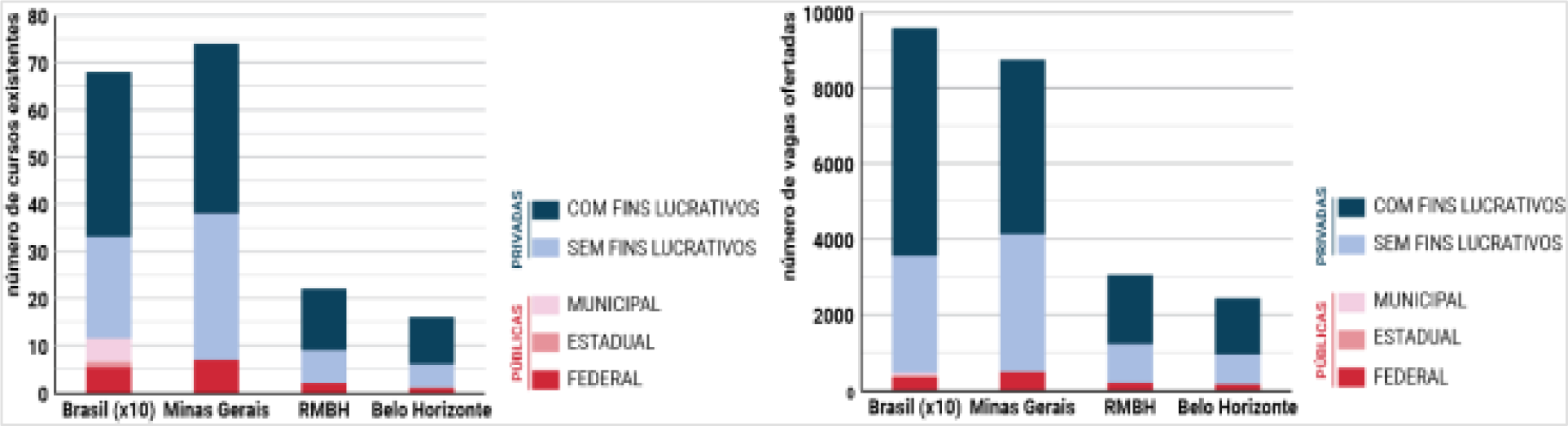
Regarding the administrative categories of the institutions offering these programs, private provision clearly predominates over public provision (Figure 3). Minas Gerais is the state with the largest number of federal Higher Education Institutions (HEIs), totaling 22 institutions, including both universities and institutes. Among these, only seven offer degree programs in Architecture and Urbanism, while no such programs are offered by state or municipal HEIs.

Distribution of Architecture and Urbanism programs and admissions capacity by geographic scope and sector.
Records at the e-MEC Platform indicate the predominance of private provision of Architecture and Urbanism degree programs, a trend that becomes even more clear when considering admissions capacity, since private institutions typically enroll larger numbers of students. Public institutions account for 9.5% of programs in the state but represent only 5.4% of available slots.
In this context, one must consider quality of these programs, drawing both on a qualitative and quantitative analysis of their curricular structures and on student performance in the Enade.
4 ANALYSIS METHODOLOGY
These results refer to the 2019 edition of the Enade, administered on November 24, 2019, the most recent edition with publicly released results prior to this study. Enade is part of the Sistema Nacional de Avaliação da Educação Superior (SINAES), established by L. No. 10,861 (Brazil, 2004), “with the objective of ensuring a national evaluation process of higher education institutions, undergraduate programs, and student academic performance,” as stipulated by the 1996 LDB. Enade is applied to groups of degree programs in three-year cycles, with the most recent cycle evaluating Architecture and Urbanism programs carried out in 2023.
The Area Report (INEP, 2019) specifies that the examination is composed of a general education component (25% of the score) and a specific component (75% of the score), the latter designed by the Advisory Commission for Architecture and Urbanism. Both components include objective and discursive questions. The methodology for calculating the Enade grade, based on exam results, is defined in Technical Note No. 05/2020/CGCQES/DAES (INEP, 2020).
It is important to note that the methodology adopted does not allow comparisons between different editions of the exam or across subject areas in the same year, but only between programs within the same field each year. Enade is complemented by the Student Questionnaire (68 items, completed online), the Program Coordinator Questionnaire, and the Test Perception Questionnaire (nine items completed at the end of the exam). Program-level performance is detailed in individual reports published by the Instituto Nacional de Estudos e Pesquisas Anísio Teixeira (INEP).
To assess the performance of curricular structures, programs in Minas Gerais with an Enade grade equal to or greater than four (4) were selected, based on data from the e-MEC platform. Although the 2019 Area Report identifies 87 programs in the state, only 46 received grades in that cycle. In the present study, program performance is considered using exclusively its Enade grade, without considering disaggregated results by specific exam questions.
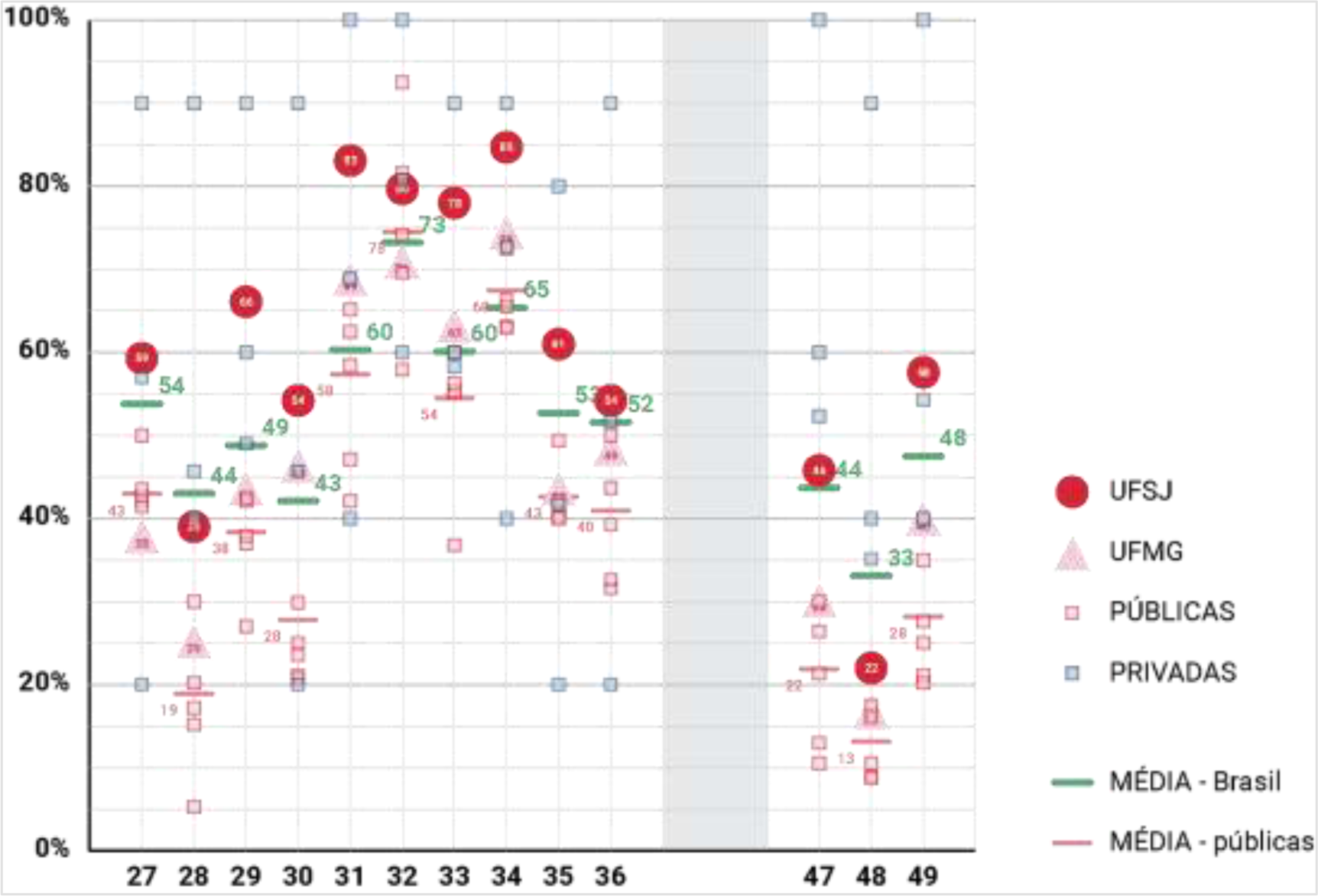
In addition, items from the Student Questionnaire related to pedagogical design and curricular structure (questions 27–36 and 47–49) were analyzed, excluding responses regarding faculty or infrastructure. Students responded on a six-point Likert scale: a) Strongly disagree, b) Disagree, c) Partially disagree, d) Partially agree, e) Agree, f) Strongly agree. Responses were compiled into two figures: one showing the percentage of “Strongly agree,” and another aggregating all levels of agreement (“Partially agree,” “Agree,” and “Strongly agree”).
Items 02, 07, and 08 of the Test Perception Questionnaire were also analyzed. Item 02 addressed the perceived level of difficulty of the specific component, with the following response options: a) Very easy; b) Easy; c) Moderate; d) Difficult; e) Very difficult. Numerical values from 1 (option A) to 5 (option E) were assigned to each response, and weighted averages were calculated according to the percentage of respondents. The result was an index representing the overall perceived level of difficulty of the component, ranging on the same 1–5 scale. Item 07 asked whether students experienced specific difficulties in taking the exam. For this analysis, two categories were considered particularly relevant: A) Lack of content knowledge, which indicated curricular gaps in students’ training and carried a negative weight in the analysis, and E) I experienced no difficulties in completing the exam, which indicated students without any difficulties and carried a positive weight. Other alternatives referred primarily to the exam itself or to the respondent’s state of mind and thus were not considered directly relevant to professional training. Finally, Item 08 examined, considering only the objective questions, the degree of students’ knowledge of the exam content. For each program, the sum of the percentages of responses D and E was calculated, representing students who reported having studied and learned most or all assessed content.
The analysis of these questionnaires helps to qualify the overall exam results, as it highlights whether respondents perceived that their performance was affected by the absence of specific content in their training. This factor is particularly important for assessing whether flexibility in curricular structures has led to gaps in student learning.
In parallel, curricula and, when available, the official Pedagogical Program Documents (PPCs) of programs meeting the Enade performance criterion were analyzed. Curricula were evaluated according to three sets of criteria:
-
total, practical, theoretical, and integrated credit hours: The calculation considered the total credit hours of the program, including all activities (such as internships, complementary activities, and diploma projects). For the calculation of practical, theoretical, and integrated credit hours, only coursework was included, excluding the types of activities mentioned above. Integrated credit hours were defined as units combining both theoretical and practical components, or those explicitly identified as integrated in the curriculum. In the latter case, the credit hours were divided between theoretical and practical components either equally or according to the specified distribution.
-
mandatory and elective coursework: Only coursework was considered, excluding internships, complementary activities, and diploma projects. Courses assigned to a specific semester and bearing mandatory titles were considered compulsory, even if this was not explicitly stated in the documentation. Electives included optional courses and group courses in which students were required to complete a given workload in a field or topic without specifying a particular unit.
-
requirements: The number of units with prerequisites (units that must be completed before enrollment) or co-requisites (units that must be taken simultaneously) were counted, along with the total credit hours of such units. In addition, an index was calculated by weighting the credit hours of units with prerequisites/co-requisites by the number of such requirements. This index was calculated by summing the workload of each unit with prerequisites or co-requisites, multiplying it by the number of requirements, and dividing by the total workload of the program. Thus, units with higher workloads and multiple requirements contributed more heavily to the requirement index. As before, internships and diploma projects were excluded.
These calculations enabled evaluating, comparatively and objectively, the integration between theory and practice proposed by the curriculum (criterion a), as well as its degree of flexibility and openness (criteria b and c combined). Quantitative results were then compared with student performance (as measured by the program’s Enade grade) and with responses to the complementary questionnaires.
Pedagogical Program Documents (Projeto Pedagógico de Curso -PPC) were analyzed according to the following criteria:
-
autonomy: the extent to which students can determine their own academic path, including temporal organization, areas of emphasis, and the development of personal methodologies with critical reflection. In curricular terms, this is directly linked to flexibility.
-
flexibility: the extent to which course content can be modified to some degree, as well as the sequencing of its offerings.
-
integration: horizontal (integration of simultaneous content), vertical (possibility for a curricular unit to be taken by students at different stages of the program), and applied (linkages between theory and practice).
Since the central objective of this analysis is to question rigidity of curricular structures—demonstrating how more flexible and autonomous pedagogical projects may foster stronger performance—the review of the available PPC sought to identify whether these concepts were present in each program proposal, even when expressed under different terms. These documents were also compared with the corresponding curricular structures to examine whether the principles stated in the pedagogical project were in fact reflected in the organization of courses.
5 RESULTS
Regarding Enade grades of Architecture and Urbanism programs in Minas Gerais, only ten programs achieved scores equal to or greater than 4. The results indicate a predominance of quality among public institutions, whose programs obtained an average grade of 4.57, while private programs reached an average of only 2.58. Federal institutions account for all programs that attained the maximum score of 5 (four programs), while the remaining (three programs) achieved a score of 4, together with three private institutions.
It is noteworthy that among these institutions, the program at UFMG is traditionally regarded as a benchmark, being the oldest in the state and the most consolidated in terms of research, teaching, and outreach. It has also trained a significant proportion of the faculty currently teaching in other programs. However, UFMG is among the programs that do not make their PPC publicly available on their official website, providing access only to the curricular structure through its academic system. The pedagogical projects of the programs at UFOP, PUC-Minas, and UNIARAXÁ were also not located. In the latter case, even the published curriculum lacked complete information, such as prerequisite requirements for specific courses, limiting the scope of analysis.

Regarding the available PPC, the following summary table (Figure 5) was prepared, based on the methodological criteria previously described:

Almost all PPC mention the word “autonomy”, but in most cases only as a brief and abstract reference. This suggests that the term has little practical resonance in the strategies for implementation and is often supported by the assumption that ensuring flexibility automatically entails the development of autonomous students. Indeed, there is a relationship between the two concepts; however, most proposals rely on simple subdivisions or on the limited availability of elective units—which, as reflected in the table analysis, translates into only partial or negligible recognition of the concept.
A similar situation occurs with the term “integration”, also referred to as transversality or interdisciplinarity. In many cases, integration depends heavily on coordination among faculty members and course administration, which has proven to be quite fragile.
Regarding the curricular structures, the results in terms of total workload are presented in Table 1:
Most degree programs approximate the minimum credit load established in the national curricular guidelines. Notable exceptions are the programs at UFV and UFOP, whose total credit loads are approximately 10% above the minimum, and PUC-Minas, which exceeds the minimum by 17%. No clear correlation is evident between the total credit load and performance in the National Student Performance Exam (Enade), as among these three programs, only UFV attained the highest performance rating (grade 5).
With respect to the theoretical versus practical orientation of curricular components, most programs prioritize theoretical courses, which account for a greater share of the total credit load compared to practical courses (Figure 8). Exceptions include UFSJ, by a narrow margin, UNA, and PUC-Minas. Regarding the integration of theory and practice, the programs with the largest proportion of integrated coursework are IFMG, UFU, and UFOP, with approximately 55% of their total credit load allocated to integrated units. Notably, although programs such as UFSJ and UNA emphasize in their PPC the importance of bridging theory and practice, this emphasis is not reflected in the actual allocation of credit hours, as these curricula demonstrate comparatively low proportions of integrated courses.

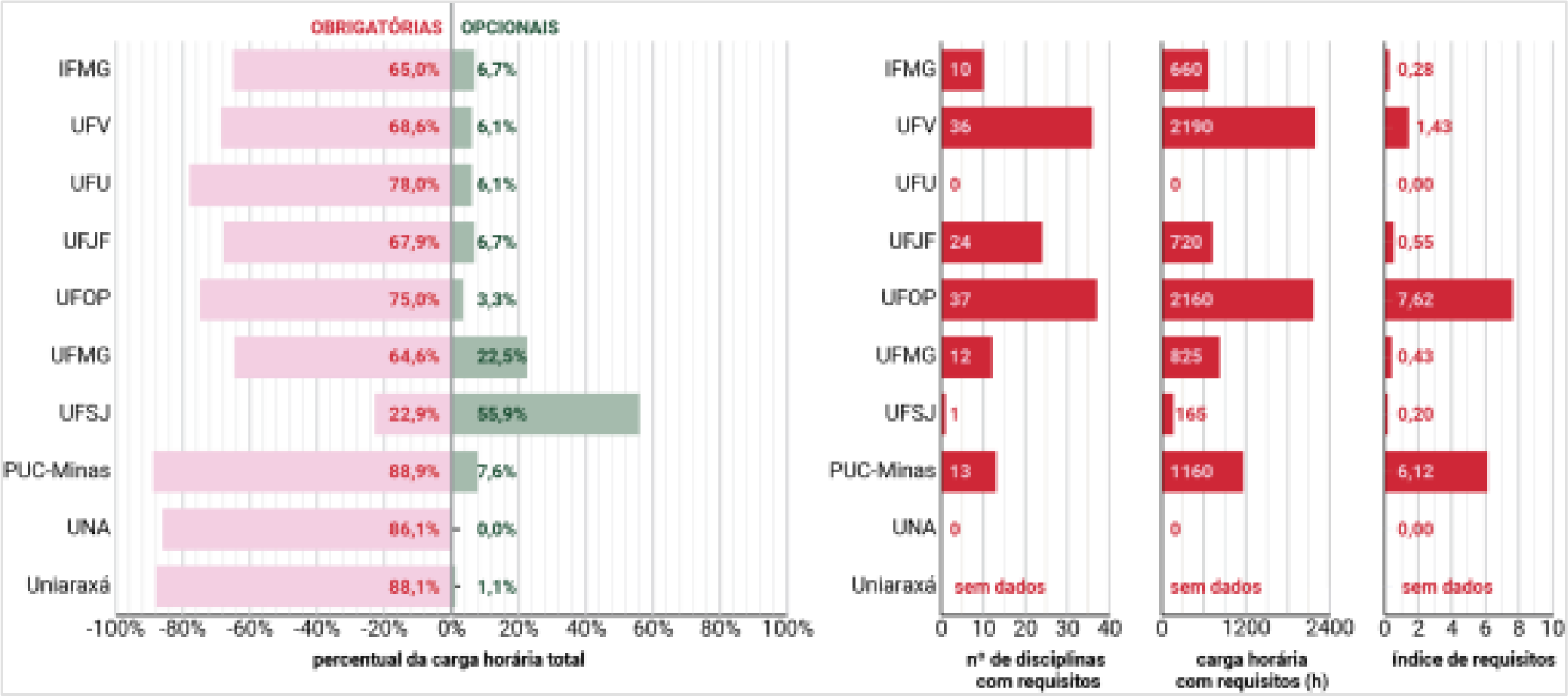
Regarding the mandatory nature of curricular units (Figure 5), there is a marked difference between UFSJ and UFMG compared to other institutions. Public universities generally offer an average of 240 hours of elective courses, corresponding to approximately 6% of the total credit load. In the case of private institutions, this proportion is even lower, with nearly 90% of the curriculum being mandatory. In contrast, UFMG provides flexibility in nearly one-quarter of its credit load, while UFSJ allows more than half of the credit hours to be chosen freely. It is noteworthy that most of this flexibility is not offered as standalone electives but rather as groups of courses that require a predetermined workload within a given theme or area, while allowing students to select specific courses from the available options. At UFMG, such blocks are limited to Design courses in the mid-stage of the program (referred to as PFLEX). At UFSJ, blocks are more diverse and encompass both theoretical units (referred to as modules, organized into five areas) and practical units (referred to as studios, distributed across intermediate levels, 3rd to 6th semesters, and advanced levels, 8th and 9th semesters).
Beyond course mandates, some programs systematically employ prerequisites, which tend to increase curricular rigidity. Prerequisites may also hinder students who fail courses from following the intended sequence, creating challenges for retention and course offering management. UFV and UFOP are the programs with the most extensive prerequisite requirements. These institutions also maintain a greater number of courses in the exact sciences. At UFOP, most courses from the 3rd semester onward require the successful completion of all courses taken two semesters prior. Consequently, UFOP achieved the highest prerequisite index, reflecting the growing and extensive set of requirements per semester from the 3rd onward. UFV’s curriculum ranks third in terms of prerequisites but remains significantly lower than the top two programs (over 80% lower than UFOP). Among private institutions, PUC-Minas exhibits the highest prerequisite indicators, although they are concentrated in a limited number of courses.
At the other end of the spectrum, UFU and UNA do not require any prerequisites, although courses are assigned to specific semesters. This approach provides a structured and linear progression while allowing students to rearrange the order of courses or compensate for failed courses. UFSJ adopts a more radical strategy, with virtually no courses serving as prerequisites and many courses not assigned to a specific semester. Most requirements are defined as percentages of completed credit hours within blocks, resulting in the third lowest prerequisite index among the group.
No direct relationship is observed between curricular flexibility and objective performance in the Enade. The two programs with the highest proportion of elective credit hours (UFMG and UFSJ) achieved the highest Enade rating (grade 5). UFV and UFJF, which also obtained grade 5, have mandatory credit loads like UFMG, although with fewer elective hours. However, flexibility in both cases is limited by the greater number of prerequisites, particularly at UFV, which has the largest number of credit hours subject to prerequisites among all evaluated institutions (2,190 hours) and the third highest prerequisite index (1.43). This, however, did not negatively affect student performance. Conversely, institutions with the largest mandatory credit loads, namely the three private universities, did not achieve superior outcomes.
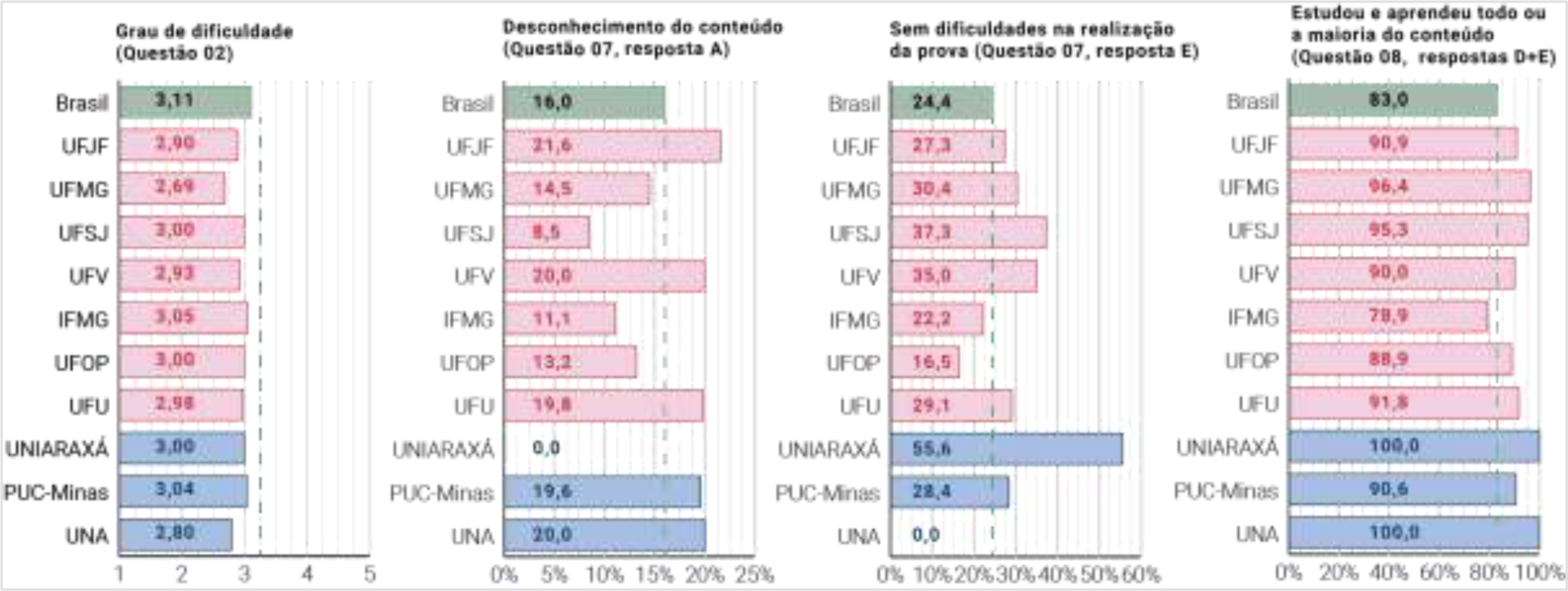
Given the diversity of program structures and the low correlation with objective student performance, student perceptions of the exam and their educational experience were also assessed, based on the questions outlined in the methodology and included in the complementary Enade questionnaires. The perceived difficulty of specific exam components is measured through responses to Question 02 of the Exam Evaluation Questionnaire. This perception can be further triangulated with responses to Question 07, in which students specified the challenges encountered during the exam. The results are presented in Figure 6.

Index of perceived difficulty for specific exam components (Question 02) and percentage of responses to Questions 07 and 08
Students from UFMG reported a lower level of difficulty in completing the exam, although all results cluster around a value of 3.00, corresponding to a medium level of difficulty. It is also noted that the perception of medium difficulty among respondents from these institutions is lower than the national average, which aligns with the strong performance of these universities.
A joint analysis of the graphs indicates that, although UFSJ students rated the exam as more difficult than their peers at UFJF, UFMG, UFV, and UFU, they reported the lowest level of content unfamiliarity among all public institutions. Within this group, UFSJ also has the highest proportion of respondents stating that they encountered no difficulties while taking the exam. UFMG similarly presented few issues related to content unfamiliarity and a comparatively high percentage of students who reported no difficulties during the exam; however, it fell from first to third position in the overall assessment of exam difficulty. At UFJF and UFV, despite strong performance, relatively high percentages of students reported content unfamiliarity, exceeding the national average. Of note are the responses from UNIARAXÁ, where no respondent indicated unfamiliarity with the content, and more than 55% reported encountering no difficulties in answering the exam questions, despite the component being rated as having medium difficulty.
Regarding content knowledge, as indicated by responses to Question 08 and shown in Figure 7, most of the evaluated institutions performed above the national average. Positive response rates—where students indicated they had studied all or most of the assessed content—were often above 90% in eight of the ten programs analyzed.
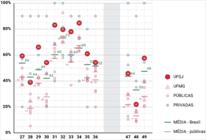
Percentage of students responding “Strongly Agree” to the questions, by institution, along with national and public institution averages
The graph shows that average responses from students at public higher education institutions in Minas Gerais fall below the national average for all questions, except for Questions 32 and 34, which pertain, respectively, to teamwork and the development of critical thinking skills. The performance of public institutions was particularly low on Questions 28 and 48, which address the practical application of course content during internships and professional life, and on Question 30, which examines whether the teaching approaches were innovative. This may indicate a disconnect between public higher education and the labor market in general, or at least in terms of students’ perceptions or expectations regarding professional practice.
In this survey, UFMG reported responses slightly above the public institutions’ average (approximately 7.3 percentage points higher on average), although several results remained below the national average. Its strongest performance was observed in Question 35, related to the development of critical thinking and its application to solving social problems. UFSJ, in turn, showed average responses significantly above those of its public peers (approximately 20.5 percentage points higher), with results above the national average for all questions except Question 28 (concerning internships). A particularly high level of agreement was observed for Questions 31 to 34, which relate to more general competencies not strictly tied to professional practice, such as ethical awareness, teamwork, reflective and argumentative capacity, and critical thinking. As with other public institutions, UFSJ’s lowest performance was in the applicability of course content during internships and professional life (Questions 28 and 48). For most questions, its performance was surpassed only by UNIARAXÁ, whose students also demonstrated exceptionally positive responses in this survey, with 90% or more indicating full agreement.
6 CONCLUDING REMARKS
In the evaluation of the 2019 Enade results, the superior performance of public institutions stands out, as they account for all the highest-rated programs, consistently achieving scores above 4. While some universities with more traditional curricular structures obtained strong Enade rankings, it was also observed that programs with more flexible curricula achieved objective results (Enade scores) equal to or exceeding those of traditional programs. This reinforces the analysis that curricular flexibility does not entail a loss of knowledge, skills, or content. In fact, results from the questionnaire administered by INEP indicate higher engagement with pedagogical processes among graduates of more flexible programs, who perceive not only greater development of relevant professional skills not tied to specific content, but also a higher applicability of their learning to practical and professional contexts.
It is noteworthy that there remains a stronger focus on the curriculum itself rather than on pedagogical projects, which are often absent or exist but are not publicly disclosed. This may correlate with a preference for content-heavy pedagogical proposals, which tend to be more rigid and overlook auxiliary strategies that could enable more complex management of learning pathways. The issue of flexibility requires a more open mindset, more complex management systems, and consequently, a departure from traditional processes. In this regard, the continued widespread use of the term “curriculum grid” stands out, reflecting attachment to an outdated, discipline-centered logic, whereas other institutions have updated terminology to reflect less rigid approaches that allow for adaptation and change— essential in contemporary education.
Another important observation is that the new curricular guidelines under approval for architecture and urbanism programs are moving in the opposite direction of adaptive, skills-centered organizational thinking. New teaching and learning modalities are increasingly prioritized in a context where the rapid evolution of tools (such as software programs and information technology interfaces) necessitates their constant updating. Consequently, increasing both the total workload and the specificity and number of curricular contents appears counterproductive, as it heightens challenges in student engagement, attention, cognition, and the practical use of space, techniques, and instruments. Only more flexible structures can keep pace with the speed of change and the pressures of reality on educational strategies, which are reflected in the preparation of future professionals. Recent events, such as the development and application of Information and Communication Technologies (ICT), the COVID-19 pandemic, and proposed reforms in basic education, further demonstrate the urgency of new demands and the prevalence of hybrid, in-person, and remote experiences in educational settings.
-
3
Here, an ideological discussion is distinguished from a partisan one, since the latter belongs to the institutionalized sphere of political struggle which, although legitimate, is not essential to the design of pedagogical practices. This means that individuals (teachers) with divergent political views can converge on the same educational outcome, whether in a collaborative manner or in a complementary one.
-
4
The author mentions the school because he discusses mainly children education, but the term might refer to any educational institution.
Data Availability
The data underlying this study are available from the author(s) upon justified request, due to ethical, security, and/or financial restrictions.
References
- ALTHUSSER, L. Aparelhos ideológicos de Estado: nota sobre os aparelhos ideológicos de Estado (AIE). Rio de Janeiro: Edições Graal, 1983.
- APPLE, M. W. Ideologia e currículo Porto Alegre: Artmed, 2006.
-
ARAÚJO, R. Projeto político pedagógico: conceituação e definição. Texto utilizado na disciplina Elaboração do Projeto Político Pedagógico do curso de aperfeiçoamento Mineração, Rompimento da Barragem e Revitalização: desafios para a educação; Programa Formação Continuada de Educadores da rede pública dos municípios atingidos pelo rompimento da Barragem de Fundão, em Minas Gerais – PEBRID. Belo Horizonte: UFMG, 2024. Disponível em: https://www.escoladoriodoce.fae.ufmg.br/leituras-do-curso/rojeto-politico-pedagogico-diagnostico-e-construcao/ Acesso em: 14 out. 2024.
» https://www.escoladoriodoce.fae.ufmg.br/leituras-do-curso/rojeto-politico-pedagogico-diagnostico-e-construcao/ -
ABEA -ASSOCIAÇÃO BRASILEIRA DE ENSINO DE ARQUITETURA E URBANISMO. Aprender arquitetura e urbanismo à distância não funciona Brasília: ABEA, 2017. Disponível em: http://www.caubr.gov.br/wp-content/uploads/2017/01/20170126.abea.carta.contra.ead.em.au-1.pdf Acesso em: 10 abr. 2025.
» http://www.caubr.gov.br/wp-content/uploads/2017/01/20170126.abea.carta.contra.ead.em.au-1.pdf -
BRASIL. [Constituição (1988)]. Constituição da República Federativa do Brasil. Brasília: Senado Federal, 2016. Disponível em: https://www.planalto.gov.br/ccivil.03/constituicao/constituicao.htm Acesso em: 07 jul. 2025.
» https://www.planalto.gov.br/ccivil.03/constituicao/constituicao.htm - BRASIL. Decreto n° 19.851, de 11 de abril de 1931. Dispõe que o ensino superior no Brasil obedecerá, de preferência, ao sistema universitário, podendo ainda ser ministrado em institutos isolados, e que a organização técnica e administrativa das universidades é instituída no presente Decreto, regendo-se os institutos isolados pelos respectivos regulamentos, observados os dispositivos do seguinte Estatuto das Universidades Brasileiras. Diário Oficial da União, Brasília, p. 5.800. 15 abr. 1931. Seção 1.
- BRASIL. Decreto n° 23.569, de 11 de dezembro de 1933. Regula o exercício das profissões de engenheiro, de arquiteto e de agrimensor. Diário Oficial da União, Brasília, DF, p. 23.441, 12 dez. 1933. Seção 1.
-
BRASIL. Lei n° 4.024, de 20 de dezembro de 1961 Fixa as diretrizes e bases da educação nacional. Brasília: Presidência da República, 1961. Disponível em: https://www.planalto.gov.br/ccivil.03/leis/l4024.htm Acesso em: 07 jul. 2025.
» https://www.planalto.gov.br/ccivil.03/leis/l4024.htm -
BRASIL. Lei n° 5.194, de 24 de dezembro de 1966 Regula o exercício das profissões de Engenheiro, Arquiteto e Engenheiro-Agrônomo, e dá outras providências. Brasília: Presidência da República, 1966. Disponível em: https://www.planalto.gov.br/ccivil.03/leis/L5194.htm Acesso em: 07 jul. 2025.
» https://www.planalto.gov.br/ccivil.03/leis/L5194.htm -
BRASIL. Lei n° 5.540, de 28 de novembro de 1968 Fixa normas de organização e funcionamento do ensino superior e sua articulação com a escola média, e dá outras providências. Brasil: Presidência da República, 1968. Disponível em: https://www.planalto.gov.br/ccivil.03/leis/l5540.htm Acesso em: 07 jul. 2025.
» https://www.planalto.gov.br/ccivil.03/leis/l5540.htm -
BRASIL. Lei n° 9.394, de 20 de dezembro de 1996 Estabelece as diretrizes e bases da educação nacional. Brasília: Presidência da República, 1996. Disponível em: https://www.planalto.gov.br/ccivil.03/leis/l9394.htm Acesso em:
» https://www.planalto.gov.br/ccivil.03/leis/l9394.htm -
BRASIL. Lei n° 10.861, de 14 de abril de 2004 Institui o Sistema Nacional de Avaliação da Educação Superior – SINAES e dá outras providências. Brasília: Presidência da República, 2004. Disponível em: https://www.planalto.gov.br/ccivil.03/.ato2004-2006/2004/lei/l10.861.htm Acesso em: 07 jul. 2025.
» https://www.planalto.gov.br/ccivil.03/.ato2004-2006/2004/lei/l10.861.htm -
BRASIL. Lei n° 12.378, de 31 de dezembro de 2010 Regulamenta o exercício da Arquitetura e Urbanismo; cria o Conselho de Arquitetura e Urbanismo do Brasil – CAU/BR e os Conselhos de Arquitetura e Urbanismo dos Estados e do Distrito Federal – CAUs; e dá outras providências. Brasília: Presidência da República, 2010. Disponível em: https://www.planalto.gov.br/ccivil.03/.ato2007-2010/2010/lei/l12378.htm Acesso em: 15 set. 2024.
» https://www.planalto.gov.br/ccivil.03/.ato2007-2010/2010/lei/l12378.htm - BRASIL. Parecer CFE n° 336, de 4 de dezembro de 1962 Fixa o currículo mínimo e determina a duração do curso de Arquitetura e Urbanismo. Documenta: Brasília, n. 10, p. 42-44, dez. 1962.
- BRASIL. Parecer CFE n° 384, de 10 de junho de 1969 Fixa os mínimos de conteúdo e duração a serem observados na organização dos Cursos de Arquitetura. Documenta: Brasília, n. 102, p. 91-97. jun. 1969.
-
BRASIL. Ministério da Educação. Parecer CNE/CES n° 334, de 8 de maio de 2019 Institui a orientação às diretrizes curriculares nacionais dos cursos superiores. Brasil: MEC, 2019. Disponível em: https://portal.mec.gov.br/index.php?option=com.docman&view=download&alias=119811-pces334-19&category.slug=agosto-2019pdf&Itemid=30192 Acesso em: 07 jul. 2025.
» https://portal.mec.gov.br/index.php?option=com.docman&view=download&alias=119811-pces334-19&category.slug=agosto-2019pdf&Itemid=30192 -
BRASIL. Ministério da Educação. Parecer CNE/CES n° 952, de 6 de dezembro de 2023 Revisão da Resolução CNE/CES n° 2, de 17 de junho de 2010, que institui as Diretrizes Curriculares do Curso de Graduação em Arquitetura e Urbanismo. Brasília: MEC, 2023. Disponível em: https://portal.mec.gov.br/index.php?option=com.docman&view=download&alias=256931-pces952-23&category.slug=dezembro-2023-pdf&Itemid=30192 Acesso em: 07 jul. 2025.
» https://portal.mec.gov.br/index.php?option=com.docman&view=download&alias=256931-pces952-23&category.slug=dezembro-2023-pdf&Itemid=30192 - BRASIL. Ministério da Educação. Portaria n° 159, de 14 de junho de 1965. Determina a duração mínima para cursos de graduação. Diário Oficial da União, Brasília, p. 5.874. 23 jun. 1965. Seção 1, Parte I.
- BRASIL. Ministério da Educação. Portaria n° 1.770, de 21 de dezembro de 1994 Fixa as diretrizes curriculares e o conteúdo mínimo dos cursos de graduação em Arquitetura e Urbanismo. Brasília: Presidência da República,1994.
-
BRASIL. Ministério da Educação. Resolução n° 6, de 2 de fevereiro de 2006 Institui as Diretrizes Curriculares Nacionais do curso de graduação em Arquitetura e Urbanismo e dá outras providências. Brasília: MEC, 2006. Disponível em: https://portal.mec.gov.br/index.php?option=com.docman&view=download&alias=5 649-rces06-06&Itemid=30192 Acesso em:
» https://portal.mec.gov.br/index.php?option=com.docman&view=download&alias=5 649-rces06-06&Itemid=30192 -
BRASIL. Ministério da Educação. Resolução n° 2, de 18 de junho de 2007 Dispõe sobre carga horária mínima e procedimentos relativos à integralização e duração dos cursos de graduação, bacharelados, na modalidade presencial. Brasília: MEC, 2007. Disponível em: https://portal.mec.gov.br/index.php?option=com.docman&view=download&alias=16872-res-cne-ces-002-18062007&category.slug=janeiro-2015pdf&Itemid=30192 Acesso em: 07 jul. 2025.
» https://portal.mec.gov.br/index.php?option=com.docman&view=download&alias=16872-res-cne-ces-002-18062007&category.slug=janeiro-2015pdf&Itemid=30192 -
BRASIL. Ministério da Educação. Resolução n° 2, de 17 de junho de 2010 Institui as Diretrizes Curriculares Nacionais do curso de graduação em Arquitetura e Urbanismo, alterando dispositivos da Resolução CNE/CES n° 6/2006. Brasília: MEC, 2010. Disponível em: https://www.gov.br/mec/pt-br/cne/2010/rces002.10.pdf Acesso em: 07 jul. 2025.
» https://www.gov.br/mec/pt-br/cne/2010/rces002.10.pdf -
CONFEA -CONSELHO FEDERAL DE ENGENHARIA, ARQUITETURA E AGRONOMIA. Resolução CONFEA n° 218, de 29 de junho de 1973 Discrimina atividades das diferentes modalidades profissionais da Engenharia, Arquitetura e Agronomia. Brasília: Presidência da República, 1973. Seção 1. Disponível em: https://www.fca.unesp.br/Home/Graduacao/0218-73.pdf Acesso em:
» https://www.fca.unesp.br/Home/Graduacao/0218-73.pdf - FREIRE, P. Pedagogia da autonomia: saberes necessários à prática educativa. Rio de Janeiro: Paz e Terra, 2014.
- GIMENO SACRISTÁN, J.; PÉREZ GÓMEZ, A. I. Compreender e transformar o ensino Porto Alegre: Artmed, 2007.
- INEP -INSTITUTO NACIONAL DE ESTUDOS E PESQUISAS EDUCACIONAIS ANÍSIO TEIXEIRA. Nota Técnica N° 5/2020/CGCQES/DAES. Brasília: Inep, 2020.
-
INEP -INSTITUTO NACIONAL DE ESTUDOS E PESQUISAS EDUCACIONAIS ANÍSIO TEIXEIRA. Relatório síntese de área: arquitetura e urbanismo. Brasília: INEP, 2019. Disponível em: http://download.inep.gov.br/educacao.superior/enade/relatorio.sintese/2017/Arquitetura.e.Urbanismo.pdf Acesso em: 10 dez. 2024.
» http://download.inep.gov.br/educacao.superior/enade/relatorio.sintese/2017/Arquitetura.e.Urbanismo.pdf -
LAVERDE, A.; OLIVEIRA, C. T. de A. As entidades nacionais na política educacional das escolas de arquitetura e urbanismo no Brasil – entendimentos sobre a área da tecnologia da construção. Revista História da Educação (Online), Santa Maria, v. 24, e92558, 2020. Disponível em: https://www.scielo.br/j/heduc/a/wxskqy5qnF9ypLrTw9bSv7m/?lang=pt Acesso em: 01 jul. 2025.
» https://www.scielo.br/j/heduc/a/wxskqy5qnF9ypLrTw9bSv7m/?lang=pt -
MAIA. J. C.; SACARDO, M. S. Pós-criticismo ou atualização da teoria crítica?: do currículo “pós-moderno” e híbrido ao currículo crítico. Revista e-Curriculum, São Paulo, v. 20, n. 2, p. 589-610, abr./jun. 2022. Disponível em: https://revistas.pucsp.br/index.php/curriculum/article/view/51852/39951 Acesso em: 01 jul. 2025.
» https://revistas.pucsp.br/index.php/curriculum/article/view/51852/39951 - MARTINS, Carlos Benedito. A reforma universitária de 1869 e a abertura para o ensino superior privado no Brasil. Educação & Sociedade, Campinas, 2009, v. 30, n. 106, p. 15-35, jan./abr. 2009.
- PERRENOUD, P. Pedagogia diferenciada: das intenções à ação. Porto Alegre: Artmed, 2000.
- SANTOS JUNIOR, W. A ABEA e a conquista das Diretrizes Curriculares nacionais para os cursos de Arquitetura e Urbanismo em 1994: uma inflexão inovadora no ensino de Arquitetura e Urbanismo no Brasil (1985-1994.95). In: MONTEIRO, A. M. et al. A construção de um novo olhar sobre o ensino de arquitetura e urbanismo no Brasil: os 40 anos da Associação Brasileira de Ensino de Arquitetura e Urbanismo. Brasília: ABEA, 2013. p. 60-91.
- SCHÖN, D. A. Educando o profissional reflexivo: um novo design para o ensino e a aprendizagem. Porto Alegre: Artmed, 2000.
- SCHÖN, D. A. The reflective practitioner New York: Basic Books, 1983.
- TYLER, R. Basic principles of curriculum and instruction Chicago: University of Chicago Press, 2013.
-
VIDOTTO, T. C.; MONTEIRO, A. M. R. de G. O ensino de arquitetura no Brasil: da missão francesa à criação da Faculdade Nacional de Arquitetura. In: CONABEA – CONGRESSO NACIONAL DA ABEA, 17. ENSEA – ENCONTRO NACIONAL SOBRE ENSINO DE ARQUITETURA E URBANISMO, 32. Anais [...] Goiânia: ABEA, 2013. Disponível em: https://www.academia.edu/27843337/O.ENSINO.DE.ARQUITETURA.NO.BRASIL.DA.MISS%C3%83O.FRANCESA.%C3%80.CRIA%C3%87%C3%83O.DA.FACULDADE.NACIONAL.DE.ARQUITETURA Acesso em: 14 out. 2024.
» https://www.academia.edu/27843337/O.ENSINO.DE.ARQUITETURA.NO.BRASIL.DA.MISS%C3%83O.FRANCESA.%C3%80.CRIA%C3%87%C3%83O.DA.FACULDADE.NACIONAL.DE.ARQUITETURA -
YOUNG, M. Teorias do currículo: o que é e porque é importante. Cadernos de Pesquisa, São Paulo, v. 44 n.151 p.190-202, jan./mar. 2014. Disponível em: https://www.scielo.br/j/cp/a/4fCwLLQy4CkhWHNCmhVhYQd/abstract/?lang=pt Acesso em: 01 jul. 2025.
» https://www.scielo.br/j/cp/a/4fCwLLQy4CkhWHNCmhVhYQd/abstract/?lang=pt
-
Editor de Seção:
Milena Pavan Serafim; Rafael Ângelo Bunhi Pinto
-
Editora de Layout:
Silmara Pereira da Silva Martins

 Source: authors’ elaboration
 Source: authors’ elaboration based on data from the e-MEC Platform, the 2019 Enade Area Report, and IBGE.
 Source: author’s elaboration based on data from e-MEC Plataform
 Source: authors’ elaboration based on data from the 2019 Enade Program Reports
 Source: authors’ elaboration
 Source: authors’elaboration
 Source: authors’ elaboration
 Source: authors’ elaboration