
 TEACHING IN HEALTH: INTENTIONS OF PROFESSIONAL MASTER’S DEGREES FOR TRAINING AND INTERPROFESSIONAL WORK
Abstract
the descriptive study of documentary analysis aimed to analyze the intentions of professional master’s degrees in health education in the CAPES teaching area for training and interprofessional work in the Brazilian context. The research involved 20 CAPES Collection reports from professional master’s programs in the teaching area of the five geographic regions of Brazil referring to the 2017–2020 Quadrennial Assessment. The qualitative analysis of the reports was carried out by tracking terms related to the object of study and analyzing the content of the documents. The reports express the peculiar characteristics of the programs and the intentions for professional training, the development of research and educational products with objects that emerge from daily work, directed to the Brazilian healthcare system principles and guidelines; they recognize the importance of problem-solving, critical and reflective training; and they use different active and interactive methodologies with the potential to strengthen integrated work among different professional categories. The reports present intentions for training and collaborative work, although there is a need for programs to explain the strategies used to develop teamwork and interprofessional collaboration.
Keywords:
education; health; professional master’s degree; interprofessional education
Resumo
o estudo descritivo de análise documental teve como objetivo analisar as intencionalidades dos mestrados profissionais em ensino na saúde da área de ensino da CAPES para a formação e o trabalho interprofissional no contexto brasileiro. A pesquisa envolveu 20 relatórios do Coleta CAPES dos mestrados profissionais da área de ensino das cinco regiões geográficas do Brasil referentes à Avaliação Quadrienal 2017– 2020. A análise qualitativa dos relatórios foi realizada por meio do rastreio de termos relacionados ao objeto de estudo e análise de conteúdo dos documentos. Os relatórios expressam as características peculiares dos programas e as intencionalidades para a formação profissional, o desenvolvimento da pesquisa e de produtos educacionais com objetos que emergem do cotidiano do trabalho, direcionados aos princípios e diretrizes do sistema de saúde brasileiro; reconhecem a importância da formação problematizadora, crítica e reflexiva; e utilizam diferentes metodologias ativas e interativas com potencial para fortalecer o trabalho integrado entre diferentes categorias profissionais. Os relatórios apresentam intenções para a formação e o trabalho colaborativo, embora se veja a necessidade de os programas explicitarem as estratégias utilizadas para o desenvolvimento do trabalho em equipe e da colaboração interprofissional.
Palavras-chave:
ensino; saúde; mestrado profissional; educação interprofissional
Resumen
el estudio descriptivo de análisis documental tuvo como objetivo analizar las intenciones de los profesionales de maestría en educación para la salud en el área de enseñanza de la CAPES para la formación y el trabajo interprofesional en el contexto brasileño. La investigación involucró 20 informes de Colección CAPES de maestrías profesionales en el área de enseñanza de las cinco regiones geográficas de Brasil referentes a la Evaluación Cuatrienal 2017–2020. Análisis cualitativo de los informes se realizó cribando términos relacionados con el objeto de estudio y analizando el contenido de los documentos. Los informes expresan las características peculiares de los programas y las intenciones para la formación profesional, el desarrollo de productos de investigación y educación con objetos que emergen del trabajo cotidiano, orientados a los principios y directrices del sistema de salud brasileño; reconocen la importancia de la formación problematizadora, crítica y reflexiva; y utilizan diferentes metodologías activas e interactivas con el potencial de fortalecer el trabajo integrado entre diferentes categorías profesionales. Las informes presentan intenciones de formación y trabajo colaborativo, aunque se necesitan programas que expliquen las estrategias utilizadas para desarrollar el trabajo en equipo y la colaboración interprofesional.
Palavras clave:
enseñanza de la salud; maestría profesional; educación interprofesional
1 INTRODUCTION
In Brazil, data collection on Stricto Sensu Graduate Programs (GPs) is carried out by the Coordination for the Improvement of Higher Education Personnel (In Portuguese, Coordenação de Aperfeiçoamento de Pessoal de Nível Superior - CAPES) information systems. Since 2013, this process has been carried out via the Sucupira Platform, which aims to provide support for assessing GP quality. On the Sucupira Platform, information is entered by program coordinators, departments and/or professors and should portray the courses’ structure and composition.
The set of information collected about GPs gathers data on their location, affiliation with a higher education institution and other characteristics that reveal their identity. This data makes up a report organized in accordance with the structure of the professional programs assessment form adopted for the aforementioned four-year period (2017–2020). An assessment form is composed according to three criteria, such as program, training and impacts on society, with several items that support GP quality analysis and assessment (Brazil, 2020).
In the area of education, program quality can be assessed by the production and dissemination of the knowledge produced, as well as by the training of human resources, based on the potential for: dissemination of the knowledge produced by GPs in terms of geographic reach; qualification of the knowledge produced in terms of its publication or public presentation; innovation of the knowledge produced in terms of its social and cultural characteristics, aiming at both scientific production and product development, through carrying out research and educational products that integrate the knowledge inherent to the world of work and systematized knowledge, in addition to its impact on society and training of human resources in terms of local-regional scope and the quality of their professional insertion (Brazil, 2023).
As described by Rôças, Moreira and Pereira (2018, p. 61), graduate studies in the professional modality need to establish a dialogue with the different sectors of society, “going beyond the walls of academia and promoting the transfer of scientific, educational and/or cultural technology”, anchored in applied research and in the expansion of theoretical-conceptual and methodological knowledge of each area of knowledge.
For the World Health Organization (OMS, 2010), integrating educational institutions and healthcare services is an essential action to overcome existing challenges in relation to the continuing education of healthcare professionals so that these workers incorporate the healthcare system principles and guidelines and the global assumptions for improving assistance to meet populations’ demands.
A professional master’s degree (PM) is a stricto sensu graduate modality created by Ordinance 80 of CAPES (Neves, 1998) to meet the needs of professionals who, inserted in the world of work, need to improve their professional qualifications and seek innovations in their area, through the study of techniques, processes or topics that meet the demands of their reality, without necessarily moving away from their work activities (CAPES, 2019; BRASIL, 2009).
Professional masters in health education (PMHE) emerged to qualify the healthcare system, through the scientific empowerment of work teams. This health training space is a privileged locus for studies and production of scientific, educational and technological knowledge (Mamede; Abbad, 2018).
The Global Strategy on Human Resources for Health 2030 (WHO, 2016) identified the health workforce training as a major challenge for strengthening healthcare systems. In this context, it is necessary for professional training to strengthen healthcare provision with a focus on expanding access and quality of services (McPake et al., 2016).
These global strategies can lead to improvements in populations’ quality of life in conjunction with health-related goals. The Pan American Health Organization Strategic Plan for 2020–2025 aims to catalyze efforts to reduce inequities and identify specific actions to address health inequalities through four central cross-cutting topics to address the determinants of health: equity; gender; ethnicity; and global human rights (OPAS, 2020).
The current model of professional training in health, characterized by a strong division of labor and centered on professionals’ technical knowledge, still highlights training with an emphasis on the specific skills of each category, resulting in the development of a uniprofessional profile that is fragmented and incompatible with facing the growing and complex demands of health, present today. This training and work model leads to losses in quality of care and in resolution of health needs Freire Filho et al., 2018; Peduzzi et al., 2020).
Tompsen et al., (2018) pointed out that the complexity of health demands and the organization of services indicates a growing trend towards the need to replace professionals’ isolated and independent work with collaborative teamwork.
Professional training for comprehensive care represents a strategy of the Brazilian Health System (in portuguese, Sistema Único de Saúde - SUS) to face the challenge of optimizing its resources in an innovative and courageous proposal for a universal and equitable system. These training processes must consider the accelerated pace of knowledge evolution, changes in the health work method and transformations resulting from demographic and epidemiological aspects, with the perspective of training critical and reflective professionals, with knowledge, skills and attitudes that make them capable of working in a qualified and integrated healthcare system (Vilela; Batista, 2015).
In this regars, there is a meeting point between the PMHE training proposal and the SUS demands.
As described by Ogata et al., (2021), the process of strengthening the SUS is marked by policies to reorient health training and work that, historically, seek to address the obstacles that compromise the system operation according to its principles. In this movement, the most important are continuing education in health, which constitutes the SUS policy for training workers in the sector, and interprofessional education (IPE), an approach to education and professional training that has gained momentum in Brazil in the last decade.
IPE is defined as the occasion in which actors from different healthcare professions learn together, interactively, with the explicit purpose of strengthening collaboration and improving the quality of services offered (Reeves et al., 2013).
For the OMS (2010, p. 7), “a collaborative practice-ready health worker is someone who has learned how to work in an interprofessional collaborative team and is competent to do so”.
IPE has been widely advocated worldwide, as it provides a theoretical-conceptual and methodological framework capable of developing skills for collaborative work, with positive implications for providing effective, safe and quality healthcare services (Reeves et al., 2013).
Interprofessionality refers to interprofessional interventions in education and/or in the workplace, in which members of different professions are studying or working together, interactively and collaboratively, to build patient-centered healthcare systems and quality, safe and sustainable healthcare (Xyrichis, 2020).
Although it is a relatively new topic in the Brazilian context, IPE shows itself to be a promising and vigorous approach to health training and the transformation of professional practices.
Prevedello, Góes and Cyrino (2022), state that undergraduate learning, mediated by interprofessionality, facilitates the development of required skills, in order to meet the Brazilian National Curricular Guidelines and the SUS needs, despite the various challenges faced by students, trainers and managers. These training initiatives show that IPE is a way to improve healthcare by promoting opportunities for students, during their undergraduate studies, to develop skills for teamwork, collaborative practice and comprehensive care.
Despite the positive results of IPE in Brazilian undergraduate courses, it is observed that the intentions and effects of training anchored in the principles and assumptions of interprofessionality still need to be better explored in stricto sensu graduate courses.
PMHEs have an interdisciplinary nature and can be powerful spaces for interprofessional training, with a view to building training processes based on strengthening teamwork and collaborative practice. In addition to being a strategy in the context of the process of reorienting professional training in health, PMHEs aim to prepare qualified professionals for comprehensive care, promoting transformations in health work scenarios and acting as formal professors or service preceptors.
Thus, PMHEs are considered a privileged locus for continuing education, study, research and development of skills for professional training and improvement of professional practices, in order to drive transformations in health work scenarios.
Given this context, this study was guided by the following question: what are the intentions of PMHEs for adopting the theoretical-conceptual and methodological assumptions of interprofessionality in health training and work? The study aimed to analyze the intentions of PMHE for interprofessional training and work in the Brazilian context.
2 METHODOLOGICAL GUIDELINES
This is a qualitative, descriptive study of documentary analysis, since the focus of analysis is on the contents of CAPES Collection reports, referring to the 2017–2020 Quadrennial Assessment, produced by the PMHE of the five geographic regions of Brazil.
For McCulloch (2004), documentary analysis involves paying attention to details that make up the whole document, using interpretation of records and also connotations beyond the text, but which are related to the content. Documents must be considered through a text-context connection.
Descriptive research aims to present the characteristics of a given phenomenon and establish relationships among variables. This methodology seeks a deep and well-founded understanding of the topic under analysis (Thomas; Nelson; Silverman, 2015).
The qualitative approach proves to be relevant, as it values researchers’ reflections, perceptions and impressions in the interpretation process.
The research was conducted in the context of PMHE, accredited and assessed by CAPES, with a complete assessment cycle and grades equal to or higher than three, distributed across the five geographic regions of Brazil. Thus, 20 GPs met the inclusion criteria, and are distributed as follows: North = 2; Northeast = 6; Midwest = 2; Southeast = 9; and South = 1.
The 20 CAPES Collection reports, referring to the period from 2017 to 2020, forwarded by PMHE coordinators, obtained through public access to the Sucupira-Information Collection Platform in 2023, were the object of the analyses.
A set of terms was organized and used to track GPs’ reports in search of data that signaled the intentions for adopting the theoretical-conceptual and methodological assumptions of education and interprofessional work in the training of future professors.
The terms “Interdisciplinary/Interdisciplinarity”, “Multidisciplinary”, “Interprofessional”, “Multiprofessional”, “Collaborative Practice”, “Teamwork”, “SUS”, “Continuing Education”, “Comprehensiveness in Care”, “Professional Training” and “Competency(ies)” were explored.
Using documents saved in “PDF” format and the “CTRL F” command, each term was tracked in search of the frequency with which they were mentioned. Moreover, excerpts from the documents were identified and selected, specifying the location page, which were copied and pasted into a spreadsheet. With the data collected for the 20 reports, thematic content analysis began (Minayo, 2008).
To support qualitative analysis, content excerpts were read and reread with a view to highlighting those that established a direct relationship with the object under study and that presented aspects relevant to understanding the phenomenon. The document excerpts were organized into thematic categories that emerged from the analyses.
The material was processed in three stages: pre-analysis; material exploration; and treatment of results and interpretation. Content analysis allows classifying the components of the meaning of the message, dealing with an objective, systematic and qualitative description of extracted content and its respective interpretation (Minayo, 2008).
To ensure confidentiality, GP reports were identified by alphanumeric combinations (e.g., GP1, GP2, and so on, up to GP20). PMHE characterization data were used only to account for their geographical distribution in the country.
This research is part of a larger project that followed all ethical precepts related to Resolution 466/12, under assessment and approval by the Research Ethics Committee of [identification removed for submission purposes], Certificate of Presentation for Ethical Consideration (In Portuguese, Certificado de Apresentação para Apreciação Ética - CAAE) 32429320.7.0000.5505 and Opinion 4.197.726.
3 RESULTS AND DISCUSSION
Thus, 20 PMHEs met the inclusion criteria, and the respective reports, referring to the 2017–2020 Quadrennial Assessment, were extracted from the Sucupira Platform through public access.
CAPES Collection reports are distributed among different higher education institutions, being: 30% (N=6) in federal public institutions; 20% (N=4) in state public institutions; 5% (N=1) in municipal public institutions; and 45% (N=9) in university centers, colleges and private universities.
Table 1 presents the indicators of the terms tracked in PMHE reports.
Indicators of terms tracked in CAPES Collection reports for the 2017–2020 Quadrennial Assessment, professional master’s degrees in health education. São Paulo, SP, Brazil, 2024.
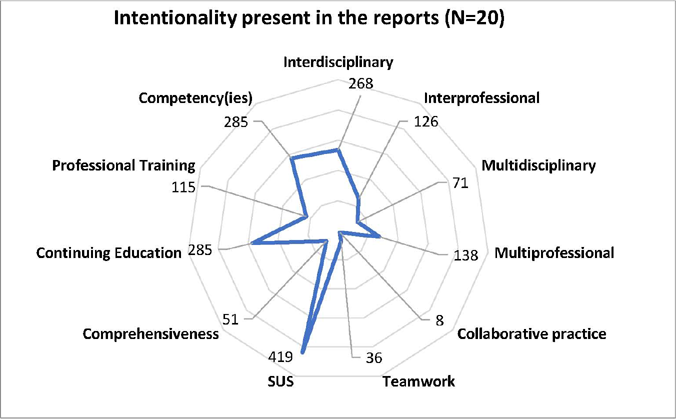
To better visualize the indicators presented in Table 1, the total value was calculated for each term identified in the reports. Figure 1 illustrates the total numbers for each term located.

Intentions of professional master’s degrees in health education for interprofessional training and work. São Paulo, SP, Brazil, 2024.
It is observed that the highest frequencies are related to the terms “SUS” (419), “Continuing Education” (285), “Competencies” (285), “Interdisciplinary/Interdisciplinarity” (268), “Multiprofessional” (138), “Interprofessional” (126) and “Professional Training” (115).
The reports theoretically reflect PNHEs’ training intentions, incorporating relevant topics related to policies that induce training and work in health. However, a lack of clarity and objectivity was noted in relation to the description of the strategies and actions implemented in the training trajectory that signaled the potential, challenges and possibilities of adopting and strengthening the assumptions of interprofessionality in GPs.
For N. Batista e S. Batista (2016), health training is more than a set of skills to be developed, constituting significant experiences in which exchanges, sharing of knowledge, dialogue, respect, ethics and the appreciation of others as legitimate partners in the construction of knowledge that is organized in different ways, with a view to meeting the formative characteristics of the desired professional model, are valued.
The qualitative analysis of the contents expressed in the reports is presented in thematic categories that emerged from the interpretations and excerpts from the documents that illustrate the identified characteristics. Six categories emerged from the analyses:
-
a) Transformation of professional practices in the context of the Brazilian Health System;
-
b) Professional master’s degree as a space for continuing education;
-
c) Training strategies for developing teamwork skills;
-
d) Aspects of interdisciplinary training in graduate studies;
-
e) Elements of interprofessionality in training for health work;
-
f) Training for teaching, research and work in health.
The first category, “Transformation of professional practices in the context of the Brazilian Health System”, shows PMHEs’ intentions with the training of committed professionals prepared to meet the Brazilian population’s growing and complex health needs. The excerpts from documents illustrate these characteristics:
The program’s core objectives are to research and produce scientific knowledge that contributes to the growth of the thematic field of teaching in health sciences, as well as, based on this knowledge, to develop interventions that induce advances and transformations in the practices researched, in addition to providing technical, creative and potentially transformative qualification of higher education professors and technicians for teaching in this area. (GP17, p. 20)
The program aims to train professionals for the production of scientific knowledge, the development of research and technologies and the exercise of teaching in health committed to strengthening the SUS, through the deepening of the theoretical-methodological bases of the human, social and biological sciences that underpin the multidisciplinary field, with this training being oriented towards the field of professional activity. (GP19, p. 2)
The program aims to train professionals with technical and scientific capacity to act and produce knowledge as trainers at the intersection of the university and healthcare services, […] working in actions linked to health education, ensuring integration between the university and healthcare services at the levels of complexity of the SUS in primary, secondary and tertiary healthcare. (GP11, p. 16)
The program aims to train professionals capable of implementing strategies aimed at integrating teaching and service within the SUS, simultaneously qualifying care and training. (GP20, p. 4)
PMHEs intertwine teaching, research and educational products to produce systematized knowledge and implement changes in health training and work scenarios. It is clear that PMHEs are anchored in the premises pointed out by Britto (2022), in the sense of knowing by acting, knowing to act and acting to transform.
The second category, “Professional master’s degree as a space for continuing education”, illustrates the opportunities and importance of graduate training as a differential to enhance professionals’ performance and initiatives in the health-education dyad.
[…] GP training aims to develop teaching protagonists who can contribute to the transformation of education into a process of permanent guarantee of freedom and consolidation of autonomy […] our graduates return to their work environments with a different vision of teaching, its potential, weaknesses and applicability in different socioeconomic and cultural contexts (GP2, p. 60).
[Teaching internship] allows students to reflect on the challenges present in health education and continuing education carried out inside and outside healthcare services. Another perceived need was to expand the spaces for internships as a way of redefining experiences for teaching, with continuing education in health as the axis (GP16, p. 5).
The program aims to assess the social impact in education and health with the meaning of pedagogical action in health, within the scope of the SUS, with the limits, possibilities of advancement based on the strategy of pedagogical training and continuing education (GP19, p. 3).
In the line of research on continuing education in health, there is evidence of a critical approach and dialogue with national continuing education policies and with projects and plans for training healthcare professionals. Studies and research in continuing education in health with health workers express a characteristic feature of the research developed, which is collaborative research (GP17, p. 8).
The GP aims to qualify the actions of trainers, in order to ensure a comprehensive approach to the health-disease process, with an emphasis on primary care and transformations in the processes of knowledge generation, teaching and learning and provision of services to the population, as established by public policies aimed at the continuing education of healthcare professionals (GP18, p. 27).
Ordinance 80 (Neves, 2005), which creates the PM, addresses the need to train students capable of developing new techniques and processes, with a performance that is different from that of graduates of the courses, aiming at a deepening of knowledge or techniques of scientific, technological or artistic research, in addition to a curricular structure linked to its specificity, articulating teaching with professional application, in a differentiated and flexible manner, in terms that are coherent with its objectives and compatible with a time of qualification.
A notable characteristic of PMHE is the fact that master’s students are working students who focus on teaching topics for developing research and educational products based on demands arising from the local realities of health work. This peculiarity of PMHEs points to innovations and knowledge production that mobilize practice scenarios with the perspective of promoting transformations and producing positive impacts on the community.
Lacerda and André (2020) highlight some premises of the PM such as: professional training and its relationship with practice, meeting the needs of the world of work; the interconnection of knowledge produced with social development; the importance of integrating professional training with social demands, aiming at the effectiveness and efficiency of institutions; and increasing the competitiveness and productivity of institutions.
The third category, “Training strategies for developing teamwork skills”, presents PMHEs’ contributions aiming to envision the training of qualified professionals to promote changes in health work scenarios.
[The GP] presents a curricular matrix with disciplines and other curricular components aimed at training professors, service professionals and researchers, using various teaching-learning strategies, such as team-based learning (TBL) and tutorial sessions with problem-based learning (TBL), in addition to laboratory environments, problematization, simulation, seminars, workshops, teaching internship, among others (GP11, p. 3).
Development of skills for interprofessional work and teamwork as a strategy for improving comprehensive patient care. The project is part of the teaching-learning and educational technologies in health research line, and has the potential to qualify interprofessional relationships related to patient care and strengthen the research line focused on interprofessional work and education and teaching-service integration (GP19, p. 4).
The discipline teaching practices in healthcare problematizes the health work process with a view to improving students’ critical-analytical skills on ethical and humanistic bases aimed at achieving comprehensive and humanized care, appropriate to the context in which they are developed. Theoretical and practical content involving service scenarios, technologies and pedagogical methodologies used to deal with situations experienced in the health field and methods of producing teamwork are considered (GP10, p. 4).
As guidance for the graduate’s skills profile […] learning strategies are used, with a focus on students, which enhance the development of communication and teamwork skills, in addition to offering an environment conducive to the development of greater autonomy and accountability in health training, with the production and dissemination of applicable knowledge (GP20, p. 32).
The topic of developing skills for effective teamwork is considered strategic at this time of rescuing the training of a healthcare professional who is better prepared for teamwork, with a view to comprehensive care for people, greater resolution of health demands and quality of care.
In PMHEs, teaching occurs through the use of strategies that problematize the realities of health work, favoring active and interactive learning, and promoting the development of key skills for interprofessionality, such as interprofessional communication, collaborative leadership, conflict resolution, teamwork dynamics, clarity of roles, professional responsibilities and care centered on the person, family and community.
Considering that PMHEs in the teaching area have an interdisciplinary nature and can constitute a privileged locus for interprofessional training, the fourth category, “Aspects of interdisciplinary training in graduate studies”, shows that:
The GP has the mission of collaborating with training health professionals, seeking to face the educational challenges of our millennium, combined with those present in training for the SUS. […] it adopts an interdisciplinary perspective to address research topics related to teaching in health, and has been expanding the horizons of training professionals committed to innovation in professional practices in health (GP19, p. 34).
The program aims to produce scientific and technological research to consolidate the interdisciplinary training in health; contribute to the development of interdisciplinary care technologies to deal with the population’s main health problems; and train masters in health education to be able to work in basic, technical, higher education and continuing education activities (GP10, p. 3).
Since the course absorbs professionals from various areas of knowledge and various health specialties, interdisciplinarity and interprofessionality are considered important points as fields of emphasis in studies (GP15, p. 7).
The line of research includes the investigation of production of knowledge in teaching and training in health […] includes studies on: interdiscitplinarity and multiprofessionality in health; research, training and teaching practice; the development, implementation and practice of new educational technologies in health teaching (GP8, p. 3).
Program graduates develop skills to organize and lead multidisciplinary and interdisciplinary work teams in the performance of specific educational tasks, such as teaching, curriculum development, student assessment, educational quality assurance and continuing education in health education (GP7, p. 4).
Interdisciplinarity, understood as the intertwining of disciplinary knowledge and expertise, is present in the individual or collective projects of PMHEs, involving professors, students and graduates, which culminate in the implementation of educational products developed as tools for continuing education actions configured in the format of videos, podcasts, workshops, conversation circles, team meetings, production of devices for health education in the community, among others.
In the fifth category, “Elements of interprofessionality in training for health work”, some of these intentions can be observed:
Education and interprofessional work stand out as principles for the reorientation of training and the healthcare model, from the perspective of comprehensiveness and humanization of care, valuing users and their needs as fundamental elements for strengthening the SUS (GP18, p. 26).
[…] the teaching-service-community integration aims to emphasize topics related to interpro-fessionality in approaches to health education processes that involve professionals, scenarios and learning practices aimed at strengthening the Brazilian public health area, with emphasis on continuing education in health and SUS equity policies (GP15, p. 3).
The social inclusion of GP has had an impact on the formulation of public policies in health education, especially in the last two years (2019 and 2020) with PET Health Interprofessionality: production of educational material, tutoring, supervision, advice on national projects. In short, multiple functions and activities taken over by professors and graduates of our program (GP17, p. 19).
The product was a course developed by an interprofessional team and aimed at providing practical interprofessional training, […] as a teaching tool to qualify and integrate care for hospitalized pediatric patients. Qualifying interprofessional care may reflect on the healthcare system safety and humanization (GP8, p. 21 and 23).
Training initiatives from the perspective of IPE have been implemented more consistently in undergraduate courses in Brazil, based on inductive policies that encourage the adoption of these principles as ways to improve healthcare, promoting opportunities for students to develop skills for teamwork, collaborative practice and comprehensive care. However, in the graduate space, training experiences anchored in the assumptions of interprofessionality are still rare.
Professional qualification, within the scope of graduate studies, in the professional modality in the teaching area, has proven to be a valuable opportunity to prepare trainers for the education of healthcare professions, such as professors, managers, tutors, preceptors, researchers of their own practices and differentiated professionals to promote changes in the spaces of health work to strengthen the SUS. Thus, the sixth category, “Training for teaching, research and work in health”, reveals the prerogatives of PMHEs:
The main objective of the program is to provide graduate technical-scientific training to professors, preceptors and professionals who have proven experience in educational processes in health education, making them highly qualified to identify real problems and seek solutions, forming a more critical, reflective and innovative professional profile capable of intervening and positively impacting their area of activity (GP7, p. 3).
The program offers qualifications to professionals linked to teaching and healthcare services, mainly to the SUS, and trains healthcare professionals committed to new pedagogical concepts and practices to act as inducers of change in their work institutions, with the aim of improving the teaching-learning process and enhancing technical and scientific production (GP11, p. 59).
The area of concentration encompasses initiatives aimed at training qualified healthcare professionals to work in healthcare professions education. It involves an interdisciplinary and interprofessional approach to aspects related to the planning, operationalization, assessment and management of training processes in health, from the perspective of integration with services, the community and public policies aimed at reorienting professional training in health in Brazil, through the production of scientific, technological knowledge and innovation in this strategic area for SUS consolidation (GP18, p. 2).
The master’s degree focuses on the pedagogical training/continuous education of healthcare professionals who work with students and other professionals in the daily routine of healthcare services; trained professionals, with a critical and broad vision of society in and for the SUS, qualified to promote integrated articulation between the teaching and health sectors, […] in the construction of collective, interdisciplinary, critical and creative teaching practices, committed to transforming reality (GP19, p. 2).
In PMHEs, students develop knowledge, skills and attitudes guided by a curricular structure and by professors who mobilize knowledge to provoke reflections on relevant topics, with a view to triggering promising movements for changes in the scenarios of professional practice in health.
The dynamic and complex nature of people’s lives and health reality highlights a growing need to reorient the training of professionals and the production model of healthcare services (Frenk et al., 2010; Freire Filho; Magnago; Costa; Forster, 2018), building educational trajectories to achieve the five central objectives of health: improving patient care quality; improving communities’ and populations’ health; improving professionals’ work experience; reducing costs related to service provision; and improving health equity (Farrell et al., 2023).
D’Amour and Oandasan (2005) consider that interprofessionality is a response to the fragmentation of health work, and they recommend a change in the care and training model so that educators and professionals collaborate synergistically in the teaching-learning process and in healthcare.
The ongoing articulation of PMHE with policies that encourage the reorientation of health training is a powerful strategy to contribute to advances in scientific production and the development of intervention products aimed at key topics that enhance initial and graduate training, and to strengthen the SUS, such as: interdisciplinarity; interprofessional education and work; comprehensive care; equity; care centered on the user, families and communities; among other essential topics for health training.
Training professionals in teaching, management and assistance who are qualified, autonomous and innovative for the world of work is a major challenge, requiring investments from different levels.
For graduates to be able to plan, develop and assess research projects, new methodologies and products for innovation and transformation in practice scenarios are necessary to align theoretical-conceptual and methodological foundations so that they dialogue with the complex and growing demands of population health and with policies that induce the reorientation of health training, advancing scientific production and the development of innovative technical-educational products that contribute to real transformations in health work scenarios.
IPE is considered an appropriate strategy for overcoming a fragmented training and health model, as it constitutes a training perspective that promotes integrated and collaborative teamwork among professionals from different categories, focusing on the population’s health needs (Reeves, 2016)
For Peduzzi (2016), the SUS is interprofessional, built and consolidated as a space for healthcare, professional education, management and social control, guided by the comprehensiveness, equity, universality and participation principles.
One of the purposes of PMHE is to qualify professionals for transformative practice that meets social, organizational or professional demands. Thus, they constitute powerful spaces to promote interprofessional training, since the problems of services are complex and require a broad view of different disciplines and areas of knowledge, favoring collaboration, partnership and cooperation among professionals from different categories.
Interdisciplinarity has proven to be a strong point in some PMHEs, involving several areas of knowledge inherent to health. However, interprofessionality is still present in only a few GPs.
IPE has been presented as an important tool for training professionals capable of working in teams so that future professionals and those already working in the healthcare field can develop collaboration as a skill that ensures a change in the logic of the healthcare model. Collaborative professionals ensure comprehensive healthcare practices through collaborative work, with a greater capacity to respond to health problems and needs (Reeves, 2016).
For Peduzzi (2016), IPE is aligned with the SUS fundamental principles by establishing: the user centrality in the reorganization of healthcare services; the alignment of professional profiles with complex health needs; the search for the reorganization of health practices in the logic of teamwork and interprofessional collaboration; and the training of professionals more involved with the transformations necessary for society.
Thus, it is understood that the PMHE constitutes a rich scenario to enhance teamwork and collaborative practice. By encompassing professionals from different categories, already graduated, who continue their training through the deepening of knowledge, GPs in the professional modality are configured as a fruitful space to develop, implement and assess innovative research, processes and technological/educational products, in order to contribute to transformations in the scenarios of professional practice, whether in spaces of formal education offered by educational institutions or in spaces of non-formal education, aimed at training professionals who work in the different contexts of healthcare.
4 FINAL CONSIDERATIONS
The study aimed to analyze the intentions of professional master’s degrees in health education, in the CAPES teaching area, for training and interprofessional work in the Brazilian context.
Documentary research with a descriptive-analytical approach allowed us to value PNHEs’ trajectory and explore the intentions of training, with a view to creating opportunities for the development of skills for teamwork and collaborative practice.
Analyzing the 2017–2020 Quadrennial Assessment CAPES Collection report, focusing on the assumptions of interprofessionality, assumed singular relevance, as it allowed us to identify the characteristics that permeate health training strategies, revealing a health and society project that we plan to build.
The data claim that there are elements that identify the intentions in defending the principles of interprofessionality based on consistent theoretical-conceptual and methodological references. However, there is a set of PMHEs in which a lack of theoretical-conceptual alignment with this assumption is observed, presenting terminological and conceptual confusion, and sometimes treating different terms similarly, such as “Interdisciplinary”, “Multidisciplinary”, “Multiprofessional” and “Interprofessional”.
To a greater or lesser extent, PMHEs present possibilities for strengthening the principles of IPE, especially with regard to recognizing the complex and dynamic nature of health needs, which in turn demand greater interaction and integration between different professional categories to promote user-centered care and achieve comprehensive care.
The research brings two important intrinsically related considerations: the need to think about more systematized pedagogical proposals, with greater clarity of theoretical-conceptual and methodological foundations; and that, despite this, the courses prove to be powerful for the adoption of the principles of interprofessionality, as they constitute professional master’s degrees of an interdisciplinary nature, with students from different professional categories in health, education and the social field.
In this context, it is worth highlighting that the CAPES Collection report, as an institutional document that expresses values, objectives and pedagogical methods, needs to be clearer, more consistent and reveal in an elucidative manner the guiding elements of the training process.
Furthermore, it cannot be stated that what is foreseen in documents is in fact operationalized, requiring an effort to complement this study with other research that can explore the dynamics of the formative processes, the programmatic contents, the pedagogical strategies used in the curricular units, implemented based on the realities and the subjects involved.
In general, PMHEs cannot represent just a condition for the creation or existence of the course, as they also need to explain the theoretical-conceptual and methodological bases capable of contributing to and supporting the construction of a new health and society project.
The findings of this study may have important implications for the induction of new health training policies, by identifying proposals that lack greater theoretical-conceptual and methodological solidity, a fundamental aspect for a model that has in its genesis the commitment to transforming the logic of education and work processes in health.
Although the analysis proved to be powerful in understanding the documents that guide the training processes, with their intentions for change, it is important to highlight that the analysis of GP reports allowed us to (re)discover the mission, objectives, role and demands that guided the course structure. However, it also raised limitations regarding information clarity and objectivity, which sometimes made it difficult to understand the daily teaching in training proposals.
Thus, future research may focus on analyzing in greater depth the guiding elements and the operationalization methods of training processes, which may prove to be complex, structuring, innovative and long-lasting.
-
Financing source:
Brazilian National Council for Scientific and Technological Development (in portuguese, Conselho Nacional de Desenvolvimento Científico e Tecnológico -CNPq), Research Productivity Grant.
References
-
BATISTA, N. A.; BATISTA, S. H. S. B. Educação interprofissional na formação em saúde: tecendo redes de práticas e saberes. Interface, Botucatu, v. 20, n. 56, p. 202–204, 2016. Disponível em: https://www.researchgate.net/publication/287107672_Educacao_interprofissional_na_formacao_em_Saude_tecendo_redes_de_praticas_e_saberes Acesso em: 30 jan. 2025.
» https://www.researchgate.net/publication/287107672_Educacao_interprofissional_na_formacao_em_Saude_tecendo_redes_de_praticas_e_saberes -
BRASIL. Ministério da Educação (MEC). Coordenação de Aperfeiçoamento de Pessoal de Nível Superior (CAPES). Diretoria de Avaliação (DAV). Documento orientador de APCN: área 46: ensino. Brasília: MEC; CAPES; DAV, 2023. Disponível em: https://www.gov.br/capes/ptbr/acesso-a-informacao/acoes-e-programas/avaliacao/sobre-a-avaliacao/areas-avaliacao/sobre-as-areas-de-avaliacao/colegio-de-ciencias-exatas-tecnologicas-e-multidisciplinar/multi-disciplinar/Ensino_Documento_Orientador_APCN_2023.pdf Acesso em: 27 jan. 2025.
» https://www.gov.br/capes/ptbr/acesso-a-informacao/acoes-e-programas/avaliacao/sobre-a-avaliacao/areas-avaliacao/sobre-as-areas-de-avaliacao/colegio-de-ciencias-exatas-tecnologicas-e-multidisciplinar/multi-disciplinar/Ensino_Documento_Orientador_APCN_2023.pdf -
BRASIL. Ministério da Educação (MEC). Coordenação de Aperfeiçoamento de Pessoal de Nível Superior (CAPES). Diretoria de Avaliação (DAV). Ficha de avaliação: programas acadêmicos e profissionais: quadriênio 2017-2020: área 46: Ensino. Brasília: MEC; CAPES; DAV, 2020. Disponível em: https://www.gov.br/capes/pt-br/centrais-de-conteudo/FICHA_ENSINO.pdf Acesso em: 27 jan. 2025.
» https://www.gov.br/capes/pt-br/centrais-de-conteudo/FICHA_ENSINO.pdf -
BRASIL. Ministério da Educação. Portaria Normativa n.º 17, de 28 de dezembro de 2009. Brasil. Ministério da Educação (MEC). Dispõe sobre o mestrado profissional no âmbito da Fundação Coordenação de Aperfeiçoamento de Pessoa de Nível Superior-CAPES. Diário Oficial da União, DOU n.º 248, de 29.12.2009, Brasília, Seção 1, p. 20, 2019. Disponível em: https://cad.capes.gov.br/ato-administrativo-detalhar?idAtoAdmElastic=753 Acesso em: 27 jan. 2025.
» https://cad.capes.gov.br/ato-administrativo-detalhar?idAtoAdmElastic=753 -
BRITTO, L. P. L. Conhecer e agir para transformar: a leitura do mundo em Paulo Freire. Revista Café com Paulo Freire, Recife, v. 2, n. 1, 2022. Disponível em: https://pt.scribd.com/document/775459930/2022-BRITTO-Luiz-Percival-Leme-Conhecer-e-agir-para-transformar-aleitura-do-mundo-em-Paulo-Freire-In-Cafe-com-Paulo-Freire-v-2-n-1 Acesso em: 30 jan. 2025.
» https://pt.scribd.com/document/775459930/2022-BRITTO-Luiz-Percival-Leme-Conhecer-e-agir-para-transformar-aleitura-do-mundo-em-Paulo-Freire-In-Cafe-com-Paulo-Freire-v-2-n-1 -
D’AMOUR, D.; OANDASAN, I. Interprofessionality as the field of interprofessional practice and interprofessional education: an emerging concept. Journal Interprofessional Care, Reino Unido, v. 19, Suppl. 1, p. 8-20, 2005. Disponível em: https://pubmed.ncbi.nlm.nih.gov/16096142/ Acesso em: 30 jan. 2025.
» https://pubmed.ncbi.nlm.nih.gov/16096142/ -
FARRELL, T. W. et al Academic health centers and the quintuple aim of health care. Academic Medicine, Filadélfia, v. 98, n. 5, p. 563-568, 2023. Disponível em: https://journals.lww.com/academicmedicine/fulltext/2023/05000/academic_health_centers_and_the_quintuple_aim_of.24.aspx Acesso em: 30 jan. 2025.
» https://journals.lww.com/academicmedicine/fulltext/2023/05000/academic_health_centers_and_the_quintuple_aim_of.24.aspx -
FREIRE FILHO, J. R. et al Cursos de especialização ofertados no âmbito do mais médicos: análise documental n perspectiva da educação interprofissional. Interface, Botucatu, v. 22 (Supl. 2), p. 613-1624, 2018. Disponível em: https://www.scielo.br/j/icse/a/YQM4Q5nkPDpc9j555xVbLQj/?lang=pt Acesso em: 30 jan. 2025.
» https://www.scielo.br/j/icse/a/YQM4Q5nkPDpc9j555xVbLQj/?lang=pt -
FRENK, J. et al Health professionals for a new century: transforming education to strengthen health systems in an interdependent world. The Lancet, Shanghai, v. 376, n. 9756, p. 1923-1958, 2010. Disponível em: https://www.thelancet.com/journals/lancet/article/PIIS01406736(10)61854-5/abstract Acesso em: 30 jan. 2025.
» https://www.thelancet.com/journals/lancet/article/PIIS01406736(10)61854-5/abstract -
LACERDA, C. R.; ANDRE, M. E. Mestrados profissionais em rede: contribuições e desafios para a formação docente. Revista da FAEEBA: Educação e Contemporaneidade, Salvador, v. 29, n. 57, p. 45-60, 2020. Disponível em: http://educa.fcc.org.br/scielo.php?script=sci_arttext&pid=S0104-70432020000100045&lng=pt&nrm=iso Acesso em: 30 jan. 2025.
» http://educa.fcc.org.br/scielo.php?script=sci_arttext&pid=S0104-70432020000100045&lng=pt&nrm=iso -
MAMEDE, W.; ABBAD, G. S. Objetivos educacionais de um mestrado profissional em saúde coletiva: avaliação conforme a taxonomia de Bloom. Educação e Pesquisa, São Paulo, v. 44, 2018. Disponível em: https://www.scielo.br/j/ep/a/5wf4MqfMppSMLvM6yLwTCQQ/?lang=pt Acesso em: 30 jan. 2025.
» https://www.scielo.br/j/ep/a/5wf4MqfMppSMLvM6yLwTCQQ/?lang=pt -
McCULLOCH, G. Documentary research: in education, history and the social sciences. Londres: Routledge, 2004. E-book Disponível em: https://www.taylorfrancis.com/books/mono/10.4324/9780203464588/documentary-research-gary-mcculloch Acesso em: 30 jan. 2025.
» https://www.taylorfrancis.com/books/mono/10.4324/9780203464588/documentary-research-gary-mcculloch -
McPAKE, B. et al Implications of dual practice for universal health coverage. Bull World Health Organ, Genebra, v. 94, p. 142–146, 2016. Disponível em: https://www.researchgate.net/publication/313503139_McPake_and_Russo_2016_Implication_of_dual_practice_for_universal_health_coverage Acesso em: 30 jan. 2025.
» https://www.researchgate.net/publication/313503139_McPake_and_Russo_2016_Implication_of_dual_practice_for_universal_health_coverage - MINAYO, M. C. S. O desafio do conhecimento: pesquisa qualitativa em saúde. São Paulo: Hucitec-Abrasco, 2008.
-
NEVES, A. A. B. Portaria n.º 80, de 16 de dezembro de 1998. Revista Brasileira de Pós-Gra-duação, Brasília, v. 2, n. 4, p. 149-150, 2005. Disponível em: https://rbpg.capes.gov.br/rbpg/article/view/88/84 Acesso em: 30 jan. 2025.
» https://rbpg.capes.gov.br/rbpg/article/view/88/84 -
OGATA, M. N. et al Interfaces entre a educação permanente e a educação interprofissional em saúde. Revista da Escola de Enfermagem da USP, São Paulo, v. 55, 2021. Disponível em: https://www.scielo.br/j/reeusp/a/K89qghvK3WgSN3pzcdKsZgR/?lang=pt Acesso em: 30 jan. 2025.
» https://www.scielo.br/j/reeusp/a/K89qghvK3WgSN3pzcdKsZgR/?lang=pt -
OMS – Organização Mundial de Saúde. Departamento de Recursos Humanos para a Saúde. Marco para Ação em Educação Interprofissional e Prática Colaborativa Genebra: OMS, 2010. Disponível em: https://pesquisa.bvsalud.org/portal/resource/pt/biblio-964974 Acesso em: 30 jan. 2025.
» https://pesquisa.bvsalud.org/portal/resource/pt/biblio-964974 -
OPAS – Organização Pan-Americana de Saúde. Plano estratégico da organização Pan-Americana de saúde 2020–2025: equidade, o coração da saúde. Washington, D.C.: OPAS; OMS, 2020. Disponível em: https://iris.paho.org/bitstream/handle/10665.2/52968/9789275722756_por.pdf Acesso em: 30 jan. 2025.
» https://iris.paho.org/bitstream/handle/10665.2/52968/9789275722756_por.pdf -
PEDUZZI, M. et al Trabalho em equipe: uma revisita ao conceito e a seus desdobramentos no trabalho interprofissional. Trabalho, Educação e Saúde, Rio de Janeiro, v. 18, (Supl.1), 2020. Disponível em: https://www.scielo.br/j/tes/a/RLtz36Ng9sNLHknn6hLBQvr/?lang=pt Acesso em: 30 jan. 2025.
» https://www.scielo.br/j/tes/a/RLtz36Ng9sNLHknn6hLBQvr/?lang=pt -
PEDUZZI, M. O SUS é interprofissional. Interface, Botucatu, v. 20, n. 56, p. 199-201, 2016. Disponível em: https://www.scielo.br/j/icse/a/7MgQL4JM9dRYFDLYYzQVLHM/?lang=pt Acesso em: 30 jan. 2025.
» https://www.scielo.br/j/icse/a/7MgQL4JM9dRYFDLYYzQVLHM/?lang=pt -
PREVEDELLO, A. S.; GÓES, F. S. N.; CYRINO, E. G. Educação interprofessional na formação em saúde no Brasil: scoping review. Revista Brasileira de Educação Médica, São Paulo, v. 46, n. 3, 2022. Disponível em: https://www.scielo.br/j/rbem/a/HzRqsxYTXT6gbWP9wSvzqtw/?lang=pt Acesso em: 30 jan. 2025.
» https://www.scielo.br/j/rbem/a/HzRqsxYTXT6gbWP9wSvzqtw/?lang=pt -
REEVES, S. et al Interprofessional education: effects on professional practice and healthcare outcomes. Cochrane Database of Systematic Reviews, Londres, v. 3, 2013. Disponível em: https://www.cochranelibrary.com/cdsr/doi/10.1002/14651858.CD002213.pub3/information#versionTable Acesso em: 30 jan. 2025.
» https://www.cochranelibrary.com/cdsr/doi/10.1002/14651858.CD002213.pub3/information#versionTable -
REEVES, S. Porque precisamos da educação interprofissional para um cuidado efetivo e seguro. Interface, Botucatu, v. 20, n. 56, p. 185-197, 2016. Disponível em: https://www.scielosp.org/pdf/icse/2016.v20n56/185-197/pt Acesso em: 30 jan. 2025.
» https://www.scielosp.org/pdf/icse/2016.v20n56/185-197/pt -
RÔÇAS, G.; MOREIRA, M. C. A.; PEREIRA, M. V. Esquece tudo o que te disse: os mestrados profissionais da área de ensino e o que esperar de um doutorado profissional. Revista ENCI-TEC, Santo Ângelo, v. 8, n. 1, p. 59-74, 2018. Disponível em: https://scholar.google.com/citations?view_op=view_citation&hl=pt-BR&user=ot_i9fIAAAAJ&citation_for_view=ot_i9fIAAAAJ:_kc_bZDykSQC Acesso em: 30 jan. 2025.
» https://scholar.google.com/citations?view_op=view_citation&hl=pt-BR&user=ot_i9fIAAAAJ&citation_for_view=ot_i9fIAAAAJ:_kc_bZDykSQC -
THOMAS, J. R.; NELSON, J. K.; SILVERMAN, S. J. Research methods in physical activity Champaign: Human Kinetics, 2015. Disponível em: https://books.google.com.br/books?id=OPR6DwAAQBAJ&printsec=frontcover&hl=ptBR&source=gbs_ge_summary_r&cad=0#v=onepage&q&f=false Acesso em: 30 jan. 2025.
» https://books.google.com.br/books?id=OPR6DwAAQBAJ&printsec=frontcover&hl=ptBR&source=gbs_ge_summary_r&cad=0#v=onepage&q&f=false -
TOMPSEN, N. N. et al Educação interprofissional na graduação em odontologia: experiências curriculares e disponibilidade de estudantes. Revista de Odontologia da UNESP, Arara-quara, v. 47, n. 5, p. 309-320, 2018. Disponível em: https://www.semanticscholar.org/paper/Educa%C3%A7%C3%A3o-interprofissional-na-gradua%C3%A7%C3%A3o-em-e-de-Tompsen-Meireles/e7da9992b73fa0e730b3ab6fd46a7f961327257e Acesso em: 30 jan. 2025.
» https://www.semanticscholar.org/paper/Educa%C3%A7%C3%A3o-interprofissional-na-gradua%C3%A7%C3%A3o-em-e-de-Tompsen-Meireles/e7da9992b73fa0e730b3ab6fd46a7f961327257e -
VILELA, R. Q. B.; BATISTA, N. A. Mestrado profissional em ensino na saúde no Brasil: avanços e desafios a partir de políticas indutoras. Revista Brasileira de Pós-Graduação, Brasília, v. 12, n. 28, p. 307-331, 2015. Disponível em: https://www.mendeley.com/catalogue/1e55a4ebbe9f-3f56-9b68-dd0988964832/ Acesso em: 30 jan. 2025.
» https://www.mendeley.com/catalogue/1e55a4ebbe9f-3f56-9b68-dd0988964832/ -
WHO – World Health Organization. Global strategy on human resources for health: workforce 2030. Genebra: WHO, 2016. Disponível em: https://www.who.int/publications/i/item/9789241511131 Acesso em: 30 jan. 2025.
» https://www.who.int/publications/i/item/9789241511131 -
XYRICHIS, A. Interprofessional science: an international field of study reaching maturity. Journal of Interprofessional Care, Londres, v. 34, n. 1, p. 1–3, 2020. Disponível em: https://www.tandfonline.com/doi/full/10.1080/13561820.2020.1707954#d1e75 Acesso em: 30 jan. 2025.
» https://www.tandfonline.com/doi/full/10.1080/13561820.2020.1707954#d1e75
-
Section Editor:
André Pires
-
Layout Editor:
Silmara Pereira da Silva Martins

 Source: data produced by the authors, 2024.