
 Beyond Feasibility: A Bibliometric Analysis of the Research into Energy Exploitation of Landfill Gas
Abstract
Reducing methane emissions, such as landfill gas, is important for tackling climate change in the short term. Although underexplored, the energy recovery of landfill gas can finance improvements in the sanitation sector. This research identified the gaps and trends in the scientific production on landfill gas energy recovery. The tools Bibliometrix and VOSviewer were used to perform a bibliometric analysis of studies retrieved from the Web of Science. The results indicated an increase in research in developing countries, a decrease in feasibility studies (economic, social and technical) and an emerging interest in energy recovery from waste based on sustainability and circular economy. There are still few studies on the regulatory framework, suggesting the need for more in-depth study of public policies that promote energy recovery and benefit other sectors, such as sanitation.
Keywords:
Bibliometrics; Biogas; Biomethane; Landfills; Municipal solid waste; Renewable energy
Resumo
Diminuir as emissões de metano, como o gás de aterro, é importante para combater as mudanças do clima no curto prazo. Apesar de subexplorada, a recuperação energética de gás de aterro é capaz de financiar a melhoria do setor de saneamento. Esta pesquisa identificou as lacunas e tendências na produção científica sobre a recuperação energética de gás de aterro. As ferramentas Bibliometrix e VOSviewer foram utilizadas para conduzir uma análise bibliométrica de estudos recuperados a partir da Web of Science. Os resultados revelaram um aumento das pesquisas em países em desenvolvimento, uma diminuição de estudos sobre viabilidade (econômica, social e técnica) e maior interesse na recuperação energética de resíduos tendo como fundamento a sustentabilidade e economia circular. Há ainda poucos estudos sobre o arcabouço regulatório, o que sugere a necessidade de maior aprofundamento no estudo de políticas públicas que favoreçam sua exploração energética e beneficiem outros setores, como o saneamento.
Palavras-chave:
Aterros sanitários; Bibliometria; Biogás; Biometano; Energia renovável; Resíduos sólidos urbanos
Resumen
La reducción de las emisiones de metano, como el gas de vertedero, es crucial para abordar el cambio climático a corto plazo. La recuperación energética de este gas puede financiar mejoras en el saneamiento, aunque es poco explorada. Esta investigación identificó las lagunas y tendencias en la producción científica sobre la valorización energética del gas de vertedero. Se utilizó el análisis bibliométrico con las herramientas Bibliometrix y VOSviewer en estudios de la Web of Science. Los resultados mostraron un aumento de la investigación en países en desarrollo, una disminución en los estudios de viabilidad (económica, social y técnica) y un interés creciente en la valorización energética basada en la sostenibilidad y la economía circular. Aún hay pocos estudios sobre el marco normativo, lo que sugiere la necesidad de profundizar en políticas públicas que promuevan la valorización energética y beneficien sectores como el saneamiento.
Palabras-clave:
Bibliometría; Biogás; Biometano; Energías renovables; Residuos sólidos urbanos; Vertederos
Introduction
The increased frequency of extreme climate events highlights the urgent need of dealing with the impacts of climate change, as the scientific consensus has been demanding for the past 40 years (Ripple et al., 2021). Although gradually eliminating fossil fuel use and modifying existing energy systems are crucial, reducing methane emissions is considered an effective strategy to reach the required reduction in greenhouse gas (GHG) emissions and stabilize global temperatures in the short term, in accordance with the goals set by the Paris Agreement (Nisbet et al., 2020).
Methane (CH4) contributes 30 times more to global warming than carbon dioxide (CO2) (Nisbet et al., 2020). Moreover, since CH4 remains in the atmosphere for a short period, even low levels of reduction may substantially help revert warming trends (Nisbet et al., 2020; Ripple et al., 2021; Scharff et al., 2023). The fossil fuel sector and agriculture are the main contributors to methane emissions, but the waste sector also merits attention. Although waste management activities accounted for less than 4% of global GHG emissions, in terms of CO2e, in 2019 (Dhakal et al., 2023), the anaerobic decomposition of the organic fraction of waste accounts for approximately 20% of anthropogenic methane emissions (Wilson; Filho; Ramola, 2023). Consequently, it is estimated that enhancing waste management practices could contribute to the mitigation of 15% to 25% of global GHG emissions (UNEP; ISWA, 2024) and relatively low-cost reduction technologies are readily available, including landfill gas capture with energy recovery and diverting the organic fraction of municipal solid waste (OFMSW) from landfills (Malley et al., 2023).
The anaerobic degradation of OFMSW in landfills results in the formation of landfill gas with a significant concentration of methane. Although the uncontrolled release of landfill gas into the atmosphere contributes to climate change, the physical and chemical properties of landfill gas are interesting for its use for energy. In recent decades, waste management has improved as a strategy to reduce its negative environmental impacts, but with major disparities between the global north and south (Wilson, 2023). Developed countries have successfully implemented initiatives such as promoting energy recovery from waste (Bogner et al., 2007), mainly via the segregation and previous treatment of organic matter, as seen in the European Union (IEA, 2020). In contrast, developing nations still have low municipal solid waste (MSW) collection and a prevalence of inadequate final disposal sites, such as open-air dumps (Wilson, 2023) or landfills (Kaza et al., 2018). The latter, despite featuring structures to minimize adverse environmental impacts and having lower costs when compared with other waste management, handling, and treatment techniques, still contribute to the GHG formation and emission when landfill gas emissions are not controlled (IEA, 2020; Sabour; Alam; Hatami, 2020).
The investigation of the energy potential of landfill gas is a multidisciplinary field of study, with a substantial amount of research carried out in recent years from the standpoint of both sanitation and energy. According to Boloy et al. (2021), electricity production is overall the most often studied route to transform waste into energy and advancing the knowledge for its use in the transportation sector is needed. Moreover, those authors identified a growing trend of comparing landfill gas energy recovery with alternative waste-to-energy technologies that are considered more efficient both in terms of energy production and waste management. Likewise, Sabour et al. (2020) concluded that landfills are important for countries facing the challenge of improving waste management given the cost and relative ease of adoption. However, those authors observed that most studies assessed argue in favor of the need to reduce untreated waste disposal.
Although energy recovery from landfill gas is seen as an interesting alternative to mitigate GHG emissions (Scharff et al., 2023), only a small fraction of potentially available biogas, including landfill gas, is exploited for energy purposes (IEA, 2020), which shows there are still hurdles for the complete development of biogas systems. Given the mismatch between the potential energy exploitation of landfill gas and its current use, the key issue the present study sought to address was how the scientific production on energy recovery from landfill gas has evolved and which opportunities still require further investigation.
To that end, a bibliometric analysis was carried out using the tools Bibliometrix and VOSviewer. This method is an interesting option to map scientific production and forward knowledge production as it allows assessing a large amount of information aiming at identifying opportunities to advance the entire field of study (Aria; Cuccurullo, 2017; Mukherjee et al., 2022). First, this study provides a qualitative overview of the research recovered, describing the chronological evolution of scientific production, along with the main sources and countries that contribute to the development of the field of study. The second step presents a conceptual structure (co-occurrence of keywords) and thematic evolution. Next, the intellectual structures (most cited papers locally and globally) and collaborative networks (co-authorship) of the publications captured are described. Finally, the discoveries were connected to explore in depth their implications, suggesting, if needed, a redirection of the research development pathway on landfill gas energy use that enables more efficient exploitation of the resource and, eventually, improves sanitation conditions and accelerate the mitigation of climate change effects.
Material and Methods
The research was carried out in three steps: (i) study design, (ii) search and refining, and (iii) information processing and analysis. The first step defined the database used to collect the studies included in the analysis and the bibliometric analysis tools. The database chosen to collect the studies assessed was Web of Science. The tools Bibliometrix (Aria; Cuccurullo, 2017) and VOSviewer (van Eck, N. J.; Waltman, 2010) were chosen for the bibliometric analysis.
Bibliometrix (version 4.1), through its application Biblioshiny, was chosen for being open-source software and for offering the highest number of possible analyses when compared with other bibliometric tools (Moreira; Guimarães; Tsunoda, 2020). The analyses were complemented with the use of VOSviewer (version 1.6.19), which proved more adequate for observations of some connections between the studies recovered, such as thematic evolution of the field of study and the collaboration network between authors according to affiliations.
The initial step also involved the creation of a search strategy to be applied on the database of the main collection of the Web of Science platform. Based on the objective defined, the search strategy sought to relate words referring to the object of study (landfill gas) and its application (energy). Therefore, the terms defined for the search strategy were “landfill* gas*” AND energy. Those terms were applied to the topic search field (which includes the title, abstract, and keywords of the records) and are in English, since that is the language used to index scientific publications. The search on the platform was performed on May 6th, 2023 and recovered 886 papers.
Later, in the refining step, only peer-reviewed papers and review papers were considered. Book chapters and conference papers were excluded to prevent duplicity, since there are normally no restrictions to the publication of papers presented in scientific events. Additionally, only papers in English and Portuguese were included for being the most representative among the publications recovered and for familiarity with the language, respectively. Finally, everything from the first publications up to the studies published by the end of 2022 was considered, since the bibliometric tools chosen present analysis results on an annual basis. Consequently, early-access papers were also excluded. After the refining step, 632 papers were processed in the tools chosen. In the end, all information was exported using an appropriate text file format for bibliometric analysis. Figure 1 illustrates the steps carried out by the search.

Results and Discussion
Overview of the search on landfill gas energy recovery
Between 1990 and 2022, 632 original papers and review papers were published on landfill gas energy recovery, with a 13.65% year-over-year growth rate. The relevant increase in publications since 2013 stands out, after which over 70% of the studies recovered published dealt with the potential energy recovery from landfill gas. The first works analyzed that mentioned landfill gas did not directly involve energy recovery from it. However, since 1993, a growing amount of research has investigated the energy use of landfill gas, comparing it with other waste energy recovery (for example MSW incineration) and its environmental effects (Porteous, 1993), also emphasizing the direct link between landfill gas emissions and climate change (Gardner; Manley; Pearson, 1993).
The core source of papers, identified by the software Bibliometrix according to Bradford’s Law, delimited the set of publications pointing out the contributions and most relevant concepts for advancing the field of study and comprised 221 papers published in journals pertaining to waste management (95 papers) and energy (126 papers). The journal with the highest number of publications is Waste Management (52 papers), followed by the Journal of Cleaner Production (32 papers) and Renewable & Sustainable Energy Reviews (32 papers). Although the scope of the main journal of that set is waste management, more studies have been published in journals of the energy sector as a whole. Nonetheless, improving waste management is a condition for landfill gas production and capture. Therefore, based on the scope of the journals listed, it can be argued that the set of research assessed is mostly characterized by studies of a less cross-sectional nature since most of them focus on the energy use of landfill gas with no in-depth investigation of aspects related to waste management and its implications and social and environmental impacts.
Overall, the set of publications recovered also comprises studies published in journals on thermodynamic processes, chemistry, environment, and sustainability. Despite the finding that overcoming economic hurdles and lack of subsidies (Wilson, 2023) as well as improving regulatory frameworks significantly impact the increase in use of the existing energy potential of landfill gas (IEA, 2019; Nevzorova; Kutcherov, 2019; Gustafsson; Anderberg, 2021; Kanda et al., 2022), only a small amount of research was published in journals on the institutional legal framework related to the object of study, such as the journal Energy Policy (6 papers).
The analysis of the scientific production, taking into account the ten most common affiliations, shows that research on the energy use of landfill gas is carried out by researchers in developing countries such as Malaysia, Brazil, and China, or from countries particularly engaged in landfill gas use, whether due to the abundance of the resource, such as the United States, or due to tradition in using biogas for energy purposes, such as Nordic countries, particularly Denmark.
Moreover, the participation of authors from countries in the northern hemisphere has decreased since 2000, with a significant increase in the number of contributions by authors from China, India, Brazil, and Malaysia (Figure 2). Such increase among developing countries suggests the use of landfill gas as a source of energy may be a good alternative to fight the challenges towards improving waste management in those regions.

Conceptual structure and thematic evolution
The conceptual structure was assessed using a co-occurrence graph generated by the tool VOSviewer using the keywords defined by the authors. That graph is useful to identify possible thematic clusters in the set of papers and their relevance to the area of study. In total, 1,442 keywords were identified in the papers assessed. Of those, 71 words occurred at a frequency of five or more and, therefore, were taken into account in the creation of the map. In addition, a list was prepared to group similar words to facilitate the interpretation of results. In order to ensure ideal clustering, the size of each cluster was adjusted to include at least three words. As a result, the co-occurrence graph examined 53 keywords grouped into six distinct groups (Figure 3).

Based on the resulting co-occurrence graph, the set of works assessed revealed the following thematic areas: (i) in red, sustainability, climate change, and landfill gas energy recovery; (ii) in green, environmental impacts of landfill gas and its energy use; (iii) in blue, technologies and methods for landfill gas treatment; (iv) in yellow, landfill gas modeling and combustion; (v) in purple, landfill gas energy recovery and waste management; and (iv) in light blue, renewable energy and circular economy.
The thematic evolution of research on landfill gas energy recovery could also be identified by overlapping the co-occurrence graph with the approximate year of publication of the papers included in the analysis (Figure 4). The results reveal the papers published between 2014 and 2016 focused on the different landfill gas energy recovery routes. Later, a growing number of publications, starting in 2016, explored the connection between MSW management and landfill gas energy recovery, focusing on the different landfill gas treatment and energy recovery techniques mainly using life-cycle assessment as research method. Finally, in recent years and particularly since 2020, the topics of waste management and climate change have become increasingly significant in the studies analyzed given the keywords defined by the authors with the conceptual framework of Circular Economy and issues related to sustainability.

As a result, the most often used keywords in the papers analyzed point to the predominance of studies on energy conversion, especially as a source of renewable energy able to mitigate climate change. The lack of specific keywords related to research on the use of the energy resource obtained, such as biofuels, vehicles, and industry, can also be noted, which confirms the gap previously identified by Boloy et al. (2021) on the lack of studies related to the transportation sector, besides denoting a lack in sectorial analyses assessing the energetic use of landfill gas.
Most relevant publications and collaboration networks
Based on the total number of citations in each publication, a document analysis was carried out at two levels of relevance, taking into account the ten most cited works within the set of documents assessed by the research (local citations) and overall (global citations). Mentions to other disciplines or topics were computed as global citations, whereas local citations reveal the influence of a specific work within the collection assessed and its impact on studies within that same collection (Table 1).
Electricity generation from landfill gas is the main technological route explored by the papers with the most local citations, including the two most cited studies. Those studies assessed the economic viability of electricity production taking into account different dimensions such as the type of technology adopted (Bove; Lunghi, 2006), the impact of improving waste management (Scarlat et al., 2015), and the influence of the revenue obtained with the commercialization of carbon credits (Johari et al., 2012).
The work by Themelis and Ulloa (2007) is the third most locally cited paper and the one with the most global citations, which shows the research conducted by those authors has a major contribution not only for the research in analysis, but to the field of study as a whole. What could explain such high number of global citations is the fact the study provides relevant subsidies to calculate the potential methane generation in landfills with no differentiation of the final energy uses. It also compares the result with the performance of MSW decomposition in reactors, which is of interest to other fields of study such as research on anaerobic digestion, which were not captured in the present research.
The residual components of landfill gas are a relevant topic in the papers with the most local and global citations. Schweigkofler and Niessner (1999) proposed a methodology to quantify contaminants specifically for landfill gas, while the review paper by Rasi et al. (2011) reported in detail the presence of those compounds in the biogas obtained from substrates other than landfill gas. That explains why the latter is the second most relevant paper in terms of number of global citations while also being locally important.
Life-cycle assessment (LCA) is a widely employed methodology to estimate the impacts of waste management and energy recovery from landfill gases (see Figure 3). Ayodele et al. (2017) and Manfredi and Christensen (2009) are among the most locally cited works and applied LCA to assess different technological routes for energy recovery and the influence of several landfill management practices, respectively. The contributions of those studies at both the local and global levels are equally comparable in terms of the number of citations and provide important elements to define the best MSW management practices aiming at optimizing energy generation and use from that source.
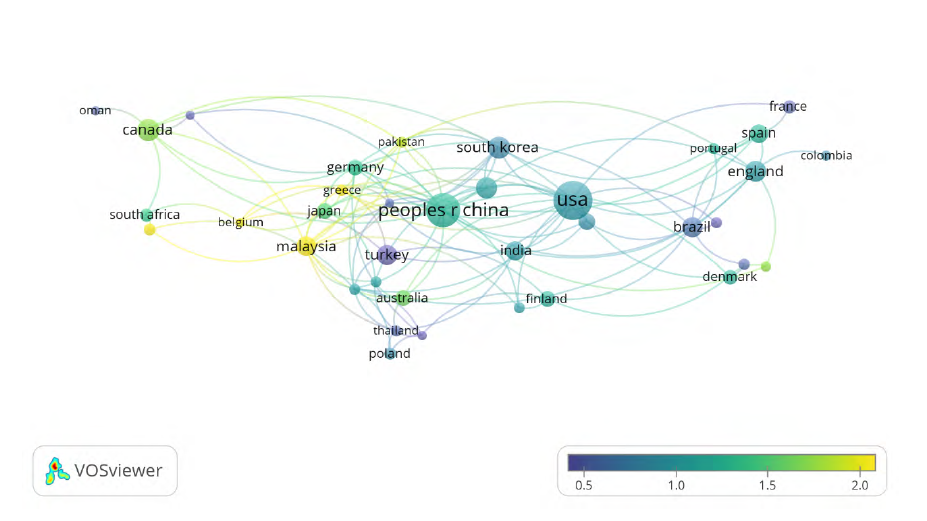
The co-authorship network was used to assess the collaboration networks between researchers in the set of publications analyzed (Figure 5). The unit of analysis was the country of affiliation of the authors. The contribution of each country to the development of the field of study was assessed taking into account the number of citations. The citation index was normalized to correct any distortion deriving from date of publishing since the papers published recently had less chance of being cited. The bubble size of each country indicates the frequency of contributions or the number of documents, while the color represents the normalized number of citations.

Collaboration network and contribution of publications assessed by co-authorship and citations.
The resulting co-authorship network comprises 37 countries with at least 5 publications each. The highest number of publications comes from the United States (121), followed by China (90), Canada (34), South Korea (33), Italy (32), and England (31). However, among the countries that stand out in terms of the number of publications, China has more publications in co-authorship with authors from other countries (higher number of connections) than the United States. The third and fourth countries with the highest number of connections are Malaysia (26) and Germany (16), respectively. Given the normalized index of citations for that group of countries, the publications from Belgium and Malaysia are the most relevant, being higher than two.
Although Malaysia is not among the countries with the highest number of publications, it stands out when the collaboration network and normalized citation index are taken into account. Although such a result does not allow a connection between the collaboration network and citation count to be directly established, both aspects are present in the publications from that country. The interest and influence of those recent publications from Malaysia may be because they consist of studies on circular economy or involve aspects related to biomethane, which are recent and significant topics for the scientific progress in the field of energy recovery from landfill gas.
Conclusions
The present study performed a bibliometric analysis aiming at identifying possible gaps and opportunities in research that, once overcome, enable the full development of energy recovery from landfill gas. The analysis showed an increase in the current scientific production with a greater proportional participation of publications from researchers affiliated with universities in developing countries. Such discovery reveals the importance of the challenges the southern hemisphere faces regarding the adequacy of municipal solid waste management.
It could also be observed that other waste management techniques are currently more broadly researched and confronted with all social, economic, and environmental consequences of adopting landfills. Consequently, the thematic evolution clearly showed the change in the research landscape, suggesting a distancing from well-established viability studies from the past (economic, social, and technical) towards a greater interest in other technologies for the transformation of waste into energy, largely founded on the conceptual framework of sustainability and circularity.
Due to that new perspective, recent studies defend replacing landfills with other techniques, despite the unexplored energy potential of existing sites, particularly based on the concepts of circularity and sustainability and on the need to improve waste management. Nonetheless, the study on landfill gas energy recovery is still a needed approach given the existing liabilities, the wide adoption of the final waste disposal in landfills, infrastructure, and limited financial capabilities of low- and medium-income countries that still need to enable the improvement of sanitary conditions.
In addition, the results presented confirm a deficiency in research on the regulatory framework pertaining to the field of study, which represents the main gap identified. With that in mind, it is relevant to reconsider the main hurdles to the development of biogas energy systems and, in particular, the importance of improving policies that promote their use. Furthermore, most studies consider landfill gas for electricity generation, with a limited recent trend of papers that assess the technological aspects of production and use of biomethane.
Using biomethane from biogas as a biofuel is a promising path towards the development of this research field. Thus, it is an interesting opportunity for future research that might focus on assessing specific sectorial issues for its production and energy use. In this sense, a more in-depth investigation in sectors such as transportation could support better and more qualified use of the resource, the development of more efficient policy structures, and, ultimately, contribute to combating climate change in the short term and improving sanitary conditions.
Acknowledgments
This study was financed in part by the Coordenação de Aperfeiçoamento de Pessoal de Nível Superior - Brasil (CAPES) - Finance Code 001.
References
-
AMINI, Hamid R.; REINHART, Debra R.; MACKIE, Kevin R. Determination of first-order landfill gas modeling parameters and uncertainties. Waste Management, S. l., v. 32, n. 2, p. 305-316, 2012. Available at: https://linkinghub.elsevier.com/retrieve/pii/S0956053X11004272
» https://linkinghub.elsevier.com/retrieve/pii/S0956053X11004272 -
ARIA, Massimo; CUCCURULLO, Corrado. bibliometrix: an R-tool for comprehensive science mapping analysis. Journal of Informetrics, S. l., v. 11, n. 4, p. 959-975, 2017. Available at: https://doi.org/10.1016/j.joi.2017.08.007
» https://doi.org/10.1016/j.joi.2017.08.007 - AYODELE, T. R.; OGUNJUYIGBE, A. S. O.; ALAO, M. A. Life cycle assessment of waste-to-energy (WtE) technologies for electricity generation using municipal solid waste in Nigeria. Applied Energy, S. l., v. 201, p. 200-218, 2017.
-
BOGNER, J. et al. Waste management. In: METZ, B. et al. (org.). Climate change 2007: mitigation. Contribution of Working Group III to the Fourth Assessment Report of the Intergovernmental Panel on Climate Change. Cambridge: Cambridge University Press, 2007. p. 587-613. Available at: https://www.ipcc.ch/site/assets/uploads/2018/02/ar4-wg3-chapter10-1.pdf
» https://www.ipcc.ch/site/assets/uploads/2018/02/ar4-wg3-chapter10-1.pdf - BOLOY, Ronney Arismel Mancebo et al. Waste-to-energy technologies towards circular economy: a systematic literature review and bibliometric analysis. Water, Air, and Soil Pollution, S. l., v. 232, n. 7, 2021.
- BOVE, R.; LUNGHI, P. Electric power generation from landfill gas using traditional and innovative technologies. Energy Conversion and Management, S. l., v. 47, n. 11-12, p. 1391-1401, 2006.
-
DHAKAL, S. et al. Emissions trends and drivers. In: SHUKLA, P. R. et al. (org.). Climate change 2022 - mitigation of climate change. Cambridge: Cambridge University Press, 2023. p. 215-294. Available at: https://www.cambridge.org/core/product/identifier/9781009157926%23c2/type/book_part
» https://www.cambridge.org/core/product/identifier/9781009157926%23c2/type/book_part - GARDNER, N.; MANLEY, B. J. W.; PEARSON, J. M. Gas emissions from landfills and their contributions to global warming. Applied Energy, S. l., v. 44, n. 2, p. 165-174, 1993.
- GUSTAFSSON, M.; ANDERBERG, S. Dimensions and characteristics of biogas policies - modelling the European policy landscape. Renewable and Sustainable Energy Reviews, S. l., v. 135, p. 1-11, 2021.
-
IEA. Outlook for biogas and biomethane: prospects for organic growth. S. l.: IEA, 2020. Available at: https://www.iea.org/reports/outlook-for-biogas-and-biomethane-prospects-for-organic-growth Accessed: 18 april 2022.
» https://www.iea.org/reports/outlook-for-biogas-and-biomethane-prospects-for-organic-growth -
IEA. Renewables 2019. Paris: IEA, 2019. Available at: https://www.iea.org/reports/renewables-2019 Accessed: 21 may 2021.
» https://www.iea.org/reports/renewables-2019 - JARAMILLO, P.; MATTHEWS, H. S. Landfill-gas-to-energy projects: analysis of net private and social benefits. Environmental Science & Technology, Washington, DC, v. 39, n. 19, p. 7365-7373, 2005.
-
JOHARI, Anwar et al. Economic and environmental benefits of landfill gas from municipal solid waste in Malaysia. Renewable and Sustainable Energy Reviews, S. l., v. 16, n. 5, p. 2907-2912, 2012. Available at: http://dx.doi.org/10.1016/j.rser.2012.02.005
» http://dx.doi.org/10.1016/j.rser.2012.02.005 -
KANDA, Wisdom et al. Policy coherence in a fragmented context: the case of biogas systems in Brazil. Energy Research & Social Science, Amsterdam, v. 87, p. 102454, 2022. Available at: https://doi.org/10.1016/j.erss.2021.102454
» https://doi.org/10.1016/j.erss.2021.102454 - KAZA, Silpa et al. What a waste 2.0: a global snapshot of solid waste management to 2050. Washington, DC: World Bank, 2018.
-
MALLEY, Christopher S. et al. A roadmap to achieve the global methane pledge. Environmental Research: Climate, S. l., v. 2, n. 1, p. 011003, 2023. Available at: https://iopscience.iop.org/article/10.1088/2752-5295/acb4b4
» https://iopscience.iop.org/article/10.1088/2752-5295/acb4b4 - MANFREDI, Simone; CHRISTENSEN, Thomas H. Environmental assessment of solid waste landfilling technologies by means of LCA-modeling. Waste Management, S. l., v. 29, n. 1, p. 32-43, 2009.
- MOREIRA, Paulo Sergio da Conceição; GUIMARÃES, André José Ribeiro; TSUNODA, Denise Fukumi. Qual ferramenta bibliométrica escolher? Um estudo comparativo entre softwares. P2P e Inovação, S. l., v. 6, p. 140-158, 2020.
-
MUKHERJEE, Debmalya et al. Guidelines for advancing theory and practice through bibliometric research. Journal of Business Research, S. l., v. 148, p. 101-115, 2022. Available at: https://doi.org/10.1016/j.jbusres.2022.04.042
» https://doi.org/10.1016/j.jbusres.2022.04.042 -
NEVZOROVA, Tatiana; KUTCHEROV, Vladimir. Barriers to the wider implementation of biogas as a source of energy: a state-of-the-art review. Energy Strategy Reviews, S. l., v. 26, p. 100414, 2019. Available at: https://linkinghub.elsevier.com/retrieve/pii/S2211467X19301075
» https://linkinghub.elsevier.com/retrieve/pii/S2211467X19301075 -
NISBET, E. G. et al. Methane mitigation: methods to reduce emissions, on the path to the Paris Agreement. Reviews of Geophysics, S. l., v. 58, n. 1, 2020. Available at: https://agupubs.onlinelibrary.wiley.com/doi/10.1029/2019RG000675
» https://agupubs.onlinelibrary.wiley.com/doi/10.1029/2019RG000675 -
PORTEOUS, A. Developments in, and environmental impacts of, electricity generation from municipal solid waste and landfill gas combustion. IEE Proceedings A: Science, Measurement and Technology, Hertford, v. 140, n. 1, p. 86, 1993. Available at: https://digital-library.theiet.org/content/journals/10.1049/ip-a-3.1993.0015
» https://digital-library.theiet.org/content/journals/10.1049/ip-a-3.1993.0015 -
RASI, S.; LÄNTELÄ, J.; RINTALA, J. Trace compounds affecting biogas energy utilisation - a review. Energy Conversion and Management, S. l., v. 52, n. 12, p. 3369-3375, 2011. Available at: http://www.sciencedirect.com/science/article/pii/S0196890411001968
» http://www.sciencedirect.com/science/article/pii/S0196890411001968 -
RIPPLE, William J. et al. World scientists’ warning of a climate emergency 2021. BioScience, S. l., v. 71, n. 9, p. 894-898, 2021. Available at: https://academic.oup.com/bioscience/article/71/9/894/6325731
» https://academic.oup.com/bioscience/article/71/9/894/6325731 -
SABOUR, Mohammad Reza; ALAM, Ehsan; HATAMI, Amir Mostafa. Global trends and status in landfilling research: a systematic analysis. Journal of Material Cycles and Waste Management, S. l., v. 22, n. 3, p. 711-723, 2020. Available at: https://doi.org/10.1007/s10163-019-00968-5
» https://doi.org/10.1007/s10163-019-00968-5 - SCARLAT, N. et al. Evaluation of energy potential of municipal solid waste from African urban areas. Renewable and Sustainable Energy Reviews, S. l., v. 50, p. 1269-1286, 2015.
-
SCHARFF, Heijo et al. The impact of landfill management approaches on methane emissions. Waste Management & Research: The Journal for a Sustainable Circular Economy, S. l., 2023. Available at: http://journals.sagepub.com/doi/10.1177/0734242X231200742
» http://journals.sagepub.com/doi/10.1177/0734242X231200742 - SCHWEIGKOFLER, M.; NIESSNER, R. Determination of siloxanes and VOC in landfill gas and sewage gas by canister sampling and GC-MS/AES analysis. Environmental Science & Technology, Washington, DC, v. 33, n. 20, p. 3680-3685, 1999.
- THEMELIS, Nickolas J.; ULLOA, Priscilla A. Methane generation in landfills. Renewable Energy, S. l., v. 32, n. 7, p. 1243-1257, 2007.
-
UNEP; ISWA. Global waste management outlook 2024: beyond an age of waste: turning rubbish into a resource. S. l.: United Nations Environment Programme, 2024. Available at: https://wedocs.unep.org/20.500.11822/44939
» https://wedocs.unep.org/20.500.11822/44939 - VAN ECK, N. J.; WALTMAN, L. VOSViewer: visualizing scientific landscapes. S. l.: s. n., 2010.
-
WILSON, David C. Learning from the past to plan for the future: an historical review of the evolution of waste and resource management 1970-2020 and reflections on priorities 2020-2030 - the perspective of an involved witness. Waste Management & Research: The Journal for a Sustainable Circular Economy, S. l., v. 41, n. 12, p. 1754-1813, 2023. Available at: http://journals.sagepub.com/doi/10.1177/0734242X231178025
» http://journals.sagepub.com/doi/10.1177/0734242X231178025 -
WILSON, David C.; FILHO, Carlos Silva; RAMOLA, Aditi. The significant potential of better waste and resource management for climate mitigation. S. l., 2023. Available at: https://waste-management-world.com/recycling/the-significant-potential-of-better-waste-and-resource-management-for-climate-mitigation/. Accessed: 23 may 2024.
» https://waste-management-world.com/recycling/the-significant-potential-of-better-waste-and-resource-management-for-climate-mitigation
The research data are available upon request only.

 Source: Created by the authors.
 Source: Created by the authors.
 Source: Created by the authors.
 Source: Created by the authors.
 Source: Created by the authors.